



Abstract
The commons are alternative social and economic practices for fostering community development and regeneration. While finance is increasingly criticized as a trigger for individualism, community currencies are one of the financial initiatives that aim to reorganize finance in the collective interest. We analyze to what extent these alternative systems allow finance to constitute common goods or ‘commons’. To this end, we investigate the commoning practices through which resources are created, distributed, and consumed in a way that promotes new collectives. We analyze the extent to which community currencies can be considered as commons. Our findings suggest that community currencies have strong collective attributes such as community building, as well as the insertion of solidarity and cooperative values in money. Finally, we inquire into the limits and ambiguities of community currencies to represent an alternative to the capitalist economy.
Introduction
In November 2016, more than a 100 civil society organizations and activists met in Brussels, Belgium, to create the European Commons Assembly (ECA). All over Europe, multiple organizations have been emerging in response to the progressive enclosure and privatization of shared resources, such as land, information, cities, and the Internet (Bollier and Helfrich, 2012; Dardot and Laval, 2014). The ECA was launched as a platform for commoners to share experiences and practices guided by democratic participation, social equity, and environmental sustainability. Its founders also aim at influencing legislation and securing recognition for commons-based alternative ways of making the economy.
Increasingly used by practitioners and social activists, the concept of commons comes with the promise of preserving and creating collective wealth (Bollier and Helfrich, 2012; Fournier, 2013; Tedmanson et al., 2015). Commons are linked to a model of collective governance outside market and state relations (Ostrom, 1990) and promote democratic alternatives aiming to re-socialize and re-politicize the economy (Dardot and Laval, 2014; De Angelis, 2007; De Angelis and Harvie, 2014). According to Linebaugh (2008), commons cannot be reduced to a shared resource but consist of activities and actions based on cooperation and solidarity, or ‘commoning’. Commoning refers to the social practices of creating and producing commons in society and communities. Following this idea, Fournier defines the commons as ‘both a mode of organising that clearly stands outside of capitalist relations and a resource subject to capitalist appropriation’ (Fournier, 2013: 438). Hence, a more radical view of the commons sees ‘commoning’ in terms of social practices that challenge capitalist models of private accumulation (Caffentzis, 2004; De Angelis, 2012; Federici, 2009). This approach emphasizes the collective use of shared resources as well as the new meanings emerging from and through such alternative forms of organizing. Commoning is thus antagonistic to capital and even aims at moving ‘beyond capital’ (De Angelis and Harvie, 2013).
Commoning has been studied in several settings, such as urban areas and cultural movements (Bollier and Helfrich, 2012; Bresnihan and Byrne, 2015). In this article, we analyze five community currency (CC) schemes as commons. In recent years, an increasing number of communities have developed complementary currencies with the objective of fostering new forms of exchanges (Blanc, 2000; Cohen, 2016; Michel and Hudon, 2015) and of contesting the official monetary system (Ahmed and Ponsot, 2015; North, 2014b). With more than 3000 CCs worldwide (Seyfang and Longhurst, 2013), these alternative forms of monetary organization are often considered vehicles of social change and acts of resistance on a micro-scale (Blanc, 2015; North, 2014a). As such, these monetary alternatives are part of a larger movement, challenging existing dominant social and economic structures (Gibson-Graham et al., 2013; Parker et al., 2014).
CCs are conceived of and issued by local nonprofits, civilian associations, businesses unions, and local governments (Blanc and Fare, 2013; Kennedy et al., 2012). While most monetary creation is nowadays ensured by debt money issued by private banks (Dodd, 2014; Ingham, 2004), these alternative currencies exist alongside their conventional counterparts, circulate within a defined geographical region or community, and arbitrate the exchange of goods and services without bearing interest (Lietaer, 2001; Safri, 2015). They encourage community-based local trading and the development of moral values for currencies (Lietaer et al., 2012), such as nonaccumulation and nonspeculation, promote local and sustainable development (Joachain and Klopfert, 2014), tackle poverty and social exclusion (Gomez and Helmsing, 2008), and build social capital (Seyfang, 2002). CCs also aim to change the capitalist nature of exchange and trade to inject more solidarity and cooperation into economic activities (Fare et al., 2015).
By exploring new ways of producing, distributing, and consuming money, CCs provide an interesting example of the commoning of finance. In this article, we analyze five community monetary systems and models: Time Dollar in the United States, Local Exchange Trading System (LETS) in the United Kingdom, Chiemgauer in Germany, Palmas in Brazil, and Trueque in Argentina. We study the extent to which these currency schemes can be considered as commons, or social systems enabling the production, use, and circulation of shared resources in communities (De Angelis and Harvie, 2014; Paranque, 2016). Our analytical framework relies on the three pillars of ‘commoning’ defined by Fournier (2013): organizing in common, organizing of the common, and organizing for the common.
Our contributions are threefold. First, we shed new light on the potential commoning process in the financial sector. CCs have a strong collective dimension such as building communities and bringing solidarity and cooperative values to exchanges between economic actors. Second, we contribute to the CC literature by providing a new understanding of these alternative monetary systems along Fournier’s three collective dimensions to determine the extent to which they can be considered as commons. Third, our analysis explores the contribution of alternative currencies as alternatives to capitalism. More precisely, we inquire into not only the potential but also the limits and ambiguities of CCs as alternatives to the capitalist economy.
Theoretical background to the commons
Commons as a concept is becoming widespread in the world of research and among civil society actors. According to David Bollier, we are witnessing the emergence of a ‘commons paradigm’ (Bollier, 2011). This refers explicitly to forms of civil society organizations enabling people to collaborate and share (Bushouse et al., 2016; Dardot and Laval, 2014; Linebaugh, 2008). This new paradigm is an alternative way of organizing economic activities collectively according to values, principles, and operating methods that differ from those applied by the market or the state (Bollier and Helfrich, 2012; De Angelis and Harvie, 2014).
The collective association of users in commons organization makes the commons different from capitalist organizations in several ways. Commons are collectively owned: the commoned resources are shared by users (De Moor, 2011). Collective ownership influences the governance and management of the organization, which relies on a more democratic and participatory form of decision-making (Nyssens and Petrella, 2015). Hence, commons organizations involve democratic mechanisms, enabling users to collectively govern and manage the organization, without making any reference to private wealth. On the contrary, capitalist organizations’ governance relies on share ownership with less democratic mechanisms at work in organizational choices. Commons organizations are also against enclosure and privatization (Bollier, 2011). In this respect, preserving and building commons can be understood as a counter-movement of the enclosure of collective resources, which is necessary for primitive and continuous capital accumulation (De Angelis and Harvie, 2014). By contrast, commons organizations aim to preserve and extend access to shared resources (Coriat, 2015). That access does not only rely on prized and market-based mechanisms, but it also includes mechanisms of mutuality and reciprocity (Servet, 2013). Therefore, commons organizations promote inclusivity of access and aim to build new social ties. In this sense, commons are a process of social production as explained by Linebaugh (2008): the commons is an activity […] It might be better to keep the word as a verb, an activity, rather than a noun, a substantive. (p. 279)
This process of commoning has been further developed by Fournier (2013), who developed three conceptual dimensions of commoning: organizing in common, of the common, and for the common. In this section, we present these dimensions, which will serve as theoretical framework for analyzing CCs.
Organizing in common
The creation of commons first requires collective action and coordination for the management of shared resources. ‘Organizing in common’ refers to a mode of social organization in which community members co-produce rules and share responsibility for allocating shared resources. Organizing in common is present in a wide diversity of self-managed organizations, where users co-produce a common resource and govern it collectively (Bollier and Helfrich, 2012; Dardot and Laval, 2014; Lohmann, 2016).
Ostrom’s (1990) seminal work Governing the Commons has been of crucial importance for understanding the collective organization of commons. She showed how communities and users of natural resources create their own institutional arrangements for the effective management of these shared resources over time. Users collectively produce norms and rules defining the access conditions, operational procedures, withdrawal limits, and sanctions concerning common resources. The co-production of institutions is achieved by the users themselves in collective-choice arenas and provides solutions, ensuring the renewal of the resource. Rules are adapted to the local context and users’ needs and also take into account the intrinsic characteristics of the resources (Ostrom, 1990).
Commoning through organizing in common is present in community enterprises or communities ‘acting corporately as both entrepreneur and enterprise in pursuit of the common good’ (Peredo and Chrisman, 2006: 310). Community enterprises are established by and in deprived communities to create social and economic development opportunities (Haugh, 2007). The same collective dimension is also present in social and solidarity economy organizations in which collectives of workers and citizens shape entrepreneurial activities in cooperatives, nonprofits, and mutual funds (Cheney et al., 2014; Dey, 2016; Huybrechts and Mertens, 2014; Périlleux and Nyssens, 2017). These organizations also pursue objectives of social and economic emancipation to the extent that they aim to achieve greater democracy in economic activities and working places (Laville, 2010).
Organizing of the common
The second dimension of commoning is linked to the creation of communities (Fournier, 2013). ‘Organizing of the common’ suggests the establishment of communities throughout the collective action. The process of collectively managing, producing, distributing, and consuming engenders new communities and solidarities at local level (Dey, 2016). Indeed, sharing creates new forms of sociability and social exchange mediated not by the market and state but by solidarity and reciprocity (De Angelis, 2007). Commons organizations’ action for social change also develops new forms of social relationships and sociality (Hjorth, 2013). Hence, commons appear as a social process of producing collectives and communities (Caffentzis, 2004; De Angelis and Harvie, 2014). Creation of communities is often driven by the political principle of reclaiming citizens’ collective power by institutionalizing social and cooperative practices (Dardot and Laval, 2014).
In consequence, looking at the collective dimensions of commons also implies considering the communities (Argandoña, 1998; Melé, 2012; Paranque, 2016) and political projects behind them (Dey, 2016). Commons organizations, like other organizations, are therefore ‘communit[ies]of persons’ (Melé, 2012) in which people meet to achieve common objectives. These objectives are often driven by a teleological ethic to ‘emancipate [people] not just from poverty and shrinking opportunities, but from governance systems that do not allow them meaningful voice and responsibility’ (Bollier and Helfrich, 2012). In this regard, the objective of serving the common good (Frémeaux and Michelson, 2016) of communities and society is present in commons organizations. This common good principle can be defined as the beneficial interest of most people, an interest collectively expressed through participation and democratic practices. The common good is, thus, considered as the philosophical principle that ‘entails cooperation to promote conditions which enhance the opportunity for the human flourishing of all people within a community’ (Melé, 2009).
Organizing for the common
‘Organizing for the common’ refers to the collective use and consumption of what is managed and allocated in common. The shared resources are therefore not privately appropriated by individuals but consumed collectively. For example, vegetables produced in collective gardens can be cooked communally and offered to members involved in managing the shared resources. The same applies to urban commons that are enjoyed collectively by city dwellers.
This third dimension of organizing for the commons differs from the notion of commons originally put forward by Ostrom, who refers to commons’ users as appropriators that collectively manage shared resources to preserve and renew them over time, but that own them privately and do not share them with other members of the community. This conception of the commons as being limited to collective organizing has been criticized by several authors (Caffentzis, 2004; De Angelis and Harvie, 2014; Fournier, 2013). Fournier argues that commoning ‘can go well beyond the collective process of resource allocation and preservation, as suggested by Ostrom’s work. It can also involve collective use and collective production’ (Fournier, 2013: 444).
Services exchanged thanks to CCs sometimes enable the production of new skills among the exchangers. Hence, skills acquired in and around the collective organization or resource can be used to serve the community. Sometimes, they are not restricted to members only and can be opened to outsiders. For example, social centers and city centers offer services to the community, such as a leisure facility and a concert. The collective use is therefore not based on market values and exchange but rather on sharing and gifting. In addition, the notion of serving the community and the general public can be seen in the positive externalities of commons organizations. Nyssens and Petrella (2015) argue that commons organizations are similar to solidarity economy organizations since they provide goods and services that can benefit not only the users but also society as a whole, thereby having positive effects on social cohesion and local development. These collective benefits are not externalities stricto sensu, as they are explicitly claimed and promoted by the commons organizations.
Complementary currencies as commons
To explore whether CCs constitute commons, we conceptualize money as a socio-economic institution intermediating exchanges between actors in a defined community (cf. Aglietta and Orléan, 1998). This institution is a social phenomenon based on a community of users that employ this common symbol and unit of account to exchange goods and services (Dodd, 2014; Ingham, 2004).
Complementary currencies are good examples of grassroots alternatives to the official monetary system since they aim not only to foster ethics in finance (Blanc, 2015; Kennedy et al., 2012) but also to change the market orientation in trade and exchange (Ahmed and Ponsot, 2015; Blanc, 2000; Dittmer, 2013) and to promote sustainable development (Michel and Hudon, 2015; Seyfang and Longhurst, 2013). These monetary schemes are instruments for community micro-policies that pursue three principal objectives. First, they localize economic activities by restricting monetary transactions to a defined space or community (Gelleri, 2009), thus possibly generating economic and environmental benefits. Second, they foster interactions by using specific financial mechanisms that facilitate monetary access and increase spending speed (Gesell, 1958). Third, they change the nature of exchange by fostering a cooperative and reciprocity-based dynamic that diverts transactions away from an instrumental market-based transfer (Fare et al., 2015).
CCs encourage cooperation and solidarity between exchangers. According to Blanc (2015), the shared characteristic of CCs is that they are associative by nature: nonprofits are constituted around a vision of what should constitute a good economy, good finance and a good currency; they are the collective construct of persons involved voluntarily in [a] project that is deemed to be in the collective—and even general—interest. (p. 2, Translated by the authors)
This statement was made in reference to French CCs but can be applied to CCs more generally. This type of approach to CCs makes them potentially good example of commoning practices.
Our analysis of CCs is organized along the three dimensions of the commons delineated above. First, we examine whether the organization issuing the currency has collective governance and management mechanisms for users to co-create the rules linked to the shared resource (organizing in common). Second, we investigate the extent to which CCs enable the creation and affirmation of communities, and the development of a financial system distant from market mechanisms and promoting social change (organizing of the common). Third, we study whether CCs are used in common, meaning that they enable the collective consumption of goods and services, and whether they have collective outcomes (organizing for common) (Fournier, 2013).
We examine five CCs in a variety of settings: Time Dollar in the United States, LETS in the United Kingdom, the Chiemgauer in Germany, the Palmas in Brazil, and the Trueque in Argentina. We have based our selection on the classification used by Seyfang and Longhurst (2013) to make their review of CCs. Seyfang and Longhurst (2013) suggest that there are four types of CCs: credit services, barter markets, local currencies, and mutual exchange. We have taken one example of each category, the one which is the most quoted one according to our review of literature. The only exception is the category of local currencies since we think that this system is currently re-emerging in different parts of the world, for instance, with the transition movement or the different initiatives related to local development (North, 2010). Table 1 in Appendix 1 resumes some of the main characteristics of the CCs analyzed.
All these CC systems are considered as references in the CC literature (Kennedy et al., 2012; Seyfang and Longhurst, 2013). Most of them are seen as successful, and several have given rise to new models of complementary currencies, such as the Chiemgauer and the Palmas, at the origin of the Regiogeld model in Germany (Thiel, 2011), and the community bank currencies in Brazil (Melo and Braz, 2013). These cases are also the best known and most extensively documented. Moreover, in some cases we had to refer not to a single currency experience but to a broader currency scheme and model. Some of the references on CCs are fairly general, and empirical data were difficult to find. When available, those data were often focused on multiple occurrences of a currency scheme and model. The documentation concentrated on multiple experiences because a single experience would not provide adequate information. This is notably the case for Time Dollars in the United States, LETS in the United Kingdom, and Argentinian Trueque.
Our analysis relies mainly on secondary data. The scholar/practitioner journal International Journal on Community Currency Research was an important source of information for our analysis. Systematic and conceptual articles, as well as books on the topic, were also consulted. In addition, the authors have extensive experience of complementary currencies, having been involved in several practitioners’ projects, and also conducted field research to study CCs in developed and developing countries.
Time Dollars in the United States
Time Dollar currencies emerged in 1986 in the United States, where they were implemented in poor, marginalized areas to rebuild social ties between community members (Dodd, 2014; Seyfang, 2002). They reward voluntary activities performed within neighborhoods and communities in order to alleviate social exclusion and strengthen caring between community members. In this way, Time Dollars reward community members for the time given to the community through activities such as assisting in a residential home, providing transportation, gardening, and dog walking. Participants earn monetary units in the shape of time credits for the hours spent on social work.
Time Dollars can be implemented by community-based organizations and local public governments. Those implemented by community-based organizations are considered as ‘Neighbor-To-Neighbor Time Dollar Exchanges’ (Gray, 2003) based on reciprocity and mutual help. Those implemented by local public governments, known as ‘Specialized Time Dollar Exchanges’, aim to achieve specific purposes linked to the provision of public services. From this perspective, Specialized Time Dollars rely on the idea of co-production according to which social beneficiaries must not be ‘the passive recipients of [social] services’ (Seyfang, 2002). This idea of co-production is based not only on an approach that involves stakeholders in the provision of services but also on removing public government from the provision of some public services. Hence, this CC partially involves users in the definition of rules and production of the currency.
Time Dollars reinforce and produce communities as they aim to build social infrastructure. One of their key objectives is to enhance trust and caring in communities and also reward civic engagement and volunteering (Gray, 2003). The purpose of this CC is not to create an alternative monetary system. As argued by the initiator of the Time Dollar movement, Edgar Cahn, Time dollars ‘are designed to rebuild a fundamentally different economy, the economy of home, family, neighborhood and community. And there is nothing alternative about home and family and neighborhood’ (Cahn, 2001: 2). In accordance with this statement, Time Dollars should mediate social bonds and cohesion without any pretense of changing economic activities. Rather, this CC promotes tradition in family and neighborhood and does not aim to produce commodities for the market or create another (more socialized and socially regulated) market. Hence, the common in this CC lies in strengthening communities; the aim is not to change economic relationships and the (capitalist) economic order. In this respect, this CC differs from the other currencies we analyze, which are part of a broader reflection on the role of money and economic relationships.
Most of the services provided and exchanged through Times Dollars are privately consumed and used. The monetary units are not therefore consumed jointly. However, some services are enabled by the currency, which has positive impacts and externalities on communities. Specialized Time Dollars affect whole communities, for example, by enabling peer-monitoring programs in education, or care for children and old people (Gray, 2003). This favors the promotion of community self-help through mutual volunteering (Seyfang, 2002), which contributes to build social capital.
LETS in the United Kingdom
LETS are mutual exchange systems that operate as a free credit union between their members (Biggart and Delbridge, 2004). Members exchange goods, while services are measured by an internal accounting unit (generally time) and recorded in a central structure. For example, members can exchange services such as an English or piano lesson, bike repair, handiwork, or goods like second-hand furniture and clothes, or homemade food. Created in 1983 in Canada, LETS were originally developed by Michael Linton as a system to exchange goods and services in a context of local economic crisis. People still had the ability to produce and consumption needs to satisfy, but the money was lacking to bring producers and consumers into direct contact. Therefore, LETS appeared as a substitute for coordinating socio-economic actors addressing economic needs. The LETS currency model has spread to many countries. It was particularly prolific in the United Kingdom in the late 1980s and 1990s. When participants join a LETS, they indicate in a register the goods and services they can offer. Money is created during the exchange: the units of time spent are credited to the person providing a service, while the account of the member who received the service is debited by the same amount. The total amount of trade is then equal to zero.
LETS are organized in common, as they are managed by nonprofit organizations. These currency systems are implemented by groups of citizens who gather and collectively set up the functioning rules of the CC. However, as mentioned by Seyfang (2002), ‘[m]ost LETS are set up by individuals rather than organizations, are unfunded, and are run on a voluntary basis by community activists’ (p. 3). Therefore, leadership is of key importance in these systems, which rely heavily on voluntary work for daily management. Some local public authorities are also involved in setting up and running LETS in the United Kingdom, using them as tools for anti-poverty and economic development policies. Although these systems have a strong nonprofit and social dimension, some organizing principles are decided individually. For example, the value of some goods and hours exchanged is not decided collectively but left in the hands of the exchangers. There is a certain ‘laissez-faire system of individuals negotiating prices on LETS’ in the United Kingdom (Seyfang, 2002: 4), which reflects individual preferences more than collective decisions. One consequence of this laissez-faire can be to reproduce the valuation of work present in official currencies. Hence, 1 hour of a doctor’s time may not equal an hour of gardener’s or baby-sitter’s time. Hence, LETS might not promote a more equal distribution of resources among exchangers.
Several studies show that LETS foster the creation of communities through expending social capital and building networks of relationships (Seyfang, 2002; Williams et al., 2001a). As argued by Ingham (2004), LETS are as much concerned with the intentional creation of co-operative behaviour and communal reciprocity as they are with the producing economic welfare. […] it is clear that LETS can help to combat economic disadvantage and foster social solidarity. (p. 185)
Poverty can be alleviated by enabling the unemployed and domestic workers to gain access to work and credit. Indeed, ‘LETS act as bridges into work by both improving employability and providing a seedbed for the development of self-employed business ventures’ (Williams et al., 2001a: 126). The common created in these systems is therefore both collective, through community-building rationales, and individual from an employment perspective.
Services and goods exchanged in LETS are used and consumed privately. Nevertheless, the exchange of services enables the transmission of knowledge and disseminates expertise that is consequently used jointly by the users of the exchange. For example, bike repairers and handymen may teach people how to repair, which allows exchangers to pass on their knowledge. The currency unit is not collectively used but enables the joint usage of knowledge. Moreover, LETS functions on a voluntary basis, and volunteers managing the systems can be rewarded in LETS units.
Chiemgauer in Germany
The Chiemgauer is a local currency that acts as legal tender in the Chiemgau region of Bavaria, Germany. It aims to support the local economy by concentrating purchasing power within a network of local firms (Kennedy et al., 2012). Founded in 2003, the currency is backed by the euro and can be spent in 519 businesses. According to Blanc and Fare (2016), these businesses do not have to sign a charter or fulfill selection criteria to enter the system. However, they meet a dimension of affirming territorial self-identity ‘seated on a communal representation of what this identity is’ (Blanc and Fare, 2016: 306)—in this case supporting the local economy and culture.
The Chiemgauer was developed through a participatory process. It started out as a school project between students who had begun pondering the role of money in society. The project quickly moved beyond the school, and community members were consulted for developing it in the community (Gelleri, 2009). The community origins of the currencies are present in the governance mechanisms of the Chiemgauer, which is managed by a nonprofit organization relying heavily on volunteers. As mentioned by one of its founders, ‘[i]t’s important to understand that the community decides all rules of the Chiemgauer. It’s a basic democratic institution. If a rule isn’t good we change it’ (Gelleri, 2009: 70). Hence, the organization of the currency relies on a voluntary organization and nonprofit governance involving several local stakeholders.
In April 2017, 999,809 Chiemgauers were circulating. The CC could be acquired in 32 participating organizations partnering with and acting as branches for the Chiemgauer association. When a Chiemgauer’s user converts his or her euros into local currency, 3% of the amount exchanged is given as a donation to the voluntary organization of his or her choice (Gelleri, 2009). As such, from 2003 to 2017, 531,736 Chiemgauers were donated to 270 local nonprofits by 3,358 CC users. A singularity of this currency is that it uses the demurrage mechanism, which induces a depreciation of its nominal value as compensation for nonutilization of the monetary resource (Gesell, 1958). This financial concept, which emerged during the Great Depression, aims to prevent capital retention and encourage monetary injection into the economy. The Chiemgauer has a demurrage fee of 2% per quarter. The success of Chiemgauer inspired the dissemination of similar currencies, also known as Regiogeld, in 30 areas of Germany (Thiel, 2011).
The currency contributes to the organization of a community, which is based on territorial affirmation of exchanges and sustainable consumption. The use of the currency by consumers conveys a message of economic localism to businesses and a preference for the territory (Gelleri, 2009). As such, the currency aims to foster sustainable development by creating a more resilient community, especially through developing short supply chains and local networks of entrepreneurs (Thiel, 2011). In addition, although the Chiemgauer maintains strong links with the market economy, it is also part of a reflection about the role of interest and accumulation, mainly thanks to the demurrage mechanism.
The goods and services bought by the currency are privately consumed: there is no collective use of currency units. Nevertheless, 3% of the amount exchanged from euros to Chiemgauer is given to nonprofit organizations. This donation is used collectively: for example, it can allow nonprofits to acquire sporting and cultural equipment. Therefore, even if the currency units are not used collectively, they enable the creation of resources that are collectively shared by community members affiliated to nonprofits present in the area.
Palmas in Brazil
The Palmas is a local currency used in the territory of Conjunto Palmeiras on the outskirts of Fortaleza in North Eastern Brazil. It is issued by Banco Palmas, a self-managed community bank created in 1998 by community social actors with the objective of generating employment and income at community level. Banco Palmas provides microcredits to enhance economic production and issues the Palmas currency to provide additional liquidity and foster consumption within the community. Both these financial services aim to support production and consumption within the neighborhood with the objective of consolidating economic activities. The local currency also aims to encourage reflection about the role of money in the economy and financial flows in territorial development (França Filho et al., 2012).
Palmas appeared in 2002, after an initial local experiment with barter market currencies, and subsequently expanded to the whole area. It is issued through microcredits for emergency consumption, payment of Banco Palmas employees, and conversion from the Brazilian national currency to Palmas. The Palmas comprises several banknotes that are backed by the national currency and accepted by many local businesses for payments. Banco Palmas also established a local credit card to facilitate local payments. And, with the Palmas Institute (a nested organization), it recently developed the E-dinheiro, a mobile complementary currency for local payments.
When the Palmas was first issued in 2002, the rules governing it were discussed collectively in community assemblies. This was also the case for the nonprofit organization managing and issuing the currency, which is a self-managed organization (França Filho et al., 2012). Indeed, the governance of Banco Palmas relies on several community participation arenas that enable community members to participate in defining different organizational strategies (Hudon and Meyer, 2016). In addition, the Palmas currency aims at creating new communities by giving new meanings to trade and exchanges (França Filho et al., 2012). Banco Palmas is a solidarity economy organization willing to promote cooperation and solidarity between community members and businesses. As argued by Fare et al. (2015) [t]he use of a specific currency as an agreement for the exchange and the redefinition of the status of ‘exchangers’ determine new social ties. By the combination of these local relations, [Banco Palmas] tends to create a multidimensional trust embedded in the territory perspective. (p. 12)
Similar to Chiemgauer, Palmas currency units are consumed privately by community users. The products bought from local businesses are not jointly used. However, the local currency conveys a strong vision of endogenous development, according to which economic development occurs when economic activities are coordinated (Melo and Braz, 2013). Organizers of the Palmas currency, such as some other CC leaders, postulate that communities would be impoverished if their financial resources were to exit the territory without being replaced by the same amount of investment (Ahmed and Ponsot, 2015; Blanc, 2015; Melo and Braz, 2013). The retention of resources would stimulate internal development and create employment for community members. Nevertheless, the Palmas does not reevaluate the prices of products or alter the valuation of work. Palmas is totally equivalent to the national currency, although some discounts may be possible when using it for payment.
The issuance of Palmas by a community organization in Brazil attracted the attention of the national authorities. Banco Palmas’ CEO was sued for infringing the central bank’s monopoly on currency issuance. However, the judge in charge of the case ruled that the Palmas did not affect the functioning of the Brazilian national currency and, thus, could continue to exist. He also explained that if the state was unable to guarantee the financial and monetary inclusion of poor populations, it should not prevent communities from developing their own solutions. As a result, Banco Palmas is considered as a national exemplar. It inspired the community development bank model that has been disseminated nationwide through intermediary organizations. In 2013, 103 community banks were active throughout the country, and most of them had a CC similar to Palmas (Melo and Braz, 2013).
Trueque in Argentina
Particularly prominent in Latin America, barter market currencies are used as vouchers in a ‘selective spatial closure’ (Gomez and Helmsing, 2008). In these small markets, users bring self-produced goods and services, and receive the equivalent value in barter market currency. Called Trueque, the most significant barter market systems were developed in Argentina during the late 1990s and early 2000s. The first Argentinian Trueque started in 1995 (Gomez and Helmsing, 2008) at a neighbors’ meeting organized to exchange goods produced domestically in the city of Bernal in the south of Buenos Aires. These goods are, for example, home-made foods and toiletries, handicrafts, vegetables from backyards, and second-hand products (Gomez and Helmsing, 2008). The currency was first set up by people involved in a nongovernmental environmental organization. Discussions about money and the market economy preceded the transaction in Trueque within the barter market (Saiag, 2013).
The Argentinian Trueque expanded rapidly after the 2001 Argentinian financial crisis—with more than 5000 clubes de Trueque nationwide and over 2.5 million members according to estimates (Gomez and Helmsing, 2008). They function as follows: the participants arrive in an enclosed market space with a good or service to ‘sell’ and receive an amount of CC corresponding to the value of what they propose. Once in the system, participants have to regularly bring goods and services to acquire new currency units and continue trading. The prices are established by traders. Although they are not fixed in advance and do not rely on capitalist markets, they may be comparable to prices in national currencies when CC users employ peso prices as a measure. Consequently, also Trueque might not substantially alter the (unequal) valuation of work.
The currency allows the consumption of goods and services for private use and also offers a supplementary outlet for formal and informal businesses. Trueque enable disadvantaged groups in the labor market, such as the unemployed and housekeepers, to ‘start deploying [skills and competencies] outside the household, also engaging household members who previously were not economically active’ (Gomez and Helmsing, 2008: 2497). Household members and unemployed or partially employed people use the Trueque barter market as an outlet for domestic production. In other words, that market is an opportunity to exchange self-made goods and services for other products in the context of a severe economic crisis. The CC enables them to engage in economic production and trade in an alternative monetary device while the national currency is defaulting. As a result, the Trueque fosters the re-deployment of skills and competencies that are not valued in a traditional market, thus promoting ‘social inclusion of households that otherwise would become trapped in “new poverty”’ (Gomez and Helmsing, 2008: 2506).
Argentinian Trueque are governed and managed by civil society independently from state and private banks. Because of its huge success in the early 2000s, the Trueque were concentrated in three important networks. Saiag (2013, 2016) accurately represented the tensions regarding the monetary governance and institutional architecture of these networks. On one hand, one network promoted a federalist model for decentralized monetary issuance by each Trueque barter market but maintained the same unit of account between markets. The arguments for monetary decentralization were the refusal to submit to a central authority, as well as the heterogeneity of monetary needs in Argentina. On the other hand, two networks claimed independent centralized monetary issuance. Centralization was motivated by the desire to control inflation and guarantee the same unit of account. The Trueque networks returned to a more local system of governance after a number of users began to fall significantly in 2003 (Gomez and Helmsing, 2008).
This CC enables the creation of new communities. Nevertheless, based on the multiplicity of users, there are some divergences over what type of communities the Trueque create. Although the Trueque enable the valuation of competencies not appraised by the capitalist system, the ideological dimension of this monetary alternative is not clear. The Trueque federalist network was intended to function more democratically and had ambitions of social change and transformation, while these dimensions were less present in the centralized networks (Saiag, 2013). As argued by Gomez and Wit (2015), Among the leaders of the [Trueque currency], some sustained a clear anti-state and anti-capitalist discourse signaling a desire for a more communitarian type of economic system. Other leaders adopted a pragmatic position and portrayed the scheme as an anti-crisis device. (p. 3)
Trueque participants also used the CC to complement their low incomes in order to respond directly to economic needs and acquire goods and services (Gomez and Helmsing, 2008). Hence, for a large number of Trueque users, the currency was seen as a way to cushion a crisis situation, not as an alternative to capitalism.
Discussion
Our analysis shows that CCs share several features of the commons. We found some similarities in the CC-issuing organizations that are nonprofits and social enterprises, and include collective decision-making mechanisms. These mechanisms enable the co-production of rules for the production and consumption of CCs. These currencies enable the creation of new communities based on shared values for community development and social cohesion building; they also provide poverty alleviating alternatives in the case of LETS, Palmas, and Trueque. Most of these CCs aim to create an alternative monetary system to market-based relationships fostering cooperation among local actors. Finally, we learnt that CCs are rarely consumed collectively, even though they might have positive externalities on community development and building social ties.
CC as examples of commoning practices?
CCs fulfill the first dimension of commoning since the organizations that issue them are organized in common. The five CCs we studied are good examples of collective governance or management: members are often active in management and general governance and are involved in decision-making processes. This is the case for the Palmas created in a local public sphere and the Chiemgauer, governed by a nonprofit, and managed by volunteers. Moreover, most of these organizations share similar governance features with social and solidarity economy organizations, which have a very participative governance structure (Cornée and Szafarz, 2014; Dacin et al., 2011; Defourny and Nyssens, 2010; Huybrechts and Mertens, 2014; Meira, 2014). However, it is well known that self-managed nonprofit and solidarity economy organizations face several challenges to achieve continuous participation by community members (Leca et al., 2014; Paranque and Willmott, 2014; Somerville and McElwee, 2011). These difficulties are also present in CCs.
Setting the boundaries of CCs is important for their functioning: the organization regulating the money supply may exclude someone from having access to and using CCs. Such boundaries can be based on a geographical area, whether a temporary market for Trueque or a community for Time Bank, Palmas, and Chiemgauer. In addition, typical exclusion mechanisms are the ones of value affirmation and social demarcation. For example, several CCs require formal or informal affiliation to certain values, such as cooperation and sustainability (Blanc and Fare, 2016). This affiliation is formal in the case of businesses that sign a charter to be part of a CC network and exchange the currency, and informal for citizens using the CC without signing any formal document. This formal or informal exclusion, based on values, enables the construction of a common identity (Williams et al., 2001b) between CC users. Users can feel that they belong to the same system, and therefore, acknowledge that they take part in a social group that promotes similar economic, social, and even political values.
As a result, CCs are a form of organizing of the common. The use of CCs produces and strengthens communities. A collective belonging and identity is created by these monetary institutions (Fare et al., 2015). CCs also give other meanings to community members’ exchanges linked to solidarity, independence, and social cohesion (Blanc, 2015). This collective identity stands outside pure capitalist relations, and the financial resource is less subject to private accumulation and appropriation. Indeed, governed by civil society organizations, CCs do not pursue economic accumulation but foster socio-economic or environmental progress (Michel and Hudon, 2015).
A citizen claim on money
Official monetary systems are increasingly criticized on the grounds that they increase economic and social disparities (Daly and Farley, 2011) and lead to unsustainable consumption patterns (Seyfang and Longhurst, 2013). Any monetary system requires and creates a community (Servet, 2013). The main differences between the communities created by CCs and official currencies lie in the values promoted by these systems and in their governance. Hence, CCs represent a citizen claim on money. The touchstone of CCs is that no one should be excluded — particularly persons and populations who are traditionally excluded from monetary systems based on market relationships—and that collaboration between stakeholders will lead to a better, more sustainable society (Melo and Braz, 2013; Seyfang, 2002; Seyfang and Longhurst, 2013). These socio-economic practices create new forms of monetary organization, collectively shaped and promoting both individual and collective interests. They constitute collective, voluntary organizations that co-produce and manage a shared resource. This objective tends to change the nature of exchange and the notion of economic community by emphasizing on cooperation and responsible user behavior (Blanc, 2015). In this respect, CCs are far removed from the neutrality and quantitative measurement requirements of official currencies (Dodd, 2014).
CCs have created new financial systems for exchanging resources, thereby establishing economic communities. They demonstrate that civil society is able to create alternative economies to embed finance in the social and cultural codes of each community (Healy, 2009). CCs’ users are linked to a broader financial system transcending money in itself. According to Servet (2013), money cannot be reduced to a sum of transactions, but trust in the collective monetary system requires the presence—conscious or unconscious—of a third entity represented by all community members and organizations emanating from it. In other words, there is an implicitly transcendent collective authority—a common belonging. This collective authority, corresponding to the organizing of the common, is different if the currency is issued by financial markets, a political authority, or civil society. Commoning empowers citizens to design their own financial community, which answers to concrete necessities and fulfills the desire to create or preserve their common wealth.
Alternative to capitalism?
We have seen that CCs foster new forms of trade and exchange based not only on market values but also on cooperation and reciprocity. CCs fulfill two commoning dimensions as defined by Fournier (2013) and are a certain form of ‘non-capitalist practice, that is, as a practice enabling social relations and forms of life that might break our dependence on capitalist market relations’ (p. 450). Several CCs emerged for the purpose of engaging in a more critical relationship with traditional currencies (North, 2010) and also as a result of power issues with central and private banks. Nevertheless, some CCs emerged or expanded during economy crises of the capitalist system. One germane question, therefore, is whether CCs are a potential alternative or simply palliatives used in times of difficulties.
Ambiguities within the capitalist system highlight the fact that CCs might encourage the reproduction of capitalism, instead of changing it. There is, indeed, a risk that these alternative monetary arrangements are co-opted by official currencies and the capitalist system, or being tolerated as remedy for capitalism’s failures. For example, CCs such as LETS, Palmas, and Trueque—even though they convey a message of social change—address structural shortcomings of capitalism such as endemic poverty and economic crises. Hence, these CCs could inhibit market and state actors from changing their functioning to reduce these problems, paradoxically enabling structural socio-economic exclusion to persist. Similarly, some CCs may represent forms of ‘domesticated monetary protests’. Currencies such as Chiemgauer and Time Banks do not call for systemic change and therefore constitute community preservation tools that do not threaten the monetary order. Consequently, these protests are tolerated to a certain extent in their minor form: several central banks accept their existence so long as they are not too big and do not challenge the monetary order. The inclusion and respect of CCs by monetary authorities could potentially reinforce the financial system (Boltanski and Chiapello, 1999). These commons CCs may echo De Angelis’ (2012) argument that ‘capital needs the commons, or at least domesticated versions of them’ (p. 185).
Extending this argument, some CCs can reinforce capitalism, as is the case with Time Banks. Indeed, the founder of this currency mentioned that Time Banks are part of the ‘core economy’ which functions on different principles of production and distribution and it supplies the substratum on which the market economy is built in much the same way that both the Market and the Core Economy are built upon the ‘services’ supplied by the economy of nature that ecological economists have analyzed. (Cahn, 2001: 2)
That statement echoes De Angelis’ argument (2012) that the capitalist system builds on commons (i.e. local systems on reciprocity) to extend the labor force market. In a similar vein, governments can use CCs to delegate the provision of public services to civil society, a typical policy recommendation by neoliberal advocates.
In addition, some currencies ‘tend to reproduce the pattern of inequality of the social structure in which they are located’ (Ingham, 2004: 186). This implies that CCs might not guarantee more equal distribution of resources within the community. This is, for example, the case of some time-based currencies that value labor in the same way as official currencies do: one doctor-hour may not be equal to one babysitter-hour. Likewise, local currencies such as the Chiemgauer and Palmas use the same price patterns as official currencies. Although businesses may apply a discount rate when paying in CC, this is not systematic and the price still depends on market mechanisms. Moreover, CCs also reflect and reproduce society’s prevailing gender division of labor. With the Trueque and LETS, women may offer domestic services, while men are more likely to offer construction and maintenance services. All these arguments show the limits of CCs in building an alternative to capitalism, or even that they do not constitute one. There is an ongoing debate about whether these alternative currencies engage in deep radical change. From a more critical stance, CCs may appear to some scholars as ‘decaf resistance’ (Contu, 2008) in which people feel that they are resisting the marketization of money, while not bearing the cost of radically changing their consumption habits and no longer resorting to official currencies.
Conclusion
Reorganizing finance in the common interest is the challenge taken up by CCs. In this article, we analyzed five CC systems focusing on the extent to which they can be considered as commoning practices or forms of organization that enable the creation of commons. Hence, by studying the commoning dimensions of CCs, we aimed to determine whether they are commons in the financial system. Our results suggest that the currencies we studied fulfill the first dimension of commoning (Fournier, 2013), that is, the organization in common, through participatory processes similar to those of social and solidarity economy organizations. Similarly, these monetary systems follow the commoning mechanism of organizing of the common, since they produce and generate new communities and social cohesion based on values, such as reciprocity and responsibility. Nevertheless, CCs do rarely match the last dimension of commoning, organizing for the common, which refers to the collective use and consumption of shared resources. Although the monetary institution is shared by and jointly benefits all CC users, the monetary units—the amounts exchanged—enable the acquisition of goods and services that are privately used.
This analysis leads us to an important dimension of the commons, namely, the political project and teleological dimension of collective action. The decentralized issuance of money by grassroots organizations stems from a failure by the market and/or the state; it represents a clear desire by civil society to embed money in communities. As such, these systems reflect the plurality of exchange logics. By mixing the dynamics of market exchange, redistribution, and reciprocity, CCs provide a medium of exchange for a different type of wealth creation, one that is related not only to the market but also to other social and economic principles. These community systems demonstrate that finance is not restricted to for-profit transactions and individual material interests. In the case of CCs, finance can also restore reciprocity as a driving force for collective action, leading to the further development of communities and human beings.
Footnotes
Appendix 1
Main characteristics of the complementary currencies analyzed.
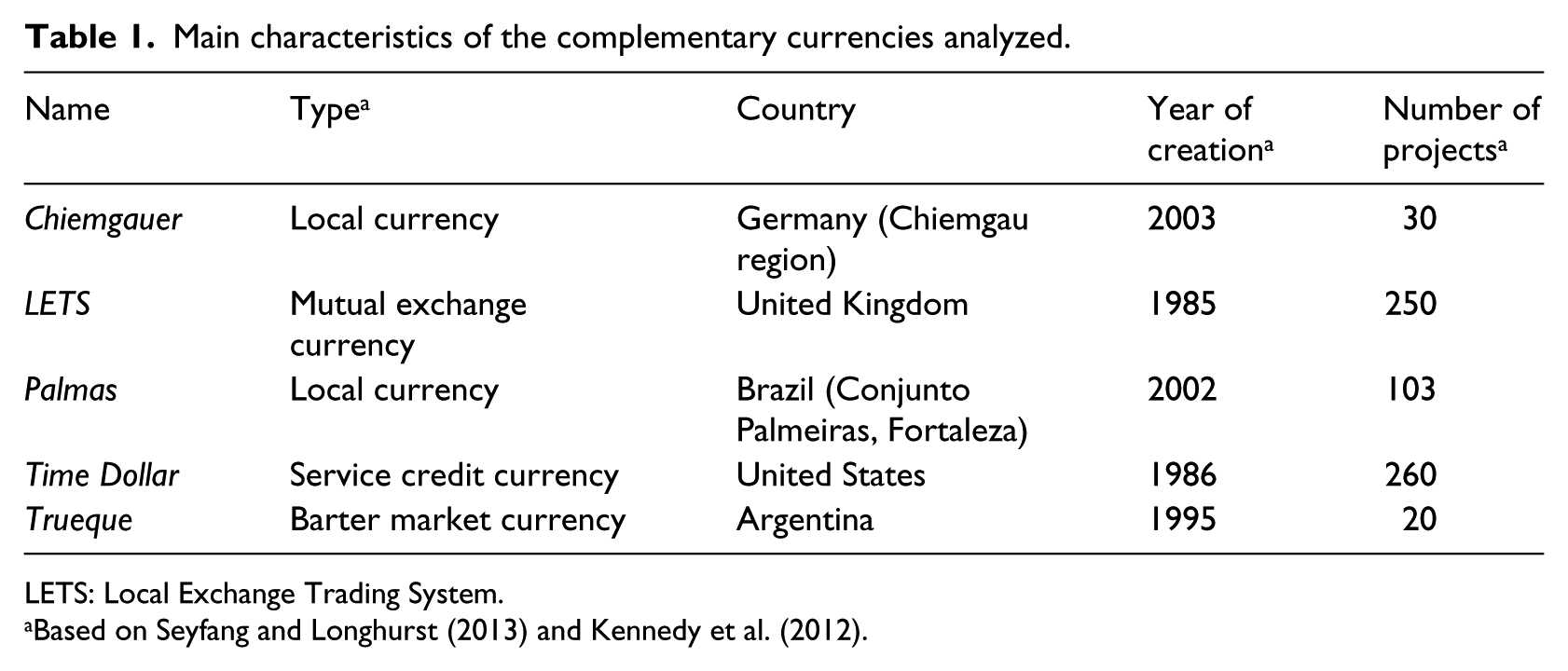
| Name | Type a | Country | Year of creation a | Number of projects a |
|---|---|---|---|---|
| Chiemgauer | Local currency | Germany (Chiemgau region) | 2003 | 30 |
| LETS | Mutual exchange currency | United Kingdom | 1985 | 250 |
| Palmas | Local currency | Brazil (Conjunto Palmeiras, Fortaleza) | 2002 | 103 |
| Time Dollar | Service credit currency | United States | 1986 | 260 |
| Trueque | Barter market currency | Argentina | 1995 | 20 |
LETS: Local Exchange Trading System.
Based on Seyfang and Longhurst (2013) and Kennedy et al. (2012).
Acknowledgements
We thank the anonymous reviewers, Tina Dacin, Tom Dedeurwaerere, Sandrine Frémeaux, Georgina Gomez, Helen Haugh, Marc Labie, Frédéric Louault, Hugues Pirotte, Jean-Michel Servet, Ariane Szafarz, Annabel Vanroose and Patrizia Zanoni for the comments they provided for improving this article.
Funding
The author(s) declared the following potential conflicts of interest with respect to the research, authorship, and/or publication of this article: This research has been carried out in the framework of an Interuniversity Attraction Pole funded by the Belgian Science Policy Office under the title “If Not for Profit, for What and How?”. The authors aknowledge the financial support of F.R.S.-FNRS.