




Abstract
Scholarship on branding has made important contributions in terms of the value-creating function of branding. However, previous literature has overemphasized the creation of value for organizations at the expense of an understanding of the destructive side of branding for organizations and society. Drawing on the work of Boltanski and Thevénot, we theorize value as different in separate ‘worlds of worth’ and offer a competing approach, arguing that the organizational practice of branding simultaneously and inevitably involves value-destructive aspects. In addition, to enable analysis of these value-destructive aspects, we argue that new understandings of what branding is are needed, and therefore, we introduce two new metaphors: branding as discursive closure and branding as hypocrisy. Based on these conceptual developments, the article offers a heuristic model for analyzing how, and what types of, value may be destroyed in organizational branding practice. We thereby contribute with a critical understanding of organizational branding that acknowledges the conflictual relationship between value regimes and enables a balanced analysis of the social consequences of branding.
Introduction
Branding—a managerial technique that aims to manage the meaning and values associated with an organization, its products, and activities (e.g. Hatch and Schultz, 2003; Kärreman and Rylander, 2008; Kornberger, 2010; Lury, 2004)—has mainly been understood as a value-creating tool. Marketing management scholarship has argued that branding activity creates value by establishing positive associations with a brand, which instill trust or mark quality and thereby simplify the customers’ choice (Keller and Lehmann, 2006: 740; see also Aaker, 1991; Kapferer, 2008). Sociologically inclined studies have added that branding may ‘build’ and maintain value by encouraging ritualistic consumption that soothes consumers’ identity anxieties (Holt, 2004; Holt and Cameron, 2010) or by creating symbols that serve as valuable resources for consumers’ identity construction (Elliott and Davies, 2006; Elliott and Wattanasuwan, 1998; Holt, 2002). Thus, for scholarship interested in ‘how-to’ brand as well as those concerned with the sociology of branding, the underlying assumption is often that branding is an organizational practice that creates value.
In this article, we propose a competing model of thought, namely that branding may destroy value. Despite the rich character of previous branding literature, strikingly little attention has been paid to its value-destructive side. Only associating branding with value creation obscures insight into its potentially harmful social consequences. The emphasis in marketing management literature on establishing simple associations with brands makes it reasonable to suspect that something valuable may be destroyed in the wake of branding practice (see also Rennstam, 2013). Differently put, if only one, positively laden story is told, it makes sense to assume that something is obscured, such as environmental harm, bad working conditions, and negative consumption patterns. Even if marketing management scholarship has called for interrogation into whether ‘brands create value, provide value, or reduce value for customers’ (Keller and Lehmann, 2006: 750), little has been done to theorize the value-destructive side of branding, and a broadened understanding of value is needed to accomplish such a quest.
‘Value’ is a central concept for making sense of the creative versus destructive aspects of branding because it enables a discussion of what is regarded as important to people, communities and societies (Graeber, 2005). However, in branding scholarship, value is mainly understood in market terms, measured by price, which limits the discussion of value to monetary aims. To bring a broader theory of value into branding analysis, our article follows scholarship that views value as a cultural and political construct that can take on many meanings (e.g. Willmott, 2010). We draw on the assumption that the value of a practice (e.g. branding) may be analyzed based on various ‘regimes’ (Graeber, 2005) or ‘worlds’ (Boltanski and Thévenot, 2006) that govern what is considered important and worthwhile. Highlighting the existence of various worlds of valuation enables a social and more critical analysis of the consequences of branding practice. It makes it possible to ask questions about the social consequences of branding, how worlds of value clash and intersect, including questions about whether branding only creates value or whether it destroys value as well. Thus, this article is guided by the following question: How may the value-destructive side of branding be brought into branding studies?
To answer this question, however, we do not only need a broader theory of value but an altered understanding of what branding is and what brands are. Brands tend to be understood either as ‘essences’ (De Chernatony, 1999; Kapferer, 2012) or as ‘platforms’ (Hatch and Shultz, 2010; Prahalad and Ramaswamy, 2000, 2004). The former view, we shall argue, communicates the assumption that branding is ‘distillation’, a process of constructing a small but complete representation of an organization, while the latter view communicates that branding is ‘platforming’, a process of creating an interactive frame within which organizations and consumers meet to co-create brand meanings, experiences, and value. While useful for understanding value creation through branding, we argue that these assumptions about what branding and brands are assist in obscuring the value-destructive element in branding.
To bring in the destructive side of branding as a management technique, we posit a competing view of branding as discursive closure and/or as hypocrisy. In branding as discursive closure (Deetz, 1992), organizations strive to represent only a selected but particular fragment of its operations or products. For example, when an organization attempts to brand itself as ‘sporty’ or ‘socially responsible’, some characteristics are emphasized, while many aspects are neglected or marginalized. In the case of branding as hypocrisy (Brunsson, 2002), branding does not even communicate a fragment of the organization, but the connections between the branded (‘hypocritical’) image and the organization’s operations are practically lost. For example, firms engaging in practices that actually destroy nature may brand themselves as ‘eco’ or ‘green’.
Considering the neglect of the value-destructive aspects of branding suggested above, our study aims to develop theory by first questioning prevailing assumptions in the field of branding studies (Alvesson and Sandberg, 2013) and then developing an alternative framework of branding to include its value-destructive side. We thereby follow the call from previous organizational scholarship to study branding from the perspectives that are ‘different from those provided by the traditional marketing literature’ (Kärreman and Rylander, 2008: 121; Muhr and Rehn, 2014; Mumby, 2016), intent on providing a more socially oriented understanding of branding.
We answer our question about the destructive side of branding by creating a heuristic model, that is, a model that is intended to be used by analysts to discover new aspects of a phenomenon (Swedberg, 2012). The model is intended to challenge the idea of branding as value creation by understanding branding as value destruction and by introducing discursive closure and hypocrisy as two new metaphors of branding that enable analysis of its destructive side. The metaphors are not meant to be exhaustive. Rather, they should be assessed based on their qualities as heuristic devices serving the purpose of ‘problematizing’ (Alvesson and Sandberg, 2013) the current understanding of branding, producing ‘interesting’ theorization through a break with dominant assumptions rather than affirmation of them (Davis, 1971; Gabriel, 2013).
In the following, we shall first discuss various notions of value and then review the managerialist and sociological literature on branding, summarizing their views of branding as a value creation. Then we develop our competing model of branding as value destruction. We finish this article with an extended theoretical discussion of the complex relationship between different types of value and implications for branding literature, for future studies, and for the broader social context in which branding takes place.
Branding and worlds of valuation
The dominant relationship between value and branding, typically articulated by the managerialist marketing literature, rests on the assumption that value can be realized in monetary terms (e.g. Aaker, 1991; Kapferer, 2008; Keller and Lehmann, 2006). Aaker (1991), for example, states that the value of the brand is ‘the marginal value of the extra sales (or market share) that the brand name supports’ (p. 24), supposing that the brand—operating by affecting customer preferences and buying behaviors—is responsible for a certain percentage of the sales, which would be lost if the brand name were discarded. Hence, ‘[t]he profits on the lost marginal sales would represent the value of the brand’ (Aaker, 1991: 24). Brand value to Aaker and his disciples thus regards the monetary value that managers or analysts anticipate that the brand will bring in the future. Or as Arvidsson (2005) puts it, ‘[B]rand value represents the present value of predictable future earnings generated by the brand’ (p. 238).
In this market-based view, value is thus measured by price (Boltanski and Thévenot, 2006; Fourcade, 2011). As a result, the understanding of branding becomes limited to a management technique in the pursuit of establishing, protecting, and increasing market value for the firm. We, however, want to extend the analysis beyond creation/destruction of monetary value, to include other types of value as well, and how these may be destroyed in the wake of branding.
Extending the view beyond what can be measured by price, value is associated with what ‘actors are ultimately trying to achieve in life’ and what they find ‘important, meaningful, desirable or worthwhile’ (Graeber, 2005: 439). Graeber underlines that there are different ‘regimes’ of value, governing what is worth pursuing, and particularly distinguishes between the ‘economic’ and the ‘social’ regime. In the economic regime, value is quantitative and equals exchange value measured by price. In the social regime, the concept of value is qualitative and multifaceted. It is used to measure the worth of things, practices, and structures, not for the sake of profit but for the sake of anything that is perceived as worthwhile. Social value cannot be quantified and measured exactly but is understood as that which, regardless of the economic worth, is perceived as instrumental to people and communities in their pursuit of achieving what they find important in life (Graeber, 2005: 439).
Highlighting clashes between principles of valuation
Boltanski and Thévenot (2006) have produced a more systematic outline of what is deemed important and worthwhile in different ‘regimes’. Similar to Graeber’s use of regimes, they characterize seven ‘worlds’, 1 each with its own way of understanding value and thereby legitimating action. In addition to (1) the market world where value is measured by price, they present (2) the industrial world where value is measured by efficiency (input/output ratio), (3) the world of fame where value is measured by the degree to which a person or organization is recognized by others, (4) the domestic world where value is measured by connections to others and place in a hierarchy, (5) the inspired world where value is measured by expressions of talent or passion that produce unique creative results, (6) the civic world where value is measured by the extent to which actions are directed toward the common good, and (7) the green world where value is measured by the extent to which actions reflect the principles of environmentalism, such as non-pollution, protection of wilderness, and animal health (the green world was elaborated in Thévenot et al., 2000). Thus, similar to Graeber’s (2005) argument, the meaning of ‘value’ is by no means limited to the kind that can be monetized. Rather, there are multiple meanings and orders of value, which are socially and politically constructed (see also Harvie and Milburn, 2010; Karababa and Kjeldgaard, 2013; Small, 2013; Willmott, 2010).
Boltanski and Thévenot’s (2006) framework was developed primarily to analyze how agreement is reached when actors ‘have to justify their judgments in response to criticism’ (p. 19) in a social world that is constituted by co-existing orders of worth (or ‘worlds’). Organization scholars have picked this up to study, for instance, how a ‘fair price’ on coffee was justified (Reinecke, 2010), how institutional legitimacy was regained after a nuclear accident when the worth of a particular arrangement for energy production was questioned (Patriotta et al., 2011), and how conflicts between the ‘goods’ of the market and the goods of the environment lead to compromise in practice (in favor of the market) (Nyberg and Wright, 2013).
We shift the focus slightly from practical processes of justification and draw on Boltanski and Thévenot’s (2006) framework particularly because it enables empirical analysis of how different value systems may clash and intersect. Consequently, we do not invoke the framework primarily to analyze responses to criticism but to develop a model through which analysts (scholars mainly and also other critically minded analysts) can direct critique toward branding initiatives. This by no means excludes ‘actors’ (those engaged in and exposed to branding) from the analysis; actors’ perceptions and actions are key for understanding the dynamics and consequences of branding, and our framework is a starting point for bringing them in. But to develop our model, we do not primarily emphasize the justification process but the underlying assumption that beneath every ‘order of worth’ lies an idea of how value should be understood. It is this ‘plurality of principles of valuation’ (Reinecke, 2010: 565) that we draw on and wish to employ to support a broader and more critical discussion of how the market-based value that typically organizes branding may create tensions with other ‘worlds’.
Inter- and intra-world valuation: an example
To Boltanski and Thévenot (2006), each world has its own ‘higher common principle’ (p. 140) against which people, objects, and actions are valued. Valuation can be analyzed both within and between worlds. For example, within the market world, things, actions, and persons are valued by their price, and within the civic world they are valued by their contribution to the common good. An intra-world perspective thus enables analysis of the value of branding within one world. Consider, for instance, a situation where a firm attempts to protect its brand value after having been accused of illegal or immoral practice. The branding activity may be ‘successful’, re-establish positive associations with the organization, and thereby restore the market value of the brand. But it may also ‘backfire’, exacerbate the harm done, and thereby further decrease the value of the brand in the market world.
The Dole vs Gertten case exemplifies the intra-world analysis. Fredrik Gertten, a Swedish filmmaker, made a documentary (Bananas) where he accused Dole, a major fruit company, of using toxic pesticides that harmed the banana plantation workers (Gertten, 2009). Dole tried to protect its brand name by various attempts of silencing Gertten and his associates. However, Gertten decided to make a new documentary (Big Boys Go Bananas) based on the silencing attempts which became widely known, and the value of the Dole brand in the market place probably suffered as a result of their defensive branding strategy (Gertten, 2012). Thus, the analysis of valuation within a world enables us to suggest that while branding may create value as understood in the market world, it may also destroy value in the same world.
But the analysis above is narrow because it only considers one world and one principle of valuation: the valuation of Dole’s actions is conducted only to assess whether they live up to the value criteria of the market world (price). Situations—such as a branding initiative—typically contain elements that belong to different worlds (Boltanski and Thévenot, 2006: Ch 7 ff.). This indicates that it is meaningful to value people, objects, and actions in a situation based on principles of the various worlds that are rendered relevant in the situation. In such an inter-world analysis, the question is not whether an activity lives up to the criteria of one specific world (‘Was it really good for Dole to go after Gertten?’). Instead, inter-world analysis questions the criteria of one world by invoking the criteria of another world (Nyberg and Wright, 2013).
Let us return to Dole vs Gertten for an example of an inter-world analysis. Suppose that Dole’s branding strategy were ‘successful’ in the sense that it managed to silence Gertten and present Dole as a responsible firm, although Gertten was still right about its malpractice. Dole’s brand value as understood in the market world would increase (or at least remain the same), but as understood in the civic world—where giving up self-interest and taking the common good into account is valued—the value of Dole’s activity would decrease. Similarly, invoking the criteria of the green world, Dole’s use of pesticides would likely clash with the ideal of non-pollution and protecting the wilderness. The focus on the relationship between different worlds is thus useful for broadening the analysis of the value of branding. The valuation of Dole’s actions is no longer conducted to assess whether they live up to the criteria of the market world; instead, the very relevance of these criteria is questioned (Boltanski and Thévenot, 2006: 223 ff.). The inter-world analysis thereby enables us to suggest that while branding may create value as understood in the market world, it may also destroy value as understood in other worlds (here, the civic or green worlds).
This expanded and, arguably, more complex view of value enables a broader and more critical discussion of the role of branding in organizations and society. By bringing in how different worlds of value co-exist, struggle, and dominate each other, we make possible a more nuanced analysis of the kinds of value created, protected, and destroyed in branding.
As an organizational or managerial activity, branding may involve the parallel creation of both market value and other forms of value. For instance, firm employees may experience the value of a felt mutual belonging with colleagues and a common identification with the firm or the workplace (Pratt, 2000). As the field of Consumer Culture Theory (see Arnould and Thompson, 2005) has shown, consumers may experience community value (Muñiz and O’Guinn, 2001; Schau et al., 2009), linking value (Cova, 1997), an ethical surplus (Arvidsson, 2005), value of distinction (Bourdieu, 1984; Holt, 1998), or value of a unique and authentic identity (Elliott and Wattanasuwan, 1998; Hebdige, 1979; Holt, 2002) through their use of brands. Simultaneously, however, value may be destroyed. Through positioning, firms exclude consumers they find unworthy of the brand, thus depriving them of the value of community and belonging. Similarly, when organizations try to silence discussions that may reveal embarrassing facts about their activities, they prevent the public from obtaining counter-images of the organization’s behavior, decreasing the value of transparency.
To sum up, as a step toward a broad discussion about the value of branding, we have extended the meaning of value by relating it to other ‘worlds’ than the market world (Boltanski and Thévenot, 2006; Thévenot et al., 2000). However, to investigate the destructive side of branding, we need not only a broader understanding of value but also an alternative view of what branding is. In the following, we shall first review and critically appraise the dominant literature that focuses on value creation and, we argue, sees branding as either ‘distillation’ or ‘platforming’. Then we develop a competing model—which is based on a critical reading of the branding literature from the point of view of some key insights from organization scholarship—that focuses on value destruction and argues that branding is ‘discursive closure’ and/or ‘hypocrisy’.
Emphasizing value creation—the dominant view
Branding as distillation
In order to represent how the traditional brand management literature understands branding, we draw on the metaphor of ‘distillation’. In this scholarship, branding is treated as a value-creating process (Aaker, 2012; Keller and Lehmann, 2003). Furthermore, ‘the brand’, we argue, is assumed to be a distillate—a small representation of a larger whole—of the organization, and value is understood in economic terms (Graeber, 2005) as something that is created and organized in the ‘market world’.
The distillation metaphor illustrates the assumption that multiple characteristics of an organization are boiled down into a ‘brand essence’ (Kapferer, 2012; Van Rekom et al., 2006) or ‘brand identity’ (Balmer and Greyser, 2006; Ghodeswar, 2008) which is transmitted to the minds of the customers/consumers (Nandan, 2005), hopefully generating among them a willingness to pay a premium price (see Anselmsson et al., 2014; Feldwick, 1996). ‘The brand’ is thus understood as a truthful and genuine representation of an entire corporation (its employees, products, intra-/inter-relationships with employees, customers/suppliers, and its culture and history), an understanding that bears resemblance to the Durkheimian assumption that the quintessential character of any social phenomenon can be identified by extracting what is common to its different manifestations, thus enabling the capture of the ‘real essence’ of the social (see Parkin, 2002: 28–29; Thompson, 2002). This idea of the brand as a distillate of the whole organization is manifested by the frequent references in the brand management literature to concepts such as brand DNA, genetic code, brand identity, and essence (Holt, 2004).
The distilled brand identity is assumed to be a source of value creation because it is transmittable to consumers and thereby makes up the basis for the brand image (Keller et al., 2011; Park et al., 1986). The brand image and subsequent brand associations formed in consumers’ minds are what ultimately are thought to drive brand equity, that is, the monetized value of the brand (Aaker, 1991; Keller, 1993, 2001). This last step, from brand image to money, is a key assumption in the so-called ‘brand equity chain’ (Feldwick, 1996). Brand image (what consumers think of the brand—their brand awareness, brand associations, brand knowledge, attitudes, beliefs, and emotions) is thought to generate brand strength (how customers/consumers behave or intend to behave toward the brand, reflected in their purchase intent, brand satisfaction, loyalty, the price, and volume premium created by the brand), which in turn creates brand value (increased cash flow, profit, and growth) (see Feldwick, 1996; Keller and Lehmann, 2003).
A central assumption in the branding-as-distillation scholarship is that the creation of a strong and valuable brand relies on an organization’s success in narrowing the gap between brand identity (the way managers and staff perceive the brand) and brand image (the way consumers perceive the brand) to the point where full alignment between these entities is reached (Balmer and Greyser, 2006; De Chernatony, 1999; Hatch and Schultz, 2003). To succeed in this quest, it is suggested that organizations hire branding professionals who guarantee consistent and strategic communication of the brand identity (see Eagle and Kitchen, 2000; Keller, 2001). Although perfect alignment between identity and image is the ideal, it should be noted that the literature acknowledges the difficulties associated with achieving this, not least because multiple actors are involved in image creation (e.g. Thompson et al., 2006; Wipperfürth, 2005). However, regardless of those difficulties, the review of the brand management literature illustrates our point: brand value is thought to be created by distilling the entire organization into a brand identity, which is then transferred to the minds of the consumers.
Branding as platforming
During the past decade, an alternative view on branding has emerged. It also conceives of branding as a value-creating process, but differs in its understanding of the brand and the process through which value is created. Rather than understanding the brand as a distillate or essence of an entire organization, this view suggests that ‘the brand […] is a platform for the patterning of activity’ (Lury, 2004: 1). In particular, it is activities of producers and consumers that are connected on the platform, in a way that enables joint creation of immaterial content, such as (brand) meanings, experiences, and values (Arvidsson, 2005; Hatch and Schultz, 2010; Kornberger, 2015, 2010; Prahalad and Ramaswamy, 2004).
The ‘brand as platform’ view relies on the idea of the agentic and working consumer who may produce symbolic/cultural, experiential, and material content for brands (Arvidsson, 2005; Cova and Dalli, 2009; Prahalad and Ramaswamy, 2004), which in the end may increase the brand value (Endrissat et al., 2017; Tynan et al., 2010). Consumers are assumed to have a stake in brand building, constituting an operant resource to be included in a joint creation (between firm and customers/consumers) of brand value (Vargo and Lusch, 2004). This implies a shift in the conceptualization of brands, from company-supplied property to a collaborative value creation activity between the organization and all its stakeholders (Merz et al., 2009).
From this point of view, the managerial practice of branding centers on ‘platforming’, that is, the design of platforms that invite customers and consumers to participate in organizations’ brand value creation (Hatch and Schultz, 2010; Prahalad and Ramaswamy, 2004). Brand platforms are designed to organize consumers’ production of symbolic content so that it pushes the brand in a favorable direction. Put differently, the brand platform is supposed to frame what the brand can mean and then let the consumers produce symbolic meanings, sociality, and experiences within that frame (Arvidsson, 2005). The brand platform thereby becomes a ‘social space’ in which human thoughts and practices are structured (Lefebvre,1991) in such a way that certain thoughts and practices are enabled and others constrained. In value terms, the platform design is supposed to promote consumer-produced immaterial content that increases the brand value, and prevent actions that decrease the brand value (Arvidsson, 2005).
Informed by these ideas, the managerialist literature has focused on how to design platforms that allow for organizations to harness the creativity and experiences of customers most optimally, with the aim to extract as much (brand) value as possible from consumers’ work. For instance, Prahalad and Ramaswamy (2004) developed a model for platform design that focused on the co-creation of experiences, arguing that an optimal co-creation platform needs to contain the elements of dialogue, access, transparency, and risk assessment. Based on their work, Hatch and Shultz (2010) later developed a simplified model, suggesting that an optimal platform should build on a certain degree of organizational self-disclosure to facilitate company and stakeholder engagement in branding.
The managerialist perspective has received criticism, especially from sociologically oriented scholarship, for constructing an overly optimistic view on the relationship between producers (organizations) and consumers/customers in value co-creation processes and for framing co-creation as a joint project on equal and symmetrical terms. From a sociological perspective, conceptualizing the brand as a platform implies interactivity but not symmetrical interaction. Instead, certain types of producer–consumer relationships are promoted, while others are kept well hidden (Lury, 2004). In addition, marketing and consumer researchers have argued that value co-creation is just another, albeit updated marketing strategy that seeks to mobilize consumers as a new work force (Zwick et al., 2008). ‘Platforming’ is here understood as the conduct of conduct, instilling a deceptive sense of freedom in consumers, while subtly directing their work toward a certain end (Zwick et al., 2008). Moreover, when voluntarily participating in value co-creation, consumers run the risk of becoming doubly exploited because they are required to pay a premium price for the products of their unpaid brand labor (Cova and Dalli, 2009).
In sum, both the managerialist and sociological streams of literature acknowledge and conceptualize branding as platforming in terms of the (co-)creation of brand value but fail to theorize its value-destructive sides. Although there is a critical strand in the sociological scholarship, it has not focused on value. In addition, neither the distillation nor the platform metaphors lend themselves to theorizing that which may be destroyed in the wake of branding. For theorizing branding’s destructive sides, we need new metaphors for what branding is. Therefore, we suggest two alternative metaphors of branding: branding as discursive closure and branding as hypocrisy.
Emphasizing value destruction—an alternative view
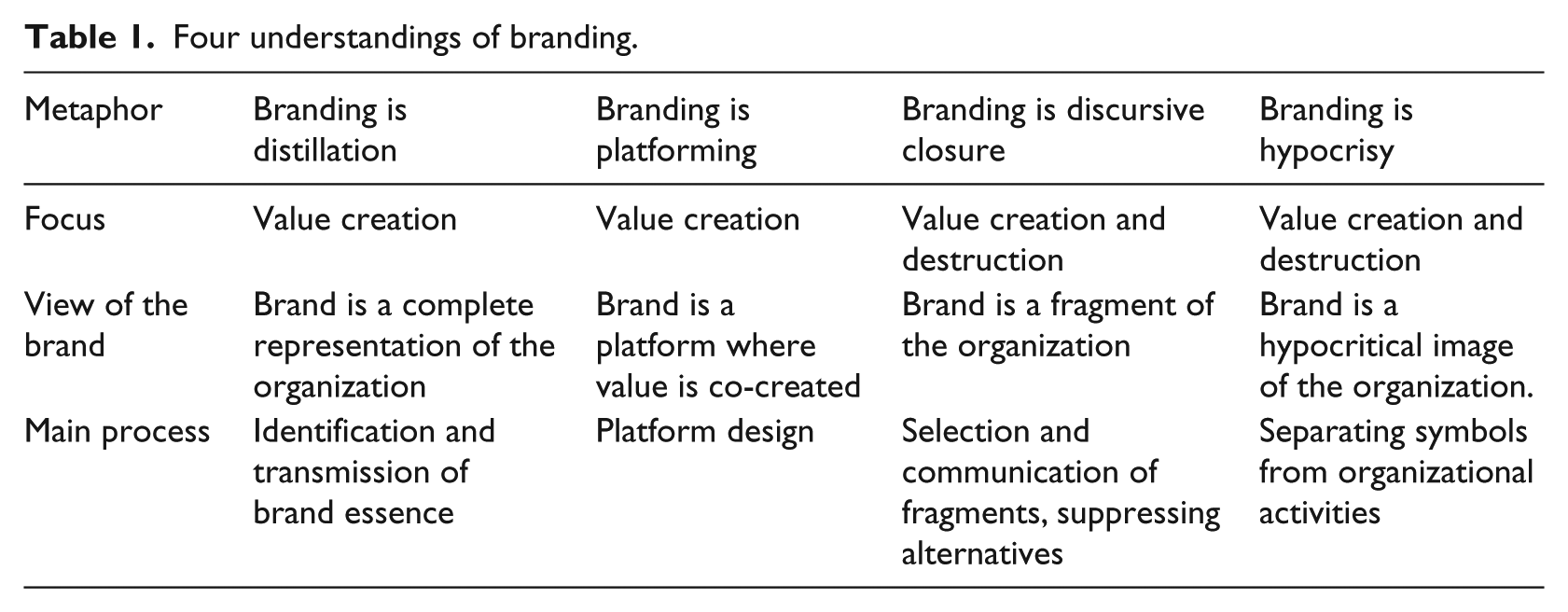
We are not denying that branding may create value according to the logic presented above. But we suggest that branding may also destroy value. Below, we shall theorize branding as value destruction instead of value creation by suggesting a heuristic model where branding is understood not as distillation or platforming but as discursive closure or hypocrisy (see Table 1 for a summary). These alternative understandings of branding stem from a critical reading of the literature on branding based on two key insights from organization theory. Specifically, we draw on the organizational literature on (1) ‘discursive closure’, which argues that corporate communication tends to present a small part of the organization as if it were the whole (Deetz, 1992), and (2) ‘hypocrisy’, which suggests that organizations tend to present an image of themselves that is ‘decoupled’ to the extent that it has very little connection to the organization’s actual activities (Brunsson, 2002; Meyer and Rowan, 1977).
Four understandings of branding.
Branding as discursive closure
As an alternative to the view that branding strives to ‘distill’ the whole organization and represent it through the brand, this perspective sees branding as a practice of discursive closure (Deetz, 1992), striving to suppress voices and interpretations that could harm the brand. As a result, the brand is seen not as the ‘essence’ or ‘identity’ of the whole organization but as a fragment of the organization, strategically selected to communicate a favorable image. Determined to ‘simplify choice’ and to ‘promise a particular quality level’—which is what branding does according to the distillation view (Keller and Lehmann, 2006: 740)—organizations brand themselves by putting forth selected and simplified fragments as if they represented the essence of the organization. Thus, brands promise quality rather than encourage people to scrutinize products and services, and simplify choice rather than asking people to critically interrogate possible alternatives. As Ashcraft et al. (2012) have put it, brands are meant to create ‘a reflex, rather than reflexive, reaction’ (p. 476).
In light of this focus on simplification and strategic selection of fragments, the idea that branding is about communicating a distillate of the whole organization becomes somewhat flawed. A more reasonable view is that branding strives for discursive closure: it reduces complexity in a way that marginalizes certain views and highlights other. Discursive closure aims to suppress potential conflict (Deetz, 1992; Leonardi and Jackson, 2004). It refers to processes that ‘suppress insight into the conflictual nature of experience and preclude careful discussion of decision making regarding the values implicit in experience, identity, and representation’ (Deetz, 1992: 188), or in Thackaberry’s (2003) words, ‘ways of closing off alternate determinations of meaning’ (p. 342).
Although there are many methods of discursive closure (see Deetz, 1992), ‘topical avoidance’ (pp. 187–193) is of particular relevance for making sense of the view that we wish to convey here. Topical avoidance, that is, discouraging the discussion of certain topics, events, or feelings, thereby keeping political issues off the agenda (Deetz, 1992: 192 f; see also Lukes, 1974), is a consequence of the strategic choice to communicate a certain ‘fragment’. Since branding is about communication, topics are avoided not by means of complete silence but by means of choosing to talk about something else. For instance, McDonald’s may avoid the topic of health or working conditions by talking about child-friendliness instead, the police may avoid the topics of homophobia and racism by talking about its extensive diversity training program, or male professors may avoid the topic of gender by talking about meritocracy instead. Topical avoidance typically regards areas of potential conflict, which threaten the established order. In Deetz’s (1992) terms, topical avoidances ‘may be motivated to enhance propriety and order, but they often function to preclude a discussion of the values that define propriety and order and the benefits that certain groups acquire from them’ (p. 192). Translating this into branding practice, one may provocatively argue that organizational branding, in order to maintain the established order, avoids the conflictual topics that really matter for understanding what the organization represents. Thus, from this point of view, if we are to understand an organization, we should not pay attention to the fragment through which it brands itself, at least not literally. Instead, we should focus on what the branding practice avoids, downplays, and silences.
Discursive closure and value
Conceiving of branding as discursive closure enables a value-based analysis. Indeed, discursive closure implies valuation. When one fragment of an organization is selected and another suppressed, a hierarchy is established among the organizations’ aspects, and the act of privileging one aspect over another is an act of valuation. As Deetz (1992) notes, ‘[t]o value is to differentiate’ (p. 61) which means that ‘something is always chosen over something else’ (p. 60). In other words, one type of value may be created when a fragment of the organization is highlighted, while other types of value may be destroyed.
Let us use Nike and McDonald’s as examples. When Nike (or other global apparel companies) communicates the image of being a health provider (e.g. Nike, 2017), it suppresses the less upbeat aspect of the organization as a sweatshop owner and exploiter of cheap labor in the third world (see, for example, Klein, 2000, who also brings out similar aspects of other transnational organizations such as Walmart and Disney). In the market world, it hardly produces value to highlight the sweatshop aspect, but it may do so in the civic world where knowledge about sweatshops is valued because it can be used to denounce and put an end to them.
McDonald’s can be analyzed in a similar manner. For instance, McDonald’s brands itself as ‘believer in young people’, stating in a Canadian advertising campaign, we give young people responsibility for our entire company, because we believe in Canadian youth. (McDonald’s, 2015; see also Harris, 2015)
The association between McDonald’s and support of the young may create market value because more young people may apply for a job at McDonald’s and more people may buy their products because they sympathize with the idea of consuming food from an organization that supports young people. But this fragment of McDonald’s suppresses and deflects attention from the fact that working conditions at McDonald’s are not always acceptable. In fact, instead of emphasizing that McDonald’s supports young people, one may stress that they abuse them. Royle (2004), for example, states in the conclusion of his extensive study of McDonald’s in the European Union that they engage in ‘recruited acquiescence’ (p. 199), that is, that they hire ‘young workers who lack the previous experience, maturity and confidence to challenge managerial authority and foreign workers who are very concerned about keeping their jobs’. A different and well-known aspect of McDonald’s is that its products tend to give rise to obesity and health problems (Spurlock, 2004).
Thus, ‘believer in young people’ is hardly a distillate of McDonald’s; it is a fragment. And when this fragment is put forth as a representation of the whole organization, important topics that pertain to McDonald’s are avoided. This may create value in the market world. But in the civic world, where contributions to the common good are valued, the value of a healthy population or the value of generally good working conditions may be destroyed when the civically problematic aspects of McDonald’s are suppressed.
Understanding branding as discursive closure will also affect the focus of the platform view. Attention would be drawn to how a fragment of the organization gets to be the platform on which consumers are mobilized to co-create. Put differently, it encourages analysis of how the platform is staged by the organization so that favorable images are co-created. Returning to McDonald’s, Ronald McDonald may be seen as a staged platform upon which ‘child friendly’ is co-created as part of the fast food chain’s brand. On the Ronald McDonald platform, children and their parents are invited to eat, play, and enjoy themselves, participating in the creation of McDonald’s as a fun and safe place for kids (see Wilson and Schlosser, 2006). As a result, market value is likely to transpire.
According to the view of branding as discursive closure, however, ‘child friendly’ is only a fragment of McDonald’s. Highlighting this fragment may create value for McDonald’s in the market world. But in the ‘green world’, where value is measured by the extent to which actions contribute to environmental sustainability, it is not valuable (or child friendly) to encourage children to consume food that contributes to the warming of the planet. Similarly, in the civic world, where value is measured by the extent to which actions contribute to the common good, it is not valuable to have children eat and play in a way that makes them overweight (obesity caused by consumption of fast food and soft drinks is a well-documented social problem). Thus, from the perspective of those worlds, it makes sense to think of the Ronald McDonald brand-platform as a space where value is ‘co-destructed’ rather than co-created.
Branding as hypocrisy
Organizational hypocrisy signifies the phenomenon that an organization’s talk, decisions, and actions pull in different directions (Brunsson, 2002: xiii). Branding as hypocrisy characterizes branding as an activity employed to build images that are de-coupled from—rather than a fragment of—the organization’s actions in order to compensate for the fact that its actions run counter to the demands of some of its stakeholders. It is thus a managerial practice that seeks to build brand images that enable organizations to handle conflicting demands.
Returning our McDonald’s example, branding as hypocrisy would imply that the organization brand itself as a ‘health-brand’, while its actions would in fact make people unhealthy. Thus, the brand would be de-coupled from the organization’s activities. The example is not entirely hypothetical. McDonald’s communicates how it works with nutritionists to ‘make informed and mindful food choices’ 2 while, for instance, documentaries like Spurlock’s Supersize Me supply evidence of the unhealthy aspects of regular consumption of McDonald’s food. The emphasis on health and nutrition meets demands associated with the green world, while McDonald’s burger, fries and soda-production meets demands associated with the market world (there are high margins on fries and soda) and partly the domestic world (where tradition is valued: burgers and fries ‘made’ McDonald’s).
Separating brand image from organizational action
The branding as hypocrisy metaphor is mainly based on Meyer and Rowan’s (1977) concept of de-coupling, and Brunsson’s (2002) construct the organization of hypocrisy, because these concepts highlight the aspect that branding tries to resolve contradictions between stakeholders’ demands and the organization’s actual operations. Although the raison d’être of firms is to generate profits, an increasing number of organizations today experience pressure to justify their operations to actors who have other priorities than market value (Christensen and Cheney, 2000). As a way to solve this problem, organizations try to satisfy conflicting demands by, for instance, separating the manufacturing of material products from the creation of symbols—turning branding and production into two separate activities, de-coupled from each other (Salzer-Mörling and Strannegård, 2007). De-coupling through branding thus builds on the construction of a structure—upheld by systematic representations of the organization as, say, ‘sustainable’—that protects the organization from inquiry and insight into its activities.
Brunsson (1993, 2002) refers to this difference between words and deeds, and the eventuality that organizations may talk in one way, decide in another, and act in a third, as organized hypocrisy. Through hypocrisy, an organization can meet some demands by way of talk (in this instance via a brand communication), others through decision-making, and yet others through action. In that way, an organization can handle several conflicting values at the same time while keeping different stakeholders with conflicting demands on the organization happy and thereby maintain the organization’s legitimacy.
Brunsson (2002) also suggests that the organized hypocrisy entails a reverse relationship between talk, decision, and actions. The general view of traditional decision theories is that when (management) talk and decisions point in a certain direction, this will increase the likelihood that corresponding action will be taken. Organizational hypocrisy, however, implies the opposite: that ‘talk or decisions pointing in one direction reduce the likelihood of the corresponding action actually occurring, while actions in a particular direction reduce the likelihood of any corresponding talk or decisions taking place’ (Brunsson, 2002: xiv).
Brunsson thus argues that talk does not encourage action in the same direction but compensates for action in the opposite direction. In a branding context, this would imply that if an organization strongly brands (talks about) itself as ‘green’ or ‘child friendly’, we should expect that its actions pollute the environment or that they have a negative impact on children. Reversely, when an organization systematically acts ‘green’ (e.g. exclusively sells organic food grown by local farmers), we should expect that it will not talk extensively about this or make decisions that call for ‘green’ action. Although this reversed relationship between talk and action should not be understood as a universal law, it stimulates critical analysis of branding efforts.
The branding as hypocrisy metaphor enables critique of branding as distillation, particularly of the way that the relationship between brand identity and brand image is understood. While the branding as ‘distillation’ literature celebrates full alignment between brand identity and image (see Balmer and Greyser, 2006; De Chernatony, 1999; Hatch and Schultz, 2003), branding as hypocrisy implies that misalignment between those entities is a prerequisite for ‘successful’ management of conflicting external demands, and the maintenance of organization legitimacy and long-term survival. As a result, the hypocrisy metaphor negates the assumption that the aim of branding is to communicate a truthful representation of the (essence) of the organization (what it is and what it does). Instead, the aim is to compensate for, or divert attention away from, the organization’s actual operations.
The notion that brand images may be inconsistent with organizational action is not novel (see, for example, Alvesson, 1990; Olins, 1989; Christensen and Askegaard, 2001). What is more novel is the idea that practicing hypocrisy through branding may be a rational (yet problematic) managerial activity, exercised to ensure organizational legitimacy and survival. The more skilled organizations become in the organization of hypocrisy and in de-coupling production/action from brand image creation, the more capable they will be to build sophisticated brands assuming a life of their own, regardless of how, where, or by whom the branded goods have been manufactured (Salzer-Mörling and Strannegård, 2007).
Hypocritical brands and the creation–destruction of value
Returning to Boltanski and Thévenot’s (2006) framework of valuation, the view of branding as hypocrisy is intended as a starting point for analysis of the simultaneous creation and destruction of value. Consider Colombia’s leading oil company, Ecopetrol, which brands itself as ‘clean and in balance with nature’ by offering ‘Clean Barrels of oil’ and employing advertisements designed in green colors and wooden letters, depicting humans and animals living in harmony on a paradise island. 3 Arguably, this is an example of the organization of hypocrisy, because the company, in Brunsson’s (2002) and Salzer-Mörling and Strannegård’s (2007) terms, communicates a brand image that runs counter to the organization’s actions. Producing and selling oil are seen by many as the opposite to being environmentally friendly. Still, that is the brand image that Ecopetrol (and most other oil companies) cultivates, probably because it wants to legitimize its activities in relation to environmentally aware customers. If it is successful in making this brand image so credible and convincing that consumers cannot see the de-coupling between the image and the organization’s actual operations, Ecopetrol’s branding practices may create value in various worlds: in the market world through increased price, in the world of fame by becoming more recognized, and in the industrial world because the business is likely to run more efficiently if conflicts with ‘environmentalist’ stakeholders are avoided. But value may be destroyed in the domestic world where being truthful is valued, in the civic world where transparency is valued, and in the green world where environmental protection is valued.
When it comes to the platforming view, branding as hypocrisy highlights how consumers might be invited to participate in the (rather precarious) enterprise of constructing hypocritical images of organizations. In our example from the oil industry, the web page of the Swedish division of Q8 can be seen as such a platform. On the web page, they stress how they are launching ‘sustainable fuel stations’ whose environmental impact is minimized through the use of solar cells, green roofs, and ground source heating. 4 They also invite consumers to participate in the development of ‘sustainable driving’ by learning from Q8 how to drive and wash the car in an environmentally sustainable way and by choosing tires that release less toxics. 5 From the view of branding as platforming, consumers are thus invited to participate in the creation of associations between Q8 and environmentalism. However, they do this while driving their cars using mostly fossil fuel. Although washing and driving ‘sustainably’ reduce the environmental harm, buying and driving cars is still one of the more environmentally harmful human activities. Seeing branding as hypocrisy thus brings forth how the platform is designed to compensate for rather than highlight the organizations’ key activities (oil extraction and car driving). This in turn enables analysis of value creation and destruction: it highlights how the Q8 (or any other oil company) platform is a space where market value may be created for Q8, and perhaps some sort of value of a ‘fake green consciousness’ among car drivers, while that which is valued in the green world is destroyed.
Just like Ronald McDonald can be understood as a platform on which consumers co-create the child friendly fragment of McDonald’s, the oil companies’ web pages—and to a certain extent the ‘sustainable fuel stations’—can be seen as platforms where car owners are invited to participate not only in fuel consumption but also in the (hypocritical) association between the oil company (Q8) and environmental friendliness. Seeing branding as hypocrisy thus brings forth how the platform is designed to compensate for rather than highlight the organizations’ key activities: oil extraction and car driving.
Theoretical extension and future studies
In light of our outline of new metaphors for branding and how they enable branding analysis that acknowledges conflicts between different values, the last section focuses on three themes. First, we nuance our discussion of value by further acknowledging the complexity of the relations between values. Then we expand on how our framework contributes to branding scholarship. Finally, we suggest some concrete research questions and foci for future studies.
Branding and the complex relation between different values
We have mainly focused on how our metaphors enable analysis of how branding might create value in one world but destroy it in another. However, the ways in which branding relates different values to each other are complex. Many types of value may be involved in branding, and they may be related in various ways. In firms competing on a market, market value is always the bottom line, but the market world is rarely referred to directly. Instead, as Lury (2004) has noted, while brand value in firms is measured in quantitative terms, it often draws on qualitative measures. Or put differently, the brand as a platform enables analysis of the interaction between different worlds/spheres of worth (see Boltanski and Thévenot, 2006), where branding may establish an ‘exploitative’ relationship between the market world and other worlds (i.e. the market world makes use of and derives benefit from other worlds). For example, McDonald’s exploits the values of the civic world when it emphasizes its child-friendliness. ‘Child-friendly’ is not only a quality cherished in the civic world (because healthy, happy, and well-functioning children are a prerequisite for the common good) but also a quality that can be used by organizations to generate quantitative value (higher price or increased sales). Thus, branding may create value in the market world by communicating that it supports the values of the civic world. But since only a fragment or a hypocritical image is communicated, other aspects of the organization that may destroy value in the civic world are downplayed, such as the health aspects that make McDonald’s not-so-child-friendly. Another example is how branding may create market value by exploiting the artistic world. Clothing brands may draw on cultures such as snowboarding and surfing, and thus exploit characteristics that are valued in the inspired world (uniqueness and talent) to produce value in the market world (Holt, 2004) and possibly in the world of fame if people feel popular by wearing the clothes, or in the domestic world if they gain a sense of community and connection with others by wearing and consuming the clothing brand (e.g. Muñiz and O’Guinn, 2001).
Since our main focus is on branding as a managerial technique in firms, it is the market world that plays the role of the ‘exploiter’. This does not mean that the market world always ‘wins’, however. Take the Dole vs Gertten case that we referred to earlier. Arguably, the civic world ‘kicked back’ and Dole’s protective branding efforts proved counterproductive, from Dole’s perspective. Actors in non-capitalist organizations may also exploit the market world to increase their value in their own world. Greenpeace, for example, sells merchandize with its brand name on it to exploit the value of price in the market world to improve financial power (see Greenpeace UK, 2017; Redbubble, 2017), arguably allowing itself to better defend the principles of environmentalism, thereby increasing the organization’s value in the green world. In a similar vein, the civic organization ‘Missing People’, whose purpose is to assist the police in finding people gone missing, may exploit the value of recognition in the world of fame to attract additional people to the organization, which will enable them to improve their actions directed toward the common good (becoming better at or more effective in finding missing people), thereby increasing its value in the civic world (see Missing People Sweden, 2017; Swedish Television, 2013).
When we understand branding as discursive closure or hypocrisy, we thus open up for the idea that branding relates different worlds of worth to establish exploitative relationships (often to the benefit of the market world), resulting in the simultaneous creation and destruction of value. In light of this, future empirical studies—conducted in research, teaching, and activist contexts—should focus on how fragments or hypocritical images are created when these relationships are established and ask which ‘worlds’ come out as winners or losers in the process.
Contribution to branding scholarship
We have presented a heuristic model for supporting analysis of how value may be destroyed in the wake of branding practices. The model is intended to stimulate thought and analysis to gain new insights with regard to branding. Branding is not objectively and purely distillation, platforming, discursive closure, or hypocrisy. Those are ideal types (Weber, 1947) for making sense of the directions toward which branding efforts strive. Our contribution thus lies in the explication of discursive closure and hypocrisy as two new root metaphors for what branding is, which provide the stage for a critical value-based analysis intended to produce new knowledge about the consequences of branding.
To managerialist scholarship, we contribute with a competing model. Specifically, our perspective competes with the managerialist view that treats brands as distillates or essences of organizations (Kapferer, 2008; Keller and Lehmann, 2006; Nandan, 2005). This scholarship aims at maximizing organizational efficiency, thereby leaving issues such as destruction, dominance, and marginalization in the wake of managerial practice unproblematized (Fournier and Grey, 2000). Our approach, on the other hand, highlights precisely these phenomena, aiming to enable broadened analysis of the meaning and consequences of management practice (branding) in society and within organizations. Thinking of branding as discursive closure and hypocrisy thus offers a way to analyze that which is neglected by the managerialist scholarship.
Our relationship to the ‘platforming’ scholarship is less critical and deserves further explication. Our framework does not negate the idea that a brand can be a platform on which value is created in communication between producers and consumers (e.g. Kornberger, 2010; Lury, 2004). What we offer is an analytical device that expands on the platform metaphor to argue that the result of the communication on the platform is a fragment or a hypocritical image of the organization, and that this insight is a starting point for analyzing how branding is a double-edged practice that both creates and destroys value. We have already briefly exemplified this by suggesting that Ronald McDonald may be seen as a platform on which a fragment of McDonald’s is produced, which may create value in the market world but destroy value in the civic or green worlds. This communicates especially with brand scholarship on ‘co-creation’ of brand value (e.g. Cova and Dalli, 2009; Cova et al., 2011), opening up for analysis of how consumers or employees are mobilized by organizations to participate in the ‘co-destruction’ of value.
Such analysis enables critical insight into contemporary branding initiatives that, on the surface, may seem to be characterized by synergetic interactions between different worlds of worth. For instance, Endrissat et al. (2017) recently showed how organizations—in their case: a large North American grocery chain focusing on organic and locally grown food—may brand themselves as artistic and progressive by strategically employing art-school graduates to shop floor positions. The shop floor thereby became a platform upon which employees expressed brand-relevant characteristics through their identities and lifestyles, while they received ‘identity-incentives’ to validate and develop their identity as creative subjects. Thus, on this platform (the shop floor), provided by the grocery chain, the market and inspired worlds interacted: the market world exploited the inspired world to produce market value, while the inspired world exploited the market world as a place where artistic identities could be developed. This may sound like a synergistic relationship, but when people are branding the organization they are also being branded by it (Vasquez et al., 2013), which raises questions about the consequences of people’s identities being mobilized to create brand value. A value framework, combined with the insight that brands are fragments or even hypocritical images of organizations, is a starting point for analyzing such consequences. It would encourage research questions such as the following: Which fragment(s) or hypocritical images of the grocery story are highlighted and constructed on the platform, and which are silenced and downplayed? How is the ‘inspired value’ affected by the fact that an artist creates or has created his or her identity on the grocery shop floor instead of the ‘real’ art shop floor? What types of value need to be exploited by the grocery store (or other organizations) to turn it into an attractive workplace for art students and a legitimate platform for developing creative identities? (For instance, developing one’s artistic identity in a conventional store (e.g. Safeway) or a more innovative one (e.g. Whole Foods) is likely to mobilize different types of value and affect the nature of the fragments or hypocritical images produced.)
Also, more popular critical analysis of branding may be enriched by thinking differently about what branding is and how it relates to different types of value. Klein’s (2000) insightful analysis of branding treated the deeply problematic issues and societal consequences of global brands and branding in her famous book No Logo. However, she did not, in any explicit terms, discuss these problems in terms of a broadened perspective of value. This would have added further complexity, nuance, and insightfulness to her powerful but quite binary analytic narrative in which corporations simply ‘win’ while society and people ‘lose’.
Questions and foci for future studies
We have provided a number of empirical examples in this article but they are only illustrative of how branding may build on fragments or hypocritical images of organizations, and how this may create and destroy value in different worlds of worth. Our main contribution is thus a conceptual framework to support future studies with empirical and analytical depth of how branding creates and destroys value. To provide impetus for such an enterprise, we shall in the last part of this article suggest some questions and foci that could work as starting points for future studies.
Since our framework directs attention to the relationship between value creation and value destruction, empirical studies of branding work may address general questions pertaining to this relationship. For example, if organizations gain economically from branding efforts, then what are the effects on other worlds of worth than the market world? How can we gain balance between different worlds of worth? Which worlds are constructed as more important and how does this happen? What is the overall value for societies when organizations engage in branding? And on the level of experience, what are the tensions experienced by employees in organizations when confronted with the branding logic, and how do they handle those tensions? On the level of action, how do actors participate in the value construction and destruction? What kind of impact does this have on the employees’ understanding of their work and their occupational identity?
On a more specific level, building on the argument that brands are fragments or hypocritical images of organizations, future studies might investigate specific techniques for how those fragments and/or hypocritical images are produced and how this relates to different worlds of worth. Grounded answers to this ‘how’ require empirical investigations, of course, but some techniques may be suggested as starting points for analysis:
Turning action into essence through labeling
Labels tell us what things are (Czarniawska-Joerges, 1993). Here, studies might focus on how organizations make some of their own actions into essence and how they make the actions of competitors into essence to differentiate themselves from or stigmatize others. For instance, the Trump organization used this technique when competing with the Clinton organization for the presidency of the United States in 2016. At one point, Clinton handled her emails carelessly using a private email server for communicating sensitive information. This action—one among many actions that have been undertaken by Clinton—was picked up by the Trump campaign, which labeled her ‘reckless’ and ‘crooked’. Thus, by selecting one thing that she did and transforming it into what she is, a fragment of her actions was turned into essence through labeling. Studies could pay more systematic attention to how organizations use labels to turn action into essence, ask whether these essences are to be seen as fragments or hypocritical images, and how different types of values are related, used, created and destroyed, silenced, or downplayed.
Using metaphors to create misleading associations and platitudes to normalize the organization
Metaphors tell us what things are like by associating them with something that they are not (e.g. Morgan, 1986). 6 Organizations tend to use metaphors in various ways—intentionally or unintentionally—to produce positive images. For instance, Ecopetrol—using a commercial set on a paradise island, where a large ‘clean’ oil barrel had replaced the typical island mountain 7 )—used the metaphor of the paradise island where animals and humans lived in harmony to associate themselves with the green world. Platitudes, in turn, are statements designed to ‘conventionalize’ by stating obvious and unquestioned things, pointing at common ground that is shared by all participants (Czarniawska-Joerges, 1993: 19). For instance, in protective branding (Fournier and Avery, 2011), organizations may state that ‘political’ or ‘economic concerns forced us to make this decision’, thereby stressing how a decision to, for instance, cut down rain forest or lay off people was just a conventional, normal decision that had to be done. Focus on the use of metaphors and platitudes may reveal how fragments or even hypocritical images of organizations remain significant parts of ‘the brand’ and how other images are hidden and provide empirical grounds for analyzing value-based consequences.
Using euphemisms and exaggerations to distinguish the organization from others or to conceal unfavorable images
As an example of euphemisms, the fast-growing Scottish brewery BrewDog stresses how it has ‘Fans, not customers’ and how its investors are not really investors but ‘brand ambassadors’ and ‘craft-beer evangelists’ (Watt, 2015: 69, 106). Exaggerations can be exemplified by ordinary universities, which are probably good in many ways, presenting themselves in a hyperbolic tone, stating that they produce ‘research and education in world class’ (Alvesson, 2013: 72). Scholars could investigate how branding through euphemization and/or exaggeration enables interactions between worlds of worth and the consequences of this in the different worlds. For instance, at a glance, it seems like BrewDog is exploiting the world of fame (fans) and the inspired world (craft) to produce market value.
We make these suggestions—the general questions and the techniques—to indicate a few among many possible empirical undertakings that could be informed by our framework. In addition, the suggestions are meant to underline what we mean when we say that our framework is heuristic: it encourages analysts to discover for themselves the ways in which branding is related to value by acknowledging the existence of various value regimes.
Conclusion
It is our ambition that various social actors—such as employees, consumers, activist organizations, and managers who wish to consider the social aspects of branding practice—can gain from reading this article. Our discussion has addressed consequences of branding by theorizing its destructive side. We have highlighted how branding may divert the public’s attention away from unpopular practices, creating space for organizations to do things that would otherwise be hard to ‘get away with’, thereby detracting societies from important discussions about organizations. To understand the broader meaning of branding in society and avoid one-dimensional thinking that forces all measure of value into the market world, we have suggested new metaphors for what branding is and tools for a multi-dimensional analysis that accepts multiple regimes of value.
Branding may be seen as an organizational project of increasing stock market value, a supra organizational system of ideas to symbolically distinguish one organization or product from another, or, which is part of our contribution, a practice of communicating palatable images of organizations and hiding problematic aspects, being more committed to ‘change of face than change of heart’ (Boorstin, 1962: 189). Understanding the value of branding from a societal point of view requires that all these aspects, and more, be brought forth, and that we move beyond the market world. We side with authors who worry that an increased focus on branding may colonize social life (Mumby, 2016) and lead to a ‘promotional culture’ where firms ‘divest themselves of accountability for their products and forms of production while focusing on their brand images and marketing efforts’ (Aronczyk and Powers, 2010: 5). Our framework responds to these general concerns, providing tools for articulating in new ways what branding is and how it may destroy value by blocking off insights that would be instrumental to people and communities in their pursuit of achieving what they find important in life.
Footnotes
Acknowledgements
Jens Rennstam and Jon Bertilsson contributed equally to the production of this article.