




Abstract
Metaphorical phrases appear frequently in practitioner and academic texts on internal branding and depict employees as ‘brand ambassadors’ who ‘embody the brand’ and ultimately turn into ‘living brands’. In this article, I examine how these metaphorical phrases rhetorically construct the concept of internal branding and thereby also impact our thoughts on organizations, employees and their relationships to one another. The findings show that complex metaphorical phrases provide linguistic framing for internal branding and simultaneously convey conflicting messages to different stakeholder groups. These metaphors describe internal branding as empowering employees to be autonomous and encouraging them to take control over the brand, whereas connotations paint a picture of employees being controlled by the brand. This article contributes to studies on internal branding, branding more generally, and on language in critical management studies by highlighting that internal branding metaphors point to a hidden value system that values brands higher than employees. This value system reflects tensions around the increasing financial value of brands and increasingly precarious working conditions.
Introduction
Don’t you see that the whole aim of Newspeak is to narrow the range of thought? (Syme, the philologist, to Winston; Orwell, 1950: 52).
According to prominent metaphorical phrases in texts on internal branding, employees show ‘on-brand behaviours’, ‘deliver the brand’, turn into ‘brand ambassadors’ or ultimately into ‘living brands’. These and similar metaphorical phrases appear recurrently in academic and practitioner-oriented texts advocating internal branding. In this article, I draw on critical discourse studies and present and examine metaphors – as special instances of language in organizational research (e.g. Cornelissen et al., 2008; Morgan, 1980; Oswick et al., 2002) – in texts proposing the concept of branding employees known as ‘internal branding’.
Internal branding is an extension of culture management (Cushen, 2009; Edwards, 2005; Kornberger, 2010), and like culture management, it revolves around normative control, a central topic of critical management studies (Alvesson and Willmott, 2002; Willmott, 1993). What is new about internal branding compared to culture management is that employees should represent the brand to external audiences (Edwards, 2005; Müller, 2017). According to its advocates, internal branding is about aligning employees’ behaviours, attitudes, demeanours, outward appearances and language use with the company brand (e.g. Aurand et al., 2005; Burmann and Zeplin, 2005; Miles and Mangold, 2004; Morhart et al., 2009).
Nevertheless, critical organizational scholars have long neglected branding and its significance for organizations (Mumby, 2016; Willmott, 2010); in line with this, also internal branding has been overlooked, although it has turned into an important normative management concept. To better understand the influence of internal branding on organizations and also employees, we need to advance our knowledge of how internal branding is formulated and how this concept is able to portray both organizations and employees in certain ways.
Critical management studies acknowledge the centrality of language (Adler et al., 2007; Alvesson and Willmott, 2003; Mumby, 2016) and view language as a central force that shapes rather than mirrors social reality (Alvesson and Kärreman, 2000). Willmott (1993), for example, relates culture management to newspeak or doublespeak (which includes euphemisms or intentional ambiguity to distort or alter meanings) in George Orwell’s famous novel ‘1984’. Thus, Willmott specifically points to the importance of language in concepts around normative control. Metaphors, that is, words or phrases used to refer to something else in order to emphasize similar qualities (Rundell, 2007), are especially suited to influence people’s thoughts and understanding of the world (Alvesson and Sköldberg, 2009; Lakoff and Johnson, 1980; Morgan, 1980, 2006). Analysing recurring metaphors in internal branding texts can thus help us to advance our understanding of internal branding through examining the rhetorical construction of the discourse and how it portrays brands, organizations, employees and the relationships between them. The purpose of this paper is, therefore, to analyse how recurring metaphorical phrases construct the idea of internal branding and impact our thoughts on organizations and employees in academic and practitioner-oriented texts that discuss internal branding.
For the metaphor analysis, I use insights from critical discourse analysis (CDA) (Fairclough, 2001, 2003) and semiotics (Barthes, 1973). I analyse internal branding metaphors as common ‘intertextual’ elements (Fairclough, 2003) of the internal branding discourse. Intertextual elements are words, phrases, quotations and so on that appear in many texts of a discourse and thus, due to their wide use and repetition, are considered important. According to Fairclough et al. (2011), CDA includes critical semiotic analysis (p. 362). Semiotics, as the study of signs and meanings (Barley, 1983; Chandler, 2007; Eco, 1979; Fiol, 1989), provides an ideal framework for detecting meaning in given contexts (Barley, 1983; Fiol, 1989). By combining insights from CDA and semiotics, I am able to examine the metaphors as linguistic and intertextual features of the internal branding discourse and analyse their meanings within the discourse of internal branding.
This article contributes to the literatures on internal branding and on language and discourse in critical management studies in the following ways. First, it advances our knowledge on metaphors in organizational research (e.g. Cornelissen et al., 2008; Morgan, 1980; Oswick et al., 2002) by showing that recurring metaphorical phrases in internal branding texts are complex semiotic double systems of meaning. In this sense, the very notion of ‘brand’ is metaphorical and, therefore, enhances the metaphoricity of other words that are part of complex metaphorical phrases. As double systems of meaning, these metaphors can convey different messages to different stakeholder groups simultaneously. This knowledge can be useful in ‘decoding’ rhetorical strategies around normative discourses in organizational research. Moreover, this article also extends the critical literature on internal branding (Brannan et al., 2015; Edwards, 2005; Land and Taylor, 2010) by highlighting underlying assumptions of internal branding that are tied to an implicit value system that favours brands over employees. The study shows that internal branding metaphors present brands as central ingredients in employee–employer relationship and thereby reflect and reinforce tensions around the increasing financial value of brands and increasingly precarious employment conditions for employees (Kalleberg, 2009; Smith, 2010; Vallas and Cummins, 2015).
A critical view on the idea and language of internal branding
Internal branding, as mentioned, developed from the normative concept of culture management 1 , which has been a topic for critical management studies for the last 25 years (Alvesson and Willmott, 2002; Willmott, 1993). While the interest in this topic had diminished at some point, recent studies indicate new developments on culture management (Fleming and Sturdy, 2009; 2011). Edwards (2005) describes internal branding ‘as an extension of the management of corporate culture with a particular branding slant’ (p. 271). Additionally, Kornberger (2010) writes that the brand literature ‘sees culture as an instrument’ for branding employees (p. 130). Proponents of internal branding consequently suggest that organizations change their culture to align it to the brand (e.g. Boyd and Sutherland, 2006; Burmann and Zeplin, 2005; Punjaisri and Wilson, 2007). What is new about internal branding is the requirement that employees are not only an additional audience but that they actually become the brand message (Edwards, 2005; Müller, 2017). I will elaborate on this point in the following section.
What exactly is internal branding?
The idea of internal branding is, according to organizational scholars such as Edwards (2005) and Kornberger (2010), an extension of culture management that is focused on brands. Like culture management, internal branding revolves around normative control aiming to regulate the employees’ inner lives, their self-image, feelings and identifications (Alvesson and Willmott, 2002). Indeed, advocates of internal branding suggest that employees (have to) align their behaviours, attitudes, demeanours, outward appearances and language use with the company brand (see, for example, Bergstrom et al., 2002; Boyd and Sutherland, 2006; Chong, 2007; Miles and Mangold, 2004; Punjaisri et al., 2008). In contrast to culture management, however, internal branding does not want to sell the brand (or culture) to the employees but rather to have the employees act as ‘living brands’ to sell the brand to the customers.
Internal branding differs from the related concepts of corporate branding and employer branding in a specific way. Corporate branding presents the entire company including its products, logo, buildings and relationships to stakeholders and employees as a brand (Schultz et al., 2006). According to Foster et al. (2010), corporate branding has two sub-concepts: employer branding (with an external focus on prospective employees) and internal branding (with an internal focus on current employees). Internal branding and corporate branding are interconnected, but the crucial difference, according to Edwards (2005), is that employer branding uses the organization as a branded entity to target prospective employees, whereas internal branding uses employees as the branded entity to target consumers who interact with branded employees (Edwards, 2005: 272, emphasis added). In recent studies, Brannan et al. (2011, 2015) and Kärreman and Rylander (2008) show that corporate branding and employer branding can have internal effects on employees and their identity work because the employees are an additional audience to these branding activities. However, internal branding focuses on employees as the actual means to communicate to an external audience. In this way, employees are not just an additional audience for the brand message (as in corporate branding), but they actually are the message (see Müller, 2017).
Proponents of internal branding in marketing enthusiastically present it as an innovative tool to enhance employee commitment, motivation and loyalty (Miles and Mangold, 2005; Vallaster and De Chernatony, 2005). Employees, regardless of whether they have customers contact or not, are expected to align their attitudes (Aurand et al., 2005; Baumgarth and Schmidt, 2010; Burmann and Zeplin, 2005; Punjaisri et al., 2008), appearances (Chong, 2007; Miles and Mangold, 2004), demeanours, behaviours (Bergstrom et al., 2002; Mangold and Miles, 2007; Miles and Mangold, 2004) and language use (Alcorn et al., 2008; Boyd and Sutherland, 2006; Morhart et al., 2009) with the brand. This, according to the internal branding literature, will raise employees’ brand awareness (Andruss, 2010; Burmann et al., 2009; Burmann and Zeplin, 2005) and brand enthusiasm (Burmann et al., 2009; Gapp and Merrilees, 2006; Ind, 2003).
Advocates of internal branding often use terms such as ‘employee empowerment’ (e.g. Henkel et al., 2007; Mahnert and Torres, 2007; Burmann and Zeplin, 2005; Vallaster and De Chernatony, 2005), ‘passion’ (e.g. De Chernatony, 2002; Mitchell, 2002) or the ‘creation of meaning’ (Bergstrom et al., 2002; Gapp and Merrilees, 2006) and conceal the companies’ economic goals that are, in actuality, the motivation behind internal branding activities. Willmott (2010) mentions that brands have become intangible assets with a monetizable value. Internal branding strives to add to this monetizable value through improving service quality and customer satisfaction (Miles and Mangold, 2004; Punjaisri and Wilson, 2007). De Chernatony (2002), for example, states that internal branding enables employees to deliver services to customers ‘in a more natural manner, with passion and commitment’ (p. 122).
Critics of internal branding, however, highlight important issues. Mitchell (2004), one of the few critics in the field of marketing, argues that internal branding turns employees into ‘Stepford Wives’ 2 or branded robots. Edwards (2005) writes that internal branding considers employees a malleable resource for the brand, and questions the ethicality of the concept. Harquail (2007) raises concerns about the effects of internal branding practices on employees’ identities as these practices involve recruitment, appraisal, internal and external communications, socialization processes, organizational décor and artefacts, such as ‘logoed’ clothes (Harquail, 2007). Cushen (2009) points to the normalizing effects of ‘fashioning an ideal employee identity based on the organisation brand’, which may be ‘a normative step too far’ (p. 102). Moreover, Land and Taylor (2010) observe a qualitative shift in employees’ work-life balance as internal branding approaches attempt to tie employees’ personal interests and leisure activities to the brand. This is done, for example, through posting pictures of leisure activities that are related to the brand on the company web page or by presenting employees as engaging in these activities in the company catalogue for customers.
The discourse and language of internal branding
The idea of internal branding emerged in the field of marketing and is based on related concepts such as corporate branding – which appeared in the in the mid-1990s (Schultz et al., 2006) – or employer branding – which emerged in the late 1990s (Ambler and Barrow, 1996). The socio-economic background in which the idea of internal branding appeared is connected to the transformation of brands into strategically important and monetizable assets and to the increasingly precarious conditions of employment in organizations.
The transformation of brands into monetizable assets is an important factor in the rise of internal branding. From being a mere marketing issue in the early 1980s, brands have now found their way into the stock prices of well-known companies or, in the case of acquisitions, into companies’ balance sheets (Willmott, 2010). In 2004, the World Economic Forum declared that ‘corporate brand reputation outranks financial performance as the most important measure of corporate success’ (Power, 2008: 129). The intangible qualities of brands thus have turned into measurable and comparable (e.g. in online rankings) financial assets in the form of brand value or brand equity. As valuable assets, brands are also of strategic importance to organizations as branding efforts and investment in branding have become part of strategic descision-making to create shareholder value (Willmott, 2010).
The precarious employment conditions employees often face today are, according to sociologists such as Kalleberg (2009), the result of macro-level changes of neoliberal globalization (market-driven solutions, privatization strategies and removal of government protection) that led ‘employers to seek greater flexibility in their relations with workers’ (p. 3). In the popular business discourse, the end of standard working arrangements (long term, full time and on-site) was celebrated, and new forms of employment (part time, temporary and contract work) were idealized as leading to freedom and fulfilment (Vallas and Cummins, 2015). Kalleberg (2000) and Smith (1997) report that these new non-standard working arrangements increased significantly in the last decades. Thereby employers ‘convert full-time jobs to part-time, primarily as a strategy to cut labour and benefits costs’ (Smith, 1997: 327). The constant threat of discharge through short-term contracts leaves workers increasingly susceptible to market imperatives and has posed a new scheme of employee control that promises only that the skills and experience employees gain in the current job will be useful in future jobs at other companies (Vallas and Cummins, 2015). Culture management, based on long-term commitment to organizational cultures, did not fit well with the rise of precarious working conditions and so organizations and their consultants formulated new concepts such as internal branding in an effort to strengthen the weakened bond between employees and employers.
The discourse of internal branding emerged in this wider context of rising precarity in employment conditions and the increasing economic value of brands for organizations. The discourse appeared, as mentioned, in the field of marketing when the term ‘internal branding’ began appearing in texts that advocated the idea of internal branding and it consists of a growing number of articles by and for practitioners and academics. It is an interconnected system of texts that construct a certain idea through a ‘particular way of representation’ (Fairclough, 2003: 17). The texts represent speech that is highly deliberate and a trace ‘of an author’s world view, preserved at a point in time and immune to retrospective construction’ (Barley et al., 1988: 27). The authors’ language use is thereby an important factor in how they construct and convey the idea of internal branding and turned it into a concept.
Language, as we can see, is a central resource for formulating ideas around a new concept. In his study on how language servers to normalize new concepts or events, Hirsch (1986) introduces the concept of linguistic framing and writes that ‘without concrete terms, metaphors, and contexts in which to describe and interpret new, unexpected events, it is unlikely that they can become conceptualized as normal, routine, and acceptable, that is, become absorbed into the culture of the collectivity’ (p. 821). In this article, I focus on metaphors as special instances of language because they influence people’s thoughts and understanding of the world (Alvesson and Sköldberg, 2009; Lakoff and Johnson, 1980; Morgan, 1980, 2006). In this way, metaphors are important elements of the linguistic framing of concepts such as internal branding. In the next section, I provide more details on metaphors.
Metaphors in a nutshell
To examine how metaphors provide linguistic framing for internal branding, I focus on the ability of metaphors to influence our perceptions and thoughts. The Macmillan dictionary defines metaphor as ‘a word or phrase that means one thing and is used for referring to another thing in order to emphasize their similar qualities’ (Rundell, 2007). Through drawing on the meaning of a word to refer to something else, metaphors can generate mental images as visual associations (Alvesson and Sköldberg, 2009; Cornelissen, 2005, 2006; Lakoff, 1987; Morgan, 1980; Ricoeur, 1978). Metaphors, like other rhetorical master tropes (Chandler, 2007), are, thus, not merely language embellishments. Rather, they influence our understanding of the world through alternative ways of thinking and, therefore, are of utmost interest in the field of organizational and management research (Alvesson and Sköldberg, 2009; Cornelissen, 2005; Cornelissen et al., 2008; Heracleous and Jacobs, 2008; Morgan, 1980, 2006; Oswick et al., 2002).
The literature on metaphors describes original and conventional metaphors, and these two types differ slightly in how they generate mental images and visual associations. Original metaphors are easily recognizable as unusual phrases and consequently have a particularly high potential for generating mental images. An example of an original metaphor is ‘Juliet is the sun’ (Shakespeare, 2008: 33). In contrast, conventional metaphors are often not very noticeable; they had typically started out as original metaphors but have become socially established over time and turned into conventional metaphors (Billig and MacMillan, 2005; Charteris-Black, 2004). An example of a conventional metaphor is ‘sunflower’. Metaphor, as we can see, is a ‘graded phenomenon’ (Steen et al., 2010: 18). Only few people appear to recognize ‘the visual quality or etymological origins’ of conventional metaphors (Billig and MacMillan, 2005: 640) in terms of mental images before their mind’s eyes, but these qualities continue to resonate ‘unconsciously’ to ‘shape our understanding’ (p. 461). Both original and conventional metaphors thus evoke images and associations as non-explicit layers of meaning and point to an ‘underlying system of ideas’ (p. 29) that influences people’s perceptions (Charteris-Black, 2004).
A metaphor analysis typically provides insights into what mental images and visual associations certain metaphors generate. In organizational research, the primary approach to analysing metaphors is cognitive linguistics (Cornelissen, 2005, 2006; Heracleous and Jacobs, 2008; Oswick et al., 2002). In cognitive linguistics, Lakoff and Johnson’s (1980) conceptual metaphor theory (CMT) has strongly influenced subsequent research. They argue that people conceptualize bodily experiences which they can understand easily (Billig and MacMillan, 2005), in order to translate these experiences into metaphors by mapping the less clearly delineated concept onto the more clearly delineated. For example, in the metaphor of ‘love is a journey’ (Lakoff and Johnson, 1980), the more concrete meaning of journey (based on bodily experience) as the source domain influences the meaning of love as the more abstract target domain. However, CMT assumes stable meanings of metaphors across the language, that is, in very different contexts or fields, without being sensitive to specific discourses (Cameron, 2008). In contrast, I use semiotics as the basis for the metaphor analysis in this article. With its focus on signs and the meanings these signs carry in specific discourses or communities (Barley, 1983; Chandler, 2007), semiotics allows me to focus on the particular discourse in which the metaphors are used, specifically, the normative discourse of internal branding in academic and practitioners’ journals. In the texts on internal branding, certain metaphors appear recurrently in titles, page headers and abstracts and, therefore, must play an important role in the discourse of internal branding. Thus, I want to ask the following question: What is the role of recurring metaphorical phrases in the rhetorical construction of internal branding and how do these phrases portray brands, organizations, employees and their relationships to one another?
Method
To address the research question, I focus on insights from semiotics (Barley, 1983; Barthes, 1973; Chandler, 2007) and CDA (Fairclough, 2001, 2003). According to Fairclough (2001), social conditions shape language use and consequently beliefs, values and implicit underlying assumptions which, in turn, shape the production and interpretation of texts and discourses (p. 20). Discourses are sets or systems of texts or statements which construct ideas and concepts and provide a framework for attaching values to these ideas (Parker, 1992). The gradual concentration of communication about corporate branding, employer branding and internal branding and the emerging sets of texts around these concepts thus allows me to view them as discourses. The texts that are part of a discourse are typically linked through intertextual elements which are not only shared pieces of text (e.g. direct or indirect quotes) but also shared implicit assumptions (Fairclough, 2003: 39). Following Fairclough, I analyse internal branding metaphors as common intertextual elements in the internal branding discourse as they appear in many of the texts. This analysis can help examine not only the mechanisms through which the metaphors work but also the implicit underlying assumptions of the internal branding discourse. In this section, I analyse metaphors in texts on internal branding from 1999 3 to 2010. This amounts to the first 10 years of the formation of the internal branding discourse. I provide details on the following points: (1) systematic collection of internal branding texts, (2) metaphor identification, (3) collection of internal branding metaphors and (4) semiotic analysis of metaphors.
Collecting internal branding texts
Drawing on Cornelissen (2006), I collected the texts that I analysed (the ‘corpus’) through a systematic search of seven databases known as common search tools in the social sciences (Jacso, 2005; Walters, 2009): Google Scholar, Business Source Premier, Academic Source Premier, EconLit, SocINDEX, the SSRN and the Web of Science (20 October 2014). My search terms were the words ‘internal branding’ and ‘employee branding’ because some authors (e.g. Edwards, 2005) suggest that they are synonymous, but I also included ‘internal’ and ‘brand(ing)’ and ‘employee’ and ‘brand(ing)’ in a Boolean search. To compare the emerging internal branding corpus with other corpora, I also ran searches for ‘corporate branding’ and ‘employer branding’. To distinguish between different text genres, I created three sub-groups of texts which were academic papers including a reference section and often a quantitative or qualitative study, shorter articles for practitioners, and texts for both practitioner and academic audiences (see also Barley et al., 1988).
I shortlisted the first 50 results (in English) from each database and assessed the relevance of the articles according to title, abstract and introduction section. I deleted texts that made only passing reference to internal branding (see Cornelissen, 2006: 692) and collected only texts that had a clear focus on internal branding. The refined empirical material consisted of 89 texts: 82 journal articles (in practitioner and academic journals), 4 online texts and 3 book sections. About 65% of internal branding texts were marketing texts, whereas the others were mostly in general management. All these texts appeared between 1999 and 2010.
Identifying internal branding metaphors
The next step consisted of identifying metaphors. However, metaphor identification is often based on interpretation (Steen et al., 2010) or intuition (Cornelissen et al., 2008). To develop a systematic approach, the Pragglejaz Group (2007) introduced the Metaphor Identification Procedure (MIP) which Steen et al. (2010) explain as follows: the metaphorical meaning of a word arises out of the contrast between its context meaning (in which it is used in the text) and its more basic meaning defined in a dictionary. Steen et al. (2010), for example, use the Macmillan English Dictionary of Advanced Users (Rundell, 2007) or the Shorter Oxford Dictionary on Historical Principles (Little et al., 1977). However, while Steen et al. (2010) use MIP to analyse metaphors based on one word or term, the metaphors of interest for this article were metaphorical phrases in which the metaphorical meaning was carried by the entire phrase. To determine whether certain phrases in internal branding texts were metaphorical, I applied MIP to the terms ‘brand’ or ‘branding’ as key components of nearly all phrases and assessed the metaphoricity of the entire phrase.
The definitions of the noun ‘brand’ in the Shorter Oxford Dictionary on Historical Principles (Little et al., 1977) included the following: a ‘burning’ (earliest known meaning), ‘a mark made by burning with a hot iron’ (from 1552), ‘a mark (usu. of infamy)’ (1597), ‘a trade mark’ (1827), ‘a branding-iron’ (1828) and ‘a class of goods’ (1854) (p. 230). Although the older definitions such as a mark made by burning have receded into oblivion, metaphors can easily evoke these meanings, as practitioners and academics in marketing themselves admit (Estell, 2002; Judson et al., 2009). The Macmillan Dictionary (Rundell, 2007) described the contemporary basic meanings of the term ‘brand’ as ‘a product or group of products that has its own name and is made by one particular company’ or ‘a mark that is burnt onto the skin of an animal such as a cow, to show who owns it’ or in a literary sense ‘a burning piece of wood’ (p. 169). A comparison between the current basic meaning (product made by a particular company) and the contextualized definition of ‘brand’ in internal branding texts (a promise, set of values, vision, image or message) confirmed a difference between these meanings. A ‘brand’ in internal branding texts was thus always metaphorical. Furthermore, Macmillan (Rundell, 2007) defined the basic meaning of ‘branding’ as ‘the use of advertising, design, and other methods to make people recognize and remember a particular product’ (p. 169). As this definition did not include the alignment of employees’ attitudes with the brand, ‘branding’ had an indirect and metaphorical meaning in the internal branding texts.
The metaphorical meanings of ‘brand’ or ‘branding’ in internal branding texts consequently enhance the metaphoricity of the other parts of the metaphorical phrases. These phrases are complex metaphorical phrases in which the ‘production of sense is borne by the whole utterance’ (Ricoeur, 1978: 146). The complexity of most of these phrases is due to the fact that either two metaphors come together (e.g. in the phrase ‘brand ambassador’, in which both ‘brand’ and ‘ambassador’ are metaphorical) or that one part of the phrase – typically ‘brand’ or ‘branding’ – heightens the metaphoricity of other parts of the phrase and turn the entire phrase into a metaphor. For example, in the rather conventional phrase ‘to deliver a service’ the term ‘deliver’ is of low metaphoricity, but in the phrase ‘deliver the brand’, the meaning of the phrase changes and portrays people acting and thinking in accordance with a predefined set of norms. Due to their high metaphoricity, internal branding metaphors can be seen as original metaphors.
Analysis of internal branding metaphors
The third step of the metaphor analysis consisted of carefully reading through all the texts on internal branding I had collected. I coded only metaphors that combined the brand and employees directly. For example, I coded ‘identification with the brand’ but not ‘identification with the organization’s values’, I coded phrases including the term ‘behaviour(s)’ only when they also contained the term ‘brand’ and I coded phrases of ‘living the brand (values, promise, etc.)’ but not ‘live the organization’s values’. Moreover, I documented findings of additional reinforcing phrases that supported the meanings of the metaphors. However, these reinforcing phrases only appeared in a few texts, not systematically in several or many texts.
To illustrate the frequency of the metaphors and their systematic use in many different texts, I additionally used WordSmith Tools which is a quantitative corpus linguistics software package. This tool allowed me to compare frequencies of certain metaphors between the three text sub-groups of internal branding texts (academic articles, practitioners’ texts and texts for both) and between different discourses (internal branding, corporate branding and employer branding). To prepare the texts, I excluded recurring page headers, reference sections, tables and figures so that the software could only count the metaphors that were part of the running text. The search words came from either the preceding qualitative analysis or the ongoing corpus analysis. After several iterations with new search words, the search was sufficiently comprehensive. Yet, while the search yielded a list of thousands of short text lines encompassing the search words, it could not tell me whether these expressions have metaphorical meaning (see Musolff, 2004). Therefore, I had to re-contextualize the results through extensive manual reworking (see Koller, 2004) before they could support the qualitative analysis. I then documented each phrase according to whether it was metaphorical and tied to internal branding.
Through linking the qualitative and quantitative parts of the analysis, I could add rigour to the analysis because I not only found and identified metaphors but also (1) illustrated the frequency of the metaphors in articles on internal branding, (2) compared the frequencies across authors and in different text sub-groups and (3) compared the frequency of these metaphors between the internal branding discourse and related discourses (as mentioned, corporate branding and employer branding). Moreover, as a cross-check, I searched for all metaphors (with exception of the phrase ‘internal branding’, because it had served as a search word for collecting the internal branding texts) in all databases to see whether they appeared in any other publications or discourses. This search also showed at which time the metaphors appeared for the first time.
Analysing metaphors as semiotic chains
As a fourth step, I analysed the internal branding metaphors I had collected on the basis of semiotics. Semiotics can be summarized as the study of signs or sign systems (Chandler, 2007). For my analysis, I turned to the concept of semiotic chains and developed a method for turning metaphors into semiotic chains. In this section, I first introduce semiotic chains in more detail before I show how I analysed metaphors as semiotic chains.
Semiotic chains are chains of metaphorical associations that connect different practices, objects and so on (Barthes, 1973; Eco, 1979; Greimas, 1983). For example, in his classic article on practices in a funeral home, Barley (1983) uses chains of metaphorical thinking to associate the closed eyes of a deceased person with the expression of a sleeping person. In this example, death, metaphorically, is sleep. The basic ingredients of a semiotic chain are systems consisting of three parts: signifier, signified and sign (Barthes, 1973; Eco, 1979; Greimas, 1983). The signifier (e.g. the sound pattern of the word ‘tree’) and the signified (the association in the form of a mental image of a tree) together produce the sign (the word ‘tree’ invested with a certain meaning). A semiotic chain consists of two (or more) of these systems that are interlinked as one is superimposed onto the other. In the first-order system, the signifier and the signified produce a sign. This sign, in turn, functions once more as a mere signifier in the higher-order system. This means that the sign/signifier in the ‘middle’ is part of both systems. The first-order system produces explicit denotations based on the common dictionary usage of the sign or word. The second-order system brings non-explicit connotations into play and adds layers of sociocultural associations (Chandler, 2007).
Semiotic chains are typically used to connect practices (Barley, 1983), objects, pictures and so on through metaphorical thinking, but for the analysis of internal branding metaphors, I turned the metaphors themselves into semiotic chains. According to this approach, the first-order system consists of the linguistic expression (a word or phrase) as the signifier and the basic dictionary meanings of the linguistic expression as the signified. Together they produce the sign which turns into the signifier of the second-order system. The second-order system then adds socio-cultural associations (see Figure 1). Thefirst-order system produces denotation and the second-order system connotations the metaphor conveys. In this way, metaphors become double systems of meaning that build on the visual qualities of both original and conventional metaphors. Conventional metaphors typically feature denotation, but connotations arise from historical or etymological contexts. Original metaphors usually feature connotation, but denotation is needed to understand the metaphor as a metaphor. Connotations are powerful visual associations, but, according to Barthes (1973), they are ‘confused, made of yielding, shapeless associations’ (p. 119). Nevertheless, denotation and connotation always exist, and even if one appears dominant, the other still resonates.
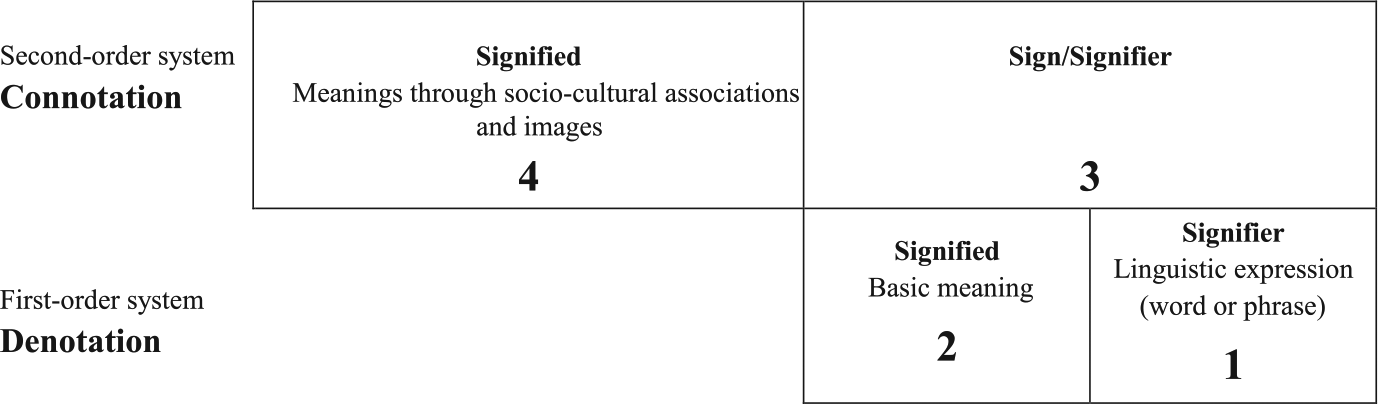
Detail of a metaphor as semiotic chain.
The link between denotation and connotation depends on the context, in this case the discourse of internal branding. This means that social and historical circumstances always play a role in semiotic analyses (Chandler, 2007) in that the meanings and interpretations are not generalizable across the language as in CMT (Cameron, 2008).
Moreover, the semiotic analysis of internal branding metaphors also included examining oppositions. In semiotics, oppositions appear in the form of paired contrasts (e.g. good–bad, mind–body and culture–nature; Chandler, 2007). However, while one part of these paired contrasts is mentioned explicitly, the other is ‘absent’ or non-explicit. This absent part ‘goes without saying’ and indicates consensus about a certain way of thinking in a certain community and is connected to an underlying social value system (Chandler, 2007). In this way, even the absent contrasts can influence the readers’ thoughts. Barthes (1973) argues that semiotic double systems are often charged with a value system corresponding to the interests of the powerful. Discourses and language then are grounded in value systems (Chandler, 2007; Fiol, 1989), but these values remain hidden so that normative messages appear self-evident and natural.
Findings
The key findings of the metaphor analysis highlight that special internal branding metaphors can convey different meanings and messages at the same time in order to address different interest groups. In this section, I present (1) internal branding metaphors and their meanings in internal branding texts, (2) the (sudden) appearance of novel internal branding metaphors in the emerging discourse of internal branding and (3) additional rhetorical features that support the meanings that the metaphors convey.
Internal branding metaphors and their meanings
In this section, I present internal branding metaphors and illustrate their ability to convey different meanings simultaneously due to the interplay of denotations and connotations. The findings show two types of metaphors: metaphors about the entire process of internal branding (the phrases ‘internal branding’ and ‘employee branding’) and metaphor groups about certain aspects of the internal branding process. The metaphor groups are sets of metaphors connected in overarching groups according to their denotations and connotations. The metaphors appear systematically, that is, frequently and across authors and genres, as common intertextual elements.
Metaphors about the entire process of internal branding
The metaphors ‘internal branding’ and ‘employee branding’ are often used synonymously by authors (e.g. Aurand et al., 2005; Boyd and Sutherland, 2006; Devasagayam et al., 2010; Edwards, 2005; Sartain, 2005). These metaphors summarize the idea of internal branding and provide a label for the discourse. The denotations of ‘internal branding’ tell readers that branding, as a marketing tool, should affect the internal side of an organization, namely, its employees. However, a closer look at ‘internal branding’ shows that it is a complex phrase. ‘Branding’ as well as ‘internal’ are metaphors with ‘internal’ referring to the inside not only of organizations (as the denotation suggests) but also to the internal space of individuals (their bodies and minds). These connotations portray internal branding as an enforced process that fundamentally changes the mindsets of employees. Vallaster and De Chernatony (2006), for instance, write about organizations ‘changing their employees’ mindsets’ (p. 768).
The first appearances of the phrase ‘employee branding’ were in three practitioners’ texts: Estell (2002), Farrell (2002) and Mortimer (2002). Davies and Chun (2003) link this phrase to the method of identifying livestock in the 19th century in the United States to which Judson et al. (2009) adds ‘branding in the marketplace is similar to branding on a cattle ranch. The purpose of a branding programme is to differentiate your cow from the other cattle on the range’ (p. 55). Estell (2002) mentions that ‘employee branding’ makes people think about ‘some aspect of cattle ranching’ (p. 42). These authors refer to the original context of the phrase ‘a brand mark on a product or animal’. Commonly, people do not have this in mind when they talk about branding in marketing; however, as mentioned, language is to some extent always figurative (Steen et al., 2010). In this way, the original context resonates with those using the term in a non-explicit way. The non-explicit original context leads to connotations of employees as livestock or cattle, brand marks on employees, or declared ownership of employees. Baumgarth and Schmidt (2010), for example, refer to the ‘brand-owner’s employees’ several times.
These connotations of brand marks on skin are also illustrated in MacLeod et al.’s (2009) article ‘Employee Branding’ as seen in the pictures in Figure 2. In the first picture, a man’s neck shows a tattoo reading ‘Born to work’; in the second, a woman’s ankle bears a tattoo reading ‘I go the extra mile’, a phrase employed in several internal branding articles to describe ‘on-brand behaviour’.

Pictures in an article (MacLeod et al., 2009: 18f).
Metaphor groups about certain aspects of the internal branding process
These findings show three metaphor groups: activation metaphors that depict how the brand gets inside employees, influence metaphors that depict the brand’s growing influence on employees and living metaphors that picture employees turning into living, breathing brands. Table 1 presents examples of the metaphors from texts advocating internal branding.
Examples of metaphors in internal branding texts.
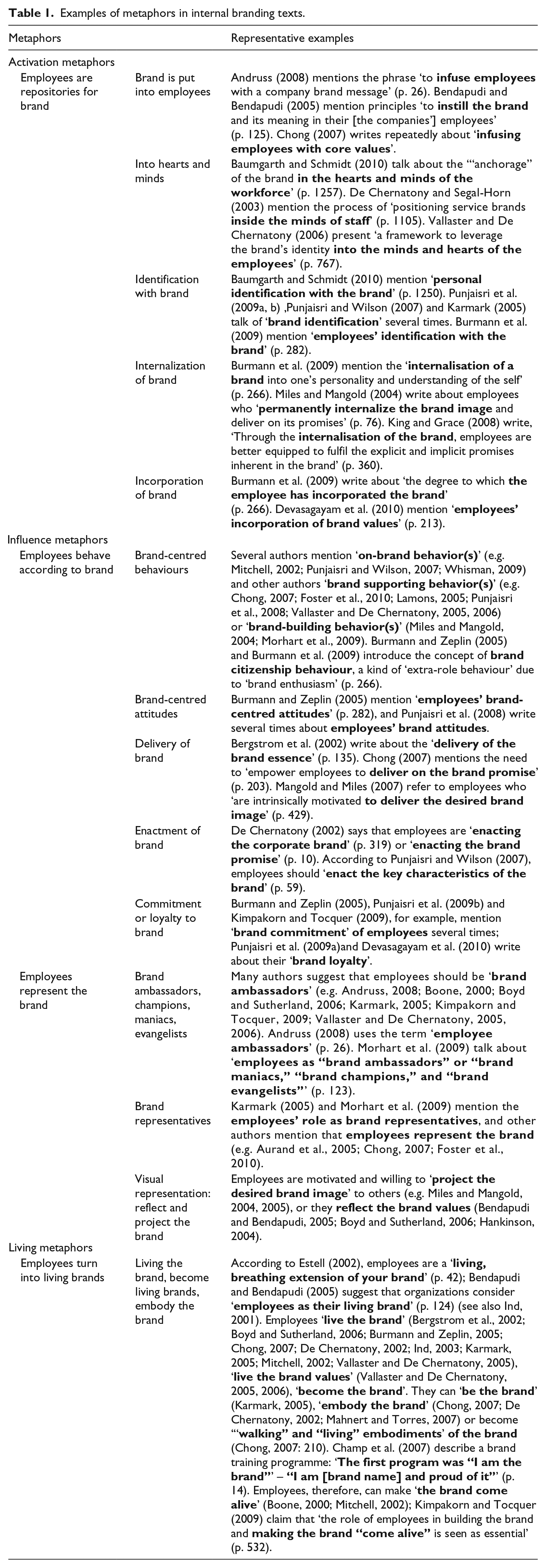
Activations metaphors (e.g. ‘instil’ or ‘infill the brand’ into the ‘hearts and minds’ of employees), and their denotations tell readers that employees learn what the brand means so that they can understand it, support it and establish psychological connections to it. Potential connotations, in contrast, portray employees as repositories, that is, passive recipients, for the brand. These connotations first picture the assimilation of the brand through terms such as ‘instilling’ and ‘infusing’ the brand into employees or ‘anchoring’ it in them. Connotations also focus on the location of the brand in the ‘hearts and minds’ 4 of employees as their internal emotional and cognitive space. Some phrases, such as ‘identifying with’ the brand, ‘internalizing’ or ‘incorporating the brand’, capture this process. Although identification, incorporation and internalization rely on active involvement from employees, the connotations of these terms imply enforced processes of employee involvement that create peculiar tensions. All these metaphors portray the employees’ importance to the brand but primarily through their being repositories for it.
Influence metaphors (e.g. ‘brand behaviour’, ‘brand advocates’ or employees ‘projecting the brand image’ to customers) have the following denotations: (1) the employees’ behaviours and attitudes are in line with the brand; (2) they ‘represent the brand’, act on its behalf and believe in it; and (3) the employees produce or reflect an image based on the brand. Potential connotations, however, revolve around the influence of the brand on employees: employees behave according to the brand’s attributes, and the brand guides the employees in order to develop their commitment or loyalty to the brand. This becomes visible in the employees’ own behaviour and appearance. In this way, the brand controls the employees, depriving them of their freedom and leaving them dependent. The brand turns into a powerful entity that makes the employees appear rather powerless. Some authors of internal branding texts mention ‘brand citizenship behaviour’ (Burmann et al., 2009; Burmann and Zeplin, 2005) which fits well with the connotations of passionate ‘brand ambassadors’ representing the brand to others, ‘brand advocates’, ‘brand champions’, ‘brand apostles’ and ‘brand evangelists’. These metaphors originate in politics, sports and religion, and their connotations portray employees as developing a special kind of loyalty to the brand. Some phrases include visual representation due to employees ‘projecting’ or ‘reflecting’ the brand onto others, while other phrases are about ‘brand commitment’ or ‘brand loyalty’ (employees’ inclination to stay with the brand). Such relations suggest, as already mentioned, that the employees are governed by a brand depicted as being so powerful (a quality frequently mentioned in many texts) that it might override the employees’ autonomy and leave them powerless.
Living metaphors (e.g. ‘living brands’, ‘becoming the brand’ or ‘embody the brand’) should tell the readers, according to the denotations, that the brand plays an important role in both employees’ work-related activities and in their leisure time. Phrases such as ‘living the brand’, ‘embodying the brand’ and ‘being (or becoming) the brand’ appear even in the employee questionnaires used to study internal branding (e.g. Boyd and Sutherland, 2006). The connotations, in contrast, picture employees as actual living breathing brands. They imply that employees indeed are the brand, meaning that the brand defines and controls their entire existence. The connotations thus portray internal branding as a form of alienating transformation and manipulation process. Ultimately, the employee as a ‘living brand’ is objectified and dehumanized, while the brand becomes personified (in the body of the employee). Here, the metaphor and its connotations are bidirectional and ambiguous. In this way, the person becomes the brand but at the same time the brand becomes the person. This outcome points to the producibility of employees as ‘living brands’. Living metaphors are prominent phrases in the internal branding discourse and appear frequently with some authors using them as slogans, titles, page headers or labels instead of the term ‘internal branding’ itself (e.g. Karmark, 2005).
The (sudden) appearance of novel internal branding metaphors
In this section, I present the findings of the quantitative analysis that complements the analysis of the meanings metaphors convey. These findings show the frequencies of different metaphorical phrases in internal branding texts, in different sub-groups of these texts, and in related branding discourses such as corporate branding and employer branding. Moreover, a cross-check of these phrases found in all databases mentioned earlier shows when exactly the discourse around internal branding appeared.
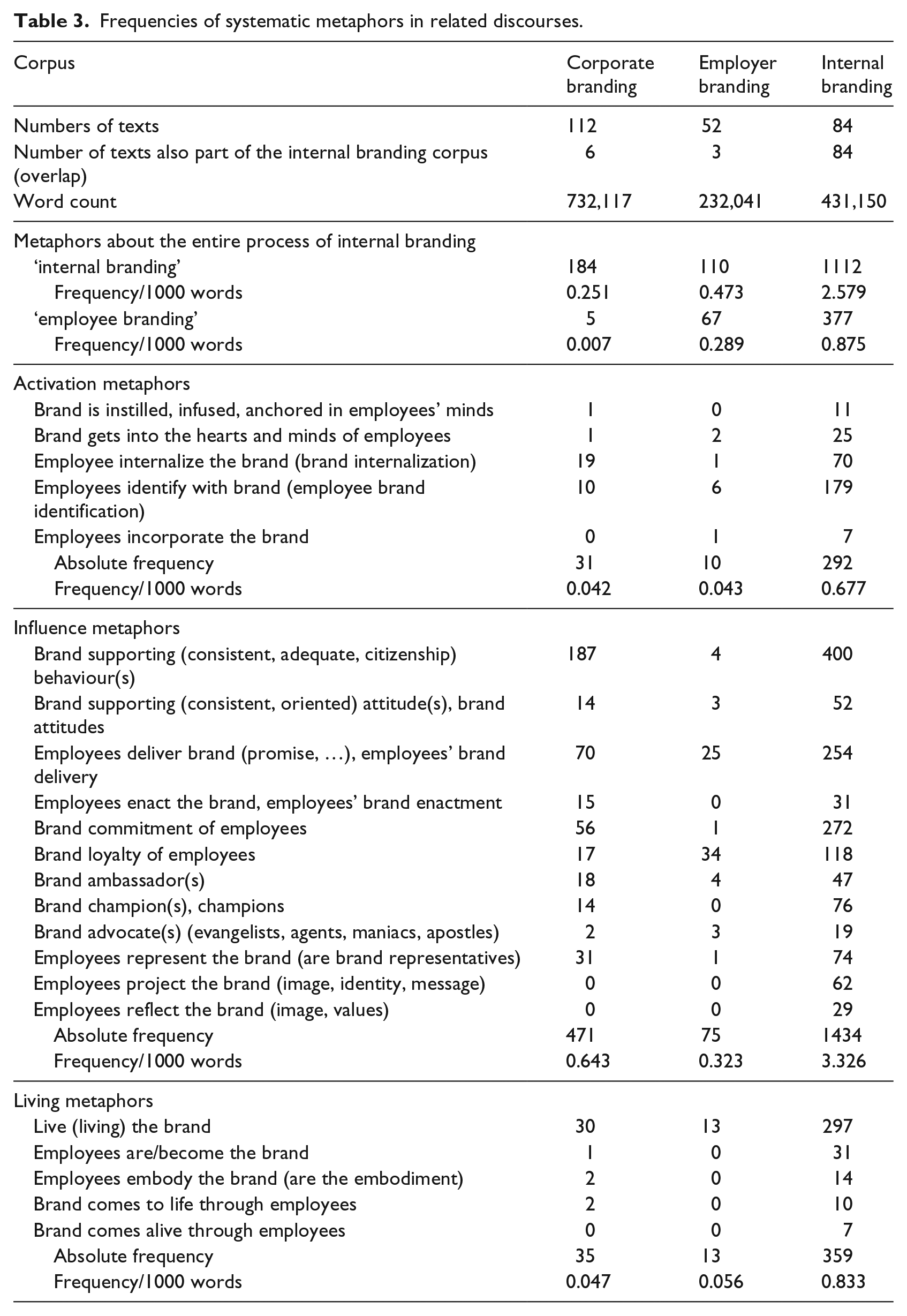
The findings of the frequencies of metaphors (see Tables 2 and 3 5 in Appendix 1) confirmed that the metaphors appear frequently. In all the texts together, I counted a total of 3574 phrases. Of these phrases, internal branding appeared 1112 times in 75 texts, employee branding 377 times in 23 texts, activation metaphors 292 times in 42 texts, influence metaphors 1434 times in 67 texts and living metaphors 359 times in 68 texts. A comparison of frequencies in different sub-groups of texts within the internal branding discourse shows that they appear systematically, that is, across different text sub-groups (academic articles, practitioners’ texts and texts for both) and authors. Table 2 (Appendix 1) shows that only 6 of the 24 metaphorical phrases I searched for do not appear in all three sub-groups.
The systematic search for internal branding texts in all mentioned databases and the cross-check of all metaphors in these databases showed that the metaphors only appeared in the early 2000s – with the exception of one article in 1999 that can be seen as the starting point for the discourse. This means that these metaphors are inherently tied to the discourse of internal branding because they simply did not exist earlier or were not part of any published texts before that time. The metaphors appeared together with the internal branding discourse and were novel at the time in which they appeared.
The findings of the search of the metaphors in all databases also confirmed that the metaphors are not part of other discourses outside of internal branding, employer branding or corporate branding. Nevertheless, the results showed that the metaphor frequencies per 1000 words are significantly higher in the internal branding discourse than in the corporate or employer branding discourses (see Table 3, Appendix 1). The novel metaphorical phrases are thus characteristic of internal branding but not of corporate branding or employer branding. As a result, the quantitative analysis shows that the metaphorical phrases in internal branding texts are novel, systematic, frequent and highly characteristic of the internal branding discourse.
Additional rhetorical features in internal branding texts
The findings also highlight additional rhetorical features that support the meanings the metaphors convey. Reinforcing phrases are strategies used to reinforce the connotations of the metaphors mentioned earlier, and distractions work to either downplay problematic connotations or distract the readers’ attentions.
Reinforcing phrases
Unlike the metaphors that appear systematically in many different texts, reinforcing phrases are isolated metaphorical words or expressions. They build on and extend the connotations of metaphor groups. For example, some phrases elaborate the notion of employees’ religious relationships to the brand. Harris (2007) writes that inward brand management ‘should be the creed by which the whole organization elects to live and breathe’ (p. 104). Bergstrom et al. (2002) state that ‘you do not have the luxury of ten commandments – five or less is ideal’ (p. 136), and Vallaster and De Chernatony (2005) explain that employees have to ‘firmly’ (p. 183) and ‘deeply believe in the brand’s values’ (p. 184).
Other phrases elaborate connotations of living metaphors, particularly the notion of dehumanization of employees through their transformation into living brands. This transformation is bidirectional meaning that while employees ‘humanize’ the brand (Karmark, 2005; Morhart et al., 2009), the process turns them into interchangeable commodities. In other words, the brand ‘creates’ ideal employees. Miles and Mangold (2004), quoting Rafiq and Ahmed (2000), mention the process of ‘creating motivated and customer orientated employees’. Webster (2002) states that ‘[b]rand champion employees must either be systematically found, or created from people with promise’ (p. 1). For Punjaisri et al. (2008), internal branding should ‘create a committed workforce who deliver on the brand promise’ (p. 411). An article is even titled ‘Creating the living brand’ (Bendapudi and Bendapudi, 2005).
Some reinforcing phrases, when taken to extreme, picture the biological reproduction of branded employees as if members of the management were laboratory scientists that produce or clone committed employees. De Chernatony (2002) describes a seminar task for the senior management of a company which is to imagine that they would be able ‘to re-create the very best of their corporate brand on planet Mars […]. However, only five seats are available on the rocket, so the team must select those who are exemplars of the brand’s values’ (p. 123). McKee (2009) talks about nurturing the brand internally ‘to the point that it’s now part of the company’s DNA’ (p. 19). Sartain (2005) describes that in a company the brand was called the ‘Life Engine’ (p. 91), and Harris (2007) adds that ‘[p]eople are the key ingredient in any branding effort’ (p. 113).
Producibility and the quasi-religiousness of internal branding go hand in hand with the loose adaptations of other management concepts that turn the brand into the central concept of managing organizations. Hankinson (2004), for example, talks about ‘managing by brand’ (p. 89), and Boyd and Sutherland (2006) mention ‘human capital branding’. Baumgarth and Schmidt (2010) use the term ‘internal brand equity’ which ‘describes and measures the impetus provided by brand-esteem amongst the brand-owner’s own staff toward brand-supportive behavior’ (p. 1250). Burmann and Zeplin (2005) add that finding the brand essence ‘is not a democratic process, it has to be somewhat totalitarian’ (p. 289). These reinforcing phrases in academic and practitioner texts support and emphasize connotations of the metaphorical phrases and thereby express and maintain management ideologies favouring the ‘brand-owners’.
Distractions
Distractions are explicit statements in the texts that direct the attention of the reader away from potentially problematic connotations and euphemize these connotations through focusing on innocuous meanings instead of problematic ones. For example, while the connotations of ‘internal branding’ or ‘employee branding’ imply that the brand takes ownership of employees, distractions claim that internal branding enables employees to take ownership of the brand (e.g. Andruss, 2010; Devasagayam et al., 2010; Judson et al., 2009; Punjaisri et al., 2009a; Whisman, 2009). Connotations of activation metaphors indicate that the employees’ importance was tied to their being a repository for the brand, but many internal branding texts emphasize the centrality of employees (Andruss, 2008; Boyd and Sutherland, 2006; Foster et al., 2010; Mitchell, 2002; Punjaisri et al., 2008; Vallaster and De Chernatony, 2005).
The connotations of influence metaphors imply that the power of the brand defines and controls employees. However, many articles mention the empowerment of employees through internal branding (e.g. Andruss, 2008; Bergstrom et al., 2002; Burmann and Zeplin, 2005; Chong, 2007; Henkel et al., 2007; Mahnert and Torres, 2007; Miles and Mangold, 2005; Vallaster and De Chernatony, 2005) and focus on expressions that emphasize the employees’ authenticity (Andruss, 2008; Morhart et al., 2009), individuality (Boyd and Sutherland, 2006; Miles and Mangold, 2005; Vallaster and De Chernatony, 2005) and freedom (Bergstrom et al., 2002; Burmann and Zeplin, 2005; Ind, 2003; Kimpakorn and Tocquer, 2009; Morhart et al., 2009). These explicit statements distract the readers’ attention from possibly problematic aspects by downplaying them or by offering statements that appear less problematic or even positive. In doing so, distractions can reduce concerns linked to potentially problematic connotations of metaphors.
Discussion
The key findings of this article highlight that certain internal branding metaphors which were novel at the time the discourse was emerging provide linguistic framing of the idea of internal branding in a very special way. As complex metaphorical phrases, the metaphors can convey double messages and euphemize problematic aspects of internal branding. Furthermore, these metaphors are connected to an implicit value system that values brands higher than employees and present the brand as pivot point of employee–employer relationships. I discuss these points in more detail in this section.
Internal branding is a development from the normative concept of culture management (Edwards, 2005; Kornberger, 2010; Müller, 2017), but it involves a new ingredient – the brand – as a central element. While culture management is about employees becoming part of a collective corporate culture, internal branding promotes the idea of employees actually ‘being’ the brand message in order to communicate that message to others. The newness of the idea of employees as branded entities (Edwards, 2005) called for ‘linguistic framing’, a set of expressions that facilitate the public acceptance of unexpected events or new trends (Hirsch, 1986). The findings of the quantitative analysis confirm that the metaphors were novel at the time the discourse was emerging, that they are appearing frequently and systematically in different types of text and that they are highly characteristic for the internal branding discourse. Thus, this study shows that internal branding metaphors provide the linguistic framing for the idea of branded employees, meaning that the metaphors make it possible to think and express that employees turned into brand messages.
Internal branding metaphors, nevertheless, provide linguistic framing in a very specific way due to their complex structure. In the recurring metaphorical phrases I analysed, the metaphorical meaning is often based on several parts of the phrase. As mentioned earlier, either two metaphors come together and turn into a kind of double metaphor (e.g. in ‘brand ambassador’ or ‘internal branding’), or one part of the phrase – typically ‘brand’ or ‘branding’ – turns other parts into metaphors as well (e.g. ‘deliver the brand’ or ‘living the brand’) and heightens the metaphoricity of the entire phrase. In this way, these metaphors work as complex semiotic double systems of meaning. The phrases present one layer of meaning, usually denotation, as dominant. Connotations are often powerful visual images but, at the same time, are shapeless and fleeting (Barthes, 1973). The metaphors can, therefore, convey different and even conflicting messages simultaneously. The denotations describe internal branding as empowering employees to be autonomous and encouraging them to take control over the brand, whereas connotations paint a picture of employees being controlled by the brand and having to represent the brand to others. In this way, internal branding metaphors can convey double messages in the form of conflicting promises to different interest groups. Promises of employee control through internal branding are made to organizations and promises of empowerment and autonomy through internal branding are made to employees.
The internal branding metaphors can also convey problematic connotations in a euphemistic way by emphasizing innocuous meanings instead of problematic connotations (e.g. employees as cattle would be problematic). As discussed earlier, critics of internal branding question its normalizing effects on employees, its ethicality and intentions (Edwards, 2005; Harquail, 2007; Mitchell, 2004). Mitchell (2004), for instance, critiques internal branding as ‘Stepford wife branding’ creating branded robots. Taken to the extreme, we can see two themes that are typical of science fiction stories: an alien entity that is taking over human bodies and minds and the cloning of human beings. Stories such as ‘The Body Snatchers’ (1955) in which seeds from space replace people through plant-based pods or ‘Moon’ (2009) in which an employee is cloned several times by his employer are examples of these themes. However, as the internal branding metaphors can convey double messages and present innocuous meanings as the dominant ones, problematic meanings remain in the background. Additional rhetorical features in the form of distractions work to downplay these problematic ideas or distract the readers’ attention. In this way, the internal branding metaphors are engaging in doublespeak or, in this case, brandspeak as a kind of brand-related doublespeak.
What is not said or goes without saying in the internal branding discourse typically points to implicit, underlying assumptions. In semiotics, it is the oppositions that can tell us more about what is not being said. The oppositions are paired contrasts which are connected to hidden value systems working in the interest of the powerful (Barthes, 1973; Chandler, 2007). The value system in the case of internal branding is not only about defining brand strength by (a lack of) employee autonomy and vice versa but about positioning brands as essential and valuable while employees are seen as replaceable. In this way, the metaphors and internal branding discourse reflect not only the tensions around increasingly precarious working conditions but also the interconnected fact that brands have become intangible assets of sometimes substantial monetizable value.
The metaphors, as mentioned, point to the increasing importance of brands in strategic and financial terms (Willmott, 2010), especially for companies with widely known brands. The term ‘brand strength’ (which internal branding authors mention frequently and explicitly) is closely tied to brand equity or the value of the brand as a separate asset that can be sold or included in a balance sheet (Wood, 2000). Although culture management is also based on economic goals rather than employee satisfaction, internal branding ties employees as financial value to the brand in a direct way. Internal brand equity, which revolves around ‘brand-esteem amongst the brand-owner’s own staff’ (Baumgarth and Schmidt, 2010: 1250), connects the employees’ performance with the financial value of the brand through their behaviours, attitudes, outward appearance and language use. The employees’ feelings of being so closely connected to the brand, according to internal branding advocates such as Bergstrom (2002), may even influence them to accept ‘somewhat less in terms of benefits and compensation’ (p. 138). The most important duty of employees, it appears, is to display a high level of ‘brandedness’ to increase the internal branding equity of the company although this might not pay off for them in financial terms.
The financial value of brands is also based on external audiences and their evaluation of the company and its products. While the internal branding discourse focuses on branding the ‘internal side’ of organizations, it is always the outside audience that needs to be addressed through employees as the branded entities. Especially, metaphorical phrases such as ‘projecting the brand’ or ‘brand ambassadors’ point toward these external audiences that can evaluate the employees according to the degree of their ‘brandedness’ which leads to ‘brand-centred control’, as Müller (2017) illustrates. Brand-centred control engages external audiences as additional sources of normative control of employees. Thus, internal branding is a tightening of traditional normative control of employees whose main purpose is to add value to the brand through their enactment of brand messages.
Internal branding metaphors, with ‘brand’ or ‘branding’ as central parts of the phrases, present the brand as a pivotal point in the relationship between employees and companies. This rhetorical construction of the brand as being central is mirrored by internal branding practices in organizations where the brand is now often the basis for recruitment, socialization processes and reward (and even punishment) systems (Harquail, 2007). Through rhetorically constructing the brand as the valuable part of employment relationships, the internal branding discourse also constructs a picture of employees as necessary but exchangeable resources. And while employees are told that they are a valuable and central part of the organization (e.g. the ‘distractions’ in the texts mention empowerment, authenticity, etc.), organizations increasingly offer them short-term, temporary or contract work to cut labour and benefits costs (Kalleberg, 2000, 2009; Mumby, 2016; Smith, 1997, 2010; Vallas and Cummins, 2015).
The metaphors and oppositions hide a value system that favours the interests of organizations that demand a flexible workforce at the expense of the interests of shop floor employees. The metaphors, however, also reinforce the tensions around precarity by pointing out an acceptable or even commonsensical solution for employees, namely, to passionately embrace the brand and become ‘living breathing brands’. Mumby (2016), drawing on Dean (2009), argues that branding has become a central discursive mechanism of ‘communicative capitalism’, in which brands influence and indeed regulate the employees’ self-understanding through calling for deep emotional attachment to the brand albeit in a context that is increasingly characterized by precarity, instability and affective states of anxiety. In this way, internal branding becomes a means by which employees can manage their insecurity and anxiety through ‘providing the opportunity to internalize norms and values that provide a sense of stability, however temporary’ (Mumby, 2016: 899). The skill of knowing how to be an enthusiastic ‘brand ambassador’, how to ‘deliver the brand’ and how to ‘live the brand’ might thus be the most important skills for employees to gain useful experience for future jobs in other companies (see Vallas and Cummins, 2015). The requirements for employees to ‘enact’ the brand then turn into a condition for and of their employment. Because the ultimate goal of internal branding is defined in economic terms, the brand becomes the financially valuable central element, whereas employees are seen as exchangeable resources and vessels for the brand.
Conclusion
In this article, I presented complex metaphorical phrases in academic and practitioner texts advocating internal branding. This article illustrates the important role of metaphors in rhetorically constructing the normative idea of internal branding and shows what meanings these metaphors convey about internal branding and about employees’ relationship with their companies. Thus, it makes important contributions to the literature on branding, but it also contributes to the literature on language and discourse in critical management studies through advancing our knowledge of metaphors and the role of internal branding metaphors in communicative capitalism (Mumby, 2016).
This article advances our knowledge of metaphors in organizational research (e.g. Cornelissen et al., 2008; Morgan, 1980; Oswick et al., 2002) through presenting how complex and frequently recurring metaphors work as semiotic double systems of meaning. Because metaphoricity is tied to more than one word, internal branding metaphors can convey different and even conflicting messages to different stakeholder and interest groups. In this way, they work as special kind of linguistic framing (Hirsch, 1986). This paper also adds to Willmott’s (1993) classic article on culture management in which he mentions the simultaneous affirmation and negation of employee autonomy. The semiotic analysis of metaphors done in this article shows how this paradoxical mixture of messages works on a micro-level of language. This knowledge can also be beneficial for employees. In many companies, the metaphors I analysed in texts on internal branding are also a typical part of their internal communication with their employees (along the lines of ‘Become a brand ambassador and live the brand so that other people can experience the brand through you’). Seeing through these rhetorical figures designed to euphemize management concepts that are first and foremost beneficial for the company can empower employees to unveil and problematize the power effects inherent in the language around such management ideas. A better understanding of the rhetorical mechanisms of complex metaphors can also fuel further research into language use in the field of organizational and management research. The semiotic approach to analysing metaphors I proposed in this article offers the possibility to analyse complex metaphorical phrases. This ability is essential because (novel) metaphors are often phrases or even neologisms, that is, are a combination of two words that have melded into each other (e.g. ‘brandividual’ 6 is a melding of brand and individual).
Moreover, this article adds to the critical literature on internal branding (Brannan et al., 2015; Edwards, 2005; Land and Taylor, 2010) and branding more generally (Mumby, 2016; Willmott, 2010). According to Willmott (2010), organizational and management studies have long overlooked the importance of branding in ‘shaping the identity, strategy and structure of organizations’ (p. 523), and thus, we need to advance our knowledge of this topic. This paper furthers our understanding of internal branding by highlighting how the internal branding discourse is tied to an implicit and ‘silent’ value system that considers brands as being more valuable (in financial terms and when it comes to employee–employer relationships) than employees as exchangeable vessels for the brand. This insight is in line with Willmott’s (2010) observation that brands have turned into financial assets and that brands always involve external audiences (customers, fans and the wider public) to which employees have to communicate and represent the brand message (Edwards, 2005; Müller, 2017). This article also sheds light on how internal branding texts are part of the discursive mechanisms of ‘communicative capitalism’ in which employees should emotionally attach themselves to brands even in the face of increasingly insecure and precarious employment conditions (Mumby, 2016).
The internal branding metaphors reflect these tensions around precarious employment conditions for employees (Kalleberg, 2009; Smith, 2010; Vallas and Cummins, 2015), but at the same time, they also reinforce these tensions through encouraging employees to enthusiastically embrace the brand and become ‘brand ambassadors’ or ‘living brands’.
Footnotes
Appendix 1
Appendix 1
Frequencies of systematic metaphors in related discourses.
| Corpus | Corporate branding | Employer branding | Internal branding |
|---|---|---|---|
| Numbers of texts | 112 | 52 | 84 |
| Number of texts also part of the internal branding corpus (overlap) | 6 | 3 | 84 |
| Word count | 732,117 | 232,041 | 431,150 |
| Metaphors about the entire process of internal branding | |||
| ‘internal branding’ | 184 | 110 | 1112 |
| Frequency/1000 words | 0.251 | 0.473 | 2.579 |
| ‘employee branding’ | 5 | 67 | 377 |
| Frequency/1000 words | 0.007 | 0.289 | 0.875 |
| Activation metaphors | |||
| Brand is instilled, infused, anchored in employees’ minds | 1 | 0 | 11 |
| Brand gets into the hearts and minds of employees | 1 | 2 | 25 |
| Employee internalize the brand (brand internalization) | 19 | 1 | 70 |
| Employees identify with brand (employee brand identification) | 10 | 6 | 179 |
| Employees incorporate the brand | 0 | 1 | 7 |
| Absolute frequency | 31 | 10 | 292 |
| Frequency/1000 words | 0.042 | 0.043 | 0.677 |
| Influence metaphors | |||
| Brand supporting (consistent, adequate, citizenship) behaviour(s) | 187 | 4 | 400 |
| Brand supporting (consistent, oriented) attitude(s), brand attitudes | 14 | 3 | 52 |
| Employees deliver brand (promise, …), employees’ brand delivery | 70 | 25 | 254 |
| Employees enact the brand, employees’ brand enactment | 15 | 0 | 31 |
| Brand commitment of employees | 56 | 1 | 272 |
| Brand loyalty of employees | 17 | 34 | 118 |
| Brand ambassador(s) | 18 | 4 | 47 |
| Brand champion(s), champions | 14 | 0 | 76 |
| Brand advocate(s) (evangelists, agents, maniacs, apostles) | 2 | 3 | 19 |
| Employees represent the brand (are brand representatives) | 31 | 1 | 74 |
| Employees project the brand (image, identity, message) | 0 | 0 | 62 |
| Employees reflect the brand (image, values) | 0 | 0 | 29 |
| Absolute frequency | 471 | 75 | 1434 |
| Frequency/1000 words | 0.643 | 0.323 | 3.326 |
| Living metaphors | |||
| Live (living) the brand | 30 | 13 | 297 |
| Employees are/become the brand | 1 | 0 | 31 |
| Employees embody the brand (are the embodiment) | 2 | 0 | 14 |
| Brand comes to life through employees | 2 | 0 | 10 |
| Brand comes alive through employees | 0 | 0 | 7 |
| Absolute frequency | 35 | 13 | 359 |
| Frequency/1000 words | 0.047 | 0.056 | 0.833 |
Acknowledgements
I would like to thank the editor, the anonymous reviewers, Christian Huber and André Spicer for helpful comments on earlier versions of the article.