




Abstract
Management and organization studies commentary on how authors experience peer review of journal papers suggests that it can be an overly interventionist process which reduces the originality and coherence of eventual publications. In the literature on co-authorship, this argument is reversed. Here, free riders who do not contribute fully to research collaborations and the practice of gift authorships are problematized, and it is argued that everyone involved in writing a published paper should be rewarded with co-authorship. In this article, qualitative interviews with 12 management and organization studies academics see respondents describing peer review as a transaction during which reviewers – and editors – actually co-author published papers. But their perspectives on this vary with the subject position from which they are speaking. When they speak as reviewers or editors, this co-authorship is depicted as a collegiate gift, a professional obligation or a process where authors might over-rely on reviewers’ generosity. When they speak as authors or their proxies, it is characterized as reproducing disciplinary orthodoxy and ethnocentric exclusion, perpetuating disciplinary cliques, creating disorganized papers and constituting excessive interference with authorial privilege. These various perspectives on peer review deserve more attention in our empirical studies of academic labour. They also suggest we should reflect more on when, how and why we collaborate in our research and on how much we should recognize additional co-authors on (or resist their input into) ‘our’ work.
Introduction: peer review and its discontents
Occupying the roles of author, reviewer and later editor for management and organization studies (MOS) journals for nearly three decades has made me curious about how colleagues understand and experience these roles. My focus on journal papers here derives partly from this curiosity and partly from their being – in the United Kingdom anyway – the ‘gold standard’ MOS output. I use qualitative interviews focusing on the peer review of journal papers with MOS academics to explore the claim that at reviewers’ and editors’ insistence and often across multiple rounds of review, manuscripts are revised so as to dilute their originality and/or render them incoherent. Authors – this argument suggests – comply for career-related reasons, including securing employment or tenure, salary increases and promotions.
In my data, the respondents characterize peer review as a process whereby the authorship of published journal papers often becomes collective because reviewers – and editors – play a major role in their development. But participants describe this co-authorship in different ways, varying with the role from which they are speaking. When they speak as reviewers or editors, for instance, it is depicted as collegiate gift labour or a quid pro quo for having their own work reviewed. But when they speak as authors or their proxies, the practice becomes something that reproduces disciplinary cliques, say, or comprises illegitimate meddling with authorial prerogative.
Peer review of academic journal articles dates back to the late 17th century when the first journals were established to assist editors with manuscript selection. As these journals were invented to facilitate written academic exchange, scholars sought authentication of their work before publication, and learned societies and academies required a system to assure public confidence in and the legitimacy of what was published (Bedeian, 2004; Day, 2011). Peer review became commonplace after the Second World War due to the increasing number and complexity of journal submissions (Macdonald, 2015). In contemporary MOS, Ortinau (2011: 152) describes reviewers as ‘journal editors’ lifeblood’, and Davis (2014) says reviewing is the ‘core technology’ of any journal.
From the reviewer’s perspective, there is also more reviewing to be done. Parker (2013) suggests the tide began to turn in MOS in the 1990s when publishers realized the considerable profits journals could generate, given the externalization of most production costs to universities. Starbuck (2013: 715) says the volume of publications in business journals increased by 11.04% annually between 1999 and 2009, excluding the presumably much larger number of rejections. Since the mid-1980s, Spector (cited in Tsang and Frey, 2007: 129) claims, the length of reviews has likewise increased exponentially and authors are now expected to deliver point-by-point responses in their resubmissions. As such, it is commonly claimed that peer review is labour-intensive and that good reviewers often end up being overloaded (Bedeian, 2003, 2004; MacInnis, 2003; Nakata, 2003; Ostrom, 2003).
Gabriel (2010) agrees that MOS journal publishing has changed substantially and that the unpaid work we do in (re)writing and reviewing for, and editing, journals has burgeoned. Similarly, Bedeian (2004) quotes Glenn in describing reviewing as a form of ‘charity work’ (p. 211), and Carpenter (2009: 192) calls it a ‘public good’. MOS academics are generally expected to undertake peer review as a matter of course above and beyond their institutional workload, and it is typically not acknowledged in performance evaluations (Feldman, 2004; Macdonald, 2015; Nakata, 2003).
Relatedly, MOS peer review is said to be undervalued by publishers. Beverungen et al. (2012) suggest publishers’ profit margins are ‘unheard of practically anywhere else in the economy’ because they appropriate publicly funded academic labour by securing property rights to the knowledge produced and selling it back to the academy at inflated prices (p. 931). This critique, as Davis (2014: 194) notes, is widespread. Beverungen et al. (2012: 932) acknowledge the individual gains from publishing in or editing highly ranked journals. But they insist peer review itself reaps ‘very few direct benefits’ and is often undertaken at the weekend or in the evenings.
Furthermore, because it determines whether our papers appear in print – and where – peer review informs decisions around academic recruitment, tenure, salary and promotion and affects scholars’ and universities’ reputations more generally. The growing number of MOS journals also means our decisions on where to submit manuscripts are increasingly governed by journal rankings. This is said to represent a significant disadvantage for those not employed by ‘institutions which ha[ve] the infrastructure to support successful [journal] submissions’ (Parker, 2013: 469).
The above notwithstanding, the criticism of peer review I concentrate on here is that it often involves interference with authorial privilege without improving the quality of published papers. I draw on qualitative, first-person accounts from MOS academics in various locations and at various career stages. Extant MOS scholarship on peer review, in contrast, is based on content analysis of publications (Alvesson and Sandberg, 2011; Sandberg and Alvesson, 2011), theoretical discussion (Bedeian, 2004; Driver, 2007), quantitative survey data (Bedeian, 2003; Bedeian et al., 2010), use of secondary data to reach statistical conclusions (Starbuck, 2005) or (the most common approach) meta-review and/or editorial commentary incorporating personal experience and reflection. 1 I have found no interview-based accounts in this scholarship to date.
There is also an emerging commentary on academic capitalism in MOS, some of which discusses the insidious effects of the neoliberalization of higher education on research. Again, though, this work comprises mainly of meta-review and editorial commentary. Butler and Spoelstra’s (2012, 2014) research on the notion of excellence in MOS probably comes closest to my project: it uses data from qualitative interviews with academics and indexes peer review for higher ranking outlets as ‘so rigorous and exacting as to inadvertently produce bland or trivial results’ (Butler and Spoelstra, 2012: 897). However, the central emphasis is excellence. While peer review appears in their data, it is not the primary focus of Butler and Spoelstra’s work.
Next, I discuss MOS descriptions of peer review as overly interventionist. Given what emerged from my data, I then summarize MOS discussions of co-authorship before outlining my methodology. My findings follow, outlining the various ways in which the respondents characterized the co-authorship they identified in the peer review process.
Peer review in MOS
It is often suggested that peer review for MOS journals can – among its other demerits – generate insubstantial, unwieldy publications because of excessive reviewer and editor tampering. Ashforth (2005) argues peer review leads to insignificant papers being published which make only incremental contributions to knowledge. These papers are metaphorical ‘vanilla pudding’, bland comfort food of little nutritional value. Nakata (2003: 346) agrees reviewers in MOS tend to disdain the ‘messy, provocative, and envelope-pushing’, and marketing scholar Ortinau (2011: 150), based on evidence from previous studies, goes as far as claiming that
only a small percentage (about 3%) of the articles appearing in prestige journals contain meaningful important scientific contributions concerning new innovative, important, and/or useful insights that enhance the body of marketing knowledge.
Relatedly, Starbuck (2003) suggests MOS reviewers’ advice regularly echoes generally held beliefs about – say – ‘proper’ methodology. Elsewhere, he says these beliefs can be inaccurate, identifying statistical significance as especially badly misunderstood (Starbuck, 2013: 708). Bedeian (2004) says authors may be at the mercy of reviewers’ idiosyncrasy and whimsy, and Macdonald (2015) argues against any notion of peer review as a quality control mechanism. Since the advent of impact factors in the 1960s, he asserts, reviewers have become concerned with papers’ citability over their quality ‘because originality threatens established thinking, but also because heresy is not as citable’ (p. 271). Macdonald suggests reviewers now act as disciplinarians who ensure compliance with a field’s normative expectations, which in its turn benefits established academics.
Özkazanç-Pan (2012) echoes these arguments, quoting Audre Lorde to the effect that ‘the master’s tools will never dismantle the master’s house. They may allow us temporarily to beat him at his own game, but they will never enable us to bring about genuine change’ (p. 209). Özkazanç-Pan’s point is that, to be publishable, critical MOS scholars may have to ape the methodologies and concepts of mainstream MOS enough to seem palatable. According to Sandberg and Alvesson (2011; see also Alvesson and Sandberg, 2011), this conservatism rebounds in the formulation of research questions. Their analysis of articles in leading MOS journals suggests we frequently engage in low-risk ‘gap-spotting’. This does not problematize assumptions built into earlier scholarship, and so we write papers which fail to ‘challenge already influential theories’ (p. 25) to increase their chances of being accepted.
On the related subject of authors’ autonomy, Bedeian’s (2003) survey of lead authors of papers appearing in the Academy of Management Journal and the Academy of Management Review indicates almost 25% felt pressurized to make changes to their work based on reviewers’ or editors’ recommendations with which they disagreed. Elsewhere, Bedeian (2004) describes reviewers as ‘ghost-writers’, 2 citing Frey’s observation that publishing in journals is effectively intellectual prostitution (pp. 207, 209). As such, peer review is said to often undermine individual researchers’ autonomy without necessarily improving the quality of their work. At minimum, De Rond and Miller (2005) describe it as a process where authors ‘negotiate’ with editors and reviewers ‘about which revision requests to accept and how they should be made’ (p. 325).
Regarding coherence, Ashforth (2005: 401) says some editors ‘think that their job entails little more than writing glorified form letters telling the author to make the cacophony of reviewers happy’, and Tsang and Frey (2007: 131) quote Murnighan’s experience of having a paper accepted by Administrative Science Quarterly, having rewritten the manuscript so that it was ‘all things to all people’. Gabriel (2010) also draws attention to our (over-)compliance with reviewer recommendations, ‘citing authors one does not care for, engaging with arguments one is not interested in and seeking to satisfy different harsh masters, often with conflicting or incompatible demands’ (p. 764). He agrees this can produce ‘overextended’, flabby manuscripts, full of ‘superfluous references’ and lacking originality (Gabriel, 2010: 765).
Some MOS scholars advance explanations for this reviewer meddling. Bedeian (2003, 2004) and Tsang and Frey (2007) identify competitiveness between academics; apathy – there are usually no significant consequences for reviewers from their reviews, and rarely an authorial right of reply; and impression management, so reviewers appear conscientious to editors. This generates a ‘criticism bias’ according to one of Bedeian’s (2003: 336) respondents or what Van Lange (cited in Tsang, 2013: 168) calls the SLAM mode of review – Stressing the Limiting Aspects of Manuscripts. Similarly, Miller (2006) refers to complexity bias (the more, the better) as well as confirmation bias (Ashforth’s vanilla pudding conundrum, where orthodox papers get an easier ride), such that selecting reviewers for ‘fit’ with a manuscript may also entail ‘homosocial reproduction’ (p. 428).
Additionally, Meriläinen et al. (2008) claim MOS peer review is characterized by ‘core-periphery relations between the Anglophone core and peripheral countries such as Finland’, which both camps perpetuate in writing and reviewing (p. 584). The resulting ‘discursive closure’ means academics who do not have English as a first language must write in English, with the attendant issues of translation, and also make studies of their home contexts interesting for those raised as Anglophone. This does not apply in reverse, so the ‘hegemonic practices’ of academia reflected in peer review ‘organiz[e] whose theories count and whose work is cited, whose experience is valued and whose empirical data is deemed interesting and relevant’ (p. 588; also see Raelin, 2008: 127).
Overall, this MOS commentary suggests peer review frequently upholds disciplinary orthodoxy and undermines individual researchers’ autonomy, weakening any contribution without improving the quality of the work – indeed likely damaging it and reducing its coherence. Of course, as Bedeian (2004) suggests, if all knowledge is socially constructed anyway, then ‘advances’ can only be achieved via ‘social definition’ (p. 199). Peer review from this perspective (re)produces ‘the acceptable content, positioning, and form of new contributions’ (Bedeian, 2004: 200, following Myers). Equally, Starbuck (2003) claims,
It is people, acting collectively, that determine what is significant and essential. Processes of communication, social influence, and consensus building transform the insignificant into the significant, the inessential into the essential, the irrelevant into the interesting, perceptions into facts, conjectures into theories, beliefs into truths. (p. 348)
Raelin (2008) says Bedeian’s arguments could lead us to conclude that ‘the author may be thought of as the initiator but not necessarily the sole proprietor of the work’ (p. 126). Raelin likens this viewpoint to Umberto Eco’s take on music composition, where both musical scores and manuscripts are understood as ‘unbounded and open and thus susceptible to alternative interpretations’. Given its strong overtones of peer review as co-authorship, his claim is a useful gateway into the remainder of this article. Whereas MOS complaints about peer review often concern the apparent death of the author, Raelin suggests a more appropriate understanding is that the author originates but only ever co-owns a publication.
I now move to consider MOS discussions of co-authorship.
Co-authorship in MOS
This literature begins from the premise that, nowadays, MOS ‘teams – rather than individuals – are increasingly dominating the production of impactful published works’ (Jonsen et al., 2012: 394). Some contributors use network analysis to interrogate co-authorship patterns in fields, including consumer behaviour (Eaton et al., 1999), family business (Debicki et al., 2009), international business (Chan et al., 2008), marketing (Goldenberg et al., 2010) and service management (Martins et al., 2012). The same approach is used to explore these connections in individual journals, such as Public Administration Review (Slack et al., 1996), the Journal of Personal Selling & Sales Management (Yang et al., 2009) and the Journal of Purchasing and Supply Management (Wynstra, 2010). This scholarship often links patterns of co-authorship to author productivity or manuscript quality or offers lessons on networking within and across fields.
In a variation on this theme, Zupic and Čater (2015) outline the elements of science mapping, a form of bibliometrics – one being co-author analysis. They provide recommendations for undertaking science mapping to review and critique extant literature. Their argument is similar to those offered by Chan et al. (2008), Debicki et al. (2009) and Wynstra (2010), who also provide suggestions for future research on the basis of their network analyses.
But, as Zupic and Čater (2015) add,
Co-authorship as a measure of collaboration assumes that authoring a publication is synonymous with being responsible for the work done. However, just because a person’s name appears as a co-author of a scientific article, it is not necessarily because they contributed a significant amount of work but could be purely ‘honorary authorship’ for social or other reasons … On the other hand, there might be scientists who contributed to the work but whose names do not appear on the author sheet. (p. 435)
Indeed, another strand of research explores the politics and ethics of MOS co-authorship. Bennett and Kidwell (2001) suggest collaborations between MOS researchers can be affected by the free rider problem, so affective relationships within these groups have a profound influence on whether collaborations endure. Along similar lines, Manton and English (2008) report findings from a survey of 442 faculty at 30 Association to Advance Collegiate Schools of Business (AACSB)-accredited business schools. About 35.6% said they had published a paper with someone who had made very little contribution to the research. Nearly 10% said they had done this with a co-author who made no contribution. A later study by Manton et al. (2012) recruited 698 survey respondents, 646 of whom had co-authored at least one paper. About 80% knew a colleague who had received a gift authorship (which Zupic and Čater call an honorary authorship), 58% of those with experience of co-authoring had credited a co-author who had done very little and 18% had done so with a co-author who contributed nothing. Yet 75% of respondents overall identified gift authorships as unethical.
A relevant development here is the Committee on Publication Ethics (COPE), established in 1997 by a group of UK editors of medical journals. At the time of writing, more than 11,000 journals across the world, representing many different disciplines, are members. Its website
3
says the organization
provides advice to editors and publishers on all aspects of publication ethics and, in particular, how to handle cases of research and publication misconduct. It also provides a forum for its members to discuss individual cases. COPE does not investigate individual cases but encourages editors to ensure that cases are investigated by the appropriate authorities (usually a research institution or employer).
COPE also offers training to incoming journal editors on issues like plagiarism and authorship, runs annual conferences and funds research into publication ethics.
Although Organization is not a member, its Submission Guidelines make direct reference to the COPE position statement ‘Responsible research publications: international standards for authors’ (Wager and Kleinert, 2011). This emphasizes the importance of ‘Appropriate authorship and acknowledgement’, elaborating as follows:
Researchers should ensure that only those individuals who meet authorship criteria (i.e. made a substantial contribution to the work) are rewarded with authorship, and that deserving authors are not omitted. Institutions and journal editors should encourage practices that prevent guest, gift, and ghost authorship. (Wager and Kleinert, 2011: 315)
Indeed, Organization stipulates in the Authorship section of the same guidelines
4
that
where authorship of [an] article is contested, we reserve the right to take action including, but not limited to: publishing an erratum or corrigendum (correction); retracting the article (removing it from the journal); taking up the matter with the head of department or dean of the author’s institution and/or relevant academic bodies or societies; banning the author from publication in the journal or all SAGE journals, or appropriate legal action.
To (re)summarize the relevant MOS literature on peer review, then, a lot has been said on illegitimate reviewer (/editorial) interference with authorial autonomy. This commentary also underlines the incoherence resulting from authors pulling a manuscript in different directions during peer review. In contrast, the focus in MOS co-authorship literature on politics and ethics suggests free-riding in research teams, and gift authorships are extremely problematic, leading to individuals being over- or under-rewarded for their (non-)investment in a manuscript. Yet these practices are seemingly not uncommon, despite the existence of organizations like COPE.
I turn now to methodological considerations. As suggested earlier, I have not located any MOS commentary on peer review which makes use of interviews. Collecting qualitative, first-person accounts from colleagues therefore presented itself as a useful way of contributing to this literature methodologically.
Methodology
When interviewing my 12 respondents, I used a semi-structured approach. This meant I could cover issues suggested by my experiences of peer review and the relevant literature while allowing respondents to use their own words to answer questions and direct the flow of each interview to some extent. In recruiting participants, I relied solely on my personal and professional networks to reduce any ‘cold calling’ problems, also taking into account gender, career stage, location and first language to ensure some diversity among the group. Table 1 gives biographical details for each respondent.
Respondent biodata.
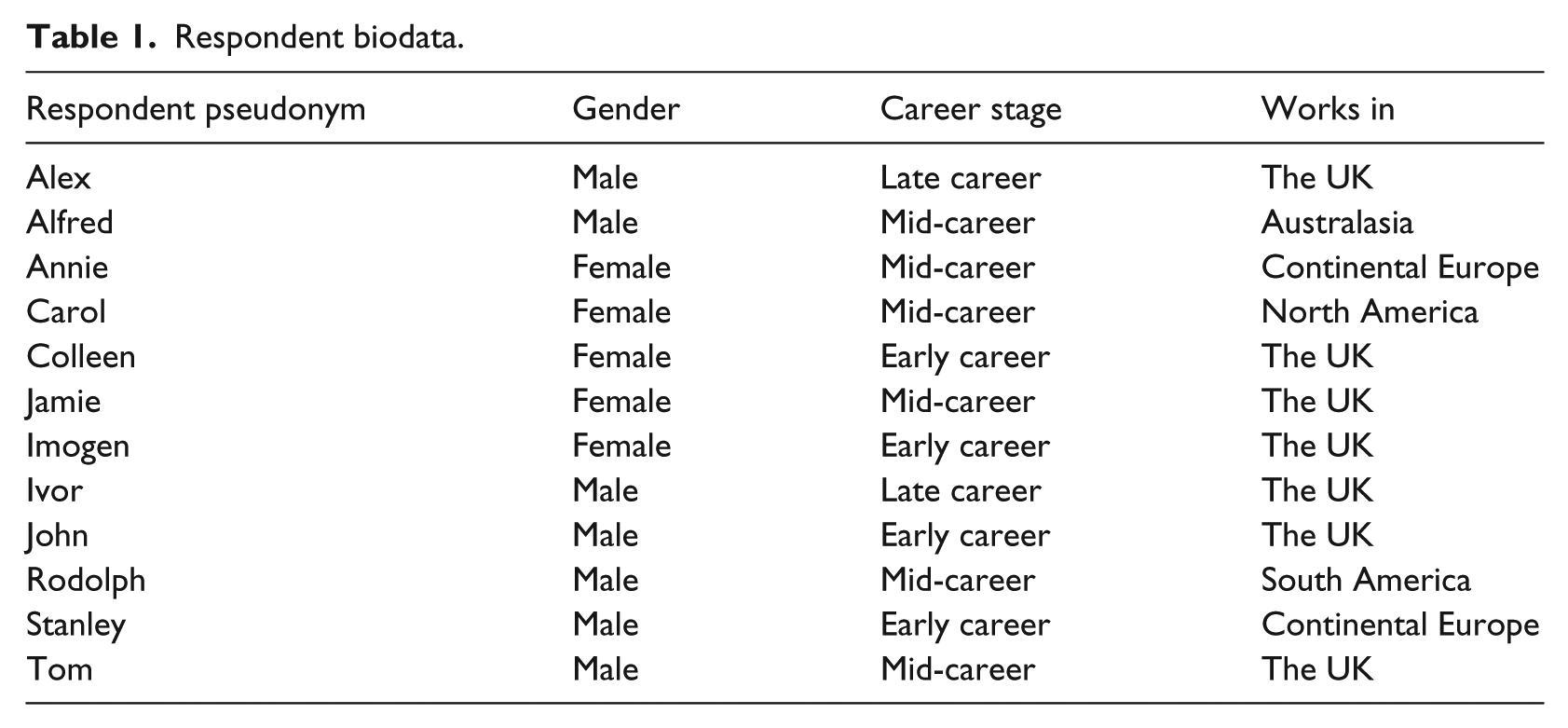
This group of respondents is in no way representative of any wider population of MOS academics. First, White, Anglophone participants predominate, reflecting the make-up of my networks. Second, I do not believe that striving for representativeness is desirable in research anyway, taking my cue from Sanger (1996) when he recommends that ‘Rather than observing people and objects as samples of larger groups in some presupposed classificatory system’, we should ‘examine them in their complex singularity’ (p. 20). This, Sanger argues, avoids us proceeding on the basis of assumptions about how people in particular categories differ.
I explained to everyone I approached why I was inviting them, offering standard assurances around ethical approval, data protection, withdrawal, recording and transcribing, confidentiality and anonymity. I said I would ask respondents to review their interview transcript, as well as a ‘good’ draft of any future papers, including the one at hand. I also heeded my own advice (Brewis, 2014), as well as guidance from University of Leicester ethics officers, about recruiting friends and colleagues for research. I told potential participants they might be ‘more forthcoming with me than they would be with a stranger-researcher’ about difficult experiences. I offered to send examples of previous publications to show ‘how it might feel to be represented in print by me when considering whether to take part’. I also asked everyone to reflect on my occupying editorial roles for MOS journals since their future submissions might be assigned to me in that capacity. Finally, I promised to send the interview schedule in advance so they could ‘mull over the issues beforehand’. Once respondents agreed to take part, they were asked to complete an informed consent form.
The interviews took place between January and May 2015. Five were conducted in person and the other seven over Skype due to geographical distance. Interviews ranged from an hour to 2+ hours. All were recorded and professionally transcribed. I corrected and anonymized the transcripts before asking respondents to excise anything they wished to. This produced a total of 330 pages of single spaced transcripts. I did not seek respondents’ permission to share the transcripts with others. Even following anonymization, this would make participants, and those they discussed, potentially identifiable.
I was on sabbatical while I did the interviews, affording me space to design and undertake them and to analyse the data. As Ford and Harding (2008: 236) did in developing their ethnography of a management conference, I made a pragmatic decision around how many interviews I could conduct in 6 months when other projects also needed attention. Additionally, in recent MOS research, ‘exploratory’ is often used to describe projects investigating something about which we know very little. My interviews could be labelled exploratory because no similar MOS study of peer review exists – perhaps echoing Ford and Harding’s (2008) remark that ‘The absence of studies [of conferences] may perhaps be partially explained by the problems of researching something so familiar’ (pp. 234–5).
But the aforementioned exploratory work in MOS is all based on empirical research on a larger scale than mine, usually considerably so, which often used more than one method (e.g. Busse et al., 2016; Grandy and Levit, 2015; Jenkins and Delbridge, 2014; Leca et al., 2014; Mayer and Boness, 2011; Reinecke and Donaghey, 2015; Sturdy et al., 2006; Whittle and Mueller, 2008). So it is more accurate to label my project as an inadvertent pilot study. I did not think of it on that basis during the interviews or the data analysis, but the themes emerging – such as co-authorship – would, to quote one of my reviewers, certainly ‘benefit from more interviews …, perhaps with some new, targeted questions’.
In checking the transcripts, I automatically engaged in preliminary analysis, ‘feeling out’ what the data seemed to suggest. I then re-read everything and made notes on what stood out thematically. These themes were – obviously – partly artefacts of the questions asked, as well as my reading of the relevant literature, but were also partly induced from the data. The instance discussed here – peer review as co-authorship – exemplifies this emic lens. I subsequently coded each transcript comprehensively using NVivo 10. Writing this article represented further analysis as I recoded some of the data then, as did the revisions I made during the review process. Indeed, I consulted the MOS literature on co-authorship as a consequence of reviewers’ comments.
Overall, this iterative analysis moved between the data and the MOS literature I read at different stages in the process. My original argument relied heavily on post-operaist literature on co-production. This perspective was omitted – perhaps ironically! – after my reviewers expressed their reservations about it. So, like Grandy and Levit’s (2015) work on co-creation of value in churches, my argument results from ‘an emergent, messy process involving a to-ing and fro-ing between the extant literature, data collection, analysis and the writing process’, as well as subsequent revisions on the basis of reviews (p. 250).
I make no claim to objectivity here. Neither do I believe my data are anything other than a product of the interviews – what ‘is said is far too context-dependent to be seen as a mirror of what goes on outside of this specific situation, either in the mind of the interviewee or in the organization “out there”’ (Alvesson and Deetz, 2000: 72). Moreover, quoting Ford and Harding (2008) again, ‘there is no such thing as an essential self who speaks a truth that reflects something called ‘reality’, but rather a self who is constructed in the very process of speaking the narrative in the interview’ (p. 235). I actually addressed my respondents as occupying three distinct roles – author, reviewer and editor – so I could generate as much data as possible in the time available. As Alvesson and Deetz (2000) also observe, ‘identities that are called upon in interview work … frame the situation and guide responses. If one interviews somebody as a “woman,” a “leader,” a “middle level manager,” different identities are invoked and different identities are produced’ (p. 72). Comments made by my respondents – and my reviewers – certainly index these different subject positions and what happens when one is hailed after the other. An example is Alfred’s response when I asked whether he had anything to add at the end of the interview:
… I particularly liked the way that you did it by, by role, and sometimes … when you change role, you find a slightly different view of the same thing … So [laughs], so it does raise comment. I mean, the classic example for me there was, you know, how do you edit things [as an editor]? Should you be editing things? [Like r]eviewers’ comments. And, you know, I was someone that would think ‘No, you should absolutely not be doing that’, because where’s the line? And then on the other hand, when you’re on the end of something you don’t like and you wonder why it wasn’t edited in the first place … So those roles do shift your perspective a lot …
This changing perspective is a central element of my findings.
Findings
Peer review as co-authorship
My respondents often characterized peer review as a form of collegiate co-authorship. When discussing his work as a reviewer, Tom, for example, remarked on articles – in higher ranking journals specifically – now being ‘written by committee’. He added that ‘essentially what starts out as being very much the mark of a particular author, the final product is something that looks distinctly different’. Tom suggests peer review ‘has become a much more engaged part of the writing process, which means that what we see in journals now is much more ostensibly a collective outcome’. He described how manuscripts typically go through several rounds of review so reviewers are very involved in shaping what gets published. Indeed, Tom said he had jokingly written to the editor regarding a fourth review of one paper to say, ‘This has got to be the last one, otherwise I’m going to claim co-author status!’. He said he wrote some 5000 words in total in these reviews, but that the paper had had significant potential from the beginning and ‘that was the beauty of the reviewing process, that there were a lot of people involved in producing that paper and I think it’s going to be one that’s going to be long remembered’.
Similarly, Alfred’s ‘view is to see [peer review] more as a group of peers who are working together on reading and writing about a set of issues that are encoded in a particular manuscript’. He describes the process as
more of a collaborative framework or a dialogical framework where my idea is that I’m with you, engaging with you as a writer in a developmental process, as some kind of interlocutor. That does not mean you have to agree with everything I say but, you know, we’re having a conversation through the process.
In answering a question about whether reviewers should sometimes be invited on to a paper as co-authors, Colleen said,
I think I was actually thinking that one of the things I, I have found in reviewing is by the time the paper actually comes out I have actually co-written it and that’s kind of an interesting one if you just accept it.
John was discussing whether reviewers’ names should appear alongside a published piece when he remarked that ‘in many cases the reviewers can really change [a paper], you know, they are co-producers in some senses’. Later, he observed from an author’s perspective that ‘when you are asked to do something [by a reviewer] that you hadn’t thought about then it does seem to me that, like, it is a co-production, you know’.
Making vanilla pudding
On the contrary, my respondents also agreed that peer review can generate papers which look and feel similar to extant MOS knowledge. Speaking as an author, Imogen described a recent experience where peer review ‘made [a paper] a bit worse but was the paper better at the end than it was when I originally submitted it? Probably. It probably looked a bit more like a journal article’. She continued,
in terms of … an article in that journal, it made it a better piece of work for the purpose it served. Did it kind of objectively make it better? I’m not sure, but it made it better for the purpose that it can now serve.
Here, Imogen says her paper was subject to certain norms during review, especially about the use of ‘evocative language’, and became a different product accordingly.
Also from an author’s perspective, John recounted submitting a paper to a special issue which was desk rejected. Although the guest editors said the manuscript was nicely written and carefully researched, they added, ‘It does not engage sufficiently with [a particular] literature’. John continued,
And now you’ve got a discourse which is saying ‘It’s not like the other stuff’, right? And if that’s the criteria, then things are going to start being the same. If looking like the stuff that’s already there is one of the criteria, then everything’s going to look pretty similar.
Switching roles, John observed that in his experience authors sometimes collude in this process. He remarked on how many papers he reviews which look good ‘on the surface’ but do not make an identifiable contribution. Instead, they represent ‘that kind of formulaic research critique that they all look like papers and they all look like somebody’s gone “OK, what does a paper that’s in [this journal] look like? Let’s make this paper look like it"’.
Relatedly, Ivor told an anecdote about a well-regarded journal, whose equally well-regarded editor would keep adding reviewers to a manuscript in order to secure ‘at least three very favourable reviews’ before they accepted it. He said, ‘that astounded me, given the seniority of the person in the, the editorial chair. But it’s not uncommon of the attitude of editors’. Ivor suggested MOS editors should have the courage of their convictions and ignore reviewer recommendations where appropriate, asking ‘What’s the point of running a journal if you can’t get stuff you like out?’ Nonetheless, he believes this is not standard practice in our discipline.
One reason for this homogenization, my respondents suggest, is in-crowds who control access to specific MOS debates or journals.
Ethnocentrism
The two respondents who do not have English as a first language spoke as authors in suggesting these in-crowds are ethnocentric. Discussing the challenges of submitting papers to Anglophone journals, Rodolph told me that
the most hard is the language, the discourse … it’s not about writ[ing] the grammar, vocabulary, it’s about much more than this. It’s about how to think the life, how to understand things because it’s not just a case of [how] to translate, understand? In terms of the logic in English, to think, to live it, to do things, it’s completely different in [the] logic [of my language], understand? … the discourse, the logic, there is a materiality in the discourse: it’s a reflection of the life, of the culture, understand? Sometimes it, this is the most hard task in my opinion.
Rodolph said most papers he has sent to Anglophone journals have been rejected. He added that the editors of these journals tend to ‘privilege’ papers by well-known Anglophone academics and implied that both impact factors and publishers’ profit margins increase thereby.
Annie offered similar comments about the assumptions that reviewers make regarding authors’ origins:
And as a non-English native writer, you often get comments, especially if the fieldwork is obviously not from an English–speaking country, you get all those comments about language, which can be rather patronizing sometimes … people believe just because they can see the fieldwork is [not] from … an English country, that they have the right to say something about the language.
Annie adds that a British friend submitted a manuscript based on fieldwork done in another country and ‘got back the same comments [about her English] which really pissed her off’. She went on to talk about having her work language edited prior to submission, but said this is expensive and depends on funding availability. When she was a doctoral student, Annie paid for it from her own pocket, which was ‘quite a large sum’.
Talking in more general terms, Alfred agrees,
… it’s certainly the case that this is a system that’s set up to benefit those that are trained in it in the first place, and those are typically, you know, from, in inverted commas, first world, global northern institutions, mainly English speaking in the case of management and org[anization] studies, but more broadly through European language based scholars in first world contexts who have the institutions, the support, the library access, the capacity to be developed in how to write for those systems. And that’s, and that actually limits who can take part, and it makes it more difficult for those [who] … don’t have access to those to be part of that system.
He adds that high-ranking MOS journals, despite being
held up as the places that you should be publishing in, as international journals of excellence, [are] not international. They’re US and European and they use the English language, and so the barriers for authors not in those contexts to get in are really, really much higher.
Colleen, connecting the vanilla pudding theme with ethnocentrism, suggested,
I am interested in understanding, you know, gender inequality not just from the western perspective – what does it mean in Thailand? what kind of frameworks do they use? what kind of explanatory framework? – to try and challenge that kind of dominant ‘Well, if it’s not Bourdieu you can go home’ kind of thing.
Here, she suggests MOS peer review privileges Western theories and Western frameworks, as well as scholars who (are assumed to) have English as their first language.
Sub-communities and closed shops
Smaller networks were also identified as creating barriers to entry for some MOS journals. Speaking as an author, Imogen described one as ‘a really closed shop; they just republish the same people and I think, if you’re not in their little group, it’s super-hard’. Ivor agreed, saying what he sees in MOS nowadays is
enforced conformity to the expectations of narrow communities and those communities exist only out of expediency really. You know, ‘We’ve got to publish and we’ve got a nice little number going here so let’s keep it going’. You know, it’s never really stated but ‘We’re in this little group here’.
These sub-communities can, Alex suggests, perpetuate very specialized discussions which are of little interest to non-members. He uses a fictional example to describe a recent debate section in a US journal:
[Y]ou know in Gulliver’s Travels, in Lilliput they talk about the Big End[ians] and the Little End[ians], you know, which way your egg’s broken? Well this alleged debate between them was so minute and nothing about critical realism, nothing about ANT, nothing about European theory at all.
5
Imogen also said that ‘a conflict of interest’ may arise in peer review because papers are sent ‘to supposed, you know, experts in the field’. She argues, as a result, that ‘if you feel that somebody is doing something substandard in that field then you may feel a need to protect the kind of credentials of what is being published in that field’. Imogen then switched back to her perspective as an author to predict that a recently submitted paper will get a cool reception. Her concern is that the reviewers
are going to try and drag us into [specific] debates because the kind of people [the journal] are going to send the paper out to, they are going to be people that feel very strongly about this sub-discipline and I think they are going to feel that we are doing something they don’t think is appropriate with it.
Imogen’s description of conflicts of interest seems to be partly based on her fear that the editor of the journal she references in the second extract will send the paper to specialists in a particular sort of labour. This, she thinks, might mean she and her co-author are required to situate their argument in that literature following peer review, when in fact the paper is about a different type of work. Here, Imogen suggests authors locate their scholarship in particular ways, which may be interpreted by editors – and subsequently reviewers – rather differently.
Here, the global MOS community is represented as a series of larger and smaller sub-communities. Within each, academic work is seen to take a particular form, and barriers to entry – and journal publication specifically – are identified where one’s research does not fall into line. Members of these sub-communities, however, are depicted as having a ‘nice little number going’, as Ivor puts it.
Pantomime horses and ghost-writers
Further to their comments on homogenization, respondents suggested peer review sometimes produces incoherent papers. When I asked Jamie to comment as an editor on whether MOS authors are good at responding to reviewers’ comments, she replied,
I mean, nowadays there’s a tendency to try and, you know, respond to every single reviewer’s comments in a way that means there’s a potential to create a sort of pantomime horse
6
paper. So I think there’s a will to respond, respond to [reviews], but whether it’s responding well is another matter … You’re often pulling in different directions and, and, of course, it’s a power imbalance, isn’t it? You want it published and so you’re trying to satisfy all the reviewers’ requirements, but in doing so you can end up with a very strange paper at the end.
Here, Jamie depicts authors as increasingly subservient to reviewers because of the publish or perish culture. Similarly, Alfred remarked,
… I’m thinking here of [a journal], actually, someone else’s experience that I talked to and in some other journals where, usually American ones where there’s such a desperation, it seems, to get in those journals, that you do anything … And you wonder ‘Well, I know these authors and I know that they would probably think that, something a little bit more cutting edge than this, or a bit more provocative … This is a hodge-podge and it didn’t work, and I think it’s because you wanted a piece in that journal’.
Related comments were made about reviewers being too interventionist. Speaking as an author, Imogen referred to an instance where one reviewer had been ‘a bit of an arsehole and they wanted me to do loads and loads and loads’. When she addressed their comments, she exceeded the journal’s word limit slightly. The reviewer refused to evaluate the resubmission because it was too long. Recounting stories he had heard from other MOS scholars and also evoking the vanilla pudding metaphor, Alex told me,
people who’ve got in [one US journal] say it’s not your paper at the end. I’ve heard it, again this is [name], had a piece, I think nineteen rewrites to get it in and, you know, because the reviewers are allegedly saying ‘There’s this reference you haven’t included’. And of course often it refers to their work because there are citation cartels. So often that’s the case, but it’s not your paper, you know. It’s been burglarized, gutted, and often the contentious stuff you really wanted to say isn’t in there.
Rodolph suggested sometimes ‘people want to be [the] author of the paper, not [the] reviewer … because the reviewer has a political[ly] different position, understand? They want to change everything, like [co-opt] the author for their religion’. Later, he said this is because ‘everybody wants to have followers’ and that ‘some academics [are] very political, it’s a power relation’. And Colleen remarked,
I think sometimes [reviews are] actually a form of violence. I think, similarly to teaching, it’s a form of violence in terms that ‘You will craft your work into the way that I want it to be’, and oppressing an author’s voice. I think there can be a real danger of that, actually.
Annie summed this theme up when she said that once a paper is submitted,
you let it go, it’s not your text any longer, it’s always the reader’s text … And you as the author cannot really control how the reader reads your text, and that’s really obvious in, in, in the review process … and that’s sometimes why you get so frustrated as an author because you say ‘well, they don’t get what I try to say’ because, because, yes, because they own the text right now …
In these remarks, reviewers are characterized as ghost-writers, as asking for such extensive changes to manuscripts that they become co-authors in all but name. Editors were likewise characterized as interfering too much at times. Alex observed, again on the basis of talking to other MOS authors, that ‘some editors think that’s what their job is really – to put you on a Procrustean bed, you know, chop the bits off that don’t fit to match it’.
7
He went on to talk about being ‘in the hands of increasingly baronian, let’s use the male …, individuals who think that for three years they are the gatekeepers to the, the discipline’. Stanley recalled receiving a ‘two page reject and resubmit’ on a journal submission, saying this suggests
there’s another level of the peer review process at work, an unacknowledged one which is when editors take it upon themselves to unilaterally reject something – which is fine, they have the prerogative to do that – but they do so whilst calling for revisions to a paper. And I see that as a little bit problematic, I’m not sure why.
The dilution of authorial contribution and coherence is a prominent theme in all of these comments.
Authors’ negligence
These descriptions of MOS peer review as co-authorship of various kinds co-exist with remarks about how authors behave when submitting work to journals. Here, my respondents discuss their experiences as reviewers. Imogen commented,
[T]he one thing about the brief amount of reviewing that I have done, and both me and [my partner] have said this, has just made me realize what almost like disrespectful stuff people submit, you know. And it’s like, it’s made me realize, you know, if you are really pushing a deadline for a special issue but you don’t think it’s perfect … ‘let’s just chuck it in anyway, everybody else does’, you know! Some of the stuff I have reviewed I thought has been really poor quality.
She says papers like these have not even been edited to excise errors and that the ‘sort of common decency of scholarship just hasn’t been addressed’. Stanley concurred, suggesting he has reviewed many papers which seem unfinished, as if the authors think ‘It’s good enough, let’s submit it because we’ll always have revisions to make in the review process so the reviewers can tell us how to finish our papers’. He says this is extremely annoying:
Those papers I don’t look favourably upon and you can usually tell them, they’re kind of quick, the quickies that are just churned out full of typos or, you know, you can just read them and tell if that was published the next day, they would be embarrassed because they haven’t even proof-read it, they haven’t done a spellcheck, a rudimentary spellcheck.
Stanley suggested that some MOS authors seem to see peer review as another stage in writing a paper as opposed to the first stage of publishing it. He added that although he resents reviewing submissions like these, they may represent a sea change in how authors approach journal submissions ‘because it’s become a lot more challenging to get something published from, you know, multiple rounds of review’. Annie agreed that some authors submit ‘papers just to get feedback, and they’re not really finished papers’. She says this is particularly true of European MOS academics, who think, ‘So, OK, I’ll send it in to get some feedback’. Describing a recent experience of editing a book, Annie said, when compared to US contributors, ‘many European scholars were not as careful with the writing, and it was more sort of “Yeah, well I mean, I don’t have to be like, like, precise and I will probably have, can do another round"’.
Discussion
MOS commentary on peer review argues that the process often renders manuscripts less original and more orthodox and oftentimes disrupts their narrative flow. Reviewers and editors are characterized as failing to respect authors’ autonomy, overstepping professional boundaries and becoming ghost-writers. Turning to MOS co-authorship literature, however, we see a problematization of free riders who do not contribute fully to research collaborations and of the (apparently not uncommon) practice of gift authorships for people who have had little or nothing to do with producing papers. This commentary also insists that all of those who have been involved in writing a paper be rewarded with co-authorship status. The organization COPE – to which many MOS journals belong – was established in part to protect the ethics of publication in this respect.
My respondents agree MOS peer review is often tantamount to co-authorship. But their perspectives on this vary, typically with the subject position they are speaking from – or being hailed as occupying – at any point. I now summarize the various constructions of co-authorship as they appear in the data, classifying them by subject position.
The co-authorship of peer review 1: collegiality and obligation
Speaking as reviewers, participants generally acknowledge that they may well have ‘actually co-written’ the resulting papers, as Colleen suggested. These remarks echo Raelin’s (2008) claims about authors perhaps being ‘the initiator but not necessarily the sole proprietor of the work’ (p. 126). They also characterize peer review in MOS as one of our collegial commitments to each other and as relying on generosity. This was actively invoked in the interviews, with Stanley, for example, describing peer review as ‘free and unrewarded gift labour’. It was counterbalanced by remarks characterizing reviewing as driven by a logic of exchange, like Alfred’s observation about a ‘tacit commitment that if you, you yourself have benefited from a review process in a publishing outlet, that you might want to give back to the journal and continue the conversation’. Overall, though, participants construct journal papers as ‘ostensibly a collective outcome’, in Tom’s words. My respondents also do not self-present as expecting any concrete credit for their labours on manuscripts in this regard or as believing their ‘substantial contribution to the work … should be rewarded with authorship’ (Wager and Kleinert, 2011: 315). 8 As such, their remarks in this strand of the data represent peer review as co-authorship positively.
The co-authorship of peer review 2: making vanilla pudding
But when discussing what happens to their and others’ work during peer review, my participants suggest the process blurs the lines between author and assessor in more negative ways. The first surfaces where papers are described as being rewritten during the review process to conform to reviewers’ demands for (sub-)disciplinary orthodoxy, as Ashforth (2005) claims in coining the vanilla pudding metaphor. Here, whether speaking for themselves or about what they see happening to others’ journal submissions, consensus is identified as important in order for manuscripts to see the light of day. Imogen says a recent review process ensured one of her papers ‘probably looked a bit more like a journal article’ and John suggests papers may need to look ‘like the stuff that’s already there’ in order to be published, for example.
The co-authorship of peer review 3: ethnocentrism and sub-communities
Equally, respondents indexed what they saw as ethnocentric barriers to publication in Anglophone MOS journals. Rodolph and Annie, the two respondents who do not have English as their first language, suggest that – their difficulties in thinking and writing in English aside – judgements are made by editors and reviewers which make it much harder for them to publish in these outlets. Rodolph talked, for example, of the ‘privilege’ that he sees being accorded to scholars from the global north. Here, my respondents echo Parker (2013) and Macdonald (2015) in suggesting that authors who lack the cultural capital of English as a first language and/or the social capital of working for a global north institution are disadvantaged in the peer review process for supposedly ‘international’ journals. Their remarks also chime with Meriläinen et al.’s (2008) claims around the ‘hegemonic practices’ which ‘organiz[e] whose theories count and whose work is cited, whose experience is valued and whose empirical data is deemed interesting and relevant’ (p. 88).
Elsewhere, again speaking as authors or for other MOS authors, my respondents point to what they see as disciplinary sub-communities who want to ‘protect the kind of credentials of what’s being published in that field’ (Imogen). These data suggest the existence of ‘cartels’ (Alex) and ‘coteries’ (Ivor) and imply that being networked in particular ways – having an association with specific outlets or debates – pays off for some but certainly not all authors.
Across the ethnocentrism and sub-communities data, peer review is represented as precluding many MOS scholars from publishing in what ‘are held up as the places that you should be publishing in, as international journals of excellence’ (Alfred). This is attributed to beliefs about what constitutes MOS research among Alex’s ‘gatekeepers’. When speaking from the subject position of author or author’s proxy, then, my respondents construct a sense of authorship as inappropriately compromised by some peer reviewers and editors. These gatekeepers might deny others the right to publish altogether or insist their papers are reshaped (/co-authored) to conform more closely to the MOS orthodoxy in the global north or in a specific sub-discipline.
The co-authorship of peer review 4: producing pantomime horses and involving ghost-writers
In other parts of the data, peer review as co-authorship is constructed differently. Here, authors are characterized as complying with conflicting reviewers’ demands in their desperation to be published. This results in Alfred’s ‘hodge-podge’ or Jamie’s ‘pantomime horse’ papers. A related claim is that reviewers can undermine an author’s prerogative by dragging the paper away from its origins. Examples include Imogen’s comments about an ‘arsehole’ reviewer wanting her to rewrite a manuscript as they ‘would have written it’. Editors are also described as misbehaving, taking what Alex called ‘an increasingly baronial’ approach to their roles. All of these comments again suggest peer review can threaten authorial autonomy, so the author becomes just one of several owners of their work. Indeed, Alex says that authors may lose any proprietary claim to their work, having to accept that ‘it’s not your paper at the end’ in some instances.
The co-authorship of peer review 5: authors’ negligence
But when occupying the subject position of reviewers, some of my respondents suggest authors may actually expect reviewers to co-author their papers, like Annie’s remarks about European MOS scholars sending in papers to receive feedback or believing they will have at least one round of revisions to fine-tune their arguments. Here, some MOS authors are depicted as free riders in a different sense from the one Bennett and Kidwell (2001) describe, assuming reviewers will do the work of making their papers publishable without any tangible acknowledgement (see Note 8). Stanley suggests this may be a reaction to the ‘multiple rounds of review’ which are now common when a paper is being considered for publication. He identifies a vicious circle, where MOS authors assume they will have to weather several rounds of revision (/co-authorship) after submitting their work and consequently reduce their investment in a manuscript in the first place.
Conclusion
To reiterate, I make no claims for the objectivity of my analysis nor do I suggest it has any direct correspondence with the ‘truth’ of peer review. Indeed, the analysis is itself a form of co-authorship. Nor are my claims generalizable beyond the boundaries of this pilot study. Still, my respondents are speaking from various subject positions throughout, making different observations as authors – or author’s proxy – from those they make as reviewers and editors. Their presentations of co-authorship in MOS suggest it extends beyond conventional research collaborations into the peer review of journal papers. They characterize the co-authorship of peer review as multi-faceted, depending on one’s position within it, and as ethically and politically complex.
Of course, these constructions are empirical artefacts and arguably represent what one of my reviewers called ‘stories that researchers tell to legitimize themselves to themselves’ and to others. But we continually tell ourselves and those around us these stories as part of the ongoing discursive process of (re)producing the MOS academy as a set of institutions, practices, relationships and subjects. These understandings of peer review as co-authorship – as generous gift, professional duty, reproducing MOS orthodoxy, ensuring ethnocentric exclusion, perpetuating disciplinary cliques, creating ‘pantomime horse’ papers, constituting excessive interference with authorial privilege or over-reliance on one’s reviewers – suggest different ways to read co-authorship more generally. We should therefore ask ourselves questions about when, why and how we collaborate with each other, and the extent to which we should be recognizing additional co-authors (or resisting their input) as a result.
Given the paucity of qualitative empirical accounts of MOS peer review, as well as the increasing interest in the changing political economy of knowledge production in the field per se, these issues deserve more attention. Indeed, an empirical focus on the manifold subject positions we inhabit – reviewer, author, editor, researcher, teacher, assessor, administrator, mentor, mentee and so on – how we move from one to the other during the working day and their effects on how we characterize and reconstruct our academic lives are probably warranted. As I see it, this would afford us further valuable insights into how we do and redo the MOS academy, as well as opportunities to consider doing it differently.
Footnotes
Acknowledgements
Given the focus of this paper, it seems appropriate to write a rather longer ‘Acknowledgements’ section than is conventional. First, I am well aware of the paradoxes inherent in submitting this paper for review and subsequently writing these Acknowledgements! But the paper has been very much shaped by the constructive, generous and collegiate comments offered by my three reviewers, my associate editor and Editor in Chief Yvonne Benschop. For example, they helped me to see that my original post-operaist lens did not necessarily assist in surfacing the arguments I wanted to make. Among many other insightful observations, my reviewers also suggested that – despite protestations to the contrary – I had inadvertently treated the data as some kind of lens on the real world in the first version of the manuscript. Of course, I indulged in the traditional period of post-review anguish, followed by the feeling that my attempts to understand autonomous Marxism had been wasted. Then I found myself consulting the MOS commentary on co-authorship to try and rescue the analysis. Now, almost exactly 12 months after the original submission, I am extremely grateful to all concerned for being my co-authors in the best possible way. Second, I want to thank my 12 respondents who not only gave up their time to talk to me about their experiences of peer review but also provided extremely helpful commentary on various versions of the paper. They also deserve co-authorship status. The same is true of Martin Parker and David Harvie who looked over two drafts of the original paper and provided many supportive suggestions and observations. Sincere thanks to all of you!