




Abstract
The Lascivious Costume Ball, a sexuality-themed and institutionally authorized party that took place at the University of Chicago from 1970 to 1984, began as a form of student rebellion. Yet within a few years it was diluted and managed by the university administration. Stripped of its initial transgressive character, the Lascivious Costume Ball had been integrated into the legitimate routines of the University as a representation of its institutional identity. This article uses the Lascivious Costume Ball as a case study to examine how organizations respond to potentially threatening oppositional action marshaled by their constituents. Drawing on an analysis of archival materials and 69 interviews with administrators, faculty, and alumni associated with the University at the time of the Ball, I argue that spatiotemporal context crucially shaped administrators’ approach to the event and hence its transformation. This article (1) illuminates the importance of relationality in shaping organizational responses to oppositional action; (2) introduces a new mechanism, organizational absorption, whereby organizations manage and defuse such action; and (3) suggests a fresh appreciation for the role of organizational identity in the management of disruption.
The Lascivious Costume Ball was a sexuality-themed and institutionally authorized party that took place at the University of Chicago from 1970 to 1984. A sliding-scale admissions fee defined the event: the nude entered for free; the scantily clad, a discounted rate; and the completely clothed, full price. Situated in the broader radical historical moment of the 1960s, the Ball began as a form of student rebellion against the values of the parent generation, stereotypical gender roles, the stigma attached to casual sex, and even other students’ political views. In the words of an alumnus who attended the inaugural Ball, the event’s purpose was ‘Down to one word? Defiance. … We were trying to declare our cultural independence. We were trying to break free of the previous and oppressive and sexist order-for-order’s-sake culture.’ Within a few years, however, the Ball was diluted and managed by the university administration. Stripped of its initial transgressive character, the Lascivious Costume Ball had been integrated into the legitimate routines of the University as a representation of its institutional identity.
In this article, I use the Lascivious Costume Ball as a case study to examine how organizations respond to and ultimately defuse potentially threatening oppositional action marshaled by their constituents. This is a central question in the social scientific literature on organizations because it often illuminates broader processes of organizational continuity and change. Existing research emphasizes a desire to preserve legitimacy and stability as crucial in shaping the range of responses—from overt repression to facilitation—organizations mobilize to manage internal disruption (e.g. Coy and Hedeen, 2005; Gamson, 1975; Jenkins and Eckert, 1986; Selznick, 1966 [1949]; Walker et al., 2008). Yet the role of relationality, specifically social and temporal context, remains underspecified (Emirbayer, 1997; Somers, 1998).
Drawing on an analysis of archival materials and 69 in-depth interviews with administrators, faculty, and alumni associated with the University at the time of the Ball, I demonstrate the importance of spatiotemporal context to administrators’ actions in response to the event and, in so doing, introduce a new process whereby organizations minimize oppositional action. I trace how administrators’ approach to the Ball shifted over time and how their changing response helped transform what was initially a boundary-pushing act of defiance into an institutionalized tradition. The transformation of the event occurred through a dynamic process contingent on local and national history as well as the behaviors of other organizational actors in the field. In what I term organizational absorption, organizations validate the oppositional action and reconfigure its symbols and rhetorical packages so that it comes to represent and even amplify certain aspects of organizations’ identities.
This research makes at least three contributions to the social scientific literature on organizations. First, it draws out an important relational dimension of organizational responses to oppositional action that has remained largely implicit but that also resonates with broader trends in organization studies, specifically the recent ‘historic turn’ (Bucheli and Wadhwani, 2014; Rowlinson et al., 2014). This is made possible by the analytical approach, which examines the disruptive action and administrators’ responses sequentially in time and therefore ‘in relation to’ both one another as well as the larger social context. The article also identifies a novel mechanism of organizational control that may be useful in explaining the attenuation of potential threats in a variety of settings. Finally, it suggests a fresh appreciation for the role of organizational identity in the management of internal disruptions.
The article proceeds as follows. The first section reviews existing research on organizational responses to oppositional action and discusses the value of incorporating a relational approach. I then introduce the concept of organizational absorption, highlighting its distinctiveness from mechanisms of control already identified. Next, I provide an overview of the historical and organizational context of the Ball. After describing data collection and analysis procedures, I trace the transformation of the Ball from a defiant, dramatic spectacle into a diluted, institutionalized ceremony, thus outlining the process of organizational absorption.
Organizations, oppositional action, and relationality
Disruptive events and actions regularly occur within organizations, and organizations usually respond through governance, that is, actions taken by individuals in positions of power and authority within the organization on behalf of the organization (Davis et al., 2008; Hirsch and Weber, 2001; Katzenstein, 1999; Kerr, 2001; McDonnell and King, 2013; Morrill et al., 2003; Raeburn, 2004; Rojas, 2007; Rosovsky, 1999; Zald and Berger, 1978; Zald et al., 2005). Existing research has identified a broad spectrum of mechanisms whereby organizational governance defuses disruption. On one end is overt repression, specifically the use of violence or punishment (Davenport et al., 2005), but there are also many covertly repressive forms of control.
Channeling, for example, describes a process in which organizations allow oppositional action to occur within their bounds but only under certain conditions. The organization and opposition develop agreed-upon terms specifying when and where the action will occur as well as the tactics permitted, and the organization threatens punishment for deviations (McCarthy and McPhail, 1998; Paul and Lydenberg, 1992). This distances the disruption from the organization both geographically, by positioning it in distinct ‘demonstration zones’ (Davis, 2004), and symbolically, by demarcating it from its legitimate routines.
Co-optation is another related process, slightly closer than channeling to the facilitative end of the spectrum. Here, the opposition (Selznick, 1966 [1949]) and/or the content of its discourse (Burke and Bernstein, 2014) are incorporated into the organization but radically redefined to come to serve the organization’s goals and interests, minimizing potential threats to stability and legitimacy (Naples, 2002). The organization confers no new advantages to the opposition and, although now part of the organization ‘in form,’ the opposition’s substance changes dramatically (Auerbach, 1983; Ezekiel, 2002; Gamson, 1975; Hedeen and Coy, 2000; Johnson, 1981). Patrick G. Coy and Timothy Hedeen (2005) illustrate with the example of community mediation, which first emerged as part of a movement advocating alternatives to the formalized judicial system in the United States. Mediation was initially completely voluntary until the court system co-opted the movement and redefined mediation as compulsory.
Facilitation, conversely, involves granting concessions, such as policy changes or monetary support, to the opposition in order to quell their actions (Jenkins and Eckert, 1986). This response is noted to work better on disruptions marshaled by constituents, who are typically easier to appease than outsiders (Walker et al., 2008). Nonstate organizations, including schools and corporations, are often more willing to facilitate oppositional action because they wish to appear responsive, reduce reputational damage generated by negative publicity, and avoid escalation (Hoffman, 2001).
Underlying these diverse approaches, however, is a shared emphasis on a desire to preserve legitimacy and stability as crucial in shaping organizations’ responses to disruption. But actors and actions are always ‘situated in social time and place’ (Abbott, 2007: 7) and so the role of contextual factors must also be considered. This calls for a relational approach that ‘embeds the actor [and the action] within relationships and stories that shift over time and space’ (Somers and Gibson, 1994: 65). Relationality encompasses both social structure and temporality. Social structural factors of interest here include the focal organization’s position within the field and the behaviors of other organizations, especially peers, in parallel situations. Temporal factors include local, national, and global history and, relatedly, the sequencing of events (Abbott, 1995; Aminzade, 1992; Braudel, 1992; Sewell, 2005). An organization may, for example, base its present approach to oppositional action on its own or its peers’ past successes and failures (Cohen et al., 1996; Johnson, 2008; Marquis, 2003; Schreyögg et al., 2011). Incorporating relationality into analyses of how organizations respond to disruption therefore requires us to expand our attention beyond the synchronic organization-opposition dyad to also examine the social structural and temporal settings within which they act.
The relational approach I propose resonates with long standing theoretical insights in organizational research as well as with more recent disciplinary developments. It aligns with the now classic conceptualization of organizations as ‘open systems,’ which emphasizes the mutually constitutive relationship between organizations and their environments as well as the contingent nature of organizational action (Scott and Davis, 2006). Daniel Katz and Robert L. Khan (1966) concisely summarize open systems theory as one that assumes ‘no social structure is self-sufficient or self-contained’ (p. 20). The contemporary ‘historic turn’ in organization studies, which encourages deeper engagement with historical research and reasoning, also points to the importance of relationality (Booth and Rowlinson, 2006; Clark and Rowlinson, 2004; Cooke, 1999; Kieser, 1994; Leblebici and Shah, 2004; Üsdiken and Kieser, 2004; Zald, 1993). Scholars working within this approach explain the value of temporal perspectives: [They] provide unique insights by allowing researchers to ‘look back’ on organizational behavior and thought in order to identify relationships and processes over time, to consider the historical consciousness of organizational actors, and to take new temporal, spatial, and social angles onto organizational issues. (Wadhwani and Bucheli, 2014: 23)
Attention to the ‘relational matrices’ (Emirbayer, 1997: 309) in which organizations are situated and their impact on organizational action is therefore not new but has yet to be directed to the specific question of how organizations manage disruption. Perhaps because of a broader tendency in organization studies to emphasize structure and stability (McAdam and Scott, 2005: 9), research in this vein has instead focused on the minimization of vulnerability and maximization of continuity as key factors affecting organizational response. I argue that, in addition to these important factors, spatiotemporal context should also be considered. This article takes the initial step toward a more direct integration of relationality into analyses of how organizations discipline oppositional action by assessing the role of contextual factors in shaping University of Chicago administrators’ response to the Lascivious Costume Ball.
Organizational absorption
In employing a relational approach, this article identifies a new mechanism whereby organizational governance defuses oppositional action, although the mechanisms discussed above may also be assessed using a relational lens. The empirical sections illustrate organizational absorption in greater detail, but an initial overview provides useful framing and helps clarify its distinctiveness.
Organizational absorption has several, potentially overlapping stages that unfold over time, in relation to one another, and in relation to broader spatiotemporal context. First, the organization responds to the potentially threatening disruption with purposeful nonintervention, authorizing its occurrence and administering little to no oversight. This decision is based on past events at the organization, specifically its reactions to other oppositional actions, peer organizations’ behaviors in parallel situations, and a general lack of information about the disruption. Next, having acquired additional information about the action as a result of experiencing its inception, the organization engages in regulative validation. It continues to allow the action and even provides support necessary for its occurrence, such as financial resources, but also becomes more involved in its administration through the imposition of regulations. The third stage involves reconfiguration of the symbols and rhetorical packages of the action so that some become more prominent than others. The ones linking the action to the organization’s identity become more prominent; the threatening and subversive ones, less prominent. This helps transform the action into a representation of the organization’s identity, enabling its absorption into the organization’s legitimate routines, and diluting its initial transgressive signification. The ‘oppositional’ element of the action ultimately dissolves as it becomes an institutionalized tradition—the final stage of absorption.
There are similarities and differences between absorption and other covertly repressive forms of organizational control. Like channeling, the organization allows the disruption to occur within its bounds, but it does not, however, separate itself from the action by corralling it into geographically and symbolically distinct zones. Rather, the organization incorporates the disruption into its routines, which also occurs as part of co-optation. But in co-optation the oppositional action is redefined as it is incorporated, whereas in absorption it is not. There is instead a rearrangement of the existing symbols and rhetorical packages comprising its substance so that those already linked to or that organizational actors perceive as linkable to the organization’s identity come to the fore. Absorption is also distinct from facilitation because the organization does not afford new benefits to the opposition but rather increases regulation of the action while simultaneously validating it. Finally, absorption differs from existing mechanisms because it highlights how organizations mobilize their identities as a response to disruption. The following empirical analysis uses the case of the Lascivious Costume Ball to trace the process of organizational absorption, illustrating how administrators’ actions on behalf of the University helped transform this once transgressive event into a tradition emblematic of the institution’s identity.
The case study in historical context
The Lascivious Costume Ball emerged at the cusp of an era defined by sociocultural upheaval both on and off campus. The 1960s in America saw the civil rights movement, innumerable anti-war demonstrations, the emergence of the women’s and gay rights movements, and a sexual revolution. The New Left—a set of movements spanning the late 1950s to early 1970s that challenged the social, political, and cultural values established in market democracies (Garner, 1996)—mobilized support for much of this activism, and college students formed one of its largest and most active contingents.
University of Chicago students were no exception. Three main ‘waves’ of student activism occurred during the era, each increasingly radicalized (Martin, 2010: 11). Students’ protest against the University’s racially discriminatory housing policies in January 1962, less than a year after the Freedom Rides, is representative of the first wave. None of the 33 students who occupied President Beadle’s office as part of the demonstration faced disciplinary action. Campus politics at the University escalated into the mid-1960s alongside the anti-war movement. More than 400 students participated in the 1966 anti-draft sit-in, and 120 participated in a second anti-draft demonstration in 1967. The second resulted in the suspension of 58 students, though the administration did not carry out most of the suspensions (University of Chicago Special Collections Research Center, n.d.). In accord with the broader dynamics of the student movement, the third wave of activism at the University was the most dramatic, culminating in the 1969 sit-in or ‘the great nervous breakdown of the University’ (University of Chicago Maroon, 1970c). Over 400 students occupied the Administration Building for 2 weeks in protest of the sociology department’s decision to deny Assistant Professor Marlene Dixon a second-term appointment. Students suspected that this decision stemmed from Dixon’s ‘leftist politics, radical sociology, emphasis on teaching rather than publication, and her gender’ (University of Chicago Special Collections Research Center, Statement of the Committee of 75, 1968-1975). The 1969 sit-in occurred just 5 months after the 1968 Chicago Democratic Convention, which saw violent anti-war riots orchestrated by Students for a Democratic Society, and 10 months before the Weathermen’s even more violent Chicago Days of Rage. In the sit-in’s aftermath, 42 students were expelled. The inaugural Lascivious Costume Ball took place mere weeks after the first anniversary of the 1969 sit-in, and peace rallies and anti-war strikes continued on campus into the early 1970s (University of Chicago Maroon, 1972a, 1972b).
Over subsequent iterations of the Ball, through the mid-1970s into 1980s, the atmosphere in America and on campus changed dramatically. An era of upheaval gave way to one of relative quiescence. The New Left declined (Armstrong, 2002: 83), Black opposition faded (Reed, 1979: 72), the counterculture movement waned (Gitlin, 1987); conservatives ascended to political power (Hunter, 1991); and the economy stagnated. Neoliberal and managerial logics became increasingly prevalent in many arenas of social life (Bauman, 2000; Enteman, 1993; Fleming and Spicer, 2007; Graeber, 2015; Jacques, 1996; Mirowski, 2013; Parker, 2002), including higher education. A scarcity of students, the decline in government funding, and the emergence of third-party rankings contributed to a ‘tendency of US colleges and universities to behave less like civil service organizations and more like self-interested corporations’ (Stevens and Gebre-Medhin, 2016: 130). Although American colleges and universities have long displayed market-like features (Kleinman and Osley-Thomas, 2014), the rise of ‘market higher education’ (Berman, 2012) represented a new configuration of the sector characterized by heightened competition, profit maximization, and the emergence of a new class of professional administrators (Biesta, 2010; Collini, 2012; Ginsberg, 2011; Nussbaum, 2010; Schuster and Finkelstein, 2006; Slaughter and Leslie, 1997; Tuchman, 2009). The University of Chicago experienced many of the difficulties characteristic of the era, particularly budget problems and declining enrollments, and thus started to do more to ‘sell’ the experience through, for example, trying to improve student life; however, the University, like many other elite privates, remained on a system of faculty governance with academics doing the work of running the institution in addition to fulfilling their scholarly duties (Boyer, 2015).
Data and methods
To assess how the University of Chicago responded to the Lascivious Costume Ball, I conducted an historical organizational ethnography of the event. It is historical in the sense of being retrospective and longitudinal, seeking to assess ‘how people in another time … made sense of things’ but also how these understandings shifted throughout the life of the event (Vaughan, 2004: 321). It is organizational in the sense that it focuses on the social system of the University of Chicago, including its variety of members and their understandings (Kostera, 2007; Rosen, 1991; Van Maanen, 1979; Yanow, 2012).
Data
I collected archival and interview data on the event, which occurred in 1970, 1971, 1974, and then biannually until 1984. 1 The archival data consist of materials directly related to the Ball as well as materials providing a broader understanding of life at the University from the late 1960s to mid-1980s. They include Student Government Records, Student Activities Office Records, and University Factbooks (i.e. pamphlets outlining and advertising the school’s major features), which often presented administrators’ perspectives. I also reviewed every issue of the student newspaper, the University of Chicago Maroon, published between September 1968 and September 1991 to confirm when the first and last iterations of the Ball took place as well as to grasp the campus climate from students’ perspective before, during, and after the Ball. I analyzed approximately 400 articles, letters to the editor, advertisements, and cartoons that addressed one or several of the following topics: the Lascivious Costume Ball, other major social events on campus, student life at the University, the relationship between the administration and the student body, University history, orientation guides, gender relations on campus, local and national student activism, and life in Hyde Park. In this article, which uses the Ball as the central object of inquiry, I focus most closely on the 82 Maroon items covering the event.
In spring 2011, I completed 69 in-depth interviews with faculty, administrators, and alumni about their experiences with the Lascivious Costume Ball. Interviewees discussed their time at the event, motivations to attend, what the Ball meant to them, interactions with administrators at the event, why it was permitted, and public perceptions of the event. The interviews ranged in length from 35 minutes to over 2 hours, with an average length of just over 1 hour. I conducted 13 interviews in person and 55 by phone; all were recorded. 2 I recruited participants through flyers posted across campus, electronic flyers posted on University mailing lists and emailed directly to key informants identified through archival research or by referral from another interviewee, an advertisement in the University of Chicago alumni magazine, and personal networks. I interviewed every individual who responded to recruitment. Table 1 displays the characteristics of interviewees.
Interviewee characteristics (n = 69).
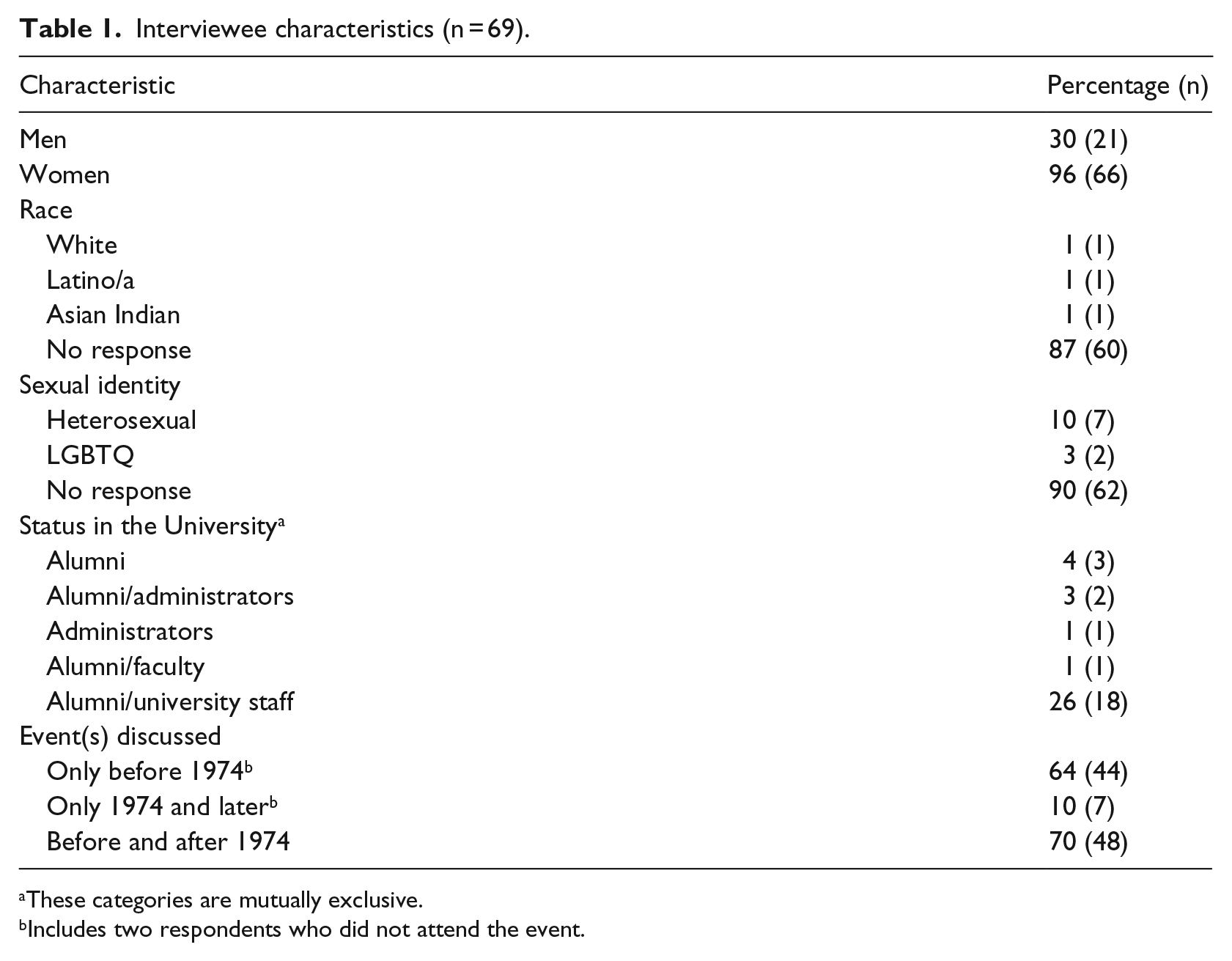
These categories are mutually exclusive.
Includes two respondents who did not attend the event.
The sample of interviewees is composed of a range of individuals who vary by their role at the University (administrators, alumni, faculty) and by their experiences with the early years of the Ball, the later years of the Ball, or both (Small, 2009). This allowed me to create multiple cases within a single case and to gain multiple perspectives on each case, which was crucial for the relational dimension of my analytic strategy.
Analytic approach
I analyzed the data in multiple stages. First, I reviewed the materials in their entirety to identify relevant and recurring themes. This inductive ‘open coding’ indicated that interpretations of the event and administrators’ response to it had changed over time (Emerson et al., 1995). To better examine these changes as well as the spatiotemporal context in which they occurred, I then arranged the materials into cohorts by event discussed: data addressing the 1970 Ball comprised cohort 1, data addressing the 1971 Ball comprised cohort 2, and so on. This allowed me to compare the understandings of the event at time 1, time 2, and so on and, more importantly, to investigate how administrators’ responses unfolded in relation to one another, in relation to parallel situations at peer institutions, and in relation to a broader shifts in the socio-political climate. Next, I constructed a narrative, ‘tying together actions and events through time and space’ (Czarniawska-Joerges, 1995: 15), and examined it in light of existing theories about organizational responses to oppositional action, which allowed for the identification of observational surprises in the tradition of abductive analysis (Timmermans and Tavory, 2012). Indeed, it became clear that the mechanism contributing to the transformation of the Ball did not quite align with those already identified, providing an opportunity to generate a new general description of how organizations mange and defuse oppositional action. Development of the concept of organizational absorption thus occurred through a process of alternation between revisiting the data, engaging with existing theory, and explaining the phenomenon observed. What constitutes a surprising finding is, of course, partly a matter of positionality, dependent on the researcher’s role in the world and on the theoretical background she brings to the field. To illustrate the integrity of the empirical material, I include examples that cut against my interpretation throughout the analysis.
I do not use interviewees’ names in the analysis but rather cite them by degree obtained and graduation year. I cite interviewees who did not graduate by specifying their status in the University and span of time they were there (e.g. undergraduate, 1965–1970 or administrator, 1960s–1990s). When citing publicly available archival materials, I use real names.
Organizational absorption of the Lascivious Costume Ball
Below, I show how University of Chicago administrators responded to the Lascivious Costume Ball, highlighting the role of spatiotemporal context in shaping their response. I begin with a description of the inaugural Ball and administrators’ purposeful nonintervention. Then I show how, at a critical hinge point, administrators started to engage in regulative validation of the event while also initiating its reconfiguration. Finally, I present data on later iterations of the event that demonstrate its transformation into an institutionalized tradition.
The inaugural Ball and administrators’ nonresponse
The first Lascivious Costume Ball occurred on Friday, 27 February 1970 at Ida Noyes Hall, a historic campus building. Inspired by an event held by Brandeis University’s Dionysian Orgy Club, the Ball was the centerpiece of a larger student-organized event called the Libertine Arts Conference, which involved a week of boundary-pushing and politically charged social activities, such as a rally for men’s liberation, a smoke-in to garner support for a drug abuse campaign, and a co-educational nude swim-in at a campus pool (University of Chicago Maroon, 1970d). It was organized by the satirical, anti-establishment group, Students for Violent Non-Action. One of its leaders (AB 1973) describes the organization’s mission: We wanted to shake people up, but not … push them against the wall. … You know, we wanted to end the war, too, but we weren’t—we didn’t think … that student protests were necessarily going to do it. So what we were doing was going after the culture …
Except for an estimated $150 for publicity from Student Government, Students for Violent Non-Action funded the Lascivious Costume Ball. It was immensely successful. Ida Noyes Hall was filled with ‘in excess of 2500 people …, much to the chagrin of the fire guards’ (undergraduate, 1965–1970). 3 Once inside the building, attendees enjoyed a variety of organized amusements: the music of two rock bands, a stripper performance, a Day-Glo body painting room, contests for the ‘most lascivious’ and ‘most obscene’ costumes, a Mr. U of C pageant, and pornographic films (University of Chicago Maroon, 1970b). Participants imbibed ‘tasty little suckers’ (i.e. marijuana cigarettes) (AB 1975) and Students for Violent Non-Action Punch, made with 190-proof ethanol that a founder of the Lascivious Costume Ball ‘liberated’ from the University’s chemistry laboratory (PhD 1975). Despite the variety of amusements occurring in Ida Noyes, Students for Violent Non-Action pointedly advertised that ‘no activities [were] planned in several small rooms … scattered throughout the building’ (University of Chicago Maroon, 1970b).
Alumni and administrators alike depicted the inaugural Lascivious Costume Ball as oppositional and disruptive. An alumnus (PhD 1975) describes the purpose of the event: ‘[W]e were rebelling against was the affluent culture of the ‘50s, the economy or the society that the greatest generation created.’ For alumni who described themselves as ‘straight-laced’ (JD 1972; PhD 1972), the Ball marked the first time they removed their clothing in public, watched a pornographic film, drank liquor this hard, or witnessed a live stripper performance. Alumni described costumes as ‘wild’ (PhD 1978), ‘dirty’ (PhD 1975), ‘terrific’ (JD 1972), and ‘clever’ (AB 1973), remembering a man who came covered in peanut butter and another who dressed up as a giant penis, with volleyballs for testicles and a hydraulic system that spurted whipped cream at the sight of arousing stimuli. Attendees did not expect the Ball to be so risqué. An alumna (PhD 1972) recalls her reaction to the event: Well, I think I went at least twice, and I remember the first year, the first one was just really something. I mean people went all out with costumes and my husband and I, we didn’t. We just dressed in what we thought was a fairly lascivious manner with the tight pants and the low-cut shirts and just looking sexy. … I just thought, ‘Boy, our costumes are really lame.’ This one group of people … came as testicles and a penis. It was quite something.
A critique of the values of the parent generation, the Ball was established as a response to long-standing University of Chicago traditions that many students viewed as out of date, specifically the Washington Promenade, a formal dance held annually from 1903 to 1970 (AB 1972; AB 1973; PhD 1973), where Miss University of Chicago was crowned. An alumnus (AB 1973) summarizes students’ reaction to the Promenade: We were startled to find that at the University of Chicago there was still a prom … [T]his was something that we said, ‘Oh, come now. You know we can’t allow this to stand. A prom at the University of Chicago?’
The Lascivious Costume Ball directly parodied the Prom with its own pageant, a Mr. University of Chicago contest. The Student Project on Equal Rights for Men, an offshoot of Students for Violent Non-Action, sponsored the competition, which ‘attempt[ed] to give the American male a chance to become a sexual object’ (University of Chicago Maroon, 1970a). R. Gorden Quintz, Student Project on Equal Rights for Men spokesperson, comments on the pageant: ‘We want to know that we also have a chance to be raped right on the street. We’ve always been jealous of women who get pawed all over by men—we want to be pawed all over by women’ (University of Chicago Maroon, 1970a). Administrators recognized the satire, irreverence, and historical relevance of the event and also that students viewed the Lascivious Costume Ball as ‘our version [of Wash Prom]. … Sort of a thumb-your-nose-at-just-the-opposite. Yeah, we’re different. It’s different and we’re liberated’ (administrator, 1960s–2000s). Although some aspects of the Ball (e.g. strippers, pornography) likely re-inscribed the status quo even as they challenged it, the data demonstrate substantial convergence around the event’s defiant and rebellious character.
Administrators’ nonresponse
The administration took a noninterventionist approach to the 1970 event, sanctioning its occurrence within the University and imposing very little oversight—phase 1 of organizational absorption. Administrators did not intervene in part because they were unaware of what the Ball involved. Although Students for Violent Non-Action members went before a panel of administrators and students to gain permission to use Ida Noyes for the event, they did not fully disclose their plans, neglecting to mention that they would serve alcohol at the event and encourage people to attend naked with the sliding-scale admissions fee (undergraduate, 1965–1970). An administrator (1950s–1970s) on the panel remembers students’ pitch: They said, ‘Well, we want to have this party called the Lascivious Costume Ball’. And I’m sure—let me also say, I’m socially fairly conservative and if I had an inkling of what it was about, immediately alarm bells would have rung off. They did me so well! … They said, ‘Well, we’re gonna call it the Lascivious Costume Ball and we’re gonna contact this famous stripper and she’s gonna come and she’s not gonna take her clothes off, no, no. And we have these old VD films from WWII and we got this guy who’s gonna sell sex magazines.’ And, you know, so I’m thinking freedom of speech.
Students for Violent Non-Action clearly provided administrators scant information about the event.
Administrators’ approach to the 1970 event is well-illustrated in official budgetary records for the Libertine Arts Conference, of which the Lascivious Costume Ball was a part. The Student Activities Office asked Students for Violent Non-Action to submit a budget for the conference to satisfy administrative procedure. The haphazard document, handwritten in green marker listing a total of 12 anticipated expenses for the 6 events comprising the weeklong conference, is far from detailed (University of Chicago Special Collections Research Center, Libertine Arts Conference Budget, n.d.). The incompleteness of this budget intimates administrators’ lack of concern over the event. For administrators and Students for Violent Non-Action members, who ‘put [the Ball] together just spur of the moment’ (PhD 1975), the event was a spontaneous dramatic spectacle whose guerilla character added to the sense that ‘it was not organized from above; it was counterculture as opposed to culture’ (AB 1973).
It might seem puzzling that the University did not actively manage or altogether prohibit the event, especially because of the potential threat it posed to its public image. But when considering spatiotemporal context, it is clear. Along with the rest of the world, administrators witnessed the ineffectiveness of interventionist and prohibitive approaches peer institutions, such as Columbia and Berkeley, took toward student disruptions. The administration did not want to make the same mistakes and certainly did not want the negative publicity that accompanied such debacles. An alumnus (AB 1972) summarized the importance of peer references in shaping University of Chicago President Levi’s general approach to campus disruptions: [H]e was doing what he had to do to deal with what was raging all around the country in terms of student unrest, and he wanted to do it in a way that avoided Columbia. That was critical. He understood that Columbia suffered a huge, huge, negative impact from what they did, and he wanted to avoid that at all costs.
The administrators dealing with the Lascivious Costume Ball surmised that if they did not draw attention to the event by forbidding it or ‘mak[ing] a fuss’ (administrator, 1970s), it would ‘die on its own’ (administrator, 1950s–1970s). One administrator (1960s–2000s) aptly summarizes the approach: ‘We weren’t about to radicalize people who were already radicalized.’
Administrators were also still feeling the effects of the 1969 sit-in and hoped to avoid a recurrence in part through improving campus life. They understood the sit-in as ‘an expression just not simply of political unrest but of unhappiness among students about the way they experienced their time [at the University]’ (administrator, 1960s–2000s). An alumna (AB 1973) describes the dearth of attention towards students and student life: ‘[T]he University then had relationships with ideas and not so much with the students.’ As an attempt to appease students after the 1969 sit-in, the University began making a concerted effort ‘to focus on some things outside of the classroom that had basically been neglected’ (administrator, 1960s–2000s). Another administrator (1950s–1970s) elaborates, ‘[The 1969 sit-in] was part of the awakening of the University to the importance of student life, a role for student life as well as the life of the mind.’
From the perspective of administrators, the Ball was the perfect opportunity for (1) the University to show students that it was not uncaring about their overall experience and (2) the release of student energies. Relative to the 1969 sit-in, it seemed harmless because it was nonviolent and posed little apparent threat to university operations. Administrators ‘figured [the Ball] was better than having the sit-ins and riots that they had in the 60s …’ (administrator, 1970s). One administrator (1950s–1970s) went so far as to say that the University welcomed the event in the hopes that it would ‘deflect energies away from contemporary politics’: I think in some ways [the Lascivious Costume Ball] was exactly what the University and what the higher-ups in the University wanted. It was something that provided an opportunity for students to do something that … was a violation of the social norms, an opportunity for their creativity. Something that they were certain the University didn’t approve of and something which, … [students] could show not only their sense of liberation but also their sense of kind of snubbing their nose at authority of all kinds.
Context was therefore crucial in shaping administrators’ approach to the first Ball. They considered the broader national political climate, peer institutions’ responses to parallel situations, and past local events. Of course, legitimacy and stability concerns also affected their response, but it was nevertheless contingent, influenced by spatiotemporal context. This approach allowed the event’s defiant character to flourish, helping it act as a steam-valve. But rather than exhausting future interest in the event, administrators’ nonresponse may have bolstered students’ desire to hold another Lascivious Costume Ball, for the first was such a thrill.
Regulative validation and reconfiguration
1971
Students for Violent Non-Action did not intend for the Ball to be repeated, but by popular demand, it was held again in 1971 (PhD 1975). Yet by its second iteration, the event’s defiant mood had started to fade. Why? It was not participant turnover, as 1970 graduates and dropouts were the only ones to formally exit the University, or a major transformation in the cultural climate. 4 Neither did it result from a change in the event’s organizers, as Students for Violent Non-Action continued to orchestrate the Ball. And it was only the second annual event, thus it is unlikely that it had already become completely routine to students. 5 What did change, however, was the administration’s approach.
In contrast to their initial response, administrators intervened in the 1971 Ball, acting in ways that further restricted and validated the event while also initiating its reconfiguration—phases 2 and 3 of organizational absorption. Having experienced the first Ball, the administration now fully understood what it entailed and was thus better able to respond to the ambiguous circumstances it created. The event incited a deep sense of uneasiness among the administrators I interviewed. They feared the long-term effects of the disruptiveness of the late 1960s and early 1970s on U.S. campus culture. An administrator (1950s–1970s) chaperoning the 1971 Ball conveys this sense of uneasiness: It was clear; it was obvious from later stories [about the event] that people were doing everything imaginable off in corners and various places. So, I think I basically stayed in the main hall … I never went back in one of the corners.
Administrators’ internal responses to larger changes happening in society, captured by the Ball, thus likely contributed to the shift in their approach. They also realized that the popularity of the event would demand more iterations of it, and with each subsequent iteration, the Ball would become more difficult to insulate. Administrators therefore acted to preserve the institution’s legitimacy among important benefactors; they ‘didn’t want this in the main papers [because] the trustees would have just about had a heart attack’ (administrator, 1970s). The presence of outside authorities, including the Chicago Police, at the event could bring negative publicity to the University and compromise its privileged, insular position (administrator, 1970s). Legitimacy concerns and spatiotemporal context therefore both affected administrators’ changed response to the Ball.
Administrative intervention in the event involved two processes: (1) increasing regulation and surveillance of the event and (2) the exploitation of the preexisting link between the event and the University’s institutional identity, that is, the administration’s vision for it. Beginning in 1971, the Student Activities Office prohibited alcohol service at the event. Administrators also monitored the doors of Ida Noyes, ensuring that each entrant possessed a valid University of Chicago ID card. An administrator (1960s–2000s) describes the precautions taken: We had people who were there. First of all, the Ida Noyes staff, the Student Activities staff, they were on the front lines … [T]his was supposed to be a University event and we did not want it to be invaded by non-University people from the outside, the rest of the city. … So we were pretty rigorous … in limiting the entrance to people with a student ID.
A student writer for the Maroon reflects on the expanded administrative presence at the 1971 Ball: There was tight security at this year’s dance which might have been a cause for the slightly dampened spirits of some people. Student Activities Director Skip ‘Dan B’ Landt expressly forbade picture taking, and alleged members of the Vice [the name of an administrator] squad lurked in the corners … (University of Chicago Maroon, 1971a)
Yet, despite these regulations, the administration continued to permit the Ball within University space, which contributed to a sense that it was valid.
The University also began to exploit the event’s connection to its institutional identity, which further validated it and facilitated its reconfiguration. For alumni and administrators alike, intellectual curiosity, a stalwart commitment to scholarship and academic freedom, and quirkiness defined the University of Chicago’s identity. Students for Violent Non-Action had already drawn this connection—one member (AB 1973) described the first Ball as ‘sex, drugs, and rock “n” roll meets Plato’s Republic’—but administrators emphasized it, highlighting how the Ball represented the institution’s supposed cleverness, ingenuity, even its edginess. All administrators interviewed and most alumni who attended the Ball from 1971 onward described it as ‘very U of C.’ The elements of the event linked to the University’s identity had started to become more prominent as those linked to its disruptive signification fell into the background. This reconfiguration enhanced the event’s legitimacy and administrators’ repeated allowance of it, reframing the Ball as something only University of Chicago students, ‘a band of scholars’ (AB 1977), would create and sustain.
The dissolution of the event’s initially disruptive character did not, however, occur instantly. It took time for the event to be fully integrated into the legitimate routines of the University (and, hence, completely validated) and for the reconfiguration of the event to stick or, in other words, for the institutionalized meaning of the event to unseat its oppositional signification—phase 4 of organizational absorption. This can be explained by the lag that often accompanies the adoption of new ideas or practices (Rao et al., 2003). As the connection between the Ball and the University’s identity was reproduced and strengthened by later attendees, the Ball became less of an act of defiance and more of a demonstration of the University of Chicago’s eccentric intellectualism. This is pointedly evident when comparing alumni conceptualizations of the event. Alumni who attended the 1970 Lascivious Costume Ball described it as an opportunity ‘to liberate the culture, … loosen up people, and defy the people who really did think that rock “n” roll was music in the service of the Kremlin’ (AB 1973), while attendees of later versions presented the more institutionalized and, in turn, intellectualized understanding of the event. An alumnus (AM 1986) illustrates, ‘[The Ball] was a Dionysian revelry to counterbalance the emphasis on the apollonian’, that is, ‘very U of C.’
1974
Organizational absorption had progressed by the third Lascivious Costume Ball. 6 The disbandment of Students for Violent Non-Action facilitated the intensification of organizational absorption, as Student Government became responsible for orchestrating the event. Unlike Students for Violent Non-Action, Student Government received regular financial support from the University and had a formalized relationship with administrators. By 1974, Student Government and Student Activities budgets allocated funds for the Lascivious Costume Ball, allowing the administration to increase its involvement in the event to a greater degree. Additionally, administrators had an even better understanding of the event and effective management strategies based on their experience with the first and second iterations.
Archival documentation of the 1974 Ball highlights the administration’s increased involvement and how it advanced the University’s absorption of the Ball’s disruptive character. In contrast to the one-page, handwritten budget Students for Violent Non-Action submitted to Student Activities and the informal verbal proposal they presented to administrators in 1970, Student Government President Mark Brickell had to submit a detailed outline of his plan for the 1974 event to Skip Landt, Director of the Student Activities Office. Landt’s response illustrates the administration’s desire to tighten regulations as well as its continued efforts to institutionalize the event: He inquires about the legality of ‘art films and strippers’ to be included at the event, asking ‘What assurances do you have that these programs will be within limitations of the current laws?’ (University of Chicago Special Collections Research Center, Memo from Skip Landt to Mark Brickell, 1974). Landt demonstrates his concern for keeping the event out of the public eye—‘How and where would you publicize the event in such a way to minimize misunderstandings about who would and who would not be admitted?’—and reiterates the prohibition of alcoholic beverage service: I think there are enough problems with the Lascivious Costume Ball that attempting to serve alcoholic beverages of any kind would cause serious problems. Frankly, anyone who needs a glass of beer to find such an evening interesting would have to be a person of very limited imagination. (University of Chicago Special Collections Research Center, Memo from Skip Landt to Mark Brickell, 1974)
He asks Brickell to explain what he means in his proposal when he writes, ‘[A]n unlighted room will facilitate the artistic self-expression of the patrons’ (University of Chicago Special Collections Research Center, Memo from Skip Landt to Mark Brickell, 1974). Landt also urges Brickell to provide a more detailed outline of his ‘crowd control’ plan and efforts to ‘prevent violent and antisocial behavior’ (University of Chicago Special Collections Research Center, Memo from Skip Landt to Mark Brickell, 1974). Importantly, Landt is not pushing for a redefinition of the event here, as in the case of co-optation. He instead appears to critically question some of the event’s more transgressive components, indicating a reconfiguration of the Ball’s symbols and rhetorical packages was underway. Indeed, a letter from Student Government to the student body demonstrates the intensity of administrative involvement: ‘During the five weeks of planning the event, we were so discouraged by the more extreme constraints placed upon us that we even considered handing the whole project to the Student Activities Office’ (University of Chicago Maroon, 1974b). Attendees ‘were forced to wait in line for up to ninety minutes before they were admitted to Ida Noyes’ because administrators insisted on checking IDs twice (University of Chicago Maroon, 1974b).
The process of organizational absorption, initiated in 1971, was at its peak by 1974. The University had institutionalized and diluted the event’s initial transgressive character. The Ball had become a tradition—funded and validated by the school, executed by a student group closely affiliated with the University, and reconfigured into a representation of the institution’s identity. No longer a reflection of the defiance that defined late 1960s and early 1970s America within and beyond the university setting, the Ball was now integrated into the legitimate routines of the organization as ‘the culmination of the University’s social season’ (University of Chicago Maroon, 1974a).
The tradition of the Lascivious Costume Ball
The power and extent of organizational absorption is even more apparent in accounts of the 1980, 1982, and 1984 Balls. Student participants and organizers perpetuated the event’s signification as something ‘very U of C’ (e.g. AB 1984; MA 196) and many referred to it as ‘just another party’ (e.g. AB 1985). Some alumni who participated in the 1984 Lascivious Costume Ball knew about its link to ‘a sort of antiestablishment mentality’ (AB 1984), but most neglected to mention its connection to the local and national politics that instigated its establishment and defined University of Chicago student culture in the 1960s and early 1970s. An alumnus’s (PhD 1984) discussion of the Lascivious Costume Ball illustrates: I remember when we first heard about [the Ball] …, the people said, ‘Oh, this is kind of like a … tradition that’s gone on every couple years,’ … dating back to the ‘60s or something.’ But people were vague. They didn’t know.
Others provided similar testimony: [T]he way it was pitched … was, ‘It’s this weird party where everybody goes and if you wear street clothes, it’s $8. If you wear lascivious costume, it’s $4 and if you go naked, you get in for free.’ … It was just sort of a big wild thing with people doing sexual stuff. (Alumnus, AB 1985)
Particularly illustrative are the reflections of one alumnus (AB 1973) who helped organize the 1970 Lascivious Costume Ball but returned to the University in 1984 and found the Ball had an altogether different meaning than when he went. A few people remembered its link to 1960s disruption ‘but not to the point of actually doing something illegal and subversive’ (AB 1973). He observed a successfully absorbed Lascivious Costume Ball that lacked its boundary-breaking bent: ‘It became more or less just a dance in its later years, and it became sort of a venerable tradition.’ Even administrators recognized that the Ball ‘had become an event far from the spirit of its origins’ (administrator, 1970s–1990s). It ‘evolved into more of a party’ that people attended ‘because it was something you could say you did as part of your University of Chicago experience’ (AB 1984). Through the process of organizational absorption, the event had lost its initial oppositional character.
Rebelling against the parent generation, protesting the Vietnam War, participating in the student movement, and celebrating the sexual revolution—all of these trends had faded. Accordingly, a sexuality-themed party that represented this rebellion became obsolete. Although some students attempted to update the event’s social and political relevance by linking it to gender politics and gay rights, 7 most attendees of later versions of the Ball considered it University tradition only tinged with a residual air of rebellion. The event, for most students, had become ‘a place where you go and get naked or whatever’ (AB 1984).
An alternative interpretation is that students’ descriptions of the event, rather than the event itself, are what changed. Since ‘The Sixties’ had ended, students lacked a social movement consciousness and thus no longer used emancipatory, politicized language to describe the Ball. Instead, they characterized it as a wild party. Another possibility is that the Ball transformed from what Mikhail Bakhtin (1984) calls a true festival, characterized by laughter and the suspension of social order, into an official one, which reinforces the social order and has a more serious tone (p. 9). These alternatives and my interpretation are not mutually exclusive; however, they do not account for the link between the event and the University’s identity, which, I argue, strengthened through the process of organizational absorption and contributed to the attenuation of the Ball’s transgressive signification.
Epilogue: the demise of the Lascivious Costume Ball
Administrators canceled the Ball after its 1984 iteration. Legitimacy and stability concerns as well as spatiotemporal context shaped this decision. The media became more involved, with the 1984 Ball ‘covered by 500 news cameras and 400 reporters’ (University of Chicago Maroon, 1984a). In an article for the Chicago Tribune, Mike Royko (1986) chronicled the evening’s festivities: [A] considerable number of students wound up in a hospital emergency room, suffering from being loaded to the gills. Others had to have their eyeballs realigned, as a result of having smoked, sniffed or swallowed the wrong herbs and spices.
Administrators wanted to avoid this negative publicity, especially as the University sought to maintain its recently achieved financial stability (Boyer, 2015). An alumnus (AB 1984) perceptively comments, ‘[T]hey killed [the Ball] when the TV news cameras showed up and this stuff showed up live on the ten o’clock news.’
The progressive ascension of conservatism in the 1980s and ‘the Age of AIDS’ (Laumann et al., 1994) combined with the comparatively quiescent atmosphere on campus also made it easier for the University to take a more authoritative role in student life. An administrator (1960s–2000s) elaborates, Now, if we said, ‘No, we’re not going to do [the Ball]’ after the first Ball, I suspect there would have been a big, big problem the next year. We said we’re not going to do it in 1986 or ‘87 or whenever it was and a lot of people were unhappy but essentially, well, ‘That’s too bad, blankety blank.’ So on and so on, end of story.
With the period of student disruptions long over, administrators correctly assumed little backlash from students in response to the cancelation. Further, the University’s authorization of such an event became less justifiable in the climate of the 1980s. An alumna explains (AB 1984): I think [the Ball] continued on … until popular opinion and cultures started to change. You had a lot of shifting values starting in the early ‘80s with Ronald Reagan, and people started to become a little more socially conservative … And I think it became unacceptable to be having an event [like the Ball] that was … sponsored by the school.
The factors shaping the administration’s decision to cancel the event were consistent with those affecting its response to previous iterations: the local and national socio-political climate, recent past events at the University and beyond, and a desire to preserve stability and legitimacy.
Discussion and conclusion
This article integrates relationality into analyses of how organizations respond to and defuse potentially threatening oppositional action through an historical organizational ethnography of the University of Chicago’s Lascivious Costume Ball. I argue that spatiotemporal context, in addition to stability and legitimacy considerations, crucially shaped administrators’ approach to the event and hence its transformation. This change occurred through what I term organizational absorption: a contingent process involving purposeful nonresponse to the oppositional action, regulative validation of it, reconfiguration of its symbols and rhetorical packages so that those aligned with the organization’s identity become more prominent as those linked to its transgressive signification fade, and, finally, incorporation of the opposition into the organization’s legitimate routines as an institutional tradition representative of its identity.
Although the data provide substantial evidence in support of the argument, they have limitations. The sample of interviewees has a self-selection bias, which may elicit certain types of accounts. However, no comprehensive list of attendees exists, making it difficult to acquire a representative sample, and I required the perspectives of key informants, such as event organizers, in order to develop a comprehensive understanding of the University’s response to the Ball. The number of administrators interviewed is also small. While I cannot claim I interviewed every administrator directly involved in the Ball, archival documents indicate there were few. Most of the administrators I interviewed managed multiple iterations of the event and were thus able to convey that there was little turnover in University officials responsible for the Ball. There were a few administrators whose insight would have been valuable but, given that the last Ball occurred over 30 years ago, are no longer available. I addressed these limitations by incorporating archival documentation of and multiple perspectives on both the event and administrative involvement in it. This strategy of triangulation enabled a thorough assessment of officials’ response and the process of organizational absorption.
This research makes several important contributions to organization studies. First, it highlights the contingency of organizational governance, specifically actions taken in response to internal disruptions. I demonstrate the dynamic relationship between organizational actions across time and social space. This approach illuminates a crucial relational dimension of organizational control often eclipsed by assumptions that norms or means-ends calculations motivate such action (Emirbayer, 1997; for an exception, see Vaughan, 1998). It therefore also advances the discipline’s recent historic turn, which seeks to integrate context more explicitly into explanations of organizational behavior. Emphasizing the spatiotemporal embeddedness of organizational responses to oppositional action frames governance as form of situated problem-solving in the pragmatist tradition more so than a mode of strategic action.
By closely attending to social and temporal context, this article identifies a new mechanism whereby organizational governance defuses disruption and generates little resistance in doing so. One key aspect of organizational absorption that distinguishes it from other control processes and makes it highly effective is reconfiguration of the oppositional action. Elements of the action already linked to or that may, in the eyes of officials, potentially link to the organization’s identity are drawn out over time, which relegates its threatening elements to the background and leads to their ultimate dissolution. Initially, this may give the opposition the impression that they are still engaging in something defiant, because the action has not been dramatically redefined through, for example, co-optation. But by continuing to participate in the action as it is being reconfigured, the opposition becomes complicit in its absorption, reinforcing its link to the organization’s identity and allowing the organization to become increasingly involved in its administration. A condition that must therefore be satisfied for absorption to occur is that the action needs to contain ‘absorbable’ elements. For example, an organization may absorb disruptions related to environmental protections as ‘sustainability efforts’ that subsequently become representative of its green identity. Future research should further assess the applicability of organizational absorption to other forms of disruption in different empirical settings.
Finally, this article illuminates the largely underspecified role of organizational identity in the management of internal oppositional action. An influential literature documents how organizational identities can be used in control processes to foster employee commitment (Alvesson and Willmott, 2002), minimize external threats generated by environmental changes (Gioia and Thomas, 1996; Ravasi and Schultz, 2006), and cultivate reputations among outsiders (Dutton and Dukerich, 1991). But this line of work remains distinct from research on organizational responses to internal disruptions. This article begins to bridge these literatures, demonstrating how organizational officials defused internal opposition by exploiting its link to their organization’s identity. Given that identities emerge through action (Albert and Whetten, 1985; Gioia et al., 2000; Whetten, 2006; White, 2008), this may offer fresh insight into the dynamics and stability of organizational identities by lending additional specificity to the actions that help define them.
Footnotes
Acknowledgements
I thank Andrew Abbott and Kristen Schilt for helping to conceptualize the project and for comments on early drafts. Thanks are also due to Julia Adams, Rene Almeling, Emily Erikson, Marcus Hunter, Philip Gorski, Charles Perrow, Frederick F. Wherry, and Christopher Wildeman whose criticisms and encouragement strengthened the paper.
Funding
The author(s) received no financial support for the research, authorship, and/or publication of this article.