




Abstract
The aim of this article is to apply literary theory and a work of literary fiction (Cloud Atlas by David Mitchell) to the task of offering points of departure for new thinking about organization theory. To this end, I locate this article at the seam between organization and the literary, where I employ two concepts proposed by Deleuze (the fold and the rhizome), apply the semiotic square and discuss the relationship between form and content. An examination of Cloud Atlas is positioned in the middle of the article to reflect the idea that the literary is at the heart of organization and vice versa. In keeping with the literary spirit of Cloud Atlas, this article mirrors the following narrative pattern of the novel: A | B | C | D | C | B | A. By working the seam, I find a way of developing alternative metaphors, challenging prevailing ideological assumptions and problematizing current paradigm assumptions.
Organization (theory)?
When I read David Mitchell’s (2004) Cloud Atlas, it initially seemed to have no association with organization. On closer repeated readings, I began to realize that, on the contrary, organization is at the heart of its narratives. It appears in a number of guises, for example, as a ship on the ocean, as a composer and his amanuensis, as a private detective agency, as a literary agency, as an old people’s care home, as a fast-food restaurant, as a university and as a tribe. Organization scholars would also be intrigued by one of the main themes of the novel – a study of power and resistance, which maps out a history (of the past and the future) of imprisonment and exploitation in which seemingly hopeless situations are somehow resolved (Jameson, 2013). For example, in the first half of The Ghastly Ordeal of Timothy Cavendish (Chapter 3), Timothy Cavendish is tricked into staying at a ‘hotel’. This ‘hotel’ turns out to be an old people’s home, where he falls ill and is confined. However, in the second half of the narrative (Chapter 8), he simultaneously escapes and frees other ‘residents’. They flee to Scotland where Timothy Cavendish and his elderly co-escapees live comfortable new lives ‘in exile’ – away from harm that lurks south of the border in England. In An Orison of Sonmi~451 (Chapters 5 and 7), Sonmi~451 is a slave-clone who is imprisoned in a fast-food restaurant (‘Papa Songs’), where she and other clones must serve ‘purebloods’ (humans). The clones are routinely subjected to violent abuse and death, so Sonmi~451 writes declarations of liberty and becomes an important figure in a resistance movement. In the story, she is captured and condemned to death, but her ideas survive, having ‘been reproduced a billionfold’ (Cloud Atlas: 364).
Not only the content but also the chiastic form of the novel piqued my interest. This interest drew me to the work of Deleuze (1993), who presents the concept of the fold. In many ways, Cloud Atlas can be seen as a Deleuzian fold. First, it is folded within its covers (or in the memory of an e-reader) and unfolds in a particular way. In the first half of the novel, the narratives unfold from, through and around each other. Then, in the second half, the narratives refold back upon themselves – an involution back into their original form (a closed book or e-reader memory). The stories that make up Cloud Atlas can also been seen as folds in that the narrative significantly changes in both form and content. As the novel unfolds and refolds, there are interruptions, flow, connections and disruptions in which chance and contingency play an important role for the multitude of characters that inhabit the worlds created by the author (Mitchell, 2010). Furthermore, the novel does not follow a single narrative. Instead, six stories are told in 11 chapters with widely divergent narrative styles, chronotopes, genres, voices, times and places. However, these stories are interconnected in intricate ways that are not always readily observable. Instead, the folds and interconnections emerge through the reading of the novel. The idea of the fold allows us to see the novel as an example of the ways in which we can establish new ways of seeing and thinking. For example, in Cloud Atlas, form and content are thrust together through symbolic themes, interconnections, the ontological forms of the various narrative constructions and the shape of the book as an entity.
The presence of organization in Cloud Atlas and the strangeness of its narratives draw attention to the connection between organization and the literary. For example, we might begin considering the gaps between the form and content of organization as imagined and represented by academic researchers and organization as the social constructions and processes that are lived. From here, the literary then challenges us to think beyond form and content. It also propels us to problematize the gaps between the real (that which does not depend on our conception of it and is beyond our ability to describe), reality (that which we know – meanings that we use to provide a sense of what is there) and fiction (imagined realities; Belsey, 2005; Rhodes, 2009). In other words, we can apply ideas from the literary realm to raise questions about the extent to which the narratives that organization scholars create are affected by the interactions among form, content and mode of expression, and how closely these narratives are (or can be) in contact with the real. Once we begin to consider these issues, our assumptions about organization come into view. For example, some assume that organization can be captured and caged within relatively stable frameworks for analysis and that the results can be presented to a public audience. Presenting theory in this way can be regarded as an oversimplification that obscures as much as it reveals about organization because it is confined to a realm in which it is assumed that organizations are formal entities and institutions, where social ordering is ‘already a formed and predetermined given’ (Böhm, 2006: 5). As a result, ‘attempts to understand organizations as discrete, functional, abstracted entities cannot penetrate the significance of organization, since these are merely epiphenomena of a more fundamental process’ (Carter and Jackson, 2004: 117). Thus, a major challenge for organization theory involves identifying and understanding this fundamental process. Doing so requires new ways of thinking that incorporate non-linearity, flow, movement, multitude, difference, becoming and emergence (Linstead and Thanem, 2007).
Attempts to achieve such new ways of thinking have long been of interest to organization scholars. While the edited work of Helin et al. (2014a) marks a recent noteworthy effort, we can trace contemporary endeavours back to the work of Deetz (1996), in which Burrell and Morgan’s (1979) seminal work is employed to develop and outline alternatives to the functionalist tradition, introducing potential new ways of thinking about organization (e.g. interpretive and postmodern perspectives). Tsoukas and Chia (2002) take up this theme in their work, which explores organizations as sites of change. They argue that organization is as much a product of human action as it is an attempt to shape it. Chia (2005) amplifies these two works with a discussion of alternative (postmodern) perspectives including the idea that organization ‘is a ceaseless process of reality construction’ (p. 137). Böhm’s (2006) book outlines a repositioning project that aims to dislodge our thinking about organization from the hegemonic discourse of managerialism and global capitalism, which embeds it within the economic realms of the workplace and the wider spheres of society, politics and technologies that are associated with neo-liberalism. In more recent research, Rhodes (2009) re-examines reflexivity as imagination – the process of creativity and new thinking in organization; coming full circle, Hassard and Wolfram Cox (2013) take us back to Burrell and Morgan (1979) with a call to revise our thinking about paradigms in organization studies in a way that ‘would allow us, at once, to acknowledge essential differences between epistemic communities, highlight the contributions of marginalized research domains, and variously challenge the hegemonies of post-positivist discourse’ (p. 1717). I contend that the literary can provide a rich vein of inspiration for new thinking that will contribute to this search for better ways of doing organization theory.
To search for ways of revising our thinking, I explore the seam between organization and the literary (De Cock and Land, 2006) with the aim of destabilizing various assumptions of organization theory, and I provide alternative metaphors, challenge ideologies and reassess paradigm assumptions (Alvesson and Sandberg, 2013). To this end, I examine the following questions: What kinds of literary concepts and perspectives, if any, are available to us that can provide a point of departure and inspire new thinking? How can we use the literary to reimagine our relationships with organization, the organizational lives that we imagine and the reality of organization that we live? To answer these questions, I employ David Mitchell’s novel together with literary theory, which is primarily informed by the philosophies of Deleuze (sometimes with Guattari). This combination provides an introduction to a range of literary concepts and perspectives that are needed to attempt this difficult and controversial (and risky?) task.
At the seam: inside/outside the Deleuzian fold
The potential of Deleuzian philosophy has yet to be fully realized in the study of organization, even though it has greatly influenced the development of new thinking in the realms of social, cultural and literary theory. A strength of Deleuze (and Guattari) is that this work provides ways of escaping foundationalism in our thinking (Gandy, 2005) and draws our attention to the need to shift from thinking about processes in organization to ‘how we should be thinking about processes’ (Kristensen et al., 2014: 505). For example, in organization research, Bougen and Young (2000) challenge the assumption that incremental regulatory change can succeed in preventing fraudulent behaviour and that regulators can learn from the past experience. In addition, Deroy and Clegg (2011) destabilize the institutional foundations of business ethics by applying the Deleuzian concept of the ‘event’, while Painter-Morland and Deslandes (2014) challenge us to think beyond conventional representations of gender in leadership studies. Organization researchers have also applied Deleuzian philosophy to challenge the foundations of organization theory more broadly. Linstead and Thanem (2007) question the epistemological and ontological assumptions of organization theory, suggesting that organization is autosubversive, that is, it is without a solid foundation and is constantly changing. Sørensen (2005) also challenges us to rethink theory. Using a range of concepts from Deleuze’s work (e.g. de/reterritorialization), he proposes an alternative philosophy in which organization, chaos and change are inseparable, forming ‘organizing refrains’ (rhythms and expressions). Styhre (2002) problematizes the language of organization theory. Using ideas such as multiplicity and assemblage, he suggests that organization concepts are indeterminate in that meaning is a linguistic fabrication. Finally, Wood (2002) shakes organization knowledge from it foundations in mainstream organization research, proposing a perspective that combines time and space. According to Wood (2002), knowledge can be considered polyphonic, heterogeneous and constantly changing – connecting all things at all places and at all times. Despite the publication of these and other studies, Deleuze still remains somewhat peripheral, even though his body of work has been shown to ‘offer – new thinking on organization(s)’ (Carter and Jackson, 2004: 124; see also Kristensen et al., 2014).
The fold is a concept that shows particular promise (Deleuze, 1993). This neo-Leibnizian perspective brings the writings of Nietzsche and Spinoza to bear (Lœrke, 2010: 42) on the work of Baroque philosopher Gottfried W. Leibniz (1646–1716) to create a philosophy of becoming, in which the world and everything in it is in a constant state of folding, unfolding and refolding (Deleuze, 1993). This idea agrees with Leibniz’s original philosophy, except that the monad (a fixed state) is replaced with the nomad (constant variation and trajectory). By proposing this concept, Deleuze draws our attention to the interaction between form and force. Gibson (1996) argues that the fold is primarily a line of force (of movement and change), while form is simply ‘a provisional container’ (p. 58) that is repeatedly distorted and destroyed by force (i.e. force and form fold, unfold and refold).
For Deleuze (1993), the fold has metaphorical properties. First, he compares the fold to a Russian doll because it has interiority and exteriority (a fold within folds). Second, he compares the fold to Japanese origami because it has processual characteristics that refer to the transformation of form. In other words, the fold refers to form in that folding involves enveloping/developing and involution/evolution. It is a ‘point of inflection’ where things change their form as force is applied – that is, where variation takes place. Deleuze (1993: 9) illustrates this transformative property and distinguishes between organic and inorganic folds by describing how a caterpillar envelops a butterfly (i.e. it is folded inside it). He goes on to explain that the caterpillar develops (unfolds) into a butterfly. It then dies and involutes (refolds) back into its constituent parts. These constituent parts become inorganic folds that wait to evolve once again into an organic fold – though in a different form. Thus, we have organic folds that are interior envelopments of other organisms (e.g. the caterpillar and the butterfly), which are distinct in the ways that they are complex envelopments of interior sites (Deleuze, 1993). By contrast, there are inorganic folds. These simple and direct folds are exterior sites, including water, air, fire, and rocks, that flow in, through, on and around organisms (organic folds). Deleuze (1993: 9) also argues that no separation exists between the organic (interior) and the inorganic (exterior) because the inorganic folds into the organic and the organic folds into the inorganic. For example, a lake is an exterior (inorganic) site, but it is infused with organisms (e.g. fish); however, the fish that move through the water are also suffused with that water in every cell of their bodies, and these fish contain the seeds of all other generations of fish, which, in turn, are suffused by inorganic folds, and so on (Deleuze, 1993). In other words, forms that are folded are virtual until they are unfolded (expressed or actualized) by some folded force, and, once unfolded, they are moulded by folded forces (i.e. constantly folding, unfolding and refolding). This continuous movement from fold to fold is characterized by uninterrupted series of differentials, variations, actions and the like (Lœrke, 2010) on planes of differing and continually ‘becoming life’ (Colebrook, 2002: 70). These planes are infused with multiplicity and interconnectivity, which Deleuze and Guattari (1987) refer to as rhizomes.
The rhizome is a metaphor that compares social life to chaotic root structures in which everything is connected to everything else. It draws attention to complex movement, activity and change in which connectivity and heterogeneity are defining characteristics (Deleuze and Guattari, 1987). Rhizomes are composed not of units but of multiple dimensions and directions in motion; as such, ‘there is no beginning, no end, only a middle that grows’ (Deleuze and Guattari, 1987: 21). For example, a rhizomatic text does not have meaning per se; its meaning exists in the work as an event or production. In their book about Franz Kafka, Deleuze and Guattari (1986) describe his work as rhizomatic. They argue that Kafka’s novels are events; when they are read, a movement of interpretation occurs along a single surface that then stratifies and creates new surfaces of movement and activity – new interpretations, new connections and even new realities. However, these realities are themselves rhizomatic, meaning that no fixed, single points or positions exist. Instead, there are planes of multiplicity whose dimensions ‘increase with the number of connections that are made on it’ (Deleuze and Guattari, 1987: 9). Rhizomatic action constantly moves along these connections, changing and connecting to ‘other multiplicities’ (Deleuze and Guattari, 1987: 9). Given this argument, it is possible to contend that new ideas and new thinking can emerge anywhere and everywhere and at any time because, together, folding and rhizomes suggest that reality constantly reconstitutes itself by changing direction, tracing inside and outside spaces that cannot be mastered by an exteriority (Deleuze, 1988). It is here that new ways of thinking develop (Deleuze and Guattari, 1987).
The fold and the rhizome open up possibilities to challenge taken-for-granted assumptions in organization. In a related way, Cooper (2014) discusses the unfoldment–enfoldment of events as a way of rethinking processes of organization. In addition, Kornberger and Clegg (2003) directly apply the Deleuzian concept of the fold to provide a new perspective on complexity, change and creativity in organizations, while the rhizome appears in studies of complexity and change in the ways in which urban cultures are organized (Daskalaki and Mould, 2013; Gandy, 2005). However, the fold and the rhizome have not yet been used in combination. To explore how they can be blended to provide new ways of thinking about organization, I employ a semiotic square (Greimas, 1987). This approach allows us to extend ‘the analysis of a binary opposition by introducing contradictory and complementary terms’ (Boudes and Laroche, 2009: 381) and, in doing so, gives us a way of illuminating ‘deep structures that define the fundamental mode of existence of an individual or a society, and subsequently the conditions of existence of semiotic objects’ (Greimas, 1987: 48). In other words, the semiotic square allows us to elucidate how the narratives about the world that we produce are converted into our knowledge and understandings about the world and vice versa (Corso, 2014; Jameson, 1987). To examine organization, the fold and the rhizome in this way, I hold ‘organization’ and ‘disorganization’ as contrary terms (Cooper, 1986), with ‘not organized’ and ‘not disorganized’ as their respective contradictory terms. In doing so within a semiotic square, we can begin to uncover what fold and rhizome mean in the context of organization and what they do in this context (Figure 1).
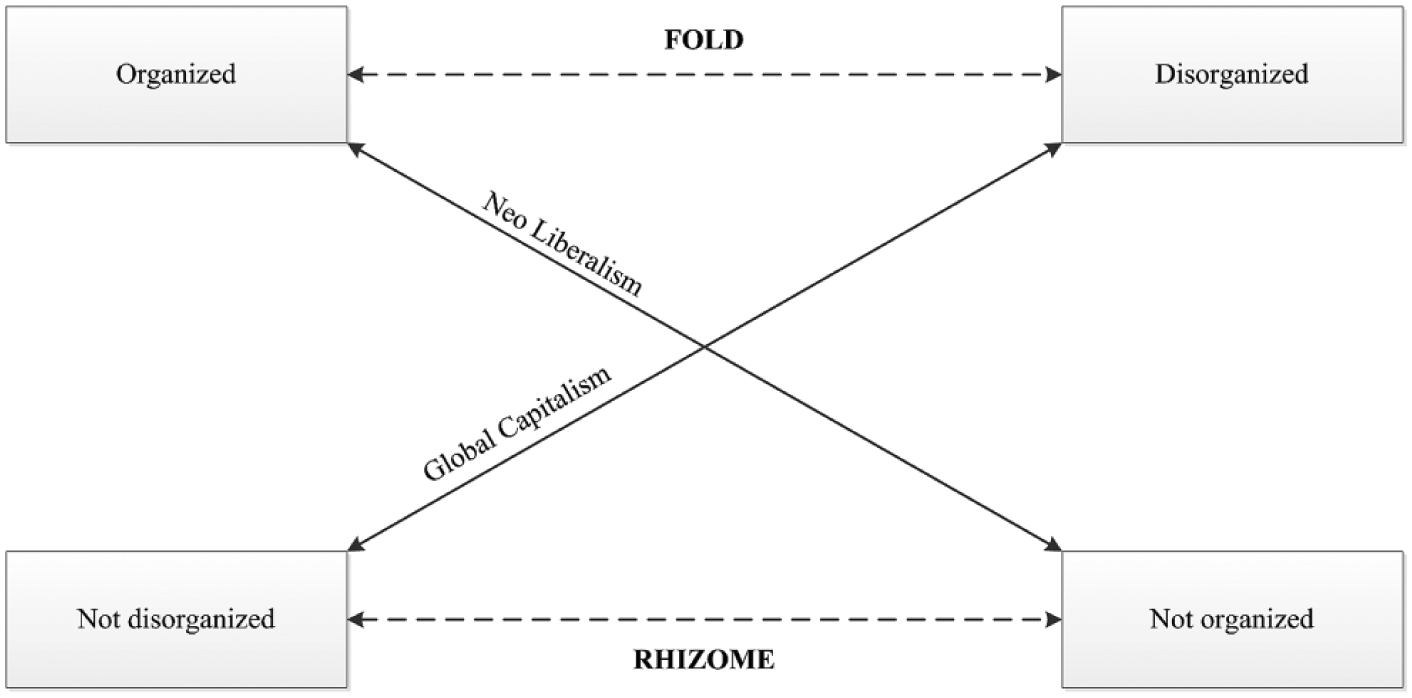
The fold, the rhizome and organization within a semiotic square.
Figure 1 reveals that the fold metaphor provides a way of seeing organization as organized and disorganized. The fold not only refers to organized processes of unfolding and refolding but also calls attention to the fuzzy and indeterminate nature of the difference between the internal and external. In this respect, the fold can be seen as disorganized. The rhizome can be seen to refer to organization as not disorganized and not organized. The rhizome metaphor suggests that organization is something in which everything is connected to everything else. These connections are not disorganized in that various planes of multiplicity exist, but they are also not organized in that there is a constant flow and flux of new connections being made between multiplicities. Combining the fold and rhizome metaphors can seemingly help us think about organization in new ways. For example, we can examine ideological assumptions anew.
According to Alvesson and Sandberg (2013), ideological assumptions are those that underpin ‘various political, moral, and gender-related assumptions’ (p. 255) about organization. Ideology draws our attention to how the external provides a foundation or grounding, which thought should obey ‘as though power structures determine life from above’ (Colebrook, 2002: xiv). However, ideologies have a ‘range of narrative embodiments … they are all in one way or another buried narratives’ (Jameson, 1987: xiii). Using the semiotic square thus has the potential to open ideology up to critical attention. Using the metaphorical power of the fold and the rhizome, we can begin to expose and examine ideological assumptions that underpin theorizing about organization. In particular, we can illuminate the contradictions of the ideologies that currently dominate theorizing and perhaps produce alternatives. This illumination is possible because the fold and the rhizome deny the division between organization and disorganization. Instead, there is folding, unfolding and refolding of rhizomatically connected immanent forms and forces. This concept challenges us to think not only about representation but also about the ways in which the ideologies that underpin the theorization of organization transform and act upon life. Böhm (2006) illuminates the hegemonic features of neo-liberal ideology and the positioning of organization within the discourses of global capitalism. As shown in Figure 1, if we place neo-liberalism and global capitalism at the centre of the semiotic square, we begin to see the contradictory assumptions that underpin them more clearly. This exercise shows that neo-liberalism is an organized ideology that espouses free market economics – which is not organized due to its desire for economic activity to continue unfettered by regulation (e.g. the global flow of capital). Global capitalism, on the other hand, is certainly not disorganized; however, given the unfolding of events around the world (e.g. the global financial crisis) and the inability of national governments to regulate effectively, it seems to be disorganized – prone to sudden crises and accelerating, unchecked political, economic, social and environmental degradation.
Organization is everywhere, folded into and folding out of the form and content of rhizomatic connections – of life itself (Deleuze and Guattari, 1987). As such, the challenge involves finding ways of applying the fold and the rhizome to enhance understanding of and better represent the contemporary, complex world of organization (De Cock, 2009). As a way forward, we could engage in experimentation in contact with the real. However, how do we experiment, and what do we experiment with?
Further into the seam
A large body of research investigates the connection between the literary and organization (e.g. Beverungen and Dunne, 2007; Czarniawska-Joerges and de Monthoux, 1994; De Cock, 2000; De Cock and Land, 2006). For De Cock and Land (2006), there is great value in the literature created by novelists. They argue that this value arises because we find not only the literary in organization but also organization in the literary. In addition, the power of the literary should be valued because both novelists and organization researchers work to create shared understandings about the world (Rhodes and Brown, 2005). Although they do so in different ways, they also aim to develop testable questions, models, understandings and perspectives about patterns of social interaction and human experience (Phillips, 1995), and scholars can make their ‘stories stronger and enhance their impact by spending time inside the heads of master storytellers’ (Pollock and Bono, 2013: 629).
Tension remains regarding the use of the literary in organization research. Care must be taken given the contention of Beverungen and Dunne (2007) that organization scholars have yet to fully apply literary theory to the task of studying and theorizing about organization. Their challenge to literary organization scholars is to ‘either take literary theory seriously or leave it alone’ (Beverungen and Dunne, 2007: 181). Employing the semiotic square gets us closer to achieving this goal, but we must go further. One avenue that may help meet this challenge involves working harder at the seam where organization studies and the literary engage and influence each other – a point where scholars can reflect and provoke contestation in both domains (De Cock and Land, 2006).
Applying Deleuzian philosophy more intensely to the task of taking literary theory seriously is a productive way forward. According to Buchanan and Marks (2000), ‘it is impossible to overestimate the importance of the literary to Deleuze’ (p. 1). This is clearly evident in the way that Deleuze draws extensively on the literary in his work – notably in his books on Kafka (Deleuze and Guattari, 1986) and Proust (Deleuze, 2000) and in his allusions to the work of many other literary figures, including Lewis Carrol, James Joyce (e.g. in Deleuze, 1994) and Leo Tolstoy (e.g. in Deleuze, 1990). In fact, it is in the literary arena where Deleuze and Guattari (1987) suggest that form and content should not be considered a binary division. Instead, they argue that four overlapping and inseparable parts must be considered: form (configuration), content (reality), expression (texts) and substance (the real) (Figure 2).
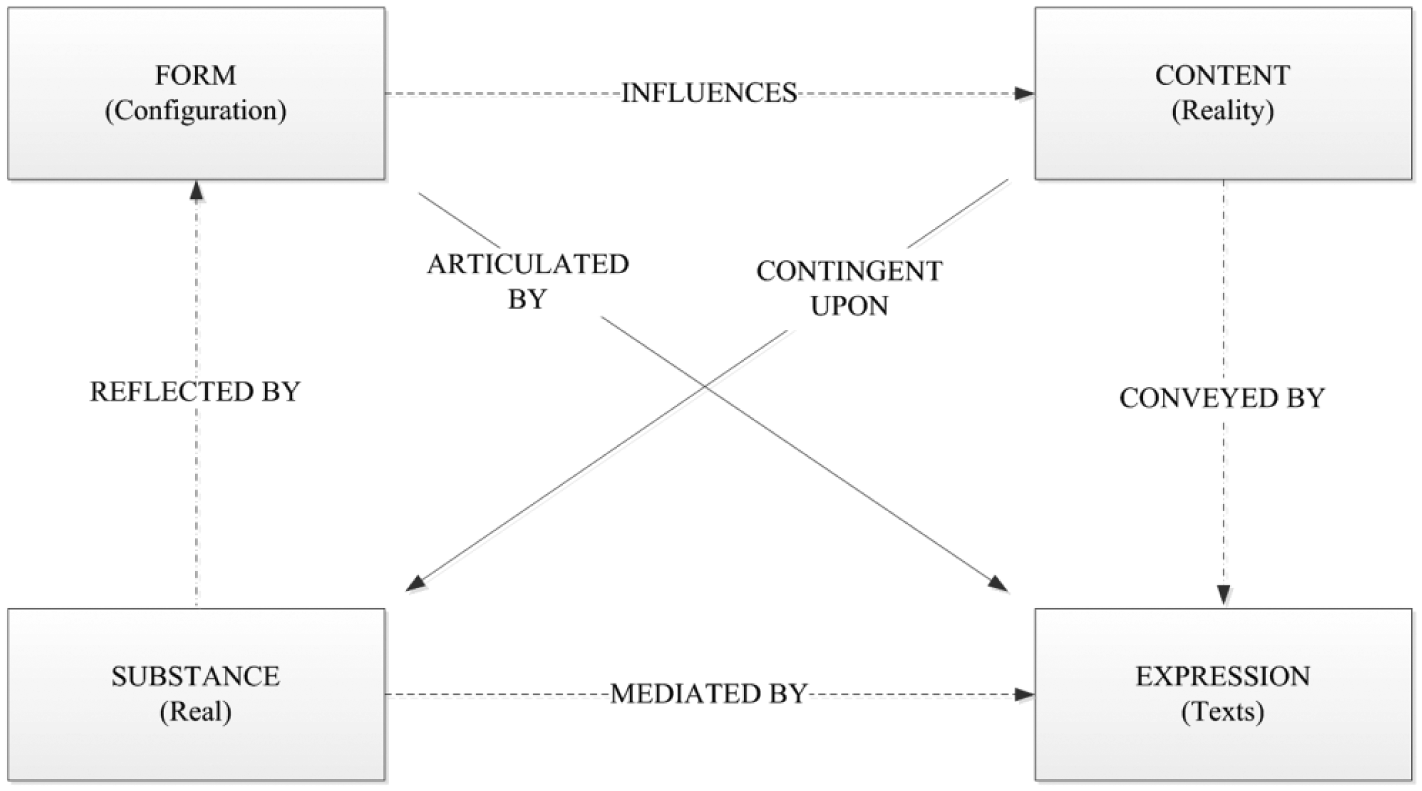
Organization and the literary (after Deleuze and Guattari, 1987: 416).
On closer examination of Figure 2, a picture emerges of uncertainty about the boundary between the internal world of reality and the external real. Belsey (2005) suggests that while the real exists, it remains unknowable, but we can observe encounters with the real in which knowledge might in some ways make inroads into the real – through the physical sciences, for example. While the real that surrounds us can be internal to us, the same applies to the realities and stories that we construct. This raises doubts regarding the boundaries between substance (the external real), content (the internal reality) and expression (text) and draws attention to the indeterminacy of the distinction between these and form (configuration; Figure 2). These arguments lead to a consideration of ontology and epistemology. Epistemology refers to the internal world of knowing, whereas ontology refers to the external world of existence. But if the distinction between the external and internal is problematic, where does that leave ontology and epistemology?
If ontology and epistemology are vulnerable, where does that leave organization theory? What this conundrum requires of organization researchers is not easily discernible. When applied to thinking about organization, the four overlapping and inseparable elements illustrated in Figure 2 draw attention to the relationship between substance (organization in the real) and form (organizational configuration), where content (social reality) is constantly created, transformed and expressed (texts) in various ways. In some ways, organization cannot be located solely in the real; it is also a social construction and, as such, is part reality and part real (see, for example, the work of Boje, 2008; Gabriel, 2000; Rhodes, 2009). Two things about organization are real: the people who interact with organization (who are themselves only part real – an unreachable organism and part subject) and the physical containers and spatial dimensions occupied by organization (e.g. the physical presence of buildings and computers). Of interest now is how the content, form and expression of organization encounter one another and what happens when they encounter the real.
Working the seam – Cloud Atlas
Working the seam with David Mitchell’s novel draws us to the work of Jameson (2013). He suggests that the shape of Cloud Atlas provides us with an image of a lift that moves in various directions through space and time, zig-zagging as it goes. For me, the novel is more than Jameson’s image. To me, Mitchell takes us on a circular ride past a gallery of chronotopes, in which we glimpse organization manifested in different times and places. In each chronotopic landscape are clues that impel us to make and interpret connections and cross-references across time and space, to make judgements and to try to figure out what happens next (Jameson, 2013). As such, the novel is not only a postmodern pastiche and tricks of form but also a historical novel (Jameson, 2013) in which the past, the present and the future are folded together. In Cloud Atlas, Mitchell uses the metaphor of a Russian doll to illuminate this fold as ‘an infinite matrioshka doll of painted moments … The doll of the now likewise encases a nest of presents yet to be which I call the actual future but which we perceive as the virtual future’ (Cloud Atlas: 409). However, just as powerfully, Jameson (2013: 308) also highlights that Cloud Atlas is an ideological analysis in that it illuminates ‘the contradictions in which we are ourselves imprisoned, the opposition beyond which we cannot think’. Cloud Atlas incorporates new perspectives on the world, new ways of writing, new ways of representation and expression and new ways of raising (and searching for answers to) questions about the world.
The first chapter (The Pacific Journal of Adam Ewing) appears in the form of a personal journal set in the mid-19th century on a ship on its way from Australia to California; the first journal entry is dated 7 November. The form and expression of this narrative generate confusion about whether the reality of the story is that of a person in the act of writing a daybook or that of Mitchell’s commentary on the squalid conditions experienced in 19th-century colonies and on those who sail the ships that maintained empire; alternatively, perhaps he is painting picture of a world that passed with the advent of steamships (Jameson, 2013). However, the chapter ends abruptly mid-sentence, folding the narrative back on a reference to a journal entry that comes before the beginning of the chapter: ‘… Henry and I sensed anew the hostility that workers emanate at the bystanding idler and so we left the toilers to their work. Reading my entry for 15th October, when I first met Raphael’ (Cloud Atlas, p. 40). In turn, we not only wonder how things unfold (what comes next) in the novel but also are uncertain about what remains folded in the past (what came before).
Mitchell leaves us in no doubt that Cloud Atlas does not submit to a conventional plot of linearity (Jameson, 2013) at the start of Chapter 2 (Letters from Zedelghem). The reader is introduced to a new set of characters at a different place and time – a Belgian country house in the years leading up to the outbreak of World War II. The content of the narrative is not only located in a different chronotope but also takes on a different form and mode of expression. It is composed of letters from one character, Robert Frobisher, who lives in Belgium, to another, Rufus Sixsmith, who lives in England. This story provides us with an insight into the world-weariness and cynicism of the times (early 1930s), with the world recovering from war and an economic depression only to be thrust into the chaos of the rise of fascism and the catastrophe of World War II. It also reminds us of the connection between master and servant (Vivian Arys and Robert Frobisher) and the ways in which servility can become a trap from which we are unable to escape. This is illustrated when Letters from Zedelghem ends abruptly, with Frobisher deciding to extend his stay at the chateau for what he thinks is his artistic and financial advantage.
The novel continues with this pattern of truncated and widely varying narratives. The next unfinished narrative – Half-Lives: The First Luisa Rey Mystery – is in the form of a corporate thriller set in the 1980s, which tells of an exposé by a journalist (Louisa Rey) about the nefarious activities of big business (the nuclear power industry; Jameson, 2013). The chapter ends halfway through the narrative after Rufus Sixsmith is murdered and an attempt is made on the life of Louisa Rey. In this narrative, Mitchell reminds us of the rise of corporate power and the emergence of neo-liberal and global capitalist ideologies during the 1980s, which have since come to dominate social, political and economic discourses. This story is followed by The Ghastly Ordeal of Timothy Cavendish, which marks another shift in form, expression and chronotope. This contemporary comedy is told as a first-person narrative. The first half concludes with Cavendish trapped in an old people’s home. We can only assume that this story brings us to the present – as evidenced by the ‘tenements of Somalians … [and] … malls of casualized labour’ in London (p. 163), and privatized railway companies (SouthNet Trains). The chapter ends with Mitchell referencing a contradiction in the relationship between power and resistance: ‘Prisoner resistance merely justifies an ever-fiercer imprisonment in the minds of the imprisoners’ (p. 184). This contradiction reminds us that challenging hegemonic discourses can be a risky enterprise – an idea that is pursued in the next chapter (An Orison of Sonmi~451).
The narrative in An Orison of Sonmi~451 takes the form of a dystopian science fiction history of the future, which is set in Korea. Mitchell presents his bleak imaginings of a repressive non-nation-state future (Jameson, 2013) following an outbreak of global war (referred to as ‘the skirmishes’ in the novel). This world is inhabited by ‘truebloods’ (humans), who are served by an enslaved race of fabricants (clones). The chapter is truncated, ending midway through the final statement of a condemned rebel slave-clone (Sonmi~451), which presents a mystery about Hae-Joo Im (Sonmi’s apparent friend and ally) – he is not who he said he was. This chapter concludes the presentation of truncated narratives. What follows is Sloosha’s Crossin’ an’ Ev’rythin’ After, a narrative that takes the form of a complete story told by an unnamed survivor of a global apocalypse (‘son of Zachry’) in which Mitchell takes us to Hawaii in the distant future (after ‘the fall’). In this world, humans are on the verge of extinction and are forced to live in small, isolated warring tribes. As a concluding history of the future, this narrative completes the novel’s broad sweep of time and space.
Taken together, the narratives that constitute Cloud Atlas include repeated unfolding, refolding and unfolding as well as rhizomatic connections that suggest the ‘legitimacy of authentic dead pasts and dead futures, the legitimacy of our own collective Imaginary’ (Jameson, 2013: 305). For example, an identical birthmark in the shape of a comet appears on individuals in each chapter (Robert Frobisher, Timothy Cavendish, Luisa Rey, Sonmi~451 and Meronym and perhaps Adam Ewing). Furthermore, the ‘biotech cuboids cloning humans for shady Koreans’ (Cloud Atlas: 170) in The Ghastly Ordeal of Timothy Cavendish return in An Orison of Sonmi~451 as the source of slave-clones. Additional connections emerge with each movement of the narrative, making new planes of immanence perceptible. Overall, the novel traces a ‘grand narrative … or at least [it] make[s] the search for one somehow inevitable and unavoidable’ (Jameson, 2013: 305). It is the narrative of our future history and the ways in which organization is implicated in this narrative. While Mitchell paints a bleak picture of the consequences of our current ways of organizing, the truncated narratives provide a clear view about how we can never really know what the full story is or how stories are folded together. In a similar way, we do not or cannot fully know about organization; therefore, our theorizations are never entirely explanatory or predictive. In novels, we can at least flip forward to later pages and see the history of the future. For organization scholars, the future real, reality, form and expressions of organization are unknowable, as they remain folded and inaccessible on plane(s) of immanence until some force is applied that causes an unfolding of events that makes them perceptible.
This unfolding of planes of immanence and the establishment of multiple connections in the novel has a destabilizing effect on the boundaries between the ways in which we see narratives as constructed realities and fictions and the effects of various forms and modes of expression for how we understand the world. Beginning in Chapter 2 (Letters from Zedelghem), Robert Frobisher finds Adam Ewing’s journal on a bookshelf at Chateau Zedelghem. It is a badly damaged published book, as detailed in a letter from Robert Frobisher to Rupert Sixsmith:
Poking through an alcove of books in my room I came across a curious dismembered book … It begins on the 99th page, its covers are gone, its binding unstitched. From what little I can glean, it’s the edited journal of a voyage from Sydney to California by a notary of San Francisco named Adam Ewing. (Cloud Atlas: 64)
This excerpt suggests that Adam Ewing’s narrative is folded within Letters from Zedelghem. Next, Rufus Sixsmith reappears in Half-Lives: The First Luisa Rey Mystery, in which the reader discovers that the narrative in Letters from Zedelghem is folded within this story. However, this impression of reality is shattered in the next narrative, The Ghastly Ordeal of Timothy Cavendish, which reveals that Half-Lives: The First Luisa Rey Mystery is as an extract from a novel by Hilary V. Hush. This disclosure means that the previous three narratives are fictions that are folded within the narrative of The Ghastly Ordeal of Timothy Cavendish:
I opened my bag for a bag of Werner’s toffees but came up with Half Lives – The First Luisa Rey Mystery. I leafed through its first few pages. It would be a better book if Hilary V. Hush weren’t so artsily-fartsily Clever. (Cloud Atlas: 164)
However, upon reading the next narrative, An Orison of Sonmi~451, the reader discovers that the story of Timothy Cavendish is a fiction folded within this narrative. This time, The Ghastly Ordeal of Timothy Cavendish takes the form of a movie that the character Sonmi~451 wants to see. Finally, this destabilization of the boundary between reality and fiction is complete when Sonmi~451 reappears in the central narrative of Sloosha’s Crossin’ an’ Ev’rythin’ After. Her ‘orison’ survives the apocalypse, and a tribe subsequently finds it and learns to play it back, believing Sonmi~451 is some kind of deity. In Sloosha’s Crossin’ an’ Ev’rythin’ After, the narrative is a myth passed down through oral history to the ‘son of Zachry’ (the narrator of this story). The worlds described in An Orison of Sonmi~451 and Sloosha’s Crossin’ are distinct from those in the other narratives. These stories stand alone as narratives of a future reality (future history), whereas the other narratives are fictions folded within each other and then folded within the narratives of An Orison of Sonmi~451 and Sloosha’s Crossin’. The question then arises regarding which narratives are closer to the real or the realities that we experience or that might come to pass – the folded fictional realities within fictional realities established in the first four stories (tracing the past to the present) or the future history (a dystopian science fiction/post-apocalyptic fiction) established in An Orison of Sonmi~451 and Sloosha’s Crossin’. This question draws our attention to the uncertainty about the borderline between reality and the real and between reality and fiction. Because organization is at the heart of this novel, we seek to consider and problematize the gaps between organization as interpreted and represented in the various forms of our writing and organization in the real and as social constructions that are lived and that might be lived in the future. In other words, questions arise about the realities of organization and the texts about organization that scholars produce and their relationship with the real.
As a novel in which organization resides, the ways in which Cloud Atlas illuminates power and resistance are also worth considering. The novel’s chiastic structure leads the reader to the central narrative of a post-apocalyptic world that the author positions as a potential reality that arises from the predatory and exploitative nature of (late) capitalism. While the narratives are predicates (Deleuze, 1993) to the post-apocalyptic world of Sloosha’s Crossin’, a close reading of the first halves of the narratives that predate this world reveals repeating themes of domination, greed and exploitation that seem to connect (or even lead) to the situation in Sloosha’s Crossin’. In concluding the other chapters, Mitchell seemingly suggests that alternatives exist and that the world of Sloosha’s Crossin’ is not inevitable – that resistance to the exploitation and greed that are characteristic of (late) capitalism is possible. The novel ends with the final entry of the Pacific Journal of Patrick Ewing that can be interpreted as a message of hope from Mitchell (Jameson, 2013):
I hear my father-in-law’s response … ‘He who would do battle with the many-headed hydra of human nature must pay a world of pain and his family must pay it along with him! & only as you gasp your final breath shall you understand, your life is no more than one drop in a limitless ocean!’ Yet what is any ocean but a multitude of drops? (Cloud Atlas: 529)
Further into the seam
In many ways, Cloud Atlas has Deleuzian characteristics. It is multi-voiced and suffused with non-linearity, and it includes various narrative flows, rhythms and patterns at various scales; in addition, like the work of Deleuze, the novel is disruptive, complex and difficult to unravel. Its narrative form varies (often vertiginously) in that there are different chronotopes, rhythms and styles (Jameson, 2013). The novel thus defies being categorized as a single object (a thing). Instead, it is a constantly evolving multitude of events and characters, making it resistant to a single authoritative interpretation. This resistance is in no small way articulated through the novel’s modes of expression, culminating in Sloosha’s Crossin’ an’ Ev’rythin’ After (at the heart of the novel), which is a first-person narrative told in a strange form of English. The novel also connects the content of each chapter (each individual character’s reality) to the substance of the (real) world at the micro-level and the broad sweep of the author’s commentary on global capitalism. These characteristics mean that the novel cannot be ascribed to a particular category. Cloud Atlas is neither a collection of short stories nor strictly a novel; perhaps, it is both (or neither, given the place of Cloud Atlas within Mitchell’s macro-novel canon). It cannot be placed within a particular literary genre or style or culture; it is a multitude of narratives, characters and connections and is consequently irreducible – it is a multiplicity. This irreducibility also influences where it can be placed in a literary/cultural tradition. In some ways, Mitchell’s use of narrative techniques in Cloud Atlas positions it as a postmodern novel, as it does not aim to represent or imitate and the narratives are open, given that questions are posed about the nature of humanity without being prescriptive. However, the novel is also fragmented, discontinuous and interconnected to other novels in such a way as to have a destabilizing influence on the reader, perhaps situating it as a postmodern novel. In effect, Cloud Atlas cuts across and against the grain of postmodernism because it includes an act of belief – a belief that humanity can mobilize against the destructive forces that threaten our future (D’haen, 2013).
Applying this discussion about Cloud Atlas to organization, serious consideration of the literary leads us to conclude that we must accept the limitations of our current modes of representation and expression and rethink how we illuminate the multiplicity of complex, contemporary forms of organization in accessible ways. As in Cloud Atlas, when we attempt to capture organization and hold it steady for examination, it escapes our grasp. Indeed, much work has been conducted in an attempt to bring organization clearly and securely within analytical frames, but, as Böhm (2006) notes, it is sometimes an object (a thing), a social process (a flow), a social form (and/or content) or even an ideology (closely associated with management) – or all four simultaneously. The effect is that, under our very gaze, organization shifts and slips away as our attention is drawn in various directions. We thus find that we are thinking not about organization itself but the tracks that it leaves behind: footprints, scats, fragments of past meals. By working at the seam between the literary and organization, we can begin to illuminate the flux and flow between form (configuration), content (constructed realities), expression (texts) and substance (the real); in doing so, we can find new ways to theorize that keeps organization clearly in focus.
To explore this idea a little more closely, the study of identity may serve as a good illustrative example. Watson (2008) advocates an analytical approach to identity work that separates internal self-identity from external discursive social identity. Recent research by Hoyer and Steyaert (2015) extends this idea by suggesting that we take a psychoanalytical approach, focusing on unconscious desire as a driver of identity construction. They argue that a better understanding of identity can be achieved by paying attention to ‘the pre-personal, the pre-conscious, the not-yet-said’ (Hoyer and Steyaert, 2015: 1858) and that identity has immanent qualities. We can first rethink Watson’s (2008) assumption that we can separate the internal and external dimensions of the world. Similarly, we can also challenge Hoyer and Steyaert’s (2015) assumptions about unconscious desire and identity. These assumptions are based on Freudian psychoanalysis, in which a singular ego must be defended; there is a desire to minimize harm to the self. In arguing that substance (external real), form (configuration), content (internal constructed reality) and expression of identity are interconnected and inseparable, Deleuze and Guattari (1987: 29) suggest that conventional approaches to analysing identity do not acknowledge that the unconscious is a ‘crowd’, ‘in constant motion’ of becoming; we engage with no fixed identity or being through ideas. Instead, we are challenged to imagine beginning with a multiplicity – all the ways in which we are different. Identity is then produced not from a process of imposing differences from above. Identity can be seen as unfolding from events of difference that create and are created through social relations. Thus, we are forced to ‘think without assuming some pre-given (or transcendental) model’ (Colebrook, 2002: xvii); in its place, we identify and examine the interaction and forces between substance, form, content and expression simultaneously.
At the seam: inside/outside the Deleuzian fold
As a Deleuzian fold, Cloud Atlas includes multiple and emerging rhizomatic connections between narratives. It is organized in that the narratives have a discernible pattern – the stories fold around each other in a chiastic way and fold within and out of each other like a Russian doll. The novel is also disorganized in that the narratives are left unfinished halfway through, only to be taken up in later chapters; the stories are often difficult to follow, and the various narratives are a seemingly chaotic assemblage of form, content and modes of expression. In a similar sense, the novel is not organized in that no particular theme or character or chronotope exists; then again, it is not disorganized either, as its logic emerges with reading. Taking these factors into account, Cloud Atlas is not visible in the light of any one thing considered in isolation; it is instead only discernible as a result of multiple junctures. Thus, Cloud Atlas is not only an image of the world but also an experiment with the world that unfolds through reading (see Deleuze and Guattari, 1987). For example, the novel experiments with new connections through time and across space that emerge as the stories unfold, each one creating new planes of immanence within the novel itself, with other novels by David Mitchell (e.g. Luisa Rey and Timothy Cavendish appear in Ghost Written) and with novels by other authors (e.g. Aldous Huxley’s Brave New World is alluded to in An Orison of Sonmi~451). As an experiment that is connected to the real, Cloud Atlas denies a pre-existing structure and, as such, frees our thoughts from the imprisonments of the hegemonic ideologies and discourses of neo-liberalism and global capitalism, forcing us to include our historical futures when theorizing about organization (Jameson, 2013).
More specifically, as an actualization of folded (external – immanent) rhizomatic forces, Cloud Atlas paints a picture of global capitalist organization as little more than varying forms of imprisonment and oppression. The narratives in the first half of Cloud Atlas reflect the postmodern condition of hopeless relativism that leads to ‘a sense of despair and the abdication of responsibility that generates a tragic impotence’ (Carter and Jackson, 2004: 106). In the novel, this condition is connected to the wretched world of the central chapter, Sloosha’s Crossin’ an’ Ev’rythin’ After. The truncated narratives of the first half of the novel suggest that something is missing from theory that tacitly assumes capitalist forms of organization. By contrast, the second half of the novel, in which the truncated narratives are concluded, suggests that the something that is missing is a sense of alterity beyond the capitalist consciousness. Cloud Atlas takes us to the furthest point that our thought can reach (the distant future) – a cruel, barbaric world – and then brings us back through time to Adam Ewing’s message of hope (Jameson, 2013). Of particular importance for organization scholars is the idea that individuals who act as a multitude produce powerful forces that push and pull the ideological assumptions and discourses of neo-liberalism and global capitalism out of shape.
Exploring the folded and rhizomatic characteristics of Cloud Atlas has significant philosophical implications for our perspectives on organization theory. The work of Deleuze and Guattari is ‘deeply implicated in the development of postmodernism’ because they explore different possibilities of thought in the new (postmodern) world(s) (Carter and Jackson, 2004: 106). Likewise, Cloud Atlas draws our attention to neo-liberalism and global capitalism. Deleuze’s metaphors of the fold and the rhizome and Mitchell’s novel provide a means of making rigorous and subtle critiques of the accepted assumptions about organization, which helps us explore the possibilities of a new order that does not conform to the limitations imposed by the hegemonic discourses of neo-liberalism and global capitalism (Carter and Jackson, 2004).
Lazzarato (2004) exemplifies this argument, suggesting that the world of consumption and production unfold from capitalistic modes of organization; it produces realities. Pedersen (2008) demonstrates this unfolding in an analysis of employee stress; he argues that there is a folding of organizational reality within employees and that this (folded) reality unfolds from employees in such a way that their reality is one that is a creation of and for organization. Extending these ideas, by applying Deleuze’s (1993) notion, that there is a folding together of the organic with the inorganic makes it possible to see that there is an external (inorganic) organization fold that cannot be separated from the internal (organic) organization fold of people. As an inorganic fold, organization can have a physical presence – bricks and mortar or concrete and glass, for example. However, the inorganic organization fold is suffused with organic organization folds as people move in, through and around the physical space occupied by organization as they engage in constructing (unfolding) the realities of organization. Theories of organization must then consider organic and inorganic enfoldments.
The combined strength of the fold and rhizome metaphors can be illustrated by showing how they can be applied to extend the ideas presented by Gehman et al. (2013) about turning points in the process of emerging value practices in organizations that are associated with a change in values. Their analysis illuminates drawn-out entanglements and events that lead to a re-patterning of processes, in which significant shifts occur at various times and at various organizational levels. Using the idea of the fold and the rhizome, we escape the idea of organization as being a site where processes take place; instead, we see organization itself is a continuous interaction of rhizomatic, folding and unfolding force and form. We can then add a new dimension to the theoretical perspectives provided by Gehman, et al. (2013). Rather than turning points, we can see values as being rhizomatically connected immanent folds within the organic folds of people who flow in, through and around the inorganic folds of organization. Organization values are folded within individuals and become part of their own values. These values then become perceptible as differences as they unfold from individuals. These individual values are then refolded back into organization values. This perspective allows us to build theory based on assumptions about processes of unfolding evolutionary emergence from folds of involuted rhizomatic complexes. We can thus illuminate the nature of fluctuating, continuous developments of various forms of values within which individuals become for the world of organization as constructed by existing capitalist forms of production and consumption.
Bringing the fold and rhizome as metaphors into focus, their usefulness can also be illustrated by showing how they can be used to develop Wright and Zammuto’s (2013) use of the ‘field’ and ‘nest’ metaphors to conceptualize and theorize change as an interactive process between the social, the field, organization and different groups (networks) of actors. Although Wright and Zammuto (2013) suggest a variety of research agendas arising from their study, organization is still assumed to be a stand-alone entity rather than a broader social, cultural, political process. The authors hint at – but do not explicitly suggest – that folds and rhizomes are present. Instead, they contend that there is a ‘complex array of networks’. Rather than the linear model proposed, a more nuanced understanding emerges if we introduce the fold and rhizome metaphors to help explain the idea that change is an agglomerative, restless, often opportunistic process that includes subtle, sometimes subterranean shifts (Chia, 2005). The connections within and between actors and factors in the process of change are arguably untraceable in a linear way – within a field or as a nested pattern. Employing the rhizome can provide a way of understanding change as non-linear. Bougen and Young (2000) suggest this idea in their analysis of banking fraud. They argue that using rhizomes helps provide new perspectives on organization failure because ‘different words [help] us think different thoughts’ (Bougen and Young, 2000: 424). However, once we introduce folds, we can see change as unfolding events that create new surfaces and interpretations, new connections and new realities that do not necessarily match those intended. Change is heterogeneous without fixed, single points or positions and ‘spreads like a patch of oil’ (Chia, 2005: 133). This idea about continuously shifting perspectives allows us to theorize about organization change as an unfolding rhizomatic action. It can then be examined as events that initially begin along a single trajectory but then spread and are opened up to reinterpretation, creating new realities that continuously divide.
Organization (theory)?
The close connection between organization and the literary becomes clear when Cloud Atlas is read alongside Deleuze. The novel becomes more than just a work of literary fiction; it turns into a source of inspiration for new thinking, as we can find ways to avoid resorting immediately to interpretation and instead engage in experimentation. We are also provided with a way of challenging ourselves to imagine and to occupy the unsettling zone of in-between rather than being overly concerned with the problems of representation. In doing so, our focus shifts to concerning ourselves with understanding processes and the ways in which these understandings contribute to changing the world (for the better; Helin et al., 2014b). Our attention is drawn to modes of change, expansion, propagation, occupation, contagion and peopling – the legion of forces at work that crisscross the self and the world, the self and organization, and organization and the world. As a result, possibilities arise to open up new registers of thought, action and speed – for example, in the form of new metaphors, ideologies and paradigm assumptions.
This process can be aided by serious consideration of the literary. De Cock (2009) argues that the literary can provide experimental variations in our world; similarly, Deleuze and Guattari (1987) suggest that the literary allows us to experiment with virtualities (realities that are not actual). In his analysis of Cloud Atlas, Jameson (2013: 305) contends that Mitchell presents a new kind of genre-bending literature, which introduces a new form of historical novel that folds together science fictions of the future with a number of other genres that present narratives of the past. Mitchell manages to ‘tinker with reality’ (De Cock, 2009: 441) to illuminate and problematize the ideological forces (past, present and future) that produce and shape organization. In doing so, the novel disrupts our everyday common sense about organization by expressing how ideology justifies malevolence, exploitation and stupidity (Colebrook, 2002). Indeed, Cloud Atlas takes us to the ‘farthest point that thought can reach’ (Jameson, 2013: 318), challenging us to reimagine our future and consider genuine alternatives.
Once we begin to employ this mode of thinking, new perspectives on organization emerge. For example, it is possible to argue that organization, those who create research narratives about organization, and those who read these narratives are indistinguishable and interdependent because the theories and narratives that organization researchers produce fold out of organization itself. In effect, organization theory unfolds from the rhizomatic connections and interactions between organization and the researcher. In the first instance, organization theory unfolds within researchers; in the second instance, it unfolds out of the research itself; and, in the third instance, it unfolds within and out of the reader. This challenges the ways in which ideological assumptions of neo-liberalism and global capitalism that are folded within researchers unfold in such a way that they – and the work that they produce – are as much for as about these dominant forms and discourses of organization. This challenge is important because these assumptions unfold within and from those who consume this research, creating understandings that are for the dominant forces of neo-liberalism and global capitalism; what is needed is the creation of alternative perspectives that challenge these dominant forces.
It seems that the fold and the rhizome help us think more clearly about how ideological assumptions underpin organization theory. For example, we can employ a semiotic square to illuminate the conflicting notions of organization. In this way, the fold and the rhizome serve as new ways of examining organization, which illuminate the contradictions of hegemonic neo-liberal and global capitalist ideologies and discourses. However, a more concerted effort to closely examine organizational folds and rhizomes is needed. For example, we need to identify and disentangle the distinctions and connections between form, content and expression of the folds and rhizomes that constitute organization.
My encounter with the works of Deleuze and Cloud Atlas also raises questions about the paradigm assumptions that underpin how we do organization theory. While we can claim that the real is inaccessible and question whether organization is real, we can also suggest that the fold and the rhizome have an ontological reality in forces, forms, inflections, inclusions and processes. This idea draws attention to ontological and epistemological assumptions about the separation of the inside (interiority) and the outside (exteriority). We are then compelled to think differently about our relationships with organization, and, in doing so, the existence of flow and flux of form (configuration), content (constructed realities), expression (text) and substance (the real) emerges. We are thus challenged to consider how our theorizing about and representations of organization transforms and acts upon life. However, a more concerted effort to closely examine how this influences our paradigmatic assumptions is needed: the ways in which we identify, unpack and analyse the flow, content, expression and substance of organization. We can then begin to unbind theories from conventional assumptions and conceptual dimensions, allowing them to open and reopen in new places and in new ways. Theory can then pose and confront new questions about the status and limits of organization.
Deleuze and Guattari (1986) describe how the literary shows us a way that experimentation can be an open-ended project that acknowledges the incompleteness of organization and how undecidability is a key to understanding. If we accept their claims, there can be no resolution and no closure to the folded, rhizomatic multiplicities of narratives that constitute organization. As such, when the theoretical narratives that organization researchers produce are engaged with the literary, these narratives necessarily have an ending (e.g. Cloud Atlas ends on page 529); however, they do not have closure, and we cannot be certain where the boundaries of the narratives are. As a result, we are made acutely aware of the instability and uncertainty of theorizing and of our (in)ability to grasp organization in the real. In this article, Cloud Atlas can clearly be seen as a work of fiction, but, through the use of form, content and expression, Mitchell makes the realities of the future seem more real than the nested fictional realities supplied in the other narratives. The novel thus offers an experimental ‘history of the future (our own present)’ (Jameson, 2013: 298). This history of the future is important because it calls into question our relationship with organization – about the organizational lives that we imagine, the reality of organization that we live now and in the future, and the ways in which this reality connects to the real.
Working the seam between the literary (literature) and organization seemingly has a lot to offer. By taking the literary seriously, organization scholars can discover opportunities for experimentation that is in touch with the real. In particular, the literary provides us with new modes of form, content and expression as well as alternative registers of thinking, new ways of asking questions about organization and, consequently, new ways of theorizing about it. In this article, we saw that Mitchell presents us with a multitudinous array of styles, voices, genres, forms and perspectives that contain messages about contemporary organization and its consequences. The vertiginous shifts in the narratives and the multitude of characters and voices in the novel at times leave the reader unable to trace connections within and between narratives. Cloud Atlas conveys an expanding assemblage of connections, relationships, perspectives, actions and events that perhaps express organization in its broadest sense much more effectively than ordered accounts, such as those regularly found in the organization literature. Notice here that once we begin working the seam between the literary and organization, the generation of new and interesting insights becomes possible. I argue that working this seam shifts the foundations of organization theory. Current assumptions are often founded on being and attempt to uncover processes that lead to a particular condition. By engaging with the literary, our attention is drawn to flow and flux, shifting our perspective to view organization as a continuous series of rhizomatic, unfolding events of fluctuating, socially constructed and emergent flows and inflections. The challenge for organization researchers lies in finding ways of expressing this idea as a theory that progressively closes the gap between the real and the realities that we represent in the theories that we produce – that is, having a critical awareness of the difference between research about organization and research for organization. This task is significant because it involves not only theorizing about organization as becoming, as suggested by Tsoukas and Chia (2002), but also recasting organization theory as becoming theory.
Footnotes
Funding
The author(s) received no financial support for the research, authorship, and/or publication of this article.