




Abstract
The endangered loggerhead sea-turtle (Caretta caretta) nests on the shores of the Mediterranean, but faces threats to its existence from a variety of sources. Answering the question of how this species can survive is complex as it involves examining the relationships between the turtle, its natural environment, local tourists, property developers, conservation organisations, governments and law-makers. We argue that actor-network theory provides a powerful methodology for tracing these relations and identifying crucial actors which enable the survival of this animal. Using a rich ethnography and drawing on insights from 116 interviews, we trace three actor-networks that highlight factors important to the survival of the species. Yet, we also highlight the conceptual difficulties that result from using an actor-network theory ontology for understanding socio-ecological interactions and argue that these may be ameliorated by embedding the actor-network theory methodology within a critical realist ontology. We argue that this engagement between critical realism and actor-network theory offers researchers a powerful method for understanding relations between socio-ecological actors while overcoming some of the theoretical difficulties of actor-network theory.
Introduction
In reacting to Judeo-Christian anthropocentric ‘othering’ of animals, post-Enlightenment thinking has developed a range of philosophical positions that not only provide critical perspectives on animal rights, husbandry, experimentation and genomics (Haraway, 2008; McCance, 2013) but also, in reconstructing the human as animal, call into question assumptions concerning human rights, free-will and consciousness (Steiner, 2013). In focusing on human–animal relations, here contextualised as ‘socio-ecological’, such developments are intrinsically philosophical – they prompt questions of ontology (what are humans and animals?), epistemology (how do humans know, construct and study animals?) and ethics (do animals and humans have any, or similar rights?). Answering such questions has prompted an engagement with radical theories of the social world which seek to avoid both the anthropocentricism of many humanist accounts and the positivism of the traditional natural sciences (Franklin and White, 2001).
Two alternatives to traditional ‘scientistic’ (Fleetwood, 2005) approaches can be found in actor-network theory (ANT) and critical realism (CR). ANT challenges traditional dualities of society/nature and agency/structure by proposing a ‘flat’ actualist ontology which prioritises the constructive effects of empirical networks between human and non-human actors and rejecting the essentialisms associated with the natural sciences (Latour, 2007; Latour and Woolgar, 1986). CR, on the other hand, proposes a ‘depth’ ontology which commits to emergence and stratification (Bhaskar, 1979), as well as a ‘moderate essentialism’ (Sayer, 2000: 97) in recognising that entities possess inherent properties and (potential) powers (Fleetwood, 2005). Both have proved increasingly popular critical approaches to understanding relations between the natural, material and social, but both have also been critiqued. Concerning CR, one criticism has argued that it has over-emphasised human agency and the ‘invisible’ domain of the real (e.g. social structures) at the expense of the empirical, the material and the non-human (Reeves, 2011). With rare exceptions (e.g. Benton, 1993; Dickens, 1992), CR’s focus on the human has caused a neglect of ecology and animals in social accounts. For ANT, critique has often come from the opposite direction – that the empirical is over-emphasised to the extent that it can ‘lead to the production of simply more or less interesting stories … with the fading of context into the background’ (Mutch, 2006: 239). Moreover, concerns about the ontological commitments of ANT have been raised from outside and within ANT. Indeed, we frame this article, in part, as a response to calls from its founders to develop ANT without ‘throwing the baby out with the bathwater’ (Callon, 1999; Callon and Latour, 1992: 369; Latour, 2007).
In this article, using the case of Caretta caretta sea-turtle conservation in the Mediterranean, we argue that ANT provides a powerful methodology to understand socio-ecological relations, and provides counter-intuitive insights about the relations between empirical actors. However, we also illustrate four limitations of ANT in providing an adequate answer to the question of how the C. caretta can survive, and argue that these can be ameliorated by embedding the ANT methodology within an alternative CR ontology. The opportunities for a potential engagement between ANT and CR were sketched out in a theoretical article by Mutch (2002) which argued that, in future research, ‘of most importance [in CR-ANT engagement] might be the incorporation of non-humans into the analysis of social interaction’ (p. 493). Yet, subsequent analyses have not only remained theoretical, but have tended to focus on human–human relationships (e.g. Elder-Vass, 2008, 2015) rather than exploring the role of non-human actors, especially animals. Moreover, studies in this area since Mutch (2002) have tended to find little of value in ANT itself – with Elder-Vass (2015) recommending ‘abandoning’ ANT in favour of CR. Thus, there is an opportunity to respond to Mutch’s call for deeper, and preferably empirical, exploration of the possibilities of an engagement between ANT and CR, especially in a field where non-human actors may play a significant role.
This article, therefore, explores the potential of an ANT-CR engagement in the context of a socio-ecological case-study of the conservation of the C. caretta: an endangered species of sea-turtle which nests on the beaches of the Mediterranean. The question we ask is, how can the C. caretta survive? A fundamentally important question (not least to the actor, that is, the sea-turtle), but also one which requires, as we shall see, an answer (and thus a theory) that can cut across socio-ecological boundaries, and recognise the role of a variety of actors, including the turtle itself, which influence its existence. The difficulty many disciplines face is that they tend to stop at the boundary, with the natural sciences reluctant to engage with sociological issues, and mainstream sociology traditionally wary of the natural (Benton, 1993). To address our question, therefore, we draw on ANT, which has been used in a variety of studies of the socio-ecological (Callon, 1986; Castree, 2005; Latour et al., 1993; Law and Mol, 2008; Thompson, 2011). Our analysis highlights the contested enactment of the turtles in three competing and inter-related actor-networks: the development network, which concerns the growth of local tourism and the associated building developments; the scientific network, which is focused on the measurement and reporting of turtle numbers, and the reproductive network, which concerns the life-cycle of the turtle itself as it hatches, matures, mates, nests, lays eggs, and dies.
Empirically, the ANT method generates powerful insights concerning the contested enactment of the turtle, the enrolment of key actors, and the agency of non-humans. However, theoretically, we show how ANT’s ontological commitments generate difficulties concerning identifying network boundaries, explaining regularities, and understanding absences. We argue that these limitations can be alleviated by using the emergent, stratified ontology offered by CR. This contribution builds upon existing work which engages CR and ANT (Elder-Vass, 2008, 2015; Mutch, 2002) in three ways. First, we provide the first empirical illustration of the potential of an ANT-CR rapprochement – in our case, for understanding socio-ecology. Second, we develop new critiques of ANT from a realist perspective, especially concerning its theorisation of absences. Finally, we show how, using abduction and retroduction, CR can build on the ANT methodology to generate more powerful analyses of the socio-ecological world.
Understanding the socio-natural: the possibilities of ANT and CR
The potential of ANT
By dislodging human agency from its dominant position in social theorising, promoting an explicitly non-structuralist account of social change, and empirically describing how taken-for-granted ‘objects’ are institutionalised (or ‘black-boxed’), ANT has provided a radical challenge to both anthropocentric and structural theorising (Callon, 1986). 1 Its ontology rejects social structures or invisible mechanisms in favour of a commitment to actualism (Harman, 2009: 16): following an empirical network of events occurring in local contexts (Latour, 1987). Indeed, ANT rejects a priori theorising in favour of ‘following the actors’ (Callon and Latour, 1992; Sayes, 2014). The ontology is also explicitly relational, indeterminate and anti-essentialist: ‘entities take their form and acquire their attributes as a result of their relations with other entities … entities have no inherent qualities’ (Law, 1999: 3). While ontologically committing to a form of actualist realism (events and their relations exist in the empirical world, but that is all), ANT is epistemologically constructivist, in that while real objects exist ‘out there’ they come into being through the practices of science (Latour and Woolgar, 1986: 182).
Actors are the ‘prime movers’ of ANT, and are inextricable from the networks of which they are part. In line with the anti-essentialist commitment of ANT, actors take their attributes as a ‘result of their relations with other entities’ in the network (Law, 1999), ‘as neither the actor’s size nor its psychological make-up nor the motivations behind its actions are predetermined’ (Callon, 1999: 181–182). The point here is not that animals are different to what we assume they are, but that they and any other actors – human, animal or otherwise – are enacted only and always in the instant of the network. In this respect, ‘ANT presents a coherent methodology for incorporating non-humans into social scientific accounts’ (Sayes, 2014: 135). For example, Law and Mol (2008: 59) emphasise that ‘in each of these practices a sheep is something different’, while Law and Lien (2012: 363) argue that salmon are only what ‘come to be in a relational, multiple, fluid, and more or less unordered and indeterminate (set of) specific and provisional practices’ (Law and Lien, 2012: 365). Moreover, this definition is not only ecumenical – actors may be germs, scallops or humans – but also, crucially, symmetrical, as it is the network which lends properties and powers. The ‘general symmetry principle’ of ANT regards both ‘nature and society as twin results of … network building’, which should subsequently be approached with the same methodological and ontological assumptions (Callon and Latour, 1992: 348).
ANT theorists hold that the only connections that matter are the practices within an empirical network of events (Latour, 1993: 117). When actor-networks act as a unified whole, they can become taken-for-granted assumptions, scientific ‘facts’, or institutionalised social mores, what ANT terms ‘black-boxing’ (Latour and Woolgar, 1986). Another feature of the network is its translation effects. Translation is the process by which ‘the identity of actors, the possibility and the margins of manoeuvre are negotiated and delimited’ (Callon, 1986: 222) within the network: in short, those seeking to enrol actors into a network do so by creating obligatory points of passage through which the network is routed. This is sometimes achieved by establishing oneself as a central actor in the network or by using interessement devices (e.g. technology, experimental apparatus) which prevent actors from ‘engaging’ with competing networks.
For those academics interested in human engagement with animals, and non-humans more generally, Latour’s relational ontology provides significant resources: the insistence on agentic symmetry, the anti-essentialism of the network, and its anti-structuralist actualism not only de-centre the human from its traditional dominance in explanatory social science, but also help open up the ‘black box’ that is the scallop (Callon, 1986), microbe (Latour et al., 1993), horse (Thompson, 2011), sheep (Law and Mol, 2008) or genetically modified mouse (Castree, 2005). For management and organisation studies, innovative ANT approaches to animals call attention to the organisation of actor-networks that enact ‘animals’ and the systems of rights, husbandry and domestication which are translated through networks of agency (Grasseni, 2005). The radical nature of ANT analyses is built around methodological concepts which provide researchers with tools ‘to help explicate, amplify, and link’, but which do not provide prescriptions regarding how we might understand the nature of the agency of any given actor, or make ‘substantive claims’ about the world (Sayes, 2014: 142). Below, we examine ANT in more detail, especially in relation to its use in understanding the socio-ecological domain.
A critical realist perspective: opportunities for engagement
The critique of ANT has come from a variety of sources – not least within ANT itself (Callon, 1999; Latour, 1999). One critique, focused primarily on ANT’s ontological assumptions, has come most strongly from CR (Elder-Vass, 2008, 2015; Mutch, 2002). CR
2
is a stratified, emergent ontology which commits to a distinction between the transitive domain (loosely epistemology) and intransitive domain (loosely ontology) (Bhaskar, 1979) and, in doing so, distinguishes between the real (underlying causal mechanisms), actual (events) and empirical (perceptions and senses of the actual). CR holds that entities … exist independently of us, and we are capable of performing acts of reference in which we treat them as independent, while also recognizing that the concepts we use to understand and explain them are products of human endeavour. (Elder-Vass, 2015: 115)
For critical realists, the powers of an entity depend on its essences: ‘Water is H2O and has the power to soak, organizations have directors and the power to employ; money has legal status and has the power to purchase’ (O’Mahoney and Vincent, 2014: 42). This equates to a ‘moderate’ form of essentialism (Sayer, 1997), which is neither necessarily reductionist nor determinist (O’Mahoney, 2012), but affords explanatory power as to why entities act in some ways and not others.
CR’s approach to explanation is fallibilist and relativist (Al-Amoudi and Willmott, 2011). First, because the knowledge we mobilise to make sense of the world is inherently a social and historical construction. Second, because explaining (i.e. identifying causal mechanisms) proceeds through two highly fallible approaches: abduction consists in developing ‘the most plausible description of the mechanisms that caused the [empirical] events … often in tandem with [extant] theory’ (O’Mahoney and Vincent, 2014: 17). Retroduction seeks to ascertain what the world must be like in order for our observations to be as they are and not otherwise. Both abduction and retroduction seek the most plausible explanation, while recognising alternative candidates, rather than absolute certainty.
Emergence, in CR, explains the apparition of novel entities (including powers) resulting from the interaction of pre-existing entities. The resulting picture is (metaphorically) deep as it locates emergent entities at a ‘higher’ level than the ‘lower’ level entities from which they emerge. For example, minds emerge from brains that emerge from cells. A much discussed emergent relationship in CR concerns actors and social structures which are both ontologically distinct and mutually dependent upon, though irreducible to, one another. The powers of actors depend (in part) on the structural relations in which they engage (e.g. bees’ power to produce honey emerges from their belonging to a colony). And conversely, agents’ activities continuously reproduce and transform the structure of relations (e.g. colonies would dissolve if bees ceased producing honey over a long period).
As most applications of ANT reject essentialism, social structure, and the distinction between ontology and epistemology, it is perhaps unsurprising that it has come under attack from critical realists on all of these points (Elder-Vass, 2008, 2015; Mutch, 2002). Indeed, the tensions between a strict actualist ontology and the methodological necessities of research have caused the founders of ANT to accept some of these critiques (Callon, 1999), but to also called for analysts to avoid ‘throwing the baby out with the bath-water’ (Callon and Latour, 1992) – a call echoed by realists who find value in ANT’s empirical project but disagree with many of its metaphysical assumptions (Forsyth, 2001; McLean and Hassard, 2004). Yet, although it rejects the notion that the properties of an entity are constructed by the network in which it is embedded, CR has no issue with empirical networks per se – for CR, causal mechanisms occur at the level of the actual every time a power is realised. Indeed, one might go further and suggest that the empirical networks which ANT excels at identifying provide CR with opportunities to retroduce and abduct causal mechanisms which might allow a better understanding of why different entities (or actors) relate. Moreover, although ANT argues that structural and structurationist theories of ‘agency have tended to make much of the mediating character of the person, forgetting perhaps how many other things are also mediators’ (Shaw, 2013), CR does not deny that non-human entities have powers to act, and thus what ANT would call ‘agency’ (p. 160). Although it is true that critical realists tend to depict agency as exclusively human, there is nothing in CR which militates against non-human agency. It is rather that when talking about the activities of non-human agents (e.g. labour markets or class conflict), realists tend to talk of the ‘causal powers of entities’ rather than agency (Bhaskar, 1975).
For its part, one charge raised against CR (and other structural ontologies) is that it often emphasises invisible social structures at the expense of the visible and empirical, and is thus often lacking adequate methodological tools for studying the material world (Cruickshank, 2004). Perhaps as a result, although CR has engaged with wider ecological debates (Benton, 1993; Dickens, 1992), it has remained silent on the topic of animals. Yet, as Elder-Vass and Mutch have argued, there is potential for CR, and other ontologies, to learn from the domain level devices and tools of ANT. For example, Elder-Vass (2008) argues that ‘ANT’s techniques of tracing the connections at the level of individual actors have a great deal to contribute … critical realists need to do more of this’ (p. 468). For critical realists seeking to engage with ANT, ANT’s actualism is a positive because it means that its theoretical devices tend to focus at the level of the ‘actual’ – and thus are compatible with one domain of the critical realist ontology.
Given this potential for congruence, if not synergy, our article seeks to explore the relations of human and non-human actors in the socio-ecological world by engaging an ANT methodology with a critical realist ontology. To achieve this, after briefly detailing our methods, we first provide an ANT reading of the case of the C. caretta and then assess the effectiveness of this, and argue that CR can help ameliorate the weaknesses we identify.
Methodology
The data for this case comprise ethnographic material from a sea-turtle protection organisation in Greece – ARCHELON. This involved 116 semi-structured interviews with 67 volunteers and one of the author’s participant observation in a full 19-week volunteer ‘season’, with this data augmented by observations acquired through a further 15 weeks as a volunteer and 9 weeks as a researcher spanning the last decade. Participant observation entailed the researcher engaging in various activities: conservation work, the social and domestic interactions within camp, and interactions with local populations, tourists, and, of course, the turtles. Detailed notes were recorded as points of interest were observed. During the interviews, data were also collected concerning volunteers’ age, sex, social class and educational background.
In addition, a variety of documents were also reviewed. These included journal publications from ARCHELON, European Union (EU) environmental reports, newspaper reports, EU legal proceedings, and publications from various non-governmental organisations (NGOs) related to the case. These were reviewed to identify the networks which helped trace the data collected by volunteers, through the reports and lobbying by ARCHELON, and subsequent legal decisions at an EU level. A number of reports and papers from ARCHELON and other organisations were examined to shed further light on sea-turtle activities in the region. In addition, we contacted, by email and phone, three researchers who contributed to reports which were used by the Council of Europe’s ‘Standing Committee on the Bern Convention on the Conservation of European Wildlife and Natural Habitats’ (‘the Bern Convention’). These were used to clarify exactly how data were collated, transmitted and used for decision-making.
An inductive anthropological approach was taken towards participant observation, with ideas emerging throughout the data collection process, rather than being led by theoretical concerns. However, following a critical realist approach (Ackroyd and Karlsson, 2015) we used retroduction to identify gaps in the ANT accounts of networks, especially in response to why questions (e.g. why is the local Mayor so important to the scientific network? Why do volunteers tend to be White, middle-class Western females? Why do people volunteer at all?). Abduction (O’Mahoney and Vincent, 2014) was then used to connect these gaps to extant theorising, not just concerning ANT-CR debates, but also in seeking tentative answers in causal mechanisms such as class, power or interests.
The following section commences with an ANT-inspired ethnographic account of the journey of the data from the nesting beaches, to Athens, to Brussels and Switzerland, and back to the beaches of Greece.
The journeys of the C. caretta
The C. caretta has existed for around 20 million years and for much of that time, has been returning annually to nest on the beaches of the Mediterranean. To navigate to the same beaches year after year, these sea-turtles read the magnetic field of the earth. One night in June 2013, one female turtle uses her flippers to make her way onto a beach and begins digging in the sand. After a while, when sufficient depth is reached, she lays around 100 small white eggs. The sand allows this activity as it has the suitable combination of coarseness and wetness to support a ‘chamber’ in which the eggs can be housed.
While the turtle is laying, she enters the field of vision of two volunteers from ARCHELON, the Sea-Turtle Protection Society of Greece. ARCHELON has trained the volunteers, provided equipment for them to use, prescribed many activities which they undertake, and provided roles for the leadership and governance of the project. With the volunteers are a tape measure, callipers, a ‘gun’ which inserts a transponder into the turtle’s shoulder, a number of transponders, a transponder scanner, marker pens, a notebook, biro, livestock tags, and an applicator which attaches these tags to the turtle. The watchers have come from a beach-side camp, which houses around 20 other volunteers, and is occupied for the whole turtle ‘season’, from mid-May until the end of September.
When the turtle has finished laying, she buries the eggs in the sand ready to begin her journey back to the sea. However, before the turtle’s return journey can be completed, the volunteers and the equipment begin their work: the turtle is measured and a pen marks its dimensions into a notebook along with the location of the nest. As she has no identification tags on her, the volunteers, the livestock applicator, and the PIT (passive integrated transponder) ‘gun’ attach internal and external tags identifying the turtle should she appear again in the future. When the intervention is complete, she completes her journey, leaving imprints of her flippers as she moves. The turtle re-enters the sea, where she will remain until she next nests. The nest is marked with bamboo, lengths of which litter the area, and the volunteers continue along the beach.
The next morning, before the sun has risen over the mountains, the tracks left by the turtle and her marked nest attract the attention of three more volunteers. Enacting the training that they have been given, the volunteers and their equipment cover the nest with a metal grid, and bamboo stakes are hammered in around its perimeter. These stakes hold the grid in place, thwarting attempts at predation by foxes and dogs. A sign is affixed to this bamboo which, in Greek, English and German, states that the nest is protected by EU law. When their work is completed, geo-location equipment records the location of the nest, the data are written in the notebook, and the volunteers continue along the beach.
Although the turtle has returned to the sea, she leaves behind at least two significant traces which now begin their own journeys – the first of which are the marks made by the pens on the notebooks. These numerical representations make an ambitious trip, first from notebooks back to the beach camp. Here, a spreadsheet asks the volunteers for the geo-location of the nest, the relative position on the beach, the distance of the nest from the sea, the depth of the top egg, and, if the nest had been relocated, the number of eggs in the nest. At the end of the season, after hundreds of entries, the completed spreadsheet comprising these data are emailed to ARCHELON headquarters in Athens, where it is combined with spreadsheets from all the other project areas. Analyses of the compiled data then travel to the computers of various academics and environmentalists around the world and are translated into reports, plans and papers which have their own journeys to make. In late 2013, one such file arrives on the computer used by a researcher working for MEDASSET (the Mediterranean Association to Save the Sea-Turtles). Here, it is combined with other data and text into a report which is passed via email to various places, two of which we can highlight here.
The first destination for the report is the International Union for Conservation of Nature (IUCN), the body that determines the risk classification of different species, and which classified the C. caretta as ‘endangered’ in 1996. This classification is important because the organisation is a source of information for key legislative bodies such as the United Nations (UN) and the EU. The second is the Council of Europe’s Bern Convention. At the end of 2013, data collected by ARCHELON (and other organisations) are projected onto a screen at the Bern Committee’s annual meeting in Strasbourg (Bern Convention, 2014), and in early 2014 ‘Recommendation No. 174’ is emailed to the Council of Europe (European Commission (EC), 2014), noting the continuation of illegal building and other contraventions to EU. At this point, we should note that a previous actor-network in the 1980s had resulted in the Greek government becoming a signatory to the Bern Convention, and, in 1983, changing its laws to protect nesting sites from new development, removing illegal buildings and roads, limiting the use of boats and fishing in the area, protecting beaches from over-use and limiting the deployment of beach furniture and light pollution (Dimopoulos, 2001). Shortly after receiving Recommendation No. 174, the Council of Europe initiates court action against the Greek government for failing to ‘provide adequate protection’ for sea-turtles, resulting in a judgement that ‘unless the Greek Government takes clear steps to prevent further damage … a conviction will result in heavy financial penalties’ (EC, 2014).
Yet from this point, our network begins to peter out, as further activity is marked by its absence rather than its presence. The network one might expect to focus on, the enforcement of Greek national law at the local level, simply does not occur, and we can perhaps learn why if we consider a (more opaque) actor-network that connects the local Mayor, the police, the beach and our volunteers. What we know of this network is that the buildings (which are constructed illegally on the beach by developers), trucks and various equipment, which disrupt the nesting turtles, are rarely visited by inspectors or law enforcement officers. A key actor in enabling this is the local Mayor, who fails to direct the police in enforcing Greek environmental law. Indeed, two Mayors of areas in which C. caretta nest were taken to court in 2006 and 2007 for ‘authorizing unlicensed construction’ on local beaches (ARCHELON, 2012: 4). We can also point to a decree issued by one Mayor banning ARCHELON volunteers from certain tourist areas where they were conducting education activities, and to the strong family and social networks which exist between decision-makers and business interests, especially in rural Greece (Charalampēs et al., 2004). As much of this network is opaque to us, we can perhaps stop here and instead pick up on the second of the traces our female turtle leaves behind: her eggs.
As the nest which our turtle dug remains undisturbed, and the temperature is suitable for the development of the eggs, most of these eggs hatch, 55 days later, translating into hatchlings that try to make their way to the sea. Other nests were less fortunate: vibrations from illegal building work or the movement of tourists caused some to hatch early and die in the sand. Others, despite the efforts of the grid, the bamboo and the volunteers, are dug up by foxes and dogs. Others still, despite having hatched successfully, have their hatchlings eaten by birds or other predators, or caught in beach furniture. Some hatchlings that evaded these threats are killed because they are disorientated by the lights of beach-side hotels, and head inland towards the road where they are crushed by cars or die from dehydration. Others get caught in tyre-tracks from vehicles illegally using the beach and thus journey in the wrong direction until they too expire. The risks to these hatchlings are so great that only around one in a thousand will reach sexual maturity. Yet despite these dangers, a handful of our hatchlings do make it to the sea, and some of these evade sea-borne predators, fishing nets and outboard motors. Yet from here, our network again disappears, for no-one knows where these hatchlings go during the period before the females return, some 17 years later, to the same beach.
Analysis
The potential of ANT
ANT allows us to trace three overlapping networks that ‘enact’ different turtles (Figure 1). First, we have a ‘scientific’ network, which is our main focus, which follows the translations of the nesting turtle, into marks in the notebook, and then into a spreadsheet, and then to the complete ARCHELON database, comprising these spreadsheets from various sites over many years. It is worth recalling here the argument of Yarrow (2008) that the structure of forms and templates have agency – they not only structure the agency of other actors, but also create the expectation of structuring: ‘eliciting thoughts and responses that were not straightforwardly their own’ (p. 130). This might also be argued of the annual databases compiled by ARCHELON from the individual spreadsheets sent by project leaders, and annual reports that are compiled by MEDASSET, which follow a regular structure and format, regardless of who ‘authors’ them. From here, the network takes us to the deliberation and outcomes of the Bern Convention, which themselves follow a highly routinised and structured format, and the translation of these outcomes through various means into Greek law. This network not only seeks to enact the turtle as legally endangered and thus in need of protection against the activities of touristic development, but also seeks to create the measurements in the notepads as the ‘obligatory point of passage’ through which action in the network is defined. However, as this network has failed to enrol the local Mayor, there is no route for this actor-network to achieve its aim.
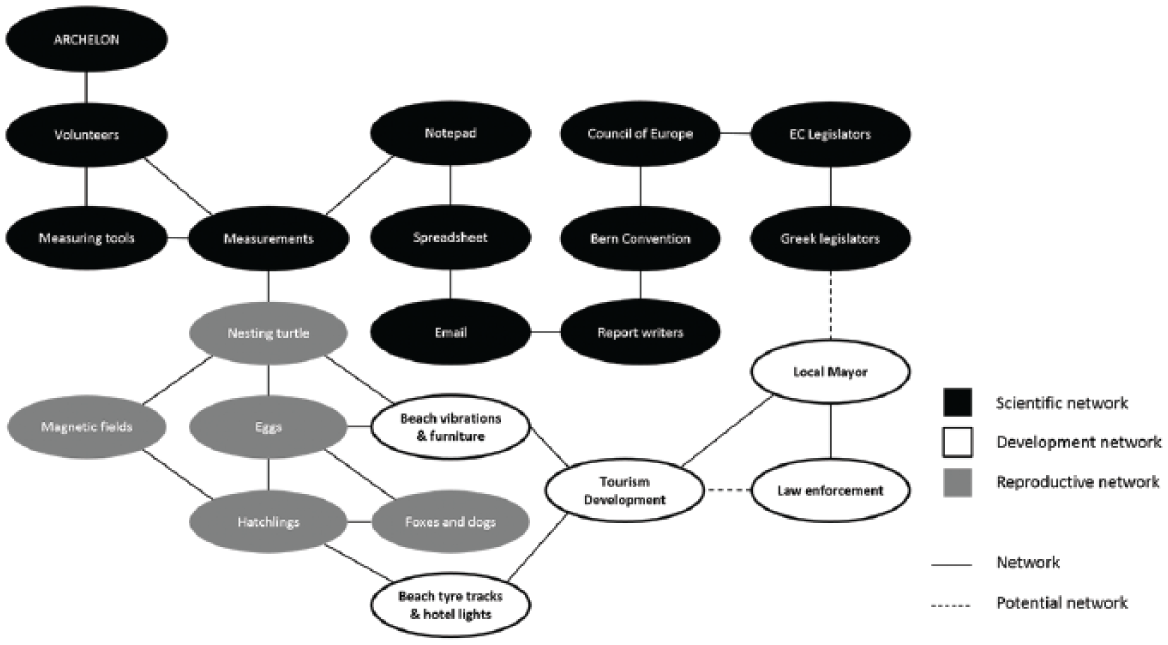
(Simplified) actor relations in the development, scientific and reproductive networks.
Through community ties, the Mayor is instead enrolled in a second, ‘development’ network which attempts to enact a turtle that is secondary to concerns of building development and tourism. For this network, the turtle is ideally invisible (i.e. not part of the network) and to all intents and purposes has been rendered as such by the failure of the Mayor to prompt the police to enforce European and Greek national laws. This is perhaps the opposite of the ‘interessement’ by which actor-networks engage actors (e.g. Callon, 1986). Here, we have a dis-interessement – a disengagement of an actor from a network, whereby the turtle is both unseen and rendered unimportant.
A final overlapping ‘reproductive’ network is the one in which the C. caretta has participated for 20 million years. This network sees the translation of eggs into hatchlings into mature turtles, and the agency of the sea, the beach, and magnetic fields to enable this annual cycle. This is the network of which we know least, as no-one knows what happens to the hatchlings after they disappear into the sea. Yet, dogs and foxes, vehicles, hotel lights, tourists and even volunteers are also co-producers of turtle populations. Moreover, while the development network seeks to disengage the turtle, its consequences, in the form of beach-side furniture, vibrations and tyre-tracks, also have a consequence for turtle numbers.
ANT’s method of mapping out the different empirical inter-related networks in which the turtle participates is powerful in providing an answer to our question, can the C. caretta survive? The reproductive network is obviously crucial in the survival of the turtle, but this in turn is impacted deleteriously by the development network, which is restrained (albeit imperfectly) by the scientific network. It is the failure of the latter to enrol the Mayor (and thus the subsequent network) that is central to the existential threat faced by the sea-turtle. This positioning of the turtle as contested between three actor-networks shows how its different ‘enactments’ are contingent upon a number of actors connecting and acting in specific ways: if nests are not protected, the data are not collected, the developers do not build, or the emails are not sent, the networks we have described change, and the turtles may or may not survive as a result. Moreover, in contrast to many ANT studies of scientific networks (Callon, 1986; Latour et al., 1993) we can also see how the key obligatory point of passage for the enrolment (and thus survival) of the turtle is less the measurements of the scientists (although these are important), but more the Mayor’s failure to translate central conservation law into local action by the police and other authorities.
The ANT perspective on the survival of the C. caretta also highlights the agency of non-humans and the decentring of human agency from its descriptive accounts. If we ask who are the authors of the acts which make a difference in this case, restricting the answer to ‘humans’ provides a very limited understanding. At the very least, two of these networks depend on the turtle for their very existence: its annual pilgrimage, its tracks, nests and eggs. To a great extent, it is the agency of the turtle that sets the rhythms of life for the volunteers. When and where it nests, the tracks it makes, the number of nests it creates and the eggs it lays, structure where the volunteers live, what they do, when they do it, and even what they talk about. Upon the back of this creature an edifice is created through a series of translations, first to the numbers measuring its dimensions, nests and hatchlings, and then to a long network of activities, stretching from our Greek beach to the EC in Brussels. Remove the turtle and the reproductive and conservation networks collapse (although the development network may flourish further).
Moreover, the turtle is no predictable automaton but is, rather, a mediator whose translations enact others. Agency elsewhere in the networks, for example EU legislation, depends on the indeterminacy of questions such as ‘how many hatchlings make it to maturity?’ For Latour (2007), the presence of these chains of agency means that ‘the whole set up, no matter how solemn or controlled, may become unpredictable’ (p. 202). Additionally, the turtle, and its translations, are acted upon by a number of other actors, from foxes and dogs, to notebooks and committees. This does not just concern the co-production of turtle numbers, but the enactment of a large part of what the turtle is – whether it is more or less valuable than tourism, and, through the IUCN, whether it is classified as ‘endangered’ or not.
At a more general level, the ANT perspective highlighted to the authors the extent to which taken-for-granted language in academia (and presumably elsewhere) reflects and constructs anthropocentric accounts of agency, especially concerning the relationship between humans, materiality and nature. Using different descriptions often reads awkwardly, but shifts the focus of researchers from the human to the non-human. Some examples of rewritten terminology are provided in Table 1.
Examples of ethnographic versus ANT case descriptions.
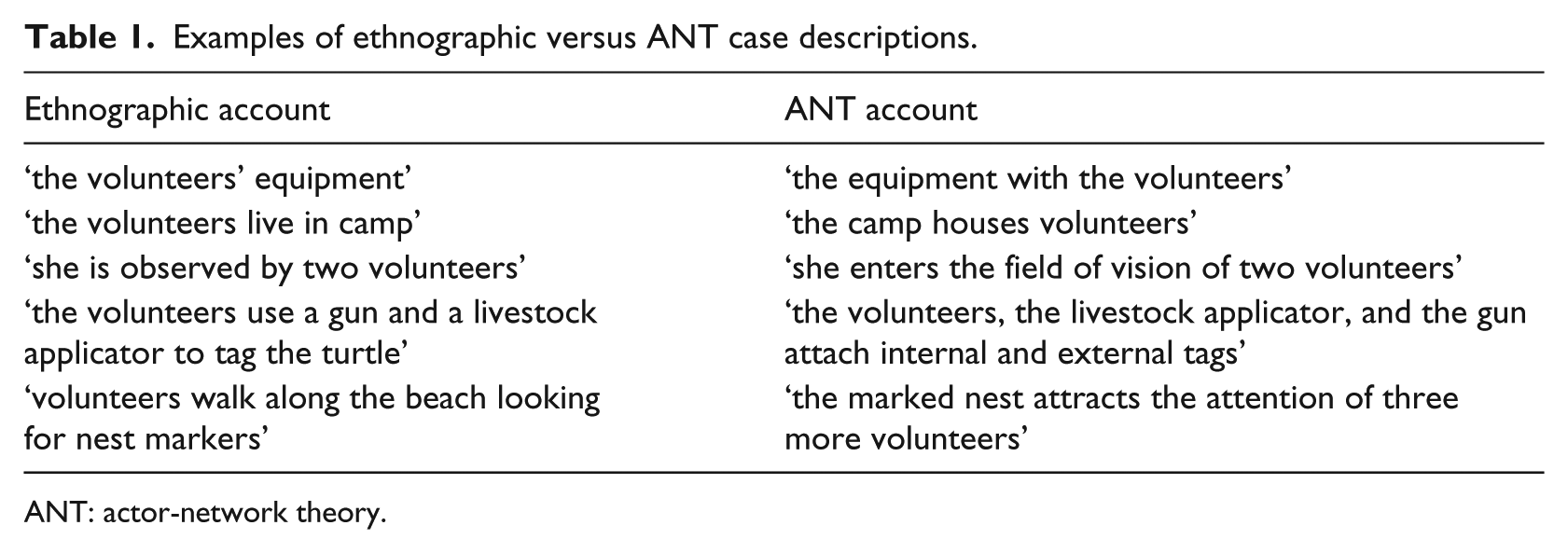
ANT: actor-network theory.
Such differences mark a subtle shift away from anthropocentric accounts by shifting the attention of the researcher towards the ‘agency’ of entities which play a greater part in the story. Such a role is often revelatory, as one realises that it is not simply a turtle that does not lay which may disrupt the network, but equally, a pen that does not work, a volunteer that oversleeps, or an email that gets lost. The taken for granted or ‘black-boxed’ network that links changes in turtle populations to conservation efforts is potentially precarious. Moreover, the crafting of these agentic accounts highlights the participation and enactment of the researchers and their own texts in the network (Latour, 1987).
Issues with ANT
Using the ANT methodology has been of great value in providing a non-anthropocentric account of how the three actor-networks contest and enact different turtles. However, its powers are also limited in answering our question, how can the C. caretta survive? The first issue here concerns the boundaries of the network. If all actors are treated symmetrically, then it is difficult to find entities that should not be included in the network (Elder-Vass, 2008). In the case presented above, the actors that are depicted in Figure 1 were perceived by the authors as the important actors. However, if we were to be strict ANTs we might have included the crab that the turtle ate, the silty sand in which the crabs foraged, and the countless entities which were involved in making the silt. Although drawing boundaries is a challenge for all perspectives, the ANT commitment to the ‘symmetry’ of actors and the primacy of events, makes this especially problematic if all actors and events are held to be equally important to network construction. 3 The de facto approach the authors of this article took to focusing on some actors rather than others was on the basis of their potential powers to make a difference, which appeared to be a necessary deviation from ANT. Yet, this problem is also evident within ANT accounts of animals themselves. For example, in Callon (1986), Law and Mol (2008), Latour et al. (1993) and Castree (2005), the actors which gain the researchers’ attention (other than the animals themselves) are those that have more power to act (e.g. researchers, vets, farmers, governments and universities).
The second issue concerns regularities. We find a number of cyclical, persistent patterns such as the visiting turtles, the production of MEDASSET reports, the visiting of tourists every summer, and even the building of the beach-side volunteer camp. We also find a number of social patterns, for example, that volunteers are most commonly young (a mean age of 23), middle class
4
(63%) and female (75%) – and that these trends are replicated each year. Moreover, while some actors fade away when they have been enacted (e.g. the turtle nest), others are relatively persistent such as ARCHELON, MEDASSET and the European Council. Such temporal and spatial persistence generates difficulties for an actualist ontology which treats entities as events. Although when considering organisations, Latour (2007) speaks of networks which ‘have constantly to be made, or remade, and during this creation or recreation the group-makers leave behind many traces that can be used as data’ (p. 34), this remaking cannot explain why there is such persistence in rules, legal forms and routines: ‘Latour grants no initial principle to endurance over time, just as he accepts no force of temporal flux over and above specific actors themselves … time is produced by the labour of actors’ (Harman, 2009: 105). As Elder-Vass (2010) puts it, ANT’s refusal to theorize structural stability must count as one of its gravest weaknesses; much of contemporary society may well be fluid, but there are still massive stabilities, over a variety of time frames, which are enormously important in contemporary society. (p. 461)
The third issue concerns a priori theorising. 5 ANT explicitly rejects a priori theorising and seeks instead to identify actor-networks by following the actors (Callon, 1986: 200; Callon and Latour, 1992; Sayes, 2014). The implications of such an epistemology are radical, necessitating the rejection of prior assumptions of the researcher, or indeed the insights and theories previous research might have developed. Yet, in our attempt to replicate this method we ran into a significant challenge in linking two or more empirical events. Why, for example, should the email which arrives on the MEDASSET researcher be linked with their subsequent use of that email, rather than say, the researcher eating their lunch, or indeed, the sun coming up the next day? Without an a priori theory (however implicit) of how events and actors are linked, we found we had little basis for identifying an actor-network.
The final issue concerns absence. An actualist ontology has no place for things that do not act: ‘for Latour … if it acts, it is an actor leaving traces that can be followed; if it does not act, it does not matter and has no place in the description’ (McGee, 2014: 25), or more poetically, ‘if a dancer stops dancing, the dance is finished’ (Latour, 2005: 37). Yet, our case is full of absences that make a difference, and thus imply a form of action. The absence of eggs translating into mature adults prompts action on behalf of volunteers, while the absence of action by the local Mayor contributed to the fining of the Greek government by the EC. Moreover, absence appears intrinsically related to potential as it is the perceived potential of volunteers’ action to make a difference to turtle numbers, the potential of the Greek government to be fined by the EU, and the potential of the Mayor to prevent beach encroachment, which makes them important. However, as ANT commits to an anti-essentialist position which denies potential as an ontological category (Lee and Hassard, 1999), it makes discussion of potential highly problematic. An actor-network theorist might counter that any absence that makes a difference counts as action and thus should be incorporated into an ANT analysis. However, the key question is ‘an absence of what?’ Without an ontological acceptance of potential, one is forced into a position where all absences of everything make a difference: the absence of Mayoral action cannot be argued to be more important than the absence of a crustacean.
Thus, while the ANT methodology is insightful, the limitations of its ontology cause difficulties in generating the explanations which are necessary in understanding how the C. caretta can survive. Indeed, it is problematic for any actualist ontology to adequately answer a question concerning the future because actualism necessarily excludes events that have not yet happened, as well as the ‘invisible’ explanatory factors (e.g. logics, mechanisms and social structures) which can provide temporal stability (Cummins, 2000). Indeed, Latour accepts some of these limitations and ‘very deliberately seeks to elide “how” and “why” questions’ (Bijker and Law, 1992: 291). Yet, in our case, the questions ‘why do volunteers volunteer?’, ‘why do volunteers tend to be female?’ or ‘why does the Mayor allow building on the beach?’ generate very different, and less adequate or sociologically interesting answers, than if one replaces the ‘why’ with a ‘how’. To answer our empirical question, then, we need to look beyond the networks identified, not by expanding the boundaries of the study to include more empirical ‘actors’ (such as crustaceans or plankton), but instead by expanding the boundaries to include factors which are variously absent, potential, invisible or recurrent.
Ontological reframing: a critical realist alternative?
The argument we make here is that the ontological commitments of CR are loosely compatible with the ANT methodology, and help overcome the weaknesses identified above. This allows us to provide a more complex and more thorough response to our empirical question, but has certain methodological and ontological implications. Therefore, this ‘appropriation’ of ANT methodology requires a brief explanation. As CR’s ontology is emergent and stratified rather than flat or monovalent, it can accept and distinguish between a variety of things that make a difference in our case: not just the empirical events that occur, but the processes that cause them to occur, the talk and work or the volunteers, researchers and politicians, as well as the organisations and governance systems which co-ordinate this work. Unlike some philosophical positions which prioritise one methodology (e.g. discourse or regression analysis), ‘there are no specifically CR methods … from a CR perspective there is a valid and important place for all the methods sociologists have employed – although not necessarily in the way that they have employed them’ (Porpora, 2015: 63). CR, therefore, is potentially compatible with the methodological, though not the ontological, commitments of ANT.
As detailed earlier, CR adheres to an essentialist, emergent and stratified ontology which, by retroducing and abducting the findings facilitated by the ANT methodology, can generate explanations and help ameliorate the four limitations identified above. To take boundaries first, actors in CR are not symmetrical and have properties that define their potential powers. This not only places constraints on what an entity can do (e.g. turtles might reproduce, swim or die), but also allows some entities to play a more significant role than others. This helps us define the important actors by identifying their potential powers, which remain invisible in an ANT ontology. For example, the local Mayor is important to the scientific network because of the potential power accorded to him by his role in the Greek governance structure to instruct the police to prevent beach developments.
The concept of social structure also helps us understand the regularities with which ANT struggles. ARCHELON, for example, is a (relatively) persistent legal entity which structures persistent relations between agents, positions and practices (Bhaskar, 1979: 40–1). These relations, constitutive of a structure, are real and powerful as they enable and constrain actors’ powers. Thus, the importance of the local Mayor and EU policy makers is not arbitrary, but derives from the powers granted to them by their position in their respective organisational structures. Social structures also help us explain why many volunteers have upper-middle class backgrounds 6 (O’Mahoney, 2015). When asked in interviews why they were involved, many talked about their ‘future careers’ and ‘CV enhancement’. Through abduction and retroduction with reference to prior theorising we can postulate that volunteer concerns with employability are embedded within modern capitalist structures (Boltanski and Chiapello, 2005). As others have argued, ‘volunteering’ generates cultural capital which distinguishes individuals from other classes, and contributes to the reproduction of social stratification (Bourdieu, 1986; Pearlin and Kohn, 1966). Moreover, concern with environmental issues such as conservation has been shown to be strongly associated with young, upper-middle class mores (Urry, 2002), as has the propensity to engage in volunteer tourism (Simpson, 2004). These structures therefore provide a partial explanation for the question of why these actors volunteer and not others. Empirical regularities are not only the result of the causal powers of social structures, but also the consequence of the powers of actors and other entities. For example, in seeking to understand the ongoing presence of volunteers, we can retroduce from a variety of data (both in this case and elsewhere) that the properties of humans include the capacity to care (Archer, 2000; Sayer, 2011) – properties not possessed by, say, hotel lights. Thus, when asked about their motivations for volunteering, respondents cited altruistic and ethical reasons alongside the instrumental motivations detailed above. To be sure, the target of care (i.e. turtles as opposed to say germs) is very much a product of social mores, but it is the capacity for care that contributes to (though not determines) the ongoing pattern of volunteering.
This also illustrates the CR response to the challenge of a priori theorising. In contrast to ANT, CR is explicit about using a priori theorising, and thus does not encounter the same challenges in connecting two disparate events. For CR, events are related through the interaction of causal mechanisms with actors and other entities. The abduction and retroduction critical realists use to identify these mechanisms necessarily builds on the insights identified by other researchers, and helps us provide a fuller answer to the question of how the C. caretta can survive. Locating our case in broader discussions of, for example, social class, power, and environmental politics, help shed further light on the networks we describe. For instance, broader relations of power (which we refer to as social structures) explain why the Mayor enjoys prerogatives that other citizens lack, or why middle class volunteers are in a better position than those from less privileged backgrounds to spend their summer participating to charity work in Greece. Yet a priori theorising is insufficient by itself as new knowledge and prompts for further explanation are prompted by contradictions between expected observations and actual observations. For example, if turtle numbers increased despite growing beach-side development, or if the Mayor decided to volunteer with ARCHELON, these new facts would prompt further attention and explanation.
Finally, CR helps us with the absences in this case. Absences in CR are important, not only because the presence of an absence makes a difference (Bhaskar, 2008) but also because actors often base their action on the potential powers of another actor, or (in the case of our volunteers) their own power to potentially make a difference by preventing a potential absence of turtles. The Mayor, unlike a volunteer, not only has the power to prohibit local infringements of the law, but crucially also has power to ignore them, thus making him a target for lobbying efforts by both developers and volunteers. The EU, unlike ARCHELON, has the potential power to fine the Greek government for not protecting Natura 2000 zones, and thus it is this organisation to which reports are targeted. Methodologically, the absence of an exercised power points to something that needs explaining. For example, the failure of the Mayor to exert his potential powers to prosecute developers nudges the researcher towards further (often retroductive) analysis – perhaps into the strong local personal ties that are found in many Mediterranean cultures, or the relationship between tourism and the recession in Greece.
This emphasis on possibilities also helps with the ‘absurd’ (McLean and Hassard, 2004) treatment of different enactments of actors as creating different entities (e.g. Law and Mol, 2008). For critical realists, the properties of a turtle are distinct from its discursive construction or its network enactment, meaning that the same animal can be part of different networks without needing to be presented as actual different animals. Thus, in CR, unlike ANT, the enrolment of actors into a network does not change their essential properties: even if a turtle were elected Mayor, 7 it would not possess the properties and powers (say, reflexivity, communication, imagination and memory) to allow it to act in the same capacity as a human (Collins, 2010b). In our case, this definition of properties is useful in explaining how entities which are not yet part of a network can come to be identified and enrolled.
Discussion
In answer to the question how can the C. caretta survive?, we use an ANT methodology to trace three networks of which the turtle is a part, and note that the ‘missing link’ is the local Mayor’s instruction to the police to limit the development network. From an ANT perspective, the survival of the sea-turtles depends on the Mayor being enrolled into the scientific network, or an alternative actor found that can equally retard the development network. Yet, while ANT’s extortion to ‘follow the actors’ provided a useful methodological tool, its underpinning ontology was impossible to sustain for the researchers, who ran up against difficulties of identifying network boundaries, explaining persistence, rejecting a priori theorising and conceptualising important absences.
To address these tensions, we have suggested embedding the ANT methodology within a CR ontology. This argument is important for two reasons. First, because it allows researchers to trace actor-networks without internal inconsistencies. As we saw, adopting a flat ontology rules out reliance on knowledge held by the researcher about events, actors, and how they relate. Our approach, instead, consisted in mobilising an ANT methodology within a CR ontology and epistemology that recognises the (limited) validity of research and observations produced before this study. Second, because it allows the researcher to shift the temporal focus of the research question from describing how existing sea-turtles survive in the empirical present, to exploring how sea-turtles might survive in the future – both temporalities are implied by our original question, but ANT answers only one. The use of a CR ontology means that we can move beyond describing the current network and suggest potential mechanisms for making changes to these networks in order to save the C. caretta. Identifying these mechanisms requires us to abduct and retroduct, drawing on literature about parallel cases, and imaging the consequences of change, in order to understand how the world might change.
From this realist perspective, we can suggest that in order for the C. caretta to survive, a number of potential powers might be enacted that would provide the sea-turtle with a more promising future. This involves exploring the potential powers of actors (such as people, organisations or roles) to use mechanisms (such as education, regulatory change, or persuasion) to achieve potential outcomes. For example, EC institutions may lobby the Greek government to change Mayoral governance structures; volunteers might educate local tourists to make more environmentally friendly choices when choosing hotels and bars, or may seek to convince hoteliers of the touristic value of the turtles; ARCHELON might seek to raise revenue from their middle class volunteers (and their families) to further their lobbying and protection activities; the Greek government might change the governance of environmental policing or increase fines associated with illegal activity. Each of these identifies an entity/actor with (potential) powers to effect change in another entity/actor.
The methodological consequences of combining CR with ANT are significant. Researchers taking our approach would take the lead of ANT in following the network, problematising taken-for-granted categories, and rejecting anthropocentrism. However, in using CR as a base, researchers need reject neither a priori theorising (either their own, or prior research) nor the retroductive question of why might things be this way rather than another (Lawson et al., 2007; O’Mahoney and Vincent, 2014). Thus, as we saw with our own example, the CR use of ANT is likely to not only provide descriptions of actors (human and non-human) and the ways in which they relate (causal powers), but also to provide an idea of why this is the case with reference (perhaps) to social structures, potential powers, similar cases and prior research. Yet, an actor-network theorist may reply that the appropriation of ANT methods and terms by a CR ontology changes their meaning, rendering ANT unrecognisable to its adherents. Although we accept that some shift in meaning is inevitable, our commitment is not to maintaining the philosophical purity of ANT, but to developing a better understanding of the socio-ecological world. We position ourselves with those sociologists who argue not only that ontological dialogue and commensurability is possible, but also that this is necessary for good social research (Gorman, 2010). ANT itself has been applied with considerable theoretical variation, and even its founders (e.g. Callon, 1999; Callon and Latour, 1992) have called for its development especially in dialogue with other disciplines. Indeed, Latour (2005) calls for researchers to ‘use [ANT], to distort it beyond recognition, or, most likely, to drop it altogether’ (p. x). We see our work as responding to such calls.
Conclusion
This article has explored the potential of ANT in answering how can the C. caretta survive? Our empirical contribution uses an ANT methodology to trace three networks that are important in describing how turtles survive, highlighting the contested nature of the turtle, and identifying actors that are important in enabling this to happen. However, we found also that the ontological commitments of ANT caused four explanatory issues, concerning network boundaries, regularities, a priori theorising and potentials/absences, which prohibited the development of a satisfactory answer to this question. As Sayes (2014) suggests, then, we have adopted ANT as ‘a useful starting point for providing a proper rendition of the complexity of the associations we form with others and with non-humans’ (p. 145), and CR has provided us a means of moving beyond this to theorise these relations.
Our engagement of CR and ANT allows us to move beyond the description of how sea-turtles survive now, to providing a richer account of how the sea-turtles may survive in the future if certain mechanisms are actualised. We have built upon existing work seeking to engage ANT and CR (Elder-Vass, 2008, 2015; Mutch, 2002) in three ways. First, we provided an empirical, socio-ecological illustration of the potential for such an endeavour. Second, this empirical illustration provided us with new theoretical insights: the critiques of a priori theorising and absences/potentials in ANT, and their amelioration with CR, are new to the literature. Finally, unlike many CR accounts, we also seek to use ANT to highlight the deficiencies in many applied CR accounts, such as the assumption of solely human agency and the tendency to side-line the empirical.
The combination of ANT and CR points to the potential for future research in other areas. While the agency of animals, and the socio-ecological realm more widely has obvious potential, other areas such as information technology and (socio) materiality may also benefit from an empirical use of the approach we have illustrated here. There are a number of limitations in this article that also point to potential future avenues for research. The first is that we lack the space to develop a more sophisticated account of a CR engagement with non-human actors. There are outstanding questions concerning if, and how, emergent properties might arise from their interactions, and the extent to which human/non-human relations might differ from purely human relations as they participate in the transformation or reproduction of social and cultural structures (Archer, 2000). In addition, ANT highlights the performative effects of the ‘transitive’ dimension of knowledge: in our case, how the counting and representation of turtles has real effects, not just elsewhere in the network, but on the meanings associated with turtles themselves. This raises a challenge for critical realists who often claim epistemological relativism, but claim to know (or know better) the ‘real’ world. The ambiguous and intentionally counter-intuitive language of ANT offers an opportunity for seeing the world in a different way – but we see this opportunity as more methodological than theoretical (Sayes, 2014). We hope these and other challenges may be taken up by those interested in developing the conversation between CR and ANT.
Footnotes
Funding
The author(s) received no financial support for the research, authorship, and/or publication of this article.