




Abstract
This article argues that the notion of affective atmosphere provides a privileged access to the study of organizational affect as it relates to a spatial ontology of ‘being-together-in-a-sphere’. Drawing on the study of affective atmospheres in philosophy and cultural geography, we develop a conceptual positioning from which to analyze a musical intervention in the streets and squares of Berlin. The study traces the preparation and enactment of a 2-day music event that breaks with the emotional experience of a ‘mainstream’ classical concert, and instead intervenes in urban atmospheres by mingling music performances with everyday urban life in an attempt to affect chance spectators. Tracing how the concert’s atmospheres emerged through a series of encounters between various bodies and their specific affective capacities, the analysis emphasizes the tension between the possibility of designing and crafting atmospheres and its emergence in erratic, ephemeral, and excessive ways. Therefore, we propose that affective atmospheres make perceptible the potentialities of organizational space and give scope to our feelings as we experience their spatial recomposition. In the conclusion, we emphasize affective atmospheres as a key concept for the critical study of affect, as it advances a politics that attends to new possibilities of feeling and acting collectively in spaces of organizing.
Who are we in relation to the real world outside, the world that does not take place in the concert hall? Are there points of contact or not, are we lost there or can we survive there? I have no clue.
Introduction
Imagine a Saturday in early summer. You are rushing to buy groceries as guests are coming for dinner. But the summer has not yet arrived and it’s pouring out. Slightly irritated, you leave your bike home and take the underground; as you take it daily during the week you would have appreciated a break from it during the weekend. When you change metro lines, you stumble onto a group of young people, weirdly dressed in ninja-like costumes. They play quite unusual music: rhythmic, dissonant, with forceful staccatos. You stop in your hasty trot through the metro corridors and join a quickly growing group of onlookers. They seem not to know how to react: should they feel shocked or should they engage with the enthralling music, played with such virtuosity? You realize immediately that these are not your everyday street musicians, but you really have no clue what is going on. Suddenly, you shudder at the screeching violin sounds that remind you of the shower scene in Hitchcock’s Psycho. Someone shouts, ‘This is not real music’, but you no longer pay attention to the chaotic noises of the metro, and you have forgotten all about the shopping—you do not even notice that you left the grocery list on the kitchen table. You live in a cloud—along with many others, enveloped, but not imprisoned, by this experience that seems to be outside of time. For exactly 14 minutes and 20 seconds, you are overwhelmed by the music’s intensity, and the unexpected rare splendor of those, long, interlaced string glissandi that translate into goosebumps on your arms. You feel alive, just briefly, but still your mood is miles away from the mode of consumption you were engaged in before. Then, a final crescendo is quickly drowned in spirited applause. Before you can feel grateful for this free concert, the musicians have disappeared and the crowd dispersed. You need some fresh air and climb up the stairs to free yourself from the suffocating underground, where you were captured in a magical encounter with guerilla musicians. Outside, it has stopped raining, and you wonder whether summer will come after all.
This affective episode seems to form a spontaneous and immediate encounter with a varied palette of sensations, feelings, and intensities: haste and slowing down, surprise and feeling overwhelmed, a shudder and goosebumps, suffocation and vexation (over the rain), delight and thrill, and a sense of aliveness and magic. However, many things—including ideas, energies, people, artifacts, music history, Saturday dinner habits, and a metro ticket—have to be assembled and carefully arranged for such an affective atmosphere to surprise, attract, and envelop a group of onlookers. This affective atmosphere, as described in (an attempt at) a short ficto-critical story (Stewart, 2007), emerged along with the enactment of a music event in Berlin some summers ago, an event that commemorated the life and music of the Greek-French composer Iannis Xenakis. Drawing on an ethnographic study, in this article, we describe the process of how a small, autonomous string ensemble prepared and offered a 2-day celebration concert, of which this gig in the metro was a small part. Our analysis, which understands the organizing of affective atmospheres as a compositional process (Latour, 2010), reveals how they are simultaneously carefully designed and crafted through aesthetic work (Böhme, 1993) and spatial formation (Edensor, 2015; Thrift, 2008), yet also emerge in erratic, ephemeral, and excessive ways.
In elaborating this ‘double entendre’ of organizing affective atmospheres, we seek to contribute, both empirically and conceptually, to the study of affective life in organizations following Reckwitz’s (2012) lead that ‘atmospheres offer rich potential for an analysis of affects’ (p. 254). Here, we expand on the concept of the ‘affective atmosphere’ and its potential for understanding organizational affect by emphasizing its spatio-aesthetic unfolding. Therefore, we would like to inquire how affect becomes organized as affective atmosphere, which constitutes a core riddle in the study of affect as identified by scholars such as Margaret Wetherell (2013) and Ben Anderson (2014). Even if these authors find themselves on quite opposite ends of the spectrum of answers to the question of how to explain affect as communal event, they specify this question in a similarly double-sided way. For instance, Wetherell (2013: 221), recognizing that affect can become as uncontrollable as a sneeze (see also Damasio, 1999), formulated the following witty question: ‘Are we engaged in “performing emotion” or in “emotional sneezing”?’ to encircle the tension between research accounts that see affect as a predictable performance or as an unpredictable event. Referring to affective atmospheres, she zooms in on what she calls ‘the duality of affect’ (Wetherell, 2013: 221) and the challenge to understand ‘the intertwining of emergent and accomplished affect’ (p. 222). Similarly, Anderson (2009, 2014: 21) wants to understand how affects bring a specific feel to episodes, encounters, and events; he points out how the ambiguity of affective atmospheres emerges in ‘between presence and absence, between subject and object, between subject and subject, and between the definite and indefinite’ (p. 137). Even if affect comes as excess to an ordered life (Thrift, 2008), Anderson (2014) confirms that ‘[w]hat is needed is an account of how affective life is organized and mediated that sits alongside the emphasis on the excess of affective life over and above existing determinations’ (p. 17). Therefore, an analysis of affect needs a double critical-affirmative stance, offering ‘a way of attending to moments of change in which social life is reordered and other possibilities may be glimpsed’ (p. 15).
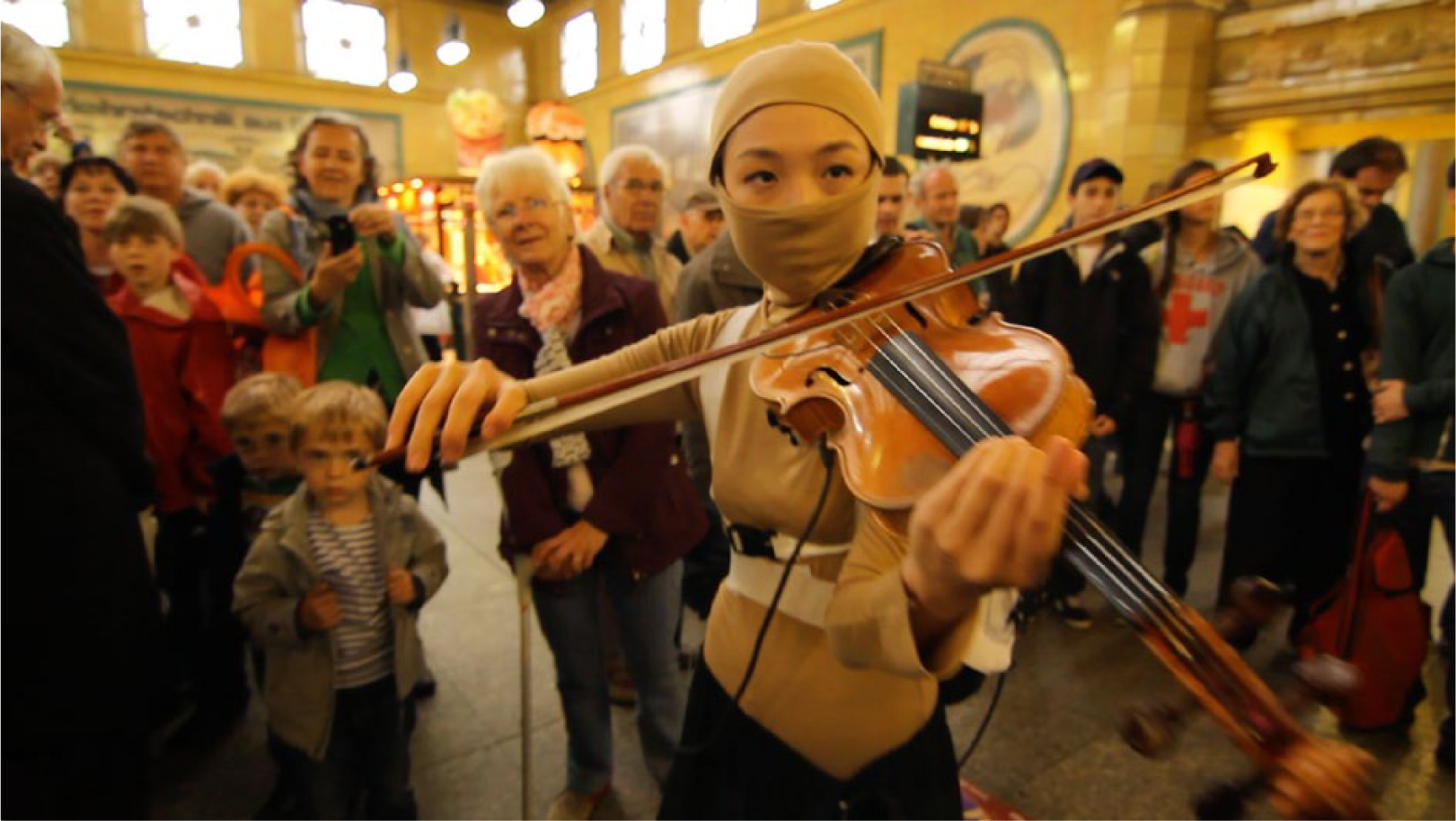
Guerilla concert at U-Bahn station Wittenbergplatz.
In this article, we flesh out three ways that research into affective atmospheres can inform organization studies. Conceptually, we bring to the fore the ambiguities of organizing and show how these ambiguities are ‘held together’ in the emergence of affective atmospheres as they are at play not only in artistic interventions but also in, for instance, temporary organizations (Burke and Morley, 2016), marketing practices (Biehl-Missal and Saren, 2012), and consumption spaces (Healy, 2014).We argue that the notion of affective atmospheres contributes to current discussions on the unsiting of organizational spaces (Beyes and Steyaert, 2013) as it conceptualizes how affects can become unlocked by reorganizing a site’s constellation of material and immaterial elements. Methodologically, we illustrate how organizational research can open up to the registers of affectual composition through aesthetic experimentation (Blackman, 2015; Stewart, 2007). The more-than-representational ways in which we trace and document the composition of affective atmospheres inform the increasing interest in affective methodologies (Knudsen and Stage, 2015) to study organizational affect. Third, concerning the politics of organizing, we show how the composition of atmospheres impacts the possibilities of feeling and acting collectively in new ways. Our study, thus, reflects upon and promotes an understanding of organizational politics that emphasizes the creative potential of the unrestrainable and communal forces of affect.
Consequently, the article is structured as follows. First, we review the literature on affect in organization studies to point at the undertheorized notion of affective atmosphere for the analysis of (organizing) affective events. Second, we build on the study of affective atmospheres in philosophy and cultural geography to develop a conceptual positioning for our empirical analysis. After explaining our methodological setup, in the ‘Results’ section we describe two elements: the careful crafting of the affective atmosphere through aesthetic work and spatial formation, and the unpredictable variations of atmospheres that result from the unexpected encounters with new sites, chance bystanders, and weather fluctuations. A ficto-critical account rounds out the empirical section and prepares for our discussion of the analysis, where we emphasize the tension between the possibility of designing atmospheres and the unpredictable outcome of this process. In the conclusion, we reflect on the organizational, methodological, and political implications of our study; these let us emphasize affective atmospheres as a key concept for the critical study of affect in organizations.
Affect and affective atmospheres in organization studies
In recent years, the study of all things ‘emotional’ in organizations has been confronted by a series of contributions on the notion of affect (Kenny and Fotaki, 2014). These contributions take note of the so-called affective turn in the humanities and social sciences (Blackman and Venn, 2010; Wetherell, 2012), which has been prominent in cultural studies (Clough with Halley, 2007; Hemmings, 2005), especially in human and cultural geography (Anderson, 2014; Anderson and Harrison, 2010; Thrift, 2008). In organization studies, this turn has been mostly exploratory (see Fotaki et al., 2014; Gabriel, 2014; Kenny et al., 2011; Linstead and Pullen, 2006; Steyaert, 2015); so, thus far it resembles a twist more than a turn. Still, the concept of affect holds considerable promise for transforming the ways that the psychosocial is theorized in organizations, where it can signify ‘a new departure’ (Kenny and Fotaki, 2014: 18). In this article, we seek to contribute to the line of affect research in organization studies (see Beyes and Steyaert, 2011; Hjorth and Pelzer, 2007; Thanem and Wallenberg, 2015), which is built around an aesthetic and spatial understanding of affect as a transindividual force of organizing; it emerges from and is experienced in the encounters of human and non-human bodies and in their mutual capacities to affect and be affected by one another. To establish the link between affect and (affective) atmospheres in this nascent stream of organizational research, we mainly address those contributions stemming from non-representational theory (Anderson and Harrison, 2010; Thrift, 2008), which understands affect as ‘the capacity of interaction that is akin to a natural force of emergence’ (Thrift, 2008: 182). This understanding of affect draws on the conceptual developments by Spinoza (see Hjorth and Holt, 2014), as articulated by Deleuze (1988) and ‘translated’ by Massumi (2002), who has been ‘the most obviously influential in the new panorama’ (Wetherell, 2012: 56). In the following paragraphs, we discuss the work of those scholars in organization studies who have drawn on this ‘non-representational’ understanding of affect to address the vitality of organizational life.
Notably, Beyes and Steyaert (2011) have connected the affective, spatial, and aesthetic dimensions of organizing. The authors describe ‘provisional spatio-temporal constellations that are in process, alive and unstable (that are in rehearsal, so to speak)’ (p. 9) and how they induce unfamiliar and uncanny affects to organizational spaces. These processes of ‘unsiting’ enable unexpected and transformative affects through a doubling, a multiplication of everyday organizational life (Beyes and Steyaert, 2013). The concept of ‘life’ here closely relates to and emerges from the tension between attempts at designing (or managing) the unfolding of organizational processes and the unpredictable outcome of affective encounters in space. Hjorth and Pelzer (2007) have explored this tension in their analysis of Volkswagen’s attempt to enter the market for luxury cars. Drawing on a Deleuzian understanding of affect, they showed how the company used art, architecture, and literature in the context of business to associate the production of a new car with the emergence of affective capacities. By showing how the productive force of art did not result in the outcome that the Volkswagen management desired, the authors stressed the limitations of organizing affect for marketing purposes and highlighted the unpredictability that is inherent in artful organizing (Hjorth and Pelzer, 2007). Furthermore, in the context of workplace dynamics, Iedema et al. (2006) drew on Schatzki’s (2002) concept of ‘teleo-affective intensities’ to address a dimension of organizational life that allows for a creative refashioning of conduct, both accompanying and exceeding managerial control. In a similar vein, Thanem and Wallenberg (2015) pointed out that affects in the form of joyful encounters might be quite rare, as organizations frequently reduce the opportunities for such encounters, rather than enhancing them. However, they see this as an opportunity to reflect on ‘how life happens in the midst of organizations, and how people exercise embodied capacities in the midst of authority while seeking to understand and take responsibility for how we affect and are affected by others’ (p. 246). The Spinoza-inclined affective ethics elaborated by Thanem and Wallenberg highlights the joyful passions that may emerge in the encounter between bodies with different affective capacities. While the authors focused on the capacities of ‘individual bodies’ (p. 248), in our study, we are interested in understanding how affect becomes communal by emerging as an organizational force in the form of atmospheres.
What connects these previous studies is a view on affect that brings a force we could call de-territorialization (Hjorth and Pelzer, 2007) or de-subjectivization (O’Doherty, 2008), a force that bears directly upon the recipient. However, we see an important question to explore further: how can affect be organized spatially and aesthetically in a way that maintains the open endedness and unpredictability of such encounters? Our proposal is to approach the spatio-aesthetic composition of affective encounters through the notion of ‘affective atmospheres’. The notion of atmosphere has only recently, and not very forcefully, entered the discourse of organization theory. Meanwhile the term ‘affective atmosphere’ has rarely been mentioned, even in the organizational literature on emotion and affect, and then only in a descriptive sense, referring to work or relational climates (Sieben and Wettergren, 2010). The exception here is the work by Christian Borch who connects affect with an interest in atmospheres in the context of organization and management. Introducing Sloterdijk’s three-volume spherology (see Beyes, 2014), Borch proposed concepts such as ‘organizational atmosphere’, ‘organizational foam’ (Borch, 2010), and ‘foamy business’ (Borch, 2011). We will integrate his contribution as we conceptualize affective atmosphere, an idea to which we now turn.
Conceptualizing the qualities of affective atmospheres
The study of affective atmospheres, related to a broader interest in affective urbanism (Anderson and Holden, 2008), focuses in particular on spaces of affect and feeling (Thrift, 2004). The notion might seem very specific, but can easily be drawn out through its connections to the study of affect and emotion (Wetherell, 2012, 2013), on one hand, and the focus on atmospheres (Borch, 2010; Sloterdijk, 2009), on the other. Empirically, affective atmospheres have been studied in relationship to (the organizing of) events such as football matches (Edensor, 2015), commemorations (Wetherell, 2013), marathons (Latham and McCormack, 2010), and informal, urban events (Douglas and Hinkel, 2011). In addition to arising in urban settings like tourist attractions (Edensor, 2012) and public transport (Bissell, 2010), atmospheres are produced in all kinds of moments of organizing, ranging from trading floors (Biehl-Missal and Saren, 2012), surveillance systems (Ellis et al., 2013), and nighttime work (of street cleaners or taxi drivers; see Shaw, 2014), to shopping environments (Healy, 2014).
The notion of an affective atmosphere combines attention to atmosphere with the singularity of affective qualities (Anderson, 2014). To a certain extent, the notion is tautological, since atmospheres are seen as ‘affective powers of feeling, spatial bearers of moods’ (Böhme, 1993: 119). Often dominated by an architectural focus on the effect that buildings have on atmospheres (Böhme, 2006; Borch, 2014), the notion of affective atmosphere tries to open up a field of analysis which includes a wider range of human and non-human components and attunes to the prepersonal or transpersonal dimensions in affective encounters (Anderson, 2009). For others, this focus seems too narrow (Wetherell, 2012). For instance, Edensor (2015) argues ‘that it is inappropriate to isolate affect as the key ingredient of atmospheres’ as the latter ‘folds together affect, emotion and sensation in space’ (p. 82). Therefore, Edensor (2015) proposes to follow the entanglements between ‘affects, emotions and sensations in the production and experience of atmosphere, a thorough melding of these stimuli and intensities’. Also, Anderson (2014) emphasizes that ‘bodily capacities are always-already mediated’ in processes that involve a range of discursive and non-discursive elements (p. 83). As Wetherell (2012, 2013) has emphasized several times, there is no need to a priori exclude anticipation, reflection, or symbolic meaning making from the social-material configuration of an atmosphere.
The understanding of affective atmospheres is strongly influenced by the spatial and aesthetic interpretation of atmosphere that the German (phenomenological) philosopher Gernot Böhme (1993) summarizes in one clear-cut phrase: ‘how I feel here’ (p. 120). According to Böhme, atmospheres ‘are ontologically indeterminate quasi-objects of perception that lie between subject and object, literally in the medium’ (Chandler, 2011: 558). Referring to Schmitz’s philosophy of the body, Böhme conceptually connects atmospheres to the (role of the) body. He says that the body as ‘a space of action, […] is one of centered possibility, as a space of moods it is affective and atmospheric, and as a space of perceptions it is one of being amongst other things’ (Chandler, 2011: 358). In particular, Böhme studied how atmospheres are increasingly designed and staged (Böhme, 1995), not in the least in architectural projects (Böhme, 2006).
Drawing on this groundwork by Böhme, others have further developed the notion of affective atmosphere from the perspective of non-representational theory (Anderson, 2014) to expand the range of spatial-material elements and to consider the human body on more equal terms with its material environment (and with other bodies). Indeed, Anderson conceptualizes atmospheres as constantly evolving processes as he confirms (and translates) Böhme’s understanding of atmosphere not as ‘something that exists by itself in a vacuum, but quite the opposite [, as] something that emanates and is created by things, by people, and by the constellations that happen between them’ (Böhme, 1995: 33–34 translated by Anderson, 2014). Therefore, we must emphasize their emergent and unfinished quality: ‘atmospheres, emanating and enveloping particular things, sites or people, are endlessly being formed and reformed through encounters as they are attuned to and become part of life’ (Anderson, 2014: 145). Drawing on Deleuze’s reading of Spinozian affect, then, atmospheres are experienced through the changes in a body’s affective capacities as it moves in and out of relational compositions (Anderson, 2014). However, many types of bodies can participate in this process; as Anderson (2014) puts it, ‘[n]umerous bodies can be said to be atmospheric, in the sense that people, sites or things produce singular affective qualities and emanate something like a “characteristic” or a “quality”’ (p. 146).
As we try to conceptualize the emergence of affective atmospheres, the Latourian (2010) notion of ‘composition’ helps us attend to the spatiality of affective atmospheres, the possibility of their artistic design and their relational—and thus fragile—unfolding. Latour reminds us that ‘things have to be put together (Latin componere) while retaining their heterogeneity’ (pp. 473–474, emphasis in original). As we consider these open-ended and emergent qualities of affective atmospheres, the question is whether it is useful to try to intervene in the composition of atmospheres and the way they unfold. Given his interest in architectural atmospheres, Borch (2010) has pointed out that atmosphere is something that can be created, in Böhme’s words, ‘more or less consciously’ by an architect (or any other designer or artist) (p. 235). This makes us aware of the possibility of aesthetic manipulation, namely, ‘the capacity of aesthetic, i.e. atmospheric, production to generate specific affective states’ (Borch, 2010). In this sense, Böhme (1993, 2006) and Zumthor (2006) have described how atmospheres can be systematically crafted or designed. For instance, Zumthor hints that ‘there is an artisanal side to this task of creating an architectural atmosphere’ (p. 21, our translation).
Summarizing these conceptual developments, we would like to briefly point out the potential that the notion of affective atmospheres holds for organization studies. First, this notion fruitfully combines processes of spatio-material organizing with the affective and emotional life of organizations. Second, the emergent qualities of affective atmospheres help to account for the processuality of organizing. Third, addressing affective atmospheres in terms of composition fosters an understanding of organizing that comes alive through encounters between heterogeneous elements.
While the literature review reveals that studies have mostly focused on either the designing or the accidental side, our research of the artistic project gave us a chance to study both aspects in one composition process as the ensemble carefully crafted its performance, yet also gave itself over to the indeterminate, open-ended, and chance-like qualities that come with an atmospheric intervention. To seize this double aspect as articulated in our research question, we formulated two related questions to guide the analysis: (1) How does an affective atmosphere emerge from designing encounters between its various components? (2) How is an affective atmosphere altered as new, unpredictable elements enter its composition?
Methodological orientation: atmospheric research practices
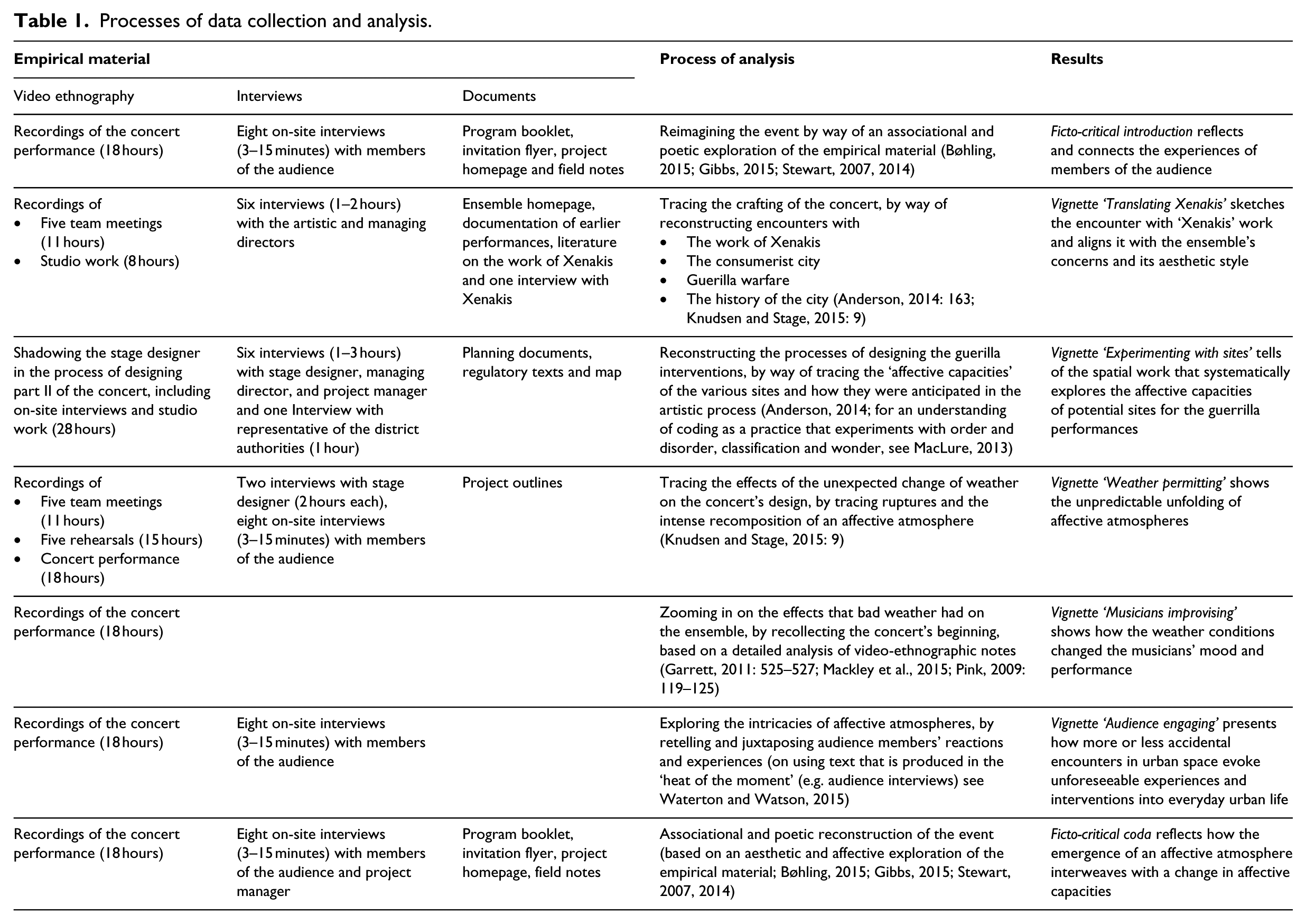
Our proposal to empirically study the fleeting phenomenon of affective atmospheres might raise the question of how we can ‘represent that which lies beyond the scope of representation?’ (Bondi et al., 2005: 11). Taking into account ‘methodological’ guidelines to study atmospheres (Anderson and Ash, 2015; Mackley et al., 2015), we suggest circumventing this tricky question by following an enactive approach to empirical social research (Law and Urry, 2004). Such an approach traces the processes through which atmospheres emerge and tries to perpetuate their unfolding in sensitive and evocative research accounts. Still, it acknowledges that a more-than-representational approach is also likely to include representational elements. Understanding the collection, analysis, presentation, and discussion of the empirical material itself as a process of composing (Stewart, 2013), we aim to present a research account that is both well connected to our empirical material and sensitive to our affective experiences during the research process. In Table 1, we present an overview of our compositional endeavor; it shows how the writing of the respective vignettes and ficto-critical accounts is based on the various sources of data collection and how we interpreted them in various clusters of concepts.
Processes of data collection and analysis.
Collecting empirical material
By way of ethnographic research, the first author (C.M.), together with another colleague and supported by a filmmaker, accompanied a Berlin-based music ensemble in the 12-month preparation and performance of the concert project XI: A Polytope for Iannis Xenakis. The performance lasted 2 days. It began with a concert at the famous Berlin philharmonic concert hall in the evening of the first day, which ended with some of the musicians leaving the concert hall and continuing their performances on nearby streets. The following day, the ensemble played so-called guerrilla concerts at various iconic sites around the city’s public space, ending in a ‘polytopic concert performance’, during which the musicians split up and played at 15 different remote locations, transmitting their music via cell phones to a derelict field in the middle of the city. There, 15 cars received the signals and amplified the music with the help of their stereo systems, meanwhile moving in a slow choreography across the field. The audience was invited to move between the cars and to explore the concert performance in fragmented and constantly changing ways.
Following the ensemble from the generation of initial ideas to the publication of the online documentation, we collected a rich set of empirical material on both the aesthetic and spatial preparation work of the artists, musicians, and organizers, and the unfolding of the concert on the days of its performance. In the course of our research, we collected about 100 hours of audio-visual recordings, conducted 22 long interviews and many short ones, and gathered numerous documents, such as flyers, regulatory texts, maps, planning documents, and project outlines. Furthermore, we wrote 50 pages of field notes documenting some of our own (affective) experiences.
The use of audio-visual recordings not only allowed us to generate ‘notes’ that were sensitive to the more ‘touchy-feely’ aspects of the socio-material worlds (Crang, 2003) but also served as an important door opener to our case. The ensemble used parts of our video recordings for a documentation of the concert performance. In this sense, we understand our use of audio-visual research methods as an alternative, and evocative and suggestive, route to collecting empirical material (Garrett, 2011: 525–527; Pink, 2009). We accompanied the ensemble members at team meetings, in their studios and rehearsal rooms, and on their trips to explore potential venues. To learn about the life and work of Iannis Xenakis, we followed the readings and video material suggested by the artists and did some further research on our own. Finally, we inquired into the experiential worlds of the audience by conducting short on-site interviews immediately after each performance.
Data analysis and writing research accounts
Guided by Anderson’s (2014) assertion that ‘[t]o speculate on how an atmosphere forms it is first necessary to understand how a diverse grouping of things and people come together’, we zoomed in on the aesthetic work, the spatial exploration, and organizational planning (p. 152). In short memos, we described how these processes emerged from, and were limited and subverted by, encounters between a set of potential components and their affective capacities; these included the work of Iannis Xenakis, the performance sites, the funding institution, and the artistic and coordination team. Furthermore, we were equally affected by sudden changes during the performance days; as researchers we felt the impact of the weather and were curious to engage with the various responses of the bystanders. In this sense, as filming researchers, we lived and experienced the turmoil that was bestowed upon the organizers, musicians, and artists, which brought a day of improvising in contrast to the meticulous and detailed preparation. As a consequence, we had quickly felt, if not yet articulated, a central tension between design and chance in atmospheric composition that structures the current description of the empirical analysis. Furthermore, this tension became reflected in how we interpreted the emergence of the concert’s atmosphere as conditioned by systematic aesthetic and spatial work and a series of unforeseeable encounters.
With this ‘felt’ core tension, we engaged in a more systematic analysis. After transcribing all the interviews, we began by closely reading this material, bracketing core passages in transcripts that spoke to the designing and the accidental parts, and to their interrelationship. We undertook a similar process of preselection with regard to the video recordings and the documents we had gathered during fieldwork. We then coded these bracketed fragments (MacLure, 2013) by distinguishing and naming the various encounters with sites, actors, and documents during the preparation, and by categorizing—based on the responses of the audience—several of the most surprising and eye-catching moments of movement and expressions of sensation during the performance days. This coding process can be seen as ‘an experiment with order and disorder, in which provisional and partial taxonomies are formed, […] not as a static representation or translation of a world laid out before us on the operating table of analysis’ (MacLure, 2013: 181).
Based on this first set of categories, we realized that we needed to complement the coding by taking into account our own conceptual sensitivities, as the base upon which our temporary understanding of affective atmospheres could evolve. In several rounds of coding and conceptual ‘testing’—also driven partly by feedback as we wrote the article—we stabilized our interpretation of the designing process as crafted through ‘aesthetic work’ (Böhme, 1993) and spatial formation (Thrift, 2008). To retrace how accidental events could diffuse into the composition as moments of ‘affective encounters’ (Anderson, 2014), we distinguished between the weather-induced unpredictable unfolding, the improvisation by the musicians, and the chance encounters of the audience, and then considered how these contributed to what Knudsen and Stage (2015) have called ‘the intense building of assemblages’ (p. 9).
In this interplay between coding, testing conceptual potential, and interpreting our results, we learned that the writing process also becomes an important, even essential, aesthetic experimentation from our side. Therefore, it was important to translate the various clusters of interpretation that came to play a role in composing an affective atmosphere in expressive and lively vignettes. These vignettes interweave analytical categories, quotes from interviews and observations, and an affective stance that translates our own affective experiences into an integrated description that can suggest the fragility of (a part of) an emerging affective atmosphere. Besides these five vignettes, we took inspiration from Kathleen Stewart’s (2007, 2013, 2014; see also Gibbs, 2015) creative non-fictional, or ‘ficto-critical’, form of writing as a way of performing a research account that is both sensitive and evocative. That is, it is sensitive to the affective dynamics of the on-site interviews with the audience and evocative, in that it invites readers to get a sense of (and feel for) the affective push that moved (some of) the onlookers (see also Bøhling, 2015). Therefore, we decided to open the article with one such ficto-critical account and also to end the analysis with a ficto-critical coda to give readers a chance to feel (at least partly) immersed into these moments of an affective encounter. In a similar way, we present a selection of stills from the video material to accompany the text. We selected those images that illustrate a part of the empirical description but can also add another affective layer to the research account (Steyaert et al., 2012). With these images, we aimed to ‘mobilise techniques of experience and experiment with which to participate with the play of images in the multiple layers of thinking, sensation and imagination’ (Latham and McCormack, 2009: 260).
Methodological reflection
In conducting our research, we tried to ‘avoid both the pitfall of neutrality and of radical performativity’ (Knudsen and Stage, 2015: 6); that is, we aim to develop a research account that moves beyond the dichotomy of realism versus constructivism. Instead, we understand our research as starting from and elaborating the messy middle between these two sensibilities. Starting from the middle also requires that we be reflexive about how our research emerges from and depends upon our own affective capacities as researchers. In other words, we need to use and be honest about our own bodily involvements and reactions as a part of affective research, instead of covering it up and trying to disguise the fact that researchers also have bodies with a capacity to be affected. (Knudsen and Stage, 2015: 17)
In organization studies, Cunliffe and Karunanayake (2013) have pointed out how the crafting of research accounts (through field work, analysis, and writing) cocreates the identities of both researchers and respondents. Taking up the concept of ‘hyphen-spaces’ developed by Cunliffe and Karunanayake (2013), we understand our research as a process in which we affected and were affected by both the unfolding of the concert performance and the enactment of our research project. In the process of our research, we ‘navigated’ this hyphen-space of affecting-affected in multiple ways, including the following three:
Filmmaking-researching
The choice of audio-visual ethnography allowed us to perform a double role: both documenting and conducting research into the ensemble’s work. Our role as filmmakers-researchers was essential not only to our gaining access to the ensemble but also to gaining an aesthetic sense that would let us (re)present affective atmospheres in writing.
Participating-observing
As they prepared for the concert, the artists occasionally asked for our opinion, positioning us as reflection partners and as coauthors of the performance. Furthermore, they showed a clear interest in learning from and reflecting on our academic perspective and in employing our understanding of the ensemble’s work: they invited us to a meeting to plan the development of a future project.
Attaching-detaching
Furthermore, we felt ‘attached’ not only by a fascination and sympathy for the young ensemble but also by our own immersion in the highs and lows of the ensemble’s preparation process and in the rollercoaster weekend of the performance. Even if the analysis is based on a process of affective detachment, the plethora of feelings we experienced was crucial in crafting the research accounts and ficto-critical stories.
Affective atmospheres: the enactment of a guerilla concert
In the following two empirical sections, we seek to show how the concert’s atmosphere emerged from two elements: the continuous attempt at designing the performance through aesthetic work and spatial formation, and the unpredictable outcome of encounters in the process of both planning and playing the concert.
By design: crafting an affective atmosphere
Translating Xenakis
For this ensemble, bringing the music of Iannis Xenakis to the streets and squares of the city of Berlin was anything but a haphazard decision. The ensemble had ‘set itself the task to prize open the traditional concert settings’ (from the ensemble’s homepage, 2013). Therefore, since its foundation in 2006, it had played with the spatial experience of classical and avant-garde music, often in collaboration with artists from other disciplines, such as dance, theater, stage design, and architecture. In this endeavor of playing with other spaces and disciplines, Xenakis had become an important point of reference (not to say an idol) for the ensemble. However, the idea of a concert in honor of the upcoming 10th anniversary of Xenakis’ death had emerged only a year and a half earlier. As one of the artistic directors described it, another of the artistic directors had seen an exhibition on Xenakis’ Polytopes—I think. And she came back very enthused, suggesting that we could combine [an earlier project idea, sketched under the title The Right to the City] with it, that it would be an opportunity to combine these two things somehow.
That director’s encounter with Xenakis’ Polytopes—massive multimedia performances composed for specific sites outside the concert hall—ignited the thought of turning their initial idea into A Polytope for Iannis Xenakis. To make this happen, it was important to the artistic directors to create something ourselves, because Xenakis’ Polytopes cannot be re-performed. Those are pieces that came into existence for a specific place and event. And in this sense, we too want to bring into existence a piece for a place, for a specific event.
The Right to the City project provided the Polytope with a theme: ‘attacking’ the capitalist city with avant-garde music and thus altering the atmosphere from a commercial to a political one. As the general manager puts it, Our dream back then […] was to venture into Alexa [a shopping mall at Alexanderplatz], to enter these wacky buildings, which we find utterly ugly in Berlin, to go into the Mediamarkt [an electronics superstore] and to go hog wild until you are chucked out. Simply unpacking the instruments and starting to play, until the security staff arrives and chucks us out.
The stage designer also related the theme of urban warfare to Xenakis’ history as a partisan fighter against the Nazi occupation of Greece in 1944. Xenakis’ encounters with war inspired his approach to composing music, in particular the composition of his first musical piece Metastaseis. In an interview (Banfield and Peitgen, 2010), Xenakis described how he experienced the rhythmic choruses of student protesters being overlaid and interrupted by the rhythmic gunfire of soldiers: ‘This change from something very rhythmic into a chaotic phenomenon which was filling the city, was something essentially very important, very exceptional for me’.
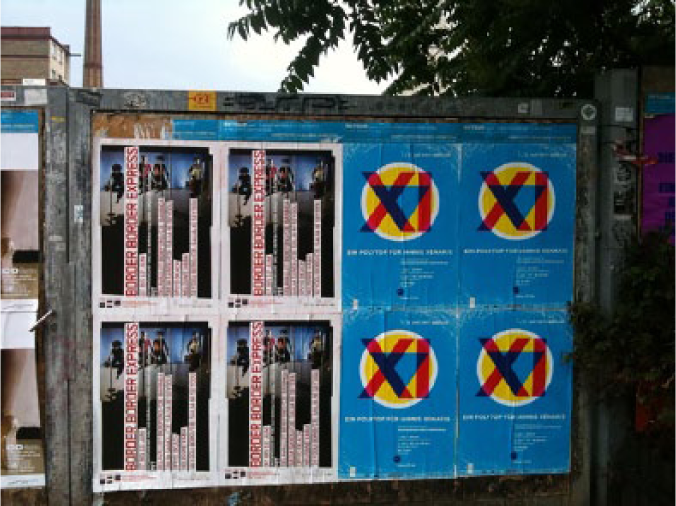
Posters announcing the concert.
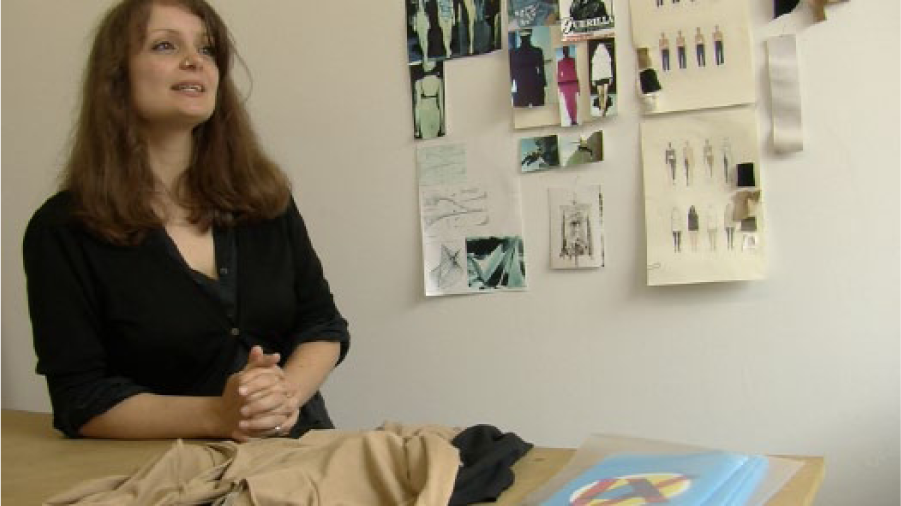
The costume tailor during interview at her studio.
In the concert performance, the ensemble took up the theme of urban warfare by designing the second part of the performance as so-called ‘guerilla concerts’: With Xenakis becoming part of the project it was also about biographical wartime experiences. And we thought that we wanted to make these wartime experiences part of the performance. With musicians that play and are being chased—like partisans … a bit like being in a war zone. (From an interview with the general manager)
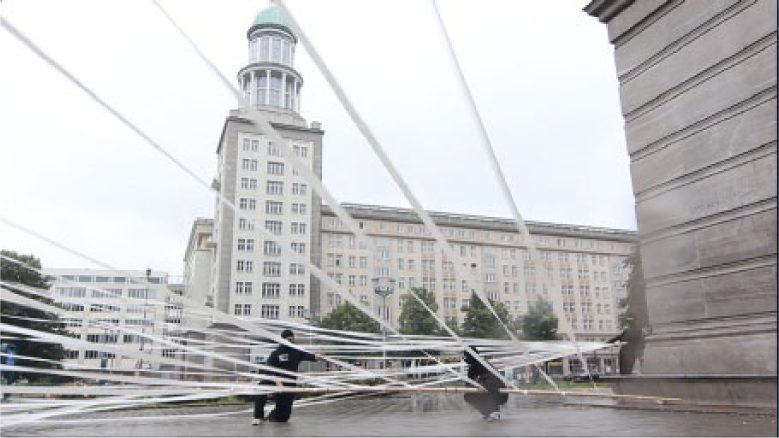
While Xenakis’ wartime experiences inspired the guerilla concerts in the use of Ninja-like costumes, megaphones, parkour runners, and ‘war correspondents’, his architectural ideas were used in the design of a large portable structure, which was made out of bamboo poles and broad rubber bands and which accompanied the ensemble on its journey through the various sites of the guerilla concerts.
Experimenting with sites
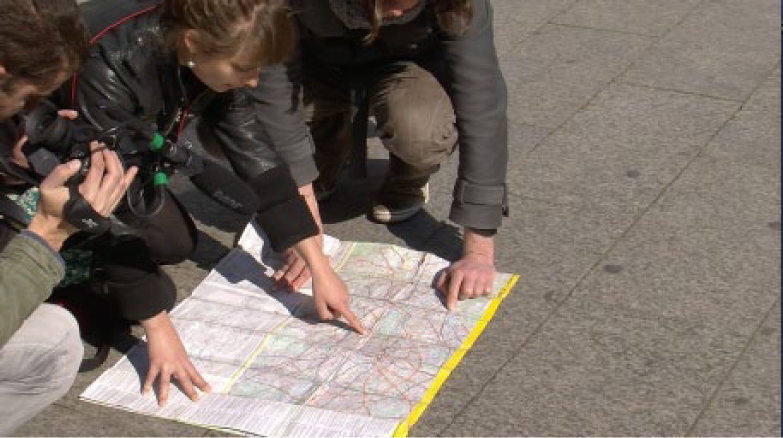
To select the various sites for the guerilla concerts, the stage designer had first experimented with a map of the city which was overlaid with the letters ‘XI’, representing the composer’s initials and 2011, the year of the concert performance. The resulting shape of the course was then developed further by taking into account more practical considerations, such as the public transport infrastructure, and by exploring potential sites on multiple visits. During these visits, the stage designer and her assistant were concerned with the sites’ capacities to stage a guerilla concert, and their potential to inspire an interesting variation of the performance, as well as their fit with the overall trajectory. For example, a huge circular pit that the artists found at Görlitzerpark provided an ideal environment with great acoustics to perform Xenakis’ musical piece Terretektorh. One of the artists explained that this piece ‘is about multiple circles and the sound circulates in space. For that [the pit] would be ideal’.
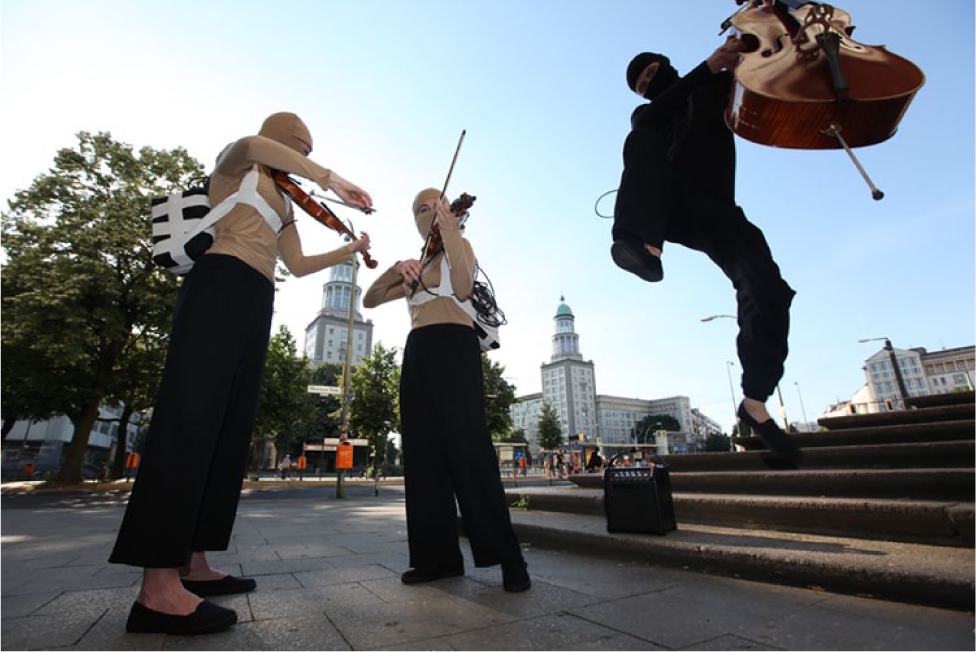
Other sites became interesting because they inspired the artists to develop variations of the guerilla concert. As ‘every site brings a lot of input’, the artists asked themselves, ‘when we come to a place, what can we play with?’ For example, as two monumental towers define the spatial situation at Frankfurter Tor, the artists felt stimulated to develop an idea of performing a dialogue between a solo voice at the top of the tower and the chorus at its base, with the audience alternately looking up and down. These variations were particularly important as they allowed the ensemble to design an ‘arc of suspense’ that accompanied the audience through the overall route.
Apart from the artistic considerations, another influence on the design of the guerilla interventions was the need to stay within the confines of legality. As the ensemble had gained a substantial amount of public funding, it was no longer an option to pursue its initial idea of playing ‘real’—meaning illegal—guerilla concerts in which they would raid private and public spaces and play avant-garde music. The ensemble manager explained, If we make an appearance as organizers, and moreover if we do so with public funding, we have no other choice—if we don’t want to cross the line where we become liable to prosecution—than to work with permits.
The struggle with the city’s regulatory systems was not only a time-consuming process of filling in annoying forms, but the project manager also complained about the Kafkaesque situations she faced in communicating with the various departments. The legal terminology did not resonate with the endeavor of the guerilla performances, as the event could not be classified either as street music (too many musicians) or as a cultural event (too many different places); nor did it feel right to classify it as a political demonstration (no clearly defined political concern). While this manager could obtain permissions for some of the sites, others were taken off the program as they were both highly regulated and tightly controlled. For example, it seemed impossible to get all the necessary permissions in due time to play at the Brandenburg Gate. Playing there without permission seemed equally impossible as the area is under constant police surveillance. Through the process of exploring the various regulatory frameworks, the project team gained expertise and a feeling for where permissions were vital and where the ensemble could possibly play without permission. In that sense, the ensemble’s work became carefully attuned to the regulatory body and the affective capacities it coproduced.
Unfolding of the structure at Frankfurter Tor.
Accompanying the artists on their site visits.
Promotion photograph, taken weeks before the performance, at Frankfurter Tor.
By accident: actualizing an affective atmosphere
Weather permitting
In order to survive outside the safe space of the concert hall, the project team had done substantial work regarding permits, transportation, catering, and—crucially—weather conditions. In setting the date of the concert, they had chosen the day of the year with the lowest likelihood of rain, and they had factored in an alternative date in case of bad weather. Also, they had asked the musicians to bring inexpensive instruments and had organized raincoats to protect all the musicians from rain showers. However, the aesthetic imagination of playing outside had always been associated with the idea of playing on a mild summer evening, with many people out in the city’s streets and squares. Especially since stores and shopping malls had disappeared from the program, the idea depended even more on good weather. If bad weather meant no one would be on the streets, who could the ensemble confront with its music? In little narratives, recurring again and again in our interviews, people always imagined performing on a warm summer day. Bad weather appears only as something that needed to be dealt with, not as a quality that could potentially contribute to composing the concert’s atmosphere.
On the weekend of the concert, the weather was bad. The temperature was very low, and periodic rain showers seemed to dominate the atmosphere. The showers grew more intense during the main performance day and turned into a permanent heavy rain in the evening. The locations of the concerts had to be changed overnight. The stage designer came up with an alternative route, replacing most of the outside locations with stations on the Berlin U-Bahn. For a short moment, even the idea of entering the Alexa shopping mall surfaced again in one interview with the stage designer: And now [in the case of rain] we intend to play in Alexa, in the shopping center. I would prefer that also as regards content. It would be without the objects, because we need to be flexible. But I cannot decide that myself. [The general and project managers] will make this decision, but I think it would be the better version content wise. […] In that sense, the rain can also be a good outcome.
Reflection of tower at Frankfurter Tor, on the day of performance.

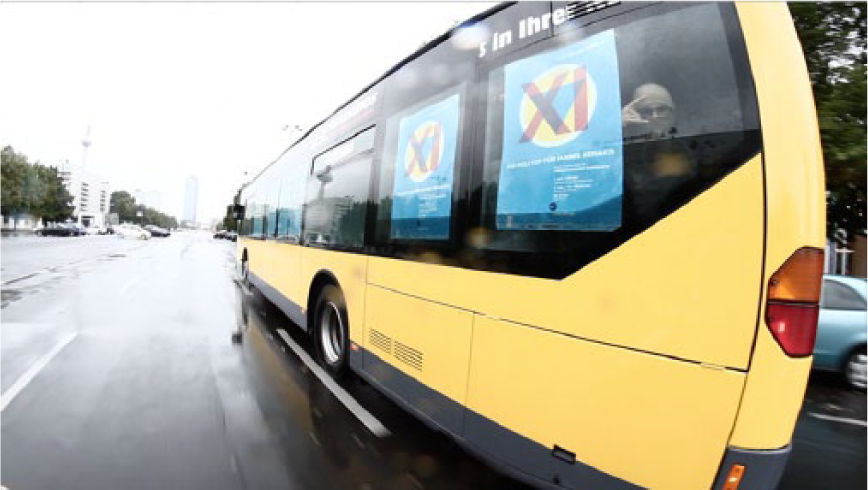
Tour bus with one of the musicians peeking through its window.
Musician with rain cover.
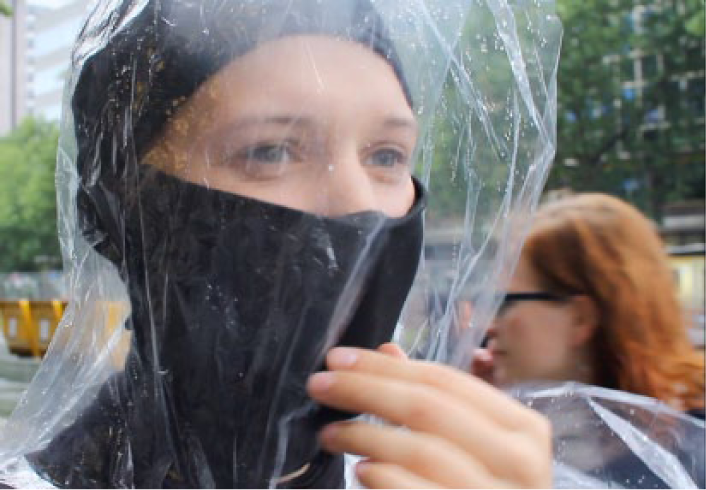
Musicians improvising
As the ensemble lacked permissions to play in any of the U-Bahn stations, the stage designer welcomed the musicians on the morning of the second day with the announcement that the ensemble would now play ‘real guerrilla’. This announcement triggered a surge of laughter and a small buzz among the musicians; an excited yet slightly nervous tension filled the air of the assembly room. What had so far been addressed as a carefully planned and rehearsed street performance suddenly turned into a somewhat risky—and open-ended—event. Would they be stopped by the police? Maybe even arrested? Would there be fines or open conflicts? Their costumes and especially their masks took on a somewhat different feel as the performance had turned into a ‘real guerilla’ concert.
When the tour bus took off, the musicians were clapping and hooting with excitement, bolstering themselves for the coming challenges. The bus was stuffed with people and equipment and brimming with activity. While some of the musicians remained silent in their seats, concentrating on what was to come, others were preparing their costumes or their instruments. The camera team was filming, while the project managers were hastily going through the new, still vague, schedule for the day. Short conversations emerged in agitated tempi, interrupted by frequent laughter. In the buzz of voices, someone made a sipping sound and said, ‘Now I would love to have a beer’. And suddenly, a short hip-hop improvisation—by a staff member describing the ensemble’s current situation—filled the air. The rest of the ensemble joined in by clapping along in rhythm. Smiles appeared on their faces, and the final applause was accompanied by yells of excitement. Outside, endless streams of rain ran down the large windows of the tour bus. While the ensemble was slowly heating up for their intervention, the atmosphere at Wittenbergplatz—the first site of the guerilla concerts—reflected the regular Saturday morning routines of a West Berlin subway hub: At 11:40, the entrance hall of the U-Bahn station Wittenbergplatz was calm, populated only by the occasional coming and going of travelers, some of whom stopped at one of the kiosks for newspapers or coffee. Apart from an occasional squeaking of the heavy wooden doors, the air was filled with a silent humming of voices and the sounds of steps on the stone floor. At 11:45, the ensemble’s fifteen musicians entered the hall, masked in ninja-like costumes, with portable amplifiers strapped to their backs and holding instruments in their hands. Walking in a line they crossed the entire space before putting down their amplifiers. A few seconds later, a disturbing glissando filled the air. As the musicians arrived, pedestrians had immediately formed a circle around them, creating a density in the spacious entrance hall. Most of those who didn’t stop and tried to make their way to the platforms turned their heads and tried to catch a glimpse of what is going on. Smartphones appeared in the hands of the audience while one of the parkour runners slowly climbed the clock tower. (From our field notes and video recordings)
Audiences engaging
One of the bystanders at the guerilla concert, an Italian tourist, described his experience this way: Stunning! Because the sounds come from various points; that makes it difficult to understand what this is about. At the beginning I became curious, then I felt like stopping. I did not only watch the musicians, the interpreters; what fascinated me most was watching the people who were surprised by the performance: the children, the families, the pedestrians, those who passed quickly, those who stopped or those who were annoyed. I was curious to see how all these people were fascinated by the music and tried to make sense of what was going on.
The faces and bodies of the passerby told of wonder, excitement, confusion, and fear. Some members of the audience were outraged about the performance and yelled at the musicians: ‘Shut up!’ and ‘This is not real music!’ Some simply moved on, but others seemed to feel ambiguous, wondering if they should stop. For instance, a young man ‘on his way to change trains’ spoke about how he had ‘accidentally passed by the performance’, how he had wondered about what was going on, ‘first wanting to leave’, ‘but then becoming curious’. ‘Not being able to make sense of what was happening, because the music was very confusing’, he felt that ‘it had to do with the society because society too is very scattered and very contentious’. Others were literally drawn into the performance. A resident of Karl-Marx-Allee said that I sat in my room, the window was open, I heard the music and went downstairs. I am a person who listens once in a while to classical music, but rather neoclassical, scenic music. And that’s why I became interested. Initially I thought that it was one of my favorite bands playing outside. Maybe as a promotion or something like that. That’s why I got interested. I went down and I was completely shocked. When I stepped out the door, everything was crowded with people, who stood right here, with masks and everything … So I thought, ok, what’s going on here … (laughing).
Associating the sound of the music with the rather different music genre of neoclassical, the young man found himself lured into the street and slap-bang in the middle of a situation that felt completely strange. On entering the scene, he said, he was caught by the feeling that he was walking into a revolutionary action of the autonomists (the militant left scene); in a way, this also resonates with the location of the Frankfurter Tor, which is a key landmark on Karl-Marx-Allee. The masked musicians, the dramatically flapping straps of the sculpture, the wind, and the music of Iannis Xenakis let a ‘sense of destruction’ emerge. Immediately after the concert had ended, this destructive atmosphere also evaporated: ‘All of a sudden it was all over and everything fell back into place’.
Similarly, another spectator described the concert as ‘very disturbing in a way, […] it invokes ah … maybe war-like […] sentiments’; he stressed how much the sculpture and the bad weather contributed to the emergence of this atmosphere. However, he experienced this war-like sentiment in relation to the history of the Frankfurter Tor: I love cycling along Karl-Marx-Allee. I think it’s pretty amazing, especially around sunset. […] and actually, now that I think about it, this is the first time I have stopped at the Frankfurter Tor. Normally I just pass by. So … ah … the ensemble made me stop and think about the place (laughing).
He went on: The feeling that the place has is exactly the opposite of the war. So I guess in a way it was the denial of the war, it was the denial of all those things that the music kind of brought back in.
Thus, these participants related to two partially overlapping yet different enactments of the guerilla concert and its atmosphere. One compared the performance to contemporary political/militant struggles over the organization of urban life (and space), and the other made a connection to the history of the location and the invisibility of the political. Each made a connection between the artistic performance, the organization of urban space, and the political. This connection was also affirmed by another bystander. As she described it, You’re walking along the street in your normal life and suddenly you see these figures appearing before you, playing amazing sounds and creating an art work out of an ordinary space, really turning it into an art space. That’s what I loved about it. And the sounds were incredibly amplified so that [you] could really hear and really experience it while you’re surrounded by it. It’s the kind of thing that Xenakis would have loved! I think that is what he wanted to do. Revolutionary music. That’s what I think.
Member of the audience during the performance at U-Bahn station Alexanderplatz.
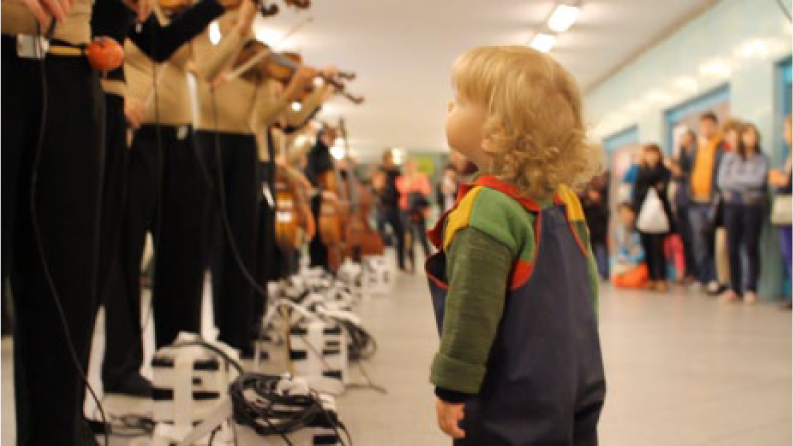
Audience at U-Bahn station Kottbusser Tor.
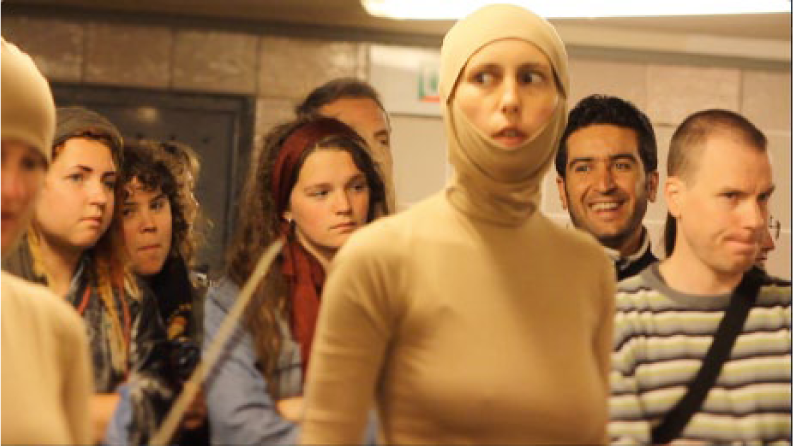
In this woman’s experience, the atmosphere was also linked to the idea of political/artistic revolution, yet this time it was set in relation to the figure of the composer. Others ‘actually enjoyed’ the encounter with the ensemble as it triggered ‘the idea of something new’ and a sense of freedom with respect to traditional forms of music making and the rituals of the concert hall. Another bystander, at the Kottbusser Tor U-Bahn station, said this: It was beautiful! Because, when you visit a concert [hall] you are not even allowed to cough, to make any sound … you have to be completely silent. Once I went with my wife, and I had to cough and could not suppress it any longer. I had to leave and waited outside for the rest of the concert. Here you have the freedom. If you don’t like it, you listen and you leave.
Third part of the concert performance in the deserted field.

Paradoxically, both the surprising recomposition due to the bad weather and the fascinating encounters with the audience were something that the artists had not only anticipated but also fostered through their design approach. With reference to Xenakis’ use of contingencies in composing, the stage designer explained that [w]hat I find interesting about this project, and I think also in general with regard to art in public space, is that the audience is random and that one uses the accidental, meaning that you don’t have to do everything yourself, but that a great deal is done by chance.
An affective atmosphere emerging ...
The Saturday evening dinner never took place. After she got home, the passerby (Was it you?) had done an Internet search for the music event and discovered that several little concerts had taken place across the city. She realized not only that she had missed a concert the night before but also that all this would culminate in a ‘closing part’. This made her even more curious; she felt she should not miss this. She decided to take her dinner guests hostage and to abduct them to the evening performance, via one of Berlin’s Currywurst-Imbisse stands, where they dined quickly, standing up, on curried sausages.
What an upsetting sense of happy chaos this evening provided; what a moving concert it became. Dark gray clouds had trooped together over Berlin, bringing gushing rain over the concert field. Groups of people stood crammed together under umbrellas, spread almost randomly across the pitch, which became more and more muddy. One of those soaked groups, those friends out for a quick supper, warmed up to each other and to the event. The music literally passed by in little fragments of intensity, as cars with open windows crossed the field: The concert literally moved (them). But even more, the music was entangled with the damp climate, the dark clouds, the reflecting umbrellas, the fluorescent rain clothes, the yellow car lights, and a shrieking wind, which together enveloped audience, artists, and automobilists alike into a sense of absurd turmoil—and of frenzied aliveness. On their way out of the concert site, the group of friends saw someone filming, and, as they listened in, learned this was the production assistant: The mood? Hmm, I thought it was great. I had imagined it to be very different, because I had these associations of nice weather and picnic blankets and many people and everything to be very relaxed and a comfortable evening. But now it turned into something very special, especially to see the rain through the cars’ headlights. I found it very poetic somehow, even though I am also looking forward now to my bathtub.
Yes, the passerby agreed that she would very much welcome a soak in a hot bath. But she also remembered the promise she had made to herself while immersed in the event: if classical music concerts can be so different, her Saturdays would never be the same again. And for once, her friends agreed.
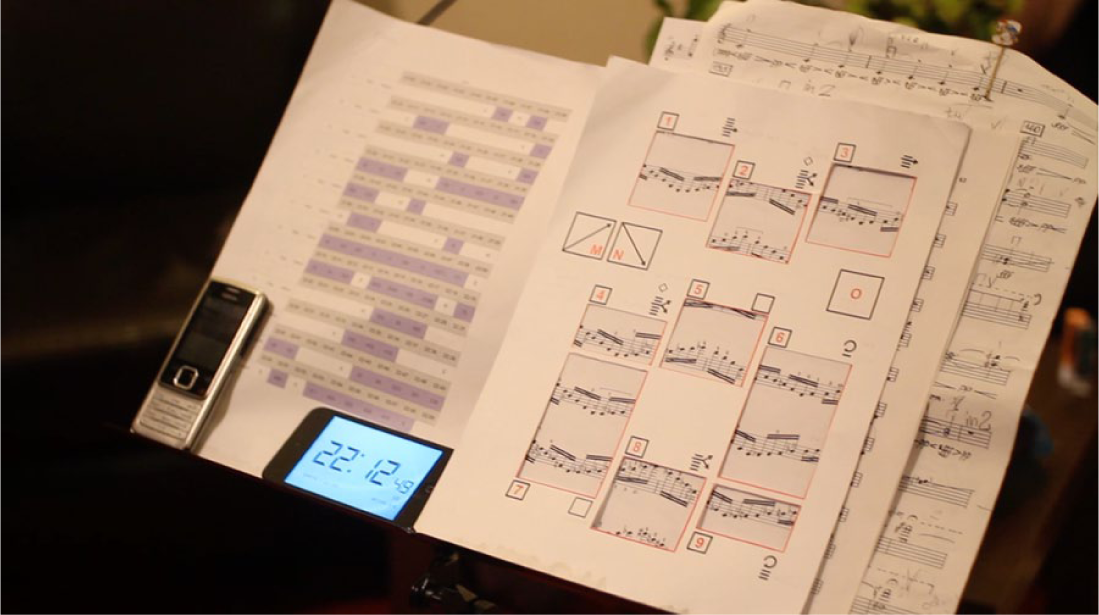
Transmission of music via cell phone from the Ristorante Tipico Italiano in Grunewald.
Discussion
In the empirical analysis, we retraced how an affective atmosphere emerged, brought on by an urban art intervention. The analysis provided us with the central idea that affective atmospheres emerge both from anticipative aesthetic work and spatial formation and from the engagement with accidental encounters. In this interplay, something happens, or as Kathleen Stewart (2007) writes, ‘[s]omething throws itself together in a moment as an event and a sensation; a something both animated and inhabitable’ (p. 1). It almost seems that Stewart was thinking of the very passerby and other participants in the performance event we described in the short coda at the end of the analysis: in the blink of an eye, affect has reached out to the spectators, stopped them in the midst of some busyness, some routine, and enveloped them. Meanwhile, others moved on hastily. It is these ‘[o]rdinary affects [that] are the varied, surging capacities to affect and to be affected that give everyday life the quality of a continual motion of relations, scenes, contingencies, and emergencies’ (pp. 1–2).
In the first part of the analysis, we traced how the (moment of the) event occurred as part of a longer crafting process which we documented through the aesthetic work and spatial formation that prepared for the concert performance. But we must see the composition and emergence of an affective atmosphere in connection to the way the concert project was enacted in a series of encounters between various bodies and their specific affective capacities: the ensemble with its specific history of experimental music making and its various attempts to bring classical music outside the usual concert hall, an exhibition on Xenakis’ Polytopes and the life history and artistic oeuvre of Xenakis, project partners such as funders and the stage design team and technical crew, and the very streets and squares of Berlin. While some encounters were unplanned (such as the director’s visit to the Xenakis exhibition), others were the product of a more systematic testing of affective capacities in the process of aesthetic work (the making of the costumes and the wooden sculpture, and the music rehearsals) and spatial search (such as the systematic exploration of Berlin’s urban sites). Still, others were produced by methods that created accidental encounters between the concert’s components (such as overlaying the city map with Xenakis’ initials) or that used Xenakis’ approach to music making (especially his interest in contingencies and the multiple rhythms of urban life) as a conceptual reference point for working artistically with the unforeseeable.
In the second part, our analysis zoomed in on aleatory and accidental elements that disturbed, modulated, and actualized the composition process. Actually, as we argued, the design process was intended to anticipate the accidental in several ways: it allowed the participants to not know what would emerge in the actual performance, it made space for the audience to participate creatively, and it opened up the possibility of accidental encounters as it mingled with the rhythms of urban life under the open skies. But these openings for the accidental also allowed more to happen than anyone anticipated. For instance, the weather circumstances gave everyone, especially the organizers, a sense of apocalypse: would months and months of work literally drown? These (un)foreseen components could enter the composition process and fundamentally affect its unfolding. Every body (including the weather itself) that is drawn into an affective atmosphere comes with specific capabilities to affect and be affected, and thus has the potential to intervene in and fundamentally transform the atmosphere. While all these elements form atmospheric conditions, the emergence of this ‘something’—of an affect enveloping at some point—remains unstable and unpredictable as ‘affect comes to name the aleatory dynamics of how encounters exceed the forces and processes that mediate them’ (Anderson, 2014: 82). Therefore, the enactment of the concert emerged not in a linear and additive way but rather as an unstable field of ‘potentialities’ from which possible atmospheres started to emerge (Anderson, 2014: 15) and were conjured up into an indeterminate affective excess.
As a consequence, this article contributes to the current literature on the unfolding of affect through unsiting (Beyes and Steyaert, 2013), de-territorializing (Hjorth and Pelzer, 2007; O’Doherty, 2008), and other forms of intervening in organizational space. Opening up for the duality of affect (Anderson, 2014; Wetherell, 2013), we provided an understanding of how affective atmospheres are crafted as moments of potentiality and promise, without capturing and neutralizing the event before it has happened. In particular, we documented how the concert’s design—so meticulously and systematically prepared and crafted—left multiple openings for different atmospheres to emerge during its performance. For instance, once the performers moved their music out of the safe space of the concert hall into the city streets, the audience could no longer fall back on the usual scripts of a classical concert and had to become creative participants in actualizing the affective atmosphere. Therefore, the audience itself became an element of chance, making the crafting of affective atmospheres unpredictable. This became clear as we zoomed in on the audience’s responses, which ranged widely from ignoring the event or condemning this kind of music to being quiet (silently), overwhelmed, or (loudly) enthused; to interpreting it in its historical and political significance. And so, now and then, we encountered someone who was familiar with Xenakis and could spell out the musical-aesthetic meaning of what just happened. And then, there were those few, like the passerby, who promised that their life (on Saturday) would change a little. This range of open and capricious responses documents why Thanem and Wallenberg (2015: 242), in their affective ethics of organizing, remind us that ‘because it is impossible to know up front which encounters will generate joy, one cannot plan for joyful encounters and harmonious alliances. Instead, one must experiment […] with a variety of bodies and encounters’. Even if its members embraced artistic experiment and bold risk, even if they fully wanted to stand up for the consequences of the critiques they addressed to the cultural milieu and to the consumer society, what brought the process of composing the affective atmosphere full circle was the ‘accident’ of the weather. The moment when they entered the underground without permission, that moment provided not only ‘real guerrilla’ but also, above all, that something that Stewart (2007) refers to as a politics of affect (and affective atmosphere): This is the ordinary affect in the textured, roughened surface of the everyday. It permeates politics of all kinds with the demand that some kind of intimate public of onlookers recognize something in a space of shared impact. If only for a minute. (p. 39)
Thus, our analysis has articulated the core insight for understanding how interventions in organizational space depend upon the ephemeral and excessive sides of affect: it is problematic if any artist, designer, or architect intentionally crafts atmospheres in ways that do not leave open possibilities for the experimental and the accidental. This inference is similar to the situation that Hjorth and Pelzer (2007) described, and we detailed earlier: an artistic event to promote a new car failed as it was reterritorialized as a marketing event. As the event was ‘overcoded’ with regard to its managerial objectives, affect could not play its role as a de-territorializing force (Hjorth and Pelzer, 2007) that would allow for the unpredictable. In contrast, the Xenakis celebration triggered (and welcomed) an entire set of unexpected and transformative affects in the unfolding of everyday urban life. Beyes and Steyaert (2013) have referred to these ‘strange doublings that we experience when the familiar is defamiliarized and unsettled’ as the ‘unsiting’ of everyday urban spaces (p. 1446). The unsiting of organizational processes and the affective life it may set in motion go hand in hand with the emergence of affective atmospheres which feed on the unfamiliar capacities of the participating bodies.
In a similar way, O’Doherty (2008) analyzed an ‘anti-architectural’ installation in the form of a cloud hanging above a lake during the Swiss Expo 2002; he argued that potentiality emerges ‘when the affective capacities of the human sensorium are opened up, extended, stimulated and intensified’ (p. 555). What O’Doherty calls ‘the blur sensation’ can then be interpreted in our view as the emergence of an affective atmosphere that ‘invites a kind of de-subjectivization at the same time that it intensifies the senses’ (p. 553). Therefore, it can be said that atmospheres form the horizon of potentiality through which affective excess can become felt in the being together of heterogeneous bodies. Comparing the contrasting studies of Hjorth and Pelzer (2007) and O’Doherty (2008), our case analysis helps to explain how, in these (rare) moments of intensification and shared impact, affective atmospheres appear as irreducible to their parts, and thus cannot be ‘decomposed’ (Anderson, 2014; Böhme, 2006) as they conjure up affective excess. In that sense, atmospheres form the potentiality of space, as Löw (2008) has argued, since ‘spaces develop their own potentiality which can influence feelings’ (p. 44).
Conclusion
According to Anderson (2014), efforts to understand affect create an imminent organizational problem which urges us to ask how affective life is organized. In this article, we have suggested that the notion of an affective atmosphere deserves more attention because it offers an entry into a key question: how affective qualities can condition and modulate life by giving a particular cosubjective feel to sites, episodes, or encounters (Anderson, 2014). Through the case study of an atmospheric intervention, we have shown how the study of affects as atmospheres points at a spatial ontology of ‘being-together-in-a-sphere’ (Beyes and Steyaert, 2011; Sloterdijk, 2004, 2009). Organizations are one type of such spherical spaces, enacted through ongoing social formations of being together and joint interdependence. Therefore, we should emphasize that atmosphere and atmosphere making are not limited to artistic settings but exist in all aspects of everyday life (Reckwitz, 2012). In particular, atmosphere is an integral part of all organizational contexts, sites, and moments where affect is ‘at work’ (Kenny and Fotaki, 2014) through atmospheres: boardroom meetings, corridor conversations, recruitment interviews, New Year’s parties, strikes, financial reports, lunch breaks, strategy retreats, and—why not—corporate bathrooms (Borch, 2011). Passing through an organization means passing through its atmospheres, which are ‘like floating in the sea through warmer and colder layers of water, moving through regions of affect, which enlist us for a time, physically take over our bodies and then release us’ (Wetherell, 2012: 145). Thus, a study of organizational affect through affective atmospheres is a study of the ‘air conditions’ (Sloterdijk, 2009; see Beyes, 2014) that permeate communal affective organizational life with its (changing) intensities, resonances, and durations. Affective atmospheres form the excess of affect that envelops bodies and keeps them together until the moment of encounter fades out.
We do not want to overestimate the impact of one empirical study, but we would like to point out some possible directions in the study of organizational affect that derive from our understanding of affective atmospheres. First, our study exemplifies what Wetherell (2012) has called the advantage of affect as ‘it brings the dramatic and the everyday back into social analysis’ (p. 2). The atmospheric intervention is, on one hand, a dramatic performance that comes with extensive artistic and dramaturgical considerations. On the other hand, it swaps the concert hall for the street and metro stop, and tries to connect to the feeling of everyday urban life. As a consequence, the notion of affective atmosphere brings to the study of organizational affect this ambivalence between the spectacular and the everyday, between the excessive and the ordinary, between the uncanny and the familiar (Beyes and Steyaert, 2013), and between volatility and stability (Iedema et al., 2006). Rather than study these dualities in a separated and static way, the challenge is to research and theorize affect and affective atmospheres in a way that oscillates and connects. In this sense, Seigworth and Gregg (2010) suggest that empirically affect can be approached ‘as an aesthetic or art of dosages: experiment and experience. Feel the angles and rhythms at the interface of bodies and worlds’ (p. 16; emphasis added). As our study of an atmospheric intervention has shown, only if one experiments can one feel the alternations, the spillovers, and the excesses that come with the formation of an affective atmosphere as an ‘inventory of shimmers’ (Seigworth and Gregg, 2010). The notion of affective atmosphere thus provides a conceptual answer to the question of how to understand the communality of organization as a space of resonance (Borch, 2008), a form of ‘holding together’ (Anderson, 2014), and feeling attached (Kenny, 2012).
Second, any study of affective atmospheres comes with its own methodological challenges (Kenny, 2012; Knudsen and Stage, 2015). As much as the artists, musicians, and audience were invited to enter into the middle of a ceaselessly recomposing affective experience, we, as researchers, were equally ‘called’ into the middle, to follow an ‘analytics of experimentation’ (Blackman, 2015). Thus, tracing the composition of an affective atmosphere requires that research approaches open up to the register of affectual composition, as an ontology of always coming to formation, but also more prosaically as a creative and writerly task (Seighworth and Gregg, 2010: 11). This study presents an example of how ficto-critical writing and the use of video stills can contribute to the crafting of research accounts that are both sensitive to the subtle movements of affective encounters and evocative for a reading audience. Hence, we believe that future studies of affect and affective atmospheres require further intensive experimentation; we already see this happening in the increasing expansion and exploration of affective (Knudsen and Stage, 2015), atmospheric (Anderson and Ash, 2015), inventive (Lury and Wakeford, 2012), non-representational (Vannini, 2015), and Deleuzian-inspired (Coleman and Ringrose, 2013) methodologies.
Third, the study of affective atmospheres brings with it the question of how this can influence a new politics of organizational affect. Even if a propitious moment can show how life has the potential to become something else, ‘shifts in affective atmosphere are not equal to changing the world’ (Berlant, 2010: 116). The issue is, therefore, what other politics of affect one can expect in organizations. Our study brings forward several core questions: how are situated affective encounters drawn into large-scale events, and how do waves of public feeling impact one’s day-to-day affective capability? How is one’s personal trajectory impregnated by engagement with various affective atmospheres in the course of one’s life? And what sort of residue do the experiences of one day leave in one’s emotional life experience? Indeed, the politics of affect can imply new possibilities of feeling and acting collectively in organizations, and attending to these makes studying affects generative and meaningful. Future research should document how affects can be unlocked in the planning and designing of organizational space by understanding how atmospheric interventions can prevent organizational space from becoming dominated (Thanem and Wallenberg, 2015), (re)colonized (Ashley, 2016), or, simply, forgotten and lost (Petani and Mengis, 2016).
In conclusion, we have argued that perhaps affective atmospheres can be crafted intentionally, but ‘life exceeds the intentions of those who aim to act on it’ (Anderson, 2014: 91). Anyone who composes affective atmospheres must accept that at any moment they can turn in another direction, in the same way that a change in the weather drowns one’s hope of a cozy concert into a moment of existential fear that all this work has been for nothing. But when we understand that affects allow other ways of living and being to be disclosed in organizations, the politics of affect establishes affirmative possibilities and generativity. Therefore, the organizational study of affect through affective atmospheres gives us a chance to ask pertinent questions such as ‘What conditions the air that envelopes us when we go to work?’ and ‘What atmospheres in our organizational lives make us shiver or cry tears of laughter or sadness?’ In our view, these are the burning questions for the future study of organization as organizational atmosphere because they allow us to begin to ask, with Spinoza and Deleuze (1988), what other affects we can hope for in organizational life.
Footnotes
Acknowledgements
We would like to thank the reviewers at Organization, the special issue editors, and our colleagues Patrizia Hoyer and Chrysavgi Sklaveniti for their valuable comments. Special thanks go to the Solistenensemble Kaleidoskop and its partners for their generous access and support, and to Stephan Talneau for sharing parts of his exquisite film (see  ) from which we generated most of the stills we present here. Further thanks go to Laurent Marti and Manuela Ruggeri who substantially contributed to generating the empirical material for this study. Finally, Helen Snively did a tremendous job as a language editor: Thank you very much!
Funding
The author(s) disclosed receipt of the following financial support for the research, authorship, and/or publication of this article: This study was supported by Swiss National Science Foundation (SNSF) under grant number CR11I1_130673.