




Abstract
This article explores the role of remembering and history in the process of planning new spaces. We trace how the organizational remembering of past spaces enters the conception (i.e. planning) of a large culture center. By drawing on Henri Lefebvre’s reflections on history, time and memory, we analyze the processual interconnections of his spatial triad, namely between the planned, practiced, and lived moments of the production of space. We find that over time space planning involves recurrent, changing, and contested narratives on ‘lost spaces’, remembering happy spaces of the past that articulate a desire to regain them. The notion of lost space adds to our understanding of how space planning involves, through organizational remembering, a sociomaterial and spatiotemporal work of relating together different spaces and times in non-linear narratives of repetition.
Dans cette vie qui nous apparaît quelquefois comme un grand terrain vague sans poteau indicateur, au milieu de toutes les lignes de fuite et les horizons perdus, on aimerait trouver des points de repère, dresser une sorte de cadastre pour n’avoir plus l’impression de naviguer au hasard.
Introduction
This article develops a processual approach to Lefebvre’s spatial framework, as advocated in organizational literature (compare Beyes and Steyaert, 2012; Dobers and Strannegård, 2004; Taylor and Spicer, 2007), by integrating Lefebvre’s (1970, 1975, 2004 [1992]) understandings of history, temporality, and memory within his framework on the production of space (Lefebvre, 1991 [1974]). We address the specific call for investigating the history of how space is conceived (Mitev and De Vaujany, 2013: 327), produced, and reproduced in the long term (De Vaujany and Vaast, 2013) by exploring how historic spaces of the past enter the process of space planning through remembering (Decker, 2014). From the qualitative analysis of our empirical study on the planning practices of a large culture center in a small Swiss city, we introduce the notion of ‘lost space’ to indicate a remembered space that connects a happy space of the past with the experience of its loss that narratively articulates the desire to regain, repeat, or compensate for it.
The concept is coined in reference to Proust’s (1919) ‘lost time’, which influenced Lefebvre’s understanding of time ‘with the issues of loss and memory, recollection and repetition’ (Elden, 2004a [1992]: x). In search of the history of a space, Massey (1995, 2005) argues that homogenous temporal linearity poses problems not only because many spatially displaced relations simultaneously produce a given place but also because rival interpretations of a place’s authentic pasts result in claims and counter-claims about its present. Aware of this insight, we argue it is important to understand the multiple spatiotemporal relationships between remembering and space at the phase of conceiving (i.e. planning), especially since organizational analyses of space in general, and adopting Lefebvre more in particular, have tended to privilege analyses of how already-constructed spaces are transformed by organizational practices of end users, rather than address the long-term organizational phenomenon of space planning.
We draw on Lefebvre’s (1970, 1975, 1989 [1959], 2002 [1961], 2003, 2004 [1992], 2014) critical reflections on temporality, history, and memory to explore the productive imagination of the past through remembering. By tracing how the history of spaces gets remembered in planning a great urban project, we develop a more processual approach to Lefebvre’s spatial framework (1991 [1974]). Consequently, we ask the following: What is the organizational role of remembering and history in the planning of space? How can a focus on remembering help us to develop a more processual understanding of the interplay between the moments of Lefebvre’s spatial framework?
After presenting Lefebvre’s (1991 [1974]) spatial triad, we review and discuss the organizational literature that has engaged with it. We then show how Lefebvre (1970, 1975, 2004 [1992]) argued for the centrality of a processual understanding of space, which we illustrate introducing some of his reflections on temporality, history, and memory.
Finally, we present an analysis of how the organizational remembering of space enters the process of conceiving space by drawing on a focused ethnography of the planning and construction process of a culture center in a small Swiss city. We show how the sociomaterial incorporation of remembered space is a key organizational aspect of how space is conceived and produced over time.
Lefebvre’s spatial triad and its translation in organization studies
In his influential book The Production of Space, Lefebvre (1991 [1974]) proposed a spatial triad, which originated from his critique of Descartes’ notions of res extensa, material space, and res cogitans, an abstract geometric representation of space allowing its quantitative measurement. According to Lefebvre, such dichotomy did not capture the experience of space in everyday life and the temporal, symbolically rich (and politically charged) process of its becoming. Lefebvre thus introduced the moment of lived space (Zhang, 2006), presenting a trialectic spatial framework consisting of perceived, conceived, and lived space, which we summarize below (for extended discussions, see Elden, 2004b; Schmid, 2008; Stanek, 2011; Zieleniec, 2007).
Perceived space accounts for the physical, concrete space, a real space used by all in the environment and explained by Lefebvre (1991 [1974]) as spatial practice (p. 38). Examples are the road traveled to go to work or the office workspace that we transform through daily routines. Through these everyday spatial practices, we materially negotiate various organizational and personal spaces.
Conceived space, on the other hand, indicates the way space is planned in abstract conceptualizations, an organizational prerogative of technocrats and urban planners, an instrumental space imagined through technical representations of space (e.g. maps, plans). For Lefebvre (1991 [1974]), this is ‘the dominant space in any society’ (p. 39), so a powerful form of political control.
Lived space, which Lefebvre (1991 [1974]) also calls representational space, is ‘the dominated space which the imagination seeks to change and appropriate’ (p. 39). It is how we imagine the spaces we use, what such spaces mean to us. As a temporal and process-friendly reading puts it, lived space is ‘space as produced and modified over time and through its use, spaces invested with symbolism and meaning […] space as real-and-imagined’ (Elden, 2004b: 190; see also Soja, 1996).
In their attempts to better understand how organizational spaces are conceptualized and struggled for, organization scholars have drawn heavily on Lefebvre’s spatial triad, in particular to address the interrelation of power, identity, and materiality (Beyes and Steyaert, 2012, 2013; Burrell and Dale, 2003; Dale, 2005; Dale and Burrell, 2008; De Vaujany and Vaast, 2013; Dobers and Strannegård, 2004; Ford and Harding, 2004, 2008; Hancock and Spicer, 2011; Hernes, 2004; Kingma, 2008; Spicer, 2009; Spicer and Taylor, 2006; Taylor and Spicer, 2007; Wapshott and Mallett, 2012; Wasserman and Frenkel, 2011; Watkins, 2005; Yeung, 1998; Zhang et al., 2008; Zhang and Spicer, 2014). For example, studies have shown how the materiality of space influences the construction of selves through forms of organizational oppression and control (Ford and Harding, 2008), analyzing both the power of aesthetically enchanting architectures (Hancock and Spicer, 2011), and the aesthetic strategies of workers to resist space-driven identity regulation (Wasserman and Frenkel, 2011).
When investigating the interplay between conceived, lived, and practiced spaces, organizational research has studied corporate life struggles arising from a tension between the way space has been conceived and physically built and how it is appropriated or lived by users (Spicer, 2009; Spicer and Taylor, 2006; Wasserman and Frenkel, 2011; Zhang and Spicer, 2014). In doing so, organizational scholars have mainly focused on the productive adaptation of organizational processes within already physically built spatial products (i.e. corporate buildings), exploring the tensions arising in constructed spaces conceived by non-users and later transformed by the different organizational practices of users.
We know little, however, about the specific organizational practice of planning space per se and how the three moments of Lefebvre’s triad play out in the process of conceiving space.
In other words, rather than taking conceived space as the produced abstract representations of spaces (e.g. in architectonical maps), few organizational studies have inquired on what goes into the production of conceived spaces, that is through what organizational processes (e.g. justifying in public official documents specific configurations of conceived spaces and not others) we plan and conceive space. In this process of conceiving space, a time-sensitivity seems particularly important to understand ‘the spatiotemporal implications of the past in the present’ (Beyes and Steyaert, 2013: 1449). Although some studies have turned to the organizational history of construction projects as their empirical objects (Decker, 2014; De Vaujany and Vaast, 2013; Gastelaars, 2010; Kornberger and Clegg, 2011; Lancione and Clegg, 2013), few studies adopt a long-term spatio-historical approach and an explicit sensitivity for time drawing on Lefebvre. One such exception is the work by De Vaujany and Vaast (2013), which presents a long-term perspective on how spatial practices (perceived space) change and how the symbolic history of space is used over time. Such a history-sensitive approach still needs to be extended also to the process of conceiving space (as called for by Mitev and De Vaujany, 2013) and, in particular, to how space is remembered (Decker, 2014).
In our view, the lack of historical perspective is due to a misunderstanding of Lefebvre’s work as a reorienting ‘away from time […] toward a focus on space’ (Dear, 1997: 49). Organization scholars have criticized such essentialist adoptions of the spatial triad that risk ‘to turn spatial becoming into representations of the beings of organizational spaces, to prioritize the spatial products over the processes of their productions’ (Beyes and Steyaert, 2012: 49, emphasis added).
A processual approach may help to appreciate the temporal definition of Lefebvre’s (1991 [1974]) spatial triad as three interconnected moments of social space (p. 40) and to integrate some of Lefebvre’s (1970, 1975) key works on history and everyday life rhythms (Lefebvre, 2004 [1992]). In the latter, he suggests a methodology in which the researcher, ‘without omitting the spatial and places, of course, makes himself more sensitive to times than to spaces’ (Lefebvre, 2004 [1992]: 22). Lefebvre’s (1991 [1974]) temporal sensitivity in the theorizing of space explicitly states an interest in ‘the historical and its consequences, the “diachronic”, the “etymology” of locations in the sense of what happened at a particular spot or place and thereby changed it’ (p. 37). All these temporal phenomena become inscribed in a space where ‘production process and product present themselves as two inseparable aspects’ (p. 37). Time and space themselves, albeit distinguishable, are not separable from each other (p. 175). Through this shift from ‘things in space to the actual production of space’ (p. 37), Lefebvre’s work becomes interesting for process scholars.
In what follows, we introduce some of Lefebvre’s insights on time, history, and memory to show how a processual adoption of his spatial triad can be better developed.
The temporality of space in Lefebvre: the role of remembering
Lefebvre (1970, 1975, 1989 [1959], 2002 [1961], 2004 [1992], 2014) developed critical understandings of history and time in some of his key writings, which can help us to explore the role of remembering in the conception of space.
Already in the presentation of his spatial triad, Lefebvre (1991 [1974]) theorized perceived, lived, and conceived spaces as dialectical, interconnected, and often contradictory ‘moments’. Not only does he thus define space temporally, he also charges a moment politically by defining it as ‘the attempt to achieve the total realization of a possibility’ (Lefebvre, 2002 [1961]: 348, emphasis in original). The possible is in turn conceptualized as important to understand temporal becoming and history: The past becomes the present (or is renewed) as a function of the realization of the possibilities objectively implied in this past. It is revealed with them. The introduction of the Possible into historical methodology permits us to conceive the objectivity—while yielding its due to the relativity, novelty and inexhaustibility—of history. (Lefebvre, 1975: 34, emphasis in original)
In this light, the production of space starts to appear as a contested historical process of interaction between sociomaterial possibilities.
The possible is, in fact, bound to what is materially or objectively affordable (bringing with it a certain consequentiality between past, present, and future), but also contains an openness given the subjective stratification of past moments. The unfolding present has a history of incremental lived experience. Everyday sociomaterial practices are marked by ‘momentous events’ that pave the objective path of what is made possible. But these turning points do not set, as new moments alter the subjective narratives of the increasing (and mutable) past. A particular space is thus produced by the interplay between decisive moments that materialize the objective possibilities implied in a space’s past (Lefebvre, 2003, 1970: 178), and the more subjective, social products, like the collective imaginations and historical interpretations related to these revealing moments. In this way, production includes not only the material making of products and things, but also a ‘“spiritual” production, that is to say creations (including social time and space)’ (Lefebvre, 1971: 30–31).
Despite the material consequences of decisive moments, Lefebvre is far from proposing a linear, deterministic notion of temporality or history. On the contrary, ‘each time one of these possibilities is realized, it retroactively sheds a new light on the initial event’ (Lefebvre, 1975: 34) and it is here that memory becomes of importance. For Lefebvre (2004 [1992]), memory is required to grasp this present otherwise than in an instantaneous moment, to restore it in its moments … The recollection of other moments […] is indispensable, not as a simple point of reference, but in order not to isolate this present and in order to live it in all its diversity, made up of […] subjective states, objective figures. (p. 37, emphasis in original)
Remembering is thus a practice that allows us to live our time and to understand moments beyond their instantaneous occurrence; ‘the “moment” thus conceived of has its memory and specific time’ (Lefebvre, 2003: 174).
The presence of other moments through the practice of remembering creates a ‘lived time’, a multifaceted reality that goes beyond notions of linearity, irreversibility, and unity. It echoes with Proust’s view of time that Lefebvre appreciated as more polyvalent and more contradictory than abstract philosophical notions, as it allowed for memory and art (Elden, 2004b: 175). The remembering of moments is an interesting temporal repetition, a representation that ‘involves the return and reintegration at a high level—individual and social—of elements of the past and of the surpassed’ (Lefebvre, 2003: 174). It is this non-linear embedding of a moment in a temporally multiple-lived time that allows for imagination and non-determinacy in the production of space.
In summary, Lefebvre’s socio-historical view of space is important to understand a production—and especially a conception—of space that involves what Dale (2005) calls a ‘social materiality’, accounting for, but irreducible to object or objectivity, as it is ‘imbued with culture, language, imagination, memory’ (p. 652, emphasis added). The production of space therefore involves the dialectical interaction of multiple, often contradicting moments of space, in which the realization of specific sociomaterial possibilities is attempted with the temporal contribution of memory. In fact, a moment with its specific affordances, does not stand by itself, but becomes related—through practices of remembering and the emergence of new present events—to other moments. With a more temporal orientation to Lefebvre’s framework of space, we now inquire into how the various moments of space play out in practices of remembering related to the process of conceiving a cultural center.
Research context and method
This study draws on a single longitudinal case, investigating through ethnographic methods the planning and construction of a public cultural center of considerable financial import (over 230 million Swiss Francs (CHF)) in a small Swiss city of 60,000 people (140,000 in the extended urban area). The Council decision to build the center dates back to 2000, while construction started in 2009 and terminated in 2015. The cultural center represents the highest public investment in the history of the city, which is the major investor with over 200 million CHF. The Canton (region) participated with 5.5 million CHF. Initially, the center was planned to be situated in a 19th century former hotel, which was preserved from demolition in 2000 by popular referendum, but which later (2004) was sold by the city for 20 million CHF to private real estate developers, who restored the building to create luxury lakefront apartments. The culture center was placed next door, on a portion of the same lakefront area, and is designed to include multiple facilities: a museum, a theater-concert hall, a rehearsal room, a bookshop, a café, administrative offices, a conference area, and an underground car park (one floor of which was sold to the private developers for around 10 million CHF). Public spaces attached and related to the urban transformation include an invaluable 16th century Romanesque style church with its former convent and cloister, a major new square, and a backyard hill destined to become a public park.
Data collection
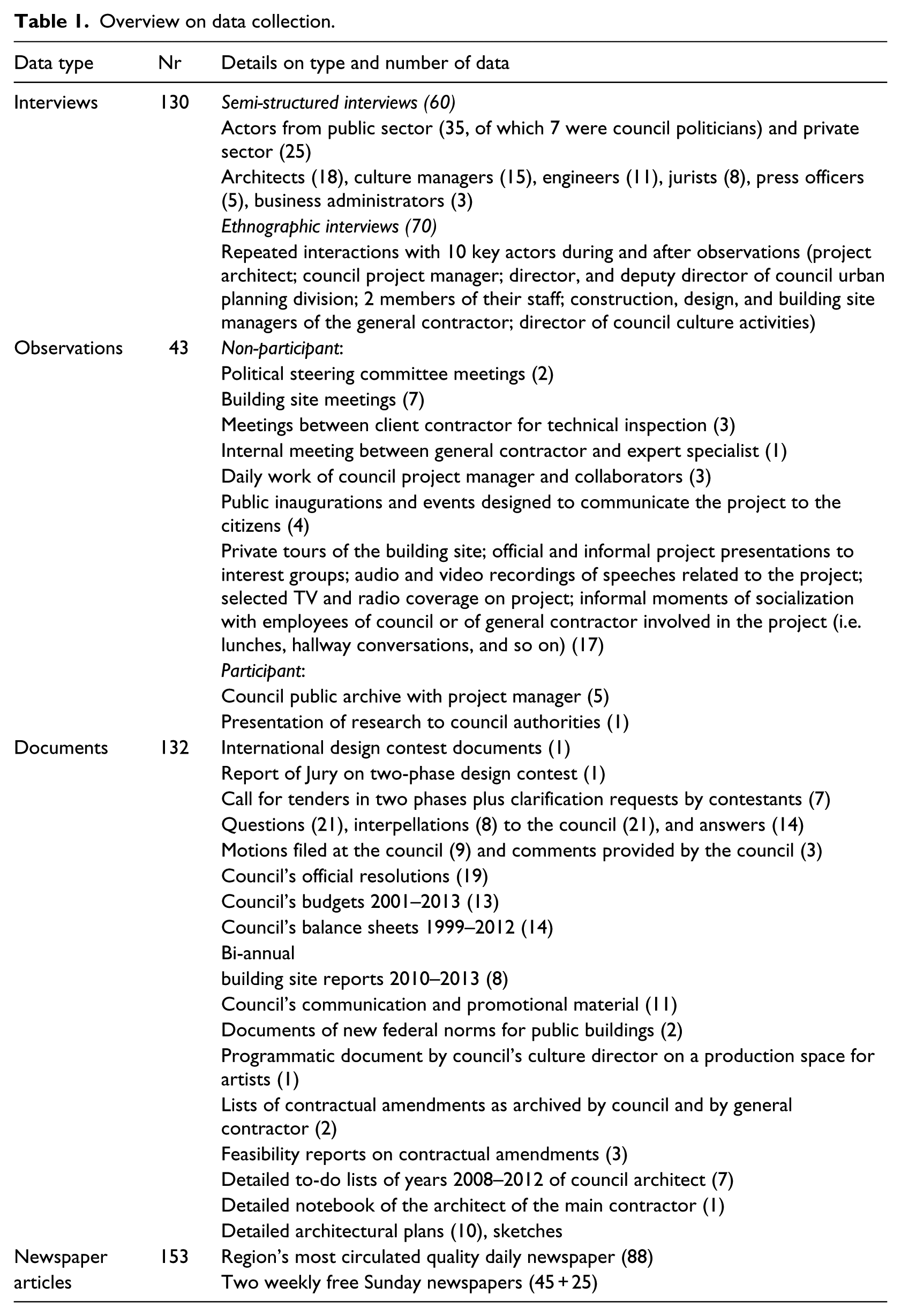
Fieldwork was conducted between November 2011 and May 2014, with both authors actively involved in data collection. Our process sensitivity invited us to build on rich longitudinal data relying on archival sources, interviews, and field observations. Fieldwork started with an explorative media analysis of 153 newspaper articles published on the project between 2000 and 2012, allowing us to get a first sense of the strongly felt issues and related historical events (e.g. the public debate and referendum to maintain the façade of the former hotel), and of the project’s key actors to be interviewed. The interviews further specified the events of the project’s history and pointed to the organizational documents of the planning activities.
Overall, we collected over 130 public and private documents (ranging from the official urban planning and funding decisions in 2000 and 2004 to key, confidential and public documents of the construction phase), conducted 60 semi-structured interviews (all audio-recorded and verbatim transcribed) with the major stakeholders involved in the project and 70 ethnographic interviews (conducted throughout data collection, with repeated interviews with key informants), and engaged in both participant and non-participant observation for a total of 43 days, distributed over the entire fieldwork time. After a difficult access to the organizational spaces of space production—partially because the project raised many political controversies in the media and legal disputes between council and general contractor—we were able to observe building site meetings and council steering committee meetings. Table 1 provides further details on the collected data.
Overview on data collection.
Data collection from multiple sources proved highly interactive and iterative. We became particularly interested in tracing the changes intervened in the originally conceived culture center during its planning and construction phases. Documents pointed us to ‘dramatic’ shifts (Pettigrew, 1990) in the project (e.g. the sale and repurposing of the former hotel and consequent relocation of the theater). We used the insights from the documents to anchor specific questions in the interviews. The interviewed actors, in turn, indicated where we could find additional documentation on the changes or what meetings to attend. During our participant observation at the council archive, helping the council project manager to archive all the project’s planning documents, we realized the huge effort spent in conceiving possible spaces that never got materially constructed, but were not forgotten either. The manager’s frequent recalling of possibilities not chosen, implemented elsewhere or in the past, backed by evidence in other interviews and in documents, led us to sharpen our sensitivity for the remembering of different times and spaces in the practice of conceiving. It empirically emerged that the project was not resulting only from the spaces conceived of in official documents, but also from imagined and experienced possibilities of other moments, remembered in narratives traced in newspaper articles, meetings, and interviews. In this way, data collection became increasingly analytically focused.
Data analysis
After a first descriptive analysis aiming to understand the sequence of events (developing a timeline, see: Langley, Smallman, Tsoukas and Van de Ven, 2009) and tracing how particular spaces changed over time, our thematic analysis (Braun and Clarke, 2006) became more selective (Strauss and Corbin, 1990). As a result, we undertook an in-depth analysis of the cases of spaces that got narratively related as justification of the changes to the original plan. Considering these narratives, we realized that they drew a wider mnemonic landscape, made of far-reaching temporal and spatial connections (e.g. comparing the culture center to other historical spaces of the city). From a processual perspective, this non-linearity in the process of conceiving (i.e. meaning that future spaces became related to past and remembered ones) was particularly interesting and we started to code more systematically a focused selection of documents. As these varied hugely in historical value, temporal scale, and specificity, our selection targeted milestone documents, rich in narrative practices of organizational remembering (e.g. crucial funding resolutions), excluding documents that were less interesting to our ends (e.g. annual budgets).
We first coded these texts descriptively with codes such as ‘past spaces compared to the project’, ‘remembering a heroic past’, ‘remembering a space no longer existing’, ‘commemorating a past space’, and so on. The enlarged project’s story seemed to mnemonically expand to the level of urban history and beyond: evoked moments brought about spatiotemporal interrelations that needed neither to refer to events spatially unfolded in the project area (e.g. the moment when the city lost its theater in another area of the city), nor to follow linear temporal sequences (e.g. selectively looking at distant pasts of a space while ignoring recent events).
Our increased temporal sensitivity developed coding also for present and future-oriented narratives, such as ‘anticipated possibility’, ‘present available option’, and ‘narrating a future space’. We then interrogated the organizational nature of these space-related moments inquiring into the relationships of the various codes (what is referred to as axial coding, see Strauss and Corbin, 1990). We analyzed how specific spaces of the city were organizationally recollected as part of the project-specific history and investigated how driving possibilities were narratively related to collective spatial memories of past glories and losses. It gradually emerged that historical spaces that had been dismantled, or that had been radically repurposed, were frequently remembered (‘remembering a space no longer existing’) when delineating possibilities of future spaces (‘narrating a future space’). We thus started to code these historic spaces of the past, remembered with a sense of loss, as ‘lost spaces’, and started to inquire how their remembering played out in the process of conceiving.
For this purpose, we went back to the literature, reading up on historical accounts of space production, and Lefebvre’s (1991 [1974], 1996, 2014) theorizing seemed relevant for both space and time/history (Lefebvre, 1970, 1971, 1975, 1989 [1959], 2002 [1961], 2003, 2004 [1992]). So we started introducing in our coding the three moments of Lefebvre’s (1991 [1974]) spatial triad and compared ‘lost spaces’ for their perceived and lived qualities. For example, were these spaces lost both in their perceived and lived dimensions, or just in the perceived dimension? What makes it possible at different times for these spaces to enter conceived future scenarios?
The planning and construction of the culture center was thus studied by tracing some of its key organizational narratives and material relations with other times and places, gradually moving from description to explanation (Pentland, 1999). For the presentation of our data, we favor depth of analysis over breadth and will illustrate our findings through a few examples of how remembering and history enter the conceiving of space.
Findings
Remembering spaces as ‘Lost’: the old theater
The longstanding mayor (an architect, in office uninterruptedly from 1984 to 2013) during his interview fondly related the origin of the culture center to a snowy Sunday of December 1999, when the idea struck him of demolishing the theater of the city to accommodate a new casino in its place. The theater, as part of an important culture center, would be placed within the former hotel, a landmark building from the 19th century. Initially, the new casino was planned at the former hotel, but the lengthy structural renovation required by the historic, perilous building led to the ruling out of this possibility, as the city wanted to present a successful license application for the casino to the federal authority. Consider how the decision to change spatial plans (an important historical urban transformation) is communicated in a public council resolution of early 2000, which approved the demolition of the theater and granted 670,000 CHF toward the international design contest for the new culture center: … the extraordinary and prestigious location of the present theatre on the lakefront, and, not least importantly, the possibility of relying on the necessary spaces within the deadlines required for the license concession request [for the casino] … [are] the conditions in order to present ourselves with the best chances to the Federal Authority and request a concession […]. From the new plan for the theatre and the casino … follows the suppression of the theatre, which therefore needs to find, as soon as possible, its new collocation in […] the former hotel plot.
Note how the mentioned ‘possibility’ regards not the theater (let alone the culture center), but the sociomaterial (‘granting a concession’, ‘necessary spaces’) and temporal (‘deadlines required’) conditions for the conceived new casino. The perceived space of the theater is reduced to its ‘extraordinary and prestigious location’, an opportunity for the ‘best chances’ of the future casino. The theater’s lived space is noticeably absent: the document remembers to forget (Anteby and Molnár, 2012). The theater can simply be ‘suppressed’ and replicated elsewhere. This implies forgetting the theater’s irreplaceable history: the ‘deadlines required’ for the casino kill the time of the theater’s disembodied ‘location’, fixing it in the future and erasing its present, and especially its past.
Four years later (2004), when the theater had been demolished, the casino inaugurated (2002), and the former hotel area destined to host the new culture center, the theater re-entered the stage at the decisive moment of voting for the highest public investment in the city’s history. In the historic resolution of 2004, the council decided to release 200 million CHF for the culture center, and the lost theater was narratively mobilized as a still living space (vivid in the collective memory) to keep the casino private stockholders
2
accountable for the financial support to the conceived culture center: The decisions the City took in favor [of the casino], were all based on agreements […] that the organization [the casino] would support tourism and culture, and take upon itself the burden of the expenses for the theatre […]. We remind […] that: The acquisition of the plot of land of the former hotel […] was linked with the gambling business; On request of the casino, the city agreed to modify the project, for which the former hotel was initially acquired […]; [To place the new casino elsewhere] it was therefore produced the sacrifice of the existing theatre, a structure tightly connected with the urban tradition, with an ideal location, an adequate seat capacity, and an artistic and cultural bond with our reality, […]. Initially the casino assured that it would preserve at least the dome and the staircase [of the theatre], but later sacrificed even those; the repurposing of the hotel plot (and the following sacrifice of the theatre) took place for the exclusive needs the casino had of receiving a structure in a shorter time […]; clear as it was that the firm’s commitment to fund the theatre […] had not ceased to be valid as a consequence of the destruction of the theatre, but quite the contrary! The city will therefore ask the casino […] to contribute adequately towards the investment and running expenses, on the base of its history and by-laws […].
In this narrative, a financial obligation is created to compensate for the moral loss of the theater that historically made it possible to produce the casino. Note the change in the tone between the matter-of-fact, future-oriented, abstract representation of the newly conceived theater relocation in the 2000 resolution, vis-a-vis the emotional tone of the 2004 document. In 2000, the substitution between casino and theater is proposed in lifeless, functional, and spatiotemporal terms. ‘From the new plan’, an inanimate conceived space, ‘follows’ a quite neutral, hardly perceivable ‘suppression’ of the theater. Instead, in 2004, the theater, with its dismantled past of perceived spaces (e.g. ‘later sacrificed even […] the dome and the staircase’) is re-membered in a space production story of sacrifice (e.g. ‘it was therefore produced the sacrifice of the existing theater’) to remind the casino of its commitment and historical debt toward the theater. The theater is no longer represented abstractly (e.g. a ‘prestigious location’ ready to contain other projects), but is related to its incommensurable (because materially unrepeatable) past of a formerly perceived and lived time and space, ‘a structure tightly connected with the urban tradition, with an ideal location […] and an artistic and cultural bond with our reality’. Remembering ignites the previously carefully obscured lived and affective dimension of the theater, here expressed in the more vivid representation of the perceived and lived space, still present in a collective memory that resists (and seems almost reinforced by) the brutal ‘destruction’. Organizationally, remembering the casino’s obligations clarifies that the theater is not simply a dead space; ‘quite the contrary!’, the emphatic exclamation mark (rarely found in formal documents of this kind) suggests it is still alive and kicking.
The example illustrates that in the process of conceiving a new space (i.e. the culture center), previously lived and perceived spaces (i.e. the former theater) are drawn in through narrative practices of remembering. Such drawn-in spaces extend the conceived space beyond the physical location and time of the new construction (a sort of relational spatial durée). Spaces are therefore strategically remembered differently at different times (i.e. as easily disposable through suppression, as lost destroyed spaces) or even purposefully ‘not remembered’. Most importantly, the example shows that remembering space as a lost moment of its production can extend the lived temporality of perceived spaces of the past, allowing to enliven them even after their material disappearance. Such extended duration of space through remembering claims agency in the present process of conceiving: the spatial martyrdom of the theater, however possible in the past, produces a moral and historic credit toward new spaces. Spaces planned ‘in the theatre’s name’ go in search of a lost spatial legacy (De Vaujany and Vaast, 2013), not in an abstract or nostalgic evocation per se, but with the organizational objective of fulfilling the future possibilities of the city’s rubble.
Remembering lost spaces as to be regained: the former hotel
The former hotel—similarly to the theater—features prominently in the council planning documents, commemorated for its historical and symbolical value. For example, on the first page of the call for tenders for the public construction contract, a short historical premise, signed by the mayor in 2007, thus presents the city and the architecture project to potential general contractors: When in 1969 the former hotel went out of business, not only did darkness fall upon the lounges of the most antique hotel of the city, but an important part of its history was taking its leave. […] The hotel was erected in 1855 by brothers X and Y, important characters within the independence struggles; […]. In 1851, X acquired the plot of the deconsecrated monastery and, in August 1855, the hotel was inaugurated. The construction of the hotel coincided therefore with the start of a new era, that of the rich tourism of the XIX century, an industry that thrived following the opening, in 1882, of the railway connection (another project that Y had contributed to realize). […] The reasons why 37 years have passed from the abrupt closure of the hotel and the opening of the building site for the New Culture Center are complex. But for sure, in hindsight, one can say that it was the necessary time, allowing us to pass from a first project of the city as financial center […], to a second project that draws its strength especially from the construction of the New Culture Center on the spoils of the former hotel. The preservation of the hotel façades on the private side of the project was intended explicitly to express this will for continuity […]. With the construction of the New Culture Center, the future of the city is being built and a precious space is given back to the citizens.
The curious aspect of the text is the recollection of the history of the space of the project through the exclusive celebration of the former hotel building, which, however, will not be included in the conceived construction project, as 3 years earlier (2004) it was sold to private developers who renovated it independently. The call for tenders relates to the construction of a theater, a museum, a park, and other facilities, but does not include the former hotel, which, however, remains in spatial perceived continuity with the new culture center, as both look onto the same public square.
In the attempt to better understand why the former hotel is remembered with such prominence and what it does in the process of conceiving the new culture center, we have to look at how it is narrated and what spatiotemporal moments are related to it. Although the mayor starts his solemn recollection of the hotel acknowledging a ‘loss’, both in terms of perceived space (‘did darkness fall upon the lounges of the most antique hotel of the city’) and of the lived, vividly imagined historical space of development it stood for (‘the rich tourism of the 14th century’ related to the ‘railway connection’), he constructs a narrative of positive continuity. This narrative, the mayor recognizes, is more an expression of a will (‘to express this will for continuity’) than of a perceived continuity, because, for unspecified ‘complex’ reasons, 37 years ‘have passed from the abrupt closure of the hotel’. In this non-linear continuity with the good old days, the temporarily lost space of the hotel is ‘given back to the citizens’ and its past glory needs to be regained in the spatiotemporal ‘building of the future’. The text selectively remembers the distant past of ‘good’ organizational ghosts (Orr, 2014), the great politicians involved in the ‘independence struggles’ who made history also by planning and constructing the hotel. Recent events related to the hotel, recollected in many interviews, are not remembered here: the homeless people who abusively occupied the hotel, the fire that almost burned it down (1994), and especially the most recent decisions of the council to buy the area (1996), then to save the building from demolition through a referendum (2000), and later to sell it to private developers (2004), are all purposefully forgotten.
The recent history of the last 37 years is even archived in positive terms as ‘the necessary time’ for the city to progress from its financial identity to a ‘new and old’ development project based on tourism and culture. 3 The mayor thus remembers a spatially close symbol that remains standing, the old hotel, elaborating on its historically demonstrated possibilities of the past as a perceivable memento of great possibilities for the future. By suggesting to repeat these possibilities from the past, the text draws a line of continuity to future projects, and remembers the future (Weick, 2006). In this way, remembering a temporarily lost space to be regained is here an organizational way of reproducing ‘what we once knew and hope to find again’ (Bachelard, 2000 [1950]: 26).
The conceiving of space appears here entirely ‘bound up with the histories which are told of [it], how those histories are told, and which history turns out to be dominant’ (Massey, 1995: 186, emphasis in original). The future-conceived space does not need to be further detailed; it is enlivened entirely by remembering the hotel as a historic, objectively positive product. This refuge to the past, where fond memories of happy times help to regain a general point of reference (in Modiano’s terms), narratively manipulates history’s sense of direction (Lefebvre, 1970), at a moment of particular uncertainty for the city’s future (e.g. the end of its financial identity).
In the next section, ‘Failing to remember space as lost: the church’, we show how remembering a space does not suffice to ‘produce it’ as lost and how it is through the conjoint work of perceived and lived space that space gets charged with a search for regaining past possibilities in conceiving a new space. Because the production of space always implies alternative possibilities that actors need to negotiate, such a process is far from obeying a historical determinism, but is constantly fueled by uncertainty, power, and political struggles that are importantly managed through organizational narratives of remembering. In this way, lost space may represent both a strategic manipulation of the past that tells stories of necessary continuities and a moment to critique the production process on the base of losses suffered and untaken paths to regain them.
Failing to remember space as lost: the church
At a crucial turning point of the project, when the planning application was being filed and the decision to sell the former hotel was taken, the history of the former hotel was remembered in a very different way from the one just considered. A council member from the same party of the mayor, in a 2004 newspaper article entitled ‘Ghosts of Today and of Yesterday’, thus critically assessed the production history of the former hotel: If we raise the hardly chaste publicity veil covering the phantasmagoric ruin of the hotel, a façade appears that could be compared to the decomposing face of a corpse … We want to ignore what lies immediately behind these façades … I realize that the population has decided on the preservation of the façades. […] The restoration and renovation of the façades will be a giant work that, aside the necessary time, will require an army of specialists […] I do not want to act cruelly towards a project in which a simple professional estimate would frighten the interested investors (the auction will start from 20 million, plus a 50 million warranted commitment towards the construction [of the former hotel]). It is with a certain anxiety that I think of the possible absence of people interested in such a risky investment or, in the best case scenario, in a cost overrun based on too optimistic estimates. Mr W
4
had at the time [of the referendum] defended the preservation of the façades because ‘belonging to the city’s historical and cultural heritage … Unconsciously, [he] had given more importance to the arrogant gesture of the hotelier of the time, who, conscious of the city’s potential, in an arbitrary and merciless manner, had pasted the new hotel to the church, covering a side of it and its splendid cloister. I ask myself today if, to restore a jewel of the ancient city, it would not have been better to release the church from the oppression of an arbitrary façade and find a solution more suited to the original aesthetic of the place. It would have been the moment to redress an ancient abuse. What a pity!’
Differently from the celebratory rhetorical history of one produced building (i.e. the former hotel), here the history of production and of conceiving is contested and enlarges to consider the stratified relationship of the hotel with other buildings of other times (e.g. the church).
The façades of the old hotel are here not remembered as the symbolic memento of the rich tourism they inaugurated in the mid-19th century. They are instead presented as ‘the phantasmagoric ruin […] oppressing in an arbitrary and merciless manner […] a jewel of the ancient city’. The council member, evoking the perceived space of the hotel as a historically dominating bad ghost (Orr, 2014), tries to demolish its lived space related to the grand touristic legacy (which contributed to the referendum’s outcome and the saving of the hotel’s façades). The church is depicted as the victim of a reproachable production process (‘the arrogant gesture of the hotelier of the time’), thereby challenging the historical conceived space that produced the hotel.
The narrative expresses, however, not only a sense of guilt for not having saved the church but also an organizational anxiety related to the culture center. It implies not finding an owner ‘interested in such a risky investment’ and capable (at a warranted minimum cost of 70 million CHF) of restoring the former hotel, whose proximity to the culture center represents a problem that a demolition could have avoided.
The attempt to frame the church as a more authentic (simply because older) lost ‘jewel’ to be regained remains a rather abstract way of remembering, conceiving the church as superior, on the basis of architectural and aesthetic reasons. This way of remembering the hotel and the church has little possibility of changing the public construction project: on the one hand, the hotel effectively remains a lived space even if a ‘decomposing corpse’ (as sanctioned by the citizens in the referendum); on the other, the church remains perceived as idealized and objectified (an inanimate ‘jewel of the ancient city’) and lacks a lived dimension. The council member’s attempt to remember the church as a lost space fails.
The excerpt illustrates that even if remembering is here portrayed as a narrative and often strategic practice, open to diverse positions, and subject to change over time, it is not independent of the lived and perceived space it seeks to organize. Spaces have a duration and a materiality that means they cannot be remembered in ways disentangled from these features.
Moments have their material possibilities and ‘best before’ time of production; the remembering shown in the excerpt above comes after the public saving of the façade, attempting to frame the church as lost (and the hotel as oppressor), an impossible ‘utopia’ (a word used in other parts of the article). The freed or regained church remains at the level of a conceived ‘what if’ organizational scenario, an untaken path that was however ‘imagined as possible’, framing as desirable the repetition of an ancient, hotel-free spatial arrangement. Remembering this space as ‘lost’ is, however, an interesting moment, as an attempt to realize a possibility (Lefebvre, 2002 [1961]); even if it fails, it constitutes a history of conceiving that may later be recycled. Remembering a space as lost requires to tap into perceived and lived spaces of the past and the present. We find that only remembering a space that is or was both materially practiced and imaginatively strongly appropriated allows it to enter the planning process as lost, in this way time-tuning it to the present and future possibilities, features that the church lacks in the narrative considered.
Analyzing the characteristics of the dominant organizational narratives of remembering should not, however, lead us to conclude that all well-crafted narratives of remembering hold the same power to translate into a conceiving of space. Consider the stance of the star architect W: evoked in the newspaper article as defending the questionable ‘historical and cultural heritage’ of the hotel, in our interview, he explained why he withdrew as president of the jury of the international design contest. When the council decided to sell the former hotel to private developers, he felt a ‘betrayal of the project’. Although citizens saved the façade of the old hotel, he maintained, they had lost the property of the building to private, multimillionaire owners. The star architect saw this in a particularly critical light, also because, as a consequence, the new theater became physically invisible from the lakefront promenade, covered by the massive private building. He exclaimed, ‘Where is the theater?!! … A city builds a theater every 200 years … And they don’t show it. Worse! They hide it!’ In his critical remembering, that summarizes an authoritative organizational reconstruction of the production process (yet not represented in the council planning documents), neither the new planned theater nor the former hotel is effectively regained by the city.
The two examples illustrate the organizational debates and lived feelings (anxiety, anger, sense of guilt, frustration) of the planning process; beyond the level of its official records, which neatly crystallize robust historical narratives, a much more lively contested process sees the clash of political and professional positions. Critical recollections of organizational actors further confirm that events could have unfolded differently. The necessary work of time or history expressed by the mayor in his selective remembering and skipping of closer ‘complex’ times cannot be advanced as a necessary and sufficient explanation for how events unfolded and spaces got produced and reproduced. At turning moments, intentional and powerful histories and organizational remembering of space inform the way in which available possibilities are represented.
Discussion and conclusion
In the attempt of developing a more processual account of space, our analysis has focused on the temporal interactions between the three spaces of Lefebvre’s spatial framework, with a particular attention to the implications for conceiving space. While other authors before us have argued that space planning involves far-reaching, non-linear, and space–time relational processes (Healey, 2004; Graham and Healey, 1999; Massey, 1995, 2005), our study shows how and why this is the case, by elaborating in particular the organizational role of remembering and history in the process of conceiving. In their attempts to represent future spaces, actors deal with future’s uncertainty (Modiano, 2007) by creating references to even very remote historical pasts. They do so, however, not by keeping a singular, stable reference point, but by drawing narrative continuities between different spaces and times through remembering. We have shown that, at different moments in the planning process, these narratives of remembering are recomposed differently, thus creating from the past new possibilities for the future (Lefebvre, 1970, 1971, 1975). What further adds to this non-linearity is also that, at particular moments, multiple narratives of remembering draw different relations between spaces and times of the past. The imbrication of material contingencies with these diverse narratives of the past allowed us to show how remembering the past differently creates new possibilities in the present and, more theoretically, why moments represent neither one nor infinite possibilities (compare determinism vs interpretivism discussion in Lefebvre, 1970, 1975).
By integrating the temporal/historical understanding of Lefebvre in his spatial framework, we have shown, more specifically, how perceived and lived spaces, over time, feed into the conceiving of space. Our empirical evidence has led us to theorize about remembering and how it temporally extends lived and perceived spaces of the past, particularly those where a sense of loss (and a longing to make up for it) is produced and enters conceiving. By representing the future repetition of past spaces as desirable, lost space is a spatiotemporal product of remembering (i.e. a narrative reconstruction) that needs to take into account the materiality of perceived and lived spaces. Comparing the different places in our case, we can see, for example, that while the theater was remembered as lived and lost, just after its perceivable duration was over (i.e. when demolition made it materially disappear), such an option of traumatic remembering/resuscitating could not involve the church, which was tried to be remembered as lost at a time when it was still materially present and well preserved. On the contrary, the hotel’s more ruinous perceived state compared to the church better allowed for qualifying it as lost. This gives indications that for a space to become lost, a sociomaterial losing has to occur, and that remembering is therefore dependent on the sociomaterial spatiality of its context, and not free to remember whatever it wishes. In this way, organizational remembering is relational work, where mnemonic references are not only (differently and recursively) brought into a line of relative continuity, but also have to account for the spaces (lived and perceived) in which they take place. Remembering thus requires—similarly to what Halbwachs (1980 [1950]) argued for collective memories—a spatial framework. If remembering space cannot account for spaces as merely set in stone, because narratives shape their becoming beyond materiality, we should also consider that remembered spaces are not just produced by words either, since the stone that spaces are made from (i.e. their materiality) constrains the narratives about them.
Moreover, the temporal sequence in which words and stones are organized, demolished (or dismembered), and remembered makes a difference. Lost space is in fact not only a sociomaterial, but also a spatiotemporally embedded product, and therefore subject to change during its long-term production process. A comparison between the former hotel and the theater can illustrate this point. While the continued material presence of the nearby former hotel (as perceived space) allowed for creating a spatiotemporal continuity between the golden age of tourism and the new conceived culture center, the theater’s perceived space had exhausted its ‘material’ time, so its duration could be extended through remembering only by its imagined dimension (lived space). The examples show that lost space, reflecting through remembering the entanglement of narrative construction and materiality, attempts to specify and organize the temporality of this materiality. Lost space is creatively remembered by anchoring decisive moments to practiced and lived spaces of the past, therefore articulating the temporal unfolding of production, as a creation (and especially a destruction) of specific spatial possibilities. As Bachelard (1964 [1958]) argued, in our search of the past, we spatially fix a sequence of moments in spaces that can house our memories (p. 8).
From an organizational standpoint, lost spaces are relevant because their sociomateriality presents the affordance to enliven spaces of the past by temporally extending their duration. They can therefore express both a critique of moments responsible for losing past possibilities and a will to regain in the future a continuity with bygone times. Lost spaces can therefore be used strategically to motivate and justify the planning of certain spaces.
We want to clarify that the organizational remembering we analyzed through the notion of lost space is not entirely like Proust’s madeleine. Although sharing the search for a happy, vanished state of the past, lost space is different from Proust’s involuntary memory of the madeleine. Lost space is in fact the purposeful product of a narrative, strategic practice that remembers spaces of the past to regain their possibilities in the present.
The notion of lost space has helped us to integrate some of Lefebvre’s (1970, 1971, 1975, 2002 [1961], 2003, 2004 [1992], 2014) key notions of time, history, and memory within his spatial framework (Lefebvre,1991 [1974]). It has allowed us to add specificity to the temporal dynamics in Lefebvre’s (1991 [1974]) spatial framework: by extending the moment of conceived space to the process of conceiving, we could show how spaces of the past—perceived and lived—become part of the recursive efforts to conceive future spaces through remembering. Lefebvre’s understanding of moments as multiple attempts to realize possibilities, and of possibility as a temporal, processual notion to grasp the never definitive or predetermined repetition of past moments in the present, helped us, more in general, to explore the becoming of space over time. We hope that this can complement understandings of how in the conceiving of space, spatial legacies (De Vaujany and Vaast, 2013) and historical interpretations of space (Decker, 2014) get narratively organized through remembering.
Despite these contributions, we are aware of several limitations of this study. First, while our research provides some indications that the organizational remembering of specific spaces at specific times shows intentionality toward certain objectives, further research is needed to explore the strategic use of these remembering narratives and how they are negotiated among multiple actors. This would include hypothesizing recurrent patterns in spatial planning, through critical questions such as the following: Are planners demolishing, with a deliberate long-term strategy of later commemorating spaces as lost and then justifying compensating or regaining plans? While our study fails to reply to this politically relevant question, it points to the interesting finding of the productive and mnemonic force of destruction.
Moreover, our analytical focus on the process of conceiving space through remembering has privileged a post-humanist explanation that acknowledges agency both for texts and the materiality of spaces, at the risk of de-emphasizing the human politics, struggles, and negotiations surrounding official planning documents. In particular, our focus on planning has operated with clear temporal cuts, for instance, excluding the role of the ‘end users’ of space, as the culture center was not built and therefore occupied at the time of our study and the voice of users was not focal in our data. Our study has, however, shown that planners are no less ‘users of space’ as they inhabit (live) the conceiving with remembering past spaces. In this way, our move from the moment of conceived space to the process of conceiving (Beyes and Steyaert, 2012, 2013) has shown how the planning of space is far from the cold, abstract, and detached space of planners (Lefebvre, 1991 [1974]) but is tightly entangled with lived and perceived spaces. This points to an area we could only cover loosely here: the everyday living of conceiving. Conceiving has, indeed, a history with a small h, made of all the plans that do not get built, which would allow further processual inquiries into space planning and construction.
Our contribution brings time and space together in foregrounding the sociomaterial role of remembering in space planning. For ‘space reasons’ (and not because we forgot, or ran out of time), we had to skirt major related themes; we trust, however, that our call for a spatiotemporal and sociomaterial analytic frame may fertilize debates on organizational memory (Schatzki, 2006; Walsh and Ungson, 1991), organizational remembering as practice (Feldman and Feldman, 2006), and indeed the historic turn of organization theory (Bucheli and Wadhwani, 2014; Rowlinson et al., 2014).
We have taken remembering and history as space-specific phenomena to theorize about how different times and spaces get relationally organized in the conceiving of space. Our findings introduced the concept of lost space and contributed to a better understanding of the organizational remembering of space. As a lively product of remembering, lost space is a powerful narrative mechanism that strategically aligns convenient times of the past toward intended objectives of space planning.
Finally, we hope our study has convincingly argued that Lefebvre was not exclusively interested in space. His work on temporality and history may help to bridge the spatial and historic turns in organization theory.
Footnotes
Acknowledgements
The first author would like to thank Laurent Thévenot, Luc Boltanski, Valérie November, Olivier Coutard, Laurence Créton-Cazanave, Pascal Ughetto and Antoine Picon for offering their precious time (and Parisian space) to discuss earlier drafts and themes of this paper. Both authors also thank anonymous reviewer 1 for providing a great help in developing this article.
Funding
This study was supported by Swiss National Science Foundation (SNSF) under grant numbers 138105 and 152272.