




Abstract
Arguing that binaries and their relationship to masculinities operate to constrain the development of corporeal or embodied ethics in organizations, this article seeks to advance their deconstruction and dissolution. If bodies are to matter, binaries need to shatter. First, it deconstructs the binary by examining the epistemological space between representations of life, language, labour and gender and the assumptions of subjectivity that are their conditions of possibility. Recognizing deconstruction to have some limitations in terms of subscribing to cognitive and perhaps masculine discourses, the article turns secondly to two literatures that seek to dissolve binary constructions ontologically. By combining epistemological deconstructions and ontological dissolutions, the second of these approaches facilitates the development of an embodied and embedded approach to organizational ethics that disavows dominant discourses of masculinity. The article then has two central objectives of first documenting the dominance of masculine, disembodied binary thinking in organizations and society and second, of examining ways through which it may be deconstructed and dissolved so as to enable an embodied ethics of engagement in organizations.
Keywords
Introduction
Around the turn of the 21st century, scandals within Western corporate capitalism have escalated and given new impetus to those who demand more ethical standards from business and management in organizations (Adler, 2002; Carson, 2003; Crane and Matten, 2010). More recently, many including the Governor of the Bank of England have suggested that bankers should promote ‘a culture of ethical business’ (Carney, 2014) whereas previously the establishment, as opposed to the general public, have refused to acknowledge explicitly that the global financial crisis was a failure of ethics. Yet the ethics of failure remains one where those perpetuating the crisis retain their privileges while victims suffer the costs of the bail out as well as the impoverishing consequences of austerity. Moreover, thinking about business ethics seems not to have been dramatically transformed by the events. Even though general commentaries now speak about a culture of greed or of irresponsible risk-taking as the context in which our bankers and other financiers gambled the wealth of the global economy for individual gain, the solutions on offer ‘tend to exclude any sustained examination of the contexts within which individuals operate’ (Parker, 2003: 189). While some have attributed the crisis to an elite whose 1980s naïveté in promoting free markets turned later into hubris (Engelen et al., 2011), putting ‘blind’ faith in finance to produce a permanent utopia of economic growth and prosperity, this article is not seeking to cast blame on any single group. Rather it seeks to examine the masculinity of ‘binary fundamentalism’, 1 which is seen as an important yet wholly neglected condition of possibility for the crisis to have unfolded.
Consequently, my focus is on the epistemology and ontology of binary fundamentalism or the way that binary masculine, linear rational orientations to the world have constrained, and continue to present significant obstacles to, the development of corporeal or embodied ethics (Knights and Tullberg, 2012). This is not to argue that the limits to corporeal ethics are wholly discursive, for the history of corporate capitalism would suggest quite the opposite—that the materiality of economic production (albeit supported by institutional and legal relations) ‘legitimately’ displaces ethical considerations (Friedman, 1970).
The objectives of the article are twofold. First, it is to revisit representations of gender and the body to show that even when we are aware at a cognitive level of gender or mind/body binary thinking and practice, we are prone to reproducing it both in our writings and our everyday lives. Despite many radical critiques, ‘the mental habit of linearity and objectivity persists in the hegemonic hold over our thinking’ (Braidotti, 2011: Location 341). Consequently, this linear cognitive dimension often dominates our writing/living such that the embodied and emotional ‘realities’ of life are conveniently marginalized (Dale, 2001). It seems that the binary is so embedded in what may be seen as dominant masculine discourses as to render us immune to our disembodied ways of living, and this is inimical to gender sensitive research, let alone practice. Part of this problem can be traced to the domination of discourses of masculinity and their reproduction of binary epistemologies, ontologies and methodologies within everyday organizational and institutional life. A theme of the article is that if bodies are to matter, binaries need to be shattered.
My second concern then is both to deconstruct and also find a plausible way of dissolving these binaries, and I attempt this through focussing on three approaches to binary fundamentalism. First, a deconstruction of the binary through an examination of Foucault’s (1973) view of the humanities residing epistemologically in the space that lies between representations and the conditions of subjectivity that make them possible. Second, an attempt to dissolve the binary through an exploration of the Deluezian inspired feminism of Grosz (1994, 2005), who develops an anti-dualistic ontology that exposes the dominance of masculine mind/body binaries and seeks to invert them. Third and finally, I focus on the philosophical deliberations on the entanglement of body and mind or matter and meaning of Barad (2003, 2007) that can be seen as drawing together both the epistemological writings of Foucault and the ontological discourses of Grosz and other feminist philosophers (Braidotti, 2011; Gatens and Lloyd, 1999; Ziarek, 2001). This combination of an epistemological deconstruction and an ontological dissolution of binaries, in what she calls agential realism, would seem to have the greater potential for developing an ethics of embodied engagement in organizations and social life. Such thinking eschews both social constructionism where the politics of identity leaves identity itself unchallenged, and realism with its focus on an unknowable reality that still has determinate consequences for human life and society. The ultimate concern of the article, then, is to theorize the conditions that might facilitate an embodied ethics in organizations rather than their continued mismanagement through resorting only to deontological rules, regulations and the ‘public relations’ of corporate social responsibility.
The article is structured as follows: the first section elaborates this brief introduction by discussing the relationship between masculinity, disembodiment and organization before turning in the second section to challenging the epistemology of binary thinking through a discussion of Foucault’s analysis of representational knowledge and the conditions of its possibility. In the third section, I raise the question of whether the epistemological deconstruction of binaries may be a necessary though not sufficient basis for developing an ethics of embodiment especially for those who are subjugated and discriminated against by the dominant powers of masculine discourses. The reasoning here is that deconstructing identity may be seen as irrelevant for those who have yet to experience any positive as opposed to negative identity (Braidotti, 2003: 53). 2 Critically examining this objection, the cognitive nature of deconstruction is problematized and the ontological dissolution of binaries from a feminist perspective (Grosz, 1994) is discussed. I then turn to the work of Barad (2007) who combines both epistemological deconstructions and ontological dissolutions of binaries to provide ‘agential realist’ accounts that open up the possibilities for an embodied ethics of engagement in organizations and everyday social life. In the ‘Discussion’ section, I draw on aspects of all three approaches in pursuit of developing an embodied and embedded approach to organizational ethics that disavows dominant discourses of masculinity. Finally, in a ‘Summary and conclusion’ section, I summarize the arguments before indicating the implications and limitations of this analysis.
Masculinity, disembodiment and organization
A considerable literature has documented the domination of masculine discourses within organizations (e.g. Collinson and Hearn, 1996; Forbes, 2002; Fotaki, 2012; Knights and Tullberg, 2012; Pini, 2008; Roper, 1994), but these are linked neither to their epistemological or ontological groundings nor to their implications for embodiment and organizational ethics. Research focussing on masculine bodies at work in organizations (e.g. Jefferson, 1998; McDowell, 2008; Wacquant, 2003) generally refers to the mind–body dualism as something of a myth in relation to how work is actually conducted but do not explore the epistemologies and ontologies that continue to sustain the myth. More detailed examinations occur in philosophy where, for example, there are accounts of everyday ritualized disposals of the subject’s bodily ‘other’ and a closure of meaning around such reasoning (Derrida, 1982) or cultural studies, where the subject is seen to be an effect of cognition as if this could occur without any substantive presence of a body (Judovitz, 2001). By valorizing the mind in this way, the cognitive aspect of the body is seen to displace that which it is not—the amorphous, diffuse, unpredictable and ever changing organic form that is its lived experience—not an obvious candidate for control which, it can be argued, is the hidden agenda behind masculine mind–body binaries. In such masculine models, human agency is an expression of thought alone and reason is ‘its sole guide and defining principle’ so that the body and emotion ‘is disenfranchised from action’ … and this is … ‘not just metaphysical but also technological’ (Judovitz, 2001: 68). Through such technologies, the body though is reduced to a ‘mechanical device—a machine’ that is ‘an objectified and instrumentalized vision of itself’ (Judovitz, 2001). An even commonsense phrase such as it is ‘just a matter of mind over matter’ prevails on us to control our bodies and emotions rather than allow them to interfere with the orderly, cognitive certainty and purposive intent of rational actors. Certitude founded on mathematical principles is what lies behind the binary, as is clear in the angst and anomie prevalent in the existentialist discourse of Sartre where the contingent, excess, overflowing and viscous nature of existence stimulated nothing but nausea (Murdoch, 1953; Sartre, 1938/1975).
This privileging of one side of a binary—the so-called objective over the subjective, individual over society, reason over emotion, linear rationality over other forms of rationality reflect and reproduce the elevation of masculine above feminine discourses and subjectivities. It is important to note that masculinity and femininity are not coterminous with men and women respectively since biological and discursive features are variable within and between the sexes and hybrids of those sexes. Queer theory, in particular, has sought to disrupt gender identities to demonstrate that biological and discursive features of what it is to be human are neither fixed nor immutable (Hall, 2009). However, binary representations preclude variability, flexibility and difference or deviation from the norm—in short, they freeze or reify the dominant masculine normative order.
Since historically the body and emotion have invariably been associated with the female sex, the subordination of women to men is natural to the logic of Cartesian rationality. Women are seen like nature itself to be a passive or inert frame upon which culture or sex is inscribed through the constructions of masculine dominated institutions and organizations. Within this framework, there is a denial of embodied male subjectivity that facilitates its ‘sexless’ and impersonal appearance (Judovitz, 2001: 9). By contrast, nature and the female body are seen simply to submit to the discourses that govern and discipline their organization and regulation through specific power/knowledge relations.
Representations of the disembodied male are closely associated with positions of authority relating to ideas, knowledge and culturally valued products of the rational mind (Knights and Kerfoot, 2004). This generates a productivist instrumental rationality within the context of particular organizational practices where, paraphrasing Seidler (1989), the present is a moment to be continually evaded as masculinities seek their own self-validation in the conquest of future externalities, for this is what it means to be a man (Cohen, 1990; Connell, 1987; Brittan, 1989). While these literatures identify gender differences as cultural constructions, Butler (1990) argues that both sex and gender difference are equally cultural constructions but ones that are dominated by norms of heterosexuality. Building on this rejection of the separation of biology (the body) and culture (masculinity), it is argued that we have ‘to pay attention’ to both as well as ‘their interaction’ (Bordo, 2000: 39). As discussed later, this can be achieved through socio-material theories that understand gender and sexuality as embodied, material and culturally discursive processes and practices (Barad, 2003, 2007; McWhorter, 1999; Ziarek, 2001).
Deconstructing binaries
I am aware that any attempt to speak of non-binaries is at one level self-contradictory insofar as the non-binary only serves to constitute another binary and is equally hierarchical in seeking to elevate non-binary over binary thinking. It is for this reason that after an epistemological discussion of finding space between representations of the world and the assumptions of subjectivity that are a condition of their possibility, I turn to the idea also of dissolving and not just deconstructing binaries. For then it is also about removing the discriminatory ground that is the condition of possibility for binary thinking and the hierarchies it sustains. A qualification is necessary here because sometimes authors conflate the making of distinctions between terms that have opposed meanings with binary thinking. Distinctions are in themselves not problematic and are indeed fundamental to analysis. It is only when the distinctions are reified and reflect and reinforce discriminatory and hierarchical judgments that they can be classed as binary in structure and content. I turn now to the first of the three approaches that it must be admitted Foucault did not explicitly link to the binary problematic, even though his work was mostly non-dualistic (Knights and Vurdubakis, 1994).
Epistemological deconstruction: space between representations and subjectivity
Contemporary representations of organizational life presume a reified set of subjectivities that are reproduced through the power/knowledge relations that invariably are exercised in their name. Most often these subjectivities are disembodied cerebral and masculine in construction thus leaving little space for ethics to which I will return later in the article. This is because the concurrence of discourses of masculinity and neo-liberal economics creates a tunnel vision whereby the instrumental pursuit of material benefits disavows any social or ethical concerns. Indeed such concerns are often seen as inimical to organizational life (Friedman, 1970), but this indifference to ethics is not without consequences of a negative nature, as the global financial crisis of 2008 dramatically exposed.
However, my argument here is that the space between representations and the subjectivity that makes them possible could create the epistemological conditions for thinking beyond the norm of orthodox, reified conceptions of the subject. In this sense, the knowledge that derives from existing representations that depend on such subjectivities can be readily challenged so as to secure space for different and more open and engaged ethical kinds of relations. One of the conditions for this transformation is to develop a more dynamic ontology whereby the subject is not seen as passive, static or reified and this requires both the deconstruction and dissolution of binaries.
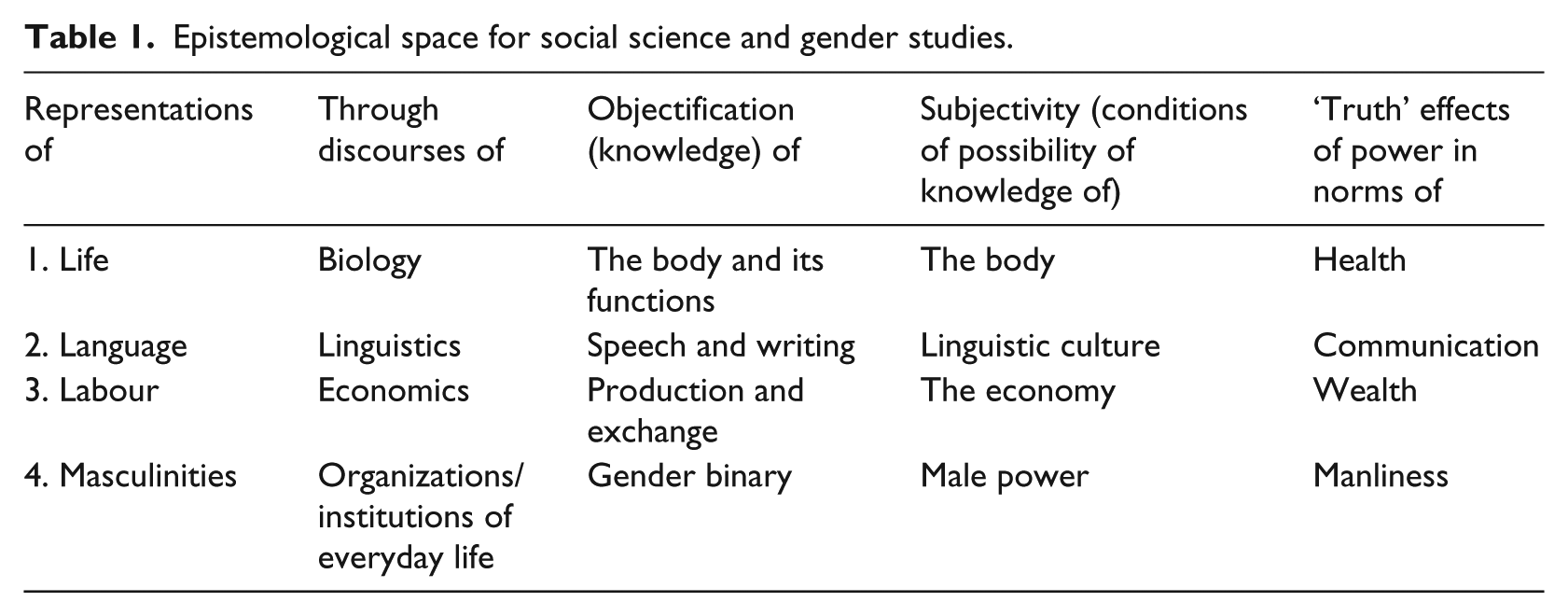
For Foucault, subjectivities 3 are produced through the exercise of power ordinarily informed by knowledge based on particular representations of reality. However, although power/knowledge relations constitute subjectivities, representational knowledge is itself dependent on a conception of particular subjectivities. What this approach suggests is that we go beyond representation in order to challenge the subjectivity that makes it possible. This requires us to occupy a space that stands between representations and the subjectivity that provides their conditions of possibility. The model (see Table 1) is developed from Knights (2006) and seeks to relate Foucault’s (1973) discussion of knowledge in his archaeological phase with his conception of power/knowledge (Foucault, 1980, 1982) in the genealogical phase and his later focus on the self as an aesthetic and ethical project (Foucault, 1985, 1988a, 1988b, 1997). 4 There is a sense in which this coincides with Deleuze and Guattari’s (1988) view of genealogy (p. 119 quoted in Gatens and Lloyd, 1999: 7) as thought that frees … ‘itself from what it thinks (the present)’ … in order … ‘to “think otherwise” (the future)’. It involves a ‘transition from passive thought to a form of thought more aptly described as an ethical activity’ (Gatens and Lloyd, 1999) and an imagination that has ‘a direct and strong contact with bodily reality’ (Gatens and Lloyd, 1999: 12).
Epistemological space for social science and gender studies.
Positive knowledges and subjectivity
In the archaeological phase, Foucault stressed the autonomy of discourses and, in particular, the positive sciences of biology, linguistics and economics to constitute the human body, the ways of communicating through language and the producer of economic wealth respectively. His later genealogical work reversed this process to show how ‘social practices condition cognitive discourse’ (Hoy, 1986: 4) and later still, an ethical or aesthetical phase where the self constitutes itself through its relationship to itself. In Table 1, I have sought to capture all three phases of Foucault’s thought—fields of knowledge, power and norms, and the processes through which one recognizes and develops oneself as a (ethical or aesthetic) subject. In addition to Foucault’s (1973) focus on the positive knowledges, for purposes of my subject matter I include discourses of masculinity although this addition is neither exhaustive of possible representations nor should they be seen as static and unchanging.
When knowledge informs exercises of power, the assumptions about subjectivity become self-fulfilling for humans are transformed into the very subjects they were presumed to be—economically rational self-interested, healthy individuals preoccupied with communication. Of course, there are numerous social and technological devices (e.g. work organizations, markets, the media, gyms, sporting events, mobile phones and social media) that facilitate a reinforcement of these transformations. Also it is important to appreciate how processes of transformation are not simply one-way from knowledge, through social practices to subjectivity but also that the reverse occurs insofar as subjectivities and social practices can condition modes of knowledge. The concern with health puts demands on science to develop new cures; the preoccupation with communication stimulates a proliferation of information technology innovations and economists can never ignore the activities of labour or consumers.
It is subjectivity that renders these representations possible but at the same time is an effect of their deployment in power/knowledge relations. None of the representations and their objectification of particular events or activities are possible in the absence of implicit or explicit conceptions and/or presumptions of subjectivity. In some senses, these assumptions are crucial, for to take the first example in Table 1, how would it be possible to represent human life independently of knowledge of the body grounded in notions of a healthy subject? However, assumptions about subjectivity are often taken for granted rather than interrogated as a condition of what makes it possible to generate representations of reality and partly as a result, they are self-fulfilling.
Cultural knowledge and masculinities
In relation to representations of gender or masculinities, we are in the field of non-positive or critical knowledge that seeks to challenge prevailing cultural, social, political and economic relations. Often representations of masculinities are commonsensical and unquestioned but they still can have similar ‘truth’ effects as those of positive knowledge. As cultural artefacts, these representations are articulated and sustained through organizations and institutions that reflect and reproduce the dominance of male subjectivity, which have ‘truth’ effects in norms of invulnerable manliness. 5 Foucault’s refusal to include gender as opposed to sexuality as a target for his analysis is complex, but broadly he felt that such discourse tended to reproduce heterosexual hegemony. 6
Nonetheless, subjectivity is a necessary condition for any representation to be made possible. The conception of subjectivity that reflects and reproduces gender representations of say masculinity is the binary that divides men from women as discrete subjects or masculinities from femininities as distinct discursively produced cultural constructions (i.e. identities). Subscribing to the representations of gender leaves the gender binary divide intact, making a disruption of masculinity difficult. Remaining in the space between those representations and the subjectivity of binary oppositions that make them possible, on the other hand, leaves us free to refuse the subjectivity of masculinity that is one of their significant discursive outcomes. It may be possible to disrupt their ‘truth’ effects in terms of the norms of what it is to be human—a healthy and wealthy ‘real man’.
Deconstructing gender and other binaries can generate self-awareness of some of the problems of masculine preoccupations with the self, but they are highly cognitive so that living out their consequences as an embodied being perhaps demands dissolution to which I now turn.
Dissolving binaries
Deconstruction tends only to challenge the reification of the terms wherein the binary discourses of mind–body, culture–nature and masculine–feminine are treated as absolute and unchanging. Dissolving binaries, by contrast, invites a collapsing of the terms so that they no longer sustain and reproduce the polarities, which reflect and reproduce the domination of discourses of masculinity.
Such dissolutions have found theoretical and practical sustenance through the philosophical work of Deleuze and Spinoza and, in particular, new feminist readings of their work (Braidotti, 2011; Gatens, 1997; Gatens and Lloyd, 1999; Grosz, 1994, 2005; Stewart, 2007). While undoing dominant representations that rely on some static authority from the past, these Deleuzian and Spinozian readings embrace a ‘positive notion of desire as an ontological force of becoming’ (Braidotti, 2011: Location 105). In their concern with the flow of bodies that are not simply determined by the norms of organizational life (Gatens, 1997), masculine dominated modes of cognition are de-emphasized, but whether this form of theorizing is accessible to, or can have an effect on, everyday organizational and social practice is contestable. This is because our everyday practices are informed by heavily internalized norms and beliefs whose transcendence depends precisely on transformations that such transcendence anticipates (Braidotti, 2011). Moreover, organizations and institutions are often resilient to new thinking or embrace it so slowly as to severely constrain its radical potential to transform practice. Nonetheless, since the ultimate effects of ‘an ontology of the unthought’ (Foucault, 1973: 326) can never be known, we should not be deterred from challenging deep-rooted closures on meaning that sustain such representations.
Ontological dissolution: mind–body inversions
One possibility is to invert the mind–body binary, as has been attempted by Grosz (1994), who understands the body and mind neither as two substances (Descartes) nor as two different attributes of the same substance (Spinoza) but ‘somewhere in between these two alternatives’ (Grosz, 1994: xii). She develops Lacan’s notion of a ‘möbious strip’ which is ‘an inverted three dimensional figure eight’ (Grosz, 1994)—a metaphor that allows for the way in which, through inversion, the mind and body are in a process of continually becoming one another such that the inside or psychic aspects drift into the outside corporeal self and vice versa.
Grosz seeks to rethink subjectivity through re-theorizing the body to depart from both the Cartesian mind–body and the Freudian conscious–unconscious mind binaries. Drawing not uncritically on Deleuze and Guattari’s (1988) radical system of thought regarding ‘the body as a discontinuous, nontotalisable series of processes, organs, flows, energies, corporeal substances and incorporated events, speeds and durations’ (p. 145), she seeks to dissolve traditional binary polarities between mind and body and nature and culture.
The body-without-organs or what Gatens (1997) prefers to term bodies-without-organized-organs can be seen as a re-conceptualization that displaces the teleology of consciousness or what we know as the preoccupation with identity as a reflection and reinforcement of a rule-based morality defined by social and normative organization. This coincides with Spinoza’s view ‘that there are no “final causes” or telos in nature’ (Braidotti, 2011: 2) and that the body is a moving and dynamic flow affecting and affected by other bodies; life is understood as a ‘complex relation between different velocities, between deceleration and acceleration of particles’ … ‘variations in speed’ … ‘“on a plane of immanence”’ (Deleuze, 2005: 59). Here, there is a move away not only from Cartesian mind or soul–body and Freudian body–civilization dualisms but also from the Lacanian depiction of desire in terms of that which the body lacks for it to be a unitary whole. In its place Deleuze and Guattari understand the body as ‘a field of immanence of desire’ (Grosz, 2005: 149) as becoming, indeed becoming-woman.
This is a concern to dissipate not just masculine identity but identity as a whole for their objective is the reduction of the fragments of the body to ever-smaller fragments that culminate in an indiscernible imperceptibility—dissolving the body, as we know it (Grosz, 2005: 154–55). Grosz (2005) is suspicious of this as it is reminiscent of other pro-feminist discourses that support a feminist objective only as a stage on the journey to a broader phallocentric political and philosophical cause. Moreover, they pay no attention to the specificities of the sexed body, and the violence that it does to its ‘other’—women and minorities and nor, by implication, the relevance of feminist theories for ‘women’s own self-representations’ (Grosz, 1994: 188). While resisting pre-empting the content of alternative, non-patriarchal terms for women’s own autonomous self-representations in advance of them being formulated, she does question ‘the ontological status of the sexed body’ (Grosz, 1994: 189), which historically has been deeply masculine (Butler, 2004). In particular, she challenges the domination of masculine sensibilities in representing women’s bodily fluids as polluting, contaminating, disorderly and indeterminate in contrast to those of men that are transformed into some more solid end result such as the presumed sexual satisfaction of the woman—‘an index of his prowess to generate her pleasure’ (Butler, 2004: 199) or to its role in reproduction. By converting fluidity to solidity, a more orderly, determinate and safer world is created as the culmination of masculine discursive reality.
This said the theories of Deleuze and Guattari do allow us to ‘acknowledge the normative operations of sex and gender without prioritising either’ (Gatens, 1997: 164). They also generate a way of thinking about organizations and management that would facilitate a removal of the dominant masculine ethos where power and control eviscerate relations of ethical engagement. Developing both the epistemological deconstruction and the ontological dissolution of binaries, I turn now to the discourse of ‘agential realism’ where the notion of entanglement generates not only the conditions of possibility, but also the moral imperative, for embodied ethical engagement.
The onto-epistem-ological entanglement of matter and meaning
Paralleling the earlier epistemological argument that non-dualistic knowledge resides in the space between representations and the subjectivity that is their condition of possibility, Barad (2003) argues that materiality is the condition that makes language possible and yet in much discourse is ‘figured as passive and immutable’ (p. 801), not unlike the female body in relation to men. Within gender studies, the work of Butler (1990, 1993) has resulted in the notion of performativity transcending the domination of representation in analysis although this is ‘not an invitation to turn everything (including material bodies) into words’ but ‘is precisely a contestation of the excessive power granted to language to determine what is real’ (Barad, 2003: 801). In this sense, it could be suggested that performativity resides in the space that lies between language and the conditions of materiality that make it possible, and it challenges the view that what is represented is independent of the processes and practices of representation. It also offers a way of challenging an even more fundamental binary between social constructivism and critical realism that has recently replaced earlier epistemological and ontological polarizations between idealism and materialism. This demands an avoidance of slipping into understanding the body as passive that despite his post-representationalism, Foucault tends to do in not showing how ‘materiality plays an active role in the workings of power’ (Barad, 2003: 806, author’s emphasis). It is possible to attribute this to an abandonment in Foucault’s later writings of knowledge that resides in the space between representations and the conditions of their possibility for while rejecting representationalism, he embraces a constructivism that ‘assumes a materiality for the body prior to its signification’ or historical cultural inscription (Butler, 1989: 604). Thus instead of dissolving the binary between signification and the body, he reproduces it when he sees history as ‘“inscribed” or “imprinted” onto a body that is not history’ ‘a prediscursive and pehistorical “body” [that is] a source of resistance to history and culture’ (Butler, 1989: 607). Butler (1989) argues that this seemingly undermines the ‘constructed status of the body’ that Foucault’s studies sought to establish.
If a non-binary and embodied form of thought is to be established, there is a need to criticize both representationalism and realism since they both subscribe to a separation of words and things (Bardon and Josserand, 2010; Foucault, 1973). In the former, too much power is acceded to language whereas in the latter, too much power is given to an unknowable reality that has determinate effects on the structure of relations. Barad (2007) suggests an alternative ‘agential realism’ where matter and meaning, nature and culture, body and mind and emotion and cognition are performatively entangled as agents and products of one another. Despite productive power reflecting this performative entanglement, masculine discursive practices at senior levels of organizational hierarchies often deny it by elevating the latter of these distinctions over the former. This may have several contradictory consequences the more vivid of which has been the mismanagement of Western financial institutions of late (Blomberg, 2009; Knights and Tullberg, 2012). For as is made clear: ‘Discursive practices and material phenomena do not stand in a relationship of externality to each other; the material and the discursive are mutually implicated in the dynamics of intra-activity’ (Barad, 2007: 184). The term intra-action as opposed to interaction is crucial because the latter presumes a prior separation of bounded entities in advance of their interaction whereas the former captures an engagement of internally related yet unbounded elements that are in the process of becoming through their intra-action. Rather than a separation of the world and knowledge, the merging of ontology and epistemology generates practices of knowing in being or what Barad (2007: 185) terms ‘onto-epistem-ology’.
Discussion: beyond identity politics and towards embodied ethical engagement
Each of the three approaches offers us something in terms of what it would mean to live an ethical personal and organizational life. Deconstructing representational knowledge to expose the often hidden assumptions about subjectivity that condition its possibility enables us to identify the dominance of linear progressive, masculine rationalities that marginalize the body and emotion in such a way as to displace ethics from thinking. Even for Foucault (1985) where the ‘the telos of his ethics’ was to ‘get free of … [him] … oneself’ (p. x, quoted in Foucault, 1994: xxx), he declared a view of friendship as reciprocity and he asked the question as to whether it was possible to have … ‘an ethics of acts’ … that was able … ‘to take into account the pleasure of the other’ (Foucault, 1985: 257–258 quoted in Foucault, 1994: xxviii). Reciprocity and the idea of taking the other into account reflect masculine discourses of separation between self and other—a separation that can only be bridged by the recognition and attempted fulfilment of each other’s (instrumental) self-interests. In this sense, Foucault is unable ‘to get free from’ himself and the internalization of masculine subjectivities to develop an embodied ethics of engagement and relationality, as is advocated by posthumanist feminists (Barad, 2007; Braidotti, 2013; Haraway, 1991).
In re-theorizing the body through a critical debate with Deleuze and other philosophers, Grosz (1994) moves away from the epistemological deconstruction of binaries to their ontological dissolution and theorizes the subject as neither a psychical or corporeal substantive entity but more as an effect of ‘the pure difference that constitutes all modes of materiality’, and especially the sexed body (p. 208). This sexed body, she claims, has to be theorized in non-patriarchal terms if women’s own autonomous self-representations are to be developed in ways that challenge the tendency for male philosophers to reproduce phallocentric representations. However, in relation to this she does not extend her critique beyond deliberating on how dominant interpretations of the bodily fluids and flows associated with femininity are ‘subordinated to the privilege of the self-identical, the one, the unified, the solid’ (Grosz, 1994: 195) that is the apotheosis of masculine discursive reality. Maybe she was concerned not to reproduce the gender binary oppositions she has painstakingly dispensed with in seeking immanence or transcendence from sexual specificity. For it is the case that the turn to the body, materiality and dissolution of binaries was also a challenge to the politics of identity (Hekman, 2010; Nicholson and Seidman, 2005). At the same time, Braidotti (2003) argued that the underprivileged may feel it important to go through a ‘phase of “identity politics”—of claiming a fixed location’ … [since] … ‘you cannot give up something you have never had’ (p. 53).
Perhaps this dilemma can be resolved by turning to the agential realism of Barad (2007), where the entanglement of self–other, matter–meaning, masculine–feminine and human–non-human removes any sense in which identity would be possible let alone desirable. For if we all (both human and non-human) intra-act in a web of complex entanglements, the boundaries between self and other, mind and body, masculine and feminine, human and nature, and social and material simply dissolve. This removes the conditions of possibility for the development of distinct and comparatively ‘fixed’ identities as opposed to dynamic and flowing relations. It is then not a question of those previously denied a dignified or valorized identity giving up something they have never had so much as realizing its mythical and masculine ontological status even for those who believed identity to be a property of their very being. For as it has been argued, identity work is primarily a masculine occasion for producing an orderly and predictable world in which to secure a solidified sense of self (Clough, 1992; Game, 1991). As a medium and outcome of an individualized society, masculine intentionality instrumentally transforms everything into a resource for securing itself. Moreover, it is this masculine preoccupation with securing the self in a stable identity that generates closure in such a way as to deny or denounce difference, for individuals often attempt ‘to destroy the other so as to assert the sovereignty of their own selfhood’ (Hancock and Tyler, 2001: 572), thus disabling ethically engaged and embodied relations. In order to fulfil the requirements of confirming identity, the other person or object is treated as an instrumental resource that must be tamed and controlled or its difference ‘reduced to being the Same as the self—like me’ (Knights, 2006: 265; Levinas, 1986).
However, through an onto-epistem-ological understanding of agential realism we can no longer secure identity through resources that are external to the self because there is no separation of humans from materials, self from other and, in terms of ethics, subjectivity from responsibility. If so, responsibility is a relation of bodily engagement ‘that precedes the intentionality of consciousness’ (Levinas, 1985: 95 quoted in Barad, 2007: 392) and ethics or responsibility is then about our proximity to the other who is different from us but to whom we cannot be indifferent (Levinas, 1985, my emphasis). Of course, organizations invariably express their indifference to difference except where it can be managed as a form of diversity that seeks to render the organization isomorphic with its client base—matching diverse members of the organization to the same diversity of groups of customers. This simply treats diversity as an instrumental resource for advancing corporate control over clients/customers and in so doing, reproduces the binarism between management and the managed, members of the organization and customers and organization and the market. This not only has contradictory consequences of a practical nature but also denies the ethicality of our embodied internal relations and intra-actions with one another and with our material existence. While as we saw in relation to the financial crisis discussed in the first paragraph of this article, the contradictions of pursuing instrumental goals without concern for their consequences intended or unintended have implications wildly beyond any practitioner’s imagination but the ethical damage of living as if we are in independent silos must be self-defeating in that it ignores the complexities of our relationships to the world.
Two approaches have dominated the critical literature on organizational ethics—an ethics of consensus and an ethics of difference although neither can be seen as without their differences and disagreements (Rhodes and Wray-Bliss, 2013). In the former, individuals can transcend or reconcile differences through living their social interdependence rather than acting as if interests are exclusively ‘internal to the self’ (Roberts and Jones, 2009: 858). However, the consensus approach can homogenize the ethical subject rather than explore how through ‘practices of freedom’ (Fornet-Bettancourt et al., 1987), we can ‘construct our own morality’ (Bardon and Josserand, 2010: 507) or examine how organizations can exploit community ‘through the false ethics of a manufactured corporate culture’ (Rhodes and Wray-Bliss, 2013: 46). Ethics of difference within organization studies have varied between those focussing on how a preoccupation with identity can undermine ethics (Hancock and Tyler, 2001; Knights, 1990, 2006) through those that see ethics as a political challenge to liberalism (Ten Bos, 2003) to those concerned with re-embodying ethics as part of what it means to resist oppressive pressures for conformity in organizations that readily ‘close down difference’ (Pullen and Rhodes, 2013: 4). Here the inspiration has come from a range of feminist and other philosophies, many of which have been drawn upon in developing this article. What seems to have been neglected in the literature is an examination of the conditions and consequences of dominant discourses of masculinity and their ethical implications for organizational life. Attempting to fill this lacuna, I have theorized masculine discourses as a reflection and reproduction of a range of binary sensibilities that disembody relations in organizations so as to undermine ethical engagement with difference and our complex intra-actions with others, materiality and a subjectivity of responsibility.
As has been argued, an ethics of embodied engagement may be contingent on the deconstruction and dissolution of binaries and the masculine discourses and subjectivities that are one of their conditions and consequences. For the domination of cerebral and disembodied masculine discourses in the context of corporate and neo-liberal capitalist demands to compete aggressively for the comparatively scarce material and symbolic values of success undermines what little space ethics enjoys in organizations. So whether in the form of practising one’s freedom to transfigure the self as part of an aesthetic and ethical project (Bardon and Josserand, 2010; Foucault, 1994; 1997; Munro, 2014), a dissolution of identity (Deleuze, 2005; Roberts, 2003; Ziarek, 2001), a responsibility to the other (Barad, 2007; Knights, 2006; Levinas, 1986), or the transformation of managerialist culture (Iedema and Rhodes, 2010; Pullen and Rhodes, 2013), ethics is always on the back foot.
However, others have argued for alternative critical responses to the prescriptive literature on ethics in organizations by suggesting that we examine the cultural contexts and the resources drawn upon when ethics are attributed to some event or activity. In particular, here there is a focus on the sense in which the ethic of modernity imposes on individualized subjectivities a demand that they strive incessantly to realize their full human potential without limit (Costea et al., 2012). Following Simmel (1997), they argue that this ideal ethos of the subject that stretches human potential into infinity is the greatest tragedy of our culture. It not only projects on to us unrealizable goals but also simultaneously abandons us to pursue these wholly through our own devices, thus arousing a fear of failure and a perpetual anxiety regarding under-achievement. Rather than reflecting on the contradictions of subjecting everyone to ‘the unsustainability of its ethical demands’ (Simmel, 1997: 35), our culture simply intensifies the pressure for self-improvement and self-development in the pursuit of the illusory goals of excellence and self-fulfilment. It then renders subjects guilt-ridden as they are expected to assume complete personal responsibility for any shortfall in realizing the ethos. This is tragic, Costea et al., 2012 argue, because it refuses to acknowledge any limits to the unrelenting treadmill of striving to attain the ‘perfect’ self. I would go further to suggest that its implications are more sinister insofar as while claiming to be advancing wellbeing, this ethos simply reflects and reproduces aggressive competitive relations for there is no other way for isolated subjects to judge their ‘progress’ except through insidious comparisons with others. Moreover, this ethos can threaten an alternative ethics of embodied engagement insofar as it reinforces the preoccupation with self and indifference towards all except those who appear useful to the individual’s own self-realization (Roberts, 2003).
Summary and conclusion
In this article, three approaches to disrupting gender and other binaries have been discussed. In the first epistemological approach, binary discourse was deconstructed to show how the conditions that made it possible for representations of reality to be produced were a series of assumptions about subjectivity (Foucault, 1973). In Table 1, examples were provided of biological, linguistic, economic and gender representations and the assumptions about subjectivity on which they depended. Typically the assumptions that render it possible to represent biological life involve elevating the mind over the body through medical rationalities that define what it is to be a healthy subject. Linguistic representations give precedence to language and cognition that depend for their possibility on assumptions about the competent communicative subject. Representations of economic life in the West tend to produce binaries between capital and labour or management and employee subordinates, but their conditions of possibility are assumptions that subjects are economically rational and self-interested. Similarly, gender binaries are dependent on assumptions that elevate masculine over feminine subjectivities.
While this deconstruction of binaries that reside in assumptions of subjectivity underlying various disciplinary representations is revealing, it remains to some degree at the cognitive level. For this reason, it needs to be complemented by strategies for dissolving as well as deconstructing the range of binaries that are the lifeblood of representational and realist epistemologies. I concentrated on examining two of these approaches that are focussed primarily on gender. The first focussed on disrupting the binaries through theorizing how the mind and body flow into one another in processes of becoming that challenge the domination of masculine sensibilities (Grosz, 1994). The second concerned building on the deconstruction of representational epistemologies to develop an integration of epistemology and ontology through embracing the entanglement of matter and meaning, body and emotion, and masculinity and femininity (Barad, 2007).
In the discussion, I continued a critique of dualism and the domination of masculine discourses in organizations in seeking to go beyond representations and identity politics to transcend the preoccupation with self that is their condition and consequence. Two prominent critical approaches that seek to challenge the prescriptive literature on ethics—an ethics of consensus and an ethics of difference both of which informed the writing of this article—were then discussed. Through enforcing a false consensus and fuelling and firing a fear of difference, masculine discourses present a major obstacle to ethical embodied engagement as modes of organizing. They need to be challenged through what Pullen and Rhodes (2013) describe as an ethico-politics of resistance. This could be achieved through participating in the space between the representations of what is closed down and the assumptions about subjectivity that make such closures possible, combined with approaching ‘the process of subject formation in a distributive, dispersed and multiple manner’ (Braidotti, 2011: Location 165) through onto-epistem-ological thinking (Barad, 2007). Finally, I turned to an alternative critical approach demonstrating how certain ethical formulations such as the ethos of human potential can be dangerous insofar as it promotes an ideal that is damaging to wellbeing in its unattainable demands but also reinforces one of the greatest obstacles to ethical engagement—the preoccupation with self as if it existed independently of its conditions of possibility in embodied social and material relations.
When several years ago, discourses on gender identity displaced a conservative and functionalist role theory (Brod, 1995), it advanced the cause of feminism substantially, but perhaps what it obscured was how the very notion of identity emanating from the linguistic turn in social science is itself embedded in masculine discourses. Masculine in the sense that identity can be seen as a highly cognitive construction of the symbolic significance of the self that is equally as disembodied as the notion of role that it displaced. Attempting to reverse sex inequality and discrimination to generate the ethical respect for difference by asserting alternative identities could be seen then as an oxymoron. This is because the preoccupation with identity is itself already gendered as a product of masculine discourses. Of course, as pointed out earlier, where minorities and other disadvantaged groups have only experienced negative rather than positive social recognition and respect, it is difficult to ask them to abandon a preoccupation with identity. Yet it is also hard to deny that identity is a major source of social practices that result in discrimination and disadvantage, since its construction depends on a negation of, or elevation over, the other that it is not.
Moreover, where the Other is not readily appropriated in the service of the self, what is little more than an occurrence of difference can generate indifference or lead to in-group/out-group stereotyping that easily slides into embittered war-like relations given that identity is often threatened by the mere presence of the other (Ziarek, 2001: 74). As Irigaray implies in An Ethics of Sexual Difference, one of the conditions of the possibility of equality is that the Other is not reduced in this way ‘to the narcissistic “substitute prop” of the subject’ (Ziarek, 2001: 167). If ethics involves a respect for difference (Braidotti, 2011; Gatens and Lloyd, 1996; Spinoza, 1955), ‘homogenizing portrayals’ of subjectivity (Rhodes and Wray-Bliss, 2013: 41) have to be avoided so as to dispel this constant ‘return to the same’ (Levinas, 1986) where the Other has to be tamed or reduced to a pale image of its own difference. Of course it is not just, identity that obstructs a bodily engagement with difference especially in organizations for certain forms of managing and organizing readily ‘close down difference’ in ways that can be seen as oppressive (Pullen and Rhodes, 2013: 4). Furthermore, these oppressive forces extend well beyond any particular organization to include the broader global political economy, as again was evidenced in the global financial crisis.
It is anticipated that this article might stimulate organizational studies academics to confront the obstacles to more open and engaged ethical relations. As well as reflecting global capitalist market relations, these obstacles partly reside in the preoccupation with self (identity) that is a reflection of, but also reproduces, masculine discourses and comparatively disembodied relations. Of course, the limitations of the project are political in the sense that discourses of masculinity accrue power and those enjoying the advantages that follow may not be inclined readily to relinquish them. The mismanagement of ethics in organizations or what Ten Bos (2003) describes as ethical technologies that keep the ‘demons’ or melancholia at bay continue to maintain organizational order through resorting to deontological rules and regulations. This not only sustains an orderly and predictable organizational life but also it shores up, rather than threatens, masculine phallic and logocentric power at the cost of an ethics of commitment to openness and an embodied engagment with difference. The global financial crisis may have raised the legitimacy of ethics in the theory and practice of organization, but let us trust that it is not appropriated by masculine discourses as just another resource for securing identity and sustaining binary fundamentalism.