




Abstract
This article explores how an allegedly ‘non-hierarchical’ and aestheticized managerial practice reconfigures power relations within a creative industry. The key problematic is ‘governmental’ in the sense suggested by Michel Foucault, in as much as the manager’s ethical self-practice—which involves expressive and ‘liberated’ bodily comportment—is used tactically to shape the space of conduct of others in the company. The study foregrounds the managerial body as ‘signifier’ in its own right. Empirically, this is done through an analysis of video material produced by the film company Zentropa about their apparently eccentric Managing Director, Peter Aalbæk. Contrary to much of the literature discussing embodiment and ethics in organization studies, we do not identify an ‘ethics of organization’ dominated by instrumental rationality, efficiency and desire for profit which is ostensibly juxtaposed to a non-alienating, embodied ethics. Rather, when the body becomes invested in management, we observe tensions, tactics of domination and unpredictability.
Introduction
Within critical management studies (CMS), the conventional business ethics approach has largely been depicted as a set of abstract standards against which organizations may be evaluated. This is particularly evident in the articles published in Organization during the past decade. CMS, in attempting to extend what was viewed as a restricted framework for understanding business ethics, has focused on ‘how individuals might (or might not) maintain a valued experience of themselves as ethical subjects despite the behaviour of organisations, and how organisations might be politically contested in the name of ethics’ (Rhodes and Wray-Bliss, 2013: 40).
This position has led to an interest in how ethics is embodied in human practice, indeed, in its carnal materiality (Merleau-Ponty, 1968). The body is elevated as a stark contrast to the rational organization and its mechanical routines (Hancock, 2008; Pullen and Rhodes, 2010). In this matrix, the personal and affectual are always at risk of becoming alienated and ‘managed’ by organizational prerogatives (Hochschild, 1983). While a greater part of today’s organizations certainly can be understood through a perspective focusing on personal alienation, we believe that it is fruitful to explore what may happen when the focus is on how highly personalized managerial practices impose themselves on the employees, and the manager’s body itself becomes a site of ethical practice. How do we study the body as a vehicle for managerial performance? Of course, even the ‘rationalized’ organization’s ‘rational’ managers have bodies, but those bodies were conceived more as uniforms or at least as disciplined by uniforms (Harding, 2002). In contrast, in what has become known as the ‘post-bureaucratic organization’ (Grey and Garsten, 2001; Maravelias, 2007), the knowledge-intensive, creative sectors reveal new types of managerial practices. These new practices not only express what we may term ‘postmodern’, decentred and anti-hierarchical imageries but also echo wholly new configurations of management. Indeed, these complex configurations have been termed ‘soft bureaucracies’ (Courpasson, 2000), where more flexible structures are being deployed by an elite, who bypass the (shrinking) middle management with a softer, seemingly more humane, managerial practice without annulling the functioning bureaucratic forms.
Historically, Taylor’s (1911) Scientific Management brought with it a separation of the execution of work from work-planning. The body was separated from cognition, the plant from the office and the worker from the manager. Weber, in his way, would exclude from the bureaucratic rule any ira et studio and relegate personal affect and passion to the domestic or social spheres of life, thus banning bodily expressions from the bureaucratic context. The conventional dichotomies between management and the body, between bureaucracy and passion are now being reconfigured. The managerial body itself is now quite literally taking centre stage, in what Thrift (2001) has termed ‘a performative politics of incarnation’ (p. 418).
In this article, we wish to pursue this embodied/incarnated perspective by problematizing what we view as an increasingly urgent obligation in contemporary management to perform an ‘embodied ethics’. By embodied ethics, we refer to bodily acts that are performed in order to display a practical ethos. We assume this ethos to be particularly pronounced in the so-called creative sector. This is an ethics which can never remain abstract but, as we shall see, must always be enacted and experienced vicariously in order for it to have personal and persuasive value in the management context discussed here. We postulate, therefore, that management ethics have now become invested in the body itself. The evaluation of management ethics, we argue, now centres on the body performed insofar as no other ethical premises are available.
In explicating this material incarnation of managerial agency, we will focus on the etiquette of modern management in the day-to-day practices of a single creative sector corporation. We follow the CEO Peter Aalbæk of Zentropa, a film production company best known for producing the award-winning films of its co-founder Lars von Trier (including Breaking the Waves, Dancer in the Dark, Antichrist and Melancholia). The main data source is a 16-minute documentary feature directed by Pablo Tréhin-Marçot (2004), entitled One Day with Peter. In this short film (which is not accessible on the Internet), Aalbæk parades through the company barracks, greeting and kissing his employees, plays pool, shouts orders, strips naked inside an office, shakes his penis and jumps into the company pool at the end of the day. However, despite all its excess, we argue that Peter Aalbæk’s managerial performance can provide valuable insights into the nature of contemporary management more generally and expose some of the ambiguities of management strategies and tactics in the creative sector and possibly elsewhere.
The analysis focuses on three ‘bodily encounters’ drawn from the documentary: a salary negotiation, a scene of undressing before skinny dipping and sauna and a towel scene, where Aalbæk and some of his female employees interact. We contextualize our analysis by reviewing the discussion of the body and ethics in organization studies. This is followed by a conceptual and methodological description of the managerial body as signifier and the use of film as case material. We then analyse the three bodily encounters from the film focusing on Aalbæk’s dramatized unleashing of creative forces and his oscillations between different managerial figures. We then discuss the kind of power effects which emerge from Aalbæk’s performance, showing how our findings challenge the claim for an embodied ethics as a way of humanizing management (Steyaert and Janssens, 1999). Finally, we present some implications for research into embodied and aestheticized managerial practices.
Ethics performed by bodies
While CMS, as we shall see, has increasingly engaged in questions pertaining to embodied, ethical subjectivity, our approach is inspired by the Renaissance philosopher Spinoza, who sought to bring together the living body and ethics. The central Spinozist statement that Deleuze (1988) brought back into the general parlance emphasizes the body’s abilities: ‘We do not know what the body can do’, that is, we do not yet know the body’s potential for being affected by and affecting other bodies (p. 17). Where the mind has its (Cartesian–Freudian) history of consciousness and unconsciousness, the body has been not much more than a vehicle for these spiritual insights and psychological repressions. Spinoza does not accept this subordination of body to mind. He recreates the body as a locus of power, of potentia. This means, in Massumi’s (2003) words, that ethics, far from being cognitive or transcendent, becomes a process of assessing what kind of potential [actions] tap into and express. […] The ethical value of an action is what it brings out in the situation, for its transformation, how it breaks sociality open. Ethics is about how we inhabit uncertainty together. (p. 7)
The bodily encounters produce joy and sadness, in relation to how the approaching body (object, human body, idea, movement) enters into composition with us: The object that agrees with my nature determines me to form a superior totality that includes us, the object and myself. The object that does not agree with me jeopardizes my cohesion, and tends to divide me into subsets, which, in the extreme case, enter into relations that are incompatible with my constitutive relation (death). (Deleuze, 1988: 21, emphasis added)
Such is, in Deleuze’s account, the Spinozist connection between ethics and embodied presence, a connection maintaining that any embodied presence not only implies but also is preceded by ethics. We suggest that CMS’ growing engagement with ethics and embodiment is founded upon this insight and may be foregrounded by the continued accentuation of the body at work, in particular its affectual presence. In creative sector management, Thrift (2001) argues, ‘the management body had to be passionate’, in order to engage the emotions of the employees and not just their cognitive skills (their minds) (p. 418). Moreover, Thrift continues, the ‘management body’ had ‘to do more … to make more of itself’: ‘That meant working harder but it also meant spreading the body around more’.
Such a spreading around of the managerial body may be connected to the notion of ‘ethical subjectivity’ (McMurray et al., 2011), as such a subjectivity is created, we contend, through what Critchley (2007) has termed ‘ethical experiences’, in our Zentropa case through ‘bodily encounters’ between the manager and his employees. The notion of experience is central to both of Critchley’s philosophical sources, Emmanuel Levinas and KE Løgstrup. From Løgstrup (1997 [1956]) we get the following central ‘ethical demand’ in a formulaic version which pertains both to Spinoza (mood) and to the power of, for instance, management (holding in one’s hand): A person never has anything to do with another person without holding some of that person’s life in his hand.
1
It may be a very small matter, involving only a passing mood, a dampening or quickening of spirit, a deepening or removal of some dislike. But it may also be a matter of tremendous scope, such as can determine if the life of the other flourishes or not. (p. 15ff, translation from Danish modified)
As with Spinoza, the ‘mood’ is a matter of ethics and politics or management. The effects of this ‘having to do’, the ‘ethical experience’, has a colossal potential; it is of ‘tremendous scope’, although we may not ‘know it’ (since we still do not know what a body can do and what it agrees with and disagrees with). Such encounters may be joyful and flourishing but may also be life-threatening to the point of death, as in Deleuze’s (1988) reading of Spinoza. In critical approaches to organization, embodied encounters are largely seen as positive, and corporeal ethics is taken to be a possible locus of resistance. Indeed, such encounters may imply a ‘corporeal generosity’ (Diprose, 2002; Hancock, 2008), which opens up for organizational difference and promises ‘an ethico-politics of resistance … [aimed at] disrupting taken for granted means’ (Pullen and Rhodes, 2013). Yet, it is equally important to acknowledge that there is no safe haven in ethical practice, which is why Foucault (1982) is interested in the ways in which self-government becomes government of others and the ‘governmentality’ involved in such practices (Villadsen, 2010). At the extreme end of this spectrum is the instance where, with Løgstrup, the manager actually holds someone’s life in his or her hand. Here, the body (of the manager) is not a ‘receiver’ but the ‘creator of social meaning’ (Godfrey et al., 2012); manager Peter Aalbæk’s performance at Zentropa is, as we shall see, very much if only also ambiguously embodied and shows little respect for conventional organizational or bureaucratic ethos (Du Gay, 2000), yet its ethicality is what we are about to question in this article.
Altogether, the ethical, as conceived variously by Spinoza, Deleuze and Løgstrup, has an ontological quality. The ethical remains a matter of immanence or expressed in one of Deleuze’s slogans—one rather apt for the CMS discourse—‘before Being there is politics’ (Deleuze and Parnet, 1987: 17). This immanent condition of ethics makes embodied ethics that much harder to discern and analyse, much less ‘manage’ in day-to-day situations. The body comes forward, but it does so in an aestheticized manner, as illustrated in recent studies of managerial strategies that seek to invest the subjectivity of organizational members with certain rationalities, imaginaries and aesthetics (Hancock and Tyler, 2007; Harding, 2002). In this critical perspective, the body becomes a vehicle for the dissemination of organizational imaginaries. The flesh becomes aestheticized.
The subordination of the flesh to aesthetics
In research on organizational bodies and subjectivity (Costea et al., 2008; Fleming and Spicer, 2003), the physical, human body has largely figured as an object of discipline, symbolization, managerial strategies or gender codification. A view of the body as an actor, itself creating signification, has received less attention (see also Godfrey et al., 2012). In this article, we will attempt to push the analysis in this direction, showing how the manager’s physical body, voice and gaze create fields of visibility and spaces of audibility. These fields and spaces are the components of the ‘social imaginaries’ that feed our joint horizons of expectation (Taylor, 2004). The analysis of such imaginaries entails analysing how subjectivity is aesthetically induced, enhanced as well as disciplined and subjected (aesthetic analyses of organizations along such lines include Hancock and Tyler, 2007; Sørensen, 2012; Weiskopf, 2002). This entails a parallel investment of ethics, which here becomes ‘a discourse premised on human existence as an aesthetic phenomenon’ (Chan and Garrick, 2002: 695) that is deferred from what is said (abstract ethics/deontology) to what is shown (what Critchley, above, refers to as the ‘ethical experience’). This makes ethics, for better and for worse, something performed rather than an essence or an abstract deontology. Hancock and Tyler (2007: 514) point out that the analysis of such staged expressions of ethics implies the employees’ (and, by implication, the managers’) embodied presence as audience and that the presentation, maintenance and performance of a mode of embodiment that is specified or compelled by their employing organization [in contemporary work-life] has become a central component of the work performed by many employees.
In this type of work, a particular pathos is installed in the ‘organizational bodies’, such as Peter Aalbæk’s own body, but the pathos also incorporates the bodies of his employees: such bodies become ‘material signifiers of an organisational pathos’ (Hancock and Tyler, 2007: 514). This aestheticized regime of pathos, as Weiskopf and Loacker (2006) observe, continuously ‘produces images of the “ideal worker” or employee’ (p. 397). Power works through the deployment of aesthetic strategies that function as ‘means of affecting both people’s impressions and definitions of reality’ (Hancock and Tyler, 2007: 512). Hancock and Tyler point to the instability of such managerially produced regimes, if not their outright haphazardness, a conclusion that we will also seek to support in this article. Hence, while the body at any historical and corporate junction is gendered and while our case material is quite explicit in this regard, the body is in practice always ‘doing gender’, yet also ‘undoing’ it (Hancock and Tyler, 2007). Aalbæk’s body and his management practice, as we will show, are a particularly strong example of this dynamic. Inspired by Foucault and following Harding (2002), we see in the ‘manager’s body … the subordination of flesh to aesthetics’ (p. 69). Hence, we may divide the body into a material body and a ‘thought body’, whose particular locale in a technical, cultural and scientific history provides it with the ideas through which it is thought into being. (Harding, 2002: 69)
The body appears, then, as Harding also points out, as a peculiar entity: rather than being a material composition endowed with special qualities like gender, intelligence, physical features, voice and gestural habits, the body emerges more like a surface onto which these qualities are inscribed and recorded. This does not mean that the biological processes that have produced this particular body are not real but that they receive distinct expression by being ordered (rather than called) into being by language (Deleuze and Guattari, 1988: 82). Here, the body, and especially the body of the manager, becomes the operator which both expresses and records productive figures of subjectivity, that is, the body comes to expose a plethora of signs while simultaneously striving to perceive and imitate these signs. An aesthetically informed analysis, however, may pave the way for ‘alternative and potentially critical way[s] of knowing organization’ (Hancock, 2005: 35), that is, for knowing other ways in which to navigate in such symbolically charged environments. The Zentropa film production company, our case study, is such a charged place. Zentropa enjoys a prevalence of actions, gestures and symbols that are devoid of any strict functionality but which play into the symbolic space of the imaginary (Roberts, 2001). Visual material, such as films, offers a potentially fruitful pathway into this space.
Films as data source
Research on films as a means of gaining insight into organizations and managerial practice is still relatively sparse (Meyer et al., 2013: 488), and so far, scholars have had to argue for the legitimacy of using films as data source. Quantitative, numerical or ethnographic descriptions of organizations continue to be regarded as more serious, rigorous and objective than visual artefacts, including films. Hence, some scholars explain the relative rarity of organization studies that foreground visual evidence with ‘a methodological bias towards the supposed certitude of empirically verifiable “science” over the indeterminacy of visual and aesthetic interpretation’ (Guthey and Jackson, 2005: 1064). Nevertheless, films and images have lately received more attention in organization and management studies as a valuable resource for understanding contemporary organizational life (Foreman and Thatchenkery, 1996; Godfrey et al., 2012; Guthey and Jackson, 2005; Sørensen, 2014).
Arguments for the legitimacy of films as data source have varied, but most of them view films as components in the construction of organizational reality alongside narratives, symbols, images, charts and other representations. Hence, visual artefacts may ‘create, transform, or stabilize particular “versions” of reality’ (Meyer et al., 2013: 509). Taking inspiration from Derrida and Lacan, Foreman and Thatchenkery (1996) argue that there is no fundamental reality of ‘the real’ organization, but merely a set of signifiers, simulacra or representations of it (p. 46). In this perspective, the pictorial elements in a film are signifiers that take part in the system of signification, the symbolic structure that makes up the unconscious. In a similar manner, Gagliardi (1996) conceives of films as representing in a very straightforward manner organizational artefacts which, as such, partake in the ‘aesthetic landscaping’ of the organization. Such artefacts may be practices enacted in ‘real time’, such as management activities that the employees experience, but may also, perhaps at the same time, be reproducible images, such as films and marketing material, which in this way gain force and significance into a wider collective, potentially becoming part of a generalized ‘social imaginary’ (Taylor, 2000). Common to these views is that visual modes of meaning construction are capable of materializing, organizing and sustaining organizational representations by constituting systems of signs.
To become more specific on how we view films as data source, we draw upon the schema of five different approaches provided by Meyer et al. (2013: 503–506). Within this extensive overview, we identify with the archaeological approach, which views visual artefacts as ‘storage’ of sedimented social knowledge: ‘Research in an “archaeological” tradition is primarily concerned with the systematic reconstruction of socially shared meaning and, consequently, the analysis of pre-existing visual artefacts in which such meaning is embodied’ (Meyer et al., 2013: 502). This begs the question of whose shared meaning it is that our film crystallizes? The immediate answer would be that the film—like any other visual artefact—is an expression of the cultural system in which it is produced. As such, the film will be able to give us an insight, not so much into the unmediated reality of Zentropa but into the system of meaning, knowledge and values prevailing in the company: ‘We treat these images and incidents as signifiers whose logic may be traced back to the organisational knowledge of the film’s collective makers’ (Foreman and Thatchenkery, 1996: 49). Like the scholars cited above, we wish to avoid placing our analysis in the conventional dichotomy between ‘lived reality’ and more or less true ‘representations’ of it (as criticized by Derrida, 1978), asserting that films contribute to the symbolic coding of our reality alongside other visual, discursive and material artefacts.
Following these methodological reflections, we proceed with a content analysis of a number of selected images or still shots from the film. Taking Derrida’s lead, our objective is not to give a final judgement of the meaning of each image, but to insert it into a play of significations by explicating and intensifying the image’s internal contradictions. Hereby, we hope to open an avenue to question and contest the self-evidence and readily received narrative of the images: Derridean deconstruction of images seeks not to find a ‘solution’ to the meaning of an image, but rather to complicate the obviousness of the image, drawing attention to the way it constructs itself in order to implicitly represent a single history. (Campbell, 2012: 116)
Deconstruction thus entails an acute attention to the image as a signifier. The task is not to unveil the reality hidden behind a filmic image but to start the interrogation strictly from within the image itself.
Eschewing hermeneutic and phenomenological approaches, our analysis proceeds by observing our central ‘actor’, the manager’s body, as a signifier, ‘in that punctuality in which it appears’ (Foucault, 1972: 25). This non-reductionist approach to a bodily statement (whether verbal or by gestures) does not look for any subjective intentionality or hidden motives but observes it as a ‘pure discursive event’ (Foucault, 1972: 27). Foucault emphasized that ‘statements’, whether corporal, verbal or textual, should be viewed neither as expressions of the speaker’s inner thoughts nor as descriptors of positively given entities. It was, rather, a matter of tracing the networks of concepts that each statement invokes (for instance, certain received leadership mythologies). In a similar vein, Butler asserts that there is no agential subject who enacts a performative moment: rather, what is performed is always re-citing something drawn from somewhere else. She argues that ‘performative power is not the function of an originating will, but is always derivative’ (Butler, 1993: 13). Butler asks by quoting Derrida (1988), could a performative utterance succeed if its formulation did not repeat a ‘coded’ or iterable utterance, or, in other words, if the formula I pronounce in order to open a meeting, launch a ship or a marriage were not identifiable as conforming with an iterable model, if it were not then identifiable in some ways as a ‘citation’? (p. 18)
In this view, then, actions should not be examined in order to gauge which motives the actor might have had or if she was genuine or not. The issue, rather, starting from the image itself and the bodily acts it displays is to mark out the horizontal relations that the image has to other images, statements and symbols.
The analysis below follows this approach, showing how the managerial body articulates, or corporally enacts references to, a number of significant discourses of management, arts and political ideologies ingrained in Western modernity. Our examination of the selected still shots will bear evidence of this strategy of ‘inter-textual mapping’ of the CEO’s leadership gestures. It follows that we are not concerned whether there exists a ‘more genuine’ performance that is unaffected by the presence of the camera, a performance that could perhaps be revealed by long-term ethnographic research. While there is undoubtedly a ‘performance for the camera’ taking place in the film, we take such cinematic performances and their aestheticization to be a recurring and integral component in the collective reality of Zentropa. Hence, those familiar with the films produced by Zentropa will recognize its artistic characteristics resonating in the short film: the unexpected mixing of genres, provocative gestures and playful invocation of major cultural figures.
The film presents Zentropa to its internal and external constituencies by means of a variant of the ‘documentary’ genre. Indeed, the film effectively invokes a sense of unveiling and digging into the actual day-to-day life of the participants (accentuated by the hand-held camera, the natural light and the occasional wind that blows into the microphone). The routines portrayed give the spectator the impression that he is witnessing normal, everyday occurrences in the firm. As the film proceeds, however, a series of much more dramatic spectacles unfolds, and it is some of these that we will focus on here. We watched the film several times, at times with undergraduate and doctoral students and with international groups of scholars and colleagues. Each session was followed by a discussion of different interpretations. We then selected three scenes which we subjected to more detailed analysis. We chose the following focus points:
The CEO’s body, including his pose, context, behaviour, dress and verbal utterances.
The intertextuality of images, that is, explicit or implicit references to managerial mythologies, figures, ideologies, utopias and so on.
The inherent paradox of authenticity versus the invocation of familiar conventions or ‘styles’ around which many of Aalbæk’s performances seem to revolve.
This latter focus was inspired by Frosh’s (2001) assertion that cultural producers in contemporary capitalism employ discourses of personal and artistic authenticity to make and express their own forms of ‘resistance’ (p. 554). Corporate managers’ quest for bestowing authenticity to their company through visual images is constantly undermined by conventions of the photography (Guthey and Jackson, 2005). Similarly, quests for hearing the authentic voice coming from the true self of managers paradoxically rely on careful structuring of the space of talk by means of dialogue techniques (Karlsen and Villadsen, 2008). Paralleling these issues, a comparative analysis of Zentropa and two other successful film companies finds that the key dilemma is one of creating distinctness while simultaneously adhering to conventions (Alvarez et al., 2005). On this background, we looked for the presence of such contradictions and paradoxes from the assumption that Aalbæk would have to negotiate them in his symbolic performances.
Enter Peter Aalbæk, ‘the visible leader’
While the Danish film director and provocateur Lars von Trier is well known in film circles, we focus here on von Trier’s partner and co-founder of the film company Zentropa, Managing Director Peter Aalbæk and his managerial practice. Aalbæk is a full-blown celebrity in Denmark, if only in a popular, somewhat low-brow sense. On the backdrop of bankruptcy, he founded Zentropa in 1992, together with the then unknown film director Lars von Trier. Von Trier and Aalbæk own 25% of the Zentropa, 25% is owned by the employees and 50% was bought by another Danish film company, Nordisk Film as of February 2008. Before the merger, the homepage of Zentropa informed the reader that von Trier was the ‘creative brain behind Zentropa’, while Aalbæk was the ‘visible leader’.
According to Aalbæk, Zentropa is based on three distinct values: Christianity, Communism and Capitalism. This triplet is a suitable background on which to consider the documentary One Day with Peter (Tréhin-Marçot, 2004). In it, we follow producer and Managing Director Peter Aalbæk for what is ostensibly one day. The short film pictures Aalbæk beginning his day with the weekly company meeting, which includes the entire group singing a song. Yet, it is not really ‘songs’ that are sung. They are hymns. In the current case, it is a well-known Danish hymn We Plow the Fields and Scatter by Jakob Knudsen. Aalbæk subsequently walks all around the company site, greeting employees, while in the voiceover he explains what he is doing and his managerial principles. During the day, we are presented with scenes such as salary negotiations, Aalbæk partaking in recreational activities, his careless signing of bills and budgets; all these scenes are accompanied by Aalbæk’s ironic and at times vulgar comments in the voiceover. The closing scene of this short film depicts, as described earlier, the typical end of a week: Aalbæk skinny dipping and resting in the sauna. In the following, we discuss the three bodily encounters that we have chosen from the movie, and we subsequently discuss the significance of these events in terms of embodied ethics and managerial practice.
First bodily encounter: the sofa-negotiation
In One Day with Peter, the salary negotiation scene first shows Aalbæk peacefully sleeping on a couch in his office/living room with an innocent, childish expression on his face. Aalbæk awakens and soon engages in a conversation with one of his female producers, who is requesting a salary increase. They sit debating this question in the same very low sofa at which Aalbæk has just had his nap. In fact, it is only the producer who is sitting, whereas Aalbæk again has descended into a horizontal, lounging position, his body extending from one corner of the sofa and onto the sofa table almost parallel to the sofa. This situation leaves the producer physically squeezed into her corner of the sofa, practically facing Aalbæk’s legs. She is for all practical purposes sitting in the end of her boss’ bed, a position of negotiation that most probably pre-configures the course of events, which are also, as we shall see, commented in Aalbæk’s voiceover (Illustration 1).
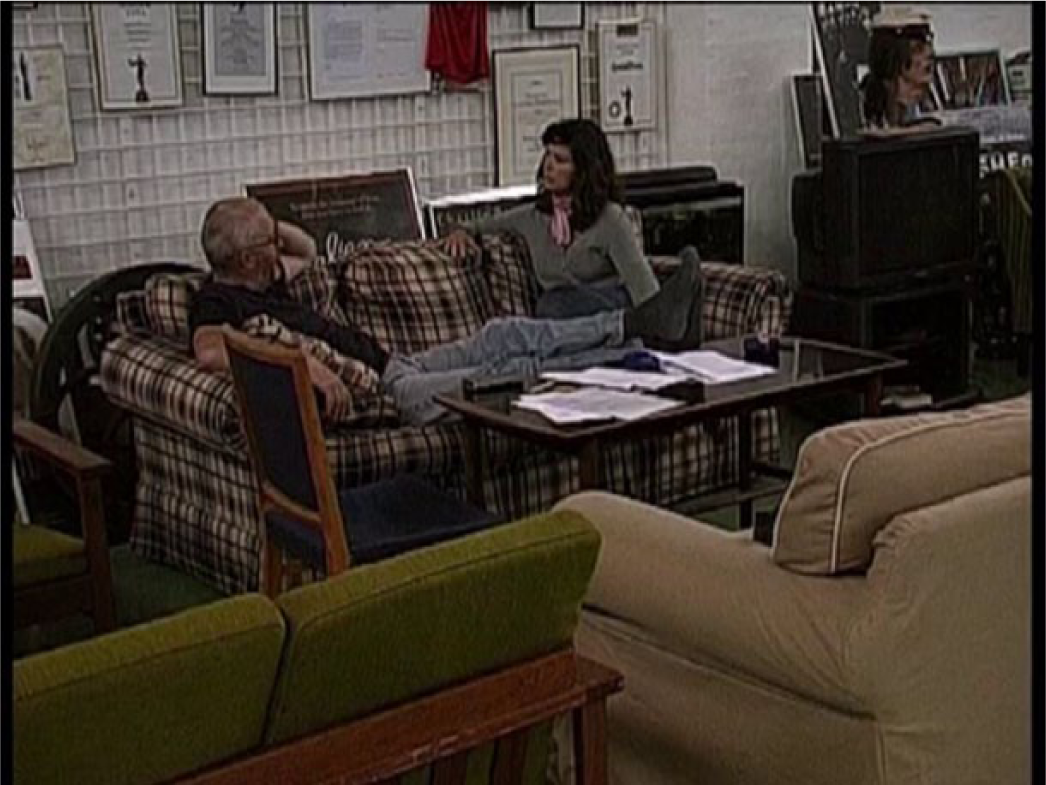
Peter Aalbæk with a producer, negotiating a pay increase.
This is a situation in which Aalbæk makes a bodily statement by indicating the cosiness and pseudo-egalitarian nature of the event, as well as its obvious quasi-sexualized character, by placing his female employee together with himself on the sofa. At first glance, the manager as an explicit signifier of power is bracketed and a free discourse among equals may blossom. In fact, this practice of symbolically negating a hierarchical relation that is acknowledged by everyone involved is what Bourdieu (1991) termed ‘strategies of condescension’ (p. 68). That they are together as ‘family’, the term Aalbæk prefers to refer to his employees in the voiceover, is underlined by placing the feet on the table indicating informality and cosiness. But Aalbæk immediately manages to reverse the message apparently sent to the producer, making it explicit in the voiceover: during the scene, Aalbæk assures the viewer that he can ‘also’ be a ‘tough manager’, capable of making hard decisions. We are told that the producer did not get the pay rise she came for. Aalbæk explains in voiceover, It was a production manager who was arguing about her salary, and we couldn’t agree. Yeah, yeah, but that that’s my job, to sit here and talk to everybody. [Aalbæk suddenly interrupts himself and exclaims casually] Oh, we have to go that premiere! [Voice-over]
It is almost as if the scene epitomizes the work regime passage posited in the much critical management literature (Weiskopf and Loacker, 2006), a passage from collective bargaining power and protective regulations to the individualized negotiation, all alone with the manager, in the most intimate of circumstances, squeezed up in the corner of the sofa. It is indeed the unmediated, direct and almost physical bodily encounter, expressing an ethical experience and an openness towards the possible mutual insight among the two, that one never has anything ‘to do with another person without holding some of that person’s life in his hand’ (Løgstrup, 1997 [1956]: 15). Yet, the rapid, almost violent, transition from the caring father and egalitarian levelling of power to the ‘tough manager’ refuses to allow a coherent experience to unfold; rather, it produces an experience of what Bauman (2000) has referred to as ‘liquid modernity’, where post-panoptic forms of power foster unpredictability and bodily intimidations that transgress conventional borderlines of privacy. Needless to say, these ethical problems would not have ceased to exist had the producer gotten her salary increase; even that result is unpredictable.
Second bodily encounter: the undressing
Our next encounter displays in an even more graphic way the manager’s embodiment of an idiosyncratic, allegedly non-conformist and anti-establishment attitude with traces of bohemian avant-garde (for a further critique, see Boltanski and Chiapello, 2005). Aalbæk had previously explained his rebellious habitus to the camera: My mother was a raving anarchist and raised me in order to always rebel against any kind of authority. She didn’t believe in the state, the police, the tax authorities, school teachers, anything. They should have the … like that! [Aalbæk displays his middle finger]. I was trained by her.
The climax of expression of this rebel-identity is Aalbæk’s undressing inside what appears to be an accountant’s office (Illustration 2). Next to Aalbæk, the accountant is occupied at his desk, carrying out some routine tasks, hardly noticing Aalbæk’s theatrical and charged performance of anti-bureaucratic rebellion. This image again graphically fits into the series of embodied acts symbolizing non-conformity that the film projects to us, but we find this scene to be particularly illustrative of the rebellious manager’s hyperconformity to the imperative of norm-transgression.
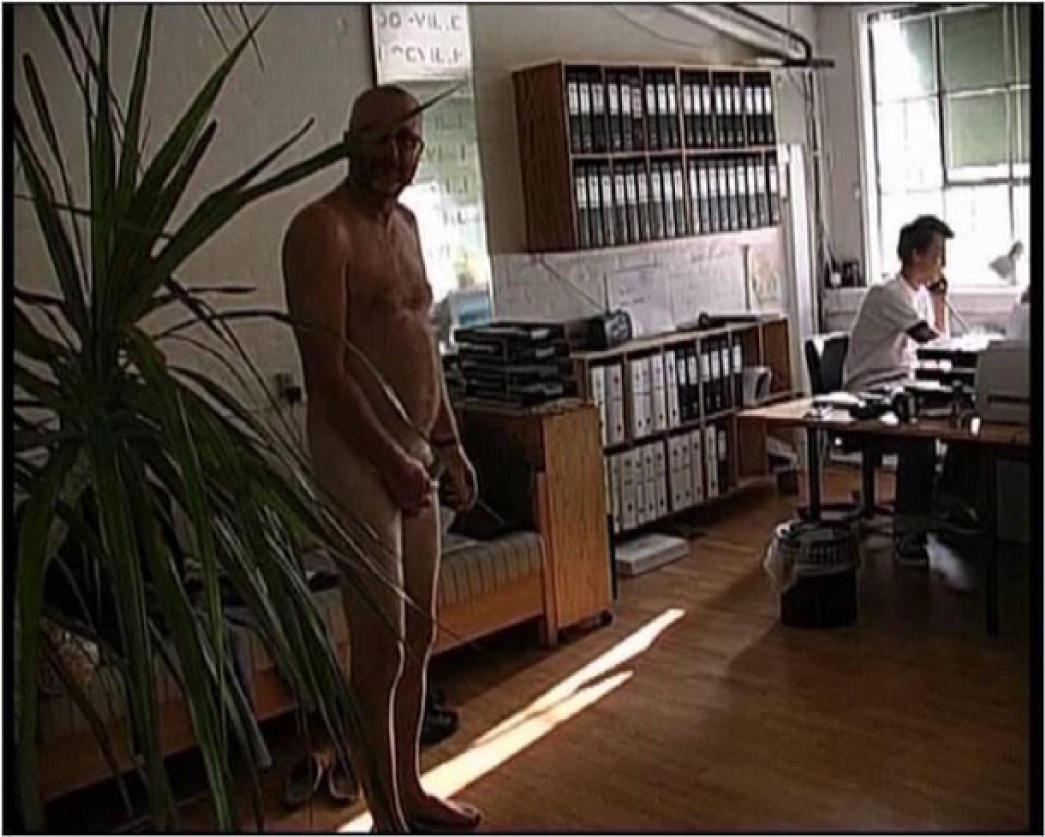
The Undressing.
Foucault (1982) said that a key problem in his whole oeuvre was to study ‘dividing practices’, that is practices in which ‘the subject is either divided inside himself or divided from others’ (p. 208). It is immediately evident that this scene creates a division between two types of subjects: the anti-authoritarian rebel versus the rule-following bureaucrat. And the division could be expanded with a list of related concepts such as ‘artist’ versus ‘bureaucrat’, ‘person’ versus ‘function’, ‘authenticity’ versus ‘rule-following’, ‘progressive’ versus ‘conformist’ and, ultimately, ‘liberated’ versus ‘repressed’. However, the efficacy of this image as a statement rests on its ability to address the employees (and ourselves as viewers) in terms of self-subjectivation. We may link this image directly to a ‘social imaginary’ (Taylor, 2000) that compels the viewer to realize that even within the mundane bureaucratic tasks of bookkeeping—and within the subject carrying it out—lies the potential for a momentary transgression that may liberate innovative forces. This is an imaginary closely connected to the rise of the ‘soft bureaucracy’ that Courpasson (2000) has addressed, a form of power which allows for bureaucracy and entrepreneurship to go hand in hand. A further interpretation of this encounter is that it calls upon viewers/employees to view themselves as divided subjects, containing the forces of repressive conformity and those of an inherent kernel of creative, visceral expressivity. Here, Aalbæk’s protected object of desire is not a disciplined and efficient production but rather the naïve innocence of anarchism and puerile joy. In the voiceover, he says, It’s fun to be a little bit on my own, me being a pain in the ass to Lars [von Trier], to Vibeke [Vindeløv, a leading producer], the team, crew, actors. So I like being the one saying the dirty things to everybody. That’s the little part I play.
That the promise of personal liberation is a key component in modern exercises of power follows from Foucault’s (1990) well-known critique of ‘the repressive hypothesis’, which questions whether power in Western societies is really expressed primarily in terms of repression. Foucault suggests that the strategic force of modern sexuality was not the prohibition and exclusion of deviant and unwanted sexuality but, rather, a more intricate discursive production of deviant ‘types’ that could be known, conceptualized and even governed while respecting their particular identities. Consequently, then, calls for liberating inert potentials must always be examined with caution; they must be contextualized and the questions of ‘liberation of what?’, ‘for whom?’ and ‘at which price?’ must be considered. Aalbæk’s embodiment of key symbolic figures of transgression and personal liberation invokes double binding slogans of the formula: ‘Rebel (like I do) against authorities (like me)’. In this article, our focus is on the CEO, but a certain dignified resilience emerges when, after Aalbæk has left the room, the accountant quietly picks up the dropped clothes and places them on a hanger in a closet. It is as if nothing unusual had occurred although he had literally hanged up the boss’ undergarments.
Third bodily encounter: the towel
Our third encounter displays, as also the first did, Aalbæk’s ability to oscillate swiftly and intensely between different identities and managerial figures. Having undressed and put on an African-looking gown, Aalbæk is filmed heading for the swimming pool. He passes some women playing table tennis. He enters an open area where a group of women are standing. He approaches them as he shouts ‘Kim! Towel!’ (Illustration 3).
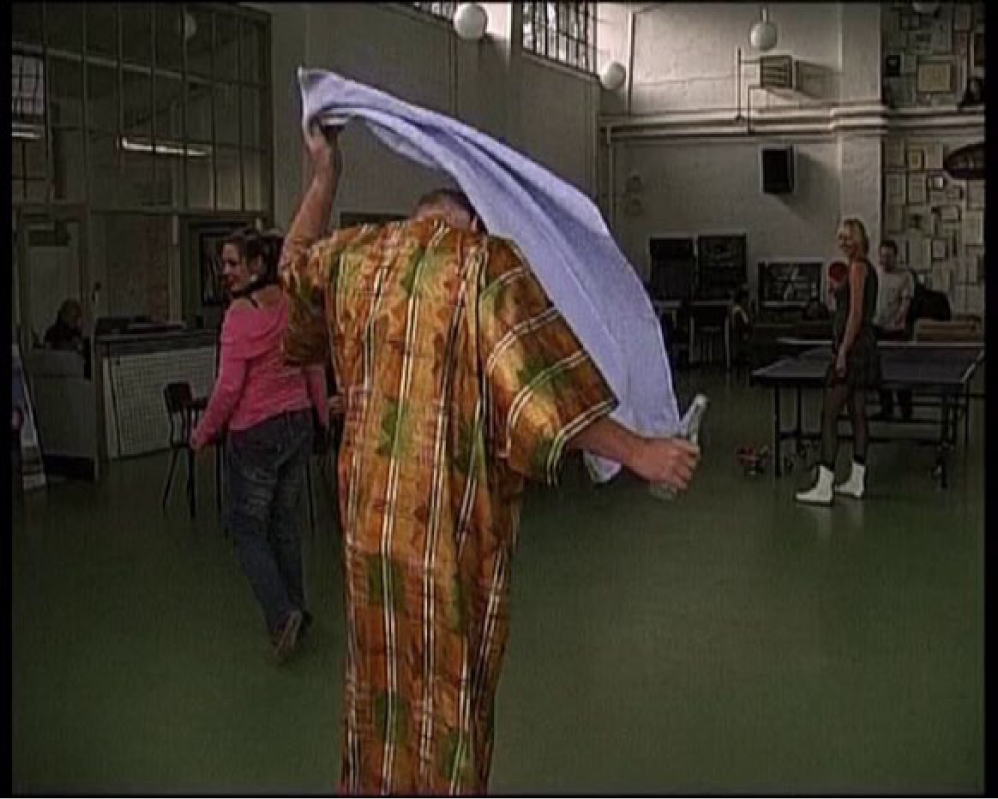
The Towel.
There is a moment of irony here, of course, in which Aalbæk realizes the impossibility of this order and the way it has been executed: he acts in a way that reminds us of Althusser’s (1984) original definition of interpellation, where Althusser refers to the way a policeman interpellates a citizen, calling him or her into being as a potential criminal. When the CEO addresses the (female) employee and singles her out of the group, he hereby, by way of the ideological configuration of the situation, interpellates her to become a particular (obviously male-dominated) subject in the discourse.
There is a tension in this scene between the alleged omnipotence of the CEO (expressed in his shouting and boxing champ attitudes) and his possible impotence: when leaving the area, he passes another female employee and teasingly lifts up the gown so as to suggest revealing his genitals. This remains a suggestion, not least because the phallus in question at this stage is in its natural, flaccid, that is, potentially embarrassing state. Again, the strategy is one of swift oscillation: the omnipotent dictator exists on the condition of him being deconstructed through the instantaneous investment of its antithesis. There may even be a question of incommensurability at play: this management gesture can only be positively expressed insofar as it is denied through its very act of expression. While, then, this gamut of incommensurability holds everyone in check, the manager, during such moments of institutional limbo, may change registers altogether, switching from the strong manager figure into that of the egalitarian communist, the exhibitionist or further into the caring Christian brother.
It is striking, then, that each time Aalbæk takes up an identity, he almost immediately reverses the message by deploying a counter-identity. Thus, during the morning walk—about in the opening of the documentary—Aalbæk is hugging and chatting briefly with all employees. He comments in the voiceover ‘I love my employees. They are like a family to me’. Aalbæk also stresses that it is crucial for him to have the ‘surplus energy’ to listen to each employee, thus incarnating the figure of a caring pastor. Yet, in the next moment he states, ‘I have to like the people here. If there is someone I don’t like, I make sure to discreetly get rid of him’. In this way, Aalbæk abruptly yet apparently effortlessly substitutes the position of pastor for a sovereign ruler. The caring family head becomes, as it were, the Godfather of a mafia clan, the latter being that distinct kind of family where you actually, from time to time, do get rid of unwanted members in the most brutal kind of way.
The impression of sovereign rule is confirmed in subsequent scenes which show Aalbæk, as we have discussed above, carelessly rejecting a producer’s claim for a pay increase and loudly commanding the female employee to bring him a towel. Then again, however, the enactment of omnipotence is subsequently rewound as Aalbæk exclaims in the voiceover, ‘All our best producers are women, and all our best directors are women. We are a matriarchy!’ Omnipotence immediately implodes into impotence. Noteworthy is indeed the intensity of Aalbæk’s oscillations between diametrically opposed identities. Furthermore, one may readily think of Aalbæk’s gestures, glamour and drama as a kind of symbolic supplement which offers a fantasy of liberated and organic creativity. To be sure, Aalbæk at times replicates images from pure capitalist production and with the accompanying capitalist discipline and authority. Yet at the same time, in his overt rebellious disconformity, he seeks a desperate utopian compensation for the very same images.
Discussion
In this discussion, we first consider how our analysis may criticize but also augment the current understanding of embodied ethics and, in particular, how it questions the body as a unitary, singular entity and hence informs the literature on embodied ethics. Second, we discuss the tactical efficacy of the CEO’s ethical practice, which we then relate to the question of employee resistance and the ideological function of ‘the rhetoric of complexity’.
We see how Aalbæk’s eccentric and oscillating management style entails numerous shifts between different registers throughout the film and throughout his practice as a manager. It is a practice which directly questions the idea of a unitary, singular human body. Harding’s (2002) division of the body into a ‘thought body’ and a ‘material body’ seems useful for understanding the divisions within Aalbæk’s flesh or perhaps rather the various scripts emanating from his body as it performs on the organizational stage. Through these scripts, which may be termed ‘Christianity, Communism and Capitalism’ in accordance with Zentropa’s espoused values (rather than their values in use, see Argyris and Schön, 1996), Aalbæk is able to shift the ‘intuitive’ exposition of his body and surprise his employees. Yet, Aalbæk’s undeniable ‘corporeal generosity’ (Diprose, 2002) leads to an extreme overproduction of organizational difference. Organizational difference cannot, in our view, per se be seen as positive; our case highlights why the practice of an embodied, ‘corporeal’ ethics does not give us a carte blanche, ‘as Foucault proposed … to reject the hierarchical and contractually bounded ethics which predominate within the organizational environments which so many of us inhabit’ (Hancock, 2008: 1371). Rather, it forces us to evaluate, from case to case, how the body, especially in the creative sector, is invested in actually producing difference imbued with a particular affect. Critiques in the name of ethics typically take as their target the social field for the existence of particular, irreducible identities. In our case, however, such a critique would be somewhat misguided, insofar as we observe an uncanny, playful appropriation of the ideals of respect for differences and diversity by the manager.
Indeed, the force of this kind of playing is very much connected to Aalbæk’s irreducible, ‘authentic’ identity, the (redeeming) fantasy that ‘he acts what he is’, namely, as a deeply eccentric character whose behaviour is dominated by idiosyncrasy, subjective taste and impulsiveness. Indeed, he is replicating the behavioural eccentricities we associate with creative ‘genius’ or ‘talent’: the childish, serene, immature, unpredictable and narcissistic gifted soul. Yet, it should be noted that throughout the film, Aalbæk accompanies his acts (in the voiceover) with a steady stream of often ironic remarks that cast doubt about the truthfulness of his different role performances. Aalbæk displays the recognition, it seems, that there can only be given sheer images of himself, yet the viewers’ awareness of the pre-existence of original versions of Aalbæk’s managerial figures is undoubtedly a constitutive and necessary element in his performance. This is, we suggest, a deliberate, built-in feature of the film. And so, the way that Aalbæk enacts a series of canonized leader-figures makes it impossible to understand their representation without an already acquired knowledge and awareness of them, thus lending his display an extraordinary sense of déjà-vu and peculiar familiarity (Jameson, 1991: 24). We are, in other words, placed in a kind of uncanny intertextuality. What function do this intense oscillation and the constant reconstruction of Aalbæk’s own person serve within management practice?
A first interpretation could be that Aalbæk is indeed acting out the ‘postmodern condition’ by creating and recreating himself as manager. He constantly invokes diverse and often contradictory messages and symbols in surprising and idiosyncratic ways. It seems that what matters in this managerial self-performance are not questions of right or wrong, true or false, beautiful or ugly, real or fake but rather an aestheticized experimentation with signs and symbols. This juggling with non-conformist and socially transgressive gestures may thus happily embrace the display of a naked paunch and a rather unimpressive penis. The oscillating enactment and re-enactment of radically different ‘manager-figures’—toggling between the fearful and the fatherly—accompanied by Aalbæk’s ironic gestures and comments create a reminiscence of ‘the postmodern moment’ of depthlessness in which we permanently doubt whether there is a real, substantial Peter Aalbæk behind all the images and masks.
At first glance, then, Aalbæk’s enactment of managerial figures may certainly appear as playing out a random stylistic allusion of received managerial figures from the archive of modern Western culture. Yet, Aalbæk’s odd, stylistic recuperations are probably not bereft of rationality or function. There is indeed, we suggest, a tactical efficacy to this ethical practice which involves deterring or undermining potential employee demands. Perhaps the explicit indeterminacy of Aalbæk’s management character and his unpredictable reactions to demands from employees—reactions of formality (e.g. compensation for overwork) or informality (‘I wish to go alone to the pool too’)—serve to prevent such demands from even occurring in the first place.
There is, however, a further complexity to the theatrical oscillation of management figures. Aalbæk has called upon the younger people ‘to rebel’, yet it seems that the managerial characters which he embodies represent nothing less than the great utopias of Western modernity: Christianity, Communism and Capitalism. Of course, this combination is readily interpreted as the production of a multi-layered reality which poses diverse and logically irreconcilable demands upon employees. But the embodiment of great utopias also poses a more fundamental problem: how to rebel against someone who is already rebelling? To ‘level’ with the naked manager, do I need to take my clothes off, too? In brief, Aalbæk’s embodied ethics can be viewed as tactics for acting upon the employees’ space of action by his claims to be avant-garde, always ahead, in terms of progressive transgression.
As of today, Aalbæk’s excesses and quasi-postmodern defiance of traditional norms may actually no longer scandalize anyone. Explicit sexualization and overt expression of non-conformist attitudes that ostensibly transcends the pillars of modernism are, in our current situation, not merely received with the greatest complacency. Such expressions of revolt, as Jameson (1991) argues, ‘have themselves become institutionalized and are at one with the official culture of Western society’ (p. 4). According to this argument, voiced by Jameson and Žižek, there is a particular ideological performativity in postmodern representations of the world as a ‘play of signification’, as deeply heterogeneous, fragmented and intersected by webs of micro-power whose effects and social value cannot be decided. This ‘extremely suspect rhetoric of complexity’, championed by Foucault and followers, portrays power as an ‘intricate network of lateral links, left and right, up and down … a clear case of catching up, since one can never arrive at Power this way’ (Žižek, 1999: 66). The rhetoric of complexity separates the micro-procedures of power from any overall system or structure. The concrete ideological effect renders it impossible to point out someone as power-holder, some structures as primary to others or to conceive of some form of cultural dominance. Hence, the ‘tactical effects’ in the local context of constantly displaying the contemporary (and perhaps still correctly termed ‘postmodern’) assertion of the world as one bereft of fixed boundaries, stable identities, formal organizational positions or even material interests are that it becomes almost impossible to thematize the ‘official’ subject positions in the company. With no fixed or stable entities, there are no critical differences of interest, responsibilities and possibilities of action. With the naked manager, labour market relations, as we know them, disappear.
Conclusion
In this article, we set out to explore the consequences of a managerial style not intended to ‘discipline’ bodies within a frame of homogeneity and a common norm (as described by Foucault, 1977). It was, rather, a managerial style intended to display and incite excess and transgression, indeed, for unleashing the body’s urges and impulses. This style draws on fantasies of fulfilling immediate, embodied impulses which in the current context are supposed to open up hitherto repressed resources of creativity and production. Our study, moreover, did not in the first place see the body as a recipient but rather as the ‘creator’ (Godfrey et al., 2012)—or perhaps more precisely as the imposer—of social meaning. Sheltered by a fiction of acting out his authentic Self devoid of (bourgeois, common man, bureaucrat) filter, Aalbæk creates, through the sheer force of his bodily presence, an organizational and tactical leverage that allows him to oscillate between various, incongruous managerial figures corresponding to Zentropa’s branded values: the businessman (Capitalism), the comrade (Communism) and the caring pastor (Christianity). When ethics is seen as a practice rather than as a set of rules, this behaviour provides insights into less explored aspects of embodied ethics, namely, how the body may become invested in breaking ‘sociality open’ (Massumi, 2003: 7) in non-benevolent ways.
While the discourse of ethics in the journal Organization, as the study of Rhodes and Wray-Bliss (2013) shows, has tended to focus on ‘the possibilities of expressing ethical subjectivity as a crucial practice of difference’, our study has sought to show how an excessive and somewhat unpredictable production of differences (however unoriginal or banal) annuls the possibilities for social organization altogether: you are integrated only if the boss hugs you, only if you can handle his request for a towel or if you can keep doing the accounts while he stands naked alongside you (p. 47).
More generally, Aalbæk’s charade verges on the overflowing and constantly disturbs the very practices of production. Indications of this include the instances where Aalbæk, on his daily morning walk, literally interrupts administrative and other staff apparently in order to ‘feel their energies’ and hug them, while they display eagerness to return to the tasks at hand and avoid his transgressive gestures. It seems that one strategy for countering the CEO is to insist on working, to carry out functional tasks in order not to become enmeshed in the spectacular games of dramatic performances in which formal positions, functionality, divisions and hierarchies are seemingly dispensed with. In this space of oscillation between representations of authenticity, informal equality and managerial sovereignty, conventional forms of employee resistance and labour struggle are rendered difficult if not impossible. Which strategies of contestation and resistance that may be exercised in such complex spaces of multiple, incongruous managerial rationalities are a subject for further studies. In Hans Christian Andersen’s fairy tale, the little boy resisted power by pointing out that the Emperor had no clothes on. In the exercise of creative management, such embarrassment is reversed and the question becomes, How do we construct a position from where to resist the naked, anti-establishment manager?