




Abstract
This article considers the role of humour as a disciplinary technology. Using the British military as an organizational context, and drawing on data from the published memoirs of recently serving military personnel, the article makes three arguments in this regard. First, it is argued that the disciplinary apparatus of the military, as an example of a rule-bound and hierarchical organizational structure, creates the conditions that allow for a controlled form of resistance (through humour) to be enacted by organizational subjects; but ultimately, such acts work to serve the requirements of the organization. Second, it is argued that humour contributes to the establishing of social cohesion through disciplinary practices of inclusion and exclusion and the drawing of lines of normalization, both at the local level and at a wider institutional level. Third, it is argued that humour permeates the power relations that structure organizational life: both those governed by rank and position and those that arise through the modes of self-regulation through which much organizational disciplining is enacted. This article concludes by drawing attention to the dialectic and dynamic nature of humour while also offering suggestions for the wider applicability of the disciplinary role of workplace humour.
Introduction
The past 20 years have seen a growing and diverging interest at the intersections of humour, work and organization (Westwood, 2004; Westwood and Rhodes, 2007). Some of the earliest contributions to this debate had as their focus a range of organizational and managerial issues that could in some sense utilize humour as a ‘tool’ for improving, modifying or even changing, among other things, group cohesion, managerial control, workplace motivation and employee retention (see, for example, the work of Duncan, 1982; Duncan et al., 1990; Duncan and Feisal, 1989). Unsurprisingly, this largely ‘functionalist’ approach to humour (Westwood and Rhodes, 2007) resulted in a range of competing voices seeking to explore humour from alternative and more ‘critical’ perspectives, drawing on the use of humour as a practice of subversion and resistance within organizations (Ackroyd and Thompson, 1999; Collinson, 1988; Linstead, 1985).
As valuable as this research has been, it has been somewhat limited to a relatively narrow range of workplace environments: primarily commercial organizational settings, such as the factory (Collinson, 1988, 2002; Linstead, 1985) and the office space (Taylor and Bain, 2003), through practices such as meetings (Kangasharju and Nikko, 2009), training events (Grugulis, 2002; Thomas and Al-Maskati, 1997) and workplace cultural change initiatives (Holmes and Marra, 2002). Relatively under-explored has been the study of workplace humour in non-commercial sectors. Furthermore, much of the extant literature has addressed humour as either a form of managerial control or as a form of employee resistance. Adopting such polarizing positions runs the risk of simplifying our understanding of workplace humour.
Studies more readily available in the sociology and psychology literatures point to a potentially rich vein of inquiry that explores humour in less conventional contexts, revealing a role for humour that can make an important contribution to the organization studies literature identified above. For example, in numerous studies of the medical profession, humour is found to be a means of dealing with the stresses and strains of the job: the closeness to death, pain and suffering—what Coombs and Goldman (1973), in their study of Intensive Care staff, call the ‘detached concern’ necessary to remain effective in the role (see also Smith and Kleinman, 1988; Nelson, 1992; Howarth, 1996; Griffiths, 1998). Elsewhere, Alexander and Wells (1991) discuss the importance of humour as a coping strategy among police officers tasked with the role of body-handling following a major disaster. Their findings resonate with those of Taylor and Frazer (1982) in their study of plane crash body recovery.
These studies can offer numerous contributions to our understanding of workplace humour and yet are seldom recognized within the organization studies literature. This article seeks to make a contribution to the field of organization studies by considering the role and importance of humour in another atypical organizational context, the British military, and in doing so seeks to bridge a gap between the more sociological and psychological literature and that more commonly found in organization studies.
While there has been some interest in research in military contexts in organization studies of late, it is still very much the case that this is a relatively undertheorized organization (Godfrey, 2009) and, to date, there does not appear to be any detailed and sustained treatment of humour in the military within our home discipline. One possible explanation for this might reflect a perception that exploring humour in the context of the military might in itself seem to be antithetical: the military normally being associated with a high degree of formal rule-based behaviour, adherence to strict levels of discipline, and obedience to hierarchy. This contrasts sharply with the notion of humour as something more subversive, more informal, anarchic even (Davies, 2001). However, the argument put forward here is that humour constitutes ‘a mode of discourse and a strategy for social interaction’ (Crawford, 2003: 1414) that is fundamental to the effective functioning of the military. Using the military as an ‘extreme’ (Sanders, 2004) case study for exploring humour provides a means for extending the current literature on workplace humour, offering new insights and potential avenues for future research.
Drawing on data from the published memoirs of recently serving British military personnel, the article discusses three uses of humour in the military, from which we can infer wider organizational applicability. First, the role of ‘humour as resistance’ is considered and contested by suggesting that such practices often fail in their subversive intent. This is not to suggest that they are not productive, but rather that the intent and the outcome do not necessarily accord. Second, the role of ‘humour as normalizing practice’ is considered, and it is argued that humour plays a crucial role in developing and maintaining the forms of social cohesion required for effective performance of organizational labour in the military. In this sense, humour contributes to the strategic necessity for comradeship among military subjects through disciplinary practices of inclusion and exclusion and the establishing of lines of normalization, both at the local level and at a wider institutional level. Third, the position of ‘humour as control’ is considered and found to be rather limited in explaining the role of humour in the military. Instead, a more dynamic and fluid form of humour permeates the power relations that structure military life: both the formal power relations assigned by rank and position and the more informal power relations and forms of self-regulation through which much of the disciplining in the military occurs. The article begins, however, by outlining in more detail the disciplinary nature of humour.
Theoretical frame: humour as disciplinary technology
The study of humour is far from new. Duncan et al. (1990) note that it has been considered and commented upon throughout history by figures such as Plato, in his Philebus; by Aristotle, in Poetics; Hobbes also approaches the theme in Leviathan; and Freud, as outlined below, is often credited as the originator of a particular theory of humour (Cooper, 2008). However, despite this impressive heritage, perhaps one of the greatest challenges in the field is in trying to adequately define the very concept of humour itself. Numerous authors have sought to capture its instinctive nature and quality, with limited success (see, for example, Romero and Cruthirds, 2006; Cooper, 2008). In this article, I am more inclined towards the view of Mary Jo Hatch and Sanford Ehrlich (1993) who suggest that humour is something that is ‘more readily demonstrated than described’ (p. 506).
In seeking to provide an overview of the field, Cooper (2008) suggests that there are three classical theories of humour. These are ‘relief theory’, ‘incongruity theory’ and ‘superiority theory’. Briefly, relief theory, associated with the work of Freud (1960), suggests that humour is employed as a means of displacing anxiety, fear or suffering. The use of humour thus serves as a defence mechanism that protects the conscious mind from the reality it faces. By contrast, incongruity theory draws attention to the object of humour itself. Cooper (2008), drawing on Frecknall (1994), argues that for humour to occur, there must be incongruity, or a lack of fit, between the humour object and the context of its being. It is in the space between object and context that humour occurs. Finally, superiority theory suggests that humour is employed as a social communicative tool used to position oneself in relation to (i.e. superior to) others. From this perspective, humour operates in a relation of power between the instigator and the target of the humorous act or incident.
Of these three, superiority theory has perhaps occupied the interest of management and organization scholars most consistently. Numerous researchers have argued that humour operates widely within organizational settings in a shifting pattern of superiority and subordination. In this regard, there appears to be broadly two bodies of literature. The first suggests that humour is a tool that can be employed by management to further organizational ends. Romero and Cruthirds (2006) argue, for example, that management can employ humour to achieve numerous organizational outcomes including fostering creativity, reducing employee stress, facilitating enhanced leadership and group cohesion, and also as a basis on which to build organizational culture. In a later work, Romero, with Pescosolido, argues that humour can be an important tool in the maintenance of group cohesion and even pivotal in issues of employee retention (Romero and Pescosolido, 2008). One of the earliest contributors to the field, Jack Duncan (1982) argued in favour of humour as a tool for increasing organizational cohesiveness, a claim he later retested and reaffirmed (Duncan et al., 1990). Elsewhere, Cooper (2008) suggests that in situations of ‘power asymmetry’, humour can become a management tool utilized to control and direct the labour of employees.
While not necessarily rejecting the idea that humour can have such influences, critics have questioned the strong managerialist discourse prevalent—one that reduces humour to just another tool in the manager’s box of tricks, and the supposition that humour operates in a linear and top-down fashion. As Westwood and Rhodes (2007) warn us, ‘There is a danger of humour, as an enormously rich and complex facet of human behaviour, being appropriated by a managerialist discourse and subject to regimes of manipulation and control’ (p. 4). Instead, they conceive of organizational humour as a much more complex, fluid and dynamic force. Making a similar argument, Johnston et al. (2007) favour a discursive approach to the study of workplace humour that allows us to position humour: ‘into the ambit of the language games we deploy in mounting, sustaining, protecting and changing the (social) identities we adopt within the complex, fragmented and shifting social contexts with which we increasingly engage’ (p. 114).
From such a position, humour can be read as constituting part of our social identity while occupying a place in the relations of power through which organizing takes place. Taking this idea a step further, critics argue that because humour is discursively constructed, it can be utilized by all organizational players and as such is not only, if ever, a tool of managerial control but also a form of resistance, subversion and challenge to the established structure of the organization (Ackroyd and Thompson, 1999; Collinson, 1988; Linstead, 1985).
While subscribing to many of the arguments found in this more critical literature, this article seeks to offer an alternative position, one that looks to incorporate notions of resistance and subversion while also recognizing merit in the argument that humour can indeed be used to manage organizational activity. To do this, I treat humour as a disciplinary technology: by that I mean a productive and discursively informed practice that occupies a role in the formal and informal structures and practices of organizational life. This approach is underpinned by a broader engagement with the work of Michel Foucault (1977, 1980, 2003) on knowledge, power and discourse.
For Foucault, power is inextricably linked to knowledge, truth and discourse. Power is productive in the generation of knowledge while being disseminated through knowledge. This power/knowledge nexus materializes through discourse, understood here as the ‘ideas, images, systems and practices which support a particular way of understanding the world’ (Brewis, 2001: 38). Foucault further argues that the individual cannot exist outside of discourse. That is to say, there is no ‘elementary nucleus, a primitive atom’ (Foucault, 1980: 98) but rather the individual is an effect of power—produced, historically, through discourse and shaped by a particular (discursive) subjectivity.
Furthermore, discourses produce truths through which social organization is shaped, manipulated, regulated and managed. However, for Foucault (1980), discursive truth is not to be conceived of as some kind of universalizing fact or reality but is, instead, best understood as ‘a system of ordered procedures for the production, regulation, distribution, circulation and operation of statements’ (p. 133). It operates in a circular relation with the power/knowledge systems that produce it and through the discursive practices and subject positions through which it is disseminated. To this end, he argues, we need to talk about a ‘regime of truth’ (Foucault, 1980), one that privileges certain knowledge over others. It is the inquiry into a particular truth, a specific construction of reality, that discourse analysis is concerned. Not, as Foucault notes, to detach power from truth ‘which would be a chimera, for truth is already power’ (Foucault, 1980), but to locate a particular construction of truth and the power/knowledge systems that sustain it in a particular time and space. Such truths and power/knowledge regimes have disciplinary effects. That is, they regulate what is sayable and knowable and inform the subject positions within the discourse. Thus, the subject is, to a degree, an active participant in his or her own subjectification.
Drawing on these ideas, it is argued here that specific disciplinary apparatus shape, regulate and inform organizational life. Within this apparatus, specific operations of domination (Foucault, 2003) serve as a productive force over the social body that occupies organizational space: it is a force that is able to regulate, control and make productive that body, that is, to make it ‘docile’ (Foucault, 1977). Such a disciplinary regime ‘reaches into the very grain of individuals, touches their bodies and inserts itself into their actions and attitudes, their discourses, learning processes and everyday lives’ (Foucault, 1977: 39)
This disciplinary apparatus manifests itself as a regime of power and control that operates through numerous technologies and discursive practices. In the military, this can be seen most visibly in the socialization processes that turn the civilian body into a military body during basic training (see Godfrey et al., 2012), and the formal and informal hierarchies of control, rank and position that permeate the organizational structure. It also informs the micro-practices and techniques of control in the military, such as the panoptic architecture of the military barracks building and the reporting and examining systems that keep the military subject under constant scrutiny and in competition with others.
The argument that I wish to put forward here is that, within this vast, complex and shifting regime, humour functions as a form of disciplinary technology—one that is embedded within the organization and that serves to help build social cohesion while allowing for control largely through processes and practices of (productive) resistance and exclusion. To illustrate this argument, I draw on data from the published memoirs of recent and currently serving British military personnel.
Military memoirs as data
The writing of military memoirs, and their use as scholarly data, is far from a new phenomenon. Indeed, as Harari (2008) notes, military memoirs have been one of the most popular forms of autobiographical writings since the early modern period and have been used throughout history as a means of gaining insight into hard-to-reach or long-passed events and lives. Interestingly, it seems that a particular enthusiasm for the writing and consumption of such texts has occurred within the context of the recent war in Iraq and the ongoing conflict in Afghanistan—as evidenced by the growing number of memoirs on the bookstore shelves and the quantity of best sellers among their number. Notably, it was perhaps Andy McNab’s (1993) thrilling account of his experiences as part of Special Air Service (SAS) patrol Bravo Two Zero in the first Gulf War that ushered in a new stylistic genre of military memoir: one that still dominates large sections of the literature today (King, 2009).
Of course, some may reject such texts as hyperbolic tales of fiction—mere popular culture designed to appeal to a particular marketplace audience. However, there is now sufficient research within the organization studies discipline that argues for the value of popular culture as an important lens through which to gain an understanding of organizational phenomena to resist such easy criticism (see Rhodes and Parker, 2008, for a review of the arguments). Data drawn from a range of popular cultural forms have been used to explore a wide range of organizational issues from economic systems and forms of exchange (Parker, 2009a, 2009b, 2011) to issues of managerial identity (Knights and Willmott, 1999), to the nature and structures of global capitalism (Ellis, 2008; Rhodes, 2002).
Drawing on arguments outlined in the above literature, this article treats published military memoirs not as mere forms of entertainment, nor necessarily, if at all, as accurate portrayals of factual events. Instead, and in following Brewis (1998), they are considered to be ‘pieces of knowledge’ (p. 85): in this instance, pieces of knowledge about war and the experience of military labour. When taken as such, they have the capacity to capture, unlike many other forms of war reporting, the lived experience of military subjects. Such an observation is all the more significant when we remind ourselves that the military is still a relatively closed-off institution to which we have very limited access. As such, these memoirs constitute, in a very real way, a significant part of our understanding, our knowledge, of contemporary military life. In this sense, they provide not a definitive account of soldiers at war but rather a regime of truth (Foucault, 1977) that the authors (and here, I refer also to the wider systems of writing, production and distribution that constitute the final published text) have constructed as their chosen re-presentation of war and military life.
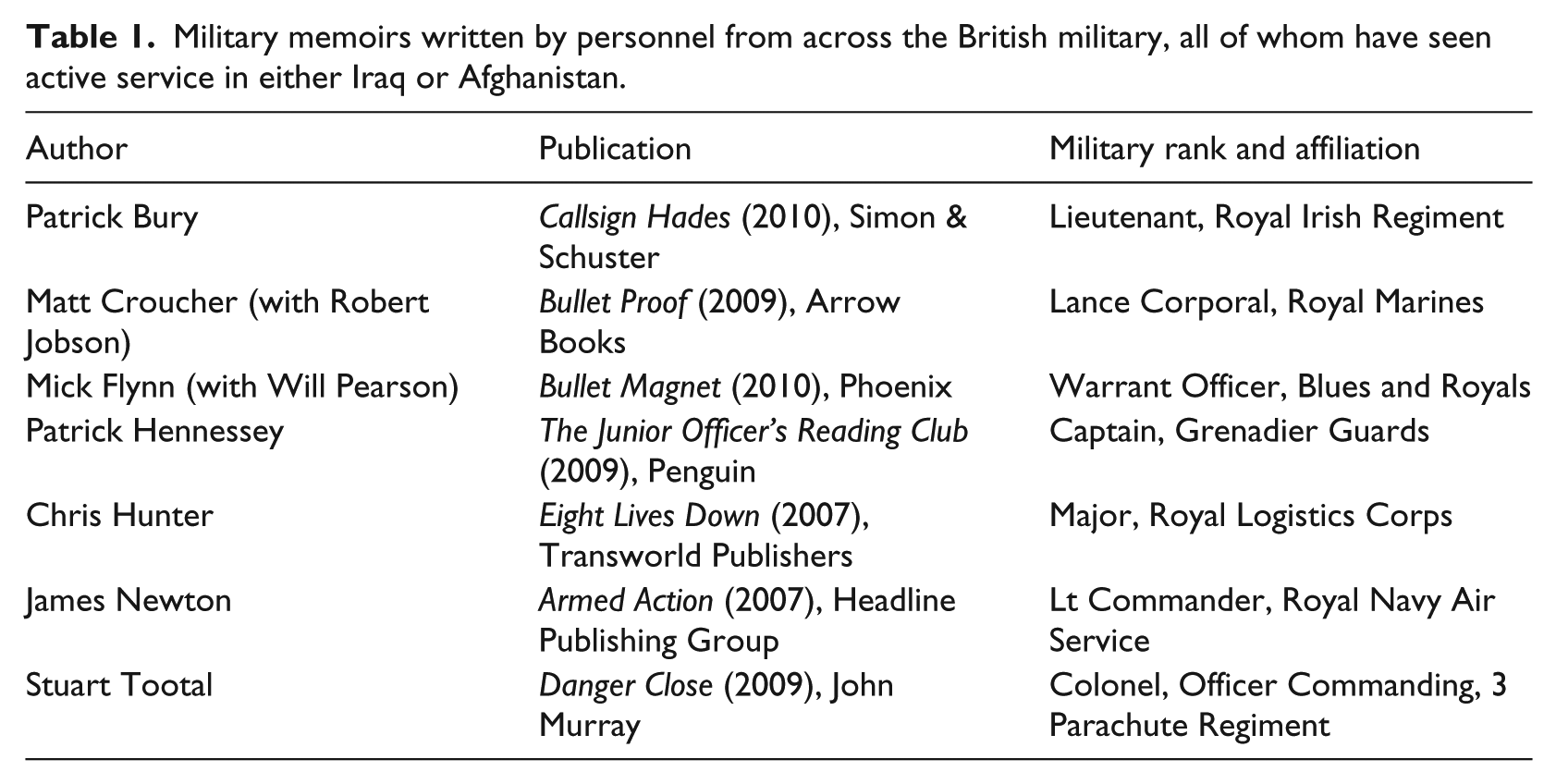
As outlined in Table 1, data for this article have been drawn from seven military memoirs, written by personnel from across the British military, all of whom have seen active service in either Iraq or Afghanistan. Contributors range from senior and junior commissioned officers to non-commissioned officers to the most junior ranks.
Military memoirs written by personnel from across the British military, all of whom have seen active service in either Iraq or Afghanistan.
The decision to use only British memoirs, written in a specific time period and covering only these two conflicts, is deliberate and recognizes the temporal and contextual specificity of humour (and of military culture), and thus creates (an admittedly arbitrary and artificial) parameter around the data set. As such, there is no suggestion to any generalizable or ahistorical patterns in British military humour.
Reflecting the dominant narrative structures of these memoirs, two organizational contexts of military service are given primary focus: basic training and combat operations. Both offer unique and atypical experiences of military labour that reveal a particular insight into the role and use of humour as a disciplinary technology. The decision to focus on combat operations also means that only memoirs written by male military personnel were considered as currently female military personnel are still officially prohibited from front-line combat duties in the British armed forces (although such a notion has become increasingly difficult to regulate in recent conflicts).
Each of the memoirs was subject to a method of discourse analysis proposed by Brownlie and Saren (2005). The purpose, and indeed value, of this form of discourse analysis is in the way it seeks (demands) that the research makes central the issues of power, knowledge, reality and truth, as constructed and represented in the text. As such, attention was drawn specifically to the ways in which the texts seek to persuade the reader of the validity of the representation of reality and the power/knowledge effects contained within this representation. This in turn requires careful consideration of the intertextual network in which the individual texts are located. The reason being, of course, that discourses are not contained within specific texts, but that texts exist within discourse: they are one more element in wider ‘systems of dispersion’ (Brownlie and Saren, 2005). As discussed above, also important in the analysis was consideration of the wider (temporal, special, organizational) context in which the texts were located, for, as Thomas and Al-Maskati (1997) have previously argued, humour can take many forms and serve a multitude of functions; however, it is only when explored in a specific context that its meaning and relevance become apparent.
Of course, in the final analysis, looking for humour will always be a deeply subjective task reflecting the researcher’s own position within the discourse. Thus, the examples and practices of humour offered in this article may, or may not, be read as such by others, but in a sense, that becomes redundant as what matters is that they have relevance and meaning for the authors of the memoirs. As such, the aim here is not to unearth universal truths, facts or realities but instead to ‘examine the way that language is used to present different pictures of reality’ (Tonkiss, 1998: 249). Having outlined the data set, I now move on to consider the first conceptual theme in this article—humour as a form of (productive) resistance.
Findings
Humour, discipline and resistance: orderly disorder?
Military life is one that is full of physical, psychological and emotional challenges, deprivations and hardships. It is a life of discipline, commitment and loss of individual control. Under such conditions, it is not surprising that military subjects devise numerous mechanisms, strategies and practices that allow them to not only cope with but also to work effectively within and, indeed, in many instances receive great benefit and pleasure from their labour (Thornborrow and Brown, 2009). One such practice is the utilization of (seemingly) subversive or resistant forms of humour to challenge both the organizational hierarchy and the system.
In the military, there is an obvious context in which such practices may become an important coping strategy, namely, in times of conflict. However, learning to use humour (as a strategy of social interaction) can also be seen as an important part of the socialization process that new recruits go through when taking up military service. During a period known colloquially as basic training, potential new recruits not only learn the skills necessary for the successful performance of their labour but are also introduced to, and socialized into, military culture. As Faris (1975) noted some years ago, the separation from family; the relative isolation from civilian life; the continuous assessment under conditions of physical, emotional and mental exhaustion; the aggressiveness; and the extreme forms of discipline and control frequently come as not only a shock to the new recruit but regularly constitute one of the most profound, memorable and often life-altering (Harari, 2008) experiences that they will ever know: such importance and significance is indexed by the often lengthy discussions of basic training in the memoirs.
In this regard, the memoirists regularly recall the humorous acts that helped them deal with this new and unfamiliar world and which helped them to feel as though they were able to regain some small sense of control. As Patrick Hennessey (2009), who would later serve as an officer in the Grenadier Guards in Bosnia, Iraq and Afghanistan, tells of his experiences of officer training at the Royal Military Academy Sandhurst (RMAS):
We muttered ‘Leadership, Character and Intellect’ [the RMAS ethos] under our breath as we scored our own little victories; diverting the energy and effort we should have been putting in on the drill square and in the classroom by planning and executing the perfect covert operation - streaking the long Old College corridor. (pp. 54–55)
He later tells stories of wanting to spike an officer’s morning coffee with Viagra, of plots to shave various colleagues’ heads and of ‘winding-up’ the Sergeant-Major by ‘compiling historical evidence that his beloved company hadn’t actually fought in any of the key battles in the regiment’s history’ (p. 105). All coded as humorous acts aimed at those in a position of authority or power and through which the recruits might feel some sense of control or active resistance.
However, such acts might be read as a mask to cover the more fragile balance between compliance and defiance that many of the authors reveal of their time in basic training. The closeness to ‘jacking it all in’, or doing physical harm to the Directional Staff (DS, or military training staff) or other recruits, was frequently abetted by a well-timed joke, stunt or reference to an earlier humorous incident. In this regard, the humour permits a form of detachment from the situation, offering the release of a metaphorical safety valve (Mallett and Wapshott, 2012) that allows the grievance to be aired in a socially acceptable way such that the training can continue. It is, as Kahn (1989) suggests, ‘a serious act of coping, performed humorously’ (p. 49).
While the intention in each of these acts is to in some way express frustration, anger or resistance to the system or the labour being undertaken, such is the disciplinary apparatus of the military that it can be absorbed into the fabric of the organization. Thus, the training staff seems fully aware that the name-calling and pranks take place and that they are mocked and ridiculed by the recruits, but such activity is permitted for the positive benefit it brings to the recruits. However, this type of subversive humour, while not denying its positive cathartic rewards, 1 might in itself be read as the example par excellence of the disciplinary technology of the military: it is a practice of compliant resistance, an orderly disorder if you will.
For, ultimately, any act of humorous resistance is futile if the aim is to truly resist the system. The military, with its wider formal and informal laws and codes of conduct, has other disciplinary techniques available to it, such as detainment, back-squadding and even dismissal, with which to discipline the deviant. As such, soldiers know that they can question, and criticize, and they can push but ultimately they also know that they cannot beat the system, not if they wish to remain within it. As Hennessey (2009) would later observe, ‘It was a game … fighting the system was all very well, but the only way to succeed was to give in’ (p. 87).
This form of orderly disorder is indicative of the dialectic nature of humour (Bergson, 2007/1901; Korczynski, 2011). That is to say, humour is at once both resistant and compliant. Thus, the very act of resistance ensures the continual smooth running of the organization. Were it not for these relatively ineffectual forms of resistance, more harmful and destructive forms of resistance might ensue, acts that could indeed fracture the structure of the organization. In Foucauldian (1977) terms, humour helps create and sustain docile bodies.
As well as providing a strategy for productive resistance within the disciplinary apparatus of the military, humour also serves other strategic functions. Such productive resistance feeds into the competitive and exclusionary culture of the military. That is, humour becomes both a gate-keeper to inclusion to military sub-groups, while also contributing to the establishing of lines of normalization—through coded speech acts and performances—that maintain levels of performance while also serving to exclude that which might disrupt the effective working of the unit. To this we now turn.
Building cohesion and establishing the norm
A fundamental concern for the military, in ensuring the effective delivery of its roles and responsibilities, is the fostering and maintenance of social cohesion among military subjects (Sion and Ben-Ari, 2009). Indeed, the building of such cohesion is a primary component of the basic training programme which, from the very first day, forces strangers into relationships of co-dependence in order to complete the simplest of activities. As Patrick Hennessey (2009) recalls in his memoir,
The famed gallows humour of the British Army is clearly forged in basic training when there’s nothing to do other than laugh (or cry - which more than a couple do). Sometimes the banter is strong and the complete strangers you have been thrown in with seem like the best and oldest friends. (p. 40)
Hennessey’s language here is interesting – that these strangers ‘seem’ like the best and oldest of friends suggests, to me, an alternative form of social relationship. This is not to deny that friendships do not arise in such situations, but rather that frequently, the kinds of bonds that are fostered in the military do not necessarily constitute friendships per se but, instead, function in the more strategic role of comradeship. The modern idea of comradeship, or camaraderie, has as its foundations the German—Kameradschaft—a term used in the late medieval period to describe formalized families of combatants who joined together for mutual protection and support (Harari, 2008). Sharing homes, food and even beds where necessary, these cameradas undertook a moral responsibility to look after one another in health and sickness and even to take care of the families of the dead. Such pragmatic organizational forms, Harari suggests, formed the basis of the modern military structure that came into existence in the 17th and 18th centuries.
The point I wish to make here is that these forms of social cohesion, frequently organized more around comradeship than friendship, are constructed and maintained in part through a series of normalizing techniques and practices that, following Foucault (1977), regulate the behaviour of both those within and those seeking admittance to such groups: the norm constitutes an effect of power/knowledge and divergence from it, (potentially) punishable. Humour, I suggest, serves as a primary mechanism through which lines of normalization are communicated and upheld. In order to elaborate this argument, two particular examples from the data are considered. First, the way in which specific speech acts and humorous performances serve as a form of initiation into the group at a local level, and second, how a wider joking culture maintains a norm of masculinity throughout the military institution.
Initiation through humour
As Coser (1960) has observed, humour is regularly employed as a means of socializing individuals into organized groups. In the military, a ritual of initiation, frequently of a humorous kind, often marks such entry (Thornborrow and Brown, 2009). For Matt Croucher (2009), a Lance Corporal in the Royal Marines and veteran of the war in Afghanistan, this involved standing in front of a wall wearing only a pair of Y-fronts while being pelted with eggs: ‘I took it as a bit of banter and an initiation to the company. But there was no harm done. Once that’s over you’re accepted as one of the lads’ (p. 42). For others, it involved various drinking games, dares and practical jokes. For many, it was also accompanied by the assigning of a nickname, typically used to capture an individual’s inabilities, inadequacies and limitations—frequently of a sexual or professional nature. James Newton (2007), who flew Apache attack helicopters in Afghanistan, tells humorous stories of one of his colleagues, simply referred to as Hovis, so named because he is a ‘loafing bastard’. As Sanders (2004) suggests, acceptance into the group through these forms of initiation and ritual humiliation can be a productive form of discipline in that they may bolster the individual’s self-esteem and the collective identity of the group.
Once successfully initiated, the subject is then exposed to the culture of the group where again humour plays a key role. As Fine and De Soucey (2005) have argued, most groups can be identified or characterized by a particular language of humour—the in-jokes, unique terms of reference, nicknames, stories and myths—knowledge of which marks one as an insider. Such humour discourses are prevalent in the data, as reflected in the following recollection made by Patrick Bury (2010), a former junior officer in the Royal Irish Regiment:
He [Mac], with others, encapsulated the spirit of the platoon, that spirit, that ethos, that constantly joked and laughed at each other and at the world in such a way that no one and nothing could keep them down. Squeak was another, an always laughing, teasing, machine gunner. He loved mocking me and annoying P.J. In this platoon, if you couldn’t laugh at yourself you were finished. (p. 88)
The final words from Bury are instructive. While joking and pranks can in one sense be seen as degrading and a form of workplace violation, 2 they can also constitute a more productive means of regulating the group and of building cohesion. For Ben-Ari and Sion (2006), such practices form an important component in the creation of akhvat lochamim—a solidarity of warriors. It establishes a common language and common experience, which is crucial to ensuring the levels of social cohesion necessary to this form of labour.
Not only does such humour foster cohesion but it also serves a ‘boundary function’ (Watts, 2007) between the group and various others. Indeed, humour is often utilized as a weapon in social relations as a means of gaining superiority over variously defined others (Cooper, 2008). As observed in the memoirs, such others include the enemy, civilians and even other units and military services. Frequently, this marking out of otherness takes the form of name-calling and practical jokes. As Hockey (1986) notes, among the regular infantry, there is a saying that only two things fall out of the sky: ‘Paras and birdshit’ (p. 78). In Afghanistan, those on the front line refer to support arms, headquarters and those further removed from direct conflict as REMF (Rear Echelon Mother Fuckers), and much disparaging ridicule is thrown their way 3 (Tootal, 2009).
However, as Ben-Ari and Sion (2006) argue, such exclusionary practices go beyond mere inter-service rivalry and jockeying for position:
The implication of this situation is that the community of strangers, while based on face-to-face groups, tends to subtly radiate and reinforce wider hegemonic attitudes: the importance of military duty, the centrality of male heterosexual identity and the exclusion of women. (p. 669)
Let us now look at this wider institutional discourse in which humour performs a regulatory function.
Gendered humour as an organizational norm
Collinson (2002) in his study of shop floor culture notes that workplace humour can often be strongly gendered. On the all-male shop floor, to accept a rite of initiation, to be laughed at, to laugh at one’s self is an important masculine trait: ‘For only real men would be able to laugh at themselves’ (p. 185). He continues, ‘Exposure to the joking culture, not only instructed new members on how to act and react, but also constituted a test of the willingness of initiates to be part of the male group and to accept the rules’ (p. 188). A similar argument has been made by Johnston et al. (2007), who argue that organizational humour has strong gendered overtones and that the ‘proper’ performance of organizational humour is important to one’s broader gendered identity.
Without too much contention, we might suggest that the military can be seen as an example of a masculine organization. For Morgan (1994), it is the site of inquiry for the study of masculine performance. Such views are widely shared: for Hirschfeld (cited in Schneider, 1997: 186–187), ‘Of all occupations that are allotted to one or the other sex, none has been considered so much a male privilege as that of the soldier’ (see also Barrett, 2001; Cockburn, 2001). Godfrey (2009) suggests that not only is a masculine performance fundamental to military practice but that the military, and the act of making war, have in themselves become significant factors in wider conceptions of what it means to be a man (subject) and how Man (discourse) has been constructed. Thus, in many societies, throughout human history, war and masculinity have been irrevocably connected, such that ‘to be a real man is to be ready to fight’ (Cockburn, 2001: 20).
In the masculine order of the military, it is perhaps unsurprising that much of the gendered humour that takes place involves the subordination of women and the feminine to a visible and embedded discourse of military masculinity. Thus, in the military memoirs (all written by men), we see, somewhat predictably, an overt form of sexual humour in which women are objectified and reduced to props in the masculine performance. Mick Flynn (2010), a veteran of both recent conflicts as well as operations in the Falklands and Northern Ireland, describes a common practice among young (male) soldiers in which female attractiveness is linked to the amount of alcohol consumed. As such, ‘a “ten-pinter” is seen as a last resort at the end of the night’ 4 (p. 265).
For Lyman (1987), such joking behaviour is deeply embedded in the structures that underpin the social cohesion of the male group: ‘gender is not only the primary content of men’s jokes, but the emotional structure of the male bond is built upon a joking relationship that negotiates the tension men feel about their relationship with each other, and with women’ (p. 150). At the same time, the metaphor of the feminine serves as an important foil against which to measure the masculine ideal: defeat, weakness and failure are attributed feminine connotations and ridiculed accordingly, while success, victory and strength are signifiers of the masculine and celebrated as such (Godfrey et al., 2012).
Not only can we see the relegation of the female and the feminine to a position of subordination that, it might be argued, is part of a wider normalizing practice in the military but also that the joking serves, once again, as a productive form of discipline that enables these military men to deal with their relationship to women. Several of the memoirs tell stories of unfaithful partners, fear of separation or temptations to cheat on spouses. For example, Chris Hunter recalls throughout his memoir how humour became an important aspect of the coping strategy he used when dealing with both the absence of family while on training exercises or on operations, and also of the strain put on family and personal relationships as a result of the commitments of military life. Having faced increasing difficulties at home and the likelihood of separation from his wife, Hunter, a bomb disposal officer in Afghanistan, opens up to a colleague about his emotional problems. His colleague in turn responds in a suitably military manner:
‘Can I ask you a serious question?’ he says. ‘Of course mate. Shoot’ ‘If it doesn’t work out between you two, and you do end up getting a divorce, do you mind if I have a crack at her?’ (Hunter, 2007: 315)
Others appear to revel in the enjoyment and pleasure to be gained from the male bond, negating any negative emotion derived from separation from the civilian self. For example, James Newton (2007) makes an interesting comment when discussing the act of saying goodbye to loved ones when departing for war, and in doing so positions the male bond as one of greater significance and enjoyment (in that context) than those left behind:
It’s always the same awkward scene of tear-stained faces, bear-hugs, quiet moments with the kids on the knee, and lots of forced humour, plastic smiles and crap wisecracks … [but the real] banter begins almost instantly we’re on our own. (p. 25)
Newton’s phrasing ‘on our own’ to define the organizational group, juxtaposed with the almost uncomfortable dynamic marking the relation to the family group, seems to support Lyman’s (1987) argument that the male bond (in such organizational contexts) frequently supersedes all other relationships—something actively encouraged and cultivated in the culture of the military.
To summarize, in the above discussion, the role of humour in fostering and maintaining social cohesion, as a strategic necessity to effective military performance, has been put forward. Central to this requirement are the lines of normalization that initiate, admit and include while also excluding, prohibiting and relegating. The languages and practices of humour serves as an important means through which such norms are communicated, regulated and maintained. In the final section of the article, I wish to consider more explicitly the power relations that underpin the various uses of humour discussed so far.
Humour, control and self-regulation
In this section, I wish to consider two examples of the way in which the underlying relations of power governing military life, both formal and informal, utilize humour as a key communicative strategy of control and (self-)discipline. First, the use of humour as a seemingly consciously employed tool used to manage the relationship between training staff and new recruits during basic training will be considered. Second, drawing on Fineman et al.’s (2005) observation on the importance of the unwritten rules, codes and practices that govern much organizational activity, consideration will be given to the role of humour as a regulatory force in the more informal relations of power that circulate within the military.
Humour as a tool of formal control
We have already noted the rigours, stresses and challenges of military basic training and the use of humour as a means of productively resisting/complying with this system. However, within this context, humour is not only used by recruits but is also embedded in the training culture itself. In particular, it is employed by the training staff as a means of communicating with, and managing the training of, recruits while also socializing them into military culture. Patrick Bury (2010) recalls his first meeting with the Colour Sergeant who would be responsible for his training while at RMAS:
‘Work hard for me and I’ll work hard for you’ That’s reasonable, mature even … Maybe he’s trying to lull us into a false sense of security? ‘And if that fails, CLF.’ ‘CLF, colour sergeant?’ CLF, Mr Bury: Cheat. Like. Fuck!’ And that was my first introduction to both British military acronyms and British military humour. My relationship with both would continue throughout my year at Sandhurst. (p. 18)
The same Colour Sergeant would later berate Bury for his inability to keep time on the drill square: ‘Mr Bury! You look like an epileptic orang-utan!’ (p. 26): a typical example and so indicative of the use of humour as a means of addressing inadequate performance and for disciplining recruits. The relevance of humour here, I would argue, is in the way it allows an important message to be conveyed and poor performance to be addressed, but it is administered in a way that seeks to draw the individual and the group into the culture of the organization. To what end? For Hockey (1986), such tactics are used widely in basic training as a tried and tested means of gaining compliance and subordination from the recruits. During what he refers to as the ‘role-stripping phase’ (p. 57), ridicule, mocking and embarrassment are inflicted on the fresh-faced recruit in a deliberate move to ‘toughen him [sic] up’. Such humour also serves to more quickly socialize recruits into military culture and, in part through protection against the barrage of abuse, begin to foster the bonds of social cohesion that have been identified above as fundamental to effective military performance.
However, Hockey also suggests that there is a changing dynamic to the banter, and in this regard, humour serves as a marker of the changing relationship between recruits and staff as the training progresses. The overt and ridiculing observations of the recruit’s poor performance slowly develops into a form of mutual joke-telling and pranks as the recruits gradually learn the skills of their chosen profession and slowly gain the respect of the DS, not just as soldiers but as potential future comrades. In so doing, a sense of solidarity and of cohesion between subordinates and superiors begins to develop. As Hennessey (2009) observes of his changing relationship to the DS at RMAS,
The CSgt was best, his stream-of-consciousness rants by now the stuff of legend among thirty of us who had as clear a case of Stockholm Syndrome as ever you’re likely to see. Hanging on every word of this man whom we had feared and hated in equal measure but now worshipped and envied, his professionalism, his experience, his implied hardness … He was an awesome soldier, and the more we learned about soldiering and the more we found it nigh impossible, the more we revered him. (p. 60)
Once out of basic training, the relationship between subordinates and superiors continues to turn frequently around humour as a form of communication as Stuart Tootal (2009), former commanding officer of 3 Parachute Regiment, observes during their deployment to Afghanistan:
Despite the most adverse of conditions and regardless of rank, the banter between officers and men was excellent. The ability to laugh at ourselves and each other served to lighten the seriousness of the grim business we were often engaged in and draw some of the blackness from the sorrow that we suffered. (p. 240)
This quote from Tootal is worth unpacking further. What it points towards, I would argue, is the dynamic nature of the power relations within the military. Despite the clearly defined hierarchy, as assigned by rank, humour functions to allow other power relations, such as those based on experience, to overcome more formal lines of responsibility. As Ben-Ari and Sion (2006) correctly observe, ‘Frequently it is soldiers who socialize new officers who have just graduated from the regular army and need to learn what is demanded of them in their new role’ and humour is a key communicative tool in this regard (p. 660). It is, to use Foucault’s (1977) language, ‘a mechanism of power’ in which formal authority is subordinated to experience and ‘know how’ (p. 104). Moreover, humour as an arbitrator of relations of power does not just operate along formal lines of hierarchy. It is also used among those of equal or similar rank in the more informal relations of power through which much military discipline is administered.
Humour as informal self-regulation
Humour can be utilized, as Fineman et al. (2005) observe, as a means of self-discipline, to control and police the deviant. As such, humour becomes ‘the first indicator of the line between acceptable and unacceptable behaviour’ (p. 217). In the memoirs cited, acts such as uplifting a recruit’s locker, hiding his personal items and moving his bed outside onto the parade ground are presented as humorous acts, but carry with them clear warnings to those recruits who are deemed not to be pulling their weight or whose poor performance is impacting negatively on the wider group. As such, humour and humorous activity are used as a form of discipline, for those who deviate from the norm. However, because of the way in which such discipline is administered, its meaning can be more easily contested and the instigator(s) of the joke or prank can more readily deny malicious or harmful intent, after all, it was only a joke!
In this regard, and in following Fine and De Soucey (2005), we can consider this form of joking culture as a disciplinary technology that not only creates acceptable norms of group behaviour but also regulates the behaviour of the group. As such, it ‘constitutes one of the more effective techniques of social control’ (p. 11) and importantly, the only way to avoid being the target of continual joking behaviour is to ‘fall into line’ with the acceptable norms established within the group. Thus, it is a productive form of discipline in that it incites a change or modification in the behaviour of the humour target.
In a profession such as the military, we might suggest that the need for such forms of in-group regulation are especially important. When the primary task of military labour is to engage in lethal combat, then, as military memoirists throughout history have repeatedly stated, you have to trust those around you with your life and have them trust you with theirs. As such, and given the heightened levels of anxiety, stress and fear that combat produces, the value of group regulation through humour, as opposed to other forms of discipline, might be seen as especially beneficial. As Stuart Tootal (2009) observes,
Humour also played a part in the motivation of my soldiers. The nervous emotion of combat often engenders a seemingly incongruous level of humour and sense of the ridiculous that seem absurdly out of kilter with the associated risks of the surrounding environment. Paratroopers often spoke of how they found the immediate aftermath of a near miss, or someone’s small mishap under fire, hilarious [such as getting shot in the backside, as appears to happen with surprising regularity in these memoirs]. It was not uncommon for people to be reduced to fits of giggles after such incidents. It was often an automatic reaction to having survived them and a vital coping mechanism for facing the rigours of the abnormal situation in which they found themselves. (p. 240)
Such a reflection is supported by Hockey (1986) in his ethnography of serving soldiers on tour in Northern Ireland in the early 1980s. He notes that in theatres of conflict when ‘faced with a day to day existence full of precariousness and uncertainty, … humour acted as a compensatory device making the fear and tragedy of the moment seem only temporary’ (p. 137).
Recounting the death of Corporal Mark Wright, who was killed in Afghanistan as a result of injuries sustained in the act of rescuing seriously wounded members of his platoon, while under enemy fire, Stuart Tootal (2009) observes,
There was even an element of humour to lessen the horrors they were in. Mark Wright joined in the banter as the wounded and those treating them took the piss out of each other. But Mark Wright was fading. He mentioned that he felt cold and that he knew he was going to die. (p. 250)
Tootal later visited two of the injured men back in a UK hospital:
I knew it was a stupid question, and I said so when I asked him how he was doing. ‘I’m all right, sir; it’s the first time I’ve been legless on the tour since you banned alcohol!’. Andy was nineteen and had just had his left leg amputated above the knee. (p. 260)
In this final passage, we see another example of the way in which the formal relations of power are inverted through the humorous speech act. Tootal, the senior officer, unsure how to deal with the situation, is guided by the soldier who makes light of it, thus reframing the damaging physical and emotional wounds in a way that allows them to be dealt with, or at least negotiated, for the time being.
Discussion and conclusion
Drawing on experiences of military service retold in the memoirs of recently serving British military personnel, this article has made an argument for conceiving of humour as an important vehicle through which the disciplinary apparatus of organizational life is communicated and maintained. Conceiving of humour as a technology of discipline (in the Foucauldian sense) creates the space for a more complex and dynamic understanding of the role of humour in workplace environments, one in which humour can be seen to take on many, often closely intertwined, sometimes contradictory, even ambiguous, functions in the ebb and flow of social interaction.
The article highlighted three such examples. First, it showed how the disciplinary apparatus of the organization creates the conditions that allow for a controlled form of resistance (through humour) to be enacted by organizational subjects, one that offers benefits to the instigator of the humorous act but that will always ultimately fail in its subversive intent. Second, it explored the role of humour in contributing to the establishing of social cohesion, specifically through humorous performances and speech acts that communicate and maintain the organizational norm. Third, it considered some of the ways in which humour permeates the power relations that structure organizational life: both those governed by rank and position and those that arise through the modes of self-regulation through which much organizational disciplining takes place.
I would argue that humour as a disciplinary technology serves an overriding purpose in the military similar to that of ‘detached concern’ described by Coombs and Goldman (1973) in relation to the medical profession. It is, ultimately, a form of coping—one facilitated by and functioning through the disciplinary apparatus of the organization. Its main value, perhaps, to create the kind of ‘psychological distancing’ (Kahn, 1989: 54) required of this form of labour. Thus, at times of great fear, stress and anxiety, humour helps increase the distance between the military subject and the situation they find themselves in, whether that be the unfamiliar surroundings and lack of reference points experienced in basic training or the horrors of the modern battlefield. Humour, in these contexts, allows the military subject to continue to operate and fulfil their labour, rather than succumbing to the stress-inducing phenomena. Humour also creates distance in the forms of othering that seem fundamental to military culture. By encouraging distance from these various others, the social bond of the group can be further strengthened and made more productive to the requirements of the organization. Finally, humour often also operates to reduce the psychological distance within the group: recruits and comrades in arms quickly (forced to) form strong, if ephemeral, bonds that allow them to deal with the realities of their labour and to subsequently manage relations within the group. In all of these instances, humour seems to be a key communicative tool.
In the final section of this article, I wish to conclude by discussing the key themes that have emerged and to use these as a platform to make a number of links back to the wider literature of workplace humour and to suggest a number of potential areas of further study and exploration.
The first key theme that the article has developed turns on the central role of power at the heart of organizational life. Of course, this is a topic that has been well researched and well rehearsed within the organization studies literature (Clegg et al., 2006), but a potential contribution of this article may rest with the way in which the relationship between power, humour and hierarchy has been reformulated. Although the relationship between power and humour has been addressed in the management literature, and has on occasion been located within the context of rule-bound hierarchical organizational structures of the kind discussed here (see, for example, Coser, 1960), much of the literature has focused on the way humour can either be used to reduce hierarchy through intentional managerial acts (Duncan, 1982) or to subvert and resist hierarchy (Collinson, 1988).
Here, I propose a more dynamic understanding of the intersection between power, humour and hierarchy. The notion of orderly disorder points to an alternative role for humour which takes account of its subversive and resistant role, while recognizing that resistance, although not futile, is certainly limited in its ability to truly challenge hierarchy, structure and rank. In this regard, Grugulis’ observation is most apt when she states that ‘To view humour as completely subversive fails to account for its apparent incapacity to change organizations or social institutions, to dismiss it as a mere frivolity underestimates its enormous symbolic power’ (Grugulis, 2002: 403).
This article provides a means for articulating a middle ground between these two extreme views and, in this sense, is more in line with the position of Mulkay (1988) and Powell and Paton (1988). In place of the simple dichotomy of workers seeking to resist through humour and managers seeking to control through humour, a more complex, subtler dynamic appears to be at play. This is perhaps best exemplified through the theme of ‘humour as control’ discussed in the latter sections of the article. Here, the article also draws out the complex and dialectic ways in which humour shapes the formal and informal disciplinary practices that regulate the behaviour and conduct of military subjects. That humour operates widely within organizational settings in a shifting pattern of superiority and subordination is a well-established theme within the literature on workplace humour (Cooper, 2008; Duncan, 1982; Duncan et al., 1990; Romero and Cruthirds, 2006; Romero and Pescosolido, 2008; Westwood and Rhodes, 2007) However, all too frequently, the issue of power is treated in a more functional sense as a possession conferred by position in which those with power exercise it over subordinates, often utilizing humour as a communicative tool.
In contrast, the role of humour as a means of communicating both formal and informal rank, position and superiority, is found to be much more fluid in the military context. While the military is an exemplar of the hierarchical and bureaucratic organizational structure, there is also a clear sense in which informal relations of power, often based on experience rather than rank, mediate organizational life. Thus, young officers taking up a new command, while formally outranking the soldiers under their care, are regularly instructed by said subordinates into their new role, the culture of the unit and so on. That the formal hierarchy of the military prohibits the giving of orders by soldiers to their officers, humour becomes a key means through which to inform, correct and educate. That subordinates ‘train’ their superiors is a largely neglected theme within the management literature, but humour provides a means of identifying and opening up the organizational practices through which this takes place. That it might be the manager ‘sitting next to nellie’ is an interesting proposition indeed. Such a finding also challenges the notion that worker humour is always and only ever subversive or resistant.
Second, this article adds further insight into the role played by humour in the socializing processes and normalizing practices inherent in organizational life. Here, the findings are resonant with those found in the more critical literature on workplace humour (Cooper, 2008; Fineman et al., 2005; Terrion and Ashforth, 2002). Moreover, the everyday practices of social interaction and local acts of humour outlined in the memoirs also serve as a vehicle through which to consider wider professional and organizational discourses (Franzén, and Aronsson, 2013). Thus, whereas in the medical profession, humorous acts are often marked by more passive and caring disciplinary technologies, indicators of the wider discourse of caring that pervades this profession (Coombs and Goldman, 1973; Griffiths, 1998; Howarth, 1996; Nelson, 1992; Smith and Kleinman, 1988), in the military, the more overtly aggressive and masculine form of humour reflects its unique wider institutional discourses. But what is most important is that ultimately, both humour regimes serve the same purpose. They both constitute productive forms of discipline. They both enable things to get done, for subjects to accomplish their labour, for the organization to function effectively. It seems to me that studies of humour in other occupational and organizational contexts could be equally revealing in articulating wider discursive practices and norms.
Finally, this study extends the existing literature by drawing out in particular the gendered aspects of these normalizing practices, and of humour itself. As Johnston et al. (2007) rightly observe, there have been ‘surprisingly few studies that have examined the gendered character of humour in organizational contexts’ (p. 115). Perhaps the notable exception being Collinson’s (1988) factory floor workers, who exhibit similar practices of (gendered) humour as those found in this study. This may not be a coincidence however; with compulsory national military service in the United Kingdom only ending in 1963, it is highly likely that many of Collinson’s factory workers would have experienced military life and culture. There is also evidence of gendered humour in other masculine workplaces such as the mines (Pitt, 1979) and the police service (Alexander and Wells, 1991). More noticeably absent from the literature are studies of humour in female-dominated or ‘feminine’ organizational contexts. Sanders’ (2004) study of humour among female sex workers provides an excellent example of the potential richness of this line of inquiry, and this article provides a conceptual framing through which such forms of gendered humour might be explored.
In sum, by considering the military as a workplace and soldiering as an occupation, this article has been able to approach the theme of humour from a unique angle that has revealed a number of new insights that add to the existing literature. It is perhaps because of the military’s status as an ‘extreme profession’ (Sanders, 2004)—one that places particular demands on the physical and emotional self and one that often exposes the individual to great physical, emotional and psychological harm—that such findings were possible. Thus, the use of humour, while seemingly incongruous with the nature of the work undertaken in this context, is, instead, revealed to be an important, if not fundamental, component of organizational life. Without denying the demands placed on the labour to be found in more conventional forms of commercial workplace, by exploring these extreme professions, we see peculiarly exaggerated forms of workplace performance that can only, it seems to me, enrich our understanding of work and organization.