




Abstract
Organizational scholars pay insufficient attention to noncapitalist enterprises, which limits management theorizing. This article is based on a participatory action research project conducted in the town of Asbury Park in New Jersey, where community researchers attempted to map the solidarity economy of the region in order to promote a different kind of economic development. It presents the findings of the project, which involved investigating the economy and surveying collective forms of organizing in sectors such as agriculture and finance. Examining the well-developed Brazilian solidarity economy movement as contextual background, the lessons from that movement could prove useful to incipient US efforts. Using the findings of the Asbury Park project, the significance and implications of supply chains in sustaining alternative economies will be explored.
Keywords
Now I been lookin’ for a job but it’s hard to find Down here it’s just winners and losers and Don’t get caught on the wrong side of that line Well I’m tired of comin’ out on the losin’ end. But I know a place where we can go, Mary Where I can get a good job and start out all over again clean.
Introduction
Mainstream organizational theorists have often used large for-profit firms as their default units of analysis (Schendel and Hofer, 1979), and measures such as return on investment as proxies for performance (Venkatraman and Grant, 1986). Once the determinants of performance are identified, they are distilled into models that are disseminated across the economy through universities, consultancy firms, and policy experts (Capon et al., 1990). These models tend to become standardized across for-profit firms, nonprofit organizations, nongovernmental organizations (NGOs), and government agencies (Rojas, 2000). The diverse forms of economic activity, especially noncapitalist ones, do not receive much attention from management scholars, and thus fail to inform management theory.
This article is an attempt to make an intervention in this area, and is based on an action research project conducted in Asbury Park, a poor town in New Jersey that is possibly best known for its most famous son, the musician Bruce Springsteen. I begin by identifying two theoretical influences informing my discussion: one, a Marxian theory that distinguishes between different forms of value, enterprise, and class structure (Gibson-Graham, 1996, 2006; Resnick and Wolff, 1989), and two, the concept of and concrete social movements associated with solidarity/social economies (SSE; Laville, 2003; Mance, 2007; Mendell et al., 2007) that seek to grow the role that worker associations, cooperatives, and progressive enterprises directed by social missions might play in producing a different kind of economic development. Both theoretical traditions have deployed participatory forms of research in order to produce different representations of the economy, and hence, challenge the tendency within organizational theory to naturalize capitalism at the macroeconomic and microeconomic levels. I report on my own participatory action research (PAR) in Asbury Park and present its main findings, as well as one of the main results from the project, the first worker cooperative composed of construction workers in the town. Using the well-developed case of the Brazilian solidarity economy, and connecting it back to a theoretical literature that surveys noncapitalist difference, mapping can be seen as a performative ontological project (Gibson-Graham, 2008). Mapping uncovers an economic diversity which shifts the ontological frame of the economy and generates new possibilities such as the creation of noncapitalist forms and supply chains. In the final section, I turn my attention to how noncapitalist supply chains require engaged research specific to the difference in their organizational forms and relations.
Class difference and diverse economies
A lively strand of research has been coalescing around the concept of ‘diverse economies’ (Escobar, 1996; Gibson-Graham, 1996, 2006; Safri and Graham, 2010). This critical literature in economics, economic geography, and political economy theorizes difference in organizational and class processes in both market and nonmarket settings (Gibson-Graham, 1996, 2006; Gibson-Graham et al., 2000, 2001; Resnick and Wolff, 1989, 2006, 2012). Using Marxian theory, Resnick and Wolff (1989, 2012) deploy the concepts of necessary and surplus labor to identify a mix of class processes. 1 When surplus labor is produced by one group of workers, but appropriated and distributed by another group or individual, that class process is identified as exploitative; when the productive, appropriative, and distributive positions are all occupied by the same group of workers, that is theorized as a nonexploitative class process. The different conditions attendant to a class process (in the intersecting realms of culture, politics, and the economy) allow further distinctions between feudalism, capitalism, communism, independent production, and slavery as either dominant modes of production characterizing an entire social formation or fundamental class processes that organize individual organizations, firms, or sites.
Orthodox or essentialist Marxists have interpreted this language of difference based on modes of production as a historical stagist model of economic development in which capitalism is ‘situated at the pinnacle of development and … communism, capitalism’s other, is posed as a future utopia, yet to be realized in any concreteness’ (Gibson-Graham, 2006: 59). Conventional analysis precludes the potential mix of class processes made possible by the deconstructive techniques deployed by Resnick and Wolff, and Gibson-Graham, who instead posit different exploitative and nonexploitative class processes as co-existing in society, rather than marching in sequence through time.
Challenging the conventional approach to the economy assumed by both non-Marxists and Marxists alike, Gibson-Graham argue against a ‘capitalocentric’ reading of the economy that
assigns positive value to those activities associated with capitalist economic activity, and assigns lesser value to all other processes of producing and distributing goods and services by identifying them in relation to capitalism as the same as, the opposite of, a complement to, or contained within. (Gibson-Graham, 2006: 56)
Instead of erasing economic difference, where all paid labor, market exchange, and organizational forms are linked together in a chain of equivalence that subsumes noncapitalism into capitalism, a set of scholars associated with Gibson-Graham and the Community Economies Collective (2001) have sought to unfix the chain and produce a language, representation, and politics of the economy as organized by difference.
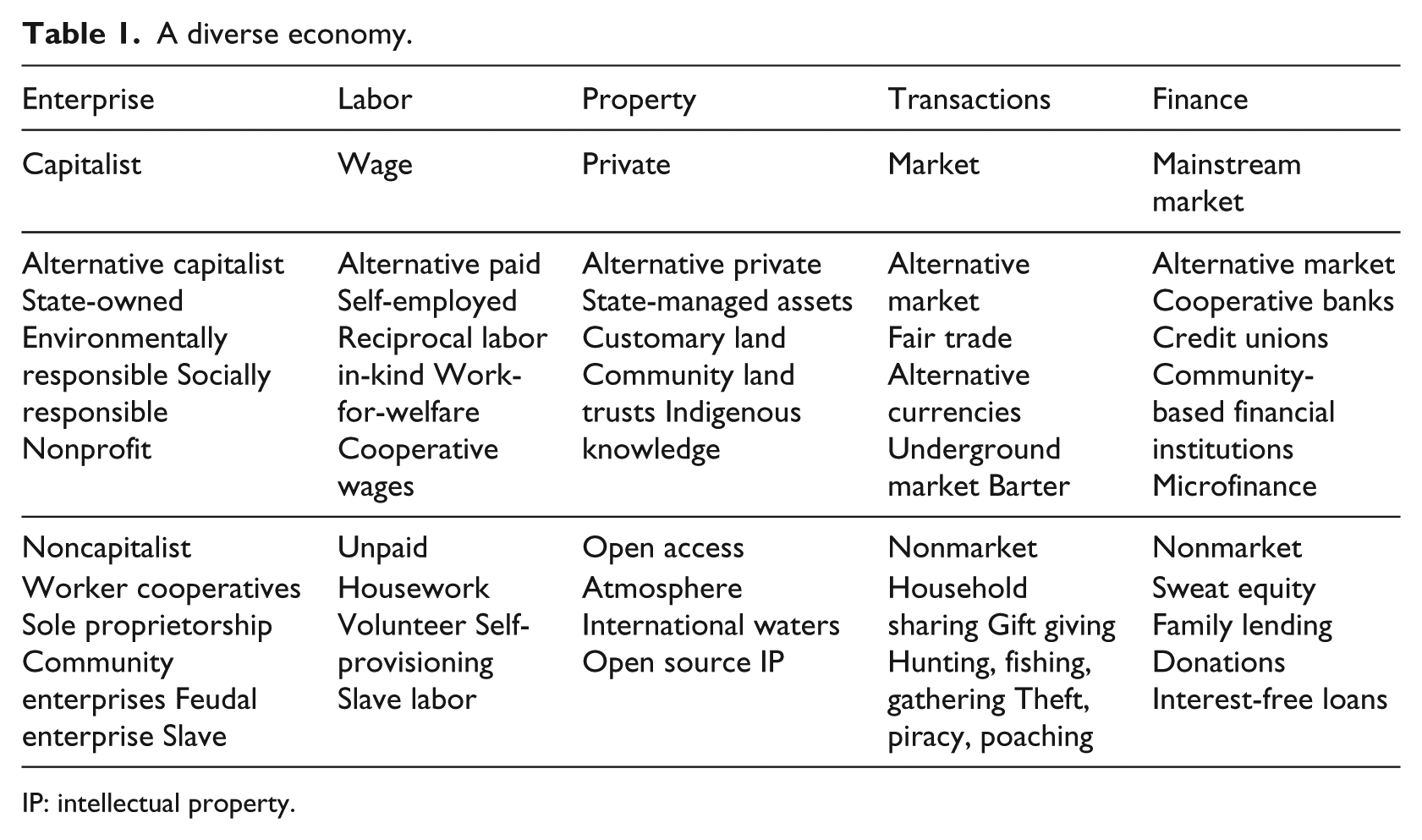
Through a variety of PAR projects, they explore the effects of different representations in terms of how they open up economic possibilities inside communities. Bringing together local community members, workers, academics, and other local professionals, community economies researchers have undertaken PAR projects in western Massachusetts (Gibson-Graham, 2002), Australia’s Latrobe Valley (Cameron and Gibson, 2005), and the Bajol province in the Philippines (Gibson-Graham, 2006), and produced a fine-grained typology of the different kinds of labor, forms of transaction, and types of enterprise organization in various sectors and class configurations (Gibson-Graham et al., 2013). Table 1 offers a typology of the diverse economic practices they have documented in the aforementioned geographic locations.
A diverse economy.
IP: intellectual property.
The joint community action research projects developed tangible outcomes in the form of new noncapitalist enterprises and community initiatives, as in the case of Australia’s Latrobe Valley, where some 80 community members became involved in a mix of new community gardens and social enterprises created after the conclusion of the research project (Cameron and Gibson, 2005). Research producing a different representation of the economy generates multiple levels of transformation. At the micropolitical level of the subject, community researchers and partners configure a desire for economic forms previously unimagined or perhaps seen as impossible. At the regional level, city officials became attentive to how such organizational forms respond to different signals and motivations, and constitute communities distinct from capitalist firms. Regional planners have long been attuned to producing diversity in terms of industry and occupation, but community economies PAR projects generate the drive to address another kind of diversity in terms of economic organization and class characteristics. At the level of the firm or organization, the PAR project helped create new social enterprises and community initiatives. Producing representations of economic difference through community research projects allows for the consideration of the economy as a space of ethico-political possibility at every level, including enterprise organization, an aim that was particularly important in the case of Asbury Park.
Solidarity/social economies
The concept of SSE has a long theoretical pedigree, and has been developed by academics in concert with a set of social movements, which span the globe (Borowiak, 2010). In the United Kingdom, this research has focused on the development of a ‘social’ economy, with particular attention paid to the role that progressive financial institutions and enterprises directed by social missions might play in producing a different kind of economic development (Amin, 2009; Hudson, 2009). In contrast, the Brazilian conception of the solidarity economy places heavy emphasis upon worker cooperatives and reflects the country’s long history with landless worker movements (Mance, 2002, 2007; Santos, 2006; Wolford, 2010). In the United States, theoretical examination of the solidarity economy has been comparatively limited, as is the development of a concomitant social movement (for exceptions, see Allard et al., 2008; Kawano, 2010; Miller, 2010).
Many SSE social movements have taken on the project of mapping SSE entities, encompassing cities, regions, and nations. The most comprehensive effort toward mapping social and solidarity economy networks has taken place in Brazil starting in 2005, under the aegis of the Brazilian Forum on Solidarity Economy (FBES) (Figure 1).
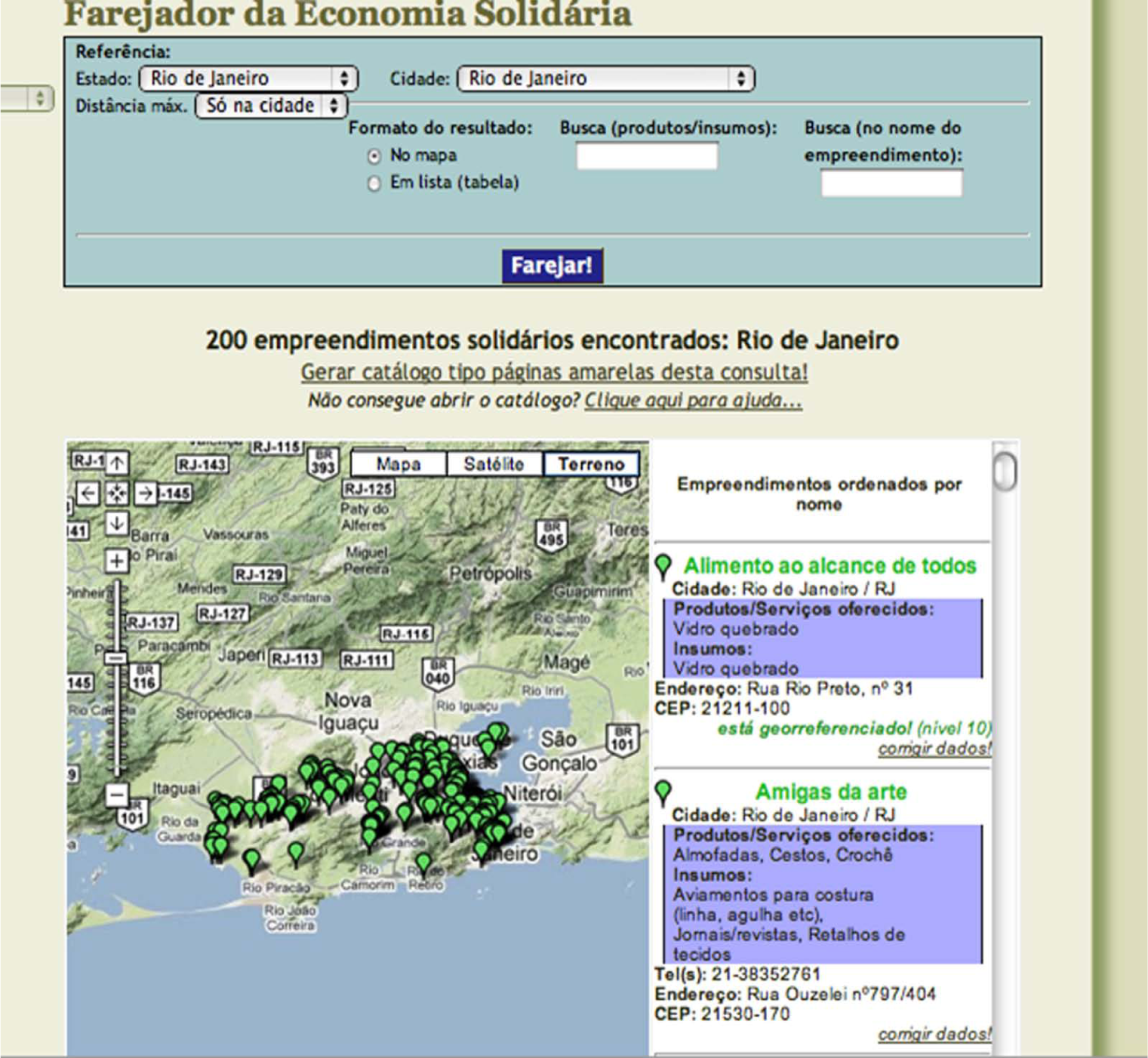
Brazilian solidarity economy map and database.
This massive national mapping project was funded by the National Secretariat of Solidarity Economy in the Ministry of Labor and Employment (SENAES) and involved mobilizing hundreds of interviewers from universities and social movements to visit 23,000 enterprises and to document the commodities or services produced, inputs required, and management structures deployed (Bertucci et al., 2009). The criteria that were used to include an entity on the solidarity map stipulated that it should have an economic nature, be constituted by more than a family, and be formed, run, and collectively managed by its workers. If a firm met the criterion of social solidarity or a commitment to healthy environmental practices, but not worker self-management, it was excluded. The map and database finally included (1) worker-managed cooperatives dedicated to the production, commercialization, and provision of goods and services, (2) solidarity funds and community banks, (3) cooperative networks, and (4) organizations providing direct support to solidarity economy enterprises, such as training and technical assistance.
Both types of projects (PAR projects undertaken by community economies researchers, and PAR-maps by social and solidarity economy movements) seek to make visible noncapitalism and create new economic subjectivities that sustain and create diverse economies as opposed to capitalist ones. But the maps offer one useful concrete difference, which is to identify entities and organizational forms (with their addresses and contact information) that produce specific commodities and use particularized inputs. The Brazilian solidarity economy movement prioritized research precisely in order to generate ethical supply chains that would allow solidarity economy producers to source inputs and outputs from one another. They too, approached mapping as a performative ontological project, but this time at a macroeconomic and inter-institutional level. This new ethico-political approach to constructing supply chains also requires development of appropriate management techniques, knowledge, and supportive institutions, all of which surfaced as challenging issues in the Asbury Park project.
‘The Jersey shore neighborhood cooperative’ at Asbury Park
Asbury Park is a working-class community on the central coast of New Jersey. According to the 2010 Census, over 50% of its population is African American, while a quarter is Hispanic. One-third of households live below the poverty line, a number more than twice the national average.
In the fall of 2009, I began a series of workshops on the economy in Asbury Park. The Holy Spirit Church had begun a program titled the Young Men’s Initiative in order to train young Haitian American men, most of whom were ex-prisoners, in construction skills. The program came out of a desire to not only think through but also plan options for postgraduation employment in a time of severe economic crisis. Wanting to examine local conditions (in which high unemployment went hand in hand with low median wages in the construction firms operating in the area) and to pursue feasible economic alternatives, one of the program’s carpentry teachers, Djar Horn, and Father William T. McLaughlin, the program head, invited me to guest-teach on economic literacy in the carpentry class. Later, as interest grew, we organized workshops outside the carpentry class on the diverse or solidarity economy. The workshops drew more and more people interested in economic justice into the conversation: undocumented Latino day laborers who were affiliated with the church, activists, teachers, people associated with a bicycle program for youth, people from the city’s office, parent–teacher associations, and nonprofits. Each invitation extended required a conversation that connected our workshops to the specific type of work in which the invitee was engaged, requiring us to think through and discuss an array of tangible outcomes that could result from the workshops.
Some workshop participants honed in on one specific economic development outcome they wanted to pursue: the formation of a worker cooperative in which the workers owned and managed the firm. The undocumented construction workers, some of whom had been teachers in the Young Men’s Initiative carpentry classes, were interested in this because they saw it as an avenue to pursuing wages that were higher than what they would get as day laborers employed by construction crews. I had spent 2 years working with immigrant day laborers in various support capacities through worker centers in an effort against wage theft, a well-documented problem rampant in New Jersey. According to a state-wide study on day laborers (Immigrants’ Rights/International Human Rights Clinic, 2011), 54% of day laborers in New Jersey reported at least one instance in that year of an employer paying them less money than promised; 48% experienced at least one instance of not being paid at all; and 94% of those who worked over 40 hours per week reported that employers had not paid them overtime as required by state and federal laws. This was the first group of construction workers and day laborers I had come across that was seriously considering the idea of forming a worker cooperative as an alternative to the superexploitative relations in capitalist construction firms. In addition, most of the worker cooperatives I had worked with over the last decade had been in domestic service and cleaning, and so construction posed an interesting but significant challenge given its capital-intensive characteristics.
Both Djar and I felt that a PAR project would be a key tool in developing a new economic development strategy in Asbury Park, bringing together participants who would go on to become workers accustomed to collective processes, as well as other SSE enterprises and organizations who would potentially be the clients of this new enterprise. A PAR approach brought together local people and researchers with different knowledges and expertise in jointly conceived research, as well as charted new actions based on the research (Cameron and Gibson, 2005).
A modest amount of financial support provided by the Holy Spirit Church was augmented through some local fundraising. This allowed seven community researchers (three Haitian American teenagers, two Latino immigrant day laborers, one senior, and one Latina student) to be paid to investigate the potential presence of entities that could be identified as part of the solidarity economy in Asbury Park and neighboring Ocean’s Grove. Community researchers had multiple reasons for participating. The undocumented immigrant day laborers had a strong desire to organize a carpentry worker cooperative, while the youth were drawn in because the workshops on the prevalence of unpaid labor had led them to reflect on their roles as caregivers to family and friends. Our discussion of the economy recognized their experiences and contributions as ex-prisoners, students, and low-wage laborers. The early workshops also included some of the interviewees who had become drawn into a conversation on diverse economies, and thus were open to taking the time to further examine their own specific roles in this new light.
The community researchers were trained (through Spanish/English bilingual workshops) in research techniques, especially in becoming comfortable with the act of asking questions about demographics, money, governance, and participation levels in an enterprise or organization. Djar accompanied others during the early interviews to model and aid in the development of leadership skills and to coach them in the process of setting up interviews, gaining formal consent, starting the conversation, engaging the interviewees in a discussion about economic activity, completing the survey, and recording the results. The support provided by the Holy Spirit Church, and in particular by Father William T. McLaughlin, was crucial, giving us access to financial resources and logistical support for this and subsequent projects initiated by the community researchers.
All the researchers collectively brainstormed a list of people and organizations to be interviewed, and had the first of many conversations on the boundaries of a solidarity (or noncapitalist) economy. We agreed we would need the interview results and another series of conversations after all the interviews had been completed in order to decide on the criteria for inclusion or exclusion in the Asbury Park solidarity economy. An official name—The Jersey Shore Neighborhood Cooperative—was chosen by the group. Community researchers spread out in the area, interviewing leaders of noncapitalist enterprises and organizations engaged in the production of a good or service, and talked to them about their work in order to determine whether their activities belonged to the category of a solidarity economy. The interviewees, who were leaders of their organizations, were chosen from a diverse group of organizations: social and green enterprises, youth collectives, volunteer collectives, churches, community gardens and community-supported agricultural firms, an HIV positive tenants association, an elderly housing association, food kitchens, housing cooperatives, and credit unions. To prepare our paid core community researchers for conversations on the economy and to motivate the research project, we crafted workshops that showcased similar projects that had been done in Philadelphia, western Massachusetts, and New York City. Pairs (or in some cases, trios) of community researchers conducted 30 interviews lasting for 3 or more hours during the winter and spring of 2010.
After our interviews were completed, the researchers had a meeting to discuss and debate which of the entities should be included in the solidarity economy. An important issue that emerged was the difference between democratic and nondemocratic kinds of nonprofits. Consequently, time was spent discussing the various organizational characteristics (governance structure, decision-making practices, form of aid given out, etc.) of volunteer collectives, churches, and nonprofits that had been interviewed. Eventually, the conversation ended in a consensus reached by the community researchers. Those nonprofit entities that provided much-needed goods and services, but did not seek systemic change, or those which were not organized democratically by their member volunteers, were excluded. Here, even as the group was trying to generate a network with which the interviewed organizations and firms could openly identify, the community researchers also decided that there had to be boundaries to this network that could be defended in the ethical terms they had established. This negotiation over foundational ethical principles is reminiscent of similar issues regarding price-setting in fair trade networks, ‘governed not by the argument of brute force but by political and moral constructions of the common good’ (Reinecke, 2010). The ethical criterion adopted by the group could also be seen from the perspective of class analysis as interrogating the moment of appropriation and/or distribution of surplus labor within nonprofit organizations. The examination of nonprofit organizations yielded some cases where volunteers were fully involved in the decision-making over their own labor (the conditions of its production, the conditions of its expansion or transformation) and other cases where volunteer laborers were absent from such decision-making and considerations, and could be seen as exploited nonwage laborers.
Many fascinating trends emerged during those interviews, but two in particular bear emphasizing, given the focus of this article. There occurred both an epistemological and ontological shift, such that a recognition of economic difference led to an opening of new coalitional and political possibilities.
What is economic activity?
Despite the fact that many of the participating organizations were engaged in economic activity, very few thought of themselves in these terms. The interviews frequently featured turning points that provided glimpses of a new vision for economic development. An observer can see examples of such reimagining in interviews with Stacey Kindt from Redeem Her (an organization collectively run by and employing ex-prisoners) and with Kerri Martin from Second Life Bikes. Describing how Redeem Her came into existence, Stacey recounted the strong commitment to ex-prisoners and to women currently in prison that formed the organization’s foundation. After establishing a collective housing arrangement for ex-prisoners, the women began a thrift store that spawned two other branches. As the community researchers continued asking survey questions about the financial aspects of the business, and as Stacey reported those characteristics (a gross sales volume of US$225,000 a year), she reached a self-surprising conclusion: what they were doing was part of ‘the economy’.
I see, how over the years, as we came up against obstacles in the community … we decided, bunk this, we’ll do it our own way. We can’t find places to live, we’ll make a place to live. We can’t get jobs, we’ll make jobs.
What did you get out of this interview?
Well, even the use of the term economy, I never thought of it (our work) that way. I know what my W2 says, but it doesn’t reflect my life, I’m obviously not a part of that economy …
I didn’t even know what economy was until recently … [everyone laughs].
What was apparent in the interviews with activists and business and organizational leaders was that while most of them readily identified with specific missions or goals (revolving around women’s health, sustainable agriculture, prison justice, recovery for former addicts, etc.), they were not accustomed to conceptualizing their activities within an economic framework. Despite having a business with an annual gross return of approximately a quarter of a million dollars, and perhaps because of running a firm geared toward an employment-maximizing rather than a profit-maximizing objective, they had never approached, or thought of their work, as having an economic character. This is not to say that they were somehow unaware of the nonprofit sector, but they had become used to seeing ‘the economy’ as something external to their own organizations. In their minds, it was other institutions (profit-seeking enterprises, banks, government branches, and large nonprofit foundations) that constituted the economy. For Redeem Her, the realization that they too constituted ‘the economy’ instigated a series of questions about what kind of economic structure described their organization and what economy they functioned within.
In most interviews, there was a deconstructive dynamic at play, in which a conventional understanding of the economy (where the economy was equivalent to capitalism) was dislocated and disrupted by an understanding of the economic landscape as being marked by diversity. Redeem Her, Earthen Harvest (a community-supported agricultural farm), and other nonprofit projects such as the Young Men’s Initiative based out of Holy Spirit Church could not and historically did not identify themselves as capitalist entities and were in some sense looking for an economic language of diversity that would encompass their difference. Our PAR research presented them with not only an alternative language of a diverse economy but also this alternative economic ontology as an ethical and political choice.
In another interview, three community researchers spoke with Kerri Martin, the head of a popular bicycle recycling program. Initially a small program run out of the Holy Spirit Church, the Bike Church began with a small number of kids who worked for 15 hours learning how to fix and refurbish old bicycles in exchange for a bicycle of their own. The program had attracted not only children but also adults who engaged in skill acquisition and skill-sharing with the kids, both through formal classes and informal interactions.
The conversations prompted Kerri to sketch out possible development options for the program. The growth of the program necessitated its independence from the Church, since the flourishing business (now renamed Second Life Bikes) could no longer be legally accommodated under the Church’s nonprofit status. At the time of the interview, Kerri was struggling with what kind of business format to legally assume, and a researcher not only questioned her about the consequences of different forms for the new business (cooperative vs nonprofit), but asked her to envision a long-term future. Kerri began to articulate her vision of a dream business that could act as an incubator:
If you think about Second Life Bikes as being part of the solidarity economy, where do you see its future?
Maybe in the future Second Life Bikes would grow into a warehouse that sheltered a mechanics cooperative, an art cooperative … of welders and artists working with found and discarded bike parts. Who knows, maybe start a pedicab cooperative with all the summertime tourists.
A proliferative logic began to appear in many interviews, in which subjects began to imagine creating new objects expressly organized by a noncapitalist organizational form. But the proliferative logic provoked a markedly different evaluation process as well, in terms of the nonmarket activities and processes undertaken by some of our interviewees. During the interview, Kerri was asked to estimate not only the sales of the shop (which she could readily recall) but also the value of bicycles distributed to kids after they had finished work obligations. She did not have an answer for that, even though the number of bicycles distributed in noncommodity form far outnumbered the number sold. When we urged her to estimate both types of economic activities since reporting only the bikes sold dramatically underestimated the total goods and services distributed by the group, she remarked that a fuller estimate could increase the group’s impact for foundations she approached for program development funds. A transformation in how groups define their economic activity produced practical short-term consequences for their organizations, but also presents us with the larger concern of the specificity of nonmarket practices.
Such nonmarket activities (undertaken by Second Life Bikes, the Boys and Girls Club of Monmouth, or the Center which provides support services for those who are HIV positive) require new and specific ways of accounting for their economic and community impacts. Some assessment can take the form of monetary equivalence (for instance, the market value of 5000 bicycles distributed for free), but other impacts will require a different language and logic. Activities such as intergenerational learning, teaching, and interaction (e.g. between bicycle mechanics or Boys and Girls Club mentors and community teenagers/children) involve making explicit the sociality and interdependence that connect participants. In a field of diverse economic processes, we are forced to rethink and redefine social well-being not simply as a matter of more goods and services but as encompassing social relations in which interdependency operates as an ontological condition of different types of well-being (Gibson-Graham, 2006; Özselçuk and Madra, in press).
What is the value of a solidarity economy?
Given the difference in the missions and activities of the respondents, the researchers of the Jersey Shore Neighborhood Cooperative were curious about whether coming together under an umbrella of the solidarity economy seemed persuasive to the interviewees. During an interview, Jeanne, a founding member of the dance troupe Core of Fire, answered a question in the following way:
What did you get out of this interview?
I could see how there is a foundation to what we do, an economic foundation that we are a part of, but is bigger than us too.
When Stacey of Redeem Her was asked to reflect on how the survey might have assisted her in thinking about her work in a different light, she had this to say: ‘I don’t really get much opportunity to look at the big picture, it’s kind of cool to think about … I never really thought about how we had our own community that works differently than the community at large.’
It is precisely this notion of community, one that exists outside the standard capitalist system that solidarity economies seek to establish. This ‘other’ of capitalism gathers here under the nodal point of a community or solidarity economy that articulates a ‘chain of equivalence’ across very different entities. Laclau (1996) identifies this as the political process inherent in articulating meaning under an empty signifier, where something ‘establishes the link between a variety of concrete or partial struggles and mobilizations—all of them are seen as related to one another, not because their concrete objectives are intrinsically related but because they are all seen as equivalent’ in another respect (p. 40). This is precisely the process fostered by SSE movements ‘that would gather together those economic models (different and adapted to each culture) that would want to call themselves “solidary”’ (Miller, 2013).
One concrete output of this project was the generation of a map. The idea was to map the incipient network of enterprises and organizations of a solidarity economy in Asbury Park. It was a rudimentary and preliminary effort and included only 17 organizations (out of the 30 that were interviewed), but it was seen as the first step toward linking organizations that recognized themselves and one another as operating inside noncapitalist economies. While each entity had a specific social mission (sustainable community agriculture, nonprofit member-directed finance in credit unions, employment over profit for ex-prisoners, etc.), there was a thread of commonality running through them. These organizations were practicing a form of economic solidarity with their own members, and with the general and/or a specific community.
Our Asbury Park map (Figure 2) was formed using Google map techniques that allow the visualization, representation, and recognition of a solidarity economy. And yet this representation also has substantive ontological consequences, such as the emergence of new noncapitalist forms, and new supply chain relations between entities that were otherwise seen as too disparate to form relations.
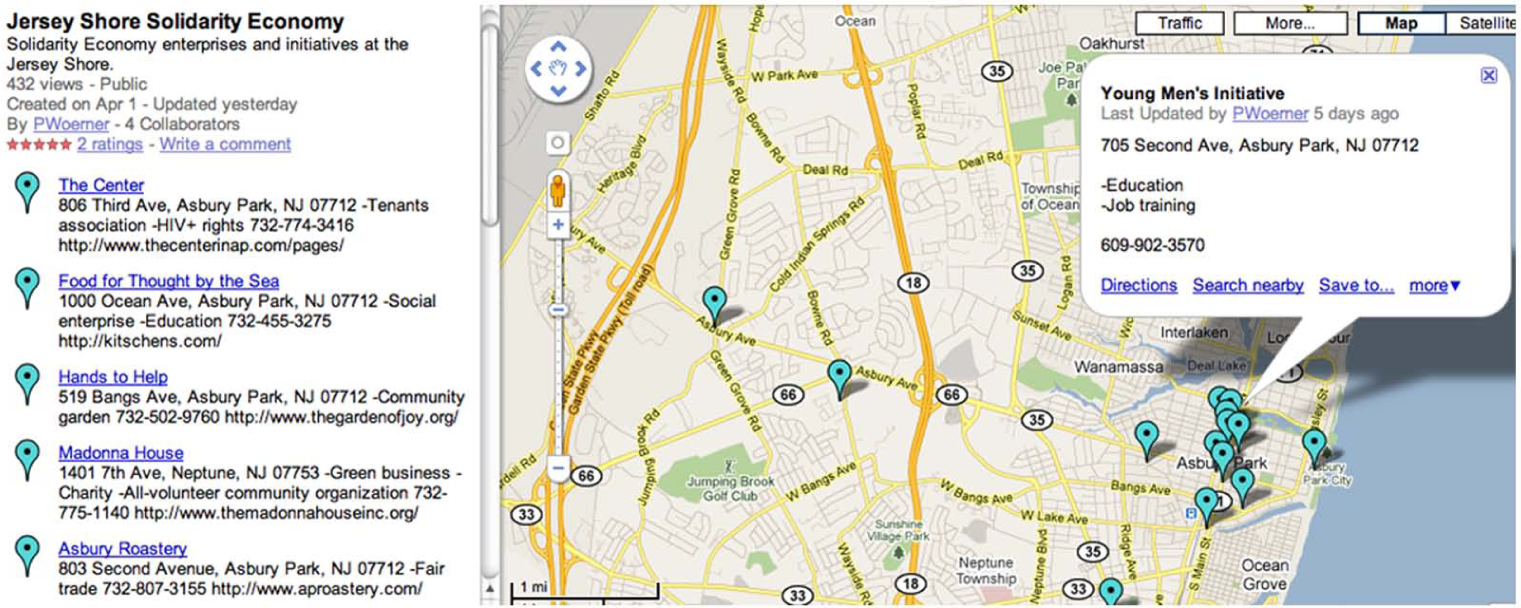
Jersey Shore Solidarity Economy map, generated by Pat Woerner.
One new noncapitalist firm emerged when community researchers associated with our PAR went on to form the first worker cooperative in the city in 2010. Expanding to incorporate more members who did construction and cleaning jobs in the area, they named themselves La Cooperativa de las Trabajadores de las Americas (American Workers Cooperative). As undocumented workers, members chose this name to emphasize the fact that they were American workers, irrespective of citizenship status. The PAR project generated enthusiasm in the community, and interviewees and other supporters came together for fundraising efforts such as tag sales and donation drives culminating in the accumulation of US$20,000 worth of tools. Holy Spirit Church continued its generous support by offering free workspace for the worker cooperative.
The process of undertaking the interviews generated stakeholder support for the new construction worker cooperative: our interviewees, both as individuals and organizations, were the first to demand service contracts from the construction workers cooperative. A local theater became interested in contracting the workers cooperative, as did the parks department of the city council, who wanted to grant a larger contract to build wooden park benches throughout the city. Other individuals required home construction services such as garage demolition or drywalling. We can see that the PAR project helped generate not only the new worker cooperative but a new supply chain in that other organizations generated the consumer demand that could potentially link together and support noncapitalist entities through buying and selling goods and services from one another, rather than from conventional capitalist firms. We envisioned this unique mode of economic integration based on ethical practices as providing an important condition of existence (buyers and sellers of inputs and outputs) that would help new noncapitalist firms get off the ground.
The cooperative has faced significant hurdles, however, in actually undertaking all the contracts that would realize such different types of supply chains. While donation drives allowed us to accumulate tools necessary to undertake construction contracts, the group could not raise the US$40,000 required annually necessary to purchase liability insurance and licenses. Without such insurance and licensing, the cooperative could not actually undertake the contracts from either the city parks department or the local theater, which could not bear the legal risk of uninsured construction workers despite their commitment to the group. Unable to take on substantive contracts, the group could not afford to pay for the insurance costs, leading to a stagnation in growth for the worker cooperative that has meant no worker member can rely on the cooperative as a full-time job, or for the bulk of their income. It became clear that such enterprises require multiple supportive conditions, such as incubator nonprofit organizations that might be able to extend continuing human relations support specific to noncapitalist enterprises, and financial institutions that channel investment toward sometime significant start-up costs. The stagnation of the worker cooperative is less an outcome of its internal structure, and more an outcome of the lack of supportive conditions and institutions that would enable them to actuate the noncapitalist supply chains.
From maps to supply chains and back again
If the Asbury Park PAR and its offshoot worker cooperative are having difficulty in enacting the noncapitalist supply chains they envisioned, how might they learn from more successful concrete examples, such as the Brazilian case of Justa Trama (Fair Chain)? And what is the state of the organizational literature on supply chain management (SCM) that could provide useful knowledge to SSE movements and groups?
In the early 1980s, there emerged a burgeoning business management literature on SCM, as the ‘planning and control of materials and information flows as well as the logistics activities which were not only internally managed within a company but also externally between companies’ (Chen and Paulraj, 2004: 1–2). Long-term relationships connecting producers, retailers, and suppliers could, as in the case of Walmart, be characterized by what Williamson (1985) described as an ‘extreme governance form’ of vertically integrated hierarchy. There has been some research on a network structure of SCM characterized by strong links between supply chain members, but with low levels of vertical integration, away from power and threat-based dependence, and ‘towards a network model in which there is a sense of mutual development within a partnership’ (Chen and Paulraj, 2004). This kind of model has received less research attention but is much more readily applicable to SCM within noncapitalism.
Much of the mainstream literature bypassed the power dynamics and negative social impacts of the standard SCM process, and instead focused on the reduced costs, tailorized input production, and higher profit rates resulting from the ‘successful’ implementation of SCM. Some SCM research centers (including those at the business schools of Massachusetts Institute of Technology (MIT), Stanford, and Northwestern University) have strong partnerships with multinational corporations. Since this produces research opportunities and internships that are targeted to issues that partner firms find pertinent, critical inquiry into the SCM literature is compromised and disincentivized.
As worldwide SSE networks (including in Asbury Park) increasingly adopt supply chain formations as a key part of their project, SSE theorists and practitioners will need to pick and choose carefully from the SCM literature for ideas for policies and strategies that are appropriate to a diverse noncapitalist practices. Research investigating holistic approaches to sustainability, decentralized forms of governance, nonprofit organizations, and the public sector offers possible insights.
Some critical work on integrating social and ethical issues into SCM did begin to appear after 2000 at the margins of the mainstream discussion on sustainable supply chains (Carter and Jennings, 2002; Seuring and Muller, 2008). While offering a useful starting point, this critical SCM literature remains limited, even if it is an improvement over the past. Some researchers argue for a holistic approach to sustainability to guide every step of the supply chain (from product design, to manufacturing, to reuse and product disposal) that must draw multiple branches of production together (Linton et al., 2007). A systemic approach requires a great degree of coordination and cooperation between private firms and the public sector, inaugurating serious complexity in terms of actors, goals, and socioeconomic issues. However, in a major survey of research on sustainability and supply chains, Seuring and Muller (2008) found that it tended to focus narrowly on environmental issues, with less than 15% addressing both environmental and social or political issues. This indicates that the systemic approach to sustainable development is not dominant, despite the claim of a ‘triple bottom line’ imperative, where ‘profits and profitability are only one element in the long-term success of companies and the economies. Also important are the future of people (internal and external to companies) and the future of planet Earth’ (Kleindorfer et al., 2005: 483).
This triple bottom line of people, planet, and profits requires new forms of accounting, reporting, and auditing, and indeed new metrics for gauging performance and socioenvironmental impacts (Elkington, 2002). However, the metrics and indices, which should offer more standardization, problematically weight factors across the triple bottom line: the Dow Jones Sustainability Index weights economic performance at 30.1, environmental performance at 7.2, and social factors at 14.55, with 30% of their sustainability evaluation based on reports written by the companies themselves (Adams et al., 2004; Cerin, 2002). For most within sustainable SCM or triple bottom line approaches, one thing is clear: the horizon of politics is within capitalism alone (Elkington, 1994, 2002).
A public supply chain differs from a private capitalist one since it should not only prioritize efficiency or cost-minimization concerns but also incorporate the citizenry’s concerns and rights (Ambe and Badenhorst-Weiss, 2011). To approach the state as purchaser of end goods and services is different from acknowledging the multidimensionality of generating a public good such as elder care, which draws multiple government agencies, the elderly, and other stakeholders into a value chain that is supposed to yield welfare and well-being (Bovaird, 2009). Most public procurement researchers and practitioners deploy a narrow conception of public sector SCM, focusing on only one link: the government as both purchaser and the most sizeable consumer. In addition to its macroeconomic significance, public procurement is governed by legislative rules (for instance, 23% of federal US government contracts must go to small businesses) mandating transparency and accountability. Many public procurement specialists concentrate on adapting the private sector’s best practices on cost reduction, working in the necessary changes due to public legislation (Larson, 2009).
A solidarity economy supply chain, in the forms that it has been institutionalized in thus far in the Brazilian and US contexts, differs perforce from models used in capitalist firms including those that focus on sustainability or public procurement. Even if such supply chains share a goal of minimizing inefficiencies with conventional supply chain managers (e.g. by seeking to transform functions that are consistently difficult to perform), they privilege distinct goals and adopt different intercooperative principles.
One such example is the Brazilian Justa Trama, formed as a network to produce bags, T-shirts, and other textiles for the 2005 World Social Forum. The core of the network was formed by five worker cooperatives that work together to produce clothing and toys from organic cotton. Coopertextil focuses on the production of raw organic cotton, Cooperative Acai uses seeds and shells from local plants to make buttons and belts, and both cooperatives sell their products directly to Cooperativa Fio Nobre, which transforms the cotton into thread and fabric. Cooperativa Fio Nobre itself is a recovered factory, whose workers seized control of the workplace and created a worker cooperative to run it. Cooperativa Fio Nobre and Coop Acai sell their products as inputs to Univens and Coopstilus, two urban seamstress cooperatives in Porto Alegre and Sao Paulo, which transform them into final clothing, apparel, and toys. With the creation of Justa Trama, cooperative members reported increased stability vis-a-vis long-term purchase contracts and higher annual sales, which also generated other changes in the production process. For instance, with the assurance of long-term contracts, Coopertextil made a switch to a different kind of cotton suited to the arid climate and soil of their region, and was ‘able to get a fair price for their production without having to resort to middlemen’ (Esteves, 2011: 271). Additionally, all the cooperatives pooled revenue, so that (in the words of a worker member of Univens)
the cooperatives that have better results transfer part of their leftover revenue to those in need … we do that instead of applying it all on internal investment, so that one or more cooperatives will not end up growing disproportionately in comparison with the others. (Esteves, 2011: 272)
Justa Trama’s supply chain strategies have contributed to member cooperative growth (by allowing increased sales) and also have been carefully managed to produce mesolevel equity through their redistributive mechanisms. Workers pool together surplus not only at the individual cooperative level but also at the network level, to be redistributed to other cooperative firms. This is not about profit maximization at all costs, but growth that is balanced and geared to optimizing worker well-being. Workers express solidarity not only with one another at the firm level but also at the level of groups of firms, similar to the redistributive mechanisms of the Mondragon Cooperative Corporation (MCC) in Spain. In 2012, when one of MCC’s worker cooperatives (Fagor Electrodomésticos) faced a disastrous decline in demand for its home appliances given the Spanish recession, Mondragon Assembly’s workers (members in a solar machine factory cooperative that actually faced economic growth) voluntarily reduced their wages by 7.5%. Mondragon Assembly redirected that amount to their sister-cooperative so that workers in Fagor Electrodomésticos would have to take a pay cut no larger than 7.5% in order to keep employing all its current worker members. This is yet another example of how distributional politics differ within a noncapitalist network, producing a strategy of reciprocity and equity in response to economic crisis. There is no one best-practice rule, but those within each network struggle to enact solidarity with very different entities precisely because they identify as actors coming together in a network where solidarity is a shared principle organizing economic interaction.
Currently, researchers from New York, Philadelphia, and the state of Massachusetts are working collaboratively on a National Science Foundation (NSF)-funded project that will produce comprehensive solidarity economy databases and solidarity economy maps in all three sites. The database will be designed to link not only domestic SSE producers and consumers with one another but also with global SSE maps and databases. The project is designed to assess geographical density and dispersion, estimate the aggregate economic impact of the solidarity economy, and provide a way for the entities in this economy to engage in supply chains. In the US context, such supply chains would be different than examples such as Justa Trama, given that US SSE inclusion criteria are broader than the Brazilian criterion of worker management. The US NSF-funded project plans to map and envisions supply chains linking cooperative forms of exchange such as complementary currencies, community-supported agriculture, and fair trade networks; alternative forms of consumption such as consumer cooperatives and community land trusts; and alternative forms of finance such as credit unions. Partly because many of these forms are absent in the Brazilian context, they do not appear in the Brazilian map or play out in their supply chain strategies. Some preliminary SCM plans in the United States include strategic coordination between solidarity economy sectors (e.g. between cooperative forms of finance and cooperative forms of production).
Based on economic impact estimates, the US group also envisions demanding targeted public procurement quotas for SSE businesses. Rules around small business preferential treatment and sustainability (as in the case of Portland’s ‘Sustainable City’ procurement policies) indicate that ethical objectives have been and can be inserted into government purchasing rules, which constitute a terrain of negotiation and expansion for solidarity economy projects. US cities often have established provisions in which a government contract falling under a threshold (US$300,000 in the case of Tampa, FL) is candidate for ‘sheltered markets’ as long as three small businesses can provide that good or service. Once certified as appropriate candidates, only those candidates may apply for fulfilling that city contract even if other large corporations could potentially offer lower bids, thus the term ‘sheltered market’.
What we can see in the Asbury Park mapping project is a counterhegemonic form of governmentality at play, where economic entities are admitting that although they are extraordinarily diverse, an economic thread binds them. This thread is not merely that they are economic, but that they constitute a different kind of economy that emphasizes some set of goals other than pure profit maximization, and that share some values despite their diversity.
Conclusion
This project sits at the intersection of two theoretical frameworks (both diverse economies and solidarity economies literatures), but it also speaks to the study of organizations. The diversity of organizational scale, structure, and composition are long-accepted facts in organizational theory. This article challenges the tendency in organizational theory to naturalize capitalism at both the macroeconomic and microeconomic levels. At the macroeconomic level, it asks management scholars to investigate how alternative SCM techniques are embodied within the solidarity movement and points to the need for techniques appropriate to connecting these economic entities. At the microeconomic level, it demands a project of visibility and is a call to dignify an alternative economy by documenting, mapping, and theorizing it. This call is underscored by the results of this concrete project where members of the community ended their research work only to start a worker cooperative where undocumented workers produce profits, appropriate, and decide what to do with those profits on a self-managed basis.
The article can also be seen as an attempt to further the efforts to decenter the hegemony of capitalism and theorize the vibrant presence of noncapitalist modes of organizing that pervade our economies (Gibson-Graham, 1996). Through its analysis of the Asbury Park and other solidarity economies across the United States and Brazil, it seeks to offer a critical alternative to the capitalism-centered discourse of SCM and to suggest ways in which labor and resources can be shared in nonhierarchical and democratic ways. The findings of the article will hopefully constitute another building block in the production of an alternative organizational theory, where noncapitalist organizations can define their own parameters of performance and enact their own models of what it means to be efficient, effective, ethical, and relevant.