




Abstract
This article builds upon archival and oral-history research on organizational change at Procter & Gamble from 1930 to 2000, focusing on periods of transition. It examines historical narrative as a vehicle for ideological sensemaking by top managers. Our empirical analysis sheds light on continuities in the narratives they offer, through which the past emerges as a recurrent lever of strategic manoeuvres and re-orientations. This reveals that while organizational history is sometimes regarded as a strategic asset or intrinsic part of collective memory, it is also re-enacted as a shared heritage, implying responsibilities. Executives (re)interpret the past and author the future, maintaining the historical narrative while using interpellation to ensure ideological consistency over time. The interpellative power of rhetorical narrative helps to recast organizational members as participants in an ongoing drama. In this way executives claim their legitimate right to initiate and manage organizational transition.
Keywords
Introduction
This article builds upon archival and oral-history research on strategy and organizational change at Procter & Gamble (P&G) from 1930 to 2000. We offer a theoretically informed longitudinal analysis drawing on executives’ speeches, policy documents, annual reports, letters to shareholders and interviews with business leaders. The focus is on periods of organizational transition, with ideological continuities revealed through the invocation of stories drawn from the company’s history (Meyer, 1982). In an organization founded in 1837, history provides a powerful seam of continuity upon which actors can draw in times of turbulence, and which they (re)enact in their daily practices. By adopting a longitudinal perspective, and through detailed analysis of company records and oral histories, it is possible to discern deeper shifts in ideology and rhetoric, reflecting parallel shifts in the external environment and social context (Heracleous and Barrett, 2001; Pettigrew, 1985).
The article demonstrates how stories of character and past achievements are invoked at P&G and become pivotal to internal and external communications at times of organizational transition, re-invigorating seminal ideas legated by past leaders (Dyer et al., 2004; Gabriel, 2000, 2004; Pepper, 2005). These stories often focus on enduring principles and values, making sense of the constant need for progress while influencing responses to a shifting competitive environment (Meyer, 1982). In turbulent environmental contexts, making sense of organizational transition in a manner accessible to external and internal stakeholders is crucial (Weick, 1995). We show how the set of dominant ideas that have framed the organizational ideology of P&G has been nourished and re-interpreted over the years and explore its ability to adapt to new demands.
Chreim (2005, 2006) has shown how managers tell organizational members narratives of change that preserve continuity with the past, demonstrating that the past adds value to the change process through the substantiation of sensemaking. Davenport and Leitch (2005: 1604) have found that strategic ambiguity (Bernheim and Whinston, 1998; Eisenberg, 1984) allows managers to promote ‘discursive openness’ or ‘discursive closure’, depending on whether they seek ‘engagement with, or compliance from’ stakeholders. Sonenshein (2010) clarifies that strategic ambiguity enables managers to accord people a choice between interpreting change as narratives of change or as narratives of continuity: those wanting change are told stories that suggest this is a desirable outcome, while those favouring continuity are placated by references to historical precedents. These accounts do not tell us how managers’ role as change agent is justified or how their ‘right to manage’ or initiate change is legitimated. A relevant literature here is that of ideology, or self-justificatory discourse (Barley and Kunda, 1992; Bendix, 1959; Billig, 1991; Costea et al., 2006; Enteman, 1993; Filby and Willmott, 1988; Simons and Ingram, 1997). Ideology is understandably self-reinforcing and defensive, however, so its openness to change is problematic.
The invocation of lessons from the past in storied form provides, we suggest, a powerful vehicle for the maintenance of an organizational ideology which centres and renders consonant the identity of human subjects within the organization by evoking their ‘active consent’ (Clegg, 1989: 160). Narrative is humanizing and gives meaning to processes of time and change (Ricoeur, 1984), assuaging fears for the future (Bettelheim, 1975; Brown and Humphreys, 2002; Costea et al., 2006; Ybema, 2010). We propose that the role of top managers in historical narrativization is to re-enact through storytelling a common heritage, evoking a collective past which evokes an ‘idiom of kinship’ or familial belonging (Ricoeur, 1978: 45, cited in Brown and Humphreys, 2002: 153; Rowlinson and Hassard, 1993). In doing so, they (re)interpret the past while ‘authoring’ a shared future (Weick, 1995: 7). By ensuring that new ‘chapters’ in the company’s development make ideological sense with the old, top executives sustain the narrative while enabling its adaptation. In their role as custodians of the integrity of the company’s historical narrative, they claim their legitimate right to direct its ongoing saga.
The literature on management and organization studies is fundamentally ahistorical in orientation (Kieser, 1994; Mills et al., 2013; Rowlinson et al., 2010). Business history research appears likewise stubbornly resistant to organization theory, giving rise to what Braudel has dubbed a ‘dialogue of the deaf’ (Kieser, 1994: 612), although there are signs that this is beginning to change (Harvey et al., 2011a, 2011b; Maclean, 2008; Rowlinson and Procter, 1999; Taylor et al., 2009). Archivally based historical research is rare in organizations studies (Rowlinson and Carter, 2002), where ‘archives are not seen as part of an organization’s memory, and business historians are dismissed as being just one among many actors in an organization’s external environment’ (Rowlinson and Hassard, 1993: 301). We perceive organizational memory as primarily concerned with the re-enactment of a shared historical narrative (Casey and Olivera, 2011; Nissley and Casey, 2002; Rowlinson et al., 2010; Walsh and Ungson, 1991). This serves a commemorative function, while helping to regenerate the company through the re-telling of stories and instilling in new recruits cherished company values (Brown and Humphreys, 2002). We contribute to the literature on ‘historical’ storytelling by top managers, which is understudied in organization theory, by proposing that historical narrative provides a vehicle for ideological sensemaking by executives. Relatively little is known about how such actors actively draw on history to support their agendas for change or continuity in the present and future (Hansen, 2007; Parker, 2002; Rowlinson and Hassard, 1993; Ybema, 2010). This article addresses this important topic, showing that top managers play an important role in organizational sensemaking, maintaining the historical narrative while using interpellation to ensure ideological consistency over time (Althusser, 1971; Rennstam, 2012). For a large multinational characterized by heteroglossia (Barry and Elmes, 1997), embracing many nationalities, such stories make accessible a common language and history. Corporate history is a socially constructed process (Booth et al., 2007; Costea et al., 2006; Nissley and Casey, 2002; Suddaby et al., 2010). Stories provide moral lessons which aim to ‘educate, persuade, warn, reassure, justify, explain, and console’ (Gabriel, 2000: 32), reminiscent of stained glass windows in medieval cathedrals, which told stories in pictorial form for (illiterate) congregations, designed to induce desired interpretations. There is also, as Gabriel (2000: 50) observes, ‘a level on which a story, unlike an ideology, cannot be negated’.
The article is organized as follows. The next section reviews the literature on ideology and organizational sensemaking. We then provide details of the research on which the study is founded. Next we identify key aspects of P&G’s narrative, establishing a platform for the thematic analysis presented in the following section. The ensuing discussion demonstrates the important part played by top executives in ideological sensemaking, who draw on the narratives of past leaders, accorded a prominent mnemonic role (Casey and Olivera, 2011; Feldman and Feldman, 2006; Nissley and Casey, 2002; Rowlinson et al., 2010; Walsh and Ungson, 1991), while subtly reframing deep ideological structures in response to shifting competitive circumstances (Heracleous and Barrett, 2001).
Ideology and sensemaking
‘Man makes his own history’, wrote Marx (1852/1897: 9),
but he does not make it out of the whole cloth; he does not make it out of conditions chosen by himself … At the very time when men appear engaged in revolutionizing things and themselves do they anxiously conjure up into their service the spirits of the past, assume their names, their battle cries, their costumes to enact a new historic scene in such time-honored disguise and with such borrowed language.
Here, Marx highlights the importance of enactment (Weick, 1995), suggesting that in taking on the mantle of the past we are prompted to ‘enact a new historic scene’ in ‘time-honored disguise’ adopting ‘borrowed language’. Brown (1978: 375) explains the significance of Marx’s observation: ‘All of us to some degree design or tailor our worlds, but we never do this from raw cloth … for the most part we get our worlds ready to wear’ (see Creed et al., 2002).
Organizations, according to Simons and Ingram (1997: 784), are ‘infused with ideology’. Yet the concept of ideology in the literature on management and organization studies (Alvesson, 1991; Barley and Kunda, 1992; Bendix, 1959; Beyer, 1981; Billig, 1991; Costea et al., 2006; Czarniawska-Joerges, 1988; Filby and Willmott, 1988; Meyer, 1982; Watson, 1982; Weiss and Miller, 1987) has arguably attracted less attention than more fashionable concepts like rhetoric and discourse (Alvesson, 2007; Hardy et al., 2000; Mueller et al., 2003; Suddaby and Greenwood, 2005; Watson, 1995), with which it is nevertheless closely related. As Enteman (1993: 8) succinctly puts it, ‘Ideology was born as a rhetorical device’. Barley and Kunda’s (1992) study of changing managerial ideologies suggests that each change was accompanied by a ‘rhetorical surge’. Costea et al. (2006: 164) agree, suggesting that current tensions of ‘growing corporations against a shrinking world … require the accelerated renewal of rhetorical resources’. Ideology functions through language which is dependent on its social context (Giddens, 1993). It has a key temporal and diachronic aspect, giving meaning to time and space: ‘organizational ideologies link the past and the future, [and] lend dignity to everyday activities’ (Meyer, 1982: 47). Vaara et al. (2004: 4) argue that one reason why we often misunderstand why particular stories gain credence in organizations and become institutionalized (Barry and Elmes, 1997) is that we overlook ‘the various cultural, historical and ideological elements’ which underpin them. Institutionalization implies to ‘infuse with value’ (Selznick, 1957: 17; Suddaby et al., 2014). We consider ideology an important lens through which to examine major organizations which have withstood the test of time to become quasi-institutions in their own right.
Bendix (1956: 2) interprets managerial ideologies as ideas ‘espoused by or for those who exercise authority in economic enterprises’, which are used to shore up and justify that authority. According to this view, ideologies are ‘the legacy of institutions and ideas’ bequeathed by one generation to the next (Bendix, 1959: 619), echoing the point made by Marx and Brown that our worlds come ‘ready to wear’. This interpretation directs attention to the role played by top managers or historical leaders in encouraging the organization to cohere around a set of recognized values or principles (while reinforcing their own authority), which they transmit to subsequent generations, thus helping to preserve the organization in the future. Drawing on Bendix (1959) and Enteman (1993), we define ideology as a set of values and principles infused by an organization’s history which inform and underpin its social and economic order in the present and future.
We draw also on the notion of interpellation, according to which ideology is conceived as a ‘representation of the imaginary relationship of individuals to their real conditions of existence’ (Althusser, 1971: 109; Rennstam, 2012). This in itself is insufficient to explain ideology’s directive power, however, which requires that individuals foster a relationship of their own to that representation to secure commitment to values and strategies, ‘interpellation’ being required to complete the process. Interpellation refers to the way in which an institution appears to speak directly to individuals as subjects, as if calling them by name (Althusser, 1971: 118). This sheds light on the power of ideological organizations to elicit the personal commitment of employees by ‘transforming organizations into beloved institutions’ (Meyer, 1982: 47).
Our understanding of ideology builds on that of ‘rhetorical history’ advanced by Suddaby et al. (2010: 147) to highlight the interpretive function of history as a ‘social and rhetorical construction that can be shaped and manipulated to motivate, persuade, and frame action’ in order to confer competitive advantage. Informed by Hobsbawm’s (1983) notion of invented tradition, which seeks to ‘inculcate certain values and norms of behaviour by repetition’, Suddaby et al. (2010) conceive of history as a combination of subjective and objective reality through which the past may be remoulded and persuasively re-interpreted. This re-telling of stories from history in ways which ascribe meaning and favour preferred interpretations has an important sensemaking role to play in steering the inferences organizational members draw from their present circumstances. Our article is located within this theoretical terrain. Drawing on Suddaby et al.’s (2010) notion of rhetorical history as well as Enteman’s (1993) interpretation of ideology as a rhetorical device, we bring a sensemaking perspective to this issue in order to explore the notion of ideological sensemaking by top managers through historical narrative.
While scholars have explored ideology and sensemaking (Brown et al., 2008; Brown and Jones, 2000; Gioia and Chittipeddi, 1991; Lüscher and Lewis, 2008; Sonenshein, 2007; Weick, 1988, 1995; Weick et al., 2005) individually and separately, we know much less about the conjunction of the two, ideological sensemaking (Prasad and Prasad, 1994; Pratt, 2000a). This article helps to conceptualize this area. Ideological sensemaking implies a (perhaps provisional) stabilization of preferred meaning amid organizational transition (Bakken and Hernes, 2006; Bergson, 1911/2009; Maclean et al., 2012; Sonenshein, 2007; Weick, 2009; Weick et al., 2005). This emphasizes the importance of historical narratives for making sense of organizational change and of ideologically infused sensemaking stories as offering (re-assuring) stability within organizational upheaval, attenuating fear for the future (Brown and Humphreys, 2002; Costea et al., 2006). In what follows, we draw on Weick’s (1995) theory of organizational sensemaking to explore the role played by top managers in ideological sensemaking through historical narrative.
Sensemaking, for Weick (1995: 4–5), is essentially ‘a thinking process that uses retrospective accounts to explain surprises’ (Louis, 1980). When surprise is acute, at times of upheaval, inadequate sensemaking may threaten an organization’s survival (Weick, 1988). The view of ideology which infuses his theory of organizational sensemaking draws on Beyer’s (1981: 33) insight that ideology comprises a ‘shared, relatively coherent interrelated set of emotionally charged beliefs, values, and norms that bind some people together and help them to make sense of their worlds’ (Weick, 1995: 111). Weick points to the link between sensemaking and ideology when he suggests that organizations with strong sets of belief around enactment, crisis prevention and management are better able to cope with crises when these occur. suggesting that ‘enactment … might serve as the basis for an ideology of crisis prevention and management’ (Weick, 1988: 315). This emphasizes organizational ideology as a resource which managers may exploit to indicate accepted modes of behaviour and preferential outcomes, helping the organization to find a way through times of turbulence, making ideology a ‘crucial resource for sensemaking’ which is implicated in strategizing by top managers (Weick, 1995: 113).
For Weick (1995), stories are similarly critical for sensemaking, for which they form ‘extracted cues’:
Stories are cues within frames that are also capable of creating frames. Ideologies, paradigms, and traditions are known by their examples … When people are asked to describe their ideology, they start with examples that imply patterns of belief within which those examples make sense. Stories that exemplify frames, and frames that imply stories, are two basic forms in which the substance of sensemaking becomes meaningful. (pp. 120, 131)
Stories assist with organizational wayfinding and enactment in that they ‘posit a history for an outcome’, sequencing itself being a ‘source of sense’ (Weick, 1995: 128). That managers can extract from ‘the vast pool of ideological substance that smaller portion that matters’ (Weick, 1995: 112) enables the selection of stories with ideological fit with the historical narrative, designed to induce ‘voluntary cooperation’ (Meyer, 1982: 55, cited in Weick, 1995: 113). However, where top managers are on occasion found wanting in Weick’s (1995: 127) eyes is that their skills lie in argumentation rather than narration. In an organizational world that is increasingly ‘text laden’ (Suddaby and Greenwood, 2005: 61), where organizational reality is dependent on narration, being ‘talked into existence’ (Bakken and Hernes, 2006; Weick, 2009: 4), their sensemaking and storytelling skills are often deficient. This creates considerable potential for ‘incomprehension at the top’ which is directly attributable to imperfect sensemaking by managers, often in situations of ‘high ambiguity and high arousal’ (Weick, 1995: 116), fostering poor judgement and flawed decision-making. This matters, because ‘it is the later stages of decision making, positions along the chain of means-ends connection, where judgment, and whatever has controlled it, affect the sense an organization makes’ (Weick, 1995: 115). This leads him to argue that managerial incomprehension deriving from defective sensemaking has left top management with little to do, effectively redundant. Given this, he ventures to propose, perhaps tongue-in-cheek, that a logical course of action would be to eliminate top management altogether:
the best organizational design is to do away with the top-management team. Because the organization makes sense, literally and figuratively, at the bottom, that is all the design that is necessary. Current organizational forms embodying teams, lateral structures, and dynamic networks seem to embody this lesson. (Weick, 1995: 117)
This suggestion challenges the notion that top managers play a critical role in espousing and perpetuating ideologies founded on a coherent set of recognized beliefs and values which they legate to subsequent generations to help ensure continuity (Bendix, 1959; Enteman, 1993). Other commentators have stressed the need for a more critical examination of some of Weick’s more unorthodox claims (Basbøll, 2010: 163; Basbøll and Graham, 2006; Booth et al., 2007). In this article, we therefore take to task his theoretical prescription to do away with top management, our research into organizational transition at P&G having led us to a very different conclusion. We find, conversely, that historically top managers have played a critical sensemaking role at P&G, where making sense of the past emerges as a sine qua non for understanding the present and future (Costea et al., 2006), implying a crystallization of meaning which serves as a spur to future action (Sonenshein, 2007; Weick, 1988; Weick et al., 2005). The sensemaking literature traditionally has accepted the need for an element of sensebreaking, following the proposition that you have to devalue the past to induce a sense of urgency and momentum for change (Pratt, 2000b). As Meyer (1982) asserts, ‘Impending crises may become auspicious occasions for updating antiquated ideologies and elaborating time-worn stories’ (p. 60). The implication is that a particular policy, however sacrosanct, may be recalibrated or jettisoned to obviate a crisis or help the organization navigate what its leaders deem to be a desirable transition. There is nevertheless a caveat. The (re)constructed narrative should make sense to organizational members, and, allied to this, the company’s new direction should have ideological ‘fit’ with the old, since new strategic narratives may founder when ‘they have been unwittingly tailored in the wrong cloth’ (Barry and Elmes, 1997: 436).
Research foundations
Our research is founded upon privileged access to selected document classes within P&G’s corporate archives, established in 1957, held at its headquarters in Cincinnati. Access was negotiated directly (by email and telephone) with the corporate archivist to materials relating to strategy, internationalization and organizational change. Annual reports and accounts, internal and external executive communications, oral histories, executive biographies, company magazines and a variety of other materials were consulted. We were aware of the ‘ideological hegemony’ (Brown and Humphreys, 2002) which pervaded the ambiance and the asymmetrical power relations which characterized our visit and status as privileged academics who must nevertheless remain within defined limits in conducting archival searches. At the same time, we were conscious of the need to act with integrity as organizational historians (Booth et al., 2007). Dellheim (1986) diagnoses the nature of the tension we experienced as researchers:
there is the risk that the historian may become little better than an archival hired-gun fighting a rearguard action armed with index cards. And it is no less certain that such behaviour would incur the outrage of professional colleagues who would, with reason, call into question the integrity of the offender. Yet one can hardly blame corporations for their reticence to welcome potential scholarly muckrakers with secret agendas. (p. 16)
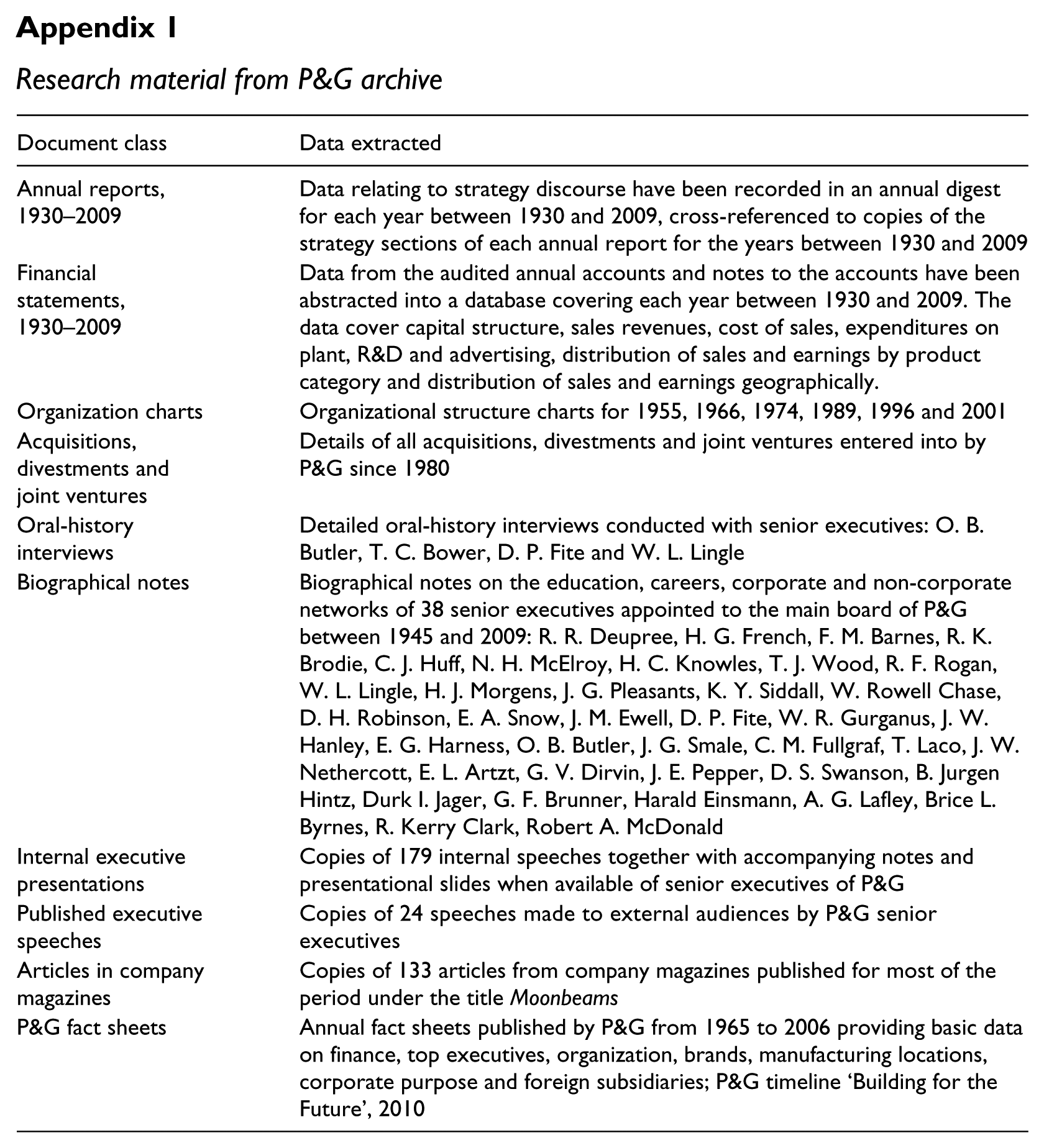
That our research was historical in nature was arguably re-assuring to the corporate archivist. Accessing an organization’s recorded history, as Rowlinson and Hassard (1993) explain, illuminates the past as organizational members choose to remember it. We selected P&G as an ideal case study company, being a large, diverse organization with a long history which has experienced episodic strategic change on a major scale, yet which has been the subject of relatively few in-depth academic studies (Denison and Mishra, 1995; Dodgson et al., 2006; Dyer et al., 2004). During the research visit made by two of the researchers, the archives team provided assistance in locating and copying documents. Extensive data were gathered covering the period from 1930, when descendents of the founding families ceased to act as managers, to the new millennium, when P&G emerged as a global player in fast-moving branded consumer goods. A summary of the primary sources collected by the research team is provided in Appendix 1.
Extensive oral-history interviews conducted by the P&G archivist with former senior executives in the 1990s proved especially valuable. The interviewees knew several of the company’s ‘great men’ personally, having risen through its ranks to assume top positions. Their accounts reveal inter alia how they learned directly from their predecessors and bequeathed this learning in turn, passing on the baton of P&G’s heritage over decades (Feldman and Feldman, 2006). The oral-history interviews were complemented by six additional interviews conducted by members of the research team as the opportunity arose from 2008 to 2011 with former and current P&G executives and managers, each interview lasting approximately 90 minutes, and all of which were recorded and transcribed. The interviews were used to corroborate insights which emerged from the archival data.
On return from Cincinnati, all documents were categorized according to their subject and purpose. Through reading and re-reading the historical record, our attention was drawn to the preponderance of documents, often executive speeches and letters to shareholders, relating to ideas, values, beliefs and the ‘character’ of the company, in short, what made it special to the P&G community. It appeared that P&G had made a conscious effort to articulate and codify this. This insight led to the decision to focus on these documents. In doing so, and through further reading of the data, we became increasingly aware of the overt use of historical narrative as a means of conveying lessons to the wider P&G community, including internal and external stakeholders, whereby the historical narrative became a vehicle for a form of moral storytelling which seemed to invite organizational members to live up to the past, accentuating the ‘bringing forth of memory’ as a critical aspect of the sensemaking process (Schultz and Hernes, 2013: 4; Whittle and Mueller, 2012). Further scrutiny of the historical record uncovered a number of recurring themes or leitmotifs, which emerged as categories, according to which we coded our data (Berg, 2009). These include the inseparability of interests between company and employees, an emphasis on the character of the company, the importance of doing the right thing, promotion from within, and the insistence on growth, followed by the slowing of recruitment in the harsher competitive environment of the 1990s.
Narratives and memory at P&G
Boje (2008) highlights the importance of writing to collective memory in formal organizations. Schultz and Hernes (2013) likewise place emphasis on the textual memory of organizations, which fosters a certain stability of meaning. Traditionally, executive speeches at P&G are carefully crafted in advance, not given off the cuff. Considerable attention has been paid to memo writing. O. B. Butler, Vice Chairman of the Board under CEO Neil McElroy (1948–1957), stresses the significance of ‘the written word’ for P&G over time:
One of the tremendous strengths of Procter & Gamble throughout history at least, was the absolute requirement that decisions be based on the written word not the spoken word. A tremendous amount of training we did was to require people to write things down, to sharpen their focus, to write things in very brief form … (P&GCA, 1994b)
This was confirmed at interview by a former employee, a first-level supervisor at P&G in the 1950s, who underscored the importance of the ‘very concise half page memo’, adding ‘the man above you couldn’t stop it—it was all about getting information to rise, it had to go up’ (Interviewee A, 2008). The former CEO of a P&G subsidiary in the 1990s agreed, ‘The shorter your presentation the more successful you were likely to be … brilliant device, the one page memo’ (Interviewee C, 2011). At times this might entail being required to redraft a memo; Pepper (2005), CEO from 1995 to 1998, recalls having to rewrite one four times. The upshot of this attention to concise expression is a written textual record of all significant company events and a common language among employees (Denison and Mishra, 1995). The importance accorded to written texts at P&G means that a rare coherent body of documentary evidence exists to scrutinize the historical record over several generations (McPhee, 2004; Vaara et al., 2004), albeit that the company has approved these texts in advance of any scrutiny, company archives often being constructed with the goal of enhancing corporate reputations vis-à-vis external stakeholders (Booth et al., 2007).
For Boje (2008: 81), drawing on Halbwachs (1950), the storytelling organization is ‘a tapestry of multiple interacting, interpenetrating collective memories of members of various groups’. Ricoeur (1984: 80) argues that written texts in combination create worlds: ‘To understand these texts is to interpolate among the predicates of our situation all those meanings that … make a world’. The story of P&G is deeply enmeshed with the growth of the modern consumer economy. In what follows, we consider key aspects of P&G’s history as ‘a set of stories which [re]construct the past’ (Parker, 2002: 589), which are used to inform our subsequent thematic analysis. These stories are propagated by managers and used to direct behaviour in the present and future, providing cues or ‘“grammars” that help actors … draw causal maps whereby their past experiences guide their future actions’ (Bakken and Hernes, 2006: 1605). These include the beginnings of P&G; the influence of William Cooper Procter on its evolving values; the development of Tide, the first synthetic detergent; and the story of P&G’s internationalization.
Beginnings: from Cholera to Cholera
To commemorate its 175th anniversary in 2012, P&G displayed on its company website a number of stories, including that of William Procter’s journey to Cincinnati. This tells how Procter travelled from London to the new world in the 1830s after his woollen shop was destroyed by fire and ransacked. A letter written by Procter’s father, featured on the website, articulates the lesson he recommends his son extract from his tribulations:
An old sailor that has split upon a sunk rock and has lost his ship is not the worst man to make a pilot of; on the contrary he is particularly able to guide those that come after, to shun the dangers of that unhappy plan. (Procter & Gamble Corporate Website (P&GCW), 2012a)
Travelling down the Ohio River, William’s wife, Martha, contracted cholera and died. Too exhausted to venture further, he remained in Cincinnati, found work in a bank and remarried, going into business with his new brother-in-law, James Gamble, a soap and candle maker. In the fledgling operation, Procter took charge of the office and Gamble of production. Almost 170 years later, the Newcastle laboratory of P&G developed a major innovation in its water purification product ‘PUR sachet’, which makes dirty water drinkable (Dodgson et al., 2006):
How remarkable—and inspiring—that the small soap and candle company the grieving William Procter would soon form would one day devote significant energy and resources toward preventing the very disease that claimed the life of his wife. (P&GCW, 2012b)
In this story, the development of PUR sachet casts the earlier tragedy of Martha’s death from cholera in a new light, re-interpreted as highlighting a problem which the organization would address and remedy in the fullness of time (Schultz and Hernes, 2013). P&G is presented in a morally advantageous light as attentive to world health issues: ‘it’s a story that deepens the roots of our resolve to improve more lives caught in the crosshairs of cholera’ (P&GCW, 2012b). The cholera story offers a new perspective on an existing narrative, which is refreshed in the process (Barry and Elmes, 1997). This extract from the corporate Web pages makes explicit the pertinence of the company’s history to its present, ‘generating action by linking events in the past to current and future action’ (Suddaby et al., 2010: 158), as one senior executive explained:
We’ve gone from suffering from cholera to preventing cholera. The purified water program was used in Haiti recently to actually tackle the cholera epidemic … Increasingly now we are using stories from the past to illuminate the present … There are a lot of people who’ve been here five years or less and don’t know the history, the institutional memory isn’t there; so, trying to use the archives, stories from the past, helps. (Interviewee B, 2011)
This excerpt exemplifies the manner in which P&G is proactively ‘using stories from the past to illuminate the present’, identifying stories from its archives which are used for sensemaking purposes to initiate new recruits into the history and, importantly, values of the firm.
William Cooper Procter: putting employees first
Organizational history, as Booth et al. (2007) observe, is often founder centred. Although not strictly speaking a founder himself, William Cooper Procter, grandson of William Procter, is accorded particular attention in company documentation. Cooper Procter began his apprenticeship in 1883 on the shop floor. The move to mass production in the 1880s required that workers at Ivorydale, the company’s soap manufacturing facility outside Cincinnati, adopt new working practices, leading in 1886 to walkouts and work stoppages (Dyer et al., 2004). At a time when better-off Americans were increasingly anxious about social upheaval, with strikes becoming commonplace, it made sense for owner-managers to embrace the logic of industrial improvement (Barley and Kunda, 1992). Cooper Procter, who became general manager in 1890 and later served as president (1907–1930), reputedly left ‘an enduring mark’ on P&G as a reformer, fostering a collective understanding of the business among employees (Dyer et al., 2004: 45). Weick (1988: 315) regards commitment as open to manipulation, and Cooper Procter worked hard to strengthen worker loyalty, persuading the partners to allow employees Saturday afternoons off and initiate a profit-sharing scheme to instil a sense of ownership. The profit scheme he launched placed the company at the forefront of ‘welfare capitalism’ (Dyer et al., 2004: 46). A sickness-disability programme for workers was established in 1915, followed by an 8-hour working day in 1918. The first African American was recruited in 1901, and the first women graduates in 1920. In 1930, being childless, Cooper Procter ceded the management of P&G to R. R. Deupree (CEO 1930–1948) whom he persuaded in 1932 to introduce a 5-day, 40-hour working week, convinced of the ‘inseparability of interests’ between the company and its workforce (P&GCA, 2010). This was a lesson Deupree embraced, stating in 1955, ‘William Procter and James Gamble realized that the interests of the organization and its employees were inseparable, and the partners saw to it that that belief was transmitted to their successors’ (P&GCA, 1976).
When Cooper Procter died in 1934, a memorial erected at Ivorydale was funded by employees. He remains one of the most admired of the company’s forebears. Stories of his endeavours centre on the transmission of P&G’s principles and heritage to employees. They construct a symbolic world, supporting Rowlinson and Hassard’s (1993: 322) observation that history is inherently bound up with institutionalization, whereby, ‘Founders themselves, and the act of founding, are institutionalized by history’.
Innovation: the story of Tide
The story of the development of Tide, the first synthetic washing power, is illuminating, exemplifying the type of ‘compelling story’ identified by Suddaby et al. (2010: 156), invested with the power to ‘unlock the historical value in a brand’. Its advent coincided with the arrival of automatic washing machines. The official story as to how it was developed is told in Dyer et al. (2004). From 1931, P&G had sought to develop the world’s first synthetic detergent, unsuccessfully. During the war years, a maverick researcher, David ‘Dick’ Byerly, worked indefatigably on the development of ‘Product X’, without official sanction, such that Product X became ‘an officially unofficial skunk works project’ (Dyer et al., 2004: 72). The breakthrough came when Byerly counter-intuitively reversed the builder-surfactant ratios with which he had been experimenting. Thus, according to the dominant story (Hansen, 2007; Pemer and Näslund, 2012), Tide emerged from ‘an R&D structure that allowed room for individual initiative, experimentation and serendipity’ (Dyer et al., 2004: 83), where individuals could learn from their mistakes, a story which implies that P&G is not unaware of the ‘competitive advantages of “applied history”’ (Suddaby et al., 2010: 156).
There is a counter-narrative, however, which tells a different story, illustrating Parker’s (2002) point that history may be contested. According to this, the patent for synthetic detergent may have been obtained from the German company Henkel after World War II. This is implied by the account offered by former Executive Vice President Walter L. ‘Jake’ Lingle:
The Henkel Company was and still is (I think) the largest soap and detergent company in Germany, [and] had been highly successful with their soap product Persil. Then Mr, Henkel, who was then head of the company… was afraid someone would invent a synthetic detergent which might damage the Persil position. So he said let us invent a synthetic detergent and patent it so someone else can’t introduce it against our soap Persil. They successfully developed the first detergent. It was based on coconut oil. Since they didn’t want to sell it in Germany, they decided to sell their patent rights outside of Germany. They picked Procter & Gamble in the United States… I think what happened was that the Henkel patents covered only coconut-oil based products. I believe that somebody else developed the petroleum based product, which got around the Henkel patents. (P&GCA, 1993)
This competing narrative suggests that the development of Tide may owe more to Henkel than is fully recognized in the official story. If this were accurate, then the dominant story of the invention of Tide would serve as a convenient narrative veil, illustrative of the manner in which organizations may choose to downplay aspects of their historical narrative, which are sidelined in the process (Barry and Elmes, 1997; Booth et al., 2007; Gabriel, 2004).
Internationalization: European expansion
From the 1950s onwards, P&G grew into a multinational enterprise through a combination of new-build foreign direct investment and acquisition, evolving progressively from a US company with limited international sales operations to a global company. One surprising aspect of P&G’s expansion into continental Europe, however, is that did not begin with a ‘grand plan’, but conversely with Lingle, then head of foreign business, deciding in 1954 that one young manager should take over a soap company in France. As T. C. Bower relates,
Jake asked me to take over the French company. Well there again, a fascinating story. He turned around to me and said, you and I have gotten along pretty well and you’ve done a good job in sales, I have a new job for you. I want you to run a company in France. And I said, I didn’t know we had a company in France. And he said, we don’t, but I want you to go over and run it. That’s how I was invited to take over the French company. And I’m not kidding. I landed in Paris with a Canadian, two Americans, a Frenchman and myself. I remember sitting in the so-called office, which was an apartment we rented, and I said, there were 55 million French and there are 5 of us and we are going to run a business, so you better pray hard as well. (P&GCA, 1994c)
This story reveals P&G’s international expansion as more haphazard than might be expected, challenging our perception as to how strategy is conceived and enacted in practice (Barry and Elmes, 1997). It supports Weick’s (1983: 48, cited in Basbøll and Graham, 2006: 200) observation that planning ‘isn’t nearly as crucial for productive action as people think it is’. It uncovers a more human aspect of the organization, as initiating international operations by a process of trial and error rather than conceiving and following a strategic master plan, a key tenet of the Strategy as Practice school of thought (Whittington, 1996). Being without a ‘map’ to follow, Bower and his colleagues had little choice but to roll up their sleeves and get on with it, navigating unfamiliar territory by dint of improvisation and their own practical competences, built up during a lengthy apprenticeship at P&G (Basbøll and Graham, 2006; Weick, 2006; Whittington, 1996).
Sensemaking and ideology in historical perspective
Thematic analysis of the archival record reveals a set of dominant ideas which pervade company documentation from an early stage in its history, and which work to strengthen the employment contract, serving as signposts to guide behaviour. These include the inseparability of interests between company and workforce, the emphasis on character, the mantra of doing the right thing and the importance of promoting from within. However, from 1990, these principles appear increasingly at odds with a perceived need to accelerate growth while slowing the expansion of the workforce. This introduces a competing logic pertaining to slowing of recruitment, after which ‘doing the right thing’ becomes associated with exercising constrained compassion in handling redundancies, euphemistically dubbed ‘separation’ (Reay and Hinings, 2009). In the extracts which follow, senior executives return to previous statements by their predecessors to voice in propria persona selected points drawn from the company’s history.
Inseparability of interests
The quintessential importance of the company’s people runs as a common thread throughout P&G documentation, the superiority of personnel systems founded on cooperation rather than conflict having been grasped early in its history (Barley and Kunda, 1992). As Deupree is attributed as saying,
the only thing that matters is people … if you were to take away all of our money and all of our factories and all of our brands, and leave me all of our people, I could build you a new company as big as the one we had today in ten years. (P&GCA, 1994b)
A key aspect of putting people first relates to the inseparability of interests between company and employees advocated by Cooper Procter. This translated into significant welfare benefits for staff, including the company’s flagship profit-sharing scheme. In 1954, McElroy (1948–1957) highlighted the key importance of the scheme as a means of attracting and retaining talented staff:
[I]n order to get and keep good men, we must be able to offer not only reasonable salaries, but in keeping with these days of high taxation, other plans helpful to employees toward creating funds available to them in the latter part of their lives. (P&GCA, 1954)
McElroy’s successor, Howard Morgens (1957–1974), echoes this point, asserting that the ‘task of developing people … receives closer attention than any other single phase of the Company’s activities and properly so’ (P&GCA, 1959). The attention paid to putting people first by consecutive CEOs sets a pattern in the narratives they offer, instilling a ‘tradition of conduct’ (Weick, 1995: 126).
The character of the company
The role played by successive leaders in articulating the values legated by the company’s founders is apparent in the documentary record. According to Cooper Procter, the standards instilled in P&G by its founders were bequeathed to those who followed as a ‘spiritual inheritance’ (P&GCA, 1976). Deupree, said to have known all former leaders personally (bar the founders) as well as his three immediate successors, played a lynchpin role in ‘transmitting that unchanging belief in the inseparability of the interests of the Company and its employees’ (P&GCA, 1976), in the manner highlighted by Feldman and Feldman (2006). Morgens reputedly regarded Deupree as a ‘father adviser’ whom he regularly consulted even after retirement (P&GCA, 1994a).
In 1960, Lingle reflected upon the character of the company in a speech which the head archivist described during our visit as ‘one of the speeches that … gets pulled out of the files most here in Archives’. If, as Weick (1995: 114) suggests, ‘influences on sensemaking are often implicit, tacit, preconscious, mindless, and taken for granted’, then this speech may be understood as a first conscious attempt to document and render explicit what the P&G character actually comprised. Lingle stressed ‘thoroughness and self-discipline’ as a dominant trait and emphasized that ‘individual responsibility is Bible’, while highlighting the firm’s philosophy of guaranteed employment (P&GCA, 1960). In 1969, Morgens’ presidential statement cited previous statements by former leaders, including the following from Cooper Procter concerning the company character:
The reputation and character, standards and ideals of The Procter & Gamble Company are not the creation of any one man but had their inception with the founders of the Company nearly a century ago. They are standards and ideals of honesty and justice and concern in dealing with its people. It has been the good fortune of the Company that the foundation laid by those founders was broadened and deepened by those who followed them. (P&GCA, 1969)
Here, Cooper Procter points to the role played by managers in ‘broadening and deepening’ the values promoted by the company’s founders—not only preserving these but adding to and interpreting the narrative in their own right. He depicts the company as one which looks to the past to build the qualities required in the future (Schultz and Hernes, 2013). These, he argues, concern character, which finds expression in the way employees conduct themselves on a daily basis, exhibiting ‘honesty and justice and concern in dealing with … people’. McElroy echoed this point in 1957, his words again reiterated by Morgens 12 years later:
The Company rates character in its people higher than any other single quality. We are raised in that tradition and we are trained to perpetuate it … We have simply become convinced through the years that our Company moves forward better and is more successful with people who respect one another and have in common high standards of responsibility to each other, to their families and to their communities. (P&GCA, 1969)
In the above excerpt, McElroy can be seen to pass the baton from his forerunner, Cooper Procter, to Morgens, his successor, underlining the role of CEOs as transmitters of perennial values, like links in a chain (Feldman and Feldman, 2006).
Doing the right thing
The character of the company and its employees finds expression in the mantra of doing the right thing; as Ed Harness (CEO 1974–1981) stated in 1976, borrowing from a speech delivered by Howard Morgens (P&GCA, 1973), ‘doing the right thing at all times—not what is expedient but what is right’ (P&GCA, 1976). This had been similarly articulated in Lingle’s exposé of the company character, which states, ‘We act from a moral position which is even stricter and more demanding than the letter or the spirit of the laws themselves’ (P&GCA, 1960). In 1995, John Pepper listed nine points which together accounted for P&G’s consistent success over the years. Fourth on the list was the importance of ‘doing the right thing’, described as one of P&G’s ‘timeless values … rooted in the early beliefs of the founders and subsequent family members’ (P&GCA, 1995). The company’s moral integrity is held as a guarantee that there will be no ‘loss of mission’ in the future (Brown and Humphreys, 2002: 149); as Harness explained, ‘the basic course of the Company will be maintained because our principles and our practice—our character—will not radically change’ (P&GCA, 1976).
Promotion from within
Closely allied to the inseparability of interests and the importance of character is the longstanding policy of promotion from within. While more recently top executives have been recruited from outside the P&G stable, including from leading competitors like Unilever, during our period of study this was not the case. A policy of promoting insiders capitalized on the extended apprenticeship on offer at P&G. Its advantages were enumerated by Howard Morgens in 1962, his explanation being recycled 7 years later:
We are a company that doesn’t hire executives from outside. We develop them—from within. Practically everyone in Procter & Gamble today has spent his entire life with the Company. This has produced people of outstanding ability in all parts of our business. (P&GCA, 1969)
Promotion from within helped to ensure that only committed employees, recognized as authentic ‘P&Gers’, were promoted to managerial positions (P&GCA, 1960). This underlines the connection between individuals’ sense of who they are and their understanding of the organization to which they ‘belong’ (Hansen, 2007). The character of the company, which Harness describes as ‘the underlying asset which holds us together in times of change or stress’, has what he terms an ‘inner face’, turned towards employees, as well as an ‘outer face’, directed at external stakeholders and customers (P&GCA, 1976). Acceptance of the inner face is seen as a prerequisite to a successful career at P&G:
no one has ever reached the top of the Company without adequate opportunity to judge our inner face and to accept it … no one has ever reached the top without being judged by superiors who believed in and operated by its principles and practice. (P&GCA, 1976)
The importance of accepting this inner face highlights the internalization of company processes and procedures as a condition of institutional membership, emphasizing familial resemblance as a key criterion for advancement and institutional belonging (Dutton and Dukerich, 1991; Filby and Willmott, 1988).
Growth and recruitment
Simons and Ingram (1997: 788) observe that ‘recognizing the adjustment of ideology to behaviour necessitated by other influences is fundamental to understanding the evolution of organizations’ ideologies’. The adjustment of ideology to a harsher competitive environment became apparent from 1990. At P&G, growth had consistently been top priority, doubling the business every 10 years having been a target since the time of Deupree, as emphasized by O.B. Butler:
We will double our business every 10 years … This was Deupree’s. I don’t know if it went back to William Cooper Procter, but it certainly went back to Deupree. (P&GCA, 1994b)
The entire history of the company from its founding until 1987 had been premised on prioritizing the long term (P&GCA, 1987a). CEO John Smale’s remarks to shareholders in the company’s 150th anniversary year reveal this to be a deeply held policy:
I believe that by focusing on the short term and considering only the immediate rewards to shareholders, our publicly-held businesses will see their competitive position decay, their resiliency in difficult times undermined, and their standing in our society compromised. I believe the history of Procter & Gamble exemplifies the benefits of the opposite approach. (P&GCA, 1987b)
However, pressure from the financial markets caused the company to assume short-term commitments in the form of 3-year profits and market share targets. Smale attributed the change in policy to the evolving business environment: ‘our profit performance has not been adequate. You’ll recall that in 1984-5 we, for the first time in over 30 years, failed to achieve an earnings gain on the previous year’ (P&GCA, 1988). In re-orienting policy away from the long term, history is invoked by the key phrase ‘for the first time in over 30 years’, justifying change paradoxically by reference to historical continuity.
From 1990, reference to growth in company statements became more overtly linked to personnel policies; the imperative ‘to get and to keep good men’ promoted by McElroy in 1952 presented now as a prerequisite for growth. This was made explicit by Ed Artzt (CEO 1990–1995): ‘Recruiting, developing and retaining the best people will be a major priority for all P&G managers so we can meet growth projections in the coming decade’ (P&GCA, 1990). The more challenging competitive environment prompted the decision to take a hard look at company values, leading to a renewal of purpose, values and principles conducted by CEO Pepper in the mid-1990s. This re-appraisal of the company’s ethos led to new values being articulated, including a shared passion for winning. Growth became a more insistent refrain in company literature. Pepper and Jager’s joint address to shareholders in October 1998 identified ‘unprecedented opportunities for growth’ together with a perceived need ‘to grow this business faster’ (P&GCA, 1998a).
At the same time, a hiatus was beginning to open up in the ideological sensemaking being made by company executives, the rationale of being ‘people-oriented’ in all things (P&GCA, 1976) appearing increasingly at variance with the expressed need to slow the rate at which the workforce was expanding (Reay and Hinings, 2009). In practice, this meant restructuring and downsizing. Faced with such difficulties, P&G employees are described as responding like ‘P&G people … courageously committed’ (P&GCA, 1994d). This hiatus nevertheless called into question the presumption of shared interests, impacting on employee attitudes and relations (Hansen, 2007). Dean Fite noted that workers were ‘not there at 8.30 in the morning. They come in at 9.00 or 9.30 and so on … There is not the loyalty to the Company today that existed back in the “40”s and “50”s and “60”s’ (P&GCA, 1994a). A former employee confirmed that ‘collegiality vanished … the company went from being bottom up to top down’ (Interviewee A, 2008).
Throughout this time, growth and the acceleration of growth (‘growing our business faster’ (P&GCA, 1998b)) remained key objectives, managers holding true to their specified goal of doubling the business each decade. The worsening economic environment nevertheless prompted a ‘politicised process of reality [re]construction’ (Ybema, 2010: 496). This led in 1998 to a joint address to shareholders by Pepper and Jager (CEO 1999–2000), announcing ‘the most far-reaching set of changes in the history of P&G’ (P&GCA, 1998a). By 1999, with cost-cutting imperatives and the need to re-ignite growth high on executive agendas, a ‘reduction in enrolment’, as Pepper (2005: 154) expresses it, was deemed necessary. The use of the term ‘enrolment’ here is striking, denoting recruitment to a club or institution. It is indeed as an institution that P&G was increasingly presented, ‘an institution and community’ (P&GCA, 2003), institutions, Pepper (2005: 2) claims, being better able to renew themselves.
This was accompanied by a restructuring programme designed to ‘drive costs to best-in-class levels, rationalize our manufacturing capacity, and address underperforming businesses’ (P&GCA, 2001). The 2002 Annual Report (P&GCA, 2002) mentions 16,600 ‘separation packages’ negotiated with employees, mainly from the United States, who took redundancy from 1999 to 2002. Weick (1995: 117) claims that typical US organizational ideologies based on competitive advantage, ethnocentrism and individualism were ill suited to ‘the internal contingencies left behind by downsizing nor [were they] sufficiently general to make sense on a global scale’. Addressing these challenges, Pepper (2005: 154) draws strength from Deupree’s exhortation 50 years previously to ‘do the right thing’, adding ‘there is no way anyone could do what’s right without taking on such decisions’. The meaning of ‘doing the right thing’ in this context is re-interpreted to embrace handling redundancies (although this word is not used) sensitively. To shed jobs strikes at the heart of how executives conceive of P&G as a company whose interests cannot be separated from those of its employees, exemplifying what Barry and Elmes (1997: 447) refer to as ‘deauthorizing’, gainsaying the original narrative. Speculating how he would tackle such difficulties were he still CEO, Pepper defers to Cooper Procter:
I have a picture of William Cooper Procter in my office. I’ve looked at it often in recent years as I pondered a tough decision, and asked myself, what would he have done? (Pepper, 2005: 275)
Pepper’s search for answers in the portrait of a revered former leader recalls Marx’s (1852/1897) insight that, in enacting change, leaders assume the costumes of paragons from the past. The picture serves as a mirror, projecting desired characteristics on which Pepper wishes to draw, offering re-assurance (Brown and Humphreys, 2002), while the question ‘what would he have done?’ represents an interesting abrogation of responsibility. Overt recourse to company forebears helps executives to present thorny issues as seemingly consistent with traditional values (Ybema, 2010). This turnaround in attitude towards employment nevertheless presaged the large-scale outsourcing and off-shoring of jobs from the United States to (cheaper) locations globally. The domestic controversies these inevitably provoked are glossed over in executives’ accounts. Dictated by the logics of cost-cutting and the maximization of shareholder value, outsourcing production was difficult to reconcile with the enduring narrative and longstanding imperative of putting people first (Creed et al., 2002; Hollinshead and Park, 2011; Reay and Hinings, 2009).
Discussion and conclusion
The P&G executives on whose statements this article has focused are themselves dyed-in-the-wool ‘P&Gers’ whose organizational worlds have come ‘ready to wear’ (Brown, 1978: 375). In assuming the costumes and battle cries of their predecessors (Marx, 1852/1897), they demonstrate their credentials as guardians of a shared heritage, thus claiming their legitimate right to direct and manage organizational change. Our research reveals that recourse to historical narrative during transition became second nature at P&G: ‘Like arguing on case law in a court, you referred back to these stories and then people were reminded how P&G had done it then’ (Interviewee C, 2011). Executives are in a strong position to influence social reality by controlling the ‘rules of relevance’ (Brown, 1978: 376; Maclean et al., 2006), choosing which elements to foreground or edit, the archives themselves housing pre-selected documents (Booth et al., 2007; Casey and Olivera, 2011; Nissley and Casey, 2002; Rowlinson et al., 2010). In their role as spokespersons for the P&G community, top managers are called upon to (re)formulate ‘what they sense to be its shared understandings’ (Watson, 1982: 264). In this sense, their speeches are to a degree scripted in advance, conditioned by powerful pre-existing institutional logics emanating from P&G’s history (Creed et al., 2002; Seo and Creed, 2002), but top managers also share responsibility for re-interpreting the past as needed and authoring a new, common future which the workforce can buy into (Maclean et al., 2007).
While conflicting logics, such as emerged when the principle of lifetime employment was revised, might be seen as sources of deinstitutionalization and change (Reay and Hinings, 2009), our article reveals that there was little loss of legitimacy at P&G when logics conflicted. On the contrary, when this occurs there are other positive logics which bolster and conceal the negative logic, such as living up to the heroes of the past, or which recast the negative logic in a more positive light, such as the P&G community responding courageously to restructuring. This suggests that conflicting logics do not induce destabilization and change as we might expect. This may be due to ideological sensemaking by executives through historical narrative providing a re-assuring cushion from ongoing transition. As Weick (1995: 120) states, ‘the gaps between exemplars in a paradigm may provide the slack that enables people who disagree to maintain the perception that there is a consensus’, accommodating different meanings. This enables account makers at P&G to manage the tension between its focus on durable meaning, especially character and people, and other systems of meaning, like the need to downsize, so that while labels stay the same, meanings may undergo subtle but significant change (Eisenberg, 1984; Gioia et al., 2000).
A further way in which executives manage the dialectic of lived contradictions, whereby some systems of meaning endorse the status quo while others legitimize its adaptation (Seo and Creed, 2002), is through the interpellative power of rhetorical narrative (Rennstam, 2012), whereby individuals are personally interpellated in a manner which requires something of them, instilling personal responsibility. This is most apparent when executives make speeches and statements targeting key internal stakeholders, including employees and top managers (in relationship with past and future generations of top managers), and require their best efforts. On one occasion, Pepper speculates how a typical employee might experience working life, saying, ‘I’m glad I found P&G. I can’t imagine working in a company with finer people. I feel I’m learning and growing and, most days, I’m having a lot of fun’ (P&GCA, 1996). By implying that working life embraces other areas of existence including relationships, emotion and play, executives expand their ‘scope for intervention in the human “lifeworld”’ beyond employment to the affective and ludic (Costea et al., 2006: 166; Fineman, 2006). In doing so, they ‘open up a present-future field of desire, promise and purpose that allows organizational members “to see themselves … as protagonists in some sort of progressive drama”’ (Carlsen, 2006: 146, cited in Ybema, 2010: 486). The role of employees and managers as players in an ongoing drama is made explicit in the following statement by Pepper:
Our place in Procter & Gamble’s history is now. I ask you to pause and try to bring to mind all the people who came before us. Some we know. Most we don’t. More than 200,000 men and women have brought this Company to where it is today … This Company … has now been placed in the care of all of us … It is our turn to nurture and preserve it; revitalize it and build it to serve the next generation even better than it has served us. This is our responsibility and our opportunity. (P&GCA, 1996)
Interpellated in this immediate yet personal way, organizational members are more likely to recognize themselves as belonging to a beloved institution, and play a role in the enactment of change.
A limitation of this research concerns the small number of interviews undertaken with current and former P&G employees (Dellheim, 1986), whose views on downsizing and off-shoring we were therefore unable to capture. The access we obtained at P&G headquarters in Cincinnati was to its historical archives for the purposes of data collection, rather than to conduct interviews with the workforce, which was not part of our agreed remit. However, we did conduct several interviews with current and former executives from P&G subsidiaries in other countries. Their views are revealing, confirming the moral purpose, uprightness and ‘almost fanatical commitment to integrity’ at P&G, where stories were ‘part of the methodological mix’, but also that greater professionalism went hand-in-hand in the late 1990s with a lessening of warmth and friendship (Interviewee C, 2011). A valuable set of oral-history interviews with former senior executives was obtained, whose personal accounts provide a firsthand window on the past (Feldman and Feldman, 2006).
Our empirical analysis, we suggest, strongly refutes Weick’s (1995: 117) hypothesis that a superior organizational design would entail the removal of the top management team, in view of the potential for incomprehension which exists at the top due to the limits of sensegiving imposed by the demands of interpellation (Gioia and Chittipeddi, 1991). Bakken and Hernes (2006: 1605) note that Weick’s conception of executive power is open to challenge, being premised on his understanding that power is distributed consensually among groups, rather than concentrated at the top ‘through a priori commitments to norms and values’. We suggest that the experience of P&G offers powerful evidence against Weick’s proposition. Top managers may indeed be ‘constructed institutions’ (Creed et al., 2002: 480; Rowlinson and Hassard, 1993), promoted insiders called to ‘live up to the past’, rather than intentional creators of discourse in their own right. However, while interpellation does indeed constrain the ideological power of top executives, their relevance lies first and foremost in their abilities as storytellers and guardians of a collective heritage, achieved through the sequential ‘multiauthoring of texts’ and their capacity to enact ‘strategy-as-story’, navigating by narration (Barry and Elmes, 1997: 446). As our empirical study demonstrates, this is a role in which top managers at P&G are well versed, in which they are, in the words of William Procter’s father to his son, ‘particularly able to guide those that come after’ (P&GCW, 2012a). Weick acknowledges the importance of this role himself when recognizing the vital nature of storytelling and the substantiation of sensemaking this offers in terms of preserving a shared organizational legacy, which requires stewards to manage the process:
Traditions, like paradigms, have exemplars and custodians …, stories and storytellers. It may seem like we are obsessed with stories. In a way that is true, but only because of the kind of data involved. Actions are fleeting, stories about action are not … [W]e must be concerned with what persists when actions keep vanishing. That is a question involving the substance of sensemaking.
Once this is understood, it would be a considerable error to do away with top managers, even in the theoretical, tongue-in-cheek way that Weick proposes it.
This article makes several contributions, which are interrelated. First, we contribute to the nascent but expanding literature which seeks to enrich organization studies by according it a longitudinal perspective, while bringing a narrative approach to business history research (Hansen, 2007, 2012; Kieser, 1994; Mills et al., 2013; Rowlinson and Carter, 2002; Rowlinson et al., 2010; Rowlinson and Hassard, 1993). We suggest that greater study of history is valuable to those who seek to better understand strategy, since historical narrative may help to address conflicting logics and overcome inertia (Barry and Elmes, 1997; Dellheim, 1986; Gioia et al., 2000; Reay and Hinings, 2009; Seo and Creed, 2002; Suddaby et al., 2010). Second, our study makes an important methodological contribution, being informed by extensive archival research, conspicuously lacking in organization studies (Harvey et al., 2011b; Rowlinson and Carter, 2002). We add to the literature on time in organizations which links the past and the future in the context of organizational transition in an ongoing present (Bakken and Hernes, 2006; Bergson, 1911/2009; Carlsen, 2006; Schultz and Hernes, 2013; Tsoukas and Chia, 2002; Ybema, 2010). Organizational ideologies lend meaning to time and space (Brown and Humphreys, 2002; Meyer, 1982; Ricoeur, 1984). Our empirical analysis reveals that while organizational history is sometimes regarded as a strategic asset or as an intrinsic part of collective memory (Nissley and Casey, 2002; Rowlinson et al., 2010; Walsh and Ungson, 1991), it is also enacted as a common legacy, implying responsibilities. Third, and most importantly, we make a particular contribution to the literature on historical storytelling by top managers. We build on the notion of rhetorical history advanced by Suddaby et al. (2010) to propose that historical narrative serves as a vehicle for ideological sensemaking by top executives, who draw on the interpellative power of rhetorical narrative to address conflicting systems of meaning and support their agendas for organizational transition in the present and future (Hansen, 2007; Parker, 2002; Pratt, 2000a; Rowlinson and Hassard, 1993; Seo and Creed, 2002; Suddaby et al., 2010). This brings together managers and employees as participants in an ongoing drama (Carlsen, 2006). Retrospective sensemaking through recourse to historical narrative facilitates prospective sensemaking at times of upheaval (Ybema, 2010), enabling actors to ‘reaccomplish actions that embody lessons learned by earlier generations’ (Weick, 1995: 126). We suggest that organizational memory, as conveyed through historical rhetoric, is endowed with a strategic, ideological function (Barry and Elmes, 1997; Costea et al., 2006), which assists with the ‘struggle for meaning’ in day-to-day organizational life (Bettelheim, 1975: 3). In this capacity, strong historical narratives may constitute a constraint as well as a resource, the exhortation to live up to the past becoming one of living up to the historical narrative (Hansen, 2007). In playing a role in the interpellation of organizational members, securing commitment to current objectives while negating potential counter-narratives, executives are themselves interpellated in turn as an intrinsic part of the process (Rennstam, 2012).
Through skilful storytelling and adaptive sensemaking, ideology can be flexed and subtly refined in response to changing circumstances (Gioia et al., 2000). At P&G, ideology promotes an understanding of causality and how the past links to the future (Feldman and Feldman, 2006). Ideological sensemaking through historical narrative elicits the ongoing commitment of organizational members, who have a need to make sense of events. Although apparently taken for granted, ideology is constantly refreshed and recalibrated when needed, in this way remaining resilient during crisis and transition.
Footnotes
Appendix
Research material from P&G archive
| Document class | Data extracted |
|---|---|
| Annual reports, 1930–2009 | Data relating to strategy discourse have been recorded in an annual digest for each year between 1930 and 2009, cross-referenced to copies of the strategy sections of each annual report for the years between 1930 and 2009 |
| Financial statements, 1930–2009 | Data from the audited annual accounts and notes to the accounts have been abstracted into a database covering each year between 1930 and 2009. The data cover capital structure, sales revenues, cost of sales, expenditures on plant, R&D and advertising, distribution of sales and earnings by product category and distribution of sales and earnings geographically. |
| Organization charts | Organizational structure charts for 1955, 1966, 1974, 1989, 1996 and 2001 |
| Acquisitions, divestments and joint ventures | Details of all acquisitions, divestments and joint ventures entered into by P&G since 1980 |
| Oral-history interviews | Detailed oral-history interviews conducted with senior executives: O. B. Butler, T. C. Bower, D. P. Fite and W. L. Lingle |
| Biographical notes | Biographical notes on the education, careers, corporate and non-corporate networks of 38 senior executives appointed to the main board of P&G between 1945 and 2009: R. R. Deupree, H. G. French, F. M. Barnes, R. K. Brodie, C. J. Huff, N. H. McElroy, H. C. Knowles, T. J. Wood, R. F. Rogan, W. L. Lingle, H. J. Morgens, J. G. Pleasants, K. Y. Siddall, W. Rowell Chase, D. H. Robinson, E. A. Snow, J. M. Ewell, D. P. Fite, W. R. Gurganus, J. W. Hanley, E. G. Harness, O. B. Butler, J. G. Smale, C. M. Fullgraf, T. Laco, J. W. Nethercott, E. L. Artzt, G. V. Dirvin, J. E. Pepper, D. S. Swanson, B. Jurgen Hintz, Durk I. Jager, G. F. Brunner, Harald Einsmann, A. G. Lafley, Brice L. Byrnes, R. Kerry Clark, Robert A. McDonald |
| Internal executive presentations | Copies of 179 internal speeches together with accompanying notes and presentational slides when available of senior executives of P&G |
| Published executive speeches | Copies of 24 speeches made to external audiences by P&G senior executives |
| Articles in company magazines | Copies of 133 articles from company magazines published for most of the period under the title Moonbeams |
| P&G fact sheets | Annual fact sheets published by P&G from 1965 to 2006 providing basic data on finance, top executives, organization, brands, manufacturing locations, corporate purpose and foreign subsidiaries; P&G timeline ‘Building for the Future’, 2010 |
Acknowledgements
We wish to thank first and foremost head archivist Ed Rider and his team at Procter & Gamble corporate headquarters in Cincinnati for selectively making available documents, publications and oral histories relating to strategy, internationalization and organizational change at P&G. We received valuable feedback on earlier versions of this article from the Management History Research Group at the University of St Andrews (2010), the EGOS SWG on Historical Perspectives on Organization Studies at Gothenburg (2011) and the BAM Management and Business History track at Aston University (2011). We also wish to express our gratitude to the Editor-in-Chief Martin Parker, the Special Issue editors and four anonymous Organization reviewers for their thoughtful and perceptive comments throughout the review process.
Funding
This research received no specific grant from any funding agency in the public, commercial or not-for-profit sectors.