



Abstract
Building on emerging research on ‘gay-friendly’ organizations, this article examines if and how work contexts understood and experienced as ‘gay-friendly’ can be characterized as exhibiting a serious breakdown in heteronormativity. Taking the performing arts as a research setting, one that is often stereotyped as ‘gay-friendly’, and drawing on in-depth interview data with 20 gay male performers in the UK, this article examines how everyday activities and encounters involving drama school educators, casters and peers are shaped by heteronormative standards of gay male sexuality. Adopting a queer theory perspective and connecting with an emergent queer theory literature in organization studies, one concern articulated in this article is that heteronormative constructions of gay male sexualities constrain participants’ access to work; suggesting limits to the abilities and roles gay men possess and are able to play. Another concern is that when gay male sexualities become normalized in performing work contexts, they reinforce organizational heteronormativity and the heterosexual/homosexual binary upon which it relies. This study contributes towards theorizing the heteronormative dynamics of ‘gay-friendly’ places of work, arguing that gay male sexualities are performatively instituted according to localized heteronormativities which reinforce contextually contingent, restrictive heteronormative standards of gay male sexuality which performers are encouraged to embody and perform both professionally and personally.
Significant cultural, social and political shifts and transformations have taken place in recent decades that have prised open opportunities for lesbian, gay, bisexual and trans (LGBT) people to identify and live a plurality of sexualities and genders (Seidman, 2002; Weeks, 2007). In the UK and in regard to employment, protective legislation such as the Employment Equality (Sexual Orientation) Regulations (2003) and the Equality Act (2010) combined with seemingly more relaxed social attitudes towards LGBT people (Weeks, 2007) means that, for some employees in specific work contexts, organizations have become more tolerant places to work openly as LGBT. In light of this and the argument that sexuality is central to organizational power relations in all their numerous forms (Brewis and Linstead, 2000; Burrell, 1984; Hearn et al., 1989), which itself turns on the idea that sexuality and organization exist in a mutually influencing dynamic, it is of considerable interest that some contemporary organizational forms have been labelled ‘gay-friendly’. Such organizations are, so the argument seductively goes, more hospitable and welcoming environments for LGBT sexualities (Correia and Kleiner, 2001), and some research does appear to support this assertion but, crucially, only up to a point (Giuffre et al., 2008; Williams and Giuffre, 2011; Williams et al., 2009).
With this in mind, we consider it apposite to examine if and how we can understand gay-friendly workplaces as organizational contexts where there is a serious breakdown in heteronormativity. By heteronormativity we refer to Berlant and Warner’s (1998: 565) definition as the ‘institutions, structures of understanding, and practical orientations that make heterosexuality not only coherent—that is, organized as a sexuality—but also privileged’. Positioned as a cornerstone of the sex-gender system, one that insists on the duality of man/woman and masculine/feminine, particular heterosexual identities, norms, intimacies and relationships to mention but a few are established as a normative and seemingly unassailable standard. Considering this, might we witness in gay-friendly places of work a breakdown in heteronormativity insomuch as it is weakened by an open and on-going process of contestation? If so, are there opportunities for LGBT employees to perform sexualities in ways that transcend the normative strictures of heteronormativity?
With these research questions guiding the analysis that follows, the argument developed in this article is that it should not be assumed that places of work understood and experienced as ‘gay-friendly’ constitute ‘new’ organizational forms that are unblighted by heteronormativity. Indeed, in some gay-friendly work contexts where evidence exists to suggest LGBT sexualities are becoming normalized, this process enables LGBT sexualities to be folded into the fabric of organizational heteronormativity, narrowing alternative options for LGBT employees to perform sexuality at work. This is considered to be problematic in how it shapes the relationship between sexuality and access to paid work. Although it is currently possible to identify gay-friendly places of work in specific ways that were impossible or improbable decades earlier, we aim to think through the concept of the gay-friendly workplace from a different angle, one that significantly builds on emerging research in this area in at least two distinct ways. First, unlike the majority of studies, we employ a queer theory perspective because this directs scholarly attention towards heteronormativity and its influence on how places of work are understood as ‘gay-friendly’ and the consequences to which it gives rise. In this vein, the queer analysis developed in this article is concerned with how heteronormativity is situated, diffused and reproduces forms of understanding, regulations, rules and practices that categorize and regulate organizational sexualities. As such, queer theory underscores the diverse sometimes contradictory realities in how sexualities are performed and lived at work, thereby challenging how others such as employers, policy-makers or even researchers think they are experienced or should be understood.
Second, we take the performing arts as our research context, a sector of employment that has long been stereotyped ‘gay-friendly’ as a protective shelter for LGBT people and an imaginative forum for portraying LGBT sexualities in the public arena (Clum, 2000; Dyer, 1990; Friedman, 2007; Sinfield, 1994, 1999). Yet the performing arts is remarkably understudied in the organization studies literature, despite emerging research over the last decade revealing numerous inequalities within the performing arts, which has a poor track record in developing equality and diversity policies along the lines of gender, race, ethnicity or sexuality (Dean, 2004). We aim to furnish organization studies researchers with empirical insight into the organizational sexualities of the performing arts, which may also be of use to organizations for developing new policy initiatives and other measures designed to improve the quality of work life for LGBT performers. As such, we draw on qualitative research conducted in the UK with 20 gay men in the performing arts, analysing how they negotiate the heteronormativities that inform an array of informal and formal encounters and interactions with peers, drama school educators, casters and agents in specific work contexts.
Before going further, it is worth noting that we focus on gay men as merely one of many possible sexual minority groups that could be studied (e.g. lesbian, bisexual, trans), largely to do justice to the diversity of our study participants’ experiences, thereby mitigating the risk of homogenizing the experiences of gay male performers. In that sense we do not wish to use gay male perspectives as a mouthpiece for the diverse voices of those LGBT performers whose experiences are overlooked in organization studies research, and thus warrant further empirical investigation. Acting in a corrective fashion, this article begins by examining how and why certain organizational forms are ‘gay-friendly’ and whether they are models of organization free from heteronormativity. Linking this to the performing arts, we then discuss how sexuality is implicated in shaping how gay male performers are educated to perform professionally and how they access work, noting the types of encounters, people and interactions that are central to both. Next we outline the study’s methodology before presenting the study data, organized around three principal performing contexts: drama school, the audition process and backstage areas. We conclude by outlining the study’s main contributions and signal directions for future research.
Organizations as ‘gay-friendly’
References to gay-friendly workplaces and organizational cultures can be found in the sexuality in organization literature (Fleming, 2007; Ragins and Cornwell, 2001; Tejeda, 2006), but seldom is this term explained and interrogated. This strikes us as an odd state of affairs since the concept of a gay-friendly organization seems to be underpinned by an implicit assumption of an ethics of tolerance and liberalism within the work environment, as Correia and Kleiner assert: ‘“Gay friendly” employers are those organizations that foster an atmosphere considered hospitable to gay, lesbian and bisexual employees’ (2001: 95). Continuing, Correia and Kleiner suggest that the characteristics of a ‘gay-friendly’ organization ought to include an employment policy covering sexual orientation and gender identity that is ‘consistently enforced’, domestic partnership benefits for same-sex couples, LGB support groups, diversity training on sexual orientation and gender, respectful advertising to LGB stakeholders and charitable support for LGB communities. 1 This allows us to recognize and begin to understand the conditions of possibility for ‘gay-friendly’ organizations to emerge.
For example, Colgan et al. (2007) examine 16 UK ‘good practice’ organizations and suggest that while the legal protection provided by the (Sexual Orientation) Regulations (2003) is not a panacea for LGBT workplace discrimination, it has exerted a positive influence as another driver for equality action. Previously, social justice and business case arguments for addressing sexual orientation at work served as the stimulus for employers to develop formal ‘gay-friendly’ signals such as policies that include sexual orientation, LGBT networks and support groups. Typically, organizations in the public sector have been in the vanguard here, with some heralded as beacons of ‘good practice’ (Colgan et al., 2007). At the same time, Colgan and McKearney (2012) submit that the initial impetus for developing a more inclusive work environment for LGBT employees can crystallize out of the activism of LGBT employees and their allies. In line with Raeburn (2004), they cite LGBT company network groups as contemporary examples of LGBT activism that appear to offer new employee voice mechanisms in the UK. Useful as this research is for guiding organizations in their efforts to create indicators of ‘gay-friendliness’, one particular problem is with the term ‘gay-friendly’ and whether it veils over how and why particular sexualities are validated at the expense of others. Our concern, then, is the unacknowledged meanings attached to ‘gay-friendly’ organizations which are potentially revealing of what the term avoids asking: do organizational sexualities continue to be categorized around a heterosexual/homosexual binary and who benefits from the heteronormative logic that reproduces these divisions? Such concerns have yet to structure much of the emergent literature on ‘gay-friendly’ organizations, although there are several exceptions.
One exception exists in research that has mobilized critical theories to interrogate the ‘gay-friendly organization’ (Giuffre et al., 2008; Williams and Giuffre, 2011; Williams et al., 2009)—broadly described by Williams et al. (2009: 29) as ‘work settings [that] attempt to eradicate homophobia and heterosexism’. Significantly, gay-friendly workplaces are said, at least at the level of organizational rhetoric, not just to tolerate LGBT employees but ‘accept and welcome them into the workplace’ (Williams et al., 2009) US study of lesbian, gay and bisexual (LGB) employees is one of very few to use queer and feminist theories to serve up a tart corrective to the blithe assumption that gay-friendly workplaces represent a wholly progressive step forward for those LGB employees who work within them. On the one hand, study participants defined gay-friendly workplaces as contexts in which they could openly disclose and participate as LGB in organizational life. On the other hand, interview accounts revealed how forms of organizational heteronormativity influenced how ‘open’ LGB employees could actually be at work, not least in terms of how they should dress and behave. For some participants this entailed dressing in sober professional attire to appear asexual (see also Rumens, 2011), being careful never to make gay jokes or perform sexuality in a way that could be construed as overtly feminine or ‘camp’ (see also Rumens and Kerfoot, 2009), so as to avoid provoking accusations from colleagues about ‘flaunting’ sexuality at work. As Williams et al. (2009) argue, even in workplaces LGB employees described as gay-friendly, heteronormative power relations continue to exert a harmful influence, reproducing normative standards about what is ‘normal’ and what is ‘abnormal’ manifestations of homosexuality.
Indeed, sociologists and queer theorists have argued that contemporary constructions of hetero-normative homosexuality are problematic. From one perspective, they have enabled some LGBT people to minimize differences between themselves and idealized types of heterosexualities, thereby positioning themselves within the folds of heterosexual society (Seidman, 2002). From another angle, normative standards of homosexuality reinforce the values, beliefs and status of heteronormativity because they subscribe to and endorse conservative politics, monogamy, family-values and treat homosexuality as a strictly private matter (Seidman, 2002; Warner, 1999). For queer theorists such as Warner (1999), this plays into the hands of heteronormative culture since it squelches possibilities for imagining alternative ways of thinking and living sexuality that can rupture heteronormativity itself. Williams et al. (2009) come to a similar conclusion, demonstrating how some employees actively sought to avoid performing sexuality in ways potentially at odds with heterosexual norms, in order to demonstrate that LGB people are just like heterosexuals. Viewed in this way, constructing and maintaining ‘normal’ LGBT identities is grounded in a politics of heteronormativity that can result in a state of ‘invisibility’ or a ‘gay-friendly closet’, as Williams et al. (2009) put it. What Williams et al. (2009) mean by this is that permissible forms of being openly LGB at work are contingent on whether performances of LGB sexualities conform to and, thus, are almost indistinguishable from normative constructions of heterosexuality. Under these circumstances, heteronormativity operates as a regulatory regime that corrals LGB sexualities into narrow subject positions, creating a false and unhelpful dualism of ‘normal’ and ‘abnormal’ homosexuality, with the latter characterized as overtly sexual, promiscuous, politically radical and disruptive. As noted above, such dichotomous thinking restricts opportunities for constructing alternative sexualities that may disrupt the heterosexual/homosexual binary by which sexual difference is normalized (Warner, 1999). As we contend in this article, the performing arts offers a space of possibility for exploring how heteronormativities influence the performance of contemporary gay male sexualities within work contexts stereotyped as ‘gay-friendly’, but are largely bereft of the formal initiatives that signal them as such.
Sexualities and the performing arts
The performing arts, an occupation stemming back almost 350 years (Dean, 2008a), is regarded here as a diverse range of work sites and activities that include television, film, radio, theatre, clowning, live dance and music. Unlike many other occupations or organizational contexts, the performing arts are historically significant as environments that have welcomed ‘gay’ performers and addressed same-sex issues on stage and screen, in spite of past efforts by censors to control the representation of (homo)sexuality (Clum, 2000; Dyer, 1990; Friedman, 2007; Sinfield, 1994, 1999). As Sinfield rightly notes, censorship in the performing arts perpetuated a ‘pattern of silence that left many people virtually unaware of homosexuals’ (1991: 44). Although censorship of homosexuality in the performing arts is arguably less of a concern than it once was, at least in the UK, we remain virtually unaware of the working lives of ‘homosexuals’ employed in the performing arts. Facile stereotypes of the performing arts depict the industry as a haven for LGBT people, but organization studies researchers appear uninterested in gay men as paid performers or with the performing arts as a site of empirical investigation into the relationship between sexuality and organization. Consequently there is little baseline research in this area, although organizational scholarship on the performing arts is emerging (Dean, 2005, 2007, 2008a, 2008b; Swanson et al., 2000; Thomas, 1995). Dean’s research is exemplary in that respect which examines, among other things, how gender, age, race and ethnicity structures access to performing work. However, there is little insight into the experiences of LGBT performers in general or gay male performers in particular, despite a recent report conducted for the International Federation of Actors (IFA) on professional performers across Europe, which suggested nearly one in five male performers identify as gay (Dean, 2008b).
The strategies employed by gay male performers in order to negotiate homosexuality to obtain work and become successful professionally are partly contingent upon the people they encounter within multiple performing locales. One significant group of people and performing context in that respect is educators in drama schools. Drama school is the principal route into the performing arts (Dean, 2005), and its influence in shaping opportunities for openly gay men to forge successful careers is not to be underestimated. As this study shows, drama school is a crucial environment for educating gay performers in the art of constructing performances that are believable to casters. Part of this process, however, may entail performing gay male sexualities in particular ways, such as ‘playing down’ or not disclosing a gay identity in case knowledge of a performer’s sexuality prejudices a caster’s decision-making. In that regard, encounters and interactions with casting directors are especially critical in determining the success of a gay performer’s career. Gay Hollywood actor Rupert Everett illustrates this up to a point when, in an interview published in the Observer in 2009, he commented: ‘I wouldn’t advise any actor thinking of his career to come out’. The complaint about Hollywood’s apparent queasiness with openly gay male performers is felt by Everett to be evident in the tendency to type-cast gay actors and their stronger occupation of supporting rather than leading roles. His observation raises wider questions about how dominant conceptions of homosexuality structure access to performing work, not just in terms of whether someone is believable in a performing role but in terms of their perceived capacity to perform different parts. Indeed, in ‘Straight Jacket’ (2010), a controversial article published in US magazine Newsweek, gay writer Ramin Setoodeh argued that gay actors cannot and should not play heterosexual male parts because they are not believable in these roles. The article sparked outrage mostly within LGBT circles. Still, it prompted Jarrett Barrios, then president, of GLAAD, 2 a US non-governmental media monitoring organization, to comment on their website: ‘Whether he intended it to or not, Ramin Setoodeh’s article in Newsweek sends a false and damaging message about gay actors by endorsing the idea that there are limits to the roles they are able to play’ (www.glaad.org).
Indeed, another important group of people and performing work context in that regard are casters and the audition. The audition is a key mechanism by which work is obtained by performers, and is often associated with uncertainty and anxiety (Dean, 2008a). As noted above, one challenge gay male performers potentially face is that casters might construct them as more limited than heterosexual male performers in their capacity to perform different male parts requiring specific gender performances. For example, Setoodeh (2010) notes the trend for heterosexual male actors to play gay men, especially where the part requires gender conventional behaviour, further intensifying competition among gay performers for roles. However, as Dean’s (2008a) research reveals in regard to gender, it might be that such roles appear to be more suited to those who are already believed to embody the characteristics of the ‘normal gay’, revealed in some casters’ preferences for performers to already be the part. The conservatism exhibited by some casters partly stems from an understanding of what audiences expect. Generally, casters have long had to avoid offending the heteronormative sensibilities of ‘mainstream’ television and film audiences regarding homosexuality (Bernstein, 2006; Clum, 2000).
Nonetheless, we should not cast gay performers as passive in how they contend the heteronormative constraints about homosexuality manifest within some performing work contexts. Encounters within informal performing work sites at drama school and backstage may facilitate relaxed and pleasurable interactions, giving rise to opportunities for gay performers to critique sexual stereotypes. For example, the concept and practice of ‘camp’ has a long pedigree in the performing arts not just as a form of backstage humour to lift anxiety before performing (Layder, 1993), but also as a practice that foregrounds the performativity of sexuality and gender (Medhurst, 1997). Camp has been accused of being everywhere in popular culture, mostly due to Sontag’s (1966) popularization of camp as a playful and ironic strategy that anyone could use. However, Medhurst (1997) underscores the historical relationship between camp and gay male culture, where camp has often been deployed by gay men in negotiating the heteronormativity of everyday life. Potentially it might function in backstage performing contexts sometimes as a mode of communicating based on exaggerating terms of endearment, sometimes as a critique of heterosexual values, identities and lifestyles (Bristow, 1989; Layder, 1993). In backstage areas where camp and informality may preside, gay performers might feel more able to disclose their sexual identities to positive effect, although others may wish to opt for non-disclosure. The point then is whether decisions about (non)disclosure may be read less as a reflection of internalized self-hatred, and more of a demonstration of strategic engagement (Seidman, 2002), using non-disclosure as a means of exercising power in encounters with different types of people. It is the empirical insights derived from analysing such encounters and situations that allows us to draw out how gay male performers negotiate the heteronormativities of contemporary performing work contexts.
Methodology
Growing out of poststructuralism, feminism, and gay and lesbian studies, queer theory is a diverse body of conceptual resources and theorists favoured by those scholars for whom the heteronormative aspects of everyday life are troubling, in how they condition and govern the possibilities for individuals to build meaningful identities and selves (Taylor and Addison, 2013; Warner, 1999). Here, it is crucial to acknowledge that queer theory is neither anti-heterosexuality nor best understood as something intrinsically against what is ‘heterosexual’; rather, what is ‘normal’ and normative (Halperin, 1995; Warner, 1999). For instance, aspects of Butler’s (1990, 2004) work examines the constraining power of normative frameworks in the context of gender, as experienced by many LGBT people who must ward off violence (e.g. homophobia, bi-negativity) done by restrictive norms, in order to participate openly in a heteronormative society.
For the purposes of this article, queer theory is a useful conceptual frame because it is adept at underscoring the oppressive effects of heteronormativity as a regime that organizes social life based on a master binary of heterosexual/homosexual. Queer theories also allow us to examine how lives and identities can be constructed differently, at some distance from restrictive norms (Butler, 2004; Warner, 1999), creating interruptions in how heteronormativity frames what we understand as sexualities, identities, desires, relationships, and so on (Seidman, 1996). As such, queer theory views sexuality as a category of knowledge that is historically conditioned and culturally contingent, rejecting essentialist accounts of sexuality as a fixed and ‘natural’ property of the individual. Specifically, we may regard sexuality and gender as the performative effects of reiterative acts that can and are repeated within a heteronormative frame which over time ‘produce the appearance of a substance, of a natural sort of being’ (Butler, 1990: 33). Put differently, through acts of repetition and recitation, sexuality like gender becomes ritualized, the effects of which make it appear ‘natural’.
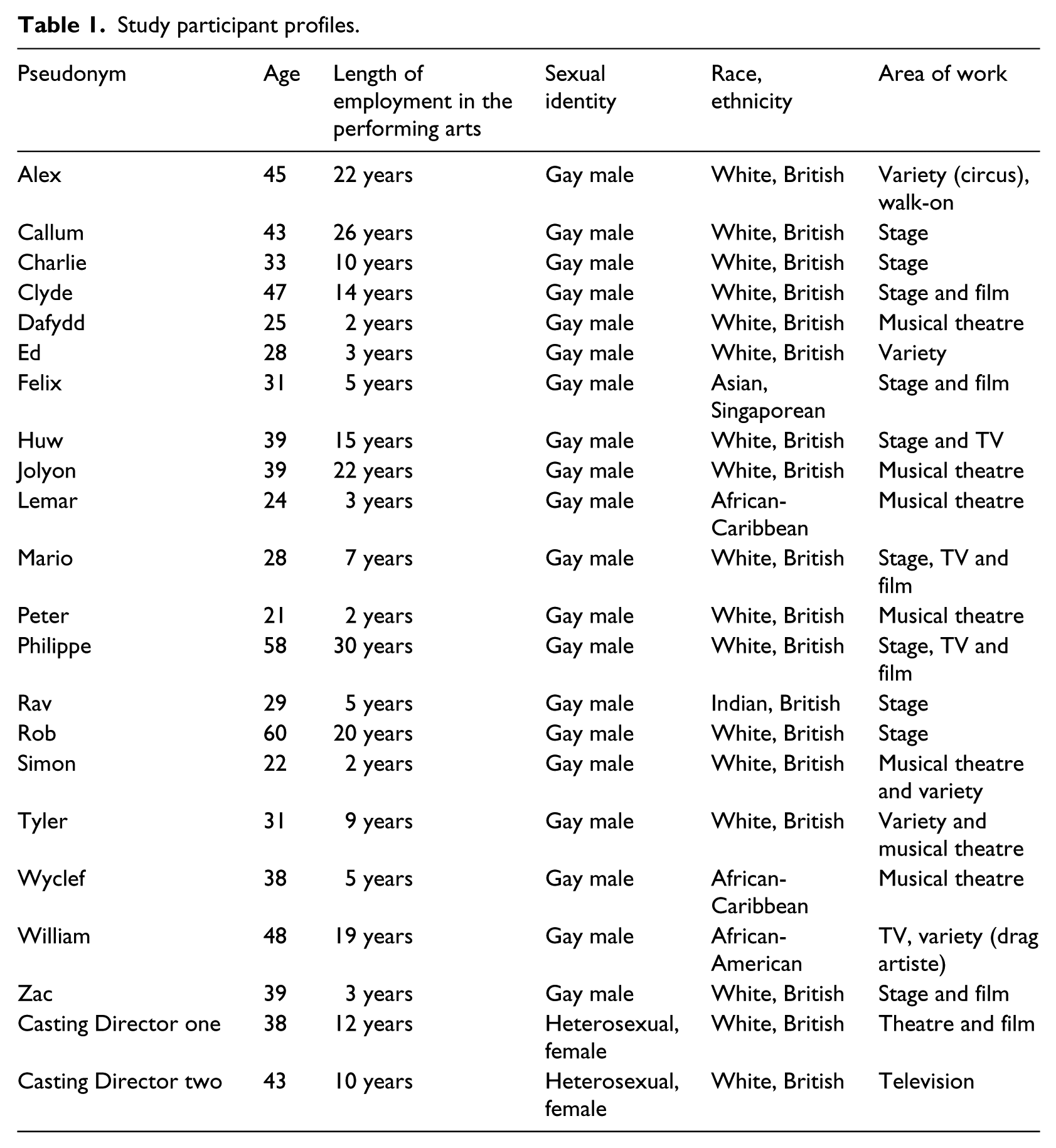
Regarding method, study data were collected as part of a wider research project, carried out in the UK on gay men’s employment experiences in the police and performing arts. Twenty gay male performers were recruited from musical theatre, subsidized repertory theatre and terrestrial television. However, participants had experienced a range of other forms of work including film, cabaret singing, drag artistry, contemporary dance and clowning. Participants were UK based, although some had performed internationally. Some participants described themselves as ‘struggling artistes’ whilst one performer, who had starred in Academy Award winning productions, could be classed as a minor celebrity. With the exception of one participant who described himself as visually impaired, all were able-bodied. Participants ranged in age, from 21 to 63. Opportunities also arose to interview two female casting directors within television and theatre. In order to preserve anonymity of participants, brief biographies are presented in Table 1.
Study participant profiles.
The sample was generated using a snowball technique, typical in studies on LGB people who represent a ‘hidden’ and vulnerable population (Browne, 2005; Rumens, 2012; Williams et al., 2009). A number of personal contacts known to the second author were used to recruit initial respondents. The trade union Equity was also contacted in a bid to raise awareness of the research project. A request for participants was eventually raised during an Equity LGBT committee meeting. Tapping into these networks has proved particularly effective in prior research on sexual identity at work (Humphrey, 1999, Ward and Winstanley, 2004), and this study was no exception. Agents who were known to represent a range of performers were also emailed, and ten West End theatres were also contacted in order to recruit participants. The only requirements for participation were that participants identify as ‘gay’ and ‘male’ and were currently or recently employed within the performing arts. In order to address the ethical issues associated with data gathering on a sensitive area of study, participants are referred to in this study using pseudonyms.
Given that the study follows a qualitative, exploratory and in-depth approach to data collection, digression from a semi-structured interview schedule was permitted. Loosely structuring the interview exchange meant that the agency of the interviewee was given primacy. From a queer theory perspective, we recognize that while interview data is co-constructed and situated, it can also be marred by heteronormativity with the effect of silencing LGBT voices (Kong et al., 2001). To overcome this, the interviews were carried out by the second author, himself a gay man, and it was felt that a shared sexual identity helped to engender participation, encouraging many participants to talk openly about their experiences. The interview schedule focused on lines of questioning that revealed how participants understood and experienced the performing arts as a place to spend time and perform professionally. As such, they were asked about how they managed their identities as gay performers in different work contexts, their experiences of working with different people, obtaining performing work and developing workplace relationships. The tape-recorded interviews generally lasted about one hour and were conducted in participants’ homes.
As mentioned above, with reference to Kong et al. (2001), we recognize that interview data is co-constructed and situated. In other words, this study does not make any claim to uncover ‘true’ versions of participants’ work realities. Rather we acknowledge the partiality and contingency of what is said in an interview situation (Holstein and Gubrium, 1995). Furthermore, while emphasis was placed on issues regarding sexuality and gender in the interview, the conversations that took place could have been very different if issues of race, ethnicity, class, age (to mention but a few) were centre stage. For this reason, we do not wish to mask our presence throughout the research process, but underscore the relevance of our own gay identities, and acknowledge that these have shaped the research findings. As such, the construction of interview data and its interpretation in the empirical sections that follow is a joint effort, and does not represent a definitive reading of the data.
As a final point here, the process of data analysis began from the moment the tape recorder was switched on at the beginning of each interview. In this respect, analysis went parallel with data collection. Part of the data analysis process involved a thematic interrogation of the interview transcripts involving the identification of categories and themes, coding and recoding (Strauss and Corbin, 1990). To aid us in this process, a qualitative data analysis computer software package (NVivo) was used. The data is presented below, organized around three summary themes developed from the analysis process: 1) training to perform (drama school); 2) getting into performing (auditioning); 3) performing backstage.
Training to perform: drama school
Study data revealed that many participants constructed drama school as a gay-friendly institution that afforded them greater opportunities for exploring and expressing their sexuality. Peter’s comments are typical of those who associated the ‘gay-friendliness’ of drama school with its particular demographic characteristics: ‘75% of the students in drama school were either women or gay men … being gay was completely accepted, it was as normal as being straight’. Of interest here is less the issue of the validity of such statistical statements, although statistics are invoked by Peter to designate what is ‘normal’ demographically, and more how such quantifications express what is normative (Warner, 1999). In this case, even in a context where gay men may outnumber heterosexual men, what is normative is still organized around heterosexuality. Significantly, this appeared to shape participants’ expectations of the industry’s friendliness towards gay men and the types of sexualities performed by gay men in drama school contexts.
Encounters and interactions with female and gay performers enabled participants to integrate their identities as gay men based on a strategy of normalization. Accounts of normalizing gay identities usually involved participants positioning themselves as individuals who share many of the qualities as their heterosexual counterparts. In this regard, when participants claimed they ‘blended in’ at drama school and when their heterosexual peers adapted to the knowledge of their sexuality, this had a positive effect on day to day interactions. Participants characterized informal interactions and relations with peers in terms of ‘trust’ and ‘honesty’. Disclosing as gay, often at an early stage in getting to know people at drama school, represented an important means of reciprocating honesty, openness and disclosures of personal information, positioning the recipients of disclosure as trusted individuals. In contrast to the discontinuous nature of performing work, drama school was a significant context for enabling participants to take their time in getting to know and trust people. Notable, then, is that participants did not frame themselves as members of a ‘minority group’ or the ‘isolated exception’, unlike the gay men in studies of the training schools of the fire service or police (Burke, 1993; Ward and Winstanley, 2006).
Interview data also revealed that the construction of ‘normal’ gay identities is a crucial process that structures access to performing work. Regular encounters and interactions with drama school educators helped participants to construct gay performing identities considered ‘acceptable’ in terms of their attractiveness to future employers, which frequently emphasized gender appropriate behaviour: We had one choreographer who said ‘you need to dance like men’ and ‘no one is going to employ men who are camp and obviously gay’. Now I try to dance in a certain way. (Peter) Because I’m camp, it was made clear to me that I might struggle going professionally. (Zac) There was a gay guy on our drama course who was incredibly camp. I once had a discussion with the Head of Acting about this. She felt that I didn’t bring my sexuality into my work. She thought I could play a number of male roles, gay and straight, and even said ‘don’t worry, you’re not tremendously camp’. I found that reassuring. (Mario)
As the quotes above reveal, drama school educators robustly assert that performers ‘who [are] not obviously gay’ are more likely to gain access to a wider variety of performing work. In these interview excerpts the presumed obviousness of gay sexuality is related to the display of ‘camp’, constructed in these accounts as an undesirable performance of femininity that is, in heteronormative terms, essentially linked to gay men. In an industry where roles for male performers are potentially diverse in terms of how they are required to perform gender, camp can function as a mechanism to expose the artificiality and performativity of sexualities by which gay men can defend themselves against a heteronormative culture that can treat homosexuality as deviant, a disease, psychological disorder, and so on (Bristow, 1989; Medhurst, 1997). Here, however, it is appropriated as a disciplinary mechanism and pressed into the service of reinforcing heteronormative classifications of (un)acceptable gay performing masculinities. Yet camp still holds currency in some performing contexts such as musical theatre, as several participants pointed out. But in many formal encounters and contexts involving drama school educators, it seemed that the potency of camp as a transgressive mode of cultural engagement based on parody and irony is noticeably diminished.
Be that as it may, the general feeling among participants was that they were passionate about performing and many, therefore, said they ‘would do whatever it takes’ to secure work. With several exceptions presented later, the widespread acceptance of expressing gay sexuality in a gender appropriate manner in formal performing encounters and contexts did not appear to negatively shape how participants made sense of performing work contexts as ‘gay-friendly’. Nevertheless, we find it hard to dismiss the possibility for understanding drama school as an institution that contributes to increasing cultural expectations for a particular expression of gay sexuality as a normative standard, one that potentially compromises the possibilities for gay sexualities to be performed differently. We develop this observation in regard to participants’ encounters with casting directors and agents.
Getting into performing: auditioning
As this section reveals, although one might expect performers to act what they think casters want, there are particular issues facing our study participants as gay performers. As with Dean (2005) who studied female performers, it is problematic that the embodiment of characteristics associated with a specific performing role is often based on dominant cultural perceptions and stereotypes of age, attractiveness, masculinity and so on. Our study findings add a new dimension to this argument, since it is clear that heteronormative conceptions of gay sexuality also structure access to performing work, as illustrated in the following quotes: An agent once asked me to ‘dress down’ for an audition. It was for a commercial. Playing devil’s advocate, I said: ‘What do you mean, dress down?’. Eventually she said: ‘Can you not look quite so gay’. They felt it would affect the outcome. I went along with it though and dressed down. (Callum) For those who are camp, you just think: how on earth are you going to get cast in all these other roles? (Lemar) I’m proud to be gay, and most of the time, once I’ve secured a job, it becomes quite natural for everyone to see that I am gay. But when auditioning, it’s not something I choose to vocalise. It’s something I feel I will be judged on. (Charlie)
As suggested earlier, our concern is not so much the idea that gay performers must convince themselves and casters they are suitable to play a particular role, but that many participants felt they had increasingly limited scope for identifying as gay when going up for a part. This knowledge framed how they performed gay male sexuality, paying attention to how gay male bodies should be clothed (Callum) or choosing not to disclose a gay identity (Charlie).
Overall, participants felt that decisions to perform gay male sexuality in front of casting directors and agents were structured by a need to respect a conservatism which counsels that it is better not to offend heteronormative sensibilities about how homosexuality ought to be expressed. Felix captured a widespread apprehension voiced by other participants, when he claimed that because casting directors are busy trying ‘to please everybody’ (agents, directors, audiences) they preferred to see ‘safe alternatives’ for certain parts. So while acting talent was demanded, participants suggested that when auditioning, casting directors are sometimes looking for someone who already is an embodiment of the role, and search for the appropriate package in the ‘right’ performer (Dean, 2008a). One female casting director interviewed put it thus: ‘If I’m casting a strongly heterosexual character, then I wouldn’t approach a gay actor’. The same situation from one of our participant’s perspectives is equally revealing of the approach taken by some casters: If there is a character called David who’s straight and grew up in Essex and drives a white car, they want an actor called David who’s straight who grew up in Essex who drives a white car. There is more of a belief that an actor has to be the character from the outset. (Zac)
Be that as it may, when gay parts came up it seemed that gay men did not have a distinct advantage over heterosexual male performers for playing these roles. Charlie’s remark was typical of others expressed by the performers when we questioned them about this issue: ‘I’ve been surprised that often, gay characters are played by straight men’.
From a queer theory perspective, the performance of sexuality in the audition process is mediated by heteronormativity, resulting in the uneven reading of both heterosexuality and homosexuality from the perspectives of our participants, performers and casters alike. Far from being merely subject to casting directors’ concerns about believability, because the performer must get the audience to suspend their disbelief, they are also subject to heteronormative practices that construct male homosexuality in specific ways. Interview extracts above (e.g. Callum, Lemar, Charlie) illustrate this by betraying the concern exhibited among casters: namely, the performance of gay sexualities that come across as being ‘too feminine’. Troubling, then, is that signs of femininity in a gay performer are susceptible to being read by some casters only as an indication they are unable to perform different ways of being gay or heterosexual as the job demands. The same might be true for heterosexual male performers who are judged by casters as too feminine to play roles that require the performance of ‘butch’ forms of masculinity. Still, the implicit essentialism underpinning both views, one that treats homosexuality and heterosexuality each as a homogenous and fixed identity, mediates how participants experience the audition process as a gay-friendly work context. Zac explained: ‘I think this perpetuates the presence of the closet in our industry, especially for those who could be the part bar their sexuality’.
Many but crucially not all participants were deeply unhappy with this outcome, experiencing a contradictory double-bind. If a participant was known to be gay on the acting circuit, he could expect to be marginalized due to the facile stereotyping of casting directors that associated gay men with being ‘unsuitable to play straight’. Yet the same participant was equally at risk from being dismissed as unsuitable when it came to ‘playing gay’, especially in light of the preferences of casting directors who wanted heterosexual men to perform contemporary gay roles that often demanded conventionally masculine characteristics. Not surprisingly, nearly all participants felt that anticipating casters’ preferences was extremely difficult. They not only had to take into account their believability for a particular role that required skill at pursuing verisimilitude in performance, but also how their sexuality might prejudice the casting director’s decision.
This deterred participants from disclosing in the audition process, with some struggling to sustain careers as openly gay performers. For example, explaining why he no longer worked in the performing arts, Zac argued: ‘It’s because of my sexuality, definitely … because I’m camp with it. If I wasn’t camp, I would’ve had more of a shot’. Other participants told similar stories about gay men they thought struggled to conform to normative forms of heterosexual masculinity, but they often appeared indifferent about this predicament or just accepted sexual stereotyping as an industry norm. One participant summed it up thus: ‘after all, this is show business’. Justifying this stance typically involved rationalizing sexual stereotyping by sympathizing with the challenges faced by casters and agents, who are in the business of anticipating what an audience is likely to accept, believe or comprehend. However, some participants did not passively accept this state of affairs. In the auditioning process then, unlike other performing work sites, non-disclosure was understood by some participants as a productive identity strategy that granted them power in their interactions with casters and agents. Rav’s comments typify those made by other participants on the matter: I’m not going to lie to you and say that I wouldn’t lie to a director about my sexuality, if it meant that I got that job. Backstage, I’d be happy to tell him I sleep with men afterwards.
We may read Rav as an example of someone who is self-aware and responding strategically to complex expectations from casters in order to gain interactional leverage in the auditioning process. Of particular interest then is that once work had been secured, participants like Rav feel able to disclose their identity as a gay man, especially in backstage areas. Indeed, backstage work sites were (re)constructed by participants as particularly ‘gay-friendly’ environments, as we explore below.
Performing backstage
Like the types of informal encounters experienced in drama schools, interactions and encounters backstage with other performers were significant for helping participants construct work environments that met their needs and interests as gay performers. Backstage, in green rooms and rehearsal areas, informality presides and participants appeared comfortable identifying as openly gay performers. Within these contexts, participants developed networks of informal relations which served as vital sources of emotional support. These were drawn upon by participants to help them cope with the insecurity associated with performing work and the demands placed on them once in a performing role. These relations also allowed participants to make more positive attributions about performing work sites as gay-friendly, in terms of fun, sexual banter and relaxed interactions with peers: I flirt with the gay guys. I flirt with the straight guys. They flirt back. It’s what you’d call ‘camaraderie’. (Lemar) If anybody gets first night nerves, I’m able to camp about and all that helps. In theatre, even the straight guys are able to ‘camp around’. (Philippe)
It is worth revisiting camp as a focal point of analysis. It is notable that, unlike the formal interactions that take place in drama school and the audition process, in backstage encounters camp behaviour is permissible and interpreted differently. Away from casting agents and directors, participants actively engaged in the liberal use of ‘camp language’. Terms of address like ‘love’, ‘dear’ or ‘darling’, regardless of the gender of the speaker, featured heavily in accounts of backstage informal interactions. The use of camp in backstage contexts displayed greater potential as a critique of harmful sexual stereotyping that underpins a heterosexual/homosexual binary logic, with gay and heterosexual male performers making fun out of satirical forms designed to make fun of gay men. The positive role played by camp in that sense can be seen in how it occasions an opportunity for gay male sexualities to find expression in forms that contest the heteronormative expectations of casters, directors and educators. From one angle, it facilitates pleasure in an occupation marked by unpredictability, uncertainly and discontinuity of employment (Layder, 1993). Demonstrating closeness within informal relations was important to many participants and using exaggerated camp language in day-to-day life helped them to communicate ‘little cuddles without touching’ (1993: 56). Such modes of conveying affection were not limited to participants’ interactions with other gay male performers, as indicated by Lemar and Philippe above.
Significant then is that mobilizing camp language and behaviour is not just about gay men getting a few laughs to help ‘counter first-night nerves’, as Philippe put it, welcome as this might be. It is also about establishing commonality and connection. In that respect, we catch glimpses of how performers can organize in ways that renegotiate the negative meanings attached to camp in some of the formal performing contexts examined in this study. From a queer theory perspective, camp directs attention to the performative character of sexuality and gender, potentially denaturalizing heteronormative constructions of sexual identities (Medhurst, 1997). However, camp is a risky business in that respect since it comes with no guarantee of disrupting heteronormativity. Its radical potentiality is sometimes realized and sometimes not. One risk is that it can easily reinforce the very heteronormative values it seeks to rupture. In the interview accounts it was apparent that the anti-normative elements of camp are often eclipsed since it mobilizes worn out gay stereotypes as a vehicle for calming nerves and anxieties about performing on stage. Another risk relates to the contextual contingency of the positive meanings ascribed to performances of camp by study participants, mostly in backstage areas. It is no coincidence that many study participants were acutely aware of the different performing work contexts which require them to negotiate their subjective performances in specific ways that adhere to heteronormative values, thereby suggesting that the subversive potential of camp struggles to seriously undermine the heteronormativities that preside in many work contexts. While possibilities exist for camp in the performing sites to be read as an informal signal of the gay-friendly aspect of the performing arts, from a queer point of view it is difficult not to read this as further evidence of the resilience of heteronormativity in the performing arts, and how it must be variously negotiated within the lives of gay male performers.
Concluding discussion
In the context of emerging scholarly debates about organizational forms described as ‘gay-friendly’ (Colgan et al., 2007, 2009; Correia and Kleiner, 2001; Giuffre et al., 2008; Williams and Giuffre, 2011; Williams et al., 2009), this article has examined how a sample of gay male performers in the UK negotiate the heteronormativities that inform the array of (in)formal encounters and interactions with drama school educators, casters, agents and peers in specific performing work contexts. The analysis above has developed the argument that it should not be assumed that places of work understood and experienced as ‘gay-friendly’ constitute ‘new’ organizational forms in which heteronormativities are eradicated. In that regard, the performing arts in an interesting research setting because it has long been coded as a ‘natural’ home for gay performers (Clum, 2000; Dyer, 1990; Sinfield, 1994). Far from witnessing a collapse in heteronormative values in the performing arts in the context of such stereotypes and at a time when a growing number of organizations are being labelled ‘gay-friendly’, the work contexts of gay male performers appear intensely heteronormative. This is not to say that heteronormativity is closed to contestation. Our study findings demonstrate that gay male performers are not victims or helpless against the ways in which heteronormativity informs normative standards of homosexuality—far from it. Rather, it is to foreground the struggles, decisions and actions taken by gay male performers as they make a living as a professional performer amid the competing demands they are subject to in terms of how they must manage the performance of sexuality in specific work contexts. This is, we reason, revealing of the dynamic between organization, work and sexuality, illustrated in the contributions this study makes to extant literature.
Empirically, this article makes several significant contributions to the study of organizational heteronormativities in the performing arts. First, by focusing on gay performers, the study adds a new dimension to a small but vital body of research on how gender, race, ethnicity and age can structure performers’ access to work (Dean, 2008a). In that respect, this study lifts the voices of gay male performers who have hitherto been silenced or overlooked. One positive effect of this is that new light is shed on gay male sexualities in the performing arts, showing how specific work contexts, even within an industry stereotyped as ‘gay-friendly’, constitute and regulate the sexual field at work, categorizing and privileging sexualities in particular ways that serve specific ends. One observation here is that gay male performers struggle to transcend heteronormativity, with little damage done to the sexual and gender binaries upon which it rests. This point is connected to the study’s second main contribution which relates to how heteronormative conceptions of sexuality can impede the opportunities available for gay performers to obtain work.
This is glaringly apparent in casters’ and drama school educators’ preferences for gay performers to avoid being ‘obviously gay’ which is to say that when gay sexuality is gendered in femininity it is often considered to carry limited professional currency. Encouraging gay male performers to cultivate specific performances of gay male sexuality is of some concern to us since there is every reason to believe that such a careful construction of self might involve modifying aspects of the self across multiple performing sites, requiring considerable effort and energy to maintain performances of sexuality according to the demands of each performing context. It may, as our study reveals, encourage some gay performers to avoid disclosing their sexuality for fear of being seen by casters and agents as limited in their capacity to perform certain roles. Here, study participants demonstrate that the performance of sexuality in organization is not radically open and unfettered. We have no intention to construct our participants as victims and passive and, like Butler (1990, 2004), we do not suggest individuals’ performances of sexuality are the effects of unconstrained choice. In the context of some ‘gay-friendly’ performing work sites, the disciplined performance of gay sexuality in various encounters becomes a marker of the performer’s capacity to succeed in a competitive environment. Noting the general sympathy expressed among participants about the challenges faced by casters, who must take into account audience expectations and tastes, we might excuse those casters who ‘play safe’ by, for example, casting heterosexual men in gay roles. Additionally, some readers might consider this a non-issue. But the views expressed by many study participants give us reason to be perturbed and, at the very least, interrogate casters’ motives, which this study shows can sometimes transcend the matter of a performer’s believability in a particular role. In other words, we argue that some participants struggle to gain traction on an organizational field of sexuality that is already elevated against them. Under these circumstances we find that gay male sexuality is homogenized and fixed within a heteronormative frame which, as noted above, casts doubt on the capacity of performers known or presumed to be gay to play a range of male parts requiring different gender performances. We suspect this might not be true in the case of many but crucially not all heterosexual male performers, but this requires further investigation.
Theoretically, this study builds on existing approaches towards conceptualizing and studying ‘gay-friendly’ organizations by using a queer theory perspective. In the sexuality of organization literature, emerging studies on ‘gay-friendly’ organizations, employers and workplaces have largely focused on ‘good practice’ which serves to signal them as such and how they are understood and experienced by LGBT employees. While some of this scholarship acknowledges that ‘gay-friendly’ organizations do not represent a new model of organization free from homophobia (Colgan et al., 2007, 2009; Giuffre et al., 2008; Williams et al., 2009), not all of it acknowledges and analyses the complex and ambiguous relationship between ‘gay-friendly’ organizations and heteronormativity (Rumens, 2014). In line with Williams et al. (2009) and, at the same time, adding a different dimension to a developing ‘queer’ organization studies and sexuality literature (Harding et al., 2011; Lee et al., 2008; Parker, 2002; Rumens, 2010, 2012; Tindall and Waters, 2012; Tyler and Cohen, 2008; Williams and Giuffre, 2011; Williams et al., 2009), we aver that queer theories provide a sharp analytical focus on how heteronormativity operates to categorize and regulate sexualities, with the aim of denaturalizing the master binary heterosexuality/homosexuality which determines what identities, desires, values and sexualities are heteronormative. As this study shows, gay male sexualities are performatively instituted according to localized heteronormativities, thereby reinforcing contextually contingent normative standards of gay male sexuality which performers are encouraged to embody and perform both professionally and personally. Indeed, through a queer lens, examining the everyday (in)formal encounters and interactions with different people in specific performing work contexts is empirically illuminating in that sense, not least because there is a paucity of formal ‘good practice’ relating to equality initiatives on sexual orientation in the performing arts. This scarcity of policy initiatives and accompanying management practices must be rectified as one step forward to addressing organizational heteronormativity. As such, we argue that ‘gay-friendly’ work contexts are usefully conceptualized as the effects of various organizing activities, both formal and informal, as well as of wider legal, social and cultural shifts. They are in a state of becoming rather than some fixed and knowable entity, despite efforts to construct them as such (Rumens, 2014), and under certain circumstances they have a crucial role to play as instruments of a heteronormative regulatory regime.
Our study begins to take up the challenge of researching ‘gay-friendly’ work contexts at a time when sexuality is subject to intense control, organization and regulation (Hearn, 2011), but more research of this type is needed. In particular, we strongly recommend the study of specific sexualities in a variety of ‘gay-friendly’ organizations and work contexts. For instance, researchers might ask what place is there within gay-friendly workplaces for lesbian, bisexual and trans employees? How can the perspectives of these individuals help to rupture the heterosexual/homosexual binary division upon which some constructions of ‘gay-friendly’ are indebted? Furthermore, we need to address how workplaces can at one and the same time be understood as ‘gay-friendly’ and sexist, racist and ageist? Such knowledge may inform organizational practices designed to engage with LGBT employees’ needs and interests in ways meaningful to the individual, especially in those work settings such as the performing arts where there is a scarcity of formal equality policy and practice. Crucially, we believe queer theory analyses can help here by encouraging scholars to examine all that which is disavowed by and yet central to heteronormative logic within organization.