




Abstract
Based on 43 interviews conducted with employees who spend around half of their working-hours on non-work related activities such as ‘cyberloafing’, a typology of empty labour is suggested according to sense of work obligation and potential output in order to set the phenomenon of workplace time-appropriation into a theoretical context in which wasteful aspects of organization and management are taken into account. Soldiering, which emanates from a weak sense of work obligation in the individual, may entail aspects of resistance, but there are also less voluntary forms of empty labour deriving from a lack of relevant work tasks. All types of empty labour are, however, bound up with the simulation of productivity. Therefore, they ironically serve to maintain the capitalist firm’s reputation for efficiency.
Keywords
As less and less people are forced to produce more and more, more and more people are forced to produce less and less. Martin Nicolaus
In the aftermath of Fordist time studies, proliferating surveys are disclosing intriguing statistics on the average extent of empty labour, here defined as ‘private activities at work’. Despite the overwhelming mass of sociological research demonstrating how the hardened competition of globalization leads to precarization and an increase of socio-pathologies such as ‘burnout’, several studies report that employees generally spend 1.5 to 3 hours of their daily working hours on non-work related activities (Blanchard and Henle, 2008; Blue et al., 2007; Bolchover, 2005; Carroll, 2007; Jost, 2005; Malachowski and Simonini, 2006; Mills et al., 2001). By measuring the flows of electronic audience between indexed internet sites, it has been observed that 70% of the US internet traffic that passed through pornographic sites by the turn of the millennium did so during working hours, and that 60% of all online purchases were made between 9 am and 5 pm (Mills et al., 2001: 3). This kind of ‘cyberloafing’ is not restricted to the US but also prevailing in nations such as Singapore (Vivien and Thompson, 2005), Germany (Rothlin and Werder, 2007) and Finland (Grahn, 2011). Some have also estimated the ‘costs’ of empty labour: according to Verton (2000), 30% to 40% in productivity losses may be the result of cyberloafing, and Malachowski and Simonini (2006) attracted much media attention when asserting that time waste may cost US employers up to $544 billion annually. Based on similar calculations, Cullen (2007) estimates that the collective working hours spent on the interactive internet site facebook.com cost Australian businesses $5 billion a year.
Theoretical differences in how various disciplines regard private activities at work are numerous: to begin with, some of the statistics just mentioned are produced by organizational psychologists and management theorists who are explicitly bent on controlling the amount of empty labour. Within these disciplines, ‘time waste’ is regarded as a consequence of ‘dysfunctional attitudes’ and a lack of ‘organizational regulation’ (see Sagie et al., 2003 for typical examples). On the other hand, critical workplace students have studied time waste and other forms of organizational misbehavior as manifestations of a political will to resist the injustice inherent in every employment relation (see Bonnet, 2007 for a review). Within critical workplace studies, there is furthermore a discussion concerning the possibility and prevalence of individual forms of workplace misbehavior in general (Ackroyd and Thompson, 1999; Fleming and Spicer, 2007) and whether the vast amount of misbehaviors that have recently been studied signify real resistance or incorporated forms of discontent that ultimately serve as ideological safety valves (Cederström and Fleming, 2012; Contu, 2008; Fleming and Spicer, 2008).
The purpose of this article is to explain how radical forms of empty labour occur. Should they not be extinct in these days of work intensification? And how can the average of empty labour be so extensive? Could it be that employees are quietly resisting work by withdrawing from it? An interest for workplace misbehavior—defined as ‘anything you do at work you are not supposed to do’ (Ackroyd and Thompson, 1999: 2)—and workplace resistance—defined as ‘anything you consciously are, do and think at work that you are not supposed to be, do and think and which is directed upwards through the organizational hierarchy’ (Karlsson, 2012: 185)—initiated this research. However, recalcitrant workers only explain one side of empty labour. Based on a vast interview material of ‘critical cases’, mostly office employees who spend around half of their working hours on private activities, this study will add a new dimension to the debate on organizational misbehavior. I will argue that both uncritical and critical organization theorists suffer from a rationalistic bias in their assessments of misbehaviors such as ‘time appropriation’ (Ackroyd and Thompson, 1999: 41–44). The general assumption seems to be that ‘there is always work if you want it’, that the workplace is a rational machine and that efficiency losses are due to individual employees lacking in work commitment and communication. Yet, sometimes, we see the opposite. To illustrate this point, I will suggest a typology of different forms of empty labour that takes organized inefficiency into account. In the next section, political dimensions of empty labour will be discussed in more detail. After a short description of the methods, I will then present my analysis of empty labour and its subcategories based on the interview material.
Literature review
To avoid the normative connotations of the concept of ‘time waste’, I propose the term ‘empty labour’. Empty labour is everything you do at work that is not your work. Marx mentions this aspect of wage labour in a passage on the ‘porosity’ of labour where he falsely predicts ‘a closer filling-up of the pores of the working day, i.e. a condensation of labor’ (Marx, 1976 [1867]: 534) as a consequence of managerial and technological rationalizations conspiring with the governmental shortening of working hours. The early launching of these rationalizations is thoroughly described in the writings of Taylor. A main concern of Scientific Management was to control what Taylor termed ‘soldiering’—the restriction of output most commonly exercised by skilled craftsmen, and, according to Taylor (1919: 14), ‘the greatest evil with which the working people of both England and America are now afflicted’. Of course, the strategic struggle between workers and time-study engineers continued to play a key role once Taylor’s project had been realized, and the exertion of soldiering became one of the main study objects in early industrial sociology (cf. Mayo, 1938; Roethlisberger and Dickson, 1939; Roy, 1952, 1954).
In all scholarly writing on empty labour so far, it has been assumed that its agent is the individual employee who, for various reasons, chooses to withdraw. Thus, in his ‘heterology’ of everyday tactics to evade submission, Certeau (1984: 25) argues that what in France is called la perruque—‘the worker’s own work disguised as work for his employer’—represents one of the clearest examples of hidden ‘enunciatory acts’ as he terms it. The secretary’s writing of a love letter and the cabinetmaker’s borrowing a lathe for turning a piece of home furniture are in Certeau’s account examples of how the worker ‘in the very place where the machine he must serve reigns supreme … cunningly takes pleasure in finding a way to create gratuitous products whose sole purpose is to signify his own capabilities’ (Certeau, 1984: 25). Whereas Certeau is careful not to create ‘a fiction’ that collects all transgressions, including time appropriation, under the sign of a single ‘Voice’ (Certeau, 1984: 135), others are more drastic in their interpretations.
In some romantic notions, time appropriation equals sabotage. The often referred to etymology of ‘sabotage’—‘to work clumsily as if by sabot blows’ (Pouget, 1913 [1898]: 17) denotes precisely what Taylor called ‘soldiering’. Dubois even argues that soldiering is the essence of sabotage: ‘“Sabotage” primarily means working slowly and lowering the quality of what is produced’ (Dubois, 1979: 103). Pouget sees the first expression of this type of industrial sabotage in the Scottish expression ‘ca’canny’, or ‘go slow’ (see also Ackroyd and Thompson, 1999: 32)—a resistance that sometimes was employed when official strike was not an option (cf. Brown, 1977). For Pouget, time appropriation thus signifies a type of ‘guerilla warfare’ that ‘develops individual courage, daring and determination’ (Pouget, 1913 [1898]: 35), and for Dubois, it is an act of resistance ‘bound up with the private ownership of the means of production’ that will disappear only ‘when we have finally achieved socialism with freedom’ (Dubois, 1979: 213). Similar thoughts can be found in Sprouse’s work on sabotage (Sprouse, 1992: 7), and in Solanas’ feminist project of ‘systematically fucking up the system’ in which ‘unwork’ plays a prominent part (Solanas, 1967: 22).
A more cynical approach to empty labour can be found in Roy’s ethnographic account on ‘making time’. Roy observes how the piecework system encourages workers to ‘bank’ a surplus—‘a kitty’—that will later fund empty labour. Roy engaged in this type of time appropriation himself and noted that he could ‘loaf’ around talking with his colleagues for up to four hours and yet ‘none of the bosses seemed to mind’ (Roy, 1952: 433). Based on similar observations, Lupton (1963) argues that time-fiddling can give workers a relative satisfaction that cuts the potential of greater harm to the industry; a type of misbehavior that would fall under Taylor and Walton’s (1971) concept of ‘utilitarian sabotage’ which designates unauthorized operations that reduce frustration among workers and thus enhance the efficiency of the labour process.
Beside these classics within labour process theory, Burawoy’s Manufacturing Consent (1979) still represents the ‘let-the-children-play’ thesis in its most elaborate form. The investigation of why ‘workers work as hard as they do’ paradoxically brought Burawoy to analyse ‘the game of making out’, which he describes as a process of ruthless bargain with time managers and intense labour ‘with the purpose of advancing as quickly as possible from one stage to the next’ (Burawoy, 1979: 51). Once you have made out, you can enjoy your ‘kitty’ as described by Roy. According to Burawoy, this and other games concerned with deceiving the piecework system constitute a psychological safety valve for worker aggression at a relatively low cost to the employer. Capitalists can afford the economic losses due to workers making out a couple of hours and yet succeed in their main objective, which is to secure and obscure surplus value. Hence, Burawoy radically changes the notions of control and resistance in labour process theory: ‘Coercion, of course, always lies at the back of any employment relationship, but the erection of a game provides the conditions in which the organization of active cooperation and consent prevails’ (1979: 83). Despite criticism of Burawoy’s analysis, particularly his one-sided functionalist approach, his lack of dialectics and the assumption that consent is only created in the labour process irrespective of external relations (e.g. Clawson and Fantasia, 1983; Edwards, 1986; Gartman, 1983; Roscigno and Hodson, 2004; Thompson, 1983), similar analyses have more recently reappeared in critical workplace studies with regard to both time appropriation (Baxter and Kroll-Smith, 2005; Ladner, 2009; Maier, 2006; Townsend, 2004) and to organizational misbehavior in general (see Contu, 2008; Fleming and Spicer, 2008; Fleming, 2009; Mumby, 2005; Sewell, 2008).
In all these analyses, empty labour is assumed to be the effect of what Taylor called ‘soldiering’—the active appropriation of time on behalf of the employee. I will argue that this assumption is based on a rationalist conception of the firm according to which inefficacy stems from the worker collective whereas productivity is the concern of management. As we shall see, empty labour is not always the consequence of employee dissent or of informal ‘games’. Often, empty labour may, on the contrary, be forced upon the employee as an effect of organized waste; sometimes with outbursts of ‘boreout’—a state of intense boredom and apathy—among employees (cf. Bolchover, 2005; Rothlin and Werder, 2007). Therefore, unlike previous studies of empty labour, the focus will here be on the interaction between individual and organizational types of idleness.
Methods
Enquiries about empty labour always risk putting the interviewee in a defensive position. In fact, only participating in a study of empty labour may be conceived as utterly shameful, which is why finding interviewees has been a very demanding task (cf. Anteby, 2003). The study material includes in-depth interviews with 43 employees from Sweden, who on average spent more than half their working hours on private affairs such as surfing the web, writing private e-mails, reading, playing computer games, watching movies, sleeping, etc. The interviewees were selected through advertisements on various forums including a webpage (maska.nu) with the explicit aim of encouraging as much soldiering (the Swedish term is maska) as possible. Based on these interviews, I also did a chain referral sampling (see Lopes et al., 1996). In sum, the interview subjects include 20 women and 23 men. Most were office employees with academic degrees working in isolation, primarily in the private sector and of a young age (ranging between 22 and 45). Fourteen interviewees had service jobs (e.g. one receptionist, two security officers, three social workers), five belonged to the industrial sector (e.g. one warehouse employee, two mechanics, one factory worker), while the rest had typical office jobs in either the private or public sector (e.g. three web developers, one accounting clerk, one logistics administrator).
A few methodological notes should be kept in mind. The amount of time spent on empty labour was self-reported and the patterns varied between those who experienced the same emptiness each day and those for whom it in waves—sometimes in terms of weeks or even months. Furthermore, by turning to a website like maska.nu a political bias in the sample might be suspected, perhaps leading to an overrepresentation of employees engaged in ‘soldiering’ (as defined below). Yet the majority of the interviewees did not frame their engagement in empty labour with political narratives (see Paulsen, 2013). Moreover, the purpose of the study is not to measure the frequency of different forms of empty labour, but to analytically discern them. A missing group in the sample—as in all interview samples—is those who, due to ‘cultural scripts’ (Alvesson, 2003) of diligence and work ethic (which are strong in Sweden, see Paulsen, 2010), are too ashamed of their idleness to talk about it. Nevertheless, there is no lack of examples in the material illustrating how long hours of empty labour can be combined with a strong work ethic.
Empty labour
The initial gathering of informants was guided by the uncritical equation of soldiering and empty labour. Therefore, the first interviews focused on the employee’s sense of work obligation. Work obligation can be defined as the employee’s inclination to work within the frames of the firm regardless of collegial and managerial pressure (Baldamus, 1961: 85–87). I soon realized that this dimension should be complemented by what I call ‘potential output’. For instance, a florist who only had two or three clients a day said that she worried more about not having enough to do than what her employer did. She kept the flower shop in perfect order and allegedly did her best to fill the downtime with meaningful work. Yet, ‘there is a limit to how many times you can water a flower’, as she put it. This limit—how much work there is at a job—is, as Baldamus (1961: 90) contends, always a source of uncertainty. While it is often assumed that there is no limit to the work each employee can engage in, sometimes the potential output can settle on a very low level in relation to time. As we shall see, this level is neither absolute nor free from value judgements. Meaningless work that has little to do with the trade in question can always be invented, but it may not necessarily contribute to the commercial output. When I define the potential output as low, as in the case of the florist, the main work tasks require little effort in relation to time whereas ‘extras’—work tasks for which the employee has no formal responsibility but that he or she may choose to do anyway (Baldamus, 1961: 85)—are either not available or so distant from the employees’ responsibilities that it would put them in trouble if they were to engage in them. Under these circumstances, empty labour can be quite involuntary on the part of the employee. When the potential output is high, i.e. when the main task of the employee requires a higher effort in relation to time and there is plenty of extra work at hand, empty labour can only come about if the employee actively withdraws from work.
Figure 1 illustrates the different types of empty labour that will be analysed here. I will pay special attention to enduring and soldiering since these two categories are the most debated and also each other’s opposites in this typology. Enduring refers to an involuntary form of empty labour, whereas soldiering refers to the intentional type of ‘output restriction’ commonly analysed in labour process theory. Coping, on the other hand, is a form of empty labour that may be called ‘recreational’ in a non-euphemistic sense. It differs from soldiering in that the employee’s intention when coping is to remain at a productive maximum. Slacking signifies the happy marriage between weak work obligations and low potential output. Here, the employees enjoy periods of empty labour without feelings of regret and boreout syndromes.
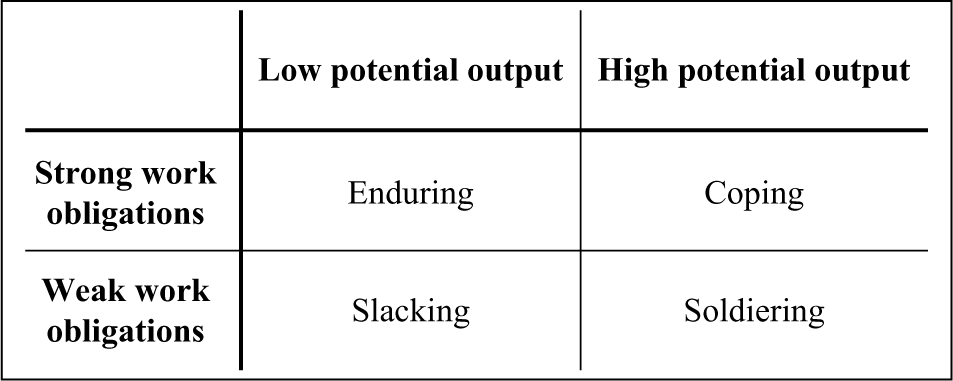
Empty labour according to work obligation and potential output.
Empty labour is rarely static enough to stay within a single square. There is a dynamic between the types to which I shall return. The difference between enduring and slacking can simply be a matter of changing moods from day to day—the sense of freedom and autonomy that some associate with empty labour may soon change into boredom. Similarly the potential output is not a constant that remains unaffected by the employee’s actions. If someone soldiers for a while, thus withdrawing from what could be done, the extras may move to the (unofficial) responsibilities of someone else, thus shrinking the potential output of the individual worker.
Slacking
One of the earliest accounts of slacking has been offered by Veblen (2008 [1899]) who, in his critique of the utility perspective that still dominates economic theory, uncovers irrational and, as he excessively argues, primitive elements in the economic behavior of the upper classes. According to Veblen, the modern leisure class was not liberated from work; it participated, but in a minor, highly symbolic and yet conspicuous manner. The leisure class not only consisted of noble and priestly classes; especially when it came to ‘conspicuous waste’, their ‘retinue’ also played an important part. The ‘vicarious leisure’ that some duties of the servant class entailed, served, Veblen argued, the function of ‘imputing pecuniary reputability to the master or to the household on the ground that a given amount of time and effort is conspicuously wasted in that behalf’ (2008 [1899]: 25). In this study, this ‘subsidiary or derivative leisure class’ is well represented among the interviewees.
A web programmer describes the Swedish office of the international broadcasting company she works for as a ‘big playground for adults’. Greeted by a massive aquarium in the shape of a reception desk, the visitor is guided through an open plan office where each department has been markedly designed to correspond to a metropolis. In the Dubai section that the web department occupies, labour constitutes approximately one hour of working hours, whereas the rest of the time is devoted to slack. For instance, the programmers take turns at being ‘disc jockey’ to the music streaming through the headsets that they all wear; through Messenger they silently exchange web links, internal jokes and lengthy discussions about where to eat lunch, but most of all they surf the web for their own pleasure. If she wanted to work more, she would not know what to do, she claims: ‘they would probably wonder what’s wrong with me’. Still, no one can slack overtly. Although the manager is completely integrated in the slack and even the worst slacker of all according to our informant, the slack must take place under the cover of feigned productivity.
Another web programmer describes his office as even more ‘relaxed’ in terms of empty labour. Here, they openly slack: ‘We have Nintendo Wii installed in our cafeteria, but that was hot last summer, now people have grown tired of it. Now we’re more into Guitar Hero where you can compete with each other’. The CEO likes to join in, but he is usually too busy. Despite the small-scale size of the company, the notorious day-and-night-working-hours within the creative industries is an unknown phenomenon to this programmer. When they approach the deadline of a project, the work becomes more intense, but they rarely work overtime. According to the interviewee, he is not paid for the labour put into the product, but for his skills and knowledge. Other examples of slacking include an archivist writing his PhD thesis while being paid for sorting files, and two night-working employees within the surveillance industry who mostly sleep, play computer games and watch movies while at work.
According to a survey from salary.com, the most common reason for empty labour is that employees feel they ‘don’t have enough to do’ (Blue et al., 2007). Slacking employees are those who enjoy this situation and have no ambition to change it. Their labour process is often spasmodic and irregular. Like Veblen’s leisure class during ‘primitive’ times, they switch from simply being available to engaging in projects. One could explain part of this slack in rationalist terms. From a transaction cost perspective, it may be more rational to let employees slack around as long as costs are kept under the level of potential consultation. It has also been suggested that slacking can support organizational experimentation and learning (Scott, 1998: 235).
However, this only constitutes part of ‘the rationale’ behind slacking. It is clear that there is an occupational stratification for empty labour that should be further explored (cf. Green and McIntosh, 2001; Green, 2004). For instance, in their survey of cyberslacking in the US, Garrett and Danziger (2008: 291) found that ‘those who are highly paid, managers and professionals, better educated, and employees with greater workplace autonomy spend substantially more time online for personal purposes during work than those below them in the workplace hierarchy’. Although the exact parameters remain to be specified, a central concept here is the opacity of the job, i.e. the degree to which the labour process is difficult for a layperson to understand and estimate in relation to time and effort. High opacity allows workers to exaggerate how much time they need to perform a certain task. High opacity can also entail that management gives the worker more time than needed. It lowers the prospects for fully exploitative staffing as it binds an already ‘bounded rationality’ (Simon, 1991) and pushes evaluation from the effort bargain to actual market success. ‘As long as the client is pleased, nothing else matters’, is a recurrent statement among slacking interviewees. Sometimes, when workers are given more time than needed, they secretly enjoy it. Other times, they are forced to endure it.
Enduring
One condition that seems necessary for a weak sense of work obligation is that the employee is engaged in external activities that are perceived as more meaningful than the job, e.g. facebooking, twittering, writing a dissertation, watching movies, listening to music, sleeping, etc. Not everyone has such activities. Whether valued as part of an identity project or as a meaningful activity in itself, wage labour is still a major source of self-esteem for many people (cf. Bauman, 2004; Beder, 2001). To such persons, empty labour can be of more trouble than gain.
Here, we should draw a parallel to the extensive research on various survival strategies at work. A common observation among ethnographers who have experienced the amazing monotony of the majority of wage labour jobs is how it forces the worker to create games whose autonomous character renders psychological investment possible (Burawoy, 1979: 72; Ditton, 1977: 76; Roy, 1953: 5). As defined here, ‘enduring’ signifies the failure of engaging in such games. For someone enduring empty labour, time awareness acquires another meaning than the economically oriented one described by Weber (1992 [1904]) and E. P. Thompson (1967). Here, the employee’s awareness of time implies time as an agonizing dimension of life that needs to be repressed.
A key accountant desk manager has worked at a logistics company for five years, in which his task is to track deliveries of the company’s most important clients whenever anything goes wrong. He normally works 50% of his working hours, but when transports are not working properly, he is heavily occupied. His superiors, who have no insight into his work and who do not even share an office with him, know nothing about his situation. To him, a balance between labour and empty labour is of vital importance to his well-being. This becomes particularly palpable when the workday is over: ‘If you’ve had a lot of shit during the day you can be tired. But you can also be tired if you’ve had nothing to do’.
To make time pass faster is a re-occurring theme in all interviews with the exception of those who are barely coping with their situation. An assistant store manager describes small periods of empty labour as a relief from time to time, ‘but after more than half an hour it just gets boring’. Yet, unlike some of his colleagues, he cannot bear ‘inventing work’, like polishing the doors: ‘It is so incredibly meaningless when you think of it. To polish for the sake of polishing’. The potential output is, in other words, low. He either has clients, or he does not.
This may sound like outrageous exceptions or just bad excuses for not working, but outside the academic frames of organization theory (where it is hardly mentioned) enduring is far from unheard of. One example is Bolchover who wrote a book about his years in the British insurance business during which he, according to his own estimates, had about ‘one month of work for every year of employment’ (Bolchover, 2005: 22). Another example is the civil servant from Germany who, on his retirement day, sent an email to his colleagues in which he explained that he had not worked at all during the last 14 years of his career (Waterfield, 2012). In both cases, it turned out that they had been put on positions where formal responsibility was high but actual work non-existent.
Two puzzles are apparent here. First, why do employees not inform their managers if they so desperately want more work? For nearly a year, a banker spent only 15 minutes a day on work-related activity. When he tried to communicate this to his boss, he always got the response that he would soon receive more work assignments. Today, he does the same job, but as a half-timer. Being only 25-years-old and without a family, the cut has not harmed him particularly, but he has ceased to complain about ‘downtime’. This is a clear example of how the capitalist employment contract limits productivity and how simulation of work can become more important than actual work. If the employee gets more time than needed for a job, there are several reasons to remain quiet about it. There may not be anything else for the employee to do in the organization. And if there is, the ‘extras’ may be specifically constructed to fill downtime and, hence, completely meaningless.
Second, why do enduring employees not spend the time freed by empty labour on whatever they want to do, thus avoiding boredom? Here, the strong sense of work obligation (and weak sense of autonomy) plays a key role. The banker still has plenty of empty labour, but despite access to the whole universe of the internet and an office space that leaves his back to the wall, empty labour remains a bore: ‘It becomes boring in the long run like when you’ve read every column of Herman Lindqvist back to 1998’. When the orders, rules and pressures of working life disappear, imagination and curiosity are imperative to help avoid boredom.
Beside these puzzles, the structural mechanisms reproducing enduring are the same as in slacking. The enduring interviewees in this study have mostly had successful careers. Despite the amount of empty labour they are still able to sufficiently display results to please their superiors. ‘The really absurd part of it’, the banker says about a particularly empty project that he was assigned, ‘is that I was highly praised for my effort at the end of the project’. Technological opacity can make 15 minutes a day appear as hard work.
Coping
Although considerably subtle in comparison to the other forms of empty labour, coping should be distinguished from soldiering. Not least because some have tended to question the difference between the two (Garrett and Danziger, 2008; Townsend, 2004)—a central reason why I wanted to concentrate on radical cases of empty labour—but also because others have labelled the idea that empty labour can be used as a way of coping as a ‘neutralization technique’ that employees use to rationalize their ‘offense’ (D’Abate, 2005; D’Abate and Eddy, 2007; Sagie et al., 2003; Vivien and Thompson, 2005). Since neither a lack of commitment nor inefficient organizational structures is causing the practice of coping, coping also allows us to grasp a dimension of work that has considerable impact on the sense of work obligation, namely the meaning of work and particularly what purpose it serves.
Among the coping employees, two shared a history of long-term sick leave due to burnout that they now believe they have found means of avoiding. Five of them are social workers, either working at care facilities or with social security. Among these, taking some time off is considered ‘an ability’ known to be more productive in the long run. This is also reflected in how management encourages the personnel to take their share of empty labour (in form of breaks) from time to time. As one allowance administrator points out, however, policy and practice are often decoupled from each other: ‘“Of course you should, of course you should take some time off”, they say. But then you’re not always ready to take the consequences’. Another allowance administrator even criticizes her boss for cyberloafing too much: ‘She uses MSN to communicate with her husband—even when you come in to her office to ask her about stuff! To me, that’s beyond limits. You shouldn’t be online all the time like that. You have to be present’. The sense of work obligation does not come from management, but from the moral meaning of work. Feelings of underachievement urge them on; or as a nurse puts it: ‘Sometimes it feels like only the basic mission is fulfilled. To give them food and keep them whole and clean’. Coping is in no way a solution to this situation. Now, the nurse has learned to ‘say no’ from time to time, but at the cost of a constantly bad conscience.
As in the case of soldiering, less meaningful work is what coping employees cut down on. Typically, this means less bureaucratic work and excessive cleaning. A keeper at a psychiatric care centre thinks much of her work is meaningless: ‘There are a lot of other things as well in our job. We’re supposed to write a bunch of, well … write-ups and fuss around. And I feel like … I mean, to sort hundreds of files that nobody has touched during the last ten years and so on? That makes no sense’. The sense of meaninglessness reflects a strong work obligation in conflict with administrative demands. The official job description is of less importance than professional and personal ethics.
Two recurring analyses of empty labour may here be addressed: (1) As I have already mentioned, we have a range of organization researchers who are eager to translate the above-mentioned attitude into psychological language and concepts such as ‘rationalization’ or ‘neutralization’ implying that the employee is less rational than the organization she or he is a member of. Particularly within the sector of social services, this seems to be a questionable idea; (2) Some scholars (Gouveia, 2012; Ivarsson and Larsson, 2012; Townsend, 2004) tend to argue that empty labour does in fact increase productivity since it allows employees to recover and renew their energy. This argument, which is extremely hard to prove empirically, is only relevant to the type of empty labour I here call coping. Given that the average time spent on empty labour ends up at around two hours a day in most surveys conducted, its relevance is also disputable. What kind of job—i.e. outside academia—could possibly require two hours of recreation a day?
Soldiering
A difference between coping and soldiering is that coping rarely takes more than one hour a day, whereas soldiering easily can free the autonomous use of more than half the working hours. Yet, the most important difference concerns work obligation. When soldiering, the employee has no ethical or identity-grounded relationship to the work. Nevertheless, work obligation should not be reduced to pure subjectivity. Structural factors can have a vast impact on work obligation: both organizational structures and institutional structures (cf. Burawoy, 1979; Thompson, 1983). For instance, the labour contract can be designed so that soldiering cannot but be considered a natural consequence. For example: a machine technician was employed to calibrate machine tools at an industrial workshop for a few summers in order for the employer to receive a grade l. The employment ended when the job was done, so it took a while. As he puts it:
I had work as long as there was work for me to do […] so it was in my own interest to prolong the work as much as possible and gain as much money as possible. So a job that could have been done in four weeks was extended to six or eight weeks. Well, to sum up my profit as it were.
Yet the meaning of work was the main subject in the interviews with soldiering employees, both the meaning of certain job tasks and the overall meaning of their job. This became especially palpable when turned into a matter of conflict. A male nurse at the border of coping and soldiering has had a lot of such conflicts, not least with his older colleagues. When the council reduced the staffing by 25% at his ward, the nurse’s reaction was to reduce his cleaning by 25%: ‘“But you can’t do that”, they said to me. “Of course I can! They are not going to get the same service if they pay less”. And some were terrified. They were like: “Do you really mean it?”’. The practice of ‘jacking’ (cf. Edwards, 1986: 232), i.e. leaving the workplace during working hours, is also disputed among the personnel at his workplace. While they all do it from time to time, it is unclear whether you have to give a good reason for leaving or whether it is a question of situational workload. Even if there is nothing left to do and you stay reachable on the phone after leaving, jacking is not always regarded as legitimate: ‘Some of the older ones will still think that you should remain seated, you should bloody sit there until your time is up on the dot!’.
The two basic rules of soldiering that all interviewees say they are following, are: first, that it should never cause patients or clients any harm and, second, that you should never shift work onto your colleagues. Similar examples of the second rule have been observed by other students of organizational misbehavior (Bonnet, 2007: 545; Mars, 1982: 99), and is a good example of how norms infiltrate the seemingly rationalist world of wage labour (cf. Honneth, 2007). As a seller puts it: ‘It is important not to slack on your own and let colleagues take the shit. If someone has to take it, it should be the boss. He is slacking a thousand times more than we do, so he should definitely take it’. Yet this rule is complicated by a less established rule, namely that soldiering should always be kept on a level that does not put production norms at stake, which is motivated by the risk of otherwise becoming subject to retaliatory action from management. When those soldiering cautiously are put together with the more daring ones, the way is paved for conflict.
The story of a machine repairer perfectly illustrates this point. While working within the same gigantic corporation, the machine repairer has changed workplaces several times. At his former workplace, he and one of his colleagues quarreled so much that he eventually had to leave. Being in the mining industry, the workers—who are male without exception—not only share working hours, but also nights and evenings at the employee accommodations. When it comes to work effort, normative agreement has considerable impact on the social harmony in the barracks.
You can quarrel about it like very intensively. Very intensively. Sometimes it turns into, well, not quite a fight, but not far from it either. But when everyone does what they’re supposed to, you can actually take two or three hours where you do nothing. But you’re still there. […] After all, a company has to make money.
When some employees ‘exceed the limits’, others feel they have to cover up for them and then ‘you go around angry at each other until finally it explodes’. The cautious way of soldiering is not necessarily an expression of weaker sense of work obligation, but rather of fear for revealed redundancy and rationalizations.
In terms of the amount of possible soldiering, opacity is, in accordance with Taylor’s theory, the most determining factor. As for Foucauldian ‘end-of-resistance-theories’, this opacity might evidently be reduced by systems of surveillance and control, but even in the context of grotesque forms of electronic surveillance, transparency is impossible. As Townsend (2005) has pointed out, employee strategies and the defective use of surveillance technologies may even allow telephone operators to enjoy empty labour. A former operator, who had to quit her job when her vocal cords became worn out at the age of 23, describes how she and her colleagues managed to get some time off despite the panoptical surveillance and registration of every move they made. There is no point in revealing their strategy here, but it was based on exploiting the systematic clumsiness and lethargy of the management. As she says, ‘we would never have been able to get away with it if it wasn’t for the bosses slacking off’. Similarly, on one occasion a home-service employee discovered that nothing happened when he mistakenly forgot to electronically register his visit at one of his ‘clients’, as they now call them. He stopped registering his visits completely, and he has since been enjoying a self-created form of ‘responsible autonomy’ for a year when I interview him. As Ackroyd and Thompson (1999: 157) observe, we apparently ‘have to be careful not to confuse the technological potential of such [monitoring] devices with the extent of their use’.
The difference in opacity between this type of job and non-monitored, high reliability jobs is reflected in the difference in the amount of soldiering between different groups of professions. While a telephone operator may soldier two or three hours individually at the most, others may be engaged in half days of collective soldiering. A molecular biologist working at an enormous laboratory relates how her team, including the team leader, once had a book club with long discussions during working hours. Their job is very monotonous and can easily be done in two hours a day, leaving plenty of time for socializing. The different laboratory departments have developed a system of warning when the superiors are making their visits every month or so. Everyone puts on white coats and gloves, and starts looking busy: ‘And Johan [the team leader] is so funny. He is so tired of them and being our boss he usually pretends to do the dangerous stuff all concentrated by the microscope. And when they say “hi Johan”, he can go “schh! I’m working”. And then they probably think “oh, they’re so busy here they don’t even have time to talk”’.
This way of maintaining the façade is of course facilitated by a high degree of opacity, but the scene also says something about the tremendous importance of the façade itself. In all types of empty labour, the façade must never collapse. As Illich formulates it, we are nowadays trained ‘to confuse process and substance’ (1972: 1). This is, he argues, one of the most oppressive features of contemporary society, but apparently, it can also be used to create spaces of autonomy. The opacity probably reaches its peaks when stemming from technical knowledge gaps, but the labour process can also be mystified in ‘cultural’ production. A typical example is that of a copywriter at an advertising agency who eventually learned that the text material she produced was not what her superiors and clients were interested in; how she framed her ideas at the meetings was much more essential to them:
I knew that no matter how much time I put on writing the text, I would have to rewrite it five times more. [In the beginning] I wrote without really knowing the jargon to sell it to the boss, but once I learned it I didn’t have to work for four hours to improve the text in any subjective meaning. Then I could just say ‘I thought like this and that’ and that was what finally got it accepted regardless of how intelligent it was. So there was no point in doing more research or thinking about how to improve the text. It was just a matter of acting.
Even if ‘expertise’ allows for exceptional dimensions of empty labour, the obfuscation of value for the sake of process is far from restrained to these professions. Among the less educated professional groups that are represented here, one could mention the ticket collector, the salesclerk, the personnel administrator and the cleaner—everyone bears witness to the importance of displaying work, rather than actually producing. ‘We are digging holes just to fill them up again’, a warehouse employee contends. To simulate work is less experienced as an offence when work itself appears unreal. In occupations where there is a kernel of reality, i.e. a concrete product or service, concentrating on that and disregarding the ‘extras’ may prove sufficient for succeeding with radical soldiering. A magnificent example recently came from the Swedish mining company LKAB where it turned out that 20 collaborating workers had taken turns in punching each other in and out on the time clock. Until it was revealed, the cooperation lasted for several years, supposedly ‘costing’ the company millions of dollars. However, no one noticed their collective soldiering until different login data was compared (they both had to punch in on the time clock and swipe their tags when entering the mine) and a mismatch discovered. The core functions for which the team was responsible (water, ventilation and electricity) were up and working (Drevfjäll, 2013; TT, 2013). They did what they were supposed to, but they did not spend enough time on it.
Conclusions
There are many conclusions to draw from the study of empty labour and I will only mention those that are of particular relevance to the debate on organizational misbehavior. First, and most fundamentally, wage labour does not necessarily include work. This simple remark should not be understood philosophically. It would be easy to, with reference to definitions of ‘work’ in Arendt (1958) or Kosík (1979) for instance, argue that much of what is being called ‘wage labour’ does not entail productive activity (see Standing, 2011: 117–118 for a recent example). But what I mean here is that wage labour may not even include the ‘pseudo-work’ that we, officially at least, are supposed to do. Much focus in the sociology of work has been on the general intensification of work. However, even if the intensification is real, it does not affect everyone to the same extent (see Green and McIntosh, 2001: 295 for example). Although we have a segment of workers who work more and more intensively, thus increasing the average intensity, we may still have another segment in which the amount of empty labour is constant or even growing. The exact composition of these segments remains to be researched, but it would be reasonable to assume that the more opaque the job is, the more empty labour you will find.
Second, low sense of work obligation is not the only reason empty labour occurs. Sometimes, organizations can be so irrationally organized that vast amounts of empty labour crop up despite a strong sense of work obligation on the part of the employee. This is the more surprising finding of this study and a part of working life that has barely been researched before. The opacity of the labour process explains part of the phenomenon, but there are other factors at work as well. For instance, the capitalist labour contract rarely dictates how much you should work, or even how much to produce. What we primarily sell is our time. Hence, work is secondary from the beginning. Monitoring software and demands on ‘full billability’ (Ladner, 2009: 295) reveal how little managers know of the time and energy a certain job can require. If they had the knowledge, they would be able to assess performance on the basis of actual output. As some of the enduring interviewees explained, management may not even want to know. Bolchover makes the same reflection in his autobiographical account of empty labour. He repeatedly told his superiors about his situation, but no one seemed interested in breaking ‘the endless spells of nothingness’ (Bolchover, 2005: 24). In the ‘conspiracy of silence’ that he suspects, the ‘Great Leaders’ have a vested interest in ‘perpetuating the idea that their company has a dynamic, creative and motivated workforce. They are clearly not going to say otherwise to the media and to investors for fear of damaging the “brand”’ (Bolchover, 2005: 8). Likewise, middle managers are more concerned about the image of their departments than about the nitty-gritty of the labour process. ‘I wasn’t cheating the system’, Bolchover contends. ‘The system was cheating itself’ (Bolchover, 2005: 23).
Third, sometimes, empty labour is the effect of employees resisting work. This might seem like a trivial, almost superfluous point, but vis-à-vis the old theory of ‘voluntary servitude’ and its re-actualization in notions such as ‘corporate culturism’, the ‘internalization of self-regulation’, the ‘colonization of the affective domain’ etc., it conveys a divergent story about human agency (Casey, 1999; Grant et al., 1998; Townley, 1997; Willmott, 1993). Soldiering is not the only form of empty labour, but as the romantic revolutionaries referred to in the literature review argue, its existence proves that the workplace is still a political space permeated by conflict and effort bargains in which workers always have the option of silent withdrawal or more conspicuous forms of sabotage. The reasons employees engage in soldiering vary (for a full analysis, see Paulsen, 2013), but the fact that there is a pattern in which type of jobs and work tasks employees withdraw from, should encourage a revision of the notion that the sense of work obligation is an endogenous phenomenon as suggested by Baldamus (1961) and others. The type of work tasks that the informants avoided was, without exception, those experienced as meaningless—mostly related to administration and/or superfluous cleaning. In other words: they had good reasons not to work, and considering the rapid increase of administration (Bark, 2008; Ivarsson Westerberg, 2004) and meaningless work more generally (Alvesson, 2013; Gorz, 1999; Paulsen, 2010), more employees will probably experience similar wishes to ‘check out’.
Fourth, sometimes, subjective resistance may be incorporated. Some employees with a weak sense of work obligation expressed triumphant feelings of autonomy and of ‘cheating the system’. Whether they actually did cheat the system is a complex question, but the types of empty labour help us critically consider the context in which the intended cheating takes place. As Hollander and Einwohner (2004: 544) propose in their typology of different types of resistance, the subjective dimension—if the act is intended as resistance by the actor—is just one dimension of resistance. Another concerns the interpersonal: is the act recognized as resistance by the target (e.g. managers and employers)? An even more relevant question that I want to suggest is whether the act is conceived of as a threat by the target. For instance, formal rules may restrict the practice of empty labour, hence turning it into an act of misbehavior, but that does not mean that it poses a threat against the enterprise. Since Burawoy first presented the incorporation theory, it has now regained new life in reaction to the intense, albeit brief, interest in organizational misbehavior that followed the publications of Ackroyd and Thompson (especially Ackroyd and Thompson, 1999). The ideal of autonomy has become part of managerial ideology, the argument goes. Therefore, cynicism and other modes of critical thinking have lost their subversive power. ‘This is the time in which grim and downtrodden employees at the heart of corporate hegemony proclaim to be communist’, Cederström and Fleming (2012: 29) assert. ‘And even the CEO agrees work sucks. Capitalism persists, not despite, but because of this mode of critical awareness’. But the incorporation does not seem to be restricted to cynicism. As Fleming and Spicer put it: ‘we feel the real question is, what kinds of resistance could not be incorporated in these managerial ideas concerning identity at work?’ (Fleming and Spicer, 2008: 304). Employees who work under conditions of low potential output are not resisting any power structures by engaging in slacking. If they think they are—none of the slacking interviewees did—they are certainly guilty of a type of ‘decaf resistance’ that only exist in their minds (Contu, 2008). Not even soldiering does necessarily qualify as the type of resistance that threatens the business. Some of the soldiering interviewees explicitly said they were not resisting anything in particular but just trying to avoid work.
In all types of empty labour, the simulation of work is, nevertheless, crucial. While other interviewees conveyed more oppositional narratives, it should be noted that empty labour cannot be too visible in order to remain for longer periods of time. As an individual daily routine, empty labour can never be the ‘voice’ of Hirschman (1970) or the type of parrhesia in which threatening truths are told from a position of inferiority (see Bridgman and Murdoch, 2008). As far as soldiering can be called resistance, it is a resistance that ‘has self-interest in not showing itself’ as Scott (1991: xxi) puts it. But even as part of a hidden transcript, the oppositional value of empty labour is highly contextual. The ‘shop window arrangements’ of the increasing number of firms moving into the symbolic sphere as described by Alvesson (2013), require workforce, and sometimes the workforce itself is part of the arrangement. To paraphrase Burawoy in one of his later ethnographies, employees ‘working’ under such simulacric conditions are primarily there to paint the capitalist enterprise in colours of productivity and efficiency. Just as in the Lenin Steel Works of communist Hungary, the show is set up to impress our counterparts to ‘the Red Barons who direct society, whom we have to entertain with these charades’ (Burawoy and Lukács, 1992: 128). Under these circumstances, soldiering ought not to be regarded as irrational manifestations of a human lifeworld within a well-oiled system, but as a grass roots rationalization of meaningless wage labour.
Footnotes
Acknowledgements
For encouragement and suggestions I would like to thank Anna Lindqvist. I am also grateful to three anonymous reviewers for Organization and to Martin Parker for invaluable comments.