




Abstract
Since the seminal essay of Friedland and Alford (1991), the institutional logics perspective has significantly influenced organizational research. Extant research understands logics as the assumptions, values, beliefs and rules that provide meaning for institutions and shape the action in organizational fields. However, by obliterating the role of values, organization scholars have confined variation and change to a schema of finite combinations, overshadowing the intrinsic and constitutive role of what Friedland has more recently called institutional substances. In this article, I present the philosophy of Cornelius Castoriadis with the aim of contributing to a deeper understanding of values in institutions. His dialectical phenomenology challenges the dominant view of logics among organization scholars because it underscores that meanings are not tantamount to logics, but rather the result of signifying acts around imaginary significations. That is, logics stem from imaginary institutions. The contribution of this article is two-fold. First, it presents a Castoridian framework for institutional analysis, whereby logics and the imaginary are interrelated though conceptually distinct. Second, it brings forth the concept of transubstantiation as a way of explicating how actors bring institutional substances into being within and through domains of practice while deferring such substances in discourse and potentially changing them.
The title above sounds familiar, I think, to most of you. It makes an allusion to one of the founding texts of the institutional logics perspective, namely, ‘Bringing Society Back In: Symbols, Practices, and Institutional Contradictions’ (Friedland and Alford, 1991). Written out of dissatisfactions with the typical explanation of society as deduced from individual, organizational and/or group interactions, that essay advanced an important approach to institutional analysis, in which institutions are theorized as the result of struggles over meaning between potentially contradictory orders—the market, the state, family, democracy and religion. Such a view has allegedly brought agency back into institutional analysis, the Achilles’ heel of new institutionalism, and therefore, the institutional logics perspective has achieved a respectable reputation among organization scholars, who have been building on it to address a wide range of regimes of practice (Greenwood et al., 2010; Lounsbury, 2007; Thornton and Ocasio, 1999, 2008; Thornton et al., 2012). However, an important element got lost in this translation. The machine-like depiction of institutional logics devised by organization scholars has confined variation and change to a schema of a finite set of combinations, overshadowing the intrinsic and constitutive role of values within institutions.
This argument was put forth less explicitly by one of the original advocates of institutional logics, Roger Friedland. Appraising the differences between his view and what he calls a ‘Thorntonian rubric’ of institutional logics, Friedland highlights values as the most critical omission by organization scholars (Friedland, 2012: 585; see also Friedland, 2013). Values are central to Friedland’s view of institutions, a concept he re-worked into the notion of institutional substance (Friedland, 2009, 2012, 2013). According to him, substances ground the identity of subjects and the ontology of objects deployed in practices within institutions. That is, practices are enactments of substances, be they gods in matters of religion, popular sovereignty in terms of democracy, property in the case of capitalism or love in the institution of family. Friedland’s message is straightforward: we must think more thoroughly about substances to identify and interpret institutional logics. His concerns call for a deeper consideration of how and why values have been lost in translation in studies of institutional logics in organizations.
It is now well recognized that the emphasis placed on organizational constraints by earlier works within new institutionalism left little space for theorizing action, limiting the role of power, politics, strategy and change in organizations (Clegg, 2010; Greenwood et al., 2008; Zucker, 1991). As a way of overcoming these shortcomings, scholars started looking for alternatives to reconcile action with institutions (Barley and Tolbert, 1997; Hirsch and Lounsbury, 1997). Efforts made in this direction resulted in approaches such as institutional work (Lawrence et al., 2011), institutional entrepreneurship (Leca et al., 2008) and the Scandinavian tradition of institutionalism (Czarniawska and Sevón, 1996), all of which incorporate, in one way or another, the role of actors in transforming and creating institutions (Hardy and Maguire, 2008).
In line with those issues, research on institutional logics has made its thrust into organization studies by addressing potentially contradictory institutional orders. Studies using institutional logics approaches describe how individuals and organizations often engage in contradictory practices and multiple logics, thereby shaping organizational heterogeneity and change (Thornton and Ocasio, 1999, 2008). Contradictions between these different logics, as the argument goes, enable action, politics and change. The conceptual apparatus behind institutional logics makes a compelling framework for the study of organizations for three reasons. First, it provides a link between macro and micro processes, linking structure to action. Second, the approach underscores power and politics that emerge from contradictory logics. Third, it reintroduces elements of wider societal realms into organizational analysis, such as family, religion, the state and the market.
Nonetheless, ghosts from the past still haunt this breed of institutionalism. The lack of a theory of agency in new institutionalism was a shortcoming stemming from its explicit desire to avoid the Parsonian value consensus which, dependent on the internalization of values, was an overly static approach suited to explain stability rather than change (Friedland, 2012; Hirsch and Lounsbury, 1997). However, if new institutionalism fled from Talcott Parsons’ approach, privileging instead the exterior effects of the social, the Thortonian rubric of institutional logics says little about values, at the most addressing them as a source of legitimacy—a misleading view according to Friedland (2012, 2013). Friedland makes the claim cogently, defining institutional logics as ‘a bundle of practices organized around a particular substance and its secondary derivatives from which the normativity of those practices is derived’ (Friedland, 2009: 61). He says that rather than external ‘sources of legitimacy’ (Thornton and Ocasio, 1999: 816), substances are the very ground of resources and power within institutions. Substances or values are interior constitutions, the metaphysical bind of material practices; they are God-like elements, world makers that exceed ‘the ritual practices by which they are recognized’ (Friedland, 2013: 8–9). In short, values-substances are the key to identify and qualify institutional logics.
The organizational rubric of institutional logics remains, according to this view, a problematic approach because while externalizing values, it reduces change to a set of higher-order logics structuring organizational fields and industries (Lounsbury, 2002, 2007; Scott et al., 2000; Thornton and Ocasio, 1999). Even when changes are attributed to cultural or institutional entrepreneurs, variety still refers to ‘recombinant types’ available in the societal sphere (Thornton et al., 2012: 118), what leaves this view closer to the structure rather than the agency side. Simply put, with a mechanical depiction of institutional logics (e.g. modularity, recombinant types and transposition of logics) organizational scholars left limited space for theorizing how new values emerge or change, reducing change to a kind of toothless cogwheel behaviour, where periods of stability alternate with sudden jolts.
Theorizing substances is more than a trivial task, however. How can we identify substances in the first place? Where do they come from and how do they take place? What are the relationships between substances and practices? More generally, how can we account for values-substances? To advance an alternative reading of the role of logics and substances, I present in this article the philosophy of Cornelius Castoriadis (Castoriadis, 1987b), whose ideas will contribute to a deeper understanding of values or institutional substances.
Castoriadis (1922–1997) was a Greek philosopher, political thinker, social critic, practising psychoanalyst, sovietologist and economist. His main work—The Imaginary Institution of Society—comprises ideas that critically review structuralism and symbolic functionalism (Castoriadis, 1987b). At the heart of his philosophy lies the ontological role of imagination, a central pillar of his thesis about the creative capacity of society to transform its institutions. Despite his originality in tackling central issues of sociology, Castoriadis remains largely ignored in organization studies (some exceptions are Fotaki, 2006, 2009; Hasselbladh and Theodoridis, 1998; Kallinikos, 1992; Leflaive, 1996; Shukaitis, 2008). In this article, his phenomenology will contribute novel ideas for addressing logics and substances.
Castoriadis theorizes, similar to the original claim of institutional logics (Friedland and Alford, 1991), that institutions comprise an interplay of material practices and symbolic components. However, he insists that instead of society encountering the world as such and articulating it (i.e. as a reflection of logics), it is through social imaginary significations that society brings itself into being (Adams, 2005; Hasselbladh and Theodoridis, 1998). Much like Friedland’s institutional substance, the notion of imaginary signification highlights the centrality of particular sets of beliefs in institutions. Yet, Castoriadis stresses the dialectics between the individual psyche and imaginary significations at the societal level as the way through which logics of language and technique are formed, sustained and/or changed. According to this view, ‘there are no “exogenous” sources of determination of organizational action and change. What exists are the effects in the real produced by a multiple set of imaginary significations’ (Hasselbladh and Theodoridis, 1998: 64). This view challenges the dominant understanding that institutional logics shape action in organizational fields because logics therein stem from imaginary institutions.
Castoriadis’ work will be a springboard from which I shall advance a way of accounting for values-substances. Accordingly, values or substances are neither ‘out there’ in an abstract higher order society nor are they simply within individuals; they must be transubstantiated (converted) within and through domains of practices. Transubstantiation is a term used in the rites of Eucharist of the Catholic Church and refers to the conversion of the substance of bread and wine into the substance of the Body and Blood of Christ, respectively. The concept serves more generally to highlight the process of giving substance to something although it remains apparently the same as before. For that matter, I will use risk management to illustrate how domains of practice bring the substance of risk into being, while potentially converting diverse and novel issues into the image of this very substance. The example of risk management shows that, rather than being objects mechanically transported by some institutional entrepreneur, values-substances only exist through the practices and rituals enacted to give substance to them. That is, values or institutional substances result from the commitments of action.
The next section critically reviews the literature of institutional logics with the thrust of showing that the mechanical view of institutional logics devised by organization scholars has confined variation and change to a schema of a finite set of combinations. With that, organizational research on logics has left limited space for theorizing how new values emerge or change within institutions.
Institutional logics, substance and meaning
The institutional logics perspective, introduced by Friedland and Alford (1991), laid out an important claim for bringing society back into institutional analysis, taking into account the different and often contradictory societal spheres—the market, religion, family, the state and the corporation. With a particular view of institutions, institutional logics would provide a method and a theory for tackling social and organizational phenomena in a non-determinist and non-functionalist way (Friedland and Alford, 1991; Thornton and Ocasio, 2008). Hence, despite having been conceived alongside seminal studies of the new institutionalism (DiMaggio and Powell, 1991), this perspective differs from them in significant ways (Thornton et al., 2012). Instead of focusing on isomorphism or legitimacy, researchers of institutional logics investigate the effects of different regimes of practice on individuals and organizations, working this task out with a conceptual apparatus crafted to address politics and power, agency and change (Friedland, 2009; Friedland and Alford, 1991). The landmark application of institutional logics in organization studies is Thornton and Ocasio’s account of change in the publishing industry, which describes the transition from an editorial logic to a market logic (Thornton and Ocasio, 1999). After their work others followed suit, and related studies have ranged from the study of colleges and universities (Gumport, 2000), to the analysis of mutual funds and accounting firms (Lounsbury, 2002, 2007; Thornton et al., 2005) to the interpretation of change in the French gastronomy (Rao et al., 2003); and the list continues to grow (Thornton and Ocasio, 2008).
Without doubt the institutional logics approach has gathered the attention of organization scholars because while theorizing heterogeneity, it restates the centrality of conflicting meanings within institutions, making it a sensitive theory in matters of power and politics. Yet, in its new habitat, institutional logics have taken a different slant from that of Friedland and Alford (1991), diverging in important ways from their original form.
In their seminal essay Friedland and Alford put forth a particular view of institutions. They conceive institutions ‘as both supraorganizational patterns of activity through which humans conduct their material life in time and space, and symbolic systems through which they categorize that activity and infuse it with meaning’ (Friedland and Alford, 1991: 232, emphasis added). (Note the interplay of symbolic and material, a central understanding to institutional logics). Institutions are therein both material and ideal systems; they are ‘supraorganizational patterns of human activity by which individuals and organizations produce and reproduce their material subsistence and organize time and space. They are also symbolic systems, ways of ordering reality, and thereby rendering experience of time and space meaningful’ (Friedland and Alford, 1991: 243, emphasis added). The material and ideal converge here, they interact and enmesh in their understanding. Within institutional logics, Friedland says (2013: 7) ‘identities of subjects, material practices, and valued objects are co-implicated, as in the linkage of owners, market exchange and property [the market]; representatives, border defense and sovereignty [the state]; congregants, prayer and divinity [religion]; or scientists, replicable representation and knowledge [science]’. It is precisely the co-implication of identity, material practices and values what makes an institutional logic ‘real, available, good to think and act with’ (Friedland, 2013: 7). This reasoning gives originality to Friedland and Alford’s proposal; and it also distinguishes their view from that of institutional logics advanced by organization scholars.
The main difference between Friedland and Alford’s original proposal and later works in institutional logics lies in the weight and understanding of values in each perspective: intrinsic and constitutive in Friedland and Alford, extrinsic and modular in Thornton and Ocasio (these terms shall be clarified soon). Friedland has recently exposed this divergence by highlighting values, which he relabelled institutional substances, as the core of his understanding of institutional logics (Friedland, 2009, 2–12, 2013). In his words, ‘[i]nstitutional logics are founded neither in subjects nor objects, neither in the will or reason of a subject, nor the material constraints of objects and tools, but metaphysically in what I have referred to not as value, but through the category of institutional substance’ (Friedland, 2013: 2). Friedland purposefully uses the Aristotelian concept of substance instead of value to underscore the ordinary role of metaphysics within institutions. That is, metaphysics ‘constitute before they legitimate; they are the ground, not the reflection of, instrumental action which substantiates them in practice through one’s relationships with objects and other people. Their ability to constitute is the basis of their capacity to legitimate’ (Friedland, 2013: 2). The contradistinction between substances and practices points to two realms converging conceptually in Friedland’s idea of logics: material and immaterial, or immanence and transcendence. Crucial in his view of institutional logics is that practices can hardly be separated from the substances they derive from, which means that practices are themselves symbolic manifestations of substances.
Therefore, the concept of institutional substance yields a relational view of the material and symbolic. Friedland gives the institution of law as an example. Justice is the institutional substance of the practices of law. It is justice that grounds ‘the elaboration and application of the structural code of legal and non-legal by which new categories of action are produced’ (Friedland, 2009: 67). Justice—a value, a substance—is in this way ‘an absent presence which is forever deferred in practice, but must be cited and believed in for law not only to be justifiable, but to be actionable’ (Friedland, 2009: 67). Substances such as justice, democracy, property, god and love must be signified through practice, that is, through juridical practices and legal codes, through electoral representation and participation, through the production and exchange of priced commodities, through the rituals of the church and practices of piety, and through marriage, cohabitation and reproduction (Friedland, 2013). It is important to note that Friedland carefully avoids the pitfalls of the materialist-idealist divide, withdrawing from the Parsonian value consensus while also rejecting the view that values are completely disconnected from individuals and practices as if they were externalized sources of legitimacy. Substances, he argues, ‘are not objects, but they depend on them’ (Friedland, 2013: 5), and though represented through material practices, values imply some kind of individual commitment to their absent presence, so reflexive agency can take place. ‘Just as one “has” the divine through material rite, one “has” property as a deed or contract, knowledge as a represented result, sovereignty as the defence of a border or the institution of a law’ (Friedland, 2013: 5). Now, let us see how organization scholars have been describing institutional logics.
In organizational institutionalism, a variety of accounts suggest that logics influence action, provide meaning and content for institutions, and shape action in organizational fields (DiMaggio, 1997; Thornton and Ocasio, 1999, 2008). Indeed, according to Greenwood et al. (2010), the very idea that logics shape practices is one of the core propositions of the institutional logics perspective. For instance, Thornton and Ocasio state that ‘assumptions, values, beliefs, and rules that comprise institutional logics determine what answers and solutions are available and appropriate in controlling economic and political activity in organizations’ (1999: 806, emphasis added). From this follows a general notion of logics as ‘broader cultural beliefs and rules that structures cognition and guide decision making in a field’ (Lounsbury, 2007: 289 emphasis added). Moorman (2002: 154) argues that the term ‘logic’ is used to ‘describe the institutional environment’s impact on what is considered meaningful, appropriate and comprehensible’. Greenwood et al. (2010), suppressing the difference between ideal and material espoused by Friedland and Alford, define institutional logics as the ‘symbolic systems, ways of ordering reality, and thereby rendering experience of time and space meaningful’ (Greenwood et al., 2010: 522). To summarize, these definitions blur the relational dynamic between symbolic and material, resulting in an excessive emphasis in how logics organize and even determine social reality. Such a conception of logics stems, I argue, from a conflated view of meanings and logics under the same conceptual umbrella, which makes a clearer understanding of the role of the substances rather difficult and leads to a depiction of meanings as if they were autonomous objects hovering over organizational fields, waiting to be carried out by some institutional or cultural entrepreneur. Probably rooted in the fear of the Parsonian internalization of values, this is a mistaken view.
The metaphor underpinning this misconception of the nature of meaning is that of a ‘conduit’ (Sinha, 1999: 224). In a conduit, meanings are viewed as objects transacted within organizational fields, be they in our heads, in society, in linguistic differences or in higher-order realms. According to Sinha (1999), the conduit metaphor reflects the dogma of the autonomy of meaning; that is, the wrong idea that ‘linguistic meaning is autonomous from the material world existing in the realm of “mental objects” (mental representations), or in the realm of Durkheimian “social facts,” or in the realm of ideal, Platonic and Fregean “senses”’ (Sinha, 1999: 224). The top-down view of meanings stemming from logics is, in this sense, antithetical to the very notion of institution Friedland defended. To him, institutions are ‘themselves practical regimes of valuation in the sense that they constitute institutional objects of value’ (Friedland, 2009: 50), an understanding indeed congruent with the Latin root of the word ‘institution’, which originally meant an ‘intentional act of creating and enacting some type of collective practice’ (Czarniawska, 2008: 79). Definitions imply theoretical choices. Thus, the arguments made so far call for attention to more than a simple flawed terminology. They point to divergent ways of addressing and interpreting values, meanings and change.
As argued previously, the main difference between Friedland’s conceive of institutional logics and the Thorntonian rubric is the weight given to and the understanding of substances in each perspective: intrinsic and constitutive in the former, extrinsic and modular in the latter. Friedland’s intrinsic and constitutive perspective should be more or less clear already. Values or substances are constitutive; they are the metaphysical bind of practices; they are neither subjects nor objects; they can rarely be separated from the practices through which they must be repeatedly enacted.
The extrinsic and modular view of value held by Thornton and colleagues can be seen in the mechanisms they deploy to tackle heterogeneity and change. According to Thornton et al. (2012), the nearly decomposable capacity of an institutional logic’s components—its identities, values, practices—enables institutional or cultural entrepreneurs to segregate, transpose and combine them. Their view of values as more or less autonomous and externalized elements renders logics a coercive strength (logics provide, determine, structure, etc.) because logics are available out there to entrepreneurs, who instrumentally access them, recombining or blending their modular elements. As in the conduit metaphor, ‘it appears as though institutional logics are located at the level of language, as though symbol and category float free from materiality’ (Friedland, 2012: 149).
The point is not to deny that cultural or institutional entrepreneurs might introduce innovations leading to change (they certainly do), but rather to expose the reduced and therefore flawed view of change as a matter of ‘different recombinant types’ (Thornton et al., 2012: 118). If institutional change is a matter of recombination of available elements, how can new values and/or new institutional logics be explained? As Friedland argues, ‘[i]dentifying the decomposable, and hence mobile, elements of an institutional logic is related to explaining their configurational plasticity, that is, understanding the limited variety of institutional formations that obtain, what logics co-exist, complement or contradict, hybridize or displace in which fields of activity’ (Friedland, 2012: 588, emphasis added). Transposition and recombination, not the social construction of values, are what the organizational rubric of institutional logics seeks to explain. And here we feel the bumps of the toothless cogwheel, once, in organizational research, logics suddenly switch position after periods of relative stability. In short, the mechanical view of institutional logics within organization studies posits serious limitations on explaining how the new takes place within institutions.
As espoused by Friedland, values-substances are the key to identify and qualify institutional logics. Friedland brings the notion of values and meanings to the ground, closer to the practices and objects surrounding them. He gives, however, fewer clues about how we can account for substances or even how changes within these very substances might happen, limiting himself to describing the core values-substances of those institutions already outlined.
Castoriadis’ philosophy can help to account for this deficiency. At the centre of his phenomenology lies imagination, a largely overlooked human capacity that casts new light upon what values and meanings are. His ideas are consistent with the understanding that meanings always result from an investment, 1 a signifying process, that is, that meanings are acts ‘continuous with (not separate from) the material world in which other (non-discursive) human activities are carried out’ (Sinha, 1999: 232). Meanings are thus not tantamount to logics. On the contrary, logics stem from imaginary institutions. In the next section I present the main concepts of Castoriadis’ dialectical phenomenology, which will serve as a springboard to account for what I call the conversion (i.e. transubstantiation) of values-substances within and through domains of practices.
Imaginary institutions
In his main work, The Imaginary Institution of Society (Castoriadis, 1987b), Castoriadis raises serious concerns about how traditional theories have addressed individuals and society. Traditional ontology, he argues, has neglected indeterminacy (apeiron) in its accounts of social phenomena, either by overlooking or subsuming it to determination (peras). That is to say, traditional theories have always relied on logical and/or mathematical principles (identity, non-contradiction, the excluded third, etc.) to explain social phenomena. Castoriadis does not deny the determinate and logical underpinnings of society; yet, he argues that this cannot be taken as the sole constitutive principle of being and society. To tackle this conundrum, he developed two conceptual ideas: magmas 2 and ensembles. Magmas refer to indeterminacy as a particular mode of social–historical domains. Ensembles are the determinate and logical strata underpinning social phenomena. In the following discussion, I present key concepts of this ontology reflected in Castoriadis’ notions of institution, the imaginary, and the identitary logics of language and technique. These will provide a clearer understanding of the role of logics and the imaginary within institutions, and more importantly, they will offer a way of accounting for values-substances beyond the schematic view of the institutional logics perspective within organizational research.
Castoriadis defines an institution as ‘a socially sanctioned, symbolic network in which a functional component and an imaginary component are combined in variable proportions and relations’ (Castoriadis, 1987b: 132). Like Friedland and Alford (1991), he intertwines the material and symbolic in his understanding of institutions. However, from his perspective, logics refer not to an overall category encompassing both the material and ideal, but rather to a kind of support through which significative processes occur. This detached, albeit interdependent, view of logics and the imaginary gives to the latter a privileged role in the constitution of social phenomena, or in Castoriadis’ terms, in the self-institution of society. It is through the imaginary, says Castoriadis, that social actors invest the material bringing identity (logics) into existence with particular values, meanings, assumptions and beliefs. It is also through these signifying processes that societies potentially transcend their logics and forms through perverting, suppressing or transforming significations, or even by positing new imaginary significations (e.g. the creation of new values-substances, as a first parallel to thesis here advanced). Thus, Castoriadis conceives institutions as active processes of bringing the functional into being through imaginary significations, rather than institutions as reflective, reproductive and regulative stances of society.
This understanding of a self-creative society is Castoriadis’ major claim and stems from his investigation of sublimation processes that take place in the relationship between the individual psyche and the social-historical. He concludes that radical imagination, the creative property of imagination, is the distinguishing trait of humans in the defunctionalization of the psyche, whereby a representational pleasure overcomes organ pleasure. Imagination makes us human; and as a distinctive feature, the human mind is characterized by a continuous representational flux capable of creating semantic relationships between previously disconnected elements. For example, consider the word ‘tree’. On the one hand, ‘tree’ brings forth the whole image, composed of twigs, leaves, trunk, etc. On the other hand, one can visualize the whole (a tree) from its parts (leaf or twig, for example). The representational flux exceeds, however, the identity-materiality of ‘things’ investing objects (values, symbols, significations) without necessarily any physical referent, objects that become to some extent autonomized within social reality. Such autonomization of representations can be seen in the biblical myths of the ‘tree of life’, whose fruit gives everlasting life, and of ‘the tree of knowledge of good and evil’, whose fruit is forbidden. These representations transcend the functional identity of the tree and remain alive in the Christian imaginary within and through its rituals.
The rupture of imagination in the psyche is the very prerequisite for the invention of language and for the crafting of imaginary significations. And ‘the domination of representational pleasure over organ pleasure is the precondition for the learning and use of language, since it requires that language itself becomes a source of pleasure and an object of desire’ (Klooger, 2009: 129). Imaginary significations function, therefore, as a link between the defunctionalized psyche and the social–historical domain, a relationship marked by contradictions, ruptures, paradoxes and creation, the distinctive feature of significations such as freedom, justice and God throughout millennia.
It is worth noting that when talking of an autonomization of representations in society this process is only partial. Domains of practice must constantly re-engage imaginary significations within actual circumstances—within and through discursive fields, practices and objects—which do not simply inherit values or meanings, but have rather a material identity supporting the instantiation of representational chains. Practices are in this sense not simply reflections of transmitted significations (or substances), but emerge from within the activation of imaginary significations in combination with their material identity. In other words, to exist, imaginary significations must be put to work through practices, while at the same time, practices are themselves symbolic manifestations of the representational flux. According to this view, organizational fields might be described as objectified-constituted within discursive practices articulated around imaginary significations (Hasselbladh and Theodoridis, 1998). It is possible to see already certain similarities between the Castoriadian notion of institutions and the imaginary (social imaginary significations), and Friedland’s concept of institutional substances.
Castoriadis, however, adds two other notions to his view of the imaginary: the instituted and instituting imaginary (Castoriadis, 1997b: 269). The instituted imaginary refers to potentially established significations; 3 that is, the more or less unquestioned significations within a discursive field. Progress and freedom are such imaginary significations through which societies have been organizing themselves in quite normalizing ways in matters of the institution of democracy. Yet, it must be observed that discursive fields are frictional fields, and then imaginary significations can vanish, change or emerge from these frictions. Castoriadis calls this impending process of re-signification in the social field the instituting imaginary. The antagonistic relationship between the instituted and instituting imaginary puts the political at the centre of his view of the symbolic component of institutions. Through this agonistic tension, society potentially re-signifies its practices or even creates new institutions with significations that might not have yet a well-formed material identity. Also, this agonistic view of the symbolic points to a wider range of imaginary significations that might question established ones, and highlights that values or substances can be questioned themselves, changing their supposed ‘nature’ (e.g. What other values-substances counteract freedom, justice, property, love or God today? What are freedom, justice, property, love or God today?).
I have spoken so far of Castoriadis’ notion of institution and the imaginary component, both important features for addressing substances in a new light. But also of equal concern is Castoriadis’ discussion of the identitary logics, which shall offer us a more on-the-ground perspective of logics as a distinct yet interdependent element vis-à-vis the imaginary.
Castoriadis argues that society has a logical and determinate stratum offering supports, stimulus and obstacles to the imaginary dimension. To address this determinate stratum, he uses a concept he calls identitary logics (also ensidic or ensemblistic logics), a notion he derives from the theory of ensembles developed by Georg Cantor. According to Castoriadis’s reading of Cantor, an ensemble might be composed of any kind of object: numbers, people, objects, other combinations, etc. The essential feature of the ensemble theory is its ‘objective reflexivity’ (Castoriadis, 1987b: 266). In other words, it is the loose definition of terms of an ensemble or set, its circularity and its naïve formulation that shows precisely the generalist character of mathematical logic that can be seen in all social activity. Therefore, the social is only viable, according to Castoriadis, in so far as some logic manifests itself, whereby identity and consistency render communication and action possible.
To articulate his idea of logics, Castoriadis uses the concepts of legein and teukhein. Legein is the identitary dimension of social designating/saying 4 (language as a code) and its operators are the following: distinguishing, choosing, positing, assembling, counting and speaking. Teukhein is the identitary dimension of social doing (technique as a code) and its logical operators are the following: assembling, adjusting, constructing and making. First, let us see how legein works.
Language, commonly viewed as a requisite for socialization, has a dual role. On the one hand, it is langue, a system with a signifying capacity. On the other hand, it is code, concerned with organizing in an identitary way, that is, as a system of ensembles or relationships that can become ensembles. So, according to this view, social reality presupposes the logical mechanisms of distinguishing and defining objects, objects that can be collected together to form wholes. These objects or elements can be composed and decomposed, and are defined in terms of certain properties, serving in turn as the basis for the definition of these very properties. Designation is a pivotal mechanism in this process, for it assigns identity to the social sphere, and it ‘does this in and through figures’ (Castoriadis, 1987b: 245, emphasis in original) establishing an logical identitary relationship between one and other eidos (image, form, shape), and to a plurality of interweaving relationships (‘a’ is different from ‘b’ which is different from ‘c’ and so on). For example, one can see the mechanisms of legein in a set of cities: Our city is the one we belong to, and we differentiate it from others (designating it, naming it), distinguishing, choosing, positing, counting and assembling cities in relation to each other. Therefore, anything can form a set; union and separation might be indefinitely repeated (iteration), allowing the possibility of forming new sets based on elements or sets already available. Language as a code is then a precondition for social and organizational forms to exist. ‘In order to speak of a set or an ensemble, or to think of one, we must be able to distinguish-choose-posit-assemble-count-say objects. The nature of these objects is of little matter, universality is here’ (Castoriadis, 1987b: 223).
Let us now consider the identitary logic of social doing (teukhein). Social doing has the following logical operators: to assemble, to adjust, to fabricate and to construct. The central schema for teukhein includes the following: union and separation, contingency (with respect to-), value as a utility or instrument (values as standing for and serving for), equivalence and possible use, iteration and order. To create a tool is, in this sense, to create
an eidos, a form, whose concrete instances or exemplaries have the same value as instances of this eidos, which allows its own indefinite reproduction. And these tools stand for tools to the extent that they serve for doing what it is they permit to be done. (Castoriadis, 1987b: 267. emphasis in original)
For example, the modern organization can be seen as a tool of the capitalist expansion serving for the indefinite reproduction of the capitalist system, divided and assembled into industries, fields, technologies and markets. Yet, even individuals must somehow be ‘fabricated’ in terms of standing for other individuals and serving for certain roles, functions and places. Technique or social doing (teukhein) exposes the inherent instrumentality of social and organizational forms, because tools, objects, procedures, devices, etc. have a production or transformation function. They are constructed with a purpose of producing, transforming and thereby reproducing indefinitely.
Language and technique, however, cannot be reduced to their respective functional-instrumental sides. Techniques are attached to signifying processes that render these very techniques values and meanings. They mingle into a network of imaginary significations. To summarize, language (legein) and technique (teukhein) are logical elements of institutions through which society designates and creates itself, making significations and meanings actionable within and through practices and discourses. These logics enable the diffusion of practices and knowledge through the recombination and transposition of elements of sets. However, underpinning the identitary logics is the agonistic processes within the imaginary, which highlights the political, creative and innovative potential of signifying processes. Thus, Castoriadis conception of imaginary significaitions is not only consistent with Friedland’s notion of institutional substances, in the sense that beliefs are central to institutions. It also adds a processual view to understanding values-substances, which can be described now as interrelated, not subsumed, to the identitary logics emerging alongside signifying processes. This perspective might help organizational research on logics to free itself from the schema of finite combinations it has built, in which logics are reduced to a matter of available ‘recombinant types’ (Thornton et al., 2012: 118) and where the constitutive role of values remains obliterated. In the next section I will flesh out how the concepts presented above can contribute to addressing institutions in both their reproductive and constitutive instances.
Towards a dialectical phenomenological approach to institutions
Castoriadis’ philosophy bears comparison to the hermeneutical and phenomenological traditions. However, the assumptions underlying his work are different from those within these traditions in important ways. One central feature of his philosophy is the anchoring of signifying processes simultaneously in individuals and at the societal level through what he calls representational pleasure, an extended account of the Freudian concept of sublimation. For Castoriadis, ‘sublimation is the adoption of new drives by the psyche, drives which are created by society to be re-created in/by the psyche’ (Klooger, 2009: 131). Two points stand out from this view. First, his conception of the imaginary is chiefly magmatic in the sense that significations are tension-laden and open to change and creation, and this distinguishes his work from cognitive approaches such as Garfinkel’s ethnomethodology (Garfinkel, 1967) or Berger and Luckmann’s social constructionism (Berger and Luckmann, 1967). 5 Unlike many versions of social constructivism, however, Castoriadis’ does not reduce social phenomena to a state of on-going flux, especially so because he accounts for the functional and determinate stratum of society (the logics of language and technique). The second important point, where Castoriadis distinguishes himself from interpretive traditions such as symbolic interactionism and hermeneutics, is that in his account of the imaginary, he highlights the creative component of institutions rather than placing exclusive emphasis on how meanings are reproduced within social phenomena. 6 Such particularities have implications for the debate on whether or not values are internalized, and indeed for the very understanding of values or what Friedland has recently called institutional substances.
The ontological status given to imagination led Castoriadis to reject perspectives in which an individual is a ‘blank slate on which are inscribed codes of culture, structures of language or the effects of power relations’ (Kalyvas, 1998: 169). With this claim, he is not saying that significations are external objects, lying on what he calls the first natural stratum. Rather, imaginary significations result from an interdependent relationship between the psyche and the social–historical. They are social creations, and as social creations, they are neither external nor internal but driving forces through which individuals engage with the social–historical. Such an interdependent relationship between the psyche and the social–historical through imaginary significations comprises a creative potential because new significations might emerge from this flux or established significations might be questioned, hampered, perverted and/or casted away. It is important to note that Castoriadis makes no normative claim for creativity. On the contrary, he explicitly acknowledges that radical imagination—the instituting component of the imaginary—may lead to terrible creations (Castoriadis, 1997a). However, by highlighting the ontological status of the imagination, he places politics and ethics into the heart of the enquiry of institutional creations (e.g. What new institutions are underway? Which significations underpin these new institutions? What are the consequences of such creations?).
All in all, it is the idea of a social imaginary articulated through imaginary significations that is Castoriadis’ most important contribution to the understanding of values-substances. The concept of institutional substance converges towards the notion of imaginary signification, 7 because both concepts understand values as neither external objects lying on nature, nor as individual’s dispositions, but as inherently dependent on the interactions of individual actors, discourses, practices and technologies. That is, values-substances just exist through the commitments of action. It is through interactions that they eventually change their nature or that new values-substances emerge. The concept of the imaginary signification offers, therefore, a bridge between individual and societal levels, adding up to a phenomenology of institutions and contributing thereby in a novel way to the issues of logics and substances. I shall sketch next how this approach works; but first, let me recall the arguments that have brought us to this point.
As previously described, organizational research on institutional logics has obliterated the role of substances. The misunderstanding of the nature of values and meanings has rendered logics an all-encompassing force, where notions such as high-order logics seems to reflect the assumptions of the traditional epistemology criticized by Castoriadis, an epistemology that has subsumed indeterminacy into determinacy. Entrapped in this tradition, the organizational rubric of institutional logics has reduced variety and change to a schema of available logics. By conflating meanings and logics, organization scholars have then obscured how symbolic orders are socially constructed. As a result, organizational research on institutional logics places stronger emphasis on causal explanations through chronological accounts, as exemplified by Thornton and Ocasio (1999), whereby institutional shifts are viewed ‘as period effects that segregate one relatively stable period of beliefs and activities from another’ (Lounsbury, 2007: 289). In many accounts, exogenous sources are the reasons for change, such as the emergence of new sources of capital and resource competition (Thornton and Ocasio, 1999), pressure for costs and performance (Lounsbury, 2007) or legislation and market exigencies (Greenwood et al., 2010). In other explanations, the ad hoc solution of the cultural or institutional entrepreneur is put to work to explain how recombinant types of institutional logics are handed out by this figure, thereby enabling organizational variation. These explanations have their merit. Yet, the misleading view of value as external and modular narrows down the possibility of accounting for how these very substances are constructed in the first place, reducing change to a matter of recombinant schema. In short, in its machine-like guise organizational research on institutional logics became blind to a greater variety of significations and/or emergent values-substances and remains silent when it comes to the constitutive aspects of institutions. Castoriadis’ ideas might be of help in this regard.
The different but complementary modes of the being and society that Castoriadis describes allow for a more clear-cut conceptual framework for tackling both the reproductive and constitutive aspects of institutions. On the one hand, one might address the reproductive aspects of institutions through the mechanisms of identitary logics, which are basically described as the distinguishing, choosing, positing, assembling, counting and saying of objects (i.e. language as a code), and as the assembling, adjusting, constructing and making of tools (i.e. technique as a code). Through these mechanisms, institutions not only achieve certain regularities that make action possible, but they also enable the modularity of elements organized in sets. Theories, cognitive frames, codes, scripts and categories are all part of different sets, elements that can be transposed and/or recombined from one set to another in order to form new sets. Such set-like logics and their mechanisms are present, for example, in the transposition of codes of practice within different spheres and organizations (e.g. from international standardization bodies to local organizations around the globe), in the internal organization of laws and the recombination or blending of its elements (e.g. constitutions and jurisdictions) and in the specialization and differentiation of science and related transfer of technological knowledge between fields. In these examples, sets interrelate with each other, creating boundaries between then and generating logical identities for different actors and practices (institutions, field and organizational; global, national and local; science, knowledge and practice). Logics of language and technique provide, so to say, the venues through which elements transit and combine and recombine, forming new sets and providing vocabularies and tools for action.
The identitary logics described by Castoriadis stand, therefore, for the reproductive aspects of social phenomena whereby diffusion of practices within organizations and organizational fields occurs. It enables communication and production through the organization, distribution and recombination of elements of sets. However, the identitary logics are not ends in themselves, and society cannot be reduced to the already-given elements of the logics of language and technique. Undergirding these logics rests the constitutive part of institutions—the imaginary—responsible for signifying established logics and/or for bringing into being new logics or forms.
On the constitutive side of institutions is the imaginary, defined as the dialectical relationship between the radical imagination (the individual psyche) and the social imaginary (the realm of imaginary significations). Here, the concept of imaginary significations enlarges the notion of institutional substances while remaining consistent with it. Imaginary significations are social and imaginary, imaginary ‘for they do not correspond to “real” or “rational” referents and for they are always instituted through creation’. They are social, ‘for they only exist while instituted and shared by an impersonal and anonymous collective’ (Castoriadis, 1987a: 230). From this angle, values-substances such as freedom, justice and God are, more generally, imaginary significations, they provide a metaphysical bind for material practices, something to be believed in and enacted by people; and they can only be indirectly accessed through the rituals, practices and commitments of action.
However, for Castoriadis, the dialectics within the imaginary are pivotal for how disruptions within institutions might happen. The dialectics between imaginary significations and the individual psyche bring forth categories, symbols, forms, etc. reproducing social and organizational forms in a more or less identitary and logical way (the code side of language and technique). At the same time, through these dialectics, society and organizations potentially add to the social imaginary, transforming or positing other significations into the discursive realm. 8 Hence, on a societal or organizational level, an antagonistic relationship between the instituted and instituting imaginary occurs, a relationship between the established significations and impending ones taking shape. This last assumption is, in fact, what the institutional logics approach lacks more generally when treating value as a recombinant type or transposing element. The instituting imaginary is an essential feature of change, both in terms of how values-substances are challenged to incorporate other meanings and forms, as well as how new substances can be formed. The instituting imaginary is the ‘positing or presenting oneself with things and relations that do not exist, in the form of representation (things and relations that are not or have never been given in perception)’ (Castoriadis 1987a, 127). Through this dialectical movement, society does not pin down significations or substances definitely. Rather, people act in the world through them while simultaneously deferring these very significations or substances to be re-enacted and actualized by different domains of practice in different times and spaces. Figure 1 illustrates the concepts discussed here. I will try to briefly sketch how one can address organizational phenomena in both their reproductive and constitutive aspects, using risk management as an example.
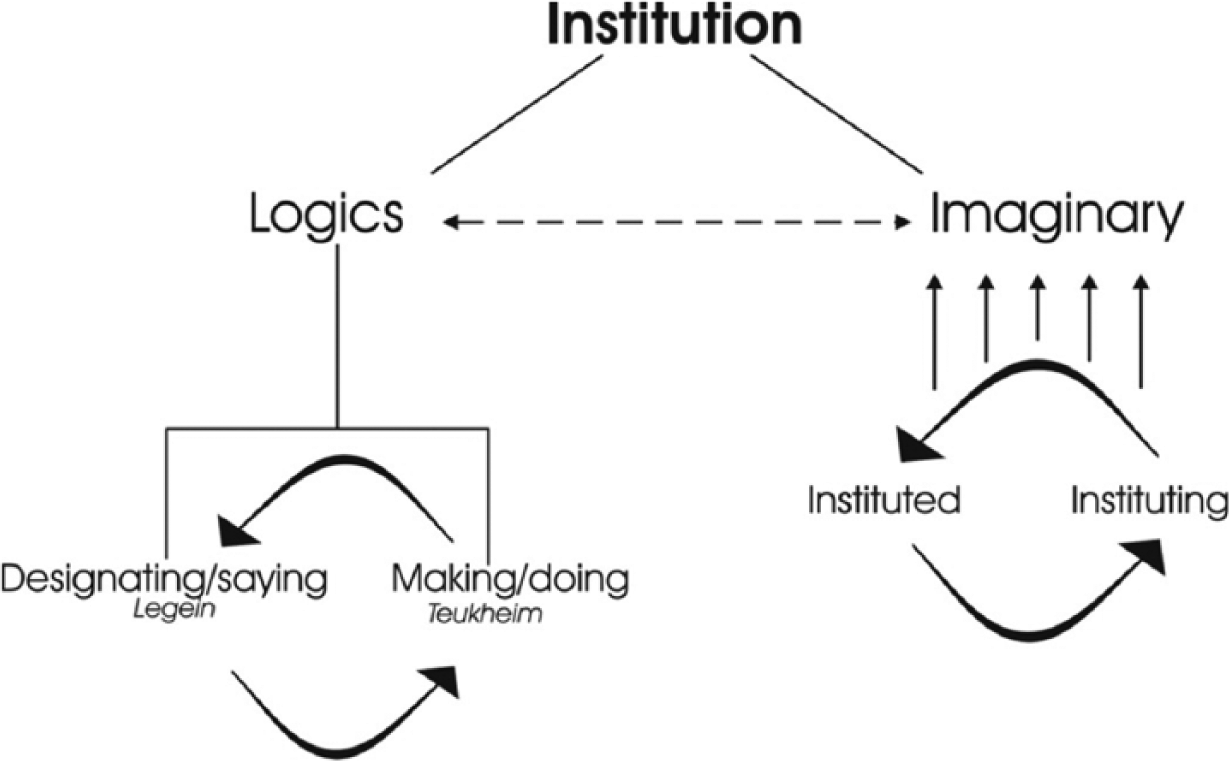
A Castoridian view of institutions.
As already largely debated, risk has become a core signification in late modern societies (Beck, 1992; Giddens, 1991; Lupton, 1999). Risk management throughout these societies can be described as an institution once it has created a new moral order underlying political debate and processes of organizing (Gephart et al., 2009). In organizations, this institution can be traced back in the creation of new departments going through the establishment of professional roles (Power, 2007). Now, upon examining the practical requirements of risk management, one can identify the mechanisms of the identitary logics of language and technique in many situations. For example, one can find the set-like logics in devices used to designate this practice, such as the COSO Framework, The Sarbanes-Oxley Act of 2002, the Basel II and III Accords and the ISO 31000, all of which lay down different elements of risk management by distinguishing, choosing, positing, assembling, counting and speaking risk categories as well as establishing the tools of risk management which enable assembling, adjusting, constructing and making risk through different techniques. These tools and language have been crafting vocabularies of risk into decomposable sets comprising categories and distinct applications, enabling this vocabulary to spread to different and sometimes new domains such as is the case with the invention of operational, reputational and fraud risk (Power, 2007, 2012; Power et al., 2009). This process can be tracked in financial regulation (e.g. the Basel treaties and the Sarbanes Oxley Act), in international standards for internal control (e.g. the COSO framework, ISO 31000 and Turnbull report) and in public governance regulations (e.g. in British universities and in European food regulation). The codification of risk management is ubiquitous. These are, nevertheless, the most salient aspects of this institution, and they provide the means through which organizations reproduce risk management indefinitely.
At its deepest level, however, this new moral order had to be crafted into a discourse and indeed, into people’s very beliefs. Here, the insights of the sociocultural approaches to risk are important. Mary Douglas, the anthropologist who wrote extensively about the cultural underpinnings of risk, says that risk has suffered a transformation in its meaning throughout the last three centuries, from the meaning of risk as a result of probability and outcome to the contemporary understanding of risk as danger (Douglas, 1992). This ideological change has a constitutive character because new forms for dealing with danger were created. At the core of this constitutive process, one finds an imaginary signification or the substance of risk management. This is the notion of ‘risk as uncertainty’, an imaginary signification par excellence once a risk is never something material until the moment it materializes into damage—the moment when it stops being an uncertainty.
The imaginary aspect of risk as uncertainty—the representational flux around it—brings into existence its functionality (its codes, frames, categories, laws, tools and techniques, etc.), which at the same time provide the means through which this signification can diffuse through practice and can be made actionable. Yet, risk as uncertainty is an absent/present around which rituals of risk management are organized, rituals from where one can derive two processes taking place: on the one side, political struggles over the imaginary of risk might synthesize agonistic tensions through the instituted and instituting dynamics described above. For example, Douglas and Wildavsky have documented how competing views of technological and environmental risks gravitate around political struggles and different claims about risk, therefore confirming that contests over power give rise to a variety of opinions about risk (Douglas and Wildavsky, 1982). On the other side, through the rituals around the absent/present nature of risk, it is possible to see that the management of risk itself occurs only within and through its vocabularies and tools, which in turn have their very existence grounded in the signification of risk as uncertainty. This means that the logics of the language and technique of risk are likely to reinforce the establishment of ‘risk as uncertainty’ in the discourse; this also highlights that substances, as Friedland argues, can only be derived from the practices around them. To what extent practices constrain the imaginary component of risk and vice-versa, or how risk as uncertainty relates to other significations, are empirical questions that shall be pursued within different domains of risk management practices. An important point is that as an imaginary signification, risk as uncertainty remains potentially pervasive within discourse.
Despite Douglas’ many insights about risk, her approach tends to be ‘somewhat static’ (Lupton, 1999: 51) and does not provide therefore a good basis for explaining how values-substances change. My contention is that institutional substances, such as the signification of ‘risk as uncertainty’, must be enacted by domains of practice while being deferred within discourse and practice. This deferral is indeed what gives such significations strong adherence to practices and discourses, thereby allowing its pervasiveness into the most remote domains. At every signifying process, the imaginary of risk as uncertainty potentially incorporates other elements changing the discourse and practices, and the way the very substance is understood. I will explore this point in detail in the next section, where I suggest the concept of transubstantiation as a way to account for how domains of practice bring substances into being while potentially changing them. In addition, I will contrast the notions of logics and the imaginary previously explained with the notion of institutional logics, presenting implications for organizational research.
Discussion and implications
Castoriadis places the imaginary at the centre of his philosophy, underscoring the autopoietic capacity of society to exceed its organizational closure. According to his view, logics emerge from the interplay between core imaginary significations and their instantiation in domains of practice/knowledge. In this section, I discuss the implications of this understanding for organizational research and introduce the concept of transubstantiation as a way to better understand the role of values-substances in institutions.
Logics and the imaginary
As previously discussed, organizational research on institutional logics has obliterated the intrinsic and constitutive role of values within institutions. The institutional logics perspective therein remains problematic once it conflates logics with meanings. Bringing ideal and material under the same conceptual umbrella obscures important aspects of the constitutive role of substances within the symbolic component of institutions. The result is a mechanical view of institutions that confines variation and change to a schema of a finite set of available logics. Again, the organizational rubric of institutional logics seeks to explain transposition and recombination, not the social construction of values. Logics refer, then, to
everything that can be constructed and built up, starting from the principles of identity, contradiction, the excluded third or nth (n here being finite) and from the organization of anything given, by means of univocally defined elements, classes, relations and properties (Castoriadis, 1995: 23).
Reproduction, differentiation and regularity are the main characteristics of logics, which indeed are pivotal characteristics of social and organizational fields, but which alone do not explain how new values and institutions emerge.
Castoriadis’ more clear-cut formulation of logics and the imaginary inverts the top-down orientation found in notions such as high-order logics or supra-organizational patterns. From a dialectical phenomenological perspective, the identitary logics—the ensemblizable relationship between discrete elements within language and social doing—serve as conditions, stimuli and supports, stops and obstacles, necessary for action. However, undergirding the very nature of such logics rests the signifying processes of actors through particular imaginary significations. It is through these significations that organizations and individuals bring particular logics into being. From this perspective, organizations or domains of practice can be described as comprising a system of interpretation that functions at the same time as the constitutive part of its own world. It is for this reason that societies and organizations cannot be derived stricto sensu from previous forms because logics emerge from within imaginary significations, significations that are deferred within space and time, to be re-engaged idiosyncratically accordingly. Through this process of enacting imaginary significations, new significations might emerge from the established ones, thereby rearticulating the social and organizational realm. This inversion posits implications for organizational research on at least three attendant points.
First, if the concept of institutional logic remains an umbrella of material and ideal, there might be a masking of the role of values-substances within institutions. This lack of conceptual clarity reinforces the mistaken view of values and meanings as autonomous elements, resulting in rather stiffened and determinist interpretations of the symbolic and of values within organizations. In this case, values-substances are not the result of particular interactions and signifying processes, but simply objects transacted between different orders. For example, this reflects in arguments that there is a logic ‘that it is optimal (within cost constraints) to offer numerous choices with unique attributes and then let consumers choose products that most effectively meet their needs’ or ‘that there is a prevailing logic of consumer want, as opposed to consumer need, that results in firms performing more marketing analysis than nutrition analysis in new product development’ (Moorman, 2002: 155). Such views obliterate the constitutive dynamics of substances under the symbolic component of institutions, pointing towards the very functionalist kind of explanation that Friedland and Alford wanted to avoid. Moreover, they divert attention from a variegated range of significations through which domains of practice are articulated. Examples of other substances playing an important role within domains of practice might be seen in the interplay of significations such as confidence/faith and gambling/speculation in financial markets (DeGoede, 2005; Taylor, 2004), whereby an ambiguous binomial investment materializes practices and constitutes domains of power within this field. Thus, imaginary significations are often unspoken, unconscious and inexplicit, and derived aspects of them might be found only as marginalized or hidden agendas.
Second, viewing logics and the imaginary as separate but complementary gives an enhanced emphasis to the politics of meanings within organizations and institutions, beyond the rather exclusive role attributed to institutional entrepreneurs. While there might be a dominant logic and a dominant imaginary, they are not discretely correlated because in the imaginary side of institutions signifying processes might shape novel and unpredictable logics. Power and resistance are thus often latent within the articulation of domains of practice and knowledge around imaginary significations. For example, significations such as confidence/faith and gambling/speculation are usually worked into political projects in an ongoing process of reinforcement, gearing up organizational actors with a variety of rules and knowledge taken as cognitive–descriptive and normative principles, respectively (Hasselbladh and Theodoridis, 1998). Although manifested through the identitary logics (the code side of language and technique), these normative principles only become actionable through imaginary institutions, that is, through the instantiation of these principles through imaginary significations and related signifying processes. That the politics of meaning takes place within a variety of practice and knowledge fields is consistent with the contradictory orders described by Friedland and Alford (1991). Yet, there is always
a dispersed, local type of knowledge and practice—that which is produced upon the struggles against the established forms of power and knowledge and the forms of domination that they entail—which is usually never articulated-instrumented into domains of discursive practices and never codified-crystallized. (Hasselbladh and Theodoridis, 1998: 66)
Such non-establishment is often disregarded, disqualified, repressed or buried by conventional and hegemonic modes thought.
In this sense, the antagonistic relationship between the instituted imaginary and instituting imaginary offers a way to investigate which values-substances or significations are changing and/or emerging within organizations and organizational fields. Of course, changes do not occur very often; yet, the relationship between antagonistic signifying processes underscores that, in terms of values and meanings, institutional changes cannot be simply described as relatively stable period of beliefs and activities segregated from each other (Thornton and Ocasio, 1999; Thornton et al., 2012). Castoriadis was himself sceptical about what kind of change could be called change. But his theorizing on the dialectics between the psyche and the social imaginary (imaginary significations) shows that a break with central substances is, in many times, the trigger of substantial changes. This last point is overlooked by organizational research on institutional logics and demands more attention from researchers regarding whether some change can be described as a new institutional logic or if it is just the recombination of elements of an already established logic (see Friedland, 2012).
A third implication for organizational research concerns the method of addressing substances and meanings. Taking into account what has been said about the imaginary and assuming that meanings are not autonomous from material practices imposes limits on the extent to which ‘the content and meaning of institutions’ can be examined (Thornton and Occasio, 2008: 109). The constitutive role of the imaginary points out to the limits of a reconstruction of such contents and meanings by researchers because they are immersed in the social imaginary being analysed, either through their access to the field or through particular forms of language. Since the symbolic is a highly politicized arena, it could bias theoretical and methodological choices. Therefore, it would be interesting to differentiate between methods investigating logical aspects of institutions on the one hand and signifying processes within institutions on the other. By logical aspects of institutions, I refer to the set-like relationships between elements already given, their different combinations, correlations, transpositions and overlaps. By signifying processes, I refer to the imaginary and its magmatic mode of being, where methods such as psychoanalysis, critical discourse analysis and/or hermeneutics might be of help (for a recent discussion on the role of psychoanalysis, see Fotaki et al., 2012). The study of emotions, desires and affects fits this second case (for a recent discussion on the role of emotions within institutional work, see Voronov and Vince, 2012). Herein, the reflexive interpretation, with its different levels suggested by Alvesson and Sköldberg (2000) might be relevant. However, since identitary logics are a pivotal part of social systems, analyses addressing both reproductive (identitary logical aspects) and constitutive elements (imaginary significations) could enlighten the relationship between logics and the imaginary.
Finally, the Castoridian reading of institutions contributes a dynamism to Friedland’s notion of institutional substance. According to the dialectics of the imaginary, it is not possible to conceive substances as being simply enacted within organizational fields, for there are no substances per se in the social and organizational world. Substances only exist through acts of transubstantiation, a concept I explain next.
Transubstantiation
It seems convenient to carry on with Friedland’s conception of institutional fields as religious orders, once substances are, in his view, God-like elements or world makers that ‘must necessarily exceed the ritual practices by which they are recognized or accessed’ (Friedland, 2013: 8–9). The notion of transubstantiation is, therefore, consistent with this view while also comprising the dialectics of the imaginary previously outlined. The term transubstantiation is used in the rites of the Eucharist of the Catholic Church. From the 12th century on, the theology of the Eucharist was explained by the language of substance and accident, wherein the doctrine of transubstantiation was adopted by ecumenical councils including the Fourth Council of the Lateran (1215) and the Council of Lyons (1274). In the Eucharist, transubstantiation refers to the conversion of the substance of bread and wine into the substance of the Body and Blood of Christ, respectively. While the bread and wine appear the same as before, their substance has changed. In more general terms, to substantiate means to give form or substance. Transubstantiation, however, means to give substance to something, despite its remaining apparently unchanged. Thus, it refers to conversion (conversio) rather than change (mutatio). 9 This concept will be used here to explain how domains of practice bring into being substances or imaginary significations while potentially converting the nature of these substances into something different. Risk management provides us again with an example.
Mary Douglas has described that the contemporary notions of risk are rooted in the rituals of blame and purification (Douglas, 1966, 1985, 1992). In her works, she fleshes out the relationship between taboos and sins in primitive societies and risk in modern ones. Douglas presents several cases in which taboos or sins have played a central role in defining and explaining the dangers in primitive societies. For example, she cites the Hima people of Uganda, where contact between women and cattle would result in cattle becoming sick and dying, or the blaming of Jews in the 14th century Europe for poisoning well water, and many other examples (Douglas, 1992; Douglas and Wildavsky, 1982). The point she stresses is that the whole process of assessing and evaluating dangers comprises disputes over the allocation of blame, disputes underpinned by the interactional context in which judgements take place. In short, blame systems are moral and political systems.
In the modern era, risk ‘replaced older ideas about the cause of misfortune’ (Lupton, 1999: 46), once the term acquired a forensic utility and perpetuated itself through a ‘sanitized discourse’ allegedly free from political or moral biases (Douglas, 1992: 24). The word ‘risk’ fits perfectly, says Douglas, with the individualist culture of modernity, and the contemporary blaming system we are in is one where actions should be taken promptly to find the causes and apply the charges to misdeeds, catastrophes, crisis and other dangers. However, despite this apparent change, Douglas argues that risk has somehow become a reinterpretation of sin because the term has surpassed its roots in probability theory to convey the more generalist notion of danger. So, if the previous examples seem distant from our modern way of thinking, Douglas remembers that since the discovery of the HIV virus in the 1980s, the issue was strongly linked to a stigmatization of individuals carrying this disease, even ‘to the extent that one would have to assume that the virus was capable of making a moral judgment’ (Douglas, 1992; Tansey and O’Riordan, 1999: 74). Therefore, the modern discourse of risk functions as a moral discourse, in many ways similar to that of sin in primitive societies (Lupton, 1999).
One important point Douglas raises, and here I make the first connection with the transubstantiation of risk, is that sin and risk are both terms oriented towards the future. ‘The very name of the sin is often a prophecy, a prediction of trouble’ (Douglas, 1992: 27). And risk as uncertainty is never material until the moment it materializes into damage. Thus, both notions function as a kind of springboard through which political struggles over danger occur (e.g. What are the dangers? How are we supposed to deal with them?) and specific morals are incarnated in material practices. Furthermore, even if risk and sin have different uses in different times, ‘people may sometimes be blamed for being “at risk” just as they were once blamed for being “in sin”’ (Lupton, 1999: 42). Thus, the rituals of risk management work in an analogous way to the rhetoric of Salvation and purification of the Eucharist because these rituals involve accounting for blame and purification. Risk management aims to purify what seems to be deviant; it aims to expunge sins, and in its most extreme manifestations, it aims to eliminate the very possibility of incurring sin (see Hood, 2002; Linsley and Shrives, 2009; Power, 2004; Radcliffe, 1997). However, the management of uncertainties is a recurrent processes underpinned by the signification of risk as uncertainty, the driving force aiming to perpetuate risk discourses and practices. Such a driving force stems from the dialectics between the individual psyche and the imaginary signification of risk as uncertainty. It is this dialectical movement that enables risk to be repeatedly enacted by society and organizations, while organizational actors defer the signification within practice and knowledge. The fact that risk as uncertainty is an imaginary signification gives it the power to create worlds according to its image; it is the source of its power to perpetuate itself within practices and discourse and even to extend itself to new domains through the embodiment of other substances. To be enacted, risk must take into itself material events signified as risks. That is to say, events must be converted into risk issues; they must be transubstantiated.
Domains of practice must give actuality to risk as uncertainty. It is through transubstantiation that such actuality takes place because risk as uncertainty faces continuous conversions within and through domains of practices and knowledge, which define what will be risky and how it will be dealt with. Dangers must be ‘selected for public concern according to the strength and direction of social criticism’ (Douglas and Wildavsky, 1982: 7), and beyond that, they must enter into the field of representations and discourse and must be talked about and believed. Yet, as an absent present (Friedland, 2009), risk as uncertainty must be constantly re-enacted. At each new crisis, dangerous event or organizational failure, new stock is incorporated by practitioners through the substantiation of ‘risk as uncertainty’. An unnoticed global financial crisis, a nuclear catastrophe that escalates to unexpected events, an unlikely climate change affecting crop prices, social unrest in response to austerity programs and a global espionage scandal triggering political debate are all material stock through which new substances are converted into the notion of ‘risk as uncertainty’, pushing it to new territories and giving it new materialities and forms (i.e. it is still risk management but somehow different). What determines if different forms of risk management will emerge is how (and if) new situations and events are being converted into risk issues, which might add up to the substance of risk as uncertainty or even shift the signification away from its contemporary outlook. Yet, by converting new events into risk issues, individuals and organizations defer ‘risk as uncertainty’ in the discourse and practices to be indefinitely re-enacted. The conversion of events into risk is likely to reinforce the identitary logics of risk because preventive actions are undertaken ‘to improve the coding of risk in the domain which has turned out to be inadequately covered’ (Douglas, 1992: 16). Nevertheless, there is always a component of indeterminacy. New technologies and practices and/or even different significations entering the discursive field of risk might contribute to change the imaginary of risk and therefore its practices.
The transubstantiation of risk—the conversion of many different events into risk issues—produces the symbolic unity of risk management institution. It unifies epistemology and ontology, that is, what I know about risks becomes what I believe risk is. Repeated processes of conversion underscore that values-substances are not ‘things’ transacted between institutional orders, but rather significations that must be put in movement within and through practices in order to produce material effects. At the same time, as imaginary significations, values-substances must be deferred in the discourse by people, who build tools and language, practices and routines as the material representations of a belief or a set of beliefs. That is the reason why Friedland describes institutional substances as transcendent gods which ‘are invoked by name, as though they are eternal subjects who act in this world’ (Friedland, 2013: 13).
The concept of transubstantiation highlights that institutional substances are not autonomous from practices or superimposed by an institutional logic. On the contrary, they are the key driving forces of institutions through which actors struggle to signify the world within material practices. Values-substances such as God, property, love and freedom, as well as many others, are social imaginary significations bridging the individual psyche and the social–historical field; and as seen in the preceding example of risk, domains of practice convert a variegated range of issues into the image of these substances so that they can be reproduced, enacted and believed. The logics of language and technique can function as constraints to the impending significations (instituting imaginary) within society and organizations. Yet, logics emerge alongside the politics of meanings undergirding domains of practice. Signifying processes of individuals and organizations carry idiosyncratic properties when bringing these substances into being, when converting new or unexpected issues into the image of these very substances, adding new nuances to them or shifting their nature. This underscores how individuals and organizations invest the material world in unpredictable ways. While the logics of language and technique depict some patterned relationship, the magmatic mode of being of the imaginary is unpredictable, often controversial and politically negotiated through the rituals of practice.
Conclusions
Beliefs are central in institutional logics. There is, however, a forgotten meaning of ‘belief’ that seems to enlighten our understanding of institutional logics. In the New Testament, beliefs were largely represented by the Greek word pistis, which generally means good faith, trust and reliability, something like a commitment. So, when Jesus demanded pistis from his disciples, he was asking for commitment, not credulity (Armstrong, 2009). Beliefs involve politics through and through, and since commitment demands compromise and action, beliefs just exist through the practices and rituals enacted to signify such commitments. In the organizational rubric of institutional logics, things are rather different.
By fleeing from the Parsonian internalization of values, organizational scholars have disconnected values from practices and individuals at the price of a confinement of heterogeneity and change into a finite schema of decomposable elements. Logics, as the argument goes, determine and structure decision making (Lounsbury, 2007; Thornton and Ocasio, 1999), a view that brings the organizational rubric of institutional logics closer to the structure rather than agency. We are left with the impression that meanings and values hover over our heads, waiting to be grasped by an institutional entrepreneur who will combine and implement them. This is a mistaken view, as I have shown, a view that leaves organizational research blind to emergent values and mute to the greater variety of significations underpinning institutions.
As an attempt to contribute to a deeper understanding of values-substances, I have presented in this article the philosophy of Cornelius Castoriadis. His phenomenology of imaginary significations is consistent with the notion of institutional substances in the sense that it highlights the centrality of particular sets of beliefs in institutions. It also places signifying processes closer to the material practices they derive from. Moreover, Castoriadis’ work helps to a better understanding of the role of values-substances through important ideas. Imaginary significations are bridges of a dialectical relationship between the individual psyche and the social–historical. Through this dialectical relationship substances/significations are set to work, and an antagonistic relationship between established significations (instituted imaginary) and impending signifying processes (instituting imaginary) come into play. From this angle, logics are not determinants of decision making or the providers of meanings for action, but rather conditions, stimuli and supports, stops and obstacles by which domains of practice bring their reality into being through imaginary significations. These logics are not superimposed cultural beliefs, but rather interrelated elements of signifying processes.
Drawing on these ideas, I brought out the concept of transubstantiation to address how substances are prone to conversions within domains of practice. A new practice signified as an important issue to democratic process, material losses influencing regulations and trying to re-signify what financial markets are, an espionage scandal triggering global political debate about the risks of the internet, are, for example, material stock adding up to institutional substances. By the processes of conversion, organizational forms might change (when the instituting imaginary takes place) or remain untouched (when the instituted imaginary prevails). It is through the dialectics of the imaginary that organizations potentially transcend their forms by perverting, suppressing, transforming or creating imaginary significations.
Now, saying that imaginary significations or values-substances must pass through conversions does not mean that the world is in an ongoing social construction. On the contrary, it indicates the inherently political component of signifying processes. It is a matter of who is defending which signification(s)—values or substances—and with which slant and practical consequences. Finally, the very nature of imaginary significations point towards a less-explored aspect of organizations because such significations resemble a sort of window that bridges past and future actions. This means that imaginary significations are not merely constraints of history, but elements opening up projective fields through which the past is re-signified and rematerialized. Imaginary significations underscore that values-substances can be both drivers of dreams (e.g. fighting for freedom, searching the perfect love, praying the reign of God, extolling progress through capital) and the grounds of nightmares (e.g. risk as a danger). Therefore, Castoriadis enriches our understanding of values-substances as being essentially imaginary significations, and therefore his ideas pushes organization studies to novel enquiries. For example, which particular imaginary significations have emerged within contemporary organizations and organizational fields? How are these significations made actionable through particular practices and fields of knowledge? Which logics of language and technique are privileged within particular uses of imaginary significations? Which values-substances have emerged through the relationship of certain logics and imaginary significations? To what extent are imaginary significations used to hinder the political questioning of institutions and organizations? What are the ethical implications involved in the establishment of new significations in organizational fields? Looking for answers to these questions promises no safe haven. However, it does admit the imaginary as a pivotal and constitutive part of social and organizational phenomena in need of better elucidation. The inherited thought always tried to conceal it behind the different hues of rationality (logos, nous, Ratio, Reason, etc.). It is time to return it to its proper place.