




Abstract
Critical management scholars have emphasized that organizations’ attempts to regulate employees’ identities can prompt the reproduction or transformation of self-identity. The emotional consequences of identity regulation, however, remain largely unexamined. This article explores the experiences of eight management consultants in the British office of a global consulting firm over several months. Interviews and observations were analysed according to the principles of interpretative phenomenological analysis. The results of the study highlight consultants’ identification with an organizationally inspired elite discourse alongside high levels of commitment and the presence of a counter-intuitive yet significant status anxiety. Drawing on psychological and sociological theories that connect identity and anxiety, this article suggests that the continual promotion of an elite identity within the consulting firm leaves many of the consultants feeling acutely anxious about their status.
Keywords
The conception of identity as a malleable and precarious construction has led critical scholars to view employees’ identities as a potential locus of organizational control (Alvesson and Willmott, 2002). Despite the steady growth of research concerned with the mechanisms of identity regulation, there has been limited investigation into the emotional consequences and anxieties for employees who experience this control. Researchers have suggested that the reconstruction of identity is one remedial response to anxieties (Alvesson et al., 2008; Collinson, 2003) and that corporate regulation may reduce anxiety for employees (Alvesson and Willmott, 2002). However, the role of organizationally regulated identity constructions in producing particular forms of anxiety remains unexamined.
Several studies of organizations’ regulation of identity note the presence of anxiety (Carroll and Levy, 2010; Gagnon, 2008; Hodgson, 2005; Kuhn, 2006; Thornborrow and Brown, 2009), though these investigations make only brief references to this experience. Beyond organization studies, there is a small but growing sociological literature that focuses attention on the role of identity in the production of distress and anxiety (e.g. Burke, 1991, 1996). This literature, however, has had little engagement with work settings.
The objective of this article is to address the absence of research concerned with the anxiety outcomes of identity regulation in the workplace. Adopting an interpretative phenomenological analysis, this study interviews and observes a cross-section of management consultants in the British office of a global consulting firm. Several studies have identified practices of identity regulation in consulting firms (Merilianen et al., 2004; Robertson and Swan, 2002) which suggests consulting is an appropriate occupation to explore the anxieties that may emerge from regulation.
In exploring management consultants’ experiences of identity regulation and anxiety, this article makes two specific contributions. First, it responds to the appeal for students of organizational control to appreciate the dynamics of identity (Albert et al., 2000; Alvesson and Willmott, 2002) by suggesting that anxiety can be intimately involved throughout the identity processes of management consultants. Second, it answers the call of critical management scholars to expose the suffering in contemporary organizational life (Grey and Willmott, 2005; Sennett, 1998) by highlighting an acute status anxiety as a potential consequence of consultants’ identity regulation. Jointly, these two contributions are of pragmatic value—one person in six experiences a mental health problem and this costs £105 billion each year in England alone (Layard et al., 2006; Sainsbury Centre for Mental Health, 2007). This study presents an incremental effort to explicate different contributing factors and experiences of anxiety and intends to be of value to individuals and organizations.
The article proceeds as follows: reviewing the identity and anxiety literatures to reveal the limited interaction of identity regulation and status anxiety research; introducing interpretive phenomenological analysis as an appropriate approach to explore these concepts; analysing the themes of consultants’ experiences that emerged during the research; discussing these findings in light of the wider literature and considering their broader implications.
Self-identity, status and identity regulation
A growing body of identity research within organization studies draws inspiration from Giddens’ (1991) conception of self-identity as an ongoing reflexive project or continually constructed narrative. Giddens suggests that identity is a product of the ongoing interaction of structure with agency and that whilst individuals are not the sole authors of their identities (Czarniawski, 2004) nor are the structural constraints upon identity totalizing as some suggest (Newton, 1998). In this way, identity is not just a personal story but instead an ongoing struggle between the self-view and external demands (Alvesson, 2010).
Central to this conception of identity is identity work. Identity work refers to individuals’ ongoing attempts to shape a relatively coherent and distinctive personal self-identity, constituting and constituted within social identities in their context of other people, cultures and discourses (Watson, 2008). Identity work therefore connects external social-identities to internal self-identities (Tajfel and Turner, 1985). In this way, the identity work, that underpins the identity process, draws upon a range of meanings which individuals can identify with or resist (Fleming and Spicer, 2003; O’Mahoney, 2011). For example, individuals can derive a sense of self from the differing degrees of social status (Turner, 1988) associated with membership to different groups.
In the meritocratic systems common today, individuals often acquire status through their accomplishments in competition with others (Marshall, 1998). As such, employment within the professions with their competitive requirements has traditionally offered high status (Gabriel et al., 2000; Watson, 1995). In this way, status is one link between the self and society and a source of meaning for individuals to relate themselves to others. As social positions can change ‘any given identity and its status is always provisional and subject to revision’ (Sturdy et al., 2006). As such, an individual’s identity undergoes constant work and revision.
The ongoing process of identity work presents the possibility of identity regulation. Alvesson and Willmott (2002: 625) describe identity regulation as ‘the more or less intentional effects of social practices upon processes of identity construction and reconstruction’. Within employment settings, identity regulation may be one mechanism of organizational control over employees. Researchers of identity regulation tend to adopt an emancipatory or critical approach, emphasizing the role of discourse (Parker, 1992) and discursive regimes in regulating identities (Alvesson et al., 2008). The idea that individuals struggle with discursive regimes rests on the belief that reality is socially constructed (Berger and Luckmann, 1967) and that discourse provides rules that define what is appropriate (Grant and Hardy, 2004; Hall, 2001).
Researchers have investigated specific discursive mechanisms and organizational practices of identity regulation. These have included status distinctions (Alvesson and Willmot, 2002), training programs (Andersson, 2008) and routines (Brown and Lewis, 2011) all of which can produce identity work. Whilst largely viewed as a form of control and oppression, researchers have noted that organizational attempts to shape employee identities are not necessarily detrimental due to their potential to foster desired identities (Anteby, 2008). Nonetheless, research largely focuses on identity construction and identity work as the ongoing outcome of identity regulation without exploring the associated lived experience or anxieties of the individual.
Although the potential of organizationally inspired identities to produce anxieties remains under-explored, researchers have highlighted anxiety as instrumental in the construction of identity. Giddens (1991) argues that to escape feelings of anxiety individuals will seek ontological security—a sense of continuity in their lives through the ongoing (re)construction of a continuous, stable identity. Similarly, Collinson (1992; Collinson and Knights, 1986) described anxiety as stimulating efforts to maintain a stable personal identity and therefore to engage in identity work. This would suggest that identity work and the acquisition of an appropriate identity proffered by an organization could help individuals to reduce their anxieties (Alvesson and Willmott, 2002), albeit temporarily. Certainly, the role of anxiety in the (re)production of identity appears important and it can be inferred that one factor of organizations’ successful regulation of identity would be anxiety. However, there is limited empirical evidence available that explores the presence or production of anxieties following the regulation of an identity.
Consultants are a relevant occupational group to explore the anxiety that may follow from identity regulation. Several studies into consulting firms have exposed organizational practices of regulation (Alvesson and Robertson, 2006; Ibarra, 1999; Karreman and Alvesson, 2004; Merilianen et al., 2004; Roberston and Swan, 2003). For example, an organizationally inspired elite discourse and an elite status and social identity run throughout these studies, implicitly or explicitly. An elite identity refers to an identity construction ‘in terms of “how we are amongst the best” rather than simply narratives around “who we are”’ (Alvesson and Robertson, 2006: 197). This elite identity, when internalized, provides high standards of performance for consulting firms whilst facilitating consultants’ procurement of ontological security. Yet, elevation to an elite status also presents the possibility of anxieties around the loss of this position. Almost all of these insightful studies of identity regulation mention consultants’ stress or anxiety but do not explore these concepts further.
Status anxiety and identity
Anxiety can refer to a subjective emotional state with an internal sense of apprehension or worry and in more extreme states as a sense of fear or panic (Payne and Cooper, 2001). Anxiety can also be a physical state with a sensation of tension and a range of physical symptoms (Payne and Cooper, 2001). This article contends that whilst social factors largely drive anxiety (Fineman, 1993; Newton, 1989), anxiety also reflects some degree of biological ‘reality’ (Helman, 1994; Pollard, 2008).
Although organizational researchers frequently refer to anxiety, they rarely acknowledge that anxiety can take a variety of forms. Though it is beyond the scope of this article to detail all of these varieties, it is important to acknowledge the breadth and diversity of anxiety as a multi-faceted concept. For example, philosophers theorize about existential anxiety (Kierkegaard, 1844/1981). Psychologists examine generalized anxiety, social anxiety or separation anxiety amongst many other forms (for a classification see Carr, 2006: 465). Other researchers explore the anxiety related to a particular event such as being tested (Sarason, 1984). A further variety is status anxiety.
Status refers to the position of a group or an individual in relation to others within a social hierarchy (Marshall, 1998). Status anxiety therefore describes an apprehension or worry about a position or value in a hierarchy. Jensen (2006: 97) employs a related definition, albeit at an organizational level, by defining status anxiety as ‘concerns about being devalued’. Similarly, historians and legal scholars employ the term status anxiety to describe groups or social movements who fear a loss of status (see Balkin, 1997).
It seems reasonable to believe that status anxiety also occurs at an individual level. Indeed, it is likely that this type of anxiety is particularly prevalent in today’s stratified meritocracies where individuals competitively pursue statuses, and associated benefits, which are no longer birthrights (Collinson, 2003; Luckmann and Berger, 1964). To clarify the conceptualization of status anxiety as an individual experience, this article utilizes the populist writer Alain de Botton’s eloquent explanation. Status anxiety is a worry that ‘we are in danger of failing to conform to the ideals of success laid down by our society and that we may as a result be stripped of dignity and respect; a worry that we are currently occupying too modest a rung or about to fall to a lower one’ (de Botton, 2004: 3–4). Thus, at an individual level, status anxiety refers to a person’s worries about losing or not possessing a position in a social hierarchy that they deem valuable. This is distinct, for example, from the worries concerning the finitude of human existence associated with existential anxiety or the fear of social interactions associated with social anxiety.
There has been a growth of sociological studies concerned with identity constructions and anxiety outcomes. Burke’s (1991, 1996) identity control theory emphasized that the disruption of the ongoing identity process could generate anxiety. Burke’s work has laid the foundation for a burgeoning body of empirical studies (Marcussen 2006; Stets and Carter, 2011) demonstrating links between disruption to identity and anxiety. Also viewing psychological distress from the perspective of identity, Higgins (1987) has suggested that discrepancies between individuals’ actual, ought and ideal identities can trigger different emotional outcomes ranging from anxiety to guilt. The importance of these theories lies in their appreciation that individuals do not just ‘feel bad’ when there are tensions between identities—certain emotions serve to reduce discrepancies and preserve the social structures within which their identities exist (Stets and Burke, 2005). In particular, both Burke and Higgins explain that status, whether lost or discrepant with individuals’ aspirations, can produce anxiety.
These studies, however, have rarely investigated work organizations, instead considering married couples, undergraduate students, laboratory groups and parents amongst others. Whilst the occupational stress literature (e.g. Cooper and Cartwright, 1994) has examined countless examples of different organizational settings, this research has tended to ignore the role of identity and organizational discourses. Other critical explorations of anxiety in the workplace (e.g. Newton et al., 1995) also pay limited attention to the role of identity. However, Haines and Saba’s (2012) recent investigation of human resource workers’ distress and anxiety draws on Burke’s (Burke and Stets, 2009) identity theory and suggest this is especially applicable to professionalized occupations.
Researchers have intimated that consultants, as one professional group, experience anxiety. For example, Costas and Fleming’s (2009) investigation described the clash between who consultants felt they ought to be and who they are and touched upon the distress this provoked. Although Jackall (1988) briefly acknowledged that consultants experience anxiety, little recognition exists ‘of the pressures and insecurities experienced by consultants themselves’ (Sturdy, 1997: 393). Perhaps the stigma of mental health issues in the workplace (Haslam et al., 2005) circumscribes such research, as employees are unwilling to share their personal feelings for fear of endangering their careers. This speaks to the value of further research that sheds light on anxieties from the perspective of identity, which would contribute to our understanding of the psychological well-being and mental health of professionals.
The focus of this article is the relationship between the regulation of identity and the experience of anxiety within a management-consulting firm. To explore these concepts, the article poses two main research questions. First, how do management consultants make sense of their own identity as consultants? Second, what are the psychological implications for management consultants of their identity constructions? Consultants are a useful occupational group to explore identity regulation as researchers have identified particular discursive and social practices intended to inform self-identities in consulting firms. Furthermore, there is limited research concerned with consultants’ lived experiences and the implications of their identities. Figure 1 illustrates the focus of this article by drawing on Watson’s (2008) ‘three step’ view of the relationship between discourses, social identities and self-identities and extending it to highlight anxiety as one possible implication of maintaining particular identity constructions.
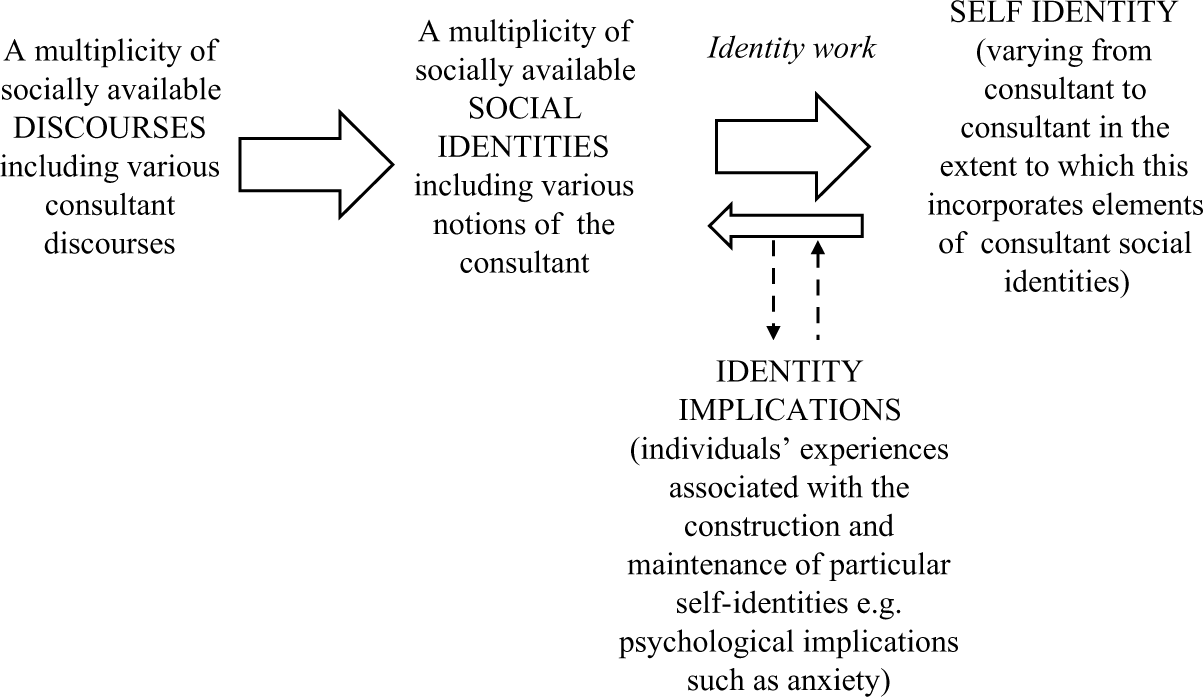
The relationship between discourses, identities and identity implications (adapted from Watson, 2008).
Methodology
This article adopts an Interpretative Phenomenological Analysis (IPA) approach. IPA is a recently developed qualitative approach that has become increasingly popular in psychology and education research. As only a small, albeit growing, number of organizational studies have applied this approach (e.g. Fitzgerald and Howe-Walsh, 2008; Millward, 2006) this section will briefly introduce IPA’s key tenets (for a detailed introduction see Smith et al., 2009; Smith and Osborn, 2003).
IPA draws upon the theoretical framework of phenomenology and provides practical guidance for researchers exploring how individuals make sense of their personal and social world. It is phenomenological as it explores participants’ lived experiences from their own perspective and description (Eatough and Smith, 2008). The intention is to investigate and develop a deeper understanding of the meanings particular experiences hold for participants through the collection of their rich and detailed accounts that consider their involvement in their context. Thus, IPA separates itself from other qualitative approaches, such as discourse analysis, which focus on the use of language (Chapman and Smith, 2002). However, IPA also appreciates that researchers cannot conduct this exploration completely or directly and that a double hermeneutic process exists as both the researcher and participant are interpreting meaning (Smith and Osborn, 2003).
IPA is a qualitative approach, which aims to ‘capture the quality and texture of individual experience’ (Willig, 2001: 53). As Thompson et al. (1989) suggest, the reality individuals experience (their lived experience) does not always correspond with the world of objective description because objectivity often implies trying to explain an event or experience as separate from its contextual setting. Given its epistemological assumptions, IPA is suitable for studying experiential accounts and therefore for examining individuals’ identity constructions and their involvement in their context but not for analysing the structure of a context or culture itself (see Smith et al., 2009). As such, IPA adheres to Alvesson and Willmott (2002) and Folkman and Moskowitz’s (2000) shared prescription of in-depth qualitative research and the appreciation of context for the study of identity regulation and mental distress respectively.
A distinctive feature of IPA is its commitment to a detailed interpretative and idiographic account. It achieves this with a small sample. Though similar to grounded theory (Strauss and Corbin, 1990) as it seeks master and subordinate themes that emerge through the iterative comparison of data, IPA does not seek theoretical saturation. IPA has a sample size usually towards the lower end of 1 to 30 (Brocki and Wearden, 2006) as per phenomenological studies (Starks and Brown-Trinidad, 2007). The emphasis is on having sufficiently rich data as opposed to sufficient numbers of participants.
Participants and data collection
The sampling of participants is purposive in IPA. The intention is to recruit participants who can offer a meaningful perspective of the phenomenon of interest. The study therefore selected a management-consulting firm as previous research has demonstrated the attempts of identity regulation within consulting firms (e.g. Alvesson and Robertson, 2006). Recognizing that researchers have described access to consultants as challenging (Sturdy et al., 2009), the study selected its sample from the first consulting firm to grant access.
The study recruited participants from a UK office of global and strategic management consulting firm, hereafter known as Firm X. The firm granted access to observe the office, and to conduct interviews with consultants during the first half of 2010. All eight participants were male, aged 25–40 and represented three nationalities across two continents. They covered a spectrum of positions from graduate entrants to more senior consultants. Prior to interviewing, assurances of anonymity and confidentiality were provided and permission was obtained to digitally record and then transcribe the interviews.
Semi-structured interviews facilitated exploratory discussions and the collection of participants’ reflections (Rubin and Rubin, 2005). This interaction provided the flexibility to assist the participants in exploring their lived experience (Eatough and Smith, 2008). Digital recordings were transcribed verbatim, in accordance with the principles of IPA. Only one of the interviews did not take place in the consulting firm’s offices and all others were face-to-face in a quiet room. Initial interviews ranged from 40 to 90 minutes and covered a range of questions centred on identity and identification. For example, what kind of person do you think Firm X recruits as a consultant? Several months worth of observations in the consulting office, documents ranging from appraisal forms to intranet pages and subsequent informal and unstructured discussions supplemented initial interview data.
Context of the study
In line with the methodological commitments of this article, it is important to consider the participants’ working environment to contextualize their accounts. All the participants in this study were management consultants in Firm X. Firm X is a global provider of strategic advice to CEOs and senior business leaders across a variety of industries and sectors. This advice relates to a variety of organizational issues from the development of market entry strategies to the implementation of cost saving exercises. The consulting organization currently employs thousands of consultants, recruited from prestigious business schools, with the express purpose of achieving excellence for their clients (Firm X corporate website). It has grown over many decades and now operates with more than 50 offices across multiple continents.
The London office of Firm X is the main site of this study. This office is located in an affluent and high-status area of the city. The office possesses a grand and spacious entrance area, which provides access to several different floors and meeting rooms where the consultants work. There are very few designated rooms and consultants of all ranks share desks in an open plan office space. Although many consultants would typically work at their clients’ premises, they would usually return to their consulting office at the end of each week or remain there for longer periods between projects. The consultants would also regularly return to the office to attend planning sessions or to meet with their clients.
This study analysed the interview and observational data collected from within the office of Firm X to establish themes. It searched for connections and patterns between these emergent themes in accordance with the principles of interpretative phenomenological analysis (e.g. through a blend of abstraction, subsumption, polarization and contextualization of the themes, see Smith et al., 2009). The next section presents the results that emerged from this thematic analysis.
Findings
The analysis produced a variety of subordinate themes organized within three master themes: (1) the construction of an elite identity and status; (2) commitment to consulting; (3) status anxiety. These themes represent distinct but inter-related strands of the management consultants’ experiences. An account of the analysis follows, with extracts from the transcribed interviews to illustrate each theme, supported by document analyses and observations. The extracts selected are those that best capture the essence of each theme.
The construction of an elite identity and status
The participants described how their sense of being a consultant gradually emerged over time through their interactions with colleagues and clients. Central to this understanding was the idea that consultants were elite or special individuals. From the participants’ point of view, this notion of being elite related to who consultants were and not just to what they did. For example, the participants spoke highly of their colleagues within the firm and consistently described their achievements and valuable traits:
Management consultants are … top quality and, uhm … exceptional individuals. (P02) It’s a bit more cerebral than other, some other, professions … I would say it’s a mixture between quite driven but also quite academic people … You tend to find more people in consulting with PhDs, MBAs. (P03)
However, the participants did not suggest that they became consultants, and therefore elite individuals, immediately upon joining the consulting firm. Instead, the participants described their efforts to develop into consultants over time:
You do change, you do change. It’s not easy, you know, you’re not just turning up on day one and acting like a senior [Firm X] consultant. (P08)
The participants’ development into Firm X consultants was not just in terms of their skills or adherence to particular norms but also in terms of their self-understanding:
I’ve … developed tools and a way of thinking about myself and business problems. Being a consultant … you learn from experience and soak it up from the people around you. (P01)
In this way, the participants appeared to construct gradually a sense of themselves as consultants and therefore as elite individuals. As mentioned by Participant 1, the participants’ colleagues informed this self-understanding. Indeed, fellow consultants appeared to proffer the notion of consultants as elite individuals by regularly emphasizing the aspects of their work that separate them from others. Frequent communication between consultants served to reinforce the distinctive aspects of being a consultant, such as the variety of the work:
I think a lot of people I’ve spoken to, and other consultants I’ve worked with and over dinner we’ve talked about this kind of thing, often it’s the variety … that comes up first. (P04)
Observations also highlighted the important role of particular recruitment and training practices within Firm X, which served to reinforce the idea of consultants as elite individuals. For example, Firm X’s internet and intranet recruitment pages were replete with phrases like ‘exceptional people’ and ‘leading individuals’, specifying a range of criteria that candidates should meet to join or progress through the firm. In a further example, immediately upon joining the firm, each consultant would undertake several days of full-time training to develop appropriate skills and would then complete several more mandatory courses over the course of the year. These courses, developed and delivered by experienced consultants within the firm, provided an array of project management skills. These training sessions emphasized that Firm X selected and retained consultants because they were ‘high achievers’ in a ‘top tier’ consulting firm. In this way, the organization appeared to suggest that maintaining a position as a Firm X consultant was synonymous with being elite.
In addition to colleagues and organizational practices, the participants’ clients provided further support for the notion of consultants as elite. During observations of several meeting, clients explicitly referred to the expensive daily rates for hiring consultants and insisted on receiving high quality advice from the consultants they worked with. For the participants, requests for their advice provided external validation for the idea of management consultants as elite individuals, sought by very senior, and therefore successful, business-leaders to provide help and guidance:
In consulting you’ve got the buy in of the CEO or board, essentially wherever you go, so people listen to you. (P04)
The large fees provided by clients also enabled Firm X to provide significant salaries to their consultants. These salaries were further, tangible validation of an elite identity:
the money, which is better than the average … maybe some people go into consulting for the money. It’s not impossible at all. (P01)
It is notable that, again, the participants draw upon aspects of their work that separate them from other groups. Pay is therefore another theme consistent with the concept of consultants as enjoying an elite status. To the participants in this study, embracing the elite identity of a Firm X consultant, as proffered by colleagues and clients, provided a self-conception that was positively distinct from other professionals, in terms of achievement, influence or financial rewards.
Commitment to consulting
During the process of analysis, the centrality of consulting work and the significance of being a consultant within the participants’ lives became clear. The overwhelming and often invasive nature of the work appeared to be a consequence of both content (e.g. heavy, difficult workloads) and conduct (e.g. travel and time away from home) which called for particularly high levels of commitment. The consultants’ commitment to consulting also reduced their attention to other aspects of their lives and, in particular, family and friends.
All participants acknowledged the significant time spent at work as a basic requirement of most consulting projects.
At the drop of a hat you’ll work through the night, into the small hours of the morning. You’ll do work at the weekend. Holidays get cancelled. Uhm … you know … you miss dinner plans. (P03)
The travel, as with the long hours, limited access to roles outside of work:
You’re away from home a lot of the time. So it doesn’t leave much room for girlfriends, hobbies, friends this kind of stuff. (P04)
The de-prioritization of their personal, or non-work, lives demonstrates another facet of the deep commitment consultants perform as part of their employment. This intensity was a consistent feature of consulting work:
It’s … high intensity because a lot is expected of you, most of the time. (P02)
Commitment in consulting could therefore be seen not just in terms of the time spent working but also in terms of the intense mental attention and output required.
Whilst the consultants remained committed to their work and roles as consultants, this did not necessarily translate into a commitment to all aspects of their consulting firm. Firm X communicated their corporate values regularly, through dedicated intranet pages, posters on walls and even cards to fit into consultants’ wallets or purses. Yet most participants demonstrated a cynicism through their unanimous dismissal of Firm X’s values:
I’d just see that stuff as crap … when I see anything come out as value 1, value 2, value 3 and all that guff, I just delete it. I’m sorry to be cynical. (P02)
Despite the participants’ apparent rejection, in different parts of the conversations the consultants readily identified with collaboration and teamwork—one of the main corporate values. Indeed, consultants’ identification with colleagues appeared to override the relationship with the firm:
You identify with the people as well. You know, Firm X, as a brand and as a firm er … I’m not that concerned. (P03)
The participants’ colleagues were a particularly prominent target of commitment. Almost all of the consultants observed in this study performed their work in teams. The individuals in these teams would spend considerable amounts of time together. According to the consultants’ themselves, they were the first people to arrive and the last to leave the client site and would usually spend most of the day together in one room, separated from the other employees of their client. When staying in hotels overnight or working late, both of which were described as the norm by the participants in this study, the consultants would usually eat dinner together and then spend further time with one another working into the night. In this way, the consultants would predominantly interact with a small number of team members throughout their working week.
With this came a clear desire to perform and meet the expectations of the team of which each consultant was a vital part:
Firm X is not an abstract concept. It is a group of people who are … trying to work … towards a common goal. (P08)
Consultants described not just a connection with teammates but a commitment to achieve team goals and to complete their work. The inevitable outcome of the high levels of commitment to consulting is a decreased commitment to other aspects of life:
I think a lot of people in consulting put work before most things. […]I’ve put work in front of lots of thing I probably shouldn’t have. That’s probably one of the things I don’t like about it [consulting]. (P03)
The above comment demonstrates that commitment to the job challenges consultants’ notions of what is important and highlights a tension between what consultants believe should be prioritized and what actually becomes prioritized. This is problematic as family and friends were crucial sources of support to cope with the pressures of consulting:
I don’t think I’ve said anything positive about the company to friends and family since … for … er … years. But that’s because it’s an outlet. (P02)
This makes clear both the invasive nature of the consulting work and the sense of loss associated with the commitment consulting calls for. This loss centres on consultants’ non-work relationships.
When I’m on a project-x, everything gets shelved. And it’s like, after the project, I’ll phone my family member and say how have you been for the last month? (P02)
Observations of activities within the office also highlighted Firm X’s attempts to encourage further interaction between consultants and to foster a ‘consulting community’. Irrespective of where consultants conducted their projects, it was common practice for the consultants to return to the office at the end of each week to attend Firm X presentations and social activities. The consultants participating in this study described how they were encouraged by senior partners in the firm to attend and organize these ‘extra-curricular’ activities or events. Delivering such activities also formed a part, albeit small, of the criteria for promotion within the firm. In this way, success in Firm X required the consultants to display commitment to both their work and their organizational community at the expense of other valuable aspects of their lives.
Status anxiety
As the research progressed, many of the participants began to disclose negative features of their work. For example, stress was an integral aspect of their work alongside a need to hide their true thoughts and fears lest fellow consultants perceive them as failing to meet the high expectations of being a consultant. The consultants’ elite aspirations and commitment also limited the opportunity for them to draw on other narratives of self and be ‘themselves’, which appeared to make their elite identities and statuses an increasingly important source of meaning. In elevating the importance of an elite identity, many of the participants also appeared to experience a particular form of anxiety related to losing this identity and the associated status.
Participants identified stress and anxiety as a real and serious result of consulting work:
The stress is very real. I … it’s almost to the point where it’s not something that’s purely psychological, it has physical symptoms. (P08)
Other participants alluded to the different challenges to their mental health:
I find if you don’t get a break from it … you just go a bit crazy. (P02)
As one consultant put it, those wishing to pursue a career in consulting pay a price:
My perception is that … a reasonable portion of people who leave the firm will do so because … uh … they’ve discovered that’s it just too much, too much of a burden. Or they feel that they’ve done that […] but actually the … the … the … some level of personal or mental cost was incurred by doing so. (P05)
Whilst different participants spoke of different types of anxiety and pressure, one particularly salient form of anxiety appeared to stem from the consultants’ elite identities and statuses. Indeed, several consultants expressed a fear or anxiety of losing the status bound up in being an elite consultant in Firm X:
You’re constantly thinking about … in the back of your head … am I good enough for this place? If not … then … most other places are a step down. (P01) If I wasn’t working here, then I wouldn’t be … wouldn’t be a … part of it. Part of a, you know, successful firm. I want to be a successful person. So, of course, of course you worry or think about your next review. (P04)
With the participants perceiving themselves as successful due to their identity and status as consultants there was a pressure to hide, or keep in check, any contradictory thoughts or behaviours. The range of pressures placed upon consultants seemed to generate anxiety as they worried about their ability to meet the firm’s exacting standards and to retain their position in a ‘successful firm’. Such apparent personal costs appeared to be an integral part of being a consultant in Firm X.
Whilst many of the individuals discussed stress or anxiety directly, several of the participants acknowledged their presence but would not dwell or go into detail on these concepts. It is possible, as another participant suggests that this could be a façade or a defensive measure against failure and dealing with the pressures:
There probably are a reasonable number of people who are insecure on some level within management consulting. And that tends sometimes to be covered up by this quite macho, quite bravado approach to dealing with stress and the long hours that sometimes come with the job. (P08)
Being a consultant appeared to be not only about working hard but also about appearing to do so without difficulty. In preserving and protecting their elite identity and all the benefits associated with it, the consultants often played-down or ignored their other identities or conflicting aspects of themselves. Some participants recognized this as a disparity between their work and home selves. As participant 03 acknowledged, different ‘selves’ for work and home may be a common occurrence. However, as many of the interviews progressed, it became clear that there was a significant disparity and conflict between who consultants felt they were and who they were supposed to be. Indeed, this disparity was a source of fear and anxiety:
I think an awful lot of consultants are neurotic and tend to suffer from some imposter syndrome or other. (P02)
In summary, the findings reveal three themes. First, the construction of an elite identity and status: consultants drew on an elite social identity that emphasized the distinctive and positive aspects of being a consultant, including high achievement and working with other successful individuals. Second, commitment to consulting: consultants worked hard to complete their team projects and to contribute to their firm whilst their personal lives, family and friends often took a secondary position. Third, status anxiety: consultants described significant anxiety about maintaining their position within the firm and endured a disparity between who they felt they were and who they were supposed to be.
Discussion
This study has explored consultants’ identity constructions and their implications. The study’s findings provide further evidence for the regulatory power of an elite discourse in consulting firms. An elite discourse and social identity appeared to inform the participants’ identity work and to shape how they made sense of their identities as consultants. The findings also suggest that this form of identity regulation may produce experiences of acute status anxiety for the consultants.
Elite identity as regulation
Several of the interview and observational findings can be categorized into particular mechanisms of identity regulation as specified by Alvesson and Willmott (2002), two of which were particularly prominent. First, the consulting organization actively defined the employee as elite, throughout all stages of their employment, for example through recruiting materials and regular training programs. Symbols including a prestigious office location and pecuniary benefits also served to support this elite discourse and social identity. Second, the consulting firm ascribed social roles to the consultants as project members and part of the community of the consulting firm. The consulting organization’s significant emphasis on teamwork presents the possibility of concertive control, where the consensually negotiated values of groups provide a supervisory force (Barker, 1999). Moreover, involvement in social activities formed part of the promotion criteria, albeit with a small weighting, and drove commitment to a consulting community. This suggests consultants are more likely to create a shared social identity (Ashforth and Mael, 1989) and then embrace shared values (Casey, 1996).
The consultants in the study appeared to identify strongly with the elite discourse and to undertake identity work as a result. In line with Watson’s (2008) conceptualization of identity work, the participants appeared to align their self-identity to an elite social identity and to develop a distinctive sense of self by becoming elite Firm X consultants. An elite identity may have provided or perpetuated a desirable and coherent sense of self and therefore offered some degree of ontological security (Alvesson and Robertson, 2006; Karreman and Alvesson, 2004). Yet to retain this identity and security required high levels of commitment from the consultants. These findings provide further corroboration for previous studies that also describe the regulatory power of an elite identity in consulting firms in driving congruent behaviours of commitment (Merilainen et al., 2004; Roberston and Swan, 2002) thereby demonstrating its utility to organizations.
It is important to emphasize that the participants negotiated their identity and co-constructed the values and social identity that embedded them. There is a recursive relationship between social identities and self-identities as an individuals’ identity work can influence, within limits, the social identities they draw on (Watson, 2008). As discussed in the institutional work literature (e.g. Lawrence and Suddaby, 2006), individuals’ actions create, maintain and disrupt the institutions that embed them. For example, the consultants within Firm X devised and delivered the training programs that may regulate their identities. Similarly, the consultants organized ‘extra-curricular’ social activities and would regularly discuss the elite aspects of their work with one another. In this way, the consultants were complicit in their own control (Oakes et al., 1998) and reproduced the shared social identity and the practices that regulated their self-identity. This reflects the complexity of the identity regulation process, which appears to operate through a variety of pathways in an organization.
As the consultants can shape their environment, they are capable of resistance. They draw from a range of cultures and discourses to define themselves (Ravasi and Schultz, 2006) and notably highlighted family as alternative source of meaning. The tension between being an elite consultant and family member facilitates reflexivity and, in turn, ‘spaces of action’ (Holmer-Nadesan, 1996) emerge and present the possibility of counter-identification. Yet despite consultants’ dis-identification (Fleming and Spicer, 2003) with espoused corporate values they still followed the corporate line by appearing to support these values, thereby reproducing the elite social identity. Consultants’ sustained commitment to projects also reduced the availability and frequency, and therefore efficacy, of alternative sources of meaning such as family and friends (O’Doherty and Willmott, 2001). In this way, the dominance of consulting work suggests elite discourses have a strong presence in the lives of the consultants and are likely to inform their identities.
Consequences of identity regulation: status anxiety
This study highlights the consultants’ experiences of considerable anxiety. The content of the interview schedule focused primarily on identity and identification. That issues of anxiety were so significant across participants’ accounts perhaps attests to the saliency of anxiety for consultants and to the related role of identity. In particular, the study suggests that identifying with an elite discourse and constructing an elite identity is a significant contributing factor to the emergence of a painful status anxiety for consultants.
The notion that successful identity regulation is likely to produce anxiety initially appears counter-intuitive. Researchers have noted that corporate regulation may reduce anxiety for employees (Alvesson and Willmott, 2002) and that the reconstruction of identity is one remedial response to anxieties (Collinson, 2003). These accounts tend to refer to an existential anxiety and the subsequent construction of a socially prescribed identity, such as an elite identity, as a source of ontological security (Alvesson and Robertson, 2006). However, as Powell (1958) notes, individuals’ adoption of professional social roles and associated ideologies of success may cause other psychological difficulties. This study suggests that consultants’ suppression of an existential anxiety by adopting an elite identity gives rise to a different form of worry that concerns their status. In recognizing there are varieties of anxiety, it appears that identity regulation may suppress some forms of anxiety whilst simultaneously encouraging others. Thus, whilst this article focuses on a relationship between elite identities and status anxieties, it is likely that different identity constructions will interact with different types of anxiety.
Although it seems paradoxical, the enhanced status and confidence that can come from employment in an elite consulting firm may lead to an increased anxiety relating to the potential loss of that status. As Sturdy et al. (2006: 854) explain: ‘no matter how confident a subject may feel there is always anxiety; indeed the more self-confident a subject feels, then potentially the greater the anxiety since there is so much more to lose’. The participants largely defined themselves by their status as elite consultants and their disclosures of anxiety often related to their attempts to maintain this identity and status. For example, they worried about failing to achieve promotion, receiving negative feedback or losing their job. This anxiety was not simply about losing employment but concerned the loss of their position and status in such a successful and prestigious organization (Thornborrow and Brown, 2009). Indeed, most of the consultants felt confident of their abilities to secure employment elsewhere but as one consultant described; ‘most other places are a step down’.
This article emphasizes the tentative nature of the relationship between an elite discourse and status anxiety given the small sample size. There is, however, a burgeoning body of sociological and psychological literature to support this possibility. Burke’s (1991) research substantiates a link between individuals’ experiences of anxiety and significant interruptions to their identity process (Marcussen, 2006; Stets and Carter, 2011). One example of this is through an over-controlled identity system, which refers to an identity that attempts to match an identity standard or ideal very tightly—the tighter this control the more exacting the standards of matching. As demonstrated in this study and others (e.g. Alvesson and Robertson, 2006), the consultants attempted to meet the expectations of an internalized elite discourse. In trying to be elite, the consultants set themselves an almost unachievable target: being the best and the brightest for indefinite periods. This means that when they are unable to do so, perhaps receiving less than excellent feedback, an elite identity is disrupted producing anxiety. In this case, the anxiety is acute because the consultants derive a significant sense of self from their elite status.
Similarly, Higgins’ (1987; Higgins et al., 1992) self-discrepancy theory suggests that significant disparities between individuals’ actual, ought and ideal self can produce a range of specific emotions. The difference between consultants’ actual and ought self, where consultants believe they ought to be elite, can produce anxiety (Higgins, 1987). To be sure, all occupations, as Fine (1996) notes, create tensions between multiple identities. However, an elite identity appeared to suppress other salient self-narratives such as being a family member. As such, being elite was such a significant aspect of the consultants’ self-identities and therefore anything that endangered this sense of self is likely to generate considerable anxiety.
Status anxiety is particularly prevalent in the meritocracies of modernity where individuals competitively pursue statuses, and associated benefits, which are no longer assured (Collinson, 2003; de Botton, 2004; Luckmann and Berger, 1964). It seems reasonable to believe, then, that a meritocratic system comprised of elite individuals is likely to inspire even greater competition for, and anxiety about losing, the valuable status conferred by employment in an elite consulting firm. Consultants derive a significant and positive identity from this status and expect themselves to perform at a corresponding and elite standard, as do their peers and employing organization. They are therefore likely to be acutely anxious about meeting the challenging expectations necessary to sustain their sense of self.
Broader implications
Individuals’ experiences of status anxiety when identifying with an elite social identity may be applicable beyond the bounds of this idiographic study. Scholars have noted that other consulting firms construct elite identities (Alvesson and Robertson, 2006) and that firms across different professions, such as law, also trade upon an elite image (Robertson et al., 2003). As such, it seems reasonable to suggest that there is the potential for many other employees to endure similar anxieties, as they fear losing the significant status afforded by their position within elite organizations. Understanding and explicating the experience of status anxiety in different contexts is important because it has implications for individuals, organizations, society and for management research.
Status anxiety can engender individuals to act to maintain an elite identity or status and the accompanying positive self-conception. In meritocratic systems, however, this status is constantly subject to revision and the associated anxiety may abate for a time but is unlikely to cede. Status anxiety is an unpleasant experience for individuals. In an acute form over protracted periods, anxiety can harm psychological well-being and reduce individuals’ quality of life (Luckmann and Berger, 1964; Mendlowicz and Stein, 2000). Observers might ask why, then, the bright individuals employed by elite firms do not simply leave an environment that can cause them harm and take up another job elsewhere. Such a view underplays the role of identity and the value that individuals derive from their employment in a particular organization. Individuals may believe they can retain their status, and therefore reduce their status anxiety, not by leaving but by more strongly identifying with their elite organizations.
Organizations may incur both benefits and costs by trading on an elite identity and an associated status anxiety. An elite identity promotes higher levels of commitment and productivity, which may pull employees away from competing sources of meaning such as family, thereby elevating further the importance of an elite identity. As the importance of an elite identity grows, the status anxiety associated with it may also increase. On the one hand, generating status anxiety is an effective business practice and form of control as it can stimulate identity work and identity regulation. Indeed, employees regulate their own behaviour and work harder to compete with their peers to retain their elite status. On the other hand, however, this fiercely competitive environment may drive higher rates of employee turnover or sickness and lead to the loss of talented individuals. In this way, an elite identity may also limit productivity.
The wider society may also bear a financial burden from these individual and organizational experiences of status anxiety. In England alone, billions of pounds are raised by the government through taxation to provide treatment for mental health issues such as anxiety and depression, with the ambition of keeping individuals employed (Layard et al., 2006; Sainsbury Centre for Mental Health, 2007). If some of those individuals who endure a painful status anxiety seek help through national healthcare then a broader population shares some of the burden of an organizationally inspired anxiety. Whilst many leading professional service firms provide benefits to their clients, employees and the economy this should not obscure the subtle costs they may generate for the same stakeholders and the need for further examinations of identity and anxiety in the workplace.
This study also hopes to have implications for research that adopts a more critical perspective on management. Critical management scholars seek to de-naturalize (Fournier and Grey, 2000) or interrogate the assumption of management as a self-evident force for good (Alvesson et al., 2009) and to scrutinize managerial discourses and practices. This is with the intention of opening up a dialogue about power and exposing the mechanisms of control to facilitate the emancipation of those individuals who suffer in the workplace. In accordance with these aims, this study’s identification of management consultants’ status anxieties demonstrates how organizational practices that perpetuate a seemingly positive elite discourse can also produce suffering. By unravelling some of the psychological suffering bound up in practices of identity regulation, this article suggests that anxiety remains a relatively underexplored yet significant consequence of organizational control. In particular, this article posits that individuals can experience a variety of anxieties simultaneously and there may be interplay between different identity constructions and different types of anxiety. As such, anxiety and mental health more broadly warrant further attention from researchers seeking to understand the full implications of modern management practices.
Future research and conclusion
One of the strengths of using a phenomenological approach is the opportunity to examine participants’ own accounts in detail and to tap into their significant constructs (Smith, 1999). This facilitated the emergence of consultants’ vivid descriptions of their identities and experiences of anxieties. Conversely, the idiographic nature of this study means it cannot make definitive claims beyond a small number of participants’ accounts. Perhaps reflecting the predominantly masculine composition of Firm X, one female consultant’s withdrawal from the study due to work commitments also meant that the study was limited to examining the experience of male consultants. An additional practical concern was that the majority of interviews took place in a work environment as opposed to a more neutral site, which may have affected the participants’ responses (Sturdy, 2003). Furthermore, the study concentrated upon the shared themes that emerged across the participants’ accounts rather than the differences between their experiences. Future studies could examine the role of age, cultural background, gender or working conditions to understand how these factors may mediate or shape the construction of an elite identity and the experience of status anxieties.
The notion that there is a stigma surrounding anxiety in the workplace (Haslam et al., 2005) is borne out in the results where consultants described the discussion of such issues with colleagues as ‘career limiting.’ This stigma is likely to be one explanation of the dearth of empirical studies detailing the presence of anxiety in consulting organizations or other professional service firms. In this study, eliciting accounts of anxiety from the consultants was a gradual process and depended upon establishing a degree of trust beyond confidentiality agreements. This article hopes that future studies can explore the role of identity in the production of particular anxieties in different organizational settings.
This article set out to investigate the lived experience of identity regulation within organizations. Previous studies of identity regulation have identified many different ways in which organizations enact control, particularly through discourses. This article has argued that these valuable contributions have not fully addressed the consequences of identity regulation. By adopting an interpretative phenomenological approach, this study has identified consultants’ experiences of acute status anxiety as one potential implication of identity regulation. Organizational practices that produce anxiety warrant further attention from critical management scholars who aspire to expose and remedy the suffering of individuals in the workplace.