




Abstract
Through a study of small scale independent theatre companies, generally known as ‘fringe’, this article explores how passion is drawn on and activated as company founders seek an outlet for their work. Drawing on a social constructionist approach to emotions, we highlight the multiplicity of passion through its positive and negative dimensions as well as how these may intersect. Further, by positioning passion within a set of power relations we point to its performative role in reflecting and reinforcing contextually specific discursive regimes. We contribute to the literature on the social and emotional performance of entrepreneurialism and to understandings of passion that characterize the affective entrepreneurial condition.
Based on a study of small scale independent theatre companies (SSTCs), generally known as ‘fringe’, this article explores the emotional dynamics of entrepreneurship. Specifically, it investigates how SSTC founders draw on and activate emotions of passion in their attempts to secure sustainable funding and an outlet for their work. The study contributes to literature on the emotional dimensions of organization in the context of entrepreneurship where the latter is seen as a social and emotional performance (e.g. Du Gay, 1996; Gartner, 1988, 2001)—an orientation that foregrounds the significance of social interaction, language and the co-construction of meanings (Du Gay, 1996; Goss, 2005a, 2005b; Shane et al., 2003). Recently, there has been recognition that these processes and interactions have a strong affective base (Cardon et al., 2012; Goss, 2005a, 2005b). However, while the need to incorporate emotional dimensions of entrepreneurship is entering discussions of how entrepreneurialism is understood and performed (Goss, 2005a, 2005b, 2008; Shane et al., 2003), few studies have made it a central concern.
This gap is surprising given that (a) the emotional dimension of organizational life is an established body of work with potential to illuminate aspects of entrepreneurial behaviour (e.g. Ashforth and Humphrey, 1995; Fineman, 2008) and (b) entrepreneurial performances are likely to be deeply emotional activities involving commitment, drive and emotional energy as well as integrity, self efficacy and self control (Goss, 2005a, 2005b, 2008; Shane et al., 2003). As exceptions, and in justification of our research focus, recent work has attested to the significance of passion, generally defined as an intense, driving or overpowering emotion such as enthusiasm, love or joy (Linstead and Brewis, 2007), in understandings of entrepreneurship (e.g. Baron, 2008; Cardon, 2008; Cardon et al., 2005, 2009; Chen et al., 2009). However, as Linstead and Brewis (2007) point out, such work has tended to adopt a teleological approach that orients passion as a positive factor behind business success. Further, while Fineman (2008) argues for the need to incorporate contextually based ‘power flows’ into the analysis, these factors are often overlooked. Thus, drawing largely on a cognitive psychological perspective, there has been a focus within entrepreneurship literature on the benefits of passion for the success of the firm through persistence, hard work and the ability to overcome problems (e.g. Cardon, 2008; Chen et al., 2009), rather than on the meanings of passion beyond strong or positive affect and how passion is implicated in and influenced by power infused social interactions and behaviours in entrepreneurial contexts.
Our research site of the creative industry helps to surface some of these under-explored dynamics. Independent theatre founders conform to Karp’s’ definition of entrepreneurs as people who ‘change certain conditions in order to create value around perceived opportunities, either within an existing enterprise or a new venture’ (Karp, 2006: 292)—where value can refer to aesthetic and creative as well as financial or social capital (Bolton and Thompson, 2005). Generally small scale and less than profitable, SSTCs are the site for powerful emotions as individuals negotiate, in a manner highlighted by Voss et al. (2000), the often conflicting imperatives of creating drama and achieving funding and other support. These imperatives demand emotional energy as founders sustain their creative endeavours and as, in a highly competitive context, they seek to persuade others of the creative and financial merits of their enterprise. The work of theatrical production is therefore ‘saturated’ with emotion in ways that may be less evident in other contexts, making SSTCs a prime site for exploring the dynamics of passion within practices and behaviours of entrepreneurialism.
Through a textual analysis of 80 SSTC applications to a UK-based theatre production company (referred to here as ‘Play-On’) to perform a drama idea, we explore the emotional dynamics of passion in founders’ ‘pitch’ for support. Along the lines of Linstead (2003) and other established authors in the field (e.g. Allen, 2000; Alvesson and Karreman, 2000; Keenoy and Oswick, 2004), we view this written text as an important form of ‘critical activity’ and social action—inseparable from its context and which is ‘productive, synthetic, transformative, ideological—saturated with power’ (Linstead, 2003: 2). The application is accordingly a form of social performance and self presentation that seeks to negotiate specific social relationships (e.g. between SSTC and the production company) and to convey appropriate (entrepreneurial and creative) meanings.
The findings make three contributions. First, they illustrate how passion, in the form of longing, suffering and potential, is implicated in social interactions and performances of entrepreneurialism. Second, they contribute to an understanding of passion as fluid and diverse in nature, going beyond notions of positive affect to include suffering and pain. Third, they elaborate on conceptualizations of passion to include its performative role through an analysis of the significance of power relations and dominant discursive regimes.
Emotional dimensions of entrepreneurship
Work on the emotional dimensions of entrepreneurship has tended to fall into two areas (Goss, 2008; Lupton, 1998): psychological theories that focus on inner, cognitive processing of emotions and emotional states (Ashkanasy and Daus, 2002; Baron, 2008; Cardon, 2008) and the social constructionist approach (Fineman, 1993, 2008; Goss, 2005a, 2005b, 2008; Goss et al., 2011; Hochschild, 1983), whereby emotions are given meaning in context and in specific interactions.
In terms of the former, psychological perspectives see emotions as ‘within the individual’ bodily experiences (Fineman, 2008) or responses to events and situations. Dominant in the field of emotions and entrepreneurialism, such work has focussed on the link between emotions and behaviours such as how emotional experiences influence entrepreneurial decision making (Podoynitsyna et al., 2012) or the role of joy and fear in the exploitation of entrepreneurial ideas (Welpe et al., 2012). Other work has explored the implications of strong, positive affect (excitement, enthusiasm) in encouraging creativity, hard work and persistence (e.g. Baron, 2008; Cardon 2008) and for entrepreneurial success (Baron, 2008; Cardon, 2008; Terry and Hogg, 2000).
By contrast, social constructionists see emotions as part of social practice and interpersonal work—managed and drawn on as interactional repertoires in embodied expressions and social performances (Fineman, 2008; Hochschild, 1983; Williams and Bendelow, 1998). Thus, as Fineman points out, while emotions have biological roots they are soon overwritten by ‘social and moral discourses’ (Fineman, 2008: 2) that privilege some forms of expressiveness over others. Through the dramaturgical concept of ‘emotional arenas’ (Fineman, 1993, 2000), he highlights how emotion is acted out via vocal and bodily posture as part of a micro-structural performance. This emphasizes how socio-cultural protocols underpin the ‘performatory’ role of emotions (Ahmed, 2004) and how emotions frame interpersonal relations—highlighting the importance of language and discourse in shaping and structuring meaning (Du Gay, 1996; Goss, 2005a; Fletcher, 2003).
From the latter perspective, social processes, interactions and dialogues are implicated in how entrepreneurial knowledge (e.g. what it means to be an entrepreneur) is conveyed (e.g. Du Gay, 1996; Fletcher, 2003; Gartner, 2001; Goss, 2005a, 2005b; Steyaert, 1997). These performances are likely to involve the need to persuade others and self of the validity of particular arguments as well as, from Watson (1995), of personal credibility and worthiness. Lounsbury and Glynn (2001) point to the role of story-telling in mobilizing social and cultural resources in legitimizing new ventures while Boje and Smith (2010) show how such narratives help produce appropriate entrepreneurial identities; similarly Pitt (1998) demonstrates how narrative texts capture the ‘myths’ that guide and shape entrepreneurs’ thinking and action. As Perkmann and Spicer (2007) note, these skills require symbolic and discursive work that draw on established logics to give weight to arguments and appeals. Such research is indicative not only of the primacy of text—whether written or oral—in reflecting and shaping entrepreneurial meanings through their location in specific discursive regimes but also how failure to persuade or to conform to normative expectations, relating to appropriate language, conduct and knowledge (Carter and Jones-Evans, 2006), may jeopardize the provision of financial and other support (Holmquist, 2003; Jones et al., 2008).
As Goss (2005a) points out, there is an emotional basis to these encounters and self presentations. Social and cultural contexts provide the emotional scripts and vocabularies for different audiences—capturing, among others, commitment and emotional energy as well as integrity, self efficacy and self control (Goffee and Jones, 2005; Goss, 2005a, 2005b). Thus, entrepreneurs market themselves and work on positive and ‘authentic’ displays and performances that influence their own and others’ behaviours (Holmquist, 2003; Nuttall, 2004). As Goss (2005a, 2005b) points out, entrepreneurial emotion work is involved in the need to interpret emotions and to appraise emotional encounters in context; in presenting authentic self confidence; in managing uncertainty in relationships with significant stakeholders and in the emotional energy demanded in processes of creativity. Emotions are thus ‘interactionally generated corporeal experiences’ (Goss, 2008: 122), rendered ‘sensible’ within the context of socially constructed meanings. This has implications for SSTCs who must negotiate these meanings and expectations (e.g. by displaying credibility and reliability) in their persuasive ‘pitch’ to venue providers and other theatre backers while at the same time preserving creativity and leaving ‘ground-breaking’ motivations and aspirations intact.
Both orientations can be critiqued for overemphasizing either inner emotions or the social context. To position each in mutually exclusive terms, as Goss (2008) and Lupton (1998) argue, is to rule out the possibility that emotions are grounded in ambiguous and non-specific origins and that the social and the psychological can coincide. As Goss (2008) points out in terms of the latter, the inclusion of social dimensions in psychological accounts provides some common ground with social constructionist positions. Conversely, an orientation towards social performance and the socially constructed nature of emotions does not rule out the potential to see emotions as ‘inner’ experiences. The latter can be present—surfaced and conveyed through performance. Relatedly, even though some actors may be ‘skilled rhetoricians’ (Höpfl and Linstead, 1993), impersonating the passion conveyed, there is potential for performed emotions to translate into inner feeling, as Hochschild’s (1983) ‘deep acting’ suggests. In other words, emotions are embodied phenomena that arise in social relationships of interdependence and power (Sturdy, 2003; Williams and Bendelow, 1998). Therefore, while we lean towards social constructionist accounts of emotions as tied up with the social performance of entrepreneurialism, we acknowledge, following Goss (2008), the potential for ‘felt’ psychological states.
Passion and entrepreneurship
Following the above, as a phenomena that is deeply embedded in the ‘folklore and practice’ of entrepreneurship (Cardon et al., 2009: 511), passion can be seen as an affective ‘inner state’, the dominant approach in literature on entrepreneurship, or as socially produced and reproduced in specific contexts. The first is oriented towards passion as a central element of the entrepreneurial process and a driving force behind entrepreneurial success. Thus, in their review of such work, Cardon et al. (2009) identify common themes suggesting that passion is an ‘intense positive emotion’, that its referents involve venture related or entrepreneurial activities and that it has a strong motivational effect. Specifically, passion is seen to lead to benefits such as venture growth (Baum and Locke, 2004) as well as opportunity recognition and pursuit (Baron, 2008; Baron and Ward, 2004). Passion facilitates innovation through a sense of empowerment and energy (Bierly et al., 2000), acting as a driving force for entrepreneurs to realize their vision and dreams (Chang, 2001; Ma and Tan, 2006; Shane et al., 2003). Passion encourages motivation and commitment in others through ‘emotional contagion’ (Breugst et al., 2011; Cardon, 2008) that draws in prospective employees, partners and financial backers; as a forceful energy, it can lead to greater persuasiveness in pitching ideas (Elsbach and Kramer, 2003). Passion sustains optimism in the face of set-backs (Bird, 1989), enhancing perseverance and persistence (Cardon, 2008; Chen et al., 2009). Much of the psychological literature therefore adopts a teleological approach—seeing passion as a positive emotion (joy, vitality, enthusiasm) that influences entrepreneurs’ cognition and behaviour in a variety of ways and with direct or indirect venture related beneficial effects.
The second orientation views passion as a ‘situated mobilization of feelings, understandings, identities, practices and organization’ that unfolds in specific situations (Gherardi et al., 2007: 323). Passion from this perspective is socially produced and reproduced as a historically situated cultural and social practice of meaning creation that sustains both work and identity (Gherardi et al., 2007; Landri, 2007). Rather than a ‘disorderly’ emotion within accounts of modernity (Gherardi et al., 2007), passion is now seen as integral to entrepreneurial and managerial identity. Here, as Hatcher (2003) points out, managers are increasingly required to fashion themselves as ‘passionate’ for the betterment of their businesses and organizations. Similarly, with a focus on particular behaviours such as exploits and adventuring, Jones and Spicer (2006) discuss the place of passion and excess in discourses of entrepreneurship and in the way the contemporary entrepreneur is defined.
While not foregrounded in the entrepreneurship literature, some work has gone some way to acknowledge the socially constructed and contingent nature of passion. This has looked in particular at how displays and performances of strong feeling (through verbal and non-verbal cues) impact upon stakeholder intention such as the provision of funding support (e.g. Chen et al., 2009) as well as how different ‘role identities’ of entrepreneurs (inventor, founder, developer) may influence how passion is experienced (Cardon et al., 2009). This reflects the notion that passion for work may be subject to change with external circumstances (De Clercq et al., 2013) such as the opportunity to experiment with new ideas. However, the absence of the significance of power effects within the social relations considered precludes a more dynamic approach that can contextualize passion within (e.g. uncertain, unstable) social relations and discursive regimes. The manifest ways in which broader social and political relations may be implicated in how passion is displayed and experienced in the context of entrepreneurship are therefore overlooked.
Within both psychological and socially constructed orientations, passion can be traced, implicitly or explicitly, to an energy that is suffused with desire—reflecting either a deep, psychological attachment to the business venture or an on-going identification, however elusive or unattainable (Jones and Spicer, 2005), with desired practices and discourses of entrepreneurialism. Both passion and desire are grounded in intense feelings of yearning and longing (Cardon et al., 2009; Linstead and Brewis, 2007)—though the intransitive nature of desire lies in contrast to passion which, as a focused powerful emotion, is generally directed to another (someone or something).
The intensity of desire inherent within understandings of passion and the alignment with yearning and longing—for what may or may not be achieved or possessed—allows for recognition of passion’s negative potential. Thus, as Linstead and Brewis (2007) argue in a general context, passion in its more obsessive forms can ‘consume, displace, even destroy the self’ (p. 352) in the pursuit of something external. Here they draw attention to the etymological roots in the Latin patiore meaning to bear or suffer as exemplified in the suffering that was the Passion of Christ. This ‘dark side’ means that passion can be potentially destructive. In recognition, some work has noted negative implications of passion for business ventures such as excessive optimism that may lead to cognitive biases (Branzei and Zietsma, 2003) or response patterns that are misdirected or blind (Vallerand et al., 2003). In general, however, such meanings have not found their way into much of the literature on entrepreneurial passion which, as noted above, gives priority to positive affect.
Following Gherardi et al. (2007), and in acknowledgement of the socially constructed nature of emotion, we take passion to include situated performances and expressions of strong feeling that relate to a valued goal, practice or identity and which unfold in specific contexts. On this basis, and given a need to go beyond positive affect and to incorporate social interactions and relations of power into the analysis, our study was guided by two interrelated research questions: What are the different manifestations of passion within SSTC founders’ application for support? How do these manifestations relate to social relationships and ‘power flows’ within this institutional setting?
Context and method
Our context is the UK independent theatre sector, known as fringe—a largely uncharted sector that grew out of the Edinburgh International Festival in the 1960s. The sector encompasses non-mainstream entertainment where dramatic performances are small scale (approximately 40 seats), technically sparse and often comprise a single act and where, unlike the ‘commercial’ sector, companies have a major role in the design and production of shows that they present. Productions take place at festivals or in small local venues (e.g. in a room over a pub; in ‘black box’ studios such as abandoned and renovated spaces), where new scripts, especially ones on more ‘edgy’, unusual or experimental material, are showcased (Quinn, 2005).
Given that fringe is a common route for early career theatre makers, it has been described as the ‘life blood’ (Meary, 1993) of the theatre industry—with one estimate suggesting an economic impact of £707m per year (ACE, 2004). The actual number of fringe theatres is unknown—though Edinburgh shows over 2,400 events per year and with smaller festivals showing about 100 (Wide, 2010). Characteristically, SSTCs are ‘self-start’ enterprises where, rather than aiming towards commercial, profit oriented entities characteristic of more mainstream theatre, the primary motive is to produce ‘cutting edge’ drama whilst gaining small amounts of funding to survive.
As Voss et al. (2000) have found, ‘non-profit’ professional theatre is marked by a highly unstable environment, by uncertain consumer demand and unpredictable product success. This insecurity has been exacerbated by funding cuts since 2010 amounting to £19m for Arts Council England (ACE), one major source of finance for theatre work, with a further 3% due in 2014/15 (Parliament, 2011). This means that SSTC founders face a highly competitive struggle for recognition and external support, placing further pressure on the need to demonstrate entrepreneurial capabilities as well as artistic talent. SSTCs face the following options in terms of seeking to sustain their work. They can continue for a short time with self-financed performances with a view to establishing a profile and identity (the ability to self-finance however is highly constrained given relatively low ticket prices as well as the small audience sizes); they can enter partnerships with venues or production companies that will promote their work and develop performance opportunities (competition however is intense for example: festivals can receive 200 applicants for only ten performance ‘slots’); they can secure external funding, e.g. through the UK National Lottery such as the current ‘Grants for the Arts’ scheme that provides funding to enable new work to get off the ground; or, once established, they can secure revenue and sponsorship through core funding such as through ACE. Very few reach the latter two levels (ACE, 2008).
In general, to gain National Lottery and/or ACE core funding, SSTCs need to have an established identity and profile—seen as the successful undertaking of more than three public performances (a goal that may take two years or more to achieve). As Holden (2006) points out, criteria for funding of fringe artistry is based largely on ‘intrinsic qualities’ such as value, impact, credibility and audience experience that are difficult to quantify and convey. Together with the lack of a ‘detachable product’ and a shared ethos rooted in the ‘avant-garde’, this means that the language of SSTC founders’ creativity and expressions of their emotional identification with and personal commitment to the product are key to conveying value. Taken together this highlights the unstable and often chaotic nature of the fringe theatre sector, the high level of competition for backing and the primacy of applicants’ text, seeking support, in expressing the quality and creativity of the dramatic work.
The study was undertaken in conjunction with a UK-based theatre production company (‘Play-On’). Play-On has the mission to provide support for fringe theatre makers by giving writers and performers the opportunity to produce and get feedback on their work. These performances take place at two bi-annual drama festivals in London and, on the basis of their applications, about 25 (from approximately 80) are chosen. The initial application, which to be successful must convey innovation, viability and commitment, is therefore critical in the ‘pitch’ to convince Play-On of the merits of both the company and the drama idea. As we were not interested in factors contributing to success, we did not know, nor did we seek to know, which of the applications received support.
Eighty paper applications to perform at one of these drama festivals form the basis of the textual analysis presented in this article. Of the 80 applicants, 36 were male and 44 female. Half were aged between 25 and 29, 24 were between 30 and 40 and the remainder equally spread in the under 24 and over 40 age group. Thirty applicants had been running their company for under 18 months, 31 for between two and four years and 19 for over four years.
The application comprised the following sections: Performance Title; The Performance (usually one page outline of the performance idea); Running Time (length of the show); The Company (usually half a page background to the company in the form of experience, credentials and drama orientation); Future/ what next/ where are you going (usually one paragraph on future directions); Marketing Copy (usually one paragraph summarizing the idea and its form); Technical Details (usually five to six lines outlining production requirements). Applications were all word processed and varied from one single page to three pages in length.
The research drew on a social constructionist perspective (Berger and Luckmann, 1966) where there is no ‘single discoverable true meaning’ (Johnson et al., 2006) but different interpretations that are implicated in the social construction of reality. Human experience is seen to be mediated through language which does not simply describe ‘reality’, but also produces and creates meanings through social interaction and conventions of communication. The texts that comprise the initial pitch to Play-On can be seen as a form of social action (Keenoy and Oswick, 2004; Linstead, 2003) that has its own set of meanings and values. The applications from theatre makers are thus a key entrepreneurial social performance through which meanings are constructed. The question is not therefore whether the texts reflect ‘true’ attitudes, feelings or experiences but how the applicants constitute themselves with reference to their aspirations to perform and in their interaction with a key stakeholder.
Analysis was guided by Fairclough’s (1992, 1995) orientation to written and spoken text as also containing discursive and social practice—an analysis that fits within social constructionist methodology (Burr, 2003). Thus, as outlined by Oswick and Robertson (2007), attention was paid to how the text is constructed through language and what it seeks to achieve (the text dimension), the context of the text production and consumption and how different interpretations might accordingly be made (the discursive practice dimension) and the broader ideological and social context, specifically how and what knowledge and understanding are conveyed (the social practice dimension). SSTC applications can accordingly be seen to draw on a language that seeks to convince and persuade (the text dimension); to be set within a specific context of fringe theatre where employment is often insecure and where the application has primacy, within a set of power relations, in securing support (the discursive practice dimension) and where applicants draw on overarching discourses and ideologies to ground their self-presentations, e.g. of creativity, managerialism and commerciality (the social practice dimension).
Thematic analysis was undertaken to identify key themes or ‘patterns of experience’ (Aronson, 1994)—recommended by Potter and Wetherell (1987) as a sound starting point for discourse analysis. Three broad patterns emerged from the data (relating to longing, suffering and potential) that formed the basis for further analysis. Data were collected under each theme and subthemes explored based, from Taylor and Bogdan, on ‘conversation topics, vocabulary, recurring activities, meanings, feelings’ (Taylor and Bogdan, 1984: 131). Thus, from the pattern of ‘longing’, sub-themes of want, hope and fantasy were identified. Sub-themes were analysed at a discursive level paying attention, from Fairclough (1992), to the dimensions of text outlined above—specifically to the language used, the value assumptions made, the discourses drawn on and their relationship to other discourses. Applications were read in their entirety by the four researchers involved in the project to identify patterns of experiences outlined above. This was followed by a more in-depth reading of 20 applications by each individual to surface sub-themes and to undertake analysis at a discursive level. These applications were then discussed in turn by the researchers in pairs and finally by the whole group. Analysis was thus an iterative process as more nuanced themes and discourses were identified and were corroborated or adjusted by co-authors through repeated reference to the text.
Findings
In their pitch to perform, applicants articulated strong feeling for theatrical enterprise and for an opportunity to showcase their work. Founders expressed an intensity of emotion through ‘forces of utterances’ (Fairclough, 1992) that were evident in a language of dedication and single minded commitment (‘We are devoted to telling stories’; ‘(we have) a compelling passion for performance’). Themes of longing (incorporative of want, hope and fantasy), suffering (often expressed through desperation and fear) and potential (capturing originality, production and skill) emerged from the text. These drew on broader discourses (e.g. of futurity, creativity, commerciality) and were grounded in the specific regulatory regimes of theatrical enterprise. This is summarized in Table 1.
Dimensions of passion.
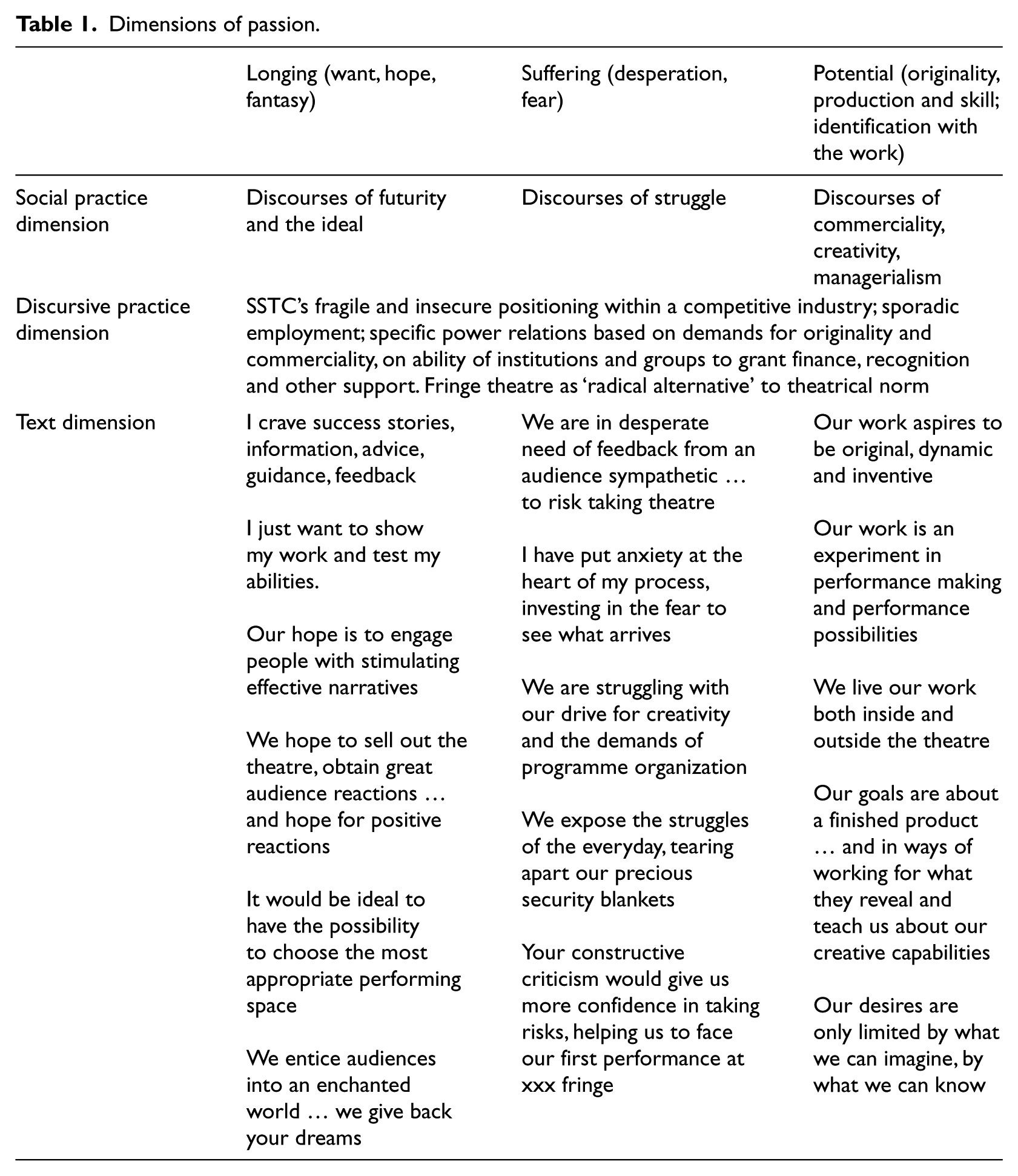
Longing: want, hope and fantasy
Longing, as a ‘craving’ and ‘fervent desire’, suggestive of unfulfilled promise, accompanied meanings around want, hope and fantasy that infused applicants’ texts. A language of intense longing accompanied pleas to Play-On for support—articulated by one founder in survivalist terms as ‘a vital force to the life of the play …’. This was commonly expressed in terms of want and need: I crave success stories, information, advice, guidance, feedback, contacts in the business and of course to be discovered. Our fervent desire is to put on another show and perform together. The … solo work marks a real want to marry a political text with a physical skill.
Symptomatic of what is yet to be fulfilled, longing is also indicative of hopes and aspirations as well as of future oriented imaginings as seen in a language of anticipation and ambition: (Play-On) will be a vital and important force to the life of the play and to how we can reveal its full potential … . If we had a producer we would be able to transpose the work to a greater professional level and promote the work to a greater audience.
Hope often had a naive and child-like quality (‘I just want to show my work and test my abilities …’), expressed in undemanding, tentative terms. As one company claimed, ‘through a wider audience, hopefully we can begin to become recognized for our ideas’. Recognition is hoped for—but its embryonic status (we can only begin to become recognized) is presented as a far-off dream, reflective potentially of the fragility and uncertainty that pervade theatrical enterprise. Emotions are therefore drawn on and conveyed that frame a future oriented longing and need, encouraging recognition and approval rather than rejection and denial. A simple wish to ‘show my work’, a ‘hope’ for recognition or a plea for the ‘life of the play’—all elicit help, through the texts’ consumption, a move towards acceptance rather than rejection. How can one refuse a simple request? Deny life to an idea?
Hopes and aspirations often carried an unrealistic, fantastical quality. One company, writing in 2009, aspired to present their work at the Edinburgh festival later that year and then ‘transfer it to a London theatre’—a seemingly unrealistic goal in light of an earlier (rather casual) admission that the play was only ‘more or less ready’. Fantasy and enchantment imbued drama ideas but also entered, through escalating promise, aspirations regarding production plans: We would really like to expand our 30 minute piece to a full length production and bring it to theatres across the UK and, hopefully, the US at some point. We will be looking into working with dancers, musicians, puppets and perhaps even circus performers in what will hopefully become an overwhelming experience.
While rendered provisional through the conditional (‘hopefully’) and through time (‘at some point’), aspirations contained elements of the supreme (‘an overwhelming experience’). In fact, a language of the idyllic was a common factor in the majority of texts (’ideally, we would like to develop our piece into a full length play’; ‘it would be ideal if we could showcase our work …’).
The pitch accordingly contained, through meanings around longing, a strong emotional appeal. Such emotions are potentially reflective at the ‘discursive practice’ dimension (Fairclough, 1992, 1995) of the organizational context of the SSTC, where passion helps to convey value and where individuals and/or groups work alone, often on a project to project basis, with little security or public recognition. A language of hope evokes the intensity of the desire to be given a chance to perform and fulfil the promise of the idea. The hope, however, is faltering and unsure, indicative potentially of a fragile positioning within the theatre world and compelling in its expressions of need. Further, the longing expressed appears to offer little possibility of satisfaction: all SSTC founders had performed at different venues before, so the next performance becomes, in a performative sense, reiterative of a continuing search for recognition (from audiences; from theatre producers; from Play-On) and for the unfulfilled dream. This promise holds elements of the unrealistic and fantastical—captured in visions of elusive perfection, through escalating promises and discourses of the ideal.
Suffering: desperation and fear
In the context of an industry which places value on the new and the alternative and which, additionally, can easily discard and destroy, emotions of suffering framed the aspiration to perform. Suffering in the form of mental and physical stamina was demanded in the routines of dramatic performance—where the need for endurance was recognized by founders as an inevitable ‘by-product’ of the creative enterprise: What need is there to suffer in the pursuit of performance practice? In my mind the two are interlinked … not only in the profound sense of the artist mentally exhausting one’s self in the creation of their work … but in the far more real sense of suffering in the creation of a durational art work in action … that … physically pushes the body to go beyond the norm … I find that sense of suffering in these moments of prolonged gesture fascinating.
Suffering is thus linked with the process of creativity—given greater purchase, potentially, in the context of fringe which celebrates the non-mainstream—and with a sense of struggle and endurance (as in prolonged pain). These professed feelings are ‘profound’, ‘real’ and embodied—presented as endemic to artistry itself.
Suffering could also be identified in the intensity of the longing to perform, discussed above, as well as an associated fear of failure. This was expressed in terms of desperation where the need for support and for audience feedback was couched in explicitly urgent terms: We want to really engage with the work by seeing it in front of an audience more than once as we’re desperate to develop it into a full length piece of work. At this stage we are in desperate need of feedback from an audience sympathetic to performance/audience interaction as well as risk taking theatre.
Fear (of rejection; of non-recognition) can be read in these expressions of extreme anxiety as well as in the common plea for ‘sympathy’ (‘we need a sympathetic venue’; ‘we crave a sympathetic audience’). Struggle and anxiety also surrounded the performance process. One applicant referred to his ‘constant struggling with … the craft and the everyday’; another to an ‘overwhelming feeling of terror’ which he sought to harness as a form of energy in the course of the production: I have put anxiety at the heart of my process, investing in the fear to see what arrives.
The language of desperation that underpins the intensity of need as well as the struggle, pain and anxiety presented as integral to the performance process highlight the potential for suffering and fear to imbue the theatrical enterprise. The potential for failure (through non-recognition and rejection; through disintegration and ‘lapses’ in the unstable, fantastical dream) may be provocative of fear that finds purchase in the endemic anxiety and insecurity of the SSTC. Such accounts may also align with the radical nature of fringe theatre—creating pressure to produce ‘cutting edge’ work as well as underpinning identification with the product founded on struggle and non-conformity. As other work has discussed (Brewis et al., 2006; Höpfl and Linstead, 1993; Linstead and Brewis, 2007) these feelings and expressions are endemic to notions of passion and are evidenced in the ways passion can be potentially destructive through sacrifice and obsession. This problematic and more negative side of passion can be seen to be framed within the specific contextual features of fringe and in the associated challenges faced by SSTCs.
Potential: creativity, production and skill
As well as a strong feeling for theatre, applicants must possess creative and production potential, i.e. they must demonstrate capacity to produce an end product through creativity, originality and skill. Creative artistry of SSTC founders was given emotionally charged expression through words such as ‘innovation’, ‘experimental’, ‘new’, ‘original’ and ‘ground breaking’ to describe the dramatic performance—meanings that have been associated with independent small scale theatre that supports challenging, inventive and exploratory work.
Our work aspires to be original, dynamic and inventive: both thought provoking and challenging, and work that is striking and beautiful.
This creativity and originality was presented as central in terms of the company’s philosophy and values and at the heart of its endeavours. Founders accordingly expressed a strong identification with the dramatic product, commonly referred to as ‘our work’, indicative of a seriousness of intent and reflective of core beliefs and values: ‘Our core intention is to produce exceptional drama’; ‘We live our work both inside and outside the theatre’.
Applicants must not only show capacity to excite and inspire through the creativity and novelty of the idea, but also demonstrate credibility and encourage confidence in terms of their ability to market and produce a dramatic work. Recognition of this more commercial imperative was evident in the detailed care with which applicants presented their previous experience through personal CVs and descriptions of the company background. It was also evident in the universal pre-occupation with audience feedback, widening audience base and the ongoing development of the work. Reflective of this ‘social practice’ dimension (Fairclough, 1992, 1995), founders drew on a managerialist language of ‘project management’ and ‘goals’; on ‘development’ (of the dramatic enterprise, of self, of capabilities and expertise); on ‘promoting’ their work; on ‘rigorous testing’ of ideas and ‘responding to critical review’.
Our goals are about a finished product … and in ways of working for what they reveal and teach us about our creative capabilities … we want to ask what audiences want to see and what we need to do to give it to them … we are looking to promote the work to potential backers, programmers or producers. My attempt is always to find new ways of intimacy in a live shared space and I often make work that is based around sensory perception, the use of magic … After I have tested the work rigorously with a variety of audiences and consulted venues and programmer about how the work can sit among a programme of performances, I would wish to develop the work in several ways.
The above applicant thus moved from discourses of creativity to, at a later stage in the text, a demonstration of credibility through a ‘rigorous’ testing of the work and a concern with the pragmatics of programme organization . Similarly, a proposed work that was concerned imaginatively with how ‘the individual body negotiates and survives its symbiotic relationships with other bodies, objects, spaces, pressures and influences’ ended more prosaically with audience feedback forms made available at the proposed events—and claims of their ‘crucial importance’ to company members for their future development.
Commerciality, that prioritizes the practicalities of dramatic enterprise and demonstrates capacity and potential, must accordingly accompany the creative, original and ‘cutting edge’ nature of fringe. Creativity and production expertise are therefore required for the future development of the work—capacities that must be proven to potential backers. Here, SSTC founders demonstrate strong identification with their work through a process of self-affirming and on-going creativity that is presented as developmental in both artistry and skill. Passion is therefore productive in that it motivates us to ‘exceed ourselves’ (Styhre, 2006) through experimentalism and openness whilst also seeking to reveal, in a more pragmatic sense, capacity and potential to fulfil the promise of an idea.
Discussion and conclusion
Drawing on a social constructionist perspective, this article set out to explore how SSTC founders draw on and activate emotions of passion in their attempts to secure financial and other support. In so doing, it has responded to a call for an inclusion of the importance of emotion in social performances in this context (Goss, 2005a, 2005b, 2008; Goss et al., 2011) as well as for more research on the social construction of entrepreneurialism through a focus on discourse (e.g. Downing, 2005; Fletcher, 2003; Johansson, 2004) such as through written and oral text. The significance of passion has emerged from studies of entrepreneurialism largely in relation to outcomes such as organizational success (e.g. Baron, 2008; Cardon, 2008; Cardon et al., 2005; Chen et al., 2009). However, few studies have explored the meanings of passion beyond strong or positive affect and how they are mobilized and experienced in specific organizational contexts.
We show how founders undertake ‘emotion work’ (Goffee and Jones, 2005; Hochschild, 1983) that is given meaning in the particular (uncertain, competitive) context of fringe theatre where survival depends on the ability to ‘sell’ a dramatic idea. Here, power is located within specific institutions (production companies, festival organizers, funding bodies, audiences) and exercised through processes such as the giving of funding and other support. Through performances and discourses of passion that speak to creativity, integrity and reliability, founders seek to persuade Play-On of the merits of their work and so gain entry into ‘professional’ theatre making and the world of fringe. As ‘interactional repertoires’ (Fineman, 1993), emotions are accordingly managed and conveyed in specific contexts as self presentations (Goss, 2005a; Holmquist, 2003) that seek to elicit from significant others, positive affective (and hence behavioural) response.
In this respect, the pitch is expressive of the passion that founders convey for their work at both the text, discursive and social practice dimensions (Fairclough, 1992, 1995, 2003). The text dimension is captured through, for example, appeals to hope as well as in the plea for compassionate consideration as founders articulate a desire for Play-On to provide a ‘sympathetic venue’, a ‘home’ that can give ‘security and a place to take risks’. Together with a language of desperation and need, such feelings reflect, at the level of discursive practice, SSTCs fragile hold in a seemingly ruthless industry, the isolation and insecurity of their entrepreneurial condition, the relatively powerless location within theatrical fringe as well as the primacy of the ‘pitch’ in conveying commitment and value. Thus, the role of ‘petitioner’ within these institutional relations underpins emotions that signify the holder’s relatively powerless base, i.e. through the longing, desperation and fear as manifestations of passion commonly expressed. At the level of social practice, founders draw on broader discourses (creativity, commerciality, futurity) to frame their emotional display. These ‘dynamics of passion’ are illustrative of feeling rules that reflect and reinforce a set of institutional power relations and of emotion work which is articulated through the specific ‘institutional logics’ and ‘institutional vocabularies’ (Battilana et al., 2009) of fringe theatre. These relations and hierarchies prompt contextually appropriate emotional performances and displays—such as, in this context, longing and suffering as well as strong feeling for and identification with the work.
Diversity and multiplicity of passion
Following the above, our findings provide new insights into the dynamics of entrepreneurial passion. Firstly, while previous work has conceptualized passion as a strong, positive affect that often contributes to entrepreneurial success (e.g. Baron, 2008; Cardon, 2008; Cardon et al., 2005; Chen et al., 2009), our results point to the diversity of passion and to the multiple ways—both positive and negative—in which it can be expressed. In terms of the former, through expressions of capacity, originality and potential, SSTC founders convey affirmative meanings that relate to openness, experimentation and inventiveness—a desire to go beyond existing boundaries and explore new forms. By drawing on discourses of novelty and creativity, and demonstrating founders’ strong identification with their work, this speaks to a force that is both productive and affirming as we ‘dare to become’ (O’Shea, 2002) through ability and potential.
In terms of the negative side of passion, want, hope and fantasy are articulated through a future based longing for recognition, given primacy in the context of fringe, and for the opportunity to fulfil the promise of the dramatic idea. However, the very real possibility that the ‘end point’ will not be achieved—that the application will fail—lends desperation to the yearning. Struggle and pain reflect not just the insecurity and fragility of SSTCs’ positioning, but also the radical roots of fringe’s inheritance where, ‘subversive, dangerous … and in constant opposition to the Establishment’ (Bradwell, 2010: 35) theatre making is actively engaged with resistance and struggle. Resonant with Linstead’s (2007) etymological account of passion as incorporative of suffering through, for example, obsession and dread, these dynamics underpin common expressions of desperation, suffering, struggle and fear. Entrepreneurial passion can therefore capture the negative and the painful as well as the potential for creativity and affirmation.
These are not discrete manifestations, however, but can be seen to intersect. Thus, struggle is implicated in potential and creativity as founders seek to overcome challenges and obstacles faced (e.g. raising finance and other support; seeking acceptance for the idea); in a parallel fashion, extreme physical and mental effort, symptomatic of forms of suffering, are required in embodied performances that deliver the creative idea. Potential and creativity are also conducive of fear as individuals anticipate the possibility of rejection—evidenced, arguably, in the pleas for sympathy and the tentative hope commonly expressed. This points to the fluidity of passion, how it can incorporate different emotional experiences or expressions that may be contradictory or ambiguous in origin. Passion is accordingly diverse and can take a plurality of forms. This elaborates our understanding of passion beyond the single dimension, dominant in the literature on emotions and entrepreneurship, of strong positive affect.
Power relations and the performative role of passion
Secondly, our study shows how in a social constructionist sense, expressions and manifestations of passion are situationally produced and made intelligible in context, i.e. within institutionally based regulatory regimes. Here, drawing on Butler’s (1993) work, Ahmed (2004) alerts us to the performative nature of emotions in terms of understanding what emotions do—how, through repetition, they reproduce and/or subvert discourses and subject positions.
Here, our data highlights the performativity of passion as both constituting and constituted by regulatory norms and practices and by particular power relations and discursive regimes. Relatively powerless within the discursive field of fringe theatre, and in order to gain a favourable response, we have seen how SSTC founders re-cite dominant discourses of originality and creativity that rely on emotion norms of passion for support. These vie with alternative discourses of commerciality, grounded in the rationality tradition and also hegemonic within entrepreneurialism (Mason and Stark, 2004), that speak to production capacity and the deliverability of the idea. Applicants move between these often competing discourses, dominant in theatrical enterprise (Voss et al., 2000), to frame the emotional appeal. They invest in norms and practices of novelty and creativity, sometimes creating distance from regimes of commerciality even though founders are also subject to their regulatory power. There is no finality to these goals and practices: each aspiration is partly reiterative, in a performative sense, of the next so that passion is inscribed within a ceaseless process of hope and ambition (‘larger audiences’; ‘a full length play’). Through citational practices based on the ongoing, reiterative search for fulfilment and on the repetition of a prior set of authorizing norms, the performance of passion thereby both reflects and underpins existing forms of power.
Further, specific manifestations of passion (longing, hope, desperation, fear; dedication to and identification with the work) can be understood in the context of particular subject positions (e.g. petitioner requiring support; ‘ground breaking’ creative artist) conferred through discursive regimes—such as fund awarding institutional relations, imperatives of commercial enterprise and demands for novelty within fringe. Through the articulation, SSTC founders can be seen to support and give credence to their dominance—re-inscribing, in Butler’s (1993) terms, their hegemonic status and reproducing the very phenomena (i.e. power saturated theatrical relations) that these discourses regulate and constrain. Thus, the tentative hope expressed and the urgency and desperation of need reflect the powerlessness of the petitioner condition within the competitive context of fringe whilst, through the performance, re-inscribing this hierarchical regime. The specific manifestations of passion referred to above therefore articulate and are inscribed within discursive regimes that both support and reflect the power dynamics of theatrical enterprise.
Reading emotions through text
As forms of social action and interaction (Keenoy and Oswick, 2003; Linstead, 2003), designed for another’s consumption and response, written texts bound social performances, influencing how meanings are conveyed. In this sense, texts are ‘vulnerable’ to their ‘own incompleteness’ (Höpfl and Linstead, 1993: 91) so that readers are persuaded to fill in the missing parts and to ‘formulate the other elements as consistent’ (Mangham and Overington, 1983 cited in Höpfl and Linstead, 1993: 79) with, for example, a contextually appropriate entrepreneurial ideal. Thus, we can see how through mystification and associated discursive constructs, founders seek to overcome the limits of the text and the partiality of its descriptive potential to speak sympathetically and convincingly to their dramatic enterprise. They accordingly draw on powerful and evocative language to convince and persuade. As a final contribution, by analysing textual accounts we have surfaced some of the emotional dynamics of entrepreneurialism and, in so doing, have given validity to a potentially powerful approach to research on performed emotions and the emotional dynamics of performance.
Through the emotionally charged setting of fringe theatre, our study has helped to increase our theoretical understanding of the role of passion in the social performance of entrepreneurialism and organization more widely. In particular, it has allowed us to develop analytical generalizations about the dynamics of passion that relate to its diversity and fluidity as well as to its performative nature that will, we hope, translate into and inform other organizational contexts.