




Abstract
This article analyses the evolving cultural political economy of climate change by developing the concept of ‘climate imaginaries’. These are shared socio-semiotic systems that structure a field around a set of shared understandings of the climate. Climate imaginaries imply a particular mode of organizing production and consumption, and a prioritization of environmental and cultural values. We use this concept to examine the struggle among NGOs, business and state agencies over four core climate imaginaries. These are ‘fossil fuels forever’, ‘climate apocalypse’, ‘techno-market’ and ‘sustainable lifestyles’. These imaginaries play a key role in contentions over responses to climate change, and we outline three main episodes in the past two decades: the carbon wars of the 1990s, an emergent carbon compromise between 1998–2008 and a climate impasse from 2009 to the present. However, climate imaginaries only become dominant when they connect with wider popular interests and identities and align with economic and technological aspects of the energy system to constitute ‘value regimes’.
One of the most striking features of recent debates about climate change is the disconnect between the organization of economic activity and the accumulating body of science pointing to potentially devastating consequences. This disjuncture presents a challenging puzzle that social scientists have approached from a number of perspectives, including collective action failures (Ostrom, 2009), the inertia of complex systems (Levy and Lichtenstein, 2012), representations in the mass media (Boykoff, 2007) or the power of the fossil fuel industry (Newell and Paterson, 1998). While each of these perspectives offers some important insights, here we highlight the role of widely shared, highly emotive, yet often conflicting understandings of this complex issue. For instance, many people remain committed to the belief that climate change is highly exaggerated or even a myth, while others understand climate change to be a real concern, yet strongly believe that creative market solutions and technical innovation can address the problem.
These viewpoints reflect enduring ‘imaginaries’ (Anderson, 1999; Taylor, 2004) that provide a shared sense of meaning, coherence and orientation around highly complex issues. Imaginaries are closely linked to the ways in which institutions and economic activity are organized and structured, and the ways people think they ought to be organized and structured. Consequently, there is considerable contestation over these imaginaries, as the stakes are perceived to be very high, whether in terms of the planet or economic interests. In this article, we argue that contested ‘climate imaginaries’ form a key part of the struggle over responses to climate change. If we wish to understand the lack of effective organizational response from firms and governments in the face of mounting evidence of a climate crisis, it is vital that we explore the role climate imaginaries play.
To this end, we develop the concept of ‘climate imaginaries’ as shared socio-semiotic systems that articulate and structure a field around a set of shared understandings that provide a sense of coherence and link actors into a network around the issue. Imaginaries imply a particular mode of organizing production and consumption, and a prioritization of environmental, cultural and consumerist values. To explore the role climate imaginaries play, we examine public debate about the impact of climate change, with a focus on the US energy sector. In particular, we analyse contestation among NGOs, business and state agencies over four core climate imaginaries: ‘fossil fuels forever, ‘climate apocalypse’, ‘techno-market’ and ‘sustainable lifestyles’. We then explore important historical shifts in these imaginaries. After the carbon wars of the 1990s, the article traces the emergence of a ‘carbon compromise’ in the early 2000s based on a gradual process of decarbonization of the economy facilitated by market mechanisms such as carbon trading and clean-tech entrepreneurship. The incipient carbon compromise has been disrupted, however, by the financial and sovereign debt crisis of 2008–2012, resulting in the current climate impasse, characterized by uncertainty and inertia. The ‘fossil fuels forever’ imaginary, which was in retreat during the 2000s, remains highly resilient and the ‘techno-market’ imaginary, which appeared to be on a path to hegemonic status in the mid-2000s, has now stalled. The ‘sustainable lifestyles’ imaginary remains a niche, though it plays an important role interacting with other imaginaries. We argue that the differential fate of these imaginaries reflects not only their ability to articulate an attractive vision that connects to the interests and identities of broad groups, but also to materialize these visions into viable policies and economic forms, which we term a ‘value regime’.
In developing this argument, we make three notable contributions. The first is to ongoing debates about organizational responses to climate change (e.g. Böhm et al., 2012; Wittneben et al., 2012). In particular, we seek to show how evolving, contested climate imaginaries temper these responses and account for the striking variability across organizations, sectors and countries. The second contribution is to existing debates about social imaginaries. We do this by extending Jessop’s (2010) Gramscian understanding of imaginaries into the realm of climate change, demonstrating how the concept may be used to understand the intersection of economic, political and ecological issues. We show that the contestation around these ‘climate imaginaries’ is central to efforts to transform, as well as to defend, the extant fossil-fuel based value regime. This suggests that the transformation of the energy regime resembles an ongoing ‘war of position’ (Gramsci, 1971) to propagate and incorporate ideas into state projects and supportive networks, and to construct a viable economic basis for the regime. Finally, we describe how climate imaginaries interact and co-evolve with economic, policy and technological aspects of energy systems to constitute ‘value regimes’, a concept we develop to characterize this semiotic and material system in which economic value and environmental visions are jointly stabilized.
We proceed by briefly looking at how social theorists have conceived of the notion of the imaginary. We then turn to recent work by Jessop (2010) that has developed a more Gramscian account of what he calls the economic imaginary, and build on this work to develop our concept of ‘climate imaginaries’. We trace the historical evolution of four dominant climate imaginaries and their relationship to the organization of the energy field, and we focus on field actors and dynamics at the intersection of the climate change issue with the energy industry in the United States. In the discussion, we argue that the dominance of climate imaginaries is tempered by their connection to broader value regimes and their articulation with popular interests and identities.
Imaginaries
Although there are a range of conceptions of ‘imaginaries’ (Strauss, 2006), our genesis point is Benedict Anderson’s Imagined Communities (1999). In this classic, he argued that social imaginaries were central to the creation of nation states during the 18th century. These were broad socio-semiotic systems which enabled quite different people to feel a shared sense of identity and interests. Anderson places a significant emphasis on the role of mass media and the modern bureaucratic apparatus in shaping this sense of commonality, despite geographic dispersion and abstract relationships among community members.
Charles Taylor built on Anderson’s work to argue that in modern contexts, a range of social imaginaries persist simultaneously and are often shared among different societies. Akin to the notion of culture, Taylor (2002: 106) describes ‘the way ordinary people “imagine” their social surroundings; it is carried in images, stories, and legends … the social imaginary is that common understanding that makes possible common practices and a widely shared sense of legitimacy’. Taylor connected changing social imaginaries to the rise of capitalism, describing a transition from a classical imaginary based on natural order and monarchy to one based on individualism, economic rationality and the separation of public from private spheres. Taylor notes that the transition to modernism was led by elites with new social and economic theories, and fuelled by increasing state rivalry during the emergence of capitalism. Nevertheless, Taylor suggests that contestation around social imaginaries plays out in the ideational realm, and consequently his account lacks an appreciation for their embodiment in political institutions and forms of economic life.
To address these shortcomings, Bob Jessop (2010: 344) has developed a cultural political economy framework with a strategic orientation informed by Gramscian thought. He uses the concept of the ‘economic imaginary’ to probe the way an imaginary provides structure and meaning for the immense complexity of economic and social life. For Jessop:
Imaginaries are semiotic systems that frame individual subjects’ lived experience of an inordinately complex world and/or inform collective calculation about that world. They comprise a specific configuration of genres, discourses and styles and thereby constitute the semiotic moment of a network of social practices in a given social field, institutional order, or wider social formation. (Jessop, 2010: 344)
Jessop highlights how imaginaries are linked to political and economic systems such that the ‘emergence and consolidation of a new economic regime with its own distinctive economic laws or regularities … depends critically on institutional innovation intended to reorganize an entire social formation and the exercise of political, intellectual, and moral leadership’ (Jessop, 2010: 348). He reminds us that social imaginaries do not just construct communities (as Anderson claims) or intellectual frameworks (as Taylor assumed), but entail strategic struggle to assemble coalitions, mobilize state projects and stabilize conjoined economic and ideational systems. This struggle requires actors ‘to articulate strategies, projects and visions oriented to these imagined economies’ as they seek to coalesce an historical bloc comprising ‘political parties, think tanks, bodies such as the OECD and World Bank, … business associations and trade unions, and social movements; the mass media are also crucial intermediaries in mobilizing elite and/or popular support behind competing imaginaries’ (Jessop, 2010: 345–346).
Building on this Gramscian perspective, Jessop argues that constructing hegemony around a new socioeconomic regime requires a new ‘economic imaginary’ that ‘enables the re-thinking of social, material and spatio-temporal relations among economic and extra-economic activities, institutions and systems and their encompassing civil society’ (Jessop, 2010: 348). He claims that contradictions between an existing imaginary and the material dimensions of economic life can trigger moments of crisis and set in motion a pathway of change. Actors compete to offer new ideas, though only some of these are selected due to their alignment with broader ideological and economic structures, and ability to bind a coalition of actors.
Jessop examines two major shifts in economic imaginaries. Jessop’s (2004) first example, the crisis in Fordism in the latter part of the 20th century, manifest itself primarily in economic terms as a loss of industrial competitiveness, which spurred emergence of the ‘knowledge based economy’ (KBE) as a new imaginary, a set of understandings related to sources of value, competitiveness, innovation and entrepreneurship. Crucially for Jessop, the success the KBE imaginary ‘does correspond in significant ways to the changes in core technologies, labour processes, enterprise forms, modes of competition, and economic “identity politics” … And it has since gained a crucial role in consolidating them through its capacity to link different sets of ideal and material interests across a broad range of organizations [and] institutional orders’ (2004). More recently, Jessop (2010) argues that the ongoing global economic crisis that erupted in 2008 has led to profound questioning regarding extant imaginaries of capitalism, leading to the generation of competing alternative imaginaries to explain the crisis and articulate solutions. Currently, he argues, we are at a selection stage where more radical imaginaries that fundamentally question capitalism, or seek to revive Keynesianism and a stronger state, are losing plausibility within the coordinates of neoliberal capitalism.
Imagining the climate
Jessop’s concept of economic imaginaries provides a valuable analytical framework for understanding responses to crises at the intersection of political-economy and ecology. Here, we extend Jessop’s work to develop the notion of the climate imaginary, representing a shared socio-semiotic system of cultural values and meanings associated with climate change and appropriate economic responses. In one sense, a climate imaginary is a narrower, more microscopic concept than the imaginaries of Fordism and the KBE, in that it concerns field stabilization within a particular field or industry rather than the entire economy (see also: Levy and Scully, 2007). At the same time, the concept has a broad scope insofar as it reaches far beyond strictly economic issues and typically includes wider understandings relating to the natural environment, such as its fragility or resilience, its value for leisure or resources and the cultural construction of products and activities with high environmental impacts, such as cars and planes.
A climate imaginary contains idealized visions of the future, which could encompass electric cars and high tech gadgetry for controlling energy use or a simpler life using local organic foods and bicycles. An imaginary might connote idealized market forms, such as carbon markets and dashing entrepreneurs raising venture capital for new technologies or perhaps government funding for university research and public mass transit systems. Elements of these imaginaries are far from universally shared and can create considerable contestation (Leahy et al., 2010). A variety of actors, including firms, NGOs, governmental agencies and multilateral organizations advocate different climate imaginaries that reflect their ideologies, normative commitments, scientific understandings and material interests. This contestation among ‘interpretive communities’ (Leiserowitz, 2005) is not just to instill a particular imaginary in the public mind. Rather the aim is to forge a hegemonic alliance in order to shape broader economic responses and mobilize supportive policies at multiple scales, regional, national and supranational (Jessop, 2007; especially chapter 4 on Gramsci and spatiality).
We identify four relatively coherent imaginaries around which there is active contestation, though there are, of course, many shades and gradations of perspective. These climate imaginaries were derived from observation and analysis of the various framings and positions adopted by actors and the media. These four core imaginaries we term ‘fossil fuels forever’, ‘climate apocalypse’, ‘techno-market’ and the ‘sustainable lifestyles’ imaginary. We consider each of these in turn, before examining the dynamic processes of contestation among them in more detail.
Fossil fuels forever imaginary
The first imaginary we term ‘fossil fuels forever’, in which an abundance of cheap fossil fuels have brought progress and prosperity, fuelling the process of industrialization and associated material comforts. Fossil fuels are plentiful, in this scenario, as new technologies facilitate the discovery and extraction of fuels from previously inaccessible places such as shale rock. The corollary is that controls on fossil fuels would cause severe economic dislocation, threatening the routines and comforts of industrialized societies and depriving developing countries of prospects for growth. In this imaginary, there is no scientific consensus regarding the impact of fossil fuels on the climate, and if needed, technological solutions such as carbon capture and storage can be developed at reasonable cost.
This imaginary has been a favourite of carbon intense sectors of energy industry, particularly oil and coal (Levy and Egan, 2003; Newell and Paterson, 1998). These sectors have engaged in public relations campaigns to portray a stark contrast between a prosperous world running on fossil fuels and a dark, cold, poverty-stricken future if these fuels are restricted. This imaginary has brought together a wide coalition of actors, including unions associated with these sectors and national governments concerned about competitiveness and employment, particularly in countries with large fossil fuel sectors such as the US, Canada and Australia. They are joined by emerging market countries such as China and India, who view their large coal reserves as engines of economic growth.
Climate apocalypse imaginary
The ‘climate apocalypse’ imaginary, by contrast, paints an alarming picture of the coming decades. Swyngedeow (2010: 217) describes an ‘apocalyptic imaginary of a world without water …, ravaged by hurricanes whose intensity is amplified by climate change; pictures of scorched land … droughts and floods; icebergs that disintegrate around the poles as ice melts into the sea, causing the sea level to rise; alarming reductions in biodiversity as species disappear’. The apocalyptic imaginary is epitomized by films such as The Day After Tomorrow (2004) and The Age of Stupid (2011), and by books including McKibben’s End of Nature (1989) and Gilding’s The Great Disruption (2011).
Many NGOs have found the climate apocalypse imaginary an appealing populist call to action, though some view the imaginary as a counterproductive strategy. Katz (1995: 277), for example, argues that ‘apocalypticism is politically disabling’ because it offers ‘a dreary politics of self-sacrifice and self-denial’, while Swyngedouw (2010) contends that apocalyptic rhetoric serves elite interests by presenting carbon dioxide as a common enemy requiring technical and managerial solutions. Climate scientists were initially reluctant to engage with this imaginary because the associated scenarios were considered ‘too extreme for the public policy world to absorb’ (Wynne, 2010: 293). In their striving for credibility, climate scientists therefore ‘have constructed a representation of future climate change and its human causes which presents it as reassuringly gradual’ (Wynne, 2010: 295). However, with strengthening evidence pointing to severe impacts, scientists have begun to suggest that climate change constitutes ‘an increasingly direct, urgent and radical challenge to modern society’ (Wynne, 2010: 290). However, this imaginary’s appeal is by no means universal. It is avoided and disavowed by business as it could lead to a deeper questioning of consumerism and capitalism, a surge in support for environmental organizations and more severe governmental regulation (Böhm et al., 2012). Similarly, governments have been reluctant to embrace the direst scenarios because they are averse to the vast expenditures that would ensue for energy and transportation infrastructure.
Techno-market imaginary
An optimistic ecological modernization scenario (Hajer, 1995) forms the basis for what we term the ‘techno-market’ imaginary, based on advanced clean energy technologies such as solar and wind alongside carbon trading and other market innovations. The invocation of innovation, entrepreneurship, venture capital and carbon markets allocates a primary role to the private sector in addressing climate change, lending this imaginary a broad appeal across multiple constituencies. It presents new market opportunities for firms with low-carbon technologies, as well as for finance and accounting firms. For policymakers, it promises economic rejuvenation and employment opportunities in these fast growing sectors, while avoiding the political costs of regulation. Professional and technocratic elites have displayed considerable enthusiasm for developing the legal, financial and accounting mechanisms for carbon management, reporting, and trading. In addition to more neo-liberal versions of the climate imaginary, there is also the more neo-Keynesian ‘Green New Deal’ (GND) which advocates increased state support of green industries as a response to the 2008 financial crisis.
Jessop notes the GND’s hegemonic potential because it ‘is being narrated as capitalism’s best hope to create jobs, restore growth, and limit climate change’ and due to its penetration into production, politics and culture (Jessop, 2010: 350–352). In a similar way, the techno-market imaginary appeals across various groups, from business to environmentalists and state agencies, and across scales, from the local to supranational. As with other popular concepts such as ‘sustainable development’ and ‘corporate citizenship’, ‘the very fuzziness’ of the imaginary ‘has helped to build alliances and compromises’ (Jessop, 2010: 351). Despite its broad appeal, the techno-market imaginary does not lack critics. Conservative forces object to the role of the state in promoting clean energy. These objections have gathered force in the US with the recent failures of several solar firms which had received substantial government subsidies. On the left, proponents of the ‘deep green’ position object to decoupling economic growth from greenhouse gas (GHG) emissions through technology, the continuation of consumerism and the pursuit of infinite growth (Jackson, 2011). Eco-socialists dismiss the techno-market imaginary because it disregards the fundamental contradiction between environmental sustainability and capitalism, or ‘metabolic rift’ (Foster et al., 2010; O’Connor, 1989). As Böhm et al. (2012: 1619) put it, ‘the dynamics of capitalism constantly tend to propel economic processes beyond the limits of controllable growth’. The problem with carbon markets is not just that they are corrupt and ineffective (Lohmann, 2006); rather, they represent an advanced, adaptive capitalist imaginary, part of an attempt to establish a new regime of ‘accumulation by decarbonization’ (Böhm et al,. 2012; Bumpus and Liverman, 2008).
Sustainable lifestyles imaginary
An alternative approach to addressing climate change is found in the growing popularity of movements for sustainable consumption, localism and more recently ‘slowness’ (e.g. Land, 2009; van Bommel and Spicer, 2011). These movements are inspired by the vision of a simpler, less materialistic life, which we term the ‘sustainable lifestyles’ imaginary. This imaginary conveys a radically different set of values, encompassing stronger community, more leisure time, experiments with alternative economic structures and market forms based on small scale production, co-ops and community-based services (Maxey and Dale, 2009). The cultural roots of the ‘sustainable lifestyles’ imaginary run from the utopian romanticization of rural life during the intense industrialization of the 19th century, to Schumacher’s (1973) Small is Beautiful and, more recently, Schor’s (2010) Plenitude. Jackson’s (2011) Prosperity without Growth summarizes the position well:
The prevailing vision of prosperity as a continually expanding economic paradise has come unraveled … this chapter searches for a different kind of vision for prosperity: one in which it is possible for human beings to flourish, to achieve greater social cohesion, to find higher levels of well-being and yet still to reduce their material impact on the environment. (Jackson, 2011: 35)
The sustainable lifestyles imaginary has been adopted by some NGOs, co-operatives, fringe policy makers and academics. It is a well-known idea, but remains somewhat marginal in popular discourse. Espousing a simpler life with fewer luxuries represents a risky strategy for environmental NGOs when the dominant culture reinforces values of consumerism and careerism. The hegemonic appeal of the techno-market imaginary is precisely that it does not demand major changes in lifestyle and promises to reconcile the tensions between climate concerns and functioning of the economic system. In fact, it is a key principle of green business strategy that new technologies should be invisible to consumers or even enhance product performance (Esty and Winston, 2006). The sustainable lifestyles imaginary, however, implies substantial change, and thus appears threatening to consumers as well as business.
Comparing climate imaginaries
In order to explore the relational linkages and differences among these imaginaries, we characterize their key assumptions and beliefs and portray them in Figure 1. One dimension on which climate imaginaries differ concerns their assumptions regarding the resilience or fragility of the natural environment. A second dimension is their degree of commitment to the present economic system, with some imaginaries envisaging only minor, incremental changes to core elements such as consumerism, growth, markets and technologies (Benson, 1977), versus an assumption that radical change is needed. Putting these together, we find that there are at least four logical possibilities for clusters of assumptions: resilient nature with incremental change, resilient nature with radical change, fragile nature with incremental change and fragile nature with radical change. Other means of classification (as well as other imaginaries) are possible, of course, but we suggest that these capture key dimensions particularly well.
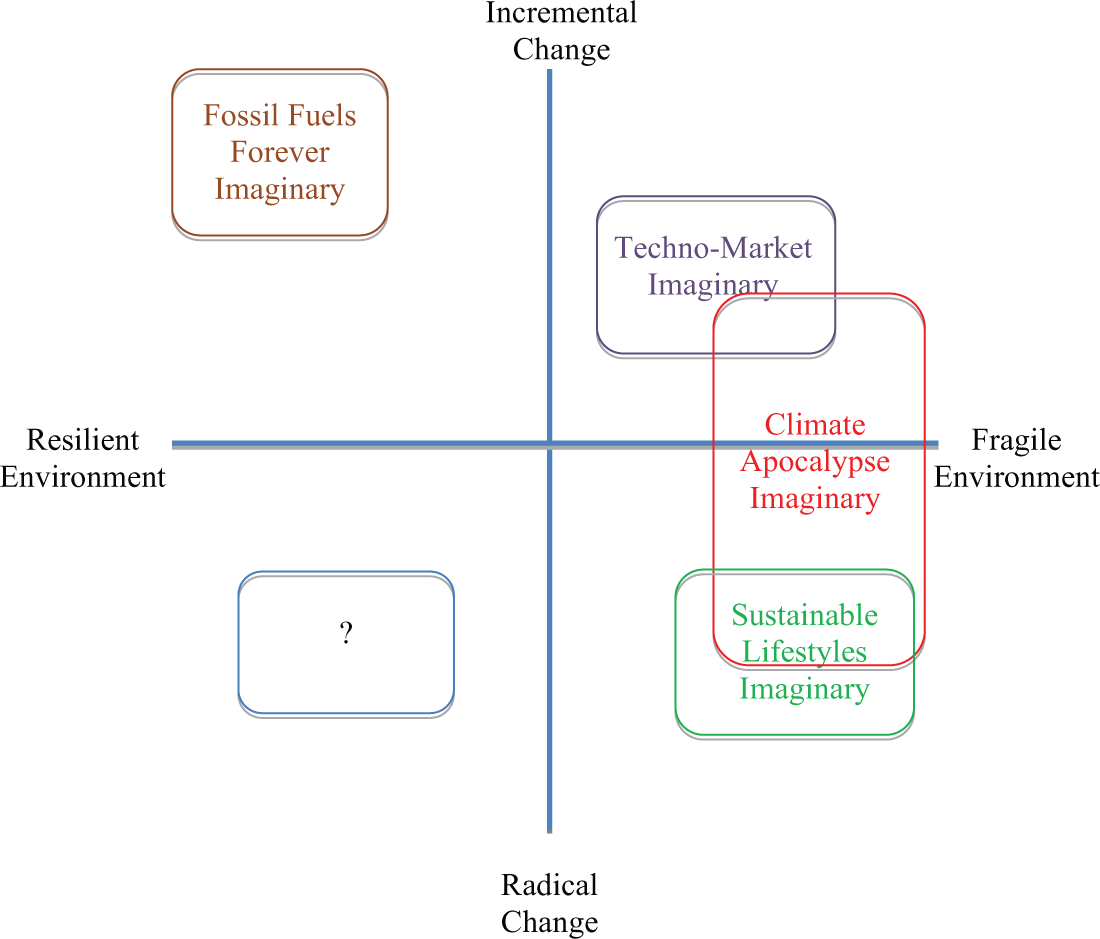
Climate change imaginaries.
The fossil fuels forever imaginary presumes the resilience of the environment in the face of human activity, and therefore little need to change the present economic system. In stark contrast, the sustainable lifestyles imaginary assumes that the environment is highly fragile and that radical changes need to be made to the current economic system to achieve sustainability. The techno-market imaginary is located between these poles; it assumes that the environment is somewhat vulnerable, but that the climate issue is manageable through appropriate economic incentives and technological innovation, without fundamentally compromising lifestyles or economic growth. This imaginary’s positioning highlights its hegemonic appeal, by claiming to reconcile economic and environmental concerns. Indeed, an increasingly common framing of this imaginary is that low carbon technologies should be pursued for reasons of profit and environmental side benefits, such as clean air, even if the climate is not at risk (Lovins and Cohen, 2011).
The ‘climate apocalypse’ imaginary is founded on the extreme fragility of nature and the dire climatic consequences of human activity. It is often invoked to support action by consumers, businesses and policymakers, though frequently the changes promoted are more incremental, and some would argue, pragmatic rather than the radical shifts advocated by the sustainable lifestyles imaginary. The contradiction between a looming apocalypse and the modest changes envisaged by the techno-market imaginary has been highlighted by its critics (Böhm et al., 2012).
The meaning of the quadrant that combines belief in resilience of the environment with a need for radical change is less clear, and the assumptions appear somewhat contradictory. One could locate here non-green socialists, who seek radical change but not primarily for environmental reasons. The space could also represent some deep green perspectives that emphasize the longer-term resilience of the earth’s ecosystems, even if that entails substantial disruption of our industrialized civilization. In practice, however, most deep green groups advocate for strong action on climate change, and are closer to the sustainable lifestyles position.
Contested imaginaries
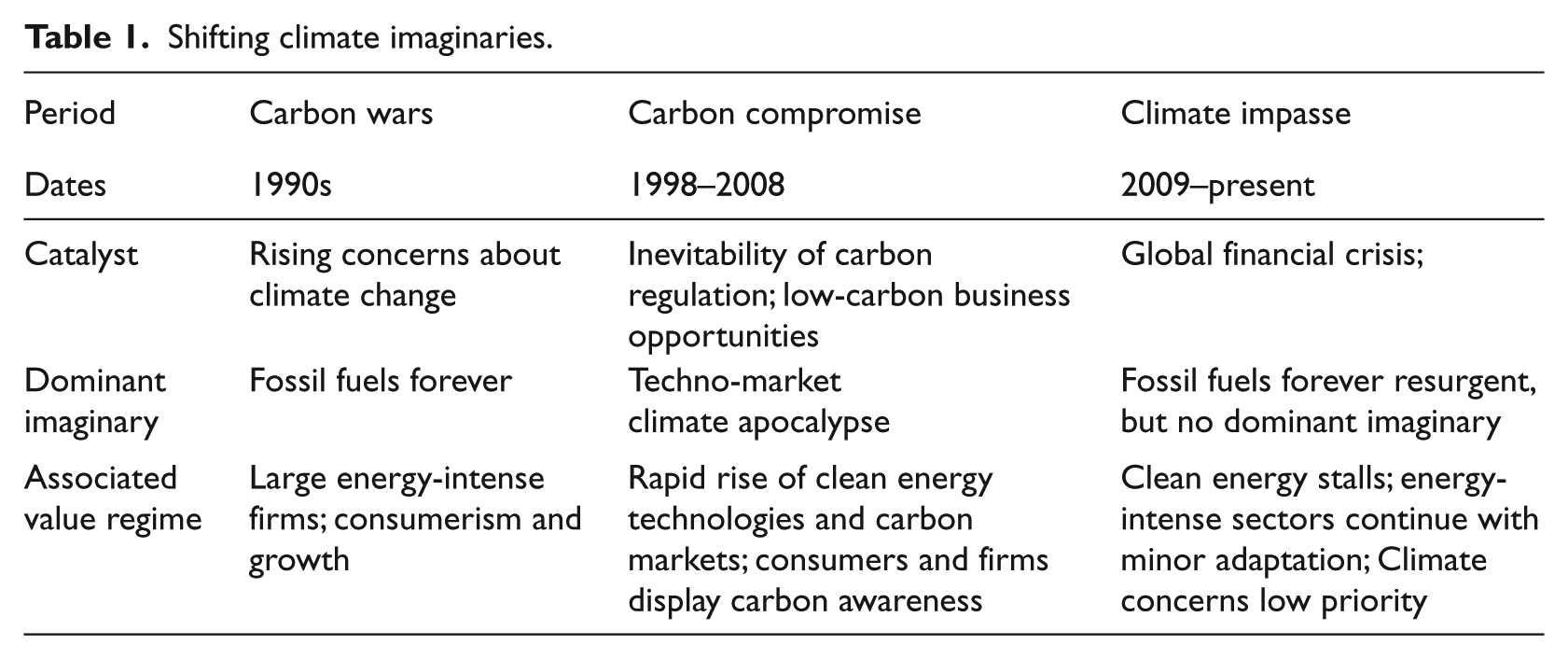
Contestation over these imaginaries has been fierce during the last two decades. In this section we describe these struggles as moving through three distinct episodes. The ‘carbon wars’ of the 1990s saw the rise of the climate issue onto the public agenda and strong efforts by the industry to protect the ‘fossil fuels forever’ imaginary. From around 1998–2008, we saw the emergence of a ‘carbon consensus’. This was formed around the need for a transition to a clean energy regime, inspired by the ‘techno-market’ and ‘sustainable lifestyles’ imaginaries, and motivated, in part, by ‘climate apocalypse’ concerns. From 2009 to the present, we have witnessed what we call ‘climate impasse’. The impact of recession, low gas and carbon prices and other factors have disrupted the earlier carbon compromise trajectory and re-ignited contestation around imaginaries. In what follows, we trace through these struggles in more depth and connect them to economic and policy responses. Table 1 summarizes key features of each episode.
Shifting climate imaginaries.
Carbon wars, 1990–1998
The carbon wars of the 1990s took place in the context of a well-entrenched energy sector dominated by large and profitable fossil fuel companies allied with other energy-intense sectors. Unruh (2000) refers to this situation as ‘carbon lock-in’ whereby the ‘interlocking technological, institutional and social forces … perpetuate fossil fuel-based infrastructures in spite of their known environmental externalities’. Carbon-intense technologies seemed secure after more than a century of incremental innovation combined with the economies of scale of mature markets. Physical infrastructures, such as power plants and airports, have long replacement cycles and enjoy network economies, creating considerable inertia. A powerful array of supportive organizations, or ‘Techno-Institutional Complex’ (Unruh, 2000), including industry associations and government agencies, reinforces the industry’s position. The sector’s profitability provided resources to fund lobbyists, think tanks, political donations, economic and technical analyses and public relations campaigns (Levy and Egan, 1998). At senior levels, industry executives and government officials rotated through revolving doors, weaving networks of relationships that induce convergent conceptions of interests. State officials were also aware of their structural dependency on the investment, employment and taxes generated by the sector (Newell and Paterson, 1998). The fossil fuels forever imaginary was a vital component of regime stability. Consumer desires for large cars, air travel and spacious air-conditioned homes are embedded in notions of success and status. Paterson (2007) has described how the automobile industry not only represented a powerful political and economic force, but also crafted its cultural environs, facilitating spatially decentralized lifestyles while promoting values associated with mobility, privacy, and prestige.
The emergence of the climate issue in the 1980s posed a serious challenge to this ‘carbon lock-in’ (Newell, 2000). Regulatory controls on carbon threatened the economic profitability of energy intense sectors, the rise of environmental organizations and the growing role of multilateral agencies posed a political threat and growing public sensitivity to environmental issues augured a cultural shift (Levy and Egan, 2003: 814). The techno-market imaginary began to gain strength in this period, and interest grew in clean energy technologies. The aggressive response by US industry to this perceived threat included the formation of issue-specific associations, lobbying politicians, challenging the science of climate change and pointing to the high economic costs of reducing emissions (Gelbspan, 1997; Leggett, 2000).
Business managers understood the economic threat implicit in a challenge to the fossil fuels forever imaginary. Levy and Egan (2003: 815) cite an American automobile industry executive saying that ‘there are people who have cast the automobile as a villain. It is a puritanical view, that we are having too much fun, that we have too much mobility and freedom, that suburban sprawl is bad. They think we should all live in beehives’. Industry responded with discursive strategies intended to protect their position, such as the economic and scientific reports commissioned by fossil fuel firms and industry associations. These reports served not only as technical devices for lobbying elites, but also as instruments of cultural politics. Some advertisements used graphic images and emotive themes to convey this message in cataclysmic terms. A notorious 2006 television advertisement from the Competitive Enterprise Institute (CEI) asserted that: ‘The fuels that produce CO2 have freed us from a world of back-breaking labour, lighting up our lives, allowing us to create and move the things we need, the people we love’. As the music turned ominous, the narrator continued: ‘Now some politicians want to label carbon dioxide a pollutant … What would our lives be like then?’. The advertisement graphically suggested dire consequences for economic and family life, ending with the infamous line: ‘Carbon dioxide. They call it pollution. We call it life’.
While environmental groups did not have the resources for large-scale television campaigns during this period, they would generally cover the issue by pointing to official scientific reports which, at the time, were notable for avoiding discussion of potentially catastrophic climate scenarios, or ‘extreme events’. From 1996, Greenpeace began to articulate the ‘climate apocalypse imaginary’, for instance, by highlighting the threat to polar bears from the melting of Arctic icecaps. 1 The imaginary also began to gain presence in popular culture. The 1995 movie Waterworld, for example, depicted a post-apocalyptic world in which rising sea levels had destroyed civilization and bands of pirates and mutants fight for survival.
Carbon compromise, 1999–2008
In the closing years of the 20th century, a ceasefire took hold in the carbon wars. The ‘techno-market’ imaginary gained enthusiasts among politicians, business and environmental groups, forming the basis for a ‘carbon compromise’ structured around a gradual transition to a low-carbon economy that does not unduly threaten existing energy sectors (with the exception of coal). Business strategies began to acknowledge the inevitability of emissions regulation, a rising price on carbon and new low-carbon technologies (Jones and Levy, 2007). By 2000, the perceived balance of risks and rewards had shifted, and in this changing landscape, business took steps to reduce the political and reputational costs of denying climate science and opposing regulation. While most firms preserved their core strategies, they increasingly hedged their bets by making modest investments in low-carbon technologies and products, and measuring and managing their carbon emissions (Jones and Levy, 2007). ‘Fossil fuels forever’ was faltering as the dominant imaginary, and a broad group of actors, from business to state agencies and environmental groups, were coalescing around the techno-market imaginary.
This shift can be attributed to a series of developments that created tensions in the fossil fuels forever imaginary and the wider energy regime. These included changing competitive dynamics and the diffusion of ecological modernization discourse (Hajer, 1995; Porter and van der Linde, 1995) that promoted the centrality of business in addressing climate change through innovation, voluntary action and carbon markets. Scientific evidence pointing to the potential severity of climate change was becoming stronger and concerns were emerging regarding ‘peak oil’, pointing to declining supplies of oil and sharply rising prices (Kunstler, 2006). The 1997 speech by BP’s CEO John Browne, recognizing that climate science warranted regulation and corporate action, split the oil industry and sparked a process of realignment. The rise of more progressive business groups such as the US Climate Action Partnership (USCAP) highlighted new market opportunities and provided legitimacy for clean energy investments.
Business hostility to carbon regulation moderated as it became clear that the weak, flexible carbon regime emerging out of Kyoto, with modest emission targets and market-based implementation, would not threaten core markets and might even offer new opportunities. The auto industry could embrace hybrid technology without facing extinction, while the oil and gas industry realized that markets were secure for liquid fuels for transportation and natural gas for electric power (Levy and Kolk, 2002). The rapid growth of clean energy during the 2000s provided an economic basis for the emerging carbon compromise and helped fuel the techno-market imaginary, a motivating vision of business-led innovation for a low-carbon transition. Global investment in clean energy reached $243 billion 2010, and in the US clean energy accounted for 23% of venture capital investments (Pernick and Wilder, 2011).
Newell and Paterson (2010) use the term ‘climate capitalism’ to describe reorientation of the economy, emphasizing the role of carbon management and trading in galvanizing the resources and political support of key financial actors, including investment banks, traders and accountants. Other financial actors, including insurance companies, pension funds and banks began paying attention in the early 2000s to climate risks, particularly physical damage from hurricanes and business risks from higher fuel prices or technological obsolescence. Enthusiasm for carbon markets was instrumental in building a wider coalition by offering strategic flexibility for manufacturers, new market opportunities for financial firms and capital for developing countries. For industrialized countries, carbon trading offered a low cost and flexible means of implementing emission targets. Leading financial centres, such as New York, London and Frankfurt, hoped to extend their competitive positioning to the new markets. By 2009, global trading of carbon had reached $143 billion (Point Carbon, 2009).
The move toward clean energy required considerable work to lay the institutional and market foundations. Initiatives have proliferated at a variety of spatial levels (Rabe, 2008; Selin and Van Deveer, 2007), such as cap-and-trade mechanisms in the Northeast US and Europe, state-level portfolio standards for renewable power in the US, and direct subsidies for clean energy. The creation of carbon markets required a regulatory infrastructure to define protocols for carbon units, establish property rights and structure exchange mechanisms (Bumpus and Liverman, 2008; MacKenzie, 2009). A few key players, such as Cantor Fitzgerald and Deutsche Bank, were central figures in forging the carbon markets, and not surprisingly, they shaped the rules to suit their capabilities and interests.
The rise of the techno-market imaginary, with its seductive appeal of entrepreneurship and innovation, induced many mainstream businesses to invest in a range of low-carbon technologies and undertake programs to manage and report carbon emission (Jones and Levy, 2007; Kolk and Pinkse, 2005). GE’s ‘Ecoimagination’ initiative, for example, brought together existing product divisions, such as lighting and gas turbines, with expansion into new sectors including wind and smart grid. Marketing themes for premium ‘sustainable’ brands could appeal to a consumerist version of the sustainable lifestyles imaginary that accommodated existing consumption patterns. Even the oil industry had repositioned itself with major investments in relatively low-carbon natural gas and in biofuels, which represent a good strategic fit with these companies’ existing hydrocarbon capabilities.
One way to understand the uneven rise of the techno-market imaginary is through Gramsci’s concept of ‘passive revolution’, referring to the reformist changes adopted by dominant groups to accommodate pressure from challengers (Morton, 2007). The investments in low-carbon technologies by some major firms can be viewed as a defensive manouever, in part a hedging strategy, but also a political move to sustain legitimacy in the face of the rise of new climate imaginaries and the associated economic threat. These firms also assimilated elements of the new imaginaries, accepting the science of climate change to various degrees and proclaiming their commitment to sustainability. As Swyngedow argues, (2010: 223) ‘A Gramscian “passive revolution” has taken place over the past few years, whereby the elites have not only acknowledged the climate conundrum … but are moving rapidly to convince the world that, indeed, capitalism can not only solve the climate riddle but also that capitalism can make a new climate … through a series of extraordinary techno-natural and ecomanagerial fixes’. Whether these accommodations are cynical and ineffective or lay the basis for far-reaching structural change is an open question.
Carbon impasse, 2009–present
In 2009, the momentum toward a post-carbon economy seemed ineluctable as the techno-market imaginary gained popularity. The US was leaning toward a federal cap-and-trade system and was supportive of the forthcoming Copenhagen climate negotiations. The last bastions of corporate opposition to carbon controls were weakening; in October 2009, Nike and Apple defected from the US Chamber of Commerce in a high profile protest over climate stance, and a group of multinational companies including Coca Cola, GE, Microsoft, Cisco and DuPont came out in support of a binding emissions cap, stating a preference for predictable policy. 2
Yet by 2011, a remarkable turnaround had occurred. There was a widespread backlash to discussions about climate change and the clean energy industry. Climate denial was resurgent, and recession and austerity had driven climate change from the political agenda in many countries. The oil industry, which was enjoying a recovery in prices and discovering major new oil fields in Africa and Latin America, renewed its public campaign to support the fossil fuels forever imaginary. Among the US public, a climate backlash erupted within conservative segments of the population as the issue became aligned with other key partisan issues of US cultural politics, such as taxes and regulation.
A confluence of events appears to have provoked this backlash. The deep recession that commenced in mid-2008 was probably the most important factor in cracking the material foundations of the emerging regime. While there was initially much talk of climate Keynesianism and a Green New Deal, rising debt levels and shifting political discourse quickly brought calls for austerity and deficit reduction. In Europe, feed-in tariffs that had supported the rapid growth of renewables were cut. A drop in demand for carbon allowances under the European Trading Scheme caused the price to fall from about €30 in mid-2008 to under €10 in early 2012, greatly reducing the financial incentives for clean energy.
Entrepreneurial clean tech firms were particularly hard hit by the credit squeeze in 2009, and by a dramatic decline in venture capital and private equity investments, falling from $11.3 billion in 2008 to $6.4 billion in 2009. 3 The recession combined with a boom in shale gas in the US caused the price of natural gas to fall precipitously, making clean energy investments less attractive. The emergence of China as a low cost competitor also put pressure on Western clean energy firms. Together, these developments led to a series of high profile bankruptcies in the US solar industry in 2011, including companies which had received significant public subsidies and loan guarantees. These events enabled conservatives to challenge the techno-market imaginary’s promise of industrial renewal and green jobs, and discursively associate clean energy with reckless government spending.
The recession also provided fertile ground for the resurgence of climate denial, and in the US, a restructuring of the cultural politics of climate change. 4 The proponents of climate denial, including the Tea Party in the US, have successfully tapped into populist anger rooted in economic insecurity and a perception that policy elites are out of touch. The claim that climate change is a hoax used to justify an expansive regulatory state, higher taxes and funding for scientific elites, had been floating around right wing political fringes, but the recession appears to have provided a material context in which this discourse could thrive. This linkage of climate to class politics was expressed powerfully in a 2008 CEI television advertisement targeting Al Gore’s alleged hypocrisy regarding energy. The narrator begins: ‘Here’s the electricity we use at home. Al Gore uses 20 times as much’. Against a backdrop of Al Gore greeting other celebrities and receiving his Oscar for the film, An Inconvenient Truth, the narrator continues: ‘Mr Gore’s friends use lots of energy, too, but Al Gore wants to cut our energy use, putting our jobs and our future in jeopardy. Mr Gore’s future, on the other hand, couldn’t be brighter’. Reprising themes from earlier advertisements, the narrator warns: ‘But what will happen … if we restrict energy use? Some people may have a bright future, but don’t kid yourself–without affordable energy, hundreds of millions of people won’t have any future at all’. The final scene is a destitute black child wrapped in rags.
One advertisement does not shift cultural politics by itself, of course. In the US, the ideological apparatus of the tabloid press, talk radio and Fox News has successfully woven environmentalism and climate change into a populist cultural politics that fuses anti-government, anti-tax sentiment with distrust of scientific elites and a reassertion of traditional masculinity. The 2010 Superbowl ads for car brands Dodge (Man’s Last Stand) 5 and Audi (Green Police) 6 capture this spirit, gendering environmental concerns by mocking submissiveness to women and the intrusiveness of the ‘green police’ nanny-state. The ‘Climategate’ affair, in which hackers broke into the University of East Anglia system and publicized emails from notable climate scientists, also received widespread media attention in November 2009. The message that climate scientists were manipulating the science for financial gain, though rejected in several investigations, was again amplified through the mass media, as well as the editorial pages of the Wall Street Journal. Opinion polls in the US and the UK showed a dramatic jump in 2011 in doubt and denial regarding climate change, with white working class conservative males in the US exhibiting the highest rates of denial (McCright and Dunlap, 2011).
The revival of the fossil fuels forever imaginary was organized through a well-funded strategy. In 2009 the industry-funded group Energy Citizens arranged a series of large rallies against carbon regulation ‘to remind Congress that energy is the backbone of our nation’s economy and our way of life’. 7 The climate backlash was also supported by wealthy industrialists David and Charles Koch of Koch Industries, a conglomerate that includes oil refineries and pipelines. The Koch brothers have a long history of funding libertarian organizations to fight regulations and taxes, and more recently have focused on the environment and climate change. Since 1980 the Koch brothers have given more than $100 million to a network of foundations and policy organizations, some of which promoted the Climategate affair in the media or pushed to include skeptical views on climate change in school science curricula (Mayer, 2010).
With this shifting balance of forces, in February 2010, BP, ConocoPhillips and Caterpillar pulled out of the USCAP, the leading business organization promoting cap-and-trade legislation in the US. 8 BP’s action was particularly significant because it was the first oil major to acknowledge climate change and leave the GCC, and it was a founding member of USCAP in 2007. By the end of 2010, it was clear that the prospects for federal carbon regulation were dead in the United States, and that the country would not support an extension of the Kyoto Protocol beyond 2012. Amidst considerable economic uncertainty, the techno-market imaginary had lost its allure, and momentum toward clean energy was stalled.
Discussion
Our analysis has identified four major climate imaginaries in the period since 1990: fossil fuels forever, climate apocalypse, techno-market and sustainable lifestyles, and has traced the contestation among these imaginaries through three key periods. The strength of each imaginary depended on its appeal to the interests and identities of broad range of groups, and its alignment with the material dimensions of the energy field.
A central theme of this article is the crucial role that contested imaginaries play in the evolution of US energy field. For a long time, the dominant fossil fuels forever imaginary shaped corporate investments, government policy and consumer consumption patterns in ways that buttressed the economy’s reliance on fossil fuels. The rise of the techno-market, climate apocalypse and sustainable lifestyles imaginaries posed a challenge to the fossil fuels forever imaginary, providing actors with an alternative vision and novel ways of simplifying, and apparently resolving, conflicts and contradictions in the current field. Change-oriented organizations have tried to assert moral and intellectual leadership in propagating these imaginaries and mobilizing coalitions around them (Levy and Scully, 2007). The rise of the techno-market imaginary, in particular, fuelled substantial economic and technological change. In the late 1990s, when clean energy technologies were far from economic viability, the sector was propelled by the enthusiasm of entrepreneurs, environmentalists and policymakers for the vision of saving the world through innovation and markets. The fossil fuel sector recognized the threat to its interests and has expended considerable resources to discredit the challengers.
Climate imaginaries are conditioned by their relationship to economic and technological structures. As Jessop (2010: 344) argued, if imaginaries are ‘to prove more than “arbitrary, rationalistic, and willed” (Gramsci, 1971: 376–377), they must have some significant, albeit necessarily partial, correspondence to real material interdependencies in the actually existing economy’. The challenge to the fossil fuels forever imaginary is not purely ideational; the prospect of declining oil supplies and rising prices, coupled with growing evidence of climate change, has played an important role.
Imaginaries and value regimes
To develop a more rigorous analytical framework for understanding this dialectical relationship between imaginaries and economic structures, we propose the concept of a ‘value regime’. This refers to the broader political-economic settlement linking an imaginary with specific set of technologies, production methods and market structures. We borrow this term from Appadurai (1986: 570), who described a value regime as ‘a broad set of agreements concerning what is desirable, what a reasonable “exchange of sacrifices” comprises’, thereby linking economic exchange value with normative and cultural values.
For us, a value regime has a number of distinctive features: it comprises a field of actors, it constitutes a governance mechanism and it stabilizes several aspects of value. First, a value regime entails a network of actors and organizations who interact around economic and semiotic elements of a contested arena. The energy value regime is an example of an issue-level field (Levy and Kolk, 2002) that ‘forms around a central issue–such as the protection of the natural environment–rather than a central technology or market [and] introduces the idea that fields become centers of debates in which competing interests negotiate’ (Hoffman, 1999: 351). The term regime signifies its structural resilience, the significance of power relations and the importance of economic processes. Our concept of an energy value regime thus bears affinity with Moore’s (2011) ‘world ecological regime’, signifying the interaction between ecological systems and specific ‘regimes of accumulation’ and with Podobnik’s (2006) discussion of ‘energy regimes’. The sociotechnical regimes approach similarly develops a systems perspective on interactions among technologies, social practices, economic structures and ecosystems (Geels and Schot, 2007). These perspectives on regimes, however, lack an appreciation for the role of cultural imaginaries.
Second, a value regime operates as a mechanism of governance, ‘defined broadly here to mean the rules, institutions, and norms that channel and constrain economic activity and its impacts’ (Levy, 2008: 946). Governance therefore includes not only formal regulations but also the market structures that coordinate production, the discipline of capital markets and the legal and accounting mechanisms that structure carbon markets (Cutler et al., 1999; Prakash and Hart, 1999). It extends to the ideological and cultural forces that structure imaginaries (Gill, 1995). Governance has a structural aspect related to the hegemonic stability of a value regime, when an imaginary is closely aligned with economic elements. Governance is always contested, however, as agents strive to shift value regimes.
Finally, a value regime stabilizes two inter-related dimensions of value, economic processes of production and exchange, as well as the normative and cultural values that comprise imaginaries. The regulation of exchange value includes a range of processes from the dynamics of market structures to the social institutions in which markets are embedded (Fligstein, 2001). Asymmetric power relations across firms and regions, between incumbent and challenger energy companies and between producers and consumers, structure the creation, appropriation and distribution of value (Gereffi, 1994; Levy, 2008). Value regimes also entail mechanisms through which social assessments of value are translated into market processes, through calculative mechanism and by attributing worth, status and legitimacy to products and lifestyles (Callon and Muniesa, 2005; Willmott, 2010). Simultaneously, economic processes reinforce imaginaries, through, for example, advertising and consumption practices.
By locating climate imaginaries within broader value regimes, we gain more acute insights into their possibilities and vulnerabilities. The techno-market imaginary flourished during the 2000s not just on account of its discursive appeal to innovation and entrepreneurship, but also due to a virtuous circle of increasing investment and innovation that have brought new clean energy technologies to commercial scale and dramatically reduced costs. The rapid growth of clean energy led to positive media coverage in the business and popular press. A clean energy value regime appeared to be on a trajectory toward displacing fossil fuels. This process went into reverse, however, when the clean energy sector faltered in the late 2000s due to recession, loss of subsidies, bankruptcies and more intense international competition.
In a similar way, locating the fossil fuels forever imaginary within a broader value regime helps explain its resilience. Even as the imaginary eroded as a motivating vision, it remained anchored to economic and technological foundations, reinforced through everyday practices of energy intense lifestyles, just as institutional logics are reproduced through routines (Lounsbury et al., 2003; Seo and Creed, 2002). Moreover, the sector remained politically powerful, with substantial profits to fund lobbying, advertising and other efforts to defend the value regime.
Embedding value regimes into everyday life
For a value regime to achieve hegemonic status, it needs not just support of dominant actors but also to become embedded in the institutions of civil society and the culture and practices of everyday life. The techno-market imaginary aligned well with elite discourses of markets and entrepreneurship, and succeeded in mobilizing the support of key sectors of business, finance and government (Newell and Paterson, 2010). However, it has fared less well in penetrating popular culture and linking with people’s everyday concerns. Average consumers and workers have been more worried about the prospect of higher prices for fuels and travel, and the threat of unemployment. Indeed, premium prices for clean energy and electric vehicles reinforces the perception of climate as an elitist project. This lack of popular appeal in conjunction with a shaky economic base and weak political organization of the sector provided a fertile opportunity for the oil industry to attempt to undermine the incipient clean energy value regime.
The sustainable lifestyles imaginary faces even greater hurdles in constructing a stable value regime. By standing in opposition to the dominant consumerist values of branding, convenience and comfort, its appeal is very limited. Developing viable business models based on the sustainable lifestyles imaginary is particularly difficult. While green branding can generate premium prices, the sustainable lifestyles imaginary is primarily about reduced consumption and simpler living rather than switching brands. At the macroeconomic level, it is unclear how reducing consumption can be reconciled with resuming growth and lowering unemployment, at least within the existing capitalist system (Jackson, 2011: 130). If the imaginary cannot be articulated with a material economy into a viable value regime, there is little prospect of assembling a supportive network with key corporate, professional and state actors around such a project.
The US oil industry and allied conservative forces recognized the importance of aligning an imaginary with the interests and concerns of wider groups. The renewed public relations campaign since 2008 against carbon regulation has sought to employ an anti-elites discourse to align climate change with other conservative issues that appeal to working class identities, such as low taxes and fuel prices, and a reassertion of traditional masculine values. Inserting climate change into this culture war relied on a deeper level of preparatory organization and ideological framing than in the earlier 1990s skirmishes, which had largely been geared toward influencing policy elites. While some of the organizations funded by the Kochs are still front groups run by lawyers, they are increasingly engaged in ‘grasstops’ organizing as well, which involves recruiting and training people to become leaders in their churches and communities. Matt Kibbe, the president of FreedomWorks, a Tea Party advocacy group, stated in an interview that the mission: ‘was to take these heavy ideas and translate them for mass America … We read the same literature Obama did about nonviolent revolutions—Saul Alinsky, Gandhi, Martin Luther King … We learned we needed boots on the ground to sell ideas, not candidates’ (Mayer, 2010).
Conclusion
In this article, we have explored the dynamic and contested evolution of climate imaginaries in the popular debate about climate change and the energy industry. We have argued that climate imaginaries play an important role in providing future-oriented visions for the industry and coordinating broader policy activity. To conclude this article, we briefly reflect on the contributions of our argument as well the future prospects for research.
Our first contribution is to show how organizational responses to climate change are tempered by climate imaginaries that are dominant within a field comprising the energy sector and associated actors. Here we have highlighted how the rise and stall of ‘clean energy’ in the US has been (partially) conditioned by the imaginaries at work. This suggests that the responses to climate change by firms, governments and NGOs will be shaped by the dominant climate imaginaries at work, and that these might vary across countries, industries and time.
Our second contribution is to the debates about social imaginaries (e.g. Jessop, 2010). We explore how the concept of social imaginaries might be meaningfully extended by taking into account visions not only of political and economic conditions but also ecological ones. In doing so, we have repositioned the concept from a macro perspective of society or capitalism as a totality, to the field level, at the intersection of a sector with a controversial political issue. In particular, we show how the evolution of the energy field involves an ongoing ‘war of position’ (Gramsci, 1971) where groups seek to build coalitions by articulating understandings of climate change and potential solutions. This process is characterized by ongoing struggles over the legitimacy and reasonableness of responses.
Our final contribution is to offer an explanation of why particular imaginaries become dominant whereas others remain relatively marginal. We have argued that dominant imaginaries are successfully connected with popular interests and identities, thereby having a broader resonance with people’s everyday lives. They are also closely linked with material structures to constitute value regimes that enjoy hegemonic stability through the alignment of economic, discursive and political elements.
One avenue for future research involves exploring the current climate impasse, which provides a difficult challenge for anyone attempting to predict the future. Despite mounting evidence that impacts of climate change are more imminent and severe than scientists had been predicting, the momentum toward a clean energy value regime has stalled since the onset of global recession in 2008 and the collapse of international climate negotiations in Copenhagen in 2009. The fossil fuel-based value regime remains in place, though support for the fossil fuels forever imaginary has eroded. New imaginaries have emerged but have failed to capture the public imagination, perhaps because they appear either too elitist, too radical or too gloomy. These imaginaries have also failed to connect with viable business models on a large enough scale to create successful value regimes Further investigation of the political dynamics involved could yield insights regarding moves toward a more sustainable value regime.
A second opportunity for future research involves exploring how these dynamics have played out in different settings. This article is based on an analysis of the evolution of imaginaries within the United States. If we looked at a different setting, a very different story might emerge. For instance, there are countries in Europe, Asia and Latin America with continued commitment to invest in and generate ‘green jobs’. There are other national and industry contexts where the sustainable lifestyles imaginary continues to thrive and inform the development of an alternative clean energy regime. There are also other settings that appear resigned to the bleak realities of climate change and have begun to plan seriously for adaptation measures, such as stronger defenses against sea-level rise. Given the high level of current uncertainty, however, there is no deterministic outcome to this contested process. Future research comparing these different settings might begin to provide a richer picture of how climate imaginaries condition organizational responses to climate change.