




Abstract
Through the Arab Spring and the Occupy movement, the idea of horizontal, leaderless organization has come to the attention of the mass media. In this article we explore radical, participative-democratic alternatives to leadership through an empirical study of four Social Movement Organizations (SMOs). Whilst there has been some writing on leadership within SMOs, it has mirrored the ‘mainstream’ assumption that leadership is the product of individual leaders possessing certain traits, styles and/or behaviours. In contrast, critical leadership studies (CLS) recognize that leadership is a relational, socially constructed phenomenon rather than the result of a stable set of leadership attributes that inhere in ‘the leaders’. We utilize this framing to analyse how leadership is understood and performed in anarchist SMOs by examining how actors manage meaning and define reality without compromising the ideological commitments of their organizations. Furthermore, we also pay attention to the organizational practices and processes developed to: (a) prohibit individuals from permanently assuming a leadership role; (b) distribute leadership skills and roles; and (c) encourage other actors to participate and take-up these roles in the future. We conclude by suggesting that just because an organization is leaderless, it does not necessarily mean that it is also leadershipless.
The Arab Spring and Occupy movements have brought the idea of leaderless social movement organizing to the attention of the mass media. Although perhaps too diffuse to meet common definitions of an ‘organization’, they have nevertheless challenged the orthodoxy that social action needs clearly identifiable, hierarchically positioned leaders. At the same time, we have seen a series of scandals involving some of the biggest business organizations, from the hacking scandal at News of the World and the disgrace of the Murdochs, to Bob Diamond’s implication in Barclays’ fixing of the Libor rate. The fault lines seem clear: the leaderless masses line up on one side against corrupt leaders on the other. Framed like this, these global events have brought the practical necessity and ethical desirability of leadership into question, opening up a space to examine alternatives to leadership within organizations.
In this article we explore radical, participative-democratic alternatives to leadership through an empirical study of four Social Movement Organizations (SMOs). Whilst there has been some writing on leadership within SMOs, this has mirrored ‘mainstream’ leadership theories, that leadership is the product of individuals with certain traits, styles and/or behaviours. Taking issue with this, critical studies of leadership have theoretically decentred the leader in leadership studies (Wood, 2005) as well as examining the dark side of leadership practice (Collinson, 2011; Gemmill and Oakley, 1992). However, most critical studies have focussed their attention on capitalist organizations, or hierarchical forms of organization in the military and government. Such approaches have had less to say about the construction of leadership in horizontal, anarchist SMOs. In part this might be due to the difficulty of identifying leadership in the absence of designated leaders. However, critical leadership studies (CLS) has long recognized that leadership is a relational, socially constructed phenomenon rather than the result of a stable set of leadership attributes that inhere in ‘the leaders’ (Wood, 2005). Despite this, on-going debates over the essence of leadership, or its primary functions (e.g. Kelly, 2008), mean that identifying leadership in the absence of individual leaders remains a complicated proposition.
In this article we work with the definition that leadership is primarily concerned with the ‘management of meaning’ and reality definition (Smircich and Morgan, 1982). Therefore, after introducing mainstream leadership perspectives, we review the key tenets of CLS: a relational perspective on leadership as a socially constructed and culturally specific phenomenon, with potentially negative consequences for organized social relationships (Collinson, 2011; Fairhurst, 2007, 2008, 2009; Fairhurst and Grant, 2010; Gronn, 2011; Spicer and Alvesson, 2012). The article then explains our methodological approach and how leadership emerged as a key analytical category. The empirical section first examines the orientation to leadership in the organizations we studied, finding that the emic perspective on leadership broadly follows the equation of leadership with leaders. This ontological understanding of ‘leadership’ is combined with an axiology more readily associated with CLS, in which leadership produces alienation and disempowerment. For these reasons, the organizations we studied explicitly rejected leadership as an organizational principle. The second part of the empirical discussion examines how leaders are kept at bay through practices like consensus decision-making. The third part examines how meaning-making and leadership was performed in the absence of designated individual leaders. The final part of the empirical discussion considers some of the challenges faced, most notably the danger of leaders emerging through the formation of cliques, or through imported forms of cultural capital, competence and gender identity.
Challenging leadership: from mainstream to critical perspectives
‘Mainstream’ leadership research
Since the early 1920s, leadership has been a focus of academic research. Collinson (2011) notes that a majority of studies can be located within a ‘mainstream’ paradigm, which encompasses a diverse range of perspectives. Trait-based theories, for example, locate leadership in leaders’ innate physical and psychological characteristics, such as authenticity and charisma (Avolio and Gardner, 2005; Bass, 1975; Burns, 1978). Style or behavioural perspectives change this focus to studying the specific skills and behaviours that make an individual a ‘good’ leader (Lewin, 1939; McGregor, 1966). Situational or contingency theories emphasize organizational context, suggesting that specific styles of leadership are preferable in different situations (Fiedler et al., 1975; Hersey and Blanchard, 1977). Although these theories have their differences, they all understand leadership as the product of individual leaders who possess certain skills and are solely responsible for inspiration, influence and organizational performance (Forster and Browne, 1996; Yukl, 1989). Ontologically speaking, these theories assume that leadership is something with an independent existence and a coherent ‘essence’ that can be identified through causal relationships (Alvesson and Spicer, 2012). Furthermore, these perspectives function on the unitarist assumption that there is a top-down influence process through which leaders in hierarchical positions of authority ‘have’ the power and right to influence followers (Barker, 1997, 2001). A distinction is drawn between leaders and followers therefore, in which followers are simply marked by their ‘susceptibility to certain leader behaviours or styles’ (Collinson, 2005: 1424).
More recently, theorists have sought to distance themselves from this conceptualization, marked by the introduction of post-heroic (Fletcher, 2003, 2004; Pearce and Sims, 2000) and distributed (Drath et al., 2008; Spillane, 2004) approaches. These perspectives emphasize a more dynamic understanding of leadership, particularly in the context of flatter hierarchies and team-working structures (Collinson, 2011; Raelin, 2003). Gronn argues that this has attracted a large following in recent years and is ‘fast approaching hegemonic status’ (2011: 439) in leadership research more generally. Despite this change of focus however, Collinson and Collinson (2009) note that distributed leadership is still fundamentally about top-down delegation, rather than bottom-up engagement. Whilst the rhetoric suggests that it enables a more collaborative approach with equalized power relations, so long as participative leadership exists within a hierarchical organizations located in the capitalist market, then at best it may be another style to be adopted by individual leaders seeking to increase economic efficiency through participation, whilst continuing to provide direction, vision and steer expectations (Gronn, 2011). Therefore, whilst post-heroic and distributed perspectives do much to advance understandings of leadership in post-bureaucratic organizations, the relative success/failure of such structures is still determined by the effectiveness of individual leaders.
In regard to the social movement literature, leadership is an understudied area (Barker et al., 2001; Bate et al., 2004; Klandermans, 1989; Melucci, 1996; Morris, 1999; Morris and Staggenborg, 2002). Where attempts have been made, they have generally mirrored mainstream leadership theory. Building upon the classic work of Robert Michels (1969), who argued that even radically democratic organizations develop oligarchic tendencies and centralize leadership, some theorists have claimed that leaders are essential for the formation, growth and success of SMOs (McCarthy and Zald, 1973; Oberschall, 1973; Zald and Ash, 1996). A variety of theorists have sought to delineate SMO leaders’ specific styles and behaviours, such as charismatic traits (Blumer, 1969); their capacity to shift roles in different stages of organizational lifecycles (Michels, 1969; Wilson, 1973); their ability to encourage, energize and enable subordinates to act (Nadler and Tushman, 1990: 81); to articulate ideologies and mobilize the ‘rank and file’ (Zald and Ash, 1973: 331) or to be ‘guardians of themes’ (Bate, 2004: 23). More recently, there has been a shift in emphasis as attempts have been made to explain how leadership can be performed more democratically. Paralleling the rise of post-heroic and distributed leadership discourses, social movement theorists have sought to re-imagine leadership by highlighting how leaders are able to encourage democratic practices within organizations (Ganz, 2000; West, 2008). Despite these attempts to expand the notion of leadership, the assumption that it emanates from an individual (albeit ‘democratic’) leader remains, rather than being a process enacted by a multitude of organizational members. For example, whilst Ganz notes that leadership in SMOs ‘goes well beyond that of the stereotypical charismatic public persona’, the development of democratic and participative structures is still seen to be the ‘responsibility’ (2000: 510) of permanent individual leaders.
Although mainstream perspectives have enjoyed a rich history, their underlying assumptions occlude the organizational power dynamics emerging around leadership, and fail to adequately analyse the contingent, on-going and contested social construction of leadership. Adopting a stance more readily associated with CLS, along with its focus on the relational, socially constructed nature of leadership, may allow a move away from the mainstream ontology. Rather than focussing on what individual leaders do, emphasis is placed on seeking to understand what leadership is, and how it can be recognized (Collinson, 2011; Spicer and Alvesson, 2012). CLS may therefore be understood as a particularly well suited paradigm for studying SMOs, especially when seeking to understand how leadership is performed in the absence of individual leaders.
Critical leadership studies
CLS utilizes ideas outlined by Critical Management Studies (CMS), aiming to deconstruct and de-naturalize hegemonic representations of organizational life and knowledge (Alvesson and Spicer, 2012; Fournier and Grey, 2000; Spicer et al., 2009; Western, 2008). Because it draws upon a range of theoretical perspectives including, but not limited to, feminism, Marxism, labour process theory and post-structuralism, CMS has been referred to as a ‘slippery and fragmented domain’ (Adler et al., 2008: 32). Beneath this apparent heterogeneity, however, there is some agreement as to the overarching principles and goals. On a very broad level, Fournier and Grey suggest that ‘to be engaged in CMS means […] to say that there is something wrong with management […] and that it should be changed’ (2000: 8). Similarly, within CLS, although scholars draw upon a vast range of approaches, there is a common view about ‘what is neglected, absent or deficient in mainstream leadership research’ (Collinson, 2011: 181).
In one strand of CLS research, theorists have sought to understand these deficiencies and have highlighted leadership’s negative and destructive potential by investigating its ‘dark side’ through issues such as domination, conformity, abuse of power, blind commitment, over-dependence and seduction (Calás and Smircich, 1991; Conger, 19907; Gemmill and Oakley, 1992; Khoo and Burch, 2007; Marcuse, 2008; Mellahi et al., 2002). Gemmill and Oakley (1992), for example, suggest that the problem is not leadership going wrong, or with particular styles, but leadership itself. In their account, leadership is an ‘alienating social myth’ that disempowers organizational members, reducing them to helpless followers who are lost without a leader to take control of events. Organizational members are able to project their worries and anxieties onto their leader, who is constructed as omnipotent and the original source of leadership, rather than leadership being attributed to the leader by followers. From this perspective, leadership is dangerous and necessarily leads to infantilization and, through existential deskilling, dehumanization.
Many have also problematized a reliance on individual leaders in SMOs, rejecting the notion that individuals should occupy hierarchical positions. From this perspective, a reliance on leaders represents an attack on autonomy, meaning that instead of an organization being democratically maintained, it becomes the product of an elite who direct and control from the top-down and prohibit participation (Day, 2005; Dishman, 2005; Garfinkel, 2003; Guerin, 2005; Kaplan, 1997; Michels, 1969; Purkis, 2001). Given the turn toward anarchistic organizing principles in SMOs more generally (Crossley, 2003; Day, 2005), it is perhaps unsurprising that activists and theorists have highlighted these ‘leaderless’ structures. Indeed, discussing the Occupy movement, Graeber notes that ‘we don’t want leaders’ and stressed the need to construct forms of organization that allow participants to act ‘autonomously’ and ‘as a collective’ free from the constraints of powerful individuals (cited in: Berret, 2011). However, it is important to note that the mainstream conceptualization, that leadership can only exist if there are leaders to enact it, is still retained. Therefore, a leaderless organization must, by definition, be leadershipless. Fyke and Sayegh (2001) suggest that by refusing to acknowledge any kind of leadership, organizations may be at risk of re-creating the same hierarchical relations they seek to abolish as informal hierarchies rooted in power are likely to emerge. What is needed therefore, is not an all-out rejection, but a different conceptualization, of leadership defined as a process.
Some critical leadership studies identify ‘bad leadership practice’ (Western, 2008). Others argue that leadership itself is undesirable (Gemmill and Oakley, 1992), and should be ‘done away’ with (Alvesson and Sveningsson, 2010). In addition, however, many CLS scholars argue for a conceptualization of leadership as a socially constructed process. These perspectives posit leadership as an inter-subjectively produced phenomenon based on multiple realities, lay theories and sense-making practices (Alvesson and Sveningsson, 2003). At the core of this conceptualization is the understanding that leadership is constructed through meaning-making and interaction. In short, meaning-making refers to the ‘multitude of processes involved in creating, re-creating, uncovering, preserving, maintaining, nurturing and evolving meaning’ (Wilkens, 1983: 85), that occur when people seek to construct a sense of what is, and what is important, to provide the basis for action (Drath and Palus, 2000). Although this might be understood as a solitary process (Ganz, 2000; Weick, 1974), for organizational theorists meaning-making (and thus, leadership) is a necessarily social phenomena taking place in a collective context (Dusfield, 2000; Fairhurst, 2007; Fairhurst and Grant, 2010; Gioia and Chittipedi, 1991; Grint, 2000; Halliwell, 2007; Pfeffer, 1981; Robinson, 2001; Smircich and Morgan, 1982; Vickrey, 1999; Wilkens, 1983). If leadership is thus understood as constituted by meaning-making, and emerging in moments where actors ‘succeed in attempting to frame and define the reality of others’ (Smircich and Morgan, 1982: 258), then the right to ‘lead’ need not stabilize within specific individuals. It is worth unpacking the meaning-making process further.
When engaging in meaning-making (and by proxy, leadership), actors must first name and interpret; explain and justify; generate points of reference and frame experience (Weick, 1974). Following this, actors also construct interpretations in such a way that they foster commitment from other organizational actors, so that they feel the action is meaningful and important (Shamir, 2002). Finally, attention must be paid to the ways in which organizational members collectively construct shared meanings through interaction processes (Coburn, 2001; Ganz, 2000). Although specific actors may take the lead in meaning-management, these meanings must be shared, common and valued by all in the organization before collective action can occur.
The key move here is away from an individual perspective of leadership towards a conception that emphasizes relationality and the construction of social meaning. This move may be seen as complimentary to the post-heroic and distributed leadership perspectives, but there are significant differences. From a mainstream perspective, in more distributed settings the focus of attention is on the ways in which individuals are able to delegate tasks to others, construct collaborative environments and compel others to act (Hardy, 1996). Leaders must first be in place before acts of leadership can be delegated and enacted, so these leaders have a heightened ability to influence others, provide vision and motivate (Ganz, 2000; Wilkens, 1983). Ontologically this perspective implies that leaders precede collective meaning-making processes but delegate their already sanctioned authority to others within the organization. These delegates’ leadership practices, or meaning making activities, are thus ultimately sanctioned by hierarchy, rather than being constituted through a politically acephalous form of collective meaning-making.
From a CLS perspective, we can understand power as not inhering in an individual leader, but rather that the power of leadership results from, and is exercised through, the collective performance of leadership, including its attribution to an individual leader. This leads to the question of whether we should consider leadership as being exercised in other situations, when organizational members frame one-another’s experience and help to create shared meanings in a way that provides the basis for organizational sense-making and action but in the absence of formally ascribed ‘leaders’. Robinson offers this kind of reading when he suggests that leadership is ‘exercised in moments when ideas expressed in talk or action are recognized by others as capable of progressing tasks or problems which are important to them’ (2001: 93). From this perspective, leadership is a shared activity that creates social meanings, which may be temporarily stable but always open to contestation, change and reinterpretation (Fairhurst and Grant, 2010). It does not, however, need to inhere as an ascription to a stable ‘leader’—thus, leadership can exist without leaders.
Critical scholars have also examined patterns of power associated with leadership, and related this to ‘broader ideological and institutional conditions’ (Alvesson and Spicer, 2012: 373). Doing so allows a move away from the dualism of mainstream leadership research, which typically separates leaders and followers, denying the latter power, autonomy and agency, or neglecting them entirely (Gordon, 2005). Rather, Collinson argues, power relations between and among leaders and followers may be better understood as more complex and ‘interdependent as well as asymmetrical, typically ambiguous, frequently shifting, potentially contradictory and often contested’ (2011: 185). Given this change of focus, it is perhaps less useful to rely solely on the leader/follower binary, and instead draw on Fairhurst’s (2007, 2008) term ‘leadership actors’ to open up the analysis of leadership to consider any individual who takes on a leadership role, whether that be ‘designated leaders, emergent leaders or followers’ (Fairhurst, 2010: 180–181). Therefore, the distinction between being a ‘leader’ or ‘follower’ becomes increasingly blurred, as the process of leadership may shift amongst a range of individuals. The potential for leadership is not aggregated in a few leaders, but dispersed amongst a range of leadership actors. Hence, a leadership actor may be understood as any individual who exercises power by managing meaning, defining reality and providing a basis for organizational action. This moves away from the notion that power is exercised in an exclusively ‘top-down’ manner, and instead views it as a more subtle and dynamic quality embedded in social interactions, discourse and meaning-making processes (Jackson and Carter, 2007).
To summarize, there are four key contributions from CLS. First is the recognition that leadership is a socially constructed process shaped by interaction and negotiation. Second is the recognition that leadership is concerned with the meaning-making and reality definition. This emphasis on the production of meaning and knowledge places power at the heart of any critical perspective on leadership, so the third key contribution of CLS is the recognition that ‘the exercise and experience of power is central to all leadership dynamics’ (Collinson, 2011: 185). This perspective on power moves beyond the traditional leader/follower dyad to acknowledge a multiplicity of leadership actors, interacting in a complex of shifting power relations. This fourth contribution is captured well by Fairhurst’s use of the term ‘leadership actor’, to expand the study of leadership to encompass any individual who ‘expresses ideas through talk or action that others recognise […] as capable for progressing tasks or problems that [are] important to them’ (Robinson, 2001: 93).
While CLS provides a welcome corrective to the reification of ‘the leader’ in mainstream leadership research, to date critical studies have predominantly focussed on business organizations in capitalist markets and favouring economic efficiency (Caza and Jackson, 2011; Collinson, 1992, 1999; Fleming, 2005; Graham, 1995; Kets de Vries, 1980), with some also considering other established hierarchical forms such as the military (Prince, 1998) or politics (John, 2010; Leach et al., 2005; Lowndes and Leach, 2004). Although these studies encompass a range of aims, methodologies and theoretical underpinnings, the empirical foci have much in common, tending to have centralized and hierarchical structures, where leadership is concentrated at the organizational apex. Despite these studies being concerned with the analysis of power relations in and around leadership, there has been no account of organizations that explicitly reject hierarchy and embrace radically democratic organizational structures (Alvesson and Spicer, 2012; Barker, 1997, 2001; Sullivan et al., 2011; Böhm et al., 2010). Whilst a number of scholars have sought to investigate meaning-making processes in social movements (Ganz, 2000; Kurzman, 2002; Mellucci, 1996; Poletta, 2002), they have primarily concentrated on the ways in which this can help to forge collective identities. Although this is undoubtedly an integral part of what leadership is, we seek to build on such discussions by relating them directly to CLS, seeking to understand how this meaning-making work is done in the absence of permanent and stable leaders. Partly acknowledging this gap, Collinson recently called upon CLS scholars to ‘develop more nuanced accounts of the diverse economic, social, political and cultural contexts in which leadership dynamics are typically located’ (2011: 190).
In the rest of this article we respond to Collinson’s (2011) call by examining the understanding and performance of leadership in ‘leaderless’ SMOs that are structured around anarchistic principles of horizontal, radical, participative democracy and the destruction of hierarchy. Through an examination of four such organizations, the article explores: how ‘leadership’ is understood; how actors exercise influence, manage meaning and define reality without compromising the ideological commitments of their organizations; and the practices and processes developed to (a) prohibit any one individual from assuming a leadership role more permanently; (b) distribute leadership skills and roles; and (c) encourage other actors to participate and take up these roles in the future.
Method
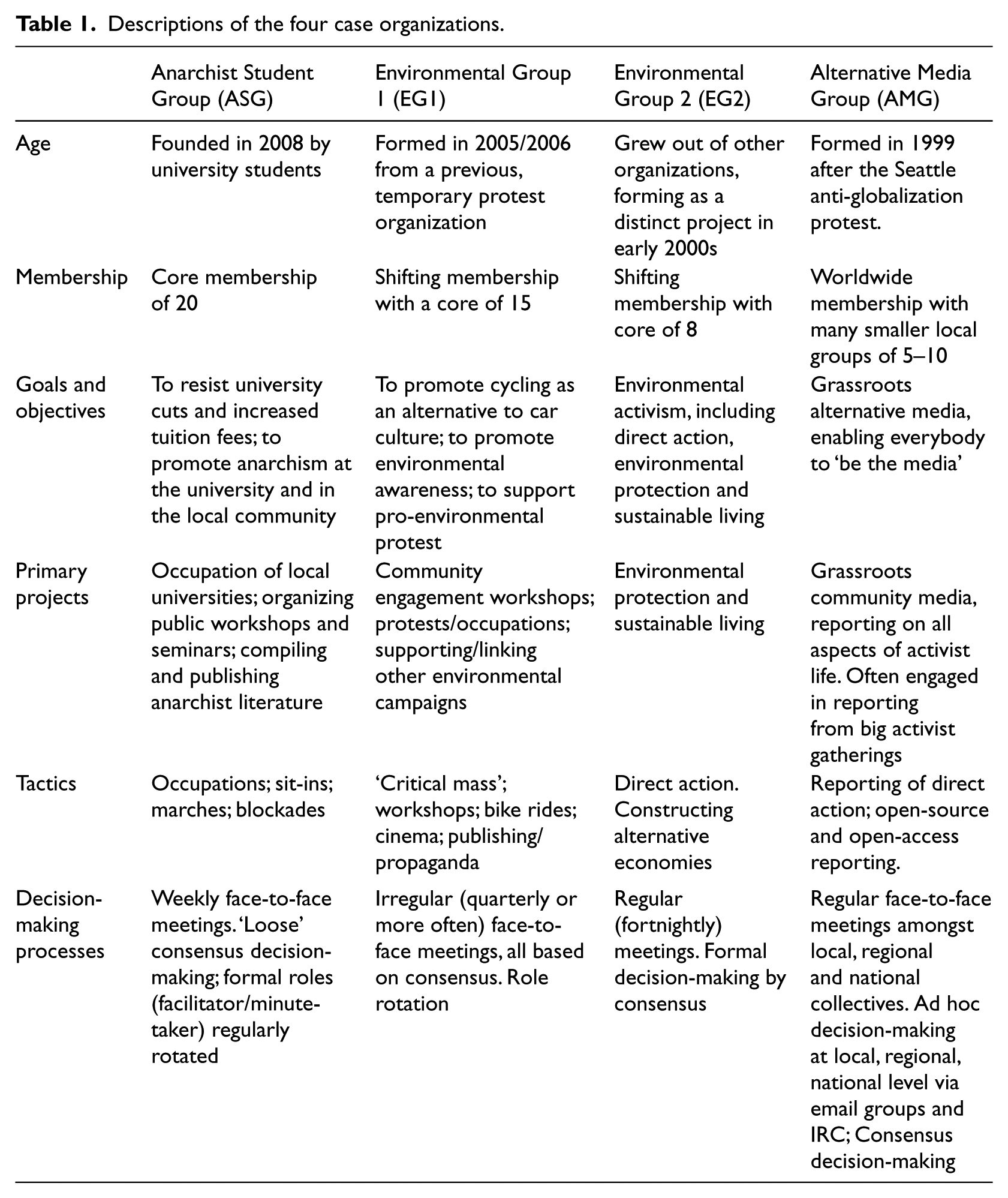
The research used a multiple-site case study methodology (Stake, 1995), combining data from four separate studies, undertaken between 2002–2009. Although leadership was the primary focus of only one study, it emerged as a key theme in the observations and interviews conducted in each case, so the datasets were re-examined to provide answers to the research questions. The similarities between the organizations ensured that they were directly comparable and could effectively constitute a multiple-site case study (see Table 1 for details of the case organizations). All were broadly anarchistic in their political orientation, and all combined forms of protest and/or direct action with a prefigurative politics whereby ‘the modes of organisation and tactics undertaken […] accurately reflect the future society being sought by the group’ (Gordon, 2005: 62). Although each organization had a different focus for their political activities, all were identified with anti-hierarchical, anti-authority organizational structures and radically democratic and participative decision-making practices. When directly asked about organizational structure, participants commonly spoke about the importance of collectivity, cooperation and anti-authoritarianism. These were seen as essential if the organizations were to present a viable alternative to the hegemonic forms of organization based in bureaucracy and a masculine concern for efficiency, impersonality, profitability and competition (Buechler, 1995; Ferguson, 1984; Marshall, 1984).
Descriptions of the four case organizations.
Methodologically, all four studies used a combination of interviews and participant observation (Schwartzman, 1993; Waddington, 2004; Ybema et al., 2009). This approach was informed by an ethnographic perspective where the primary concern was to gain an emic understanding of organizational processes. Across the studies, 31 semi-structured interviews were conducted, lasting between 1–2 hours. Here, instead of forming a structured, standardized interview, flexible ‘interview guides’ were utilized. This was crucial for the formation of this article, as the topic of leadership only emerged during the interview process in three of the cases. Data were also collected from periods of participant observation (at meetings, demonstrations and events), which allowed us to observe what people did in ‘real life’ contexts, not just what they say they do (Humphreys, 1970; Li, 2008). For understanding the production of leadership in action, this was particularly important as it enabled observation of leadership practices and processes, even when the emic understanding of leadership was broadly in line with the mainstream emphasis on individuals in hierarchical positions. Working with this conception, the organizations all denied the existence of leaders, raising the question of whether there was still anything that functioned as, or like, leadership. Investigating this required direct, participant observation and could not be derived from interviews alone due to the strong equation of leadership with leaders within the emic discourses of organization.
Because the studies were conducted separately, the first stage of coding and interpretation was done on an individual basis, followed by a series of face-to-face meetings where we collectively validated examples. Individually, we re-read and reviewed our own datasets (including field-notes, diaries and interview transcripts), and developed codes related to leadership, democracy and participation. Articulations of ‘leadership’ were coded and analysed in line with the primary functions of leadership discussed in the CLS literature. We therefore began by identifying where leadership was explicitly mentioned, as well as the ‘moments’—discussions, comments, emails, negotiations—that were to crucial to meaning-making. This enabled us to move beyond an analysis of how leadership was understood in the case organizations, to explore how leadership was performed in the absence of leaders. To appreciate the tensions around ‘leadership’ as a contested practice, we extended our analysis to include a range of associated concepts related to hierarchy or referencing actions that were understood as disempowering, as these were the primary emic critiques of leadership. As well as practical domination, for example in decision-making episodes, this form of leadership was also articulated in a broader sense and concerned with the definition of organizational reality.
After re-reading and reviewing individual datasets, we met to collectively compare and validate our interpretations. The findings across all four case organizations were similar, and pointed toward a series of themes and discussion points. First, in a majority of cases where ‘leadership’ was explicitly mentioned, it was framed as destructive and unnecessary, and as something that should be rejected. Understanding this situated our overall discussion, as the commitment to leaderlessness influenced day-to-day practices employed by each organization— put in place to combat the emergence of individual leaders. This was our second overarching theme.
The final two themes concentrated on the performance of leadership. Given that our operational definition highlights the importance of ‘moments’ where meanings are made and realities defined, it was crucial to identify some of these moments in practice. In fact, although individual leaders were not present, there was still evidence of leadership happening, as a shifting pool of ‘leadership actors’ temporarily came forward to construct meanings that were valued by the rest of the organization. However, this was not always successful, and the final theme was concerned with these difficulties, highlighting that even with a commitment to anti-leader(ship), democracy and participation, in some cases leadership did stabilize within certain individuals or groups. In what follows, we will address each of these themes in turn.
Discussion of the cases
Anti-leadership: anti-leaders(hip)?
Within each case organization, participants explicitly rejected the idea that leadership should be permanently stabilized in particular individuals. For example, an Alternative Media Group (AMG) activist noted: I hate when somebody thinks that his ideas or interpretations are more important than all we are collectively doing. … That approach, which is always based on a strong individual […] is mad; you always have the position of war between that vision and the relation between the other people. … There should not be one particular person that leads.
During interviews, participants often drew on past experiences to illustrate their disdain for individual leaders, and the need for an alternative. Predominantly, these experiences can be aligned with the mainstream leadership approach, where individuals became leaders due to their charisma and/or cultural capital, such as skills, expertise or knowledge. Although scholars have often portrayed this form of leadership in a positive way for its effect on organizational strategy, commitment and motivation (Bass, 1985; Burns, 1985; Smelser, 1962), influence (Wilson, 1973), resource mobilization (McCarthy and Zald, 1973, 1977) and opportunity creation (Goldstone, 2001), participants were sceptical of its implications. For example, one Anarchist Student Group (ASG) member discussed his experiences in a previous group where a reliance on certain individuals became problematic. He remembered a demonstration for which a more outspoken and experienced member had taken on the main planning duties. This included logistical tasks like organizing phone-trees and food, as well as direct action tactics and routing. In short, ‘he definitely became the leader … he knew what he was doing but he’d done it before … We would have helped but … I felt a bit out of depth’. Although other members had previously expressed their desire to protest peacefully, on the day they were pressured into taking a more confrontational stance. Congruent with Yukl’s (1989) ‘dark side of charisma’, in retrospect he felt that members were coerced into acting in ways they would not normally, as they ‘couldn’t say no’ to the charismatic leader: I was made to feel as though if I didn’t do this, that I’d be letting everybody down, that I’d be letting the cause down … He knew better than us and had been around a lot longer … it can be hard to argue with that.
Furthermore, he noted that when individuals are ‘promoted’ (informally or formally) to the status of leader, it creates asymmetrical relationships. This point was regularly reiterated in interviews across all case organizations, and discussed in participant observation settings, with the common view being that when one person takes control, others are expected to be passive – unable to challenge the leaders’ views. In one case, before a meeting began, ASG members were informally discussing this point, with a new member stating: At other places I’m the quiet one at the back listening to the experienced folk planning. I’m the one that does the grunt work … but I never got to choose what it was … I get told what to do and crack on. It’s exhausting and … It’s not anarchist.
Interviewees thus adopted an ‘anti-leadership’ (or ‘anti-leaders(hip)’) stance. Generally, the issues raised here do not seem vastly different from some of the criticisms levelled at mainstream leadership theories outlined earlier, suggesting that a reliance on individual leaders can lead to domination, conformity and over-dependence (Calás and Smircich, 1991; Conger, 1990; Gemmil and Oakley, 1992; Khoo and Burch, 2008; Marcuse, 2008). However, this rejection has a more ideological basis, as it is fundamentally against democratic-participative principles. The concept of an individual leader is therefore redundant, as it makes for an undemocratic and non-participative environment, where only a select few represent the organization, and all others are reduced to the role of passive followers. For groups organizing around prefigurative politics, this is particularly significant, as an AMG member highlighted during a meeting: ‘We’re trying to create a world that is free from authoritarianism. So … it doesn’t make sense to organize in any other way’, she continued, ‘If we can’t do it, and show the world how it can be done … who will?’
‘Getting everybody on board’: the importance of democracy and participation
To combat the emergence of leaders, each organization made efforts to construct a participative democratic environment. Generally, democracy and participation were the key principles underpinning these organizations, and representative democracy was rejected in favour of a more radical/direct approach. This was something that the organizations strove towards in their blueprints for social change, and sought to realize in their here-and-now organizational practices. Constructing a less hierarchical conceptualization of leadership was therefore seen to be important in itself as it ‘accurately reflected the future society […] sought by the group’ (Gordon, 2005: 62)
In each organization, decision-making was the main activity in which participative democracy was sought. To facilitate decision-making, face-to-face meetings were held, where members debated discussed their activities. Decisions were made by consensus—a process used to ensure that solutions are supported and generally agreed upon by all organizational members, rather than by majority rule. This was overseen by a facilitator who ‘focussed discussions, ensured that voices were heard and kept meetings moving’ (AMG activist), and through the use of ‘go-rounds’ in which members were given the opportunity to voice their opinions, or through the use of hand gestures, where ‘waving hands’ signal agreement, or a fist indicated a ‘block’, all participants were able to contribute.
On occasion, issues would spill over beyond a single meeting, so led to on-going debate at multiple meetings until a compromise was met. One example of this was seen in Environmental Group 1 (EG1) and related to the politics of food production and consumption. Primarily, EG1 focussed its attention on the positive aspects of cycling as a way to make a difference to people’s daily lives. They organized events with pedal-powered cinemas and repair workshops and produced a small booklet—The Guide—which outlined critiques of car-culture, and advice on how to cycle with a family or do bike repairs.
It was common for members to take a lead on organizing events in their home-town as they usually had more contacts and would be able to coordinate with other groups to co-produce the event. In one case a member had asked a local ice-cream maker and sausage producer to attend, who both used pedal-powered tricycles to sell their wares. The problem arose at a meeting when several vegan members of EG1 objected to animal products being sold. After an extensive debate, stretching over two meetings, the decision was made not to involve those trading in animal products. On the basis of this, one member agreed to write a section for The Guide on the environmental impacts of animal farming, which was challenged as not being radical enough. Others objected that it implied that veganism was impractical, and wanted a more strongly worded position. As one email put it: All we agreed was that we would not have any organisation that traded in animal products officially linked to us—effectively blocking the infamous sausage bike :-) I was happy to agree to that out of respect for all our vegan members … Promoting veganism is great but I would veto any wording of [The Guide] which out and out accuses non-vegans of immorality. All we need to do is make people aware of the issues and help them understand the environmental impact of *all* their activities (from buying an iPod to driving a car to eating a Big Mac) so they can make informed lifestyle changes that benefit the planet. And of course show them how great bikes are!!!!
In this email we can see the process of consensus decision-making in action. The concept of the ‘block’ is raised twice. First to recognize that the pro-vegan members had already blocked the decision to involve animal products and that this had been agreed upon. Second, to raise the possibility of a further block if the position was augmented to include an absolute moral position on veganism. Here, the process of consensus decision-making enabled all members, even those who had no issue with veganism, to have a say. The protracted spaces of dialogue opened up by the consensus process enabled all voices to be heard and allowed members to consider their responses and positions through debate, before a final decision was reached.
Whilst it may seem an obscure example, the case of ‘the vegans versus the sausage bike’ went to the heart of what the group stood for. This was not only a matter of collective identity, but also of how they were perceived externally and the efficacy of their campaigning. In both of these external and internal facing aspects of the group’s identity work, this account of the consensus process shows how leaders(hip) and domination was contested and how meaning was managed through negotiation. The process prevented domination by any individuals or groups, and ensured that all viewpoints were taken into consideration.
Consensus decision-making played a similar role in each case organization. The process encouraged participation and direct democracy, and gave every member the opportunity to engage in meaning-making. The emphasis on democracy and participation also prevented any individual from taking a permanent leading role, as active decisions were the product of collective deliberation. Illustrating this, at the end of a lengthy ASG meeting about an upcoming direct action workshop, the facilitator noted: I think it’s gone really well today. It feels like everyone was properly … engaged. We’re moving forward, but in a direction I hadn’t thought of before. We’ve all sorted these ideas out, and actually, there isn’t one person who’s had more of a say. We’ve made the decisions … together.
In summary, a radical form of democracy and participation was fundamental to each case organization. They were built around, and underpinned by, these values, which influenced members ideologically and on a practical level. In fact, the two cannot be separated. Understood in terms of prefigurative politics, the goal of these practices was to bring the means of day-to-day organizing into line with the groups’ underlying ideological commitments: to organize in a way that they are enacting the kind of social relations they wish to see in wider society. As Maeckelbergh notes, these means ‘are not just procedures, but they are the building block of an alternative form of governance in the making’ (2011: 17). For our case organizations, democratic and participative practices provided an instrumental means of decision-making, but also contributed to the construction of a more collective form of leadership. In the following section we will highlight how these leaders(hip) alternatives were constituted.
‘Keeping ourselves in check’: constituting alternatives to leaders(hip)
In the previous sections we demonstrated how leaders(hip) was rejected and how democratic and participative practices were established to prevent ‘leaders’ emerging. This absence of leaders does not, however, mean that there was no leadership. If we identify leadership as taking place ‘in moments when ideas expressed in talk or action are recognised by others as capable of progressing tasks or problems which are important to them’ (Robinson, 2001: 93), then there was no shortage of participants (or ‘leadership actors’) who temporarily performed leadership in specific moments, sometimes subtle and fleeting and sometimes overt and lengthy.
This is well illustrated by an example from Environmental Group 1 (EG1), revolving around the music being played on the sound-system during a bicycle tour. After one day in which loud rap music had been played at an open-air event, some members raised their concerns about the songs’ content. A long discussion ensued, including the gender politics of misogynistic lyrics; the impression that the music made on local families attending the events and the politics of censorship. Whilst a small example, if we accept that the primary function of leadership is meaning-management and the articulation of collective identity, then such episodes can be seen as points where identity is performed. Eventually, a resolution was agreed, with two playlists being created, one for ‘family and friends’, and an uncensored list for rural roads. Compromise was made to reach a collectively acceptable consensus around the groups’ identity and politics, with no one personality determining a fixed culture. Indeed, each organization stressed the importance of inclusivity and participation and the need to work collaboratively to build a shared vision which was inclusive of diversity and difference (see also Brower et al., 2000; Pickard, 2006). One significant aspect was the idea that, although leadership actors may come to the forefront in certain situations, the focus was on ensuring that all were able to contribute to the leadership of the organization by building collective power through the distribution of skills, knowledge and expertise. Experienced individuals were therefore allowed, and often encouraged, to offer their thoughts on certain situations, but efforts were made to ensure that they did not become permanent ‘leaders’. Rather, it was preferred for the leadership of the group to develop organically due to shared expertise and skills instead of being determined by individuals’ cultural capital or styles and behaviours.
An example of this occurred in the early days of ASG, when few members had experience of direct action or active decision-making. Prior to a demonstration, more experienced members were invited to give a series of talks to disseminate their knowledge: They weren’t there to say ‘this is what we’re going to do’ … they were there to inform everybody of what they experienced before … what worked, what didn’t … and what they thought might be appropriate.
After everyone felt they had the relevant information, an open discussion was held, where no members were considered to be more or less knowledgeable, and meaning-making became something that the group collectively engaged in. Instead of allowing more experienced members to become leaders and take on responsibilities individually, efforts were made to ensure that knowledge and skills were distributed amongst a variety of leadership actors. After the completion of the workshops, another ASG member noted: If one person can help in a situation, and has something insightful to offer … then it’s worth listening to them. But they need to distribute their knowledge, because then the next time around you’ve all got it … and you can make the informed decision together.
In addition to distributing tacit knowledge, each organization also rotated formal roles, with every member being expected to take these jobs on at some point. Rotation happened primarily in meetings, specifically with minute-taking and facilitating roles, and served a number of purposes. First, it ensured that no member saw a role as their ‘property’, where only they knew how to perform tasks. This was a significant factor for preventing temporary leadership actors becoming permanent leaders, because if role-specific skills were monopolized, it could lead to an unequal power balance. While Collinson (2005, 2011) suggests that power asymmetries are treated as unproblematic within mainstream leadership literature, our participants were more critical, noting that if left unchecked, these imbalances are ‘only likely to get worse and more obvious’ (ASG activist). Rotation therefore ensured that role-specific skills were shared equally amongst organizational members, rather than being ‘aggregated in the hands of a few’ (Fulop and Linstead, 2004: 87). This challenges conclusions drawn in previous work on social movement leadership, suggesting that organizational successes come from leaders’ monopolization of skills, and their capability to take full control of decision-making processes (Bate, 2004; McCarthy and Zald, 1973; Zald and Ash, 1966).
Role rotation also ensured equality of participation as all members were expected to become temporary leadership actors at some point, rather than assuming that it took special skills or a particular type of person. This has the potential to reduce the passivity of followers highlighted by CLS theorists (Barker, 1997, 2001; Collinson, 2005, 2006), as members do not come to look to particular individuals for direction, so are more inclined to engage in meaning-making themselves: It’s great when you realise that you can do it yourself and work together instead of putting your hope into one person … I used to be worried about speaking up or taking on roles, but now I don’t even think about it. (AMG activist)
Again, this challenges mainstream assumptions. Instead of viewing relationships as inherently dominant/submissive, leadership shifts amongst multiple leadership actors. If everybody has the potential to engage in meaning-making (and thus, leadership), people may be relieved of their ‘anxieties and fears’ of working together to define a collective reality, instead of being driven by those anxieties to devolve this capacity to define reality to a leader (Gemmill and Oakley, 1992).
Finally, role rotation encouraged accountability through increasingly symmetrical power relations. The implication here is that organizational actions should be accountable to the ‘greater organization’, and by extension, any leadership actor is also accountable, and directly recallable by the group. Members were therefore encouraged to speak out if they felt as though a leadership actor was not acting in the organizations best interests. During an ASG meeting, this issue came up when a new member asked about the consensus process. A regular attendee replied: We always make sure that everybody knows they can challenge … constructively … what anybody else says if they don’t like it. Even if ninety-nine percent of the group agree, we fully support the one percent.
This means that leadership actors can’t automatically assume total control, and further supports the construction of a democratic form of leadership. Although this has been discussed in the CLS literature, which highlights the need to analyse leadership power relations between organizational actors (Alvesson and Spicer, 2012; Collinson, 2005, 2011; Knights and Willmott, 2011), few have studied it empirically. In fact, when power is addressed, it is often conceptualized as ‘power-over’ (Starhawk, 1987: 9–10), identified as the imposition of one will over another, through force, coercion, manipulation and/or authority (Conger, 1990; Khoo and Burch, 2007; Marcuse, 2008). From this perspective, power is exercised by leaders, over followers. However, without leaders who consciously compel others to act (Hardy, 1996), it may be fruitful to draw on Starhawk’s term, ‘power-with’. This is defined as ‘the kind of power that occurs in a group of equals’; that is, ‘the power not to command, but to suggest and to be listened to, to begin something and see it happen’ (Starhawk, 1987: 10). This replaces the notion that power is exercised as a commodity in an exclusively ‘top-down’ manner, and instead views it as a more subtle and dynamic quality embedded in social interactions, discourse and meaning-making processes (Jackson and Carter, 2007).
Tensions: leaders(hip) emerging and stabilizing
Whilst the discussion thus far has been concerned with how leadership was collectively performed within the case organizations, alongside this was an on-going struggle against leadership stabilizing in individuals. To address this we present three examples: two in which individuals came to take on leadership roles, and one where a gendered division of labour emerged to reproduce leadership power relations.
A number of researchers have suggested that even in ‘democratic’ organizations, more outspoken members can take over and eclipse others (Graeber, 2009; Juris, 2008; Maeckelbergh, 2009). In EG2 it was apparent that some members, especially the highly educated, were more ‘competent’ than others, and their cultural capital could create inequalities that disempowered other members. For example, one member had influence over the group because he took the lead on writing funding proposals. Educated to post-graduate level and with grant writing experience, this member was able to articulate the group’s concerns in a framework that was compatible with the interests of funding bodies. During the process, EG2’s concerns were subtlety altered to frame them in terms that the funding bodies would recognize. For some members, this steered the projects in directions that they were not comfortable with, even leading some members to leave, feeling that the focus and concerns of the group had drifted too far. In liaising on details with outside bodies some members of the organization unintentionally leveraged their cultural capital in order to advance projects, effectively occupying a position of leadership. This created difficulties for total participatory equality, as there was a danger that the most competent would determine what the organization did and how it did it, thereby marginalizing the less competent. In light of the prefigurative politics discussed earlier, the congruity of means and ends was essential for these organizations, so this kind of inequality was more than a minor detail. It was understood as symptomatic of an emergent inequality and hierarchical form of leadership.
Elsewhere, the informality of inter-personal relationships in ASG led to the formation of cliques of the most enthusiastic members, who also shared accommodation. These groups wielded considerable meaning-making power and instead of every member being invited to participate and having the potential to become a leadership actor, only a select few were in the ‘in-crowd’ who held exclusive discussions. These people had greater decision-making weight and gradually came to assume more permanent leadership positions: It got to the stage where whatever they said … was what we did. They’d already chatted about most of the agenda points, so just reiterated that without giving anybody else time or space to air their thoughts. It wasn’t aggressive, and most of us didn’t realise it for ages … but they became so powerful.
Various theorists have written about the issues associated with cliques and the impact it has on democratic organizing (Ansell, 2003; Haug, 2013; Petit, 2004), from stifling the potential for participation, to prompting the disbanding of groups due to irreconcilable power imbalances. While Michels concluded that ‘a democratic ideal is impossible’ (1969: 70), Freeman (1970) holds a more positive view, suggesting that if organizations have certain processes in place, and that members are able to recognize problems, it is possible to reduce these issues. Indeed, in this case, a ‘crisis’ meeting was held, where: We got everyone together, and let everybody voice their concerns. We found that the people involved weren’t even aware that they’d taken the power away from the group […]. We reflected on this … and made sure that we all knew what went wrong.
Another tension related to the gendered division of labour within EG1. During data collection, interviews were conducted with pairs of participants (one male, one female) and thus became a three-way conversation. In an early interview, one respondent mentioned the gendered division of labour during workshops comprised of bike repairs, maintenance lessons and bike art classes. The latter were aimed at children and led by female members of the organization, while the bike maintenance sessions were run by predominantly male members. Although there were knowledge sharing sessions to train less skilled men and women in maintenance and repair skills, there had not been a parallel process to get the men involved in the arts/education side. After this arose during interviews, the issue was discussed in the next meeting and a process put in place where the ‘feminine’ skills of art and education were shared in the same way as the more ‘masculine’ skills of maintenance and repairs. Although this may not appear to be directly related to leadership, the underlying issue was about the organization’s identity and core activity. As systems had been designed to involve all members in maintenance work, this was framed as a core activity and central to ‘what we do’. The arts/education side, on the other hand, was marginalized, and seen as less valuable. This gender inequality was also visible in a local alternative media group (AMG) operating in Serbia, which is a country known for its relatively paternalistic political culture (Cabada, 2009). Although, gender inequalities were explicit parts of the politics of that AMG group (e.g. supporting gay and lesbian rights), the majority of activists involved in the group were white males and little attempt was made to rectify this situation.
In these examples we can see how the activist groups we studied unreflexively reproduced gender norms that permeated wider society. For example, the norm that privileges technical forms of competence that are culturally coded as masculine, and marginalized childcare and education as peripheral or even unskilled, was reproduced throughout the case organizations. Although not the product of, or even embodied in, an individual leader, this was nevertheless an emergent leadership function that defined the groups’ reality and constituted hierarchically divided value practices.
Although we have offered examples of difficulties faced whilst attempting to construct a collective form of leadership, it is important not to fall back on the argument that leadership will inevitably formalise and stabilise within individual over time. These examples demonstrate that if certain ‘checks and balances’ are not in place, or if organizational members are not critically reflexive (Steyaert and Van Looy, 2010), then informal hierarchies may emerge, reproducing broader social and cultural inequalities. This mirrors conclusions drawn by Freeman, highlighting the importance of learning from organizational histories to engage in ‘trial and error processes’ (1970: 4) that can help prevent problems in the future. In fact, this takes somewhat of a circuitous route. If there is an issue relating to how leadership is done then this is discursively fed back into the concrete organizational processes put in place to attempt to resist such issues recurring. As one AMG member put it: You can’t just write down a list of rules on a piece of paper and expect them to work straight away. I don’t think there are ANY rules that will work in every situation, all the time. So it’s okay to get things wrong. It just means we’ve got one less thing to get wrong next time.
Conclusion
In this article we have explored how radical, participative-democratic SMOs deal with questions of leadership. Whilst CLS scholars have pointed to the problematic aspects of leadership (Collinson, 2011), they have focused their empirical attention on hierarchically structured organizations. By undertaking studies of leadership in non-hierarchical organizations, CLS has the opportunity to analyse leadership in a context where the conventional power relationships between leaders as power holders, and followers as powerless, do not obtain. Not only does this enable an appreciation of the diversity of different ways in which leadership is performed by a range of leadership actors, but also how organizational alternatives to mainstream understandings of leadership might be constituted. Studying SMOs provides an appropriate context for this kind of analysis that is sensitive to the nuanced plays of power and organization that constitute leadership as a function and effect.
Across the four case organizations, we found that, although individual leaders were not present, there was still evidence of leadership occurring. This unsettles previous assumptions, which have suggested that individual leaders are essential for the formation, growth and successes of SMOs. Our empirical material demonstrates that leadership actors did not assume any kind of permanent position within the organizational hierarchy, and efforts were made to ensure that: (a) the opportunity for leadership and meaning-making was distributed in order to give others the opportunity to take on leading roles in the future and (b) leadership actors did not assume that role permanently, thereby becoming leaders, through concrete practices such as role rotation. Consequently, although individuals may take on more of an active leadership role in certain situations, elsewhere, they would step back as others would take the lead.
By taking on-board these lessons—on the social construction of leadership, the importance of collective meaning-making and critiques of mainstream perspectives—future studies could develop a much more nuanced analysis of the realities of leadership in SMOs. Where engaged research into social movements, for example activist ethnography (Sutherland, forthcoming), is concerned, an ethnographic approach that seeks to both understand the contested leadership dynamics at work in organizations, and to bring them to light for members of the organization, is invaluable. As one of our examples demonstrated, feedback from the researcher can facilitate critical reflexivity and support SMOs in their own understanding of leadership, power and domination in organizations, furthering their goal of prefigurative politics.
Throughout this article we have presented the four case organizations as relatively homogenous, in that they are ‘leaderless’ and have parallel anarchist ideologies; directly democratic structures and utilize the same consensus decision-making processes. As has been demonstrated, the way in which leadership was performed, and the practices put in place to stave off leaders(hip), were broadly similar. However, it is important to acknowledge that there may also be some diversity between the cases, and between SMOs more generally. Although it has been beyond the scope of this article to delve too far into these differences, there is clearly some space for expanding an analysis of how leadership is practiced across different organizations and contexts.
One example is the wider social, cultural and economic environment in which specific SMOs are based. In this article, three of our four case organizations (ASG, EG1, EG2) were based in England, while AMG encompassed several collectives, operating globally (in England, Serbia, Argentina and many other locations). Although this did not appear to affect the way in which leadership was enacted during this study, others have noted the importance of cultural differences. Frenzel et al. (2011), for example, draw out some of the key differences between SMOs in the ‘Global North’ and ‘Global South’, noting that Northern and Southern partners often differ in their organizational forms, identity and accountability. Where Northern groups are broadly oriented toward informal and horizontal modes of organizing, Southern groups draw on more formal and centralized forms. Therefore, whilst organizing around similar issues, the wider societal context may have some influence by the ways in which organizations are structured; how interpersonal relationships develop and the level of democracy and participation employed. Whilst this did not emerge as a salient issue in AMG, it may be fruitful to explore this further in the future, and to analyse, compare and contrast how leadership is performed and constructed across Northern and Southern contexts.
Another challenge, both for the theory of, and practice in, SMOs, is to do with scale. Again, AMG was an international organization, but this study only focussed on a select few collectives with relatively small memberships, similar to ASG, EG1 and EG2. However, as several commentators have recently suggested, when the concerns of SMOs are global, as is often the case with environmentalism, anti-capitalism or the alter-globalization movement, small scale, local initiatives are likely to be inadequate to presenting a serious challenge to the hierarchically organized and globally distributed institutions (Albo, 2007; Harvey, 2012; Sharzer, 2012). Although evidence from other studies suggest that anti-leaders(hip) practices, such as consensus decision-making, can be scaled up effectively (Maeckelbergh, 2009), whether they can function at all scales, and over large geographical distance, is still open to debate. Further research into the organization of these movements, adopting a CLS perspective on the relational, distributed and contested nature of leadership as an organizational process, would further such debates.
As horizontal forms of organization grow, and come to the fore of global politics in the form of uprisings like the Arab Spring or Occupy movement, an understanding of the construction and contestation of leadership that combines the insights of CLS and social movement studies will become increasingly relevant.
Footnotes
Acknowledgements
We gratefully acknowledge the support of a research grant for sections of this work, through the ESRC’s Non-Governmental Public Action (NGPA) Research Programme (RES-155-25-0029). The article has benefited from the insights of three anonymous reviewers. Any errors of interpretation remain our own.
Author biographies
