




Abstract
In response to the postmodern invasion of organization studies, some critics have issued increasingly loud cries that we should ‘get real’ about organizational discourse analysis. But what precisely do these proponents take to be the ‘real’? In this article we trace out some of the attempts of ‘getting real’, arguing that these approaches have some important limitations. We then explore the relevance of a post-foundational approach to discourse, which, we argue, have far reaching implications for the study of organizational discourse. We argue that such approach offers us a way of theoretically linking the ‘real’ with (1) the way discourses are structured around fundamental gaps, (2) how discourses are brought together through nodal points and (3) how discourses generate affective and emotional attachment. We then offer some suggestions of how these points can be used to study organizational processes. We conclude by reflecting on some of the limitations of this approach to studying discourse.
During the last decade there has been an increasing focus on the relation between discourse and organizations. It has been widely noted that the production, distribution and consumption of texts constitute a central aspect of organizational life. Many employees now spend large parts of their days performing all forms of discursive work—they talk in meetings, they write reports, they produce and deliver powerpoint slides and they spend countless hours writing and reading emails. To capture this significant rise of discursive work, some researchers have turned to organizational discourse analysis (Grant et al., 2004). One of the most central assumptions here is that organizations do not only engage with but are ultimately constituted by texts (Ashcraft et al., 2009). This view is reflected in a series of accounts claiming that ‘organizations exist only in so far as their members create them through discourse’ (Mumby and Clair, 1997: 181), ‘[o]rganization has no autonomous, stable or structural status outside the text that constitutes it’ (Westwood and Linstead, 2001: 4), and ‘language constructs organizational reality, rather than simply reflects it’ (Hardy et al., 2005: 60).
Recently, these accounts have become the object of mounting suspicion. For instance, Reed (2005) has argued that we need to complement discursive explanations with accounts of the structural dimension of organizations; Fleetwood (2005) maintains that there are aspects of reality that cannot be captured through constructivist accounts of discourse; and Alvesson and Kärreman (2011) have criticized some versions of discourse theory for endowing texts with muscular and almost magical qualities. Different as they are, these accounts point towards a common struggle to ‘get real’ (Reed, 2004) about organizational discourse. In this article, we argue that current attempts to ‘get real’ fall significantly short of a sufficient account of the relationship between discourse and the ‘real’. We will make a case that a post-foundational approach, which we primarily connect with the work of Slavoj Žižek and Ernesto Laclau, offers a compelling account of the role of the ‘real’ in organizational discourse analysis (for similar examples see Contu et al., 2010; Driver, 2009a; Jones and Spicer, 2005).
From a post-foundational perspective, the Real is an element that cannot be integrated into the fabric of discourse. This conception is borrowed from psychoanalysis and suggests that the Real is the element of a discourse which ‘is impossible to imagine, impossible to integrate […] and impossible to attain in any way’, and therefore ‘essentially traumatic’ (Evans, 1996: 163). In making this notion meaningful for social analysis, post-foundational theorists have stressed two important dimensions of the Real, which is related to (1) an empty form and (2) affective force. By claiming that the Real has an empty form, we mean that a discourse can never be grounded on a fixed and stable foundation. Crucially, this is not to suggest that discourse has no foundation at all, as some constructivist accounts would argue, but that a discourse can never find a final ground. As described by Oliver Marchart: ‘The ontological weakening of ground does not lead to the assumption of the total absence of all grounds, but rather to the assumption of the impossibility of a final ground’ (2007:2). In this sense, the ‘Real’ is that which ‘resists symbolization absolutely’ (Lacan, 1991: 66). It is a gap, or lack, which prevents the discourse from closure and from becoming identical with itself (Marchart, 2007). This means that the ‘Real’, rather than signifying a higher objectivity beyond or outside discourse, points to the limit of any absolute grounding of discourse. Another way of putting this would be to say that a discourse is contingent all the way down (Glynos and Howarth, 2007). This is a well-rehearsed theme in organizational discourse theory (e.g. Chia, 2000; Mumby, 2011: 1156). But what a post-foundational approach adds to this claim is a serious examination of how the Real operates in the development, sustenance and contestation of discourse. The second aspect of the Real is that it has an affective force. By this we seek to point out the intense emotional reactions and attachments that are prompted by discourses. Rather than socially constructing a meaning around an object, the Real creates an emotional tenor and provokes strong affects. Indeed, the affective dimension of discourse has been largely ignored in organization studies. We argue that a closer consideration of how affect is related to discourse is crucial for explaining passionate attachments to groups, causes, identities and organizations.
By teasing out this version of the ‘Real’ we can address the ontological dimension of a discourse while avoiding both the constructivist assumptions which underpin contemporary discourse analysis as well as assumptions about an objective reality independently existing beyond or outside discourse which underpin realist approaches. In addition, a post-foundational approach addresses the affective side of discourses, which offer a complementary insight into how discourses are used.
Organizational discourse analysis
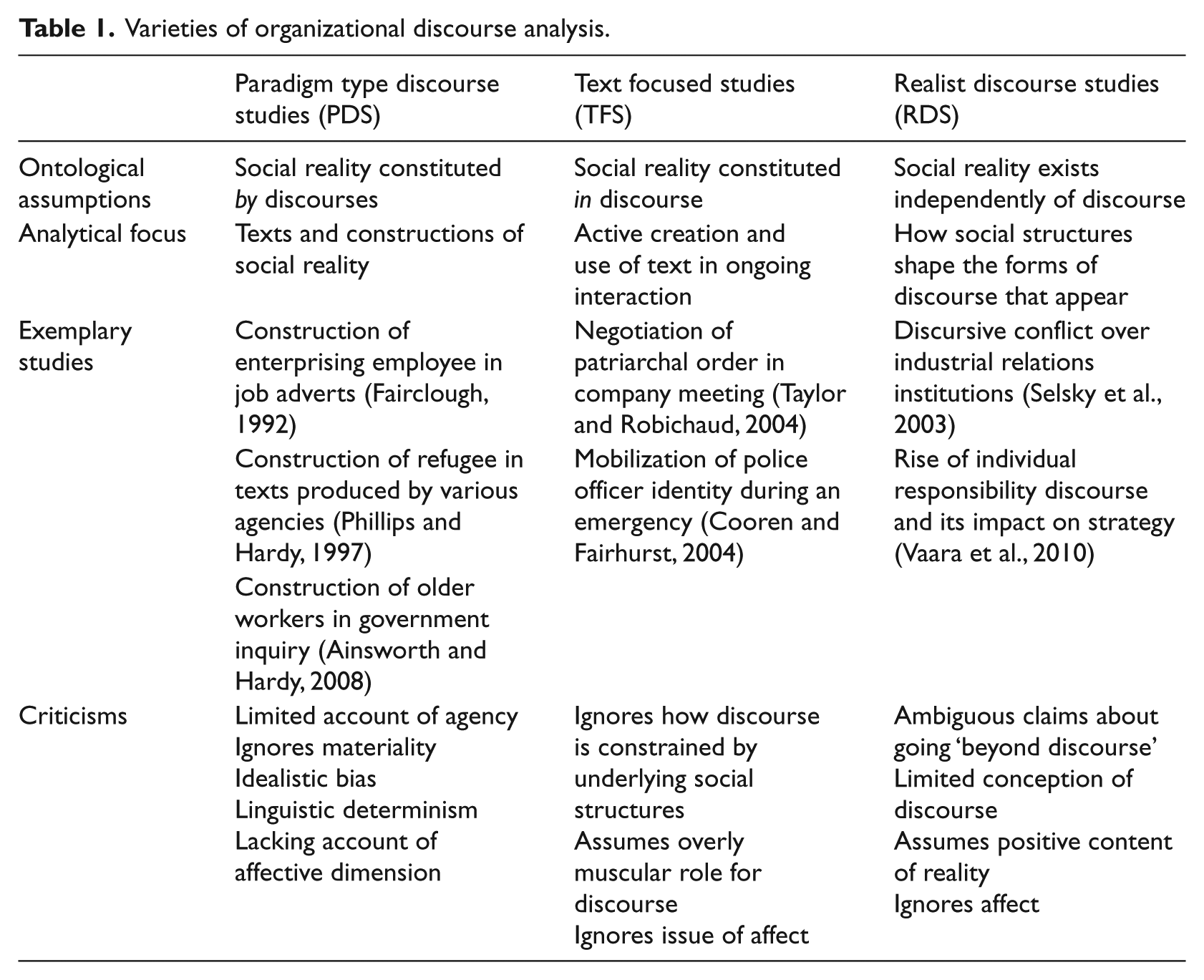
Discourses in organizations have been defined as the ‘structured collection of texts embodied in the practices of talking and writing (as well as a wide variety of visual representations and cultural artefacts) that bring organizationally related objects into being as these texts are produced, disseminated and consumed’ (Grant et al., 2004: 3). Moreover, the field of organizational discourse analysis entails ‘the systematic study of texts—including their production, dissemination, and consumption—in order to explore the relationship between discourse and social reality’ (Phillips et al., 2004: 636). Indeed, the area of organizational discourses is broad and heterogeneous. It ‘represent[s] a constellation of perspectives united by the view that language does not mirror reality, but constitutes it’ (Fairhurst, 2009: 1608). Some of the perspectives that have been incorporated into organization discourse analysis include semiology (e.g. Fiol, 1989), tropological studies (e.g. Manning, 1979), deconstruction (e.g. Killduff, 1993), Foucauldian studies (e.g. Knights and Macabe, 1998) and critical discourse analysis (e.g. Hardy and Philips, 1998). This broad range of approaches has been used to investigate a dizzying array of phenomena including globalization (Spicer and Fleming, 2007), organizational logics (Spicer and Sewell, 2010), mergers and acquisitions (Vaara et al., 2003), strategy (Vaara et al., 2010), change (Thomas et al., 2011), governance (Hartz and Steger, 2010), environmental management (Prasad and Elmes, 2005), institutions (Philips et al., 2004), human resource management (Harley and Hardy, 2004), time (Kuhn, 2006), technologies (Spicer, 2005), participation (Musson and Duberly, 2007) and industrial relations (Selsky et al., 2003). While there are a number of ways to carve up this increasingly diverse field (see Alvesson and Kärreman, 2000; Ashcraft et al., 2009; Grant et al., 2004; Putnam and Fairhurst, 2001), we follow Alvesson and Kärreman’s (2011) recent distinction between paradigm-type discourse studies (PDS) which examine the constructive effects of broader socio-cultural discourses, and text focused studies (TFS) which examine the micro-agential mobilization of discourses and production of texts. To this we add a third emergent approach that we call realist discourse studies (RDS), which examine the role of discourse in the context of extra-discursive elements. In addition to considering the distinct nature of each of these approaches, we seek to address some of the shortcomings inherent in their respective conception of the real (see Table 1).
Varieties of organizational discourse analysis.
Paradigm-type discourse studies
Perhaps the most extensive body of organizational discourse analysis fall within what Alvesson and Kärreman (2011) call ‘Paradigm type discourse studies’ (PDS). These studies typically focus on the constructive effects of large-scale discourses (what they have previously called ‘Mega-discourses’). They subscribe to the ontological assumption that ‘social objects and phenomena such as “the organization” … do not have a straightforward and unproblematic existence independent of our discursively-shaped understandings’ (Chia, 2000: 513). Through this assumption they seek to examine how a discourse (or discourses) constructs organizational reality in distinct ways (Oswick et al., 2002; Hardy, 2004). To this end, researchers have typically focused on the nature of texts in organizations and how these construct different kinds of social realities. Here, text is defined broadly as ‘the linguistic/semiotic elements of social events, analytically isolable parts of the social process’ (Fairclough, 2005: 916). More specifically, texts can be ‘discursive units’ and ‘may take a variety of forms including written texts, spoken words, pictures, symbols, artifacts and so forth’ (Phillips and Hardy, 2002: 4). This approach assumes that our conception of reality is primarily constructed through text, and that close examinations of these texts may yield important insights into how this reality is constructed. In a classic study of the constructive effects of discourse, Fairclough (1992) examined how the discourse of enterprise was propagated in the university sector through features of job advertising texts. Building on this, Phillips and Hardy (1997) examined how the identity of the refugee was constructed through a range of different texts produced by a number of agencies, such as the government and various non-governmental organizations. Each of these agencies advanced their own particular constructions of the refugee, resulting in a series of conflicting constructs, including genuine or economic, helpless and dependent or autonomous and politically active. More recently, Ainsworth and Hardy (2008) have explored how older workers were constructed during an Australian government inquiry. They found that the older worker was often constructed through discourses of commodification, marketing, consumption and risk—which rendered the older person as an unattractive product and a risky project for potential funders. While each of these studies differs clearly in their analytical focus, they all share the common ontological conviction that texts have the capacity to socially construct reality in a fairly strong way (whether this reality was the nature of the university, the identity of refugees or the assumed capacity of older people for engaging in entrepreneurial ventures).
Despite a clearly elaborated theoretical base and an impressive body of empirical studies, PDS have been the target of mounting criticism. First, some have pointed out that strong constructivist assumptions limit the account of agency, making it ‘hard to get a sense of how active agential selves “make a difference” through “playing” with discursive practices’ (Newton, 1998: 425–426). This would mean that PDS, by reducing agency to an effect of discourse, do not go very far to explaining how discourses are actively used (see also Fournier and Grey, 2000; Gabriel, 1999; Newton, 1999). It should be noted that PDS have made some attempts to address the issue of agency, although these attempts have been limited to studying how actors mobilize texts and how some discourses are resisted (Hardy, 2004). They often avoid looking at the micro-details involved in the ongoing mobilization of discourse (Iedema, 2007). The second point of critique is that PDS have focused on the role of linguistic dynamics on the expense of more material aspects of organizations (Ashcraft et al., 2009). This means that the organization is seen as caught up in an endless conversation, and that, as a result, little attention has been put on the role of objects, such as technologies (Engeström, 1999). Third, critics see PDS as too idealistic (Reed, 2000, 2004, 2005). This idealistic bias makes ‘it difficult, if not impossible, to deal with institutionalized stabilities and continuities in power relations because it cannot get at the higher levels of social organization in which micro-level processes and practices are embedded’ (Reed, 2000: 526–527). Those working in the PDS tradition have attempted to address this critique by looking at the material features of texts such as the permanence or reach of different texts (Hardy, 2004), or providing protocols for examining context as part of discourse analysis (Leitch and Palmer, 2010). However, very few accounts in the PDS tradition consider the link between discourses and other social elements (Alvesson and Kärreman, 2011). Fourth, critics claim that PDS approaches have become trapped in forms of linguistic determinism whereby discourses become seen as having unmediated causal effect upon organizational life. As Alvesson and Kärreman (2011: 1133) remark: ‘like Superman, discourses are capable of everything (almost)’. They argue that in many cases discourses do not have such powerful constructive effects, and can have a far more modest impact, or can in fact have little or no impact at all (cf Mumby, 2011). Finally, the ‘semio-centric’ nature of PDS has meant that they have largely neglected the affective dimension of discourse (Iedema, 2011: 1170–1171). This makes it difficult to capture the energies and emotions that often infuse the mobilization of discourses. It presents discourse as a conceptual form denuded of the affective force characterizing most discourses. Recently, some of these criticisms have been addressed by those working in PDS (e.g. Hardy and Grant, 2012). However, the crucial aspect of the constructivist ontological assumptions remain relatively unrevised.
Textual focused studies
Text focused studies (TFS) are primarily concerned with how texts are actively used by various actors (e.g. Cooren, 2000; Cooren and Taylor, 1997; Iedema, 2007; Taylor, 1993; Taylor and Robichaud, 2004; Taylor and Van Every, 2000). The basic assumption is that texts only become meaningful once they are mobilized and circulated. As such, this approach has largely focused on studying organizational discourse as a process of communication. Perhaps the best examples of such an approach can be found in the work of the ‘Montreal School’ of organizational discourse analysis (e.g. Cooren et al., 2006a). Researchers working within this tradition share the assumption that organizations are discursively constituted. Taylor and Cooren (1997: 429) argue that ‘such entities (as Organizations) have, however, no existence other than in discourse, where their reality is created, and sustained; to believe otherwise is simply to fall victim to reification’ (emphasis in original). It is important to note that unlike constructivists, who assume that organizations (or other organizational entities) are constituted by discourse, agency-focused researchers see organizations (and other organizational entities) as being constituted in discourse. In this sense ‘“organization” is merely a result of the mediating process, a construction of text generated in communication’ (Cooren and Taylor, 1997: 222). The central question is ‘How is the “organization” anchored in … the durée or the continuous flow of discursive conduct?’ (Putnam and Fairhurst, 2004: 16). Instead of seeing the organization as an analytically separate effect of discourse, they focus on the organization as an ongoing act of discourse. This has led researchers working in this tradition to ‘attend to the ongoing and multi-centered conversations in which getting organized occurs’ (Taylor and Robichaud, 2004: 405). For instance, Taylor and Robichaud (2004) examine how a familial organizational order based on personal knowledge and patriarchal relations was constituted and negotiated during a meeting of senior managers in a Canadian food conglomerate. Others have seen texts as possible agents by examining how they do particular things across space and time (such as warn a visitor of video surveillance) and not do other things (such as take an oath) (Cooren, 2004; Cooren and Taylor, 1997). Taking this further, Cooren and Fairhurst (2004) examined how discourses surrounding what it means to be a professional police officer (calm and objective in dangerous situations) were practically mobilized through the use of schema in an emergency situation. They noted the crucial role of both human actors (police officers, other emergency personnel, the dispatcher) as well as non-human agents (such as car numbers) in the constitution of this high reliability organization in a difficult situation. What this gripping analysis shows us is the importance of practical and ongoing mobilization of discourse as well as the material dimensions involved in discourse.
By examining the every-day use of discourse, TFS avoid the first major criticism usually targeted against textual approaches. In addition to providing detailed accounts of how actors ‘agentially’ play with discourses and use them in often unexpected ways, TFS address the issue of materiality by considering the role played by non-human actors as well as the material properties of texts. However, TFS are less accomplished at explaining how the use of discourses is constrained by underlying generative social structures—structures which are not necessarily, or even at all, textual in nature. The few accounts within TFS that provide an account of social structures tend to assert that structures emerge out of, and are stabilized through, the ongoing use of discourse (Cooren, et al., 2006b). In other words, while it is assumed that social structures do exist, they do not exist outside language. This kind of assertion has made agency focused approaches subject to much criticism, as they are seen to skirt the need to separately account for those ‘underlying generative structures’ which create the conditions of possibility for one discourse to appear rather than another. These might include capitalism, bureaucracy, gender and kinship relations (Reed, 2000, 2004). Instead, agency focused approaches have maintained that generative structures are a ‘hodgepodge’ which does not allow us to get at the details and supple processes of how texts do things in situated ways (Cooren, 2004: 385–389). The second critique that might be levelled against TFS is that they, at least in some instances, continue to provide an overly muscular view of discourse. For instance, they hold onto the assumption that organizations are constituted in discursive processes (they are seen as fixed by texts and constituted in conversation), but without considering the possibility that these discursive processes may be completely non-performative and in-consequential in the context of the organization. This leads to the third limitation of TFS—namely that they do not provide a comprehensive account of the role of affect in the mobilization of discourse. That is, while they have considered issues of embodiment of discourses, they have remained rather silent on the issue of the emotive and other ‘pre-cognitive’ forces that infuses the mobilization of discourses (for exceptions see Iedema and Carroll, 2010).
Realist discourse studies
To these two streams of discourse analysis we would now wish to add a third, which we will call realist discourse studies (RDS). Noting the importance to address the ‘underlying generative structures’ of discourse, these studies have sought to consider the relationship between discursive and non-discursive elements. Theoretically, this approach has found inspiration from critical realism (Chouliaraki and Fairclough, 1999, 2010; Fairclough, 2003; Fleetwood, 2005; Mutch, 2005; Reed, 2000), especially the critical realist claim that we need to separate discursive and non-discursive aspects of reality. Discursive aspects are defined as ‘language, genres, tropes, styles, signs, symbols and semiotized entities, ideas, beliefs, meanings, understandings, explanations, opinions, concepts, representations, models, theories, and so on’ (Fleetwood, 2005: 200). Non-discursive aspects include those elements which are thought to exist independently of our own frames of understanding, including (1) material aspects such as water, earth, and oxygen, (2) artefacts such as teapots and toasters, (3) social aspects such as important social structures including capitalism and patriarchy (Fleetwood, 2005: 199–202). Critical discourse analysis must remain analytically attentive ‘not just upon discourse as such, but on relations between discursive and other social elements’ (Chouliaraki and Fairclough, 2010: 1215). Crucially, they have claimed that discourses are underpinned by ‘generative mechanisms’ (Fairclough, 2005). In this sense, it is argued that discourses have a specific ontological character. More particularly, discourses are ‘stratified’ into different levels of reality: empirical texts which are the ‘discoursal elements of social events’ (Fairclough, 2005: 925); actual patterns of representation which are a ‘particular way of representing certain parts or aspects of the (physical, social, psychological) world’ (Fairclough, 2005: 925); and real ‘orders of discourse’ which are ‘social structurings of linguistic/semiotic variation or difference’ (Fairclough, 2005: 924). It is this deep underlying structure that sets up the conditions of what can and cannot legitimately appear in discourse (see also Clegg, 1975).
RDS have addressed some of the shortcomings of both constructivists and agency focused studies. More specifically, realist approaches have sought to capture the role of agency (through careful and sometimes close-up studies of discursive struggles between actors), they have addressed questions of materiality (through acknowledging the role of extra-discursive elements) and finally they have examined the role played by structure (through acknowledging how structures condition which discourses appear). To some extent, critical realist studies have also dealt with the problem of employing an over-muscular conception of discourse (by acknowledging other potential causal aspects). However, realist approaches are open to other shortcomings. First, critical realism’s claim that we can go beyond discourse is ambiguous. On the one hand they acknowledge that there is ‘no unmediated access to the world’ (Fleetwood, 2005: 199). On the other hand, they assert that we can go beyond discourse. We certainly agree with critical realists that the world, or any other material object for that matter, is not ‘created’ by discourse. But this does not mean that our understanding of the material world is not coloured by discourse (Alvesson and Kärreman, 2011: 1139). In their endeavour to go beyond discourse all they can provide us with is new discourse. Second, critical realism uses a limited and often reified conception of discourse. Fairclough, takes discourse to be ‘linguistic and other semiotic elements (such as visual images and “body language”) of the social’ (2005: 916). This conception turns discourse into a phenomenon, separated from material entities, artefacts and social structures. If discourse would be restricted to ‘beliefs and opinions’, we too would acknowledge that we ought to go beyond discourse. However, a post-foundational approach would posit that discourse is a structural complex that turns our experience of social reality into a coherent (albeit partial) whole. In effect, it proves difficult to identify and analyse any non-discursive social phenomena in a way which is not infused with discourse (for similar arguments see Iedema, 2007: 937–939). The third problem with critical discourse analysis is how it conceptualizes the ontological nature of discourse. We have seen that in its attempts to identify ‘the real’ underlying aspects of discourse, Fairclough appeals to the notion of ‘orders of discourse’. This suggests that the ‘real’ dimension of discourse has a definite and positive ontological content. Critics working in the Lacanian tradition have argued that the ‘Real’ dimension of discourses do not have a positive, present content. Rather, the ‘Real’ involves a marked absence which is the limit of any objectivity (see Hoedemakers, 2010a; Jones and Spicer, 2005; Roberts, 2005). To be sure, more sophisticated versions of critical realism acknowledge the negative basis of ontology which involves ‘the hidden, the empty, the outside; desire, lack and need’ (Bhaskar, 1989: 5). However, this negative aspect is treated as an ‘intransitive’ feature of social reality that exists external to meaning, and which may or may not be discovered. This subsequently sidelines any of the clashes, ambiguities and uncertainties which characterize discourse (Mumby, 2011). The final shortcoming of realist approaches is that they do not capture the affective dimensions of discourse. Although they recognize the important of bodies and other material aspects, they ignore the role of emotive dimensions such as desire and fantasy in the mobilization of discourses.
A post-foundational approach to discourse
To confront the shortcomings of existing approaches to discourse we will now turn to a broad, yet distinct, body of work, which has variously been called ‘new theories of discourse’ (Torfing, 1999), ‘the Lacanian Left’ (Stavrakakis, 2007), ‘radical democracy’ (Tønder and Thomassen, 2005), ‘the Essex School’ (Howarth et al., 2000) and ‘post-Marxism’ (Miklitsch, 1995). By its critics, meanwhile, it has received the less flattering label, disco-Marxism—implying that Marx’s thought is reduced to a fashionable dance of discourse (see Critchley, 2005).
While noting that this approach comes under various names we will use Oliver Marchart’s term, ‘post-foundationalism’, primarily because it highlights the importance of foundations and how a discourse, seen from this perspective, can never be grounded on a stable foundation. Connected to this line of inquiry is also the complex relation between discourse and the ‘Real’. In order to explain what we mean by a post-foundational approach we will turn to some key points found in the work of Ernesto Laclau and Slavoj Žižek. It should be noted that similar (but not identical) arguments could be found in the work of Alain Badiou, Jean-Luc Nancy and Claude Lefort (Marchart, 2007). However, our purpose in this article is not to give an all-encompassing picture of post-foundationalism, including detailed analyses of its numerous representatives. Rather we aim to explain some of its key themes and how they can inform our understanding of organizational discourse. For this purpose, the work of Laclau and Žižek 1 provide us with a particularly fruitful account in that it goes straight to the heart of the complex relation between the ‘Real’ and discourse.
A few attempts have previously been made to introduce post-foundational approaches to the study of organizations. The most notable example is found in the work of Contu and Willmott (Contu, 2002; Contu and Willmott, 2003, 2005, 2006; Willmott, 2005, 2006). Drawing on Ernesto Laclau’s theory of social hegemony and Slavoj Žižek’s earlier work around ideology, they have called into question the currency of critical realism and its sibling critical discourse analysis. While applauding the attempt to reintroduce the question of the ‘Real’ to organizational analysis, Contu and Willmott part ways with critical discourse analysis as to how this might be achieved. Instead of trying to get at the ‘underlying generative structures’ (as critical discourse analysis propose) they suggest that we need to confront the negativity, gaps, absences or ‘lack’ that discourses are structured around. They argue that ‘negativity … can be considered the condition of possibility of what we call reality’ (Contu and Willmott, 2005: 1657). For them it is through the ‘lack’ in discourses that ‘the social’ is reproduced. ‘Lack’ also creates a space where dominant discourses can be called into question and rearticulated (see also Contu, 2002; Jones and Spicer, 2005). They suggest that this fundamental gap provides a certain space for researchers to bring back in questions of political economy. Finally, they suggest that the work of Žižek and Laclau may provide a way for thinking through the affective dimensions of organizational life.
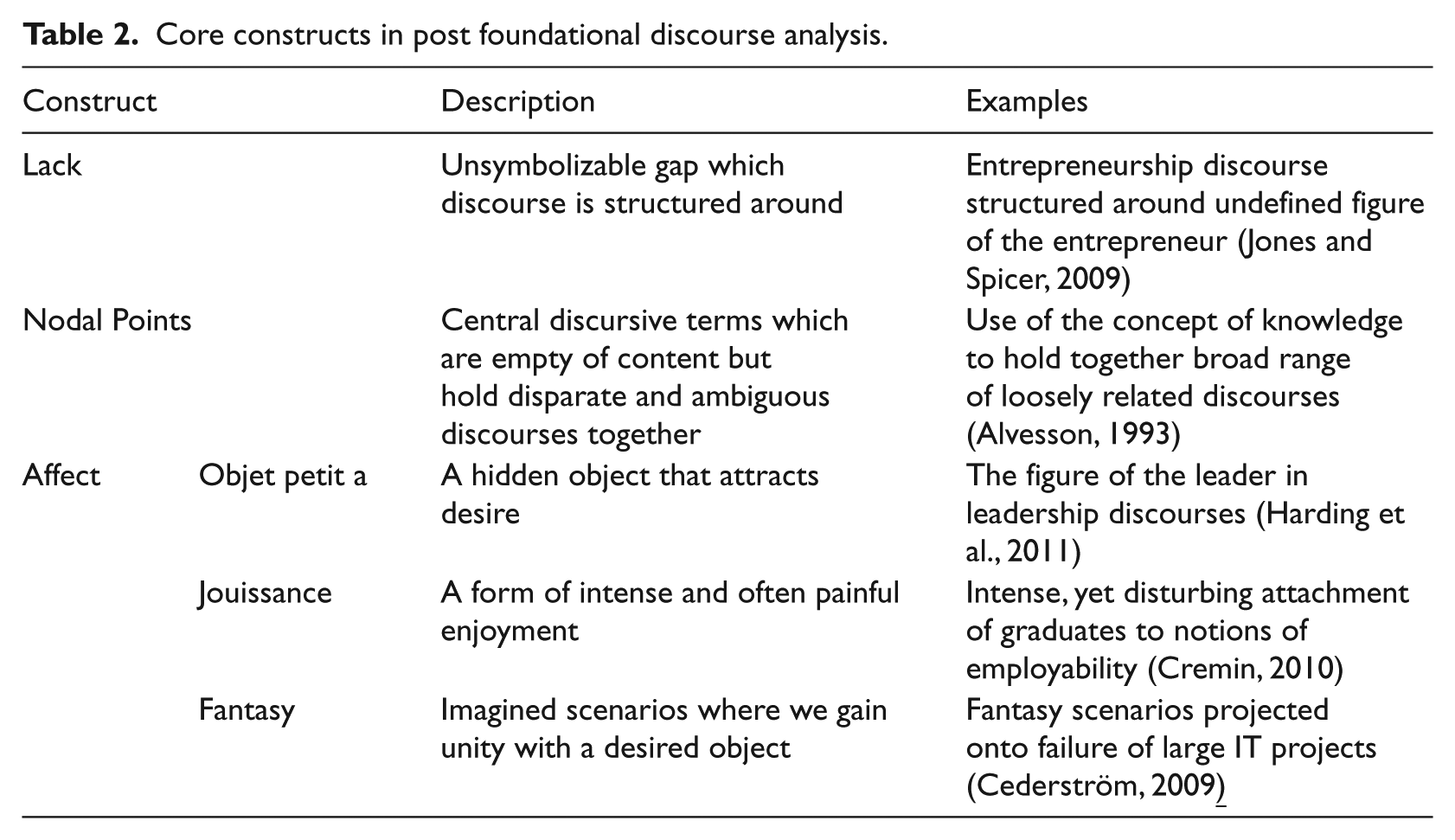
Contu and Willmott provide us with an invitation to seek to explore and apply post-foundational thinking to the study of organizations. They (and their colleagues) have explored these ideas in the context of organizational learning (Contu and Willmott, 2003), workplace control (Willmott, 2006), the philosophy of social science (Contu and Willmott, 2005), practice (Contu and Willmott, 2006), technology (Bridgman and Willmott, 2006) and social movements (Van Bommel and Spicer, 2012). What they have not done, however, is to draw out the implications of this line of thinking for the study of discourse in organizations. Therefore, in what follows, we will provide a more comprehensive account of what post-foundationalism has to offer organizational discourse analysis. We suggest that a post-foundational approach addresses three dimensions that are largely ignored by other approaches to discourse. First, it highlights how discourses are based around a constitutive lack. Second, it focuses on how temporary totality is created through nodal points. Finally, it posits that nodal points are the target for significant affective or emotional investment. We shall now develop each of these points in greater detail (see Table 2).
Core constructs in post foundational discourse analysis.
Lack
From a post-foundational perspective, discourse is seen as a relational configuration of meaningful entities (Howarth, 2000). Laclau, for instance, defines it as ‘any complex of elements in which relations play the constitutive role. This means that elements do not pre-exist the relational complex but are constituted through it’ (Laclau, 2005: 68). This definition is strongly influenced by the structural linguistics associated with the work of Ferdinand de Saussure and Roman Jacobson (Howarth, 2000). As such, it also shares the common assumption with more well-known versions of discourse analysis in organization studies (e.g. Grant et al., 2004) in that it assumes that it is the relationship between various social elements which produces meaning, rather than the social elements themselves being the bearers of meaning. However it departs from these more accepted versions of discourse analysis in that it seeks to understand not only ‘textural elements’ but also ‘material practices’ through linguistic rules (Bridgman and Willmott, 2006: 114). Seen in this light, a discourse is not just encompassing speech and writing, but also structural and material aspects: The fact that every object is constituted as an object of discourse has nothing to do with whether there is a world external to thought, or with the realism/idealism opposition. An earthquake or the falling of a brick is an event that certainly exists, in the sense that it occurs here and now, independently of my will. But whether their specificity as objects is constructed in terms of ‘natural phenomena’ or ‘expressions of the wrath of God’, depends upon the structuring of a discursive field. What is denied is not that such objects exist externally to thought, but the rather different assertion that they could constitute themselves as objects outside any discursive condition of emergence. (Laclau and Mouffe, 1985: 108)
Another way of putting this would be to say that discourses render the material world meaningful. Objects such as rocks, office buildings or computer systems are not denied material reality. However, if something material is not articulated within a discourse it is difficult to include it as a meaningful object for social analysis. What we find in Laclau and Mouffe (1985) is the argument that an object has a socially meaningful existence only insofar as it is rendered intelligible through discourse. Thus when material objects become the focus of human attention, then material aspects of social life are always written over with discourse. Discourses are also often embodied in certain material manifestations. For instance, technologies are always embedded within discursive arrangements. Conversely these discursive arrangements become influential insofar as they have a material embodiment in a certain technology (Bridgman and Willmott, 2006; cf Fleetwood, 2005: 201).
If a post-foundational perspective only provided us with the insight that all objects are given meaning through a series of linguistic rules, it would not take us any further than constructivist theories of organizational discourse analysis. Fortunately, this perspective goes further by advancing the claim that every attempt to reach a final discursive closure is an inherent impossibility. Here, the word ‘impossible’ has a twofold meaning. The first meaning is that it is impossible given the inherent flux and fluidity of language. The second meaning of the word ‘impossible’ draws more explicitly on the psychoanalytic conception of the ‘Real’ and suggests that every discourse is marked by a ‘lack’ that cannot be translated or positively described. Impossible does not merely indicate the failure of reaching a final state of stability. Rather it is the ‘impossibility’ qua ‘unsymbolizable lack’ that provides the necessary ground for establishing any kind of discourse. This unsymbolizable lack is not external to discourse because, from a post-foundational perspective, there is nothing outside discourse. However, it is other to discourse, insofar as it cannot be translated into a positive describable content, but remains elusive, as an element of the Real (Laclau, 2005). This theoretical claim invites the pressing question of how it is possible to know that a lack exists within a discourse. As we will see, these gaps or failures in a discourse are known through identifying the ambiguities, tensions and failures within a discourse (Glynos and Howarth, 2007).
To illustrate this argument, let us consider the difficult task of finding a stable definition of the entrepreneur. While many commentators have tried to answer the perennial question of what it is that makes an entrepreneur an entrepreneur, it has proven not just difficult, but impossible to come up with a final answer (Jones and Spicer, 2005). But why is this impossible? One possible interpretation is that the search for the entrepreneur remains impossible for epistemological reasons. Our attempts to know the entrepreneur and identify the characteristics associated with this figure are always provisional and must therefore be open to revision and rejection on the basis of new insights and data. This epistemological openness is often assumed in more sophisticated accounts of entrepreneurship. However, these accounts assume that ontologically there is a real and positive figure behind these provisional and ongoing iterations. It is precisely on this point that a post-foundational reading would part ways, because from this perspective the search for the entrepreneur must remain impossible for ontological reasons. A social subject, such as the entrepreneur, derives its identity not from a naturalist ontology, in which the real entrepreneur would exist independently, but from a negative ontology, which assumes social relations to be radically contingent (Glynos and Howarth, 2007: 14). The distinction between the epistemological and the ontological is thus not between what we might discover empirically or analytically on the one hand, and what really exists on the other. Rather, ontology concerns the question of what counts as an entrepreneur and if the entrepreneur, as a combination of discrete traits, is a category that exists (see Glynos and Howarth, 2007: 109). Thus, ontological questions concern not so much what naturally exists, as they deal with the categorical and existential preconditions of what appears on a discursive level. In other words, while it remains possible to characterize a subject by a specific set of qualities, any such characterization remains incomplete since it lacks a definite ontological support.
Accordingly, we have a discursive level which represents the entrepreneur through a socially agreed upon and relatively consistent language. For instance, the entrepreneur may be described as self-reliant or overly prone to take risks. These words carry with them a specific meaning with which we can map our understanding of the entrepreneur. Yet, these characteristics are by no means exhaustive and, even more important, they remain dubious and contestable. And since it is not possible to symbolize what it is that lies beyond these positive characteristics—at a deeper level—these characteristics will tend to fall short in determining the nature of the entrepreneur. So what is it, according to post-foundationalism, that lurks behind the discursive level—beyond words such as ‘risk-taking’ and ‘self-reliance’ in the case of the entrepreneur? It should come as no surprise that from this perspective there are no ‘deeper structures’ beyond the discourse that generate the entrepreneur. Instead it is argued that beyond the discursive veil is an insurmountable antagonistic kernel—the lack. The entrepreneur may be characterized by certain activities, relations and motives. But following a post-foundational reading, all these activities, motives and relations associated with an entrepreneur are held together and given meaning through the unsymbolizable lack.
The crucial point to note from this example is that this unsymbolizable element denotes the ‘Real’. The ‘Real’ in the entrepreneur is thus what we ascribe to the entrepreneur, beyond its discursive content (Jones and Spicer, 2005). This means that the entrepreneur is not just open to consistent epistemological revision, but mirrors something which does not have a positive ontological content. Another way of putting this is to say that the ‘Real’ does not designate a higher form of objectivity, beyond discourse, but signify the limit to representation. The Real indicates that, at the very centre of any reality, there is an element that resists being symbolized absolutely (Lacan, 1991: 66). Or as Laclau puts it: the Real is not a specifiable object endowed with laws of movement of its own but, on the contrary, something that only exists and shows itself through its disruptive effects within the Symbolic [discursive]. It is not an object but an internal limit preventing the ultimate constitution of any objectivity. (Laclau, 2006: 657–658)
In the study of management and organization, some have rejected Laclau as an ‘empty realist’ because his notion of the Real does not allow us to take into consideration the material, technical and socially real entities which populate this supposedly empty ‘Real’ (Fleetwood, 2005: 209–210). However, post-foundationalism does not limit materiality to material objects, which can be located, sensed, discerned and described in positive terms. Such conception of the material runs the risk of reified idealism (Žižek, 2006). A post-foundational approach recognizes material entities, not as independently existing categories, but as articulated through discourse. This is not to suggest that this approach is idealistic. On the contrary, post-foundationalism subscribes to a materialist worldview precisely by acknowledging that, while there is nothing beyond discourse, contingency goes all the way down. Žižek describes the difference between idealism and materialism in the following way: for the idealist, we experience our situation as ‘open’ insofar as we are engaged in it, while the same situation appears ‘closed’ from the standpoint of finality[…]; for the materialist, the ‘openness’ goes all the way down, that is, necessity is not the underlying universal law that secretly regulates the chaotic interplay of appearances—it is the ‘All’ itself which is non-All, inconsistent, marked by an irreducible contingency. (Žižek, 2006: 79)
Materialism is thus less to do with tangible objects than with acknowledging the lack and insurmountable antagonistic character of that which is thought to lie beyond discourses.
A number of researchers have picked up this definition and identified a range of all enveloping experiences beset with ambiguity and tension associated with the Lacanian ‘Real’ (Böhm and De Cock, 2005). For instance, some have looked at symbolic death (being stripped of our status, position, salary) associated with seriously resisting the injunctions of an organization as an experience of the Real (Contu, 2008; De Cock and Böhm, 2007). Others have argued that discourses of HRM create a sense of lack in employees as they see their work role as always oriented towards building future potential (Johnsen and Gudmand-Høyer, 2010). Others still have argued that the attraction of workplace spirituality could be explained by reference to the Real (Driver, 2005). For sure, the increasingly widespread discourse of workplace spirituality involves a whole set of stories and images of the ideal employee. However, the exact meaning of ‘the spiritual’ remains blurry and ambiguous. This elusive element of spirituality is never completely symbolized and ‘closed’ because it always suggests something more than itself. It always gestures to a spiritual experience which is ‘beyond words’.
Having addressed issues of materiality, ontology and structures of discourse, we are pushed to answer the question of how discourses become an integrated whole. To this question we find two answers from a post-foundational perspective. The first is that a so-called nodal point stands in for the insurmountable lack of the discourse. This means that a nodal point ties together disparate elements in such a way that it appears as a totality. The second answer is that discourses are also supported by an affective investment. This means that a discourse consists of a form and a force, both of which do the same thing: fill in the lack. The formal side describes how a discourse structures itself around a nodal point. The affective side, meanwhile, gives a sense of how the discourse becomes the site of a radical emotional investment. It is to the first of these we shall now turn.
Nodal points
Elements which hold discourses together have been variously called ‘nodal points’ (Laclau and Mouffe, 1985: 112), ‘master signifiers’ (Žižek, 1989) and ‘ empty signifiers’ (Laclau, 1996). However, for the sake of conceptual consistency we will here use Laclau and Mouffe’s (1985) original term, nodal points. This term is derived from what Lacan (1993) calls point de capiton, interchangeably translated as ‘anchoring point’ and ‘quilting point’, but which literally means ‘upholstery button’. The analogy suggests that the point de capiton, like a button, fixates an otherwise shapeless mass such that it stays in place. Nodal-points, however, are described in a more particular way—namely, as signifiers that are empty of any particular content, yet still capable of over-determining other signifiers, which it does in a retroactive fashion. We shall now briefly explain each of these aspects.
Nodal points are signifiers that are empty of any particular content. By this we mean that they do not necessarily have to correspond with the thing it names, because the process of ‘naming is a primal baptism, not grounded on any universal rule’ (Laclau, 2006: 109). A classic example of this is the naming of gold (Kripke, 1980; see also Žižek, 1989). Here, Kripke argues that even if it would turn out that all of the qualities originally attributed to the name ‘gold’ were wrong, we would still refer to gold as gold. The essential point that Kripke is making is that the name is not dependent on the qualities or content that it represents. Rather it is the name itself that establishes the identity of something.
In addition to being empty of any particular content, nodal points have the capacity to over-determine other elements. This means that elements which are not yet defined (so-called floating signifiers), gain a specific meaning by being tied together with a nodal point. Consider, once again, the entrepreneur. Words such as ‘need for achievement’, ‘control’, ‘self-reliance’, ‘extraversion’ all take on a particular meaning when linked to the entrepreneurial discourse. From being an unspecified ‘need for achievement’ it becomes an ‘entrepreneurial need for achievement’. The same goes with ‘control’, ‘self-reliance’ and ‘extraversion’ which all take on a particular meaning when connected to a nodal point.
Finally, nodal points structure meaning in a retroactive fashion. This means that ‘the effect of meaning is always produced backwards’ (Žižek, 1989: 113). To explain this, consider the nodal point knowledge. Until relatively recently, knowledge was a nodal point which would have made sense only in a handful of organizations such as universities. Over the last couple of decades, however, more and more organizations have made frequent use of this word. Critics have argued that this growing obsession with knowledge has gradually made it diffuse and difficult to pin down (Alvesson, 1993). Important in this regard is to note how knowledge plays different roles. In some contexts it functions as an obscure ‘floating signifier’ that managers use to spice up their pep-talks. In other situations it assumes the role of a nodal point. Here, knowledge plays a central role for the organization and its self-image. In addition, it appears not simply as a contingent concept that has historically become more important for the corporation, but as something that was always-already part of the corporation’s core identity. This is often the case in the ‘knowledge intensive firm’, where knowledge appears as a nodal point retroactively constructing the meaning of all other floating signifiers used in a company. This retroactive operation makes knowledge appear as if it was already there, thus obliterating the historically contingent nature of the corporation’s identity. After such operation, IT becomes the means for transferring and managing knowledge; the organization becomes the ‘knowledge-oriented organization’ which is constituted and subordinated to knowledge; competencies are the reified form of effective allocation of knowledge, and so on.
Affect
We have now explored how a nodal point creates a unity among other signifiers. While the concept of the nodal point allows us to describe the form of a discourse, it does not tell us much about the force that drives a discourse to be used and sustained. To explore this dimension we shall now turn to the affective dimension of discourses. Existing work in organization studies argues that discourses can be particularly effective if they are underpinned by emotional bonds (e.g. Fineman, 2000; Hardy and Philips, 1998; Knights and MacCabe, 1998). In line with this work, a post-foundational approach would claim that nodal points are underpinned by affective force. Here, as Laclau explains, ‘the complexes which we call “discursive or hegemonic formations”, which articulate differential and equivalential logics, would be unintelligible without the affective component’ (2005: 111). Including affect in the analysis of discourse enables us to consider why we gravitate towards some nodal points rather than others. Additionally, it allows us to explain why discourses might be sustained over a considerable period of time. Laclau draws on a psychoanalytic register to elucidate the ideological hold that discourses exercise. In our description we shall concentrate on three terms relevant for this analysis which are borrowed from the work of Lacan: objet petit a, jouissance and fantasy.
Objet petit a is one of the most central concepts of Lacan. To put it succinctly, objet petit a designates the object to which our desire is directed (Evans, 1996). But it is, at the same time, also the object that causes desire—which is why Lacan refers to objet petit a as the object-cause of desire. Important to note in this regard is that we are not dealing with a tangible or describable object, which could be empirically represented. Rather, it is an object that exceeds our grasp. Perhaps paradoxically, objet petit a is what is more in an object than the object itself (Lacan, 1998: 268). A compelling example here is how advertisements often focus on a partially known feature or characteristic that would make us believe that the product is not only the mere representation that we see, but also something more (Stavrakakis, 2000). In this way, the promoters of the product attempt to make a commodity evoke a feeling that there is some sort of sublime kernel lurking beneath the visible surface. A pair of Nike shoes is portrayed as not only different from other sports shoes, but also something that might help us express our individual excellence and experience an orientation to winning (Böhm and Batta, 2010). Žižek’s favourite example of objet petit a is the ‘Kinder Surprise’: a chocolate eggshell wrapped in brightly coloured article, within which a small plastic toy lies hidden. The hidden object is ‘the small object filling in the central void of desire, the hidden treasure’, which at the same time reminds us that ‘no product is “really that”, no product lives up to its expectations’ (Žižek, 2003: 145). Drawing on Marx’s theory of commodity fetishism, Žižek continues: [A] commodity is a mysterious entity full of theological caprices, a particular object satisfying a particular need, but at the same time the promise of ‘something more’, of an unfathomable enjoyment whose true location is fantasy—all advertising addresses this fantasmatic space (‘If you drink X, it will not be just a drink, but also … ’). And the plastic toy is the result of a risky strategy actually to materialize, render visible, this mysterious excess: ‘If you eat our chocolate, you will not just eat chocolate, but also … have a (totally useless) plastic toy’. (Žižek, 2003: 146)
By keeping an object at least partially hidden, and thus out of reach, a discourse can never attain a stable identity. Consider the example of leadership discourse (Ford and Harding, 2007; Harding et al., 2011). Here, the leader often attains idealized and exaggerated features, many of which are contradictory, ambiguous and uncertain. A post-foundational approach would argue that these ‘surplus-features’ play a significant role to attract interest and fascination (such as people attending a leadership training course). Crucially, it is by virtue of this elusive nature that the leader, as a romanticized construct, becomes appealing. This explains why those striving to ‘become leaders’ (and perpetually failing) often become passionately attached to the identity of the leader. Some have suggested that this attachment can also be specifically directed towards the body of the leader (Harding et al., 2011). The important point to make here is that objet petit a spurs an interest to dig deeper and so it makes sure that desire will never be put at rest (Fink, 1995). A discourse will always be in the process of bringing back its lost hidden object. In this sense, objet petit a becomes a focal point for passionate attachments (Laclau, 2005).
By organizing a discourse around objet petit a, a kind of shared collective emotional experience is made possible (Stavrakakis, 2007). This emotional experience brings us to jouissance—the second relevant term for our analysis derived from Lacanian psychoanalysis. Jouissance is distinguished from pleasure in that it is more excessive than calculative. Whereas pleasure follows the logic of the pleasure principle (where excessive pleasure is avoided in order to avoid excessive suffering), jouissance is geared towards something beyond the pleasure principle. This means that jouissance is not exclusively connected to pleasure, but also pain. (Evans, 1996; Fink, 1995). Lacan separates between two types of jouissance: phallic and feminine. The former of these is the most common and aims towards regaining an experience which has been lost through castration—that is, objet petit a. What characterizes this jouissance is that it will always fall short of its ambition. The pure jouissance imagined through the lost object will never materialize itself fully, because there is an insurmountable gap between ‘jouissance expected’ and ‘jouissance obtained’ (Lacan, 1999: 35). In this sense, jouissance is always a contaminated form of the expected pure jouissance. The second type, which is introduced in Lacan’s later teaching, indicates a corporeal jouissance that can be experienced, but not known. This form of jouissance, which Lacan calls feminine jouissance is located beyond the phallus. It is ineffable in nature and hence impossible to describe (McGowan, 2004).
Jouissance, especially phallic jouissance, is manifested in a whole range of different contexts related to organizations. Experiencing identity insecurities (Kosmala and Herrbach, 2006), ‘burning out’ (Vanheule and Verhaeghe, 2004; Vanheule et al., 2003), coaching sessions (Arnuad, 2003), workplace stress (Bicknell and Liefooghe, 2010), consumption (Sköld, 2010), employability (Cremin, 2010) or corporate spirituality (Driver, 2005) are examples where jouissance is at stake. More positive ambitions such as striving for impossible goals or the dream to radically subvert paradigms may also be seen in this light. Because phallic jouissance is geared towards something impossible, it is a useful construct for understanding how discourses are being sustained. Feminine jouissance, on the other hand, is not so much geared towards something beyond itself, but is described as a mysterious and corporeal affect. We might see feminine jouissance being at play in discourses of spirituality and bodily manifestations of resistance. It is perhaps possible also to locate this form of jouissance in forms of masochistic practices (Cederström and Grassman, 2008), as it is often described in relationship to self-annihilation (Lacan, 1999). Contrary to phallic jouissance, the feminine counterpart is not concerned with retrieving something that is fundamentally lost, but is concerned with an enjoyment which is here and now, although in a partial form, what some have called partial jouissance (McGowan, 2004). This is why a number of theorists have sought to explore the notion of ethics, as a moment of feminine jouissance, mainly because it has surrendered the male fantasy of regaining the phallus (McGowan, 2004; Zupančič, 2000)
Because the experience of jouissance can be so overwhelming, it often needs to be rooted and canalized. This happens through the articulation of fantasies. Fantasy is the imagined scenarios we construct to imagine objet petit a. It is with the support of fantasy that the desire can gain some co-ordinates and attain a concrete form (Roberts, 2005; Žižek, 1998). Far from being purely subjective and personal, fantasies are shared and highly social in nature. By creating fantasmatic scenarios around a desired object, a group can articulate its goals and aspirations in a way which is not made possible through a nodal point. Stavrakakis, for instance, claims that ‘every political promise is supported by a reference to a lost state of harmony, unity and fullness, a reference to a pre-symbolic Real which most political projects aspire to bring back’ (1999: 52). In that sense, we can think of nostalgic fantasies about the past or postalgic fantasies about the future—both of which aspires to capture this desirable state of unity or perfection (Gabriel, 1993; Ybema, 2004). To assuage feelings of insecurity and anxiety we often develop highly complex scenarios and narratives of our past, present and future.
Fantasy has, above all, two functions which are relevant to the analysis of discourse. First, it has a stabilizing effect through which a nodal point is boosted and equipped with a mesmerizing faculty. A stabilizing fantasy attempts to eliminate all doubts that could question the strength of a nodal point. These fantasies could take the form of dream-like scenarios in which the discourse is portrayed in a dazzling way. But stabilizing fantasies could also take on a very subtle tone such as the safety warnings one receives on an aeroplane. These safety cards present a possible plane crash ‘as a gentle landing on water (miraculously, it is always supposed to happen on water!), each of the passengers puts on the life-jacket and, as on a beach toboggan, slides into the water and takes a swim, like a nice collective lagoon holiday-experience under the guidance of an experienced swimming instructor’ (Žižek, 1998: 190). Fantasies can also have a destabilizing effect which works in the opposite direction—to demonize what is diametrically opposed to the nodal point (Žižek, 1998). Instead of imagining that we have or can achieve social fullness and unity, destabilizing fantasies concentrate on bringing forth scenarios in which particular characters or groups are held responsible for preventing us from achieving full identity. For instance, large information systems rarely live up to their goals and become costly and difficult to manage. In coming to terms with this failure there are many different destabilizing fantasies which are used (Cederström, 2009). Some may blame it on top-management’s ignorance, middle-managers’ laziness or simply user’s resistance. These fantasies ascribe to the culprit a malicious intent, deliberate wickedness or conspiracies that a small group is pulling the strings behind the scene.
Discussion
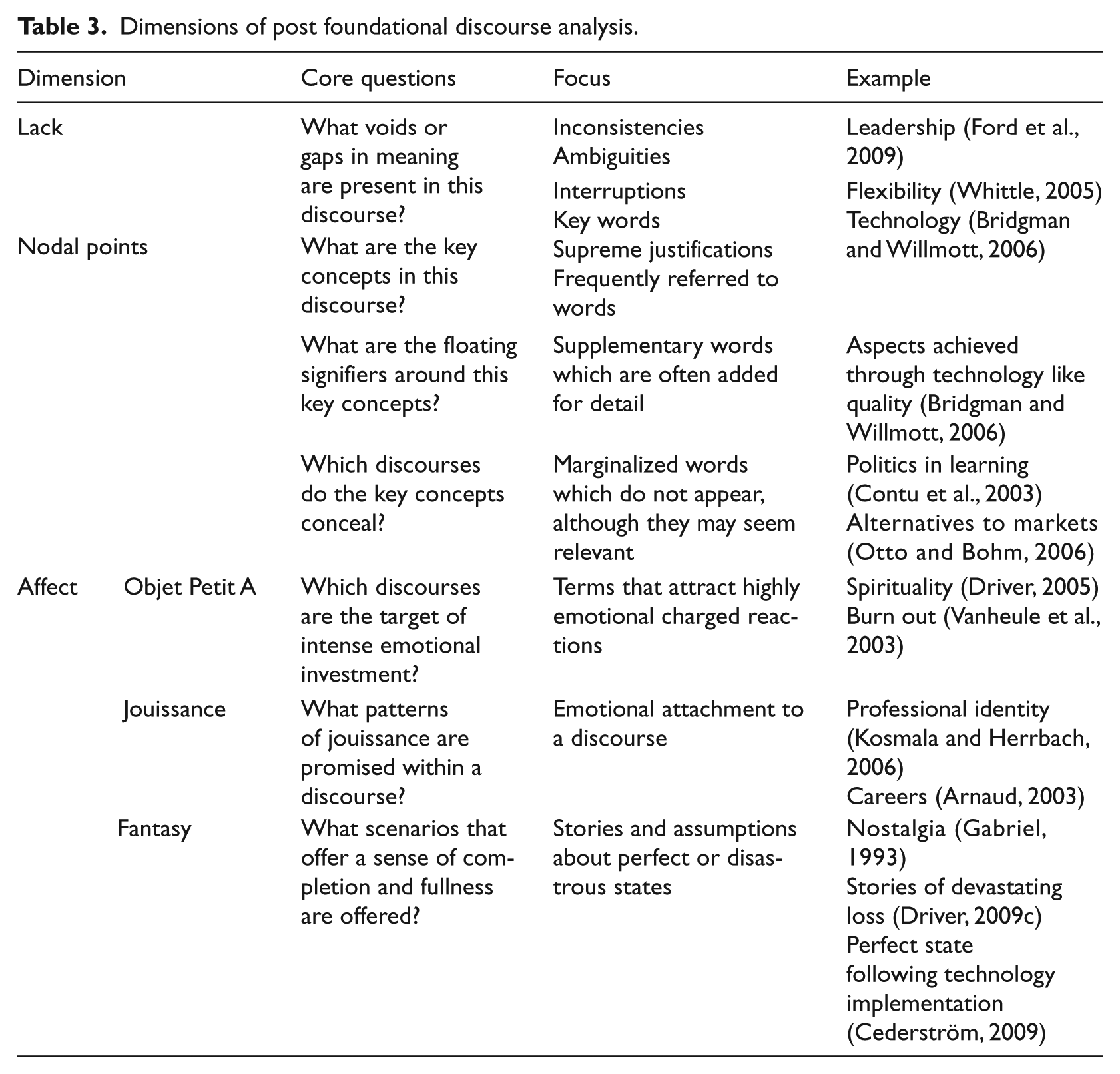
In the previous section, we sought to introduce some of the basic concepts which can be derived from a post-foundational approach to discourse theory. Now we shall turn to the task of drawing out the implications of this approach to the study of organization. To do so, we will develop a framework for what we call a post-foundational approach, which can be used for analysing organizational discourse. This analytical framework consists of three dimensions: identifying lack, tracing nodal-points and attending to affect. In what follows, we shall draw out each of these different dimensions and demonstrate how they can be mobilized in the empirical study of organizational discourse (for summary see Table 3).
Dimensions of post foundational discourse analysis.
Identifying lack
The first major dimension of a post-foundational analysis of discourse is the identification of lack within a discourse. As we have already argued, lack is representing a void within a discourse that cannot be symbolized. Undertaking empirical studies of this component would require the researcher to ask ‘what is the lack within this discourse?’. It should be stressed that this questions can never be answered with a positive affirmation such as ‘yes, I have found the lack and it is x’. This is because the lack is not immediately represented by observable objects or phenomenon. That is, since it does not appear in the discourse we are studying, we cannot translate it into a positive entity. All we can do is search for this void, and identify how discourses are oriented around it.
The task of identifying lack is a difficult one, because how do you identify something that cannot be symbolized? The answer we find in a post-foundational approach is that we can go some way in addressing this lack by searching for ambiguities within a discourse, since these tensions often belie and underlying lack which cannot be fully covered over, or sutured (Glynos and Howarth, 2007; Hoedemaekers, 2010; Howarth, 2000; Laclau, 2005). Ambiguities are perhaps most visible when discourses are used in inconsistent fashions. To go back to our previous example about entrepreneurs, the lack could be identified by attentively listening to the narratives that are used to make sense of their own occupation (or vocation). Of particular importance here would be to identify elements of ambiguity and interruptions which punctuates their self-narratives (Hoedemakers, 2010a). A related example would be that of discourses of leadership, where narratives are often peppered with ambiguities, interruptions and inconsistencies (Alvesson and Spicer, 2010). This is highlighted in a study of health professionals who were asked to adopt the discourse and associated identity of ‘leadership’ (Ford et al., 2009). Typically the health professionals would find this an attractive and seductive discourse, but they would also grapple with the ruptures, inconsistencies and ambiguities of the concept. Indeed, it was often these ambiguities and inconsistencies which continued to make the notion so attractive (Ford and Harding, 2007). This became particularly pronounced when notions of ‘authentic leadership’ were introduced with the aim to encourage would-be leaders to go in search of their (eternally illusive) ‘true self’ (Ford and Harding, 2011; see also Shaw, 2010). Another relevant example involves flexibility, where studies have found a discrepancy between the discourse of ‘flexibility’, as it was produced and promoted in management parlance, and ‘flexibility’ as it was negotiated and conceived during implementation (Whittle, 2005). Discourses of flexibility are also frequently used to mean very different things in different contexts. It may be used to simultaneously indicate employee empowerment and draconian extension of working hours (Twiname et al., 2006). Attending to these inconsistencies highlights how it is difficult to fix the discourse of flexibility around a single signifier because it continues to slide and remain ambiguous.
Tracing nodal points
A second novel aspect of a post-foundational approach is that it allows us to understand how discourses attain a degree of temporary stability by the creation of nodal points. Conducting research on this component of discourse would involve asking two interrelated sets of questions. The first set of questions would be: which signifier acts as ‘a nodal point’ linking together floating signifiers, and how are these links crafted between these nodal points and floating signifiers? In order to answer these questions, a researcher would identify key words constantly referred to and used as supreme justification. They also need to map out the other words and vocabulary attached to a nodal point. To this end, one could keep a record of the different groups or actors involved in attaching different floating signifiers to a nodal point. Bridgman and Willmott (2006) have argued that, during a major information technology implementation, a computer system itself became a nodal point, which was constantly referred to as an end in and of itself (Bridgman and Willmott, 2006). They also mapped out how the various groups would attach different floating signifiers such as ‘reducing complexity’, ‘staff empowerment’ and ‘strategic partnership’ to the computer system. The result was that the computer system became a kind of embodiment of all these characteristics. It also meant that each of these floating signifiers was thought to be achievable only through technological means.
The second set of questions pertains to the lack that the nodal-point stands in for. Here, the question is: what does a nodal point conceal? In order to answer this question, we suggest that researchers need to attend to discourses that are edged out or marginalized over time. This may involve identifying those discourses which have not or cannot be attached to a nodal point. For instance, the nodal point of organizational learning largely conceals and marginalizes political conflicts within the learning process (Contu et al., 2003). Similarly, the nodal point of the market marginalizes other possible ways of distributing water in a water management system (Otto and Böhm, 2006). Such marginalization can also be an important aspect of political mobilization. For instance, the slow food movement used the nodal point of ‘eco-gastronomy’ to bring together gourmets, environmentalists and social justice campaigners by representing ‘fast food’ as the antagonist (Van Bommel and Spicer, 2012).
Attending to affect
The final novel aspect we would like to draw out of a post-foundational approach involves attending to the affective dimension of discourse. Drawing on psychoanalysis three aspects will help us identify the affective dimensions of a discourse. These are objet petit a, jouissance and fantasy.
As we have already argued, the objet petit a is ‘what is more in the object than the object’. This paradoxical formulation means that we presuppose a hidden and intangible object in tangible and recognizable objects. In turn, it is this hidden object that establishes the ‘Real’ identity as well as securing the dazzling and romantic sides of the tangible object. However, to scientifically locate or detect objet petit a is by definition impossible. This concept is, in a Lacanian vocabulary, ‘Real’ and thus present beyond discursive articulation. In order to identify such illusive objects, the researcher should ask ‘which discourses are targets of emotional investment’. To answer this question, they might pay attention to the particular terms which attract significant emotional outbursts (either positive or negative). For instance, in the North American workplace, spirituality is a term that has attracted significant and impassioned celebrations, devoted care and at times vicious conflicts (Driver, 2005). Similarly, in the European workplace, burn-out attracts a significant degree of emotional investment ranging from systematic work on the self through to emotive outbursts (Vanheule et al., 2003). This implies that work often signals something beyond its own symbolic specificity, objet petit a, and that both spirituality and burn-out can be seen as responses to the search of this ‘lost’ or ‘hidden’ object. In relation to consumerism, it has been noted that the desire to consume more follows the logic of the desire insofar as it constantly strives to find something indeterminate (Stavrakakis, 2007). This indeterminate aspect of consumerism could be read in the light of objet petit a—which indicates that this object is not just the object of desire, but also the cause of desire (what Lacan called object-cause of desire). A final example here is discourses of leadership, which functions both as a cause as well as an effect of desire. Ford and Harding (2007: 482) point out that ‘the turn to leadership can thus be read, at least in part, as an invitation to seduce oneself through the dream of heroic leader. It attempts to lure managers into thinking of themselves as leaders’. In subsequent empirical work they have highlighted how the leader themselves can become a kind of objet petit a, which is suffused with all sorts of desiring fantasies by organizational members (Harding et al., 2011).
Jouissance, meanwhile, reflects the complex ways in which we attain and structure enjoyment. In order to study this aspect of discourse, researchers should ask: ‘what patterns of jouissance does this discourse promise’. This might be done by noting the emotional force that is attached to a discourse, especially by examining how the discourse is structuring enjoyment and developing affective bonds. In trying to detect this level of enjoyment it is important to remember that jouissance often operates on a seemingly meaningless level, where trivial aspects can acquire a disproportionate significance. For instance, the passionate attachment to a national identity often involve small precious things such as dancing and laughing, or watching baseball and eating hotdogs (Stavrakakis, 2007: 203). Changing such practices, as for example regulating the ingredients in hotdogs might unleash unexpected emotional responses. Within organizations, we can witness similar tendencies. Policies, departments, routines, procedures, rituals, hierarchies, reward systems, or lunching habits may all seem insignificant at face value. But when they are changed, groups often mobilize an excessive response. This signals the importance of analysing the relation between discourse and affect. Some have already attempted to analyse this by looking at the role of jouissance in organizational life. For instance, a study of auditors found that they were caught between a number of different competing identities (Kosmala and Herrbach, 2006). This tension became a source of significant anxiety as well as a strange kind of enjoyment on part of the auditors. Similarly, executive coaching sessions also became a site where the coached can experience both pain and pleasure associated with the travails of ‘being themselves’ in their career (Arnaud, 2003). This means that the coached becomes increasingly attached to the discourse of coaching as a way to experience this jouissance.
An often overlooked dimension of jouissance is its feminine, supplementary aspect. Studying this kind of jouissance would obviously be very difficult from an empirical point of view given that it necessarily defies description. Yet, the study of feminine jouissance could yield new insights into mysticism and spirituality, as it was in this context that Lacan (1999) originally situated the term. Other forms of bodily experiences including masochism and self-destruction (Cederström and Grassman, 2008; ten Bos, 2007) could also be further explored through seriously considering feminine jouissance. Of particular importance here is how feminine jouissance would unsettle rather than maintain discourses. Adhering to this dimension would make it possible to study some of the disruptive effects that enjoyment might have (cf McGowan, 2004).
Fantasy, finally, offers a scenario of wholeness and completeness which might come into being in the future. However, it also operates in the present by veiling antagonism between conflicting discourses. Locating the fantasy dimension of discourse involves asking: ‘what fantasy scenarios are at work within this discourse?’. To answer this question a researcher might seek to identify stories or assumptions which create a sense of wholeness (Driver, 2009b). Often these can be found in fantasy articulations of a perfect or disastrous world which often accompany an emotionally charged discourse. For instance, in the study of nostalgic discourses it is often possible to locate (inaccurate) images of a lost perfect world where the organization functioned well and everyone got along (Gabriel, 1993). Similarly, much managerial discourses such as corporate strategy relies on a postalgic fantasy whereby the future is painted as an ideal world (Ybema, 2004). In terms of fantasies of disaster, we can see in many green ideologies images of utter chaos which are an important part of their attraction (Stavrakakis, 1999). Similarly, stories of organizational change were often characterized by fantasies of devastating loss (Driver, 2009c). Finally, the implementation of many new technologies such as informational technology systems is often haunted by fantasies of malevolent forces being at work (Cederström, 2009).
Conclusion
In this article we have developed a post-foundational approach to organizational discourse analysis. We have argued that it offers a unique theory of the ‘Real’ and discourse, which makes it a viable alternative to current approaches to discourse analysis. Instead of seeking to ground an analysis of discourse through the examination of texts, textual action, or teasing out underlying ‘generative structures’, this approach to discourse analysis is oriented towards figure of the ‘Real’. This involves recognizing that while discourses have a positive content, they are structured around a fundamentally antagonistic gap—a lack. This gap is covered over through the construction of a discursive ‘nodal point’, which brings together a series of elements into a temporarily coherent whole. Moreover, this gap is the necessary ground for understanding the significant degree of affective and emotional attachment to discourses.
Contributions
A post-foundational approach allows us to advance our account of organizational discourse by addressing many of the shortcomings of existing approaches to discourse. It addresses the issue of agency by accounting for how actors use and manipulate discourses for their own purposes. It does so by beginning with the assumption that discourses are never fixed, but contingent all the way down. The approach we present proceeds by tracing how actors negotiate the uncertainties and tensions at the heart of most discourses. These tensions could be studied by focusing on the political struggles involved in the process of linking discourses with nodal points, which are sustained and reinforced by emotional investments (e.g. Spicer and Böhm, 2007; Van Bommel and Spicer, 2012). Post-foundational approaches also seek to address issues of materiality. Rather than something distinctly separable, it recognizes how materiality is a central part of discourse (Bridgman and Willmott, 2006). This approach also takes into account the structural aspects of discourse, although they are not conceived as external to discourse, since also endurable structures are ultimately contingent. To account for this structural aspect, particular focus is placed on how dominant and enduring discourses shape which other discourses can and cannot appear. Attending to the ‘Real’ dimension of discourse thus implies the recognition of the tensions, inconsistencies and antagonistic nature of all discourses—which is vital to recognize in order to understand how discourses are being shaped (Jones and Spicer, 2005). This also allows us to move beyond the inbuilt ‘muscular’ assumptions, particularly since it foregrounds the ‘absent’, ‘hidden’ and contradictory dimensions of ‘discourse’. This recognizes that far from always being forceful and ‘muscular’, discourses can also be confused and even ineffective. Instead of beginning with the question of lack—which would imply that we immediately assume that discourse constructs organizational reality—we begin with an almost opposite assumption, namely that discourses destruct, fragment and complicate aspects of organizational reality (Jones and Spicer, 2005). Finally, examining organizational discourse from a post-foundational approach allows us to account for the affective dimension of discourse. It does so by examining issues like emotional investments, jouissance and fantasy.
Future research
Despite these advances, significant work is still needed in order to further develop and test this approach to studying organizational discourse. Perhaps the most pressing question is what protocols are appropriate for empirical analysis? This is clearly a complex question and will require innovative methodology (for general treatments see Åkerstrøm Andersen, 2003; Glynos and Howarth, 2007; Howarth, 2000). However, it is clear that the kind of data gathered for a post-foundational discourse analysis should be rich in meaning and emotion. This might include archival textual data such as reports, media stories, written narratives, and academic texts. It might also include live ‘speech’ which is recorded through interviews, clinical sessions and recordings of conversations. Finally, experiential data might also be gathered in the form of observations and extended participant observation. Each of these sets of data will provide the researcher with a rich database, which might then be read through the lens of the analytical procedures that post-foundational discourse analysis provides. Following the theoretical framework which we have outlined above, we would like to suggest that at a minimum this would involve examining (1) the absent centres or ambiguities of the data, (2) the floating signifiers, nodal points and how these are linked together, and (3) the affective dimension of the data such as emotional investment, jouissance and fantasy scenarios which are developed. When analysing, researchers might like to treat the data as a whole and simply develop a snapshot of the discourse which is at work within a particular setting. However, they also might seek to tell a richer story by providing a degree of comparison, such as considering variations across time, or how the patterns vary between different social groupings.
The second future question that our article begs is how a post-foundational approach to discourse analysis might contribute to existing studies of various aspects of organization. We have already noted how post-foundationalism asks three sets of unusual questions. Each of these, we believe, could have important implications for well-trodden ground in organization studies. The first set of questions we outlined was around how discourses tend to have an absent centre. It would be very interesting to investigate how a series of popular but famously illusive discourses such as ‘quality’, ‘trust’ and ‘leadership’ appear to be so attractive because they are structured around an absent centre. Considering the absent centre of these discourses would show us how they work through having some degree of absence of content rather than only being full of as yet to be discovered positive content. The second set of questions which we outlined was around how floating signifiers are fixed by a set of nodal points. This question could be asked about a whole series of important ‘nodal points’ in organizational life such as ‘talent’, ‘flexibility’, ‘quality’, ‘knowledge’, ‘innovation’, and ‘shareholder value’. Examining these ‘nodal points’ from a post-foundational approach would show how they come to be linked with and ultimately fixed to a whole series of other discourses in an organization. The final set of questions is around the affective dimension of discourse. These questions would seek to address why some discourses come to take on a certain degree of emotional force. Building on existing work on emotions in the study of organizations (e.g. Fineman, 2000), this line of questioning would help to extend work which explains why people develop apparently irrational attachments to management fashions, corporate culture, and identities. To address these issues one could search for emotional investments, jouissance and fantasies tied up with these particular discourses.
The third question we should ask is what might be the limits of a post-foundational approach to discourse analysis. We should be clear that we do not hope nor expect that adopting such approach will simply ‘solve’ all problems with the way we understand organizations and organizational discourse analysis (see also Jones, 2006). Rather, we simply hope that a post-foundational approach to discourse analysis will help bringing to light what we see as three important questions which are not currently being sufficiently addressed in organizational discourse analysis. To be clear, a post-foundational discourse analysis does help us to understand the absent nature of discourse, processes of articulation and emotional investment. What it tells us less about is some of the linguistic questions that are of interest to people studying organizational texts, agential questions asked by those studying textual action, and structural questions asked by those influenced by critical realism. We do not hope to banish these kinds of sociological questions—all we expect is that a post-foundational analysis of discourse will act as a kind of supplement. But as we know from Derrida, any kind of supplement will always displace and fundamentally reorganize what the major body it seeks to append itself to. The question which we must constantly ask ourselves is how do we think that using a post-foundational approach will supplement and thereby transform efforts to get real about organizational discourse analysis.
The final question that might be asked in the future is whether it is possible to build reflexivity into a post-foundational discourse analysis. Existing work in the field has sought to do this by placing the authors’ life experiences and desires as an important component of the analysis. For instance, in their discussion of leadership, Ford and Harding (2007) take their own position as leadership coaches as the starting point of their analysis. Harding (2007) explores how the subject position of the interviewer and the interviewee (and indeed ‘the organization’) are constituted during an interview. Driver (2009b) notes that during interviews there is often an articulation and negotiation of lack—both on the part of the interviewee but also the interviewer. We think this kind of self-reflection is certainly important. Furthermore, this work reminds us how our own desires (which are structured by the broader discourse of the university) are implicit within empirical work. However, following a post-foundational approach it is also important to ask questions about why particular modes of knowledge become so seductive at a particular point in time. In the case of the present argument, we must ask what is it about post-foundational discourse analysis itself which has seduced a growing group of those working in organization studies? Perhaps it is the ambiguities, paradoxes and tensions of discourses—in short, the element of the Real—that make the theory so attractive. If so, the Real is an element that should concern us not only in the research we conduct to explain the world outside of ourselves, but to remind us of our own inclination to be drawn in and seduced by the elusive, the inconsistent and inexplicable—a reminder that, indeed, we are not beyond discourse.