




Abstract
This article considers the institutional and political background to the life of Organization associated with continuing debates about ‘modes of scientific knowledge’ and the supposed rise of Mode 2. It suggests that Organization should provide space for a more fully theorized and politically aware position of the new—and old—production of knowledge. It does so by, first, critically exploring the substantial volume of work that continues to insist that Mode 2—and its many variants—have tended to displace more traditional, so-called Mode 1, forms of scientific knowledge production. But its main contribution lies in suggesting that what has lurked behind scientific knowledge production for centuries is a more insidious and underlying mode of knowledge production—one which we label Mode 0—that corresponds to knowledge production based upon relations of power and patronage. We argue that not only does this notion allow us to develop a more penetrating critique of the claims made by proselytizers of Mode 2 but that Mode 0 has proved a more enduring form of knowledge production than Mode 1 and may well have greater longevity. Rather than becoming too embroiled in questions raised by the Mode 1/ Mode 2 debate about the utility of knowledge for managers, we suggest that readers may wish instead to pry further into the hidden world of Mode 0 patronage of knowledge production.
Our article considers the institutional and political background to the life of Organization associated with continuing debates about supposedly changing ‘modes’ of scientific knowledge. It will suggest that Organization should provide space for a fully theorized and politically aware position of the new—and old—production of knowledge. In the New Production of Knowledge, published in the same year that Organization first saw the light, Gibbons et al. (1994) developed the idea that Mode 1 science would give way to Mode 2: mission orientated R&D was to displace discipline based scientific practice; problem relevance was to displace ‘rigour and quality’; wealth creation was to drive research agendas; and secrecy (in patenting, for example) was to displace open conversation. The theme was subsequently developed by Nowotny et al. (2001) who made a case for ‘contextualized science’ and drew upon the idea of the agora as a market place for the (joint) production of knowledge. Since then, several variations on the theme of Mode 2 have been proposed (Huff, 2000; Huff and Huff, 2001); it has been the subject of special issues of the British Journal of Management (2001), the Academy of Management Journal (2007), Journal of Management Studies (2009) and Organization Studies (2010); it has directly shaped research practice through the emphasis placed by funding bodies on collaborative research between academics and practitioners (particularly in business and management studies); and it has shaped research policy and practice indirectly through the ‘impact’ agenda in research assessment and the wider rigour-relevance debate (Thorpe et al., 2011; Van de Ven, 2007).
At the half-way point in Organization’s 20-year history, the challenges facing universities associated with the rise of interest in the ‘new production of knowledge’ were not only highlighted as being relevant to one of the journal’s six original key themes, but also of central concern to its continuing aims, purpose and agenda (Editorial Team, 2003: 412–415). Also flagged up in that editorial were benefits to be gained from ‘… understanding the ways in which knowledge is constructed, extemporized, contested and situated in practice’ (Editorial Team, 2003: 413). This article is an effort to take that project further and to build upon the brief suggestion made then that what lurks behind a supposed contemporary transition to Mode 2 is a different form of knowledge production—Mode 0—which corresponds to knowledge production centred upon relations of power and patronage. This is presented as an enduring form of knowledge production which both predates Mode 1 and may have greater longevity than it.
Although power has long been considered as important in any discussion of changing forms of knowledge production (e.g. Grey, 2001), the sheer volume of attention directed towards Mode 2 and its inter-twining with the rigour-relevance debate (e.g. Bartunek, 2007) makes further exploration of ‘knowledge production’ arguably more important than it has ever been (cf. Learmonth et al., 2012). This article sets out to elaborate therefore on what we see as the key components of a Mode 0 form of knowledge production and how it relates to Mode 2 and its variants that have ‘co-evolved’ alongside the rigour-relevance debate. The focus is on the context within which debates about Mode 1 versus Mode 2 have been conducted and how key institutions, networks and actors have shaped those debates. Although greater familiarity (plus space constraints) inevitably means that more emphasis is placed on exploring these developments in the UK context, that is not exclusively so and our main intention is to draw out the wider implications of understanding the deeper undercurrents influencing knowledge production.
Mode 2 and the ‘new production of knowledge’: theme and variations
In The new production of knowledge, it was argued that major changes in the conditions of demand for and supply of knowledge within advanced industrial economies were affecting the ways in which knowledge was being produced and used, and were challenging the (supposed) hegemony of traditional scientific disciplines (Gibbons et al., 1994: 13). The result was a fundamental shift from a disciplinary-based ‘Mode 1’ form of knowledge production to a new, more applied form of knowledge production which was labelled ‘Mode 2’. Subsequent work by the same authors (Nowotny et al., 2001, 2003) expanded upon the distinction and further developed the case, arguing that:
The old paradigm of scientific discovery (Mode 1)—characterized by the hegemony of the theoretical or, at any rate, experimental science; by an internal taxonomy of disciplines; and by the autonomy of scientists and their host institutions, the universities—was being superseded by a new paradigm of knowledge production which was socially distributed, application oriented, trans-disciplinary, and subject to multiple accountabilities. (Nowotny et al., 2003: 179)
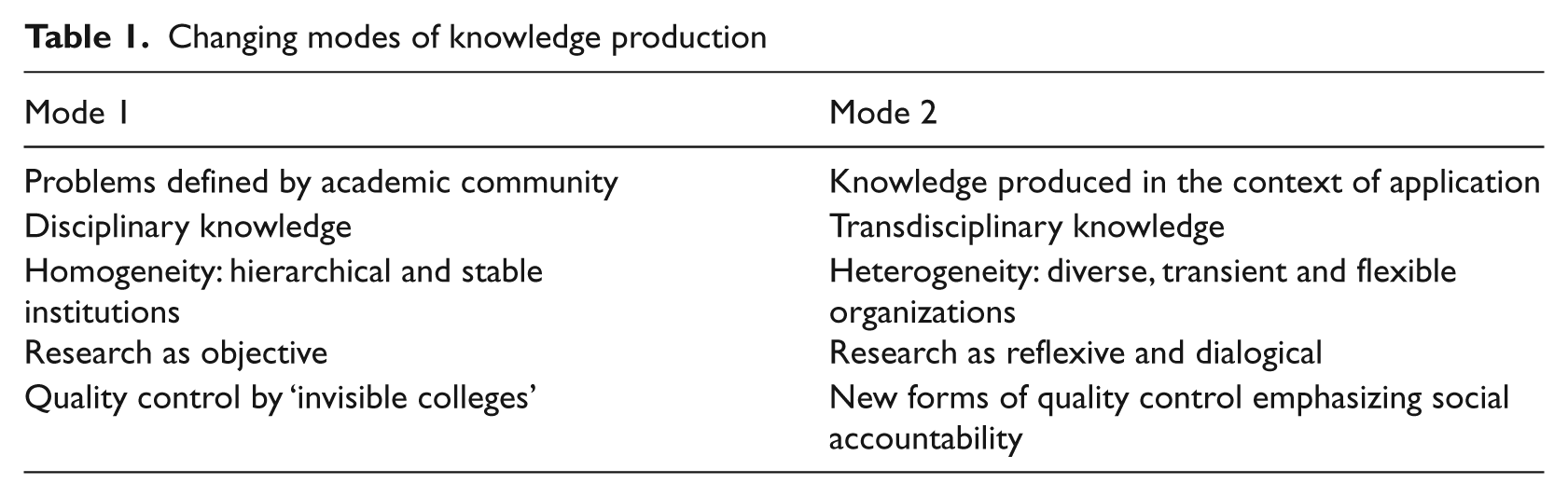
Five key features characterized this paradigmatic shift (summarized in Table 1 below). First, research becomes driven by the need to address ‘practical’ problems articulated by a variety of stakeholders to meet market ‘needs’ and so knowledge is produced in the context of application. No longer do academic disciplines and professional communities define problems or dictate what counted as relevant knowledge. Nowotny et al. (2001) likened this to ‘the agora’ in ancient Athens—a public arena for the open regulation of science. This market place for ideas is decidedly not in the control of academics—science has to be ‘sold’ in a space populated by citizens and consumers, where markets and politics meet. Second, transdisciplinarity is emphasized, with research drawing upon a range of theoretical perspectives and methods that are somehow blended into a common framework to guide practical, problem-oriented research. Third, greater institutional heterogeneity means that research is distributed amongst a variety of organizations (including research and consultancy organizations, government agencies and companies). This does not necessarily mean that it connects with ‘the public’; indeed, ‘the mob’ was deliberately excluded from the Athenian agora—due to the elitist view that it would be unable to act rationally and ‘reasonably’. Nowotny et al. mirror this in their observation that the scientific ‘agora’ is highly structured by institutions based on Reason (though not necessarily universities). However, pace Nowotny et al., the mob was allowed into the agora when they were customers of the markets regularly held there. High flown rhetorical clashes (Mack, 2002: 9) and haggling over the price of meat and bread may not be that separable. Fourth, rather than continued deference to ‘objective’ scientific methods, research is expected to be reflexive and dialogical, involving ‘an intense (and perhaps endless) “conversation” between research actors and research subjects’ (Nowotny et al., 2001: 187). Finally, new forms of quality control are meant to supersede scientific peer review and, in reflecting greater social accountability, incorporate a wider range of criteria (economic, social, political) for judging the outcomes of research.
Changing modes of knowledge production
The thesis has, of course, been subject to considerable debate and criticism. Yet, it is remarkable how persistent the support has been for the claims made since the publication of the original work 20 years ago. Hessels and van Lente (2008) identify over 1,000 citations up to 2007, noting that approximately 80% of them appear in the introductions and conclusions of articles, suggesting an ‘accepted account of the current transformations’ (Hessels and van Lente, 2008: 749). They highlight its wider resonance and co-evolution with other debates surrounding management research, most notably, the rigour-relevance debate instigated through the American academy (e.g. Huff, 2000). Recent articles even speak of the need to ‘break free of the stranglehold’ that the Mode 1-Mode 2 axis has had on the question of changing forms of management research (e.g. Hodgkinson and Starkey, 2011; Thorpe et al., 2011).
So whilst originating as a treatise on the changing nature of scientific practice from a science policy perspective, Mode 2 has undergone a transition into a manifesto for the conduct of business and management research. The idea was promoted through a series of debates instituted in the pages of particular journals that have fed through into (and amplified) research policy and practice within business and management studies. Notable amongst these was a report on management research policy, instigated through the British Academy of Management (BAM), that emphasized the trans-disciplinary nature of management research and which made a number of recommendations to advance Mode 2 in order to avoid the dual perils of ‘epistemic drift’ and ‘academic fundamentalism’ (Tranfield and Starkey, 1998: 353). Follow on work formed the centrepiece of a British Journal of Management (BJM) special issue dedicated to exploring the potential of Mode 2 management research (Huff and Huff, 2001; Starkey and Madan, 2001; see also Hodgkinson and Rousseau, 2009; Starkey et al., 2009).
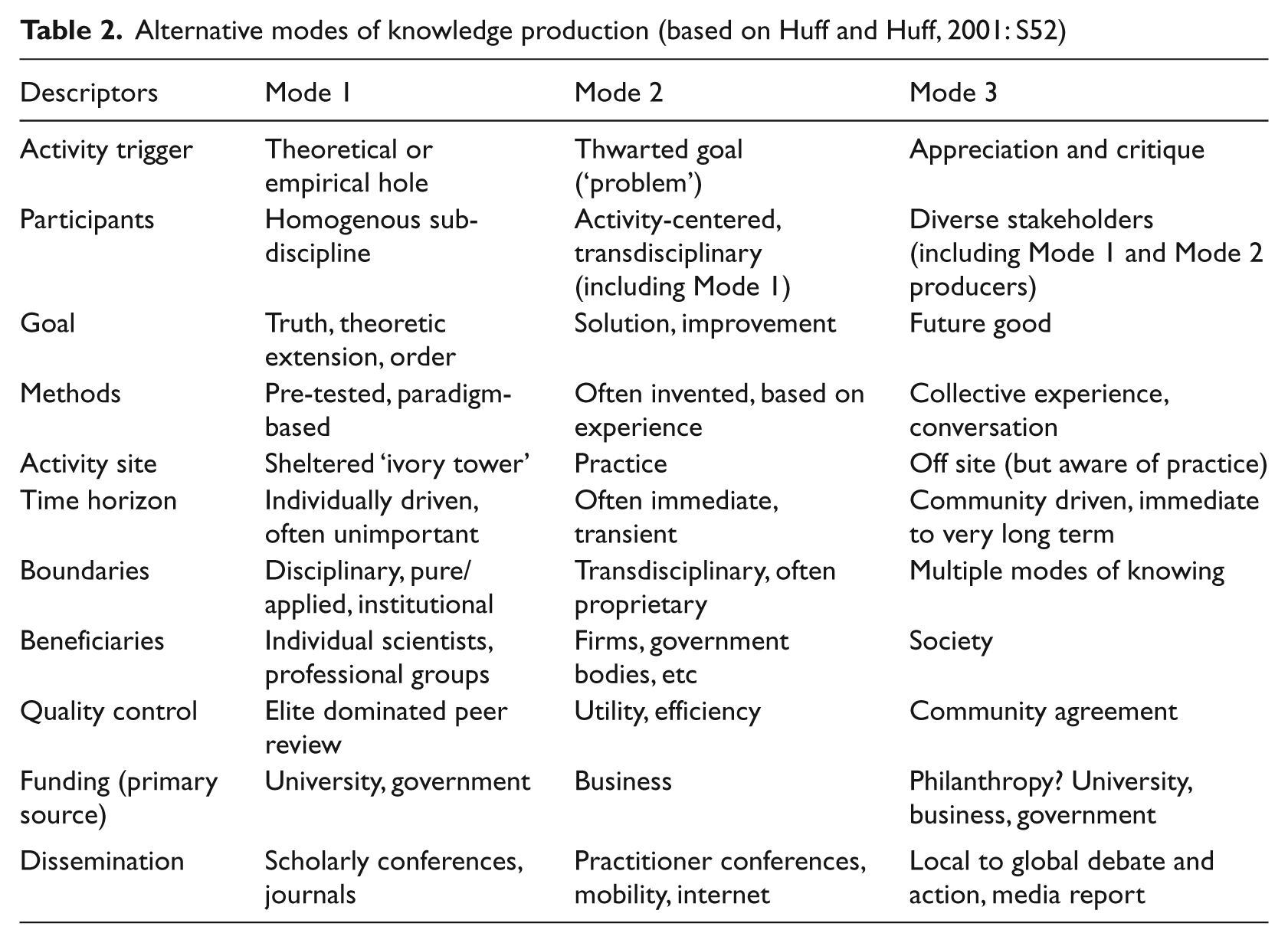
More muted support for the Mode 2 thesis came from the American Academy of Management. In her 1999 presidential address, Huff (2000) balanced sympathy with the Mode 2 approach with recognition of the challenges facing academics either striving to compete more effectively with consultants who ‘are skilled at seeking Mode 2 work and know how to perpetuate it’ (Huff, 2000: 291) or ‘who stay with Mode 1 [and] will have to improve their ability to convey the importance of the work they do’ (Huff, 2000: 290). Her solution was a Mode 1.5 which was not some transitional stage between the two, but ‘a difficult but desirable position “above” these modes of production’ (Huff, 2000: 292). Mode 1.5 seemingly involves relying on disciplinary knowledge and theory where Mode 2 experimentation is not possible or desirable, the generation of knowledge in the form of ‘public goods’, and the use of business schools as a forum for the creation of more ‘synthetic’ knowledge.
These ideas were elaborated further in the BJM special issue, by which time Mode 1.5 had transmogrified, mid-Atlantic, into Mode 3 (see Table 2 below). It should be noted that Mode 1.5 was presented by Huff to the Academy of Management (AoM) Conference and is orientated to a defence of the Business School. This contrasts, perhaps, with the model presented by Huff and Huff (2001) to the British Academy, where Mode 3 (which takes a more communitarian line in emphasizing a wider range of stakeholder interests) was outlined in response to BAM’s concerns to ‘modernize’ research. The British audience is offered Mode 3, the American audience, Mode 1.5. This difference has significance in that it may relate both to the lack of confidence in BAM’s academic seriousness and to the rise of AIM (Advanced Institute for Management), funded by the Treasury, which sought to produce measurable benefits to the British economy (and in which Huff was initially involved). Perhaps British research was seen as less distant from the industrial market place, less academically inclined, and less defensive of its claims to scientific rigour than work in leading business schools within the US? Most importantly, the AIM programme represented direct state involvement in business and management research. Arguably, this represents quite a different dynamic to knowledge production: namely, state patronage of research—an issue to which we will soon turn.
Alternative modes of knowledge production (based on Huff and Huff, 2001: S52)
At the same time, it was the wider debate surrounding the relationship between the rigour (implied by Mode 1) and the relevance (implied by Mode 2) and the possible inter-connectedness between them that has formed a platform for the continued resonance and impact of the Mode 2 thesis (Beech et al., 2010; Hodgkinson and Rousseau, 2009; Kieser and Leiner, 2009; Pettigrew, 2001; Starkey et al., 2009,). Whereas for some there is a clear symbiotic relationship between relevance and rigour (Bartunek, 2007; Van de Ven, 2007), much of the debate in this area centres upon the challenges and problems of combining relevance with rigour (Gulati, 2007; Jarzabkowski et al., 2010; Kieser and Leiner, 2009; Rynes et al., 2007).
Criticisms directed at Mode 2
Criticisms directed against Mode 2 and the ideal that it represents are fairly consistent and can be reduced to three key areas: lack of empirical support, lack of conceptual coherence and the concept’s normative underpinnings (cf. Hessels and van Lente, 2008: 755–756).
Regarding empirical support, the original thesis was particularly weak in its substantiation of the claims made about the rise of Mode 2. The text itself makes constant references to key (economic and societal) changes, but there are few data of real note. Over-inflated claims were made about the shift from a supposed Mode 1 to Mode 2 mode of knowledge production—and this is well recognized, even by its advocates in business and management studies (e.g. Starkey and Madan, 2001). Whilst Nowotny et al. (2001) made more of an effort to justify claims about the emergence of ‘contextualized science’, many commentators have stayed sceptical about Mode 2, particularly its supposed trans-disciplinarity (Godin, 1998; Weingart, 1997; Ziman, 1996). Even proponents of the approach now acknowledge ‘Perhaps we were too infatuated with the idea of Mode 2 and allowed the argument to run too far in this direction’ (Hodgkinson and Starkey, 2011: 360).
Notwithstanding several important attempts at journal citation analysis or content analysis (Hessels and van Lente, 2008; Nicolai and Seidl, 2010), little direct empirical attention has been paid to Mode 2 research in practice. Where Mode 2 research is the object of study, the nature and value of knowledge produced is often questioned (MacLean et al., 2002: 203). In reflecting on their own experiences, Mitev and Venters (2009) highlight the challenges faced in reaching consensus on the agendas, perspectives and expectations of collaborative research—experiences that resonate with one of the authors who has experienced the challenges of conducting research with industrial partners in the construction context where ‘large, multi-disciplinary projects … have more chance of producing benefits to society’ (Engineering Matters, April 2001: 1) (Bresnen and Marshall, 2000). Swan et al. (2010) further highlight the dialectical processes that can lead not only to the undermining of Mode 2, but also to the positive reinforcement of Mode 1 principles.
Regarding conceptual coherence, many continue to be highly critical of the distinction drawn between Mode 1 and Mode 2 and point to the many overlaps. Ziman (1996, 2000), for instance, argues that traditional (Mode 1) science placed a lot of emphasis on research being problem driven, and that the presumption of personal disinterestedness was highly questionable, given the pressures within professional scientific communities that steer research towards ‘acceptable’ lines of enquiry. He also asks whether ‘post-academic science’ gives scientists any real freedom to cross disciplinary boundaries, given the continued importance of disciplinary career structures. The effort required to deal with the highly structured mechanisms governing grant applications also makes a myth of the ‘attractively unbureaucratic’ nature of post-academic science (Ziman, 2000: 80–81). Similar arguments are made by others who contest the ideas that Mode 1 was the original form of research and that Mode 2 is something new—especially in the applied and social sciences (Etkowitz and Leydesdorff, 2000; Godin, 1998; Rip, 2000; Weingart, 1997). These criticisms are added to by those who question the internal coherence of Mode 2 (McLean et al., 2002: Rip, 2002) or who argue that collapsing all forms of science into two main approaches is far too simplistic (Hodgkinson et al., 2001; Starkey and Madan, 2001). Even where alternatives are explored (e.g. Hodgkinson et al., 2001), it is hard not to see in these efforts a clear preference for one type of science over others—or, until recently, any attempt to transcend the associated dualism of rigour and relevance (Hodgkinson and Starkey, 2011; Thorpe et al., 2011).
Regarding Mode 2’s normative underpinning, many have highlighted the tendency to conflate description and prescription so that, rather than presenting an objective description and analysis of developments in scientific practice, it tends to promote Mode 2—despite the claim that ‘No judgement is made as to the value of these trends’ (Gibbons et al., 1994: 1). Others have argued that Mode 2 reinforces the loss of academic autonomy and the subordination of academic science to market forces (Grey, 2001). Ziman (2000) notes that the proprietary control of research can inhibit the development and spread of knowledge. Within business and management studies, Learmonth et al. (2012) argue that it promotes a taken-for-grantedness about what is considered ‘useful’ or ‘useless’ research, that fails to take into account the susceptibility of research to managerial fads and fashions, as well as to relations of power (Grey, 2001).
Ironically, much of this debate has proceeded from (and, in turn, reinforced?) the academic institutional context of which the proponents of Mode 2 are so often critical. Various institutional actors have become involved in ‘knowledge production about knowledge production’ but some still bemoan the fact that the debate is ‘conducted by academics writing in academic journals, rather than taking action to make their work more relevant’ (Thorpe et al., 2011: 420). Similarly, with regard to transdisiplinarity, ‘engaged scholarship is still limited, because it involves practitioners on academic terms’ (Bartunek (2007: 1328). Institutional heterogeneity is of course much more in evidence—through research funding mechanisms, capacity building initiatives and pressures to demonstrate ‘impact’ in research assessments (Thorpe et al., 2011). But this does not mean any less importance being attached to the objectivity associated with ‘good science’ (Ziman, 2000). As Hodgkinson and Starkey (2011: 366) put it: ‘the desire to compete academically in world-class terms has driven and continues to drive many capable scholars towards Mode 1’ (Hodgkinson and Starkey, 2011: 360). Peer review continues to dominate and new forms of quality control are comparatively rare, although editorial gate-keeping has clearly played an important role in legitimizing Mode 2 (Bartunek 2007).
These continuing debates and consequent ironies themselves signal up inherent tensions and contradictions in efforts to legitimize a logic of knowledge production based on Mode 2 principles. But they also skate over (and leave undisturbed) a deeper undercurrent of power dynamics that has long had an effect on attempts to promote ‘relevance’. It is to a surfacing of these undercurrents that the article now turns.
Back to the future? Mode 0 knowledge production
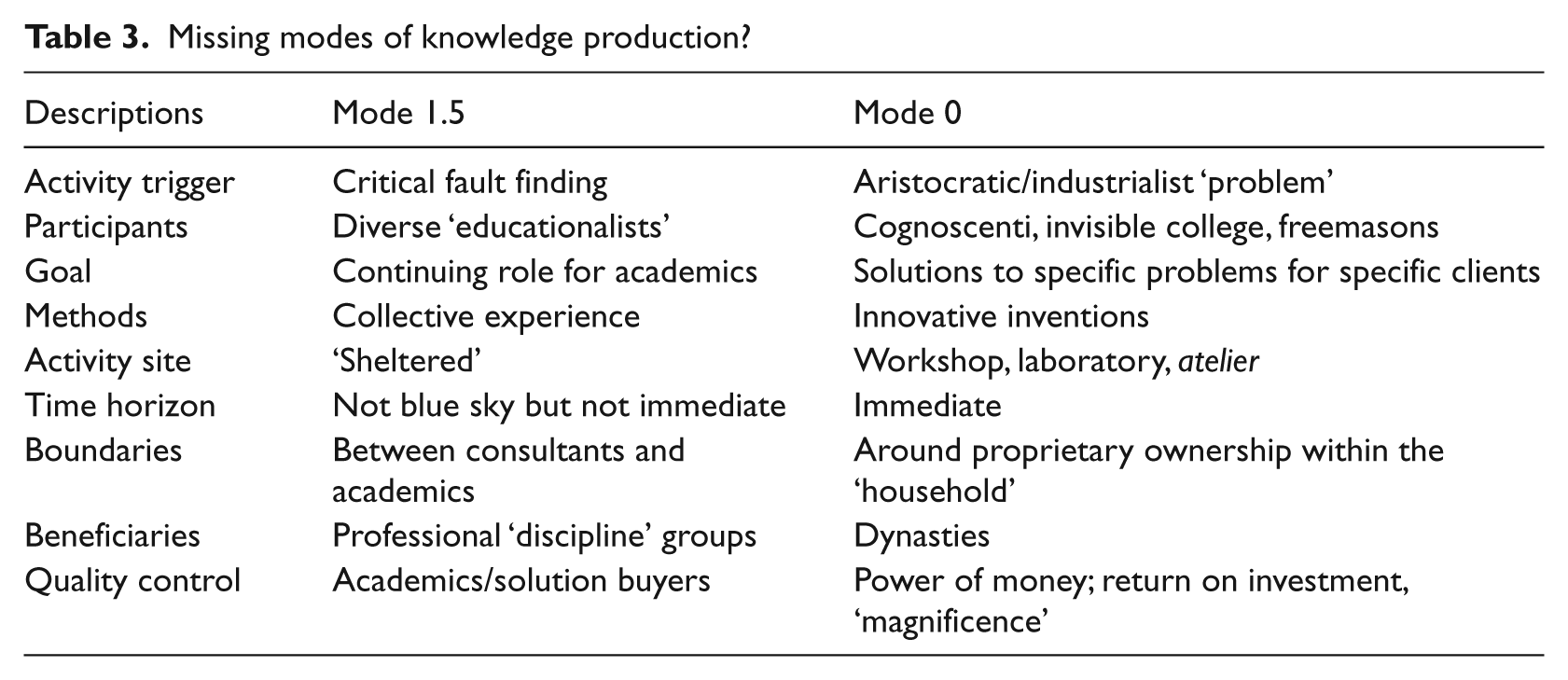
What is being suggested here is that another way of understanding developments in modes of knowledge production is to reach back further, as some already do, to examine how Modes 2 (and 3) are redolent of much earlier forms of ‘knowledge production’ that not only pre-date Mode 1 but also highlight the impact of relations of power within the formulation of (management) knowledge in ways that resonate with contemporary clarion calls for greater engagement. We refer to this as a Mode 0 form of knowledge production and contrast this with Modes 1, 2 and 3 (and specifically with Mode 1.5) in Table 3 below.
Missing modes of knowledge production?
Mode 0 is based upon an interpretive reading of the history of knowledge production in early modern Western Europe. Ziman’s work is again of interest as it signals up an antecedent and quite central tradition in academic science which could not be described as Mode 1. According to Ziman, ‘It was, quite simply, patronage. It was the convention by which society provided resources for the production of knowledge without insisting that they should be accounted for, in prospect or retrospect, in utilitarian terms. This convention may now seem elitist, irresponsible and inefficient but it worked remarkably well in its time’ (Ziman, 1996: 80).
Long before Mode 1 existed, Western Europe faced a form of knowledge production based on patronage. David claims that: ‘The system of aristocratic patronage of creative activity—the patronage of artists, architects, musicians and savants by bishops, kings, dukes and princes—had become firmly rooted in Western Europe during the Late Renaissance’ (David, 2008: 33). This patronage involved noble families employing ‘savants and virtuosos’ for both utilitarian and ornamental purposes (David 2008: 34). Engineers of weapons of war and the constructors of irrigation and flood defences were brought to the Court for their utility, but virtuosos were called upon to add to the ‘magnificence’ of their employer. Both objectives—military/engineering success and the enhancement of reputation and status—were seen as legitimate. The former required secrecy so that technologies could be researched in private; whereas art and musical performances needed to be made public to impress the European world. This question of openness or closure continues, of course, to haunt the production of scientific knowledge.
Openness and closure within the class system are also highly relevant. ‘Science’ had to possess class credentials. According to Jewson (1974: 369), the medical profession in the 18th century faced a dilemma in finding patronage for their activities: ‘The career system constrained physicians both to establish their credentials as members of the upper class and to advertise their services by individual display’. Similarly, David (2008: 61) tells us ‘family connections and alliances, political and theological factions, social graces and much else besides were considered relevant’ in the decision to patronise particular individuals. He goes on to emphasize these enduring features of knowledge production by suggesting that, for scientists, ‘operating in scientific research communities today parallel in many respects those which have been seen to have characterized the system of European Court patronage’ (David, 2008: 84).
These two points about the continuation of such practices in the contemporary world should be underscored. Rewards for scientific endeavour under the sponsorship of ‘outside’ bodies such as the large Foundations are significant and carry with them high prestige. Rockefeller, Ford, Wellcome, Gates and Leverhulme are all Foundational names derived from the highly profitable endeavours of industrialists of various sorts. These Foundations are noted for their support of scientific work including generous payments in cash and in kind to their sponsees. Access to this largesse is not open. Patronage of scientific work today relies to be sure upon the technical efficacy of the scientist but it also involves decisions about other credentials to do with social status and connections. Track record, institutional location, previous posts, referees and so on all provide ‘social’ cues to scientific reliability (Ravetz, 1972). To that extent it retains elements of a closed system—a closed shop.
‘Open science’, of course, was meant to replace the secret world of court patronage. The term ‘invisible college’ was used by Robert Boyle to describe the small group of natural philosophers whose dealings with each other led to the formation of The Royal Society. Supposedly, secrecy was eschewed by members in the desire to open up debate and contestation in scientific research, so as to make public key findings and theoretical progress (Dillon, 2006: 99–100). But here again, whilst supposedly embracing Modernity, the Royal Society was very much a closed shop. The Royal Society and its satellite groupings were influenced by male bonding and the trappings of what was effectively a secret society, for Freemasonry was well established in scientific communities across Europe. Secrecy was often maintained within the Invisible College because closure enshrined the rights of the members to status and influence—particularly over Charles II, who regarded The Royal Society not as a source of personal knowledge but as a useful appendage to the magnificence of his own power (Schama, 2001).
The adulation of Newtonian science was an official part of Masonic belief in London where the Lodges offered a meeting place for tradesmen and gentlemen behind closed doors. What Newtonianism had offered was a view of science heavily influenced by the cabbala, dependent upon esoteric mathematics, and full of secret and powerful groupings. The Royal Society and the groups upon which it drew, relied heavily upon Star Chamber mentality. The Star Chamber was the court of civil and criminal jurisdiction held in Westminster and only abolished in 1641. It was so called probably because it was the place where Jewish documents (starrs), some of which related to the cabbala, were stored in chests. It was notorious for its arbitrary proceedings and verdicts, often suggesting punishments for offences which the law did not recognize. Many judgements did not require substantiation. Causes and outcomes were divined and were not open to challenge unless it came from within. Honours could be awarded, careers and lives could be taken away. Opposition was marginalized. There was, then, a Mode 0 of scientific development which was steeped in secrecy and the ways of alchemy. As Deleuze and Guattari (1988: 373) point out ‘The royal sciences, for their part … surround themselves with much priestliness and magic’. In the UK today, such Star Chambers operate throughout the social sciences.
The key point perhaps is that ‘The early Newtonians rendered their science comprehensible to an audience that could be either genteel and educated or commercial and practical’ (Jacob, 1988: 136). Those scientists in pursuit of the ‘genteel and educated’ drummed up support by touring the coffee houses and offering pulpit lectures. By the 1760s this was a very popular form of propagandizing so that where ‘commercial and practical’ audiences were concerned, the emphasis on mechanics and utility in the creation of a society embracing industrial capitalism was ubiquitous. Pace the Gibbons et al. (1994) claim that we are witnessing this today for the first time, a basic reading in the history of science would make that position untenable.
Moreover, in rendering this 18th century mode of knowledge production acceptable, Mode 0 was heavily class- and gender-based. Whilst Jones (2009) argues that men of the lower middle class or from the provinces could find it difficult to gain access to professional science, it was women who were deliberately kept out. Watts (2007) shows that Mary Evelyn was excluded from the Royal Society, despite working on experiments collaboratively with her Oxford based husband who was allowed membership. Noordenbos (2002) demonstrates that, in France, aristocratic women developed ‘salonieres’ where conversation and debate about scientific endeavour could take place between men and women. In widening access to developments in knowledge outside of aristocratic circles and beyond the ranks of the Freemasons (Landes, 1998: 76) such women played a key role. Hence ‘open science’ did increase the transmission of scientific findings around a small group of savants, but it relied upon Royal Patronage rather than the decentralized patronage of members of the Court, reflecting the move across Europe to Absolutism. Openness and transparency then only went so far.
Margaret Jacob (1988: 135) suggests that Newton’s ideology was central to later, industrially inspired, developments. David (2008: 84) tells us that Royal and aristocratic patronage began to lose their strength as new sources of patronage came into prominence. The aristocracy were now being rivalled by a new class of industrialists, with a non-metropolitan location. Matthew Bolton’s successful perfection of the steam engine, for example, was achieved because ‘his factory was one huge laboratory of applied mechanics’ (Hill, 1969: 252). There is little that is new therefore about a Mode 2 rejection of academic purity and working with and for extra-mural paymasters. Much of science was sponsored by the wealthy and undertaken by the wealthy. The notion of the free researcher cosseted within the cloister does not sit well with the evidence. The idea that science was carried out by an elite who were entowered in the universities, to many intents and purposes died with the Newtonian Revolution and the embarkation of Western societies upon the long day’s journey into industrialization.
The new repositories of the necessary resources to employ significant numbers of well supported and well founded savants were now industry and the state—the latter no longer in the form of the monarch, but as the ‘State’ controlled by a fusion of aristocratic and plutocratic forces exercising power through parliamentary control. Industry, of course, is one such source of plutocratic power—and an important one at that—but so too is the rise of financial institutions and the banks. In Germany, the banks and industrial corporations were much more closely allied than they were in the British context and it should not surprise us that it was there that the reforms of the university system to create Humboldt’s vision of a university in the service of the State arose. So it is in 19th century Germany—we must note, carefully—that Mode 1 arises. In Britain, on the other hand, the large universities of today were founded and controlled by local worthies (such as the Wills tobacco family in Bristol) and had strong regional connections (Shattock, 2006). Universities were seen as drivers of late Victorian industrial development with an emphasis upon engineering, chemistry and mining. Thus it was for half a century. For a brief time after World War II, this provincial bias changed, so that the (non-Oxbridge) model of the UK university controlled by its Senate (of cosmopolitan academics) emerged to serve more national and international interests. But this lasted only until the 1990s so that, today, universities are (re) controlled by Councils with heavy representation of local and regional business interests. The patronage of the Barons has returned to many a British university, as careful study of their ruling Councils will show.
Conclusion
Mode 0 is based upon an interpretive reading of the history of knowledge production in early modern Western Europe which massively predates that of Mode 1. Our point is that all discussions of the ‘new production of knowledge’ are heavily under-theorized when it comes to the ‘old’ production of knowledge—as many commentators acknowledge when it comes to Mode 2, but rather fewer note when it comes to Mode 1 (Hessels and van Lente, 2008). This lacuna might be thought to be unforgiveable. We might also wish to contemplate the possibility that Mode 0 has been with us constantly since the 17th century, only in a hidden form, the better to have its security maintained by obscurity. In the British context at least, academic life may face a situation in which Mode 0 is re-asserting itself—particularly when it comes to the sponsoring closeness of patronage in medical research (the pharmaceutical companies), engineering (the defence industries), finance (the City, Wall Street), actuarial statistics (insurance companies), jurisprudence (the market for international law) and the market in fine/high art. The class structure of society and its reinforcement in the ancient universities creates pathways to sponsorship and patronage which are by no means open to all. That exclusivity is their specific function. The growth in (self) importance of the Russell Group of UK ‘research intensive universities’ further stratifies the system. Blue chip companies continue to recruit new managerial and scientific cadres en masse from the ancient universities. Whilst nominally open to all academic researchers, competitive bidding systems effectively require elite sponsorship through access, high levels of staffing, equipment and laboratories. And this patronage is no different from the 17th and 18th centuries. To them that hath shall be given.
Mode 0 is found today then wherever we look in the world of UK science—and arguably beyond. There is secrecy about and within research groups, concerned more with the protection of data and what they are used for, than with openness. In the pharmaceutical industry, sponsorship has thrown up real issues concerning the trustworthiness of raw data and interpretations based upon them. Research is undertaken on behalf of the great Foundations including, of course, (but to a lessening extent) the State. Analysis of these Foundations might suggest a bias towards entrepreneurial attitudes (for example to health) contained within a paternalistic discourse of patrician largesse. It might even suggest deep psychological needs to assuage past conduct as, for example, in the cases of Carnegie and Nobel—Scottish libraries benefitted from the former and ‘Peace’ from the latter. Kudos and magnificence is garnered by the Foundation as well as by the research team. Organization theorists may find it difficult to see the centrality of the production of luxury goods in much research, but it is there—in art history, cosmetic treatments, weaponry for military elites, meteorological observations for insurance companies, geographical information for the CIA and surveillance technology for observing everyone. The perpetuation of dynastic power pervades all this scientific work, as it did in the times of the Royal Society. Magnificence and utility continue to go hand in hand in the realm of the patrician patron.
Yet both Mode 3 and Mode 2 fail to come to terms with this long tradition in the construction of scientific endeavour. As the post-2008 State apparatus withdraws from whole areas of science, Mode 0 represents the dominance of non-state (i.e. private) patronage of academic endeavour. It is about knowledge for dynasties, knowledge for their magnificence and for their utility. Its return on investment is measured not in terms of any benefits for the population but on the good standing—the ‘name’ of the benefactor—and its longevity in the eye of the powerful. Perhaps it can be considered ‘the missing mode of knowledge production’ that is all around us, secure in its obscurity. It is the style of knowledge production that we in organization studies have under-theorized because it is insinuated within the largely invisible province of the ‘savants’ welcomed to gentlemen’s clubs and at High Table. Mode 0 then takes place behind closed doors—but these barriers may open up a little if we pry hard enough. We invite readers of Organization to contemplate more forceful prying of enduring elites (cf. Reed, 2012), shifting the emphasis away from an obsession with the questions raised by the Mode 1/ Mode 2 debate about exactly how useful we can or should be in addressing the day to day worries of middle management.