




Abstract
The leadership literature is full of stories of heroic self-sacrifice. Sacrificial leadership behaviour, some scholars conclude, is to be recommended. In this article we follow Keith Grint’s conceptualization of leadership as necessarily pertaining to the sacred, but—drawing on Giorgio Agamben’s notion of profanation—we highlight the need for organization scholars to profane the sacralizations embedded in leadership thinking. One example of this, which guides us throughout the article, is the novel A Wild Sheep Chase, by the Japanese author Haruki Murakami. By means of a thematic reading of the novel, we discuss how it contributes to profaning particular notions of sacrifice and the sacred in leadership thinking. In the novel, self-sacrifice does not function as a way of establishing a leadership position, but as a way to avoid the dangers associated with leadership, and possibly redeem humans from their current collective urge to become leaders. Inspired by Murakami’s fictional example, we call organization scholars to engage in profanation of leadership studies and, in doing so, open new vistas for leadership theory and practice.
Rather than being predictive or descriptive, leadership theories are better described as prescriptive (Ciulla, 1995). By and large, leadership studies are concerned with the provision of desirable models for leadership. Leadership theorists may even be characterized as sculptors of attractive images of leadership designed to capture and form the desires of both leaders and followers (Spoelstra and Ten Bos, 2011). Myths about great leaders from the past help to create these attractive models and often figure in academic texts on leadership (e.g. Burns, 1978; Gardner, 1997). Stories about literary fictional characters work in a similar way (Villiers, 2011). To give one example, articulating his conception of ‘servant leadership’, Robert Greenleaf (2002/1977) acknowledges that he was inspired by a fictional character in Hermann Hesse’s Journey to the East. However fictional they may be, these images and myths of leadership have real effects. They appeal to managers’ self-image as well as providing scripts, plots and characters that managers can utilize, and improvize upon, in order to perform leadership.
One of the most abiding myths of leadership has been that of the heroic leader who takes risks and makes significant personal sacrifices in order to lead an organization to greatness. As Keith Grint (2010) has recently argued, this link between sacrifice and leadership is not coincidental: leadership can only function through threefold processes of separation, sacrifice and silencing. These processes together create a sacred space of leadership that distinguishes it from other activities, notably management. In short, it is through being sacralized that the social space in which leadership is performed comes into being. In this article we suggest that leadership theories partake in this process and follow the same logic. Leadership theories sacralize both leaders and leadership as a function. They create images of leadership that are sacred and therefore cannot be touched (Agamben, 2007). For example, when scholars began to point out the dangers of charisma—one of the defining characteristics of transformational leadership—the proponents of transformational leadership were quick to reply that ‘authentic’ transformational leadership could never be morally questionable (Bass and Steidlmeier, 1999). Sealed off in a sacred, untouchable space, the goodness of leadership becomes elevated to lie beyond challenge. Any moral problems encountered in organizational practice are therefore not to be associated with the leadership concept in question (Spoelstra and Ten Bos, 2011).
In this article we argue that extant critical leadership studies literature offers three main strategies for countering the sacralizations inherent in leadership studies: demystification, the creation of counter-myths and profanation. Apart from putting forward this typology, our objective is to advance the latter of these, which, to date, has been the least developed in leadership studies. In particular, we focus on the ways in which leadership scholars have recently begun to advocate self-sacrificial leadership behaviour. We argue that these studies sacralize particular forms of leadership, and further that such sacralizations call for profanation because of the problematic effects they produce. Against this background, we read Haruki Murakami’s novel A Wild Sheep Chase as a profanation of conceptions of leadership in general and of self-sacrificial leadership in particular.
The nameless protagonist of the novel is a co-founder of a media and advertising agency. All of a sudden, he finds himself chasing a mystical sheep who, by way of entering their bodies, turns ordinary people into leaders. The protagonist’s friend, called ‘the Rat’, however, kills himself as the sheep finally attempts to take possession of him. We use this story to reflect upon the leadership literature. In our reading, the novel and its convoluted narrative twists explore two processes relevant to our analysis of self-sacrifice in leadership studies which we attend to in the following order. First, we show how the novel displays the process of the sacralization of leadership by exaggerating that which separates leadership from mundane reality and applies this logic to figurations of leadership that can be found within leadership studies. Second, we argue that the novel offers its own take on the relation between leadership and self-sacrifice through problematizing the function of scapegoating and pointing to the precarious processes of redemption in the context of leadership.
We proceed as follows. In the first section we provide an overview of the notions of sacrifice and the sacred in leadership literature, and argue that leadership studies thrive on the production of sacred spaces. We then introduce Giorgio Agamben’s (2007) concept of profanation, and show how, in relation to critical leadership studies, profanation is different from demystification and the creation of counter-myths, which we identify as other strategies applied by critical leadership scholars. After a discussion of our method, we provide an outline of the novel in terms of leadership. We continue by analysing examples of profanations of notions of leadership found in A Wild Sheep Chase. We particularly focus on the self-sacrifice of the Rat, and relate this act to the concept of self-sacrifice in leadership studies. In the conclusion, we reflect upon Murakami’s implicit profanation of leadership theories and our own explicit one, and call on organizational scholars to continuously profane sacralized notions of leadership. We also comment on the potential and limitations of fiction and profanation as a method in organization studies.
(Self-)sacrifice and the sacred in leadership studies
The theme of self-sacrifice is particularly strong in so-called ‘heroic leadership approaches’ such as transformational leadership and charismatic leadership, which have dominated leadership studies since the 1980s (Parry and Bryman, 2006). Within these approaches, self-sacrifice is primarily attributed to heroic leaders, who may sacrifice themselves ‘in the service of a beneficial cause’ (Shamir et al., 1993: 582). One typical example, often mentioned in the literature, is Lee Iacocca, who reduced his salary to one dollar in his first year as CEO of Chrysler. But self-sacrifice is not only a feature of leaders. It may also be seen among followers, since charismatic leaders often have ‘expectations for follower self-sacrifice and for performance beyond the call of duty’ (Shamir et al., 1993: 578). In fact, the self-sacrifice of the leader and self-sacrifice of followers stand in direct relation to one another: the leader’s self-sacrifice may result in the charisma that inspires followers to sacrifice themselves in return (Conger and Kanungo, 1987). In his autobiography, Iacocca described this exchange of self-sacrifices as ‘equality of sacrifice’ which, according to him, was the secret to Chrysler’s much celebrated resurrection: When I started to sacrifice, I saw other people do whatever was necessary. And that’s how Chrysler pulled through. It wasn’t the loans that saved us, although we needed them badly. It was the hundreds of millions of dollars that were given up by everybody involved. (Iacocca 1984: 242)
Self-sacrifice among leaders has the power to trigger self-sacrifices among followers, which would then result in improved business performance. According to transformational leadership scholar Bruce Avolio, the ‘utility of their sacrifices’ is very much on the mind of most self-sacrificing leaders (Avolio and Locke, 2002: 177).
The first articles to systematically discuss self-sacrifice in leadership appear in the late 1990s but have since come to constitute a research topic in its own right (Choi and Mai-Dalton, 1998, 1999; De Cremer and Knippenberg, 2004a, 2004b, 2004c; Javidan and Carl, 2004; Matteson and Irving, 2006; Singh and Krishnan, 2008; Yorges et al., 1999). In these studies self-sacrifice is commonly defined as the abandonment of the leader’s self-interest in favour of his or her followers, their organization or the common good. One representative definition is offered by Choi and Mai-Dalton (1999: 399): ‘self-sacrifice in organizational settings is defined as the total/partial abandonment, and/or permanent/temporary postponement of personal interests, privileges, or welfare in the (1) division of labour, (2) distribution of rewards and (3) exercise of power’. The subsequent question that these studies ask is: ‘What are the benefits of self-sacrificing leadership behaviour for organizations?’. Typical findings include that self-sacrifice leads to the attribution of charisma (Choi and Mai-Dalton, 1999; Conger and Kanungo, 1987; De Cremer and Knippenberg, 2004c), the establishment of legitimacy (Choi and Mai-Dalton, 1999), the encouragement of follower reciprocity (Choi and Mai-Dalton, 1999), an increase in organizational commitment and team efficiency (De Cremer et al., 2004; Yoon, 2006), and a decrease in perceived autocracy (De Cremer et al., 2004). Most of these studies, then, confirm Iacocca’s conclusion that self-sacrificial leadership behaviour can be a profitable strategy for organizations. Since the generation of organizational benefit is deemed to be a business leader’s main concern, this instrumentalization raises questions of whether any real sacrifice is taking place. As in Mauss’ (1970) classic study The Gift, there is a question over whether the sacrifice is really freely given, or whether it is simply an investment or moment in a broader process of calculation and exchange (Dunne and Spoelstra, 2010).
However, the popularity of the theme of sacrifice in leadership studies is not limited to cost-benefit analysis. More normative-oriented studies also exist. Bass and Steidlmeier (1999), for example, have used self-sacrifice or the abandonment of self-interest as a way of distinguishing ‘pseudo-authentic leaders’, who ‘profess strong attachment to their organization and its people but privately are ready to sacrifice them’ (Bass and Steidlmeier, 1999: 187), from authentic leaders who engage in self-sacrifice ‘for the sake of attaining virtue and justice’ (Bass and Steidlmeier, 1999: 195). In other words, for Bass and Steidlmeier authentic leaders are not engaged in self-sacrifice to make a profit, but have a genuine orientation towards the good. This normative approach towards sacrifice and self-sacrifice can also be read into some earlier work on transformational leadership (Burns, 1978) and servant leadership (Greenleaf, 2002/1977). Even though these works rarely explicitly use the term sacrifice, they also portray ideal leadership as rooted in an abandonment of self-interest. For example, Greenleaf’s idea of the leader as servant suggests that great leaders abandon their own interests when serving their followers. For Greenleaf it is not enough to make self-sacrifices that promise a good return on investment. To truly serve means that one gives without reciprocity in the form of power or status. Indeed, the ‘genuine humility’ that characterizes the great leader must also be ‘open and ready to receive the gifts of others, whatever they may be’ (Greenleaf, 2002/1977: 325).
Similar images of successful and/or moral leadership can also be found in popular leadership books. In Good to Great, Jim Collins (2001: 21) argues that the leader releases him or herself from subjectively derived self-interest in order to exercise what he calls ‘extreme personal humility’. ‘Level 5 leaders’, Collins’ term for supreme leadership, ‘channel their ego needs away from themselves and into the larger goal of building a great company’. In popular segments of the leadership literature one also finds frequent references to great figures such as Socrates, Jesus and Gandhi, portrayed as the best examples of leaders who sacrifice their own interest for a higher ideal. Koestenbaum (2002: 128) even refers to Socrates when he concludes that ‘the bottom line’ for business leaders, as any other leader, ‘is the willingness to die. To risk death is to risk oneself, even sacrifice oneself, for the sake of the company or the customer, the partnership or the client—for what is right’.
This line of argument establishes a direct link between (self-)sacrifice and scapegoating, as also pointed out by Grint (2010). It is either implicitly or explicitly expressed by the collective, who has been led astray into for instance economic or moral crisis: the leader who either gives up his (sic) wages or leaves office takes on a collective guilt, and becomes himself the sacrificial victim (Grint, 2010: 99). In René Girard’s (1977, 1987; see also Desmond and Kavanagh, 2003) theory of mimetic desire, the stable and continuous organization of the social rests upon a repeated ritual that can restore order in the crisis where everyone mimes the desire of everyone else. This ritual is the sacrifice of a scapegoat who, for instance during the carnival, is made king and after that ceremoniously executed. Girard (1977) further argues that the sacrifice of Christ is (the beginning of) the end of sacrificial killings, since it produces redemption: Christ’s death concerns everybody and intends to break with the logic of scapegoating. This redemptive event has already, in Girard’s (Catholic) view, had social consequences in the West’s history and its development of, for instance, the welfare states. In some fundamental (if Girardian) sense, such sacrifice is also the end to heroic theories of leadership, since these are bound to continue the vicious circle of making and breaking a king/hero/leader.
More recently, then, leadership studies has started to develop post-heroic approaches to leadership (Collinson and Collinson, 2005; Fletcher, 2004; Parry and Bryman, 2006). These approaches attempt to break with the assumption that effective leadership is dependent on one single heroic figure. Instead, they argue for collective forms of leadership, emphasizing the role that followers play in the constitution of leadership (Howell and Shamir, 2005; Shamir, 2007), or arguing that ‘self-leadership’ has become important for all organizational members (Manz and Sims, 2001). One example of a post-heroic approach is ‘shared leadership’ (Pearce and Conger, 2003; Raelin, 2003), which proposes leadership without leaders, or at least without one central leader. This idea lies also at the heart of so-called ‘distributed leadership’ (Gronn, 2002), which holds that leadership can be found ‘not solely in the individual at the top, but in every person at entry level who in one way or another, acts as a leader’ (Goleman, 2002: 14, cited in Grint, 2010: 90).
One may question, however, whether it still makes sense to use the term ‘leadership’ when the subject of analysis can perhaps be better understood with reference to other topics within organization studies, like group behaviour, team building, team work, spontaneous organization and synergy, horizontal control or alternative forms of organization. In other words, the problem with post-heroic approaches to leadership is that they might be said to make the very concept of leadership disappear. Grint’s analysis of leadership explains why this may be the case, and this pertains directly to our interest in sacrifice and the sacred in this article. For Grint (2010: 89), leadership is the social space created by sacralization: the sacred is ‘not so much the elephant in the room but the room itself—the space that allows leadership to work’. Self-sacrificial leadership behaviour, as advanced in leadership studies, has precisely this function: it attempts to map the organizational advantages of sacralizing the leader. Some post-heroic leadership approaches, in contrast, attempt to think leadership without sacralization, hence contradicting the very nature of leadership. Grint (2010) therefore questions the very possibility of post-heroic leadership, suggesting that conceptually it is at worst oxymoronic and at best unrealistic.
Grint’s critique of post-heroic leadership is not limited to this conceptual point. His thesis that we cannot dispose of leadership by replacing it with other functions also has an important ethical and political dimension. In referring to the ‘execution of distasteful but necessary tasks by leaders’ (2010: 94, emphasis added), Grint at times appears to suggest that there is something desirable in leadership that organizations should not do without. For example, contesting the sacred space of leadership may result in ‘removing the possibility of decision-making’ (Grint, 2010: 103) or it could ‘destabilize the ability of an organization to function’ (Grint, 2010: 103). But Grint himself does not justify this necessity of the sacred space of leadership in organizations, apart from referring to Harter et al. (2006), who have argued that leadership causes a form of inequality that is ‘mutually beneficial’ for leader and led (Grint, 2010: 95). From such a position, the ideal of a democratic, post-heroic leadership is not only conceptually impossible—because ‘leadership’ is defined by the sacred space that it produces—but is also undesirable.
To summarize, Grint shows that the forms of self-sacrificial leadership behaviour promoted in leadership studies (and by business leaders such as Lee Iaccoca) are directly linked to the nature of leadership itself: by means of self-sacrificial behaviour a sacred space is established that is constitutive of leadership practice. This is a valid point and an important insight for the study of leadership. However, we take issue with the idea that these sacred spaces are beyond contestation. The fact that sacred spaces are needed for leadership does not mean that they are needed for, say, organizations or society. Indeed, leadership scholars have for a long time pointed towards some of the negative effects associated with leadership practices. The power structures that the sacred spaces of leadership can consecrate are well-known, though relatively ‘silenced’ in the leadership literature. For example, one early study of leadership (Tead, 1935: 211) notes that ‘when people are in a position to exercise power over others, certain dangers are likely to creep in’. These dangers include ‘emotional instability’, ‘obsessive fears’, ‘inferiority feelings’ and ‘sadistic tendencies’ (Tead, 1935). Some of these dangers resonate with more recent writings that associate leaders with narcissism (Kets de Vries, 1985), followership with helplessness and alienation (Gemill and Oakley, 1992), and leadership with masculine bias and gender discrimination (Calás and Smircich, 1991). Others have pointed towards the negative cultural effects of a strong belief in the charismatic leader as some kind of ‘saviour’ (Khurana, 2002; Rieff, 2007). Grint’s insight that leadership phenomena by definition include sacred spaces reminds us that these dangers are not only to be explained in terms of the personality of the leader, but are also actualized through the sacred spaces in which the relation between leaders and followers is consecrated. In our view, it belongs to the task of critical leadership studies to challenge these sacred spaces. In the next section, we propose the profanation of leadership as an important way of challenging the sacred in leadership, and distinguish this approach from two already established ways of challenging sacralizations, namely demystification and the creation of counter-myths.
From the sacred to the profane
In the previous section, we have argued with Grint that leadership in practice is established by means of sacred spaces, which are separated from the mundane. In common parlance, the opposite of the sacred is often understood to be the secular. However, as Agamben (2007) points out, the original opposition to the sacred was ‘the profane’. It was only later that Christianity paired it with the opposition ‘the secular’ (de la Durantaye, 2009: 378). In this section, the distinction between the secular and the profane is crucial: following Agamben, we see processes of secularization not as an undoing of the sacred, but as a transfer of the sacred to an apparently non-religious context (see Table 1). As Agamben (2007: 77) puts it, secularization is a form of ‘repression’ that ‘leaves intact the forces it deals with by simply moving them from one place to another’. In other words, in secularization sacred spaces are not challenged; they remain operative but in a secular sphere. This is also why Grint’s analysis of leadership in terms of the sacred should not be understood metaphorically: much of popular and academic thinking on leadership draws upon religious notions and structures, but places them in a business (i.e. secular) context. Here one can think of concepts such as ‘charismatic leadership’, ‘visionary leadership’ and ‘spiritual leadership’, which have obvious religious connotations (for a further discussion of how theological concepts more generally reappear in management studies, see Sørensen et al., 2012). But even when the words that are used to describe forms of leadership are less explicitly of religious origin, as in concepts such as ‘transformational leadership’ and ‘authentic leadership’, they still remove someone or something from ordinary life, and are in this sense established by the creation of sacred spaces in a non-religious context. An example of this is the previously mentioned response of Bass and Steidlmeier (1999) to critiques of transformational leadership, namely that, due to the moral purity inherent in ‘authentic’ transformational leadership, it can never be tainted with morally ambiguous actions. This logic of argumentation also echoes in another influential article in leadership studies by Avolio and Gardner (2005: 315), which suggests that authentic leadership is ‘the root of positive forms of leadership’. This directly reminds of the theological argument for the goodness of God from which all earthly good is said to derive.
Sacralization and secularization.
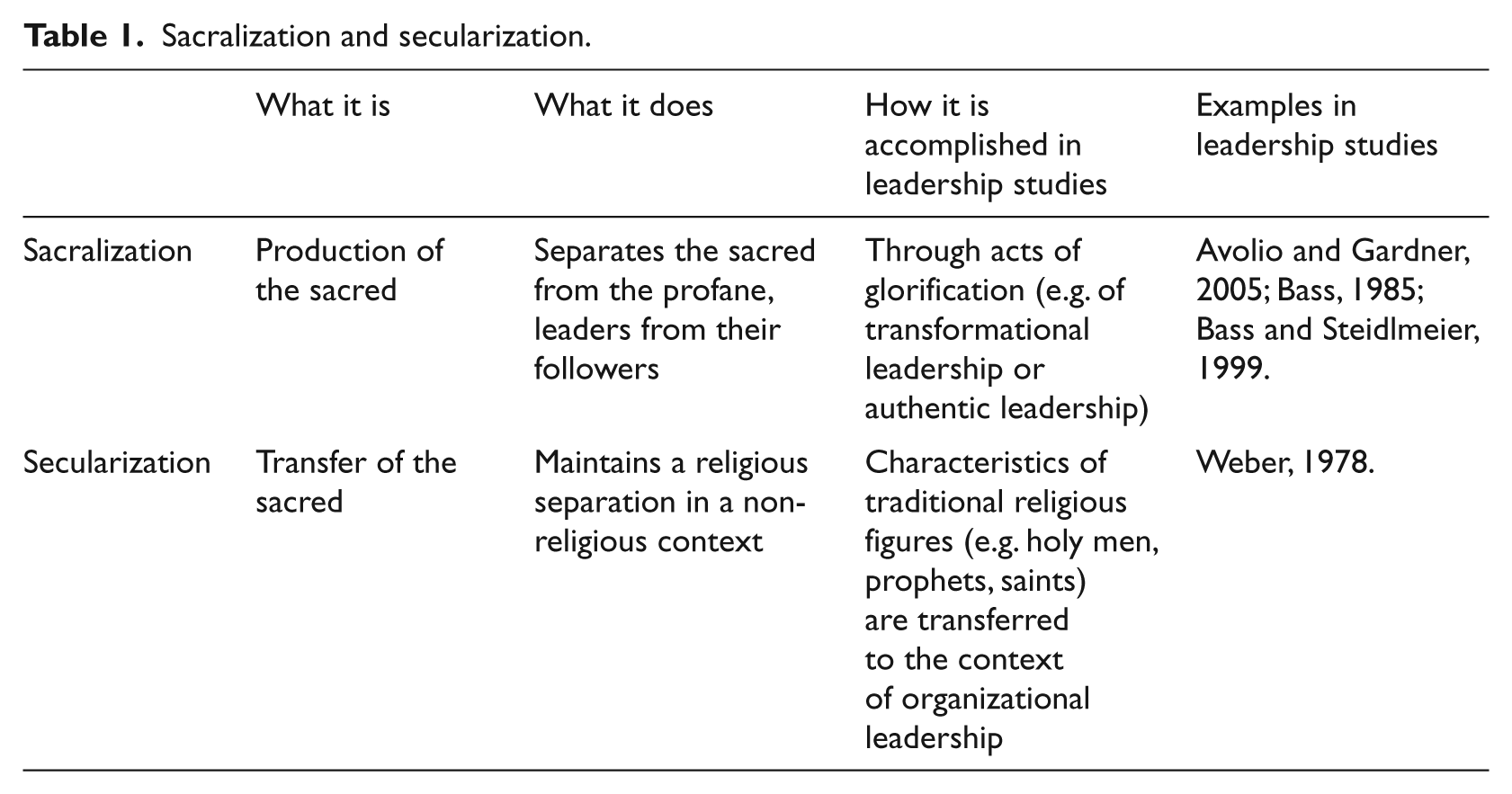
As we emphasized in the previous section, we do not see sacralizations of leadership as something that is necessarily undesirable, but they can and frequently do result in various negative forms of domination, narcissism and delusions of grandeur (Barker, 2001; Collinson, 2011; Gabriel, 1997; Gemmill and Oakley, 1992). Therefore, the sacred spaces of leadership ought to be challenged. This contestation of the sacred can take different forms. In what follows, we distinguish profanation from two more established routes of contesting the sacred in leadership studies, namely demystification and the creation of counter-myths (see Table 2).
Three ways of opposing leadership sacralizations.
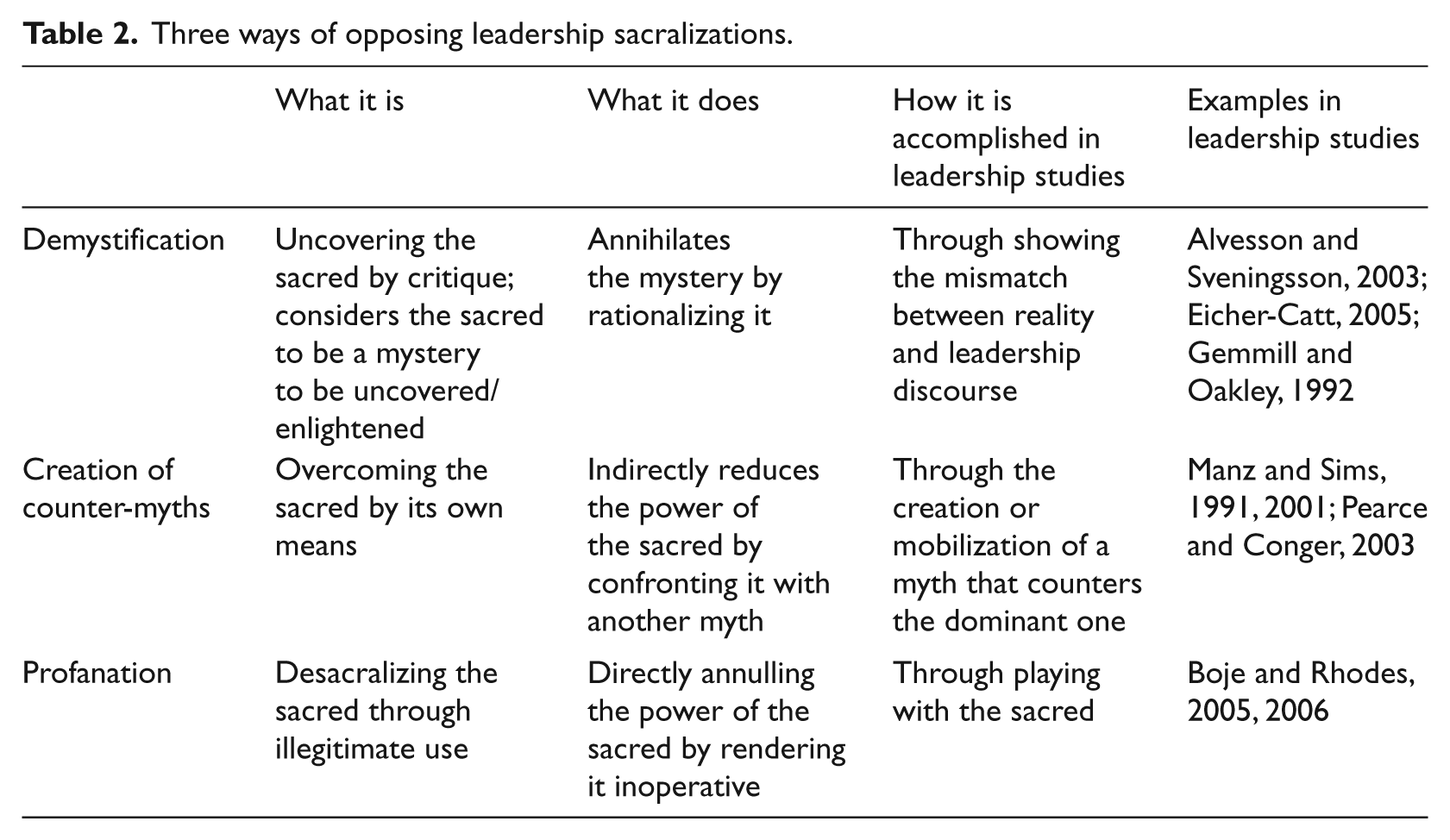
Where sacralization separates something from the ordinary (e.g. the leader from the followers), profanation goes the other direction. Profanation neutralizes the power structures that are activated through the sacred: ‘once profaned, that which was unavailable and separate loses its aura and is returned to use’ (Agamben, 2007: 77). The ‘return to use’ is an important aspect of profanation: profanation does not annihilate the sacred, it rather incorporates the sacred in daily practices and thereby, at least temporarily, neutralizes its power effects. In practice profanation occurs through ‘touching’ that which is considered sacred (and, for that reason, is considered to be ‘untouchable’). Sometimes this can be taken literally: a participant in a sacrificial slaughter, for example, can profane organs that are meant for the gods by touching them with the hands, which causes ‘a profane contagion, a touch that disenchants and returns to use what the sacred had separated and petrified’ (Agamben, 2007: 74). In a secular context, the national flag, e.g. of the United States, may not touch the ground. But the sacred can also be touched in less literal ways. For Agamben (1993, 2007), one of the most effective forms of profanation occurs through play. ‘Playland’, Agamben (1993: 79) writes, ‘is a country whose inhabitants are busy celebrating rituals, and manipulating objects and sacred words, whose sense and purpose they have, however, forgotten’. The rituals and separations are maintained but the sacralizations that once instantiated these separations have become powerless.
Profanation, as far as leadership is concerned, can occur both in leadership practice and in relation to leadership concepts as they are developed in leadership studies. In practice, the sacred aura of a leader could be damaged, for example, when he or she is ‘photographed in an ‘undignified’ situation’ (Žižek, 2004: 209). One example of profanation within leadership studies is Boje and Rhodes’ (2005; 2006) work on Ronald McDonald as a transformational leader. By arguing that a fictional clown, who tries to sell burgers to children, qualifies as a transformational leader, Boje and Rhodes touch the separation between extraordinary leadership and mundane followership upon which the traditional literature on the topic rests. As a consequence, the sacralization of transformational leadership loses some of its powers (especially as one of their articles (Boje and Rhodes, 2006) was published in The Leadership Quarterly, which is the most highly ranked journal within leadership studies). In this context, the distinction between leadership practice and leadership studies can easily be exaggerated. As noted in the introduction, concepts such as transformational leadership are designed to speak directly to practice. A profanation of these concepts is therefore equally related to practice, even though its direct audience is primarily constituted by academics.
Profanation, as we have tried to illustrate in Table 2, is both similar and distinct from demystification and the creation of counter-myths. What the three have in common, is that they contest the sacred spaces that make leadership possible. But there are also important differences. Demystification, a popular objective among critical leadership scholars (e.g. Guthey et al., 2009; Jackson and Parry, 2008), aims at the annihilation of the aura of extraordinariness surrounding leaders: to demystify myths of the heroic leader would amount to showing that these leaders are not equipped in the characteristics and powers that the myth ascribes to them. The separation between the real and the higher real, upon which notions of heroic leadership rest, is elided in the process. Profanation, in contrast, does not remove the separation between the follower and the leader. The divisions that separate the leader from the follower cannot simply be made to disappear, but they can, as de la Durantaye (2009: 379) argues in his reading of Agamben, be ‘rendered inoperative and thereby deprived of their destructive power’. The creation of counter-myths, a term that we derive from Munro and Huber (2012), refers in our view to another sacralization, this time of an opposing leadership concept. We find examples of this in the creation of the so-called ‘post-heroic’ forms of leadership, such as distributed and shared leadership (Goleman, 2002; Gronn, 2002; Pearce and Conger, 2003). These concepts function according to the same logic as concepts such as transformational and authentic leadership, i.e. through sacralization, but given that these created sacralizations diametrically oppose existing heroic leadership concepts they can succeed in taking away some of their power. We should note, however, that the label ‘counter-myth’ is a result of our analysis, in that the proponents of shared and distributed leadership would not label their work (counter-) mythological. But it remains consistent with our argument: given that leadership is only possible in the wake of sacralizing separation, countering forms of leadership must necessarily follow the same logic. This becomes visible when counter-myths become themselves the object of demystifying critiques (for example, the myth of a leaderless team: Laiken, 1994).
The novel as method of profanation
There is now an established literature on the use of narrative fiction and other forms of popular cultural artefacts within organization studies (Bell, 2008; Beverungen and Dunne, 2007; De Cock, 2000; De Cock and Land, 2006; Hassard and Holiday, 1998; Land and Śliwa, 2009; Patient et al., 2003; Phillips, 1995; Rhodes and Westwood, 2008). It was the publication of William Whyte’s (1956) classic The Organization Man, where two chapters are dedicated to ‘The organization man in fiction’, that first brought the idea of using literary fiction into the study of organization. Since then, organization studies can boast of a plethora of publications using fiction, theorizing its relevant application, or questioning its value. In the arena of teaching it has been suggested that literary fiction can provide vicarious access to the lived experiences of work, organization and management, and as such can function as a counter-balance to the rationalist and reductionist representations of organization found in most management and organizational behaviour textbooks (Czarniawska-Joerges and Guillet de Monthoux, 1984; Knights and Willmott, 1999; Śliwa and Cairns, 2007).
In research it has also been argued that literary texts can help researchers to access and understand the non-rational in organization, for example, the unconscious (Case, 1999), socially unacceptable emotions (Patient et al., 2003), or pain and suffering (Burrell, 1997). Underlying these uses of literary fiction within organization studies is the idea that both academic texts and novels are forms of performative writing, often deploying structurally similar, if not identical, genre conventions. Rhodes and Brown (2005: 469) write that: fiction has emerged as a methodological concern in three related ways: (1) fictionality can be seen to be a characteristic of research writing in general and therefore; (2) explicitly fictional stories can be regarded as appropriate empirical material for organizational research; and (3) fictional genres can be used as a legitimate mode for the writing of research.
Our use of Murakami’s novel in the present article has affinity with—but, at the same time, is distinct from—the second of these approaches, in that we wish to point to the way in which fiction can contribute conceptually to the field of organization studies. We acknowledge Rhodes and Brown’s idea that fiction can function as empirical material for analysing organization, but we also consider such mobilization of novels as ‘surrogate cases’ or ‘stories of organizing’ as specifically referring to novels typically ‘read as ‘truths’ in the tradition of literary realism’ (Śliwa and Cairns, 2007: 311). In this context, we propose that a novel like A Wild Sheep Chase—steeped in the genre of magical realism—lends itself also to other uses by organizational scholars. On the one hand, we find in it representations of leadership that are parallel to how leadership is conceptualized within the academic literature. At each turn of the story, however, Murakami unsettles the sense that had been made in the previous sections and in the end offers no simple reading that can be mapped directly onto leadership theory.
Through the artistic crafting of its form combined with the surreal, absurd and bizarre aspects of its content, Murakami’s novel, to us, does not just provide illustrations of various leadership concepts or the dangers and risks generated by the practical functioning of power relations within the sacred space of leadership. In our analysis of A Wild Sheep Chase, we wish to draw our readers’ attention to the way in which Murakami actively profanes, in Agamben’s terms, the sacralizations inherent in key leadership-related concepts. It is in its capacity to profane our very understandings of the sacralizations that it works with and to enable a more playful engagement, more messy and less certain in its outcomes, that we see the power of the novel. Through reading A Wild Sheep Chase as an example of ‘playing with’ and ‘touching’ the sacred in leadership studies, we see its potential for allowing critical leadership scholars to also engage in the profanation of leadership studies. For this task, empirical data based on research in actual organizations which tend to be sites where sacralizations of leadership are much more likely to be enacted and reproduced rather than questioned and profaned, might not be as readily fitting as the text of the novel.
While suggesting that literary fiction of the kind represented by A Wild Sheep Chase can open up for organizational scholars avenues of thinking about theories and concepts beyond those typically offered by empirical data, we do not claim that literary fiction is the only vehicle through which the profanation of organization and, in particular, leadership studies-related concepts can and does take place. For example, as previously mentioned, the study by Boje and Rhodes (2005: 94) regarding Ronald McDonald’s leadership profanes the concept of transformational leadership, thus pointing to the possibilities of ‘touching’ the sacred in leadership theories through analysing empirical examples. Moreover, whereas we position our discussion of Murakami’s novel in relation to leadership studies rather than the practices of leadership, this does not mean that profanation is only ever effectuated at the level of leadership concepts. Commensurate with Agamben’s ideas about the means of profanation is, for example, the use of humour in organizational settings. Notwithstanding the fact that it can also contribute to perpetuating the status quo, humour has been shown to have resistive and subversive potential vis a vis extant power relations within organizations (Westwood and Johnston, forthcoming). While focusing on the realm of leadership theories and concepts, through our analysis of Murakami’s A Wild Sheep Chase, we wish to open up further possibilities for the practices of profaning the power relations between leaders and their followers—a point we return to in our concluding comments.
A Wild Sheep Chase: Introducing the novel
In A Wild Sheep Chase, first published in Japanese in 1982, Haruki Murakami explores themes of sacrifice and leadership. The novel tells the story of a young advertising executive, who remains unnamed, thrown into a surreal world in which a shadowy right wing leader, ‘the Boss’, controls the Japanese media through a large corporation which he co-founded. The Boss has derived his unsurpassable leadership skills from the spirit of a mystical sheep with a star on its back, which has taken possession of him.
Going in to work on an ordinary day, the protagonist is visited by a ‘strange man’, who is a representative of the Boss’ organization. From him we learn that the Boss has become terminally ill, leaving his organization in a serious crisis. The strange man believes that this crisis is caused by the departure of the sheep from the Boss’ body. He is convinced that the sheep has to be found in order to ensure the continuity of leadership and the integrity of the organization.
The protagonist is charged with finding the sheep since he has recently published a photograph in a small-circulation pamphlet produced by his agency that, on closer inspection, contains this mystical sheep. The photograph is considered as evidence that the sheep exists and that there is something exceptional about it that distinguishes it from other sheep on the photograph and from all other sheep in the world: Aside from that particular sheep, all the others are ordinary Suffolks. Only that one sheep differs. It is far more stocky than the Suffolk, and the fleece is of another colour. Nor is the face black. Something about it strikes one as howsoever more powerful. I showed this photograph to a sheep specialist, and he concluded that this sheep did not exist in Japan. Nor probably anywhere else in the world. So what you are looking at now is a sheep that by all rights should not exist. (Murakami, 2003: 112)
While bemused by his encounter with the strange man, and the absurdity of the task he is presented with, the protagonist of the novel is left with no choice but to set out upon this wild sheep chase because he is blackmailed by the threat that should he not find the sheep, his business will be bankrupted and his professional future destroyed.
He starts his search for the sheep. As the story progresses we discover that the sheep is now in the process of taking control of a character called ‘the Rat’, a childhood friend of the protagonist and—as we later find out—the son of the Boss. After arriving at a house up in the mountains, where the sheep has been tracked to and is now trying to take of possession of the Rat, the narrator discovers that the Rat is not there. Rather, the protagonist encounters ‘the Sheep Man’, a bizarre looking character who is ‘Four foot ten at most, slouched over and bowlegged besides’ and dressed head to foot in a sheep costume, complete with ‘zipper from neck to crotch’ (2003: 249–250). The Sheep Man is even cartoonishly drawn, sat on a chair, in the only illustration in the novel (2003: 250). Despite a ‘difference of height of eight inches between them’ (2003: 255), it eventually transpires that the Rat and the Sheep Man are one and the same (2003: 285). Perplexingly, this comes out when, having shed the appearance of the Sheep Man, the Rat visits the protagonist one evening. Drinking a beer together in the pitch-black, freezing cold living room of the house, with the snow coming down outside and threatening to cut off the only road back to town for the next few months, the Rat informs his interlocutor that he is already dead, having committed suicide in order to avoid the sheep taking control, and turning him into a leader. His appearance that night in the house is hence rather incomprehensible. The protagonist asks him: Did you have to go that far? Yes, I had to go that far. If I waited, the sheep would have controlled me absolutely. It was my last chance. (Murakami, 2003: 281)
In the morning, the protagonist abandons the haunted house which meanwhile has been armed with a time bomb, and the chauffeur gives him a lift down to the train station. From the departing train he hears the sound of two distant explosions and sees, back in the mountains where the house would be, ‘a column of black smoke … slowly rising’ (2003: 294).
Profaning the sacred in leadership
The narrative of the novel A Wild Sheep Chase stands in contrast to the main tenets of leadership literature in which the question whether leaders are born or made is an ever reoccurring theme (e.g. Bennis, 1989; Avolio, 2005). In the novel, leadership is neither an inherent, inborn quality nor an acquired skill. Rather, the capacity to lead is premised on being possessed by a sheep. Thus, the leader can be seen as a follower, not of an eagle or a lion, but of a sheep. The novel deploys a tone parodying that of a scientific ethnological discourse when the reader is informed about the source of the Boss’ charisma. It owes its existence to a legendary sheep that, throughout the centuries, has been taking possession of various individuals, granting them special powers, including that of immortality.
In parts of Northern China and Mongol territory, it’s not uncommon to hear of sheep entering people’s bodies. Among the locals, it’s believed that a sheep entering the body is a blessing from the gods. For instance, in one book published in the Yuan dynasty it’s written that a ‘“star-bearing white sheep” entered the body of Genghis Khan … The sheep that enters a body is thought to be immortal. And so too the person who hosts the sheep is thought to become immortal’ (Murakami, 2003: 188).
As is obvious, Murakami deploys a long row of theological figures in his novel, but they do not necessarily come together in a coherent, theological system. The central figure of the sheep as a leader functions in the novel as a play on leadership images and mythology in a number of ways, also sometimes inconsistent and contradictory. The sheep, to begin with, is the perfect image of a follower in Western, Judeo-Christian traditions, where spiritual leaders often figure as shepherds. The sheep is also reminiscent of the Agnus Dei, the Lamb of God—Christ—who is sacrificed to save mankind. In Murakami’s story, however, it is the sheep that demands sacrifices from everyone, including the narrator and the Rat himself as prospective leader. Even the protagonist’s sacrifices are made on the basis of blind faith and hope. Charged with the task of finding the sheep, he is put in a situation where his business, his career and his entire life are invested in and dependent on the wild sheep chase—a quest that in fact may be entirely futile, as the strange man who commissions him with this assignment readily acknowledges: ‘Do I have any choice?’ I asked. ‘And what if no such sheep with a star on its back ever existed in the first place?’ ‘It is still the same. For you and me, there is only whether you find the sheep or not. There are no in-betweens … You hold the ball, you had better run for the goal. Even if there turns out not to have been any goal’. (Murakami, 2003: 123)
The nameless protagonist is ripped out of his place in life, where he, according to the Rat, ‘sheeplessly’ muddles through as ‘imperius rex’ in his ‘kingdom of generalizations’ (Murakami, 2003: 284). But everyone needs to go on such a quest, since ‘for you and me, there is only whether you find the sheep or not’. It is not central whether the sheep actually exists—the important part is the hunt itself and the relations between all those people involved in the sheep chase, i.e. hunt originality, personal leadership and even charisma. The implication seems clear: the protagonist as well as the reader are, together with everybody else, driven by what Girard (1977) refers to as ‘mimetic desire’: we are all on a wild sheep chase, relentlessly chasing what we imagine the others to be chasing, no matter whether this desired object actually exists or not. It is enough that it appears desirable in the eyes of the others. The end goal (‘even if there turns out not to have been any goal’) is to succeed in the quest for social climbing and become—a leader: an individual ontologically separated from the mass, touched only by the divine, secured in the sacred space of leadership.
Such separations and sacralizations are constantly set to work everywhere in the novel. The Boss is the central example of this, and also the character that the novel is most bent on profaning. The novel suggests that the Boss is so unique that he has direct access to the divine Providences: access that he can share with the chosen by giving them God’s telephone number. In this case the Boss shares it with his chauffeur: ‘The Boss is an honorable man. After the Lord, the most godly person I’ve ever met’. ‘You’ve met God?’ ‘Certainly. I telephone Him every night’ (…) ‘The Boss gave me it a few years ago’, said the chauffeur out of nowhere. ‘Gave you what?’ ‘God’s telephone number’ (…) ‘He told just you, alone, in secret?’ Yes. Just me, in secret. He’s a fine gentleman. Would you care to get to know Him?’ ‘If possible’ I said. ‘Well, then, it’s Tokyo 9-4-5- … ’ (…) ‘Thanks. I’ll give him a call’. ‘That’s the spirit’, said the chauffeur. (Murakami, 2003: 127–128)
The introduction of a very mundane object, a telephone, into the narrative about the second ‘most godly person’ in the chauffeur’s universe, serves as ‘a profane contagion, a touch that disenchants and returns to use what the sacred had separated and petrified’ (Agamben, 2007: 77). The telephone is also used to create the silence necessary to uphold the sacred space of leadership, i.e. quelling ‘the anxiety of followers in and through the provision of safety and security’ (Grint, 2010: 101). On the phone, you can talk with the Lord about everything: All you have to do is to speak honestly about whatever concerns you or troubles you. No matter how trivial you might think it is. God never gets bored and never laughs at you. (Murakami, 2003: 128)
When it further comes to the novel’s representation of leadership, we encounter several instances of sacrifice. The strange man, for instance, demonstrates a willingness to sacrifice himself in the pursuit of the sheep, ‘not for reasons of my personal loss, but for the greater good of all’ (Murakami, 2003: 121). Similarly, the Boss himself, by being possessed by the sheep—a notion which in itself profanes leadership as such—becomes sacrificed to the purpose of empire building and organization. These examples are isomorphic to the way in which self-sacrificial leadership behaviour is advocated in normative strands of leadership studies. And just as with normative accounts of self-sacrificial leadership behaviour, it remains unclear what the ‘greater good’ would involve and whom it would benefit. But in contrast to leadership studies, and Grint’s argument for the importance of sacred spaces in organizations, the self-sacrifices presented in the novel do not establish the sacred as ‘an essential mechanism for the performance of all forms of leadership’ (Grint, 2010: 100). Rather, they discomfortingly hint that something is not right with, and perhaps is even ‘unfortunate and embarrassing’ (Grint, 2010: 100) about the role of sacrifice in leadership. In the representations of self-sacrifice in A Wild Sheep Chase we see a playful engagement with concepts of sacrifice and leadership as we find them in leadership studies, and through this engagement these concepts lose some of their sacred aura.
The profanations that take place in the novel are not limited to providing exaggerated, comic or absurd representations of leadership. Perhaps even more importantly, the novel also profanes the concept of sacrificial leadership behaviour through the mechanism of subversion. It shows how self-sacrifice of the (prospective) leader—which, as we have argued earlier, commonly serves as a way of exercising leadership and enhancing the position of the leader within the organization—can be turned against leadership and mobilized as a way to avoid it. Specifically, profanation through subversion is evident in the Rat’s act of suicide, which is his final refusal to accede to his allotted place as the new Boss. We read the Rat’s suicide as an act of self-sacrifice necessary to effectuate—in an extreme and irrevocable manner—his unwillingness to be put in the position of leadership by submitting to the will of the sheep. Through self-destruction, then, the Rat paradoxically manages to maintain his right to self-determination.
The Rat’s suicide is another test to the notions of sacralization permeating leadership thinking: the Rat sacrifices himself not to become a better leader and to instigate sacrificial behaviour in the followers, but to avoid taking on the position of leadership. In the narration of the Rat’s suicide, we find several examples of profanation of self-sacrificial leadership behaviour in leadership studies. The very act of the Rat’s suicide is described in grotesque terms: ‘What happened was this’, said the Rat. ‘I died with the sheep in me. I waited until the sheep was fast asleep, then I tied a rope over the beam in the kitchen and hanged myself. There wasn’t enough time for the sucker to escape’.
In line with Girard’s (1977) theory of scapegoating, we first see that the Rat’s self-sacrifice restores the social order: the carnivalesque Sheep Man (the Rat in disguise) has been sacrificed, and social order is temporarily reinstalled. Yet something more profound than a carnival has taken place: the Boss’ son, the Rat, has been sacrificed and with him the mystical sheep. The sheep is, according to the Rat, ‘hair-raising evil. Give your body over to it and everything goes’ (Murakami, 2003: 283). Not only has the social order been temporarily reinstalled, but the very cosmic order, in which the hair-raising evil mimetic rivalry and the ceaseless quest for social climbing are the dominant tropes (Girard, 2000), is being brought to an end. The wild sheep chase, as an image of social organization locked in a continuous pendulum of change between a relentless social rivalry and unrest, and a quasi-stable hierarchy (holy order) installed through the sacrificial scapegoating, has ended.
The Rat, then, returns after his self-sacrifice as a ghost, in order to give advice to the nameless protagonist. This does not mean that sacred spaces should be abolished per se, but that it is through their continuous profanation that their real value is recognized, all the way to the redemptive insight that any such wild sheep chase is, in the final analysis, futile and empty, and must be abandoned. In the end, the Rat advises the protagonist to rush down the mountain before ice and snow closes off his return, that is, before the icy separation between the heavenly and the profane is permanently consecrated. Such redemptive events save, in A Wild Sheep Chase, a certain fragile humanity: The key point here is weakness … Moral weakness, weakness of consciousness, then there’s the weakness of existence itself. (Murakami, 2003: 282)
This weakness is not just a human quality, but also the vulnerable spot where the sheep may enter. This insight fundamentally profanes the idea from leadership theory that a heroic leader is a particularly strong individual. According to the Rat’s narrative, only because of his weakness would he have been tempted to allow himself to live possessed by the mystical sheep of leadership, which is ‘like a blast furnace that smelts down everything it touches’ (Murakami, 2003: 283). While this weakness is the precondition for leadership, an idea that Land et al. (forthcoming) ironically refer to as ‘The Weak Man Theory of Leadership’, it is also, perhaps paradoxically, what the Rat wants to retain and redeem: he will not allow leadership to cover human weakness up. So while human weakness is a necessary precondition for the existence of self-sacrificial leadership, such weakness must be kept, the Rat seems to argue, as an existential challenge to be tackled.
The novel ends on what our theological nomenclature identifies as a cautionary note. When the house finally explodes, the protagonist is already down at the train station, and he sees in the mountains ‘a column of black smoke … slowly rising’ (2003: 294). In face of the ongoing profanation, sacrality nevertheless—and critical leadership scholars should not be too surprised—seems to be reinstantiated. The event can be related to Exodus 13:21 which in the God’s Word 1995 version reads: By day the Lord went ahead of [the fugitive Israelites] in a column of smoke to lead them on their way. By night he went ahead of them in a column of fire to give them light so that they could travel by day or by night.
Here, the novel’s version of Jahve, of course, presents us with a very ambiguous figure: if the protagonist was to be ‘led’ by the column of smoke, as were the Israelites, he would be led back into the icy mountains to find the ruins of the house, surrounded by debris and snow. He would have no promises of returning to the valley, a fate quite antithetical to the Judaic utopia of the Promised Land. Profanation—also of new concepts—must, in other words, be an instrument constantly set at work against the ongoing sacralization of the world and its leadership.
Concluding discussion
In this article we have sought to contribute with three insights to organization studies, and in particular to leadership studies and critical leadership studies. Firstly, we have argued, drawing on Grint (2010), that leadership can only exist through sacred spaces and that self-sacrificial leadership behaviour is one way in which these sacred spaces are created. We have continued by suggesting that leadership studies partakes in the production of these sacred spaces, the literature on self-sacrifice itself being one example of this. Secondly, we have identified three strategies within critical leadership studies that take issue with the sacred spaces of leadership and their undesired effects: a strategy of demystification, a strategy that aims at producing counter-myths and, as our primary conceptual contribution, a strategy of profanation. Each of these strategies are potentially effective in desacralizing sacred spaces of leadership that are created in leadership studies and leadership practice. We have highlighted and developed the third of these strategies through a reading of Murakami’s novel A Wild Sheep Chase. The book’s profanation of leadership touches—and hence profanes—the heroic images of self-sacrifice that, according to recent leadership literature, are to be pursued in the name of the bottom line and moral imperatives. In Murakami, this sacred image of self-sacrificial leadership behaviour is profaned, most notably when the Rat decides to sacrifice himself in order to avoid becoming a leader.
Sceptic readers may wonder: where does all this leave us with regards to leadership practice? How does the use of a novel in an academic article do anything to contest the negative consequences of this continuous creation of sacred spaces of leadership? Is its effect not similar to that of a carnival event, in which everything is allowed, but only temporarily and in a controlled fashion so that the existing power relations can quickly be restored (Eco, 1984; Rhodes, 2001)? This is no doubt a danger of parody, cynicism or play, but we should stress that profanation, in Agamben’s terms, is by its very nature an illegitimate activity rather than an authorized transgression within the social institution of carnival (Bakhtin, 1984/1965). In an organizational context, for example, it is never initiated by management. Also, one could ask if a demystification of leadership has a greater effect than profanation. When a leadership concept is demystified (e.g. ‘this study shows transformational leaders do not exist; it is only a fantasy’), the proponent of transformational leadership may simply answer that this is because the real transformational leader is yet to come, or that we have searched for this character in the wrong places. This would be an answer that again sacralizes the figure as a coming saviour. When transformational leadership is profaned, however, this implies that a separation that we hold dear in our mind is directly affected: there is no escape. It also implies that profanation acknowledges the desirable and undesirable effects of sacred spaces as well as their continuous perpetuation.
But at this point we must also reflect upon the limitations of our approach. Within academic practice, profanation as a method is itself in danger of being seen as a profanation of academic methods. We have perhaps reached the stage where profanation can be proposed as a method, but this does not mean that any applications of this method will see the light of day: the more powerful the profanation, the more visible its illegitimate character, and hence, one could assume, the less likely it is to be published. We may even speculate that in the case of this present article, its publishability might lie in its methodological contribution to the field of organization studies, rather than in our attempted act of profanation of scientific borders. Academic journals may well decide not to publish profanations, as this would threaten their own legitimacy—one that is, among others, based on the separation between practitioner-oriented outlets and scientific journals.
This also relates to the use of novels within the field of organization studies. Since insights conveyed in novels are often considered as a less legitimate material to refer to than results obtained through questionnaires or interviews, articles that engage with novels may be seen as a profanation of the field—and thus resisted by organization scholars, even critical ones. One example of this is Alvesson and colleagues’ (2009: 20) reflection that the use of ‘cartoon, fictional literature, philosophy, etc’. may have ‘very limited reference to management’. The authors suggest that ‘a purist conception of CMS would tend to seek the expulsion of such ‘misfits’ from CMS on the grounds of being idiosyncratic rather than critical, and that its effect is to dilute rather than enrich CMS’ (Alvesson et al., 2009: 20). While, in the methods section of this article, we have explained the particular suitability of A Wild Sheep Chase as a conceptual resource for discussing leadership theory, we remain aware of the tensions involved in attempts at theory-building without reliance on empirical evidence—tensions that are relevant not only for academics but also for managers of contemporary organizations. In this context, it could be argued that the effect of Murakami’s novel as a resource for leadership practitioners may also be limited, even though, as one of the most widely read novelists of our times, Murakami reaches more people than the majority of popular business books.
In regards to our own article, we see the possibility of it becoming a profanation itself, rather than merely constituting another proposal for a new method that will never be allowed to be applied. This profanation stems not so much from our reading of Murakami, but from our two claims: that leadership studies is about the sacralization of leadership and that studies in post-heroic leadership are about the creation of counter-myths. This very terminology, apart from advancing a theoretical argument, is also an attempt to touch/profane a separation that is fundamental to the discipline of leadership studies as a whole: the distinction between leadership studies as a social science, and popular leadership culture as myth. We have sought to contaminate this separation by locating leadership studies on the side of the production of leadership and its sacred spaces, and by drawing conceptual insights into leadership from Murakami’s literary account rather than from leadership theory. We would like to call other scholars to engage in the practice of profaning the discipline and its sacralizations more often, whether through engagement with literary fiction or by other means. This could open up avenues for considering leadership itself more seriously, by continuously unravelling and undermining the undesired effects of the unequal hierarchical power relations that leadership produces through its sacralizations.