




Abstract
This article offers a narratological reading of two ‘ecopreneurial’ self-narratives to demonstrate how individuals achieve a relatively coherent sense of self-identity by connecting the discursively available world ‘out there’ with ‘inner selves’. The narratives of ecopreneurs, who claim to be motivated by the creation of social and environmental value over economic value, provide an appropriate empirical platform for this work because ecopreneurs have to negotiate between sets of discourses and social groups relating to the environment and to enterprise which are particularly conflicting. An analysis of the structure and shaping of these narratives demonstrates that narrators draw on a range of such discourses, each of which is felt as essential to a sense of self. These provide underlying scaffolding, within which narrators position characters of self and others. However, this identity positioning reveals existential dissonances resulting from combining conflicting environmental and business commitments. As they attempt to reconcile such conflicts, their appraisals of the same behaviours and values shifts at different points in the narratives, according to whether they attempt to identify themselves with, or against, the characterization of their others. Furthermore, they also employ strategies of distancing and deflection to negotiate a narrow, twisting path between binary oppositions into which they jettison what might disrupt the narration of a coherent identity.
There is a considerable body of work in the social sciences, including organization studies, which suggests that individuals achieve a relatively coherent sense of self-identity through the construction of narratives. Individuals draw from a variety of discursive cultural resources experienced and presented as sets of available narratives and create individualized narratives from them which connect the worlds ‘out there’ with ‘inner selves’ (Bruner, 1991; Fletcher, 2007; Giddens, 1991; Holstein and Gubrium, 2000; Rhodes and Brown, 2005; Watson, 2009a). While constrained by the expectations of others and the particular cultural resources at their disposal (Rosenwald and Ochberg, 1992; 9, cited in Rhodes and Brown, 2005), the narrative construction of many potential identities is possible. Despite this, most individuals achieve some sense of self that is felt as having ‘a degree of existential continuity and security’ (Alvesson and Willmott, 2002: 625–626).
However, the gap has yet to be fully explored between what is available in terms of discursive resources and the means by which those resources, and particularly when they are conflicting, are combined with lived experience to produce coherent narratives (Watson, 2009b). The contribution made by this article is to demonstrate empirically how individuals achieve a reasonably coherent narrative of self by drawing on a number of discursive resources to provide narrative scaffolding. Within this scaffolding, the individual positions their identity against or with their assumptions regarding the identities of those with whom the individual interacts. I will show that when competing discourses are felt as essential to a particular sense of self, narrators draw on them all but employ strategies of distancing and deflection to avoid confronting the resulting contradictions and dissonance. To do this, I offer a detailed reading of narratives told by two ecopreneurs.
I have adopted a definition of an ecopreneur as an individual who claims to be motivated by the creation of social and environmental value over economic value when founding a business (Venkataraman, 1997). The amalgam of the words ‘ecological’ and ‘entrepreneur’ signals the combination of concerns that are often regarded as inherently incompatible. Ecopreneurship thus represents an appropriate empirical platform for this work because it takes place in an arena of competing business, political and societal discourses, negotiation, compromise and conflicting values (Beveridge and Guy, 2005). Ecopreneurs have to ‘come to terms with the various aspects that will determine the triple-bottom-line of their business concepts’ (Schlange, 2006: 10) and are challenged by the need to balance the generation of profit and growth with environmental stewardship and socio-ethical dimensions. Weinberg (1998) discusses how ecopreneurs can legitimately include growth as an objective in order to, for example, replace competitors’ unsustainable practices with their own, but such objectives inevitably conflict with the realities of economic growth in a market system. In addition, ecopreneurs must move in and between groups including the business community, activists, customers and fellow professionals which they could perceive as espousing highly conflicting values and in this conflictual arena, they have to make sense of who they are and what they do.
The article proceeds as follows. First, I present a review of the literature on the ways in which discursive resources and social processes contribute to identity. This highlights that much current work focuses on one or other, but the ways in which they are combined have yet to be fully explored. I then offer an outline of the range of discursive resources available to ecopreneurs which demonstrates the complexity and conflicting nature of what is on offer. This is followed by an account of the use of narrative to illuminate the processes of identity construction, outlining narratological methods that explore the structure and shaping of a narrative as a means of analysis. The narratives are presented and analysed, showing how their narrators draw on a variety of business and environmentalist discursive resources which determine the underlying structures of their narratives. At the same time, their individual positioning within those structures accounts for a ‘local reality’ (Chia and King, 2001: 312). In order to be credible as both environmentally committed and as possessing business acumen, these ecopreneurs must draw on a range of discourses, even though this results in contradictions within their narratives. Contradictions are also evident in the ways in which they position themselves with and against others, and as simultaneously part but not part of business and green communities. Both narrators use a process of attributing to others criticisms that have been directed at themselves to avoid confronting these contradictions which could create dissonance and threaten their self-fashioning. Finally, I discuss how this detailed examination of the construction of self-narrative contributes to the theorization of identity.
Identity construction and narrative
A full review of approaches to the study of identity will not be attempted here, but within organization studies, such approaches coalesce around the notion that identity is not fixed, but that individuals are continually engaged ‘in forming, repairing, maintaining, strengthening or revising the constructions that are productive of a precarious sense of coherence and distinctiveness’ (Alvesson and Willmott, 2002: 626; see also Rhodes and Brown, 2005; Watson, 2008). In entrepreneurship studies too, there is a growing body of scholarship that rejects a traditional, positivist approach in which entrepreneurs and entrepreneurship are more or less solid objects with a fixed and measurable ontological status (e.g. Down and Reveley, 2004; Hjorth and Steyaert, 2004; Parkinson and Howorth, 2008). Entrepreneurial identity is instead regarded as ‘dynamic and constantly emerging, being realized, shaped and constructed through social processes’ (Fletcher, 2003: 127).
There are continuing debates regarding the extent to which individual subjects have agency in the adoption of particular identities or are constituted within social and institutional structures and discourse. This too has been the case within entrepreneurship studies where discourse, and in particular the discourse of enterprise, has been presented as central to subjectivity and practice (e.g. Du Gay, 1991,1996). However, there is some agreement that although discursive practices are pervasive, conflict between discourses and slippages in the processes of repetition means that socialization is never complete (e.g. Butler, 1990, 1993; Foucault, 1980). Others propose that identity is not constituted in discourse alone but is ‘refracted’ (Ybema et al., 2009: 303) through continual articulations between discourses and social processes such as engagement and interactions with others who confirm or challenge a self-identity (Down and Reveley, 2009; Fletcher, 2003). This is the position taken in this article. Alvesson and Willmott (2002) argue that identity regulation (the discursive practices of identity definition) and identity work (the interpretive practices which reproduce self-identity) are mutually constitutive of self-identity. Discourses set conceptual limits within which identities take shape and provide a repertoire of cultural and expected norms from which self-identifications are drawn, but ‘the local and particular nonetheless continually insinuate themselves to construct difference’ (Gubrium and Holstein, 1998: 164). Individuals are engaged in identity work in making choices from the range of possibilities available to them and relating to and interacting with those cultural, discursive or institutional notions of who or what they might be (Somers, 1994; Sveningsson and Alvesson, 2003; Watson, 2009a). As Watson puts it, identity work is: … the mutually constitutive process in which people strive to shape a relatively coherent and distinctive notion of personal self-identity and struggle to come to terms with and, within limits, to influence the various social identities which pertain to them in the various milieux in which they live their lives. (Watson, 2008: 129)
Conceptualizing self-identity as an interplay between socio-cultural structure and individual creativity thus bridges the analytic divide between structure and agency in a recognition of the ‘entangled’ nature of self and society (Down, 2006: 25).
In Watson’s view (2008), various discourses promote a range of socially available identities which are external to the individual. Discourses of entrepreneurship, for example, are not ‘monolithic … instead [they] must be seen as diverse, appropriated and used by people in a variety of ways depending on their position, circumstances and the economic/social/cultural/political world(s) in which they live’ (Cohen and Musson, 2000: 46; see also Fournier and Grey, 1999; Watson, 2009b). Cultural and institutional stereotypes of the entrepreneur and, likewise, those of environmentalists, including ‘deep green’ activism (Naess, 1989) or more pragmatic approaches (Beder, 1991; Crane, 2000; Prasad and Elmes, 2005) might be attached to the individual by others, or they might themselves attach them, as they are discursive resources to be used or rejected. Individuals interpret and modify these resources to craft and mould an individual self.
Thus a relatively coherent and consistent self-identity is achieved by positioning the self within and against a set of discursive resources. For example, Warren (2004) found that the women entrepreneurs who participated in her study select a discourse, in this case of professionalism as opposed to entrepreneurialism, which enables them to make sense of their identities within family, business and the wider community. In contrast, Clarke et al. (2009) believe that competition between available discursive resources can be so intense that the conception of self that is authored is neither coherent nor fluid. Rather, contrasting perspectives are incorporated so that the self is stable without being coherent, consisting of core statements that are not unified. For groups such as ecopreneurs, conflict and competition between resources throw into stark relief the ongoing effort required to author a self as socially or environmentally committed in the face of discursive practices which might suggest otherwise.
The research referred to above foregrounds the effect of discourse on the construction of a self. Others have privileged the ways in which individuals agentially create a sense of self. While discourses offer a number of subjectivities that the individual can, consciously or otherwise, adopt, positioning self-identity with and against the supposed identities of those with whom the individual interacts is also an important element of identity work. Parker (1997) refers to this as an unending process of contested classifications where deciding what counts as similar and what counts as different is key to individuation. The positioning of self in relation to others through a ‘process of differentiation, a description of one’s own group and simultaneously as separate from ‘others’’ (Wodak, 1996: 26) is thus a major element in establishing an identity (Down, 2006). The ‘other’ is regarded as less acceptable or less desirable as well as different so that self-identity is constructed and maintained by excluding that which is ‘other’ (Garcia and Hardy, 2007). For example, Down and Reveley (2004) have argued that age is one aspect of difference used by entrepreneurs to establish a sense of self, while Jones et al. (2008) add the process of suppression to those of division from and integration with others to live with and manage identify conflicts. However, as Watson points out, although there is growing interest in looking at structural aspects of entrepreneurship and at the identities of individual entrepreneurial actors ‘little has been done to link the two conceptually’ (Watson, 2009b: 252). The conceptual linking between structural and individual aspects of identity construction is the focus of the current work. Before turning to narrative as a means of exploring identity construction, I now offer an overview of the discursive resources that could be available to the ecopreneur. The complexities of and conflicts between these resources indicate the challenges ecopreneurs face in using them to construct a coherent sense of self.
Discursive resources of enterprise and of the environment
Persistent and durable discourses of enterprise and entrepreneurship are pervasive in contemporary society (Ainsworth and Hardy, 2008) and are indicative of a logic focused on market orientation, opportunity, risk-taking, job creation, continued profit-making and economic growth (Steyaert and Katz, 2004). Du Gay (2000) points to a politically-charged discourse of enterprise which promotes an ‘ethic of self’ in contrast to the communitarian ideals of environmentalism while others have noted how the entrepreneur is often discursively constructed as a white, male hero embodying neo-liberal ideals of freedom, success and individuality (Carr and Beaver, 2002; Ogbor, 2000).
Popular discourses both perpetuate and challenge those of enterprise. Entrepreneurs are often portrayed as heroic, outside the norm, fast on their feet and wheeler-dealing (Parkinson and Howorth, 2008) and associated with moral ambiguity as they strive for success at any price (Nicholson and Anderson, 2005). It is therefore arguable that the values and claims of discourses of enterprise and entrepreneurship may be consciously rejected by many business founders (Cohen and Musson, 2000), but in particular by those who elevate the performance of a social and environmental good over competition and profit maximization (see also Parkinson and Howorth, 2008).
Discourses of environmentalism are particularly complex and conflictual. Hopwood et al. (2005) offer a useful conceptual framework of approaches to sustainability that demonstrates the variety in green ‘shading’ (Porritt, 1991). Groups and perspectives are ranged along a continuum related to the scale of change they perceive as required to take account of environmental issues. At one end are groups, including much of the business world, who recognize the need for change but argue that fundamental shifts in society are unnecessary. A number of studies show how, in a business context, the discourses of what have variously been described as eco-modernization (Milne et al., 2006) reform environmentalism (Milne et al., 2009) and corporate environmentalism (Banerjee, 1998, 2001; Greer and Bruno, 1996; Newton and Harte, 1997) remain unquestioning about the primacy of technology, science and economic progress while arguing that sustainability can be achieved through incremental change and improvement (Livesey, 2002; Milne et al., 2006). Approaches advocated are shown as reasonable and practical moves towards a more sustainable future that will work within existing systems rather than confront, oppose or dismantle them (Prasad and Elmes, 2005). The business case and business interests remain paramount.
Evidence from empirical research on managers’ attitudes to sustainability also suggests that the degree to which they embrace environmentally responsible values, beliefs and behavior is very limited (Crane, 2000; Fineman, 1996,1997, 2001; Fineman and Clarke, 1996; Harris and Crane, 2002). This is largely because of the strength of the existing business-oriented frames of reference mentioned above. Crane (2000: 674) argues that this results in ‘a denial of moral status for the environment, or the avoidance of moral reflection or attachment in relation to greening’.
Much of this research, however, has focused on the greening of existing business rather than businesses set up specifically to address environmental issues and which claim to give such issues at least equal standing with profit generation. Crane (2000), moreover, found that the senior executives of social mission companies, particularly the smaller companies studied, did express higher degrees of ‘green emotion and commitment’ (Crane, 2000: 687) than those in what he terms ‘conventional’ companies. 1 There is, therefore, some support in the literature to suggest that the commercially-focused and pragmatic priorities of business are less evident in those individuals who claim to embrace environmental sustainability in setting up their ventures.
Moving along the scale of change continuum, Hopwood et al. (2005) argue that others, including most mainstream environmental groups, seek reform and are critical of business and government but see the problem as one of re-balancing rather than the transformation of existing society. Ecopreneurs may sit at this point as it has been argued that they combine the drive, ambition, creativity and risk-taking of the conventional entrepreneur with a concern for the environment that will reform and revitalize the economic system (Dixon and Clifford, 2007; Isaak, 1998; Schaltegger, 2002). They thus incorporate social and environmental values into commercial enterprise (Allen and Malin, 2008; Anderson, 1998; Azzone and Noci, 1998; Gerlach, 2003; Gibbs, 2009; Keogh and Polonsky, 1998; Pastakia, 1998), following a pragmatic strategy which arguably offers greater opportunities for advancing an environmental agenda than activism (Mars and Lounsbury, 2009).
At the other end of the continuum are those activists who want to bring about transformative change. Reform is viewed as insufficient because the economic and power structures of society are not primarily concerned with either human well-being or environmental sustainability. There are major differences between the transformers also. Some groups, such as indigenous-based movements, value human well-being and equality alongside a commitment to the environment. In contrast, there are groups such as the deep greens who argue that the non-human have intrinsic rights and values to the exclusion of human interests, or those who Hopwood et al label eco-fascists who argue that ‘the poor should be left to starve’ (Hopwood et al., 2005: 43) as a way for the earth to achieve its own balance (see also Beder, 1991; Cotgrove, 1982; Dobson, 2007).
Carter (1999) also points out that ‘most of the alternatives which have come to be associated with the greens were widely considered to be extremely odd, if not downright cranky: vegetarianism, organic gardening, no-growth economics … ’ and something of that remains, even though many of these alternatives are now discussed seriously in more mainstream arenas (Carter, 1999: 308). Running alongside this, popular television programmes such as the BBC’s Life on Earth and news media reporting of, for example, the Stern Report (e.g. Osborne, 2006) contribute to a doom and gloom discourse of environmentalism, warning that time is running out to make any meaningful change in the face of inevitable ecological disaster. Such media coverage together with a number of high-profile environmental disasters has meant that green issues have moved to the mainstream of political life, resulting in what Dobson (2007) terms ‘a series of severe cases of ideological indigestion’ (p. 2).
Ecopreneurs have to position themselves with and against discourses such as these to create narratives that convey ‘an essential part of [their] sense of who [they] are’ (Eakin, 2008, ix). In the following section, I outline how narrative analysis can be used to illuminate the ways in which individuals draw on conflicting discourses but combine these with individualized participation in a story to produce a reasonably coherent sense of self.
Narrative identity and narratology
Narratives are an appropriate interpretive lens through which to study identity construction as they both shape our experiences, and are shaped by them. Scholars of narrative and identity (for example Bruner, 1987; Eakin, 2008; Ochberg, 1994) maintain that people typically experience their lives as a collection of narratives which provide a means of ‘articulating and explaining who we are, not only to others but also to ourselves’ (Johansson, 2004: 275). As Eakin puts it ‘autobiography structures our living’ (2008: 4), or, for Abbott, ‘It is only through narrative that we know ourselves as active entities that operate through time’ (2008: 130). Narratives are thus devices for people to make sense of their identities and to mould those identities in the narratives they tell about themselves (Ainsworth and Hardy, 2004; Riessman, 1993). They are a medium through which identity construction can be discerned (Rhodes and Brown, 2005) as the individual develops narratives as well as draws on those which are culturally available (i.e. discursive resources) to produce ‘a degree of coherence and consistency in their conception of who they are’ (Watson, 2009a: 431; see also Eakin, 2008). Indeed, Giddens notes that self-identity is ‘the self as reflexively understood by the person in terms of her or his biography’ (1991: 53, emphasis in original) which involves ‘the capacity to keep a particular narrative going’ (Giddens, 1991: 54, emphasis in original). Thus, narrative identity formation involves a process of self-interpretation where the individual draws on and fashions socially learnt cultural discourses to construct and reconstruct a coherent sense of self (Ezzy, 1997). However, according to Gubrium and Holstein (1998), there is always a gap between the pre-existing discursive resources available for conveying a narrative and how a particular narrative unfolds in practice. This unfolding relates to the individualized participation in the construction of the story. Its analysis provides insight into the ways that the narrator positions the self relative to life events and the assignment of moral qualities and motivation to themselves and others; who one is or is not provide reference points against which to compare the self (Garcia and Hardy, 2007; Watson, 2009a).
The narratives of two ecopreneurs are presented to examine the processes by which their narratives are constructed. 2 I will look at the way in which the narratives are told as well as the discursive repertoires upon which they draw. To do this, I use an approach that draws on the field of narratology, and particularly on formalism, which is characterized by a concern with the formal features of the narrative; its structure and shaping.
Narratology insists that the distinction between an event or sequence of events and the manner of their representation is fundamental for an understanding of how a particular narrative works (Abbott, 2008). The former is generally referred to as the fabula, and the latter as the sjuzet. 3 Abbott (2008) remarks how the fabula appears to have a separate and pre-existing reality outside its representation through the sjuzet. At the same time, the fabula only exists when it is told as it is always mediated through the sjuzet which endeavours to communicate it. Jonathan Culler (2001: 169) refers to this as the ‘double logic’ of narrative; an irresolvable ambiguity as the fabula appears both to precede and come after the sjuzet.
Fabulas are presented through the medium of masterplots, which are ‘recurrent skeletal stories, belonging to cultures and individuals that play a powerful role in questions of identity, values and the understanding of life’ (Abbott, 2008: 236). Bruner (1991: 14) argues that masterplots are so fundamental to narrative that it is very difficult for a narrator to break with them entirely. Fabulas and masterplots thus draw on and re-iterate pre-existing discursive resources, presenting events that appear to have an independent existence prior to and outside the narration in the same way that discourses exist independently of and prior to any individual (Culler, 2001; De Cock and Land, 2006 Hiles, 2007; Hiles and Čermák, 2008). Moreover, because masterplots draw on generic and shared structures of action, they are fundamental sensemaking devices (Downing, 2005) providing a framework for the sjuzet wherein the discursive resources ‘out there’ are internalized and in which individualized narratives can be crafted.
Narratology emerged in the 1960s and was then concerned with the literary study of novels but its concepts and methods have since been applied to autobiographical life stories (Abbott, 2008; Bal, 2009; Eakin, 2008; Reveley, 2010; Shen and Xu, 2007; Xu, 2006). An approach designed to analyse fiction is appropriate because the storying of identity is configured in a fictive-like way: assigning key characters, crisis points, beginnings and endings (Fletcher, 2007), integrated into an intelligible plot and given historicity and relationality (Somers, 1994).
Some narratologists (e.g. Reveley, 2010; Shen and Xu, 2007; Xu, 2006) argue that autobiography has an important extra-textual dimension missing from fiction in that it re-arranges and re-presents events that refer to a ‘real-life’ history, whereas fiction is essentially imaginary. 4 However, my purpose here is not to seek to compare participants’ accounts with events as they ‘really happened’, but to use narratological analysis to reveal the ways in which culturally supplied narratives and narrative techniques are used in an attempt to construct a coherent representation of self. ‘Pure’ formalist narratology does not situate a literary text in the sociohistorical context in which it is produced but focuses on its form and structure and, importantly, the literary traditions in which it is situated. Even within formalist narratology therefore, there is an understanding that a literary text draws on pre-existing resources (literary traditions) that are outside the text itself. In addition, formalists such as Bal (2009) do acknowledge ‘the influence of reality on the story’ (p. 119) as contributing to the meanings it engenders and recognize that fabulas are constructed according to a ‘logic of events’; that is to say such events appear to have some correspondence with a general understanding of ‘reality’ in the social and cultural context in which they are produced (Bal, 2009: 184).
My method of analysis draws on formalism but I would argue that a judicious use of formalist technique, such as the division of a text into fabula and sjuzet, is possible and can produce interesting insights, without having to adhere completely to pure formalist methodology. There is a precedent for this approach within studies of identity; Hiles (2007) and Hiles & Čermák (2008) use the formalist technique of division into fabula and sjuzet to reveal processes of identity positioning in the autobiographical recollections of holocaust survivors. Bruner (1987) also refers to a division of a text into fabula and sjuzet as a starting place for an analysis of life narratives.
The analysis presented here will focus on the particular techniques used by the authors to construct a narrative identity, thus revealing processes of identity construction. Such identity construction involves reducing contradictions and inconsistencies in the representation of identity through, for example, filling in narrative gaps or reframing dissonant experiences to produce a coherent narrative (Reveley, 2010). I therefore focus on the way that the narrators deploy masterplots and ascribe causation to events to reveal how discursive resources of enterprise and environmentalism provide the scaffolding for the narratives. I then turn to the ways that character formation in the narratives, including their own as protagonists, indicates how the narrators position a sense of self within that scaffolding.
I gathered data by conducting life-narrative interviews with 30 participants in South West England who had founded businesses based on a social or environmental mission. The purpose of the original research was to explore the challenges experienced by these founders in establishing and growing their businesses (Phillips, 2006). Fourteen of these participants had set up businesses with an explicitly environmental focus but it should be noted that I have labeled them as ‘ecopreneurs’ as they fit the academic definition detailed earlier but they did not self-identify as such. From this 14, I selected two narratives which were the most complete, telling the stories of their business from inception to the present day as lengthy monologues with little prompting. I chose to focus on two narratives to facilitate an in-depth analysis rather than attempt to synthesize the narratives of all participants as this would lose the fine detail and particularity important to developing an understanding of how identity construction plays out (see Reveley and Down, 2009 for a similar justification). It could be argued that a focus on just two narratives presents potential methodological limitations particularly with regard to generalizability. However, I follow Down and Reveley (2004) and Watson (1994) in arguing for a detailed, small-scale study as a way of generalizing about processes rather than about all entrepreneurs or even all ecopreneurs.
Abbott (2008) comments that life narratives and autobiographies are performative in the sense that events are selected and characters presented as conforming to particular masterplots and character types that the author deems appropriate for a particular situation and audience. They are as such constructed but I would argue that this is what makes them appropriate for the analysis I wish to conduct which is to gain insight into how individuals construct self-narratives that draw on pre-existing discursive resources but shape them to suit particular contexts. Polkinghorne (1996) also reminds us that narratives are influenced by their audiences. When narratives are produced as part of an interview, even one where questioning is minimal, they are also inevitably framed by participants’ perceptions of what the interviewer is seeking and the questions and responses relating to the agenda of the interviewer. Such narratives are thus co-authored by teller and listener (Atkinson and Silverman, 1997; Fletcher, 2007). Moreover, the production of a research account such as this is itself a narrative construction and an exercise in telling a particular narrative, with its own omissions, condensations and elaborations (Alvesson and Kärreman, 2000; Mishler, 1986).
Analysing the narratives of two ecopreneurs
Sustainable Living is a small and recently founded architectural practice consisting of a husband and wife partnership and two employees. They have moved slowly and cautiously in the transition between being employed by others and founding the business. Their focus is on the design of low energy, low environmental impact buildings that minimize the life cycle costs of ownership and occupation. The narrative is told by the wife (Diane) who manages the business after a previous career as an industrial chemist. Her husband (Paul) is the architect. Diane’s story can be summarized as follows. The business was founded because both partners have a longstanding and passionate commitment to environmental issues, but they take a pragmatic, business-case approach as they believe that preaching would alienate the clientele they wish to influence. The practice is based on ethical principles not only in terms of its environmental focus but in its commitment to working collaboratively and with respect for clients and the whole design team. In the early days of their marriage, Diane provided financial security and developed business skills, while a slump in the property market meant that Paul had to find work in Germany where he set up a design practice. When conditions improved, he returned to the UK and worked for a practice focused on high environmental standards. This was a turning point because it led Paul and Diane to recognize that they wanted to set up a practice themselves where they could work together, use their combined skills and draw on their commitment to the environment. A major commission enabled them to set up Sustainable Living.
Eco-Envelopes is also a small organization but one which has been operating for several years. Eco-Envelopes source and supply environmentally benign products or those which have environmental advantages over standard office products. The narrator (Mike) is the co-founder of the business and now the sole proprietor as his co-founding partner left some years ago. Mike had previously worked as a representative for two of Europe’s largest recycling paper mills as well as having a history in environmental campaigning. The company had started by offering environmental consultancy and then moved into office stationery supply because it offered greater business opportunities. This is now the company’s focus. The company has developed a niche market as it targets green organizations as well as attempting to persuade more mainstream organizations to purchase a greener alternative. Mike wishes to sell the company in the next few years to pursue other green business opportunities
The fabula: Juxtaposing discourses in a quest masterplot
In the participants’ narratives, the fabula is presented in the form of a quest. The quest is a universal masterplot, part of what Frank Kermode called ‘the mythological structure of a society’ (Kermode, 1979: 113). The quest is a plot device that has been used throughout history; examples include Homer’s Odyssey or Tolkien’s Lord of the Rings. The quest narrative revolves around a heroic central protagonist striving to meet an all-important goal. Along this journey, the hero/heroine will be assisted by helpful characters and events and will be met with obstacles and forces trying to stop him/her from achieving this goal. In overcoming these, the hero/heroine becomes a better person and acquires knowledge or power. Both ecopreneurial narratives can be classified as quests because they describe metaphorical journeys undertaken to find more fulfilling, holistic and environmentally sound ways for the protagonists to live their lives.
Quest plots can be summarized as having three elements: the Possibility, the Realization and the Conclusion (Bremond, 1973). The Possibility sets the stage for the protagonist’s journey and provides the reason for undertaking that journey; the cause of their later actions. The Possibility can be further analysed by looking at any critical events which might have acted as a catalyst and the protagonist’s reflections on their situation and on themselves (Larty and Hamilton, 2011). The Realization describes the journey itself including details of the decision-making process and any apparent complexities and paradoxes. The Conclusion covers the result of the journey and reflections on the result. In a quest masterplot, the Conclusion involves some kind of epiphany where the hero/heroine realizes something crucial to their life or way of thinking. They have come through the quest stronger and wiser, a changed person, even if the quest itself has not been fully successful. This particular dimension to the quest masterplot is perhaps why it has been selected as the means to convey the fabula as it allows the narrators to present themselves as having acquired what Parker might describe as ‘the goods [ie morally desirable attributes] of self-care and self-realization’ (Parker, 2007: 3)
In the participants’ narratives, the masterplot is presented in Table 1.
Summary of masterplot.

According to Eakin (2008), narrators absorb discursively available storylines which are then used to structure their own life narratives. These particular ecopreneurial narratives combine storylines drawn from discourses of business, enterprise, professionalism, ‘strong’ and ‘weak’ environmentalism which provide scaffolding for the elements of the quests. The Possibility element of Diane’s narrative draws strongly on the climate change storyline associated with environmentalism. This is used to emphasize her environmental commitment, which provides not only a starting point but an entire rationale for the business. There is little in her apparent motivation that is drawn from canonical storylines of entrepreneurs (Larty and Hamilton, 2011) such as threat of redundancy or desire for independence (Smith, 2005; Smith and Anderson, 2004). In the Realization, the storyline switches to the commercial realities of building a business. Here, the importance of collaboration is in contrast to her competitiveness in ‘pitching and winning out’ against other architects. Her passion for the environment is also tempered by the need to deliver a ‘rounded business case’, so she is echoing the pragmatism found by previous researchers into the greening of business (e.g. Prasad and Elmes, 2005). Mike’s narrative draws more strongly on cultural expectations of entrepreneurship. Although he points to his green activist background (‘I was also Chair of the local Green party’), he spots opportunities unnoticed by others—‘nothing [green] was really being done about business at the time’—cannot envisage working as an employee and moves logically into office supply as it is more successful. Both narratives end with their narrators summing up the result of their quest. This is not stated as a positive impact on environmental quality, but as a recognition of their need to achieve synergies in their personal and business lives. This, too, is loosely connected with an environmental discourse that stresses the need for holism (Carter, 1999; Dobson, 2007). That they have experienced a revelation fits the quest masterplot, which itself has been noted as often evident in entrepreneurial foundation narratives (Dodd, 2002; Nicholson and Anderson, 2005; O’Connor, 2000; Ogbor, 2000). 5 In these, an individualistic hero is presented as battling and ultimately winning out against the odds, although in Mike and Diane’s narratives the prize is expressed as personal and almost spiritual growth. Diane’s reflection that they need to retain control is part of entrepreneurial discourse, but the reason for that need—to make a difference to people’s lives—fits more closely to an environmental position. Mike fits a more conventional entrepreneurial mould by wishing to sell the business on and start something else, albeit also a green venture. The narrators are thus drawing on canonical storylines relating to environmentalism such as references to the impact of climate change and collaborative working, to project a green vision and also those related to business, such as being competitive and pragmatic.
Eakin (2008) also notes that storylines are used to structure the life-course decisions that constitute identity construction. Individuals make certain choices in following or not following the scripts which such storylines suggest. Such choices can be viewed by attending to causality in the narrative. Narrative arranges events so that we read causal connections into them even when those connections are not explicitly stated. This makes the narrative appear plausible; the story hangs together. Both narratives present events which appear to be causally linked as they progress towards a desired outcome that is logical in the context of preceding actions. Thus, for example, Diane and Paul’s decision to set up Sustainable Living appears to arise naturally from their backgrounds. Mike had ‘worked for the last four years as the UK representative for two of Europe’s biggest recycling paper mills’ and it is this background in paper supply that leads logically to a decision to supply office stationery. Diane could have chosen to remain in her previous career: ‘I was leading in my field and I know certainly when I was leaving, many colleagues said to me, how can you give this up? ‘Mike notes that he could have worked in international development ‘I have an MSc in Overseas Development Studies, I could run a country if I wanted to’ or he could more lucratively run a large organization. Alluding to the discarded alternatives draws attention to desirable qualities they wish to attribute to their characters, but also underlines that the choices they have made are positive and logical within the overall narrative.
The gaps in a narrative are also illuminating. Mike, for example, has chosen to omit details of why his co-founder left. It may be that for Mike, brushing aside difficulty, picking himself up and getting on with it is compatible with his use of an entrepreneurial storyline in which he positions himself as a lone hero against the world. We might also speculate that the reasons would cast doubt on his credibility as a morally worthy, environmentally committed individual. The omission of such detail, however, is a further element that supports a narrative in which the foundation and development of the business appears seamless; such events are not important in moving on the action. What has happened since has made this part of the narrative of incidental interest only as the narrator recomposes his past ‘shifting the relative significance of different events for whom we have become’ (Mishler, 1999: 5).
In order to support a credible self that is environmentally committed and yet good at business, it is important that their own narratives hang together. They have to establish their credentials by drawing on scripts associated with business professionalism and with entrepreneurial risk taking but they also need to demonstrate that their decisions not to remain in their previous careers are logically sound, and flow naturally from their commitment to the environment. In this way, we can see the presentation of events that constitute the fabula and the masterplot as a playing out of a search for meaning and a means of making sense as they switch between storylines in constructing their narratives. The storylines are combined in a way that appears seamless and coherent because they are required to support a coherent and credible self that is environmentally committed and yet good at business. It is only when the storylines expressed in the fabula are analysed in detail that the paradoxes of the self as independent, pragmatic business owner as against the self as green visionary become apparent.
The sjuzet: Representation of self and others as characters in the narrative
While the fabula and masterplot combine storylines in uncomfortable juxtapositions albeit that the outline of the narrative appears reasonably coherent, analysis of the sjuzet reveals that the narrators’ positioning within the scaffolding of that outline has to manage the resulting contradictions.
Masterplots come equipped with stock characters whose motivations and personalities conform to certain cultural expectations (Abbott, 2008). Characters in a quest masterplot include the hero/heroine, who is expected to be determined and resourceful, supporters who help the hero/herione and villains who undermine him or her. However, the way these characters are represented in any particular narrative is part of the sjuzet.
In autobiographical narratives, characterizations of self and others convey the identity positioning of the narrators (Hiles, 2007; Hiles and Čermák, 2008). Here, self-characterizations project positive images of individual and organizational worthiness in terms of green credentials and business acumen and bolster the narrator’s self-portrayal as competent and morally virtuous. The specific representation of characters who help or support the hero/ine, and villains who would undermine their progress towards their goal also reveal identity positioning. The former help position the hero/ine’s (and thus the narrator’s) identity through processes of identification and similarity, and the latter through processes of differentiation and exclusion (Parker, 1997). Diane’s supporters are the landscape architects, artists and designers with whom Sustainable Living works and who come together in an ethic of collaboration, respect for people and inclusiveness that are important elements in narratives of social and environmental sustainability. She positions her own character so that these imperatives are what she has in common with like-minded professionals who share her vision while also emphasizing her own identification as ‘a professional’. Mike positions his character and his business in a wider green business network that makes up the bulk of his customers. His strategy is to target the two thousand green businesses on his database rather than what he terms ‘normal companies’. He aligns his character with these green customers who are ‘nice, interesting people and it’s not like we work at all’ (my emphasis) so that his character is also cast as ‘nice and interesting’.
Identity positioning is also achieved through establishing boundaries of the self which are maintained by difference. Distinctiveness is particularly important in these narratives as Diane and Mike employ narrative strategies of positioning their characters against individuals or groups characterized as villains which set up binaries of self and other. The binaries not only position the characters as different from others but they privilege one term of the opposition as more desirable or more acceptable (Garcia and Hardy, 2007). Thus they can be examined to illuminate the ideas and meanings that are being shaped, created or reinforced in the narratives (Bal, 2009; Culller, 2001). The narratives set up binaries of business as usual against business as visionary, green warriors against pragmatists, and entrepreneurs against non entrepreneurs. Each of these will be explored in turn.
Business against non-business
Although the narrators emphasize their business credentials, they position themselves as different from other businesses. This is summarized in Table 2:
Binaries of self and other: business.
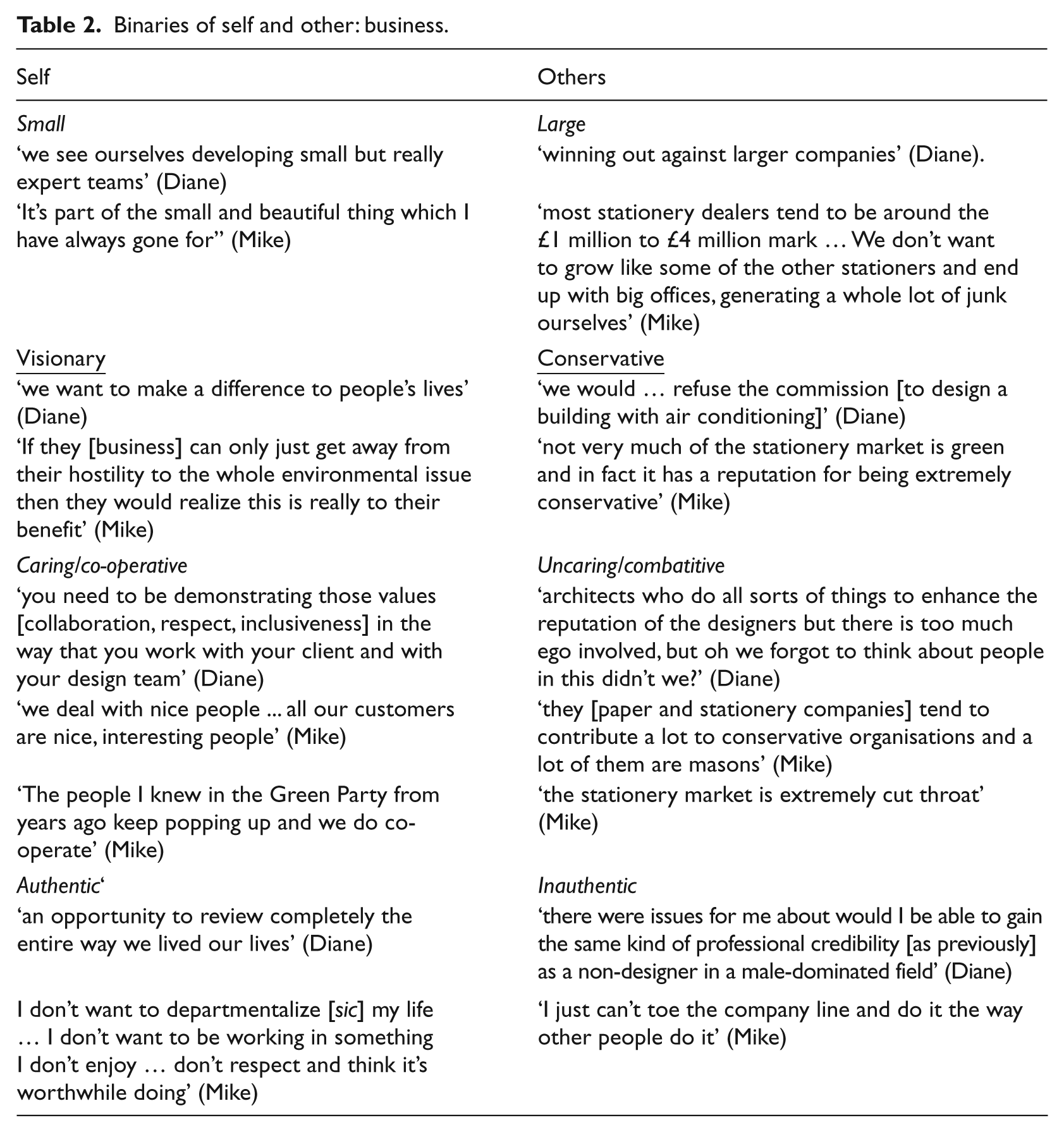
Both narrators, and Mike explicitly so, draw on the ‘small is beautiful’ positioning of environmentalism which argues that large-scale institutions are dehumanizing and ultimately unsustainable (Carter, 1999). Other explicit binaries are set up that position self as visionary, caring and authentic as opposed to conservative, uncaring and inauthentic. Diane positions herself and Paul as visionaries who ‘want to make a difference to people’s lives’ compared to those architects who would unthinkingly design buildings that require air conditioning. Mike is scathing about the conservatism of mainstream organizations in the stationery sector compared to his own vision in setting up as a green supplier. Diane stresses that they have ‘respect for people’ while other architects think more of their own reputation. Mike cares for the ‘nice, interesting people’ who are his customers, while dismissing the stationery market as ‘extremely cut throat’. Finally, Diane and Mike stress how they are working to achieve consistency in ethos and values across their lives. Fulfilling this vision will, they believe, allow them to be true to their (purportedly) real selves and contrasts with what Mike sees as a need to ‘toe the company line’ if he worked for someone else. Diane is concerned, however, that she will be perceived as an imposter in the architectural profession not only because of her non-design background, but because she is a woman. There is a leveraging effect here in that she appears to lack confidence in the perceptions of others, but she is also casting those perceptions as reactionary and biased. By the use of these binaries, competitor architects and the wider stationery market are represented as others against whom they can emphasize their own moral worth.
Green warriors against pragmatists
Their narratives also differentiate them from a perhaps more surprising group; those with green beliefs. They are pragmatists while the green community can alienate businesses. Table 3 offers a summary:
Binaries of self and other—green community.
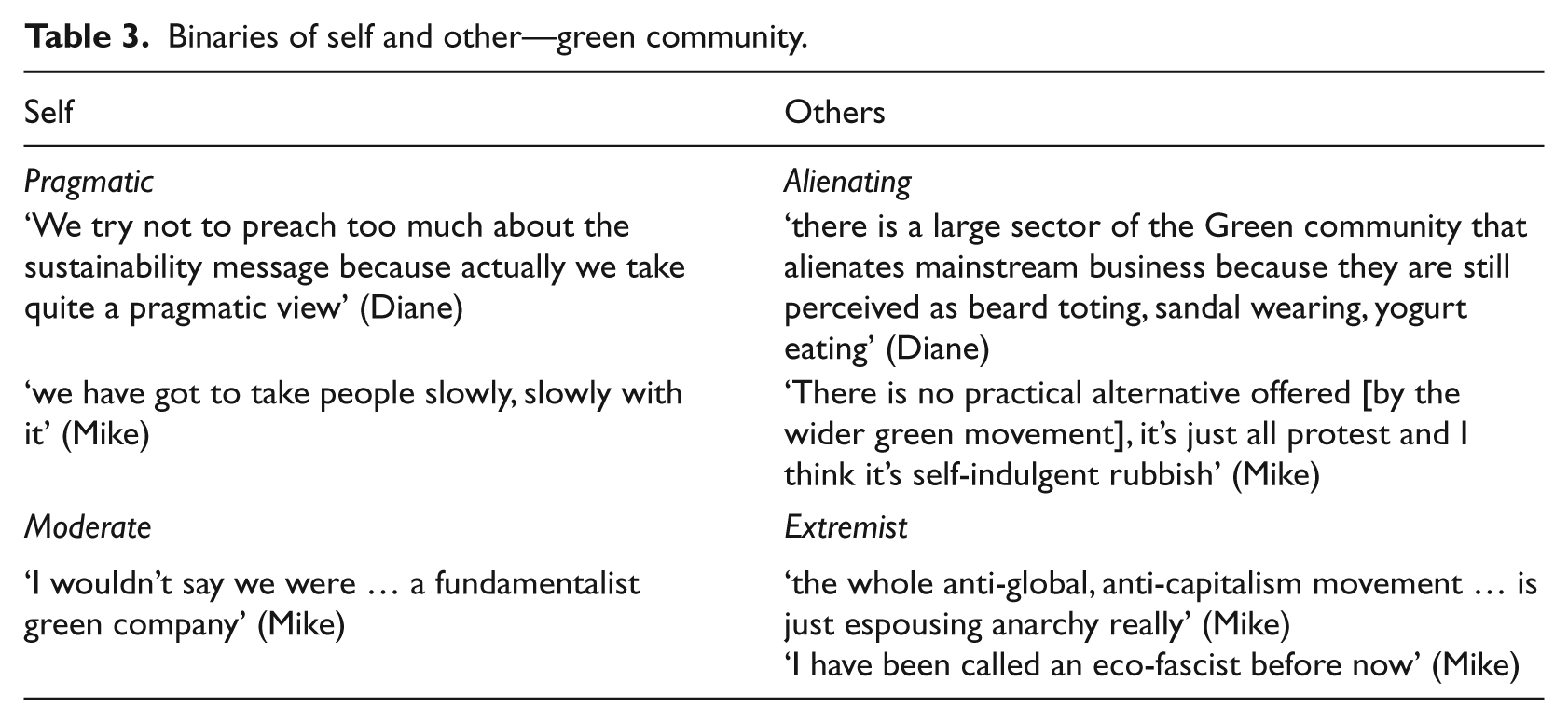
Diane notes that it is important not to alienate mainstream business if they are to get their ideas adopted and therefore they do not wish to appear ‘beard toting, sandal wearing, yoghurt eating’; a stereotypical picture of a green activist (Carter, 1999). The sense of difference is even stronger for Mike who recounts how he has developed adversarial relations with the local green movement who have accused him of being an ‘eco-fascist’ as he is not sufficiently green. He positions himself as not a ‘fundamentalist green company’, in contrast to what is represented as the anarchy of activism. This is recounted with some pride and supports his sense of being a maverick who could not ‘toe the line’. There is also conflict here with his statement that he co-operates with others in the green movement and with what seems to be important in the fabula; that his involvement in green activism led to the founding of the business. ‘Green’ is used in a perjorative manner when applied to others, but used positively to support Mike’s own environmental credentials.
Entrepreneurs against non-entrepreneurs
Although Diane and Mike differ in their conceptions of themselves as entrepreneurs, those conceptions are also part of opening a gap between self and other. This is summarized in Table 4:
Binaries of self and other—entrepreneurs.
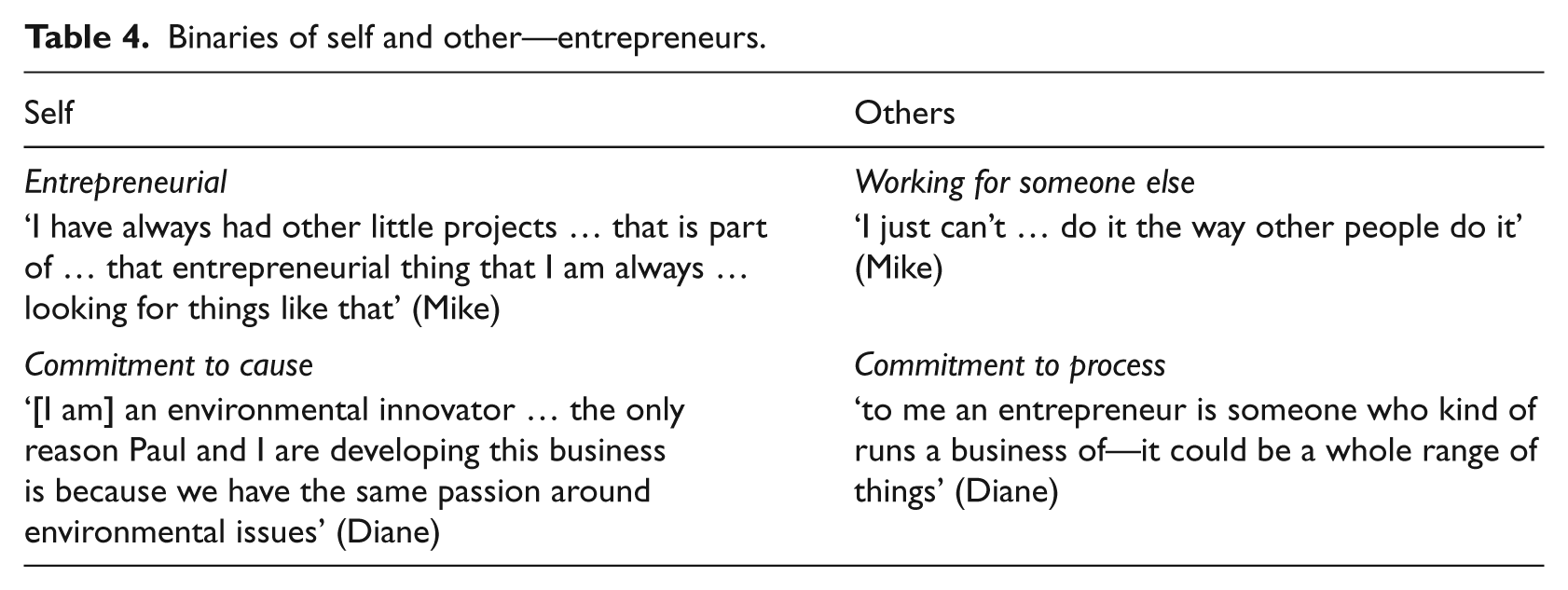
Mike positions his character as having a very strong entrepreneurial streak as he is always looking for opportunities and has a continual stream of other plans and projects. He casts himself as unable ‘to do it the way other people do it’ which sets him apart. His narrated character thus fits the stereotype of the entrepreneur as rugged individualist. Diane, however, is horrified at the thought of ‘being’ an entrepreneur, a position suggested by myself. Her narrated character is instead an environmental innovator, and she points out that the practice was only established because of their passion for the environment. Entrepreneurs, on the other hand, would be interested in setting up a business to make money rather than achieve some overarching good. Diane’s motivation is presented as commitment to a cause, while entrepreneurs are motivated by the act of establishing a business. Her characterization of an entrepreneur fits with the morally dubious picture painted by popular discourse (Nicholson and Anderson, 2005).
In both narratives, the protagonists (the narrators) are being positioned outside two antagonistic systems: the green community which is passionate about the environment, albeit in a fashion which the narrators claim is alienating, and mainstream business with its connotations of conservatism, lack of compassion and so on outlined above. The narratives are thus primarily concerned with a working out of what it means to be neither part of the business nor the green communities. Who are you if you embrace environmentalism but deny the green community? And, on the other hand, what does it mean to simultaneously deny what is connoted by and yet conduct business? The confusion indicated by the binaries points to an, as yet, unresolved tension as the protagonists are part of, but not part of, both green and business communities. They align themselves with the ‘not-business’ characteristics that by implication are also part of being green (vision, collaboration, authenticity, caring) and with the ‘non-green’ pragmatism that is complementary to business. When their narratives can provide an adequate answer to these questions, narrative resolution will be achieved and the quest of finding a way to live a holistic life can be resolved.
Conclusions: Narrating ecopreneurial selves
The aim of this article is to show how individuals construct and maintain a self through identity positioning within discourse in the narratives they tell about themselves. A narratological approach facilitates a focus on the structure of their narratives; a structure which is discursive and which pre-exists the narrative being told. Thus, like a literary work, the narrative is made comprehensible by means of association with other narratives which are themselves part of a discursive field. Moreover, the technique allows us to go beneath structure to perceive how the narrator works within it to craft individualized narrative.
The close reading of the two ecopreneurial narratives presented here leads to a number of conclusions. In developing an account of how identity is constructed, it is important to recognize that narratives of self involve a complex interweaving of discursive resources with ongoing processes of self-positioning through the vehicle of a plausible plot. To foreground either discourse or identity positioning is to miss half the story. The analysis of the fabula reveals that these participants draw on a number of storylines associated with business and environmentalism. These resources provide scaffolding that lends the self support and plausibility albeit that they are juxtaposed with some discomfort. A competing discourse is neither silenced (cf Jones et al.,2008), and nor is the narrator reflexively engaging in one discourse and rejecting another (cf Warren, 2004). Moreover, unlike the managers in Clarke and colleagues’ (2009) research, for whom discursive resources are antagonistic and coexist in uneasy tension when they attempt to construct selves as moral beings, the narrators need to draw positively on business and environmental discourses to support their identities and to present a credible self that is good for the environment and good at business. The narrators draw on another discursive resource, that of the quest masterplot, as a vehicle for the fabula. This provides a bridge between discursive resources and identity positioning by enabling them to position themselves as heroic protagonists who are acquiring moral qualities and overcoming obstacles and difficulties.
Conflicting discourses are combined relatively seamlessly to construct a logical series of events which provides a framework for achieving a cohesive identity. However, they produce contradictory self-representations in the sjuzet as the narrators have to position themselves within those events. The narrators are represented within the narratives as simultaneously part but not part of the business community and part but not part of the green movement. Their quest for a sense of self as a moral being adhering to an ethic of care and communitarian values while also managing successful businesses perhaps means it is impossible for them to identify fully with the business community and equally impossible to identify fully with green activists. Instead, they position themselves such that their activities within capitalist relations of production can be justified as using business acumen to achieve their goals of long-term change, while rejecting those elements that seem offensive or counter to their espoused values and beliefs. These would include being uncaring about other people, being driven by self-interest and a focus on profit maximization. Likewise, they are positioned as outside a green community perceived as a threat to their overarching missions to mainstream sustainability. In order to be credible as successful in business and as committed environmentalists, the narrators therefore cannot fully identify with either group and must walk a tightrope between them (see also Zabusky and Barley, 1997), engaging with both groups yet not quite belonging to either.
It might appear that Mike and Diane could be aligned with the pragmatic, business-case discourse identified as commonplace by Prasad and Elmes (2005) and others. The difficulties that seem to beset them in reaching the destination of their quest resonates a little with the use of journey as a metaphor where companies claim to undertake a journey towards sustainability without specifying a destination point or even explicitly stating that there is no destination (Milne et al., 2006). For such organizations, the journey metaphor seems to be used, either deliberately or unwittingly, as a way of claiming progress towards sustainability while covering over inaction, deferral and continuing business as usual. Mike and Diane, however, differ in that they clearly delineate their desired destination, which is to live life holistically. Moreover, Crane (2000) reports that an avowal of a passionate commitment to the environment was missing from the participants in his study who denied that the environment had any claim for moral status, and this is manifestly not the case for these participants. Indeed, their environmental beliefs are such that they provide the rationale for establishing their businesses at the outset. Thus, the participants’ narratives appear to tell a story of a struggle to chart a course towards their goals and the apparent tensions that result from the difficulties of coping with being caught between competing discourses and their attempts to weave them into a coherent whole. Their efforts to engage with such discourses result in an exposure to inconsistency that is avoided by those who focus on business as usual and do not engage in discourses of environmentalism. Such efforts result in the disorientation and anxiety Weinberg notes when green entrepreneurs attempt to grow their businesses (Weinberg, 1998).
Bruner remarks that spoken autobiographies display seeming consistency as narrators impose continuity and congruence on the told stories of their lives (Bruner, 1994). He points to the drive to reduce dissonance as critical in explaining this. Thus, in seeking to explain why these participants attempt to articulate, to self and others, a position and identity that blends business and environmentalism into a coherent whole, we could frame these narratives as exercises in reducing internal conflicts and inconsistencies. Thus for an individual who engages in a particular behaviour, or in narratological terms, is the protagonist at the centre of a series of events, his/her perceptions about that behaviour may conflict or be inconsistent with other perceptions regarding the appropriateness or moral acceptability of such actions. Holding conflicting ideas simultaneously involves anxiety or discomfort for the individual who will attempt to resolve the resulting dissonance. We could speculate that such dissonance is heightened because the participants are aware that the necessary actions and practices in which they have to engage in order to run commercial businesses conflict with their positive view of themselves as committed environmentalists. Thus the positioning of their characters within a series of events is problematic.
The means used to reduce conflicts and inconsistencies in the stories is complex and involves re-casting their appraisal regarding the behaviour causing it according to how they are positioning themselves against particular groups at different points in the narratives. The narrators cannot consistently modify their perceptions about such behaviour as negative appraisals of business and green conduct are an important element in their constructions of self through the process of othering. At the same time, those appraisals have also to foreground positive elements with which the narrators wish to identify. Thus, the narrators change their assessments of green and business behaviours to emphasize those aspects they consider desirable and de-emphasize undesirable aspects. When the narrators position themselves against the business community, they foreground their communitarian ethos and their green credentials and downplay business approaches, but when they position themselves against the green community, they stress their pragmatism and business sense and explicitly refute relatively radical approaches.
The narratives also suggest that the participants are using strategies to reduce dissonance through distancing and deflection. Distance is created by deflecting characteristics purportedly assigned to the protagonists by one set of supposed others onto the more acceptable substitute of the opposite set. The highly conservative attitudes attributed to Mike by the green movement are deflected onto the mainstream stationery companies, while the greens themselves are portrayed as unreasonable extremists. The amazement expressed by Diane’s colleagues that she was giving up a highly professional job chimed with her own worries that she might not appear credible within the architectural profession, but she then presents other architects as ‘unprofessional’ in that they leave the human dimension out of their designs. They can thus deny the existence of such attributes in their own characters, and, in an additional move, further support the casting of their others as villains against whom they can measure their own worth. To reconcile working within a market system with a belief in sustainability thus requires them to negotiate a narrow, and somewhat twisting, path between sets of binary oppositions into which they can jettison what might contest or disrupt the narration of a coherent identity. While Jones et al. (2008) found that the social entrepreneur in their study crafted identity through using claims of separation and similarity, and a strategy of suppression or silencing of what might perturb a coherent self, this study suggests that there is an additional process of distancing through deflection onto supposed others of perceived negatives that could threaten a purported moral and competent self.
Through the narration of their stories, these participants are striving to stabilize and refine a coherent sense of a self that is for business and for the environment, as opposed to for business or for the environment. They represent themselves as starting with a green vision and a desire to change the world that is then channelled through a business start-up, although it turns out that the object of their quests is actually about changing themselves. The narratives reveal how they have drawn on a number of culturally proposed, but not always compatible, storylines. They then have to position their characters in their narratives such that they can attempt to deal with the resulting existential concerns. Thinking continues to develop with regard to a ‘natural capitalism’ that focuses on restoring, sustaining and expanding the natural habitat and resource base (e.g. Hawken et al., 1999) but, for practitioners, to borrow from a well-known TV character’s catchphrase, it would seem that, for those who wish to combine business and environmental commitment, it’s (still) not easy being green and being enterprising.