




Abstract
The study uses narrative analysis to understand the workers discursive constructions of their classed, gendered and racialized subjective identities and their investments into the collectivity of the union in the context of the lock-out. It goes beyond the Marxian analysis and uses poststructural feminist analysis to understand how the intersectional subjective identities are constituted and their interrelationship to the investments in and constitution of collectivities in the context of industrial action. The study is based on participant observation and interviews of hotel workers in the food and beverage section of a hotel in Toronto, who were locked-out in 2007, and of other workers on the picket line supporting the locked-out workers. These workers are members of UNITE HERE-Local 75 (Now HERE-Local 75), who had been in the process of renewal of their contracts at the time. I would argue that the intersectional subjectivities of the hotel workers and their investments in the collectivity of the union are fluid and relate to their pursuit of material and/or symbolic security through search for an identity as a unionized, active worker or an identity which is secure irrespective of the union.
Introduction
Industrial relations research has been dominated by Marxian analysis where class identities are considered primary in constituting collective actors (Buechler and Cylke 1997). Several Marxist theorists have argued that industrial action produces an explosion of workers class consciousness and an increase in a positive ingroup identification (Archibald, 1989; Mann, 1973). Although there is now a wide recognition of intersectionality as important to industrial relations research (Bradley, 2007; Bradley and Healey, 2008; Briskin, 2008), there is very little work using a poststructural feminist lens to understand how the intersectional subjective identities are constituted and their inter-relationship to the investments in and constitution of collectivities in the context of industrial action. This article addresses this gap and uses narrative analysis to understand the workers discursive constructions of their gendered and racialized subjective identities and their investments into the collectivity of the union in the context of the lock-out.
The study is based on participant observation and interviews of hotel workers in the food and beverage section of a hotel in Toronto, who were locked-out in 2007, and of other workers on the picket line supporting the locked-out workers. These workers are members of UNITE HERE-Local 75 (Now HERE- Local 75), who had been in the process of renewal of their contracts at the time. The major point of dispute was the year of expiry of the contract—which the union demanded as three years and the management insisted to be four years. This was a part of the Hotel Workers Rising movement launched by UNITE HERE in 2005 aimed at bringing together hotel workers across North America to raise industry standards and create well-paying, safe and secure jobs and to have all hotel-worker contracts settled in the same calendar year: 2010, in the next renewal cycle. After 90% of workers refused to sign the contract with a four-year expiry, management decided to lock-out 22 food and beverage workers and closed down the restaurant and room service. According to one worker it was ‘the more vociferous workers who were locked out’. Another explanation of this was ‘the relative dispensability of room service work’ and yet another was ‘the management’s policy of divide and rule’. The lock-out continued for nearly four weeks after which the union was successful in negotiating the contract expiry date to three years on a par with several other Toronto Hotels. The paper analyses the dynamics of the gendered and racialized subjectivities and collectivities of these workers in the context of the contingent materiality of a lock-out.
On the hotel industry
The last quarter of the 20th century has witnessed a growth in precarious employment globally (Rodgers and Rodgers, 1989; Standing, 1989) and in Canada (Fudge, 2001; Vosko, 2000, 2006). Some studies (Riley, 1991; Walsh, 1991) document the prevalence of casual, part-time and temporary work in the hotel and hospitality industry, a sector of considerable interest given its relationship to the gendered and racialized character of restructuring, globalization and the rise of employment in services. The sector is also important to the study of gender and work given the role of hotels as providers of essentially domestic services in a commercial context, that is, as a domain of ‘women’s work’ (Crompton and Sanderson, 1990; Liladrie 2010; Schenk, 2006; Tufts, 2006). This marginalization of women from the top management positions is accompanied by a segregated, gendered and racialized labour process in the hotel industry (Schenk, 2006; Tufts, 2006). Inequalities in the larger society are reproduced through the internal system of stratification in the industry, evident in workers’ earnings and differential career mobility (Adler and Adler, 2003). There is evidence of predominance of ethnic minority and migrant women workers in the back room tasks like that of housekeepers and chambermaids (Adkins, 1995; Schenk, 2006; Tufts, 2007) and an under-representation of women in these social locations in the customer service work (Adkins, 1995).
The devaluation of women’s skills as natural talents accompanied by a segmentation of the labour market implies that the restructuring of the labour force will lead to the marginalization of women as ‘flexible specialists’—the idealized skilled workers of the restructured economy in Piore and Sable’s (1984) thesis (Jenson, 1989). Women’s innate aptitudes, instead, supposedly makes them ‘flexible’ labour, a moniker often used, in practice, to justify labour market deregulation and the spread of precarious, part-time and temporary work (Jesnson, 1989: 145). The social construction of skill-based divisions among women also explains the occupational segregation of racial minority women in labour market segments characterized by high levels of insecurity and poor employment conditions (Zeytinoglu and Muteshi, 1999/2000). Precarious employment is shaped by, particularly the interaction of social relations of ‘race’, gender and political and economic conditions (Vosko, 2006: 1); nowhere is this insight more apt than in the hotel industry. In his study of Journey Hotel in Toronto, for example, Schenk (2006) reveals that despite the success of the union local and the bargaining unit in winning substantial contractual improvements, the housekeepers who led the fight were the first to be faced with lay-offs and reduced hours of work when SARS hit the city in 2002. However, in my case study—of the 22 locked-out workers only three were women of whom only one was a worker of colour so that precariousness here was not apparently gendered. But a majority of locked-out men were workers of colour and constituted 15 of the total of 19 men locked-out, so that there is a racialization of precariousness.
In the year 2003, 37.9% of the 26,880 workers employed in accommodation services in the Census Metropolitan Area of Toronto were unionized (City of Toronto, 2004, quoted in Tufts 2006). Tufts (2007) also notes a significant representation of women, people of colour and recent immigrants in Unite-Here Local 75, the largest hotel union in Toronto. Tufts (2006: 356) has argued that the segmentation of the hotel workers and the uneven opportunities available to different workers to acquire cultural capital challenges the union attempts to build solidarity and a traditional ‘craft identity’. Tufts (2006) explores the role of the union in attempting to transform the hotel worker’s identity from mere service providers to ‘cultural workers’ and sees this as an attempt to invest in building the symbolic capital of the members of the union that will increase its leverage with employers and the public and as an attempt to unify ethnically diverse work force. To add to this exemplary research, I will explore what is the inter-relationship of workers gendered and racialized subjective identities to their views about the union in the context of the lock-out. What is the role of union membership to their subjectivity and collectivity? In the event of a ‘lock-out’ and the contingency of a potential job loss, how does their collectivity as unionized workers play out?
Subjectivity, identity, unions and precarious employment
The industrial relations research has been dominated by Marxian analysis where class identities are considered primary in constituting collective actors (Buechler and Cylke, 1997). Goldthorpe (1996) has questioned the Marxist and liberal class theories for their functionalist and teleological assumptions and the inability to explain why class inequalities are resistant to change. He calls for opening up the theories to enable secure micro-foundations and to explain the persistence of class inequalities. Wright (2007) questions the modernist underpinnings of class analysis which has been dominated by Marxian framework and calls for a textual analysis of working class culture based upon contingency, indeterminacy and heterogeneity.
Mobilization theory proposes that unionization may come into being due to a feeling of injustice with a breach of collective agreement rights or of widely shared social values (Kelly, 1998). Budigannavar and Kelly (2005) argue that for the workers to mobilize to form a union the grievance must be felt by a substantial number of workers, workers must either attribute the blame for their problems to an agency, e.g. employer, or must feel that the employer can remedy them and finally people must have a sense of agency that the collective organization can make a difference. The industrial unions historically have been dominated by a collective identity around masculinity, whiteness and physical strength (Cockburn, 1991; Lewchuk, 1993; Yates, 2003). Forrest (2001) investigates the role of ‘women’s issues’ in their decision to join the unions by examining a successful organizing drive in a women dominated workplace and argues that the industrial relations discourse is male biased in emphasizing the similarities between women and men and not accounting for women’s paid and unpaid work and union experiences. However, in Canada workers entering a unionized workplace have little ‘choice’ in joining the union and are automatically part of the existing union. Thus, some workers may be ‘passive’ members of the union and may not be invested in their collectivity as a union member. However, the individual and collective subjectivities are fluid and contingent and may change with the materiality of a lock-out.
Some studies have shown people’s perception of the union as linked to their perception of the instrumentality of unions in improving their economic conditions (Youngblood et al., 1984) and workers with lower socioeconomic status as having more positive attitudes towards the union (Cornfield, 1991; Cornfield and Kim, 1994; Leiter, 1986). Chang (2003) develops a model to explain how race, gender and class influence people’s attitudes towards labour union directly and indirectly through their experience of economic hardship. These studies are useful in helping understand the diverse perceptions of people to the union. However, by reducing the complex identities of people to their economic experience the analysis becomes narrow and reductive.
Several authors recognize trade unions as important source of individual social identity for members and of collective identity of solidarity and unity (Colgan and Ledwith, 2000; Hyman, 1994; Kelly, 1998; McIlroy, 1998). However, the gendered and racialized practices are common in several unions (Healy and Telford, 2002; Munro, 2001). While self-organized women’s groups were noted as important sites for social creativity in UNISON, their ability to carry through more radical collective action for social change is limited (Colgan and Ledwith, 2000) and these groups may lack a clear position in decision making structures (McBride, 2001).
According to Kelly and Breinlinger (1996: 41) individuals identifying strongly with the group will be more likely to get involved in collective action whereas individuals with weak group identity are more likely to engage in individual action. Several Marxist theorists have argued that industrial action produces an explosion of workers class consciousness and increase in positive in-group identification (Archibald, 1989; Mann, 1973). Langford (1996) in his case study of the 1987 strike by the Hamilton local of the Canadian Union of Postal Workers argues that the in-group and out-group dimensions of class consciousness are distinct and that an explosion of in-group consciousness due to inter-group conflict is more likely to occur among workers who are already identified with the in-group.
However, there are significant differences of interest between women and men and between white people and people of colour in trade unions around industrial action (McDermott, 1993; Westwood, 1984). Yates (2003) notes that there has been a conscious effort by some unions to reconstruct their identities and that as a defensive strategy of small unions HERE and UNITE have reconstructed their identities on celebration and primacy of rank and file workers. The UNITE HERE which came into being through the merger of UNITE and HERE in 2004 adopted a ‘rights based’ identity strategy for the union which targeted the rights of racialized minorities in its campaign of ‘Hotel Rising’.
Some studies of social movements construct identity as unitary and homogenous. MacKenzie et al. (2006) in their study of mass redundancy of steelworkers in Wales underline the importance of occupational identity to individual and collective identity formation. They argue that the crisis of redundancy that removed the occupational basis for collective identity provided the push to rearticulate it (MacKenzie et al., 2006: 848). However, as Tufts (2006) has argued the occupational and craft identity of the hotel workers is difficult to conceptualize in the face of a highly segmented labour market. The question this raises for my research is to explore the becoming of collectivities and collective identities of the hotel workers, who have been locked-out, are unionized and are picketing outside the hotel in my case study. How do these collectivities evolve in the face of the segmentation of the labour market by gender and race? In my case study a few workers like a first cook, a bartender and even one room server felt pride in their work and had a long association with their jobs. They invested in their identities as ‘cook’, ‘bartender’, etc. but did not have any outreaching occupational identity with other workers across the hotel, so that their self identities did not necessarily generate a commonality as ‘hotel workers’. However, there was a common sense of aggreivement at being locked-out which generated collectivities in some but produced fragmentation with the group in case of others.
Young (1987: 62) indicates ‘the logic of identity typically generates dichotomy instead of unity’ by differentiating between in and out. Several feminist thinkers have challenged the modernist conceptualization of identity and its fixity conceptualizing identity as a process and a journey (Butler, 1991; Gonzalez, 2008; Young, 1987). McCabe (2007) argues against the dualistic thinking in which the individual is put in opposition to the collective identity or class and demonstrates in the context of his case study of an automobile manufacturing company in UK how attending to subjectivity can enrich our understanding of collective resistance. McCabe describes subjectivity as: … the culmination of various power relations and the reciprocal interpretations, reflexivity and actions of an individual at any given moment. It is the way in which we understand and interpret the world and ourselves. Although subjectivity refers to the lived experience of individual subjects, this does not mean that the individual is separate from groups, collectives or society or that one necessarily embraces individualism. (McCabe, 2007: 245).
I would argue that there is a need for a dynamic understanding of the gendered and racialized subjectivities of people as they relate to their sense of individualized and collective identities and their perceptions of the union which are contingent and fluid.
The role of subjectivity in the context of the labour process theory is controversial. Braverman (1974) believed that the capitalist work confronts labour as an alienated activity regardless of the subjective state of mind of the workers (Spencer, 2000: 226). Poststructural organizational theorists emphasize the importance of combining subject and object and power and subjectivity. Some authors (Spencer, 2000; Thompson and Ackroyd, 1995) are critical of the poststructural approaches to the labour process theory as politically conservative in its focus on subjectivity and in its failure to consider resistance. On the other hand Holmer-Nadesan (1996) uses a poststructural feminist theory to illustrate how women ‘service workers’ employed by a public university identify, counter-identify and dis-identify with managerial formulations of their identity, thus challenging their socially ascribed identities. Human subjectivity is always characterized by a dual experience of self as both separate from, yet also related to, the natural and the social world (Collinson, 1992: 29). The dual experience of self as both subject and object creates an ambiguity at the very core of subjectivity, which is irreducible, but also often contradictory (Collinson, 1992: 30).
According to Foucault (1979), subjectivity is not autonomous and independent from structural forces. Rather, subjectivity is itself constituted by ‘disciplinary practices’ and ‘relations of power’. Several authors (Cheng, 1996; Cockburn, 1983; Kerfoot and Knights, 1998) have noted the inter-relationship of work and masculine subjectivity. Studies by Ford (1985) and Ingham (1984) indicate the centrality of paid work in the lives of men. Masculine identity is socially constructed through paid work, which is embedded in an occupation and often within an organization (Cheng, 1996: xiv). Soni-Sinha (2006, 2010) explores how men constitute their masculine subjectivities by investing in the discourses around their work as ‘tough’ and ‘skilled’. Collinson (2003: 529) argues ‘that the growing interest in selves and subjects within the workplace has not always fully appreciated the analytical importance of insecurity for understanding the subjective power relations, practices and survival strategies of organization’. He argues that in surveillance-based organizations the employees construct a variety of conformist, dramaturgical, and/or resistant selves to secure material and/or symbolic security but may produce paradoxical effects.
Yuval Davis’ (2006) understanding of intersectional analysis as ‘the differential ways in which different social divisions are concretely enmeshed and constructed by each other and how they relate to political and subjective constructions of identities’ is particularly useful here. McCall (2005) recognizes three methodological approaches to intersectionality—anticategorical complexity, intracategorical complexity and intercategorical complexity. The anticategorical approach deconstructs analytical categories as social life is considered too complex, with multiple and fluid determinations of subjects and structures to be captured by social categories (McCall, 2005: 1773). The interacategorical complexity approach questions the boundary-making process while acknowledging the durable relationships that social boundaries represent. The intercategorical complexity involves a provisional acceptance of existing analytical categories to document relationship of inequality among social groups and changing configuration of inequality along multiple dimensions. I would describe my approach as a combination of intercategorical and anti-categorical approaches. The study uses an intercategorical approach in that it gives voices to working class, visible minority women and men as well as Caucasian men focusing on their perceptions of the union and their identities in the context of gendering, racialization and classism. However, it recognizes the non fixity in the boundaries of categorical identities in the narratives of the respondents which are fluid, dynamic and change with the contingency of the lock-out.
In my study I find little consistency in the narrative of several individuals in the course of the interviews. There were some men who felt that they would rather stick with the hotel because of their comadaire with their co-workers but would then show a sense of frustration at the commitment to stick together. There were others who had a very strong sense of ‘self’ as sufficient on one’s own but admitted that they do understand the cause of the picket and the union perspective. On the other hand, for several men of colour, union was important for security and collective identity but they felt that it was not always fair in its representative structure. In the context of my study, I will trace the emergence of the collective identity when picketing in the face of the lock-out as also the fragmentation of this collective self. I would argue that the gendered and racialized subjectivities of the hotel workers and their investments in the collectivity of the union are related to their pursuit of material and/or symbolic security through search for an identity as a unionized, active worker or an identity which is secure irrespective of the union. However, identities are fluid and evolved with the lock-out and picketing.
Methodology
The access to the hotel workers was negotiated through UNITE HERE 75 for nearly four months involving several emails, telephone calls and visits to Toronto attending their rallies and union meetings. It was after this prolonged period of negotiations that the researcher in the union finally informed me of an opportunity to meet and speak to some hotel workers from the food and beverage section of Hotel Huron, who were locked-out and were on the picket line. This was presented to me as a feasible opportunity as the workers were in economic need and would appreciate the nominal compensation of $15 for their time. The article is based on the semi-structured interviews with 19 workers on the picket line—16 of whom were from Hotel Huron and three who were workers supporting the locked-out workers. The interviews, which lasted for nearly an hour each, took place in the nearest coffee house where workers were interviewed in turn. Of the 19 interviews, 17 were recorded with the permission of the respondents. I questioned the respondents on their demographics, the nature of their work and the work process, status of the job, wages and other benefits, gendering and racialization at work, hierarchy in the hotel and barriers to moving up in the hierarchy, and perception of the workers around the union and the lock-out.
The article examines the narratives of women and men employed in Hotel Huron to understand the discursive production of subjects and selves, the discursive and material practices of gendering and racialization in the hotel industry and the union, and the investments and contestations around collectivism in the contingency of a lock-out. Cullum (2000), in the context of her study of historically contingent experiences of women and unionization in the province of Newfoundland, documents the challenge of analysing the production of meaning making and the multiple formations and re-formations in self-identity. Similar to Cullum (2000: 32) I draw from feminist poststructural analysis to ‘perform several “readings” of the same text’ to discern the discursive production of subjects and selves. In discerning these complex meanings I acknowledge the locality of my research and its situatedness in my research framework and my multiple and intersectional identity as a woman, a visible minority, a researcher and my shifting positionality as an ‘insider’ and ‘outsider’ to my respondents. All the names of the hotel and the respondents are pseudonyms.
A profile of the workers
The profiles of the 19 workers interviewed are presented in Table 1. As noted earlier, there is a predominance of ethnic minority men, who constitute eight of the 13 men interviewed. They came from diverse regions—South Asia, Africa and the Mediterranean. Five other men interviewed were white Canadians. Of the six women interviewed, three were from restaurant and room service and were locked-out, and three were women picketing in support of the locked-out women—of whom two were room attendants from the same hotel and one was from the security department of another hotel. None of the workers interviewed were ‘new migrants’ with years of migration varying from ten to 41 years. There is a wide diversity in the ages of the workers interviewed—from 23 years to 61 years. The education level of the workers varied from Grade 10 to college level. Of the 16 locked-out workers interviewed, 14 perceived their work as full-time but said that their hours were not guaranteed. The other two worked part-time but held multiple jobs.
Demographic profile and work information of the hotel workers in Toronto.
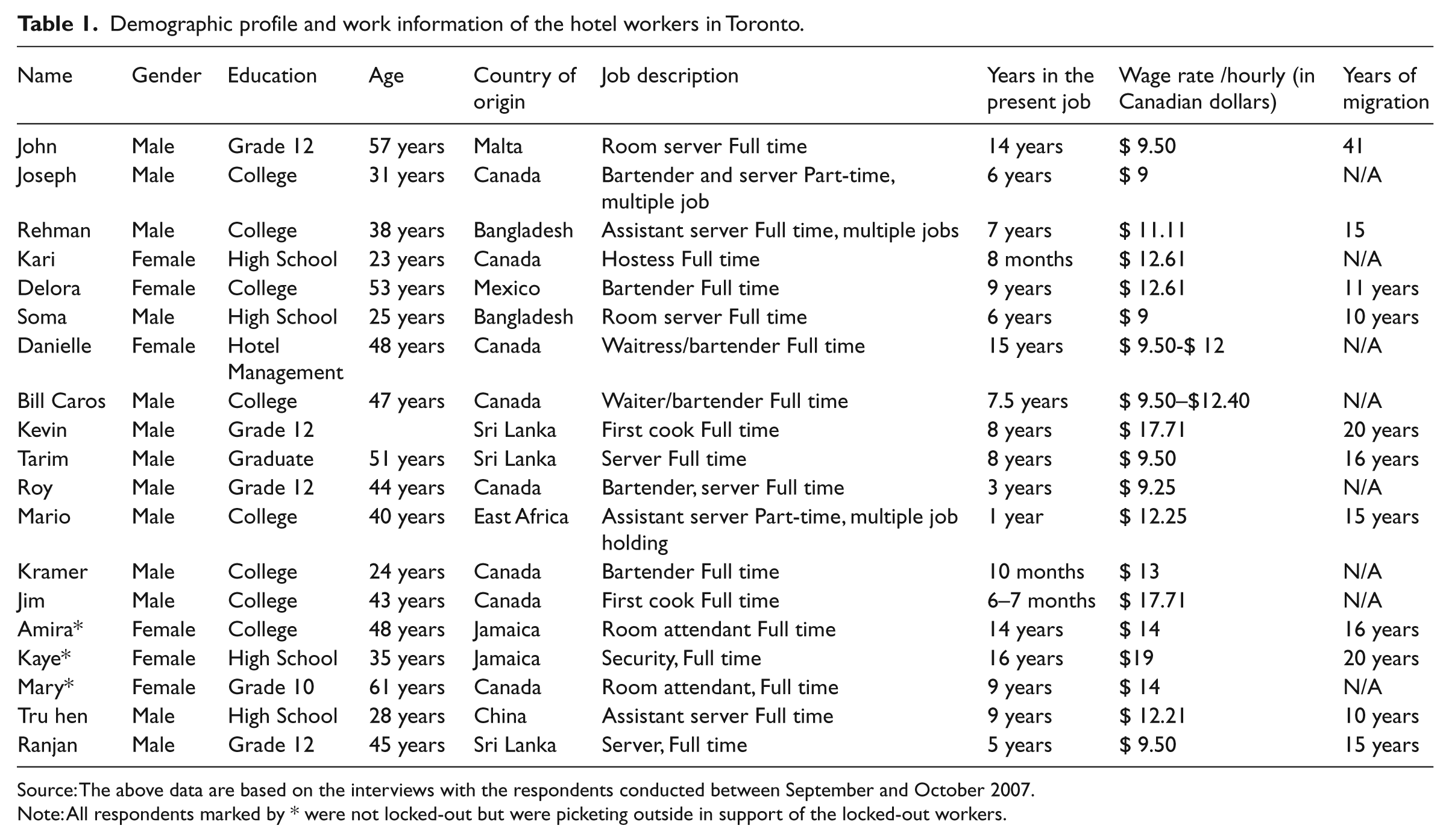
Source: The above data are based on the interviews with the respondents conducted between September and October 2007.
Note: All respondents marked by * were not locked-out but were picketing outside in support of the locked-out workers.
Subjectivities, collectivities, unions and the lock-out
The investment of the workers in the collectivity of the union and their constructions of the union were fluid, differed across workers and were related to the constitution of their gendered and racialized subjective identities which varied from those of an individualized worker who could stand up for himself and did not need a union to that of a worker who believed in the united strength of the union. There were others in between the two positions, some of whom felt little sense of organizational identity as hotel worker and perceived their hotel work as a short-term occupation for monetary return alone. A few of these workers perceived the lock-out as a financial strain they would rather not bear. However, some workers spoke of the changes in their perceptions of the union over the years and on the evolving of a collective self.
Why do I need a union when I can stand up for myself?
One of the important themes emerging from the narrative of Jim—a white man and a first cook at Hotel Huron was his individualized subjectivity as a strong, honest man who took pride in his work and who did not need a union to fight on his behalf as he could stand up for his rights. In this construction of self as ‘strong’, and ‘able to stand for self’ was the binary of a racialized ‘other’ as ‘docile’. He also wove a narrative around his work as tough and skilled which could not be done by women thus constructing a gendered ‘other’.
… when I first started I was sort of anti-union, because I never needed it in the past, as I have a good work ethic. I was never on the line to be fired or call in sick, so I was never the guy they needed to worry about. I was always more than willing to help management and show the leadership role, and do what I could, because as a first cook in a restaurant, you are guiding at least two, three guys, and below them would be the second and the third cook and the dishwasher, so if I needed someone I would get them to do it … and I guess that’s what the union is doing, it fights for people, but I guess I was always able to fight for myself. I go in, I set up boundaries, this is what I do and don’t do, this is what I expect.
Jim constructed unions as fighting for and defending people who have poor work ethics and/or for people who were weak and could not stand up for their rights and constructed his subjective identity as a leader who is able to fight for himself. We notice in Jim’s narrative of setting boundaries and in taking up a leadership role, a masculine and secure subjective identity as independent and autonomous and a reinforcement of Cartesian duality with detachment and boundedness as valued traits.
Jim’s identity is closely related to his ‘masculinity’ which is achieved by constructing his work as ‘dangerous’, ‘tough’ and difficult (Collinson, 1992). In his narrative of the hotel kitchen work as ‘difficult’ and as masculinized with a marginal presence of women in ‘light work’ he fed into his masculinized subjective identity as ‘tough’ and able to do stressful work. He also went on to describe the sexist and masculinist culture in the hotel kitchen which gave him a sense of being one of the ‘lads’ (Willis, 1977 ) and which he described as uncomfortable for most women.
I think there are few women in the kitchen because it can be a rather difficult job. It’s not a cook a roast and potatoes and cherry cobbler for dinner, it’s not like that. There’s a lot of physical, mental and stressful activity that goes on … We’re talking about a mixer bigger than the size of me, 6 feet tall, you can get into the bowl. Having to put the mixing blade on there, weighing 5 and 10 pounds the blade itself. I think the physical labour becomes so much when you go industrial or professional, that comparing home and hotel cooking is not fair. In the male dominated field, there becomes a lot of arrogance, ego and attitude, and men are easy to brush off on each other … underground sub culture that exists in the kitchen and the odd woman will infiltrate that, and either she will be able to take the blunt of sexist comments, jokes … I mean because we’re males and generally we’re there by ourselves so we try to get by and be professional, and if there is a woman who comes in … so, yah, it’s like kids in a school playground.
We can read in Jim’s narrative above the construction of his work as a cook as ‘tough’, ‘heavy’, ‘stressful’ and as too difficult for women feeding into his masculine subjectivity as tough and strong and constructing women as ‘weak’ and delicate. Hall (1996) on the construction of identities has argued that ‘ … it is only through the relation of the Other, the relation to what is not, to precisely what it lacks to what has been called its constitutive outside that the “positive” meaning of any term—and thus its identity-can be constructed’ (Hall, 1996: 4–5). Jim also engaged in the reinforcement of his identity as a white, tall man and as different from the racialized men. According to Jim: If I have an issue; I want to get it settled. Let’s say a young cook, a third cook, from the Philippines, a young man, he could be forty-five years old, even older than me, but not have a lot of power. And because he is a third cook or kitchen helper already, and let’s say he is 5’5’, I’m over 6 feet, I’m tall, this guy is a short guy from the Philippines and he’s lucky to have this job, so he might see that he is being shorted an hour on his wage, but he doesn’t have the courage or the strength to go to his boss and say how come I don’t get this.
Thus, Jim constructed his masculine subjective identity as independent by constructing a complex racialized ‘other’ who could not stand up for himself and was either pushed by the management or who with the support of the union defended his poor work ethics and pushed the management by filing grievances. In describing a Philippines man as powerless, short and as ‘lucky to have his job’ Jim fed into the racialized structures of the workplace and reproduced these structures.
Gonzalez (2008) questions collective identity as a precondition to collective action. In the course of the interview with Jim I noticed a shift in his narrative from anti-union to ambivalence to the union and investment in a collective identity which came about with the contingent situation of the lock-out and being a part of the picket. He admitted that though he was not a union person earlier, he now is supportive of the picket and in the course of participation in the picket, feels for the cause and the collective identity with other workers. According to Jim As I picket outside the hotel I feel a part of the collective. I can see now what the cause is. The cause is we need to have some kind of level playing field, and all the hotels need to have some sort of structure, because apparently other hotels have different amounts of money. Now, 60 percent of the hotels in Toronto are owned by the same company, then the jobs should equal the same amount at one place as the other place. They’ll argue that this one is 4 stars, this one is 3 stars, and this one is 5 stars. These guys are making $2 more because this is a better hotel. I argue that it is the same hotel. A VIP platter for me is the same as that. I am educated, fully professional, and there is no reason why the guy across the street doing my job should get $2/hour more.
According to Della and Diani (2003: 87) identity is not an immutable characteristic, pre-existing to action. On the contrary, it is through action that certain feelings of belonging come to be either reinforced or weakened. In other words, the evolution of collective action produces and encourages continuous redefinitions of identity. It is therefore possible to hold that the process of construction of collective identity is an integral component of collective action.
Thus we can discern in Jim’s narrative an individualized identity as a Caucasian male who was ambivalent to the union but in the course of picketing and telling of his story co-constructed a collective identity with other hotel workers who were locked-out and picketing with him. Thus, I would agree with Davies (1992: 57) that multiple positioning are always already possible and that ‘One moves through multiple positioning in any one day or even in any one conversation’.
Trade Union as important to give voice to the workers
Delora is a 53-year-old woman who is a Mexican Canadian and had been working for Hotel Huron for nine years. She spoke about the inherent racism which had led new immigrants to accept whatever job they got in the hotel and to not to voice their concerns for fear of losing their job. She also said that this has changed for her with time and with her awareness as a unionized worker. In the words of Delora: When you are a minority, you get whatever you can take. Only if you are a doctor or a psychologist, or whatever, or a lawyer, then you can choose. But when you come to another country and you are a minority, you will do whatever you have to do. You have to survive. … I think management wants ‘yes’ people. People they can manipulate. Older people like me are not easy to manipulate any longer, may be when I was younger I was, but now I understand more how everything works and how unions can protect our rights. When you are new in Canada, you have to pay your rent, and you are afraid of being fired. I am lucky I have a place to go every night but some people—they don’t. So, you are afraid of saying anything.
We read in Delora’s narrative a shift from her construction as a ‘docile’ immigrant to one who is aware of her right to picket and protest the lock-out. She had been laid off from work earlier when the bar in which she worked closed off. However, she got herself reinstated through the union. She described her experience as follows.
And I told them, no, if I had been there for all these years, I have the right to have my job back, and my reason is, the other people had been there for about six months, and I had been there for seven years at the time. So, yes, I told them. If any company wants to fire you, they have the right to fire you but only for something you do wrong. If you steal, if you are lazy, if you are dumb, if you come late, then yes, they have the right to do that to you. Not because you are getting older or you don’t look as nice as you used to. No, they have to see the experience we have, older people have experience. … How you say? I call that harassment… … Well, I tell you, thank God we have the union, if we didn’t have the union I would be out of work a year later or two years later, and the reason is you can only sell so many coffees a day.
In the narrative of Delora we notice her perception of a sexist culture in the bar where a bartender is supposed to be ‘young’ and ‘good looking’ and how she did not fit that description with age. She constructed her subjectivity as an honest, hardworking and intelligent worker and invested in the collectivity of the union which she constructed as a protector of workers’ rights. Thus, Delora’s investment in the collectivity of the union is related to her pursuit of material and/or symbolic security constituting her identity as active worker. The case of Delora resembles the study of Bradley and Healey (2008) where unions offered the space to Black and Minority Ethnic women to resist sexism and racism in the workplaces in UK. According to Delora: … because in Mexico we couldn’t be doing what I am doing right now. If we are locked out from the hotel, of my job, we are outside rallying making sure that we get those jobs back, because what is happened to us is not right. But in Mexico, if you did that, they would find you somewhere, beating up … What I believe is that if it wasn’t for the union, we wouldn’t be outside. And, they are going to listen to us, and you know why?
Adib and Guerrier (2003) have argued that identity construction is both relational and contextual and the context in which this process occurs shapes the meanings, expectations and roles that particular identities carry. Thus, Delora’s identity as a unionized worker and her engagement in the practice of the picket is contextual to her immigration to Canada. We also see in Delora’s narrative a shift in her construction of the union as a protector for lazy workers to that of an institution important for the rights of the workers. In the context of her study of clerical and technical workers at Yale University, Gregg (1993: 176–177) writes From different and overlapping subject positions as workers, mothers, activists and citizens, the women’s account—what I called their ‘stories about reality’—make visible the contested meanings of self and identity. It is by negotiating among multiple and contradictory subject positions that women create room for the contestation of meanings, oppositions and change.
Thus, in Delora’s narrative we notice the contestation and shift in her identity from a ‘docile racialized woman’ to one who is ‘active’ and ‘honest’ invested in the collectivity of the union. Delora supports the claim made by McCabe (2007: 262) that ‘when individuals feel sufficiently secure/confident/inspired or angered they may resist collectively especially where there is a tradition of collectivism’. However, though Delora felt secure in her job because of the union, not everybody who participated in the picket felt the same. Some saw the picket as an instrument to get the minimum compensation from the union while others like Jim did not see much merit in the union.
Union as important for self actualization
Amira is a Jamaican Canadian who had been working for more than 14 years as a room attendant and is now the shop steward in housekeeping. She had been a fashion designer in Jamaica, but could not get a job as a designer in Canada. One can read a narrative of racialization in her interview where she felt that she ended up as a room attendant as she had no other option.
I was a fashion designer back home. When I came here I tried to get in fashion, but they kept saying I had to have Canadian experience. My sister helped me to get this job. I went to high school back home and did fashion designing. This last year I finished English classes and went back to college. … She too was in the hotel industry and she said it is hard to get in but I wasn’t giving up fashion designing. So I tried and went to other places to do interviews, put in applications. But this was the only place that hired you without Canadian experience because that’s the kind of job, so that’s how I started. For me, back home I had six years experience in fashion designing, and they say I have to have Canadian experience, but I say to them, how can I get Canadian experience if you don’t hire me? That’s what happened to a lot of us. And you are stuck here, because I try to go back to school to get out, I apply for jobs but no one responds to me after all I did. I apply for supervisor, manager, you know, but no one responds, and I put the fourteen years of housekeeping, and I don’t understand the reason …
In the narrative of Amira one can read her sense of being othered. She referred to the Canadian authorities and management as ‘they’ and to Jamaica as ‘home’ even after more than 14 years of living in Canada. This speaks of her racialized subjectivity and her ‘not belonging’. It raises question of insider/outsider status of the immigrants in Canada. Amira perceived there to be a racial and gendered segregation at work. She commented on the preponderance of white women on the front desk and that men were paid more on an average than women.
You find that white women come to the front desk just through contacts without any experience. They come here as a night audit. They keep making mistakes when it comes to budgeting the balance, but they don’t have the experience to get the job. For me I didn’t have the experience and I didn’t get the job as a fashion designer even though I had the experience back home, but then you definitely didn’t have experience in Canada or in the industry but you got the job. In various areas I see it happen, in other hotels owned by these types of owners; they wash out and then put in whom you want to put in who don’t have experience. But I could be doing it. I should be doing that job because I am experienced. But males get them, those who don’t have experience, they will find every excuse … and I’m hundred percent sure that men get more pay than the women get. Because they see him as the head of the family, so he should get more and the woman get less.
Amira recognizes the racialization and gendering in the workplace and her frustration at not being considered for a position on the front desk. She constructs white women on the front desk and men in authority as ‘inexperienced’ constituting her subjectivity as experienced. She did not feel the comfort in her work identity as a ‘housekeeper’ and felt that she was suited to be in management or a supervisor. Thus, being a shop steward in the union gave her a different context of negotiating her identity as a leader for workers rights and not just a housekeeper.
For me I am more enlightened, I am confident, I think highly of myself and my time. it’s not that before I didn’t think highly of myself, I do, but now that I know people look up to me for advice and so forth … I say to them you have to know your rights. What I do you can do the same? It’s not just senior, it’s because I stand up for what I believe in and I say no. For me I have learned a lot through that time as a shop steward. I am on the executive board of the union local 75, so I get to also make presentation for all members, which is good for me, I learned a lot. I have learned how to cope with difficult times, and try to figure out …
Thus Amira negotiated complex relations of class gender and race and her multiple and contradictory subject positioning as a ‘housekeeper’ and a ‘shop steward’. She invested in the collectivity of the union and her identity as a union shop steward and constructed her subjectivity as enlightened and confident. Thus her individualized subjectivity was closely connected to the collectivity of the union. We see here a contrast with Jim’s narrative of little need for the union for him as he could stand for his rights and Amira’s perception of herself as able to stand for her rights as also the rights of other co-workers through her role in the union. Amira enthusiastically supported the picket, although she was not one of the workers locked-out.
Instrumental subjectivity and unions as unnecessary
For Joseph who was a Caucasian male working part-time at the hotel for six years as a server and bartender, his job at the hotel was purely for earning money to supplement his income from self employment as an actor. According to Joseph: Well, when you’re an actor in Canada, you usually need another job to get some sort of income because work is so difficult to come by here and that’s why I work in a hotel. Because, well, where I work personally, the hours are perfect for me because I get to work in the evening and leave my days open so I can try to find other work. You know it’s definitely not my ideal job, but it is perfect for what I need it to be, so, yeah, it’s OK. That helps me with what I need it to be, it helps me with my finances and that’s what the job is for. I’m not serving people because I love it, I’m trying to do other things and build a career and this job is used for what it is.
Thus Joseph invested in his work identity as an actor and constructed his job as a server in the hotel as instrumental for purposes of earning some money. He had little to do with the union, and did not see it as important to him. According to Joseph ‘Umm, I haven’t had a whole lot of experience with the union, just because I didn’t need to.’ His perception of his work as a server as secondary and instrumental was reinforced through his experience of being locked-out. According to Joseph You can’t run a hotel without housekeeping staff, they’re working, and they’re part of the union. I’m food and beverage; apparently I’m expendable, which is a terrible feeling. If this goes on past another week, I am forced to find another job. I can’t stick around and negotiate a contract when I’m losing this much money already by not working, I can’t do it. If it comes down to being this petty, forget it, I’ll just work somewhere else. … The next change I want to make would be a step up. I don’t really want to serve anymore. I’ve done it for 12 years. I feel like a psychologist half the time, because you’re dealing with people day in and day out, so, after awhile you get tired of it.
In the above narrative we read Josephs frustration at being locked-out and losing his income. For Joseph serving in the hotel was a transitory phase and he expressed dissatisfaction with both the management and the union.
I think there is a lot more that could be done to help this hotel, but I don’t know if they want to run it into the ground and sell it or restructure it that way. I just find shabby management. I think it sucks; I don’t like it at all. There always seems to be a dispute between management and union, it just seems to go hand in hand. … This union is very strong against the management of this company, or this company in particular as a whole … which I can agree with in many areas, but I find that there is too much talk and too little action; they can’t seem to negotiate anything or get to the point of negotiation quickly … things are drawn out and talked around. It’s just really frustrating because I use this job for what I need it for and it’s taken away from me because there’s a dispute between union and management.
In the above narrative, Joseph distances himself from both the management and the union and expresses his frustration at the prolonged negotiations and the inability of the union to ‘act’. He clearly does not identify himself as a ‘hotel worker’ but sees his work in the hotel as important for a living and instrumental to his continuance as an actor.
I’m expecting them (the Union) to bring more fire power, if they’re going to make a statement, make statement, don’t half ass it. If you have all this power, show us, show me. I’m out there I’m the one who has lost a job. You’re my union I pay into the union. Am I being compensated now because I’ve paid into you? I should be compensated somehow you’re supposed to take care of me in this position. So, what’s happening? I can’t seem to get any answers.
Thus for Joseph, the lock-out did not generate any feeling of collectivity with his co-workers or an identity as a unionized worker. He constructed the union as weak and unable to protect the welfare of the workers and questioned its legitimacy. His work as a server and a unionized worker was not important to his subjectivity for he saw this job as instrumental and identified himself as an actor. He resented the lock-out and the material loss it entailed and he even contemplated quitting this work to look for alternative job if the lock-out became prolonged.
Union as important for security
For several men of colour union was important for security and as a protection against discrimination. Some of them felt that they were discriminated at work and that there was segregation and racism. For Tarim, a 51-year-old Sri Lankan Canadian who had been working in Hotel Huron for eight years, moving on to the position of the server from that of an assistant server was a great struggle which involved him filing several grievances against the management. In the words of Tarim I was employed as a busser—servers’ assistant, but it was a bigger fight to get in this position as a server. I had experience as a server in the other hotel. I applied for a server but was given a job as assistant server … Maybe because they thought I didn’t have experience, or maybe thinking because it’s a front of the house job that they would want white people to work and maybe I would be lacking in my vocabulary and language. I think it was racism—I filed grievance against my director. I take my union up to the boardroom and there are questions and answers, we had to—both of us. And I actually demonstrated what I could do, I did in action. Most Sri Lankans are in the back of the industry, in the kitchen, dishwashing or in the back of the house. They are scared in their minds, insecure, it keeps them back not push them forward. In my case I have high determination, so I should go forward. Being part of a unionized workplace is very important, because when you have job security you can fight for your rights, like with what is happening now … so being a part of the union, we can stand on the street and fight for our rights.
Thus, though Tarim did perceive his racialization and ‘othering’, he wove a narrative of self as ’knowledgeable’ and ‘determined’ and as different from other Sri Lankans whom he constructed as ‘scared’. His construction of self as different from other Sri Lankans resembles the strategy of individual mobility adopted by ‘outgroup-members’ pursuing a positive social identity achieved by psychologically withdrawing from the group as described by Tajfel and Turner (1986: 41). However, his investment in the collectivity of the Union was important to him for his job security and to fight for his rights.
Tarim constructed a narrative of racialization and ‘othering’ which he resisted overtly by filing grievances. But he wove a contradictory narrative of white people as ‘no different’ in his experience of serving.
Of course I like it. I have gained more experience and I like the job I am doing, because I don’t find these people are different, they are like us. I talk to them, they communicate with us so much, I joke around with them when I am serving. … I don’t care what colour … So, when I communicate, these people like that. That is the moment where I am very much happy.
We notice the ambivalence of race in Toni’s narrative. In his narrative of ‘them’ versus ‘us’ he does construct a binary between the white customers and the racialized others. However, as a server he made special effort to communicate and joke around with the white customers which made him feel as one with them. Adib and Guerrier (2003) in their study of hotel work explore the process by which individuals negotiate their identities around gender, race, class, nationality, and ethnicities highlighting the changing and shifting nature of the articulation of their identities. Thus at one level Tarim perceived racism by the management and articulated his identity as a racialized Sri-Lankan but at another level he constructed himself as ‘knowledgeable’ and ‘different’ from the Sri Lankans. In his narrative of his job and his dealings with the white customers the articulation of his identity shifted as different from other Sri Lankan’s—as communicative, ambitious and knowledgeable and as ‘no different’ from white customers. This parallels with Fanon’s (1986) study where he noted how career success for black people entailed self denial of their racial identity. Thus, though Tarim shifted in his narrative from identifying and disidentifying as a ‘Sri Lankan’, his identity as a unionized worker was important to him to fight for his rights as a worker and against racism.
Conclusions
The paper analyses the narratives of women and men employed in Hotel Huron to understand the discursive production of subjects and selves, the discursive and material practices of gendering and racialization in the hotel industry and the union, and the investments and contestations around collectivism in the contingency of a lock-out. Industrial relations research has been dominated by Marxian analysis and considers class identities as primary in constituting collective actors. However, I would argue that hotel work is segregated by gender and race and while intersectional identities constitute the collective actors, these are not fixed. Instead, workers discursively construct their gendered, classed and racialized subjective identities which are inter-related to their constitution of the collectivity of the union in the context of the lock-out and are fluid.
The study uses feminist poststructural framework and through a combination of intercategorical and anti-categorical approaches to intersectionality performs several readings of the narratives of the workers. While the contingency of a lock-out has been important for the emergence of a collective self for some, for others it has enhanced their insecurities. The experience of racialization and gendering at the workplace meant that several women of colour invested in the collectivity of the union in pursuit of material and/or symbolic security constituting their identities as active worker and leaders. However, the constitution of the identities is temporal as it moves from ‘docility’ to ‘leadership’ for some women. The racialized men also invested in the collectivity of the union and constructed the union as important to enable them to fight discrimination and for their rights as workers. However, again the narratives reveal the insider/outsider status of some racialized men as they identify and disidentify from their Caucasian managers and clients. On the other hand, for several Caucasian men unions hold a contested meaning which is in conflict with their masculinized subjectivities as ‘independent’. Yet again, in the course of the interviews some co-construct a common identity with the hotel workers and the union and defend the picket. The study contributes to and complicates the debates on gendered, classed and racialized subjectivities and collectivities through a narrative analysis of the workers and contributes to industrial relations research by incorporating poststructural analysis and intersectionality in the context of industrial dispute.