




Abstract
Bodies are currently recognized as central to organizations. However, until now certain kinds of bodies have remained largely outside the concerns of organization studies, especially the ones of the human beings who use the products/services provided by organizations. Using a conceptual framework that mixes elements of Foucault’s developments on discipline and science and technology studies, this article attempts to contribute to filling this void by proposing to see the management of these bodies as a matter of performing disciplinary devices, understanding them as sociotechnical devices designed with the explicit aim of disciplining users’ bodies in accordance with certain predetermined programs or plans. In order to explore the empirical validity of this conceptualization, the article will study the performance of disciplinary devices by Metro de Santiago, Santiago de Chile’s underground railway, during preparations for a substantive increase in the number of daily users. Making a historical genealogy based on interviews with involved actors and document analysis, the article demonstrates disciplinary devices as always existing in a double way: as inscriptions of future users that the involved actors develop during the design phase and as incorporations when human beings have to start behaving in certain ways to deal with the organization. In the daily management of such disciplinary devices, never absent of conflict and resistances, lies a central way in which organizations exerts power over human bodies.
Introduction: organizations, bodies, discipline
In the introduction to an edited collection on bodies and organizations, Hassard et al. (2000) claimed that ‘organizing is an embodied practice’ (p. 2) meaning that organizing practices always involve the management of human bodies with the aim of reaching certain status or end. However, until quite recent the body was an ‘absent presence’ (Dale, 2001) in organization studies, being frequently ignored or taken as a secondary element in the analyses on organizational dynamics and power. In challenging such absence the work of Michel Foucault on discipline and governmentality has proven to be highly influential.
Deriving from his study of institutions such as prisons and hospitals, Foucault famously identified discipline as ‘a type of power, a modality for its exercise, comprising a whole set of instruments, techniques, procedures, levels of application, targets; it is a “physics” or an “anatomy” of power, a technology’ (Foucault, 1979: 205). From this understanding, he developed the conception of bio-power as a form of power that ‘effectively optimized the capabilities of the body, simultaneously enhancing its economic utility whilst ensuring its political docility’ (Smart, 1985: 89). In modern societies bio-power is usually practiced in two interrelated forms: anatomo-politics and biopolitics (Foucault, 1990: 139). Anatomo-politics is based on the direct management of human bodies through the usage of a series of devices and practices in order to align their physical behavior with the objectives of organizations such as factories or schools. Biopolitics, appearing a little bit later in historical terms, deals with the management of whole human populations through the usage of devices such as statistics and plans. However, power in relation to subjects did not only operate externally. It is also internalized by individuals in the form of what Foucault called technologies of the self or ‘technologies whereby individuals act upon themselves, rendering themselves subjects of government’ (Nadesan, 2008: 9). The meeting of both biopower and technologies of the self gave birth to the form of power characteristic of modern society, or governmentality (Foucault, 2008). Under governmentality the ultimate object of government is transformed, from the search of sovereignty over a territory to the detailed control ‘upon the details of the conduct of the individuals and populations who were their subjects, individually and collectively, in order to increase their good order, their security, their tranquility, their prosperity, health and happiness’ (Rose, 1999: 6).
As a consequence of the mobilization of this approach into organization studies several scholars started to locate the body and its disciplining at the very centre of organizational dynamics (Ball, 2005; Dale, 2005; Edenius and Yakhlef, 2007; Hofbauer, 2000; Holliday and Thompson, 2001; Wolkowitz 2006). The usual starting point has been the realization that ‘organization, obviously, is much more than a technical matter of goal achievement through cooperative effort. Organization also means organizing people in space, which exposes them to a complex ensemble of visional impression, acoustic and olfactory experience’ (Hofbauer, 2000: 168). Deriving from this view the research question increasingly becomes ‘how various, and sometimes contradictory, forms of control are incorporated into the spatial and material sites of organization, and enacted and embodied by workers, and indeed how resistance to these forms of control are enacted’ (Dale, 2005: 661). However, and following Foucault’s identification of technologies of the self as running in parallel with biopower, there has also been an emphasis on studying the processes through which organizational power is exerted by the subjects on their own bodies as self-discipline (Holliday and Thompson, 2001; McGillivray, 2005) and/or resisted (Shilling, 2005: 90–98). Then a central theme in these studies has been how power in organizations was exercised not only on but also through the bodies of the involved human beings.
Such studies have contributed importantly to explore the place of the body in organizational dynamics. However, there are still several key issues that remain largely untouched. One of them is the connection between organizational power and bodies in situations different than the employee status. Up to this point there has been a strong bias towards identify working personnel as the only ‘bodies that matter’ (Butler, 1993) for organization studies. However, there are several more bodies over and through which organizations exert power, with different degrees of success. Chiefly among them are the bodies of the subjects who use the products or services of the organization for any reason. Although such users, usually seen as consumers, have received an important amount of attention in organization studies, commonly such attention has tended to replicate the kind of disembodied analysis which the current literature opposes. In those analyses, the bodies of such users, and their connection with organizational power, remain largely absent, untouched, immaterial.
This article wants to fill this gap by emphasizing a specific focus on the embodiment and disciplining of users by a large and complex organization. In doing so it will compliment Foucauldian theory on discipline with Science and Technology Studies (STS), in particular with the research on users of technology. As its name reveals, such literature takes the issue of the users’ bodies and the connection with power as its main focus of interest. The starting point of the literature is the consideration that users are not ‘a monolithic or straightforward group, but are complex and fragmented in nature, and are attributed with varying significance’ (Mackay et al., 2000: 738). Such multiplicity is not inconsequential, as recalled by Oudshoorn and Pinch (2003: 6):
As Cowan (1987) suggested, users come in many different shapes and sizes. … ‘Who is the user?’ is far from a trivial question. The very act of identifying specific individuals or groups as users may facilitate or constrain the actual roles of specific groups of users in shaping the development and use of technologies. … Gender, age, socio-economic, and ethnic differences among users may all be relevant. Because of this heterogeneity, not all users will have the same position in relation to a specific technology. For some users, the room for maneuvering will be great; for others, it will be very slight.
As they identify, the particular characteristics of users, chiefly among them their embodiment, represent one of the key aspects in the configurations of power surrounding technologies. Such a conscience gave birth to an array of studies dealing with the analysis of different kinds on user bodies, such as gendered (Oudshoorn et al., 2004; van Kammen 1999; Weber, 1997) or disabled ones (Davidson, 2006; Moser, 2005).
Then the user is not a solid or unitary entity with a particular ‘human’ ontology but the emergent result of encounters between human beings and technologies in different moments of time and locations. Commonly such encounters have been seen as dividing into two broad kinds. At first, during the design phase, the user is mostly seen as a particular ‘script’ (Akrich, 1992) of a human subject/s made by the members of a certain organization in order to represent and simplify the actors who are supposedly going to use the device they are developing. Such scripts usually include ‘a representation of users’ bodies on the basis of the material and cognitive resources of their various … disciplines’ (van Kammen 1999: 329).
Users of technology are rarely only inscriptions. As soon as the technology leaves the design phase a new kind of user emerges. Following Hayles (1999), we can understand such a process as incorporation or the practices through which the usage of a particular technology ‘is encoded into bodily memory by repeated performances until it becomes habitual’ (p. 199). In contrast with inscriptions an ‘incorporating practice … cannot be separated from its embodied medium, for it exists as such only when it is instantiated [in practice]’ (Hayles, 1999). Then users’ body and the multiple technologies that surround it cannot be separated, they both emerge when such devices are continually incorporated into practices, as the concept of the cyborg (Haraway, 1991) reminds us. In some cases such incorporations could follow step-by-step the inscriptions embedded in the technology, but also, and much more commonly, they produce unexpected results or overflowings, using Callon’s (1998) term, that could even challenge the organization’s own existence. In sum, we should see users as continually emerging in the interplay between practices of inscription and incorporation of multiple devices.
This conceptual framework, when applied to the issue of bodies and organizations, directs our attention towards a conception of discipline as always performed in the relationship between a series of technical devices and its inscribed/incorporated users. In this article I am going to call such technologies disciplinary devices, understanding them simply as technical devices designed with the explicit aim of disciplining subject bodies in accordance with certain predetermined program or plan.
The option of calling them devices is not casual. In contrast with common usages of the term ‘technology’, disciplinary devices are not to be understood as stable or well defined material objects but as ‘heterogeneous assemblages of materials and textuality spread across diverse and (in some parts) nonlocalizable networks and flows of discourse and practice. It is an ongoing project in perpetual flux and continuous variation’ (Lee and Brown, 1994: 786). This definition has three main consequences. First, disciplinary devices are heterogeneous. Any device is formed by a high variety of elements, both material and semiotic, widely spread in different locations and times. Second, disciplinary devices have agency. Even the most simple ones should always ‘be considered as objects with agency: whether they might just help (in a minimalist, instrumental fashion) or force (in a maximalist, determinist version), devices do things. They articulate actions; they act or make others act’ (Muniesa et al., 2007: 2). Third, disciplinary devices are performative. They are not ‘created’ or ‘constructed’ once and for all and then used to perform docile human subjects because they cannot be moved without transformation (de Laet, 2000). In order to exist they have to be continually performed into being and each performance produces a device that is, slightly or significantly, different from the ones performed before. Instead of a single device that moves around as a solid entity we always have multiple ones (Mol, 2002), performing new users with every mobilization. Such devices are then never only material and technical, but also behavioral and lived. Then to understand the configurations of discipline in organizations we must put the focus on the very concrete processes through which such disciplinary devices and its embodied users, as inscriptions/ incorporations, are performed into being.
In order to explore the empirical applicability of this conceptualization in the rest of the article I am going to analyse one particular case: the representation and disciplining of new users carried out by Metro de Santiago (Santiago de Chile’s underground system) at a particular moment in its history. After briefly explaining the research methods, the article will introduce the case of Metro de Santiago and its preparations to deal with a substantive increase in usage given by the start of Transantiago in 2007, the new public transport plan of the city. The main scripts made about these future users and how they were materialized in a series of disciplinary devices will then be analysed. There will then be a discussion of how these new users incorporated in daily practice their role as users of Metro in relation with such devices. Finally, I will conclude by highlighting how this conceptual framework allows us to see the case under study in a different way.
Methods
In terms of research methods this article will make a genealogical reconstruction of the processes through which Metro tried to discipline new users by performing disciplinary devices. A genealogy, Foucault tell us, is ‘a form of history which can account for the constitution of knowledges, discourses, domains of objects, etc., without having to make reference to a subject which is either transcendental in relation to the field of events or runs in its empty sameness throughout the course of history’ (Foucault, 1984: 59). Choosing to perform a genealogy of disciplinary devices in terms of methodology meant a dual operation. On the one hand, it looks to reconstruct historically the multiple disciplinary devices performed by the organization (in this case Metro de Santiago) in the period under study. On the other hand, it allows specific focus to be placed on the multiple human subjects embedded in each version of the device. In doing so both disciplinary devices and its subjects are understood neither as a transcendental ontology (a ‘real’ thing) nor as an stable entity, but as the precarious and constantly evolving result of particular practices whose result are never known from the onset and in which several entities participate.
The fieldwork for this article, part of a larger project, was carried out by the author with the help of two research assistants in Santiago, between March 2007 and May 2009. Following the distinction between users as inscriptions and incorporations a dual approach was taken. In relation to users as inscriptions, it consisted in the collection of the heterogeneous devices (such as research reports, memos, media images, etc.) through which the inscriptions of the future Metro users and its related disciplinary devices were performed into being. In order to understand the practices through which they were developed, 18 in-depth interviews with different key actors involved in the process where conducted including former Metro CEO’s, managers from various Metro areas and external consultants hired by Metro to collaborate in the process.
In parallel, and in order to study users as incorporations, several sessions of participant observation of daily usages of the Metro were carried out, involving both following complete trips of single users and particular observations of the usage of specific spaces such as trains and stations. Also nine in-depth interviews were carried out with actors in charge of the daily functioning of Metro at the station level (mainly administrative and security personnel) in order to explore how they were dealing with the new users, especially in relation with disciplinary devices on a daily basis.
The information collected was later transcribed and coded in relation to a set of categories emerging from the interplay between the characteristics of the data collected and the research interests of the project. Based on this information a sequential and multi-located narrative about the development disciplinary devices by Metro de Santiago in the period under analysis was elaborated. Following the genealogical approach, the practices and discourses analysed were seen as productive in the sense of not only relating to the design of particular technical devices but also to the performance into being of multiple human subjects, both as inscriptions and incorporations.
Finally it is relevant to note that all the names of the actors involved have been changed in order to protect their anonymity.
Barbarians
Transantiago was a monumental experiment in technoscientific policymaking even being called ‘the most ambitious transport reform undertaken by a developing country’ (Hidalgo and Grafiteaux, 2007). Planning started in 2000 and the aim was to radically transform the whole public transport system of Santiago (the capital of Chile with six million inhabitants), using the most up-to-date knowledge and technologies from transport planning and engineering. From one day to the next almost every single aspect of the public transport system of the city was going to change: buses, routes, payment system, actors involved, information system, etc. The promise was to produce a ‘world-class’ public transport system that would show the successes of Chilean development in the last two decades.
However, Transantiago was not only focused on the creation of a completely new public transport system. It was also about making better use of the available transport infrastructure, especially the Metro network. This position was clearly presented in the Programa de Transporte Urbano de Santiago (PTUS), the original proposal for Transantiago published in 2000:
The metro network must occupy a fundamental place in urban transport policy. Nevertheless, until now, this has not been the case. … In fact, despite contrary announcements, since the beginning the Metro network has been operating within a context of virtual autonomy from the rest of the public transport means. … In practice there is an underutilization of the important public investment made. … It is time, however, for this to change. Metro must definitely integrate … with the rest of the public transport system with the objective to, on the one hand, maximize the economic efficiency of an important public investment like this, and, on the other hand, supply the global public transport system as a whole with efficiency, substantially improving the quality of life of the inhabitants of the city. (Correa et al. 2000: 18)
Echoing an extended view, both from government actors and transport experts, that the Metro network had quite low levels of usage, the PTUS proposed an operational and financial integration of the Metro with the surface bus-based public transport system.
Metro authorities actively resisted this proposition. From the very first discussions and proposals, their general perception was that Transantiago represented an unnecessary hassle, even an outright risk, to the organization. This critical position was based on the comfortable position occupied by Metro at the time. Ten years after becoming a Public Limited Corporation owned by the state it enjoyed the benefits of being at the same time financially autonomous (at least in operational terms) while being commonly identified in surveys as one of the best public services in the country. This positive self-image was strengthened when compared with the surface public transport system, colloquially known as Micros, usually presented as providing a service of very low quality. 1
Metro initial resistance, though, proved to be fruitless and in 2004 contracts were signed with Transantiago for the provision of transport services and financial integration. After a period of relative inaction, 2 a new management team arriving in March of 2006 took as its main task the preparation for the integration of Metro with Transantiago, planned to start just six months later. 3 Such integration was not only related to developing the financial and logistic mechanisms necessary to become part of a larger and much complex transport system. As with any radical transformation, it also ‘required changing forms of control incorporated into different spatial and material arrangements’ (Dale, 2005: 659). Among such forms of control the development of new disciplinary devices to control the users of the system under the conditions set by Transantiago appeared as critical.
A first step to design such disciplinary devices was to make scripts of these future users. The need for this inscription was heightened by the extended perception among Metro authorities that the user script with whom they had worked since the beginning of the system in mid-1970s was no longer attainable. Such a script performed the user of Metro as a client with middle to high income who traveled comfortably, usually seated. For this reason he/she had an emotional attachment with the system, which turned into caring behavior while traveling, both towards the system and to fellow passengers. He/she, so to say, was a highly civilized passenger who knew exactly how to behave during a trip, traveling in comfort and taking advantage of the time to carry out entertaining activities such as reading a newspaper. As defined by one of the marketing consultants interviewed, Metro offered a ‘business or first class’ service for a first class client.
The first version of the new user script was provided by a confidential document summarizing the findings of an exercise carried out to commensurate the future working conditions of the network under Transantiago made public in January 2006.
…As of next February, Metro de Santiago will transport about 820 million passengers a year. That figure is 250% more than what Metro transports today (…), while the number of trains and wagons for next year will increase only 10%. This will imply a very sharp increase in occupation density on underground trains. … This drastic and sudden increase in the use of Metro will mean, to be direct, a dramatic change in the perceived quality of service. … As of March next year (…), even considering all mitigating actions that Metro is developing, the model predicts a situation of ‘full usage’ at the peak hour of every weekday in different parts of the underground network. ‘Full usage’ means that all wagons from all the trains traveling at that time will be occupied at the level of six passengers per m2, which is a level of occupation that has rarely been experienced at Metro. … ‘Full usage’ means that passengers on the platform waiting to board the underground will have to wait for another train, and in many cases for several more trains … As you can imagine, this amount of passengers, even moving in an orderly flow and even after users have developed a certain ‘rational behavior’, will severely congest many of Metro’s stations. According to our engineers, most of Metro’s stations were not designed to absorb this quantity and temporal concentration of passengers. … At Metro we believe that in some cases this could lead to harsh expressions of discontent (seizure of stations, obstructing trains, protests in the surroundings of the stations?) and unfavorable media coverage. (Source: Metro 2006, Confidential Report)
The version of the users of metro under Transantiago presented here is highly critical: 820 million a year, an increase of 250% from their current usage, travelling in absolutely overcrowded conditions during peak times, their rational behavior was doubtful and they would probably express their anger violently. Clearly this overcrowded, irrational and potentially violent subject represented a radical brake from Metro’s traditional clients.
Besides being huge quantities, the inscription of the new user under Transantiago differentiated from the client in other attributes, as was explained by Raimundo Izquierdo, a manager from the marketing area of Metro.
What diagnosis did you have about the new users that were going to arrive? What did you expect from them?
We already had some hints when we inaugurated line 4, we already perceived certain changes in our clients’ portfolio, I mean, we could see, so to say, more friction between the public and our personnel, we could see, so to say, that the Metro culture was being somewhat disrupted, there were more pieces of rubbish on the floor, in fact we started to spend more on cleaning, we started to have more fare dodging and some other particular events that showed us that when integrating certain socioeconomic segments hey… I’m not going to refer to them as socioeconomic groups, we were integrating people that did not have the Metro culture, and for the Metro it was not simple to maintain the stability of the system in the long run, I mean, we had to take charge of integrating them in a way… of educating them on how to use the Metro, these non-declared but widely used codes to access Metro services, so we were conscious of what was going to happen with the integration, because we knew that most of the people who were going to access the service were people who didn’t have a lot of experience using Metro
Line 4 of Metro was inaugurated in November of 2005 and crosses through several low-income areas of the city, at least in comparison with the rest of network. As Izquierdo notes the opening of this line meant the arrival of a new kind of user characterized by lacking what he calls ‘Metro culture’, mainly presented as knowledge about proper ways to behave while using the Metro network in terms of paying the fare and cleanliness.
In replacement of the ‘Metro culture’ these subjects brought with them their culture as users of the much-maligned surface public transport system, as Victor Mendez, a marketing consultant who worked for Metro in this period, recalled.
[The start of Transantiago] was going to sum up people who belonged to another culture, you see, to the non-Metro culture, people who didn’t know how to travel by Metro and probably people who had always travelled on the lousy Micros, you see, scratching everything, spitting on the floor, throwing pieces of rubbish on the floor, urinating on the buses, and that didn’t correspond to this national pride that was Metro.
As Mendez recalls, the ‘culture of Micros’ was characterized by exactly the same bad habits identified by Izquierdo.
However, the perceived problems of future users were not only related to their bad behavior while travelling. As Alejandro Alvarez, a manager of the operational area of Metro, recalled in our interview, there was also an issue of lack of coordination:
… here, customers’ discipline is fundamental, in a system as massive, discipline is essential, in Europe and everywhere it works because people stop, get off where they have to get off, and thus work with discipline and works very well. Our culture is not very disciplined and that’s one of our greatest ongoing concerns. Nowadays, with this new customer we have multiplied many controls, the controls that we had of that situation, because while we have historically worried about the area of education, let’s say, today there is a user that has a far greater difficulties.
The Metro system working under the conditions set by Transantiago will require users who behave in a highly coordinated way. The problem is that new users, presumably given their lack of ‘Metro culture’, don’t seem to be as disciplined as users ‘in Europe and elsewhere’ in the management of their bodies while traveling on the network.
Following the ‘cultural’ denomination that occupied a central place in Metro inscriptions, these future users can be defined as barbarians, given the usual definition of this term as ‘relating to a land, culture, or people alien and usually believed to be inferior to another land, culture, or people’ (Merriam-Webster, 2003: 98). Such a definition includes a key notion that is quite evident in the words of Izquierdo, Mendez and Alvarez: such a culture is of inferior value or quality than the existent one, the culture of clients. Thus by performing them as barbarians, future users were defined not only as different, but also abnormal.
Such ‘abnormalization’ was not causal. Deriving from the work of Georges Canguilhem (1978), the concept of ‘normal’ has been seen, in the words of Foucault (1979: 184), as ‘one of the great instruments of power at the end of the classical age’. The power of such a concept lies on the fact that ‘[o]ne can, then, use the word ‘normal’ to say how things are, but also to say how they ought to be’ (Hacking, 1990: 163). So the abnormal always lies in this tension; it describes a supposedly existing reality while at the same time it indicates a desirable state towards which the existent situation should evolve.
In this case the abnormalization of the future user opened the ground to the deployment by Metro authorities of different disciplinary devices in order to normalize them. Given their incapability to self-govern in the way clients do, barbarians were going to be ‘targeted for increased surveillance and disciplinary normalization’ (Nadesan, 2008: 213), as recognized by Alvarez. Then the successful integration of Metro into Transantiago would depend centrally on the development of disciplinary devices through which these barbarians could be civilized/normalized by turning them into beings that behave as much as possible as the former clients while using Metro infrastructures.
Performing disciplinary devices
Once this inscription of the future user was accepted, the following task was to properly design the disciplinary devices that would allow the organization to start normalizing them. The first step in this process was to visit several foreign underground networks that function in conditions similar to the ones expected with Transantiago, such as Sao Paulo, Mexico City, Hong Kong and Tokyo. After studying these cases, along with other materials, an action plan was produced with the title ‘Plan for the Integration of Metro in Transantiago’ consisting of 60 measures to be implemented in order to prepare the network. These measures were quite diverse, from an optimization in the management of the trains’ fleet to hiring more personnel. Several of these interventions included different kinds of disciplinary devices through which the organization wanted to act effectively over the bodies of the users aligning them with certain pre-established ‘normal’ behaviors.
However, given time pressures, after all Transantiago was scheduled to start only a few months later, most of the measures involving the transformation and/or acquisition of infrastructures such as redesigning stations and new trains would be implemented only partially (in the best cases) when the system started. So the design of ‘softer’ disciplinary devices occupied a central place, meaning devices that could be easily implemented and widely distributed in the network before the start of the plan. Two of these devices—new signage/ads and contenciones (blockages) are analysed in the following sections.
Signage and ads
From the beginning it was clear to Metro authorities that the new disciplinary devices could not rest only on the direct control of the bodies of barbarians, or anatomo-power using Foucault’s terms. Besides the huge costs that such control would entail, there was the issue of visibility. In order to function, anatomo-power needs to have good visibility over the bodies to be disciplined, such as in Bentham’s panopticon, so it can intervene as soon as there is any deviance. However, large parts of the Metro network, critically the trains while travelling between stations, remain normally beyond the view, and hence direct control, of the actors in charge of discipline. Then besides direct control, technologies of the self should be introduced through which barbarians would learn to govern themselves while using Metro infrastructures.
Among such devices a key role was given to new signage and ads or different sets of graphical information displayed ubiquitously in trains and stations focusing mainly on the two different aspects that sum up what the organization understood as a ‘Metro culture’: rules of circulation and good manners.
Regarding the first program, rules of circulation, given that the substantial increase in usage was a key component for the success of the integration of Metro in Transantiago, was speed. As noted, the system would not be able to cope with the increase in demand without users behaving in highly coordinated fashion, moving through stations and taking trains in a fast and orderly way. In order to help users peform in this way, stations and trains were filled with new signage directly aimed at coordinating the movement of bodies, both in terms of encouraging practices that might increase their speed and forbidding others that may detain or slow them down. In particular, signage consisted of several highly visible and pervasive campaigns that through stickers and ads reminded the user of how they should behave with messages like ‘For a safe trip: cross the yellow line only when boarding the train’, ‘Metro in action: Don’t put your hands in between the carriage doors’, ‘For an expedite Metro: let [other passengers] get off before getting on’, etc.
As can be seen in Figures 1 and 2, signage was located in highly visible places in trains and stations, with signs very close to each other with the result that it was almost impossible for users to travel without constantly seeing them. For example, in Figure 2, eight different signs containing specified behaviors can be seen on the pictured corner of an average carriage. They transformed Metro into highly visually congested spaces, 4 almost completely filled with messages about how users should self-govern in trains and stations.
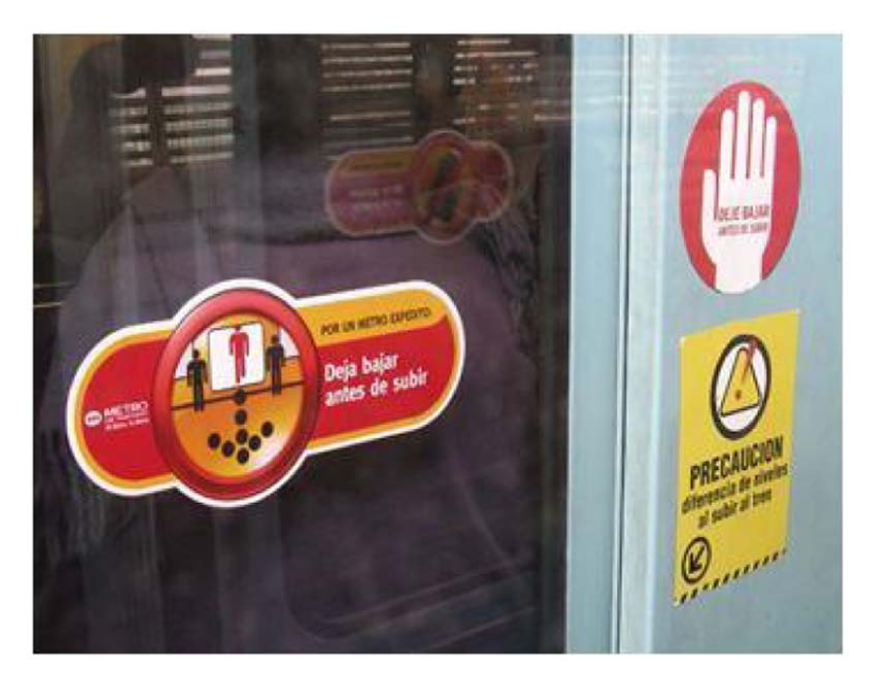
‘Rules of circulation’ signage.
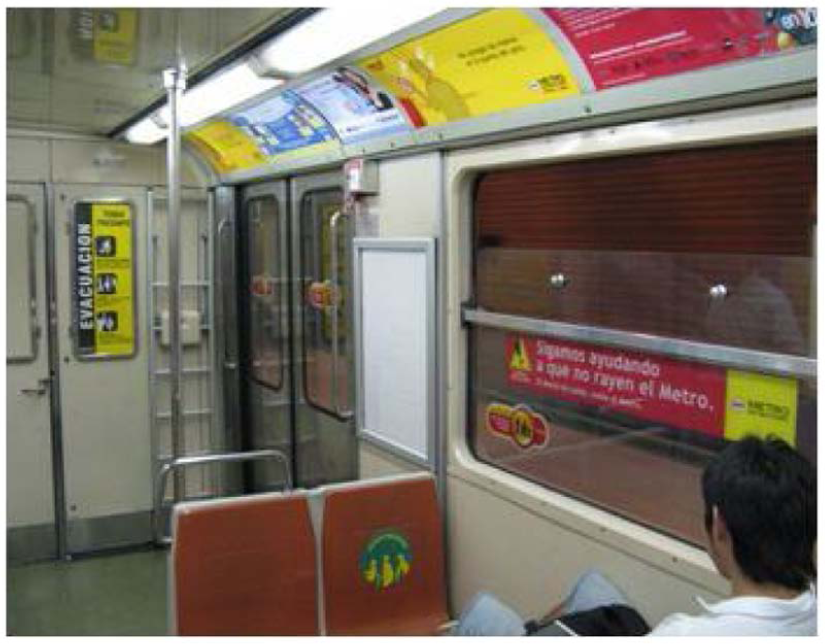
‘Rules of circulation’ signage.
The second program, ‘good manners’, aimed at transforming the way barbarians relate to fellow passengers and metro personnel/infrastructure. In particular it looked to develop on them what several interviewees called the ‘Metro effect’. The ‘Metro effect’, a key characteristic attached to former clients, was the belief that when people enter Metro stations they start behaving differently from outside, being nice and tolerant to each other and Metro personnel, giving their seat to people in need, avoiding dropping litter or damaging the infrastructure. This program was translated into ads that invited users to be polite and tolerant to each other in order to make their trips nicer, as illustrated in Figures 3 and 4. In Figure 3 a smiley presides over the message ‘if we are kind and tolerant our trip will be much nicer’, while in Figure 4 the picture of a man dressed as a punk (an epitome of urban aggression) is next to the caption ‘I’m kind by nature … with good vibes we all travel better’.
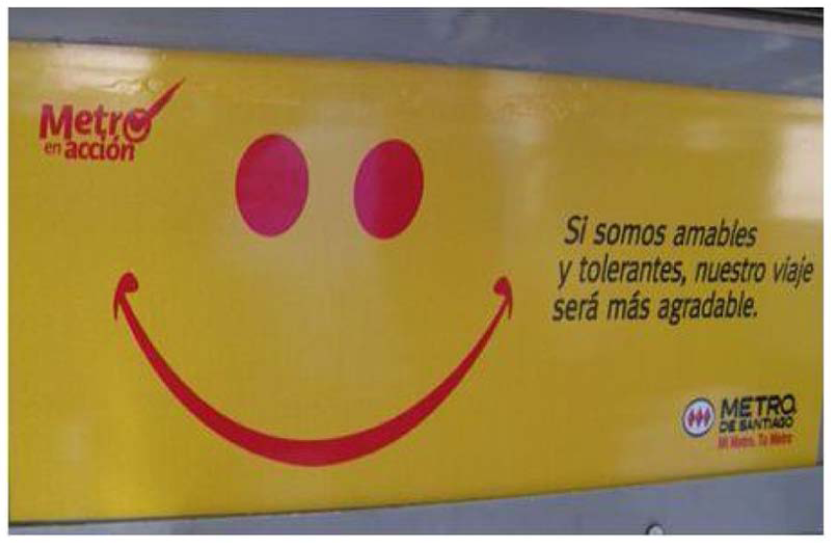
‘Good manners’ ads.
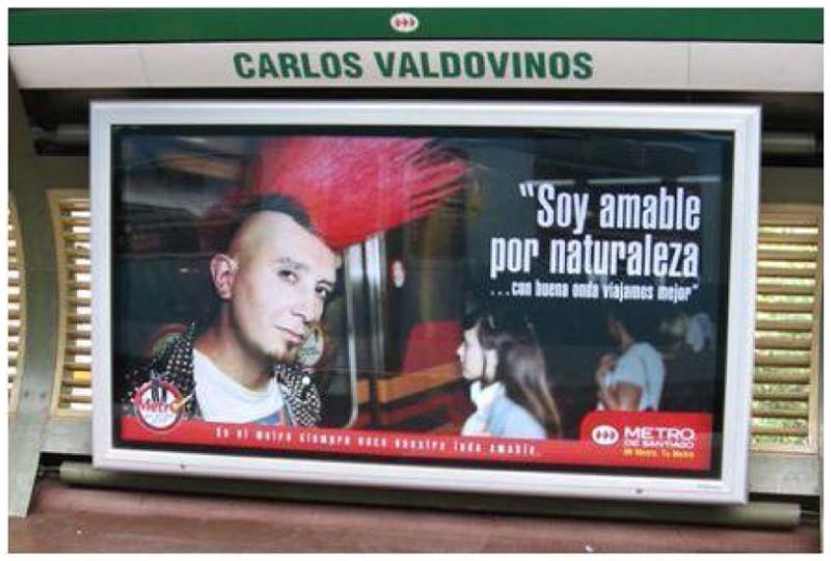
‘Good manners’ ads.
On first sight signage and ads appeared as relatively solid, albeit multiple, disciplinary devices. However, such solidity is misleading. To properly become disciplinary devices they also need to be performed in certain ways and no others. First of all, they needed to be seen, to be effective on imposing on users a certain ‘policy of attention in which everyone is supposed to be aware of graphical objects that have been placed in the environment’ (Denis and Pontille, 2008: 15). This attention must necessarily be paired with understanding, with a relative degree of literacy on the part of the users so they can make a sense of the message that the designers wanted to communicate to them. On the contrary they are not disciplinary devices at all, just stickers or images on the wall.
Contenciones
In clear contrast to the self-governing power of signage, other devices where designed to exert discipline in a more directly, physical, way over users’ bodies. Among them the most important where known internally as ‘Contenciones’ or blockades. The use of this term is revealing. In Discipline and Punishment Foucault identifies blockades as the strongest form of discipline carried out by ‘the enclosed institution, established on the edges of society, turned inwards towards negative functions: arresting evil, breaking communications, suspending time’ (Foucault, 1979: 209). Although not reaching the levels of the disciplinary institutions analysed by Foucault, Metro’s contenciones included several of these elements. In practical terms they consisted in stopping a particular group people (breaking communications) inside stations (an enclosed space) for some time (suspending time), when the stations’ platforms appeared to be too crowded to allow the safe circulation of passengers. By doing this they temporarily transform the station from a space of flows into a space of stagnation, even imprisonment.
Pedro Arrieta, the manager of Tobalaba station (one of the busiest of the network), explained in one of our interviews the complexities involved in implementing this device. The first one was the selection of the particular place where the contención would be carried out. After all, Metro stations were originally designed to enhance constant mobility, not to accommodate groups that usually reach more than 100 people. After carrying out a detailed study of users’ flows while accessing and leaving the trains, the stations’ mezzanine and some corridors were chosen as the location of the contenciones given that they offered no alternatives for people other than to stay there, not even being able to see what was happening on the platform.
A second key element of the contenciones was the decision regarding when to start the procedure.
[The decision is based on] an approximate degree of saturation … the amount of people per square meter … our maximum is six people per square meter, I mean, it’s a perception because you’re not going to be measuring the square meter there, no, you know … three [floor] tiles are about one meter, then if, on nine [tiles] you have more than six people, it must be saturated … we have a raised area where we stand, and we can see more, because sometimes you see that it is crowded here, but further ahead isn’t, because people do not move … once [people] are better distributed you step up there and if it’s still too crowded, ‘ok, we are going to start a contención’.
By Metro normative a contención must be implemented when a certain fixed degree of saturation, six passengers per square meter, is reached at the station’s mezzanine. However, as Arrieta recognizes, to calculate such saturation in practice is not an easy task, because they cannot just ‘measure the square meter’. Instead they calculate it based both on the number of people per nine floor tiles, measuring approximately one square meter, and a view of the crowd inside the station from a raised area. So the existence of a ‘level of saturation’, and its subsequent contención, involve an active interplay between the distributions of users’ bodies, the infrastructure of stations and the sight of the actors involved.
A third element, already present in the above quote, is that a contención requires the active agency of several human and nonhuman actors.
And how were those contenciones?
We had raised areas, security personnel, and after they [users] started to attack some platform assistants and guards, we had to use security guards of an external company, then our security personnel, besides having big signs saying STOP, even sometimes had a megaphone saying ‘ladies and gentlemen we are carrying out a contención for security reasons because the platform is full, once the train departs we are going to allow circulation again’ … and, in coordination, when we make contenciones in the corridors we also stop people upstairs, so they do not continue coming down here, because this sector here [mezzanine], this sector is completely full, so we must try and stop people there so it won’t be too full down here. We have also had to vacate and stop the escalators, because when it is saturated here and the people continue arriving, this could cause an accident and we coordinate that … if the line on the floor between the walls is trespassed [by people] we had complete saturation and the escalator was stopped, and we also made a contenciones upstairs so they wouldn’t keep coming down, I mean, it is completely coordinated team work.
So, a successful contención is the product of the action of an important heterogeneity of actors: Metro personnel, technical knowledge, security guards, the bodies of users, floor tiles, signs, megaphones, audio-systems, raised areas, escalators, etc. Also the contención is not an event that is located in a single place, but it is carried out simultaneously on the different floors of the station, in order not to concentrate too many waiting people in a single space. In this sense contenciones were a quite different disciplinary device than signage and ads, much more heterogeneous and widely distributed, depending on multiple agencies and performed differently on each single occasion.
Both signage/ads and contenciones, along with several others, strove to inscribe the bodies of barbarians with certain dispositions, striving to make them act while using Metro in a manner as similar as possible to the former clients. In order to do so, they exert different kinds of power, from inducing self-government in a relatively soft way to direct, physical, control. Nevertheless, their ultimate success was never secure. After all, users of technology never exist solely as inscriptions, reacting mechanically to the dictates of designers. Devices have to be incorporated into concrete practices, and in doing so its disciplining capabilities are commonly overflowed as I am going to explore in the next section.
Incorporating disciplinary devices
In several aspects the daily operation of Metro after the start of Transantiago in February of 2007 seemed to coincide with the diagnosis made beforehand. Given the serious shortcomings that the surface bus system had to satisfy users’ demand, even with minimum standards of quality (on this issue see Muñoz and Gschwender, 2008), an important amount of former bus users reorganized their trips using the Metro network as their main means of transport. As a result, from one day to the next, the network started to work at full capacity, as predicted by the 2006 report. However, it kept functioning and by midyear the actors within the organization started to talk about having reached certain equilibrium in the daily operation of the service while the nightmare of the total collapse, feared in the first weeks, started to vanish.
In reaching this state the active participation of disciplinary devices on the adaptation by new (and old) users to the working conditions under Transantiago was key. Nevertheless, several overflowings on the scripts embedded into the devices occurred from the beginning, causing outcomes that were not expected from the beginning. In order to explore this issue I am going to briefly analyse two examples of the material collected while doing participant observation on Metro trains and stations.
The first are the fieldnotes taken at Los Heroes station in the evening of October 5 2007, 5 almost eight months after the start of the plan. Like Tobalaba station, Los Heroes is a station where two lines intersect (lines 1 and 2), and it is located in the very centre of the city, transforming it into one of the most demanded nodes of the network.
18: 25 … [once we stopped] at the door there is a security guard in a yellow fluorescent jacket who watches our getting off and shouts that people should let [other passengers] get off before getting on. I hear from a loudspeaker (not loudly) a series of indications referring to changing to line 2. I walk along the platform and I see a security guard—more than 50 years old, slim, bespectacled—wearing a yellow jacket and a cap, who has a microphone in his hands and a loudspeaker hanging over his head, just under a makeshift sign made of cloth, with black letters on a white background in a small yellow rectangle (Line 2’s distinctive color) indicating ‘Combination L2’. … The guard repeats the same words every time people get off a train: ‘Combination with Line 2, right next to the escalator, combination with Line 2, right next to the escalator’. I watch a while and he repeats this process mechanically, automatically, when a train gets to the platform … After all the people getting off the train have left to change to line 2 the man stepped down, leaving the microphone hanging on the megaphone … 18: 50. Some security guards with yellow fluorescent jackets chat friendly with people waiting to board the train, there is a kind of relaxed mood, but the moment train arrives they return to their positions at the point where the carriage doors open and keep people from the yellow line marked on the floor that signals a boundary they should not cross while the train is in movement. Then one of them shouts to the people who are boarding the train, ‘Move to the end of the carriage please, move along please’, in order to fill up the interior spaces more efficiently and introduce the highest number of people per the train. There are many security guards on the platform, at least one for each door of the train, about 20.
From the notes we can see the relevance of a whole new range of disciplinary devices. Chiefly among them are important numbers of security personnel dressed in yellow jackets, as can be seen in Figure 5. Although several non-humans are mentioned—loudspeakers, makeshift signs—the central role in the process is carried out by people controlling and directing the flows of users. Then in practice the disciplining of users was not so much delegated to non-humans, but imposed directly by security personnel present on the platform. In all, the fieldnotes show a situation in which disciplinary devices seem to be working fine and users, new and old alike, behave in a relatively coordinated way.
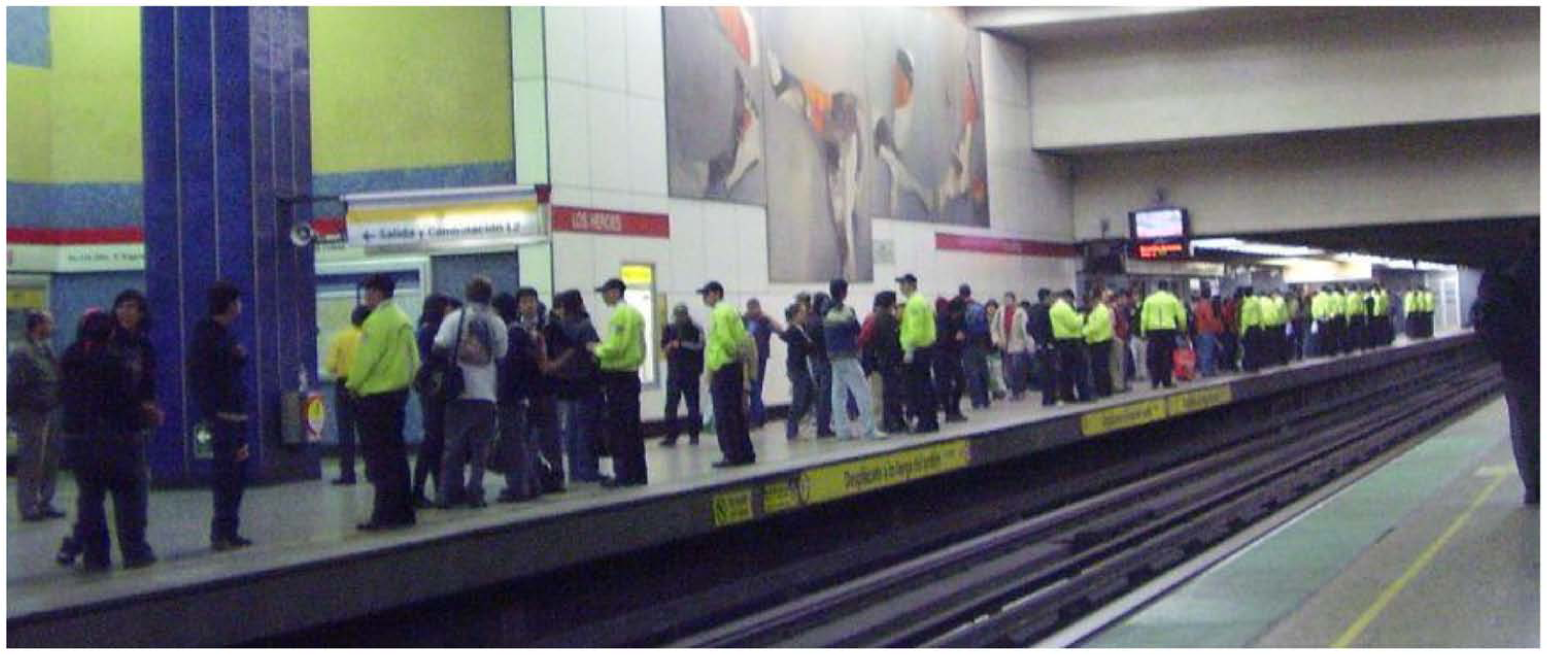
View of Los Heroes station platform.
A slightly different situation was found when the focus of observation was changed from Metro’s infrastructures to the trips of particular users. In order to explore this I will analyse some of the fieldnotes taken while travelling along with Juan, a 56-year-old man who lives in the borough of Recoleta, north of Santiago. He works as a janitor in a school located in the eastern borough of Ñuñoa. Before Transantiago he used to travel to work by bus, but now he has to take line 2 at nearby Zapadores station, then combine with line 5 in Santa Ana station and finally go down on Irarrazaval station where he takes a bus. I joined Juan on one of his morning trips to work.
We enter Zapadores station at 8: 25 … when we arrive to the platform there is quite a lot of people already waiting, Juan says that a lot of people come to this station … the train, when it does arrive, is only half full so we can enter advancing until the opposite door where Juan rest. … As we cross other stations the trains gets packed, in Puente Cal y Canto [station] people push in order to enter and we are forced to squeeze even more, the loudspeakers say ‘doors closing’, a woman expresses her anger making noises (shhhh!), other people say unintelligible things. The train is so packed that I ask Juan if he believes that we are going to be able to go down in the station in which we have to transfer to line 5, he says that sometimes he can’t go down [there] so he makes an alternative route, going down on Parque O’Higgins station and then taking a bus … a lot of people go down on Santa Ana station and Juan reaches out just before the doors of the train close, it seems that [on his way out] he beat a woman with his backpack without realizing it and she complains saying ‘you act like animals!’ … We arrive to the line 5 platform with a lot of people, there is one security guard who says ‘please try to occupy all the available space’ with a loudspeaker, the platform is quite full … an empty train arrives but we were unable to enter, then we have to wait for the next one … [when it does arrive] is quite full but several people go down, so we can make it, but the train is full anyway … we go down on Irarrazaval station, Juan says to me that the trip [on Metro] is quite tiring and the worst thing is that he has to arrive tired at work.
To travel on Metro Juan performs as a particular kind of user. In terms of circulation he behaves in a relatively disciplined way, following the orders given by the disciplinary devices without problems. But the compliance with these ‘rules of circulation’ is not without costs. First of all, he is someone who regularly experiences, and complains about, quite uncomfortable travelling circumstances, even being forced to change his route to work because of this. Second, he frequently sacrifices his ‘good manners’, especially to fellow passengers, in order to secure circulation as happened in the case of the woman he beats with his backpack. As he recognized in a later interview such a situation was not infrequent:
…The thing that I don’t like [about Metro]… is all the pushing you have to do to go inside the trains, I’m temperamental and I had had several fights with people because of this… for example the other day I was about to go inside the train at Parque O’Higgins station, I was on the side [of the doors] and a guy grab me from here [chest] saying ‘let me go down first’ and I… I didn’t accept that then I pushed him back and insulted him… so you keep having fights with people.
Juan does not perform as a barbarian, at least not in the way Metro authorities expected them to be. From the very beginning he claims to be fairly savvy about traveling in Metro, even knowing different routes to reach the same destination. He also rarely has problems following the orders provided by the disciplinary devices he finds along the way. But at the same time he is not a client. He does not travel in comfort and neither behaves to fellow passengers in a kind way. A trip by Metro is for him an experience of constant tension in which every other passenger could become a potential contestant for the scarce space inside trains and stations.
Saint Metro
The first nine pages of Metro’s annual report for the year 2007 are occupied by a sequence of pictures showing a man dressed in an elegant suit who runs, crossing several landmarks of Santiago, after an old-fashioned bowler hat taken from his head by heavy thunder. In the last picture he finally catches it, smiling and raising his left arm in a sign of victory while in the background the storm began to fade. The images are accompanied by the following captions in large red typeset:
[The year] 2007 was far from looking like a pleasant walk through the square at dusk. … We faced a storm that posed us tremendous challenges. … But did not let bad weather immobilize us. … We were always in action to meet the challenges. … We travelled great distances; we made tremendous efforts. … We advanced and exceed ourselves. … We can be satisfied with our achievements … . (Metro, 2007: 2–10)
The images and the texts build up a straightforward epic narrative. Due to its integration with Transantiago, metro faced ‘a storm that posed us tremendous challenges’. However, besides some particular, and brief, stoppages in the service, the network was able to resist in an orderly fashion. Such a narrative was widely supported, even by external actors such as government authorities and the media. Most of them usually identified Metro as the most relevant factor that averted a complete collapse of Transantiago in the difficult first months of operation. For this reason it was praised, being half-jokingly christened in the media as ‘saint Metro’.
Disciplinary devices played a central role in Metro achieving such sanctity. After future users were performed as barbarians in early 2006, Metro needed to develop a new governmentality to deal with them. In doing so, the heterogeneous and performative character of disciplinary devices proved to be highly useful, allowing them to mobilize and materially embed this script in the concrete spaces of stations and trains through multiple combinations of direct physical control (biopower) and self-government (technologies of the self). Later on, when an important extra number of people started to use Metro, they actively collaborated into their incorporation as effective users of the network, at least in terms of subjects who know how to travel from origin to destination at a certain speed.
However Metro’s sanctity, as any other, implied also a renounce. As seen above in the case of Juan, in practice the incorporation by new users of the scripts embedded into the disciplinary devices of Metro was only partial. While the script contained in the rules of circulation program seemed to be working fine, the good manners one was translated into practices in a much weaker way, at least in the case of users such as Juan. 6 Actually in practice the agencies of both kinds of disciplinary devices seemed to oppose each other. To be able to circulate in the way Metro expected them to do, optimizing their routes but in a highly uncomfortable way, users commonly needed to give up any kind of good manners to each other, even fight actively for the scarce space available. In this sense it can concluded that the ‘Metro effect’ now operates on the opposite way, turning subjects usually indifferent to each other into active opponents, knowable but fairly aggressive barbarians-on-the-move.
Beyond the analysis of the empirical case, this article sought to contribute to the development of a research focus on the disciplining of users’ bodies as a key materialization of organizational power, an issue largely unexplored until now in organization studies. Making using of a mixture of Foucauldian and STS conceptual devices, it has proposed the concept of disciplinary devices as a reminder that organizational power over bodies is always embedded into sociotechnical entities that are heterogeneous, have agency and perform in multiple ways. Such devices perform into being in two inter-related ways: as inscriptions of future subjects that the involved actors develop during the design of new services and/or products and as incorporations when human beings have to start behaving in certain ways to deal with them and with the organization as a whole.
However such devices, as explored in the last empirical section of the article, are always open to overflowings, to producing effects completely unexpected from the onset. This is especially so when dealing with human beings. As Michel Callon (2007: 347) recognizes, ‘humans … are constantly overflowing. A total, unambiguous configuration is impossible. There is always a remainder, something that hasn’t been taken into account’. For this reason it is critical for organizations to be highly reflexive when performing such devices, evaluating extensively the possible scenarios that the introduction of disciplinary devices can bring into being. After all, overflowings have unexpected effects not only on the organization, but also on the same human beings who were expected to be disciplined. Human beings such as Juan can experience more or less degrees of distress, empowerment, happiness, security, etc. as a consequence of their daily encounters with disciplinary devices. This last point is elegantly summarized by Ian Hacking (2002: 107) when affirming that such devices change ‘the space of possibilities for personhood. … What could it mean in general to say that possible ways to be a person can from time to time come into being or disappear?’.
Footnotes
Acknowledgements
This research was supported by a Marie Curie International Incoming Fellowship within the 7th European Community Framework Programme.