




Abstract
This article engages with a critique of dominant conceptualizations of competence in the studies of work and organization, in particular, the common belief that competence is a stable category, reflecting a specific content. The article puts forward a conception of competence, envisaged as a mutable and fragmented construct, evolving in response to shifts in the regulatory structures and market conditions within a particular domain of the professional service firms, involved in consultancy and assurance work. Drawing on Jacques Lacan’s theory of discourse, the article attends to some of the micro-processes associated with competence construction and maintenance in the realms of material practice. Empirical insights illustrate the possible ways in which employees attempt to script competence in the context of the socialized frames they are situated in and conforming to the regulatory standards, supporting the sense of their working life through effective performance. The possible rotations around the discourses, as conceptualized by Lacan, represent movements in the position of the subjects with respect to their own ways of experiencing lack through which ethically-driven responses can be taken up, subsequently leading to reproduction.
The notion of competence is one of the key constructs associated with both discourse and the material condition of professionalism. In the studies of work and organization, competence is commonly described as constituted by formalized knowledge (Alvesson, 2004; Brint, 2001), tacit knowledge (Eraut, 2000) and skills and personal attributes (Boyatzis, 1982; Winterton, 2007). Conceptualizations of competence in relation to knowing-in-action (Cook and Brown, 1999; Freiling et al., 2008) emphasize understandings of work practices (Means and Schneider, 2000). Wenger’s (2000) practice-based approach to professional competence reads as ‘collective understanding of joint enterprise, mutual engagement in the sense of established norms for interaction and a shared repertoire of communal resources such as language, routines, stories and tools’ (p. 229), 1 implying the importance of the processes associated with competence making and maintenance.
Professional work is increasingly mediated by organizational realms, occupational cultures and market logic. Significant contributions have been made to understanding of the appearance of professional classes, developments of professional expertise, a role of socialization, legitimacy and exclusivity of professional networks (c.f. Abbott, 1988; Macdonald, 1995). Yet, there is the absence of the studies that examine the symbolic functions associated with the professional discourse in the context of material practices (Cheney and Ashcraft, 2007), including the notions such as ‘competent’ and ‘professional’. The system, upon which competence is defined and scripted, appears socially negotiable and open-ended. Nevertheless, competence continues to be discussed as a stable and lasting resource, tied to the market advantage. This article engages with a critique of dominant conceptualizations of competence in the studies of work and organization, and in particular, the common belief that competence is a stable category, reflecting a specific content. In order to engage with such critique, this article puts forward a conception of competence, envisaged as a mutable and fragmented construct, evolving in the response to shifts in the regulatory structures and market conditions within a particular domain of the professional service firms, involved in consultancy and assurance work (hereafter PSFs). 2
Non-core audit services, including assurance work, are now added under a broad category of management consulting in the portfolio of provisions offered by audit firms (e.g. Suddaby et al., 2007). This shift introduced a new logic into the organizational realms, reinforcing managerialism; a key factor in reshaping discourse and the employee’s mindset, preserving the social order in the financial community by promoting the myth of auditor’s trustworthiness (Malsch and Gendron, 2009). The locus of professionalization is now defocalized and it is organizational context that shapes attitudes, norms and opinions about professional ideology (Alvesson and Willmott, 2002; Suddaby et al., 2009). Furthermore, it is a set of discourse-based and material processes associated with how identity-related categories are negotiated and perpetuated that reinforce the professionalism-related claims. 3
Identification processes can be reformulated as an enactment of variation within regulated, normative processes of signification. The legitimate, competent conduct is based on the claims of knowledge exclusivity and reflects both the privilege (as a claim to the expert class) and the public responsibility (as a normative-ethical obligation). This study draws on the insights from practice, based on individuals located in different organizations, all representing one occupational realm. Occupational discourse arises through socialization as individuals pursue the same profession, exposed to similar educational influences, the work-related experience and personal development in advancing their careers through joint activities and relationships. These common regulated set of practices aren’t however fully determined. One of such practices involves the reification of the subject (Sawicki, 1994). In other words, discursive practices that construct identity related categories, including competence, are rule-governed structures that simultaneously enable and constrain formation processes.
Subjectivity captures the ways experiences can be simultaneously felt as personal and singular, and at the same time, operate as a site of intense regulation, governed by both internal (unconscious) and external (ideology) forces. In unpacking the constitution of identity, Butler (1990) attempted to link Foucault’s conceptualization of discursive practices with Lacan’s psychoanalytical thought. Lacan’s sees the formulation of the subject as an effect of language while Foucault’s identity reflects the effects of discursive practices, aided by techniques responsible for controlling habits and value-sustaining self-image. In Butler’s conceptualization of identity envisaged as self-representation, as a ‘fiction’ that is neither fixed nor stable, the individual emerges in a process of signification within a system of discursive possibilities. 4
The article acknowledges the symbolic and the material interface in the domain of competence construction. Drawing on Jacques Lacan’s theory of discourse, the vagueness of discourse is acknowledged by attending to micro-processes associated with competence construction and its maintenance. Turning to Lacan allows to conceptually engage with some of the micro-processes associated with how discourse of professionalism is articulated at the individual level and how identification categories, such as competence, can be scripted in the signifying context of a capitalist organization. A perpetual sense of incompleteness, a lack, is associated with the acquisition and mastering of the language, the symbolic order, and subsequently, becoming through language. By entering into the symbolic domain, into the language, produces a lack as the fantasy associated with self-sufficiency is lost. Yet, it is the role of fantasy that acts as a shield against a perpetual sense of incompleteness in the ongoing struggle for viable identification. The remainder proceeds as follows. First, theorization of a lack is introduced drawing on Lacanian theory of discourse. Second, research methods are delineated. Third, the insights from the interviews and professional texts into the requirements placed upon the assurance providers in PSFs today with regard to competence, and subsequently, dynamics for competent conduct in managing identity are discussed. Lastly, discussion and conclusions are presented.
Situating the study: on lack and centrality of discourse
A centrality of competence and its proximity with an increasing dependency on specialized knowledge for effective work performance of expert labour (Muzio et al., 2008) has motivated a closer look at micro-processes of competence construction and maintenance, illustrated in the professional field that seem to rely on a substantial body of formalized knowledge for best practice performance, in assurance work.
Cheney and Ashcraft (2007) have positioned the notion of contemporary professionalism as a domain of contestation, calling for the studies that attend to processes by which professional categories develop and infuse practice. Drawing on Burke, the authors point out the power of ambiguity associated with the notion of professionalism, for reflecting and shaping social relations and expectations at work (p. 157). It is ambiguity of professionalism discourse, the practical as well as rhetorical power associated with the term itself that helps elevating as well as constraining social performance of acting as ‘professional’. In order to support processes of identification, we place ourselves in a particular relationship to language. It is as if language is using us to utter what ‘it’ wants. And ‘it’ has been formulated by Lacan in terms of the subject’s relation to drive’s functioning.
Lacan (2007/1969) defined discourse as a social link that is founded on language: ‘I managed to ascertain what discourse is about, as a necessary structure that goes well beyond speech, which is always more or less occasional’ (p. 13). In an editorial on Lacan’s contribution to organization studies, Contu et al. (2010) point out that the very limits of language are most unsettling about Lacanian framework; the limits that prove to be a challenge of application in the studies of language, power and identity in the context of work. The question is why are these limits so unsettling? It is precisely the centrality of lack in the subjectivity formation that makes reality disquieting. For Johnsen and Gudmand-Hoyer (2010) a sense of lack that implies an essential foundation of identity, provides a theoretical framing within the organization realms for the drama of individual subject to unfold. Commenting on the processes of character formation, the authors note Lacan’s emphasis on loss via Ruti (2008): ‘what is lost in the process of character formation, according to Lacan, is the fantasy of self-sufficiency, which provides an ideal kind of fixity or stability by invoking a real object outside of the symbolic register. The subject is destined to work through the loss of this fantasy for her entire life, circulating it, wanting it and desiring it, even creating substitutes without ever obtaining it, because the price for entering into the symbolic register signifies ultimate and irreversible loss’ (p. 337).
Despite inevitable challenges associated with the limits of language for advancing practice-focused research, Lacanian lens offers a fresh perspective in studying the formation of subjectivity. The sense of lack is linked to the structures of signification and the meanings reproduced in language.These processes also reflect, when examined via Lacanian lens, dynamics of struggle in a response to lack; conceptualizations recently advanced in organization studies (e.g. Arnaud and Vanheule, 2007; Driver, 2009a, 2009b; Hoedemaekers, 2010; Johnsen and Gudmand-Hoyer, 2010; Jones and Spicer, 2005; Roberts, 2005; Skold, 2010). Instead of exposing coercion imposed from the outside (e.g. through HRM practices), research needs to address the processes imposed from within, associated with the ways we place ourselves in particular relation to language. 5 In the work context, the processes of identification are associated with a perpetual accumulation of the new skills, experiences as well as competencies. In negotiations of identity, we need to acknowledge that subjectivity is embedded and mired within discourse but never fully constituted by it. Identities are constructed in and through language. Although the subject can’t be thought of outside the rubric of power, it cannot be solely reduced to the effects of power. In other words, multiple discourses constitute subjectivity however no single discourse can ever achieve a closure of identity. As a consequence, the subject is split over multiple discourses, each with a possible gap. In these gaps or spaces in-between discourses, a possibility of agency can be located. 6
Driver (2009a) has explored organizational identity discourse informed by imaginary constructions of subjectivity around the fantasy of ‘completeness’. She argued that such discourse contains ‘the opportunity for engaging in liberating struggles with identity as lack’ (p. 55), heightening the possibility of empowerment. 7 Similarly, Jones and Spicer (2005) have illustrated, with respect to the notion of entrepreneurship, the illusionary aspects of discourse in offering a narrative fantasy that coordinates desire for becoming (p. 237). In another study, Driver (2009b) draws on Lacan’s lack to explore how individuals appropriate discourses of organizational change as a resource for creative performativity at work: ‘who we are and what we want seem to be permanently missing, elusive and lacking … Indeed all that remains of who we really are is out being lost in the symbolic order while clinging to fantasies that continuously fail to deliver what we are looking for’ (p. 355). Hoedemaekers’ study (2010) of the organization identity in the public sector identified the interruptions and failures associated with the opaqueness of the ideal employee’s image; an image which is always ‘not good enough’. It appears identification happens exactly where the signification fails, that is, at the encounter with the lack, in the symbolic order, and in a response to such lack. The symbolic order, although heavily internalized, is never complete, never fixed. This is one of the reasons why one cannot be fully socialized into the chosen profession or a workplace. This article contributes to emerging studies of work and organization that focus on the inconsistencies and fragilities associated with subjectivity formation and its precarious nature.
Lacanian approach appears particularly relevant to studying subjectivity situated in the material practice by emphasizing an exteriority of the unconscious as ‘the unconscious exists in language insofar as we are not aware of its structuring effects’ (Hoedemaekers and Keegn, 2010: 1038). This study attends to dynamics associated with a tacit interplay between language, ideology and the material practice and, acknowledges a rhetorical character associated with a perpetual construction of the competence frameworks and the functions in coding and expressing desired performance at work. The article does not address how individuals are attached to organizations. Instead, the focus is on the role of the language that is available in the organization realms to construct the fantasy of the desired self, tied to a competent conduct.
Lacan’s theory of discourse
Lacan offers unique possibilities for advancing our understandings of constitutive as well as transformative functioning of discourse in human subjectivity. The article examines how competence is conceptualized and narrated in the signifying context of a capitalist organization. Lacan’s theory of discourse is useful in explaining that in perpetual articulations of the competent conduct, in a search of a desired closure of subjectivity, the lack associated with this process cannot be fulfilled in the immersion in the symbolic order.The subject is capable of resisting ideology on the ground of knowledge, and is, at the same time, an effect of discourse.
Although Foucault’s and Lacan’s respective theories of discourse can be conveyed as compatible, there are key differences which distinguish them. First, for Foucault, the theory of discourse is pluralistic, in the sense that there are as many discourses as one can distinguish rules governing meaning in a use of language. Lacan offers a typology of discourse, articulating the differences in discourse, in terms of specific power relations. Second, Foucault’s theory of discourse is more generic and predicated on discourse being regarded as the ‘space’ where power and meanings converge. For Foucault there are discourses of democracy, patriarchy, bureaucracy and so on (Oliver, 2009). Lacan has grouped discourses under the four (five) categories: the master discourse, the university discourse, the hysteric discourse and the analyst discourse, and subsequently added, the capitalist discourse.These distinct systems are produced by differing subject positions that the subject takes in relation to discourse. Alcorn (1994) explained that for Lacan, the subject operates upon discourse and discourse operates upon the subject. This dialogic interface between a subject shaping discourse and the social forces provides a matrix of discourse; a matrix useful for advancing understanding of specific subject’s functions (e.g. repression, resistance) as well as distinct discursive functions (such as ideology, knowledge) operating upon the subject as the subject interacts in a discourse (p. 27). How Lacanian discourses are positioned is an indication of the power relations involved.The four (five) types of articulation are possible in the way a subject takes up a relation to a symbolic network, constraining the options in which inter-subjective relations may be taken up. 8
The master discourse refers to a use of language in which some are constituted in the position of power, for instance the market or globalization. Discourse of the university refers to a use of language that gives the subject who utters it a position of power through structuring life or social relations, in terms of knowledge, in the process making one aware of one’s lack of knowledge.The university discourse encompasses rules of experts, channeled through regulatory structures. In such a discursive position individuals are to act and to desire in order to reproduce the system through educating and socializing processes. Discourse of the university often serves the master’s discourse.The master discourse promotes mastery by instituting the dominance of master signifiers which order knowledge according to their own values and keep fantasy in a repressed, subordinate position. The discourse of the master is manifested through historically transmitted principles and laws that established the profession and ‘legality’ of professional language (Bracher, 1994).
Discourse of the hysteric refers to language use that questions the power of the master discourse, questions the political, social-economic and cultural status quo. It represents a split subject, constituted by the division of self-confidence and self-doubt. The divided subject is a manifestation of alienation and experiences of meaninglessness, anxiety and desire (Bracher, 1994: 122). The discourse of the hysteric can emerge, if the individual critiques the established laws but doesn’t abolish it in the processes of reconciling the meanings for articulation of competence.
Discourse of the analyst refers to a mediating discourse, according to which social relations are structured by revealing more opaque desires, producing a space which enables temporary access to the means for pursuing desire. In the analyst discourse, the subject is in the position to acknowledge own alienation and desire, and on such basis, is capable of separating from the given master signifiers and producing own new master signifiers—identity and values that are less antithetical to its desires. The new master signifiers are produced by the subject and not imposed upon the subject from the outside. The discourse of the analyst places in the dominant position what has been excluded from symbolization and suppressed by the master discourse (Bracher, 1994: 124).
Discourse of the capitalist can be conveyed as a version of the master discourse of today. The market acts here as the final, fundamental mechanism for establishing, reinforcing and extending social relations. In the 17th Seminar of 1969–1970 Lacan stated: ‘what happens between the classical master’s discourse and that of the modern master, whom we call capitalist, is a modification in the place of knowledge’(2007: 31–32). 9 Lacan suggested that knowledge has moved into the place of the master and that capitalism has been subsumed under this discourse.The discourse of the capitalist is also referred to as a pseudo-discourse as it enacts to be what it is not. Capitalist discourse adopts the position of the hysteric, in order to give the impression that it is on the side of the subordinated to the master while it promotes the interests of the master implying capitalism’s capacity to re-invent itself whenever it faces a crisis of legitimacy (Oliver, 2009: 25–26). In assuming the position of the hysteric, questioning authority in the name of the improvement of the social and economic aspects of the human condition, discourse of the capitalist is exposed as a mere pretence.
The key factors in Lacanian theory of discourse include the system of knowledge (S2), the master signifier (S1), the divided subject (S/) and the object petit a (a). Knowledge base is necessary in establishing identity-related categories such as competence. A master signifier is any signifier that the subject has identified with and constitutes a powerful value. Master signifier plays a significant role in structuring the subject, giving the subject a sense of purpose. The master signifier also results in the division in subject. The notion of a divided subject is associated with ways in which the subject fails to identify. The object petit a is articulated as a part of subject’s being both left out of and produced by the identity in the processes of knowledge articulation, linked with lack and desire (Bracher, 1994: 110–114).
In the master discourse, the master signifier (S1) commands the knowledge (university) signifier (S2), in the sense that in this use of language (the master discourse) knowledge is subservient to the master. However, underneath the master signifier resides the signifier for the divided subject (S/) which implies that the master represses the knowledge of his finitude but cannot afford to admit in a risk of losing power. The divided subject refers to a split between consciousness and unconsciousness, between seemingly stable ego, and the subject of the unconscious (Oliver, 2009). Underneath the signifier of knowledge resides the object petit a, the symbol for a surplus pleasure, which means that in the master discourse are produced objects that can reveal what the master’s true desire is, namely to have all knowledge at its disposal, gaining pleasure from this position of domination (Oliver, 2009).
Zizek (1997/2006) informs the usefulness of Lacanian theory with a critique of contemporary capitalist predicament, offering a lens that can enrich theoretical engagement with studying organizational phenomena, entrapped in the power of discourse and situated in the market environment, such as competence construction (the capitalist discourse as the master discourse of today). In Zizek’s re-reading of Lacan’s theory of discourse, l’object petit a is the agent that can address the subject from the position of knowledge that one occupies (Zizek, 1997/2006, 2005) and conveyed as truth. Zizek (2005) points out Lacan’s nuanced conceptualization of the object petit a:
Object a is simultaneously the pure lack, the void around which the desire turns and which, as such, causes the desire, and the imaginary element which conceals this void and renders it invisible by filling it out. The point is that there is no lack without the element of filling it out: the filler sustains what it dissimulates … a is a bundle of properties that lacks existence. (pp. 178–179)
Zizek’s conceptualization of the object a emphasizes the individual role in legitimizing existing knowledge base for effective work performance, a process that involves management of evolving meanings for competent conduct. This article conceptualizes micro-processes associated with competence construction and maintenance; the processes that imply the importance of socialization and conforming to the acknowledged at the time standards of practice.The possible rotations around the discourses, as conceptualized by Lacan, represent movements in the position of the subjects with respect to their own ways of experiencing lack through which an ethically-driven response can be taken up, subsequently leading to reproduction.
Research methods
Zizek’s interpretation of Lacanian theory points out the powerful symbiosis in a notion of lack; that is, the individual subject is perceived as a lacking and the symbolic order itself is conceptualized as lacking. The symbiotic relationship is represented and supported by a language, via the symbolic order. The symbolic order is lacking in the signifying context of capitalist organization, independent of the subject in the manner of discursive practice, but in a sense identified a priori.
In a given discursive formation, there are points of incompatibility, permitted by discursive formation’ rules that allow for alternative theoretical turns to be taken. This refers to Foucault’s ‘points of diffraction’ (Foucault, 1972: 65). The points of diffraction can address the structural dilemmas associated with incompleteness in the organization of knowledge, providing a way of speaking of the ‘emptiness’ of signifiers (Foucault, 1972: 20) under the given theme. It could be argued that the reproduction processes appear possible in response to these points of diffraction in the competence discursive practice, because they can be taken up by subjects as ‘lacks’ to which ethical-driven responses are possible.
The empirical reflections concerning competent conduct are based on perceptions of practice. In order to elicit these perceptions of practice in the PSFs, interpretive turn has been adopted. A phenomenological approach (also adopted by Anderson-Gough et al., 2002), facilitates passing on from studying universals and essences to investigate the micro-level dynamics (Denzin and Lincoln, 2003), attending to processes of competence construction and maintenance. The study attends to discursive mechanism associated with construction of competence, the ways in which interviewees interpret and react to daily tasks and the underlying structure of the language in daily work engagement, that is, how they reflect upon everyday practice, and how they define key experiences in relation to the sense of being ‘successful’ and ‘competent’. This study also addresses the micro-dynamics of competence maintenance. How does the perceived lack of competent conduct not only undermine but also support practice and the firm’s functioning in the assurance realms?
Lacanian approaches to language and the methods of analysis render more transparent the power of organizational discourse in workings of imaginary and its failures in the analyzed (the subject’s speech acts). Adopting such methods helps us to better understand the role of speech acts in a particular material context (of a capitalist organization), concerning the processes of how individuals articulate the lack in their own terms, contributing to the emerging research on becoming in organizational realms (Harding, 2007), understandings of change (Driver, 2009b) and managerial prescription as a discursive resource for struggle with identity and desire (Fay, 2008; Hoedemaekerts, 2010; Johnsen and Gudmand-Hoyer, 2010; Wozniak, 2010).
Pratt (2000) argued that organizational discourse sustains the processes by which individuals identify with the organizational attributes via attractiveness and distinctiveness claims, channeled historically through the profession’s membership. Theorization of competence in the realms that rely on visible and public membership, such as assurance services associated with a particular status and expertise, has not sufficiently addressed the role of discursive processes through which preferred competent selves can be constructed and maintained. Scarcity of engagement with a process-based nature of competence construction and its maintenance has left the role of an agent largely out of the picture in researching competencies at the organizational level.
Drawing on Lacan’s theory of discourse facilitates reflections on more nuanced aspects of identifying at the micro-level through construction and maintenance of competence. Data gathering process included 30 interviews conducted in the PSFs, in assurance sector including recruitment and training and HR departments in the UK. Interviews were conducted across the UK and in the PSFs ranging from the big to smaller firms. The interview questions were split into five generic sections: (1) definitions and processes of competence constructions; (2) appearance of competence in daily work; (3) processes of how to be competent, (4) general views on competence, and (5) obstacles hindering competent conduct. The objective was to give the interviewee a voice to describe the processes associated with competence formation and maintenance and perceptions on what constitutes competent conduct for them and in the institutional context.
The interviews were recorded and transcribed verbatim for quotations. The motivation was to elicit constructions of what is perceived to be competent and to tap into an underlying system of meanings for a construction itself. In that sense, the approach adopted resulted in manifestation of several significations for the competence construct. The coding paradigm encompassed the conditions and consequences of the competence construct; that is, a core category, the central concept around which the others evolved, such as skill, knowledge, behavior (peripheral codes). On that basis, the links between the peripheral categories and the core category were identified (Alvesson and Skoldberg, 2000). The key themes of construction which emerged through repetition were further analyzed, such as technical competence, ethical competence, skills and attributes as well as maintenance processes. Current views and trends on what constitutes competence have then been mapped into the review of the professional regulatory developments, in order to contextualize interview narratives in professional discourses, attending to current institutional issues.
Current developments in the context of assurance work: framing competence discourse
Preferred conceptions of competent conduct are supported by the available discourses in the institutional context. Assurance services can now be offered to audit-exempt companies as an alternative service. 10 Such shifts and changing notions of work in the market environment introduce particular dynamics for practice.
In the case of assurance work, historically, the discourse of professionalism and the regulatory structures that support knowledge-base, portray competence as a given best practice. Yet, the competent conduct depends upon operationalization of evolving meanings of competence. What clearly has not been discussed in the literature is an engagement with more deconstructive readings of competence in professional milieus. Assurance industry substantially relies on commodification of audit expertise in a response to the evolving market trends. Processes of construction and maintenance of competence rely on a reconciliation of how work practice is understood at a task level.
Preferred conceptions of competent conduct are supported by the available discourses in the institutional context. Both, the audit services and the assurance service are defined as types of assurance engagements. Assurance services apply to accounts prepared in accordance with the Companies Act 2006 but also fall under legislation other than the Companies Act. A sense of the competent conduct has been amalgamated with impression management, linking assurance service with the consultant-type identification via the power of persuasion. Provision of services in the context of assurance appear atypical; as it still has a more traditional service claim to the common good associated with audit (a principle of public interest), and simultaneously, the demonstration of commercial value to the clients.
Over the last decade, more attention has been given to the regulatory framework developments. IFAC International Educational Standards (IES) (2004), the ICAEW Code of Ethics (2006), CIMA and ACCA programmes for international qualifications, have opened new avenues for competence remaking, 11 all emphasizing a need for ethical conduct, tied to capabilities in terms of an appropriate experience, knowledge and understanding necessary to perform clients’ engagements in accordance with the professional standards and legal requirements operational at the time. The interviews reflected the evolving discourses incorporated in these new regulatory developments. The majority of the interviewees provided practice-focused definitions of competence which emphasize an overall ability to provide assurance services. This ability was linked to the best practice and referred to as an ethical conduct that implies the ‘good use of the rules and regulations’.
Views from the interviewees reflected an overall the emptiness of competence discourse. Technical ability was viewed as important, however not sufficient for realization of competence. ‘Softer’ skills, personal attributes, personal management and leadership skills were also identified in the context of daily work, and above all ‘a state of being up-to-date with current regulation and best practice in the processes of self maintenance’ (BA1).
This quotation seems to relate to remaining abreast of current developments in the regulatory framework and the positive impression that demonstrating may create. The self-maintenance practice was linked to the desire for a possession of demonstrative capacities for channelling dynamic knowledge-base. These views of agency in self-maintenance reflect readiness to engage with evolving regulatory developments in a challenging reality to be accounted for in daily contacts with the clients. Failing in this regard can lead to anxiety. Here is an example from the interviewee concerned with the client’s needs expressed his concern associated with difficulties to demonstrate competence:
Competence is a mix of the abilities … it is about being able to do things, and having the knowledge to do those things, and having the professional skills … as well as the softer skills. It is more important now … the softer skills, to see your clients and to engage with what they need and what they want … [silence] … it is not easy … [long silence] … really not easy. (SB2)
His views reflect a gap created between attributes for an ‘ideal’ auditor and uneasiness the new context imposes for achieving them. He also pointed at the impossibility of reconciling the distance created by the clients’ expectations associated with the firm’s all-rounded knowledge advocated by professional discourse. On the whole, the interviewees revealed anxious attitudes associated with a need for continuous expansion of knowledge, following the regulatory advancements and a drive ‘to regain lost credibility’ (BC2). Some also stressed the importance of cultivation of quality relationships with the clients and communicating that quality to them, in ‘demonstration of competence and the knowledge’ (SB1); a fundamental aspect for changing face of service under assurance.
In general, the interviews reflected impossibility of framing competence via the regulatory framework, expressed in the professional discourse that seem to re-dress the problem associated with the changing clients’ needs and demands as well as technological advancement, implicitly covering for a lack of competent formation via organizational discourse. Such views reveal the emptiness in the notion of competence at the level of the symbolic and indicate the importance of the imaginary dynamics for enactment of competence and the role of self-formation for competence maintenance. The support for self-maintenance supplements the claims for realization of competent conduct, based on the organizational learning and socialization. The issue remains that the firms follow the market ideology which translates professional attributes and specialism into demonstration of effective work by ‘a focus on pleasing the client who pays the fees’ (BA3). What can be delineated from a discussion of current regulatory developments is a desire to communicate as the ‘expert stratum’ (BA1) with a strong interest in marketable knowledge and weaker concerns for the public interest, focused on a professional image. Preoccupation with the manifestation of professional attributes and anxieties that manifestation brings, suggests a lack of substance in meanings associated with the competence framework.
On acting ethical for a competent conduct
In the response to the recent corporate collapses, a global financial crisis and a decline of public confidence in the quality of services provided, the professional discourse has put more emphasis also on language of ethics. In discussing competence, acting and demonstrating ethical awareness in the building the relationships with the clients was emphasized:
Ethical aspects are probably not relevant to whether somebody can do a tax return, but they are relevant to whether somebody can do a tax return and deliver the service to a client well. It is our professional work. I suppose that’s the difference, it’s the kind of a contact element and it is crucial to get involved in … developing this contact with the client. (BA2)
Ethical dimension appeared strongly linked to a conduct and based on a good relationship with the clients and on the results; a delivery of good service that would satisfy the clients. The way ethical dimension of competence is framed, as in the above quote, is linked to the commercially informed client’s satisfaction. It could be argued that an introduction of ethics into regulatory structures for framing competent conduct can be seen as a desired element that can attract the clients, in particular, if other elements of the competence framework, such as technical capabilities or specialism, are lacking substance in meaning.
Similarly BD2 clarified ‘the need for ethics in order to complete the job properly’ and went on talking about the clients’ needs. Such views also add weight to practitioners’ concerns as to the construction and relevance of ethics for their work and sense of competent self. Here is an example that points at the ‘ethical’ concerns as an anchor that one can hold onto in the case the compliance practice fails to make the client satisfied:
I think your actions are important, but if you don’t have your actions in the right mind frame, in the right mindset … a mindset which is focused on quality [defined in the clients’ terms], a precursor to actually delivering and practising how you act … how you are seen and then, hmm … [a long pause] you may have a problem. (BD4)
A notion of ethics becomes a tool for impression management. IFAC (2001: 76) conveyed the significance of ethical dimension of competence that emphasize the use of rules, in stating that when technical competence is relied on, ‘knowledge of the ethical requirements cannot be automatically assumed’, a language that in practice seem to add more ambiguity, implying an incorporation of ethics element into the competence framework. One interviewee emphasized historically established claims in relation to the public service:
The practitioners really have to have public interest at the forefront of their mind when doing work. It is our [professional] duty. (SA2)
Despite discursive claims of the public interest, there was significant level of disagreement in the views of interviewees over what encompasses ethically a notion of serving the public interest. Every third interviewee openly disagreed with perception over the profession’s role of serving the public interest. The notion of serving public interest was instead equated with serving the client.Some of the interviewees, who attached a significant importance to an enactment and appearance for a realization of competence in the front of their clients, also reaffirmed the dominant client’s focus in a discussion on ethics. Interestingly, of those who appeared to attach importance more to a client service rather than a public service, a significant proportion were in the most senior positions. The focus on providing service to the clients was viewed as serving their client’s management. Some showed awareness of the shareholders’ needs, but explained that ‘ultimately, contact was with the management of the firms, those that pay the professional fees’ (MC2). One interviewee noted that in the conduct of their work, they have the shareholders in mind but ‘indirectly…it’s there only in the background … ’ (MD1). These views again point at the ambiguous nature of service in regulatory discursive developments.
Some of the mistakes may arise because people get things wrong; some arise because perhaps there is a lack of thinking or the necessary integrity or commitment […] Sometimes it’s confusion in the sense as to who their client really is and the wider public interest. (SA1)
There seemed to be a strong focus on meeting the clients’ needs through advice, gaining trust in the firms’ capacities to deliver moreclient-tailored services. The interviewee insinuated the uneasiness with the lack of credibility in the service delivery. The difficulties in defining a concept of public interest and the impossibility of providing a practical indication for reinforcement of ethics for conduct of work under assurance highlight deficiency in the language conveyed via regulatory discourse with regard to what constitutes the role of the profession. The emptiness of competence signifiers point at structural limitation associated with an impossibility to ‘translate’ via regulation audit services into assurance and advisory services. Furthermore, this difficulty is also associated with a more rhetorical function of ethical claims and desire of incorporation of ethics into the competence framework. Similarly, Kjonstad and Willmott (1995) and Clegg et al. (2007b) criticized the tenacious links between codification and conduct for production of ethically sound practices.
One of the interviewees acknowledged that ‘some people in firms say that client service is still most important, but I like to think they are not the majority’ (SB2). Another of the interviewees explained:’the visual aspect of our client is the management, the people we work with on a day-to-day basis, that’s the people that we need to keep happy…we see our client as whoever the key stakeholders are, and sometimes that might be the chief executive, it might be the director of finance, it might be the shareholder… basically where the money is [laughs], who makes the decisions’ (BB4).The laughter seem to convey whose interests are indeed represented under the formula of the ‘best practice’, implying that the firms now use a client’s service as a proxy for the public interest claims, contrary to historically inserted representations of public interest discourse in the regulatory framework.
Discussion: a lack of the expert
The insights from the study reveal how individuals navigate the codes associated with professionalism in the organizational settings, in the context of the institutionalized expectations and regulatory frameworks. The focus on meaning making and functions surrounding the professional discourse allowed attending to some of the processes associated with a use of language in daily practices. In the assurance context, a perceived instability of the regulatory framework that supports articulation of competence is fueled by perceived loss of credibility in professionalism; a lack and simultaneously a perpetual desire to reinstate it.
For Lacan (1977) it is the emphasis on discourse that supports a radical lack of identity. Competence in assurance context sits in realms of consultancy andappears to act as an empty signifier. Within a dominant market-driven discourse, there is a challenge to actively engage in negotiations over attributes of a perpetually altered ‘face’ of professionalism. The findings reveal the subjects caught in a pursuit of desired, yet, allusive competent self,continuously rewriting its articulation. What the individualseems to desire does not bring the fulfilment,because discourse that supports a desired competence is changing.
The construct of competence emerges as a generatively scripted package of inter-related components. The package metaphor conveys the necessity of inclusion of components that are ‘on offer’ at any given time in constructing and maintaining processes via regulatory means. A particular organization of knowledge is understood here as discursive practice with their objects, concepts, unifying themes and modalities. Technical skills are amalgamated with business skills and personal skills, forming the base for what can be perceived as an exemplar of a competent conduct, subscribed into the advisory arena (Figure 1). The package conveys emptiness of signifiers associated with competence, and in Foucault’s terms, refers to the ‘points of diffraction’ covered over by the unifying themes in competence discursive practice, addressing incompleteness in the knowledge base. Tailored meanings, as expressed by the interviewees, are reproduced with an underlying objective of pleasing the clients. Competence signifiers are unclear, often associated with ‘a state of mind’.
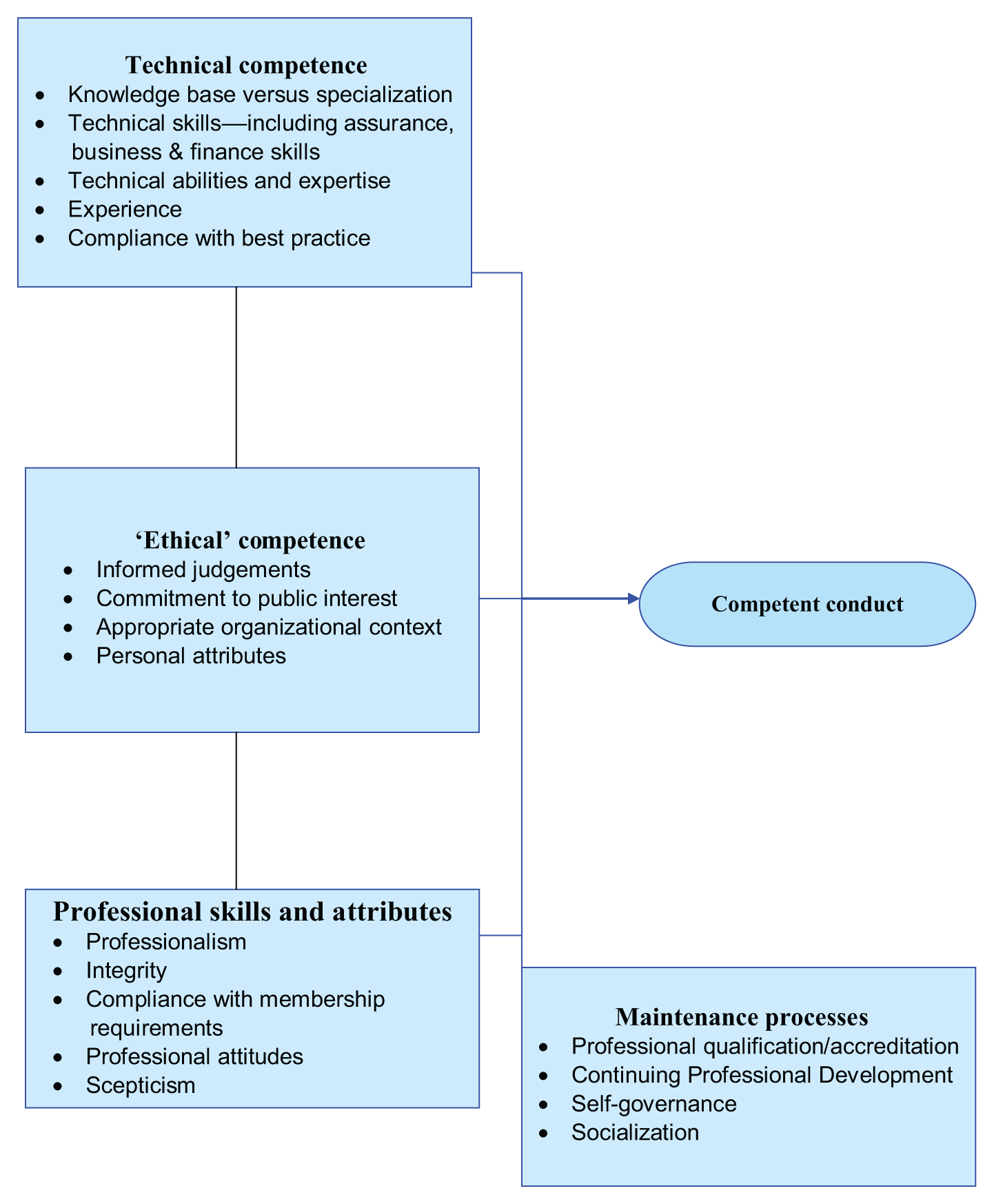
Framing conduct: competence constructions.
It appears Foucault’s points of diffraction in the competence discursive practice can be taken up by the subjects as ‘lacks’ to which ethical responses are possible and signifiers reproduced. The ethical responses are linked to ‘recent corporate failures [that] were not failures in general work but a failure in execution … a failure in leadership, the buck stops at the top, failure in regulation’ (BA1), whereas institutional norms act as ‘reiterations of the instrumental definitions in the regulatory frameworks’ (MC1). Ethical conduct has been conceived as important as technical competence, as it involves carrying technical competence through to operationalization and conviction to complete work in the ‘best professional manner’. Lacanianlens brings here an empowered subjectivity to the fore and articulates the ultimate emptiness of the signifiers of competence on offer under any given theme. This ultimate emptiness refers to structural dilemmas in the organizational knowledgethat are taken up at the micro-levelas ‘lacks’. Personal skills are understood as facilitating high quality work as well as a complement to the execution of tasks. This links to the integration of professional skills, in ensuring that key professional attributes are instilled together as expertise. Again these require utterance that is demonstrable to others, putting an emphasis on self-governance. Processes of maintenance perpetuate self-crafting; individualemployees are grappling with a sense of lack in the first place, articulating an ethical response.
Competent conduct converges technical with ‘ethical’ dimension, a process parallel with what Clegg et al. (2007a) identified as a focus on ‘success’ ethics in the formation of organizational selves. The ambiguities associated with the constructions of competence and different ways the subject is experiencing lack may render the subject to appear more ethical. It may be anxiety associated with management of meanings of competence in the context of competing discourses that can simultaneously compel the subject to act. In a face of such anxiety, reconciling the anxieties associated with the experience of a lack in competence signifiers, one can be empowered by providing ethical responses thatsubsequently lead to generativity.
‘Pleasing’ the clients has become the core in the delivery, whereby performing competently while responding to the client’s demands, as a form of accepted subjugation to the clients’ wishes, facilitate the processes aimed at an formation of the clients’ attachments to the firm in responding with credibility to what they want (a long-term concern). These processes of producing and consuming the image of ‘competent self’ appear important in legitimizing the power of profession, and seem to be linked to Macdonald’s (1995) concept of the ‘benign spiral’. The benign spiral points at the duality of monopoly in the market and the status in the social order. The spiral encompasses interactions based dynamics between economic success and respectability that operate both at the institutional and individual levels. If assurance providers are perceived as competent and ethical, they can gain respect and trust that subsequently attracts the business. These processes of producing the image via l’object petit a generate order temporarily, resulting in the client—the firm interdependence and subsequent bonding. The insights that emerge contribute to the studies of work and organization concerned with how professional relations emerge and being perpetuated in discourse with regard to the power of symbolic in the functioning of material practice.
Imaginary identification for a competent self, via discourse, reflects an image representing what one would like to be identified with, that is expertise, and symbolize its meaning to the clients, the meaning that simultaneously enters a domain of the real.Insights into perpetual reconciling processes associated with the fragmented nature of competence construction that emerged out of the interviews point at a perpetual failing of the imaginary order that is tied to the symbolic articulation (discourse of competent self) and compensating for such a failure at the micro-level (desire for competence).
Conclusions: a lack covering the lack
The article conceptualizes micro-processes of competence construction and maintenance. A tacit interplay between language, identity and material practice reproduces competence, bridging the gaps created by a distance between the client’s ‘ethos’ and the public value temporarily. In scripting competence, the lack of an essence in the sense of being professional (an empty signifier of competence) can be covered up. By reconciling the anxieties associated with a lack in the competence-supporting constructions, one can be empowered to act and rendered ethical because of the awareness of a lack.
Lacan’s theory of discourse conceptually informs alternative positions in relation to dynamics of empowerment. It could be argued that the rotations around the four (five) discourses, represent movements in the position of the subjects with respect to their own ways of experiencing lack and through which an ethical response can be taken up. If we consider a discourse of the master, the algorithm of fantasy (S/ -> a) expresses here the logic of desire to maintain oneself at the certain level of competence. The competence of the person (S/) acts as the ‘truth’ of this discourse for which this particular form of relation to object petit a is the ‘production’. In other words, agency-truth-work-production is being one way of naming the positions in the structure of the discourses (Lacan, 2007/1969: 169). We could argue that (a) constitutes an illusion, masking a sense of emptiness, in this case behind the signifier of competence. A signifier of competence refers here to the master signifier of competence (S1) that is a ‘given’ organization in the master discourse. An individual, when confronted with this emptiness feels a mobilizing sense of anxiety; anxiety generated by competence construction ‘uttered’ through the regulatory frameworks, organizational culture and in speech acts of working colleagues. The status of these discursive effects is situated between knowledge base (S2) and everyday speech acts operational at the given time.
If we consider the subject in the position of the hysteric discourse, the feeling of emptiness associated with the (a) of this discourse can be pulled by the subject into a position of ‘truth’. In this case, the feeling of emptiness appears in relation to (S2) that has likewise been pulled into the place of being a ‘production’. Alternatively, in the discourse of the analyst, if the subject chooses to challenge the ‘truth’ of the master signifier (S1) of competence itself, then it is the subject (S/) that is rendered empty under the (S2).
It appears that both empowerment and self-control are paramount to the organizational success. Through this process of continuous arrival at the competent self (responding creatively to the emptiness of the object petit a given ‘agency’ in the discourse of the analyst), security is offered to the individual through a sense of accomplishment and effective performance, tied to a sense of being competent. Sustenance of the image becomes paramount in credibility building processes, forming the base for the clients’ comfort in the quality of the services provided. Self-development and maintenance drive can be viewed as more proactive processes of rendering the work meaningful (S2 as the ‘production’ of the discourse of the hysteric) and overall functioning of the organizationsuccessful. These processes reflect some of the micro-level enacted mechanisms associated with legitimization of new identities. In other words, it appears that individuals themselves script competence constructions that support the sense of their working life through effective performance, in the context of the frames they are situated in.