




Abstract
The article examines the wearing of festive headgear as a way of understanding contemporary organizational rituals, pointing to analogous historical practice, which reveals the way that power is deployed while seeming to be relaxed. It categorizes the display behaviour associated with this apparent suspense of organizational power through four types of headgear and will trace the historical antecedents of such behaviour. It goes on to say something about the organizing of social interaction and fun and the deployment of the body in contemporary organizations. The headgear I shall consider includes paper crowns, Father Christmas hats, tinsel halos and reindeer antlers.
A walk through the city centre in any major British town from roughly the middle of November until Christmas Eve is likely to furnish an encounter with a strange set of cultural practices which have come to be accepted as quite normal: perfectly sane, generally conformist people suddenly begin to wear and display elaborate headgear to signal their participation in a number of rituals associated with Christmas. This article has its origins in this observed behaviour: the combination of office Christmas parties and Christmas hats.
In this article, I will examine the wearing of festive headgear as a way of examining contemporary organizational rituals, pointing to analogous historical practice, which casts light on the way that power is deployed while seeming to be relaxed. The headgear I shall consider includes paper crowns, Father Christmas hats, tinsel halos and reindeer antlers. I will categorize the display behaviour associated with this apparent suspense of organizational power through these four types of headgear and will trace the historical antecedents of such behaviour. I will then to go on to say something about the organizing of social interaction and fun and the deployment of the body in contemporary organizations.
The main argument of this article is that Christmas and its attendant rituals, signaled through the adoption of specific costumes such as the party hat, is vital to organizations because it allows them to restore and maintain hegemony for the coming year. The controlled temporary relaxing of organizational rules and power structures allows asymmetries of power to be re-established without opposition for the following year. By examining the historical antecedents of Christmas ritual, the hegemonic elements of the festive season can be put into sharp focus, and for this reason, the article begins with a consideration of the history of the relevant seasonal practices.
Historical note
People tend to wear outlandish headgear as part of the rituals surrounding annual office Christmas parties. The party itself can perhaps be seen as the convergence in our own time of three historical traditions, one of which, is feasting by members of craft guilds. Another is the acceptance of misrule and over-indulgence, a carnivalesque practice, paradoxically with its own rules and regulations which will be further explored below. Closely related to this is the tradition of wearing a mask, and of the donning of disguise, as manifested by mummers, and replicated to some extent by party hats and other headgear.
Guild feasting tended to occur on the feast days of the saint who acted as the organization’s patron. For example, guilds of tailors would celebrate the feast day of their patron, St John the Baptist, on 24 June. The guild feasting may be seen as an antecedent of the office party since both involve social gatherings and over-indulgence within a place or organization associated with work. The modern office party can be seen as the re-introduction or re-fashioning of these pre-modern guild festivities, celebrating as they do, unity and group identity. The other two traditions tended to be explicitly associated with the Christmas season. This was obviously the case with mumming (and continues to be). Formalized misrule was a feature of carnival, the short period immediately preceding Lent, but it was also a feature of the Christmas season (Hutton, 1997). The best-known manifestations of carnival today are possibly the Venetian Carnival and Mardi Gras immediately preceding the Easter lent, a period of abstinence from eating meat primarily, but a period of lent also preceded Christmas running from the fourth Sunday before Christmas day until midnight on Christmas Eve. Christmas Day itself, therefore, could take on the attributes of carnival and all that that entailed. Therefore, carnival and its associated practice of disguising have long associations with Christmas. The office Christmas party, similarly, is notoriously an occasion for misrule and over-indulgence and therefore is a plausible candidate as the contemporary manifestation of seasonal licensed misbehaviour. As Bakhtin points out carnival is a permissive period but one which is a temporary suspension of social norms. After carnival the normal order is quickly and completely restored (Bakhtin, 1984).
Paper crowns
The first specific piece of headgear is the paper party hat or crown which drops out of Christmas crackers normally provided by restaurants at Christmas meals. These are usually ill-fitting and made of highly coloured tissue paper. The wearing of paper crowns at Christmas has its roots in the commemoration of the visit of the Magi to the infant Jesus in the stable in Bethlehem. In Matthew’s gospel we find the reference to the Magi or ‘wise men’
… behold, wise men from the East came to Jerusalem, saying, ‘Where is he who has been born king of the Jews? For we have seen his star in the East, and have come to worship him’ (Matthew 2,1–3)
By the 6th century the Magi had merged with Three Kings of the Book of Psalms who would honour the Messiah. The visit to the stable of the Kings or Magi bearing the traditional gold, frankincense and myrrh is commemorated in several countries at Epiphany, from the Greek Phaino meaning to show, which is on 6 January or Twelfth Night. Epiphany is significant in this context because it is associated with a period of misrule. There are two examples of this, one secular and one ecclesiastical. The Elizabethan antiquary, John Stow, reported how noble households used to appoint ‘… a lord of misrule, or master of merry disports’ (Hutton, 1997: 107). Until well into the 16th century English royal courts and noble households appointed a Lord of Misrule to act as master of Christmas ceremonies. Before the Reformation, Boy Bishops would be appointed from among the choirboys on St Nicholas Day (6 December) to perform similar duties. The festivities associated with Epiphany or Twelfth Night are concerned with the world turned upside down: the most junior member of the organization becoming its head in the case of the Boy Bishop. It is seen in the military today in the traditional serving of the men by the officers at Christmas dinners. For a brief moment organizations become anarchic and established rules of hierarchy either dissolve or are inverted. We put on the paper crown to show that we can all become kings for a day, but also that we understand that it is for one day only, after which normal power relations will be restored without resistance.
The significant thing about this period of sanctioned misrule is exactly that: it is sanctioned by organizations, indeed some organizations finance Christmas parties both as a reward for staff and as a way for them to let off steam in a controlled and contained environment. Bad behaviour is tolerated for a finite period each year. After the period of misrule is over normal power relations are restored and hierarchies are re-engaged. By scrutinizing what is temporarily admitted to the organization we can appreciate what is normally absent or banished, in this case the body and bodily excess. At Christmas parties the excessive, unruly body is reintroduced to the Cartesian organization which normally polices a rigid mind-body split (Holliday and Thompson, 2001). As organizations style themselves as knowledge-intensive rather than manual entities this split becomes increasingly pronounced, and as Holliday and Thompson argue, physical bodies are disappeared in sober dark suits or uniforms. Bodies, they argue, must be kept under surveillance. This can be seen in the rise of the panopticon-like open plan office characterized by hard shiny reflective surfaces including glass, steel, chrome and polished wood.
At best the organization will accept the normal body which submits to a regime of self-discipline and rigour. Such a body is subject to a regimen of dieting, exercise, medication and regular health checks. It is well and correctly nourished. It is clean and smooth. And it is above all, continent and under control, requiring both labour and knowledge to produce and maintain (Holliday and Hassard, 2001). This is the ideal organizational body in contrast with the natural body which is far more difficult to control or account for. This body is unruly, periodically ill, often fat and tired, inappropriately hairy, wrinkled and grey, and, importantly in the context of Christmas rituals, it is excessive and prone to altering its own state. This is the body which eats and drinks to excess, to the point of satiation and foolishness. This is the embarrassing body which is normally hidden or repressed in organizations, but which is allowed to become present and visible in tightly time-bound spaces such as office Christmas parties. The organization, therefore, can be seen to have two bodies. The Foucauldian self-regulating, self-policing normalized and presented body enjoys high status; the Bakhtinian grotesque, out of control, excluded body does not.
For most of the year, the disciplined body is firmly in the ascendant, but the rupture in the corporate order at Christmas shows just how fragile that order is. This can also be framed as the constant dialectical struggle at work between a productive and desired work culture of restraint, control and deferred gratification and sublimated desire for leisure, for instant gratification and consumption, a banished ‘skiving’ culture characteristic of the ‘soldiering’ worker so despised by Frederick Taylor (Braverman, 1976). Although as we have seen, there is a whole battery of managerial techniques to maintain the clean and proper organizational body (Kristeva, 1984), as Bordo (1993) points out, we voluntarily manage the distinction for ourselves through our disciplined working bodies. This ideal is consistently aspired to and emulated except once a year during the period of misrule when the private leaky body becomes public through the weeping and vomiting that can accompany the excessive consumption of alcohol, and normally attentive and alert bodies can fall into sanctioned public sleep. However, this temporary rupture in the social order is quickly repaired through the symbolic acts of contrition including the clearing up and the discussion of the horrors of the hangover. This contrition closes the circle: the symbolic excursion into non-work, non-perfection, ill-discipline, ends with the conclusion of the party and the symbolic and actual screwing up of the paper party hat.
The Father Christmas Hat
A second great Christmas ritual is the giving of gifts. It is likely that this tradition, like the wearing of crowns, has its roots in the commemoration of the visit of the Magi, but it also makes reference to St Nicholas of Myra, who, according to legend, saved three girls from prostitution by throwing three bags of gold through their windows at night, for their dowries (Attwater, 1980). Medieval St Nicholas seems to have been transmuted into the modern Santa Claus by means of the Dutch, who hung up shoes and stockings on the Eve of St Nicholas’ day to be filled with presents by Sinte Klaas. This tradition was carried to the Dutch colony of New Amsterdam, renamed New York when the British captured it in 1664 and was revived in the 19th century first by Washington Irving and then definitively by Clement Clark Moore in, ‘A visit from St Nicholas’, popularly known as ‘The Night Before Christmas’ in Harper’s Weekly in 1822 (Hutton, 1997). It is to Nast’s illustrations of the poem that we owe the modern image of Santa Claus as a red-robed, bearded old man, with a sleigh drawn by a team of flying reindeer, and a sack of presents.
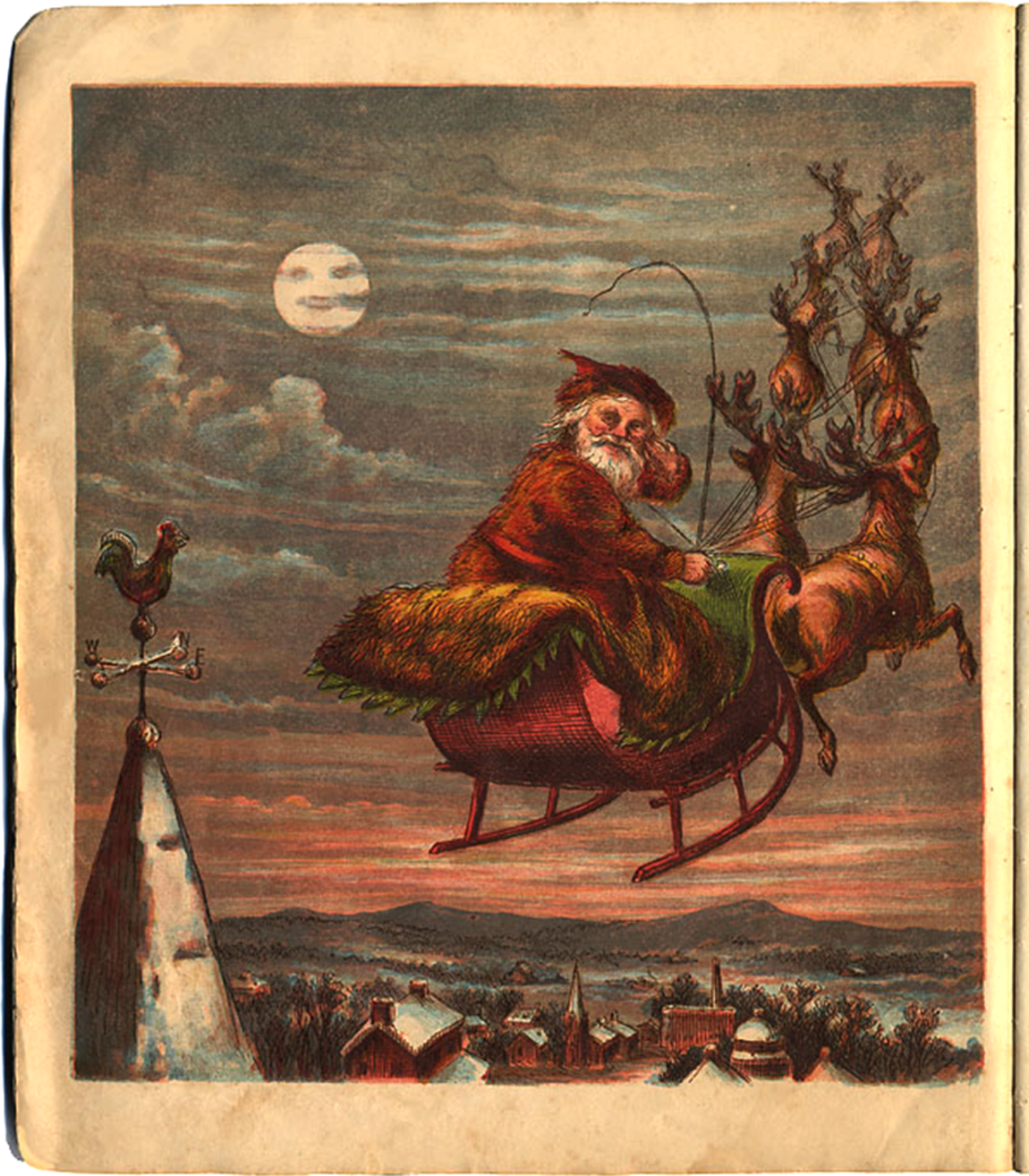
One of Thomas Nast’s illustrations of Clement Clarke Moore’s ‘A visit from St Nicholas’, Harper’s Weekly (1822)
At one level, wearing garish Father Christmas hats alludes to the seasonal giving of gifts, but the invocation of Santa Claus or Father Christmas into organizational signals a subtle knowledge about reward structures in the period outside that of misrule. Father Christmas is a secular omniscient presence who originally rewarded good children and punished the naughty. In recent years, however, Father Christmas has come to deal only in rewards, and it would be a bold parent who used Christmas as an opportunity to punish bad behaviour through the withholding of gifts. Thus guilt has been banished and moral sanctions removed. It is also possible that Secret Santa rituals acknowledge that God is dead. Organizational fate can be seen as capricious; the Great Axe can fall on the just and the unjust alike, doing a good job is not necessarily rewarded with promotion as organizations ‘rightsize’. Secret Santa, in which everyone receives a gift regardless of merit, may be a tacit acknowledgement of the breaking down of the old order of retribution and reward. Furthermore, this giving of gifts hints at a truth about contemporary Western society: goodness equals consumption. The good citizen knows he or she has a duty to consume, particularly in times of recession. Secret Santa draws attention to this duty by subverting it. There is generally a cash limit on the gift. Thus we are knowing and conscious supporters of capitalism through our consumption of useless items to give as gifts, but we subvert the notion of the good consumer by refusing to buy wholeheartedly, by withholding part of ourselves as we limit our expenditure. Secret Santa explicitly does not reflect an individual’s worth to their employer nor does it function as a reward mechanism because anybody who wishes to take part can be included. As such it may be seen as a parody of or possibly even relief from such performance management strategies as performance-related pay or merit awards.
The tinsel halo
The tinsel halo evokes the Christmas angel:
And an angel of the Lord appeared to them, and the glory of the Lord shone around them, and they were filled with fear. And the angel said to them, ‘Be not afraid; for behold, I bring you good news …’. And suddenly there was with the angel a multitude of the heavenly host … . (Luke, 2, 8–14)
It is tempting to see in the appearance of so many angels in the corporate setting a further invocation of the divine, an attempt at the re-enchantment of the disenchanted world described by Weber (1918), indeed, the transmutation of the angel into a fairy possibly reflects the secularization of organization and society.
A further possible function of the angel might be the reintroduction of degraded feminine principle in organizations. The highly efficient disciplined organization described above demands a disembodied rational mind at the expense of the base material body. Women are frequently associated with the body and in particular with an inadequate body which is often seen as unreliable because of menstruation, pre-menstrual tension or syndrome, the hormonal shifts around pregnancy, parturition and lactation, and the menopause. According to Skeggs, this is particularly true of working class women. She states that white working class women’s bodies are perceived as ‘out of control, in excess’ (Skeggs, 1997: 100).
We can contrast this with the angel, disembodied, elite, sacred, holy, spiritual, resolutely asexual, beyond, before and above sexuality. Thus, the length of tinsel wound around the head of a drunken young woman slumped in a town centre after an office party can be read as a parodic halo, and the gangs of young women all wearing tinsel in their hair swaying through city streets can be seen to represent a parody of the heavenly host. A less puritanical reading of this phenomenon, however, is to see it as a joyful subversion of the impossible Victorian Angel of the Home stereotype popularized by Coventry Patmore in which young women reinvent the category ‘Angel’ for themselves, like the reclaiming of ‘queer’ in Queer Theory or ‘Crip’ in ability and disability studies.
The reindeer antler
So far, we have been dealing with practices that in various ways have their roots in Christian history and tradition. The subject of reindeer antlers may appear to take us back to pre-Christian paganism, a time of green men and Celtic woodland spirits. However, as we have seen, the association of Santa Claus and flying reindeer seems to date back no earlier than the 19th century and Clement Clark Moore’s poem. Rather than sky-borne shamen, Santa Claus and his reindeer can be seen as the product not of ancient paganism but of a phase of capitalism which saw the emergence of the consumer society: the poem and its illustrations were, after all, produced for a commercial publication. The wearing of reindeer antlers has become more common with the mass production of plastic and felt versions, and is now a common site during the lead-up to Christmas, as can be seen in the following snapshot:
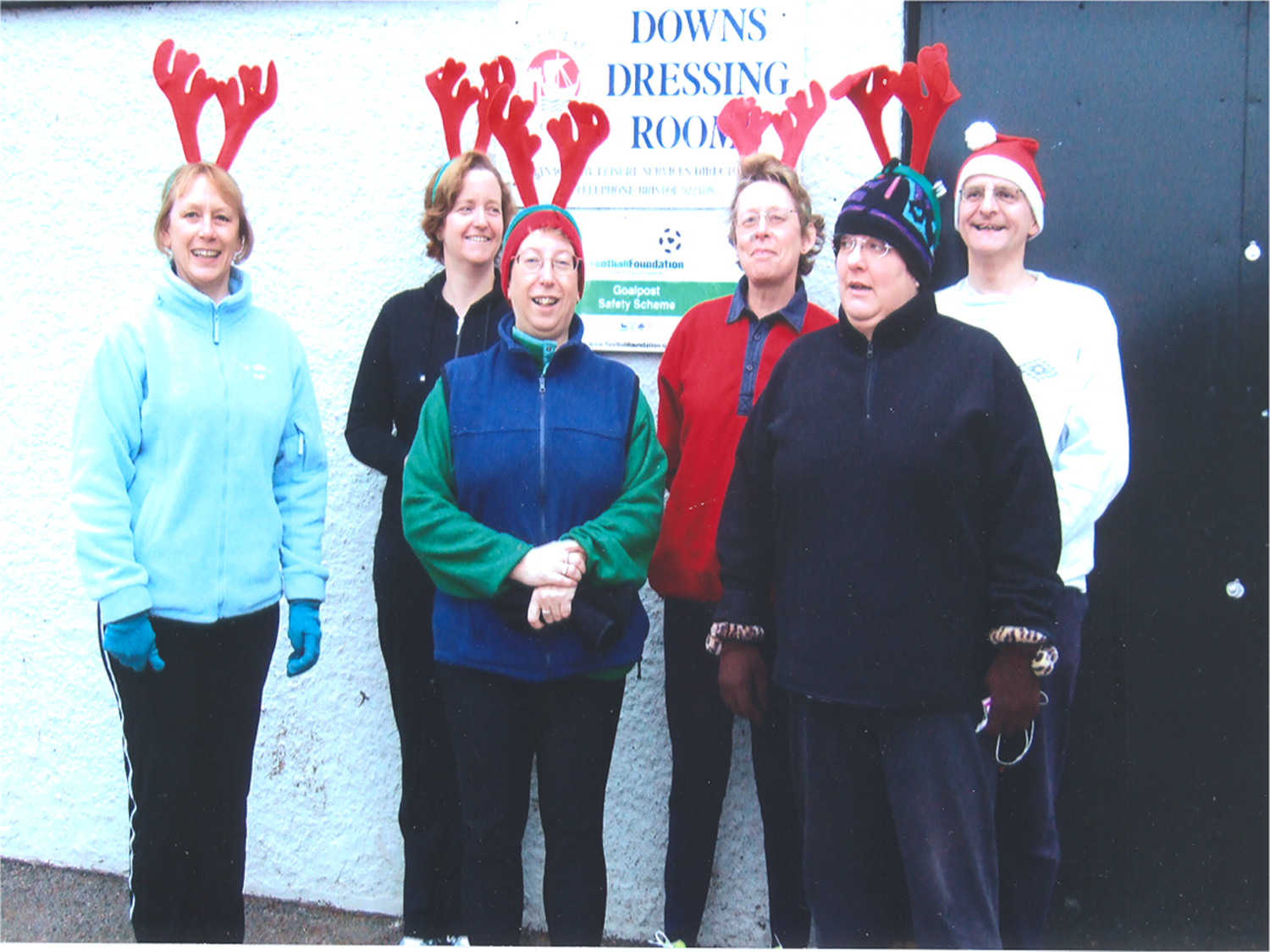
The author and companions dressed for their Annual Reindeer Run in Bristol
The reindeer acts as a counterpoint to the female principal commemorated in the angelic halo. The wearing of reindeer horns inside organizations represents the reintroduction of masculine, ‘natural’, unmediated nature into organizations, in effect, the wild animal in the confected organization. Horns have long been symbols of potency, but paradoxically, also of impotence and cuckoldry.
If the halo represents the reintroduction of a female principle into disciplined organizations, the antler might be seen to imply the re-emergence of the embodied masculine presence in our asexual, and neutered office cultures. The reindeer and stag are firmly associated with masculinity. The antler belongs to the same territory as the Green Man whose function might be to bring new vigour to moribund organizations. The donning of horns could be read as a pagan invocation to unleash a bodily masculinity into the androgynous organization which is concerned with the control of male bodies in space. As was the case with the halo, however, this reading is not unproblematic, and is open to conflicting interpretation. The wearing of horns can be read as the joyful reappropriation of the eroticized masculine body by young men, or, the adoption of synthetic felt simulacra of mighty antlers in nature can be seen as the parodic infantilization of the dangerous and unruly male body recast as the child-friendly, sweet and cuddly Rudolph the Red-nosed reindeer. This ambiguity is seen in the following photograph of two workers in a big box retail outlet:
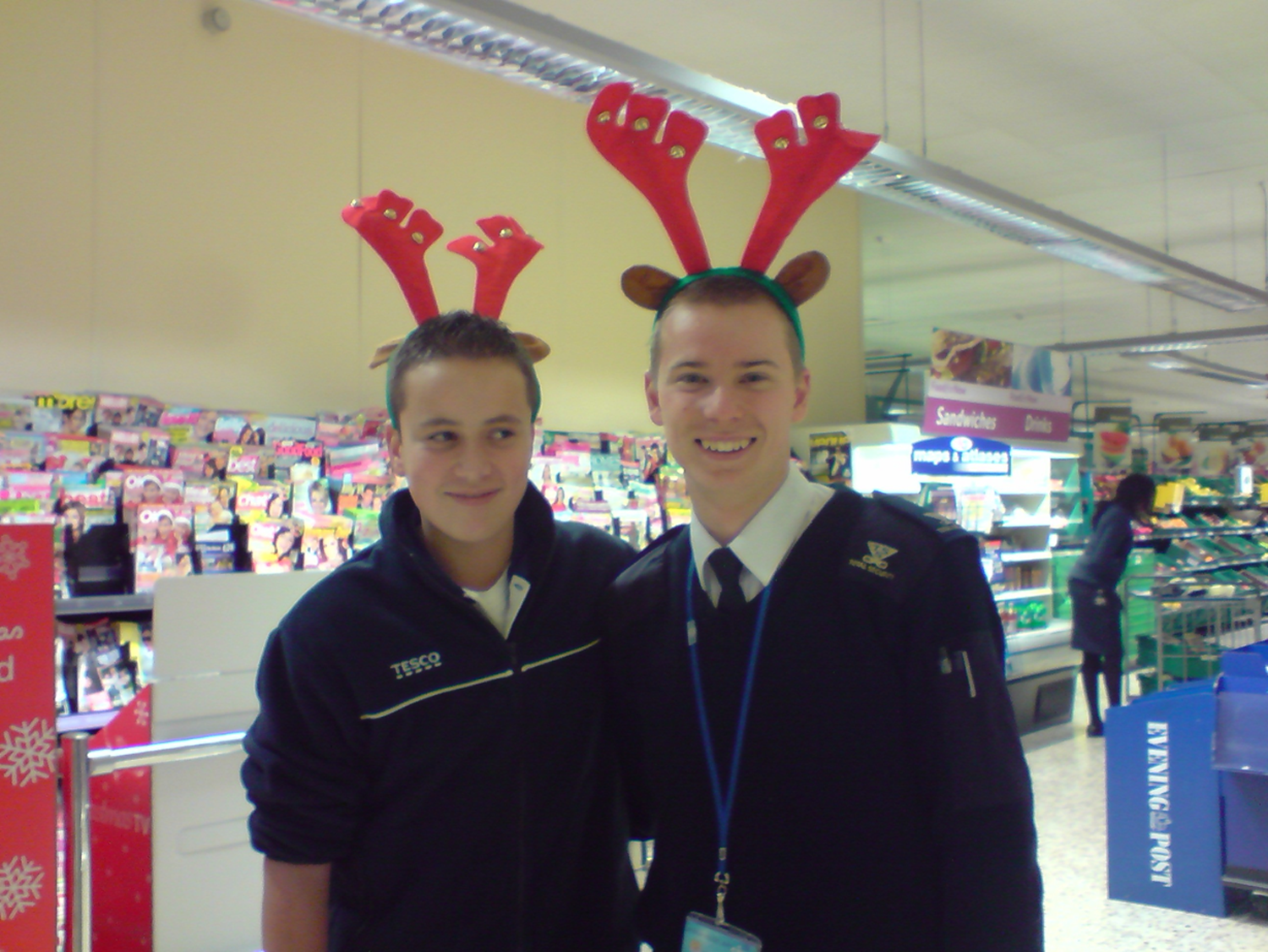
Two young male workers wearing novelty reindeer antlers (photo courtesy of Meg Ball)
The radical reading of what happens in organization would argue for the taming and neutering of the body rather than the evocation and celebration of the beast. But as Holliday and Thompson suggest, control of bodies in space is so complete that, ‘The office party becomes a site for the display of a kind of masculinity that is reminiscent of—and about as radical as—a “saucy” English seaside picture postcard’. (Holliday and Thompson: 130).
Concluding remarks
The point of origin of this article was to consider how much we unwittingly borrow from our own cultural traditions and reinvent them or recast them in a modern idiom inside contemporary organizations. Doing this allows us to see why Christmas and its rituals is so important to the unchallenged power and legitimacy of contemporary institutions. The Christmas party with its attendant wearing of paper crowns, Father Christmas hats, tinsel halos and reindeer antlers echo and restore rituals from pre- and early modernity: the Guild banquets and the season of Misrule. Rationality and calculation are set aside temporarily as the world is turned upside down and organizational actors repeat tropes from the past, possibly subconsciously picking up psychic traces in a similar way to the reuse and reframing of stories from the past as they reappear in organizational narratives (Czarniawska, 2004). Christmas rituals, as we have seen, manifest a loss of enchantment and represent secular attempts to re-enchant the world (see Weber, 1918), but this is a deeply knowing re-enchantment through consumption and bad behaviour. These contemporary rituals are emptied out and commodified emotional experiences: we buy our party hats rather than making them ourselves. A ‘good time’ is defined by consumption in one form or another rather than necessarily involving authentic contact with other people. Furthermore, Christmas rituals represent an inversion of the original principles of festivities. They are no longer preparation for period of spiritual discipline and reflection (such as carnival before or after Lent). They are now periods of self-indulgence.
It is also possible that these reinvented rituals represent a desire for meaning making in alienated workplaces. Although in this secular age we contend that divine retribution and order, and peace on earth are make-believe, we enact the rituals to give meaning to existence. And to make the play-acting more convincing we don costumes—most prevalently headgear, in order to make the ritual more powerful. Thus we find ourselves caught wearing silly hats at Christmas in a desire to return to a world of certainties and faith that echoes pre-modern mentalité all the while knowing at some level that parodic headgear underscores the sterility and hopelessness of contemporary organizational ritual.
As we have seen, this temporary dismantling shows the tenacity of organization. It represents a refuge, a very temporary respite from the regulation of the body, as Holliday and Thompson suggest:
… the eruption or display of the re-embodied and unregulated body at the office party (sexual activity, excess drinking and eating, violence and abuse directed against one’s superiors) can be seen to be a potentially carnivalesque moment in the wider culture of surveillance and regulation. (Holliday and Thompson: 118)
They go on to make the point that it is the very regularity of these hiatuses and our willingness to go back to the status quo after the period of misrule that allows the organizational iron cage to function so completely.
This is the safety valve argument explored by Humphrey in his work on misrule in fifteenth-century England. He argues that scholars have seen carnival as ‘the touchstone for all sorts of hot topics like subversion, transgression and popular resistance to authority’ (Humphrey, 2001: ix) and summarizes the differing approaches to the meaning of carnival as subversion or containment. The most popular reading, he concludes, is carnival as safety valve, a time when the ruling elite allows transgression only to reaffirm and thus strengthen its domination at the end of the designated period. Humphrey, however, appears irritated by the alacrity with which historians have embraced the concept of the Bakhtinian safety valve. If the analytic move is immediately towards this theoretical position, he argues, the subtleties of the individual event is lost. Misrule must be understood contextually. Sometimes, Humphrey suggests, these activities are just good fun, and sometimes they are informal punishments for those who have stepped out of line. Deleuze and Guattari’s concept of schizophrenic capitalism is helpful here (Deleuze and Guattari, 1980). Contemporary organizations mirror this schizophrenia which requires on the one hand conformity, control, standardization and complicity for the efficient accumulation of capital, and anarchy and riot and destructiveness of creativity on the other for their continuing vitality and innovation. What the phenomenon of the Christmas misrule in organizations presented in this article suggests is that the anarchy of the drunken, Rabelaisian, predictably unpredictable Christmas party acts as a safe space for organizations to develop adaptive capabilities without disrupting the order and discipline which keeps them in place. Employees are allowed to immerse themselves temporarily and under suffrance in their natural bodies and the fecundity they represent so that the organization will have transformative capabilities in the year to come. The status quo is engineered so that we can live both lives—the normal and the natural—simultaneously, These are not dualistic entities or separated existences. They are lived contiguously but are foregrounded or pushed into the background as organizational requirements demand. And the adoption of appropriate costume, the ritual headgear, signals the particularity of the carnivalistic, potentially generative, performative space.
Office parties, then, which can seem like bacchanals both reveal and shore up organizational power and, by wearing these hats, as we have seen, we code our own bodies not only as masculine or feminine, but also as powerful or powerless. Although ostensibly about fun, there can be an element of coercion in wearing a paper crown at Christmas. The refusal to wear one can be an indicator of resistance to group norms. The paper crown in particular offers a more poignant reading of the assigning of power roles in organizations. Its ‘forced’ wearing represents in its temporary status a cruelly parodic offering of the possibility of different hierarchy and authority structures. Our only hope of escaping this totalizing ritual is somehow to maintain an ironic and knowing position with regards to our party hats, comforting ourselves, perhaps with the consolation that there can at least be a brief hiatus in the inexorable march of the contemporary culture of self-discipline and self-surveillance.