




Abstract
Throughout our adult lives we have both been haunted by a certain sense of doubleness—a feeling of dislocation, of being in the wrong place, of playing a role. Inspired by Stevenson’s novel Strange Case of Dr Jekyll and Mr Hyde we explore this doubleness through evocative, dual, autoethnographic accounts of academic conferences. By analysing our stories in an iterative process of writing, reading, rewriting and rereading, we seek to extend the reach of much recent autoethnographic research. Presenting ourselves as objects of research, we show how, for us, contemporary academic identity is problematic in that it necessarily involves being (at least) ‘both’ Jekyll and Hyde. In providing readings of our stories, we show how autoethnography can make two contributions to the study of identity in organizations. The first is that autoethnographic accounts may provide scholars with new forms of empirical material—case studies in identity work. The second contribution highlights the value of experimenting with unorthodox approaches—such as explicitly using novels and other literary sources to study identity.
Keywords
when I reached years of reflection, and began to look round me and take stock on my progress and position in the world, I stood already committed to a profound duplicity of life … Though so profound a double-dealer, I was in no sense a hypocrite; both sides of me were in dead earnest; I was no more myself when I laid aside restraint and plunged in shame, than when I laboured, in the eye of the day, at the furtherance of knowledge. Strange Case of Dr Jekyll and Mr Hyde, R. L. Stephenson (2003: 48).
1
Robert Louis Stevenson’s short novel, Strange Case of Dr Jekyll and Mr Hyde, caused a sensation when it was first published in 1886. Even today, phrases like the ‘Jekyll and Hyde personality’ remain very much part of the vernacular, suggesting that the basic idea of the work continues to haunt our contemporary collective unconsciousness (McNally, 2007). As is surely well known, the story tells of how Dr Jekyll, a respectable medical practitioner, is able to transform himself with chemical potions into a physically different man: the unpresentable Mr Hyde. This duality, in which the transformation of the same person meant that ‘each [element of self] … could be housed in separate identities’ (p. 49), places Stevenson’s work firmly within in a tradition that, by the 1880s, had become established within gothic writing: tales of the doppelgänger, the double, or literally, ‘double-goer’ (Miller, 2003). The term was coined by the German Romantic author Jean Paul in 1796 (Vardoulakis, 2004), and by Stevenson’s time, stories featuring a doppelgänger were typically associated with ‘a notion of the subject/subjectivity that is defective, disjunct, split, threatening, spectral’ (Vardoulakis, 2006: 100).
Over the 125 years or so since its publication (especially perhaps with the rise of various 20th-century ideas that have complicated earlier assumptions concerning the ‘self’) the central idea of Dr Jekyll and Mr Hyde has offered fertile ground for interpretations and lines of inquiry, some distance from conventional readings of the novel. Indeed, Stevenson’s tale of the relentless supplanting of a presentable side of self with an unpresentable one (Jekyll forfeited the power of voluntary transformation into Hyde—the transformations gradually became spontaneous and finally irrevocable) has come to have a particular resonance with our individual experiences as business school academics.
During the evolution of this article, Stevenson’s story inspired us to write ‘doubled’ tales of our own experiences of two sharply constrasting academic conferences that we both attended. One conference, the Academy of Management (AoM), New Orleans, USA in August 2004 seemed to us, at first glance at least, to exemplify all the instrumentalism and careerism that we have since come to associate with a disparaged side of self—referred to in this article as Mr Hyde. The contrasting conference, the Congress of Qualitative Inquiry (CQI), Urbana-Champaign, USA in May 2005, again at first glance, appeared to epitomize the values of knowledge for its own sake—as beloved by a preferred self, referred to in this article as Dr Jekyll. Thus, we use Stevenson’s story (with due qualifications) as inspiration for exploring a certain ‘doubleness’ both of us have come to feel about our work and sense of self(ves) as business school faculty members—a sense of self with which neither of us has been at ease. Furthermore, for reasons elaborated later, we have come to think that our anxieties can be traced, in part at least, to the ‘profound duplicity of life’ (p. 49) and double dealing (á la Jekyll and Hyde) that such an identity has come to involve for us.
In addressing these issues autobiographically we are affirming Fine’s claim that ‘intellectual questions are saturated in biography and politics and that they should be’ (1994: 30–31). Indeed, in offering our personal stories we join an emergent practice concerned with writing about one’s own self and identity in the context of organizational studies (e.g. Ford and Harding, 2008; Ford et al., 2010; Grey and Sinclair, 2006; Humphreys and Learmonth, 2010; Karra and Phillips, 2008; Keenoy and Seijo, 2010; Watson, 1995, 2008). In the broader social sciences, such writing has attracted the label ‘autoethnography’; a genre of work which has made significant strides as a research strategy in recent years, but not without its conceptual controversies and practical difficulties.
Thus, our article aims to take forward some of the debates about the nature and practice of autoethnography. In doing so, we raise questions about (i) how the autoethnographic method might be enhanced beyond current debates; and (ii) how autoethnography can contribute to the literature on academic identity. In terms of method, we show how multiple accounts of the same phenomena written over time (and therefore written by different versions of the self) can be a valuable way of doing autoethnography. Indeed, we treat our own stories as, in themselves, sources of empirical material. Second, in terms of identity theory, we show how these sorts of stories can be analysed as ‘case studies in autobiographical identity work’ (Watson 2009: 425).
But before we look at our stories, let’s look at Stevenson’s.
Seek and Hyde
What first attracted us to Jekyll and Hyde was a fascination with our own sense of doubleness. Some critics have seen Stevenson’s novel as a modernist-humanist tale which reinforces binary distinctions drawn from various Western philosophical traditions: good versus evil; the ego versus the id; the civilized versus the savage. However, we see in Stevenson’s work a more complex and nuanced account of self and identity, one that is arguably deconstructive. Indeed, we show, in new ways, how the story can help illustrate and enrich more poststructuralist accounts of self and identity, such as Alvesson and colleagues’ discussion of the ‘presence of multiple, shifting and competing identities even as we also question how identities may appear orderly and integrated in particular situations’ (2008: 6). Indeed, our use of a novel to inspire autoethnography, links our work with that of a number of other autoethnographers, who have taken their inspiration from poetry or other forms of literary texts (Haywood Rolling Jr, 2004; Keenoy and Seijo, 2010; Maréchal and Linstead, 2010).
However, Jekyll and Hyde is hardly a novel that comes immediately to mind when discussing academic identity. Perhaps novels by authors such as Kingsley Amis, Malcolm Bradbury, J. M. Coetzee, Howard Jacobson, David Lodge, or Philip Roth would be more obvious (Bell and King, 2010). Nevertheless, in agreeing with Harding et al. who assert that notions of the academic arise from ‘an historically accreted discourse, made manifest in films, fiction and all kinds of other cultural vehicles which together in part constitute received, idealized and normative images of what a “proper academic” should be … and their traces inform the stories we tell our academic selves about our selves’ (2010: 162) we have deliberately chosen a novel ostensibly far-removed from such normative images. In doing so, we are attempting to unsettle (our own and our readers’) conceptions of what Harding et al. refer to as ‘proper’ for an academic. Indeed, in doing so, we hope to support Parker’s wish that readers of this journal should ‘respond with irritation, annoyance, excitement … [and not] merely confirm the prejudices of the conservative’ (2010: 8).
Nevertheless, in part because of the distance between Jekyll and Hyde and received ideas about academic life, we need to acknowledge that our choice (or perhaps our conceit) of Jekyll and Hyde as an analogy has caused certain problems. For example, one noticeable feature of the novel is its unremitting masculinity. It is also significant that all its characters are elite members of the upper classes. In a sense, its upper-class masculinity might be seen as a helpful reminder of the fact that most business schools across the world remain dominated by such a male elite. But the novel’s tone, in this respect, has also led us to certain questions. For example, we wonder, as we reflect on our academic lives (as men, and as ‘full’ professors at research-intensive universities), whether we have provided accounts that are themselves caught up with the competitive and manipulative masculinity that continues to haunt the academic world (Ford and Harding, 2010; Knights, 2006; Murgia and Poggio, 2009; New and Fleetwood, 2006). Indeed, we shall return to this point in the discussion.
Also, in using Jekyll and Hyde, readers might naturally assume we are seeking to make similar moral judgements to Stevenson’s: that our Jekyll equals ‘the good’ and our Hyde equals ‘the evil’. But this is not the case. We do not believe that our version of Dr Jekyll (i.e. in this article, the self who values knowledge for its own sake) represents what is inherently good in a moral sense; nor do we think that our adaptation of what we call Mr Hyde (i.e. in this article, the self who makes careerist calculations) is morally reprehensible, nor even inferior to a supposed love of knowledge. Nevertheless, we would still seek to emphasize how the novel evokes a subjectivity that is duplicitous, defective, disjunctive, split and threatening (Vardoulakis, 2006). These characterizations of our subjectivity, rather than ones taken directly from the novel, are helpful in that they enable us to avoid the kind of moral judgements made by Stevenson, but they still evoke how we sometimes feel about certain moral, and other aspects of our lives.
Who are we?
This article concerns academic identity—specifically our academic identity—and the contributions that an autoethnographic approach might make in this regard. It is appropriate, therefore, to provide some contextual autobiographical details—which, in themselves, represent forms of identity work. Indeed, throughout the article, we interpret all our ‘confessions’ as self-narratives, which we ‘‘work’ on through internal soliloquies’ (Clarke et al., 2009: 324).
We worked together at Nottingham University Business School between 2004 and 2010, and soon discovered we had interests in common. Crucially, neither of us regarded ourselves as established academics—we were both late starters (receiving our PhDs aged 41 [Mark] and 52 [Mike])—and so we carry the baggage of long-term careers outside academia. Furthermore, we share similar understandings of our former jobs, in the sense that we now see them as arenas in which we were often very uncomfortable with who we were. Mark still recalls the time when he falsified health statistics to make them politically acceptable; Mike was embarrassed to find out that the cost of his business-class flight to Upper Egypt (for a consultancy in technical education) was more than the annual salary of the Egyptian college principal with whom he was working. So, just as ‘Henry Jekyll stood at times aghast before the acts of Edward Hyde’ (p. 53), the anxiety for us was that our former jobs (albeit for different reasons) were starting to turn us into Mr Hyde. In other words, we were becoming the kind of people we wished we were not.
These experiences led us both to try to change career through pursuing masters degrees. As mature students we peered into the work of university academics—to us, there seemed to be no hint of academics’ Mr Hydes. They appeared to deal with what was interesting. And, what’s more, these academics apparently worked without the complications of a desire for career progression; as Ruth puts it, they seemed to have lives ‘devoted to inquiry and education’ (2008: 106). These, in retrospect, naive observations 2 encouraged us to undertake PhDs and move, eventually, into academic careers—in part, with the hope of becoming ‘different’ people. We sought to be, as it were, something like our admired Dr Jekylls and escape from our Mr Hydes.
Unfortunately, things did not turn out quite this way. One of the central messages of Jekyll and Hyde is that Mr Hyde is always a lurking presence within Dr Jekyll. Indeed, these dual natures were, as Stevenson put it, ‘bound together … in the agonised womb of consciousness’ (p. 49). Although we didn’t realize it at the time, simply escaping one’s former job would hardly enable escape from Mr Hyde. It wasn’t, after all, just about casting off our jobs—it was about remaking our selves within what we imagined would be a purer, intellectual environment. But, as Stevenson reminds us: ‘the doom and burthen (sic) of our life is bound forever on man’s shoulders, and when the attempt is made to cast it off, it but returns upon us with more unfamiliar and more awful pressure’ (p. 49).
Nevertheless, at the start of our different academic careers, each of us believed, at least for a time, that we had been able to get rid of Mr Hyde: just as, at one point in the novel, Jekyll reassured a friend: ‘the moment I choose, I can be rid of Mr Hyde’ (p. 20). However, as we got further in to our academic careers, we started to share Jekyll’s later view: ‘that I was slowly losing hold of my … better self, and becoming slowly incorporated with my second and worse’ (p. 55). We liked to think of our selves as people who want to write and teach in ways that reflect our moral, political and aesthetic concerns. However, we had become increasingly conscious that another, more disturbing self was simultaneously trying to pursue with ‘skill and courage … the [career] game’ (MacDonald and Kam, 2007: 641) often played in academia. The anxiety at this point in our lives then, was that this ‘other’ self, would end up only producing what Grey and Sinclair (2006) call ‘routinized, professionalised “publication”’ (2006: 452), and similarly, that this other self would teach merely to get good student evaluations (Burrell, 1997). And maybe there was a twist for academics—perhaps a more awful pressure (p. 49) to use Stevenson’s words. After all, producing work which is published in places that people read (such as in high-impact journals) is exactly the same sort of behaviour one would expect whether, like Dr Jekyll, one were to pursue ‘pure’ knowledge, or whether, like Mr Hyde, one wanted to get paid more. Perhaps in our old jobs, at least differences between Dr Jekyll and Mr Hyde were more obvious.
Autoethnography: analytic and evocative?
We now move from this reflection to discuss autoethnography more formally—a field of inquiry that has become eclectic, to say the least. 3 Nevertheless, in all autoethnographic work, in some way or other, ‘the self and the field become one’ (Coffey, 2002: 320). As Anderson notes, self-declared autoethnographers typically publish ‘especially (although not exclusively) on topics related to emotionally wrenching experiences, such as illness, death, victimization, and divorce’ (2006: 377) (e.g. Boje and Tyler, 2009; Doloriert and Sambrook, 2009) but autoethnographies can also include the mundane (Humphreys and Watson, 2009). And the autoethnographic label is often also deployed in many other contexts and forms, that Richardson and St Pierre call ‘creative analytical practices’ (2005: 962): for example, in forms of performance ethnography (Denzin, 2003; Spry, 2001) fiction stories (Watson, 2000) and other less conventional approaches (see Denzin 2006: 420 for a list of some of these). It is perhaps unsurprising, then, that Charmaz comments: ‘[w]hat stands as autoethnography remains unclear and contested. This term lumps [together] interesting, boring and revealing memoirs, recollections, personal journals, stories and ethnographic accounts under the same name’ (2006:397).
However, because of autoethnography’s concern with the self, one of the central debates is around the possible relationship(s) between theories of self and identity, and methods for representing the self—our central area of interest. Indeed, the currency and intensity of the debate surrounding autoethnography is illustrated by a 2006 special issue of the Journal of Contemporary Ethnography. This is devoted entirely to discussing the proposals of the special issue’s first essay: Anderson’s elaboration of what he calls analytic autoethnography, which he offered out of a concern for ‘reclaiming and refining autoethnography as part of the analytic ethnographic tradition’ (2006: 392).
For Anderson, the currently dominant mode of autoethnography (which he refers to as evocative autoethnography) is problematic, in that it typically refrains from—indeed, frequently refuses engagement with—conventional sociological analysis (even though it is often associated with scholars who are institutionally located within sociology departments). He cites the well-known work of Ellis and Bochner, who assert that ‘the mode of story-telling [in autoethnography] is akin to the novel or biography and thus fractures the boundaries that normally separate social science from literature … the narrative text [of autoethnography] refuses to abstract and explain’ (Ellis and Bochner, 2000; in Anderson, 2006: 377). In part, Anderson objects to evocative autoethnography on grounds that it is modelled more upon novelistic lines than upon the received conventions of social science writing. As Denzin puts it, evocative autoethnographers ‘want to change the world by writing from the heart’ (2006: 422). It seems to us, then, that evocative autoethnographers often reject the inclusion of formal analysis because they believe that to do so would compromise their autoethnographic stories’ power to evoke—evocation being their key contribution. As Ellis and Bochner argue, ‘[i]f you turn a story told into a story analyzed … you sacrifice the story at the altar of traditional sociological rigor’ (2006: 440).
Of course, there is an aesthetic element to this debate: which style of writing is most compelling? But Anderson’s objections also have epistemological and political implications. We ourselves would temper Anderson’s exhortation to be ‘consistent within traditional symbolic interactionist epistemological assumptions and goals’ (2006:378), but we feel it is important, nevertheless, to retain his ‘commitment to theoretical analysis’ (2006:378). One of the major reasons to be committed to analysis is that an insistence on stories being allowed to speak for themselves can dim the ethnographer’s appreciation of the multiple ways in which their stories might ‘speak’. For example, appearing to ‘just tell a story’ risks missing how doing so is also ‘the means by which identities are fashioned’ (Rosenwald and Ochberg, (1992); in Smith and Sparkes, 2008: 5). We think that the following story, which occurs at the very end of The Ethnographic I: A Methodological Novel about Autoethnography, is a good illustration of such dangers. It concerns the author talking with her partner, Art, about celebrating the near-completion of her book:
‘I think I’m ready to buy that new car now’, I say, referring to the silver SLK-320 Mercedes sports car we’ve looked at and test driven several times. ‘That would be wonderful’, Art says. ‘What made you decide?’ ‘Mom’s dying’, I respond. ‘ … Mom loved new cars. It would be a tribute to her …’. Art nods. ‘Why do you think she loved new cars so much?’ ‘They symbolized freedom and independence, adventure and escape, frivolity and treating oneself …’ ‘Okay, tomorrow let’s go get it’, I say. … We toast the decision with our champagne …. The talk finished for now, feelings and bodies take over. We bask in the warmth of our love for each other, and finally, the immediacy of the relational moment.
This story evokes the emotions surrounding the events of that occasion—but this is not all it does, in our view. In its (apparently unexamined) celebration of conspicuous wealth, personal freedom and traditional family values, the story also seems to us to naturalize some of the ideologies associated with the political Right.
Thus, in this account, as in all evocative autoethnography, identity work gets done, versions of desirable societies get constructed, and so on. But these processes are occluded if the tales appear to be just about ‘what really happened’. And though attempts at critical analyses hardly guarantee that stories will lose their capacity to be read in divergent ways, we submit that, had there been a concern to link this text with theory, the author may have become more aware of its possible ideological dimensions. After all, if her story is open to the kind of political reading we have offered, the Left-leaning objectives often claimed for evocative autoethnography—which Denzin and Giardina see as an important challenge to what they call ‘Bush science’ (2005: xv)—risk being damaged.
On the other hand, however, an over-riding concern with analysis might risk the opposite problem—losing the evocative power of autoethnography. 4 Denzin (2006: 419) illustrates how this could occur, with a juxtaposition of Anderson’s ambitions for analytic autoethnography against a statement from Neumann, a leading proponent of the evocative tradition:
Autoethnographic texts … Democratize the representational sphere of culture by locating the particular experiences of individuals in tension with dominant expressions of discursive power. ([Neumann] 1996: 189)
[compared with Anderson’s:]
Analytic autoethnography has five key features. It is ethnographic work in which the researcher (a) is a full member in a research group or setting; (b) uses analytic reflexivity; (c) has a visible narrative presence in the written text; (c) (sic) engages in dialogue with informants beyond the self; (d) is committed to an analytical research agenda focused on improving theoretical understandings of broader social phenomena. (2006, 375)
Thus, we think that a refusal to abstract and explain may be politically dangerous. However, we still seek to retain those aspects of evocative autoethnography which represent a means (albeit among others) to ‘move ethnography away from the gaze of the distanced and detached observer and toward the embrace of intimate involvement, engagement, and embodied participation’ (Ellis and Bochner, 2006:433/434). In this ‘doppelganger’ article, then, we are also experimenting with the possibility of another form of doubleness (i.e. a doubleness separate to Jekyll and Hyde). We have constructed a double autoethnography—one that seeks to be both evocative, and to have analytic engagement with ideas about identity. 5 In other words, we are seeing whether it is possible to use autoethnography as a means of analysing our own identity work. In order to achieve this objective we have explored our own evocative accounts, and also surfaced some of the stages we went through in iterations of the article.
AoM and CQI
We move now to telling our tales of duplicity. First, let’s introduce the settings—conferences in New Orleans (AoM) and Urbana-Champaign (CQI). 6 A juxtaposition of the officially-stated aims of the two professional meetings evokes their strikingly different political, cultural and intellectual flavours.
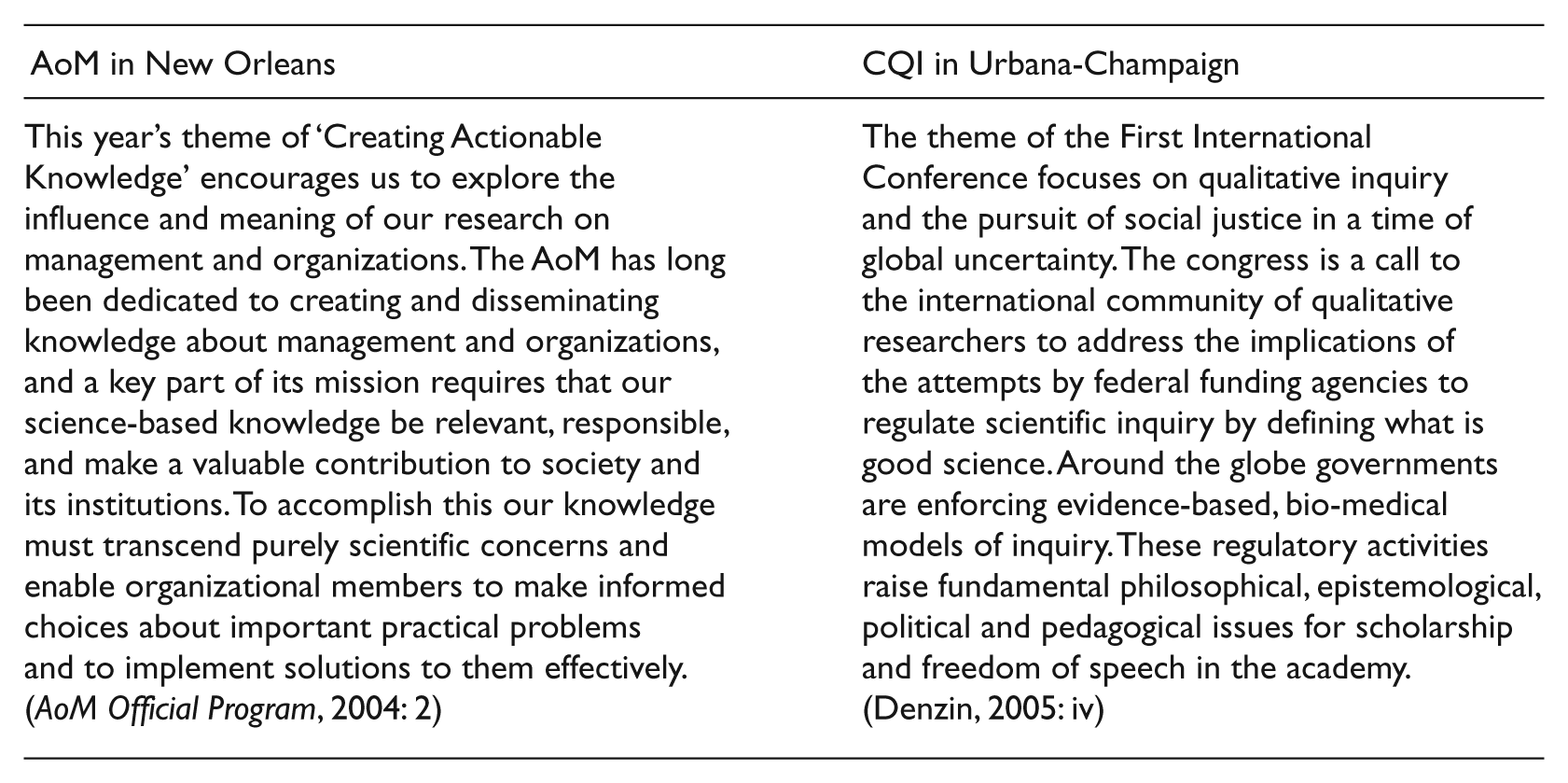
The annual AoM conference is the world’s biggest academic meeting in management and organization. In New Orleans, there were about 6,000 delegates and, though there was a relative heterogeneity in the intellectual content of the articles presented, they were overwhelmingly concerned with established managerial themes. But, we tended to notice more the activities outside the formal events of paper presentations. For example: it was striking how all the proceedings were conducted in expensive hotels; the way it was dominated (numerically at least—and probably not least) by men—who often wore business suits; how the drinks parties and similar events (provided free by publishers under the auspices of leading journals or by wealthy business schools) were an important part of the conference. Also, one could hardly escape noticing that an official aim of the conference was to provide a significant venue in which (especially young, immediately post-PhD) management academics were formally interviewed for jobs in US universities. All of which provoked considerable anxiety in us. The anxiety was caused, not just because the business suits were a reminder of former selves, but it was also the pervasive managerial ethos of the event—in what purports to be an academic conference. So, it is unsurprising to find that Burrell has described the AoM in almost nightmare-like terms. For him it ‘drips power, bureaucratic hierarchy and patriarchy … it is the modern fair in which we and our relationships are all commodified. It is a three day market in which we are all likely to be bought and sold unless we are very, very careful’ (1993: 76).
If the AoM was a nightmare, then CQI seemed equally dream-like, but much less frightening. For example, it was a smaller meeting (about 600 delegates) the majority of whom were women. There was also a much greater range of lifestyle choice evident amongst the participants—which is to say (among other things) that no-one wore a business suit. 7 Indeed, the convenor, Norman Denzin, always seemed to be wearing shorts and sandals. At CQI, ordinary university classrooms (rather than plush hotels) were used to present papers; there were no publishers’ parties, and, as far as we were aware, no recruitment was carried out—certainly not in the overt, officially-sanctioned manner practised at the AoM.
Each of us became fascinated by the evident contrasts between the two events and, thinking there might be something of interest to pursue, decided to start writing about these contrasts. Thus, in June 2005, shortly after getting back from CQI, we produced the first tales. Mark wrote the first version of the tale of CQI (Urbana-Champaign) and Mike the first version of the tale of AoM (New Orleans) from which the first tales (below) were eventually derived. 8
First tales
If each [element of self], I told myself, could be housed in separate identities, life would be relieved of all that was unbearable; the unjust might go his way, delivered from the aspirations and remorse of his more upright twin; and the just could walk steadfastly and securely on his upward path, doing the good things in which he found his pleasure … (p.49)

For a time after the initial versions were written, these tales felt like they represented how each of us really thought about aspects of our own jobs. Mark’s tale of Urbana-Champaign was a reminder of the utopian ideals which inspired his move into an academic career in the first place. The careerism and rather stultifying academic environment Mike constructed (and escaped from) through the New Orleans tale, came to encapsulate many of his misgivings about the sort of academic work that is institutionally approved in business schools. In other words, at the time they were first written, we intended both stories to be read as tales of resistance to ‘the commodification of academic work’ (Willmott, 1995: 1002). Furthermore, Mark liked himself much better when he acted in the sort of ways encouraged at CQI. Mike also liked himself much better when able simply to ignore these forces of conformity—the things one is supposed to conform to—both at AoM and in our faculty.
whilst he [Jekyll] had always been known for charities, he was now no less distinguished for religion. He was busy, he was much in the open air, he did good; his face seemed to open and brighten, as if with an inward consciousness of service. (p. 29).
Second tales
Had we been working within certain traditions of evocative autoethnography, we should perhaps have stopped at this point and left the tales to speak for themselves. For example, Sparkes, in his tale of academic life (see also Pelias, 2004), evocatively suggests that the current ways in which UK academics are judged has polarized faculty staff into ‘weasels’ and ‘scholars’ (2007: 522). For him, weasels are ‘only interested in themselves and getting promotion’ (2007: 531); while in contrast, his preferred scholars produce ‘insightful work [that] comes from investigations that have never been near a … research grant application’ (2007: 564). Using Sparkes’s typology, these stories might suggest that we are scholars—pure and simple.
However, both of us have spent a fair proportion of subsequent years writing conference articles and talking to other academics about these issues. The sorts of selves and identities implicit in the above accounts are attractive, but each of us slowly came to admit that these are not the only accounts that could be written. The growing realization came to be that each of us had not only deceived others—but had also deceived himself. After all, having both been promoted in the period that this article has been under preparation, publishing this article might assist us in our further ambitions. Perhaps each of us is doing identity work—i.e. enacting our Hydes—even as we write this article. Indeed, it is entirely possible to read this article (at least up to this point) as an attempt to carve out a career (and construct an academic identity) by ostensibly writing about not wanting a career. Each of us may well have changed jobs to be rid of the Mr Hyde (represented by AoM) and live Dr Jekyll (CQI) lives; but Mr Hyde, we came to realize, is still part of our identity, he is alive and well and haunts us still.
At the next stage of writing this article, in an acknowledgment of these anxieties—but also with an analytic concern—we individually wrote rather different tales of the same conferences. In comparison, the first tales might be seen as a naive representation by (and of) Dr Jekyll. We wrote the next (doubled) tales as a way to examine and problematize our first attempts at autoethnographic identity work. In other words, we were supplying the sort of analysis that we criticized evocative autoethnography for avoiding. Thus, these second tales illustrate that a somewhat more critical interpretation is equally available—a doubled reading that made each of us question the stability of our individual academic identities.
[t]here is something wrong with his appearance; something displeasing, something downright detestable. I never saw a man I so disliked, and yet I scarce know why. (p.11)
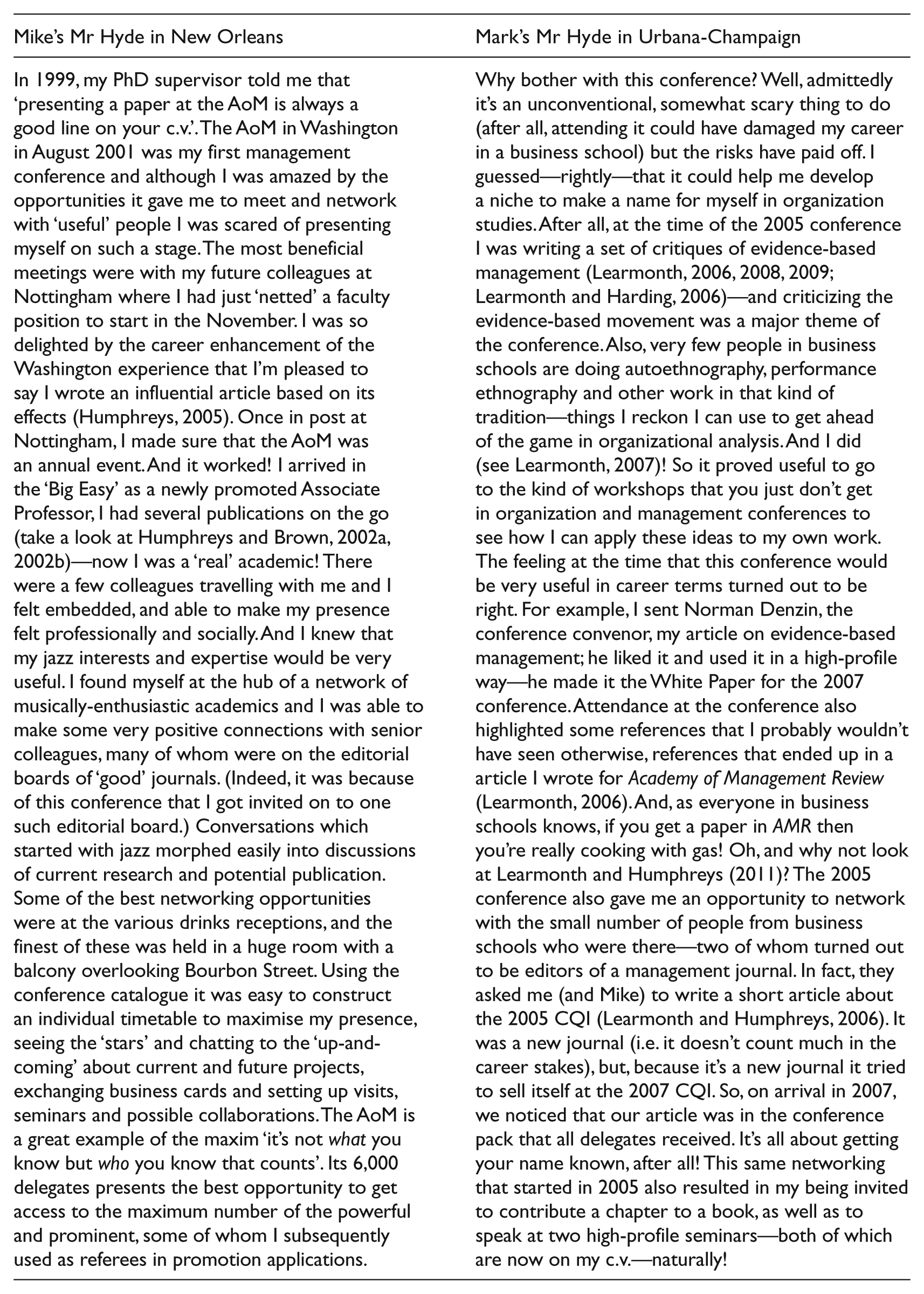
Again, for a time after these second tales were written, we imagined that we had found a way forward for autoethnographic identity work. The second tales—by and of Mr Hyde—were (we thought) a way to analyse the first tales critically—but still evocatively. Thus, compared to Sparkes’s (2007) autoethnography of academic life, work which polarized faculty members either as ‘weasels’or ‘scholars’, we began to believe that by the addition of these doppelgänger tales, we were extending and enriching his typology. Indeed, we were (again) naive enough to think that we had pinned down our own academic identities: as both weasels and scholars, Hydes and Jekylls: apparently polar opposite identities that were inextricably fused together.
Discussion; or, another tale?
[when Jekyll first transformed himself into Hyde he looked in the mirror and thought:] [t]his, too, was myself. It seemed natural and human. (p. 51)
But, as things have turned out, the iterative process of identity work through autoethnography did not stop here. The implausibility that we might have achieved some sort of firm self-knowledge via autoethnography started to be reinforced when we came across the Nobel prize-winning novelist, J.M. Coetzee’s comments about similar kinds of public confessions to ours:
the possibility we face is of a confession made via a process of relentless self-un-masking … might yet be [concerned with] not the truth but a self-serving fiction, because the unexamined, unexaminable principle behind it may not be a desire for the truth but a desire to be a particular way (1992: 280; emphasis in original)
Indeed, Coetzee goes on to claim that such confession ‘is only a special form of bragging’ (1992: 283). 9 Coetzee’s comments started to make us wonder about our own ‘desire to be a particular way’, and whether (even our own supposedly Jekyll-like) confessions were themselves just another ‘form of bragging’. Read in this light, eventually (perhaps with the passage of time—enabling us to read our own accounts more as if they had been written by others; and perhaps with colleagues, and later, with editors and reviewers pushing us to do better) we started to consider whether the identity work implicit in both sets of accounts might actually be less different than we had initially thought. Brewis’s insight that autobiographical vignettes ‘can be read in different ways and are never comprehensive or static’ (2005: 507) had become particularly resonant for us. But we hardly think it likely that we can now interpret our tales in ways that won’t strike us as naive in the future. As Stevenson’s near-contemporary, Joseph Conrad reminds us: ‘no man ever understands quite his own artful dodges to escape from the grim shadow of self-knowledge’ (2007/1900: 63).
Nevertheless, today, we might ask more uncomfortable questions of the tales written by both our former selves than we did when we first wrote them. Don’t both sets of tale suggest, for instance, that as Jekyll and Hyde we narrated successful identities—‘successful’ in the sense that we have published well (and therefore, as Jekylls influenced debate; or, as Hydes, climbed the promotion ladder)? If so, the selves portrayed in and enacted by our Hyde tales are hardly convincing doppelgängers of the selves in the first tales—indeed, they both might be read as similarly self-serving bragging—perhaps as aspirational narratives of identity. For Thornborrow and Brown such tales represent ‘story-type[s] … in which an individual construes him- or herself as an aspirant who is (i) earnestly desirous of being a particular kind of person and (ii) self-consciously and consistently pursuing this objective’ (2009: 370).
Significantly for us, however, Thornborrow and Brown’s empirical work is based upon the aspirations of a highly masculine elite—the British Parachute Regiment—a reminder, perhaps, of the unremitting masculinity of Jekyll and Hyde. This being the case, as we pondered our own desires ‘to be a particular way’, we began to see other work on academic identity in new ways—especially that written from broadly feminist perspectives. For example, Harris et al see in academic identity a rather different kind of dichotomy to ours. Theirs is a dichotomy based on polarized views about the university system of careers and rewards, a system that turns out to be ‘profoundly gendered … where production is privileged over reproduction and output over process’ (1998: 133). Thus, for them:
To say, for example, that the successful are ‘dedicated researchers’ while the unsuccessful are ‘cruisers’ suggests that the system is reasonable, handing out its rewards justly. Conversely, to describe the successful as ‘single-minded writing machines’ while those left behind are ‘all-rounders who care for their students’, implies that the system is flawed and unfair. (1998: 135).
But within our own accounts there is little hint that the system may be unfair in any way. We appear to take it for granted, as both Jekyll and Hyde, that our ‘success’ is what we deserve, as ‘dedicated researchers’. Indeed, analyses like Harris and colleagues, have prompted us to criticize both sets of our own tales in new ways; to glimpse, perhaps what we now see as a more convincing (Hyde-like) doppelgänger. We have started to realize, for instance, that our first tales (which were initially intended to signal an identity resistant to dominant ideas about academic work) were still about research and publication. We had almost entirely neglected other, conventionally less prestigious, ways of doing academic identity work, such as teaching or administration. Indeed, as Harris et al. go on to comment:
There are the successful academics, devoted to producing more research and undertaking less infrastructure—maintenance and teaching—work. And there is a large group of disaffected staff who question the values of the institution but keep working at it anyway. (1998: 146)
Might our Jekyll and our Hyde stories, then, be read, not merely as bragging, but as complicit with (indeed, actively bolstering the legitimacy of) oppressive notions of those who are, and who should be, ‘the successful’? Even the tale of avoiding the conference and having fun in New Orleans jazz clubs—a tale that we initially saw as resistance—leaves unquestioned one result of our ‘success’: the privilege of getting our expenses paid for doing so. Similarly, while the tales do draw attention to our exclusion from groups who wear suits and ties, as well as our awareness of a gender dimension in conference power relations, notably absent is any hint of possible complicity in conference practices that others may find exclusionary. For example Bell and King tell tales of:
drinking rituals which … [f]ar from being incidental to the conference proceedings … are … where working partnerships are formed and renewed, ideas are discussed and joint academic projects developed [and which] … are highly charged with the exercise of academic power. [These are] … further reinforced by the telling of drinking stories, anecdotes or comments in formal conference sessions that typically refer to an earlier episode of heavy drinking. (2010: 436; see also Ford and Harding, 2010)
In other words, read in the light of others’ alternative stories of academic life and identity, neither our Jekyll nor our Hyde tales turn out to be politically progressive. Both were tied up, in unexamined ways, with elite discourses about what constitutes success and rules for appropriate behaviour—discourses that are likely to be institutionally approved.
Thus, even with doubled accounts (and our contrary intentions), we now feel that at least our first two sets of tales still failed to escape a trap similar to the one we criticized Ellis (2004) for falling into, with her story of expensive cars. Therefore, we argue that intimate stories of the academic self, must be subjected to critique and analysis. Without it, such stories (including those written with the best motives) will inevitably reflect our cosy, middle-class professional lives and aspirations—even as they seduce their authors into thinking of themselves as radicals (Reedy, 2008). For us, then, an explicitly analytical element is always going to be essential for autoethnography to have any chance of side-stepping the trap into which both we and Ellis fell.
Conclusion
What we think we have ended up producing in this article, therefore, is more than a series of evocative stories with the ‘goal … [of] enter[ing] and document[ing] the moment-to-moment concrete details of a life’ (Ellis, 1999: 671)—although that was certainly our original goal. In working on this article, we have often been uncomfortably confronted with (various versions of) former selves; former selves whom we have begun to treat, for analytical purposes, as ‘the other’. Although it was not our original intention, the process of writing our stories has become for us a valuable ongoing commentary upon our academic lives and career aspirations. Furthermore, we think it may have enabled us to reflect better upon some of the deep acting (Goffmann, 1959) we do as academics, as well as upon the ironies (even absurdities) that arise in the construction of our own academic identities and careers. Indeed, our use of the Jekyll and Hyde conceit (which some may think of as an absurdity) first stimulated, and then framed these reflections. Here, the radical (ab-)use of a novel we attempted, though it has resonances with some other uses of the literary in organization studies (Czarniawska, 2008; De Cock and Land, 2005; Land and Sliwa, 2009; Rhodes and Brown, 2005), was one inspired primarily by the encouragement given to autoethnographers to use novels, poems and other creative forms of writing (Denzin, 2003).
In summary then, we think that an autoethnography—which includes both evocation and analysis—can make at least two contributions to the study of identity work in organizations. The first is that evocative autoethnographic tales provide identity scholars with new forms of empirical material. Indeed, having gone through many iterations, we might be inclined in future work, to analyse our own stories more explicitly as if they were an ‘other’s’ (or, to avoid what Bell and King memorably call ‘the agonizingly familiar ‘us’’(2010: 432) involve a third party in the analysis). However, in this article, our emergent analytical approach still echoes Rhodes’s ‘multiple reading strategies as a way to conduct research into organizational life’ (2000:7). There is a sense in which we have attempted three different (albeit implicit) readings of our own stories: two of these readings were authored by versions of former selves, the third (in the discussion section) authored by something like versions of our current selves. Furthermore, we were also forcefully struck by Rhodes’s advice at the conclusion of his piece: ‘don’t believe everything/anything that you read/write’ (2000: 25). This advice seems particularly pertinent for autoethnographers like us, who, as we have shown, have an understandable—if naive—tendency to believe their own tales.
The second contribution of our article is to highlight the value of experimenting with the sort of unorthodox approaches advocated by many autoethnographers (e.g. Doloriert and Sambrook, 2010) for identity and organization research. While it has almost become commonplace, particularly in more critical circles, to believe that experimental writing is exactly what we need as a scholarly community in organization studies, such writing has often proved difficult to publish. Perhaps, in part, this has been due to the ‘smoothing effect’ of multiple reviews and editorial comments. In this light, we see one of the achievements of a journal at the forefront of publishing autoethnography—Qualitative Inquiry—to be the opening up of a space for the publication of unconventional and ‘unruly’ research, while remaining peer reviewed. For example, Haywood Rolling Jr (2004) claims ‘I am a story. My intention has been to reconstitute assumptions about my identity’ (2004: 551). In the article, he reconstitutes his identity by offering a relatively lengthy autoethnographic poem about his childhood (2004: 552–555). While we have no intention of offering a blueprint for other autoethnographic work, we see an encouraging resonance between our struggle to combine the literary with evocation and analyis in the last two sentences of Haywood Rolling Jr’s article: ‘the Self as instrument of study is also the Self as artist. In other words, I can retune my self-images based on the writing and imagery I choose to represent them’ (2004: 555).
Finally, we wonder whether the contribution of autoethnography to academic identity might ultimately be about making public some of academic life’s secrets. We are struck by Michael Taussig’s meditation on a seminal phrase from Walter Benjamin’s The Origin of German Tragic Drama which so obsessed him in his Defacement (1999):
Truth is not a matter of exposure which destroys the secret, but a revelation which does justice to it. (in De Cock and Volkmann, 2002: 364)
Perhaps our autoethnography has (to paraphrase Taussig) brought insides outside, unearthed knowledge and exposed at least a little of those secret elements of academic life about which we are not supposed to speak publicly. However, if it has done these things, at this point in time, we are unsure whether it might have destroyed the secrets or done justice to them. 10