



Abstract
There is an abundance of lamentations on the ills of academia, and a more modest, but growing, discussion on how to both reimagine academia and delegitimize its dominant micro-practices. What is missing, however, is a clearer understanding of how individual academics can help to move academia from reimagination and delegitimization to transformation. Addressing this lacuna, our article makes three interrelated contributions. First, we conceptualize a novel process that we call academic micro-transformation, where change occurs through small, interconnected acts. Second, drawing on the vocabulary of Positive Organizational Scholarship, we create a typology that demonstrates how cognitive, affective, relational, and agentic change mechanisms can be implemented through daily practices that accumulate and – over time – reshape the academic ecosystem structurally. Finally, we offer readers a practical template with a range of example micro-practices that all of us – from early career academics to emeriti – can enact on a daily basis to support academic micro-transformation.
Introduction
Academic dystopian writing appears to have become one of our favourite genres. From autoethnography to polemic essays, from surveys to exemplary contributions, we are increasingly studying our own tribe (Spicer and Alvesson, 2025). And we don’t like what we find! We could fill a well-stocked library with our abundant publications on the twin evils of neoliberalism and managerialism, joined by shelf after shelf of lamentations on the dysfunctionalities in our research, such as our theory fetish, obscure writing, questionable research practices, fraud and misconduct, and the proliferation of meaningless research. Our library would be filled to the brim with thousands of articles and hundreds of books. We even have our very own ‘best-sellers’. Books such as Shut Down the Business School (Parker, 2018), Management Studies in Crisis (Tourish, 2019), and Dark Academia: How Universities Die (Fleming, 2021) are rapidly becoming the authors’ most cited works.
Much smaller, though growing in recent years, is our collective opus on how to reimagine, delegitimize and transform academia. It ranges from rediscovering meaning in our research (Alvesson et al., 2017) to promoting value cocreation with external stakeholders (Thomas and Ambrosini, 2021) and from restructuring management education for the betterment of society and ecosystems (Colombo, 2023; Colombo et al., 2024) to redefining our multifaceted collegiality (Fleming and Harley, 2024). Most recently, Sathish and Harzing (2026a) proposed the label Positive Academia for a systematic reimagination of our academic values and interactions, inviting academics to join a PACT:
However, Colombo (2024) also acknowledged that we still lack a clearer understanding of the micro-processes that allow us to move academia from reimagination and delegitimization to successful transformation. In this article, we address this lacuna by applying the concept of micro-practices, the sociopolitical activities that cumulatively produce and reproduce social structures (Śliwa et al., 2024). As Śliwa et al. (2024) aptly proclaim, ‘thousands of academics are, on a daily basis, involved in thousands of micro-practices’ (p. 1866). To date, the literature on micro-practices in academia has mainly focused on explaining the disadvantage and discrimination of minority group members (e.g. Henderson and Burford, 2020; Śliwa et al., 2024) through micro-inequities and micro-aggressions. Here, we focus instead on the intentional and positive role that micro-practices can play to support what we conceptualize as academic micro-transformation. These practices matter not because they immediately transform institutions but because they enact different values and interactions in the present. When sustained collectively, they begin to reshape what is thinkable, legitimate, and desirable within academic life.
The call for transformation in our academic literature is matched by an increasing sectoral focus on research culture, such as in the UK Research Excellence Framework (REF), and the Dutch Recognition & Rewards programme. Some influential stakeholders produced reports on the need for a wholesale culture change in academia (Royal Society, 2017; Science Europe, 2025; Shift Insight/UK Reproducibility Network & Vitae, 2024; Wellcome Trust, 2020). The Wellcome Trust has even funded a range of research culture improvement projects (Lewis-Wilson et al., 2023), and initiatives such as the Declaration on Research Assessment (DORA) and the Coalition for Advancing Research Assessment (COARA) promote a change towards responsible research assessment. However, these change efforts suffer from two limitations that hinder successful change: their (implicit) theory of change and their practical implementation.
First, many initiatives appear to assume a theory of change where reform principles are codeveloped by national/sectoral organizations and then implemented locally in universities, expecting this to be ‘magically’ followed by changes in individual academic behaviours, values, and practices. As Rushforth (2025) showed for the Dutch Recognition & Rewards programme, the latter assumption may well be flawed. Likewise, Wellcome Trust’s (2020) report refers to the problematic way in which UK higher education (HE) institutions interpret top-down strategies, often acting in a knee-jerk and short-term fashion. Thus, after being exposed to the strictures of output and impact evaluation, academics may start seeing culture change as something that is ‘coming from above/from admin’ and something that is ‘done to them, not with them or by them’. As academics, we have seen our level of discretion over many aspects of our profession restricted over the years. Our concern is that the commodification and metrification of research culture – arguably the soul of our profession – is merely the next step in this process. We acknowledge that many UK universities engage in open strategy as a way to engage rank-and-file academics in developing research culture action plans (Chahda et al., 2026). However, whether this leads to genuine involvement, let alone ‘deep and enduring changes in research cultures’ remains an open question (Chahda et al., 2026: 19).
We thus propose an alternative theory of change, one in which rank-and-file academics play a crucial role. After all, it is academics who have the power to cocreate research culture through their daily micro-actions (Gadd, 2024), not research culture deans, directors or managers. We thus empower academics with tools for academic micro-transformation through micro-practices, creating positive changes that materialize the sector-wide discourse on research cultures at a micro level, benefitting as one of our reviewers aptly commented, ‘individuals beyond universities’ performative adoption of change narratives’. In doing so, we build on earlier work on actions that are not ‘dramatic, iconic, totemic, glamorous and heroic, or even salvational’ (Horton & Kraftl, 2009: 16), such as local spontaneous action (Ratle et al., 2020), relational action (Korica, 2022), and subtle activism (Kjærgaard et al., 2024).
A second limitation relates to the way that most reports – and university missives – are presented, making it unlikely they will engage academics in change efforts. Successful academic micro-transformation would benefit from a coherent set of concrete micro-practices, embedded within strong conceptual foundations. This shows academics not only what they can do today but also how their actions fit into a broader picture of cumulative culture change. In contrast, most reports contain laundry lists of problems and high-level desirables, supported by a few case studies, whereas our universities’ missives typically centre on key performance indicators (KPIs). Unlike change narratives in the academic literature (Billsberry et al., 2023; Colombo, 2024; Sathish and Harzing, 2026a), there is little appreciation that problems are inextricably linked and that solutions need to fit together. These reports and their flawed implementation by universities are thus likely to leave academics, trained as they are in thinking conceptually, confused as to where to start. At the same time, most reports lack concrete practices, making it challenging for busy academics to get involved in culture change.
In our article, we present a different change logic. First, we introduce micro-transformation as a conceptual construct, capturing how alternative academic orders can emerge and endure through everyday practice. Second, we draw on Positive Organizational Scholarship (POS) as a vocabulary for generative change, showing how its cognitive, affective, relational, and agentic change mechanisms (Spreitzer and Cameron, 2012) can be implemented through micro-practices, helping us transform academia through ‘the fleeting everyday micro moments of small acts in organizations’ (Golden-Biddle and Mao, 2012: 769). Third, we bring our micro-practices to life through practical templates that every academic can enact. We also illustrate how these micro-practices can – gradually and cumulatively – reshape the academic ecosystem structurally over time. Our article ends with a strong call for action, urging all of us to get involved in recapturing the soul of our profession.
Our conceptual logic of micro-transformation
Debates on our contemporary academic life are dominated by narratives of crisis, erosion, and decline, portraying universities as governed by audit regimes, publication metrics, and managerial rationalities (Fleming, 2021; Parker, 2018; Tourish, 2019). These accounts offer powerful diagnoses of structural pressures but leave undertheorized how transformation might be realized under the same conditions. In response, we adopt a transformation perspective that shifts attention away from episodic reform and towards everyday practice. Rather than locating change in redesigned governance structures, policy frameworks, or exceptional leadership, our perspective starts from the ‘mundane’ interactions through which academic work is continuously produced. Reviewing, citing, mentoring, allocating authorship, and recognizing contributions are not peripheral activities but central spaces where hierarchy, credibility, and value are enacted. Research culture is encountered most directly at the point we interface with another human (Gadd, 2024), meaning that our academic order is reproduced or unsettled in interaction. When transformation is understood as something enacted in practice, it becomes a question of how everyday work is repeatedly done together, rather than how ideals are formally proclaimed.
From this interactional starting point, culture change cannot be understood as a linear progression from policy to compliance to outcome. Instead, it unfolds gradually through repetition, variation, and circulation of practice. Small shifts in how feedback is given, how opportunities are distributed, or how credit is attributed can, over time, recalibrate what feels normal and legitimate (Alvesson et al., 2017; Fleming and Harley, 2024). Long-standing critiques of business school reform demonstrate why such practice-level change matters – despite repeated waves of structural and curricular redesign, core academic behaviours often remain largely unchanged (Pfeffer and Fong, 2002). The same routines that stabilize hierarchy can be enacted differently to open more inclusive and collaborative possibilities. However, such openings remain fragile when they are isolated. A single generous or inclusive act is easily absorbed into existing expectations, whereas repeated enactment across multiple spaces makes alternatives recognizable, discussable, and imitable. This resonates with critiques of national and institutional reform programmes, which show that ambitious top-down initiatives often translate into instrumental local routines without altering everyday academic interaction (Rushforth, 2025). Durable culture change, therefore, depends on collective patterns of enactment that travel and are adapted in use, rather than on formal implementation of reform agendas.
This emphasis on everyday enactment aligns with practice-based and performative accounts of organizing, which conceptualize institutions as ongoing accomplishments produced through recurrent doings and sayings rather than as structures imposed from above (Orlikowski, 2007; Schatzki, 2002). Routine dynamics research similarly shows that stability and change coexist through repeated enactment with variation (Feldman and Pentland, 2003). In academic contexts, micro-practices such as negotiating authorship, selecting references, structuring peer review, or responding to requests define who is visible, credible, and valued. Research on micro-inequities shows how such practices reproduce inequality even in the absence of explicit exclusion (Śliwa et al., 2024). As academic order is maintained through countless micro-practices, however, it can also be unsettled through different ones. Yet this possibility is contested as alternative practices may be ignored, resisted, or appropriated by dominant actors. Reconfiguration, thus, becomes credible only when many actors recognize and repeat alternative enactments across settings, turning isolated deviations into shared expectations.
On this basis, we introduce micro-transformation as a conceptual construct to capture how an alternative academic order emerges and endures through everyday practice, building on the transformative capacity of academics in a neoliberal academic system to create a fundamentally new one (Colombo, 2024). Micro-transformation refers to the production of an alternative academic culture through the cumulative repatterning of micro-practices. It is defined by three core features. First, the unit of change is the micro-practice rather than the individual, role, or organization. Second, endurance arises from collective repetition and circulation across multiple spaces rather than from formal institutionalization or central coordination. Third, durability depends on ongoing critical reevaluation in use, ensuring that practices remain revisable rather than hardening into fixed templates. This understanding builds directly on routine dynamics research showing that stability and change are coproduced through repeated enactment with variation, rather than through disruption alone (Feldman and Pentland, 2003). Micro-transformation thus aligns with progressive accounts of performativity that emphasize intervention through situated practice while remaining alert to closure (Wickert and Schaefer, 2015).
This practice-centred understanding also resonates with scholarship on alternative organizing that emphasizes prefigurative and situated enactment over top-down design (Parker, 2018; Reedy et al., 2016). Rather than waiting for systemic change, actors enact fragments of desired futures in the present through mundane interventions in how work is coordinated and evaluated. At the same time, critical studies caution that locally enacted alternatives are vulnerable to cooptation and recentralization by dominant institutional logics (Fleming, 2021; Spicer et al., 2009). Micro-transformation addresses this tension by locating durability not in insulation from the mainstream but in repeated collective enactment under existing constraints. Policies and sectoral reforms may create permission or protection for experimentation, yet they cannot substitute for the relational labour through which new ways of coordinating, evaluating, and supporting work are tried and stabilized in everyday interaction (Rushforth, 2025). Culture change thus proceeds ‘from the inside out’, in the moments where criteria are interpreted, recognition is granted, and opportunities are shared or withheld in practice.
To explain how dispersed alternatives gain traction without central coordination, we draw on POS as a vocabulary of generative change mechanisms rather than as a normative programme (Spreitzer and Cameron, 2012). Read in this way, POS sensitizes us to how interaction can unlock renewable resources such as shared meaning, trust, compassion, and distributed agency that enable alternative practices to emerge and persist. These resources are not owned by individuals but produced in relations, making them expandable through patterns of interaction. At the same time, generativity is not inherently progressive because the same relational ties that enable alternative practices to gain traction can also reinforce exclusion and elite closure (Battilana and D’Aunno, 2009). Scaling alternatives, therefore, occurs through circulation and adaptation rather than replication, as practices change in use and are reshaped by actors in different contexts (Czarniawska and Joerges, 1996). When heterogeneous connections support such adaptation, micro-practices therefore accumulate transformative potential without requiring central orchestration.
Finally, micro-transformation depends on how critique itself is organized within everyday academic work. Drawing on Alvesson and Spicer’s (2025) critique of one-dimensional criticism, we argue that neither ritualized denunciation nor uncritical affirmation is sufficient for sustained culture change. Instead, micro-transformation embeds reflexive evaluation into practice as an ongoing activity. This orientation resonates with traditions of critical performativity that emphasize intervention while remaining alert to capture and self-legitimation (Spicer et al., 2009; Cabantous et al., 2016). Practices endure not because they are insulated from challenge but because questioning, revision, and even abandonment are legitimate responses to their consequences. Stability is therefore provisional and epistemically open, sustained through continuous learning-in-practice rather than closure or consensus. Alternative academic cultures thus persist as a living, revisable accomplishment enacted in everyday interactions, using micro-practices as agents for micro-transformation.
Micro-practices as agents for micro-transformation
Drawing on the vocabulary of POS, we conceptualize micro-practices as small, intentional acts that embody and propagate positive change within academic ecosystems, operating through four change mechanisms – cognitive, affective, relational, and agentic – that accumulate and reshape the academic ecosystem structurally over time. We thus connect micro-level actions to macrolevel change by introducing a new way to understand small, deliberate acts and their potential for micro-transformation. Given our practical orientation, we stop short of creating a full-blown process theory of micro-transformation. However, we do outline how the change mechanisms and their transformation logics work together to both embrace and strengthen reimagined academic values and interactions.
Our academic micro-transformation process
As visualized in Figure 1, our proposed micro-transformation process follows a clear transformation logic. It consists of distinctive phases that collectively lead to the desired outcomes summarized in Sathish and Harzing (2026a). We conceptualize micro-transformation as starting with a sensemaking shift (cognitive), where we change the way in which we make sense of our academic world, exemplified in our article by the practices of attentiveness and reframing. Transformation is then nurtured through emotional engagement (affective) – illustrated in our article by empathy and humility – which plays a crucial role in humanizing academic life and creating emotional safety and connections. Subsequently, transformation expands through relational renewal (relational) – elucidated in our article by civility and generosity – which helps repair damaged relationships, maintain existing ones, and foster new, sustainable connections in academic interactions as a conduit for collective change.
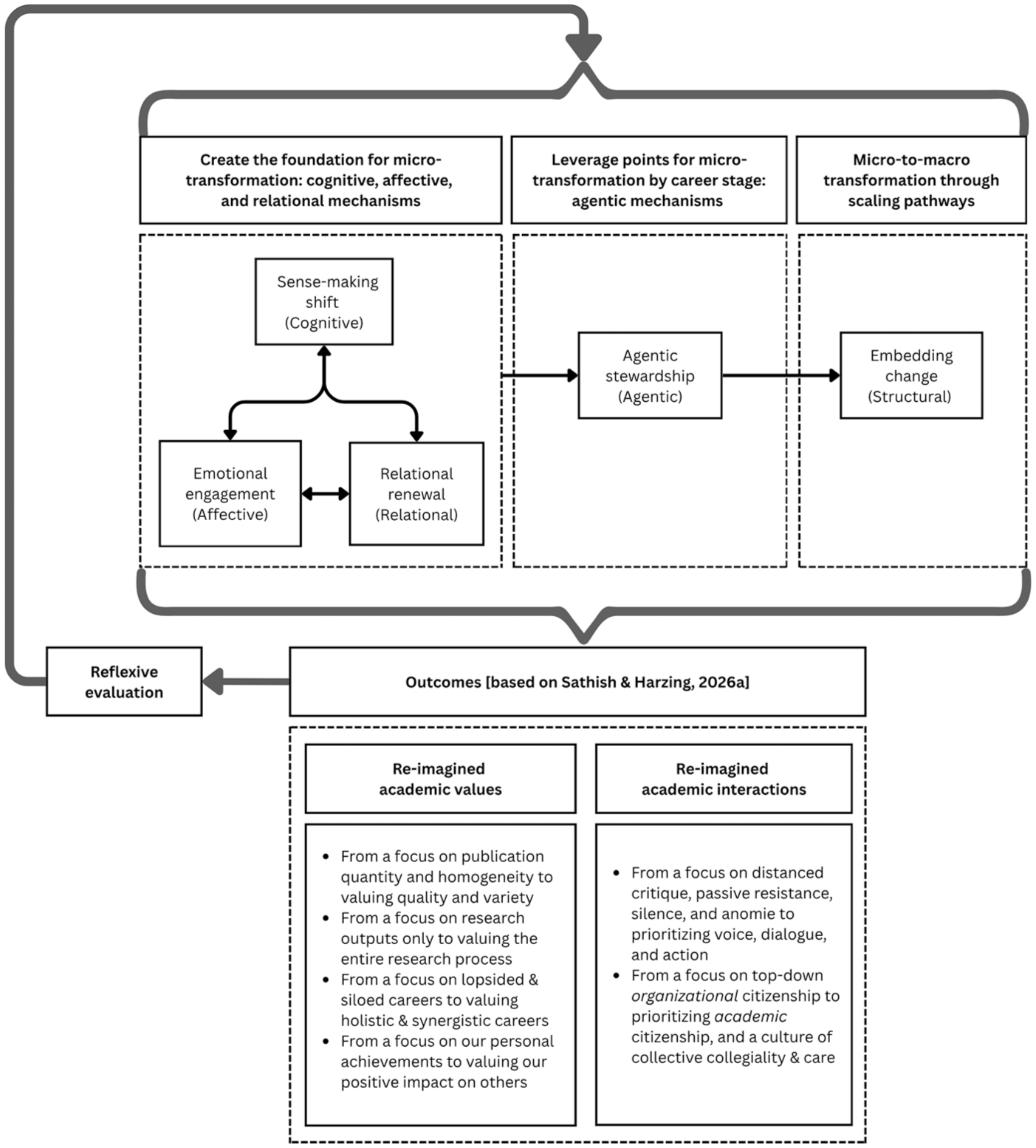
Our academic micro-transformation process.
Note that although these three mechanisms can be conceptually separated, they are often intertwined in practice. We would normally expect a cognitive sensemaking shift to occur before emotional engagement, followed by relational renewal. However, affective changes could also precede cognitive changes; emotional engagement through empathy and humility may lead people to see things differently. Relational changes might even precede both cognitive and affective changes. Most importantly, though, cognitive, emotional, and relational change mechanisms collectively build the foundation for academic micro-transformation.
However, we cannot truly transform academia without engaging in agentic mechanisms that delegitimize the status quo (Contu, 2020; Laube, 2021) and relegitimize alternative practices. Actors enact these alternative practices completely and intentionally, but we argue they do so as stewards – in a process we call agentic stewardship – not as dominant owners. In using the term stewardship, we denote that as academics, we are all caretakers of the values of our academic profession (Agate et al., 2020; Sathish and Harzing, 2026a) and act in service of our profession’s core functions of knowledge creation, diffusion, and exchange (Seno-Alday, 2021). Everyone can get involved in agentic stewardship, but the type of agency differs between early career academics (ECAs) and more senior academics. Hence, we discuss this mechanism by career stage and see pragmatic proactivity as its exemplifying practice.
Although not part of our elaboration of micro-practices and micro-transformation, structural mechanisms are core to academic transformation. We see continuously emerging patterns of micro-practices ‘seed into’ institutional routines and habits, embedding change into the system, a process Colombo (2024) calls scaling up. As we discuss in our section on structural mechanisms, this is facilitated through four scaling pathways that embed change, mirroring Colombo’s (2024) scaling deep (changing our values), scaling out (increasing our reach), scaling with (collaborating for change) and scaling down (liberating action).
Finally, our process of academic micro-transformation also requires reflexive evaluation. Without reflexivity, we risk reproducing the very dynamics we seek to undo. Even well-intended alternative practices can gradually become new dominant norms, preventing experimentation, adaptation, and renewal. Reflexivity, therefore, structurally safeguards critique and ensures continuous learning-in-practice. It is represented in Figure 1 by a feedback loop, which indicates the process of continuous transformation.
Our choice of practices and micro-practices
We based our choice of practices and micro-practices instantiating the POS cognitive, emotional relational and agentic change mechanisms on our reading of the voluminous academic and grey literature on ‘the world of academia’, combined with our own day-to-day experiences – both positive and negative – as late and ECAs. Each of our chosen practices first presents a general high-level concept – such as attentiveness or humility – that is applicable across disciplines, institutions, countries, and career stages. However, our article’s core focus is not on these practices as concepts but more on how they can be implemented, that is, treating them as a verb rather than a noun (Lindebaum, 2025).
Hence, to facilitate both information retention and practical application, we introduce catchy labels for a specific instance of each of these general concepts – such as ‘Amplify the positive’ for attentiveness and ‘Resist a hero narrative’ for humility. Finally, we present concrete examples helping the reader to understand how to enact these specific instances. Importantly, these micro-practice concepts, instances and concrete examples are not meant to be exhaustive or prescriptive. Our aim is to simply ‘seed new practices’ (Feldman & Worline, 2016: 313). Our micro-practice examples may be implemented directly, but may also act as a source of inspiration for other micro-practices more relevant in the reader’s own context. A full overview of our high-level concepts, specific instances of these concepts, and concrete example practices is presented in the right-hand column of Table 1.
A typology of academic micro-transformation: change mechanisms, transformation logics, and (micro-)practices.
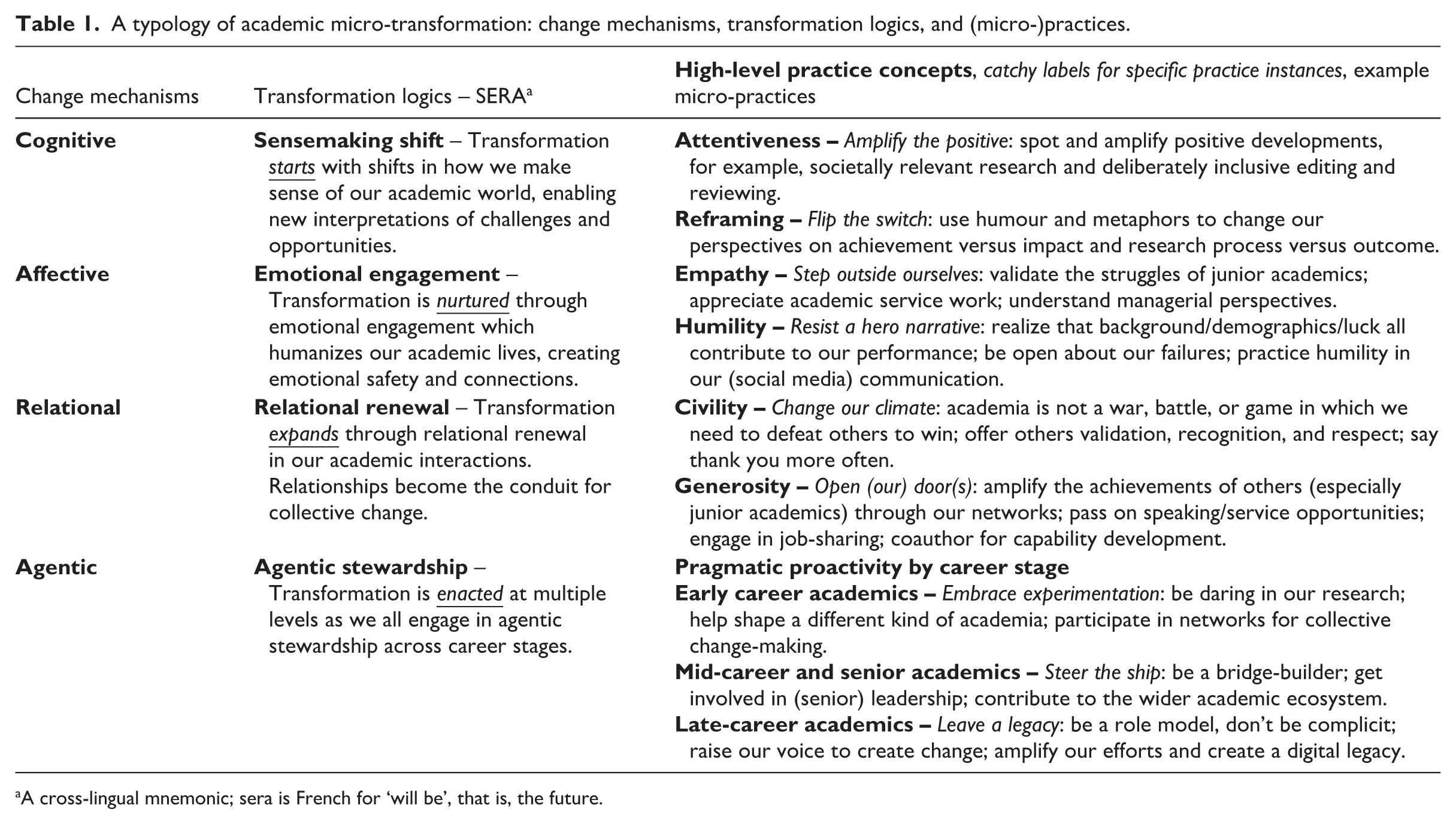
A cross-lingual mnemonic; sera is French for ‘will be’, that is, the future.
Our approach chimes with recent research calling for an understanding of future making from a practice perspective (Wenzel et al., 2025), identifying four key dimensions. First, performativity, which is core to our argument of academic micro-transformation, where practices produce and enact the future. Second, situationality, where the performance of practices depends on the situation at hand, thus varying across contexts. This is reflected in our recurring call to the reader to consider their own context in choosing which (micro-)practices to engage in. Third, heterogeneity, where practices are part of bundles and constellations of practices, illustrated by our process of zooming in from high-level practice concepts to specific instances and concrete practical examples of micro-practices. Fourth and finally, relationality, where practices are part of interconnected webs of practices and micro-practices. Although we distinguish micro-practices conceptually in our article, we also outline their intertwinement in practice, where their performance shapes and is shaped by other practices.
Through our practice-oriented approach, we move away from engaging in technical, emancipatory, or practical impact only (Wenzel et al., 2025) and towards a hybrid type of impact labelled ‘caring impact’ (Wenzel et al., 2025). This type of impact combines the emancipatory focus on critique with the practical focus on deep-seated understanding. In this way, we address Wenzel et al.’s (2025) concern about emancipatory impact as ‘merely preaching to the choir’ (p. 16). Moreover, our use of a POS vocabulary to create a coherent framework of change mechanisms addresses their concern that practical impact struggles to put concepts together into a cohesive whole. Finally, we address their concern that caring impact might be ‘at risk of failing to propose actionable alternatives’ (Wenzel et al., 2025: 17) by providing concrete example practices.
In our example practices, we focus on those that will resonate with the majority of our readers through their common-sense value, utility, and actionability. We could have included more radical ideas, such as limiting the number of articles that senior academics are allowed to publish (Bal, 2021). However, enforcement of radical changes is not within the purview of individual academics. Moreover, a focus on radical ideas would likely limit their actual impact, as it may lead some readers to default to our natural academic modus operandi of defensive critique. By focusing on micro-practices that most academics will agree are sensible, we aim to kickstart a micro-transformation of accumulative actions.
However, our micro-practices do move beyond common-sense ideas that make our readers nod and move on; they are practically and instantly implementable. We thus envision that the combination of a logical and memorable conceptualization of change mechanisms, practice concepts, catchy labels, and practical suggestions will help us achieve culture change in academia through micro-transformation. Key to this is changing our own perspectives: creating a more positive academia is a responsibility for all of us. We thus use a quasi-dialogical approach (Contu, 2020) in our writing, using a personal ‘you’ when addressing the reader and including ourselves when talking about ‘we’ as academics. Where we criticize bad practices, we plead guilty to engaging in some of these ourselves. Nobody is perfect, but recognizing good practices helps us to collectively improve our academic cultures.
We now turn to a more detailed discussion of the cognitive, affective, and relational change mechanisms and their associated practices and micro-practices, which create the foundation for micro-transformation. This is followed by the agentic change mechanism and its associated practices and micro-practices across career stages, acting as the key leverage points for micro-transformation. We close with the structural change mechanism and its associated transformation pathways, presenting the micro- to macro-transformation.
Create the foundation for micro-transformation: cognitive, affective and relational mechanisms
Our first three change mechanisms – cognitive, affective, and relational – help us in building the foundation for micro-transformation; agentic mechanisms are unlikely to be successful in cultures that are individualistic, instrumental, hierarchical, and overly competitive, rather than collaborative, generative, egalitarian, and supportive. For each of the three mechanisms, we discuss two illustrative practices to inspire you, but we encourage you to reflect on what manifestation of these change mechanisms might be most effective in your own context.
Sensemaking shift (cognitive)
Academic micro-transformation starts with a sensemaking shift, where we change the way in which we make sense of our academic world. It is exemplified here by the practices of attentiveness and reframing. Other cognitive practices might include generative curiosity (Hannah, 2019) or slow effortful reflection as practised in slow scholarship (Berg and Seeber, 2016).
Attentiveness – amplify the positive
There are many ways in which we can cultivate attentiveness; here, we suggest becoming a ‘positive detective’ (Waters, 2015). Instead of remaining stuck in distanced critique, we consciously notice, seek out, and amplify the positive practices already contributing to micro-transformation. Neoliberal institutions are not homogeneous entities; there are academics within them who successfully engage in alternative visions (Colombo, 2024). Unfortunately, positive developments aren’t generally shared or amplified (Lomellini, 2026). As academics, we seem to prefer sharing negative experiences; bad news sells and also spreads like wildfire on social media. That’s absolutely fine as a safety valve to let off steam. But if we present this as everyone’s daily reality, we socialize PhDs and ECAs into very negative and instrumental mindsets. Below, we outline two positive practices that are core to our profession: a growing focus on societally relevant research and a growing practice of constructive reviewing and deliberately inclusive editing. By cultivating your own inner positive detective, you may notice many others.
Protestations of our theory fetish abound (e.g. Hambrick, 2007; Tourish, 2019); it became the shortcut to be blamed for our discipline’s irrelevance and our lack of external impact (Haley, 2021). However, management research is increasingly addressing topics of societal relevance, reflecting Sathish and Harzing’s (2026a) call to focus on impact as one of our four reimagined academic values. Since 2021, over a dozen special issues on ‘Grand Challenges’ have been published in Academy of Management journals alone. A March 2026 search for ‘climate change OR grand challenges OR poverty OR economic inequality OR migration’ in abstracts of the eight AoM outlets resulted in more than 1300 articles. Although admittedly the majority are in AoM proceedings, it still demonstrates our huge recent interest in societally relevant research. Granted, some of this work might not be very critical (Harley and Fleming, 2021; Willmott, 2025), but there are other journals overflowing with societally relevant research of a more critical nature. By focusing our critique on what appears in top journals, we risk reifying their dominance (Cassell, 2020). We should also remember that impact is typically made up of a series of cumulative small steps and often materializes through programmatic research rather than individual articles (Wenzel et al., 2025).
In our academic careers, societally relevant research is recognized through awards such as the European Foundation for Management Development’s (EFMD) Excellence in Practice Award, Responsible Research in Business and Management Honor Roll, and their Dare-to-Care Scholarships. It is also explicitly valued in the United Kingdom’s national research evaluation, with business schools more than carrying their weight (CABS, 2021; Harzing, 2025). In our experience, many ECAs are doing research with societal impact, evidenced by the popular Impact Scholar Community (ISC) (Wierenga et al., 2025). Rather than continue to criticize our research for its supposed lack of societal relevance, why not use our energies to share good practices and support the many academics who are interested in this.
The review process is another area of our academic lives where negative experiences dominate our conversations. Peer review is routinely portrayed as coercive gatekeeping by hostile – and uninformed – reviewers, including the ever-evil ‘reviewer 2’. But this is by no means a universal experience. Granted, as academics, we have all had our howlers; we certainly did. But who can honestly say they never benefitted from a generous peer review, with reviewers going out of their way to help the authors? Noticing and sharing our positive peer review experiences demonstrates to ECAs that it can be positively transformative (Hibbert, 2025), as well as an excellent way of academic capability building (Kim and Harzing, 2024).
Editors consistently encourage developmental and constructive rather than technocratic peer review (Allen et al., 2025; Hempel, 2014). Moreover, a new generation of editors, often hailing from a wider range of demographic backgrounds than before, engages in concerted developmental and outreach activities, focusing on those underrepresented in their journals (Academy of Management Review Byron, 2024; Academy of Management Journal Gruber, 2023; Management Learning Śliwa and Prasad, 2025). Journal of Applied Psychology even offers editorial fellowships that allow ECAs to develop their editorial skills. Recognizing these positive practices highlights the considerable devotion to academic citizenship displayed by many academics as reviewers and editors, reflecting one of Sathish and Harzing’s (2026a) reimagined interactions.
Reframing – flip the switch
While being attentive to positive practices is a first step, the current incarnation of our academic values and interactions is ingrained and self-reinforcing. So, we may need to be ‘jolted out’ of our vicious cycle of negative practices by ‘reframing’. The framing literature distinguishes cognitive and communicative frames (Walsh, 2024). Cognitive frames enable us to derive meaning from our experiences and make sense of the world, whereas communicative frames organize messages in ways that help imparting a particular cognitive framework. Reframing may be evoked in many ways, but the most effective means are memorable and have the effect of ‘flipping the switch’. Once you have flipped the switch, you can’t understand why you ever looked at things the way you did. Humour and metaphors are powerful ways to achieve this. Below, we provide a concrete micro-practice example of both techniques. As these examples are culturally bound, we encourage you to create examples that resonate in your cultural setting.
Humour is a non-threatening way to showcase absurdities and can be used to reframe our perspectives on the purpose of our academic profession. The episode ‘Equal Opportunities’ of the timeless ‘Yes Minister’ BBC comedy (BBC, 1982) brings home the difference between research achievements and research impact, one of Sathish and Harzing’s (2026a) four reimagined academic values. It starts with a schoolgirl interviewing the Minister for the school’s newsletter. She asks: ‘You have all this power. What have you achieved?’ He lists all the honours and perks he has ‘earned’, just like we rattle off our top journal ‘hits’, h-index, funding successes, and awards. She says: ‘No, I mean what have you achieved for real people’? He mumbles that politics is a drawn-out process and that Rome was not built in a day, but ultimately isn’t able to answer. What have we as academics achieved for real people? What if, rather than rattling off our markers of success, we talked about how our research transformed the way we look at important phenomena, how it has made life better for ‘real people’, or how we have helped our research students and mentees to achieve their research passions?
Metaphors have been used in management research almost since its inception (for recent overviews, see Biscaro et al., 2025; Willmott, 2025). They are a ‘cognitive resource to unpack . . . complexity’ (Biscaro et al., 2025: 745), a means to understand abstract concepts by drawing on the properties of familiar concepts. They can be resonant – when they align with properties normally attached to the target – or dissonant – when there is no apparent similarity, at least initially (Biscaro et al., 2025). Here, we use the metaphor of the sausage (factory) in both dissonant and resonant ways. While initially it may appear dissonant to compare academic papers to sausages, we suggest there is a clear resonance too, helping us reframe our perspectives on publication quality over quantity and research processes over research outputs, both key aspects of Sathish and Harzing’s (2026a) reimagination of academic values.
The Publish or Perish mantra has led many academics to treat their papers like sausages and maximize their outputs, thus sacrificing both research quality and research processes. As long as their sausage-making (publishing) factory churns out enough sausages (papers), they don’t care too much whether there is any actual ‘meat’ (high-quality research) in them or just gristle (low-quality research), meat steamed of carcasses (recycled research), and artificial flavouring (GenAI). They also stop caring how they are made (the research process), often using a workforce with substandard employment conditions (badly treated or uncredited research collaborators), or automated processes (GenAI, which increasingly undermines human reflexivity, producing lazy/poor knowledge (Lindebaum and Fleming, 2024)). Academic writing is thus seen merely as a career enhancer rather than a form of artistic expression (Harzing and Sathish, 2023). What if, rather than treating our papers as sausages, we saw them as paintings, sculptures, or theatre/music pieces, ensuring they realize our creative visions?
Our sausage metaphor can also be used resonantly to positively reframe our mindset. A senior academic likened their editorship to being the head of a sausage factory. Any editor knows that the work can be relentless and – as much of it consists of rejecting contributions – demoralizing. However, what if we focused instead on what goes into the sausage (the research process) rather than on the sausage itself? If this editor had focused more on how the sausage was made and less on the sausage itself, they might have realized how much they contributed to shaping their academic field, how much they helped reviewers hone their skills for constructive criticism, and how much authors (even those ultimately rejected) benefitted from access to knowledge from their peers.
Emotional engagement (affective)
After starting our academic micro-transformation with a cognitive sensemaking shift, we can nurture it through emotional engagement, which humanizes academic life, creating emotional safety and connections. We illustrate this by focusing on the practices of empathy and humility, but you may discover affective practices more relevant for your specific context, such as, for instance, hope (Lindebaum, 2025) and gratitude (Śliwa and Prasad, 2025).
Empathy – step outside ourselves
We define empathy as the ability to take on another person’s perspective, to understand, feel, and possibly share and respond to their experience. The practice applies widely in our professional and personal lives, and there are many ways to practice empathy. Here, we focus on stepping outside ourselves to appreciate the crucial roles played by other academics in our community, allowing us to interact with them in a more constructive fashion. To provide actionable recommendations, we single out three concrete examples that most of us encounter almost daily: seniors versus ECAs, authors versus editors and reviewers, and academics versus managers, all relationships where Sathish and Harzing’s (2026a) reimagined interactions – voice and dialogue (over critique) and academic citizenship and collective care (over instrumental organizational citizenship) – are crucial. The general principle of stepping outside ourselves applies across all academic levels, roles and functions – think, for instance, about the often-fraught relationships between academics and professional staff (de Jong and Kantimm, 2024) – and we encourage you to consider where it might be best applied in your own academic setting.
As senior academics, we sometimes act out the academic equivalent of Monty Python’s ‘four Yorkshire men’ sketch (Wikipedia, 2024), outbidding each other in relating the horrors of our own early career experiences. Senior academics definitely had their challenges; try doing research without email, Internet, or even a computer. But due to severe competition, higher entry-level standards, and increasing expectations for transformative teaching, Open Science and societal impact, ECAs do have a harder time in crafting their academic careers (Cassell, 2020; Wróblewska et al., 2024). We also hear some senior academics proclaiming: ‘change is constant, just get used to it!’ That’s easy to say for those of us who have security and stability in our private lives. Uncertainty at work is devastating for ECAs who spend half their salary on rent, while still paying off their student loans. Challenges are compounded for international academics on precarious visas, who may have moved halfway across the world to escape authoritarian regimes. So please, let’s step outside ourselves and our own experiences and have some empathy for our ECA colleagues; they really are the future of academia.
Second, as authors and conference participants, let’s step outside ourselves and empathize with those taking on academic service roles such as editorial work or conference organizing. They spend precious time giving us feedback on our papers or giving us the opportunity for meaningful conference interaction. They get few, if any, extrinsic rewards for doing so; even intrinsic rewards are few and far between. So, let’s not make a critique or complaint our first response. For editors and reviewers, let’s also try to understand that – however much it may feel like it to some of us – they are not the enemy, they are not evil gatekeepers. Yes, some accept these roles because they enjoy wielding power, but most simply do so to contribute to the academic commons. Many reviewers and editors go over and beyond the call of duty and act as a ‘hidden supporting cast’ (Hibbert, 2025: 110).
Third, let’s resist the temptation to turn academia into a daily battle of ‘us against them’: academics versus management. In our interactions with management, we often focus on the ‘power narrative’ rather than the ‘contribution narrative’, embracing the convenient falsehood that we are ‘unwilling victims of all-powerful senior managers’ (Fleming and Harley, 2024: 186) and blaming ‘management’ rather than admitting our ‘community’s collective failure in enacting leadership-for-change’ (Watermeyer et al., 2025: 1228). Our academic lives are not fairy tales with cartoonlike goodies and baddies. Moreover, the problems we experience with management often reside in the role, not the person (Billsberry et al., 2023). Even critical management scholars struggle to make a difference when taking on leadership roles (Jones, 2023; Parker, 2004). Demonization of managers also creates a dearth of positive leadership role models and prevents honest conversations about the kind of leadership we need in Business Schools (Cassell, 2025). Moreover, most of ‘us’ will take on some management or leadership role at some stage; we will thus become one of ‘them’.
Humility – resist a hero narrative
We apply Solomon’s (2004) definition of humility: ‘a realistic assessment of one’s own contribution and the recognition of the contribution of others, along with luck and good fortune that made one’s own success possible’ (p. 94). This general principle can be applied broadly. Hannah (2025) applies it to our research, the review process, and disseminating findings outside academia. Śliwa and Prasad (2025) focus on developing gratitude and appreciation for the support we have received from others. Here, we apply it by calling on all of us to resist a hero narrative in the portrayal of our academic careers. Below, we provide three specific examples of associated micro-practices: recognizing our privilege, sharing our failures, and being considerate in communicating our achievements, but we encourage you to reflect on others that may be more relevant for your particular context. Practising humility facilitates a culture of collective collegiality and care (Brown and Loza, 2024; Gavin et al., 2024), one of Sathish and Harzing’s (2026a) reimagined interactions, but also draws our attention to the importance of the research process over a singular focus on research outputs.
Resisting a hero narrative means recognizing that our achievements are not due only to our talents and/or hard work, but also to privileged backgrounds and/or demographics, or to pure good luck (Livingston et al., 2024). Growing up in economically and politically stable countries with good and affordable education systems provides us with a much easier start in academia, as does doing our PhD in prestigious institutions with supervisors whose names open doors. Demographics matter too; those fitting the Western White male stereotype of a scientist are more likely to see their achievements attributed to their own performance (Bacevic, 2023). They are unlikely to receive the veiled put-down: ‘congratulations, I know they were looking to appoint/award/fund a white male; I am glad it is you’ (Anonymous, 2020). Finally, academic decisions are often ‘a role of the dice’; with another set of reviewers or decision-makers, the outcome could have been different. So, let’s all acknowledge that sometimes our successes are due purely to good luck or being at the right place at the right time.
Resisting a hero narrative also means acknowledging and sharing our failures, embracing imperfectionism (Calvard and Prasad, 2026). We therefore applaud efforts to normalize failure, such as the ‘CV of failures’ (Crew, 2019) and the FailSpace project (Jancovich et al., 2025) that examines how impact evaluation might better identify, acknowledge, and learn from failures. Research processes are very messy, but you wouldn’t think so from reading our articles, which present them as flawlessly designed and executed. Why not embrace messiness as an inherent feature of our research, especially in the Social Sciences? This may prevent us from adapting our hypotheses post hoc to rescue ‘failed’ projects, a practice Hollenbeck and Wright (2016) call Sharking (Secretly HARKing – hypothesizing after the results are known – in the ‘Introduction’ section). Failures can lead to unexpected discoveries too, leading to Tharking (Transparently HARKing in the ‘Discussion’ section), which can be good for science (Baruch, 2024). Finally, failure is part and parcel of our publishing efforts too; many articles are rejected at several journals before finding a home. So, let’s see rejection as a learning opportunity, allowing us to hone the focus and strength of our message (Kim, 2024).
Finally, resisting a hero narrative means that if we are doing well, we don’t have to ‘brag’ about it. Rather than turning social media profiles into billboards of our academic achievements, let’s focus on the collaborations – that is, the research process – that led to it. Success in academia depends on the input of many that are traditionally invisible, such as junior collaborators, research subjects, and (friendly) reviewers (Agate et al., 2020). When sharing our newly published research, let’s talk about why we are passionate about it, or how it may have an impact on others, rather than boasting about scoring another ‘top journal hit’. Resisting the temptation to trumpet our achievements avoids making our LinkedIn profiles the academic version of ‘my perfect life’ on Instagram. It also prevents unhealthy comparisons and ensures ECAs do not end up with unrealistic expectations and an imposter syndrome. And remember, ‘humble bragging’ is still bragging!
Relational renewal (relational)
After starting our micro-transformation with a sensemaking shift and nurturing it with emotional engagement, relational renewal expands the process. It can help us to repair damaged relationships, maintain existing ones, and foster new, sustainable connections in our academic interactions, turning them into a conduit for collective change. We exemplify it here by civility and generosity, but it could also embrace practices such as cocreation (Thomas and Ambrosini, 2021) and generalized reciprocity (Baker and Bulkley, 2014). Civility and generosity are conducive to creating a culture of dialogue and collective care, two of Sathish and Harzing’s (2026a) reimagined interactions, but also encourage us to value the positive impact we have on others as much as our own career achievements, one of their four reimagined academic values.
Civility – change our climate
Colombo (2023) defines civility as ‘the pursuit of ecological flourishing, inclusive of human flourishing’ (p. 134), which chimes perfectly with our generative POS vocabulary, and refers to societal citizenship. We call this ‘civility with a big C’, and it is an integral part of a more positive academia. Here, however, we consider ‘civility with a small c’, that is, behaving with courtesy, politeness, and kindness, and treating others with dignity and respect. We focus on changing our climate through three example micro-practices: reducing combative language, refraining from adversarial critique, and increasing academic courtesy. However, you may discover other ways in which civility meaningfully materializes in your context, as well as other micro-practices that might be equally suitable to change our climate.
First, let’s stop using language that frames our academic interactions as combative and adversarial battles in which we need to ‘defeat’ others to make our point and ‘win the battle’. References to paradigm ‘wars’ between positivists and postmodernists abound; why not frame this as a vigorous dialogue instead? Our use of terminology such as the ‘publication game’ and paper ‘rejection’ implies that to ‘win’, someone else must lose. Using language like this only reinforces the unhealthy competitive behaviour that characterizes our profession (Wellcome Trust, 2020). Adversarial metaphorical language influences not only our cognition, feelings, and relationships but also the actions we take. Oswick et al. (2020) illustrate this vividly, comparing the contrast between framing the pandemic as a ‘war on COVID-19’ and framing it as a resurgence of ‘global connectedness/community’. The former encourages a focus on aggressiveness, competition, self-interest, and continuity; the latter primes care, collaboration, inclusion, and an openness for new solutions, a new normal. So, let’s create new metaphors that reinforce academic cultures that recognize the importance of collaboration and cocreation.
Second, critique on the work of others doesn’t have to be adversarial, displaying our superiority and bolstering our own ego; it can be reflexive and collaborative (Hibbert, 2025), constructive and empathetic (Illari et al., 2024). All critique is relational, so let’s consider how harsh critique makes others feel, especially if they are early in their career. It might well leave them traumatized, rather than simply hurt and discouraged (Oliver, 2010). Although peer review has become more developmental and constructive over the years, our field’s tradition of double-blind peer review increases the chances of unnecessarily hurtful critique. However, ‘posturing critique’ also occurs in public face-to-face settings, such as big conferences. Seeing your first presentation as a fledgling PhD student met with a barrage of aggressive let-me-show-you-how-clever-I-am questions is a painful public humiliation. It may well leave you wondering whether you should quit academia.
Third, let’s acknowledge academic courtesy as a crucial facilitator of positive academic interactions. In our busy daily academic lives, it is easy to forget we are all humans first and academics second (Korica, 2022). We all crave validation, recognition, and respect. Fortunately, it requires almost no resources to provide this. It only takes a few minutes to say thank you to a helpful colleague or send them an appreciative email – cc-ing their line manager – if they have done a particularly good job. We agree with Schwartz (2020) that saying thank you isn’t simply an expressive act (the sayer feeling gratitude), it can also be a judgemental act (the judgement that a grateful response is fitting) and a non-communicative act (paying respect instead of expressing respect). To express lasting appreciation for our colleagues, we could consider writing public LinkedIn recommendations for them. And why not combine empathy and humility with civility by leaving a heartfelt, specific acknowledgement for the editor and reviewers that helped bring out the best in our paper, rather than the bog standard: ‘we are grateful to the editor and three anonymous reviewers’?
Generosity – open (our) door(s)
Although related to virtues such as empathy and humility, generosity has a more relational stance; it focuses on empowering others and facilitating positive change for them. Generosity thus goes beyond merely helping others, instead giving them opportunities to shine. Although it can be practised by any academic at any career stage, it often originates from senior academics towards early or mid-career researchers. Generosity can take many shapes and forms, and we encourage you to consider how it might best be reflected in your context.
Here, we focus on generosity in the area of career development, where it reflects the difference between mentoring and sponsoring. Being a sponsor involves opening doors for others but also opening our own doors for them. Whereas mentors provide their mentees with advice, typically based on their own personal and professional experiences, sponsors ensure their sponsees are ‘on the radar’ by connecting them with others, building their reputation, creating opportunities for them, and more generally advocating for them. In doing so, we need to be conscious of a ‘pro-masculinity, pro-whiteness bias rooted in homosociality’ (Śliwa et al., 2024: 1862) in both mentor and sponsorship relationships. This means White males are more likely to be at the receiving end of sponsorship with concomitant positive career outcomes.
In terms of specific micro-practices, opening doors for others can take many forms. Here we suggest a few, but we encourage you to reflect on which micro-practices might be most relevant in your particular context. Opening doors for our sponsees could mean amplifying their achievements, both on social media and ‘in real life’, especially if we have a bigger and more influential network. But it can also take a more expansive format by recommending them for high-profile tasks. Senior academics often get many invitations to speak, contribute to research projects, edit special issues, be on editorial boards, or act as examiners. We can normally accept only very few of these, but instead of just saying no, we can suggest one of our sponsees instead. In fact, they may well have been more suitable in the first place but are simply less well known. Another option we would love to see implemented more broadly is job shares for leadership positions, with 0.2 for the sponsor who acts as a repository of knowledge and advice and as a listening ear, and 0.8 for the sponsee, with the sponsor phased out over time. This may be particularly useful for those who are traditionally underrepresented in leadership roles.
Sponsoring could also take the form of opening our own doors by coauthoring with our sponsees. This means supporting them by working with them on papers and ‘teaching them the ropes’ through intense interaction (Kim and Harzing, 2024), rather than coauthoring only with our senior colleagues (Korica, 2022). González-Morales (2019) prompts us to question ourselves about our motivations for coauthoring with academic superstars. Is it really to keep our jobs? Or are we after fame and fortune ourselves? What if instead [we] focused on working with junior academics and ‘enjoy the small successes of other’ (González-Morales, 2019: 304). As experienced authors, we could also support sole-authored papers by our early career sponsees without taking up a precious coauthor position, for instance, by sharing useful references, commenting on early drafts, or engaging in friendly reviewing just before journal submission.
Leverage points for micro-transformation by career stage: agentic mechanisms
Cognitive, affective, and relational micro-practices play a crucial role in building positive foundations by starting, nurturing and expanding transformation. We are unlikely to be positively agentic if we haven’t changed our perspectives on academia, if we are not emotionally engaged, and if we are not committed to relational renewal. However, we cannot truly transform academia without engagement in agentic mechanisms (Contu, 2020; Laube, 2021). Agency is a complex and much-debated concept. A seminal article by Emirbayer and Mische (1998) teased out three elements of agency related to three different temporal orientations – iterational, projective, and practical-evaluative, examining actions oriented more towards the past, future, and present. Here, we focus mainly on the projective element, encompassing the ‘creative reconfiguration of current structures in relation to our hopes, fears, and desire for the future’ (Emirbayer and Mische, 1998: 971), but also incorporate the practical-evaluative element which refers to actors’ capacity to contextualize past habits and future desirables within current-day contingencies (Battilana and D’Aunno, 2009).
Agentic stewardship (agentic)
We defined our transformation logic in this stage as agentic stewardship, taking collective responsibility for reshaping our academic values and interactions in the pursuit of our profession’s key function of knowledge creation, diffusion, and exchange. There are many ways in which this logic could be operationalized. However, inspired by Kassirer et al.’s (2023) decision model for maximizing the social impact of our research, we exemplify it here by what we label pragmatic proactivity. This allows academics to reinterpret their own agency by considering not only what activities would be the best match for their skills and values (personal fit), but also what would maximize the difference they could make (replaceability). We have structured our examples by career stage – early career, mid-to-senior career, and late career – as the type of agency will differ considerably between these stages. As for the cognitive, affective, and relational mechanisms, our suggested practices and micro-practices are illustrative, not exhaustive or prescriptive.
ECAs – embrace experimentation
As ECAs, we may feel we need to follow senior academics’ advice for career success. However, this advice often simply reiterates ‘the perceived necessity of abiding by overly narrow, masculine ideals and defaults’ (Livingston et al., 2024: 1188). The ideal academic worker puts their work before everything else and has a singular focus on research, publishing prolifically in top journals on ‘legitimate’ topics, thus representing a lopsided and siloed type of academic career. But there are other roads to success; many elite scholars ignored the advice they were given (Livingston et al., 2024), and there is a burgeoning literature on doing academic careers differently (Bristow et al., 2025; Robinson et al., 2023). So, for the ECA stage, we exemplify pragmatic proactivity as embracing experimentation in our own research and in promoting a different kind of academia, and by seeking out others who share our values for collective change-making (Rushforth, 2025).
Be daring in our research
Focus on quality over quantity, the first of Sathish and Harzing’s (2026a) reimagined academic values, and choose topics that have intrinsic meaning to you, not topics that are ‘in vogue’. And remember, researching topics that hold meaning to us personally, or to our social identity, does not constitute subjective ‘me-search’. It may, in fact, enhance the value of our research (Bacevic, 2023; Hibbert, 2025) through a combination of emic and etic perspectives (Shantz and Byrne, 2023). We suggest ignoring senior academics telling us that our topic will never fly because it is ‘a fad’ or ‘too new’; ECAs are often at the forefront of new developments. Finally, for those of us with big ideas and the skills to carry them out, let’s pursue them. Advice to do incremental work early in our careers may be well intended, but over half of the authors publishing high-impact articles did so in the first seven years of their career, 14 percent did so during their PhD studies, often as sole or primary author (Podsakoff et al., 2018).
Help shape a different kind of academia
As ECAs, we are crucial to shaping the future of academia (Kent et al., 2022), especially in terms of the focus on research processes over outputs and research impact over achievement, but also in terms of holistic and synergistic over lopsided and siloed careers (Sathish and Harzing, 2026a). ECAs are often more open to new solutions than academics who ‘grew up’ with different academic values and often have a more ‘hands-on’ role than senior academics (Kent et al., 2022). For instance, although Open Science is not commonplace in our field, those supporting it are more likely to be ECAs. Moreover, as the first generation to ‘grow up’ in an era with policy signals advocating societal impact, ECAs are typically fully committed to this, reflecting their personal values to create positive social change (Wróblewska et al., 2024). ECAs also constitute a more diverse cohort than senior academics and thus are more likely to value academic careers that go beyond a narrow focus on research. Finally, as ECAs, we typically have higher levels of energy and optimism than senior academics. So, let’s embrace that energy and experiment.
Create or participate in networks for collective change-making
As ECAs, we have much to gain from connecting with like-minded others at a similar career stage in our quest to change academia. For instance, ReproducibiliTea – with clubs in around 30 countries – helps ECAs build local communities for open and reproducible research. Impact Scholar Community supports ECAs conducting research that solves real-world problems, providing a space for dialogue around opportunities and challenges (Wierenga et al., 2025). However, these networks could also span career stages, such as waffle groups (Dyer et al., 2024) and the CYGNA Women in Academia Network (Harzing, 2016). Moreover, cross-organizational programmes such as writing workshops can act as ‘third spaces’ – spaces between the public and private – that build collective agency by forming a ‘safe, restorative, and developmental space’ (Jones, 2025: 94). Networks like this can fortify our intentions, provide moral support and a chance to test out our ideas in a safe setting, before venturing out into the wider world. As such, they play a major role in moving towards reimagined academic interactions of voice, dialogue and action, academic citizenship and collective collegiality and care (Sathish and Harzing, 2026a)
Mid-career and senior academics – steer the ship
This stage includes academics with varying levels of experience and seniority and thus offers many and varied ways of being pragmatically proactive. Here, we chose ‘steering the ship’ and provide three examples of concrete micro-practices that manoeuvre us towards a more positive academic future: being a bridge-builder, engaging in institutional leadership, and contributing to the wider academic ecosystem. In doing so, as mid-career and senior academics, we are in an excellent position to enact and reinforce all reimagined academic values and interactions (see Figure 1).
Be a bridge-builder
It is only natural for ECAs to be focused on carving out their own space in academia. But at the mid-to-senior career stage, we are well positioned to become a bridge-builder, a linchpin between generations, communities, and geographies. Bridge-building is crucial for effective micro-transformation, as it leads to broader perspectives and builds coalitions for change. As newly minted mid-career academics, we can play a crucial role in building bridges between academic generations. Different academic eras are characterized by different demands, so it is sometimes hard for senior and late-career academics (LCAs) to relate to the challenges faced by current ECAs. On the other hand, as more experienced senior academics, we are often well positioned to build bridges between academic and non-academic communities, such as practitioners and policymakers. Finally, building bridges between geographic communities is something that most of us at this career stage can engage with, depending on the extent of our international connections and our experiences with working in other countries.
Get involved in (senior) leadership
Instead of ignoring university governance, we can embrace it as an opportunity to influence decision-making, engaging in ‘infestation from the inside rather than attack from the outside’ (Spicer et al., 2009: 548) and ensure we have ‘a seat at the table’ (Laube, 2021: 489). We can use our power to craft better systems (Korica, 2022). So, as mid-career academics, let’s ignore those telling us we are ‘too young’ to take on leadership roles. Remember: there are people leading companies in their twenties or even countries in their thirties. Academia really isn’t that special; many leadership positions can easily be fulfilled by Associate Professors or even experienced Assistant Professors/Senior Lecturers. So, let’s use our energy and drive to make a difference. As more senior full professors, we are well-placed for leadership roles that rely more heavily on academic status and reputation, such as Research Dean, Dean, or even (Pro) Vice Chancellor. Most importantly, let’s not be back-seat drivers criticizing ‘management’ but instead make a difference by taking on a leadership stint and steering the ship ourselves. Even if we discover that we don’t want to repeat the experience, we gain a much better understanding of what makes universities tick.
Contribute to the wider academic ecosystem
At this career stage, contributing to the wider academic ecosystem and changing it for the better is a key responsibility. Supporting our peer review systems and our academic associations are fruitful avenues for doing this. In the review process, we can champion quality and diversity in research outputs, insist on open and sound research processes, and welcome research with societal impact. In the early part of this career stage, we might consider associate editorial roles, organization of smaller-scale conferences or workshops, or streams of mega-conferences such as the Academy of Management. With more experience, we are well-placed for roles as editor-in-chief, leadership roles in national research evaluations, or as public intellectuals impacting public policy. The possibilities are endless; the main challenge is finding a role that draws on our strengths, rather than saying yes to the first opportunity that comes along (Harzing and O’Higgins, 2025).
LCAs – leave a legacy
Many LCAs are still involved in leadership roles within their own institutions or the wider academic ecosystem, using their wisdom to provide a sense of continuity, calm, and pragmatism in an academic world that is increasingly volatile, uncertain, and politicized. Here, however, we focus on a role that exemplifies pragmatic proactivity in this career stage: leaving a legacy for a better academia. We identify three examples of concrete micro-practices that can help us do so: being a role model, raising our voice to support others, and amplifying our efforts by empowering others and thinking beyond the here and now. In doing so, as LCAs, we are in an excellent position to both enact and reinforce all reimagined academic values and interactions (see Figure 1).
Be a role model
Other academics look up to us for guidance. So, as LCAs, let’s amplify the positives, reframe our own perspectives and help others to reframe theirs, and display empathy, humility, civility, and generosity. As Korica (2022) puts it succinctly, let’s ‘model a better academic reality’ (p. 1525). At conferences, let’s talk about our research passions and our desire to make a difference, not our ‘top journal hits’ (Lindebaum and Hibbert, 2024). When asked to present on instrumental topics such as ‘how to publish in top journals’, let’s suggest a more holistic perspective on academia instead. We can introduce topics such as: why collaboration is crucial (Jeanes et al., 2018), why we should support peer review rather than be the academic leeching on others by publishing more than reviewing (Lindebaum and Jordan, 2023), how to rediscover our love for and art of writing (Cassell, 2020; Harzing and Sathish, 2023), how to reclaim pleasure in our jobs through joyful scholarship (Lomellini, 2026), how to discover our career narrative, and why this doesn’t need to equate climbing up the academic hierarchy (Robinson et al., 2023). When running workshops, we can invite early and mid-career academics to join us to broaden perspectives, let others shine, and facilitate reciprocal mentorship.
Raise our voice
As LCAs, especially those with established reputations, let’s raise our voice on behalf of others and on the need for reimagined academic values and interactions. We can be that person speaking out about research misconduct, bullying and harassment, or exploitative behaviour by publishers. We can be that advocate for diversity in recruitment and academic career paths (Laube, 2021), and for changing promotion guidelines to include societal impact and collegiality. In meetings, rather than staying silent (Szkudlarek and Alvesson, 2024), let’s speak up to advance the cause on behalf of our junior colleagues. As LCAs, we are in a position that is more secure than most, and we have the authority that comes with our standing in the community (Laube, 2021). So, let’s not leave our more junior academics to bear the brunt of risk-taking. As Lindebaum and Hibbert (2024: 849) remark – drawing on TS Eliot – ‘old [wo]men ought to be explorers, rather than expecting junior and less privileged colleagues to take risk (as they so often do, in the pursuit of authenticity)’.
Amplify our efforts
We can only do so much as individuals. Our biggest contribution as LCAs thus lies in empowering others, being brave enough to allow the next generation of academics to lead, harnessing their drive, energy, and creativity. We can do this through amplifying the voices of others, giving credit to those who made the contribution rather than to famous academics picking up the ideas (Bacevic, 2023), but also through dedicated communication strategies (Parker, 2023), and ‘building the archive’ (Contu, 2020). The former means writing in ways that everyone can understand, and publishing in venues read beyond our narrow scholarly circle, while the second purposefully creates publicly available sources to complement journal articles. Our initiatives to build more positive academic cultures could reach a much larger audience by adapting our communication strategies and outlets and engaging in digital preservation, whether through social media, websites, podcasts, or mass media.
Micro- to macro-transformation through scaling pathways
Neoliberalism has led to universities being managed as companies, competing on metrics such as publications, citations, funding, student recruitment and satisfaction, solidified into national and international rankings (Alajoutsijärvi et al., 2018; Fotaki and Prasad, 2015). Universities thus do not have much incentive to change their current practices towards a focus on quality over quantity, sound and inclusive research processes, holistic and synergistic careers, and societal impact. Nor do they have much to gain from promoting voice and dialogue or emphasizing academic – as opposed to organizational – citizenship (Cloete et al., 2023; Fleming and Harley, 2024). As academics, we have much more to gain from these changes. Thus, in this article, we have focused on what individual academics can do to kickstart micro-transformation through their engagement in daily cognitive, affective, relational, and agentic micro-practices. However, structural mechanisms play a crucial role in ensuring the sustainability of individual initiatives and can protect academics against arbitrariness and power abuse within institutions. Hence, in this section, we briefly review the scaling pathways that can initiate a micro- to macro-transformation that helps embed change.
Embedding change (structural)
The micro-practices discussed in our article can – gradually and cumulatively – scale up to structural change by embedding change into processes, policies, and structures (Colombo, 2024). We suggest there are four transformation pathways (Colombo, 2024) that may facilitate this change. First, consistent and collective engagement in cognitive, affective, and relational micro-practices may transform academia’s cultural roots through changing our values, assumptions, and interactions, similar to Colombo’s (2024) scaling deep. Building on the 3.5 percent rule in Political Science (Chenoweth, 2020) – that is, only a small proportion of the population needs to engage in non-violent protest to promote regime change – we suggest that changes in values, assumptions and interactions at the level of both individual academics and elite field actors (Chahda et al., 2026) – such as the organizations identified in the introduction – will gradually pressure universities to engage in structural change.
Second, through agentic micro-practices, individual academics can – directly or indirectly – chip away at structural change as part of our own university leadership roles, a route that Colombo (2024) terms scaling out, reaching greater numbers by transforming the reach of our actions, spreading both ideas and practices. For instance, as a PhD director, we could design a course on referencing as an epistemic practice rather than a technocratic duty. As Dean, we could introduce narrative CVs (Bordignon et al., 2023) in performance evaluation and promotion applications, introducing a broader scope of what is valued in academia. As Teaching Lead, we could promote recognition of multifaceted academic careers and introduce promotion pathways for teaching-focused staff (Bennett et al., 2017). As discussed under agentic stewardship, our possibilities are endless if we judiciously apply pragmatic proactivity.
Third, like Lindebaum and Hibbert (2024), we see an important role for associations coalescing around our academic profession, that is, the various Academies of Management. However, this could be extended to associations focusing on specific demographics (e.g. the Young Academies in many countries), or around changing key aspects of academia, such as sound and inclusive research processes (e.g. Centre for Open Science, Universities Policy Engagement Network) and research impact (e.g. ISC, Responsible Research in Business and Management). These associations function as sites for information sharing, sense testing of ideas, and training, as well as providing moral support and fortification of our intentions. However, they can also act as collective pressure groups. As such, they are a good example of what Colombo (2024) calls scaling with, where transformation occurs through collaboration and partnerships and diffusion of successful practice.
Finally, in addition to scaling deep, scaling out, and scaling with, there may also be a role for scaling down, a process where power relations are transformed through the relinquishing of privilege (Colombo, 2024), in which academics with established careers support ECAs. In our discussion of micro-practices, we provided many examples of how LCAs can provide not only time and resources for ECAs but also liberate their creative energies.
Conclusion
In this article, we introduced our novel concept of micro-transformation – where change occurs through small, interconnected acts – and created a typology that demonstrates how cognitive, affective, relational, and agentic micro-practices can act as a vehicle for micro-transformation through daily actions that accumulate and reshape the academic ecosystem structurally over time. We also provided a practical template, offering a range of example micro-practices that we can all engage in to support academic micro-transformation. Our article thus presented a conceptualization of academic culture change that puts agency back where it belongs, in the hands of individual academics, done with and by academics rather than done to them through policies and procedures devised by administrators or managers. As Korica (2022) summarizes in her hopeful manifesto: ‘A better academia is possible if we live it’ (p. 1526).
Even so, cultivating a better academia will always remain a work in progress and will only ever be as strong as the micro-practices it collectively generates. As Contu (2020) reminds us, ‘No one will have
Footnotes
Acknowledgements
We express our sincere gratitude to our acting editor – Mairi Maclean – not only for her kind guidance but also for her choice of reviewers. With one reviewer focusing primarily on sharpening our conceptualization and the other on better outlining the current context and our unique contribution, they couldn’t have been more ideally matched. In helping us to bring out the best in our article, you all exemplified our affective, relational and agentic micro-practices, prompting us as authors to engage in a cognitive shift in how we framed our article. Thank you so much for being a living part of academic micro-transformation.

Ethical considerations
N/A.
Consent to Participate
N/A.
Funding
The authors received no financial support for the research, authorship, and/or publication of this article.
Declaration of conflicting interests
The authors declared no potential conflicts of interest with respect to the research, authorship, and/or publication of this article.
Data availability statement
N/A.