



Abstract
This article explores how learning occurs within the liminal spaces inhabited by university business incubator managers, whose roles require continual negotiation of institutional, spatial and social boundaries. Drawing on situated learning theory and the concept of communities of practice, the study examines how learning is socially constructed across shifting contexts rather than within a single, stable environment to determine how incubator managers learn to negotiate organisational and institutional boundaries and how and where such learning occurs. Using a longitudinal, ethnographically informed study of 12 incubator managers, a three-stage process was identified: learning about, learning by doing and recognising knowledge. These stages illustrate how individuals develop liminality competences that enable navigation of competing institutional logics. The findings show that liminality competence is not a static capability but a developmental learning trajectory; that learning and identity reconstruction are mutually reinforcing during sustained liminality and that belonging forms where learning occurs, not necessarily where one is employed. Learning was most actively situated in external communities such as science parks, business associations and regional networks, which became the primary locus of expertise and identification contributing to research on liminality, workplace learning and identity. This study introduces the ‘Trajectory of Boundary-Spanning Learning’ framework.
Introduction
In contemporary knowledge-intensive organisations, boundary-spanning roles are increasingly central to innovation and institutional engagement. These positions require individuals to broker relationships, translate knowledge across domains and navigate competing expectations across organisational and sectoral divides (Harrer and Owen, 2022; Hotho et al., 2014). Yet such roles are frequently characterised by ambiguity, marginality and ongoing transition – conditions associated with liminality (Bamber et al., 2017; Czarniawska and Mazza, 2003; Ibarra and Obodaru, 2016). While research has examined the structural functions of incubators and knowledge transfer units (Clarysse et al., 2005; Rasmussen and Wright, 2015), far less attention has been paid to how individuals learn to operate effectively within sustained liminality.
University business incubator managers provide a compelling case for examining this question. Positioned between academia, policy and industry, they occupy hybrid roles that lack clear organisational anchoring and require continual movement across institutional boundaries (Azambuja et al., 2023; Harding et al., 2014). Their work entails navigating contrasting logics, legitimacy claims and power dynamics, often without stable membership in any single professional community. Existing liminality research convincingly documents identity instability and ambiguity in such contexts (Beech, 2011; Ellis and Ybema, 2010), but it tells us less about how expertise develops when liminality is not transitional but enduring.
Situated learning theory highlights that learning emerges through participation in social practice rather than formal instruction (Gherardi et al., 1998; Lave and Wenger, 1991). However, much of the communities of practice literature assumes relatively stable social groupings that anchor identity and development (Nicolini et al., 2022; Wenger, 2000). What remains underexplored is how learning unfolds when individuals operate across multiple, shifting communities, with no single context providing coherence. This study addresses that gap by examining how incubator managers develop what we conceptualise as liminality competences, adaptive, socially constructed capabilities that enable productive action across institutional boundaries (Borg and Söderlund, 2015).
Drawing on a 2-year longitudinal qualitative study of 12 incubator managers, the article traces a developmental trajectory comprising three stages: learning about, learning by doing and recognising knowledge. The analysis shows that liminality competence is not a fixed capability but a process of iterative development enacted across multiple communities. It further demonstrates that learning and identity reconstruction are mutually reinforcing in sustained liminality, and that belonging follows where learning is socially supported rather than where employment is formally located.
By integrating liminality, situated learning and sensemaking, this study reconceptualises liminality as a developmental learning space rather than a temporary disruption. The next section develops the theoretical framework underpinning this analysis before outlining the longitudinal research design and presenting the findings.
Theoretical framing: liminality, situated learning and sensemaking
This study is theoretically grounded in three complementary perspectives: liminality, situated learning and sensemaking. Together, these lenses provide a coherent framework for understanding how learning unfolds within boundary-spanning roles characterised by sustained ambiguity and institutional plurality. Liminality highlights the experience of being ‘betwixt and between’ established roles, structures and communities (Turner, 1969). Rather than liminality as a temporary transition between stable states (Van Gennep, 2022), more recent organisational research recognises liminality as a prolonged and sometimes permanent condition of contemporary work, particularly in boundary-spanning and hybrid roles (Czarniawska and Mazza, 2003; Ibarra and Obodaru, 2016; Söderlund and Borg, 2018). Individuals operating in such roles frequently lack clear organisational anchoring, face competing institutional logics and must continually negotiate legitimacy, identity and belonging.
Situated learning theory conceptualises learning as a socially embedded process that occurs through participation in practice rather than through formal instruction (Gherardi et al., 1998; Lave and Wenger, 1991). Learning and identity are inseparable in this perspective: individuals learn by becoming recognised as competent participants within communities of practice (Wenger, 2000). However, much of the communities of practice literature assumes relatively stable social groupings that provide continuity, shared repertoires and clear trajectories of participation (Nicolini et al., 2022). This assumption is problematic in liminal contexts, where individuals operate across multiple, overlapping and often weakly bounded communities and where no single community provides a stable basis for learning or belonging. In liminal work contexts, sensemaking enables individuals to transform ambiguous, disorienting experiences into sources of learning through reflection on action. Rather than learning being driven solely by participation in a single community of practice, learning in sustained liminality emerges through ongoing cycles of action and reflection across multiple contexts.
Bringing these perspectives together, this study conceptualises learning in sustained liminality as a sensemaking process enacted through participation in multiple, shifting communities of practice. Learning unfolds through iterative movement between observation, embodied practice and reflective articulation, through which individuals develop liminality competences and construct professional identity and belonging across organisational boundaries. This integrated theoretical framing informs both the research design and the interpretation of findings, enabling analysis of learning as a developmental trajectory rather than a static outcome.
Liminality: crossing boundaries
Liminality theory originates from the work of Van Gennep (2022), who described a process of transition from one role or stage to another, where the social norms and practices accompanying these roles also changed. After separation from the first role and its norms, individuals enter a liminal phase, seen as an ambiguous in-between state where the individual has separated from their former state and has not entered the next. Liminality may cause discomfort in its disruption of former accepted practices and values (Thomassen, 2018), often spilling over from work to home, as seen in workers coming to terms with permanent liminality in precarious employment (Bamber et al., 2017; Heyes et al., 2018; Ibarra and Obodaru, 2016). While liminality has been applied to many aspects of organisational and workplace life, a growing body of work explores how those crossing boundaries within and between organisations experience liminality (Söderlund and Borg, 2018; Swan et al., 2016).
In crossing boundaries, individuals are betwixt and between formal and informal structures ‘betwixt and between’ (Garsten, 1999; Turner, 1969), between roles, not quite occupying any role and hence outside of established and accepted socio-cultural structures, facing competing logics in how things work and how to behave as they do so (Winkler and Mahmood, 2015; Ybema et al., 2011). Rather than progressing from one role to another as part of promotion, for instance, those in continual liminality experience uncertainties and ambiguities in terms of how others in the workplace see them and where and how they fit (Johnsen and Sørensen, 2015). This is especially true in the case of transient or temporary employees, those on zero hours or fixed-term contracts, who have a dubious status in terms of belonging within the organisation (Ellis and Ybema, 2010; Heyes et al., 2018).
Despite early predictions of the ‘boundaryless organisation’ (Ashkenas et al., 2015), organisational and institutional boundaries have not disappeared but have become more permeable and complex. Rather than dissolving hierarchy, contemporary organisations redistribute authority and responsibility across overlapping domains, producing hybrid roles that span professional, organisational and sectoral divides (Czarniawska and Mazza, 2003; Ibarra and Obodaru, 2016). Individuals in such positions must continually navigate competing logics, shifting power relations and ambiguous expectations, intensifying experiences of liminality rather than resolving them (Beech, 2011; Borg and Söderlund, 2015). Existing research documents how this generates identity instability, marginal positioning and emotional strain (Ellis and Ybema, 2010; Shortt, 2015), yet it tells us far less about how individuals learn to operate competently when liminality is not transitional but enduring, or the developmental process through which expertise is constructed across institutional boundaries.
Within organisations, individuals also encounter boundaries differentiating that which is internal and external to an organisation, maintaining hierarchical boundaries separating employees and managers (Bourgoin et al., 2020) and demarcating different work domains (Budtz-Jørgensen et al., 2019: 917). Organisational colleagues may perceive those in ambiguous roles as neither one thing nor the other, or as both or neither and as they do not quite belong, their loyalties and values are therefore regarded as suspect (Czarniawska and Mazza, 2003; Ellis and Ybema, 2010: 300). Previous studies exploring the experiences of those who ‘dwell in liminal spaces’ rather than passing through them (Sturdy et al., 2006: 930) included consultancy (Czarniawska and Mazza, 2003; Sturdy et al., 2006; Sturdy and Wright, 2011), temporary workers who are on the periphery, neither insiders nor outsiders (Garsten, 1999; Ibarra and Obodaru, 2016; Shortt, 2015) and boundary spanning in global organisations (Santistevan, 2022).
However, although these studies convincingly show what liminality feels like, they do not explain how people learn to function competently in permanent liminality (Bamber et al., 2017; Ibarra and Obodaru, 2016; Shortt, 2015). Much of the literature conceptualises liminality as a temporary transition from one stable identity or role to another (Sturdy et al., 2006; Thomassen, 2018; Van Gennep, 2022), assuming an eventual arrival at clarity, legitimacy or belonging (Beech, 2011). This transitional framing implicitly treats liminality as a disruption to be endured, rather than a condition in which expertise might be developed. Yet, in contemporary knowledge-intensive and innovation-oriented settings, many roles are deliberately and structurally positioned at the organisational margins on an ongoing basis (Azambuja et al., 2023; Czarniawska and Mazza, 2003; Söderlund and Borg, 2018). In such roles, liminality is not a brief episode; it is the daily experience of their role.
The existing literature, therefore, explains liminality primarily in terms of ambiguity, marginality and identity threat (Ellis and Ybema, 2010; Garsten, 1999), but not as a potential site of learning or competence development. Even studies that introduce the idea of liminality competence (Borg and Söderlund, 2015) treat it as an outcome, something individuals eventually possess, rather than examining how such competence is learned, practised and refined over time.
The incubator managers in this study exemplify sustained liminality: their roles require continuous movement between internal university structures and external innovation networks. They navigate multiple institutional logics (business, policy, academic), often shifting contexts several times per day, and must be able to ‘fit’ each space, adopting its expectations, norms and practices (Shortt, 2015). This creates a dual structure of liminality: (1) institutional liminality, where the role lacks clear organisational anchoring, and (2) individual liminality, where the person must continuously reconstruct identity, legitimacy and belonging (Beech, 2011; Giddens, 2023; Maclean et al., 2015). Existing research tends to treat these dimensions separately, overlooking how organisational design and personal identity work interact and become mutually shaping. The unresolved problem is this: we know liminality is uncomfortable, disruptive and identity-destabilising, but we do not yet know how individuals learn to operate effectively, and even expertly, when liminality is not a phase, but the permanent condition of their work.
Learning in liminality
How is learning involved in this process of moving between roles and locations? Earlier work has suggested that individuals can develop new, specific skills in negotiating the competing logics entailed in boundary crossing and that experiencing liminality requires the individual to develop specific competencies and skills (Garsten, 1999). These ‘liminality competencies’ were shown by project workers in engineering whose continuous mobility required them to repeatedly establish themselves in new work settings, by ‘analysing needs’; dealing with change; ‘interpreting contracts’; ‘creating trust’ and ‘developing, using and transferring knowledge’ (Borg & Söderlund, 2015:10). If the individual develops and uses ‘liminality competence’ then they master practices enabling them to cope and potentially gain from being betwixt and between (Borg and Söderlund, 2015) enabling them to fit each situation they need to deal with (Hawkins and Edwards, 2015).
Yet existing research presents liminality competence primarily as an outcome, not as a process of learning (Borg and Söderlund, 2015; Garsten, 1999). This assumes that capability emerges as individuals ‘cope’ with ambiguity, without examining where, how or through whom such capability is developed (Ibarra and Obodaru, 2016; Sturdy et al., 2006). Studies typically describe the effects of liminal experience, such as identity uncertainty, marginal positioning or emotional discomfort, rather than the learning mechanisms involved in developing expertise within liminality (Beech, 2011; Shortt, 2015). The learning trajectories or the social environments to support such learning, particularly in roles where liminality is an ongoing feature rather than a temporary transition, remain to be studied (Maclean et al., 2015; Swan et al., 2016).
Yet, in boundary-spanning roles such as those situated between universities and external innovation ecosystems, the context rarely stabilises. Individuals continually enter new communities, negotiate shifting expectations and re-establish legitimacy (Czarniawska and Mazza, 2003; Söderlund and Borg, 2018). In such settings, learning is ongoing and recursive because the social and institutional conditions that shape learning are in constant flux. The resulting problem is that existing research conceptualises liminality as disruption, anxiety or identity instability (Ellis and Ybema, 2010; Ibarra and Obodaru, 2016), but does not explain how individuals become effective in roles where liminality is the normal and enduring condition of their work rather than a temporary transition. While prior studies identify that people in liminal roles develop ‘liminality competences’ (Borg and Söderlund, 2015), they do not examine the learning processes, social environments and identity work through which those competences are developed. This study demonstrates that liminality can be a site of expertise rather than only disorientation. It shows how individuals learn to navigate and function within permanent liminality, tracing a developmental learning trajectory and revealing where learning and belonging are socially located.
Methodology
This section outlines the research design, data collection and analytical approach used in the study. It explains the rationale for adopting an ethnographically informed, longitudinal qualitative design and describes how the combination of interviews and participant diaries enabled insight into how incubator managers learned and developed over time.
Research design
This study adopts a longitudinal qualitative research design to explore how learning unfolds within sustained liminality over a 2-year period. The approach is ethnographically informed (Neale, 2021; Trondman and Willis, 2002), emphasising sustained engagement, contextual awareness and iterative meaning-making, while recognising that the study does not constitute a full ethnography. These ethnographic principles guided the researcher’s efforts to remain attentive to participants’ lived contexts and evolving experiences, despite the absence of continuous physical immersion in their workplaces. Unlike classical ethnography, this study did not involve shadowing participants or maintaining ongoing field notes, which are central to ethnographic immersion (Beynon, 1973; Delbridge, 1998). Instead, the longitudinal design emphasised repeated interviews and participant-generated diaries, enabling evolving reflections on learning, identity work and boundary navigation as they occurred over time.
Through a series of semi-structured interviews, the perceptions of a group of 12 incubator managers were collected quarterly for 2 years. Appendix 2 maps the eight interviews and initial views of themes emerging. Interviews allowed reiterations of incidents and stories as participants revisited their experiences and made sense of them. After the second interview, participants also kept a summary of their visits to other locations to aid discussion of how many places they visited in a normal week, what happened en route and what happened there (seen in Table 1 as diary of places and number of locations). Each participant agreed to do so over the same week, and this aided subsequent discussion as participants detailed contexts and encounters.
Sample details and diary entries mapping numbers and types of sites where meetings occurred.

The diary acted as a participatory elicitation device, prompting reflection and allowing participants to surface tacit knowledge concerning transitions, belonging and practice (Latham, 2003). This study recognises two interrelated forms of learning observed through the research process: (1) practice-based learning, which occurred through participants’ everyday engagement in external communities of practice and workplace interactions, and (2) reflexive learning, which was triggered during the longitudinal interviews, as participants reflected on and articulated their experiences over time. The interview process, therefore, not only captured learning trajectories but also facilitated reflection, making tacit knowledge more visible to participants themselves.
Data collection and analysis
The ethnographically informed approach of the study extended into the analytic process, which combined participant-led data generation with iterative interpretation. To analyse the data, interview transcripts and diary accounts were coded using the Gioia methodology (Gioia et al., 2013), allowing first-order participant terms to be inductively generated and then clustered into second-order theoretical themes. This iterative approach maintained closeness to participant meaning while enabling theoretical abstraction.
Data collection was followed by analysis and coding through repeated readings of narratives to identify first-order concepts in the form of interview data and field notes (Van Maanen, 1979), with second-order concepts emerging to examine patterns within the data relating to theory. The inclusion of data in these processes provided an authentic account, which enabled the sensemaking of participant accounts. This also facilitated sense-making by readers, which was also critical to support an argument that might challenge assumptions about how and why learning occurs in liminality (Golden-Biddle and Locke, 1993). Thus, the combination of the longitudinal design and the Gioia methodology enabled observation of learning as a trajectory rather than a static condition.
The diary process, mapping actions within 1 week as seen in Table 1, and subsequent discussions about it allowed analysis related to transitions, experiences and community, together with where they felt they belonged within these various locations. To ensure rigour, constant comparison and member-checking were used throughout the study. Emerging interpretations were fed back to participants in subsequent interviews, enabling clarification and adjustment of meaning (Lincoln and Guba, 1985). This reflexive, iterative process also allowed participants to recognise previously tacit learning, contributing to the development of second-order themes.
Sample
As discussed above, this research explored the perceptions of learning articulated by a purposive sample of incubator managers during a longitudinal set of interviews, an approach used in previous research to allow complexities to emerge (Down, 2006; Ibarra and Barbulescu, 2010; Theodoraki et al., 2018). By using a purposive sample based on participants’ knowledge, experience and understanding, we satisfied our research aim, to apply a learning perspective to liminality experienced by these boundary spanners to allow theoretical generalisation (Gioia, 2021; Grodal et al., 2021). Purposeful sampling prioritised information-rich cases and participants whose roles required daily movement across organisational boundaries.
Ethical approval for this study was granted by the host university’s research ethics committee prior to sample formation. Initial identification of those who managed large business incubators with both startup and growth businesses connected to a UK university and had joined no more than 9 months before led to email invitations to participate in the study. After online discussions, 12 incubator managers who were both willing and able to participate formed the sample (Table 1). Prior discussions discovered that a major part of their role was to initiate and maintain diverse internal and external relationships to access resources and to represent the university community engagement. In the university, they were part of institutional structures to encourage third-mission work and entrepreneurship, but often moved between functional and political boundaries (Bamber et al., 2017). Aged between 35 and 54 (with an average age of 40), participants had professional and/or academic qualifications. Seven had previously been employed in the public sector and five in the private sector.
When the study started, they were in their first year in post. Participation was entirely voluntary, and informed consent was obtained from all participants prior to data collection.
Confidentiality was ensured through the use of pseudonyms and the removal of all personal identifiers and organisation names from transcripts and diaries prior to analysis. Data were stored securely in accordance with the university’s code of research conduct and data protection policy.
Findings
Drawing on the longitudinal analysis, the findings are presented as a three-stage learning trajectory: learning about, learning by doing and recognising knowledge, identifying where learning occurred, derived from aggregate themes (Table 2). Following iterative reading and re-reading of transcripts, the analysis focused on how participants made sense of their learning over the two-year period. A developmental trajectory emerged in which learning moved from tentative awareness to embodied enactment and finally to confident, situated knowing. To guide the reader, the findings are organised into four sections: (1) Learning about, (2) Learning how to, (3) Recognising knowledge and (4) Communities of practice (where learning occurred).
Results of analysis, data structure.

In the first stage, Learning about (interviews 1–3), participants began to notice what effectiveness looked like in different contexts. Learning was largely unplanned, surfacing only through reflection during the interviews. Participants described observing others, preparing extensively before meetings and trying to understand expectations and interpersonal dynamics. Their reflections were tentative ( ‘I think I’m learning to . . .’, ‘I’m somehow learning to . . .’), indicating emerging awareness rather than confident action.
The second stage, Learning how to (interviews 3–6), involved moving from observation to enactment. Participants began to apply what they had noticed, experimenting with language, behaviour and interaction styles that would enable them to fit into diverse groups. By this point, they reported feeling more confident, developing relationships more easily and adapting their approach to suit different audiences.
In the third stage, Recognising knowledge (interviews 6–8), participants shifted from describing learning to articulating what they now knew. They expressed confidence in their abilities, discussed strategies for navigating organisational politics and framed their actions as intentional and competent rather than experimental. Learning had become internalised, and participants described themselves as more effective, assured and self-directed across contexts.
The fourth section, Communities of practice (where learning occurred), shows that this development was unevenly distributed across contexts. Participants reported that very little learning occurred within the university, some occurred in the incubator, and most learning took place in external networks such as science parks and business associations. These sites offered the social participation, reciprocity and shared expertise that enabled learning to occur. They now knew some of the things that had been difficult for them, moving on from preparing for meetings and trying to engage people by understanding what was important to them, to be confident about being themselves in those situations: I had been copying some of the others, but now I feel able to be me . . . I’ve incorporated some of the things that (a female entrepreneur) did and found it helped me to project what is important to me, but I’ve stopped trying to be like her, I’m just an improved version of me . . . (Ann)
These stages are seen as the development of liminality competences, captured as the aggregate themes: Learning about/ learning how to/ recognising knowledge. For clarity, the findings are organised into the three stages above, followed by a fourth subsection on the social location of learning, belonging and communities of practice. Appendix 1 explores themes of belonging emerging from reading and rereading the data. Following the Gioia methodology (Gioia et al., 2013), first-order participant expressions were coded into second-order themes and synthesised into four aggregate dimensions reflecting a developmental learning trajectory.
Learning about – (interviews 1–3)
In this stage, participants felt peripheral to the recognition that they were observing expertise in terms of soft skills and tacit knowledge in trying to understand and recognise the different contexts they were moving between. This meant trying to mimic these qualities observed in others, for instance, to ‘be on the same wavelength’ (Sian) and ‘read the room’ (Bill, George, Ian). Necessary to begin to build relationships with those in these different contexts, it was also something they had to relearn because their experience of networking and forming new relationships in previous roles had not required them to move between so many contexts or to initiate and develop relationships in this way. Part of this involved sensing processes, that is, making sense of who they were meeting and the situation they were in, but also sensing what was happening when they met that person or group in different places at different times. Sensing was very important to see where people’s mindsets were as time went on, as Ian explained: It’s not like you can get to know them, and then they’re always the same . . . of course, they’re going to change because the situation changes, the politics change . . . but I had to learn how to adapt to that and learn how to understand what was going on because at first, I found it very difficult.
Nevertheless, this required more than just going to a meeting and sensing what was happening; it also required preparation beforehand. This might take the form of reading documents, checking online or talking to people outside of that group to try to understand what was going on. Joanne explains that this was something she had to learn to do: In my last job, I could go to a meeting and just know what was happening – we were all in the same organization, and I understood the politics and people had been there a while. In this job, you are going here and there . . . to different places, meeting different people, and things change quickly, it’s very dynamic. To deal with that, you have to really work to equip yourself beforehand with information you might need and then you understand better when you’re in the room what has been happening. (Ian)
Preparation was valuable and valued by participants; it only helped, though, if you could ‘apply it in the room, on the day, when you’ve sniffed out what’s happening really’ (Fred). Also, because ‘reading only takes you so far, you’re better talking to other people who know whoever’s job it is, especially in the university’ (Ian) where ‘it could be hard to feel on safe ground’ (Bill) so you were better to try to sense what was happening by ‘keeping your head down and trying to work out what’s happening’ (Dave).
Overall, this stage is characterised by preparatory work, observation and tentative experimentation.
Learning how to (interviews 3–6)
In interviews 3–6, participants changed their emphasis; they had learned how to do things described in the first interviews and were connecting with those in different locations. By this stage, participants recognised their progress and were building new skills, as seen in others’ behaviours in everyday interactions. This included adapting language use, even walking and standing to emulate the confidence of others and behaving in meetings as others did. Both planned and unplanned, this went beyond projecting an image to embodying the sort of person they wished to be, but was a gradual shift in their ways of doing things: ‘You find yourself using the same style of speaking as others . . . but it’s not like you’re trying to do it; it just creeps up on you after you’ve been to meetings with them a few times’ (Sian). Others painstakingly planned how to fit in better through modifying their dress, ‘heels and a suit with the banks and the PVC . . . jeans and a T-shirt with the arts startups’ (Kate) and found themselves adopting different styles of speaking as they wore the different outfit. For Ann, this was ‘automatic now, your mind just shifts without you thinking about it’, while Colin recognised this had been a process. At first, I had to try to think myself into being with different groups . . . how to explain things so they could pick up on it . . . Now I realise I’m using talk to fit different contexts – formal in university committees – like the suit . . . but then, put the jeans on . . . more informal, more street with younger and creative entrepreneurs. (Colin)
In ‘connecting’ with others, they had found ways to build relationships across different groups, recognising that ‘knowing other people’s motivations was the most important thing’ (George), which had become much easier as time went by. ‘The clothes and stuff’ was ‘a way of getting into the right mindset so you understood them better and vice versa’ (Joanna). In short, practice was increasingly embodied, relational and adaptive.
Recognising knowledge – knowing who, how to and why (interviews 6–8)
In the last interviews, participants talked much less about learning and more about what they knew. The language shift reflected confidence in their abilities to cope well across different contexts, to fit in with groups and individuals they encountered and to develop productive and useful relationships across locations to benefit the people in the incubator. By the sixth and seventh interviews, participants had adopted and modified their behaviours across different contexts rather than emulating others as they had in earlier interviews: It wasn’t planned – I just started to feel strongly connected to the external groups I was meeting and have adopted their styles of looking and behaving . . . it doesn’t always fit, especially in university committees but most of my time is outside working in different places so I know that’s OK. (Sian)
Similarly, Tim and Dave discussed their improved self-belief and their ability to connect with people and gain resources really because of this learning process they had gone through to cope with the uncertainties they had felt in having to move between so many groups. They felt that they had also gained an understanding of how to build rapport, but that this had been a process of learning without planning to learn. This is seen in Tim’s comment on connecting in different contexts: ‘I suddenly realise that you are doing this better, that you know things now . . . you’ve acquired skills without knowing you were doing it’. Here, acquiring skills was a process where iterations had transferred and enabled new skills, as in the view that it had taken time to ‘build up these skills . . . just by taking the same approach, doing things other people do, then over time you can do it’. (Dave)
For all participants, the most valuable piece of knowledge they had acquired was in how to negotiate the different, often competing logics encountered within and across organisations, seen in what they described as the different politics in each place and ways of doing things. This is seen in Colin’s comment that he ‘knew now what to do about the issues and rivalries in the university between departments’. For Fred, the pace of working in the university had initially been a major irritant due to delays in getting things done, but now, he had ways to negotiate the slowness by identifying particular people who could help him, get their support and then push processes through: I know now not to bother with some systems and committees in the university because of their ways of reducing or even stopping action. Now I know who to contact, I know what’s important to them, and I can try to align what I want to do with what they want to do. It’s been a while learning that, but now I feel very confident that I can get things done. (Fred)
Communities of practice (where learning occurred)
In trying to understand how their learning occurred, we also examined where and with whom this might be. In the first two to three interviews, it was clear that the university was not seen as a community of practitioners to relate to and to learn from and with, nor did they provide the participants with the know-how, ideas, values and relevancy they felt they needed. This did not change throughout the study. This was particularly true for soft skills such as being able to engage with a wide range of ‘others’ and to ‘read the room’, which were learned outside the context of the university: Externally, I can’t stop observing how people do things, learning with them, there is so much to learn . . . in the university, the interaction is lower, and I can use the same techniques as I am learning from business association members. (Chris)
Of all the groups they belonged to, they felt the Science Park, the Business Associations and the Chambers were their base communities, in that it was in these communities that they been readily accepted, interacted, learned and developed expertise (Billett, 2020; Carter and Adkins, 2017). Recognition of this led to them expressing their feelings of belonging and commitment with those communities (Handley et al., 2006: 642).
In Table 3, the different learning stages are mapped onto the places that participants talked about as places of learning. For each participant, external communities were discussed more often and with more warmth and enthusiasm than their employer organisation or the incubator. While their time was split between the incubator and external communities, ‘the university’ was seen as a place for specific timetabled committee meetings and occasional talks to students to recruit new would-be startups or growth enterprises. Participants worked closely with members of particular faculties (three in engineering and science, one with the arts and design faculty), supporting those seen as possible startups or following up with external contacts, often from the science park, business associations and chambers to try to match university knowledge with external expertise. Hence, while recognising that they had employment ties to the university and the incubator, these were places where they shared their learning but did not develop it:
Membership of communities of practice – locations for interaction and learning.

I mean, you share anything useful to the startups and pre-startups in the incubator; you get them, mentors, through contacts etc, etc., but of course it’s a one-way street. (Sian)
They understood that this as part of their role but described their own learning as limited as in Peter’s view that ‘you’re there to help them so you do but that’s it, if you need to know how to make things work – you won’t find that in the university or the incubator’ or in Tim’s explanation of his university experience ‘what you learn at the uni is to speak when you’re spoken to in committees and to respond to direct contacts, it can be problematic to be proactive’ because, at the university, ‘once you’ve had the online learning courses and the days induction, that’s pretty much it in terms of learning’ (Fred).
In exploring their selected community of practice, we returned to the view that a community of practice has three key elements: a knowledge domain, a community of practitioners and associated shared practices (Wenger, 2000). Here, the knowledge domain is related to practical issues in business startup and growth, knowing who to contact and how to draw resources to get support quickly and effectively. More importantly, they gained a deeper understanding of how to recognise and address conflicting politics, through social learning and shared expertise in person and online (Amin and Roberts, 2008; Nicolini et al., 2022) at the Science Park, Business Associations, Finance and Banking and their local Chambers of Commerce.
These organisations welcomed outsiders and offered specific, relevant knowledge and expertise through experienced business owners and entrepreneurs. External organisations were ‘the best place for them to learn, form relationships, interact and get things going’ (Chris). These were more exciting and relevant places to interact and felt welcomed to take a full part in what was happening – different perspectives but common goals.
In contrast, ‘the university’ was seen as having conflicting goals and targets, leading to a lack of enthusiasm to work with the incubator, which was seen as a central department, as empire-building or irrelevant to the grind of teaching and research, competing missions. (Abreu and Grinevich, 2024). This manifested in extra work addressing the suspicion and often deep misunderstandings held by often closed communities within departments and faculties with local loyalties about business development ‘outsiders’. Building trust between faculty and knowledge transfer staff was time-consuming and often ineffective when faculty targets changed (Sideri and Panagopoulos, 2018). The university each belonged to was described variously as ‘monolithic’, ‘fractured’, ‘bureaucratic’, ‘difficult’, ‘confused’, ‘confusing’ and ‘indifferent’ due to internal power relationships and resulting politics (Iszatt-White and Lenney, 2020): There are protocols for how things are done, then there are people who protect and conserve these at all costs . . . and it’s made clear to you that these worthy things are not open to you to take part in. (Joanne) We have cross-university committees to encourage knowledge transfer and external engagement . . . It’s just painful . . . existing tensions and male rivalries just play out over and over, so the committee acts as a firm barrier to anything happening at all. (Sian)
Hence, the university was seen as hostile, fragmented or sometimes incoherent in its operations. Power was expressed through internal divisions with local politics as the university was ‘not an organization, it’s a jumble of small businesses trying to outdo and often do each other down so getting a decision is often lengthy or postponed indefinitely’ (Ian).
Externally, learning had been an individual process, by observing, emulating and practising skills, but it had been accelerated by working on projects and ideas with others in the wider regional community. In interviews 3–6, participants described their participation in the regional government groups, the business association activities and the chamber events as expanding their ideas and skills in drawing different types of people together and working collaboratively to build something together. Power relationships here were based on existing regional influence and specialist knowledge, which they observed and made sense of, learning how others negotiated politics and rivalries successfully and emulating those approaches themselves.
Discussing their learning throughout the two years of the study, they revisited experiences and reflected on their actions, captured by Ann’s explanation, ‘I’ve been learning . . . not intentionally, just now I realise I’ve been doing it’ and by Tim’s view you learn to understand the people in different places . . . to get to know they have different drivers and experience. I feel these last months I have just been learning how to understand things that matter about the people I’m working with in different situations.
Earlier, participants were actively learning more by ‘homework beforehand’ and by trying to understand how others ‘read the room’ rather than by trying it themselves. As the time progressed, participants felt that this had become part of their practice. ‘Some people do all this effortlessly, making contacts into relationships, working to make things happen’ (George). After observing and copying how things were done, they felt they demonstrated expertise in engaging others and working with them and found themselves starting to do things in the same way without consciously deciding to. This led to ‘Knowing that I can do these things and they are second nature now’ (Sian) in the last interviews.
Overall, participants’ narratives depict a developmental trajectory from peripheral observation towards confident participation and identity consolidation. The three learning stages: learning about, learning by doing and recognising knowledge represent a cumulative progression in which skills first emerge tacitly, then become enacted through embodied practice and finally stabilise into confident, context-sensitive knowing. The fourth component, where learning occurred, shows that this development was not evenly distributed across contexts: participants learned least within the university, more within the incubator and most extensively in external communities of practice.
Thus, the findings reveal not only how learning unfolds over time, but also where learning is socially located. Importantly, the repeat-interview design appears to have functioned as a learning mechanism in its own right, prompting reflection that surfaced tacit understandings and rendered informal practice-based learning explicit (Eraut, 2004; Polanyi, 1966). Hence, interviews became occasions for active co-construction of meaning (Holstein and Gubrium, 1995; Kvale and Brinkmann, 2009). These findings set up the Discussion section, which theorises how learning, identity and belonging unfold when liminality is an enduring condition of work and explores implications for organisational support of boundary-spanning roles.
Discussion
Connecting the empirical findings to the theoretical framework of situated learning and liminality, this section interprets how learning and belonging unfolded in boundary-spanning contexts and highlights the institutional conditions shaping these processes. The three themes: how learning occurs and develops within sustained liminality, how belonging and identity are negotiated through practice-based participation and, finally, how institutional structures enable or constrain the development of liminality competences. This research explored how learning occurs in liminality, the state of being in between two distinct stages or roles, often associated with ambiguity and transition; this included not only what individuals learned but also where and with whom. Business incubator managers’ roles are characterised by cross-organisational boundary crossing and by within-institution liminality, an ‘ambiguous role’ (Bamber et al., 2017; Ibarra and Obodaru, 2016; Reed and Thomas, 2021; Swan et al., 2016).
The development of liminality competences was explained by participants, moving from a tentative grasp of what was required to feeling confident in mastering the set of soft skills needed to transition effectively and to fit within the many different contexts in which they operate (Borg and Söderlund, 2015). Developing new skills and competences had been required to cope with their liminal position and to enable them to negotiate the competing logics entailed in boundary crossing (Garsten, 1999). Outside established and accepted socio-cultural structures within the university, they faced competing logics in how things work and how to behave (Winkler and Mahmood, 2015; Ybema et al., 2011).
Prior studies treated liminality largely as a period of identity instability or temporary disruption, from which individuals eventually emerge into a more stable role (Czarniawska and Mazza, 2003; Ibarra and Obodaru, 2016). In contrast, the managers in this study occupy liminality permanently; there is no ‘post-liminal state’. Their work does not involve passing through liminality; rather, liminality constitutes the normal condition of their role. This finding extends insights from Beech (2011), who argues that identity reconstruction occurs within liminality itself, and from Maclean et al. (2015), who show that individuals make sense of identity transitions by narrating their experiences. Here, identity and competence were continuously reshaped as individuals moved across contexts over time.
Learning as a developmental process, not a moment
This stage showed the importance of understanding experiences within liminal space, as they developed knowledge to understand the specific contexts they operate within – rather than just ‘dwelling in’ the space (Sturdy et al., 2006). This also applied across different parts of the university where organisational boundaries demarked what and who is internal or external, maintaining hierarchical and status boundaries (Bourgoin et al., 2020) and functional boundaries demarcating different work domains (Budtz-Jørgensen et al., 2019).
During the second stage:
In the third stage:
At this point, participants no longer mimicked behaviours; they enacted their own professional identities. This aligns with Beech (2011), who finds that liminality can be an active space of identity reconstruction, not merely a place of uncertainty.
Where learning occurs determines where belonging forms
A core finding of this study is that learning and belonging did not align with organisational employment boundaries. Participants identified more strongly with external communities (e.g. science parks, business associations, finance networks) than with their employing institution. This directly contrasts with situated learning theory, where communities of practice are assumed to form within organisational settings (Wenger, 2000). Here, the community of practice was not internal to the university but emerged in external networks where shared practice, reciprocity and expert knowledge were accessible. This diverges from prior liminality research, which emphasises identity ambiguity and instability (Ellis and Ybema, 2010; Shortt, 2015), by showing that liminality can also generate a stable sense of belonging, just not where expected. Rather than being ‘betwixt and between’ organisational homes, participants became anchored in external communities that enabled learning and recognition of expertise (Garsten, 1999; Turner, 1969: 95). These findings challenge prior studies that position liminal actors as peripheral or without a clear place (Garsten, 1999); here, participants developed a strong sense of ‘home’, albeit outside the organisation that employed them. External communities provided valuable resources, expertise and a sense of belonging that fostered learning and growth and were permeable to others becoming part of the community in ways the university was not.
Similarly, whereas Borg and Söderlund (2015) conceptualise liminality competence largely as an outcome (i.e. the capability to cope with ambiguity), this study shows how that competence develops and where its underpinning learning occurs; that is, through participation in external communities that were open, collaborative and practice-based rather than formal organisational structures.
The incubator represented a place of operational belonging but not learning. Participants described the incubator as a site where knowledge was shared outward, while the university was experienced as fragmented and politically charged, lacking the characteristics necessary for a community of practice. Thus, belonging followed learning, not employment. A further contribution lies in recognising the interview process itself as a reflexive learning space, as participants explained that articulating their experiences helped surface tacit knowledge and recognise developmental change, co-constructing rather than extracting knowledge (Holstein and Gubrium, 1995; Kvale and Brinkmann, 2009). Tacit knowledge becomes accessible only through reflection (Eraut, 2004; Polanyi, 1966), but we extend this by showing that longitudinal interviews can act as structured moments of learning within ongoing liminality.
Taken together, these findings extend prior research in three ways: (1) liminality competence is shown to be a developmental learning trajectory rather than a static ability (extending Borg and Söderlund, 2015); (2) identity reconstruction and learning are shown to be mutually reinforcing over time (Beech, 2011; Maclean et al., 2015) and (3) communities of practice are shown to form outside organisational boundaries, with belonging following where learning is socially supported (Nicolini et al., 2022; Wenger, 2000).
Figure 1 introduces the Boundary-Spanning Learning Trajectory (BSLT) framework. The model conceptualises liminality competence as a three-stage developmental process (learning about → learning by doing → recognising knowledge) that unfolds through iterative participation in external communities of practice. Reflexive dialogue during the longitudinal interviews made tacit learning visible, acting as a mechanism of sensemaking. The framework demonstrates that belonging forms where learning is socially supported, not where employment is located. The interviews also acted as reflective spaces that transformed practice-based development into conscious learning. Through iterative dialogue, participants surfaced tacit knowledge accumulated in daily practice and began to recognise it as transferable competence. If learning is understood as the conscious awareness of new understanding, then the interviews marked the point at which ongoing development became learning. This reflexive process illustrates how dialogue can transform unconscious competence into explicit, articulated knowledge, linking practice-based experience with reflective sensemaking. This aligns with Gherardi’s (2006) view that learning in practice involves both embodied participation and reflective articulation. The interviews became part of a community of inquiry, providing spaces for participants to narrate and reconstruct the learning that had taken place through situated participation.
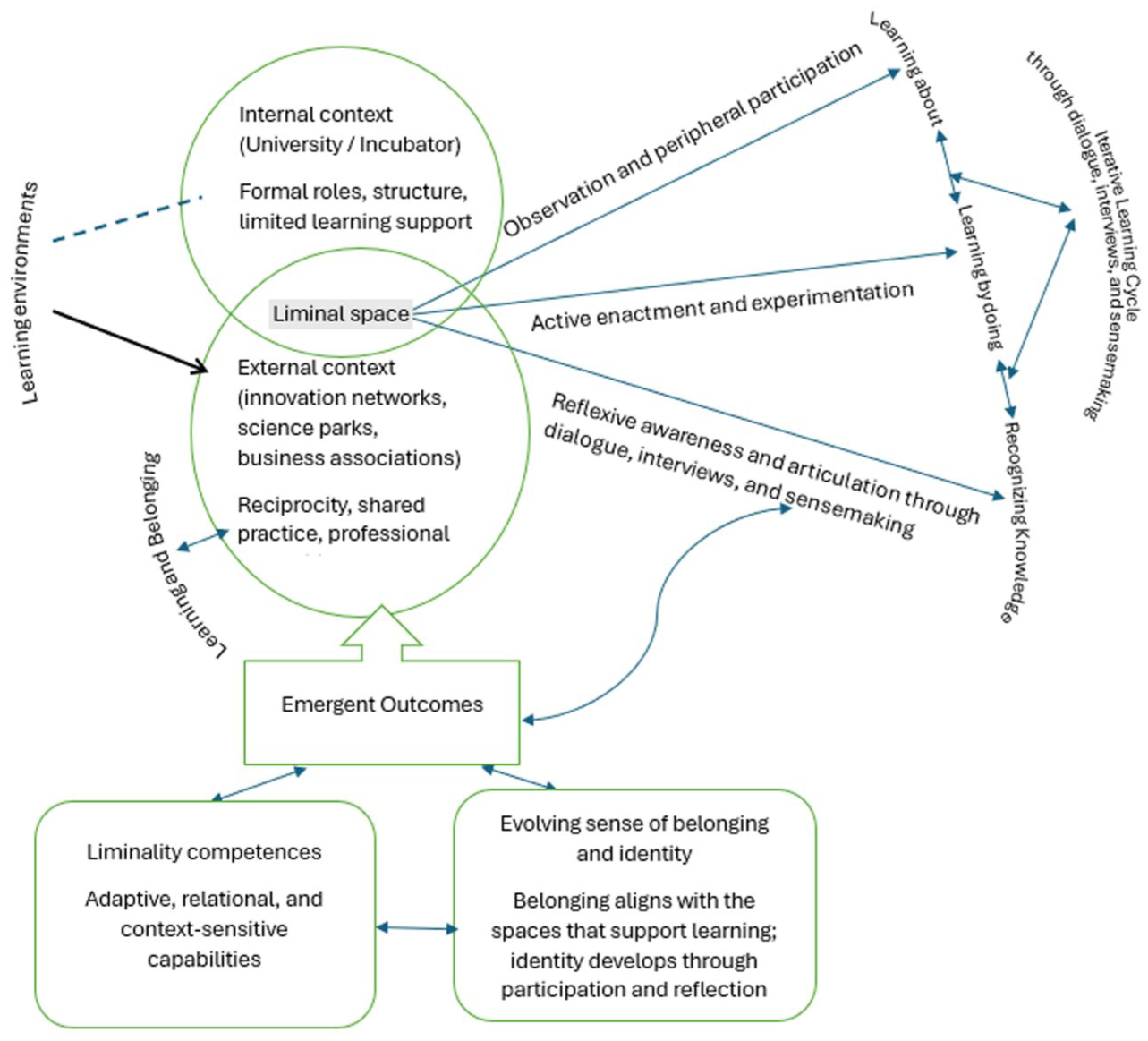
Boundary-Spanning Learning Trajectory (BSLT) framework.
Implications, limitations and future research
By offering a nuanced, process-oriented account of how learning unfolds within boundary-crossing roles, this article raises important questions about how institutions, particularly universities, support, integrate or marginalise hybrid roles (Martin et al., 2023; Reed and Thomas, 2021). There are implications for organisational design, onboarding and professional development, especially for roles that straddle internal and external boundaries (Azambuja et al., 2023; Harding et al., 2014). Future research could expand on these insights by exploring other hybrid or liminal roles in different sectors, examining how learning processes differ across cultural or national contexts or investigating how organisations might intentionally scaffold liminality competences as part of strategic capacity-building (Borg and Söderlund, 2015; Swan et al., 2016).
This study has several limitations that shape the scope of its claims. Focusing on 12 incubator managers within UK higher education enabled in-depth longitudinal analysis, but the modest sample size and single-sector context limit statistical generalisability. The findings should therefore be understood as analytically rather than numerically generalisable, illuminating processes that may travel to similar boundary-spanning roles but requiring further empirical testing across sectors and national contexts.
Second, the research relies primarily on longitudinal interviews and diary data. Although this design captured evolving sensemaking and identity development over time (Maitlis and Christianson, 2014; Weick, 1995), it privileges participants’ narrated accounts over direct observation of practice. Future studies might incorporate ethnographic shadowing or multi-actor perspectives to examine how liminality competence is enacted and recognised in interaction. Together, these limitations suggest a broader research agenda examining how boundary-spanning learning trajectories unfold across contexts, time horizons and organisational forms.
Future studies could further explore how newcomers in boundary-spanning roles acquire liminality competences through legitimate peripheral participation, especially in dynamic or contested fields. Second, universities and similar institutions might reflect on the permeability of their professional communities, particularly how internal structures either support or inhibit knowledge flow from external actors. Third, those researching communities of practice might consider formal employment and belonging, as our participants’ experiences show that organisational membership does not necessarily imply community affiliation or learning engagement.
Conclusion
This study examined how incubator managers learn to operate within sustained institutional liminality. Tracing a longitudinal trajectory across two years, the analysis demonstrates that liminality competence develops iteratively through participation across multiple communities rather than within a single organisational setting. In contrast to work that frames liminality primarily as identity instability or disruption (Beech, 2011; Ibarra and Obodaru, 2016), the findings show how competence emerges developmentally through patterned engagement across contexts. Learning unfolded through observation, embodied enactment and the eventual recognition of situated expertise, revealing a recursive process in which identity and practice co-evolved.
These findings reposition liminality from a temporary transitional state (Turner, 1969) to an enduring condition of contemporary boundary-spanning work (Borg and Söderlund, 2015; Czarniawska and Mazza, 2003). Ambiguity was not resolved but navigated repeatedly, requiring actors to move across domains governed by different institutional logics. In doing so, they cultivated adaptive repertoires through participation in overlapping communities of practice (Lave and Wenger, 1991; Nicolini et al., 2022). Crucially, belonging aligned not with formal employment but with those communities that enabled reciprocal participation and recognition. Learning, therefore, proved socially located and unevenly distributed, occurring primarily in external professional networks rather than within the institutional centre.
This processual account extends situated learning theory by demonstrating how competence can develop across multiple, non-coincident communities rather than through progressive incorporation into a single bounded one (Wenger, 2000). It also highlights the role of reflexive sensemaking in rendering tacit practice visible over time (Maitlis and Christianson, 2014; Weick, 1995). By conceptualising liminality as a developmental learning space rather than a transitional disruption, this research offers a theoretically integrated account of how expertise, identity and belonging are constructed in contemporary boundary-spanning work.
Footnotes
Appendix 1
Participant responses re belonging – how participants described ‘fitting in’.

| Language | Behaviour | Appearance | Embodying |
|---|---|---|---|
|
Shifting your language so it fits where you are (two participants)
Using the language they will understand (one participant) Talking like them to make sense to them (four participants) Using the phrases and topics they use (two participants) Using the references they will understand (student satisfaction (1))/ Oxbridge in the university (1) and business growth in the chamber of commerce (two participants) Talk about things they are interested in (nine participants) |
Showing confidence (11 participants)
Engaging people in your ideas (three participants) Acting as they anticipate / expect (all) – being dynamic and responsive externally and in the incubator (one participant) Being part of the structure in the university (four participants) – showing respect and support, toning down who you feel you are becoming to fit (one participant) |
Wearing the right clothes to fit the group you are meeting (nine participants)
Dressing right – with things ready to alter how you appear (shoes, bags, jackets, ties (eight participants)) Understanding how you look impacts the people you’re trying to work with, be like them. (seven participants) |
Walking tall – occupying the space / Striding in / looking at people directly to show confidence (seven participants)
Having the right expression, the right approach, so you can be seen as one of them (one participant) Using open hands and other gestures when you talk to draw people in (three participants) Adopting ‘the kind of voice to make them hear’(five participants) – a louder voice to be heard (one participant) – a firmer voice (one participant) – a deeper voice (one participant) |
Appendix 2
Timeline – 2 years, eight quarterly interviews.

| Quarter | 1 | 2 | 3 | 4 | 5 | 6 | 7 | 8 |
|---|---|---|---|---|---|---|---|---|
| Self-definition (introducing myself to others, what I think of myself as) | Incubator manager – but multiple | Multiple but manager Innovator |
Multiple – manager and business developer, problem solver | Multiple – manager, entrepreneur and business developer /entrepreneur |
Multiple – manager, entrepreneur and business developer / entrepreneur | Multiple Entrepreneur plus others (n = 9) Business developer plus others (n = 3) |
Entrepreneur plus others (n = 10) Business developer plus others (n = 2) |
Entrepreneur plus others (n = 10) Business developer plus others (n = 2) |
|
|
||||||||
| Understanding the nature of the role and location | 12 | 12 | 8 | 8 | 6 | 7 | 5 | 3 |
| The barriers – university structures and logics | 12 | 12 | 12 | 9 | 12 | 10 | 5 | 3 |
| Reconciling how different places work | 12 | 12 | 12 | 12 | 11 | 8 | 4 | 2 |
| Being other, being separate | 12 | 12 | 11 | 8 | 4 | 11 | 9 | 3 |
| Finding a tribe, fitting in, belonging | 5 | 5 | 7 | 9 | 9 | 9 | 11 | 12 |
|
|
||||||||
| A change place | 12 | 12 | 7 | 12 | 9 | 3 | 1 | 2 |
| A change process | 4 | 7 | 6 | 6 | 8 | 9 | 3 | 2 |
| Preferred place ‘to identify with’ | 3 | 3 | 6 | 11 | 12 | 12 | 12 | 12 |
| Preferred people ‘to identify with’ | 0 | 1 | 1 | 3 | 8 | 8 | 9 | 10 |

Ethical considerations
Ethical approval was originally sought and given by Manchester Metropolitan University in 2016, further approval was given by Anglia Ruskin in 2017, following a pilot study. Work was due to begin in 2020 but was delayed until after COVID (2022).
Consent to participate
Consent was granted to use any information and report it anonymously. Written informed consent was initially sought from the gatekeeper (here the owner-manager) and then from individual employees. Following initial communication of information about the study, including methods to be used and the use of materials at the end of the study, discussions ensured that participants understood the information and were voluntary participants. Once data was collected, anonymizing the article meant replacing any personal or place names and ensuring that details about the company were edited to prevent its identification.
Funding
The authors received no financial support for the research, authorship and/or publication of this article.
Declaration of conflicting interests
The authors declared no potential conflicts of interest with respect to the research, authorship and/or publication of this article.