



Abstract
This article critically examines the diffusion of Corporate Social Responsibility; Environmental, Social, and Governance frameworks; and the United Nations Sustainable Development Goals in emerging markets. While often presented as neutral instruments of ethical business and sustainable development, we argue that these frameworks function as Sustainability Ideological State Apparatuses that embed, naturalize, and reproduce dominant ideologies under the guise of responsible management. Drawing on theory of ideology and theory of hegemony, we show how organizations are positioned as compliant sustainability subjects, while Western-centric norms are legitimized and internalized—often at the expense of local priorities, capacities, and epistemologies. This process constitutes a form of ideological colonization, wherein global sustainability standards displace alternative models rooted in local knowledge systems. This study illustrates how small and medium-sized enterprises in the Global South resist, reinterpret, and reconfigure these frameworks through contextually grounded practices. Our analysis contributes to Management Learning by reframing sustainability as a contested space of power, knowledge, and resistance. We call for more reflexive, decolonial approaches to organizational learning that foreground local agency and critically interrogate the ideological undercurrents embedded in global sustainability discourse.
Keywords
Introduction
Over the past two decades, corporate discourse has undergone a profound transformation toward sustainability and social responsibility. Frameworks such as Corporate Social Responsibility (CSR); Environmental, Social, and Governance (ESG) criteria; and the United Nations’ Sustainable Development Goals (SDGs) have emerged as global benchmarks for legitimate, ethical, and accountable business conduct (Eccles et al., 2020; Moratis and Melissen, 2022). Promoted by international organizations, institutional investors, rating agencies, and consulting firms, these frameworks now serve as institutionalized reference points for what it means to be a responsible organization in the 21st century.
Yet, as Banerjee (2022) argues in his decolonial critique of deliberative democracy, such frameworks often fail to account for the lived realities and epistemic perspectives of marginalized stakeholders in the Global South. They risk reproducing colonial logics by legitimizing Western-centric norms and excluding alternative models of development and sustainability. This raises urgent questions: What normative assumptions underpin these global frameworks? How do they travel across borders and interact with local contexts? And what forms of power, exclusion, and resistance do they generate?
Werhane and Bevan (2022) extend this critique by examining the philosophical foundations of CSR and its entanglement with political systems. They argue that CSR is not merely a managerial tool but a political construct shaped by historical and colonial interference. Their systems-based approach challenges the notion of business as a neutral actor, emphasizing that commerce and politics are inseparable—especially in emerging economies where global capital intersects with local governance.
This article addresses these questions by critically examining the discursive and institutional roles of CSR, ESG, and SDG frameworks in emerging markets. Specifically, it argues that these frameworks function simultaneously as Sustainability Ideological State Apparatuses (SISAs)—institutional mechanisms that embed, naturalize, and reproduce dominant ideologies under the guise of ethical management—and as hegemonic discourses that attempt to fix the meaning of sustainability while marginalizing alternative values, logics, and futures.
Our central research question is the following: How do global sustainability frameworks function as hegemonic and ideological instruments in emerging markets, and how do small and medium-sized enterprises (SMEs) in the Global South resist, reinterpret, or reconfigure these frameworks through locally grounded practices? By foregrounding the experiences of SMEs in the Global South, we show how sustainability is reimagined from below—not as a checklist of metrics, but as a contested site of political negotiation, epistemic plurality, and local agency. This perspective contributes to Management Learning by reframing sustainability as a space of contestation rather than compliance, and by calling for more reflexive, decolonial approaches to organizational learning and practice.
Drawing on the theory of ideology (Althusser, 1971) and the theory of hegemony (Laclau and Mouffe, 1985), we examine how these frameworks exert symbolic power: legitimating particular forms of knowledge, privileging Western-centric standards, and displacing alternative development paradigms. Althusser’s concept of Ideological State Apparatuses (ISAs) helps explain how institutions—such as multinational corporations (MNCs), international development agencies, and sustainability rating systems—reproduce dominant ideologies through routine managerial and organizational practices. In parallel, Laclau and Mouffe’s discourse theory of hegemony foregrounds the contingent, constructed, and contested nature of concepts like “sustainability,” illuminating how these meanings are stabilized through discursive struggle and power-laden articulation.
Together, these theories provide robust foundations for conceptualizing CSR, ESG, and SDG frameworks not merely as technical instruments or ethical guidelines, but as hegemonic ideological projects that reproduce global power asymmetries. This synthesis foregrounds their dual function: as institutional apparatuses that discipline organizational behavior (Althusser, 1971), and as discursive fields that stabilize certain meanings while excluding others (Laclau and Mouffe, 1985). It also enables a sharper critique of how these frameworks circulate across borders, particularly in contexts where local realities, values, and resource constraints do not align with the assumptions embedded in global sustainability standards.
This theoretical framing has significant implications for how we understand management learning. First, it calls attention to the ideological nature of sustainability discourses—how they are embedded within broader regimes of knowledge and power. Second, it reveals how these frameworks may serve as vehicles of ideological colonization in emerging markets, where organizations are often pressured—via investment protocols, global rankings, and regulatory harmonization—to conform to externally constructed norms (Fukuda-Parr and Muchhala, 2020; Kumar and Prasad, 2023). Third, it opens space for reimagining sustainability from the bottom up: not as a checklist of best practices and metrics, but as a contested site of political negotiation, epistemic plurality, and local agency.
To ground this argument, we turn to the context of emerging markets, where SMEs face the dual challenge of aligning with global sustainability standards while navigating volatile political, economic, and institutional environments (Katmon et al., 2019; Tashman et al., 2019). Unlike large MNCs, SMEs in emerging markets often lack the capacity to fully internalize or strategically instrumentalize global frameworks, and must instead develop hybrid strategies that balance compliance, adaptation, and resistance.
For example, EcoPost (https://ecopost.co.ke/), a Kenyan SME, manufactures building materials from recycled plastic while creating employment for marginalized youth. Although its operations align with several SDGs (e.g. SDG 11 on sustainable cities and SDG 13 on climate action), its model evolved in response to local waste crises and labor challenges—not from alignment with global frameworks. In Brazil, Natura & Co (https://www.naturaeco.com/), a cosmetics company, collaborates with 44 Indigenous communities in the Amazon rainforest to ethically source natural ingredients such as Brazil nuts, andiroba and ucuuba seeds essential for its vegan body creams, shower oils, soaps and other personal care products (Clancy, 2024). Its sustainability model reflects a deeply contextualized ethic grounded in Indigenous knowledge systems, resisting reductive ESG metrics. Similarly, SELCO India (https://selco-india.com/), which began as a grassroots SME providing solar energy to rural, off-grid households, has achieved significant impact across SDG domains. Yet its model emerged through iterative community engagement, rather than by conforming to pre-determined global indicators.
These cases illustrate how Global South SMEs often innovate and operationalize sustainability in ways that reflect local priorities, knowledge systems, and sociopolitical realities. Rather than viewing such firms as laggards or late adopters, we argue that they should be understood as sites of epistemic innovation—spaces where sustainability is locally redefined, critically negotiated, and sometimes resisted. Their practices challenge the assumption that sustainability can be globally standardized and instead call for more reflexive, decolonial approaches to management learning.
By bringing a critical lens to the global-local dynamics of sustainability, this article contributes to Management Learning by offering a theoretically grounded, contextually sensitive, and politically engaged perspective on how CSR, ESG, and SDG discourses shape organizational strategies and behaviors. We argue that management learning in emerging markets must not only focus on how firms adopt global sustainability standards, but also interrogate the ideological undercurrents, institutional asymmetries, and epistemic exclusions embedded within them.
In doing so, we call for a rethinking of what it means to “learn responsibly” within global capitalism. This requires recognizing sustainability frameworks as both opportunities for ethical improvement and instruments of hegemonic control. It also demands cultivating organizational practices that resist one-size-fits-all solutions, foreground local knowledge, and engage in critical inquiry. The path forward, we propose, lies in transforming management learning from a domain of compliance into a space of contestation—where sustainability is not merely implemented, but redefined from below.
A comparative analysis of CSR, ESG, and SDGs as SISAs: symbolic power and the politics of sustainability in the Global South
Drawing on the theory of ideology (Althusser, 1971) and the theory of hegemony (Laclau and Mouffe, 1985), we examine how CSR, ESG, and the SDGs (Sustainable Development Goals) function not as neutral instruments of governance, but as SISAs (Table 1). These frameworks exert symbolic power by legitimating certain forms of knowledge, privileging Western-centric standards, and marginalizing alternative value systems and development logics. While they present themselves as inclusive and progressive, they subtly reproduce hegemonic narratives that align emerging markets in the Global South with the ideological interests of the Global North.
Comparative analysis of CSR, ESG, and SDGs as Sustainability Ideological State Apparatuses (SISAs).
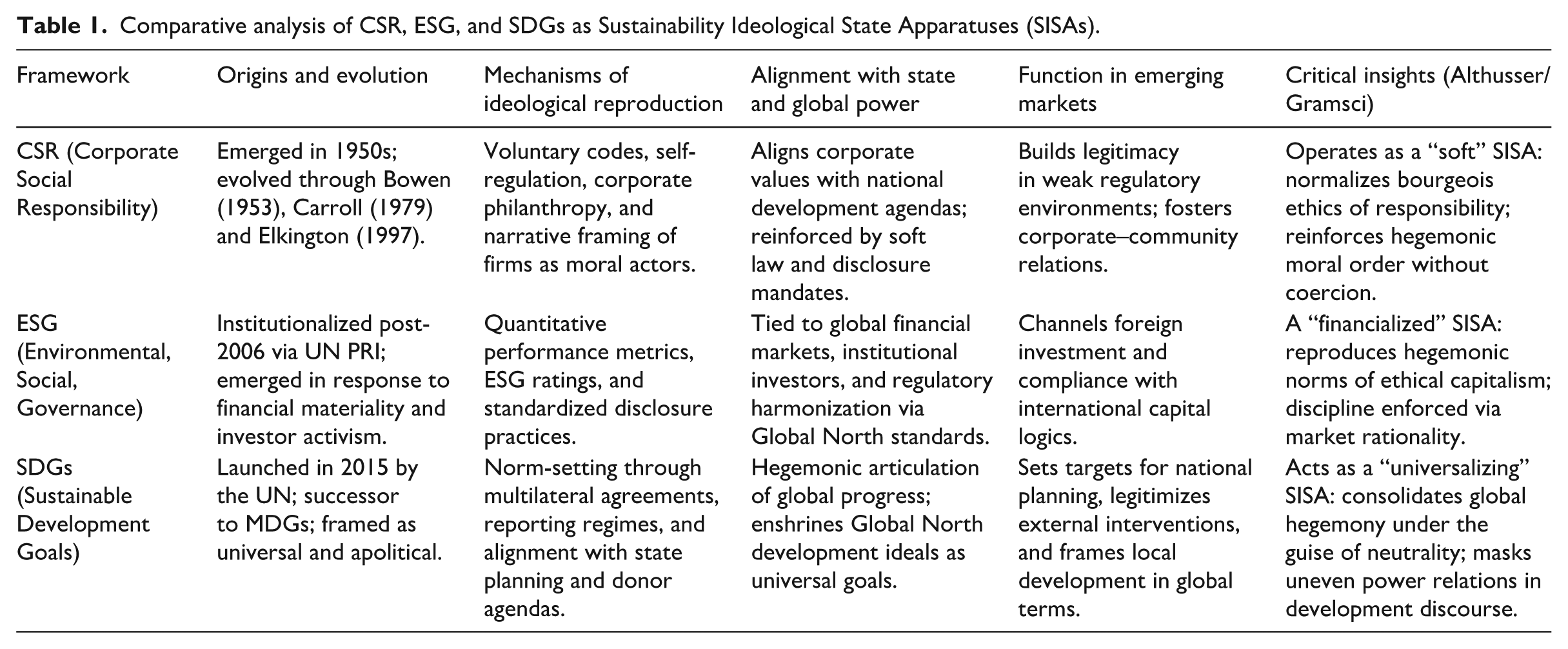
Through both ideological interpellation 1 (Althusser, 1971) and discursive articulation 2 (Laclau and Mouffe, 1985), these frameworks normalize dominant sustainability imaginaries. They produce what Laclau and Mouffe (1985) would call a “chain of equivalence” 3 (p. 144) among concepts like sustainability, market development, and responsibility—masking their historical contingencies and political contestation. For Global South enterprises and communities, this means that participation in sustainability discourses often comes at the cost of epistemic sovereignty and developmental autonomy.
CSR as a SISA: interpellation and passive revolution in emerging economies
Originally conceived as a voluntary corporate practice (Bowen, 1953), CSR has evolved into a powerful ideological apparatus in the business sector (Carroll, 1979; Elkington, 1997). Through an Althusserian lens, CSR interpellates firms as moral actors, embedding them within broader discourses of social development without fundamentally challenging capitalist accumulation. In the Global South, CSR mediates state priorities—such as poverty alleviation or national development—with corporate agendas, fostering a consensus that legitimizes capitalist-led solutions to social problems.
Building on Laclau and Mouffe’s (1985) notion of hegemony, CSR in emerging economies can be viewed as a form of passive revolution—a process by which dominant interests absorb subaltern demands without altering the structure of power. National CSR mandates, such as those in India and China, formalize this consensus. While appearing progressive, these mandates reproduce neoliberal logics under the guise of local responsiveness (Amran et al., 2014; Bhatnagar et al., 2020).
For SMEs in the Global South, CSR often becomes a disciplining mechanism. Participation in global value chains requires firms to adopt CSR standards defined by MNCs, thereby marginalizing indigenous or local value systems and community-based accountability models. Rather than enabling local empowerment, CSR co-opts social responsibility into a global capitalist framework, reducing ethics to brand legitimacy and risk management.
From an Althusserian perspective, the Sustainable Development Goals (SDGs) function as transnational ideological state apparatuses that enlist states, corporations, non-governmental organizations (NGOs), and civil society in reproducing a global order centered on market-based solutions and liberal democratic norms. However, this ideological framing is not benign—it produces (in)sensitive violence (Chowdhury, 2021).
Influential actors—including governments, NGOs, and multinational firms—claim neutrality while designing and implementing SDG-aligned strategies. Yet, as Chowdhury (2021) argues, this neutrality masks the recursive use of violence that is difficult to trace but deeply harmful. Development projects justified by SDG goals often result in environmental degradation, displacement, and emotional harm to marginalized communities. These consequences are rendered invisible by the technocratic language of targets, indicators, and strategic decision-making.
The SDGs, like CSR, normalize a global development logic that privileges elite interests while silencing alternative epistemologies. They interpellate actors into a system that rewards compliance and punishes dissent, thereby foreclosing political contestation. The result is a form of symbolic violence (Bourdieu, 1991), where dominant norms appear neutral but reproduce inequality and exclusion.
ESG as technocratic hegemony: the financialization of sustainability norms
ESG extends CSR’s ideological function by embedding sustainability within the logic of global capital markets. ESG transforms sustainability into a quantifiable, investable, and auditable construct. This quantification is not neutral—it is ideological. It obscures structural injustices behind the veneer of risk management and investment logic by translating complex socioecological realities into metrics that serve investor interests.
ESG metrics prioritize financial materiality over social or ecological justice. As Jonsdottir et al. (2022) show, institutional investors rely on ESG data to screen and rank investments, yet these data often lack accuracy, reliability, and contextual relevance. The result is a system where sustainability is defined by what can be measured and monetized—carbon credits, board diversity, or water usage—rather than by local priorities or lived experiences.
This technocratic framing forecloses political contestation. It normalizes a narrow vision of sustainability that aligns with investor expectations, sidelining alternative development pathways. ESG thus functions as a SISA—an institutional mechanism that legitimizes global capitalist norms under the guise of ethical governance.
Laclau and Mouffe’s (1985) concept of discursive closure is instructive here. ESG constructs a closed discursive field in which risk, return, and sustainability are rendered mutually compatible. This closure suppresses dissent and depoliticizes sustainability, making it difficult for actors in the Global South to articulate counter-hegemonic visions.
Emerging market enterprises are interpellated into this logic through ESG compliance requirements set by international investors, multilateral banks, and development institutions (Jonsdottir et al., 2022). Ziolo et al. (2019), while not critiquing ESG’s ideological function, empirically demonstrate how ESG criteria are embedded in financial decision-making across Organisation for Economic Co-operation and Development (OECD) countries. Their study confirms that ESG integration is seen as a pathway to more “sustainable” financial systems—but this sustainability is defined by institutional logics, not by local epistemologies.
For SMEs in the Global South, ESG often entails adopting metrics that do not reflect local priorities, cultural norms, or ecological specificities. ESG scoring systems privilege large firms with the resources to manage compliance, while small and community-based enterprises are either excluded or forced into forms of mimicry that prioritize form over substance.
SDGs as a SISA: universalism, hegemony, and epistemic displacement
Among the three, the SDGs represent the most ambitious and encompassing ideological apparatus. Marketed as universal, participatory, and inclusive, the SDGs claim to offer a shared blueprint for global development. Yet, from an Althusserian perspective, they operate as a SISA, recruiting diverse actors—states, corporations, NGOs—into a unified vision of development centered on market rationality, innovation, and growth.
Laclau and Mouffe (1985) would frame the SDGs as a hegemonic project par excellence: they articulate a discourse of sustainability that sutures contradictory demands (climate justice, economic growth, gender equity) into a coherent narrative that suppresses antagonism. This discursive closure presents sustainable development as a post-political, technocratic endeavor, rather than a terrain of contestation over values, resources, and power (Agbedahin, 2019; Rungius and Flink, 2020).
For Global South governments and enterprises, alignment with the SDGs becomes a condition for accessing global legitimacy and capital. Yet the articulation of these goals often privileges expert knowledge over local experience, global metrics over situated outcomes. As a result, grassroots sustainability innovations—such as agroecology, indigenous governance, or informal sector organizing—are either forced to become invisible or reframed through the language of Western-centric developmentalism.
Together, CSR, ESG, and the SDGs function as SISAs that reproduce dominant ideologies under the guise of ethical governance and inclusive development. Through symbolic power, these frameworks manufacture consent, depoliticize conflict, and entrench Global North epistemologies across borders.
By integrating Althusser’s theory of ideology and Laclau and Mouffe’s theory of hegemony, this critique reveals how sustainability is not merely a policy goal or market trend—it is a contested ideological terrain. For enterprises and communities in the Global South, the challenge lies in reclaiming this terrain: articulating alternative development logics that resist epistemic subordination and center local values, voices, and visions.
Beyond consent: articulation, emptiness, and the politics of sustainability
Building on the theory of hegemony (Laclau and Mouffe, 1985), we can move beyond the binary of coercion versus consent to interrogate how CSR, ESG, and the SDGs operate through hegemonic articulation—the discursive process by which certain meanings of “sustainability,” “responsibility,” and “development” become temporarily fixed, while excluding or marginalizing others. These frameworks function as nodal points in a broader discursive field, around which a multiplicity of signifiers—ethics, governance, risk, equity—are sutured into a seemingly coherent chain of meaning. Yet this coherence is always contingent, masking internal contradictions and the absence of any fixed essence—a condition Laclau and Mouffe (1985) term discursive emptiness.
CSR, ESG, and the SDGs do not merely interpellate subjects into pre-existing roles; they actively construct and circulate dominant discourses that define what counts as sustainable action, who is authorized to act, and which futures are deemed legitimate. Their hegemonic power lies in their capacity to neutralize dissent and depoliticize contestation, positioning corporate and institutional actors—often from the Global North—as the natural stewards of sustainable development. This framing is not incidental; it reflects the logics of racial capitalism (Robinson, 2000), wherein economic systems are structured through racialized hierarchies that extract value from marginalized communities while rendering their knowledge, labor, and agency invisible.
In the Global South, this dynamic is particularly consequential. Enterprises and communities are discursively constructed not as political agents capable of shaping transformative futures, but as passive beneficiaries of externally defined sustainability agendas. Their lived realities and alternative epistemologies are subsumed under technocratic metrics and global benchmarks, reinforcing a development paradigm that privileges whiteness, capital, and institutional legitimacy. As such, CSR, ESG, and SDG frameworks operate not only as ideological apparatuses but as instruments of racialized governance—reproducing global inequalities under the guise of ethical progress.
By anchoring sustainability to managerial, financial, and technocratic logics, these frameworks foreclose the articulation of antagonistic demands—such as decolonial development, environmental justice, or community sovereignty—that challenge the global neoliberal consensus. ESG ratings do not measure extractive dependency or postcolonial debt relations; SDG indicators do not register land dispossession or the criminalization of protest; CSR audits rarely reflect the lived experiences of marginalized labor. These omissions are not accidental—they are constitutive of the hegemonic project.
Toward counter-hegemonic sustainability
The implication of this critique is not that sustainability should be abandoned as a normative goal, but that it must be disarticulated from its current hegemonic form. In Laclau and Mouffe’s (1985) terms, this entails constructing a counter-hegemonic project—one that recognizes sustainability as a contested terrain shaped by antagonism, difference, and struggle. Such a project must re-politicize the concept of sustainability by foregrounding plural, situated knowledges and practices—especially those emerging from Indigenous, feminist, postcolonial, and grassroots movements across the Global South.
For Global South enterprises and communities, this means reclaiming agency not as implementers of externally defined sustainability metrics, but as producers of alternative logics of value and social organization. Examples include solidarity economies, agroecological systems, community-led conservation, and circular economies rooted in local epistemologies. These initiatives resist incorporation into dominant frameworks not because they are anti-development, but because they offer different articulations of what sustainable futures might look like—ones that prioritize autonomy, equity, and collective well-being over investment-grade compliance.
In this light, the task of critique is not merely to expose the ideological dimensions of CSR, ESG, and SDGs, but to reopen the political space for alternative articulations. This requires a sustained engagement with the hegemonic grammar of sustainability—challenging its exclusions, re-signifying its signifiers, and constructing chains of equivalence that link disparate struggles into new imaginaries of transformation.
Toward counter-hegemonic alternatives: reclaiming development imaginaries in the Global South
Recognizing CSR, ESG, and the SDGs as SISAs compels us to consider how their symbolic power might be challenged, subverted, or reappropriated. Althusser’s insight that ideological apparatuses are not monolithic but contested terrains—where dominant ideologies are reproduced yet also potentially resisted—opens up space for counter-hegemonic praxis. Similarly, Laclau and Mouffe’s (1985) conception of hegemony as contingent and incomplete invites us to explore how political subjects in emerging markets might articulate alternative discourses of sustainability that rupture the neoliberal consensus.
Rather than merely rejecting global frameworks, the task is to pluralize the field of sustainability discourse—to create space for relational, justice-oriented, and culturally grounded visions of development that defy economistic logic. This involves building what Laclau and Mouffe (1985) term “chains of equivalence” among diverse actors—grassroots movements, indigenous communities, SMEs, cooperatives, and critical policymakers—who collectively resist the reduction of sustainability to a set of audit tools or investor metrics. Such coalitions can begin to articulate demands that are not merely integrated into existing structures but reconfigure the very meaning of sustainability, ethics, and development.
Emerging market firms, particularly SMEs rooted in local contexts, have the potential to become agents of this transformation. While often seen as passive adopters of global standards, many SMEs exhibit hybrid logics—simultaneously engaging with formal sustainability frameworks and drawing upon vernacular ethics, collective ownership structures, and place-based forms of value creation. These hybrid practices represent fissures in the ideological edifice of global capitalism, where local knowledge systems and moral economies persist despite the pressures of isomorphic conformity.
However, for such alternatives to gain traction, institutional and epistemic space must be created. This requires shifting away from a development paradigm that privileges scalability, replication, and metrics, toward one that honors complexity, reflexivity, and plurality. It also means decentering the Global North as the primary locus of expertise, authority, and innovation. Universities, development agencies, and international governance bodies must be challenged to confront their own roles in sustaining ideological dominance and to support the co-production of knowledge with actors in the Global South.
In summary, understanding CSR, ESG, and the SDGs as both hegemonic and ideological reveals their power not only to govern behavior but to shape the horizon of what is imaginable. Yet that power is never total. Drawing on the theory of ideology and theory of hegemony, we can see that ideological colonization is always accompanied by the possibility of rupture—of new articulations, counter-narratives, and radical hope. Reclaiming sustainability from its ideological capture demands more than critique; it calls for the collective construction of alternative worlds.
Discussion: ideological subordination as sustainability?
From a strategic management perspective, the integration of CSR, ESG, and SDG frameworks appears to offer firms in emerging markets access to capital, legitimacy, and innovation opportunities. These frameworks are often framed as universal, value-neutral mechanisms for achieving sustainable growth and ethical governance. However, this universalism obscures the ideological work these frameworks perform. Drawing on Althusser’s (1971) theory of ideology and Laclau and Mouffe’s (1985) theory of hegemony, this article argues that the institutionalization of sustainability frameworks in the Global South is not merely a strategic alignment—but a form of ideological colonization.
This ideological colonization functions through what we term SISAs. These apparatuses do not operate through coercion, but rather through consent, interpellating firms, managers, and policymakers into subject positions aligned with global capitalist rationalities. Through ESG metrics, CSR audits, SDG mapping, and impact rankings, these frameworks normalize a technocratic logic of ethical governance. They incentivize performative alignment with Western-defined standards while marginalizing local, alternative, and often more radical conceptions of justice, stewardship, and development.
The uptake of these frameworks does not simply reflect external pressure; it reflects hegemonic internalization. The theory of hegemony reminds us that power operates not only through domination but through the construction of “common sense.” Emerging market firms and institutions increasingly internalize these frameworks as the only legitimate path to development. Managerial training programs, global partnerships, and business school curricula further sediment this consensus, making ESG and CSR not optional, but normative—even aspirational.
This ideological capture has several consequences. First, it displaces local agency by channeling ethical aspirations into measurable indicators designed outside the sociopolitical realities of the Global South. Second, it reconfigures development into a managerial problem, rather than a political and historical struggle. Third, it erodes epistemological diversity, rendering indigenous, relational, or collectivist values either invisible or in need of translation into market-based metrics.
Thus, while CSR, ESG, and SDG frameworks may facilitate access to global markets or funding, they do so by imposing and reshaping the discursive boundaries within which firms in emerging markets can act and imagine. The risk is not only instrumentalization but ideological subordination: a scenario in which emerging market actors are praised for acting responsibly only when they conform to paradigms devised by and for dominant global actors.
To be clear, this is not to argue that these frameworks are uniformly coercive or without merit. Evidence of local adaptation and hybridization exists. Some firms localize sustainability practices to align with cultural norms or grassroots priorities. However, even these hybrid forms often operate within epistemic frames set by global actors. The challenge, then, is not simply to localize global standards, but to interrogate and potentially displace the hegemonic logics that underpin them.
The broader implication is this: without critical reflection, sustainability discourse risks becoming the latest instrument of ideological colonization, repackaged in the language of metrics, transparency, and global citizenship. In reifying Western-centric notions of what it means to be “responsible,” “ethical,” or “sustainable,” CSR, ESG, and SDG frameworks may entrench—rather than disrupt—global hierarchies of power, knowledge, and value.
Limitations and future research directions
Despite offering a critical theoretical lens, this study is subject to several limitations that present opportunities for future inquiry:
Geographic and Cultural Specificity—Emerging markets are not monolithic. The uptake and interpretation of sustainability frameworks vary significantly across contexts shaped by colonial legacies, religious ethics, political institutions, and economic dependencies. Comparative studies—especially grounded in ethnographic or interpretive methods—could unpack how firms navigate these frameworks differently across regions.
Channels of Ideological Diffusion—This study focuses primarily on the ideological content of global frameworks. However, the mechanisms of diffusion—through consulting firms, international NGOs, business schools, or multilateral development banks—deserve closer scrutiny. Future research could map how these actors facilitate the normalization of CSR/ESG/SDG discourse, especially in postcolonial contexts.
Managerial Agency and Counter-Hegemonic Practices—While this article emphasizes ideological reproduction, resistance is always possible. More research is needed on how managers and firms engage in subversive or counter-hegemonic practices—whether through informal ethics, local knowledge systems, or radical transparency. Case studies of grassroots enterprises or social movements that resist mainstream metrics could enrich this line of inquiry.
Evaluating Performance Beyond Metrics—A critical question remains: do firms’ engagements with these frameworks lead to meaningful social or environmental change? Empirical studies should interrogate whether alignment with SDGs or ESG standards translates into actual improvements in equity, justice, or sustainability—or whether such alignment primarily serves reputational, financial, or symbolic ends.
Reimagining Development and Sustainability—Future work might explore alternative imaginaries of development and sustainability grounded in indigenous, feminist, or decolonial perspectives. What would it mean to reconfigure sustainability from the South, rather than for the South? How might development be reimagined beyond the logics of scalability, measurability, and market rationality?
Conclusion: toward a decolonized understanding of sustainability
This article advances critical management learning by exposing the ideological undercurrents embedded in the global diffusion of CSR, ESG, and SDG frameworks, particularly in the context of emerging markets. While often lauded as value-neutral tools for sustainable development and ethical governance, we contest that these frameworks operate as SISAs—reproducing dominant capitalist norms, depoliticizing development struggles, and marginalizing alternative epistemologies. Their adoption does not simply confer legitimacy or signal strategic sophistication. Instead, it signals a deeper ideological alignment with a transnational regime of governance that privileges investor-oriented, technocratic, and performance-driven logics of sustainability.
Drawing on concepts of ideological interpellation and theory of hegemony, we have argued that firms in the Global South are not only adopting these frameworks strategically but are also being hailed into subject positions that reaffirm the moral and intellectual leadership of the Global North. This ideological incorporation is rarely coercive. Rather, it is achieved through soft mechanisms—consulting models, academic discourse, certification schemes, managerial education, and impact metrics—that shape what sustainability is understood to mean and delimit who gets to define its boundaries. In this way, CSR, ESG, and the SDGs become less tools for transformation and more instruments of ideological reproduction.
The implications of this critique are both practical and epistemological. For scholars, it calls for a reorientation of management theory that interrogates not only what frameworks are adopted but also why, how, and at whose expense. It demands a move beyond celebratory accounts of sustainability integration to engage with the geopolitical, cultural, and ideological dimensions of knowledge production in global management. For practitioners and policymakers, especially in emerging markets, this analysis urges caution against uncritical alignment with global standards that may obscure or overwrite indigenous values, local priorities, and bottom-up approaches to development.
Crucially, this article does not reject all uses of CSR, ESG, or SDG frameworks. Rather, it challenges their assumed neutrality and reveals their function as carriers of hegemonic norms. It invites both scholars and practitioners to explore counter-hegemonic possibilities—hybrid models, context-sensitive adaptations, and resistance practices—that affirm the agency of firms and communities in the Global South. A decolonized and pluralistic vision of sustainability must foreground justice, autonomy, and epistemic diversity, rejecting one-size-fits-all templates in favor of contextually grounded, politically aware approaches.
In an era defined by global inequality, ecological crisis, and ideological fragmentation, the future of responsible business must not be dictated solely by the logics of capital. It must be co-constructed by those whose voices, values, and visions have too often been excluded from the definition of what sustainability is, and what it could be.
Footnotes

Funding
The authors disclosed receipt of the following financial support for the research, authorship, and/or publication of this article: This study is supported by Dr. Eric Ping Hung Li’s Principal’s Research Chair (Tier 2) research program at the University of British Columbia – Okanagan campus.
Declaration of Conflicting Interests
The author(s) declared no potential conflicts of interest with respect to the research, authorship, and/or publication of this article.