




Abstract
Educators recognize the significant role emotions play in experiential learning (EL), particularly in how they support students through the inherent emotion work. However, the traditional design of experiential learning theory (ELT) in higher education (HE) often presupposes a stable environment, which overlooks the impact of unpredictable external factors on students’ emotions and learning. Despite its critical importance, emotion work in EL remains underexplored, with emotional dynamics often obscured or dismissed as isolated incidents. This study sheds light on the heightened emotional challenges that arise during periods of sustained disequilibrium, such as the COVID-19-induced restrictions. It provides novel insights into the dynamic interplay of emotions and learning progression within EL frameworks, drawing on perspectives from EL educators, advisors, and students. The research underscores the importance of emotion-focused dialogue, educator-student connection, and assimilating autonomy needs in EL amid disequilibrium. It also identifies often-neglected elements in EL frameworks, such as students “sharing struggles” or “valuing work efforts,” alongside educator strategies like “personal anchoring.” The findings contribute to ELT by proposing adaptive strategies that integrate emotion work into pedagogical frameworks, enhancing reflection and conceptualization practices, and extending ELT’s applicability across diverse educational and work-based management learning settings.
Keywords
Introduction
Experiential learning (EL) educators have long understood the crucial role emotions play in student learning in higher education (HE; Clancy and Vince, 2019; Dirkx, 2008; Vince, 2010). The essence of EL educator roles lies in creating safe yet transformative learning environments (Cajiao and Burke, 2016; Mavin et al., 2024), easing student angst or disengagement in the face of uncertainty (Wright et al., 2018), and attending to both academic and emotional well-being. Yet, despite its comprehensive approach, EL theory (Kolb and Kolb, 2009) often overlooks the impact of unpredictable external factors on student emotions and learning progression, leaving a notable gap in EL research.
To gauge the impact of emotional dynamics on students, it is essential to consider the tangible effects observed during recent disruptions. Surveys during COVID-19 restrictions exposed widespread student struggles with changing learning needs, including feelings of stress or anxiety, retention and engagement challenges, and difficulties staying connected with others (Gonzalez-Ramirez et al., 2021; Holzer et al., 2021). The 2021 UK National Student Survey (NSS) indicated a notable decline in satisfaction: only 48% were satisfied with teaching and learning delivery, and merely 42% felt supported in their mental well-being (Office for Students, 2021; Pycroft, 2021). Among the 332,500 respondents, overall course satisfaction dropped, albeit by just eight points, to 75%. These findings highlight the critical role of engagement (Gonzalez-Ramirez et al., 2021), connection (Holzer et al., 2021), and adaptability (Zhang et al., 2021), key factors in maintaining learning motivation and managing emotions in the context of EL.
EL educators play a crucial role in assisting students to regulate or self-manage emotions using practices like sense-making and reflection (Wright et al., 2022). Research into emotion work—the efforts to manage or adapt one’s emotions or feelings more authentically—further explores how educators use self-reflexive practices to support their own emotional needs (Hibbert et al., 2022; Hochschild, 1979). Still, scholars debate EL educators’ readiness to effectively manage student emotions, particularly those stemming from deliberately unsettling their expectations (Sanderson, 2021). There is also significant discussion about the ethics of conducting classroom-based EL practices that purposefully engage student emotions (Wright et al., 2019). Business schools employing EL pedagogies, arguably, bear the responsibility to equip educators for proper support of students’ emotional needs. Despite these key debates, the role of EL educators in managing student emotion work remains under-researched, often because such emotional dynamics are obscured, challenging to discern, or dismissed as atypical, isolated incidents.
The onset of COVID-19 restrictions in HE led educators, abruptly shifting to fully virtual coursework, to face significant challenges, including managing heightened emotions (Greenberg and Hibbert, 2020). This upheaval offered a unique opportunity to explore how EL educators handle student emotions amid disequilibrium—the ongoing unsettling of expectations—and its implications for advancing EL theory (ELT) and practice (Kolb and Kolb, 2009). Using qualitative interviews, our study examines emotional responses from the dual perspective of both students and educators and details tensions this exposes within EL frameworks. We reveal how emotion work helps mitigate tensions and fosters learning at a time of disequilibrium, when student disengagement and conflict can be difficult to detect. In this context, “EL educator” includes EL faculty and advisors. “Advisors” are drawn from faculty, adjunct faculty, and industry or business experts, tasked specifically with coaching EL project teams and deeply involved in guiding the successful completion of EL coursework. The following research question guides our work:
How does emotion work, arising amid ongoing disequilibrium, affect experiential learning theory and practice?
This article unfolds in six sections: the first explores EL in management education and its intersection with emotions, particularly in the context of disequilibrium; the second details our qualitative data collection and analysis methods; the third presents key findings and highlights challenges in EL practices during the pandemic; the fourth describes adaptive strategies in EL amid disequilibrium; the fifth discusses how our findings inform EL theory and practice (ELT&P); and the sixth reviews implications and future research directions.
Experiential learning and its intersection with emotions
Within management studies, experiential learning (EL) is defined as learning that emerges “through the transformation of lived experience, more than rational-logical learning from texts, articles, and case studies” Sutherland and Jelinek (2015: 301). Unlike traditional management learning lecture courses, EL typically involves project-based activities that expose students to real-world challenges outside conventional classroom settings. Many educational institutions have embraced EL, crafting frameworks to fit their unique contexts (Cajiao and Burke, 2016; Heinrich and Green, 2020; Tomkins and Ulus, 2016). The inherent ambiguity of EL projects can, by design, lead to tensions, especially in team settings with diverse needs and expectations, where students can face decisions with incomplete information while needing to satisfy multiple stakeholders with competing interests (McKeen et al., 2018). These tensions can trigger negative emotions, such as frustration, anger, and resentment, leading to “disorienting dilemmas” that fundamentally challenge an individual’s frame of reference or way of thinking (Mezirow, 1990). If not properly managed, negative emotions can obstruct learning by narrowing the field of further experience (Vince, 2010; Wright et al., 2022), emphasizing the need to manage both positive and negative emotions to foster meaningful EL outcomes.
Drawing from other noted theorists, Kolb (1984) conceptualized experiential learning theory (ELT) as a cyclical process of experience, reflection, cognition, and action, centering on learners’ holistic interactions with their environment (Kayes, 2002; Kolb and Kolb, 2009). This emphasizes active engagement between students and faculty and consequently on learning interventions, which contrasts sharply with traditional learning theories that center primarily on cognitive or behavioral outcomes (Ng et al., 2009; Sanderson, 2021). Within ELT, the personal lived experience can manifest in an emotional state represented by the process of reflection, which it then combines with rational thoughts, feelings, and personal insights (Kayes, 2002). Yet, despite its broad approach, the real-world applicability of ELT is reduced by failing to consider unpredictable external factors in students’ emotional state and learning progression.
In both education and leadership, the complex and critical role of emotions in learning motivation is well documented (Dahlin et al., 2017; Hibbert et al., 2022). Research across psychology and neuroscience has shown that events categorized as emotional are more memorable and easily retrievable than those without an emotional component (Buchanan, 2007; Holmer, 2014; Immordino-Yang and Damasio, 2007). Immordino-Yang and Damasio (2007) stress that the aspects of cognition most heavily utilized in schools—learning, attention, memory, decision-making, and social functioning—are all intrinsically linked to emotional processes. Such connections suggest that effective learning and recall require engaging with emotions, thereby underscoring the need for EL frameworks that integrate emotional responses throughout the learning cycle. This integration of emotion work ensures not only that EL adheres to its pedagogical principles but also that it enhances knowledge transfer and real-world application.
The advent of COVID-19 restrictions significantly disrupted EL pedagogies, which “relies heavily on students and faculty working through real-world problems in highly relational learning contexts,” a task which the pandemic rendered “difficult if not impossible” (Greenberg and Hibbert, 2020: 125). This disruption heightened emotional and psychological stresses for both students and educators, underscoring the need for adaptive pedagogical approaches that can also accommodate unprecedented challenges. Such adaptations include allowing emotions to surface within the learning process to create both greater awareness and self-regulation and ultimately transform the narrative associated with difficult events. Academic leaders are also urged to enhance emotional connections through focused discourse that offers hope and deepens their understanding of anxieties prevalent during uncertain times (Yeomans and Bowman, 2021).
From a learning perspective, disequilibrium is a journey or situation over time where “nothing is quite as it seems” (Carroll and Smolović Jones, 2018: 195), a strain that sets in when opinions collide and appear to impede progress (Heifetz et al., 1989), thus an ongoing unsettling of expectations that instills and embeds environmental tensions. Little by little, the tension impacts learning, yet it holds developmental potential as “disequilibrium prompts or compels an individual to revise his or her self-construct in light of the new experience” (Avolio and Hannah, 2008: 335). It can trigger learners to challenge basic beliefs and assumptions, fostering self-awareness and supporting the breakthrough of defensive patterns that cause denial, allowing a more informed meaning to emerge (Holmer, 2014).
EL educators play a crucial role in helping students navigate these strains, by guiding engagement, granting countering opinions, and seizing learning opportunities amid tension. By engaging with both positive and negative emotions, they can leverage the disequilibrium as a motivator to learn, thereby promoting deeper engagement in the complexity of emotions (Clancy and Vince, 2019; Dirkx, 2008; Finch et al., 2015; Lindebaum, 2017). The spectrum of student emotions that manifest amid disequilibrium remains underexplored; thus, the next section delves into empirical studies to examine these emotions in greater detail.
Dealing with emotions amid disequilibrium
This section reviews four surveys linking student emotions with learning challenges amid COVID-19-induced disequilibrium. The studies, while not based on EL contexts, show the range of emotions that can arise. The first study, of 65 German-based students, was carried out pre- and post-semester as the initial lockdown occurred (Polujanski et al., 2020). It noted increases in positive emotions (e.g. curiosity, gratitude) and negative emotions (e.g. fear, anxiety) amid the unexpected shift to online studies. It also found a rise in the use of suppression as an “emotion regulation” strategy, although this remained low overall, and no significant change in “cognitive reappraisal,” indicating a tendency to regulate and contain reactions rather than reassess emotional responses as the extent and duration of the pandemic were yet to unfold. Thus, suppression and containing are natural responses that subdue emotional reassessments of events.
A second survey of 121 U.S.-based students, taken during May 2020 amid COVID-19 restrictions, highlights the difficulties in regulating emotions and work patterns, as students grappled with the perceived lack of social connection—with educators, peers, or community groups (Gonzalez-Ramirez et al., 2021). The study links students’ struggles to connect with lower learning motivation and increased feelings of stress, anxiety, and exhaustion, leading to disengagement and burnout, illustrating the importance of maintaining social-emotional learning connection.
A third survey, involving 7,724 students across Europe, explored how positive emotions relate to learning motivation during the sudden shift to distance learning, which increased the risks of communication gaps and counterproductive negative emotions (Holzer et al., 2021). The study linked positive emotions and learning motivation to three basic psychological needs defined in self-determination theory (SDT)—experienced competence, autonomy, and relatedness—a feeling of connection and mutual support (Ryan and Deci, 2000). The findings suggest that, during the COVID-19 disequilibrium, positive emotions were closely associated with experienced competence, and intrinsic learning motivation was notably influenced not just by students’ sense of relatedness to others but also by autonomy—the unprompted and self-endorsed or self-advocated learning actions of students (Holzer et al., 2021). Crucially, the study highlights that effectively addressing learners’ needs, feelings, and difficulties can counteract negative emotions while bolstering all three psychological needs. Findings suggest that opportunities that engage students at their own pace not only support autonomy and competence but also help to effectively manage the interplay of positive and negative emotions—an important insight for EL.
In a fourth survey, a study of 1119 students in China found that both positive and negative emotions play a role in mediating student engagement during the pandemic (Zhang et al., 2021). Data suggest that student adaptability—the capacity to adapt emotional behaviors in response to changing and uncertain conditions—was an essential factor in experiencing positive emotions and sustaining learning engagement. Emotional adaptability in responses to changing academic environments was also the primary predictor of successful learning outcomes. Findings reveal purposeful ways in which students reportedly sought to adapt and realign their responses, emphasizing the highly context-dependent nature of the adaptations, a key point returned to later.
Collectively, the surveys underscore the importance of exploring emotional needs amid disequilibrium, while managing the interplay of positive and negative emotions therein. Findings suggest that aside from regulation, emotional adaptation plays a pivotal role in engagement and ability to reassess challenging events, key insights for later discussions on emotion work in EL.
Dual perspectives on emotion work
In academic settings, studies of “academic emotions” mainly focus on the impact of student emotions, both positive and negative, on their learning achievements (Finch et al., 2015; Pekrun et al., 2002), and on emotion regulation, which promotes achievement emotions and controls maladaptive emotions (Järvenoja et al., 2019). Recent studies extend this focus to include “emotion work”—the effort to manage or adapt one’s emotions authentically—(Hibbert et al., 2022; Hochschild, 1979) and to educators’ managing their own emotions and tensions (Mavin et al., 2024; Sanderson, 2021), with increased focus on expressing emotions in dialogue. Beyond an academic focus, emotion work involves disconnecting emotionally from negative experiences, such as failure or loss (Dahlin et al., 2017; Shepherd et al., 2011); establishing trust, safe spaces, and a sense of being valued (Carmeli and Gittell, 2009; Lee, 2021); promoting emotion self-regulation at work (Lindebaum, 2017); and fostering self-reflexive change (Hibbert et al., 2022), which yields a complex set of challenges.
EL educators face complex challenges in managing intense emotions and ensuring ethical handling of emotionally charged situations, particularly during crises such as COVID-19 (Lindebaum et al., 2017; Lund Dean et al., 2020). In emotion-laden EL events, educators play a crucial role in guiding students through reflective learning (Boud et al., 2013). Both educators and students must remain open to learning and embrace emotion work amid such disequilibrium, notably when it involves difficult or unsettling dialogue (Cajiao and Burke, 2016; Hibbert et al., 2017). Thus, to effectively assimilate emotion work in ELTs, highly relational context requires capturing dual perspectives.
Complex challenges in integrating emotion work and EL
Studies show that suppressing emotions can impede emotional reassessment (Polujanski et al., 2020), while enhancing learners’ understanding of their emotional responses helps mitigate the defensive reactions that interfere with EL (Holmer, 2014). Effective management of emotional responses involves self-reflexive practices—attending, dialoguing, and realigning—to authentically connect with one’s emotions (Hibbert et al., 2022). Attending involves paying attention and actively choosing to engage with emotions. Dialoguing entails relating emotional experiences with others to explore aspects that cannot be fully recognized alone. Realigning calls for embracing personal change and making adjustments that support a positive self-orientation. Such practices become essential when striving to integrate emotion work within ELT&P.
Surveys during COVID-19 highlight the impact of increased anxiety on learning and engagement, underscoring the critical role of emotion work amid disequilibrium (Gonzalez-Ramirez et al., 2021; Zhang et al., 2021). Managing anxiety—an unrealized expectation of danger causing continuous discomfort—is crucial for maintaining engagement and adaptability in EL (O’Flanagan, 2015; Vince, 2010). Furthermore, recovering from prolonged stresses and anxiety caused by external events, such as COVID-19, requires both cognitive and emotion work (Greenberg and Hibbert, 2020). Thus, scholars stress the need for caution when surfacing anxiety-raising issues that may overwhelm learners (Gilmore and Anderson, 2012) and advocate instead for the creation of safe spaces that facilitate learning experimentation (Cajiao and Burke, 2016).
Emotions in EL can both motivate students and pose risks if mismanaged, potentially triggering vulnerabilities that complicate learning—the “shadow side” of EL (Clancy and Vince, 2019; Wright et al., 2018). The ongoing debate centers on establishing EL practice standards in business schools that employ EL pedagogies (Wright et al., 2019) and assessing educators’ readiness to manage the complex emotional dynamics that emerge from inherently risk-laden activities, such as unsettling students’ expectations or exploring sensitive “real-world” topics (Sanderson, 2021: 654). There is a pressing need for a deeper understanding of the interplay between student learning and the array of both positive and negative emotions they experience, whether prompted by educator actions, dynamic project environments, or unpredictable external factors, which underscores the necessity for this study. This research seeks to bridge the gap in understanding how emotional challenges affect ELT&P, aiming to extend its relevance and applicability across diverse EL environments. In the next section, we set forth our approach to investigating how both EL advisors and students managed emotion work amid the ongoing disequilibrium of COVID-19, and to developing our interpretive framework/EL model.
Methodology and data analysis
As the explicit study of emotion in the context of EL theory or practice is limited, we chose an interpretivist approach to grounded theory building, focusing on the informants’ understanding of their emotional experiences (Gioia, 2021: 22). We gathered qualitative data from EL advisors and students who completed EL courses at a leading U.S. East Coast university, Northern Business School (pseudonym), during the pandemic years 2020–2023.
Nine experienced EL advisors—engaged in EL from 5 to 25 years—were interviewed. All participated voluntarily. They form the diverse advisory team for ELA101 (pseudonym), a long-standing course offered for over 20 years and noted for its high student-to-advisor ratio—nine advisors overseeing up to 120 students. These educators, with full- or part-time academic roles, also teach traditional courses or hold concurrent business roles. Collectively they support 10 other elective EL courses at the university. While one is dedicated solely to course ELA101, another leads two further EL courses, while managing outside business ventures. In ELA101, advisors coach teams of four students, on working together for the successful completion of semester-long, real-world business projects, providing feedback, and grading course deliverables. Projects, which can be local, national, or international, typically involve on-site activities defined by “host” companies, who are not part of paid or contracted corporate-academic project relationships.
Student accounts are captured to complement advisor narratives, providing essential contrasts for narrative analysis (Pratt et al., 2022). The nine alumni students participated in course ELA101 during the U.S. fall of 2020 or 2021. They included non-U.S. nationals; represented eight of the nine EL advisors, four different graduate programs, and cross-registrants from other universities; participated in six additional EL courses, and worked either hybrid/on-campus or entirely remotely. Interviews, conducted to minimize anxiety over coursework or evaluations, focused on reflections on their prior-year student experiences during COVID-19 lockdowns. Participants shared self-reported recollections of emotional experiences, which studies show to be more memorable and readily retrievable (Buchanan, 2007), as noted earlier. We leveraged our experience as EL educators to facilitate the students’ reflection and sense-making, especially when they were recalling difficult emotional experiences (Boud et al., 2013).
In selecting alumni interviewees, a voluntary email invitation was extended to all class members with selection based on interest and availability (Strauss and Corbin, 1998). To minimize interviewer bias, both authors conducted the interviews; one of whom had no involvement with course ELA101. Data collection was facilitated using Zoom and Otter.ai for recording and transcription. Data were stored and ethical standards maintained in accordance with institutional review board (IRB) guidelines.
Data collection consisted of three rounds of qualitative interviews, designed to capture insights at different stages of the pandemic’s evolution (see Table 1 for a summary). The purpose of Round 1 was to identify and analyze how advisors and students report emotional issues in EL. Round 2 sought to capture advisors’ perspectives on how ongoing emotion work affected EL practices. Round 3 aimed to gather advisors’ reflections on lessons learned emerging from COVID-19 restrictions and to review and validate our emerging model based on their feedback. Round 1 interviews were conducted in the U.S. spring term of 2022, capturing advisor and alumni stories as they recalled their course ELA101 from fall 2020 and 2021. Two alumni interviews were delayed until early fall 2022 due to graduation schedules. Grounded theory methods guided the use of Round 1 insights in Round 2 questioning (Gioia, 2021). Round 2 advisor interviews coincided with the start of ELA101 in fall 2022, where advisors discussed lessons they planned to implement as COVID-19 restrictions ended. Round 3 interviews were held with the same nine advisors, after ELA101 concluded in spring 2023. During these interviews we presented our draft interpretive framework, which was developed from analyzing both student and advisor data in Rounds 1 and 2.
Data collection: purpose, source, timeframe, and analysis approach.
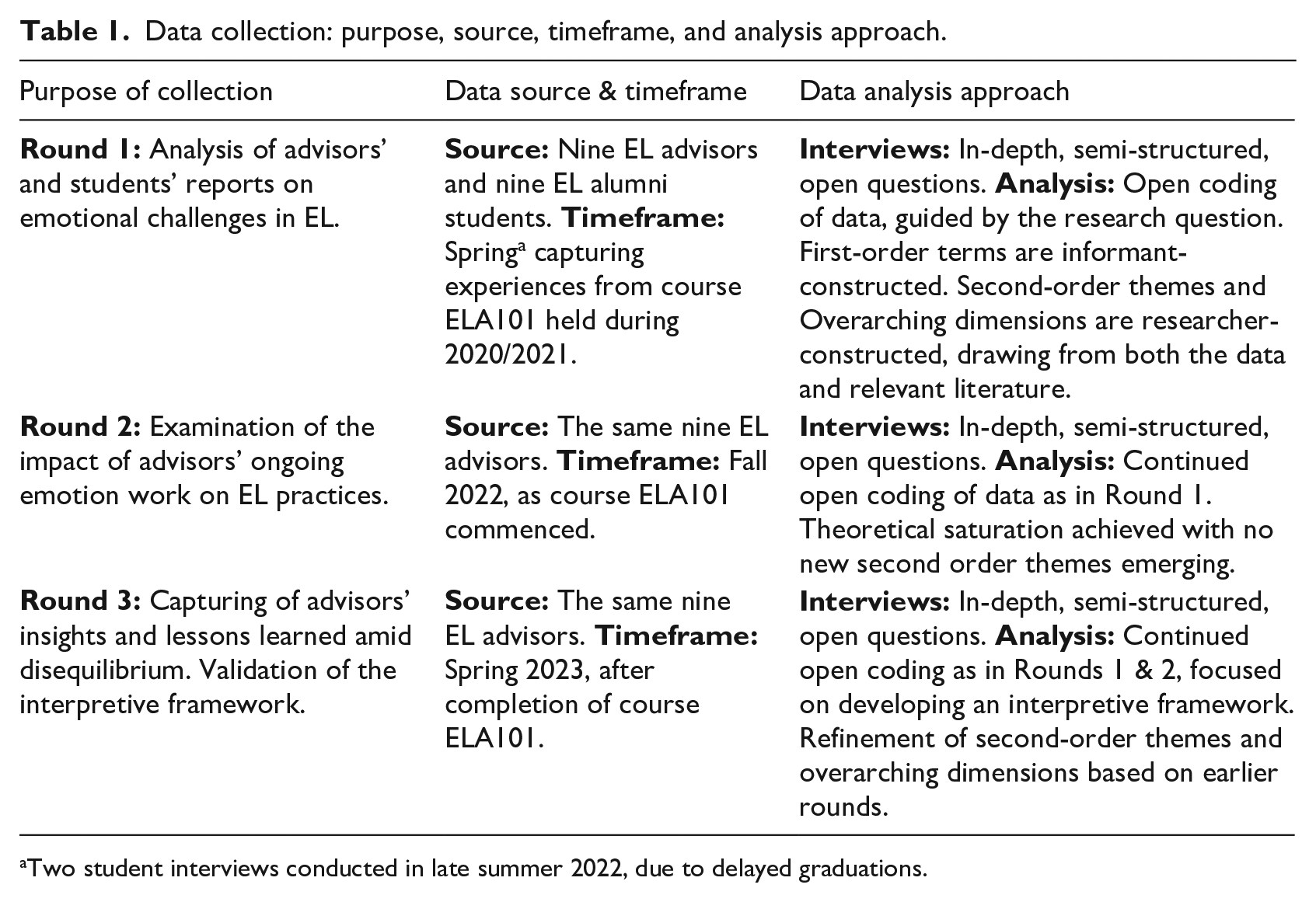
Two student interviews conducted in late summer 2022, due to delayed graduations.
Interview protocols were consistent across informants, following a semi-structured, hour-long format with in-depth, open questions (Strauss and Corbin, 1998). Using informant narratives, we depict the emotional responses of both EL students and advisors. From raw data, we construct detailed narratives of event progression (Langley, 1999), during the period of disequilibrium. This narrative strategy, ideal for multiple interviews with a smaller number of informants, provides authenticity by linking and contrasting personal stories. It also yields compelling, contextually rich accounts of self-reported experiences and EL learning interventions.
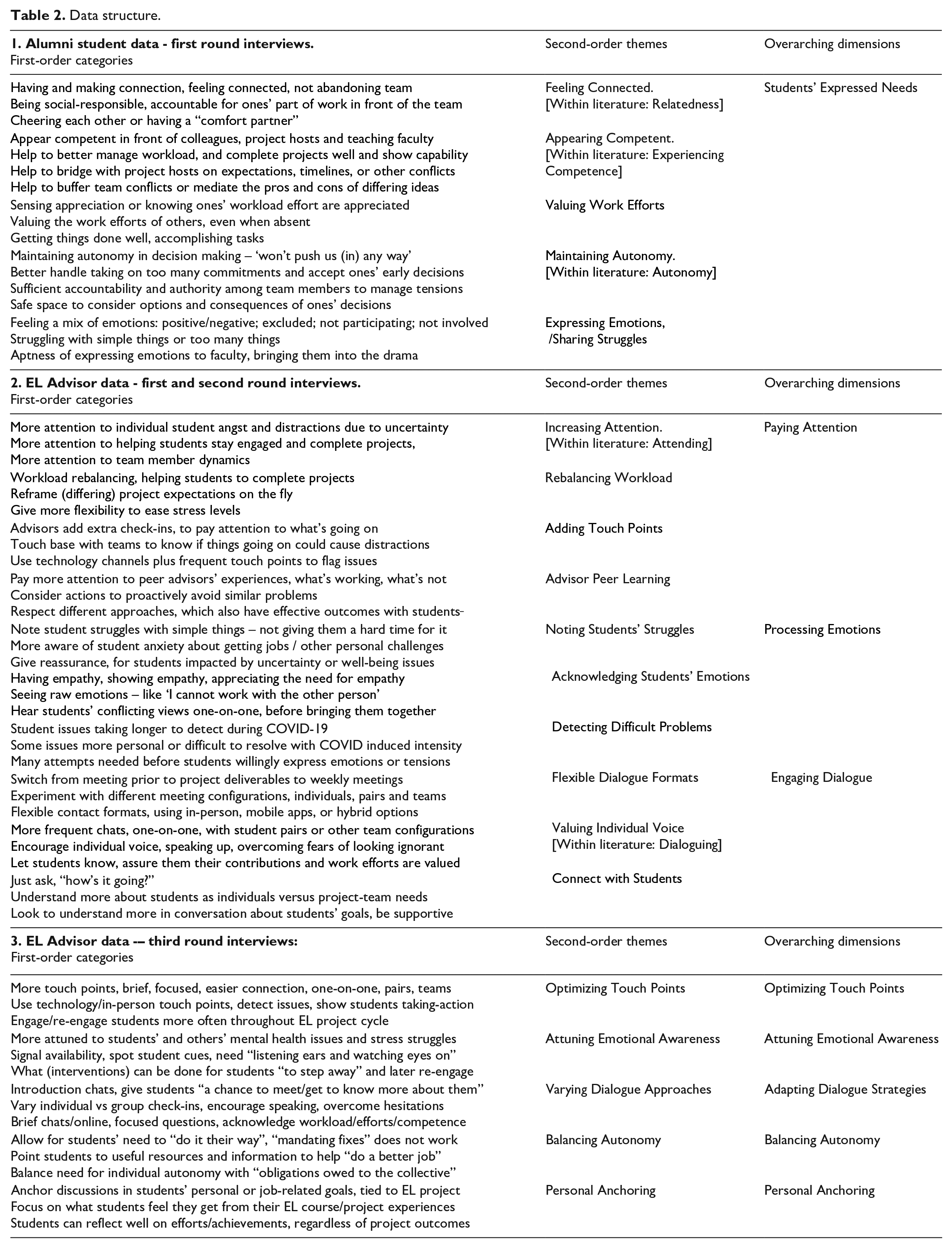
We rely on an inductive reading of the narratives to initially categorize the data (Locke et al., 2022), coding both student accounts of learning concerns and emotional responses alongside EL advisor responses. The analysis included three iterative stages; open coding or creating first-order categories of informant terms (informant-centered); combining codes into second-order themes (informant and theory-centered); and developing overarching conceptual dimensions (theory-centered; Gioia, 2021). See Table 2 for an outline of the codes, themes, and dimensional groupings that emerged from the analysis.
Data structure.
Our research question guided our investigation into how advisors and students express emotional responses to working on EL projects amid sustained disequilibrium. During our initial round of coding, each author independently examined three EL advisor interviews using open coding to identify first-order concepts (McAllum et al., 2019). Subsequently, we reviewed our findings collectively to compare insights, enhance inter-coder reliability, and minimize potential coder biases in our analytical groupings. We consistently used manual coding, allowing us to retain large sections of text for in-depth analysis while working both individually and collectively. This approach facilitates not only the meaningful interpretation of the “natural text” but also the generation of additional descriptive accounts (Van Maanen, 1979: 526).
Through open coding of advisor interviews, we identified several key concepts associated with emotion work, such as “seeing raw emotions,” “more student anxiety,” and “reducing stress.” Additional concepts emerged from student interviews, like “struggling,” “not feeling connected,” and “mix of emotions.” We grouped similar informant-constructed concepts into researcher-constructed second-order themes, as consistent patterns formed. We maintained separation between advisor and student groupings, despite linkages such as advisors “detecting difficult problems” and students “sharing struggles.” The second-order themes were aligned with existing literature, matching advisors “paying attention” with the concept of “attending,” and “valuing individual voice” with “dialoguing.” Students “feeling connected” is matched with “relatedness.” Some concepts, such as “valuing work efforts” and “personal anchoring,” remained distinct and unaligned (Gioia, 2021). We used a constant comparison approach, iteratively refining themes as interviews were added until a consistent set of concepts emerged (Glaser and Strauss, 1967).
For the second-round interviews, we analyzed responses from the same nine EL advisors. Theoretical saturation was achieved as no new second-order themes emerged in coding further interviews, although rich examples of emotion work continued to surface (McAllum et al., 2019). Our analysis identified three overarching dimensions that summarized how advisors made sense of the emotional experiences: paying attention, processing emotions, and engaging dialogue. The narrative accounts, detailed in the next section, are organized by these themes.
Following the second-round analysis, we developed a draft interpretive framework based on these three dimensions of emotion work. During the third round of interviews, advisors discussed lessons learned from navigating COVID-19 restrictions. We refined our model based on their feedback, adjusting the second-order themes to better reflect the adaptations in EL practices that arose amid the disequilibrium. For example, “adding touch points” evolved into “more-focused touch points,” and “engaging dialogue” into “adapting dialogue strategies.” We identified five themes representing the advisors’ adaptations: optimizing touch points; attuning emotional awareness; adapting dialogue strategies; balancing autonomy; and personal anchoring—each detailed later in the section “Adaptive strategies to balance EL needs amid disequilibrium.”
Findings and insights
Data in this study are presented primarily through narrative descriptions. The focus is on what came to light amid disequilibrium, compared to “normal” EL challenges (Kayes, 2002). Stories are organized to depict the evolution of events and responses to COVID-19 restrictions, illustrating how ad hoc advisor solutions evolved into established EL adaptive strategies. Quotes are italicized for clarity, and pseudonyms for EL advisors start with “M,” and students with “S.” Diagram 1 summarizes how advisors initially made sense of students’ emotional responses, structured across three thematic dimensions: paying attention, processing emotions, and engaging dialogue. Subsequently, Diagram 2 integrates students’ EL needs with advisors’ adaptive response strategies and links these to the foundation elements of ELT (Kolb and Kolb, 2009).

Making sense of student emotions in experiential learning (EL) amid disequilibrium.
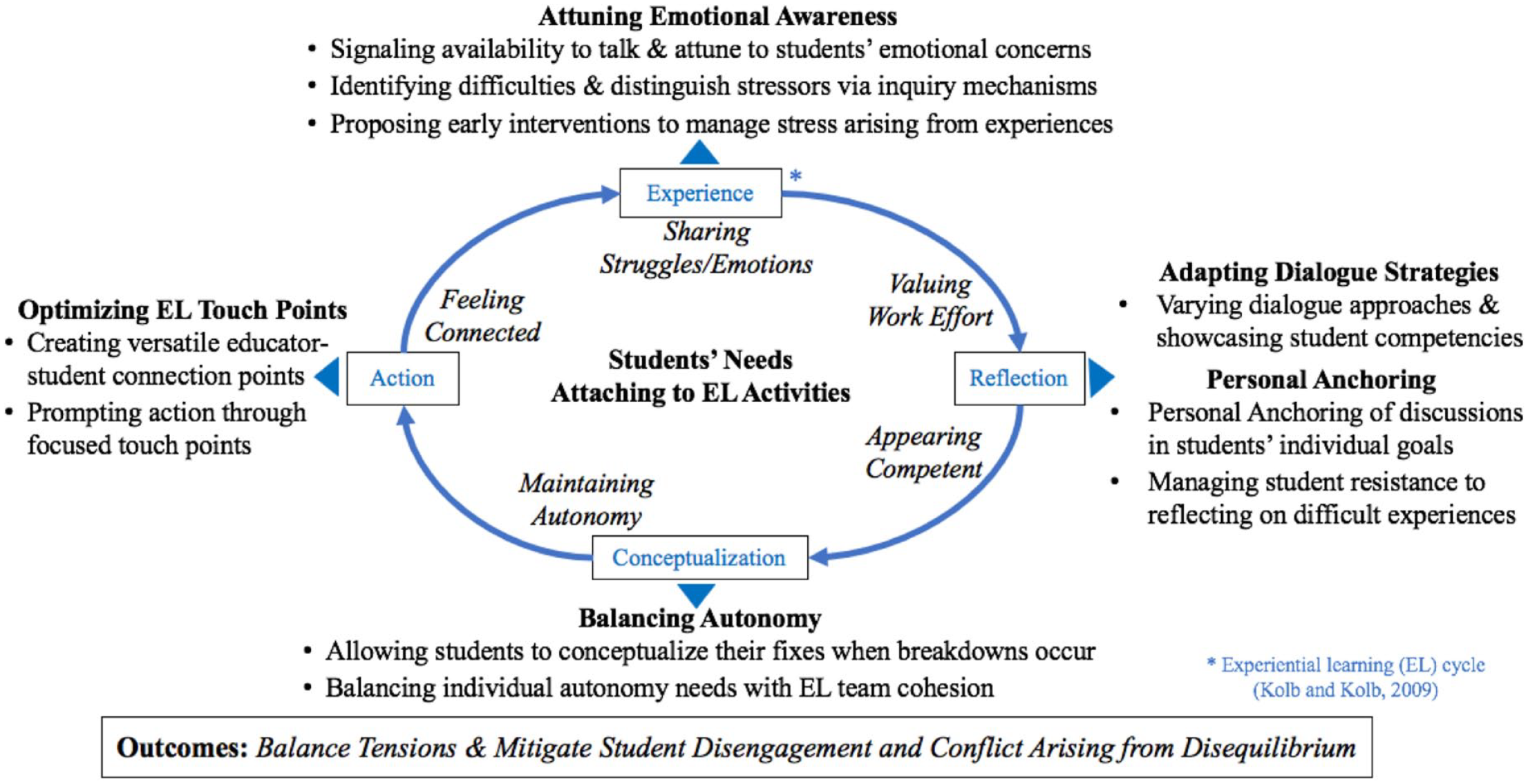
Adaptive strategies to support EL students’ needs amid disequilibrium.
Paying attention
In March 2020, as Northern Business School “pivoted” to online learning due to COVID-19 restrictions, EL advisors faced unprecedented challenges. With some student teams in the midst of projects and others just starting on-site work, projects abruptly ended. Some students had two or more projects canceled as restrictions extended. Others had significant disruptions in day-to-day living arrangements. EL advisors prioritized supporting students’ well-being and ensuring completion of term work in whatever way possible. One advisor, Myles, noted the remarkable attention and focus he observed among students, despite their many disappointments:
At Northern, the students are typically very planned . . . and one of the hallmarks of EL had been the experience on-site. When you pull the rug away from students midstream . . . in hindsight, I think anxiety shot up. . . . I don’t think that I was even calibrating to have a consciousness, to look at the dynamics that may result from . . . this massive pivot. . . . I did not have any challenges. I marveled with how well the students just focused on getting the projects done and wrapping up the semester with all these constraints.
Meanwhile, advisor Molly shared a contrasting experience, describing it as “very traumatic” for students within the same cohort. She spoke of dealing with “a lot of sadness, madness, angst, et cetera” among EL students whose “rug got pulled out from under them, twice.” In response, Molly noted that their role shifted significantly: “Projects faded in the background and we became like psychologists and . . . counselors,” due to the “tremendous uncertainty, in particular to (students) own personal goals and objectives in terms of careers.” She described the immediate impact of this heightened uncertainty on the students: “There was a lot of very difficult conversations, but really not about the EL element of the class. It was about their personal lives.” She noted students sounding anxious: “How am I going to get a job? What’s this going to do to my goals and objectives? I’m feeling depressed.”
A few months later, in the summer of 2020, Myles noted significant changes among his students: “I started really seeing a lot of dynamics around emotional things like anxiety, staying engaged, . . . I would say, light depression . . . and students just feeling blah, . . . just blah, not as energized as they would have been pre-COVID.” As preparations began for virtual EL courses in fall 2020, Myles noted the need for vigilance: “I saw that for the first time in my psyche . . . a heightened sense of awareness . . . that we needed to be paying attention . . . because there may be a lot going on.” Amid the transition from on-site to virtual EL projects, advisor McKinley emphasized the importance of recalibrating expectations to adapt to this new EL environment:
I think we all, on the (advisor) side, were really trying hard to come with no fixed expectations. . . . We were welcoming folks (virtually) from all across campus. . . . We worked very hard . . . ratcheting down expectations of all shapes and sizes, to get them to sort of join in with us in reimagining and building it on the fly.
Advisors began to reframe and reset ideas of achievable progress in EL projects, aiming to create a safe and supportive environment, while striving to avoid student angst and exhaustion amid widespread change and uncertainty. Morgan emphasized he was, “intentionally much more accommodating and gave flexibility to the students to just ease their stress levels.” At the same time, advisors noted the need to keep all teams engaged and motivate course completion. Mike spoke of adding check-ins and giving more attention to low-performing teams: For teams that, “didn’t seem to care much . . . I just had to figure a way . . . to encourage them, (by being) . . . more vigilant about paying attention to what (they) are doing almost on a week to week basis.”
Students appeared to value when advisors paid attention to their work efforts and concerns, especially when managing project workload, host expectations, and identification of resources. Here is how student Sidney spoke of his appreciation in a challenging situation.
The host . . . wanted a little bit more from us, but . . . we just dodged it. . . . We were pretty honest about the timelines: ‘We agreed on this, it’s great if we have the time to do that, but we just probably don’t.’ Our (advisor) also had a meeting with the host. I don’t know what he did, but . . . that really helped us come back to them (later). . . . It worked out well.
Addressing project workload issues within teams proved challenging. Salvador spoke of struggling to reset expectations and manage team differences, as student availability varied:
I was . . . fine getting a “C.” . . . Everyone else was like, “No, no, I want to . . . get the most out of this class . . . and accomplish.” . . . That was very hard to manage . . . when they were not able to fully participate.
Advisor Meredith emphasized the importance of check-ins when differing opinions arise and might adversely impact team dynamics, especially as teams have less chance to get to know each other: “paying attention to the personal opinion . . . try to focus . . . and ask them how this impacts the team?” This topic of check-ins or touch points is returned to in later discussions.
As lockdowns prevailed, advisors talked of paying vital attention to difficult experiences of fellow advisors, so they could take steps to prevent similar situations. Marcia reflected on these proactive adjustments: “(Advisors) were identifying troubles they were having, I would . . . sit back and go, ‘okay, am I seeing anything like that?’ And if I’m not, what things can I do proactively to make sure I don’t?” The emphasis on collaborative learning underscores ongoing efforts to adapt to persistent disequilibrium, a theme revisited in follow-up advisor interviews.
Processing emotions
By fall 2020, EL advisors observed increased emotional challenges within some project teams. These tense situations often involved discrepancies between students’ expectations and their actual campus activities, EL coursework, or EL team interactions. Previously manageable emotional issues became more intense and harder to detect and resolve during the pandemic.
Masoud recounted an instance where a student missed team meetings, raising concerns. Despite teammates insisting that all was well, the student eventually admitted to struggling with even “simple” things. After multiple outreach attempts, Masoud did find a way to show understanding and identify resources that could help address the student’s emotional needs:
(The student) wrote me a nice note, basically saying . . . “I’m having some problems focusing and I’m just struggling a little bit.” I thought, okay, . . . that’s not good, we should do something about this. . . . I . . . said, “Hey, do you want to meet by Zoom?” She said, “It’s really hard for me to do Zoom.” . . . So, I reached out to her, . . . “I’m really sorry that you’re struggling with that. . . . (The University) has a lot of resources. I really hope you’re taking advantage of them.” . . . I think she was extremely appreciative of that empathy and she did end up having (an advisor) meeting. . . . It was just a relief . . . that she could say this and nobody was giving her a hard time. It’s just okay.
Morgan recalled a severe emotional conflict within a team, where tensions escalated into a personalized conflict between two members. The team had concealed the problem, revealing it only as project deliverables came due at the end of term:
I have never really encountered . . . where I saw this raw emotion. . . . It was like “I cannot work with the other person.” . . . It really affected the students emotionally. . . . It had gone beyond just work. That is what stuck with me.
Morgan engaged in several one-on-one dialogues, “trying to get them to express what was going on, to share it with me.” First, he acknowledged the student’s feelings and struggles. He then shared the other student’s perspective. Later he shared what each student hoped for as a solution:
I just felt that there was no way I could bring them together. I got to hear everyone’s part of the story independently . . . a couple of times. . . . Then I shared . . . what the other’s perspective was so that they knew where they were coming from, . . . “this is what they are feeling.” Then (I) communicated to them what they would like to happen. . . . Finally, . . . they both said sorry to each other . . . and decided to move forward and work together. . . .The (host) was thrilled . . . wrote a very positive note about the team’s performance.
Students, such as Sybil, also shared experiences of heightened emotional tensions, exacerbated by their virtual EL project setting and the reduced in-person connection:
We were going to present to the (host company). . . . A team member was just . . . a little later than us. . . . That made it a little tense, because we’re like, “Hey, where’s your stuff?” . . . But I think that is . . . a COVID kind of thing where . . . you feel a little less accountable if you’re not like in front of the person, and you haven’t filled out your part of the PowerPoint. . . . So that’s the . . . social responsibility kind of accountability. When it wasn’t there, things did actually tend to break down a little more unless there was an authority figure in the group that was, like, really militant.
Students recalled appreciating advisors’ support, especially when tensions surfaced within teams or with project hosts. Advisors often acted as a “buffer,” mediating disagreements, or using authoritative techniques to drive action. Sang-mi described her advisor as,
play(ing) a role . . . like therapy . . . like how to manage conflict, . . . mediating . . . the pros and cons of an idea, (and) in a very factual way supporting one (idea) over the other, . . .but wouldn’t push us (in) any way.
While some students sought help in processing emotions, Sonia recalled significant internal conflicts in her project team that she chose not to address with her advisor at the time:
(My teammates) did a lot of work in my absence. . . . There was . . . miscommunication. . . . I’m thinking that my part is done, . . . but . . . the fact that I was not there made them feel like I was not involved. On one side, I’m feeling excluded and on the other side, I’m feeling like I’m not participating. I don’t know if it was a COVID thing, . . . but those are things that I wish I had handled better, by taking less commitments. . . . I did not abandon my team, I stuck to the end. . . . Sometimes, when I was doing (ELA#2) I regretted . . . but I needed the credits to complete (my degree). When I was in (ELA#3) I wish I had dropped out, . . . but then I wouldn’t have had the experience and the growth that came from it. . . .Towards the end . . . relationship(s) . . . exploded. . . . I wasn’t talking about how I was feeling, the (other students) were not talking about how they were feeling. . . . I don’t think it made sense to bring the professor into this drama.
This account highlights Sonia’s internal struggle with decision-making and participation, underscoring the autonomy students have in their EL decisions, a key point revisited later. Masoud noted it was common to have a few students, “taking way too much on their plate and anxious themselves about it.” What differed amid the pandemic was the tendency to conceal or long delays in revealing struggles despite regular check-ins, a behavior he attributed to the “increased number of distractions going on for (students).” Despite identifying these emotional challenges, resolutions were elusive. Myles elaborated on his extensive attempts to address this:
I tried everything. I talked to somebody . . . who’s a psychologist. I brought in breathing techniques. I pulled every step to try to help these students put aside their differences and focus on this incredible experience. . . . The students did deliver the final product. It was okay. (The) students had a miserable experience and it was just unfortunate.
Masoud’s experience stressed a critical insight: “trying to understand without getting into their personal life, struggles (they) are facing.” This realization led advisors to adopt a more nuanced approach to dialogue aiming to uncover and address students’ concerns at various levels.
Engaging dialogue
As disequilibrium from the pandemic continued, EL advisors, noting some significant delays in students revealing emotional challenges, increased their requests for dialogue with student teams. The positive response from students surpassed expectations. Mike explained his shift from meeting immediately prior to the deliverables, to meeting weekly: “MBA’s don’t like you to bother them unless they need you . . . but to my surprise, everybody showed up at every meeting. Not everybody has the same level of contribution, but everybody showed up.”
The added dialogue aimed to signal advisor accessibility and create opportunities for students to feel heard. Advisors tested various ad hoc approaches to engaging dialogue with a common purpose of getting to know students, including anchoring discussions in their personal goals. This frequently required advisors to consciously change their practices, as McKinley noted: “(I’m) looking to understand more in conversation with my team members as individuals, and their goals, and what are they doing afterward. . . . I’m trying to be more explicit and supportive on that front.” McKinley experimented with meeting formats, alternating between meeting with teams, individuals, and student pairs, seeking to build each student’s competence in speaking up:
I tried to . . . do these more frequently, . . . individually or in pairs, or different groups, to begin to get more individual voice and hear . . . each student . . . volunteer more on a one-on-one basis than . . . in a group setting. . . . That did allow folks to feel much more comfortable . . . surfacing insecurities, (overcoming) the. . . reluctance to . . . look ignorant.
Students, in turn, highlighted the value of one-on-one dialogue with advisors when “internal dramas” arose, or they needed to consider difficult choices, as Samarth recalled:
(My advisor) . . . offered her number and we had a conversation. She wanted me to make sure that I had thought through the options . . . and not feel forced into one action or another. She was offering a space . . . to open up . . . a safe space. As long as I understood my options and consequences, I was fine with the decision that I was (making).
Marcia talked of supplementing one-on-one dialogue with routine emails, to keep students engaged: “I kept reassuring him that he wasn’t falling through the cracks and that, . . . ‘your contributions are valued.’” Shri reflected on the role of advisor dialogue in his project: “Anxiety was extremely high. (Advisors) really stepped in and spoke to . . . the students, as well as the host company. They were bridging between the two parties . . . (about) the company’s expectations.” This illustrates how advisor dialogue helped maintain engagement amid project struggles.
You feel like . . . (the advisors) really do have your back. . . . The whole pandemic situation . . . affected me a bit more. Getting to know my classmates and . . . (advisor) in person . . . would have been great and that didn’t happen. I was a bit down . . . emotionally. . . . That’s probably the most memorable emotion . . . apart from finishing the course and feeling really proud to have done it first time, strictly on Zoom. So, okay, it was great!
The narrative highlights the interplay of positive and negative emotions and the critical support role played by advisors in balancing such mixed emotions. While online dialogue was crucial during lockdowns, students repeatedly expressed mixed emotions about this. Suri spoke positively of getting to know her team via Zoom: “I got extremely lucky because the teammates . . . the (advisors) were good, the project was good. . . . It actually exceeded my expectations greatly.” Yet, Suri also admitted to asking fewer questions: “Whenever you are speaking your face . . . is the largest one in front of everyone’s screen. . . . That definitely wasn’t the most comfortable, . . . when especially I wanted to ask some clarifying question and wasn’t sure.” Sybil expressed difficulty in demonstrating competence and building personal connection via Zoom, particularly with project hosts, noting that it hindered “ask(ing) them the dumb questions in a softer way.” Yet she embraced its adaptability in developing different skills, taking a full course load while partaking in a start-up and working with an enterprise company 30 hours a week: “I was able to go into 1.5x mode . . . and switch from one thing to the other in a matter of seconds.” Sharon addressed competence concerns by making online dialogue more fun and engaging:
My team . . . did a fantastic job at cheering each other each time we spoke during Zoom. . . . Every time one on my team said something during class, everyone will be (on WhatsApp and class chat) like, “Go You!” . . . It was really good.
Sharon highlighted how her team embraced dialogic engagement by forming pairs within her four-member team: “We decided on two pairs, . . . it was always like two of us, two of us.” Sybil added that, for her, working in pairs created a sense of both connection and competence:
It’s almost like your comfort partner, . . . you’re doing the day-to-day work with. . . .When you’re going out to the larger team of four, or even actual host company, you . . .feel like you have a partner in crime. . . . It is harder to create that with all of the (team).
This approach was supported by advisor McKinley, who had earlier observed the benefits of engaging students in dialogue in pairs. While both advisors and students spoke of adapting their approaches to dialogic engagement to address EL needs amid disequilibrium, the focus of the dialogue differed, as described in further detail in the next section.
Adaptive strategies to balance EL needs amid disequilibrium
Differences in how advisors and students manage EL needs amid disequilibrium are best illustrated by mapping their responses to the core ELT principles: experience, reflection, conceptualization, and action (Kolb and Kolb, 2009). These principles are depicted in Diagram 2.
In dialogue discussions, EL students expressed a desire to feel connected, ask questions while appearing competent, share difficulties, maintain autonomy while holding each other accountable for doing work, and both give and receive appreciation for all work efforts, despite project goals shifting or vanishing amid disequilibrium. In contrast, EL advisors prioritized getting to know students, being accessible, acknowledging emotions, providing reassurance, and varying strategies to suit the student context and project stage, leading to significant adaptations in their EL practices. Follow-up advisor interviews, conducted before and after the ELA101 course in U.S. fall 2022, demonstrate how advisors adapted their engagement strategies to better facilitate students’ emotion work, drawing from their individual and collective experiences.
Optimizing touch points
Emerging in a world greatly shaken by COVID-19, advisors like McKinley spoke eagerly of looking ahead to help students with new experiences: “Now we’re going to turn the page, . . . moving forward. We want to extract all of the relevant learnings and . . . reflect.” As advisors considered the future of EL, they shifted their focus from merely “paying attention” to purposefully “optimizing touch points.” Marcia highlighted the advantages of using both personal and technical interfaces to facilitate brief, more-focused connection with students: “We’re better off now post COVID . . . in terms of these channels to . . . communicate more succinctly and more focused. There are more touch points because . . . you can do it very quickly.” She also noted how these frequent interactions helped to quickly recognize students’ work efforts: “You’d notice a pattern . . . an indicator of harder work, more enthusiasm . . . they’re on top of it.” Malcolm added that being versatile and adapting the touch points to fit student preferences had become crucial: “They have all these different ways they want to do things. There’s just a lot more touch points, . . . Dropbox . . . Discord . . . (or) whatever platform.”
Not all advisors saw the benefits of technology touch points, as Masoud noted: “Going back to as much face-to-face as possible is good, . . . students will learn more from each other. . . . You create a norm of let’s do as much in person, . . . the rest is sort of exceptions.” Meanwhile, Myles spoke of using formal and subtle touch points to allow for unobtrusive interventions with students: “(If) I get alerted then I break-off, more of a ‘Myles to student A’ . . . in a very discrete way.” While approaches varied, there was consensus on the importance of brief, focused touch points to prompt action and engage students effectively, especially early in the EL project cycle.
Attuning emotional awareness
Advisors noted a crucial shift in their approach from merely “processing emotions” to “attuning emotional awareness.” Malcolm discussed identifying and managing heightened student stress:
I’ve had several instances . . . letters indicating modification to how we work with a student because of something related to mental health. . . . It puts a big strain on the student team. . . . We can’t always disclose . . . the situation.
Masoud emphasized the vital need for understanding: “There’s much more awareness about students and really everybody’s mental health struggles, stress struggles, . . . having a little more awareness and empathy to it is important.” Molly discussed the challenge of distinguishing between needs arising from externally imposed distractions and those self-inflicted by overcommitted students:
These are incredibly smart . . . creative . . . busy people who have overloaded their schedules. . . . Distract(ions) . . . during COVID . . . were externally imposed . . . and came with a high level of uncertainty. . . . I’m only talking about things that are personally imposed.
Advisors stressed the importance of prompt detection of student difficulties within the project cycle and early interventions to deal with stresses. Mike underscored signaling his availability to encourage open discussions about problems from day one: “I tell them that and I reinforce it in every meeting.” McKinley emphasized the need to notice when students “signal” their willingness to talk: “You have to have listening ears on and watching eyes on, to make sure you’re not missing those cues.”
Malcolm found school communiqués a reliable and effective go-to place for “guidelines in terms of protocol on how to handle (students’ emotional difficulties),” which was particularly useful amid the lockdown, “despite everything.” Masoud spoke of utilizing school resources to bolster students’ mental health before re-integrating them into EL projects:
You have to maybe send them to “the right people” to talk to about (their stresses) . . . or they learn nothing. . . . What can be done where they can step away and then (later) re-engage where they can actually benefit?
By attuning to students’ emotional needs, advisors reported increased confidence in their ability to guide students through difficult reflective learning experiences.
Adapting dialogue strategies
This third lesson from advisors emphasized varying dialogue strategies to optimize team dynamics and address related problems. Morgan added late-night hours for brief introductory Zoom chats, proactively responding to his stark experiences of team conflicts and late-semester breakdowns:
I gave my students the chance to meet with me one-on-one for 10 minutes. . . . It was optional . . . on Zoom . . . 9:30 pm, 10 pm. Many students . . . appreciated that . . . (to) know a little bit more about them before projects (began).
McKinley used dialogue to boost student confidence in speaking up: “That’s how they’re going to learn . . .(to) get over all of their hesitations, . . . ‘I don’t want to look like a dope in front of my peers,’ which is one of the most powerful drivers in human behavior.” This point ties to students’ concerns about appearing competent in front of peers, advisors, and host companies—a significant issue that re-emphasizes the importance of dialogue skills and strategies in EL.
Meredith utilized dialogue to monitor and support students’ emotional well-being:
If you identify that something is triggering some emotion . . . I had to read everybody in different ways, to talk to them first individually and then as a team and try to arrange with them what they need(ed) to do.
Marcia facilitated brief online chats, to encourage individual team members to ask questions and shorten the time between learning events: “We’ll just do a 12 minute Zoom, . . . focus on three or four questions that you have and we’re done.” She highlighted the benefits in managing “(work)load balance” and showcasing preparedness: “They kind of knew, ‘all right, now it’s your turn to pick up this piece of the discussion. And, now, it’s your turn to pick up this piece of the discussion.’ They all came fully briefed.” Yet, despite these important efforts, some team challenges persisted. To pre-empt or mitigate the ongoing issues, advisors employed two other strategies, “balancing autonomy” and “personal anchoring,” which are detailed below.
Balancing autonomy
To understand how advisors address student autonomy needs—self-endorsed and self-advocated learning actions—it is insightful to consider what did not work during COVID-19 restrictions. “Mandating fixes” during team breakdowns did not work. Myles tried to get a distressed team to align project goals and instructed that team members meet together for “lunch in the park.” Both Myles and Molly attempted structured interventions, enlisting support from Northern’s student services group. Malcolm tried reducing the project scope to “bite-size” activities so the team could finish comfortably. None of these interventions worked. Meredith concluded that mandating fixes only worked when a team was already in lockstep, and with virtual contact only—as during COVID-19 restrictions—many teams were slower to reach that point. Yet, Meredith found that allowing teams co-create solutions was helpful: “It did not work when I tried to be prescriptive, as when I asked questions for them to reflect and to generate their own ideas and find the right conclusion.” This underscores the value of allowing students to conceptualize their own fixes to EL project problems, despite any time constraints.
Mike stressed the importance of balancing the urge to push struggling teams to complete projects with acknowledging their autonomy in choosing their own path to success: “We’re not worried about showing you what needs to be done. You need to do it your own way.” Myles echoed this approach adding: “I leave autonomy to the students,” while guiding them toward useful resources to help them “do a better job.” Yet, he noted diversity in advisor approaches: “Other (advisors) . . . feel differently. . . . They need to be very directive throughout the process. . . . These (advisors) . . . have been equally effective. I always try to learn from them as well.”
Balancing individual autonomy with team cohesion emerged as a critical focus, as illustrated by Sonia’s team breakdown. Meredith sought to achieve this balance by initially allowing students space to feel heard, then fixing on collective goals:
At the very beginning . . . it’s better to understand . . . the way they make decisions and maintain their autonomy. . . . But as soon as we start with the. . . main deliverables . . . (I) keep them very focused on (project) goals. . . as best . . . for the team.
Yet, she emphasized the need for calm: “You need to stabilize those situations, otherwise, everybody’s going to be distracted, trying to make their points all the time.” McKinley stressed the need for dialogue on autonomy, notably when it became a friction point: “You lay over that, the obligations owed to the collective and the power of the individual. . . . I think it’s appropriate for faculty to make sure that a team is hearing that.” One solution to help assimilate autonomy needs in EL was to anchor discussions in students’ personal goals.
Personal anchoring in EL projects
Advisors emphasized the need to anchor discussions in students’ personal goals—as distinct from collective EL project goals—especially amid team conflicts or disequilibrium. Myles noted that embedding a focus on students’ own goals early on helped to surface concerns and acknowledge the emotion work involved:
The check-in would be “how are you doing?” . . . with no hidden agenda. Then the other part is . . . “Are you getting out of it what you want? . . . If you’re not feeling good, the learning . . . is not going to go well.”
He found this approach increasingly crucial during the pandemic: “That foundation needed to be there with a student, way more than I maybe had sensitivity (to) in the past.” McKinley stressed the value of integrating students’ own goals into reflection activities in EL, as it gave legitimacy to expressing emotions: “Always, . . . you’re a teacher, . . . it’s a course, . . . your students have (their) goals. . . . (W)e used to call them ‘reflections,’ . . . debriefs, . . . feel good and connected.” Malcolm highlighted personal anchoring as essential to connecting students with their achievements in EL, regardless of project difficulties or outcomes:
Anchoring . . . that’s what I’ve always looked at as the main objective . . . of a learning journey. If . . . the project is . . . not going to plan, as long as (you) can reflect back at the end, you can say, “Did you achieve your goals and objectives?” (you) can . . . reflect well.
Advisors leveraged personal anchoring to surface student concerns, support emotion work, and manage student resistance to reflecting on difficult experiences.
Molly advocated aligning personal and EL project goals to enhance skills development but cautioned students that they did not help themselves by “beating down” on another struggling teammate. She noted: “They’re still very, very sensitive to their . . . goals and objectives. . . . Whatever this ‘new normal,’ isn’t normal perhaps to them.” These EL advisor reflections suggest no returning to the “old normal” pre-COVID-19, where casual or ad hoc student engagement often lacked emotional awareness or focused unduly on EL action outcomes.
Discussion
Emotion work in ELT
Our study extends the experiential learning theory (ELT) model (Kolb and Kolb, 2009), by integrating advisors’ perspectives into the cycle, enabling us to mediate and accommodate emotions triggered by disequilibrium. Our findings demonstrate that engaging emotions through adaptive strategies enhances reflection and conceptualization, key to sustaining learning amid disequilibrium. We thus address our research question on how emotion work affects ELT and practice. The study uncovers diverse ways in which EL students and advisors depict learning needs and emotional experiences, broadening our understanding of the array of emotions that connect to different EL activities. The data reveal a noteworthy shift during disequilibrium, where negative emotions are less marginalized and more acceptable, as EL educators actively address students’ emotional needs and responses (Wright et al., 2022). Data show how engaging students at their own pace helps to manage the interplay of positive and negative emotions (Holzer et al., 2021), which is vital in the context of EL.
Educator-student connection
In addressing emotional needs, data highlight the crucial role of dialogue—deliberate work of engagement between advisors and students, or among students, in support of learning experiences (Hibbert et al., 2017). While both educators and students use dialogue to foster connection, their contrasting views expose tensions inherent in EL frameworks, emphasizing the value of including advisors’ perspectives in EL model-building.
Emotion-focused dialogue
Advisors underscored the importance of dialogue to signal accessibility, get to know students, acknowledge their emotions, and provide reassurance. Their emphasis was on surfacing emotions and engaging in emotion work (Hibbert et al., 2022), by encouraging students to “express what’s going on,” and share rather than conceal concerns. Advisors’ stories illustrate their attuning to students’ emotional responses, to distinguish potential stressors—whether environmental, personal, or course-related—and offer interventions when distress appeared to block student learning (Lund Dean et al., 2020). Advisors used dialogue to enable students to imagine their own solutions, moving them toward ELT’s conceptualization stage—particularly effective amid breakdowns when reflection was difficult and “mandating fixes” did not work.
In contrast, EL students spoke of utilizing dialogue to feel connected, ask questions, appear competent, and share their struggles, although the last remained difficult. Thus, dialogue played a vital role in fostering a sense of relatedness in the learning community (Kayes, 2002), motivating students to engage despite any ambivalence about EL experiences. Students also engaged in dialogue: to hold each other accountable; show and receive appreciation for work efforts; and not let colleagues down, while also retaining autonomy and agency in their choices. Regardless of the stage within the EL cycle, students used dialogue to resolve internal tensions.
During times of disequilibrium, advisors adapted their strategies, using emotion-focused dialogue to facilitate sense-making and capture differing perspectives. They met with students one-on-one, in pairs, in teams, alternating pairs and teams, using hybrid or in-person formats, setting brief but focused meeting agendas, and tailoring touch points to student preferences, thereby tacitly crafting more holistic engagement with each student or EL team. This approach, using simple questions like “How’s it going?,” focuses on motivating students to speak up amid emotional challenges and enhancing adaptability of EL frameworks in uncertain environments.
Adapting dialogue strategies extends beyond sharing, interpreting, and reflecting on experiences, as a basis for considered EL action (Kolb and Kolb, 2009). It establishes an inquiry mechanism to connect with students individually and in teams, to help identify those at risk in doing EL (Wright et al., 2018). It signals advisors’ availability to connect both formally and informally amid disequilibrium (Gonzalez-Ramirez et al., 2021). It creates space to surface negative emotions or concerns that can impact students’ sense of competence or relatedness (Holzer et al., 2021). It increases contact frequency with brief yet focused moments of questioning and reflection (Cajiao and Burke, 2016; Kayes, 2002). It gives multiple re-entry points to re-engage student in EL activities when input seems low (Sanderson, 2021). Integrating such adaptive strategies in EL frameworks not only addresses tensions and emotional challenges but also reinforces ELT’s adaptability in effectively progressing learning amid disequilibrium.
Student needs amid disequilibrium
In analyzing accounts of student EL needs, we see a convergence with SDT, the need for competence, autonomy, and feeling connected (Holzer et al., 2021; Ryan and Deci, 2000). Yet, the data reveal two further EL needs not covered in advisor narrative, SDT, or the COVID-19 student studies. First, students talked with surprising frequency about their hesitation in “sharing struggles” with peers or faculty. In other words, they often concealed problems as they did not know if or how to express them. Second, students talked of “valuing work efforts” and sensing appreciation, even when work was overwritten amid shifting EL goals. The lack of valuing work efforts, notably amid disequilibrium, often contributed to problems and disengagement. The novel constructs, “sharing struggles” and “valuing work efforts,” reveal gaps and tensions in EL frameworks, underscoring the need for more proactive advisor interventions amid disequilibrium. Further research is required to explore how these constructs could enhance ELT by fostering reflection and reducing students’ tendencies to conceal emotional struggles or challenges. This approach could add new dimensions to evaluating and realizing EL course outcomes (Cajiao and Burke, 2016; Ng et al., 2009) and enrich EL frameworks by encouraging students to openly share their learning struggles alongside their successes and competencies.
Data confirm that all expressed student needs are met within the EL cycle, yet the focus and timeliness vary. Connection needs often receive immediate attention, while autonomy needs come to the fore mainly during disequilibrium, highlighting a critical tension that merits further exploration. To balance between “leaving the autonomy to the students,” as Myles noted, and reminding them of “obligations owed to the collective team,” as McKinley put it, advisors guide students toward novel resources to “help them do a better job.” This approach balances autonomy and fosters students’ agency in enhancing project outcomes (Heinrich and Green, 2020).
Assimilating autonomy
In formative studies on student emotions, autonomy is viewed as something educators “give,” grant to, or nurture among students (Alves et al., 2024; Pekrun et al., 2002). However, concerns arise in EL that students, if granted autonomy to control their learning process, may resist balanced critique or reflection (Wright et al., 2018). In contrast, our data reveal that advisors predominantly “acknowledge” rather than “grant” autonomy, reflecting that much of the EL process is already in students’ hands. This approach not only meets student needs for agency amid uncertainty, but it also suggests a redefining of autonomy within ELT—not as granting permission or being prescriptive, but as enabling students to successfully navigate their own EL pathways.
While maintaining EL pedagogical boundaries is vital to prevent triggering student vulnerabilities (Lund Dean et al., 2020), our findings suggest that these boundaries should not constrain engaging with emotions. By attuning to students’ emotional needs, advisors gain confidence in guiding reflection on difficult experiences—a core ELT principle that is often challenging to exercise (Boud et al., 2013). Thus, having strategies for engaging in emotion-focused dialogue remains critical, even when impacts of disequilibrium are no longer discernible.
Personal anchoring
Data show the benefits of “personal anchoring,” tying discussions to students’ own goals and objectives, as it helps surface concerns, support ongoing emotion work, and enhance reflective practices. While EL does not typically require aligning personal and project goals, “anchoring” empowers students to own their learning journey. It enables them to reflect on their competencies and learning goals (Pekrun et al., 2002), foster agency in making the experiences their own (Tomkins and Ulus, 2016), and assimilate their autonomy needs within EL. This warrants further research, notably when tensions—from external elements—challenge the stability of EL’s internal “holding environment” (Gilmore and Anderson, 2012), and suggests a re-evaluation of how EL frameworks can accommodate and leverage “personal anchoring.”
Implications and limitations
Leveraging insights
Our EL model, depicted in Diagram 2, integrates ELT principles (Kolb & Kolb, 2009) with insights from both students’ emotion work and advisors’ adaptive response strategies. Our study extensively examines the emotion work of an EL population during the pandemic, leveraging insights from nine advisors with significant experience in a resource-rich EL course over multiple years, alongside nine diverse students/alumni. Despite the small sample size, the detailed longitudinal data from these participants provide unique perspectives as they navigate the ongoing disequilibrium. In addition, our approach combines multiple in-depth interviews with comprehensive student surveys, thus enhancing the robustness of our findings.
Sharing struggles
Our data highlight how student adaptation to learning challenges is context-dependent (Zhang et al., 2021), as noted earlier. EL students are more likely to speak up when they feel strongly connected, often due to support from a “comfort partner” or “cheering” teammates. This underscores the potential benefits of students working in pairs to enhance connection, adaptability, and peer support access, especially in action stages of EL. This has implications for understanding learning-team formation (Heinrich and Green, 2020), addressing student psychological needs (Ryan and Deci, 2000), and reinforcing the “relationship-centered” nature of EL teams (Tomkins and Ulus, 2016). An intriguing question remains on how factors like culture, gender, or minority status affect students’ willingness to share their struggles. This emphasizes the importance of considering equity, diversity, and inclusion in EL team formation.
Collaborating within EL communities
The data reveal how EL advisors effectively managed EL pedagogies during COVID-19, showcasing the importance of both collaborative and relational learning in addressing real-world problems (Greenberg and Hibbert, 2020: 125). Data show advisors proactively using teaching-team meetings and school communiqués to address emotional well-being, while also maintaining EL ethical boundaries (Wright et al., 2019). Yet, despite concentrated resources, challenges in EL pedagogy persist, stressing the need for enhanced educator collaboration across varying EL practices. This necessitates further research into peer learning, EL educator training (Sanderson, 2021), and establishment of practice boundaries and ethical norms in EL communities (Lund Dean et al., 2020). In addition, technology tools may also be harnessed to support advisor interventions and bolster educator-student connections (Järvenoja et al., 2017).
Attuning emotional awareness
Data also reveal how advisors began embracing self-reflexive practices (Hibbert et al., 2022), as part of the collective need to effectively manage students’ emotions. Advisors engaged in attending, dialoguing, and realigning—actively sharing in the students’ challenges while realizing the need for personal change in how they connected with students. This self-reflexivity, peaking during heightened COVID-19 restrictions, acted as a catalyst for optimizing new EL strategies, like “personal anchoring,” which enhanced students’ engagement. Educators cultivated an attuned emotional awareness amid the disequilibrium, which provides valuable insights into the interplay between educator and student emotion work (Sanderson, 2021). While further exploration is warranted, it exceeds the scope of this research.
Extending ELT applicability
Our EL model integrates emotion work in EL frameworks, shifting focus from emotion regulation and control of maladaptive emotions (Järvenoja et al., 2019) to actively surfacing emotions and fostering authentic expression through dialogue (Hibbert et al., 2022). It encourages exploratory inquiry over suppressing of strong emotions or opposing perspectives (Clancy and Vince, 2019). Recognizing that students’ emotional needs intensify amid disequilibrium, our model underscores the importance of valuing work efforts, assimilating autonomy needs, and anchoring student discussions in personal goals, to mitigate disengagement and conflict within EL teams. Furthermore, it fosters learners’ ability to reflect on challenging experiences and apply lessons learned in practice (Holmer, 2014).
This model not only extends EL’s real-world application (Immordino-Yang and Damasio, 2007) but also empowers leaders, managers, and educators to actively manage emotions and gain insights in addressing organizational concerns (Yeomans and Bowman, 2021). It expands the reach of ELT beyond traditional academic settings to environments characterized by sustained disequilibrium, such as pandemics, financial crises, or significant organizational change. Ultimately, these enhancements broaden ELT’s relevance across diverse educational and work-based learning contexts, underscoring its essential role in management learning and beyond.
Footnotes
Acknowledgements
The authors are grateful to Associate Editor Alexandra Bristow and the anonymous reviewers for their insightful suggestions and comments, which significantly improved the quality of this article. The authors are indebted to Simon Johnson, Inger Stensaker, John Van Maanen, and Michael Cusumano for their support, encouragement, and invaluable feedback throughout the development of this work.
Funding
The author(s) received no financial support for the research, authorship, and/or publication of this article.
