




Abstract
How can we understand the demands on leaders who will have to deal with extreme events that have not occurred before? This is becoming increasingly important as organizations need support to prepare for unknown, unprecedented, and unimaginable events. In a workshop with a police incident command team, we explore how extreme fiction—radically imaginative narratives of accidents, crises, and disasters—can help. To do this, we conducted a workshop with the team, responding to a scene from the apocalyptic television series The Walking Dead. We make two contributions. First, we show how extreme fiction can help to reimagine assumptions about crisis leadership. Specifically, we find that crisis leadership can benefit from weaknesses as it increases the response approach. Second, we find that extreme fiction creates engagement and reduces the reliance on simple, formulaic solutions that may be of little use in the future. This helps practitioners prepare and build resilience for handling surprising, unimaginable extreme events.
This article explores how extreme fiction—radically imaginative narratives of accidents, crises, and disasters—can contribute to leadership development. Through a popular television (TV) program, we explored with a Swedish police incident command team the issues that can arise when facing unimaginable and unprecedented crises. Using fiction as a theoretical, methodological, and pedagogical tool in management and organization studies is not new (Kankal et al., 2023), but extreme fiction for leadership learning has been underutilized. Extreme fiction is, however, important as exploring the unimaginable strengthens students’ creativity, adaptability, and resilience as they face future events.
Why should we study the unimaginable? First, the likelihood of future extreme events tends to be underestimated (Levinthal and March, 1993; Taleb, 2007) and the incidence of extreme, unimaginable crises is increasing. Recent events, including a pandemic, war in Europe, and droughts and wildfires, reinforce this observation. This has led commentators to suggest that we live in an age of “normalized unprecedentedness” or “predictable unpredictability” (Atwater, 2021; The Economist, 2021). Swedish and U.S. intelligence sources (Office of the Director of National Intelligence, 2021; Säkerhetspolisen, 2020) argue that we face increasing volatility and societal vulnerabilities from existing and future threats. Extreme fiction, such as humans battling against artificial intelligence to avoid a nuclear winter (e.g. the Terminator movies, various directors), may, thus, appear unlikely but still be underestimated. Second, the point is not to describe a future situation but to construct a scenario for practitioners to reflect on possibilities (Lalonde and Roux-Dufort, 2013; Phillips, 1995). The value? An intelligence analyst used Tom Clancy’s novel, Debt of Honor, to create a scenario of terrorists hi-jacking a commercial aircraft to kill the president of the United States before the 11th of September attacks in 2001 (Weick, 2005: 425). To this end, “fiction, as Margaret Atwood said, gives us a chance to test-drive the future—to experiment what isn’t but could be” (Rouleau et al., 2021: 4). We aim to explore the potential of extreme fiction as a pedagogical tool by demonstrating how extreme fiction can help challenge crisis leadership assumptions and reimagine crisis leadership development.
How can we understand the demands on leaders who will have to deal with extreme events that have not occurred before? In discussion with senior Swedish police authority representatives, we chose the TV series The Walking Dead (TWD) as the basis for the design of a crisis leadership development workshop for an incident command team that is used to coping with extreme events. By selecting TWD, we could challenge the team to think differently about the guiding assumptions of their leadership practices. TWD tells the story of groups of survivors facing a zombie apocalypse. Leadership themes occur throughout the narrative, as the survivors face threats from “walkers” (zombies), and from other survivor groups competing for scarce resources in a world without social infrastructures, such as the police. Cooperation and collaboration are rare. Conflict and violence are the norm. Leadership is key to survival. As an indication of the value of this approach, we have been invited to repeat the workshop.
We contribute to crisis leadership development in two ways. First, we demonstrate how extreme fiction allows participants to challenge assumptions about crisis leadership, leading to the controversial conclusion that leaders may benefit from being flawed. Second, the experience demonstrates the value of extreme fiction as a pedagogical tool for discussing human behavior, including leadership development. The value has six dimensions: a common baseline—evens out pre-understanding between students; problematizing—challenging traditional assumptions; forced creativity—novel situations require novel solutions; learning transfer—provocative and memorable; increased resilience—imagining the unimaginable makes situations less challenging to cope with; and preparation—provides familiarity with the unimaginable. Reflecting on these insights, we offer advice for leadership development.
Theoretical background
Assumptions about leadership in extreme contexts
Pedagogical tools should be informed by empirical findings and theory. A current challenge is that crisis leadership, and related literatures such as organizational resilience and high reliability theory, remains fragmented. This makes it difficult to draw conclusions (see Bundy et al., 2017; James et al., 2011; Riggio and Newstead, 2023; Williams et al., 2017; Wu et al., 2021). Recent attempts have been made to address this fragmentation by employing a context-sensitive approach under the “extreme context” conceptualization (Hällgren et al., 2018). Extreme contexts are settings where one or more extreme events are occurring that may exceed the organization’s capacity to prevent and result in an extensive and intolerable magnitude of physical, psychological, or material consequences to—or in close physical or psychosocial proximity to—organization members. (Hannah et al., 2009: 898)
A lack of contextual consideration can explain competing insights and variations between studies of organizational behavior (Johns, 2006: 389). Competing insights have hampered theoretical development, and also hinder the development of pedagogical insights. Without considering context specificity, students end up comparing proverbial apples to pears, which inhibits reflection. By reducing the fragmentation through considering the context, many of those variations can be mitigated.
Hällgren et al. (2018) distinguish between extreme contexts where events are related or unrelated to the immediate setting, and where events have a potential or actual occurrence. Four contexts emerge: risky (related and potential); emergency (related and actual); disrupted (unrelated and actual); and surprising (unrelated and potential). This typology serves several purposes. First, it reduces a large literature into manageable entities with shared commonalities. For example, learning from a financial crisis (not included) would be less relevant than a terrorist attack (included) for the police. Second, it distinguishes between extreme events that are likely to occur and, thus, come with plenty of learning opportunities (e.g. the apprehension of a criminal) and rare events with few actual learning opportunities (e.g. natural disasters). Third, the typology distinguishes between organizations designed to be well prepared and constantly learning to cope with extreme events (e.g. the police) and those that are not (e.g. a rural community). The typology thus helps us to identify settings where extreme events are not related to the typical activities of the setting, and where there is the potential for such an event.
Imagining future possibilities can help to prepare leaders for a different way of thinking (Thompson and Byrne, 2022; Wenzel et al., 2020). However, “surprising” events have received little attention (see Buchanan and Hällgren, 2019; Hällgren and Buchanan, 2020 for exceptions). Instead, crisis leadership education has focused on the preparation for potential (risky) or actual (emergency) related events, and actual events that are not related to the immediate setting of those explored (disruptive). While learning from actual and potential events is important, this risks repeating what we know, rather than prepare for what former U.S. Secretary of Defense Donald Rumsfeld called, “unknown unknowns.”
Leadership in extreme contexts is difficult to study because research access is problematic (Maynard et al., 2018). Still, “there is likely no situation where leadership is more important than during a time of crisis” (Hannah et al., 2009: 181; Riggio and Newstead, 2023: 202). Traditional tools and methods cannot be used to study unimaginable settings because “the future poses some peculiar problems: By definition, it is not here yet” (Gümüsay and Reinecke, 2022: 236).
Existing leadership research follows two main streams. One stream focuses on the traits and attributes of the individual leader and the leader–follower relation. The other stream focuses on leadership as a collective, context-sensitive practice (Batistič et al., 2017). Theories focusing on the individual see leadership as a solo, heroic performance. The leader has traits that allow them to lead under difficult circumstances. For instance, Baran and Scott (2010) find that a successful leader should have situational awareness, set direction, facilitate sensemaking, draw on past experience, reduce ambiguity, adapt to changing conditions, be a role model, and trust others. Attributes of successful leaders include: assertiveness, charisma, communication, confidence, decisiveness, determination, empathy, the ability to act quickly, and unwavering assurance (James et al., 2011). Kets de Vries (2006) notes that during times of crisis and hardship, tyrants such as Hitler, Stalin, Ceausescu, Pol Pot, and Assad come to and maintain their power by offering simple, certain, solutions to complex problems through ideology, mind control, media, illusions of solidarity, and the use of scapegoats. The second stream, leadership viewed as a collective, context-sensitive effort, has gained momentum as a critique of and complement to the individualistic focus (Denis et al., 2012; Oc, 2018). For instance, Gronn (2009, 2011) notes that leadership is a matter of concertive action, in which lead roles rotate depending on who is best suited to lead in a given context. This suggests a “whole team” or “best in team” approach to leadership, where the capabilities of any individual can be insufficient.
Riggio and Newstead (2023) identify four primary theoretical approaches to crisis leadership. Crisis management suggests that in tightly coupled, complex systems, leadership should be decentralized while less complex situations may benefit from centralized leadership. In both cases, training and planning based on existing knowledge are important. Cognitive resource theory suggests that in urgent situations, experience trumps a leader’s intelligence as quick and decisive actions are important, in contrast to extended crises when intelligence helps evaluate available options. Charismatic leadership theory suggests that a crisis makes followers look for someone to keep them safe or who have other sought-after qualities (e.g. vision, trust, ethics, legitimacy), which also make the followers more dependent on and influenced by the designated leader. Complexity leadership theory suggests that a crisis will likely unfold across levels and between stakeholders in an interconnected world. To manage these connections, leaders must be creative and adaptive.
It is beyond the scope of this article to review the entire leadership literature. However, Haslam et al. (2024: 1) list eight myths that have been “repeatedly debunked but which nevertheless resolutely refuses to die.” These “myths” that they fittingly call “zombie leadership” include: leadership is all about leaders, great leaders have specific qualities, great leaders do specific things, we know great leaders when we see them, all leadership is the same, leadership is a special skill limited to special people, leadership is always good for everyone, and people cannot cope without leaders. In turn, related to change leadership, Boonstra (2023) notes seven misconceptions: leaders change the course of history by being decisive and dynamic, leaders hold senior positions, you only start to lead when you have formal authority, there are leaders and followers, managers and leaders are different types of people, urgency enables change, and finally, leading is about leading others rather than yourself. From other reviews, the central assumptions underlying (crisis) leadership include that tyrants and immoral actions are to be avoided (Kets de Vries, 2006), and that leaders are motivated to be leaders (Badura et al., 2020). An ideal leader with the right capabilities and positive attributes will handle the event (Fors Brandebo, 2020). Teamwork is critical and leadership helps to reduce uncertainty in what are often complex situations (Denis et al., 2012). These commentators all suggest that our assumptions about crisis leadership need challenging to be better prepared in the future. We will explore challenges to these traditional assumptions outlined above through a leadership development initiative involving members of the Swedish police force.
Extreme fiction as a pedagogical tool
March and Weil (2009) note that leadership is indistinguishable from the messiness of life, which educators should not reduce to simplistic solutions. Fiction displays this messiness by allowing the observer to be temporally present in the past, present, and future, and spatially present at multiple locations (Czarniawska and Rhodes, 2006). The multi-presence becomes a source for reflection, helping students “to become critical thinkers and interpreters of the world that they observe. [Students learn] aspects of leadership that are not observable or teachable through other approaches” (Gehrs, 1994: 150).
Most academic work that uses fiction relies on actual events or settings. For instance, Penfold-Mounce et al. (2011) use the TV series The Wire as it produces “better sociology” than researchers produce, as viewers can challenge and explore ideas, possibilities, and consequences. Similarily, Holt and Zundel (2018: 578) argued that the research value of The Wire lies with how social conditions are explored and expressed. Educators have also used the movie Remember the Titans (Director Boaz Yakin, 2000) to explore leadership, group dynamics, change, conflict, and communication, and to help students discuss racial injustice and tensions (Holbrook, 2009). Fiction also lends itself to exploring other aspects of organizations. Otto and Strauß (2019) use the novel Wait until Spring, Bandini (John Fante, 1938) to explore contemporary emotions about feeling stuck at work, or “making it,” and achieving the “American dream.” McCambridge (2003) uses the fictional courtroom drama 12 Angry Men (Director Sydney Lumet, 1957) to explore communication and group dynamics. He argues that the movie dialogue helps students and managers to become more attentive communicators which in turn helps them to “drive the development of meaning” (p. 395) in contemporary business life. Ayikoru and Park (2019) use newsclips, documentaries, and the movie The Beach (Director Danny Boyle, 2000) to teach students to problematize tourism. They find that context-specific critical engagement with fictional sources stimulates students by provoking emotional responses. Students thus become more critical in their reflections. Using plays (e.g. Henry IV Part 2, Shakespeare, 1600) and novels (e.g. The Bridge over the River Kwai, Boulle, 1952) of project work, Bröchner (2021) argues for using fiction to teach students to explore values. For instance, fiction encourages the discussion of unethical behaviors associated with trade-offs between project commitments and personal ties. Finally, Buchanan and Huczynski (2016) analyze the movies Thirteen Days (Director Roger Donaldson, 2000), depicting the Cuban missile crisis, and 12 Angry Men, to understand organizational politics. They find that research-based accounts of influence tend to be tidier than reality. Challenging the assumption that movies are trivial and sensational, they find that fictional accounts of events allow them to explore the untidiness of processes which unfold across multiple layers, “shaped by contextual, temporal, processual, social, political and emotional factors” (p. 312). Fiction, therefore, allows students and researchers to access settings, topics, and emotions that are otherwise difficult to discuss.
Without diminishing the value of using actual settings to ask “what happened?,” such examples focus on existing assumptions of appropriate behaviors. In contrast, extreme fiction imagines a radically different future and allows us to ask “what if?” By asking “what if?,” extreme fiction becomes a “proxy for unlearning, for adaptation, for flexibility, in short, for many of the dramas that engage organizational scholars,” and practitioners (Weick, 1996: 301–302). By using extreme fiction with students, we allow them access to intellectual resources that are rarely used in this way.
While crisis research has become increasingly popular, “the teaching of crisis management does not seem to have developed apace” (Heino et al., 2021; Lalonde and Roux-Dufort, 2013: 22). Instead, crisis education tends to focus on formalism, structure, and upper management, which forces students to demonstrate formulaic mastery and knowledge of routines and standard operating procedures. This leaves students vulnerable to dealing with “fundamental crises” which are “neither predictable nor subject to any influence” (Lalonde and Roux-Dufort, 2013: 39). They find fiction useful to imagine the unimaginable, but caution educators that students may find fiction irrelevant because it is not real.
Controversial for those who prefer realistic scenarios, being unconstrained by reality has proven useful for crisis educational purposes. Knowles et al. (2019) argue that Daniel Defoe’s novel, A Journal of the Plague Year (1732), helps to illuminate gaps and illustrate claims in crisis management models. For example, the “establishment and maintenance of priorities, of allocation of resources, communication and managing all stakeholders are paramount in all stages of crisis management” (p. 648). Fiction may thus be helpful to imagine future crises, and shed light on current practices. Allen et al. (2022) use Bladerunner (Director Ridley Scott, 1982) to have students imagine a future where robots join the workforce, and where crises may arise. Others take a more extreme stance. Mackey and Levan (2018) use The Jakarta Pandemic (a novel by Steven Konkoly, 2010) to teach moral dilemmas in criminal justice. In 2016, the Canberra Law Review devoted a whole issue (14.1) to applications of zombie fiction to law teaching. Daher-Nashif (2021) uses pandemic movies such as Contagion (Director Steven Soderbergh, 2011) to help medical students to reflect on their practice. The imaginative world fraught by constant crises, depicted in the TV series Game of Thrones (various directors, 2011–2019), is also useful to “point out differences between film and management textbooks that have been valued in arts-based studies” (Biehl, 2023: 17). By viewing fiction not as a representation of leadership but as an immersive experience, it provides opportunities for reflection, and develops a contextual awareness beyond the intellectual understanding of leadership theories, concepts, and models (Biehl, 2023).
In this article, we rely on the case of a zombie apocalypse to imagine a radically different, often violent future where social safety nets and infrastructures are missing. Survivors must rely on their own capabilities to survive. Other commentators have used zombie fiction for other purposes. Our unique contribution is to use TWD for crisis leadership development with first responders in a police incident command system. For instance, analyzing the zombie novel The Girl with All the Gifts (M.R. Carey, 2014), Hamilton (2022) argues that such post-apocalyptic narratives help to avoid “pedagogy that only produces repetitive, intellectually restrictive exercises bolster[ing] the canonization of existing knowledge instead of fostering continual development through critical inquiry” (p. 300). Another example is Drezner’s (2015) international relations textbook, Theories of International Politics and Zombies, which is appreciated by students and found to increase engagement (Brandle, 2019). Popularity has made the zombie genre into a staple commodity in international relations education.
Used appropriately, zombie fiction can engage students and prompt them to think differently—conceptually, theoretically, socially, and globally. For example, students could be asked to imagine an alternative world, or scenarios of how people would act (Hannah and Wilkinson, 2014: 15). Studies in epidemiology have found the use of zombie fiction useful to get students’ attention and to discuss human behavior in existential crises. One advantage of the teaching approach is that it allows students to “form a more complete picture of what crisis management entails—not only health-related issues but also the many issues associated with dealing with human beings, individually and in large groups, as well as with the unstable and harmful surroundings” (Guitton and Cristofari, 2014: 376). However, as a word of caution, even if fiction can be useful for highlighting for example gender differences (Bell and Sinclair, 2016), uncritical use of fiction may “reinforce existing divisions in the field, essentialize country positions, crowd out heterodox approaches, reinforce gender stereotypes and dehumanize people” (Hannah and Wilkinson, 2014: 5). To further explore the value of zombie fiction for crisis leadership development, we turn to TWD.
The leadership development initiative
Background
This leadership development initiative was informed by insights from prior ethnographic fieldwork with the police authority in the Swedish Northern Region and their response to COVID-19 between March 2020 and June 2022. Specifically, following the incident command during the pandemic, we observed the challenge to re-consider standard operating procedures. For example, “what if” the virus would become more contagious and lethal, and most police officers were on sick leave? In this case, the police authority would not be able to function. We developed a workshop, based on fieldwork, relevant articles (e.g. Buchanan and Hällgren, 2019; Hällgren and Buchanan, 2020; Lalonde and Roux-Dufort, 2013), and conversations with the Deputy Chief of Police about the difficulty of accessing future scenarios and developments in the COVID-19 pandemic. The aims of the workshop were:
to learn about leadership in an unprepared, unimagined extreme event
to explore the implications for normal crisis leadership.
Swedish police authority
The Swedish police are one of the largest organizations in Sweden, with 37,359 employees, of whom 22,980 are police officers. The authority serves a population of 10 million in seven geographical regions. The Northern Region represents 53 percent of Sweden’s geographical area, and serves 1,200,000 citizens. Most activities are routine: domestic violence, violent crimes, traffic, and patrolling. Consistent with a newly implemented distributed leadership doctrine, management should provide the boundaries for the leadership rather than using a Command-and-Control type of leadership, to allow the “boots on the ground” to solve each situation to the best of their ability. This leadership doctrine partly clashes with the management of extraordinary events. Extraordinary events require flexibility, which is achieved with an incident command methodology with clear hierarchical structures, responsibilities, and authoritative leadership (Bigley and Roberts, 2001; Jensen and Thompson, 2016). The incident command gathers competencies from throughout the region. Some events are sudden (e.g. homicides), and others are planned (e.g. political assemblies). The incident command consists of 10 functions, led by an Incident Commander. Each function has a back-office. Between the Incident Commander and the main organization, there is a Chief of Command who has ultimate responsibility and serves as the link to the main organization. The “R” before the function’s number in Figure 1 indicates the organizational level as “Regional” (there is also N—National) and L—Local. The workshop was conducted with the regional team. In the findings, we abbreviate each function with their designation within the structure (e.g. R1) and their responsibility (e.g. Human Resources become “HR”). If there are, for instance, two HR representatives, we label them “A” and “B.” The full designation would, therefore, be “R1/HR-A.”
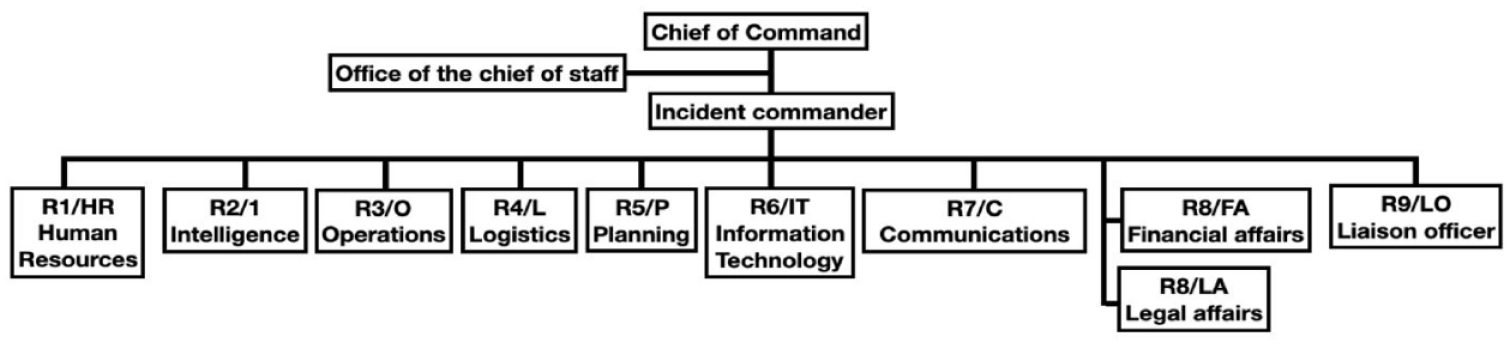
Incident command structure.
The scenario
TWD has run for 11 seasons, with 172 episodes, from 2010 to 2022. Viewers follow a group of survivors in a world inhabited by the living dead who feast on human flesh, and other survivors who can be more dangerous than the zombies. More than 10 years pass between the outbreak and the latest episodes. During this time, survivors are called upon to act in ways that are both morally and ethically questionable. There are no easy answers. When resources including medicine are scarce, there is no infrastructure to rely on to solve conflicts, there is imminent danger to the lives of loved ones, emotions run high, and leadership roles are fragile. TWD, therefore, does not offer leadership success recipes so often used in leadership development (Lalonde and Roux-Dufort, 2013). To help the workshop participants to use their imagination, we followed an inductive pedagogical approach. For an “inductive process, no theory is presented” in advance of the workshop which allows students to generate their own theory and to generalize concepts (Lee and Lo, 2014: 45). Lee and Lo (2014) found increased knowledge retention with this method, compared to a deductive approach.
For pedagogical purposes, we chose a 2-minute sequence from TWD season 2, episode 13. This clip provided us with an “attention getter, a discussion generator [and] a point illustrator” (Ender, 2019: 62). First, the sequence highlights the trade-off between authoritative and collective leadership, which the incident command team struggled with. The sequence also highlights the lack of infrastructure, such as a civilian support system, a military, a police authority, or a judicial system—which had been touched upon within the team already. Second, the clip requires the survivors to create an emergent leadership structure. Third, the situation forces the team to reflect upon the survivors’ immoral actions. Because of the situation, the survivors must quickly decide whether actions are justified and how to continue.
The sequence describes how Rick Grimes, a deputy sheriff, finds himself the reluctant leader of a small group of survivors after a zombie outbreak. Internal and external conflicts have led Rick to kill his best friend (Shane). Shortly after that, their farm is overrun by zombies. Some survivors are killed—due to indecisiveness, team dynamics, and conflicting goals. When questioned about his leadership, Rick, half-pointing his gun toward the group, tells them that he is keeping them alive, that he has killed his best friend for them, that they might be better off without him, and that they should try their own luck. Finally, in frustration Rick exclaims that if the rest of the survivors follow him, “this ain’t a democracy anymore.” As a pedagogical scenario, it challenges students to consider “what if” the world, as we know it, ain’t no more? “What if” there is no infrastructure? Can morally reprehensible actions be justified? “What if” someone claims that teamwork is no more? Can we survive? “What if” someone takes the position of a dictator to ensure survival?
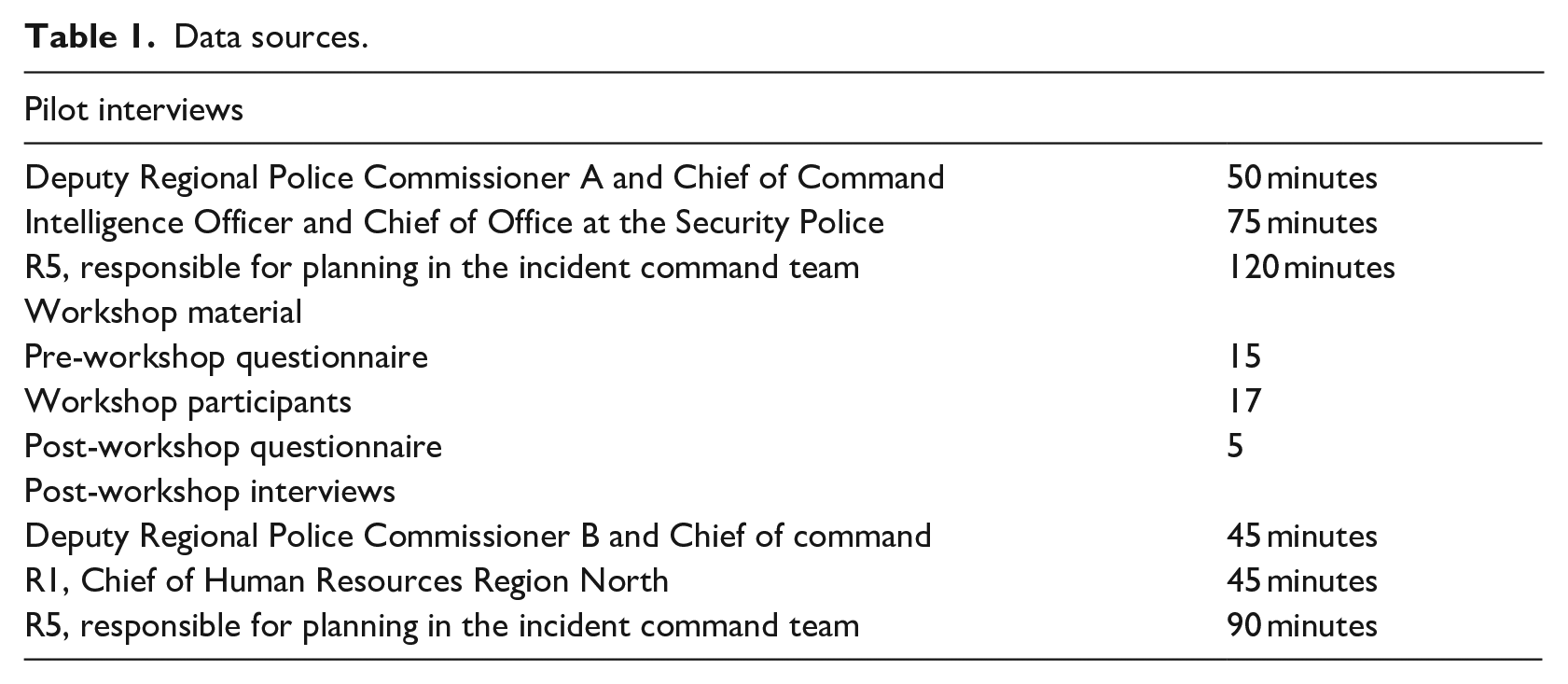
We first tested this scenario in three pilot interviews, ranging from 50 minutes to 2 hours, to explain the aims and background of the scene. After watching the sequence, interviewees reflected on the content prompted by questions about leadership, teamwork, and the COVID-19 response. Based on their feedback, we developed the 1-hour workshop design. Before the workshop, we sent participants a short questionnaire. After the workshop, we circulated another short questionnaire, and interviewed three participants (Table 1).
Data sources.
Before the workshop
We sent the workshop participants a one-page briefing a week in advance. This covered:
the workshop aims
background information on TWD
information about the scenario they were about to watch.
Before the workshop, we asked participants to respond online to six questions:
What are Rick’s strengths as a leader?
What are Rick’s weaknesses?
If you were leading a group of survivors in this crisis, which attributes would you copy from Rick?
Which of Rick’s attributes would you avoid?
Crisis leadership implies rapid, decisive decision-making. Is there no role for teamwork?
What two key lessons about crisis leadership can the incident command team learn from the experience in dealing with the COVID-19 pandemic?
During the workshop
From the incident command team, 17 members participated. Because of the COVID-19 pandemic, a geographically distributed audience, and technological limitations that did not allow for break-out rooms, we opted for a “fishbowl” method. We divided participants into four groups of four or five participants. The fishbowl method allowed each group to discuss the questions for 10 minutes while the others were listening, followed by 5 minutes for the others to comment (White, 1974). The discussion flowed freely with minimum prompting.
Data analysis
We subjected the data collected before, during, and after the workshop to thematic analysis (Corbin and Strauss, 2015). The aim was to explore the potential of extreme fiction as a pedagogical tool for leadership development. Working with an inductive pedagogical approach (Lee and Lo, 2014), we began by grouping the material according to the questions’ themes—leadership strengths and weaknesses, the role of the team, attributes to copy, and implications for practice. We coded the themes by looking for commonalities and by gradual fine-tuning across the text sequences. These sequences could be a sentence, a paragraph, a monologue, or a conversation between participants. For example, we identified “decisive” as a strength attribute. Some codes were shared across themes, for example “situatedness” linked leadership attributes and teamwork themes by suggesting that decisive leadership is useful under time constraints, but teamwork is critical in the long term (see Tables 2 and 3 for coding themes and empirical examples). Importantly, consistent with an inductive pedagogical approach to using fiction, no literature on crisis leadership was given to participants before the workshop.
Rick’s strengths and weaknesses as a leader.
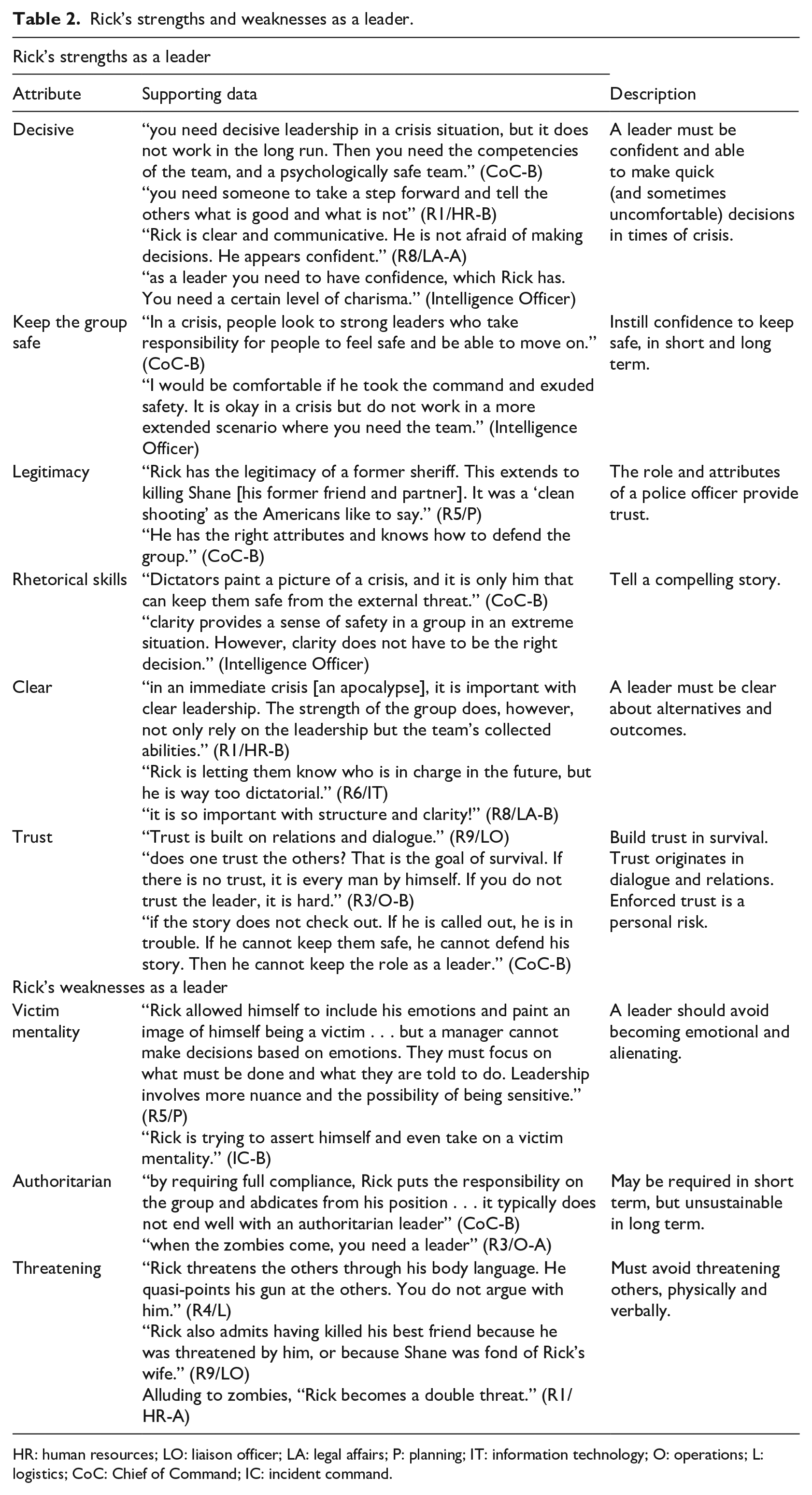
HR: human resources; LO: liaison officer; LA: legal affairs; P: planning; IT: information technology; O: operations; L: logistics; CoC: Chief of Command; IC: incident command.
The role of the team.
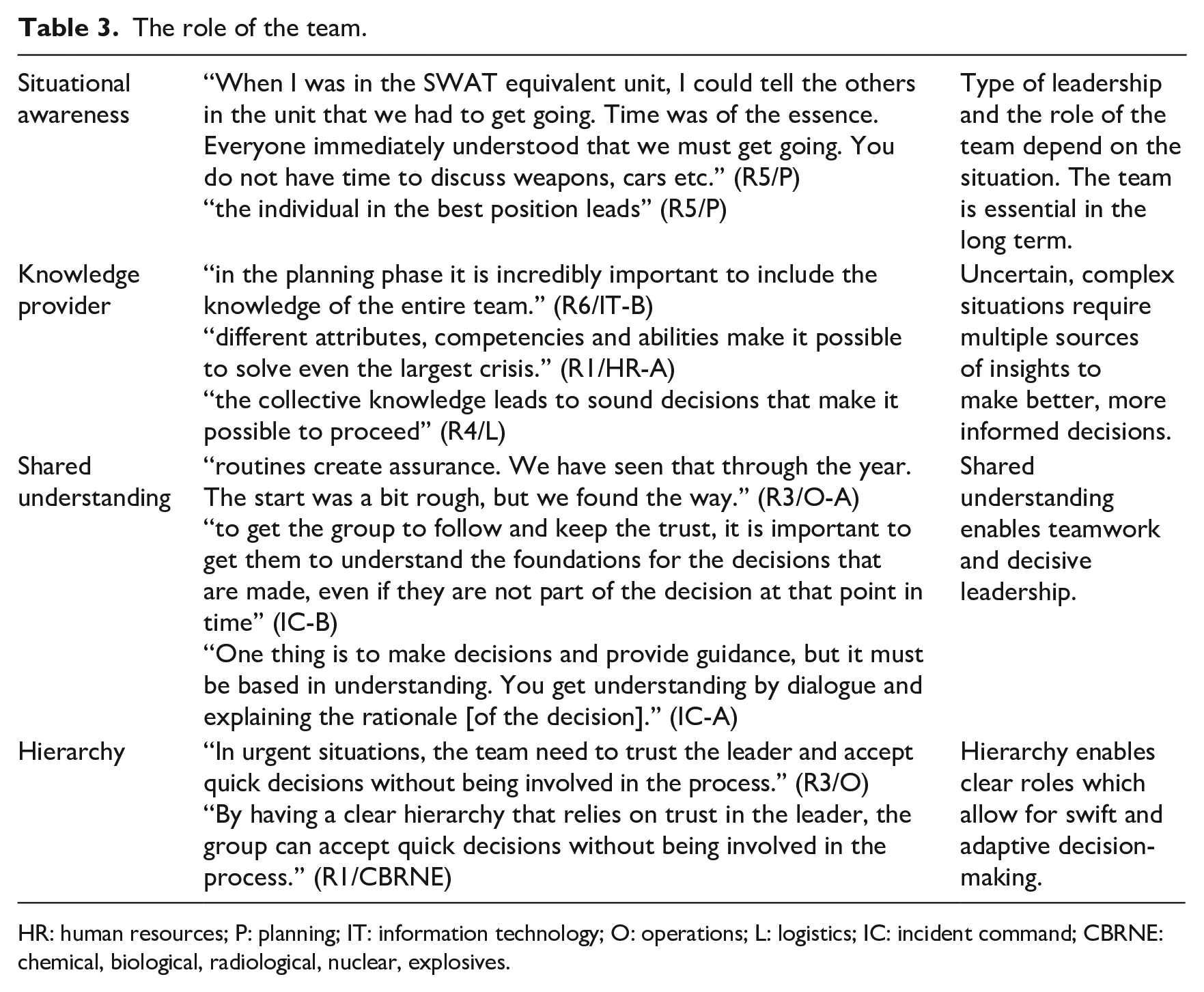
HR: human resources; P: planning; IT: information technology; O: operations; L: logistics; IC: incident command; CBRNE: chemical, biological, radiological, nuclear, explosives.
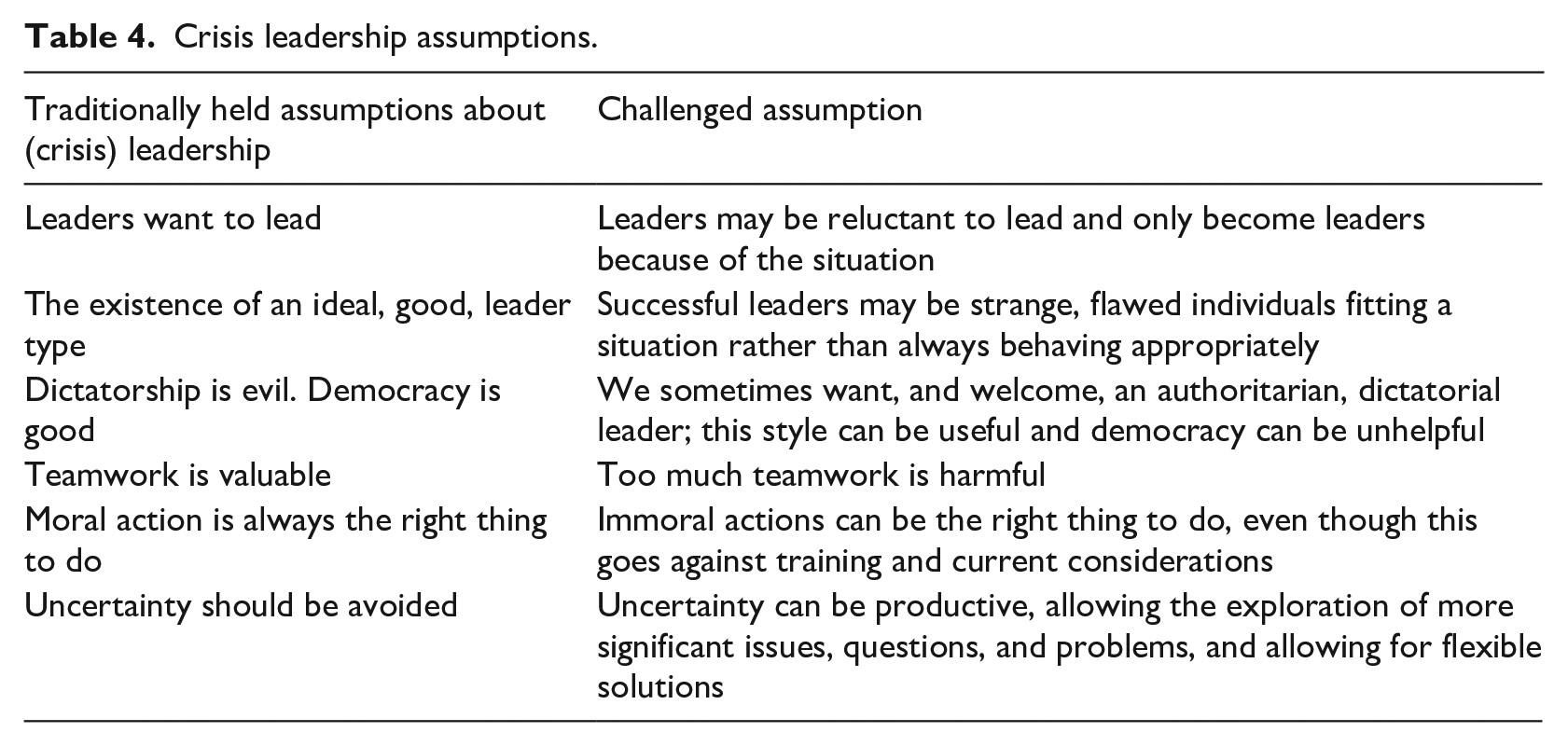
Next, in two conceptual leaps (Klag and Langley, 2013) and with “disciplined imagination” (Weick, 1989), we went from raw data to theoretical conceptualization. The conceptual leaps benefited from the first author preparing the coding, which was iteratively discussed with the second author. The first leap consisted of returning to the empirical material, coding for sequences where the team seemed to hesitate because it challenged assumptions of crisis leadership. For instance, the proposition, that “it could be good to have someone that decides. A dictator,” was followed by a discussion of pros and cons. The following themes were identified: the ideal leader, dictatorship as evil and democracy as good, teamwork as valuable, moral actions always being appropriate, and uncertainty avoidance (see Table 4, and the quotes in the findings). Drawing upon insights from previous analytical steps, the second leap consisted of inductive coding for the benefits of extreme fiction. Similar to the previous steps, this coding relied on guided imagination and themes that arose from the participants’ discussions. For instance, “Perhaps we are a bit lost as an organization” (R3/O) was coded as “problematizing” the organization. We noted six ways in which workshop participants considered extreme fiction helpful: a common baseline, problematizing, forced creativity, learning transfer, resilience, and preparation (see Figure 2, and the quotes in the findings).
Crisis leadership assumptions.
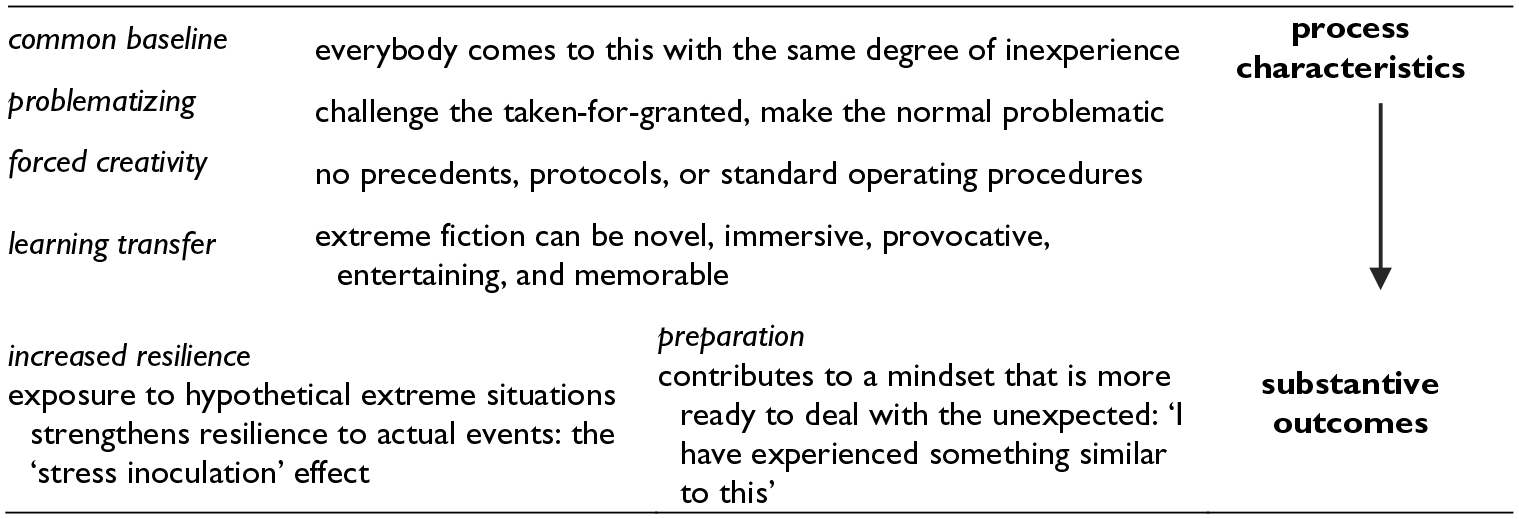
Leadership development benefits of extreme fiction.
Findings
Rick’s leadership style and teamwork
Workshop participants discussed Rick’s leadership style and behavior at length. Some leadership attributes discussed in the literature were considered. In most instances, Rick’s leadership weaknesses were seen as a negative reflection of his strengths, indicating that there is such a thing as too much of a strength, and too little of a weakness. The combination of strengths and weaknesses was seen as enabling a leader to adapt and remain flexible when the situation changed—as it is likely to do in a complex, unimaginable crisis. These reflections were often prompted in discussion by another participant (see Table 2)
While an assertive and decisive, even dictatorial, form of leadership was considered useful in a severe crisis, the participants highlighted the importance of involving the team in any long-term solution. Rather than solving the immediate problem, the team would provide knowledge and experience (see Table 3).
Broadly repeating the tension between individual and collective forms of leadership, Tables 2 and 3 describe the themes and set the scene for how the participants discussed leadership and teamwork. Notably, the attributes that the participants wanted to copy or avoid from Rick are a combination of aspects of Rick as a leader and the importance of teamwork. In uncertain and complex situations, they would prefer Rick’s decisiveness and ability to adapt, his rhetorical skills, and his clarity. These traits are juxtaposed with the need to create a shared understanding of the importance of the team and their abilities. These discussions allowed the participants, without theoretical prompting, to reimagine crisis leadership and explore the value of extreme fiction as a pedagogical tool.
Reimagining crisis leadership
We find that the participants challenged traditionally held assumptions about (crisis) research in six ways. These challenged beliefs show how the example of extreme fiction allowed the participants to complicate a seemingly simple situation and, in the process, challenge and reflect upon their existing assumptions and practices associated with crisis leadership (see Table 4 summary). The workshop format helped to align the group, but they did not reach a consensus. This suggests that extreme fiction opened fresh dimensions to discuss. It also showed the participants that formulaic methods and tools rarely apply to complex situations.
Next, we provide evidence for the ways in which the assumptions were critically assessed.
The emergence of reluctant crisis leaders
A common assumption in leadership research is that people want to become leaders and that leadership revolves around people taking initiative. The reluctant leadership identified in the discussions is different. Our findings suggest three aspects that may create a reluctant leader in a crisis: need for novel skill sets, urgency, and dependence.
Need for novel skill sets
Knowing which skills are necessary for survival in unimaginable crises is difficult as we have no experience, nor do we know how people will react. Broadly, novel skill sets are not considered essential during “normal” conditions. We see that extreme fiction allows the participants to play around with ideas—for instance, the value of having the ability to kill or to navigate.
One individual can hardly have all the skills to survive an unimaginable crisis. This is where the group’s knowledge, skill, and experience become valuable. Consequently, a leader “should inventory the skills within the group. Is there someone that can make coffee? Who is holding the gun?” (IC-A). The clip situation was also compared to the pandemic and how it created a fuzzy problem that was difficult to approach. However, participants resolved the situation as “everyone brought their knowledge, and we solved the problem” (R8/LA-B). The discussion also showed that Rick’s skills were considered to make followers of others. After all, as IC-B said, “I would appreciate the skill to kill. Everyone cannot kill. If he can kill his friend, he can kill zombies. I would appreciate that.” Although said jokingly, killing one’s friend is rarely considered a desirable leadership skill.
Urgency
In a crisis, urgency matters. We conceptualize urgency as the perceived amount of time available for making decisions and considering alternatives. From the discussion with workshop participants, we see that urgency sometimes forces followers to follow, rather than providing realistic opportunities for people to choose for themselves.
TWD, as a TV series, is informative for suggesting that urgent action may represent the difference between life and death. Even if few of the participants were familiar with the TV series, it was intuitively understood that zombies are a problem that requires any survivor’s attention. Highlighting the urgency and forced compliance, it is suggested that, ideally, any decision in a group should involve the group members, but “it depends on the degree of crisis acuteness. From a short perspective, teamwork is probably less relevant; then there is a need for a leader who yells, ‘Everyone runs right. NOW!’” Linking urgency with long-term effects and the importance of the team, the HR representative continues, “but teamwork is critical if the crisis is really to be managed. Only a difference in capabilities can, in the long, solve even the largest of crises.” The comment is consistent with others’ contribution, for instance, R3/O-B, “in some situations, there is plenty of time to think, ponder and discuss. Other situations require immediate decisions!”
We see from the participants’ reflections that by distinguishing between short-term and long-term effects, urgency changes which actions become available and how inclusion is achieved. Who becomes the leader may, thus, be an accidental consequence of available time and opportunity for which the individual has not asked.
Dependence
A common way to approach leadership is to distinguish leaders from followers. However, urgent situations that require unique skill sets may encourage followers to put reluctant individuals in a leadership role. We conceptualize dependence as someone’s actions being critical to others’ survival. This dependence is illustrated by the workshops’ TWD clip.
The clip begins with Maggie telling Rick to “do something.” Raising his voice and waving his gun, Rick responds angrily, “I am doing something! I am keeping this group alive.” This “describes the situation as if it is him alone that keeps the group alive” (IC-B). The participants identify a concern in the way Rick is leading the group, as “he is assuming leadership for his survival. He is not interested in leading the group forward. He wants a better position. Still, he is not interested in the group’s survival” (R4/L), and “Rick is making his own decisions, which triggers the situation” (R3/O-B). The continued discussion suggests that “this is what despots do. When there is shaky leadership in a nation or a group that is challenged, they initiate violence. Some of these people probably depend on others for survival” (CoC-B). Participants largely agreed that by drawing an image of the others being dependent on him, Rick diminishes the others’ skills to keep the group alive, effectively making himself a leader even if he claims he does not want to be.
Dependence comes in many forms, psychological and physical. In an acute situation, it may involve abilities and skills that few have. In this case, the leader acts in his interest without a recognized concern for the group. The survival of the group is more of a side effect of his actions. However, he is recognized as having a unique skill upon which the others rely.
In sum, TWD—an extreme fiction—challenged the assumption that the typical leader wants to be a leader, and that specific skill sets are attractive. Less-considered skills may make people dependent on individuals who have them, mainly when the situation is urgent, and it becomes difficult to consider alternatives. Therefore, leaders who are reluctant to lead may emerge.
Despite similarities in experiences and training, workshop participants did not all share the same view of leadership. However, some similarities were discussed, such as the importance of leaders having legitimacy, the detrimental effects of making a victim of oneself (see Tables 3 and 4), and that leaders do not always emerge through expected trajectories (see “The emergence of reluctant crisis leaders”). The notion of the ideal, moral leader was challenged to the point that dictatorship could be of value.
The ideal leader
The discussions revealed that there is no such thing as an ideal leader. In an urgent situation, someone needs to take command and give the others directions. But this comes at the cost of democracy and teamwork, as it does not involve others in making those decisions. Prototypical comments about the ideal type of leadership in a crisis included “you need decisive leadership in a crisis” (CoC-B). In urgent situations, a group will need someone “to take a step forward and tell the others what is good and what is not” (R1/HR-B), and “in an immediate crisis, it is important with clear leadership” (R1/HR-B). By entertaining these ideas, the participants suggested that successful leaders are not necessarily “good” leaders. For instance, Rick was recognized as having killed his friend, but also able to keep the group alive thus far (by killing zombies, friends, and enemies alike). The ideal leader is thus decided less by their traits and attributes and more by what fits the current situation.
Some of Rick’s clarity follows from “letting them know who is in charge in the future, but he is way too dictatorial” (R6/IT). Reflecting upon leadership and summing up much of the discussion, Chief of Command B, who arguably had the most experience in the group, suggested in an interview that: Successful leaders are strange people. They are not always good leaders. They have had qualities that make them successful at their thing. To achieve the goal, you cannot always be the perfect leader, even if you are convinced it is the right thing to do. Democracy is good but not always perfect.
Dictatorship is valuable, democracy is unhelpful
Dictatorship is typically considered as unhelpful, harmful, and evil, as democracy is deemed valuable, harmless, and good. The workshop format with the example of extreme fiction challenged these traditional assumptions. For instance, as illustrated by the following conversation, when discussing authoritative leadership, participants discussed how easy it is for past and current populist leaders to cause political instability and “paint a picture of a crisis, where it is only them that can keep others safe from the external threat” (CoC-B). Reflecting on the experience of the pandemic, he continued, it could be good to have someone that decides. A dictator. But what are the implications for us? Why? Why not? There are certainly winds that call for more authoritarian leadership. Why is that wind blowing? What are they lacking?
While the incident command members would all reject the idea of having a dictatorship, they entertained the thought that it has value in certain situations. When someone takes command, followers enjoy clear instructions as the leader absorbs the uncertainty on their behalf, and “one wants guidance when you are lost yourself” (CoC-B). By absorbing the uncertainty, a decisive and authoritarian leader “enables the group to move on” (CoC-B). This is, perhaps, particularly valuable in extreme situations, as safety is a significant concern and “clarity provides a sense of safety for a group in an extreme situation. However, clarity does not have to be the right decision” (Intelligence Officer). Particularly in the long run, authoritarian and decisive leadership is believed to be detrimental as it hinders the use of “the team’s collected abilities” (R1/HR-B). The discussion thus shows that sometimes a group must feel safe to operate efficiently and deal with immediate threats unique to extreme contexts where people otherwise may be hurt or killed. The way the benefits and drawbacks were discussed is also reflected in the following exchange:
In a crisis, one cannot organize a workshop. Someone must take command! Perhaps it is not good in the long run, but in the short run, it is needed.
Could I challenge you? It is easy to fall into that trap. When do you stop relying on the authoritative leader when there is no end to the situation? What responsibility do you take? Very few have voluntarily given up their power.
Perhaps it is like peeing in the pants. It is nice and warm, to begin with, but soon gets wet and cold.
Returning multiple times to the benefits and drawbacks of authoritative, dictatorial leaders, the discussion did not reach a shared conclusion. However, different views and perspectives were shared, ranging from involving the team to needing someone to take command. Interestingly, even if Rick’s leadership style was seen as problematic, it was also defended as possibly required because the participants did not have the entire picture to pass judgment.
Is teamwork always of value?
If dictatorship could be valuable, even asked for, is there a value to teamwork? Throughout the conversations, too much authoritative leadership was considered detrimental to teamwork, and too much teamwork would hinder effective leadership and skill management. The value of discussing the potential drawbacks and benefits of teamwork is illustrated in the following conversation:
Teamwork, does it mean that everyone gets their way?
Perhaps, if you have a shared goal?
Perhaps teamwork creates acceptance and an understanding of why you should do something?
Teamwork, to me, is to utilize everyone’s capabilities. Accounting for the capabilities of everyone, you do the best out of the situation. It is different from a democracy.
Reflecting on teamwork as suggested by the prompt questions, participants voiced a concern that the organization could have, perhaps, gone too far with the idea of teamwork:
Perhaps we are a bit lost as an organization. Teamwork is essential, but it does not mean everyone gets their way. The plan of one person might depend on someone else doing their part. If they do not, the entire plan falls.
This shows how there is such a thing as too much teamwork, but the previous conversation also reflects that teamwork is essential for survival, as different skills will be needed. Therefore, on the positive side, the extreme fiction exercise also allowed participants to see the strengths of the organization and the team differently:
If you have the zombies after you, you need to inventory your skills in the group or the incident command. Who is the weapons expert? Who can make a fire? It is the same with the incident command methodology. You need to trust the structure.
You are right! It is a strength, and it was our starting point. Initially, the situation was ambiguous, but we all approached it from various skills and resonated about how we should do it. Then we talked about what to do. That is great!
By discussing the clip’s content, the participants revealed novel ways to view the organization and how teamwork and leadership are reflected in their current practices.
Morality
Some participants’ reflections were profoundly personal despite the short time spent on the clip and the exercise. Reflecting on Rick, some participants said it would “be difficult to know how I would behave . . . one is not always your best self” (CoC-B), and others would question what the expectations would be from them as team members and whether they would challenge Rick on behalf of the group. Ultimately, Rick has proven to be violent; he is agitated in the clip, and he waves a gun in the direction of the group; “it would not be easy to challenge Rick. Would it be expected of them to challenge him? Would I?” (IC-B). Brief but rich in content, the clip thus allowed the participants to reflect on the rise of authoritative leaders, the possible value of such leadership, and their own moral boundaries. Like Rick, dictatorial leaders portray themselves as the solution; “It is dirty, but it works. It becomes a question of morality. Should one use it?” (R3/O-B).
Uncertainty avoidance
Uncertainty can be productive and allow us to explore otherwise hidden issues, questions, and problems. The workshop participants all had experience dealing with the COVID-19 pandemic for the past year. One of the team’s significant challenges was the constant uncertainty about how the pandemic would evolve, how it would impact the organization, and when it would end. Without a clear end, recent experiences thus resembled those of a zombie apocalypse (and the clip), where events take unexpected turns, and the end is unclear. As part of the fieldwork with the incident command, we noted the continuous challenge of considering “what if?” More importantly, in a subsequent meeting, we saw that the workshop had legitimized the existence of uncertainty and helped to challenge assumptions about the future. During another meeting to considering the future, how the virus could evolve, and how the team could prepare, the R1/CBRNE representative, who, based on his expertise, knew most about pandemics, painted a gloomy picture that set the participants back:
That dystopian outlook was not a punch in the gut but made us lose the air.
If we compare ourselves to the UK, we can see that we are going in the same direction. It is not over yet. We cannot relax! We should be worried about the fall [of 2021].
The dystopian outlook prompted the meeting participants to suggest a similar workshop design to discuss “the big questions” they are “not used to discussing,” for instance, implications of “working from home,” “more dystopian evolutions of the virus,” or the “consequence of continuous risk and need for planning.” Similar points were raised the next day in a meeting which discussed how quickly situations could evolve and become challenging.
While this section provided us with an opportunity to show that extreme fiction can help to challenge assumptions about crisis leadership, the next section will explore more in depth why it is so.
The value of extreme fiction
The workshop demonstrated six ways in which extreme fiction benefited the police authority (Figure 2). Participants reflected on their own working practices through what they saw in the TWD sequence that they were asked to view.
Common baseline
Participants all start with the same level of (in)experience concerning the setting and the issues. With traditional case studies based on actual events and incidents, some participants will have worked with similar situations before and will be more prepared in their thinking—and thus dominate, and potentially narrow, the discussion. For instance, “The case is hypothetical, but that is always the case until it is real. But, to the best of one’s abilities, one can try to put oneself in such a situation” (R8/LA).
Problematizing
Through normalization processes, organizations take things for granted. Fiction not only forces creativity, but can problematize current thinking and challenge what is good and bad, useful or not useful, and effective or ineffective. For instance, much of the discussion focused on the pros and cons of dictatorship, a topic that most organizations would find problematic but, in this setting, seemed normal. This allows participants to change their vantage point and see that there are few simple answers. The case also problematizes other aspects, including what teamwork is, and personal reflections; “I feel like Rick!” (IC-B).
Forced creativity
As the extreme setting does not mirror reality, there are no precedents, no manuals, no set answers, and no standard operating procedures. Participants are encouraged—forced—to take a creative approach to developing appropriate actions and solutions. This means considering novel possibilities which may not have been considered with a conventional approach and, although based on a fictional account, could mirror future real crises in some regards. For example, as offered by the Chief of Command B, “the case is interesting because it is edgy. It is interesting to reflect upon different types of leadership.” The Head of Human Resources reflected that, “we tend to return to the routines and how to do things. We need to be pushed back. We need the freedom that fiction provides to think differently. It is a lot easier with fiction.” Others found the “discussion on how we are scared into following dictators (Hitler, etc.) thought-provoking and frightening” (R7/C). Thus, fiction not only opens new ways of thinking, but also challenges current operational practice.
Learning transfer
Extreme fiction for leadership development is unusual, novel, entertaining, and memorable. These characteristics are aids to the retention and transfer of learning back into the organization. For example, the legal affairs representative discussed the case with her partner as the content lingered in her mind. Learning the importance of structure and leadership which clarifies the goals and expectations of many, “roles should be on standby when there is a decision to work according to the incident command methodology. Then you would have the mental preparedness and decisiveness to start with” (R4/L). Others noted the threatening body language and the gun-waving as something they would never do. The Intelligence Officer also connected the case to her experiences dealing with an alleged terrorist and how easy it is “to develop a tunnel vision. You need to have a clear organization and role distribution. You cannot do everything.”
Resilience
Research suggests that exposure to fictional extreme settings can strengthen resilience to actual events (Biehl, 2023; Janis, 1989; Scrivner et al., 2021; Seifert and Clayton, 2021). The ability and the mind-set required to deal effectively with the unexpected are strengthened by exposure; “it is difficult to be prepared for the unknown” (R1/HR-A), but the case helped her to imagine a different future.
We were “lucky” in the pandemic. What if the situation had been different? If it had influenced the police to a greater extent and what if it had targeted primarily children and young adults? It will be really important with future planning and that we consider what may come our way (hopefully not zombies!).
Preparation
Exposure to extreme fiction can be valuable for dealing with the unexpected. It helps in a real crisis if you can say, “I have not seen this before, but I have experienced something similar.” For example, R8 (LA) asked herself, “Who would I be in this situation?” The CBRNE role (R1) suggested that the workshop discussions will “be useful in a preventive and planning phase. When the crisis is a fact, one will work on instinct and experience, then there is little time to change and develop the organization.” As seen earlier, the case also showed the importance of routines. Discussing unimaginable scenarios, therefore, prepares the individual’s and the organization’s crisis leadership approach.
This use of extreme fiction shows how exploring a possible future encourages participants to reflect on the present and the near future, and liberates open discussion of sensitive issues. To summarize, the benefits reveal four process characteristics where extreme fiction establishes a common baseline that allows students to problematize and be creative. Through the immersive and provocative setting, it becomes acceptable to challenge taken-for-granted assumptions. The students’ immersion in the material leads to two substantive outcomes as they become familiar with uncertainty and have learned to consider alternative pathways. This leaves the organization better able to deal with “what if?” scenarios (see Figure 2).
Discussion
This article has aimed to explore the potential of extreme fiction as a pedagogical tool by demonstrating how extreme fiction can help challenge crisis leadership assumptions and reimagine crisis leadership development. We did this by designing a workshop based on a 2-minute sequence from the popular apocalyptic TV series, TWD, for an incident command unit within the Swedish police force. The workshop explored crisis leadership issues arising from unimaginable unprecedented events.
Assumptions of crisis leadership in extreme contexts
There are many strongly held assumptions about leadership. As a token of the strengths of these widely shared assumptions, Haslam et al. (2024) noted that some refuse to die even if they are repeatedly debunked (see also Boonstra, 2023). If assumptions go unchallenged, the foundation becomes unstable. This impacts how leadership is conducted in practice, understood in theory, and taught to students. Some more strongly held assumptions include that most crises will be successfully managed if the right leader is present. Furthermore, it is assumed that the ideal leader would and should willingly step forward, assume control, and absorb the uncertainty of the situation for others. Drawing on these strengths, the leader should create a cohesive, democratic organization whose members handle the crisis by applying known methods and structures. The logical outcome is that weaknesses, immorality, and violence are to be avoided (Badura et al., 2020; Hällgren et al., 2018; James et al., 2011; Riggio and Newstead, 2023; Williams et al., 2017). Yet, through the choice of our film clip, our findings suggest that these traditionally held assumptions deserve to be questioned. For example, current thinking may limit theoretical insights by not exploring the benefits of weaknesses. By considering the benefits of weaknesses, students are exposed to the idea that there are few easy fixes in complex present or future situations. Consequently, commentaries may not always provide helpful practical guidelines for crisis leadership development (cf. Heino et al., 2021; Lalonde and Roux-Dufort, 2013). This suggests that educators must find ways to teach students to challenge what is considered sacred, which may enable students to become more flexible and reflective in their responses to a crisis.
Our findings showed that extreme fiction allowed the participants to inductively “test-drive the future” (Rouleau et al., 2021), by reimagining conventional aspects of crisis leadership. Worth noting is that we did not introduce any leadership theory, nor assumptions, in advance of the exercise. We thus suggest that the critical appraisal originates in the choice of extreme fiction as a pedagogical tool. We identified six ways in which workshop participants challenged traditional assumptions about crisis leadership (Table 4). As recognized by the literature and the workshop participants, leaders have strengths and weaknesses (Tables 2 and 3). Instead of assuming that crisis leadership should build on strengths and avoid weaknesses, for instance, by applying a contextually driven “best in team” approach (Denis et al., 2012; Gronn, 2009, 2011; Oc, 2018), we find that successful crisis leaders may actually benefit from being flawed. This is because, in some contexts, there can be too much of a good thing (positive attributes and traits, democracy, teamwork, and moral action) and, more controversially, sometimes too little of bad and even evil things (e.g. negative attributes and traits, dictatorship, authority, and immoral action). Focusing on building strengths and avoiding weaknesses, therefore, limits the leadership repertoire. In many crises, there are few easy or correct answers. Recognizing the value of being flawed allows for flexibility in the approach for dealing with rapidly changing circumstances which may be unexpected and novel. Considering the benefits of weaknesses holds potential to serve the individual and organizations. In addition, new routines can be considered, as seemingly simple solutions that may lead to problematic outcomes can be identified, and an understanding of various competencies can be gained. Drawing on this, we theorize that leaders can use strengths and weaknesses—in other words, leaders benefit from being “flawed.”
Considering the rarely recognized benefits of being flawed has implications for crisis leadership development. We are not arguing that structure, tools, processes, and good leaders with a sound moral compass are unimportant for consistent and efficient operations. These attributes are essential for the legitimacy of the police force in a democratic society. However, our findings suggest that instead of rejecting weaknesses without consideration, training in crisis leadership should include discussion of “flawed” behaviors. By doing so, students would, on the one hand, learn to nuance their repertoire and understand that sometimes being weak (not to be confused with showing vulnerability) or even acting badly could be the best way forward in some circumstances. This would benefit crisis resolution and avoid mono-dimensional and formulaic approaches to crisis leadership that risk doing more harm than good. On the other hand, by juxtaposing and challenging what are considered “strengths” and “weaknesses” and the potential consequences, students also develop a deeper understanding of what they are doing well and how well-meaning actions can produce bad outcomes. The fact that students were able to identify how these aspects related to their practices attests to the role of extreme fiction in making organizational behaviors salient.
Through our research, we have thus been able to demonstrate the role of extreme fiction in creating a learning situation where previously held assumptions can be discussed. For students, this demonstrates the potential value of extreme fiction for discussing topics normally perceived as out-of-bounds. Opening up the boundaries, in turn, invites reflection and development among students. From a pedagogical point of view, as Haslam et al. (2024) note, the dangers of holding on too strongly to some assumptions include that they reproduce stereotypes of who a leader is, how they behave, and what the results can be. To prepare students for a future and avoid unfortunate reproduction, we need tools that allow us to put the searchlight on problematic issues.
The value of extreme fiction as a pedagogical tool
Using fiction for theory development or educational purposes is not new (Holbrook, 2009; Kankal et al., 2023; March and Weil, 2009; Munyon and Summers, 2024; Otto and Strauß, 2019). However, much fiction-based literature has focused on “what happened?” (Holbrook Jr, 2009), or discusses contemporary phenomena in a realistic setting to problematize a phenomenon and discuss the implications to existing practices (Ayikoru and Park, 2019; Bröchner, 2021). Whereas realistic fiction gives access to hard-to-access settings (Czarniawska and Rhodes, 2006; Gehrs, 1994), it does not provide access to what has not yet happened. Therefore, important and beneficial for exploring the messiness of organizational life (Buchanan and Huczynski, 2016), realistic fiction risks producing efficient but formulaic solutions to novel problems as students “know” what to expect and do (Lalonde and Roux-Dufort, 2013; Sullivan-Taylor and Wilson, 2009; Weick, 1989, 2005, 2016). This has limited the contextual sensitivity to surprising extreme contexts and, therefore, how we understand such settings (cf. Hällgren et al., 2018; Johns, 2006). We propose that extreme fiction is one way to address this shortcoming in extant theorizing and pedagogy.
A contrasting risk is the common concern that extreme fiction is irrelevant in a professional leadership development context because it is unrealistic and imaginative (Lalonde and Roux-Dufort, 2013). We did not find this to be the case. Instead, extreme fiction is valuable because it is imaginative and unrealistic. First, it is up to the instructor to introduce the pedagogical tool and establish its relevance. For instance, by showing how fiction was useful for identifying the possibility of using commercial airplanes as tools for terrorism (Weick, 2005), or as a pedagogical tool for political processes (Drezner, 2015). By considering alternatives, students are required to problematize and be creative. This enables the consideration of fresh perspectives that few have considered before. We show, for instance, the value of being flawed, or the detrimental consequences of providing “comfortable” answers. Second, the value of extreme fiction as a pedagogical tool, first and foremost, depends on the students. The way in which students interact with the material will impact the value of the approach. For instance, if fiction is used to reinforce differences, such as gender stereotypes, without a critical discussion, it may be harmful (Hannah and Wilkinson, 2014). Rather than reinforcing stereotypes, we find that extreme fiction challenges the typical by challenging traditionally held assumptions. As already discussed, by reflecting upon “strengths” and “weaknesses” in leadership behaviors, students gain a deeper understanding of their present and future practices. Third, we show how each aspect of Figure 2 (leadership development benefits of extreme fiction) follows from using extreme fiction. If the workshop had been organized around a sequence from the police series The Wire (Holt and Zundel, 2018; Penfold-Mounce et al., 2011), some police officers would have had such experience, but not the civilian staff (e.g. Human Resources). Furthermore, the experienced officers would most likely identify (and critique) proper behavior, and the realism of the fiction. Instead, the shared baseline with extreme fiction allows imagination without falling back on a “correct solution,” and it is difficult to critique the realism of the practices as there are none to juxtapose. By asking “what if?,” extreme fiction challenges existing knowledge—what could happen if the situation were like this. This leads to intellectually unrestricted conversations (Hamilton, 2022) where the “what if?” question invites the audience to consider how they could behave in a situation where there are no guidelines, rather than traditional, realistic case-based education that focuses on how do I, or how should I (or we), behave. Suggesting that provocative discussions are helpful, extreme fiction increases resilience by exposing students to the unfamiliar and unexpected in preparation for the “unknown unknowns,” by providing few answers but posing many questions about current operations and the future. By learning to ask questions and be comfortable with uncertainty, students remember and learn how to cope with the unknown. This would be particularly important in the face of asymmetric threats (Coker, 2013), where there are few correct answers.
Our point is that extreme fiction creates an immersive experience distinct from most other educational methods by requiring students to consider alternative realities (Knowles et al., 2019; Thompson and Byrne, 2022). Extreme fiction provides novel experiences that facilitate reflection on such occasions. By exploring unimaginable scenarios, extreme fiction provides access to discussions about values, emotions, and insights into differences between textbook solutions and reality (Bröchner, 2021; Otto and Strauß, 2019). In other situations, discussing stereotypes, values, and emotions can become mono-dimensional and follow expected patterns. But, by creating a level platform for discussion, we find that extreme fiction creates a learning situation where there are no “rights” and “wrongs” and students have the same knowledge base. We suggest that this creates a less judgmental and more creative learning situation that benefits leadership development within a broad group of students.
Why is it important to imagine extreme future events? Mark Twain allegedly said that “history may not repeat itself, but it does rhyme.” The COVID-19 pandemic showed us who and what mattered, ranging from parcel and food deliverers through cleaners to scientists working on a vaccine (Rouleau et al., 2021). The tasks of these essential and skilled workers are often taken for granted. The next event may not reproduce these patterns. For example, oil drilling roughnecks may become essential if there is an asteroid threat, as in the movie Armageddon (directed by Michael Bay, 1998). Using extreme fiction helps to better prepare by discussing possibilities, skills, and challenges. Our findings suggest that students discover that seemingly simple solutions may be problematic by exploring the unimaginable. Skills they did not think of could be instrumental. In short, extreme fiction helps us to consider “what if?” rather than “what happened?”
Limitations and future research
All research comes with limitations. Ours is no different. First, this article is based on research with one organization that is skilled at leading and managing crisis events. In other organizations, the discussions could potentially be different. However, outside of the scope of this article, we get similar results with three cohorts of master students (>200 students), suggesting a broader pattern. To ascertain that this is the case, future research should explore a broader group of students. Second, the previous point links to another potential issue: the fit with the audience. We wanted our case to work as an attention getter, discussion generator, and point of illustration (Ender, 2019). However, like other case-based research, it is essential to consider what this is a case of (Langley, 2021). This case exemplifies the tradeoff between leadership practices, a lack of infrastructure, and immorality. Extant research has not elaborated on how to find suitable fiction, and future research could therefore explore the methodological choices involved with choosing the extreme fiction example. Third, extreme fiction may reinforce stereotypes, such as gender differences and skin color (Bell and Sinclair, 2016; Hannah and Wilkinson, 2014). However, fiction may also allow for discussing these stereotypes, thereby exposing them. Future research should consider the role of fiction for discussing stereotypes more carefully. Fourth, the entertainment value of extreme fiction can be considered more important than the practical value. Our findings suggest the importance of balancing the “fun factor” with the “practical outcomes” by carefully linking them in the workshop exercise. Future research could explore this dynamic. Fifth, this article relies on findings from one exercise that was limited in time. Because of the limited research period, it is difficult to predict the specific long-term effects on leadership development (e.g. a behavioral change, structural change, policy change). However, with the novel case and the challenging of assumptions, our findings suggest that the participants gained new experiences and challenged existing assumptions and practices. Future research should investigate the evidence for long-term leadership development effects from extreme fiction. For instance, what would the outcomes be of a longer leadership program based on extreme fiction? Sixth, the credibility of extreme fiction could be considered “too extreme” and unimaginable. As our findings suggest, the unimaginability works in the approach’s favor. However, it does require a compelling briefing from the instructor. This can be achieved, for instance, by linking the approach to existing cases, such as Tom Clancy’s role in considering the 11th of September attacks (see Lalonde and Roux-Dufort, 2013). To the benefit of educators, future research could review situations where fiction has been linked to real situations. While these potential limitations require reflection and more research, research on extreme fiction as a pedagogical tool has just begun, and much remains to be done. We encourage future research to explore other examples of extreme fiction with “blue light” services such as healthcare, and with organizations that do not regularly face adversity. Second, leadership and team dynamics are but two aspects that organizations struggle with. Other themes to explore include, for instance, the nature of democracy, security, sustainability, inequality, and diversity. A third aspect to consider is type of fiction. There is a strong argument for movies or TV series as they speak to many senses. However, books provide a different type of immersion, which requires an adaptation of the pedagogical approach that we have described here.
Conclusions
This article explores how extreme fiction—radically imaginative narratives of extreme and surprising accidents, crises, and disasters—can contribute to leadership development. To do this, we designed a workshop for the Swedish police authority’s incident command team based on the TV series TWD. We found that extreme fiction has six advantages as a pedagogical tool for leadership development. It offers a common baseline, challenges traditional assumptions, forces participants to be creative, enhances learning transfer by being provocative and memorable, increases resilience, and aids with preparation for future crises.
As instructors involved in leadership development, this experience has encouraged us to rethink our practice in three ways. First, the use of non-traditional material is a powerful way to engage participants, open discussion, and explore the tensions and contradictions surrounding issues of leadership and the value of teamwork. It is worth noting that, although the material used in this case was a brief video clip, it prompted considerable debate and controversy. Second, it was also helpful to explore leadership in context—and in an extreme context—rather than simply as an idealized “senior organizational role.” This contextualization exposed the multifaceted nature of crisis leadership, and highlighted many issues that arise in (and may transfer to) more normal or routine settings. Third, we are reminded to avoid or to be suspicious of studies that claim to have identified “the x key characteristics of effective (crisis) leaders,” and to draw this criticism to the attention of students. The idea that effective leadership is highly contingent is well established, but we still see research and commentary that pursue the search for common success factors.
Perhaps most significantly, we find that extreme fiction invites participants to challenge taken-for-granted assumptions about crisis leadership. This led to the controversial conclusion that effective leaders may benefit from being flawed. Instead of building on strengths and avoiding weaknesses, crisis leadership development should explore the benefits of weaknesses. This is best done in a safe team environment where participants can prompt each other’s reflections. Using the common baseline that extreme fiction provides helps to create this safe environment. Extreme fiction allows students to ask and to imagine “what if?” rather than “what happened?” This is important. Formulaic solutions to known problems will likely make us less prepared for novel situations which require innovative approaches.
Footnotes
Funding
The author(s) disclosed receipt of the following financial support for the research, authorship, and/or publication of this article: The authors are grateful to Riksbankens jubileumsfond and their funding for the project “Organizational routines in incident command centres: Improving society’s ability to handle extreme events” (grant no. P20-0763).
