




Abstract
This article builds on previous work that has investigated character development within leadership learning. We take up the analogy of developing character through ‘being in a village’. We do so by gaining unique access to leadership learning within a Norwegian military academy (the village). We take a Bakhtinian perspective in analysing the data, and by doing so, we uncover multiple and competing voices that situate themselves within and across character dimensions. We contribute to the learning and development literature by showing how character dimensions are narratively constructed from differing perspectives within context. Hence, they must be considered in relational terms in any attempt to develop character and/or leadership. We show that character development is not dependent on explicit character frameworks but perhaps the role of the social dynamics in a community (village). We also uncover some of the interrelated, intertwined and competing voices that make up character in this given context which points to the way these character dimensions are ‘lived’, ‘rehearsed’ and ‘re-rehearsed’ in any context or setting. We go on to make recommendations for further research and practice.
Introduction
The conduct of leaders in private and public office remains a concern (Crossan et al., 2017). One response has been to develop models, theories and/or learning interventions so that leaders can develop ‘good character’ (Crossan et al., 2013, 2015; Hannah and Avolio, 2011; Seijts et al., 2015; Sturm et al., 2017). We contribute further to this response by exploring the situated nature of these models, theories and learning initiatives. Like previous research (Byrne et al., 2018; Crossan et al., 2023; Vera and Crossan, 2023), we use the work of Bright et al. (2014) to define character as ‘. . . an interconnected set of habituated patterns of thought, emotion, volition, and action’. Our research, however, is particularly interested in exploring, in more depth, the development of these ‘habituated patterns’ to further investigate the connection between context and character (see Crossan et al., 2021; Vera and Crossan, 2023). Hence, we hope to gain a deeper sense of the foundations of how patterns of thought, emotion, volition and action are habituated. A way of doing so is through a place-based (see Sutherland et al., 2022) investigation. By this, we mean situating our investigation in a particular place to enable us to draw heavily on contextual and cultural indicators. We believe that this is important to the leadership and character development literature as studies of leader character to date have then been anchored in normative notions of virtuous character (see Vera and Crossan, 2023). These studies look to develop habits of cognition, emotion and behaviour that signify human excellence for social betterment (Bright et al., 2014; Crossan et al., 2017; MacIntyre, 2007 [1984]; Moore, 2015) but without explicit links back to place. We are interested, therefore, in the dynamics of character development and focus on the learning process and how this informs processes of leadership (Antonacopoulou and Bento, 2018; Bang et al., 2021). For example, in their work, Crossan et al. (2023) make several propositions linking character to processes of organisational learning with the aim of gaining a deeper appreciation of links between character, context and culture in the learning process. We build on this ongoing organisational learning research and the focus on context and culture in supporting fearlessness and psychological safety (Edmondson, 2018). This brings us closer to a focus on the socio-political dynamics that underpin the content and culture of any organisational learning process (see Antonacopoulou, 2006). In this regard, we problematise the sanitised view of character development, and while we borrow the idea that ‘it takes a village’ to develop a leader character which Crossan et al. (2013) use, we provide an alternative but complementary view which goes beyond treating the village as an analogy. Instead, and within our place-based orientation, we embed the notion of the ‘village’ as a fundamental tenet of arresting the dynamics of context and culture because of the socio-political tensions it reveals. Retracing this expression to the ancient Nigerian proverb that ‘it takes a village to raise a child’, implies that raising a child is a communal effort with involvement from parents, extended family, and the broader community. For us, this is the place where character development is played out and has been ignored in hitherto efforts to understand character development. By using the village as a basis for our research, we contribute to advancing the debate through fresh empirical findings to gain a deeper sense of place, and hence, how habituated patterns of thought, emotion, volition and action are developed in relation to that place. Hence, the research questions, guiding our inquiry are how are character dimensions voiced within the village? And how do they manifest in the relation or confrontation of multiple voices?
We argue, therefore, for a deeper empirical investigation into the ‘lived experience’ (Van Manen, 2016) of the ‘village’ concept to ensure that research and practice can see how character qualities are brought to life through and within the dynamics of place (see Sutherland et al., 2022). It is because of this intimate connection to place that we also choose a rather unique place to conduct the research reported in this article. Our study of character development focuses on a military academy, which enables us to replicate this ‘village’ notion from an organisational point of reference. Our village therefore is a Norwegian Military Academy (NMA) where there is a wide blend of dynamics in educators, learners and military executives co-create interwoven learning arenas. These learning arenas are marked by symbolic artefacts and practices, such as uniform, basic everyday routines (e.g. what times is food served, where it is served, what is the process followed when coming and leaving from the dining area) and other interacting structures (e.g. that before a lesson begins cadets stand up to greet the educator). These dimensions highlight a strong relational process in character development and a dynamism in the lack of prescriptiveness in any accompanying framework. The dynamism, therefore, is less in the context per se but more in the co-action among participants and material artefacts (Sklaveniti, 2020; Wolfram Cox and Hassard, 2018). Our research unveils this co-action and co-creation of character and its governing principles by focusing on the dialogical and discursive elements of such a place.
Our contribution therefore is to understand learning in such a ‘village’ and how this ‘place’ extends conceptions of collective action (Kornberger, 2022) and re-examines relationality and connectivity in human affairs in the way character, as a notion, is co-cultivated. We recognise the particularity of such a context – military profession – and the connections, which also invites us to make with current efforts to study learning (or lack thereof) in extreme context and events (de Rond and Lok, 2016). We recognise the untypical place of a military academy but do not treat it as an extreme context because we focus on the approach and role of co-cultivating character in leadership development. We are interested in incidents when learning leadership is emergent in the movement between and across narratives from differing roles and identities within the village that contribute both to what is deemed as character and how character informs leadership development. We include three differing narrative sources within our data – The Educator, The Learner (Cadet) and The Military Executive. In doing so, we propose that character development is more dialogic (MacIntosh et al., 2012; Mengis et al., 2018), relational (Cunliffe and Eriksen, 2011) and dynamic with context (see Wolfram Cox and Hassard, 2018) than hitherto conceived. We also draw on leadership as evolving around the co-action of social reality (Sklaveniti, 2020) which adds a further multi-voice perspective.
The article proceeds by setting out our conceptual frame for the research – a multi-voice dialogic perspective (Bakhtin, 1984, 1986 [1981], 1987). By using a Bakhtinian interpretation, we are responding to calls for more empirical analyses of dialogic practices related to learning (see Mengis et al., 2018) and the wider appreciation of organisations as polyphonic (see Clegg et al., 2006). We then go on to discuss how this perspective adds to existing ideas of relationality in leadership learning (see Wolfram Cox and Hassard, 2018) and then integrate these ideas with existing literature on character development. We explain our methodological approach, report our findings and provide our conclusions and recommendations.
A polyphonic and heteroglossic interpretation of character development
Being centred on the conception of the village as a social space for co-action (Sklaveniti, 2020), we suggest that the development of leader character takes place in imagining ‘reality’ together in a collaborative mode that co-cultivates character and leadership. As such, attention shifts to the identification, elaboration and justification of narratively created qualities that are linked to important contextual and cultural prompts in organisations. Such links speak about a deeply relational nature (Cunliffe and Eriksen, 2011) of character that flows and exceeds beyond the person exhibiting behaviours, actions or virtues as expressions of character. Indeed, an expression of character encompasses voices within and beyond one’s community; voices that not only support each other but also contradict each other. We suggest, therefore, that it is these differing voices within the village that narrate the development of character. Hence, we take a dialogic perspective that encourages an appreciation of the polyphonic (e.g. Hazen, 1993) and heteroglossic (e.g. Rhodes, 2001) nature of organisations (Clegg et al., 2006), and ultimately, social interaction (Bakhtin, 1984, 1986 [1981], 1987). We believe that taking this philosophical standpoint helps to deepen other ‘collective voicing’ approaches taken in past management learning literature (e.g. Pässilä et al., 2015).
We follow the thinking of the literature philosopher and literary critique Mikhail Bakhtin to conceptually situate our work in that space of multi-voice and multi-style interpretation, which has shown the value it offers in understanding the creative process in collective practices (e.g. creativity and idea work, see Coldevin et al., 2019). For our analysis, it serves to develop the ‘village’ analogy and, hence, the character development literature. This is done by showing that the value of ‘labelled’ character qualities lies in the collective meanings, that support their manifestations than merely ‘evidence’ of such qualities being exhibited. Bakhtin’s (1986 [1981]) dialogical theory of language is about enacting a diversity of worldviews in our social interactions, whatever form they may take; verbal, written or event silent in our self-reflections. For Bakhtin, language is not just a compilation of commonly accepted, fixed signals of communication, language is a living process; it is constantly in the process of becoming. In our dialogical interactions, we actively use words to relate to one another, we choose the words to use and in doing so, we borrow the words of others and cultivate them anew, we respond to others and expect responses back from them and we contend what is said and we anticipate further explanations. Thus, a dialogical view of language draws our attention not on the individuals making use of language nor on what occurs in individual sense-making. Rather, we are confronted with the question of what happens in the co-action of social reality in the village. In our village (the Air Force Academy), everyday speech linking reflection, feelings and vulnerability are part of social reality and hence will have an impact on leadership and character development.
The Bakhtinian concept of dialogue (Bakhtin, 1986 [1981]) develops our understanding of social events dialectically in two ways. First, Bakhtin’s account of social reality infers a continuous state of becoming where many voices are situated within, on top of, and against one another to create an intertwined and incomplete polyphonic narrative, which is processual in nature (Bakhtin, 1984; Clegg et al., 2006; Edwards et al., 2019; Rankin, 2002; Wegerif, 2008). Such narrative appears through ‘articulated language, spoken or written, fixed, or moving images, gestures, and the ordered mixture of all these substances’ (Barthes, 1987: 89 in Rankin, 2002: 3). Bakhtin’s thinking is both dialogical and dialectical. The dialogical refers to polyphony (multitude of voice) and the dialectical refers to heteroglossia (multiple worldviews). Voices as well as world view are oppositional according to Bakhtin (1984). The essence for him is that they co-exist; there does not need to be one dominant voice overpowering the others. This is the reason he speaks about the polyphonic novel, where each character has their own worldviews and voices. The author’s dominant voice does not overpower the plot and narration of the story. In such ways, Bakhtin explains that language is dynamic, and dialogue is performed through competing forces, either leaning towards unity (centripetal forces) or leading towards separation (centrifugal forces) (Bakhtin, 1986 [1981]). The dynamic nature of dialogue therefore appears to be an interesting lens through which to study the co-cultivation of ideas of character as a process in interaction and connectivity over time.
Second, while dialectics are informed by opposing inclinations and ultimately brought together via reasoning to attain synthesis, Bakhtin’s approach suggests that organisational dialogism can be inter-animated in dialogue but never completed through synthesis (Clegg et al., 2006; Wegerif, 2008). Instead, they may merge, separate, diminish or become amplified at different points as a ‘multiplicity of independent and unmerged voices and consciousnesses . . . each with equal rights and its own world [that] combine, but do not merge, into the unity of an event’ (Bakhtin, 1984: 208). Hence, whenever we research a social concept, we need to be aware of what Bakhtin (1984: 243) infers as an ‘unfinalizability’ of any event and his emphasis on the ever-changing nature of social life. We are therefore interested in looking into social patterns, ideologies, and dominant discourses to speak about the culture of the social space under investigation as well as the limits of accepted behaviours.
Further to Bakhtin’s (1986 [1981]) notions of dialogue, he also highlights how social concepts are heteroglossic – having competing and contradictive styles within language (see Clegg et al., 2006). Language is the meeting place of different worldviews, (re)constructed with words. Our socialisation in certain language styles constitutes our world, our village. Language is, therefore, truly socially-constructed–‘with meaning created between the speaker/author and the listener/reader, who are themselves steeped in historic understandings and socio-political language conventions’ (Francis, 2012: 4). Hence, any concept described in social terms, such as ‘character’ or ‘leadership’, come into being through interaction with speaker, listener and context and are derived through utterances which are ‘filled with others’ words’ (Bakhtin, 1987: 89). For this reason, understanding notions such as character and leadership needs context and linguistic placement, thus the notion of ‘village’ becomes important to our investigation.
As Bakhtin suggests ‘a person has no internal sovereign territory, he is wholly and always on the boundary; looking inside himself, he looks into the eyes of another or with the eyes of another’ (Bakhtin, 1984: 287). So, taking a Bakhtinian perspective shifts attention to the identification, elaboration and justification of narratively created qualities that are linked to important contextual and cultural prompts in organisations, and, hence, form references to leader character without a given framework guiding such relating. Such relating and co-acting is not only focusing on behaviours, actions, or virtues as marks of character. Instead, it introduces to character the essential role of relating to others, including those that go beyond the boundaries of one’s immediate community. Co-relating, therefore, enables the construction of a ‘village’ as a place where character development plays out in ways of leading collaboratively even when the communities that co-exist may be in conflict. Hence, by taking this perspective, we contribute further to the area of character development and leadership learning by exhibiting the importance of connecting character dimensions continually to important aspects of the village.
The development of character, thus, is set within a dynamic and interactional environment where character is ‘habituated’ rather than taught (Bourdieu, 1990). The importance of bringing together dialogical and practice theories is that this makes more explicitly the creative work that underpins connectivity central to leadership practice (Coldevin et al., 2019). This means that ‘habitus’ (Bourdieu, 1990) allows for meanings of character to be co-cultivated. In this sense, we build on existing notions of relationist (Wolfram Cox and Hassard, 2018) and relational (Cunliffe and Eriksen, 2011) leadership.
Relationality in leadership learning
A relational leadership perspective, as Cunliffe and Eriksen (2011) highlight, explains how relationships and relating are important considerations for ethical and moral judgement in leadership. Along the same lines, Bakhtin (1984, 1986 [1981]) puts forward an ethical theory of social life by considering the co-existence of multiple voices rather than the overpowering of one dominant voice. Therefore, it is fruitful, in our mind, to link a Bakhtinian perspective to the growing interest in relational concepts of leadership and the recent turn to socio-materiality (e.g. Ford et al., 2017; Hawkins, 2015) and discursive relations (Wolfram Cox and Hassard, 2018). Wolfram-Cox and Hassard note, through Feldman and Worline (2016), how social and material aspects of life are entangled and entwined in such a way that they are mutually constituted and are impossible to separate in our understanding of the world. They highlight how learning needs to be humanistic (Petriglieri and Petriglieri, 2015) but also needs to be sensitive to the relational context (e.g. Hibbert et al., 2017). Wolfram-Cox and Hassard go on to stress that leading needs to be humble and open to learning with and from others. Hence, we believe that a polyphonic and heteroglossic perspective is relevant in capturing these aims because such diversity exposes the inclusiveness that the co-construction of what leader character means and how it is expressed in everyday practice.
Furthermore, and linked to our development within this article, we also draw on Hibbert et al. (2017), to bring closer to focus the way historical, situated, and aesthetics highlight the importance of relationships linked to experience, interpretation, and dialogue. Wolfram-Cox and Hassard therefore, suggest that a relationist perspective would need to study leadership in how it is constructed and deconstructed within an analysis of intersecting voices and practices. Hence, we take up this challenge by enacting an explicitly dialogic perspective on character development in a leadership learning setting. It is this area whereby we believe we contribute the most by delving deeper into the dialogic (while keeping the socio-material and socio-political in mind) and by picking up more on the co-action (Sklaveniti, 2020) that we also extend in our analysis as a mark of co-cultivation of character in the community.
We focus more on how individuals and the learning environment co-cultivate character and leadership and zoom in and out of various voices within the learning environment to enable us to provide more nuanced view of character development. We build on Sklaveniti’s (2020) account of co-action practised in a collective leadership frame through relating rather than through how individuals are related. To reach this understanding we need to hear the multiple voices (both social and material) in how meanings of character are co-cultivated. We do so through capturing the unfolding of leadership learning through our unique focus on the setting of a particular military academy and the co-cultivation of character development through the collective actions of educators, learners and military executives. Before we explore that setting, we will, first, link our conceptual framework more explicitly to the leadership and character literature and explain how we are able to build on already existing literature and research.
Character qualities in leadership learning
Crossan et al. (2017) have suggested the following character dimensions – Judgement, Courage, Drive, Collaboration, Integrity, Temperance, Accountability, Justice, Humility, Humanity and Transcendence are important in leadership learning. Furthermore, Bang et al. (2021) highlight 12-character strengths that predict military performance – Leadership, Integrity, Open Mindedness, Bravery, Teamwork, Persistence, Social Intelligence, Love of Learning, Fairness, Self-Regulation, Perspective and Creativity. Bang and colleagues go on to recommend that these character strengths should be considered in the selection and training of military cadets. Our research goes further by exploring how these character strengths might manifest in a learning and development context. Hence, we hope to assist practitioners and researchers in understanding the potentially complex, cultural and contradictory interactions that make up these characters’ strengths. Thus, we believe by taking the notion, originally expressed by Crossan et al. (2013) earlier in, regarding the idea of a village is important whereby we investigate the ‘lived experience’ (Van Manen, 2016) of character qualities through narratives from differing perspectives – The Educator, The Learner (cadet) an The Military executive – within the village. Our research questions therefore examine how character dimensions are voiced within the NMA (village)? And how do they manifest in the relation or confrontation of multiple voices? By responding to these questions, we can gain a deeper interpretation of ‘character’ development in a leadership learning context.
Methodology
Research context and data collection
The data presented here were gathered from the Norwegian Military Academy (NMA) as part of a longitudinal research study led by the second author, examining the ways of ‘growing leaders and leadership in the military profession’. Since 1961, the NMA has provided education for the development and training for officer cadets and other members of the Armed Forces. Cadets undertake a recently re-designed bachelors’ degree programme in Military Studies, after which they become commissioned officers in the Military. A principle goal of the programme is to equip officers with the leadership and air power expertise necessary to become effective NMA leaders.
The specific area of focus for the research was a three-year bachelor’s degree programme in Military Studies, after which learners become commissioned officers in the Military. A core learning orientation for the programme was the development of learners’ character based on the Military’s values so that that they can rise to leadership expectations. Our engagement with the Academy was based on a collaborative inquiry where one part of the authors’ team were Academy trainers, themselves military professionals, and the other were external academics. Such a constellation ensured on the one hand access to the research setting as well as the establishment of trust with our research participants, and on the other hand, it ensured a reflexive stance towards the research inquiry as the native view (military professionals as insiders of the Academy) was juxtaposed with the external gaze (academics as externals to the Academy).
The research included regular visits to the NMA base to support ongoing ethnographic, participant observations of everyday life in the NMA as well as, its educational practices including the military exercises. Beyond the ongoing conversational interviews, a series of dedicated reflexive interviews were conducted during the recent modernisation of the Norwegian Military to capture simultaneously the perspectives of educators, learners, and military executives. A total of 74 interviews, 22 interviews with educators, 29 interviews with learners and 23 interviews with military executives provided us the scope to examine more systematically the leadership learning approach and the perceptions of character and character development in the NMA.
This specific part of the data collection through reflexive interviews took place between December 2017 to May 2019 to coincide with the major educational reforms as part of the Norwegian Defences’ modernisation programme. Our research participants were therefore particularly acute towards reviewing their habituated patterns of thought, emotion, volition and action, which was for us an ideal observation place for our research interest in character development within leadership learning. From there, our research inquiry developed in the form of a focused ethnography (Sutherland, 2018) as follows. Part of our authors’ team engaged in regular visits to the Academy and participant observation of everyday life as it took place in the classroom with static learning, and outside the classroom with experiential learning in the form of military exercises. These observation points gave us insight into the desired behaviours which the learners were expected to deliver. From there, we gathered a list of qualities to be expressed in these desired behaviours and we developed an interview protocol to capture the perspectives of educators, learners, and military executives on the ways character develops within the Academy. Our intention with the interview was to purposefully evoke reflection on the strategic and operational aims of the Academy, and corresponding participants’ experiences of learning. NMA bears many of the hallmarks of a high-reliability organisation, where the high risk of large-scale catastrophe, (including but not limited to loss of life) exacerbated by time-compressed or time-critical objectives, is minimised by efforts to build resilience, and minimise hazards through inter alia teamwork, built-in safety checks and consistent feedback (e.g. Baker et al., 2006). Our interviews were designed to explore the experience of character development as it emerges in this context. Educators, learners and military executives related to the NMA were asked to define and reflect on leadership character, choose characteristics they believe are central to leadership character, and give meaning to these characteristics. This unique context, we believe, is valuable to generate new insights into character development as it constitutes a unique community but also a ‘village’ cohabited by all key actors shaping character, leadership, and their co-cultivation. In this sense, the NMA is a tight community of military and civilian staff who operate under the guidelines of the Norwegian Military Defence and yet, they also have a distinctiveness from the other branches of the military academies.
Data analysis
The data analysis followed an abductive approach in recurring circles of analysis between our compiled list, the interviewees’ responses, and our theoretical anchors on character development. Our first order of analysis was developed around experiential episodes from the data which made explicit how character qualities are expressed and mobilised within the village of the Academy. Please see Table 1 for examples from the data.
Character qualities and their mobilisation.
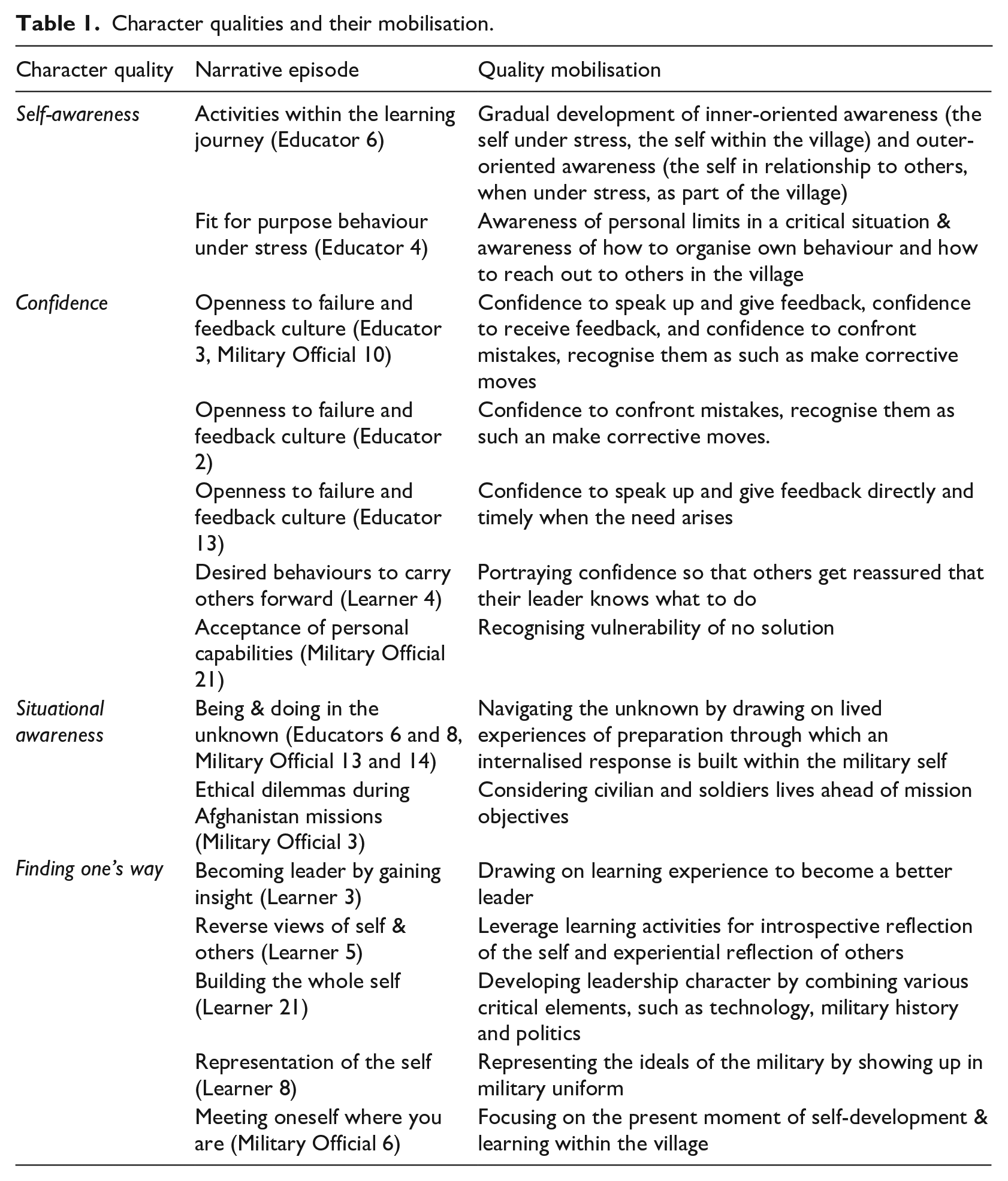
To ensure consistent and rigorous interpretation of data patterns, the analysis was reviewed by one of the co-authors and triangulated with a further round of first-order analysis conducted by the other co-authors, each of whom worked on a separate sub-section of the transcripts. At this stage, we reviewed the emerging descriptive themes, condensing, eliminating and prioritising them, before reviewing the theory in iteration with our data, to arrive at a series of ‘second order’ explanatory concepts, which underpinned our conceptual analysis. We cross-referenced these concepts to identify their internal relationships, identifying for example, where instances of identity work connected into discussions of the process, content, or outcome of learning. This process was supported by continuing engagement between the researchers and the research participants at the NMA. From there, the second order of analysis was focused on the relationships between the most frequently referenced character qualities as well as the ways these qualities are perceived across the three voices. Please see examples in Table 2.
Character qualities in the interaction of voices.
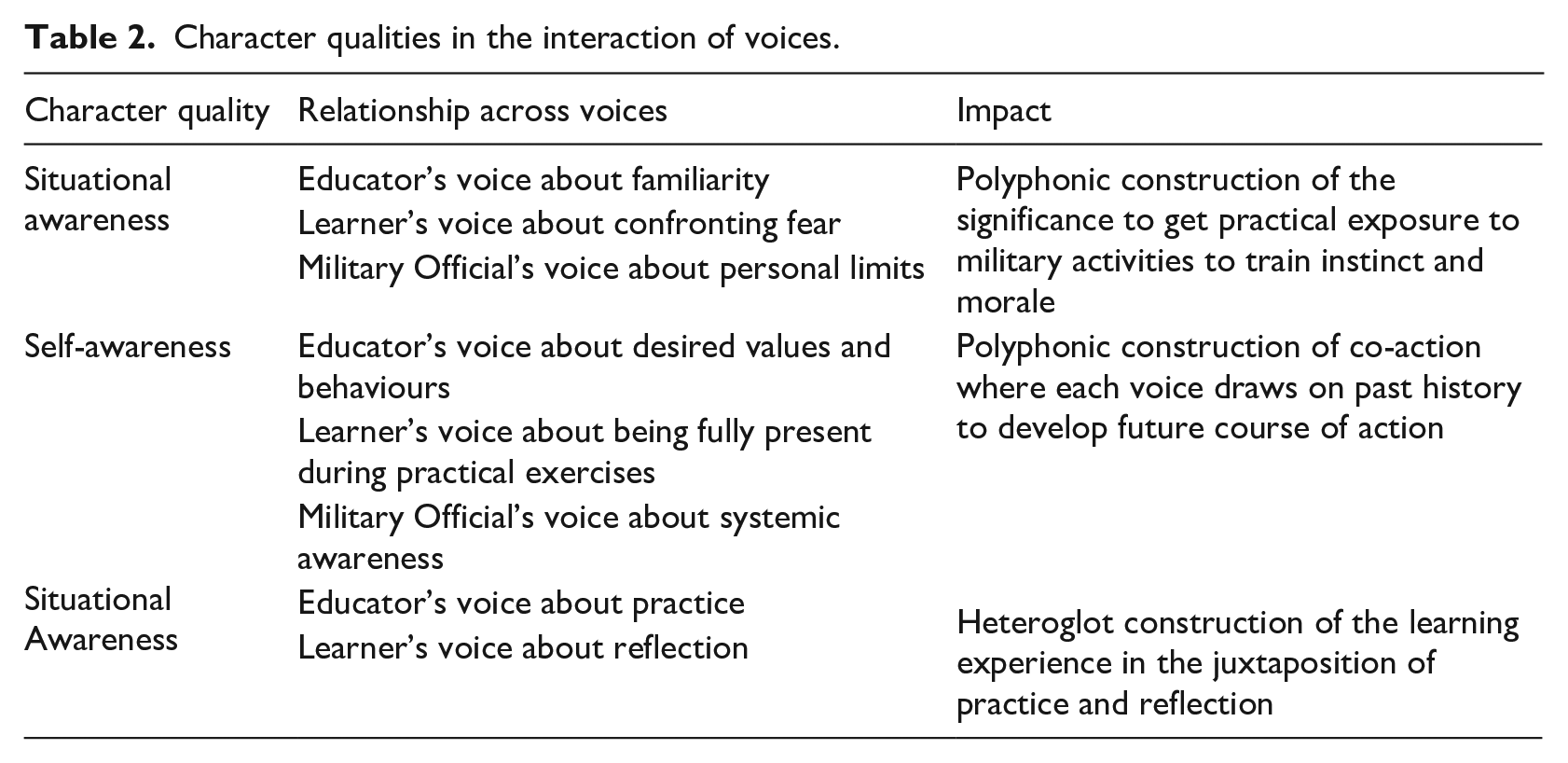
This process of sense-making was uniquely supported by our collaborative inquiry with the Academy, where we invited retrospection with the research participants at frequent intervals to ensure internal validity of our analysis. In 2019, we delivered a workshop where we shared initial research findings, checked understandings and developed further insights through dialogue with research partners, academics from a local university, and other members of the armed forces. This was an important mechanism for ensuring the internal validity of our analysis within the research team and in partnership with research participants, as well as others with expertise in leadership development in the military context. Essentially, we demonstrate the confluence of voices in our analysis of character development in the village and we adopt this confluence to strengthen the character of our research. Our findings and the way we will present them draw attention to the dialogue which develops within one voice (the separate sub-sections with exerts from the distinctive voices) and in the confluence of voices (the sub-sections on the unfinalized self).
Findings
Dialogic character development within the village
Our village is constituted by three differing narratives that come from educators, learners and military executives. First, from each narrative in the co-action within the village, we identified 39-character qualities that defined leadership within the NMA. These included many of the virtues that previous research (Bang et al., 2021; Crossan et al., 2017) have identified.
We then used this condensed list of character qualities to further question each participant on how these qualities manifest within the learning context. In what follows, we include data quotes from Educators, Learners and Military Executives to show the relational and multi-voiced nature of how character qualities manifest within this setting. We use the narratives around three-character qualities – confidence, self-awareness and situational awareness as examples from our data. Below, we start by examining each narrative source in turn to exemplify how they contribute to the village. We then turn to how these multiple voices are in relation or confrontation to exemplify our dialogic approach and exhibit how character qualities manifest through this interaction in context.
The Educator within the village – The Educator is the leading figure in the learning domain within the village. He or she develops close relationships with the learners across classroom theoretical training, practical field exercises, and reflexive-thinking exercises. Educators are furthermore related to military executives with a relationship that does not include interactions of such intensity (everyday contact, progress supervising, etc.). That said, it must be noted that all military executives belonging to the Air Force have themselves attended the Air Force Academy as cadets. This means that the relationship with educators is characterised by previously established relational ties, which affect communication, trust and tolerance for each other for years after education.
In the following example, Educator 6 explains how the relationship with the learners develops over the course of their studies towards cultivating the character qualities of confidence and self-awareness, confidence and situational awareness: They [learners] start the first year with a focus on themselves and how they react to certain situations and how they are, how their leadership is perceived, how they act in certain situations, under stress for instance. And then you have the second year where you try to have that as a background and then look at how this affects the organisation, which they are a part of and how this organisation works and how the people in the organisation, sort of, affect how the organisation works. And then you have the third year where they have the thesis model where they try to incorporate everything they have learned and then do more military things, with the background that they have. What we try to do is to make them believe in themselves, to be confident as leaders and not confident in an arrogant kind of way, but to trust themselves and to trust themselves to that degree that they are willing to ask for help when they need it, for instance. (Educator 6, pages 6–7)
What becomes immediately understood in this example is that the development of self-awareness is not oriented solely towards the self, towards the development of the individual learner. Rather, it reaches out to the team and concerns relational engagement with others. For example, if asking for help is required then it is through relational engagement. Educator 4 clarifies that leadership development starts with centring on self-awareness as the basis for teamwork as well as the critical quality for navigating a war situation. As described in the following example, We are here to help them to understand that they have the strength necessary to conduct themselves as military leaders. We will help them develop and chisel out the good stuff, so that they can use it in their daily work when they come out and are on assignment. And, to do that, you have to build their self-awareness. If an aircraft is about to crash, oxygen masks are falling down. Put on the oxygen mask on yourself first before you help others. This is something I believe in, and this is something I try and teach our learners. If you are not able to help yourself, understand yourself or work with your own development, how can you work with others? (Educator 4, pages 5–6)
Indicative of the village’s life is the building of confidence through mistakes. Educators 2, 3 and 13 point out that the driver in character development is not perfection, but the confidence to believe in oneself even after having made a mistake. Meanings of character are co-cultivated in the following examples of Educator’s perspective: What happens is that we all have blind spots, we have huge fears of what we are not good at. So, by getting feedback, you see them. You see that during two times now on a practical exercise, there’s this. Two times the same thing happens. And there is something to think about here. It’s part of something. You have a feel that you need to look closer. It’s not that you have done mistakes here but that you simply avoid it next time. (Educator 3, page 12)
Here, Educator 3 explains the way in which mistakes are included in the learning process by revealing the cycle of learning. First, Educator 3 brings up the notion of blind spots (‘we all have blind spots’), while additionally recognising the fear of one’s weakness (‘we have huge fears of what we are not good at’). From there, Educator 3 clarifies that the purpose of training within the village is not to eliminate blind spots, but rather to raise self-awareness about them (‘by getting feedback, you see them . . . And there is something to think about here’). Then, he explains the process of raising self-awareness. It starts with seeing mistakes over time, which furthermore reveals the essence of practical exposure (‘You see that during two times now on a practical exercise, there’s this. Two times the same thing happens’). Next, the process of raising self-awareness continues with accepting blind spots and with propelling action (‘And there is something to think about here. It’s part of something. You have a feel that you need to look closer’). Educator 3 ends his narrative by highlighting that the purpose of propelling action for blind spots is not to emphasise mistakes but to work on future practice.
In the next example, Educator 2 introduces the element of performance evaluation, by clarifying that the making of mistakes does not take away from the desired military character. Rather, the emphasis is on ‘the learning process in doing this mistake’, which shifts the weight towards the character quality of self-awareness: We have to make them confident and believe that this is the true team, that when you do make a mistake, you can still get an A because it’s the learning process in doing this mistake that is we are looking for; not if you were performing as good as a commander in the exercise or whatever. (Educator 2, page 5)
Such a stance towards making mistakes implicates that social life within the village is seemingly tolerant and accepting. In the following example, Educator 13 explains that any confrontation with learners has to do with discussing and reflection on mistakes but does not orient itself around absolute decisions of being expelled from the village: We have developed a culture to deal with mistakes and to handle difficult situations. You are not fired but you must create a culture that encourages you to be open and to discuss and reflect. We should confront learners more directly when we see there is a need for that. (Educator 13, page 12)
Character development in the village is underpinned by the extraordinary reality of navigating life-and-death situations. Mastering self and situational awareness is directly linked to decisions of ‘giving your life or taking life’ (Educator 8, pages 13–14). In this regard, there is a sense of urgency in learning because there are significant stakes in the village’s life. The realisation that military scenarios inevitably include the element of the unknown is widely accepted within the village. Educator 6 (page 16) remarks very directly that ‘you can’t prepare for the unknown because it’s unknown. But I think you can prepare for how you will respond and react and that might be the best thing we can do’. At the same time, there is a great need to identify sources of relief and reliability. While decisions on life and death will always incur great costs, preparing for such moments is a central characteristic of the village’s life and it is also connected to releasing the tension relevant to such decisions. Educator 8 (page 24) describes that putting the learners into such practical exercises familiarises them with realities of important decision-making under uncertainty: You are trained to go out there and make some really important decisions. It can be life and death. It can mean a lot to many people. And you will be put in situations that are critical; they have no right or wrong answer, they will be maybe under stress, there will be dilemmas. I think it’s of such a great value to have been doing that a few times. Maybe it’s not the same exact identical dilemma that you practiced here, but you will recognise some of it. You will recognise you have been there before and that will make you more fit to make decisions.
This example illustrates a two-fold movement towards achieving awareness. First, comes self-awareness and recognising the emotional implications of decision-making on the level of life and death (‘they have no right or wrong answer, they will be maybe under stress, there will be dilemmas’). Second, comes situational awareness and the familiarity with navigating such a difficult process of decision-making. Put together, these movements towards cultivating awareness in character development indicate that learning within the NMA is not one-directional towards specific character qualities. Rather, it is multi-directional and aims at cultivating each unique self towards well-suited (not optimal) responses. Finally, learning with the NMA is open-ended in the sense that it develops continuously towards increasing levels of awareness. From the narrative above, we can start to identify the dynamic nature of the language used to describe character development. This shows how the narrative is performed through competing forces, either leaning towards unity (centripetal forces) or leading towards separation (centrifugal forces) (Bakhtin, 1984, 1986 [1981], 1987). We now go on to explore a second set of narratives from the learner’s perspective.
The Learner within the village – The Learner is the focal character in the learning processes within the village. Learners develop close relationships with each other and with their educators. There are also distant relationships with military executives. A defining way learners navigate character development is through their life stories and the decisions which lead to them entering the village. Learner 3 (page 2) speaks about his motivation in the following example: I think the main reason why I have found my path and found my purpose and why I wanted to go to NMA and the leadership education is because I saw the difference in leaders when I was out working and I saw that they had a lot more insight.
The decision to enter the village defines the importance learners attribute to their learning. In the above example, Learner 3 projects the expectation of gaining insight resulting from training at the NMA. Learner 5 (page 19) moreover describes the village as equipping him with the ability to ‘see oneself from the outside and see others from the inside’, which is a relational (Cunliffe and Eriksen, 2011) and multi-voiced (Bakhtin, 1984, 1986 [1981], 1987) notion. In the following example, Learner 21 evokes the stark comparison to military equipment to illustrate that despite the technology dominating military life, the human impact is pervasive. Such a strong relationship between people and technology highlights the nature of learning within the village: If we don’t have competent leaders, we aren’t going to be able to do out task properly even with the best equipment. They educate leaders that are supposed to kind of be flexible, be a bit open in their roles and it’s not a specific kind of task they are supposed to do; learning how to drive a tank or shoot a gun. It’s more the overall leader to have an overview of the situation and to look more forward and have a more strategic point of view and that comes in with also learning about history, politics, economic situations and stuff like that. (Learner 21, page 1)
Here we see a glimpse of the interacting nature of socio-material (Ford et al., 2017; Hawkins, 2015) elements within the relationist (Wolfram Cox and Hassard, 2018) paradigm of character development. For learners – the future military leaders – the symbolism of their profession is a pervasive feature of the way they understand their role within the village. Here, it is important to note the relational understanding which learners hold for the significance of their profession and military status as representing the country. Learner 8 speaks about the symbolic power he recognises in wearing the military uniform: One very important aspect of wearing a uniform is that, when I’m wearing a uniform, you are not seeing me, you are seeing the Military Force and that goes wherever I go. How I conduct myself is going to be how people perceive the military and, by extension, the government . . . People don’t see the person, they see the uniform. (Learner 8, pages 16, 19)
Such a stance speaks about the way learners position themselves vis-à-vis their learning within the village and again exhibits the interaction of socio-material – I’m wearing a uniform, you are not seeing me, you are seeing the Military – aspects of the relational learning process. Rather than focusing on the supremacy of their individual profiles, learners are orientated towards serving a greater purpose. What is remarkable in these role expectations is that they further project into the future and the responsibilities learners will be called to face with their soldiers. In the following example, Learner 4 explains how he connects the development of his confidence quality to the future life with his soldiers: I have progressed a lot here at school regarding confidence . . . it’s important to have confidence. Even if you don’t really feel confident, you need to look confident to calm down your soldiers. It has been a challenge to me to appear confident even if I am not. I think it’s going to be crucial for me to continue with that because, if I don’t do that, then the soldiers will see it and it will have some negative consequences. Of course, I think it’s a balance. I have also learned about being vulnerable here at school, but I think, also, in the worst case, if you need to reassure the soldiers and to calm them down, it might also be necessary to put on an act, to pretend that you are in control of this, so that they feel safe. (Learner 4, pages 17–18)
The projection into the imagined future is permeating learners’ experiences of social life within the village. On the one hand, they too echo the educators’ recognition of the context of their profession – navigating life and death situations. On the other hand, they go beyond the impact such situations have on them personally and extend their concerns for their soldiers. In particular, the statement – Of course, I think it’s a balance. I have also learned about being vulnerable here at school – and the follow on from this in the statement above exhibits the dialogic nature of the development of confidence, where confidence and vulnerability are in constant flow and flux in the learning process. Furthermore, in the following example, Learner 4 emphasises how important it is for them to think about their future soldiers during their training: It’s almost like you are not allowed to back out in certain situations and you just have to live with that pressure, that’s something you accept the moment you step into the military. You know that in the worst case there is a question of life and death here. And, yeah, one thing is me as a leader, but I also have to explain it to my soldiers . . . If something happens, my soldiers will look at me. Even if I am not sure of what to do, I need to be brave enough to make a decision and to handle the pressure. I am talking about them as if they were my children already. . . But, yes, I need to be responsible for them, they are under my command, my commands will have consequences for them, and I too wish to solve our mission but I also really want to take care of my soldiers and make sure they are happy. (Learner 4, pages 13–14)
The statement above, again shows the relationality and dialogic nature of character development through the interaction of ‘solving the mission’ and ‘taking care of my soldiers’. Furthermore, the motivation for learning, the symbolism of profession, the serving of a greater purpose as well as a composed role model under pressure are all connected to relational others. Important in the process of character development is that relational others are not only the ones present during the learning (for example educators or fellow learners) but also imagined futures ones (for example, future soldiers under the learners’ command). We now turn to the military executives within the village to analyse their narrative.
The military executive of the village – Military executives reside in the periphery of the village. They are externals to everyday life within the village but are essentially connected to the organisation of social life. Because they have a broader view of the military and of military operations, they bring a certain rhythm into the social life of the village. First and foremost, they set out the ethical underpinnings of military training. In the following example, Military executive 3 explains how the ethical aspects of soldiering are a shared denominator in the village, having evolved after years of active military service: When I hear the word competence, I always sort of translate that in my head to the ability to do the right thing from both a legal and ethical viewpoint. Actually, our years in Afghanistan and Balkans before that but, in particular Afghanistan, have made us better in seeing this ethical dimension . . . I mean, I have heard Military Leaders talk about how they had to accept greater risk, to spare civilian lives, which was, I think, fifteen years ago. The priority of a Military Leader would be defined to make sure his soldiers got through a mission alive if that was possible. So, I think we have a much stronger understanding today of the ethical aspects of soldiering. (Military executive 3, page 7)
Contrary to traditional views of command and control within military leadership, Military executive 13 (page 6) makes clear that character development in the village is all about ‘release control, your own control’, which once more exhibits a dialogic in the narrative. Linked to this there is a relational element to the narrative – a much stronger understanding today of the ethical aspects of soldiering’, this appears to indicate a moral responsibility to the other (see Cunliffe and Eriksen, 2011) in the quest for character development. Military executive 21 adds that releasing control shows the way towards acceptance that not everything has a solution. Such an acceptance becomes a guiding principle for character development, as seen in the following example: Everything must have a solution. Does it? What happens if a leader saying that everything can be solved realises that everyday life is not like that? Things can’t be solved; you have to live with it. So, to develop the learners’ education is very interesting . . . (Military executive 21, page 11)
Releasing control is connected to the narrated journey of self-awareness. In the following example, Military executive 6 speaks about the trigger towards self-awareness and frames this around the curiosity of knowing oneself: I always tell people that the most important thing you should do is to focus on where you are; not where you are going. That’s because, if you are focusing on where you are . . . things will happen. So, one of the things is to make people more and more curious about and try to, in some way, to stimulate them in order to be curious about how to develop. (Military executive 6, pages 13–14)
With focusing on the incentive to know oneself, Military executive 6 connects the present self to the desired future self. With this connection, the development of confidence comes to the fore and becomes the ethic of work within the village as seen in the following example: I think that an important part of being a Military Leader is to give people room to make those mistakes on their own time themselves, as long as it’s not safety related and does not violate any sort of rules and regulations. Because you need to have built confidence in people when you want to perform military operations. Unless you are confident, self-confident or have confidence in other people, then we don’t work. We are not going to work. (Military executive 10, pages 4–5)
Military executive 10 reveals that the village is a safe space of experimenting with expressing oneself. The relationality with and co-action (see Sklaveniti, 2020) of such a safe space has three important implications for character development. First, it indicates the principle of learning from mistakes (‘they need to be able to make mistakes, because that’s how they learn, and they learn from themselves and not from being told how to do things’). Second, it shows an ethic of care in the sense that mistakes follow accepted rules and regulations. Third, it elevates notions of ‘psychological safety’ (Edmondson, 2018) and embeds ‘vulnerability trust’ (see Moldjord and Iversen, 2015) both as a mark of character (when demonstrating safety in vulnerability) as well as a condition for cultivating character. Combined, these characteristics of the village explain why as a safe space of experimentation, it drives the establishment of confidence as the currency of teamwork especially when multiple team members are connected beyond their roles and contributions in living the values of the community of which they are a part.
The development of self-awareness and confidence furthermore point to the overpowering reality of extreme work conditions. Military executive 13 (page 4) plainly notes that ‘in the most extreme case actually you have to tell people to die or to take lives’. Herein, self-awareness and confidence are the resources to survive dangerous conditions, as seen in the following example narrated by Military executive 14: The core of being a military person is that you will be placed in unsecure conditions; you will be on your own; you will be responsible for other people. You need to be able to take care of yourself and the people around you and do so in an environment where you have a lot of uncertainty. If you freeze during a situation then you, in the worst case, you will die. So, you need to be able to seize initiative and use it. But you cannot be intuitive based on nothing. If you go to improvise, you need to improvise on something. Intuitive leadership, without experience, is dangerous. You need to be aware of what is your strong side and what is not your strong side, and you need to be self-aware enough to say, okay, you are better than me at this, so I trust your judgement on this area. (Military executive 14, page 12)
In his narrative, Military executive 14 presents two simultaneous dialogic relational movements, one towards the self and one towards the other. Here, therefore, we see qualities such as self-awareness and confidence being developed through the enacting of centripetal and centrifugal forces (Bakhtin, 1984, 1986 [1981], 1987) – constantly squeezing in and out within narrations from the village. First, Military executive 14 acknowledges the broader context of uncertainty, which underlines character development. From there, he calls attention to the self-oriented movement of taking initiative and improvising. Next, improvisation reaches out to the other in two ways. The first other-oriented movement goes back to the learning developed within the village (‘you need to improvise on something’), which also reminds the purpose and usefulness of practical exposure. The second other-oriented movement calls out to the team and determines co-action based on leveraging the strengths and weakness of the team. In this first part of our analysis, we have outlined examples of dialogic relational narrative within our data. However, to develop our Bakhtinian perspective further and gain a true insight of polyphony within the village we need to appreciation the interacting and competing nature of these voices within this context (Clegg et al., 2006), which is where we turn next.
Dialogic character development through interacting and competing voices
Focusing on the three roles within the village, we recognise that character development is emerging through the social dynamics within the community of military practitioners. The desired character qualities were not taught or measured in explicit and rigid formats but rather shaped dialogically through a variety of interactions constitutive of everyday life in the village. In such ways, the overall purpose of military training was not to establish leaders with specific qualities but rather unfinalized ones. This means that the vision for learners is that they remain open to re-inventing themselves in the face of extreme situations of life and death. From here, we present further findings on how the unfinalized leader self develops within the village from two simultaneous movements. First are polyphonic movements expressed from the different life-worlds of educators, learners, and military executives. Second are heteroglossic movements expressed from variances within the life-worlds of educators, learners, and military executives.
An unfinalized self – polyphony within the village – Character development has a continuous rhythm within social life in the village. Educator 7 (page 17) highlights that the purpose of military training is ‘that we do rehearse, we do repeat and deduce’. The village is the safe space (Kisfalvi and Oliver, 2015) where future military leaders rehearse again and again the desired character qualities, as well as test themselves under extreme situations simulated in military exercises or actual crisis situations in civil or military combat. The following examples show how the voices of the educator, the learner and the military executive are intertwined in the need to continuously practise cultivating character qualities: Can you prepare anyone for all the situations in a way? No, probably not. But you can try to make them more confident or familiar with different situations they can be exposed to. So, it’s part of the preparation but some situations will be a shock. (Educator 16, page 16)
Here, Educator 16 admits that it is not possible to prepare for all possible situations. Thereupon, the aim of learning within the village is to prepare for the unknown by anticipating it and preparing for the shock unfamiliarity presents. In the following example, Learner 4 adds to the familiarity with being exposed to the unknown the fear of failure: I feel that by practising sometimes I fail. I don’t do what I want to do, I don’t succeed but then I learn that, okay, it’s alright to fail. I reflect afterwards and I grow stronger, I get better at it and, obviously, with more practise, you get better in the end. That also does something to my fear of failing –I learned that failing isn’t the end of the world. (Learner 4, page 8)
Here, Learner 4 reveals that practical exercises include an element of struggle to the extent that his performance does not align with the ideal self-expectations (‘I don’t do what I want to do, I don’t succeed’). Then follows a journey of self-improvement with reflection and further practice. Therein, what becomes distinctive in the making of an unfinalized self is the parameter of the fear of failing when exposed to the unknown, which is a matter of concern for learners. However, it is not a concern for educators, as they promote the centrality of practising in cultivating character in the village, a message that is consistent with the philosophy of learning through one’s mistakes.
Next, with the following example, Military executive 22 introduces another perspective to the nature of continuous rehearsing within the village; that of humility: I want people that are able to reflect, that are able to take learning, that are humble to learning and humble to the fact that you know very little, so we need to start somewhere, and this is the place we are going to pick that up. (Military executive 22, page 10)
Here, the unknown is linked to the limited capacity within one’s abilities. Military executives introduce a down-to-earth approach which sets character limits rather narrow (‘you know very little’). These limits are to be extended with the learning within the village leading to increased levels of co-action (‘we need to start somewhere, and this is the place we are going to pick that up’).
In addition to the continuous rehearsal of desired character qualities, our data reveal that character development takes place in the co-action of villagers creating a shared sense of ‘who we are’. This shared sense settles the voices of educator, learner and military executive within an unfinalized self in such a way that the self is open to continuous development, while anchored within the village. The following examples show how character develops for and with others, giving additional insight into the ethic of care entrenching life in the village: There is this combination of training military skills that are required; the instrumental things that learners are required to do when they leave the NMA. So, they have knowledge of what is a command post, how you organise, how you plan for operations; these are instrumental issues. But there is also the awareness theme. Through these exercises they are made aware of the consequences of their own conduct and their relationships with their fellow learners, and they see then that this has clear consequences on whether they can achieve their tasks. (Educator 17, page 13)
Educator 17 paints a clear picture of what the military training in the village entails. On the one hand, there are operational skills connected to military work. On the other hand, there is the awareness of the other, which renders character development a relational accomplishment. This includes both the implications of one’s conduct on others and the relationships with others. Both become critical for successful performance (‘this has clear consequences on whether they can achieve their tasks’).
In the following examples, Learner 3 brings up a nuance in relational teamwork, which extends the coordination within a team to the level of pull up the energy of relational others: I try to take most out of the kind of situations where we are out on exercises because that’s definitely where I feel that I get the biggest challenges. So, it’s all of the exercises, the daily exercises that we are doing now on Thursdays, these three weeks, the stress exercises, I take a lot out of them and try to analyse and think about them, how I responded. And also, especially, that exercise we had called operational teamwork. That was the kind of exercise which I put a lot of effort and energy into; to try and grab as much as possible, because it was about the relational level between people that work in teams and, for me, to be able to see the entire team and pull my co-workers up, pull their energy up and contribute so that they do their best, that’s really important to me. (Learner 3, page 3)
Learner 3 explains his stance towards the team during practical exercises by elaborating on the stimulation of co-action. Besides the establishment of relational connections with teammates, Learner 3 speaks about instilling energy to these connections and contributing to the others’ optimal performance (‘contribute so that they do their best’). Such an orientation to character development presents the self as fundamentally relational (Cunliffe and Eriksen, 2011), not only reaching out to others but blending in with them and upholding their output.
Adding to the co-active nature of character development, in the following example Military executive 2 takes up the perspective of integrating one’s expertise to the other’s one: Within the Military when you work at a joint level, there is no one component that can be done alone. So, I am pretty sure that one important part of the learners development in the future will be the understanding of how to integrate your unit, your field with the other ones, to achieve the operational effect that you want. (Military executive 2, page 6)
Here, Military executive 2 shifts the focus from the relational coordination to the collaboration of diverse degrees of expertise. First comes the recognition that military practice is a co-active achievement (‘no one component that can be done alone’). Then follows, the developmental goal of integrating one’s expertise to the other’s (‘integrate your unit, your field with the other ones’). The purpose for doing patterns itself upon the village’s expression of co-action (‘to achieve the operational effect that you want’).
The above nuances portray the co-active (Sklaveniti, 2020) nature of life within the village. They indicate the weaving together of a community of experts, by leaning towards the other. The establishment of a safety in vulnerability as a mode of trust central during the development process, progressively and regularly crystallises the sense of co-cultivation we examine through the multiplicity of voices in the shared experiences of ‘how we do work here’. Finally, our analysis now explores the unfinalizability of developing character.
An unfinalized self – heteroglossia within the village – Delving deeper into the data, our analysis reveals that character development is not underpinned by unanimity among characters, but by the diversity and inclusion of various life-worlds within the voices of the educator, learner and military executive. Our data show a tension in the building of character which is illustrative of the conflictual dynamics within the village. These conflictual dynamics indicate transformation potential as desired qualities develop in and of character. The following examples indicate conflict within the roles of the educator and learner without, nonetheless, inducing breakdown but rather inclining transformation in military training. In the example below, we notice the conflicts in the educator’s voice as seen in the excerpts narrated by Educator 14: It’s hard to practise because the right situation does not often come along, where you are tested. If you want to be successful you have to look for a situation that you can practise, that you also have to be provided with those kinds of situations and then given feedback and, you have to also yourself understand that it gives you benefit to change your performance towards a certain character trait. I don’t think we understand it. We have a debate now how should we go . . . how should we actually. .. how do we teach this, how do we change this in persons? Some people believe that just by reflecting on it then it will change and some of us believe that now you must practise more, maybe reflect less but you have to practise get feedback more. So, we had this debate over this and what’s the best way to obtain this kind of goals. (Educator 14, pages 9–10)
Educator 14 mentions that learners ask for the inclusion of reflection, while educators themselves are at odds about how to respond to such request. Herein, lies a tension between educators about whether the appropriate response is to allow more reflection or to allow more practise. Next, we draw on the learner’s voice to conclude the discussion on conflict and character development. The following two examples from Learners 5 and 8 focus on the centrality of practical exposure during military training: I don’t think you can ever prepare fully for the unknown. Because what is unknown? But if you say unexpected, within the realm of the military, then I would say yes, because you have been tested through so many different situations. But unknown, no. Unexpected yes. If you are put to the test in exercises where you don’t know what is going to happen, you try to prepare for unexpected events. Then your way of thinking starts to become more adaptive, and you see that it’s not clear cut where you must go. So, you start to look for options and that sort of broadens your horizon, to think without the theoretical training. Then you are narrower minded and maybe think that what the theory says is what will happen but then you know that that’s not always true. (Learner 18, page 5)
Learner 5 illustrates tension between theoretical knowledge and practical exposure. His narrative indicates conflict between expectations emerging from theoretical knowledge (‘what the theory says is what will happen’) and insights from practical exposure (‘you know that that’s not always true’). Herein, lies both the challenging theoretical knowledge and the reaching out to revisiting theory: I really don’t think there is any substitute to practical experience. You must put people in uncertain situations and have them learn by experiencing those uncertain situations, to be able to move forward. But the big issue is how on earth do you predict the next war? Because you don’t know when the next war is coming, you don’t know where it’s coming, in what shape, way or form it’s coming. So, pretty much the only thing you can prepare for is to be pragmatic, try new solutions, try to look at things from another angle. Because it’s, even if you train your military, it’s still not up to the military to act. We are instruments of our political masters. (Learner 8, pages 21–22)
Learner 8 acknowledges the significance of practical experience, while bringing up the question about predicting the next war, despite all preparation. Then, he introduces an additional conflict with the voice of politics, seen here in the voice of military executives. Herein, Learner 8 marginally shutters the purpose for practical exposure by indicating the inability of military leaders to make decisions about military action because this is determined on the level of military executives. The above tensions are creative of the co-action in the village. They do not trigger any breakdown but rather indicate hurdles in the continuity of social life within the village. They are also part of greater transformational prompts which lead to revisiting established parameters in military training.
Discussion
With this research, we set out to extend our understanding of relational character development in leadership learning with the research questions – how are character dimensions voiced with the academy (village) and how can this help in enhancing leadership learning in such an environment? Our data show that unlike the formal and explicit approaches in previous empirical studies (Crossan et al., 2013, 2015; Hannah and Avolio, 2011; Seijts et al., 2015; Sturm et al., 2017), our findings point to the emergence of character as an integral aspect in leadership learning. An important aspect of our findings suggest that this emergence of character is culturally and narratively bound. In this sense, therefore, character is not explicitly taught but emerges dialogically and polyphonically and, hence, shaped through a variety of interactions constitutive of everyday life in the ‘village’ (the academy). We see this in a polyphonic (e.g. Hazen, 1993) and heretroglossic (Rhodes, 2001) expression of character where the importance of multi-voicing (e.g. Clegg et al., 2006) the qualities that constitute the character ‘framework’ that underpins how the academy ‘grows’ its leaders is revealed. This suggests that unlike the explicit use of a framework, there appears an implicit embeddedness of character in the leadership development pedagogy of the academy, such that it allows for greater unfinalizability in the way character qualities are acquired and enacted. We suggest therefore that we have uncovered two important contributions.
First, we show that character development is not dependent on explicit character frameworks but more on the role of the social dynamics in a community (village). Hence, we draw into the character development literature a more overt link to relational (e.g. Cunliffe and Eriksen, 2011) and relationist (Wolfram Cox and Hassard, 2018) notions of leadership. This is evident in our data based on how voices are intertwined in the constructions of the character qualities seen as important in this context. This observation finds support in other recent studies of character development in ‘good organisations’ (see Brooks et al., 2022) and lead to character being seen a complex interplay of narratives rather than presented as a set of static dimensions. Furthermore, these voices do not belong to single individuals as we have shown with our data but to various ideologies within the village. We contribute towards leadership development therefore by suggesting that character development need not be associated to what is sometimes presented as unanimous common values but to the diversity and inclusion of various ideologies within the village whose ongoing dialogue fosters connectedness through distributed and collective action (Kornberger, 2022). The dialogical and dialectic ways of negotiating meaning on an ongoing basis, suggests that ‘living the values’ (of military leadership) is less about predefined and agreed lists of character qualities, important as these may be, but instead, a relational and co-active approach (e.g. Sklaveniti, 2020).
Second, and further to our first contribution, we have uncovered competing voices that make up character in this given context. This enables us as researchers to see the conflictual nature of character within a developmental setting. This is important in terms of leadership learning, and it pushes us towards a deeper cultural and contextual exploration of character development that goes beyond the frameworks that are already in existence in the literature. We suggest therefore that any leadership learning endeavour that wishes to make use of character development as a basis for the learning will need to provide a deeper interpretation of how these character dimensions are ‘lived’, ‘rehearsed’ and ‘re-rehearsed’ in any context or setting. This lived experience, in our mind, can only be ‘seen’ through uncovering the narrative construction of each dimension. A suggestion for doing this would be through experiential and creative methods that encourage the character to be built upon storytelling within cultural and contextual frames. We therefore add to those previous calls for more work on and appreciation of improvisation (Vera and Crossan, 2023) and wider arts-based methods (Crossan et al., 2021) when developing and exploring character and leadership. We contribute further by suggesting that these methods should work to uncover important cultural aspects of place within their experiential methods.
Conclusions and further research
We believe further research in this area should now explore how character qualities transfer across ‘villages’ and communities beyond just that which the NMA represents. Our suggestion here is to develop a deeper interpretation of the impact habitus and place have on the transitioning of character qualities. We tentatively suggest that ‘habitus’ (Bourdieu, 1990) allows for character to be cultivated – fleshing out, filling in, carving, or chiselled out – as leadership identity is formed and reformed when presented with tensions that provide not only a ‘turning point’ (Sklaveniti, 2020) in leadership but also foster accountable and responsible action choices (Antonacopoulou and Bento, 2018). This extends notions of collective action (Kornberger, 2022) by explicating the dialogical and dialectic dynamics which fuel discursiveness which in turn shapes the way villagers cohabit the place – the village. We also believe that we can further enhance the character literature through a Goffman (1978) based dramaturgical exploration. We think that exploring character in this way will help to understand the ‘rehearsal of character’ and the ‘being in and out of character’ – concepts we have uncovered in our research herein. These further investigations within our data, we believe, will provide a rich depth to the already established character literature and its growing popularity in leadership and management learning. Finally, we also believe that these areas of further research can lead to a wider appreciation of notions of collective leadership and wider links to leadership and ethics.
