




Abstract
This article focuses on understanding the qualitatively different experiences of career development reported by the MBA alumni of a UK business school. Although the potential of the MBA to support career capital development has been previously identified, a thorough investigation into how this is experienced has been lacking. The study contributes to career capital theory in the context of post-experience management education in three ways. First, our findings report the development of career capitals, and we describe how these are manifested within the context of an MBA. Second, we identify five different experiences of career capital development, to which we ascribe the following labels: applying, achieving, collaborating, believing and transforming. These five different experiences contribute to theory by revealing the interrelationships and interdependencies between different forms of capital. Finally, we highlight that while it is possible to develop certain forms of career capital either with or without others, this is not the case for those involving personal transformation, which cannot be achieved alone. The article concludes with reflections on the implication of our findings for management educators, MBA teachers and researchers.
Introduction
Careers are a recognised element of organisational studies (Jones and Dunn, 2007) and a topic of concern for business schools. While there have been criticisms levelled at the MBA curriculum (Costigan and Brink, 2015; Garcia, 2009, 2010; Lamb and Currie, 2012), the programme continues to be recognised as a professional qualification offering accelerated career progression and earnings (Elliott and Soo, 2016), and providing benefits for sponsoring organisations as well as furthering individual career goals (Ruth, 2017).
Business schools recognise the importance of career aspects of MBA programmes. Indeed a recent survey of business school leaders found careers to be their second highest priority (AMBA-BGA, 2022). This is reflected in positioning by the Association of MBAs (AMBA) and Business Graduate Association (BGA), who describe their role as assisting students and alumni in managing their careers (AMBA-BGA, 2022). Despite this emphasis on the potential career advantages of the MBA, the experience of career development in this context has been underexplored in the literature. Moreover, while labour market uncertainty prompted by COVID-19 stimulated an increased demand in 2020 and 2021 (Choudaha and Caruthers, 2021), more recent (GMAC, 2022) global survey data reports 60 percent of MBA programmes to be receiving fewer applications than in 2021. Thus, given that a change in career direction or an accelerated career path are likely to be among the motivating factors for potential customers (Kirkpatrick, 2020), it is likely that enhancing this aspect of a programme can help providers make their MBA programme more attractive. Whether it is to improve the design of programmes in order to emphasise career development, or simply to be able to communicate the advantages of such a degree, it is important to understand how career development is experienced from the perspective of the learners.
Building on the career capital theory, this study aims to explore the career development experiences reported by MBA alumni. Following a review of the relevant literature and an account of the qualitative methodology involving 29 semi-structured interviews, we report our findings to reveal how the career capitals are manifested in the context of MBA careers. By highlighting the five different various ways in which MBAs develop and combine different career capitals, this study makes a theoretical contribution in terms of the hitherto unidentified interrelationships and interdependencies between forms of career capital, as well as the salience of working with others to facilitate personal transformation. The findings have relevance for all those involved in management education practice, for example, faculty designing programmes and business school leaders aiming to communicate the career benefits of an MBA. Moreover, the study helps current and prospective students to understand how best to utilise the opportunities for career development available during such a programme. Practical implications for these varying stakeholder groups are discussed towards the end of the article.
Career development frameworks and the MBA
The notion of self-managed careers has become more prominent (McKeown, 2020), reflecting the decline of ‘jobs for life’ (Roper et al., 2010), greater ‘boundaryless’ career mobility (Arthur, 1994; Arthur and Rousseau, 1996; Crowley-Henry, 2006) and the emergence of less hierarchical perspectives on employment (Chudzikowski et al., 2020; Jackson and Tomlinson, 2020; Sullivan and Al Ariss, 2021). In the current career landscape employability is not guaranteed, and individuals increasingly need to manage their own job prospects (Hirschi et al., 2018). Various theories have identified factors that can strengthen the positive and weaken the negative effect of career boundarylessness on career success, including the level of one’s career capital (Guan et al., 2019). Thus the choice of completing an MBA, whether self-funded or paid for by one’s employer, is one strategy by which an individual may seek to improve their capital and manage their own career (Arthur et al., 2005). Vaara and Fay (2011) examined how the MBA programme serves as a vehicle for career capital development. They drew on Bourdieu, who described capital as taking economic, social, cultural and symbolic forms which are mutually convertible (Bourdieu and Richardson, 1986). In his work, Bourdieu distinguished the differences between economic, cultural (including intellectual), social (including networks) and symbolic (including linguistic) capital, and stated that forms of capital can be, and frequently are, converted into other kinds (Vaara and Fay, 2011). Economic capital is described as the easiest to convert (Bourdieu, 1977; Bourdieu and Wacquant, 1992); it not only includes financial resources, but also property, income and savings (Joy et al., 2020). Social capital involves ‘relationships of mutual acquaintance and recognition’ (Bourdieu and Wacquant, 1992: 112). Cultural capital, on the contrary, can be manifested in three forms, namely (a) institutionalised, which is associated with academic qualifications of value within a given context; (b) embodied, which includes past work experience or cultural experience; and (c) objectified, in the form of possession of books, dress or accessories (Bourdieu and Richardson, 1986). Symbolic capital is seen as reflecting the power gained by individuals through the mobilisation of their economic, social and cultural capital, and is manifested in social ranking, class position and so on (Joy et al., 2020).
Within the careers literature there are numerous frameworks using different terminologies. The career competency framework, later referred to as career capital (Arthur, 1994), has been widely adopted and although it does not reference Bourdieu, it uses concepts that are strongly aligned to Bourdieusian theory (Brown et al., 2020). Career capital is described as the overall set of non-financial resources a person is able to bring to their work (Arthur et al., 2001). This framework comprises knowing-why, knowing-how and knowing-whom (Arthur, 1994). Knowing-why includes personal attributes (Eby et al., 2003) and identity; knowing-how denotes relevant skills, knowledge, experience or qualifications, along lines described as human capital (Becker, 1964); and knowing-whom involves social resources, such as supporters and access to networks. This career capital framework with the elements of knowing-why, knowing-how and knowing-whom has been applied in a range of empirical studies (Dickmann et al., 2018; Eby et al., 2003; Lamb and Sutherland, 2010), highlighting that, over the course of their career, individuals can build and use their career capital (Dickmann et al., 2018) to create positional improvements within organisations and labour markets (Lamb and Sutherland, 2010). While the framework introduced by DeFillippi and Arthur (1994) remains the most established, other theorists have suggested alternatives. Writing of employability, Fugate et al. (2004) introduced the constructs of career identity and personal adaptability, combining social and human capital. Career identity is seen to focus on the individual’s personal career narrative, sense of self and other possible selves (Fugate et al., 2004), and is regarded as being different to personal traits, which are described as optimism, propensity to learn, openness, internal locus of control and generalised self-efficacy (GSE) – attributes deemed key to employability. Forrier et al. (2009) produced a conceptual model containing the dimensions of human capital, social capital, self-awareness (career identity) and adaptability, with the latter including motivation and self-determination. The same idea of self-awareness and identity, as separate from adaptability, is described by other authors when exploring the mechanisms of so-called ‘protean’ careers (Denyer and Rowson, 2022; Hall et al., 2018). Hirschi (2012) argues that the knowing-why aspect of career competencies includes (a) attitudinal aspects of self-knowledge, career insight and sense of purpose; (b) general personality characteristics, such as proactive personality and openness to experience; and (c) behaviours associated with career exploration.
Given that MBA programmes are often marketed as being life-changing, the separation of ‘knowing-why as confidence’ versus ‘knowing-why as identity’ appears relevant in this context. Previous studies of MBA programmes have described knowing-why career capital as an increase in confidence (Gander, 2015; Simpson et al., 2005) attributed to a sense of achievement following a hard and demanding programme of study (Simpson and Ituma, 2009). With reference to identity, Bourdieu introduced the notion of habitus to capture the sense of how we position ourselves and how others position us (Elliott and Soo, 2016), and it has been suggested that an MBA may invoke a voluntary reorientation by the student in alignment with a stylised ideal MBA habitus (Vaara and Fay, 2011).
In terms of knowing-how, previous commentators have identified the MBA as a route by which individuals might seek to develop their human capital (Baruch and Peiperl, 2000; Sturdy et al., 2006). The accrual of knowledge and skills has been identified as being important for career success (Gander, 2015; Gerli et al., 2015; Haenggli and Hirschi, 2020) and central to the individual’s regulation of identity (Sturdy et al., 2006). Indeed, increased skill and knowledge have been identified as the primary product of an MBA (Vaara and Fay, 2011). A comparative study of Australian and Singaporean MBAs found that, despite a strong motivation around personal interest, the accumulation of knowing-how was given most emphasis in both contexts (Harris and Ramos, 2013).
For students enrolling on an MBA course, the acquisition of social capital, or knowing-whom, is an important objective (Harris and Ramos, 2013; Iglesias et al., 2020) and is one of the declared outcomes of many MBA programmes, given the opportunities for networking and the development of influential contacts (Chen et al., 2012; Sturges et al., 2003; Wallen et al., 2017). As MBA programmes recruit from a range of professions and with differing levels of experience, they are seen to provide students with useful connections and networks (Wallen et al., 2017). Research on MBA learning groups suggests that they provide an opportunity for bonding (close ties) and trust and social exchange (Konrad et al., 2016; Liang et al., 2019; Putnam, 2000). Learning teams can also be used to provide an opportunity for social comparison for learners (Heslin, 2003). Moreover, students, by virtue of being enrolled in a course of study, have access to a range of informal learning benefits associated with the programme (Warhurst, 2011) and its wider resources, such as access to mentors and career advisers. Mentoring is an example of a potential benefit and has previously been identified as an important manifestation of social capital in the pursuit of career success (Beigi et al., 2018; Bozionelos, 2015; Parker et al., 2008; Singh et al., 2009). Coaching within MBA programmes is acknowledged as useful and popular with students (Jones and Andrews, 2019), and having access to supportive others aligns with the notion of participatory social resources (Skvoretz et al., 2020).
Understanding the interrelated nature of career capital development
According to Bourdieusian scholars all forms of capital are interlinked, though not spread evenly (Bourdieu and Wacquant, 1992; Wacquant, 2013), and individuals with access to certain career capitals find it easier to accrue more of them (Bozionelos, 2015). In other words, forms of career capital can be combined to develop other capitals; for example, a positive relationship with a line manager (social capital) can be used to gain access to funding (financial capital) to undertake a master’s degree (human capital) (Brown et al., 2020). Limited previous work has focused on these linkages in the context of Pacific Island professionals (Parker, 2005), information technology clusters in Grenoble (Culié et al., 2014) and entrepreneurial careers (Zikic and Ezzedeen, 2015). Parker et al.’s (2009) theoretical work describes in detail the linkages between different forms of career capital. It suggests four two-way relationships involving aspects of knowing-how career capital in the form of work experience and the development of skills and expertise, and also a linkage from knowing-whom to knowing-why and from knowing-why to knowing-whom (Parker et al., 2009). In the context of academia, a study of distinguished academics (Beigi et al., 2018) supports Parker et al.’s assertions by providing empirical evidence to confirm six linkages between two different forms of capital and also highlights how the three forms of capital might be combined, describing linkages from knowing-whom to knowing-how and knowing-why, and from knowing-whom to knowing-why to knowing-how. Beigi et al. (2018) conclude by calling for further work to highlight the linkages between career capitals using empirical data. In relation to MBAs, although prior work has recognised how they support career capital development, there has been little or no focus on the interrelationships between the different elements. Given the claims made for MBA programmes, that they offer the chance to develop relevant industry skill and knowledge, build confidence and provide a beneficial network, this is a notable omission. This study contributes to the career capital literature generally, and management development more specifically, by unveiling how career capitals are manifested and the ways in which they are developed in interrelated and interdependent ways by MBA learners. By doing so, we are able to make recommendations for practitioners involved in the whole MBA delivery system.
Methodology
This article adopts an interpretivist approach to understand the qualitatively different experiences of career development reported by MBA alumni from a large MBA provider in the United Kingdom. Data were collected from alumni of an MBA programme usually ranked in the top 70 worldwide (FT, 2022). The programme traditionally recruits experienced managers. Across the cohort, the average current age while on the programme is 36 years, with approximately 10 years of managerial experience pre-MBA. At the time of data collection, the business school had over 14,000 MBA alumni, with cohorts comprising students of different nationalities, all serviced from offices in various locations worldwide, with quality assurance provided by the United Kingdom. This study includes individuals from the UK-based full-time programme, as well as the part-time modular and flexible/distance learning programmes. Although the time spent in face-to-face delivery differs, there is a degree of uniformity in terms of course materials, faculty teaching team, group working methods, core texts and assessment methods.
Sample and data collection
Participants were initially selected from a pool of 122 MBA alumni who had participated in an earlier electronic survey on MBA careers, which was conducted in association with the alumni services team of a UK business school. These individuals had indicated their availability for follow-up interviews. Although the programme has an international presence, we opted to focus on alumni originating from the United Kingdom to avoid concerns over cultural and institutional contexts impacting on the career experience. The individuals had all completed an MBA, but the number of years since their graduation varied. Given the focus of this research, the sample was deemed appropriate as it reflected a wide range of experiences of career development derived from the MBA. The study was carried out in line with the requirements for ethical approval within the business school. All respondents provided informed consent prior to their involvement. Data were collected through semi-structured interviews through a combination of face-to-face, online and phone interviews to suit the convenience of the interviewee. The interviews lasted 40–90 minutes.
Participants were encouraged to reflect upon their personal career journey and to highlight the events that had been influential in their careers. The MBA came up naturally during these conversations as part of their career story (Ruth, 2017) and interviews focused, in particular, on how the programme supported career development. Participants’ stories provided a powerful way of accessing their experiences and allowed us to elicit rich descriptions of career development.
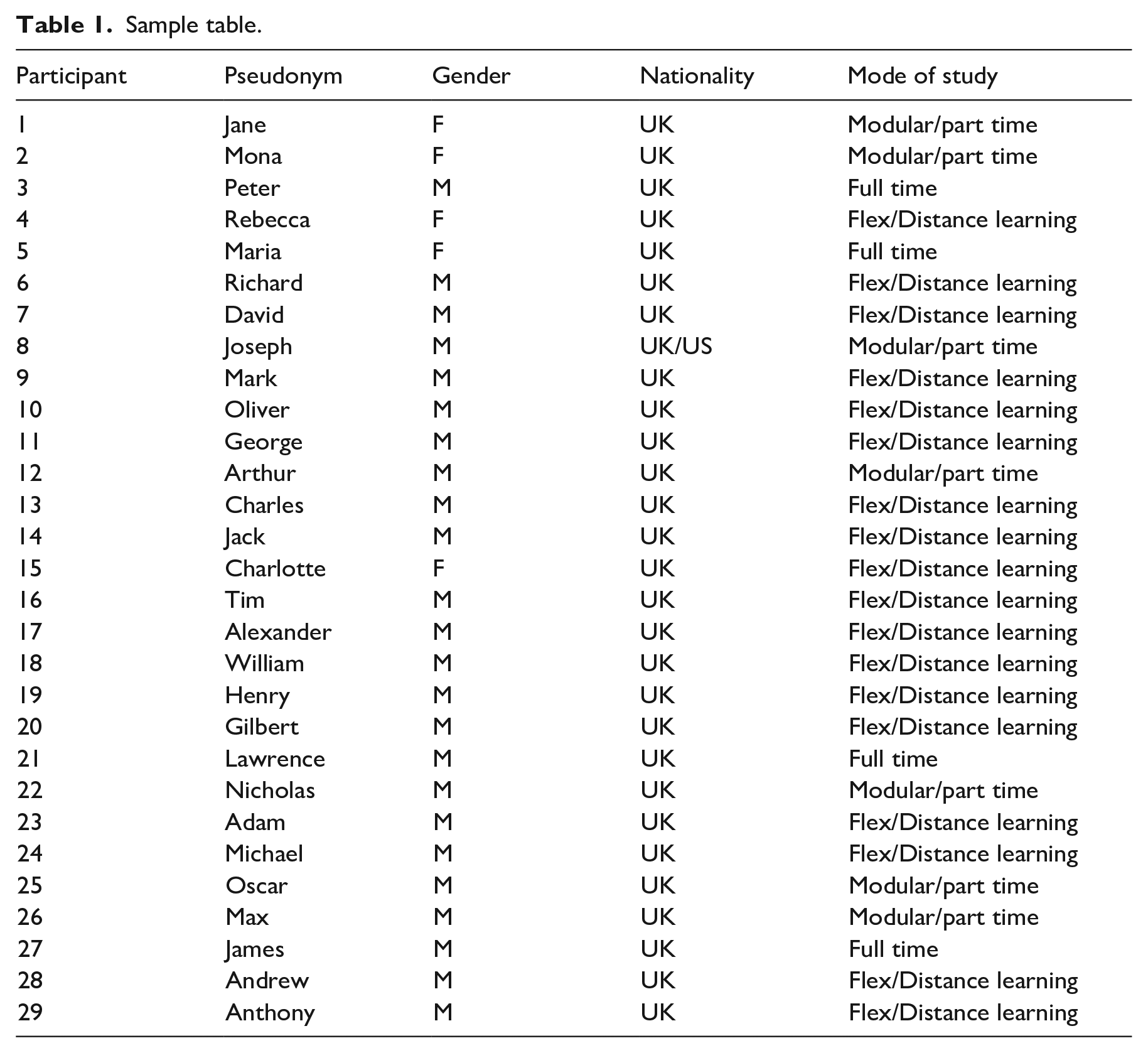
Table 1 lists each participant’s name (pseudonym), gender, nationality and mode of study. There were 24 men and 5 women, which was in line with the historical gender split on the programme. Each participant was assigned a pseudonym which will be used when presenting findings.
Sample table.
Data analysis
The first step of analysis involved immersion in the data. Each transcript was read independently by all three researchers to absorb the experience of each participant. Immersing ourselves in the data gave us a thorough understanding of it to support later analysis. We did not confine ourselves to the literature and allowed the data to speak for itself, nor did we set out to use any particular framework. In other words, as Jackson and Mazzei recommend, we did not merely borrow the concepts and fit data into them (Jackson and Mazzei, 2022). However, during this initial engagement with the data it became apparent that the rich descriptions that emerged could be understood in terms of knowing-why, knowing-whom and knowing-how. Although the three forms of career capital were useful for framing the experience reported by MBA alumni, what emerged was a more nuanced picture. For example, we noticed that knowing-whom encompassed different manifestations, including close bonds with the cohort, support from faculty and social comparison with others. We observed similar differences with the other two ways of knowing, most notably the different manifestations of knowing-why as confidence and personal attributes versus knowing-why as identity. The iterative process was facilitated by all three authors, who collectively identified, discussed and refined these different manifestations. Collaborative coding allowed us to enhance our understanding, interpretation and reflexivity (Braun and Clarke, 2006). This step of the analysis resulted in seven different manifestations of the forms of career capital, which will be discussed in the ‘Findings’ section.
In the next wave of coding iterations, we specifically focused on understanding the links between the different forms of career capital. As with the first stage of data analysis, we individually analysed the transcripts before discussing and combining our findings. In doing so, we were able to allocate participants into groups with others who shared a similar experience of career capital development and interrelationships. The groupings reflecting the overall experience of career capital development were vetted by all team members and the entire data set was then re-analysed for further evidence of these different types of experience. This led us to identify five different experiences in terms of (a) the way individuals combine career capital and (b) the essence of this experience which is reflected in the name applied to the grouping.
Findings
Across the 29 interviews, we found evidence of all forms of career capital, but knowing-how was the only element to be reported by all individuals. With the exception of three individuals, who only appear to develop knowing-how, all other interviewees also describe the development of other forms of career capital.
Manifestations of career capital reported by MBA alumni
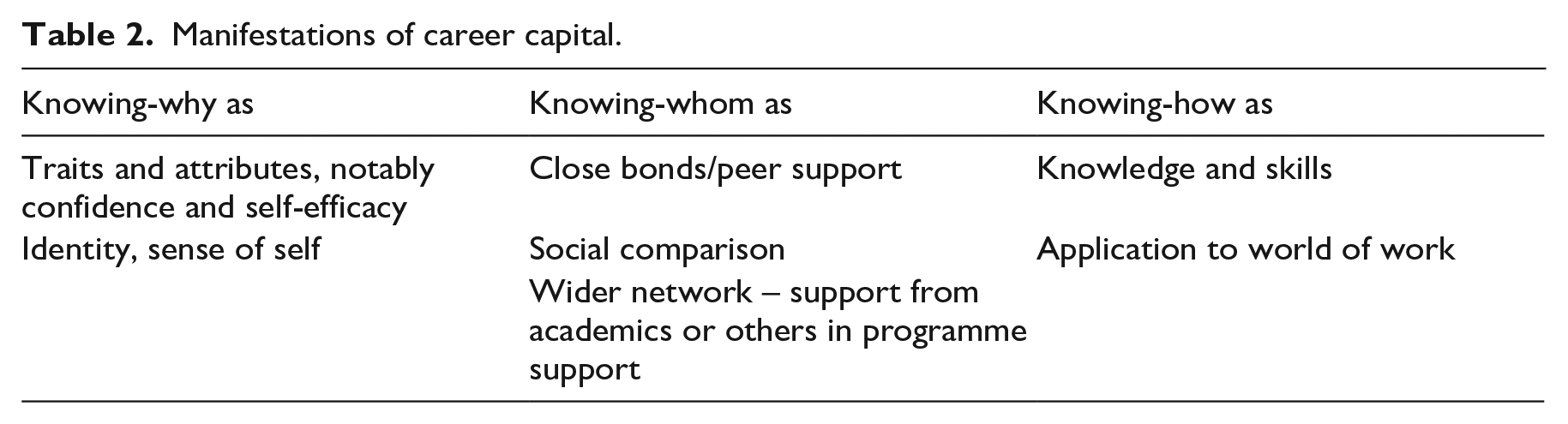
Although the interviews confirm the positive impact of the MBA on the development of all three career capitals, as outlined in the original framework by DeFillippi and Arthur (1994), the manifestation of these is more nuanced, perhaps reflecting the specific MBA context as detailed in Table 2.
Manifestations of career capital.
Knowing-why
Our analysis surfaced two qualitatively different manifestations of knowing-why. In some cases, the individuals refer to developing the traits/attributes of confidence and self-efficacy as illustrated below: Yes, it’s brilliant, I mean I have always said that I think the MBA makes you bulls*** proof. And if it doesn’t do anything else, it does that. So, you can operate in any environment, and it does give me that confidence basically to sort of engage, but also to walk away . . . and I think I have been able to add value at any level of the company that I worked. (David) So, the MBA gave me the confidence to start on project management, although I had a business degree it cemented the learning and gave me more insight into all the different areas, operations . . . I had a go at setting up my own company, the MBA gave me confidence to do that. (Tim)
Elsewhere, the emphasis is on the development of a revised sense of self. Although some individuals report both aspects, the experience of developing a changed sense of personal identity was evidenced in the interview extracts of only five individuals from our sample as illustrated below: I’m not in the same pond that I was in before my MBA. I am in, I suppose, with the bigger players, again I’m a little old country bumpkin from nowhere. I’m not privately educated, I’m not from the privileged colleges, leading universities. I am just little old me and suddenly actually I am not. (Jane) Until I did the MBA [I] probably didn’t fully have the identity of being a businessperson because it’s probably about confidence in a new identity. You need to go through something to give yourself that rubberstamp. So I think I was probably quite conscious of the fact that I did not have to do an MBA to be a businessperson, but in doing it, you know you put on your CV I have done an MBA, so it’s like okay you know your business, I didn’t need that, but I think it really helps giving you the stamp of a group and other people’s perception of me probably, they recognised it as well. (Peter)
Knowing-how
In our interviews, we found evidence of two manifestations of knowing-how: one in the form of knowledge and skill, such as MBA content, functional knowledge and academic skills, and another focused on the application of this in the workplace, as either a practical toolkit or the vocabulary of the role.
In terms of knowing-how as knowledge and skill, the following extracts provide an illustration: . . . and then MBA was just like the icing on the cake for developing more commercial skills. (Peter) The MBA gave me that slightly more academic skillset, to deal with operational, finance, strategic, marketing issues. (Oliver)
In addition to commenting on the skill and knowledge developed, there is reference to the application of this to the real world, as illustrated below: I started to see conversations with my colleagues changing quite substantially. So, my discussions with our finance client were no longer me as a client, by that time I had moved into a business role and saying okay I’ll do the analysis and you actually get into a deeper discussion with the finance team. (Andrew) ‘Okay, then obviously you had the value of it was applying it to the organisation that you were working at, because you did it alongside. (Anthony)
Knowing-whom
We found many examples of the development of knowing-whom in the interviews, with three different manifestations of it emerging. These revolve around bonding within the cohort, social comparison and external support, such as mentors, programme faculty and wider support staff.
In the case of bonding, for these individuals, the use of the MBA network revolved around warm, supportive relationships through the development of close bonds with fellow students, as illustrated below: I think it’s interesting, I don’t know if there’s been any research on this, the bonds and the kind of networks from people who were on the different modes of learning. (Adam) I felt very positive about doing it and I was really pleased when I got accepted to do the course and I really bonded with a lot of people on the course. We seemed to be in similar situations and of similar ages to me, and I really got a lot out of doing the course. (Michael)
Alternatively, others used the MBA to provide direct comparison of self with others: I think the main thing is it teaches you to be quite humble because you do get exposed to an awful lot of bright people. This is very humbling. But some of that energy does rub off on you, and I think the MBA just brings things out in you that you didn’t realise. (Arthur) The experience working within teams, and this was one of the reasons I joined this programme, for the working groups to work with people and the fact it was multicultural, ages and experiences within the room, I felt the discussions would be rich and they were. I had underestimated the alpha male types which would be attracted to the MBA programme. The competitive guys who needed to have the top marks and would be upset if they didn’t have the top marks. They were on a slightly different journey to me, but it reminded me that I liked working with people and getting them to work. From that point of view, it was powerful. (Lawrence)
Other examples revolve around the utilisation of the wider MBA network, with participants enjoying support from faculty and staff as a benefit of being enrolled on the programme: There was the coaching thing which I think is such an immense pleasure to have [there] – the exec programme and personal development aspect. That was confronting, as I had to deal with some stuff that I had been suppressing and my coach was brilliant, she was great at unlocking some of my hidden talents. (Henry) There were some lecturers who were great mentors there – they realise that you can’t grasp something, they’ll spend time with you and see when it drops (like a penny) when you just get it. (Gilbert)
Five qualitatively different experiences of career capital development and combination
As our data analysis progressed, it became apparent that the manifestations of the capitals were only one of the findings. We also identified five different ways in which MBA alumni describe their experience of developing and combining different forms of career capital based on the interrelationships and interdependencies between them. These experiences are differentiated in terms of the number and types of career capitals being combined, with the groups being labelled in a way which captures the main essence of the career capital development experience. The labels are (a) applying, (b) achieving, (c) collaborating, (d) believing and (e) transforming and are represented in Figure 1.
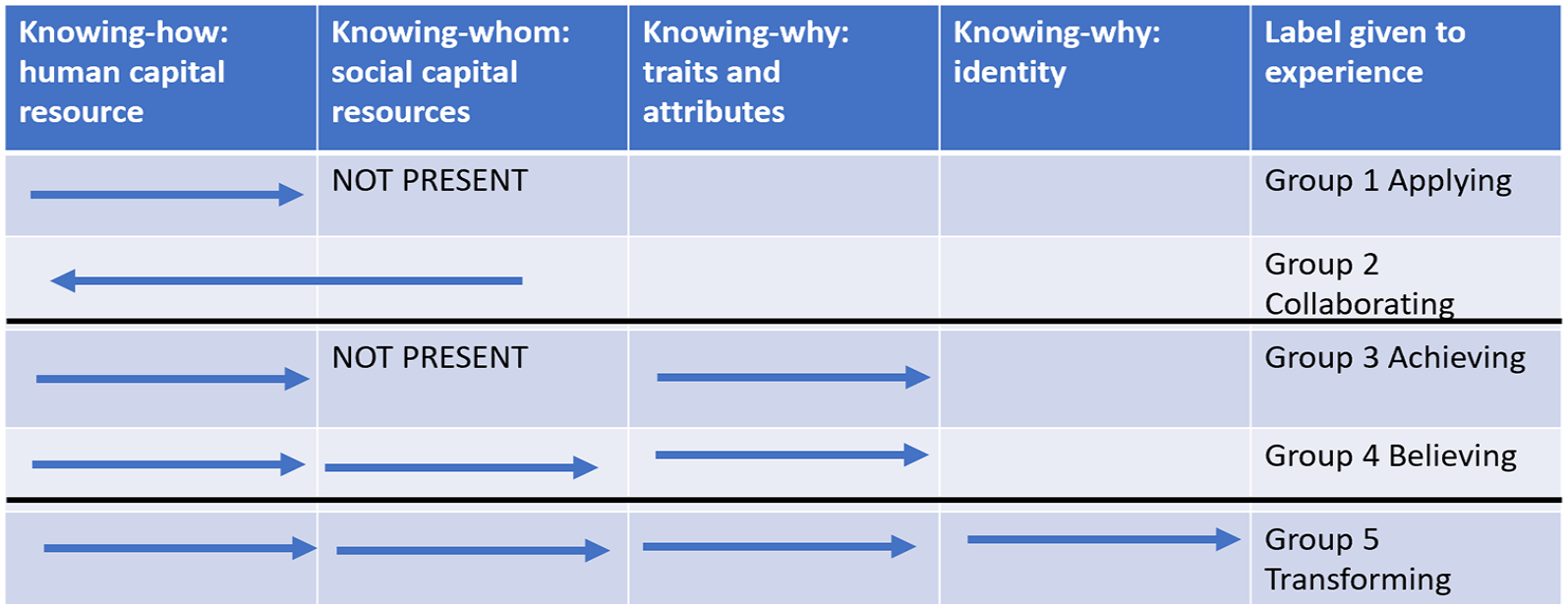
Five different experiences of the development and combination of career capitals.
In arriving at the five different groups, the presence or absence of knowing-whom in the career capital development accounts emerged as a key differentiating factor. Nine individuals develop elements of career capital without the input of others, while the majority of 20 involve others in their career capital development experiences. This is explored further in the following sections, which detail the different experiences of career capital development and combination.
Figure 1 shows the five different ways in which the capitals are developed and combined. In the case of Groups 1 and 2, the end state for individuals in terms of their career capital development appears to be knowing-how: one group develops this without the input of others, while the other group uses knowing-whom to acquire content and subject knowledge.
Group 1: Labelled as applying
There were three male and no female respondents in Group 1 who report having developed knowing-how career capital as a result of the MBA. Their reports emphasise using the programme to develop professional skills and knowledge that will be relevant in the workplace. From the interview data there is no evidence to suggest that these individuals leverage their knowing-how capital to develop knowing-why or knowing-whom. Selected quotes are presented below: And it gives you a springboard in terms of gaining insight and appreciation into how everything hangs together as a company (HOW). (Andrew) [T]o be honest with you I think there will always benefit for doing the MBA without a doubt there is benefit in terms of the technical and functional arena and the practical expertise (HOW), so there’s always benefit. (James)
Group 2: Labelled as collaborating
There were five males and no females in this group, who report the development of knowing-how as skill and knowledge but do so through mutual collaboration and support. It would appear that they need to develop knowing-whom before they can effectively develop knowing-how as skill and knowledge, as illustrated by Michael and Max below: I really liked the people in my study group (WHOM), I was really lucky to be in a study group with about six people that I liked a lot and I’m still in touch with today . . . I felt I got a lot from interacting from them and learning about their experiences in business (HOW). (Michael) The business school did a good job on the content of the MBA but much of the power comes from the cohort (WHOM) and it’s not just what you learn but the cohort journey. And it was clear that these people would often become good friends (WHOM). It became a safe, trusting place where you could throw out ideas and questions (HOW) and people would give you honest feedback (HOW) . . . When you’re with a cohort they have nothing to lose, except friendship or respect, which is unlikely because you form a great deal of respect for each other and working in small teams you get to know one another well, and you find a lot of support for each other. There were many people having life-changing milestones during that time (births, marriages, changing jobs etc.) and these are people you like, respect, and care about. So, you help them, and they help you back. (Max)
In the case of both Groups 3 and 4, the main character of their career capital development appears to be knowing-why as traits/attributes of confidence and self-efficacy. One group develops this alone and the other requires the involvement of others.
Group 3: Labelled as achieving
Group 3 comprises six males and no females. These individuals report on the development of managerial skills and knowledge (knowing-how) from the MBA and capitalise on this to increase confidence and self-efficacy. In this instance, individuals appear to develop career capital without reliance on others, as we can see below: I know how to run a business (HOW) and I can switch from a salaried IT person that doesn’t have to work weekends, there is a team of people doing everything to I am the person running the company doing everything on top of having to do the doing of the company. It is very different but I’m quite happy and confident going into it (WHY AS CONFIDENCE) the MBA filled in some gaps which was very good. (Mark) The MBA gave me that slightly more academic skillset (HOW), to deal with operational, finance, strategic, marketing issues. Personally . . . I feel much more confident (WHY AS CONFIDENCE). (Oliver)
Group 4: Labelled as believing
Group 4 is the largest group, comprising nine male and one female respondent. These individuals emerge with a greater level of knowing-why in terms of self-confidence and self-efficacy but do so via a more complex relationship than the bi-directional connection we saw in Group 3. Here, the interviewees appear to rely on the development of both knowing-how and knowing-whom in order to generate knowing-why, as illustrated by Charlotte below: As we said today you are thinking that you are the imposter (WHY), it seems because everyone goes through the same, like all these clever people, but you don’t know that at the time because who’s going to grab the pen, who’s going to lead, who’s going to present, who’s going to show how clever they are (WHOM). Whereas that was not really my thing. So, in terms of skills learnt, it was learning to learn again, and because of time between studies that was [a] learning curve in itself (HOW). But trusting in your ability to be able to do so (WHY AS CONFIDENCE, SELF-EFFICACY). (Charlotte) I guess we ended up being three mini learning groups that sort of gelled and worked very closely together (WHOM). So it was like the joint part, the skills I guess were, the models and learning how to approach new subjects (HOW). I think the big thing, that still resonates, was the reflection and reflecting is good for you even if it is painful and having a tool set and skills to be able to tackle anything and still make progress (WHY AS CONFIDENCE AND SELF-EFFICACY). (Charlotte continued)
Similarly, Gilbert reflects the themes of both social comparison and mentoring: The first part of the degree was very much getting involved and understanding what it was all about, on the executive degree there were a lot of higher calibre students (WHOM). Coming from an engineering degree, I wasn’t ready. I found people who had come from a business studies degree and who understood a lot about it already, which was a struggle for me . . . There were some lecturers, who were great mentors at the business school, they realise that you can’t grasp something, they’ll spend time with you (WHOM) and see when it drops (like a penny) when you just get it. (Gilbert) It was about applying the skills (HOW) and learning how to use your inner ability to progress a situation (WHY AS CONFIDENCE). If you get stuck, go back to your toolbox (HOW) and think about how to apply it and how to move forward. You’re thinking about the business analysis but using personal skills and learning to be yourself – dealing with people [o]n a multicultural basis was a big thing but I knew I could do that (WHY AS CONFIDENCE), however there were situations where you would get to your limit and revisiting those limits (WHY AS SELF-EFFICACY) and situations during the MBA was an essential thing. (Gilbert continued)
Although Groups 3 and 4 develop knowing-why, this is in a form characterised as the traits/attributes of confidence and self-efficacy as opposed to the career capital development experience of Group 5.
Group 5: Labelled as transforming
Group 5 comprises one man and four women, with only one woman from the five in our sample not being represented here. Like individuals in Group 4, individuals here also develop knowing-how and knowing-whom; however, in this case knowing-why is experienced in a different way. Not only does it include the traits/attributes of confidence and self-efficacy, but it also results in a change in personal identity. In Figure 1, we illustrate this by suggesting that for this grouping there is an integration of four kinds of capital: knowing-why as identity emerges from a combination of knowing-why as the traits/attributes of confidence and self-efficacy, along with knowing-how and knowing-whom. This is illustrated in the following examples from Rebecca and Peter: For me the MBA switched on (big time) the commercial gene, I wasn’t operations anymore. Once I moved to the commercial [side], and because of my MBA, I was able to be much more efficient and successful (WHY AS IDENTITY). I see the MBA as an opening and helping me to rationalise the world. For example, some of the strategic planning (HOW) we did helped me see things differently and suddenly things became very obvious to me. The world can be a very confusing place, events are happening, and you don’t understand them, and you try to rationalise them, but suddenly when you put them in [a] simple framework (HOW), which I use in my everyday life for understanding the world, suddenly things become simpler and easier to navigate through the noise. The MBA really opened my eyes and made me understand the business (HOW), the enabling functions and then I could position myself (WHY AS CONFIDENCE), understanding my goals and position myself accordingly. It wasn’t the MBA certificate that made me go into the commercial side (HOW), it was having done the MBA and understanding the business which meant I could transition and find my opportunity (WHY AS IDENTITY). In terms of people and the working group, I was distance learning so didn’t have the privilege of being in the classroom every day, but I had a very good diverse group (WHOM). There were people from communications, from all industries, which was fascinating, because once we boiled it all down, all of these very different industries had similar problems, they were the same challenges and same opportunities. I found that very rewarding. (Rebecca)
Similarly, Peter’s experience suggests the integration of all four career capitals: I felt I needed to do this. I think the MBA showed me that, they (WHOM) messed with my head and made me more entrepreneurial (WHY AS IDENTITY) . . . I used to talk to course colleagues about it, what we used to do in our jobs (WHOM) and how things could be unfair/fair to people. How they didn’t want to move on this technology, and then you go through the modules. I always remember the entrepreneurial assignment, mine was in setting up a digital agency (HOW). This was key for me, it showed me that I wanted to move on and try something different. Yes, that’s right, towards the end of the MBA I was thinking more like an entrepreneur (WHY AS IDENTITY). I had a lot more confidence (WHY AS CONFIDENCE) and I knew that I didn’t need the company I was with as much as I thought I did. (Peter)
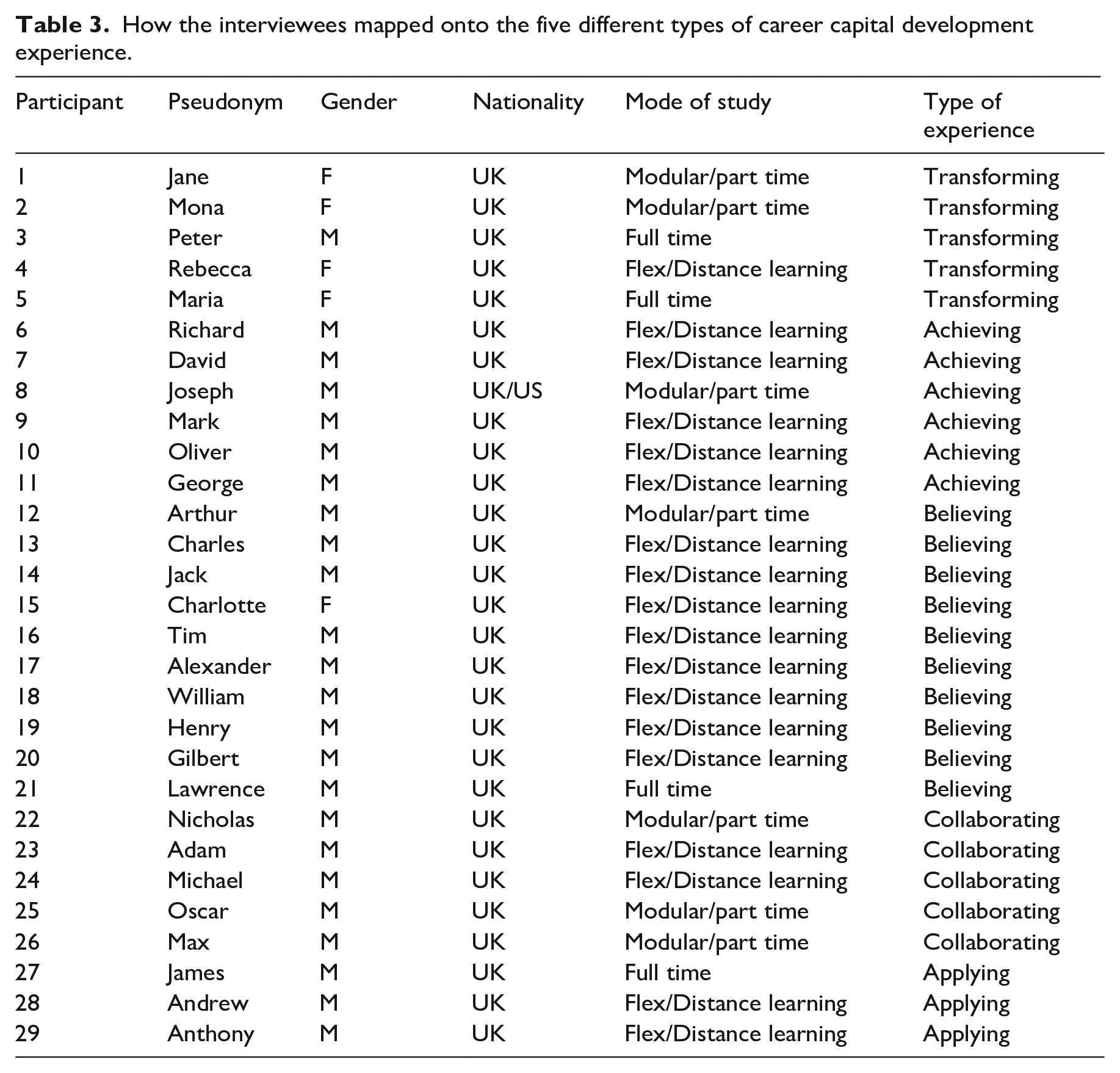
Following our analysis and the identification of the five different groups, we were able to allocate each individual in our sample to the group that most reflected their experience of career capital development. This is summarised in Table 3.
How the interviewees mapped onto the five different types of career capital development experience.
Discussion
Our study has sought to consider the following research question: What are the qualitatively different ways in which MBA alumni report the experience of career development? The career capital framework (DeFillippi and Arthur, 1994) provides a useful lens to interpret our findings, which confirm that the completion of an MBA leads to the development of career capital (Houldsworth et al., 2019; Zhao et al., 2006).
Ruth (2017) reflects on the nuance and insight provided by a qualitative methodology, particularly in terms of identity development from the MBA. In terms of our study, the emergence of different manifestations of knowing-why, as either the traits/attributes of confidence and self-efficacy, or as identity and personal transformation made it possible to discern that the latter only manifests in conjunction with knowing-whom, a point we return to later in this discussion.
In terms of knowing-why as traits/attributes, previous authors have commented on the various forms this may take, for example, proactive personalities (Eby et al., 2003), personal adaptability (Fugate et al., 2004) and psychological resources such as resilience (Hirschi, 2012). Our findings reflect Sturdy et al. (2006) with respondents typically referring to the development of greater confidence and self-efficacy.
In terms of knowing-why as identity and personal transformation, we found experiences of personal transformation which bear some resemblance to the notion of being ‘born again’ identified by Ruth (2017). This echoes Warhurst’s assertion of the importance of identity construction in relation to the MBA (Warhurst, 2011) and the potential for personal transformation to occur through critical reflection around deep, hidden feelings that are interlocked with our meaning structures (Cranton and Roy, 2003; Peltier et al., 2005).
Knowing-how was a theme across all the interviews. Given that the interviewees were all MBA alumni and the interviewer was based at the business school, this is perhaps not surprising. It also serves to echo Vaara and Fay’s (2011) point around the primacy of skill and knowledge in terms of MBA products and confirms earlier studies around how the MBA contributes to human capital development (Baruch and Peiperl, 2000) and the importance of this for career success (Gander, 2015; Gerli et al., 2015; Haenggli and Hirschi, 2020). Although there exist many criticisms of the MBA programme and its curriculum (Costigan and Brink, 2015; Leavitt, 1989), our findings are rather more positive. This may reflect the fact that our volunteer interviewees were, by implication, positively inclined towards the business school and aligns with the view of other commentators that the MBA is more helpful to the manager and less instrumental than critics suggest (Hay and Hodgkinson, 2008; Ruth, 2017).
In terms of knowing-whom, while some respondents develop career capital on their own (the achieving and applying groups), the majority of our respondents report developing career capital by involving others (the transformation, believing and collaborating groups). The bonding experience reported by some of our participants resonates with Bourdieu and Richardson (1986) and Putnam’s (2000) notions of trust and social exchange – individuals create close ties as a result of ‘being in the same boat’. For others, the experience of social capital is manifested as an opportunity for social comparison (Heslin, 2003), whereby working with peers allows individuals to develop via the ‘looking glass of self’ (Parker et al., 2009). We also see examples of knowing-whom as mutual support (Putnam, 2000) or helping capital (Konrad et al., 2016), which enables the accrual of skills and knowledge (Liang et al., 2019). Although previous studies have shown how mentoring supports the development of social capital for the mentor (Beigi et al., 2018; Parker et al., 2008), in our study we find that it is the individual MBA student who benefits from receiving mentoring from others. This was typically provided by faculty members involved in the delivery of the programme, thus emphasising the importance of the whole MBA ‘system’ in terms of the facilitation of career development.
Different combinations of capital
In addition to providing evidence of the different manifestations of career capital, we contribute to theory by reflecting five different experiences of developing and combining career capitals which represent the interrelationships and interdependencies between them. Although the experience of developing several forms of career capital is more complex, it is important to note that we are not suggesting a hierarchy in which certain levels of experience are viewed as more superior or desirable than others (Tosey et al., 2012).
Later in this section we discuss how the development of all forms of career capital can result in personal transformation, but we also acknowledge that learning which results in the development of knowing-how as business-relevant skill and knowledge is a worthy MBA outcome in its own right, reflecting the point made by earlier commentators (Hay and Hodgkinson, 2008: 27) about the ‘modest but salient role’ played by management education in broadening and challenging students’ understanding of management practice. In the context of this study, we report knowing-how development across all 29 interviewees, with it being the primary career capital outcome for two groups who either develop it alone (the applying group) or with the input and support of others (the collaborating group).
Although all respondents report developing knowing-how through the MBA, it is knowing-why that emerges as the strongest career capital theme, and we found evidence of it having two different manifestations. If we deal with the self-confidence element, our findings provide further elaboration by suggesting that confidence can be developed either with or without others. If confidence emerges from an interrelationship between knowing-how and knowing-why (as experienced by the achieving group), this may be a more fragile form of confidence (Sturdy et al., 2006) than that which emerges from a three-way relationship between knowing-how, knowing-why and knowing-whom, (as reported by the believing group), where individuals benefit from the reinforcement of others. By recognising the difference in experience, either with or without others, our findings support social constructionist perspectives, with most of our respondents reporting learning that emerges from relational dialogue with and/or through others in learning communities (Cunliffe, 2009; Hodgson and Watland, 2004). This emphasises the dialectic interaction with the collective habitus of the MBA (Fuller, 2013) and echoes Parker et al.’s (2009) emphasis on the importance of connection between the individual and their social arena.
Individuals in one of our groups (the transformers) report the development of knowing-why in a way that goes beyond the traits/attributes of confidence and self-efficacy to include personal transformation, thus reinforcing the potential role of business schools as identity workspaces (Petriglieri and Petriglieri, 2010). The fact that developments in identity are only apparent in those learners who develop all forms of career capital highlights a dependency between the career capital areas of knowing-whom and knowing-why as identity, and further highlights the importance of social interaction as part of the learning process. This aligns with Mezirow’s transformative learning theory (Mezirow, 1978, 1994); despite this focusing on the individual, it sees the essence of transformation to be located in the rational discourse and in the relationship with others, underscoring the importance of interpersonal relationships in the process of transformation (Illeris, 2014; Sturdy et al., 2006; Taylor and Cranton, 2012).
While our study highlights that personal transformation is possible as a result of the MBA, this does not appear to be the experience of the majority. Although some may debate whether business schools should seek to take responsibility for providing a transformative experience (Ruth, 2017), we would urge educators to provide support for the development of all forms of career capital, so as to facilitate the possibility of achieving personal transformation. The fact that only 5 learners, from our sample of 29, appear to experience career capital development as personal transformation concurs with earlier research findings that although deep learning can happen, most often it does not (Smith and Colby, 2007), as learning involving a shift in mindset is harder to achieve (Appelbaum and Goransson, 1997). Interestingly, of the five transformers we identified, four are female, from only five women in the overall sample. Previous studies have found that increases in the knowing-why aspect of career capital have been particularly pronounced among females (Lämsä and Savela, 2014; Sturges et al., 2003). However, with the exception of a study by Simpson and Ituma (2009), who reported that women are more likely to undergo ‘transformational’ change, most of these studies have tended to focus on the confidence element (Gander, 2015; Simpson et al., 2005). Given that recent data suggest a move towards more gender balanced MBA intakes (Hazenbush, 2022), now is the time for further work to focus on the gender differences in career capital accrual. Findings from this study suggest that in doing so it might be useful to separate out the confidence and identity elements of knowing-why. Subsequent research should focus not only on whether women are more predisposed to identity transformation as a result of an MBA, but also whether the learning environment is more supportive of them than of their male counterparts.
Implications
Findings from this study have implications for programme designers and leaders within business schools as well as all individuals intending to pursue an MBA as a career self-management strategy. In terms of knowing-how, our findings support the view that students gain valuable knowledge from the MBA curriculum. Due to the content-based nature of the MBA it is not a surprise that knowing-how features as a key element across all the interviews. Given the previous critiques of the MBA curriculum (Leavitt, 1989; Rubin and Dierdorff, 2013; Vaara and Fay, 2011), the prominence it receives from learners here highlights the need to ensure the ongoing quality, currency and relevance of this provision, particularly as, with the exception of the applying group, it appears to be linked to the development of other forms of career capital.
We found that knowing-why as confidence and identity and knowing-whom were experienced in different combinations by different individuals. Awareness of these different combinations is likely to be useful for programme leaders and for all those involved in MBA delivery as outlined below. To support those who experience career development as a combination of knowing-whom and knowing-how (collaborating), this is predicated on providing an environment for warm and friendly relations between individuals to build trust and close bonds. Most business schools deploy group working, but supplementing this with facilitation and support around group process and action learning principles might increase the likelihood of it being a positive experience. Learners who experience career capital development as knowing-how to knowing-why as confidence (achieving) do not appear to need the support of others, and these more individualistic learners might require incentives from programme delivery teams to ensure buy-in to more team-based learning approaches. Such individuals are likely to benefit from a process whereby they are encouraged to self-assess their entry point at the start of projects or topics, thus allowing them to self-report on their progress and improvement based on assignment feedback and review.
Those who experience career development as knowing-why through knowing-how and knowing-whom (believing group) rely on the input of others either within their learning team or the wider student body as well as the wider programme support structure. Individuals engaged in social comparison are likely to benefit from ongoing opportunities to compare and contrast experiences at both individual and group levels. Such an approach could include an element of peer review to provide insights into the work of others in their group. The knowing-whom element might also be achieved through a mentoring experience which could be provided from within the faculty, a careers function, or via an alumni network, but needs to be accommodated within the MBA system.
Finally, we see personal transformation as involving the development of all forms of career capital: knowing-why, knowing-how and knowing-whom. Given that changes in identity are only reported by individuals who also develop knowing-whom, this adds weight to the view expounded by Bozionelos (2015) that building and sustaining social capital must be a core priority for all career actors within the MBA. Designing in opportunities (within formal ‘teaching’ time) for students to interact and to discuss the problems they encounter is one strategy for course designers to pursue. Similarly, group working, facilitated networking and either peer or alumni mentoring are mechanisms that can be designed into the overall MBA system and have all been associated with deeper, more holistic learning outcomes (Smith and Colby, 2007; Trigwell et al., 1999).
To support self-awareness as a basis for identity work, the use of reflective writing or journalling is likely to be a useful tool and is one which was deployed in the business school where this study was conducted. By emphasising personal reflection, business schools are signalling that deeper learning approaches, rather than surface learning ones, are rewarded (Ramsden, 2003). Assessment is likely to be a key area of focus here. Individuals are more likely to experience personal revelation in an environment which does not foreground the judging and ranking of students (Trigwell et al., 1999). However, without effective use of peer review, changes to assessment regimes could involve a difficult balancing act for many business schools between needing to provide cost-effective and timely assessment with quality formative feedback.
Conclusion
Findings from our qualitative data from 29 interviews confirm that undertaking an MBA programme supports the development of all elements of career capital and provides evidence of how these are manifested. Key among these manifestations is the identification of knowing-why as either the traits/attributes of confidence and self-efficacy, or knowing-why as identity and personal transformation. Having identified the manifestations we were able to identify five patterns of experience of career capital development, thus highlighting the under-researched interrelationships and interdependencies which emerge as MBA alumni develop and combine different forms of career capital.
Knowing-whom emerged as a key factor within these interdependencies, with it becoming apparent that although knowing-how and knowing-why (as traits/attributes of confidence and self-efficacy) can be developed either with or without others, knowing-why as personal transformation cannot be developed alone. Thus, we find that the MBA, in common with other forms of higher education, provides a field or space in which interactions and events occur, where actors manoeuvre and learn to master the rules of the game (Bourdieu and Wacquant, 1992) and in which they negotiate their identity as members of the social milieu of the business world (McAdam et al., 2019). By doing so, the individual’s social positioning can be recognised and accepted (Elliott and Robinson, 2012) by others in their new MBA network with whom they identify (Bandura and Walters, 1977).
We acknowledge that our study has limitations. Our interview data will have been impacted by each individual’s memory and lapsed time since graduation and our respondents were all volunteers, which might have resulted in a group of individuals who were more reflective in nature or who had a more positive view about their learning and subsequent careers than other members of the alumni. Further research could take a temporal approach to explore career development through longitudinal research designs as a way to capture these dynamics as they are experienced, for example in the form of a diary study on a randomly selected set of learners. Furthermore, it is also important to note that our respondents were all able to gain entry onto a prestigious programme, either by converting their own economic capital or arranging for their employer to do so on their behalf. As such they represent members of an elite group with relatively privileged material circumstances (Sturdy et al., 2006), who do not find capital accumulation to be hindered without initial convertible capital (Al Ariss and Syed, 2011).
Despite the limitations, our study makes a contribution by describing how career capitals are manifested in the context of MBA and by identifying the different ways in which they are developed and combined as a result of the interrelationships between them. The most important of these interdependencies revolves around the development of knowing-why as identity change, which was only evident in the case of learners who also developed knowing-whom alongside knowing-why and knowing-how. This underscores the fact that although personal transformation is a potential outcome of an MBA, it cannot be achieved alone.
Our findings around the importance of content, the different manifestations of knowing-why and the differentiating role played by knowing-whom as a prerequisite for identity development have relevance for all those involved in management education practice as well as current and prospective students. Latter stages of the article have included some suggestions for ongoing research and practice.
Footnotes
Acknowledgements
We would like to thank colleagues who supported us by providing comments on earlier drafts, particularly Chris Brewster. We are also indebted to the anonymous reviewers who helped us to articulate the paper’s contribution more clearly.
Funding
The author(s) received no financial support for the research, authorship and/or publication of this article.
