




Abstract
The story we share here is about lessons learned during a three-year, collaborative autoethnographic journey beginning in January 2020. Our story is one of conducting a meaningful inquiry into our shared lived experience amid the changes brought about by COVID-19 lockdowns. Our insights speak to how we collaboratively reflected and researched across institutions, countries, disciplines, and career stages. More importantly, in making our process explicit, we highlight the way storying was experienced within our collective space. In doing so, we explore insights about how stories are adapted and transformed through a process of navigating the development of, and transitions between, pre-public and public spaces. Using an Arendtian lens, we explore the question, How are autoethnographic collaborative stories crafted for research in an academic context? Our insights present a cyclical and developmental frame within which to process collaborative storying and indeed collaborative academic work.
Introduction
Our stories are so much more than the sum of their individual parts. . . they emerge naturally in unexpected and unexplored spaces that exist within, through, and around us as we listen, share, nurture, embrace, and encourage each other. (Reflection on being in the Waffle Group)
Story, as both a methodology and data source, has gained significant attention in organization research (Beigi et al., 2019; Boje and Roslie, 2008; Hurd and Singh, 2021). Organizational scholars have used storytelling to give voice to organizational actors (Boje, 1995), as a ‘democratic act’ (Beigi et al., 2019: 458), to explore ‘emotional and symbolic lives within organizations’ (Rhodes and Brown, 2005: 169), and to ‘open up space and to change practices in organizations’ (Tassinari et al., 2017). Stories are viewed as an interpretation of ‘past or anticipated experience’ (Boje, 1995: 1000), intersecting past, present and future (Atkinson, 2007), and uncovering the institutional arrangements in which experiences are embedded (Clandinin and Connelly, 2000; Jørgensen, 2020; Morgan-Fleming et al., 2007). Stories are considered empirical data (Alvesson and Karreman, 2000) and, storytelling, as a method of inquiry, provides an opportunity to both sense-make of, and reflect upon, past experience, as well as to imagine future possibilities. We agree that storying is a messy process (Donnelly et al., 2013) that can be ‘fragmented, pluralistic, paradoxical and ambiguous’ (Jørgensen and Boje, 2009: 33).
In this research, we present our insights from a three-year qualitative study utilizing collaborative autoethnography (CAE) as the methodology guiding us through our journey of storying. We chose CAE intentionally because its design allows a phenomenon of inquiry to be explored from the perspective of the self as well as a concurrent and iteratively intertwined exploration using the perspectives of others (Belkhir et al., 2019; Jones et al., 2023; Nordbäck et al., 2022). It enables the ‘narrative expressions of life experiences’ (Denzin, 2017: 8), with the added elements of an interaction between colleagues (Chang, 2013) and a layering of subjectivities and contexts. Like all autoethnographic approaches, CAE allows the experiences of the self to ‘move outward from the selves of the person and inward to the persons and groups that give them meaning and structure’ (Denzin, 2017: 4). This is accomplished through a collaborative pooling of stories to search for commonalities and differences followed by an iterative discussion in which the researchers, working together, critically and reflexively search for meaning and contextualization through their socio-cultural contexts (Chang et al., 2016; Lapadat, 2017). Unlike individual autoethnographic approaches, which ‘reveal their author’s personal, professional, relational, and socio-cultural identities’ (Chang, 2013: 107), collaborative autoethnographic storytelling can enable a greater blurring between the personal and collective experience, providing a level of protection for the individual in terms of the public sharing of personal disclosures (Jones et al., 2023).
Utilizing a methodology with requisite safeguards and protections in place for our journey of reflective storying afforded us the freedom to explore our developmental processes. In the spirit of collaboration and adaptation, guided by an acknowledgement that our journey would be complex, dynamic, and interpretative, we drew upon the work of Hannah Arendt as the lens through which we explore our storying journey. Throughout her work, which is grounded in a valorization of Ancient Greek society, Arendt (1958) conceptualizes storytelling as a form of speech and action, enabling intimate matters to move from the private to the public realm to be seen, heard and validated. Nonetheless, she cautions ‘only what is considered to be relevant, worthy of being seen heard, can be tolerated, so that the irrelevant becomes automatically a private matter’ (p. 51). Within the context of our academic roles, we examine our three-year process of individually and collectively writing stories to explore the question: How are autoethnographic collaborative stories crafted for research in an academic context?
The remainder of the article is structured as follows: first, we describe concepts drawn from the work of Arendt (1958) which we took inspiration from in the crafting of the lens through which we examine and describe our storying journey. We then provide an overview of our research process, highlighting the iterative and emergent nature of our research. We make sense of this process through a frame of adaptive collaboration, occurring initially within a public space of individual sharing, then transitioning into a pre-public space of shared trust and protection, and, finally, continuing indefinitely with an iterative and adaptive cycle between pre-public and public spaces. We conclude our article with a discussion of the theoretical, practical and methodological contributions of our findings.
Drawing inspiration for our emergent analytical lens
Embedded in the complexity of The Human Condition, Arendt’s (1958) descriptions of the public and private realms offer a compelling framework for examining our collaborative autoethnographic data. When considering the theoretical lens through which we would interpret our processes, we found inspiration in Arendt’s writing, yet were not beholden to the multi-layered, richly complex, and, at times contradictory, nuances of her original conceptualizations and understandings. To clarify our applications of her concepts, we first provide a brief overview of the original definitions she ascribed to them.
For Arendt (1958), the private realm is the physical space of home where family members reside; it provides respite and a haven from the constancy of being seen and heard when in the public realm. The public realm, in contrast, is where people intentionally go to be seen and heard; by appearing before others, it is where ‘reality’ is confirmed (p. 50).
One way to be seen and heard is through storytelling. Arendt (1958) described storytelling as a way to release private experience into the public domain; in her conceptualization, the ‘result of action and speech’ is always a story (p. 184). However, because the public realm only tolerates stories that are deemed relevant and worthy, private experience must be ‘transformed, deprivatized, and deindividualized . . . into a shape to fit them for public appearance’ (Arendt, 1958: 50). She believed that while we may begin as authors of private experiences, the resultant stories are never completely our own. Rather, once a story is released into the public realm, it enters an existing ‘web of human relationships’ (Arendt, 1958: 184). The story can not only be seen and heard by everyone once it is in the public domain but also, be retold and reshaped to create a new story. It is this process which offers the potential for change and impact on the life conditions of future generations. In the end, Arendt believed that the consequences of beginning and releasing a story are boundless and unknown. What follows is the method used in our storying that captures our journey to becoming ‘the Waffle group’.
Method: On becoming the waffle group
Our group first met at the two-day Research in Management Learning and Education (RMLE) Unconference, January 2020. At the conclusion of the Unconference, we coalesced on a shared interest regarding how we were disrupting current hegemonic, neoliberal, and institutionalist academic work practices, and fostering spaces for a generative and well-being-centred academia. With the global spread of COVID-19, our plans to meet face-to-face at various conferences to extend this work were suspended indefinitely. As such, our group of seven connected via email and then through online meetings; our virtual meetings were typically held monthly and lasted for approximately 1.5 hours. This pattern continued for the better part of three years (2020–2022).
Capturing the organic nature of our conversations, and the fact that several of the members regularly joined the meetings during their breakfast, we named ourselves ‘the waffle group’. As time progressed, we would, within one meeting, have members who were in a post-dinner relaxation space, those who were in the mid-morning meeting rush, and those who were in their early morning breakfast time, often with children or partners popping into the meeting to say hello. Those in a relaxed space provided a contextual antidote to those who were in the middle of workdays, and vice versa. We shared our days, what we were doing at that moment, and together coalesced in a space that was ‘timeless yet bound by time’ (Reflection on being a Waffler). Within this space, we kept to our meeting times, yet simultaneously were not in a rush to move through each meeting ‘the pace of the group is actually a welcome change’ (Reflection on being a Waffler).
We turned our attention to the initial intention of exploring and challenging taken-for-granted assumptions and imagining new possibilities within academic work. We arrived at this inquiry from different disciplinary areas, different geographic regions, and different levels of experience in academia. We knew we wanted to engage in a collective autoethnographic (CAE) process (Belkhir et al., 2019) to reflexively draw upon and engage with personal situated experience (Cruz et al., 2020; Cunliffe, 2003; Lapadat, 2017). This process aligned with our intentions of revisioning academic work (Millar and Price, 2018).
While the starting point was our own academic practice, we did not have a fixed idea of where this inquiry would take us. Through individual and relational reflexive practice (Cunliffe, 2003), we were open to embracing the unknown, keeping faith that knowing would emerge ‘through the relationality of collective practices’ (Allen, 2017: 129). The emergent process across a three-year period saw our story shift, from an autoethnographic focus on individual experience to composite stories of academic well-being. Each stage involved a specific piece of writing which we would share with the group and read before following with a reflexive group discussion. In these discussions, we would question, ask for clarification, and push for deeper layers of meaning, understanding, and context, as we developed our stories and engaged our storying process.
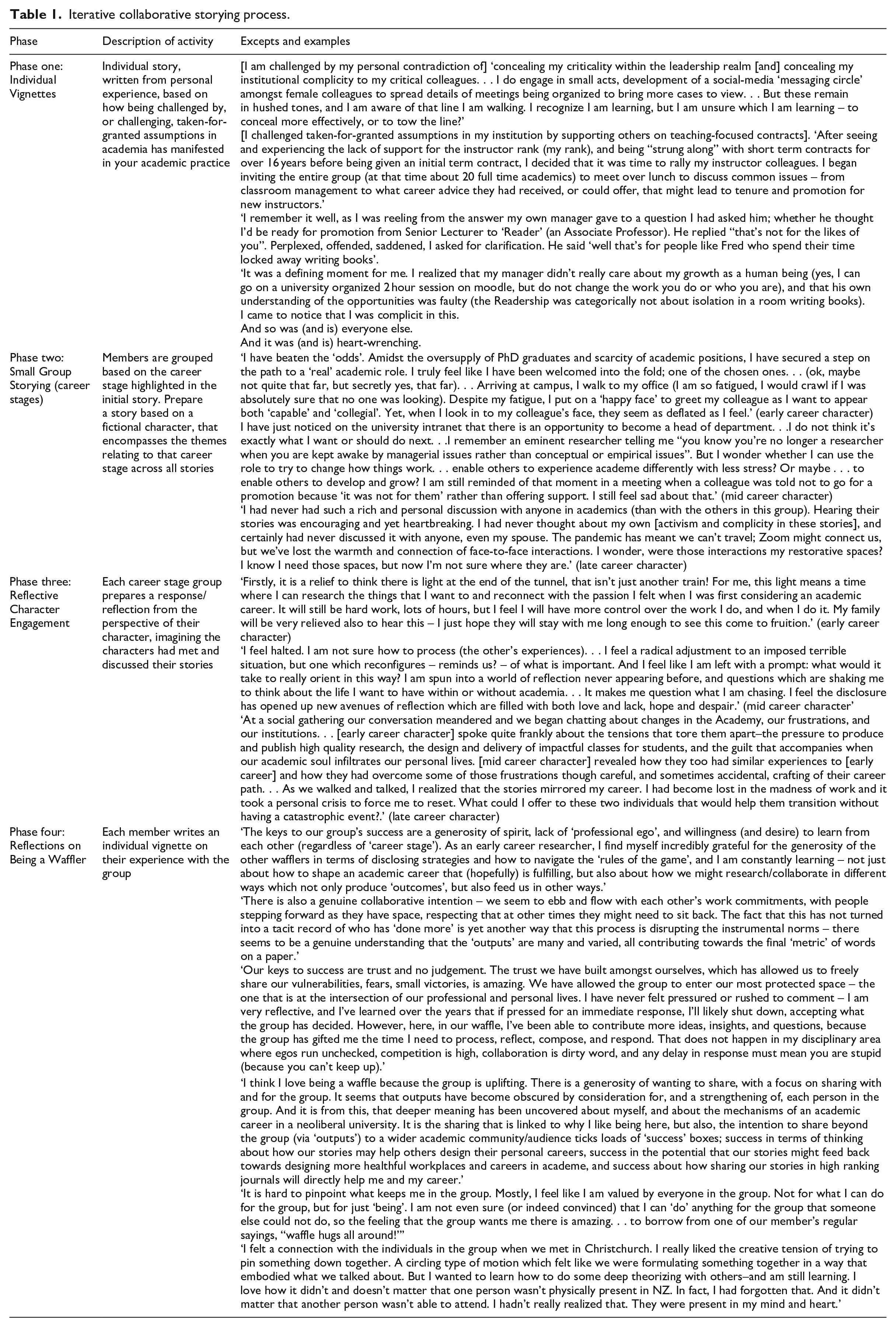
In the first instance, we discussed all individual vignettes. As we gained comfort with each other, and familiarity with the process, we would focus on just one story – allowing ourselves more time to richly explore, critique, extend, and reflect. In doing so, we were broadening and burrowing (Connelly and Clandinin, 1990), and narrative smoothing (Kim, 2016); with each retelling, the stories were reshaped. We continued with this iterative approach throughout the entirety of our journey which, to date, has included four phases. The emergent iterative phases of our collaborative storying process are described in detail below and illustrated with excerpts from our stories and reflections in Table 1.
Iterative collaborative storying process.
Emergent themes and career stages.
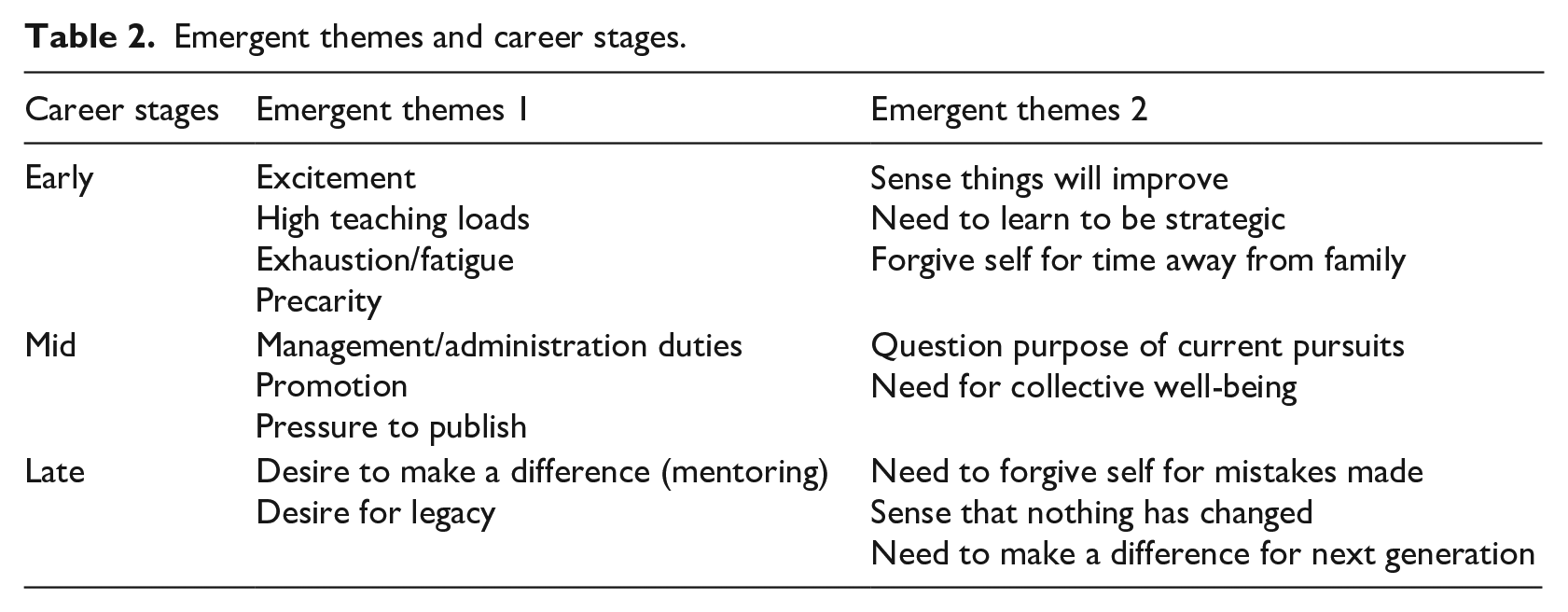
Having begun the process of sharing our work, and extending ourselves beyond the safe, private confines of our collaboratively built warm and welcoming virtual waffle space, our group was filled with enthusiasm and excitement. We shared what felt like a revelation in that there was a powerful connectivity with, and resonance emanating from, our composite stories across the career stages that seemed rich and deserving of further inquiry. It was as though the individual characters we had created who were not ‘known’ to each other, were somehow inextricably linked.
Consequently, in
The resultant discussion of hope and making a difference led us to a discussion on how the process of being a ‘waffler’ had changed our views on our own, and others’, academic well-being. We could see that although we had produced some interesting stories together, it was in the process and space we had co-created that we found methodological and practical insights. At this point, we decided to reflect more intentionally on the process we had undertaken.
One of the greatest reflective gifts of writing this paper has been our transition to
Insights into the waffle context and process
In agreeing that our story had shifted to encompass the entirety of our waffle process, we sought to conceptualize these shifts. In the first iteration, we analyzed our experience from a spatial-temporal perspective. We could also see that this mirrored our characters’ experiences, as there were spatial-temporal elements to their stories. We sought to conceptualize these shifts as ‘entanglements’. However, reviewer feedback led us to question this framing. Reflexively, we could see that we had included too many elements in that sharing of our story. At that point, we collectively agreed to explore a suggestion from one of our reviewers to reconsider our examination of context and process through the lens of Hannah Arendt’s (1958) Human Condition.
This externally driven, yet internally embraced, shift led to an agreed reframing of how we would examine and seek to understand our waffle space and process. We drew upon Arendt’s distinctions between the public and private space, through which we considered our navigations, transitions, adaptations and movements between individual and shared storying. We acknowledged that ours was never a private space, rather, we began in the virtual public space of our online meetings and yet moved, over time and shared experience, through our increasing trust and safety, to one that was still virtual, but felt different; together, we had created a space that can be best described as ‘pre-public’. This, our, pre-public space was one in which we felt protected and nurtured, able to vulnerably engage in a process of creating, co-creating, sharing, questioning, rethinking, and reworking our stories. Here, we began to understand and explore the tensions and dynamics of moving our stories from the pre-public space we created together to a public space which, in our case, was experienced through the process of academic submission and review. It was through this lens that we were able to clarify the subtle nuances that differentiated our storying in each of the four phases and the intricacies of transitions between them. The beauty of this process, and the waffle group we have storied within, is that through every phase – each iterative and collaborative revisiting and reconceptualizing – we have experienced a strengthening and clarification of our contributions to ongoing and emergent scholarly discussions. We welcome going back into our virtual pre-public space together to revisit, reconnect and reshape our collaborative storying, and then we emerge ready to be seen and heard by the public once again.
Looking back, we reflected that as we moved through this process, not only did our storying process emerge, weave and meander, but also our stories themselves emerged, morphed, shifted from individual to collective, then back to individual. Throughout this process, we intermittently journeyed into the public realm and then retreated back into the pre-public through a cyclical process of receiving external feedback as fodder for reflection, and then processing that feedback together as part of our storying journey. For us, this emergent and iterative cycle holds significant insights into the collective storying process. In particular, we drew upon our own interpretations and adaptations of Arendt’s thoughts on public and private spaces as a frame to analyse how stories are created.
Using the above contextualization through which we explored our collaborative autoethnographic data, we turn to our findings. Here, we describe the processes that lie within, and the transitions that lie between, the ‘I’, the ‘we’ and the ‘they’, and back again.
Findings
Our analysis of our CAE reflections revealed four key shifts within which our storying journey was transformed: (1) authoring individual stories to share with the group, (2) collaboratively creating group stories, (3) transforming the group stories for public release and (4) returning to individual and group stories.
Authoring the ‘I’ to develop the ‘we’
The felt tensions between the ‘I’ and the ‘we’ began when we set out to write our first individual story around challenges we had experienced within our academic work. The purpose of these stories was to privilege the ‘I’, and the language in these stories reflected this (the four excerpts below are drawn from individual stories): ‘I am aware of that line I am walking.’.. ‘I began inviting.’.. ‘It was a defining moment for me.’.. ‘I came to notice.’..
However, in choosing a personal story two write about, we also felt the tension around which aspects of the self to share that we perceived would be acceptable to other group members. We sought to be seen as valued members of the team, yet did not want to disclose too many personal details, uncertainties, and vulnerabilities. This tension is captured in the extract from a reflection on the crafting of the initial personal story: ‘As I complete this first story, I realize just how much I have struggled with writing a short story. I have been trying to ‘pick’ a story that does not leave me too vulnerable’. (Email to the Group)
We remained tentative in our trust of each other, assuming a pseudo-anonymity through giving each vignette a title without attributing a name to it. We also decided to label our initial vignettes with ‘confidential’ as a mark of the developmental nature of our trust and our initial testing of each other. In doing so, we were asking of ourselves ‘which aspect of myself am I comfortable sharing with the group?’
The nurturing response to our personal stories provided us feedback that enabled our shared journey towards trust and vulnerability: ‘I have just read [the latest vignettes] . . . I have to say . . . I felt honoured and privileged to read such evocative and heartfelt disclosures. Wonderful, really wonderful’. (Email to the Group)
At the same time, the meetings also began to feel more like a social gathering of friends. Our growing sense of value, care, trust and respect for and by group members, and feelings of belonging and of ‘being at home’ were expressed in our reflective stories of being a Waffler.
‘I have never felt that anyone was isolated or neglected from any spaces. As someone who missed a chunk of time with the group for personal reasons, I have never felt shamed or rejected from the others who worked through and carried my weight while I was away. That’s a truly beautiful gift’. (Reflections on being a waffler) ‘At first, I wasn’t sure where the waffle meetings were going, an interesting discussion each time, but what was the importance of creating these spaces, were they ever revealed? As we shared our stories, I found that our shared experiences began to form a shape – still too far out on the horizon to clearly see, but there was something there. Each time we meet, the shape becomes more defined, but then another distant shape begins to form –sometimes we pursue them, and sometimes we wave as we pass them by. I stay because the waffle group has become like my favourite hike’. (Reflections on being a waffler)
This deepening comfort experienced within the relational space, alongside the feedback we received from each other, strengthened our willingness to reveal ever more sensitive experiences within our stories. We had transitioned from a group of seven ‘I’ members to a collective Waffle ‘we’.
Navigating within the ‘we’
The ‘we’ had become a safe space to explore our experiences as part of the Waffle collective. In practice, this was embodied through our transformation of individual experiences into collective representational stories. The intensely personal nature of our stories led us to become concerned for the safety of each individual, and to look for ways to build protection into our storying. We were aware of the potential negative repercussions once a story is released into the public. This protective, care- and concern-based intentionality is evident in the following: ‘What do others think about our creating singular, evocative/fantasy ethnographic accounts to protect identities?’ (Email to the Group)
Despite our growing rapport and sense of trust, a hesitancy and nervousness remained about how our revised stories would be received by the wider group. In releasing the composite stories, we noticed each subgroup was sharing a need for group approval: ‘Attached is our ‘first ‘go’ . . . We have structured this again as a story – which may not be the intention – I wonder if we were ‘meant’ to get into more conceptual ground in this one, or whether we are still in the narrative mode? Anyway – here ‘tis! We can always go back and revise if this is not what was required’. (Email to the Group)
These small-group composite stories were still written from the first-person account with a focus on the ‘I’ as a way to protect the individuals who were part of the writing group for that story. Examples from those stories include: ‘I wake each day with renewed hope that today I will ‘get it’, today will be the day that all my hard work, the hours of unpaid work, emotional labour, and loyalty will be recognised and rewarded. And as I get myself ready to face another long day of teaching, I remind myself that this workload is only temporary. I ‘My story of being a middle-career academic begins like many academics, with the urge to progress my career to professorship level, within a neo-liberal system that seems to increasingly create ‘excellence’ hurdles for such a realisation. Key common questions reverberate: do I try and become ‘excellent’ at everything and do I deliver on other peoples’ terms or do I deliver on my own terms?’ (Excerpt from mid career composite story) ‘In the eyes of my colleagues, I had reached the coveted senior academic position, where I could choose to work on projects that were of interest to me and mentor others. I found it comforting to have the time to explore and share my ideas, and not be overly concerned with producing only A and A* journal articles. The university was now accepting what I was willing to give. It would be a pleasant transition to retirement. That cozy feeling changed after recent chance encounter at the Unconference’. (Excerpt from late career composite story)
In preparation to present at conference, our first public reveal, we reflected on how we felt our stories honoured the experiences of the group members: ‘I love it! I particularly love how you have worked to represent all our voices and individual ‘marks’ on the project. . .And while making a clear contribution, the ‘essence’ of our Waffle group remains -it feels as though it has been wrapped in a warm theoretical cloak!’ (Email to the Group)
Within the ‘we’, members shared about how the process of reflexive engagement within our collective storying extended our own understanding and insight, resulting in the possibility of new futures: ‘I think that the Wafflers have helped me build that confidence and break a “glass ceiling” I had built for myself about my capability to contribute where I felt inadequate in the past’. (Reflection of being a Waffler) ‘The Waffle group, and our waffling practices together, inspired me to go back to work after ten years . . . The Waffle group reintroduced me to the power of working with other people, in academia, together, grappling with issues, concerns, ideas, and the complex multiplicity and interwoven nature of everything we study and are challenged by’. (Reflection on being a Waffler) Transforming from the ‘we’ to the ‘they’
In our first public release through our initial conference submission, we were affirmed by the reviewers’ feedback, reinforcing our sense of the worthiness of our stories. Upon receiving positive feedback, we shared a sense of achievement within the group. Here are two examples: ‘Looks like we clearly hit our target. The viewers could relate to our stories’. (Email to Group) ‘Woo hoo! It’s wonderful to be sharing our waffleness with others and hearing that our stories resonate with them’. (Email to the Group)
The first quote above about ‘our target’ also clearly identifies that we were adapting our story for a particular public audience, and felt affirmed that our stories fit within the audience’s expectations. Upon presenting at the conference, we met with further positive feedback, suggestions to more fully explore the complex, and yet contextually relevant, work of Arendt (1958), and interest in the spatial and temporal dynamics of our storying space.
We showed a willingness to adapt again through another round of tailoring our stories for the audience, as we developed our conference paper into a full manuscript: ‘I love the fact that, as Waffles, our group isn’t in a hurry. . .we are OK backtracking to re-examine using a different lens, and heading down a different pathway’ (Reflection on being a Waffler).
Indeed, it took us some time to re-analyse and shape our story for journal submission. Our first submission received challenging but constructive feedback, which we viewed positively as a part of the ongoing development of our story. The following remarks illustrate our emotional response to this feedback. We wanted to know what the public expected of us and were excited to respond as part of our collaborative adaptation within our ‘we’ for public release, fully acknowledging that these changes were crafted based upon expectations of the ‘they’: ‘This feedback is golden in terms of us shaping a resubmission’ (Email to the Group) ‘I have to say that the guest editor’s comments were probably the best I have ever seen in terms of constructive, insightful, thoughtful, well-shaped, -grounded, and -worded, and overall helpful’. (Email to the Group)
Taking into account this careful feedback, we prepared a new submission, shaping our story, and framing our analysis in Arendt’s theoretical language, which we felt would be better received. The constructive nature of the initial review provided us confidence in this approach: I have no doubt our revision will be well-received on their end given how thorough the reviewer comments and references/suggestions were. (Email to the Group)
We also reflected on how the story had developed in response to this re-framing: ‘We realised that in framing with Arendt. . . it became a very different paper. . . but I think it is focused, and hopefully they will see the value’ (Email to the Group)
During this re-framing process, it was not only a case of negotiating the tensions between the story we wanted to tell and the interests and perspectives of the reviewers; within the group, there were also differences in opinion as to how much we should adapt our story based on the expectations of others who were providing us with guidance on the revision: ‘I was worried as I started reading it because two of the reviewers were so generous with their comments about the storytelling part of our last version, and this has a very different beginning.’.. (Email to the group)
However, the outcome of this discussion was to ‘set aside’ the concern, as other group members expressed support for, and value in, the new and adapted framing put forward by the Waffle subgroup who led the revision process (noting that our authorship subgroups are affectionately referred to as ‘mini-waffles’): ‘. . .but this version is wonderful. It is targeted and insightful. It is powerful and direct. It is clearly written and compassionate. It is everything a Waffle should be’. (Email to the group)
Interestingly, and as could be expected given the initial positive reviewer feedback related to the storytelling aspect of the paper which had been significantly reduced, the second round of feedback from the public revealed similar concerns to the worried Waffle member above. The reviewers recognized the story had transformed and their feedback gave us a moment of pause before we moved on. Here, we reflected on the inception of this paper, and how our storying process evolved organically, almost ‘by accident’: ‘One thing that struck me, and I don’t know if it is important, but I think this is also a tale of accidental/unintentional storying. . . the group had formed because we were interested in. . .[academic well-being]. . .. and yet, I think it was about the 3rd or 4th Waffle meeting when we started to see the academic well-being threads forming, and we shifted our focus in that direction’. (Email to the Group)
However, while we conceded that the process began organically and somewhat unintentionally, as we gained feedback from each other and external reviewers, our storying had become more purposeful and structured and less organic and shaped by our pre-public space. Through the initial revision process, our story had lost some of our ‘we’ and adapted too much of a focus on ‘they’. Our focus had shifted to creating a story that others, in the public, would see and hear as worthy of public release.
Returning to the ‘I’ and re-discovering the ‘we’
To reclaim our organic storying, we revisited the ‘I’ and reminded ourselves of who ‘we’ are. In Phase Four of our journey, we returned to autoethnography and wrote a vignette on ‘what being a Waffler, and this process, has meant to me’. There can be no more evocative and insightful way to demonstrate the importance of fostering nurturing and generative spaces than to share a small selection of these reflections. In the words of the Wafflers: ‘I have learned as much about our commonality around our anxieties, vulnerability, failures. . . as I have about our differences. . . when we talk, I do not see these differences at all – differences in gender, age, ethnicity, hierarchical position, discipline, university seems to not even be on the radar –which is very liberating and a special feeling. . . This is quite a revelation to me, as I never thought that a virtual space and communication could offer so much. . . what we have built is a sort of micro-university which offers such a stark contrast to what university academic life means for people within their institutions. . . it offers hope that university futures could embrace interdisciplinarity and collegiality’. ‘I think I love being a Waffle because the group is uplifting. . . It seems that outputs have become obscured by consideration for, and a strengthening of, each person in the group. And it is from this, that deeper meaning has been uncovered about myself, and about the mechanisms of an academic career in a neoliberal university’. ‘I not only like but I love the feeling that group gives me –a feeling that I am part of a group of likeminded, yet eclectic individuals who make me feel at home, although many of us are thousands of miles apart’. ‘This group, our amazing Waffles –funky syrups, crazy flavours, low calorie intake and all, has given me freedom and respected my limitations while still welcoming my contributions as important and helpful. It’s an incredibly nurturing place to be. I’m inspired by it. It has put a smile on my face, a metaphorical swing in my fingers (for typing), and warmed my heart. I’m loving it’.
Returning to the ‘I’ and reconnecting with the ‘we’ enabled us to recognize that searching for legitimacy, by writing for the ‘they’, had stripped us of our authenticity. Being a Waffler was, for us, being in a pre-public space of care, nurture, trust and protection. Our circular reconnection, of moving to the ‘I’, to the ‘we’, and back again, and being in the pre-public Waffle space gave us strength to write ourselves back into the story.
Discussion
We started by asking ‘How are autoethnographic collaborative stories crafted for research in an academic context?’ Our journey started with the intention of undertaking a collaborative autoethnographic project, using vignettes, reflexive discussion, and critique to construct stories. Indeed, one outcome has been the co-construction and publication of these collective stories (Jones et al., 2023). After working together for three years, we have gained significant insights into the process of storying. Our story, which started as individual reflective accounts, has transformed through an intersection of an authentically collaborative autoethnographic research process in the context of an academic environment. The answer to the research question we posed is complex and multifaceted. It is an answer grounded in our discovery of the developmental, iterative and cyclical process of adaptation and transformation we experienced between pre-public and public spaces as we engaged in a collaborative autoethnographic storying journey. Within this process, we discovered the potential for storytelling to transform a group of ‘I’s into ‘we’s through an intentionally slow and organic nurturing of connectedness. Drawing inspiration from Arendt (1958), we theorized this developmental space as pre-public – one in which members are shielded from public judgements. To elaborate on these processes, we highlight two areas of contribution which extend discussions on storytelling spaces in the management and organizational learning literature.
Our first contribution extends Arendt’s thoughts on storying within the private and public realms
Arendt distinguished between the private and public realm, each associated with bounded activities. Indeed, we initially distinguished between our homes as private spaces and that which we perceived to be a public ‘Waffle space’. Over time, our behaviours changed alongside the emergence of what we are now conceptualizing as a pre-public space. Others have suggested additional spaces beyond the public and private, including Oldenburg’s (1999) ‘third space’ and Goffman’s (1959) ‘backstage and frontstage’ distinctions. For Oldenburg, the ‘third space’ is in public, and is a space of relaxation, private conversation, and friendship. For Goffman, activities in ‘backstage’ occur in private, whereas ‘frontstage’ activities are performed with a specific audience’s expectations in mind. For us, the pre-public space activities and behaviours neither conform to the private, public (Arendt, 1958), frontstage, backstage (Goffman, 1959), nor third space (Oldenburg, 1999) conceptualizations. Instead, the pre-public space we experienced, and share here, is one that is decidedly relational with an explicit focus on developing a storytelling agenda, thus containing some activities and behaviours previously associated with the private and the public spaces. For example, we were concerned about what others outside of our group thought while observing a tentativeness with each other. In this pre-public space, as our trust and friendship developed, we began to share increasingly sensitive, intimate, and at times painful stories (Pryer et al., 2023) and yet our institutionally derived preexisting norms and expectations remained. Therefore, we were neither wholly free from the externally prescribed expectations, which we now realize we had internalized as our own, nor were we able to reach a state of completely ‘private’ relaxation.
Our analysis of the pre-public space we found ourselves in extends Day and Goddard’s (2010) problematization of Arendt’s distinction that public and private realms are both predetermined and hierarchical. Because the marginalized are already dismissed from the public realm, Day and Goddard (2010) argue their political struggles occur within the ‘counterpublic’ space. This space transcends private and public boundaries, contests the naturalization of the marginalized and provides a space for political activism for those who are never seen, heard, or confirmed in the public realm. Within our context of collaborative storying, our experiences of the pre-public space relate to, and yet differ from, their conceptualization. For us, our pre-public space was fluid; it was a space where the group could retreat from the public and reconvene from the private. This, our, pre-public space was where we came together to reassess our story, reconnect with each other and consider who we were before thoughtfully and intentionally re-entering the public realm as valued members of our collective ‘we’.
Second, we contribute methodologically to collaborative storytelling practice
We do so by extending Arendt’s (1958) assertion that crafting story is a process of shaping for public release. Instead, what we found that that collective storying is shaped within a pre-public space and continues to be reshaped across multiple iterations. Within the circularity of our storying, we found ourselves moving from the ‘I’ to the ‘we’ to the ‘they’ and back again. Navigating between these frames transformed our stories, both in an anticipatory response to concerns about how our stories might be received, and in reflective response to reviewers’ suggestions, comments and concerns.
For us, the pre-public space was a space of security that enabled navigation between both individual and shared storying and different theoretical frames, as we shaped our stories in preparation for public release. This blurring of the individual within the collective provided some protection upon public disclosure (Jones et al., 2023). Our iterative process, including reviewer insights, strengthened the reflexive aspect of our storytelling practice.
However, we also observed that in the process of re-storying, some of our realities were not affirmed and, as argued by Arendt (1958), aspects of individual private experiences were edited out. Therefore, we found that the iterative process of re-storying, while affirming and transforming experience, also denies the public telling of the full story. Through the process of re-storying and transitioning between the ‘I’, the ‘we’ and the ‘they’, the final story released to the public may not, in fact, be the story that was intended to be shared and heard in order to enact transformation. The richly descriptive and evocative individual story of the ‘I’ may become an anonymized reductionist composite story of the ‘we’ and the ‘they’, stripped of meaning and purpose.
These insights from our storying process provide important implications for collective autoethnographers. We highlight the importance of the collective to reflect on the processes undertaken, the stories that are shed, those that are adapted, and those that are chosen to be released. Our findings extend the theorizing of Ibarra and Barbulescu (2010) who highlighted that individuals are more likely to keep, retell and embellish stories that feel authentic and ‘validated by its target audience’, and let go and replace stories that are not endorsed (p. 148). We find that the loss of authentic stories is a potential limitation of collaborative storytelling that is worthy of further exploration and attention. From a pragmatic perspective, another contribution of our work is support for Korber et al. (2023) finding that ‘we-experiences can emerge from enlisting and revisiting shared timely moments even without sharing a physical space’ (p. 22). Using CAE as our methodology enabled us to examine our enacted temporality of connection and ‘we-sustaining practices’ in an online environment (Korber et al., 2023: 22). Our findings not only point to the efficacy of generating connectedness without physical togetherness but also raise questions for future research regarding contexts within which collaborative ‘we’ focussed storying processes may be better suited to online environments than traditional face-to-face settings.
In addition to these contributions, we find implications for the fostering of generative spaces for collective autoethnographic inquiry
Our experiences revealed the importance of time for building supportive, trusting relationships, creating safe and creative spaces, and for writing enriched collective stories. Importantly, our time together was impacted by the necessity to meet online. This virtual space freed us from the constraints of physical distance that traditionally make it rare, if not impossible, for international research groups to maintain momentum, stay connected, and meet regularly. In contrast, we suggest that the Waffle group survived and thrived because our meetings took place using an online platform. Having online meetings enabled us to meet frequently and in unusual and diverse spaces and times. As we transitioned from individual to collective storying, we built a concern for protecting each other from ‘the implacable, bright light of the constant presence of others on the public scene’ (Arendt, 1958: 51). This concern became the basis for our approach to our collective storying and shared experience.
Therefore, we concur with Pryer et al. (2023) on the importance of a ‘deep camaraderie and trust among [the] team’ (Pryer et al., 2023: 1541). We found that this enabled us to feel confident and safe. Indeed, we agree with Pryer et al. (2023) and colleagues’ assertion that it is the willingness to share evocative, vulnerable and rich experiences, which makes the collaborative autoethnographic method ‘incredibly useful for other lived experience researchers’ (p. 1541).
In this sense, we contribute to an understanding of collaborative ‘we-experiences’ (Korber et al., 2023) and respond to recent calls for more focus on the role of informal academic collectives (Callagher et al., 2021) for crafting safe shared holding environments (Petriglieri et al., 2019). Extending a discussion of protection throughout our waffling, members expressed gratitude for a focus on care as part of the process of nurturing relationship development. Not only did our storying practice strengthen as we moved forward together but we also saw our personal experiences in a new light, and experienced a hopefulness about the potential future of collective academic work.
Conclusion
We set out to explore how collaborative stories are crafted for research. We have found that the collaborative spaces of storying are more nuanced and complex than previously expressed in the CAE literature. Our collaboration not only included the interaction between the individual authors but also explored the ways in which we adapted our individual stories for the group, the ways in which the group created collective stories and the ways in which the group stories were transformed in response to public feedback. This highlights the need for collaborative autoethnographers to be mindful of both the transformative and generative potential of CAE, alongside the potential for some stories to remain untold not only in the public domain, as one would expect, but also in the private and pre-public domains.
We acknowledge this research is based on the lived and shared experiences of the seven co-authors who came together in this, our, unique shared space to create and continuously shape that which we have affectionately called the ‘Waffle group’. As such, it represents reflections drawn from our experiences, and lessons we have taken away from our storying journey, as a starting point for others to examine their own spaces and journeys. We also acknowledge that our research was initiated during, and framed by, the unique context of the global COVID-19 pandemic. This context influenced the development of our pre-public Waffle space. Being in lockdown gave each of us more time to engage in the luxury of reflexivity, which would otherwise have been bound by our day-to-day routines of academic work, daily commutes and family responsibilities. Meeting at the start of the pandemic meant we also shared private anxieties regarding personal, family and professional well-being. This shared sense of heightened anxiety shaped the formation of trust and the development of connections. The uniqueness of this context poses an opportunity for others interested in collective autoethnography to further explore these pre-public spaces outside of extraordinary times.
Notwithstanding these limitations, we conclude our experiences demonstrate that collaborative stories are adapted and, at times, fully transformed before they enter the public domain. Moreover, these transformations continued as we wove reviewer feedback into the story of our journey through the ‘I’, the ‘we’, the ‘they’ and back again. In doing so, the reviewers became part of the story, entering into our storying ‘we’. It is this type of fluid, cyclical, expanding, developmental and, at times, reductionist process that the stories of collaborative autoethnographers move through as they are iteratively entered into, and removed from, the public space. Our story has made that journey and is now public. We now know that it is a validated (not dismissed), valued (not marginalized) and permanently recorded in the public realm (no longer hiding in the shadows of the pre-public) product of an interweaving and intersecting ‘I’, ‘we’ and ‘they’.
What remains unknown, however, is the significance of the stories that remain untold, not only for the transformative potential of the experiences, but also for the web of relationships within the wider community, and for research and discovery. We encourage future research to explore the implications for the individuals whose stories remain silenced – either hidden in the space of the private, or re-storied through pre-public shaping. We hope that our journey of collaborative storying, through which we have exposed both the generative and destructive power and potential of pre-public space, will encourage others to not only (re)discover their silenced stories but also bring them to life.
