




Abstract
Field research is an important site for engagement between academics and practitioners, and a stepping stone for collecting data, publishing outputs, and fostering impact. Despite a long-standing recognition that academic research should be relevant for practitioners, academic–practitioner relationships have been stymied through stereotypes around the binary expectations of both groups. Drawing on rich illustrations from a global research project, we show some of the challenges that can characterize field research. We illustrate how academic and practitioner tensions can become salient at different stages and impact on the trajectory of a research project. We argue for a dynamic rather than a binary perspective to manage academic–practitioner relationships. This highlights how tensions emerge between academics and practitioners, and offers lessons and reflections on how they can be overcome to achieve mutual positive outcomes.
Field research challenges
The engagement and impact agenda has grown in importance for management scholars (Haley et al., 2022). Engagement is the different ways that researchers connect with and influence the public around research, for example, through media work, citizen science, or public outreach and engagement (REF2021, 2019: 54). Engagement is often an important pathway to impact, which is commonly defined as “the effect on, change or benefit to the economy, society, culture, public policy or services, health, the environment or quality of life, beyond academia” (REF2021, 2021: np).
Field research is another important forum where researchers engage with non-academic stakeholders and is described as a “systematic collection of original data—qualitative and quantitative—in real organizations” (Edmondson and McManus, 2007: 1155). The academic–practitioner interface is increasingly salient for management scholars due to the changing demands of research to generate impact on practice. Profound changes to the higher education sector call for greater engagement with practitioners for research to generate an impact on practice (Kraimer et al., 2019). This is evidenced in criteria enforced in national research audits (e.g. ERA; REF), business school accreditations (e.g. AASCB; EQUIS; AMBA), and has been promoted in editorials of leading journals such as the Academy Management Journal (Simsek et al., 2018) and the British Journal of Management (MacIntosh et al., 2017). The engagement and impact agenda serves as a reminder of the importance of re-orienting our efforts for research to address challenges experienced in management practice and learning.
We point to two conundrums that are stalling progress with the engagement and impact agenda. First, the relationship between academics and practitioners remains largely associated with debates about “rigor” and “relevance” within the discipline of management (Gulati, 2007; Hodgkinson and Rousseau, 2009). Current conventions of research methodology portray practitioners as biased participants who are too close to their context to offer dispassionate insights, or merely as gatekeepers for collecting data (cf. Simsek et al., 2018). Despite some voices that have challenged the simplicity of this dichotomous relationship (e.g. Bartunek and McKenzie, 2018; Bartunek and Rynes, 2014; Nicolai and Seidl, 2010), the debate continues to be dominated by conceptual stereotypes rather than insights drawn from empirical research (Kieser et al., 2015).
The second conundrum is the narrow conceptual stereotypes of academics and practitioners create undesired behaviors between both groups (Bailey, 2022; Hughes et al., 2011). Academics can fall into treating practitioners in instrumental ways (Cunliffe and Alcadipani, 2016), not engaging in constructive dialogue, overlooking contextual cues, and showing disinterest in practitioner solutions. Practitioners can also fall into treating academics in instrumental ways, focusing on swiftly solving their own practical problems, overlooking rigor, and showing disinterest in evidence-based academic outputs at a time when there are major business and societal threats stemming from misinformation, disinformation, and malinformation, which have accelerated through social media platforms and generative artificial intelligence systems.
Discussions of field research have focused primarily on data analysis and theorizing (e.g. Gehman et al., 2018) in what has been described as a “neurotic overemphasis on coding” (Suddaby, 2006: 638). Meanwhile, the process of collecting data has been largely depicted as linear, procedural, and occurring in a vacuum (e.g. Aguinis and Solarino, 2019; Aguinis et al., 2021), reinforcing the view that management research has wrongly been based on principles of laboratory science (Harley, 2018). Yet, such a view of the research process is at odds with efforts to foster a generative collaboration between academics and practitioners to create pathways to impact (McCabe et al., 2021; Simsek et al., 2018). Our study builds on insights generated from the experiences of researchers unpacking both the opportunities and challenges from field research (e.g. Cunliffe and Alcadipani, 2016; Langley and Klag, 2019; Mitchell, 2007; Thorpe, 2014). In doing so, our work extends insights to help equip fellow researchers to navigate challenges that may arise during fieldwork (Callagher et al., 2021; Cassell, 2018; Cassell et al., 2009).
Academic–practitioner relationships
The literature addressing the academic–practitioner relationship is concerned with explaining the close connectedness between academics and practitioners, which are different yet inextricably connected when conducting social science research (Gordon and Howell, 1959; Walsh et al., 2007). This stream of literature has provided several conceptualizations of academics and practitioners which tend to converge on the following distinctions: logics, rigor and relevance, deliverables and incentives, and timing.
Academics and practitioners are perceived as defining and tackling problems from different frames of reference, with academics based principally in a system of science whereas practitioners are principally based in practice (Beech et al., 2010; Kieser and Leiner, 2009). While rigor is perceived as a standard academics ought to strive for in research projects, practitioners are portrayed as interested in outcomes that have relevance to their practice (e.g. Avenier and Cajaiba, 2012; McGahan, 2007). The debate on rigor and relevance is closely entwined with different deliverables and incentives. A major measurement of academic output is the quality of a publication which is incentivized and embedded within an academic career trajectory, whereas a practitioner output is characterized by reports or outputs in alternative formats to academic manuscripts, which provide results that solve an organizational problem or apply an abstract construct or theory (e.g. Garman, 2011; Shapiro et al., 2007). Consequently, timescales differ, particularly given the long timeframes required to publish in top-tier academic outlets versus the typically shorter timescales of reporting among practitioners which can change by the day (e.g. Bansal et al., 2012; Walsh et al., 2007).
Based on different conceptualizations, the relationship of academics and practitioners has largely been treated as dichotomous and thus is often referred to as a divide or gap that is hard to bridge (Bartunek and Rynes, 2014; Daft and Lewin, 2008; Kieser and Leiner, 2009). The divide between rigor and relevance has been especially contentious, portraying academics and practitioner in a dichotomous relationship (McGahan, 2007), with some suggesting academics and practitioners are polar opposites (Daft and Lewin, 2008; Kieser and Leiner, 2009). The tension typically manifests in two, competing pressures: first, ensuring rigorous research, which is driven by an academic logic and, second, ensuring relevance, which is driven by a practitioner logic. Such view purports a seemingly irreconcilable relationship as academics ought to generate new knowledge based on scientific principles, whereas practitioners should be principally interested in non-scientific outputs. The dichotomous relationship is reified given the divergent timeframes of deliverables (e.g. Rynes et al., 2007; Tushman and O’Reilly, 2007) as well as different interests and incentives (e.g. Shapiro et al., 2007).
There have been calls and attempts to treat such differences between academics and practitioners as tensions that can be overcome and managed (e.g. Avenier and Cajaiba, 2012; Bartunek and Louis, 1996; Hodgkinson and Rousseau, 2009; Putnam et al., 2016; Van De Ven and Johnson, 2006). For instance, some scholars have demonstrated the role of practitioners in a joint, collaborative effort to contribute to theorizing (e.g. Hibbert et al., 2014). Others have reflected on the impact of conducting research with industry professionals on creating an identity conflict (Empson, 2013). Yet, Bartunek and Rynes (2014: 10) identified little evidence of “how the tensions are being managed.” A thorough review of the literature on the academic–practitioner debate suggests that tensions can be managed through a mode of “selection” or through “transcendence” or “separation” (Seo et al., 2004). Drawing on paradox theory (Smith and Lewis, 2011), Bartunek and Rynes (2014) suggest considering the relationship between academics and practitioners as paradoxical. This places emphasis on how tensions are managed, for instance, by oscillating or transcending differences, which contrasts with the mode of selection. Rather than casting groups as opposites in “either-or” relationships, paradoxical thinking encourages us to reconsider reframing as “both-and” and “more-than” approaches to encourage exploratory and creative ways to manage seemingly intractable challenges, rather than advocating for prescriptive approaches (Bartunek et al., 2021; Putnam et al., 2016).
The tensions between academics and practitioners are also symptomatic of the gap between theory and practice in the field of management. Van De Ven and Johnson (2006: 802–803), for example, suggest that this gap has been framed in three ways. First, a knowledge transfer problem when practitioners fail to adopt research findings because it is not in a format that can be readily applied in practice. Second, knowledge from theory and practice are distinct kinds of knowledge, with different ontologies and epistemologies, which nevertheless complement rather than oppose each other. Third, the gap between theory and practice is a knowledge production problem, which the authors propose to overcome through a method of engaged scholarship when researchers and practitioners co-produce knowledge that can advance both theory and practice. Van De Ven and Johnson (2006) suggest that engaged scholarship is a form of arbitrage which can help researchers and practitioners to frame and understand problems in ways which they would not see if they were operating in isolation. They rightly highlight that collaborative research has been asymmetric and focused on the impact of academic research for practice, whereas there has been less emphasis on how research that is engaged with practice can advance knowledge (Van De Ven and Johnson, 2006: 803; original emphasis). We take issue, however, with the following argument:
Focusing, as we have in the past, on tensions between scholars and practitioners is a mistake, for it blinds us to the very real opportunities that are possible from exploiting the differences underlying these tensions in the knowledge production process. (Van De Ven and Johnson, 2006: 803)
The reason for our departure is not because we disagree with the importance of generating new knowledge in both directions from scholars and practitioners. Indeed, Sandberg and Tsoukas (2011) helpfully highlight that while many scholars have been focused on scientific rationality, there is important theorization that can occur through practical rationality. However, we suggest that tensions can be salient at various stages of the research process. For example, when exploring data collection this may mean that some tensions emerge which should be explored between academics and practitioners such as what type of data should be collected, by whom, where, and when. However, in other contexts tensions should arguably not be framed in a positive light with possibilities such as data collection which might breach the law or an ethical code of conduct, or lead to sub-standard data which could have a misleading impact on theory and practice. Of course, important discussions among academics and practitioners on such issues are vital, but tensions should not be suppressed because they are an important form of dialogue and learning for surfacing different logics, expectations, and concerns throughout the relationship. This leads us to pose the following research question:
How do salient academic–practitioner tensions emerge and impact on field research?
Details of field research design
The original study adopted a case study approach (Eisenhardt, 1989; Yin, 2010) to understand how the reputation of the organization differed across stakeholders and countries, and how this was managed by partners and consultants. The academic research was motivated to extend understanding of the corporate reputation literature, which had hitherto largely been studied on the basis of a narrow group of stakeholders and focused on a single country context. Following Merriam (1998), the principle goal was to generate inductive reasoning and interpretation from our data rather than test fixed hypotheses. The study was principally seeking to provide a rich holistic description and understanding of the subject organization’s reputations, from the perspective of different stakeholder groups in multiple geographic locations.
Sample and context
A management consulting firm was selected as it provided a salient context to examine reputation (Fombrun, 1996; Greenwood et al., 2005). In August 2009, the firm was approached as a possible study since it operated globally. Building on a professional relationship between the Director of the Research Center and one of the partners, negotiations commenced with Novel Solutions 1 culminating in access to conduct research across several offices in multiple countries. Tom Orford 2 and Carol Dyson were located in a separate country to the lead researcher which placed particular emphasis on communicative practices, which were primarily through e-mail correspondence, although there were several face-to-face meetings in both countries. Orford was a partner and the most senior contact to gain access to Novel Solutions. Dyson was a senior consultant and the day-to-day liaison person about the conduct of the fieldwork. 3
Data collection
Between May 2010 and June 2013, the first author aimed to collect data from six different sources, guided by the research design: semi-structured interviews, non-participant observations, company documents, focus groups, discussion and strategy meetings, and an online survey. A total of 117 semi-structured interviews were conducted in eight different countries and 50 hours of non-participant observations. Company documents such as website and presentation material were collected, and focus groups were conducted with internal and external stakeholders in addition to strategy meetings in 2011, 2012, and 2013 with 24 partners from different areas. Finally, an online survey instrument was designed and commenced to provide additional data points to complement the data from the other methods.
We now describe three tensions that emerged at different stages of the field research which relate to gaining access, recruiting interviewees, and administering an online survey. We show how the academic–practitioner logic created different dominating positions at the outset as well as emerging tensions that developed during the research project (see Figure 1).
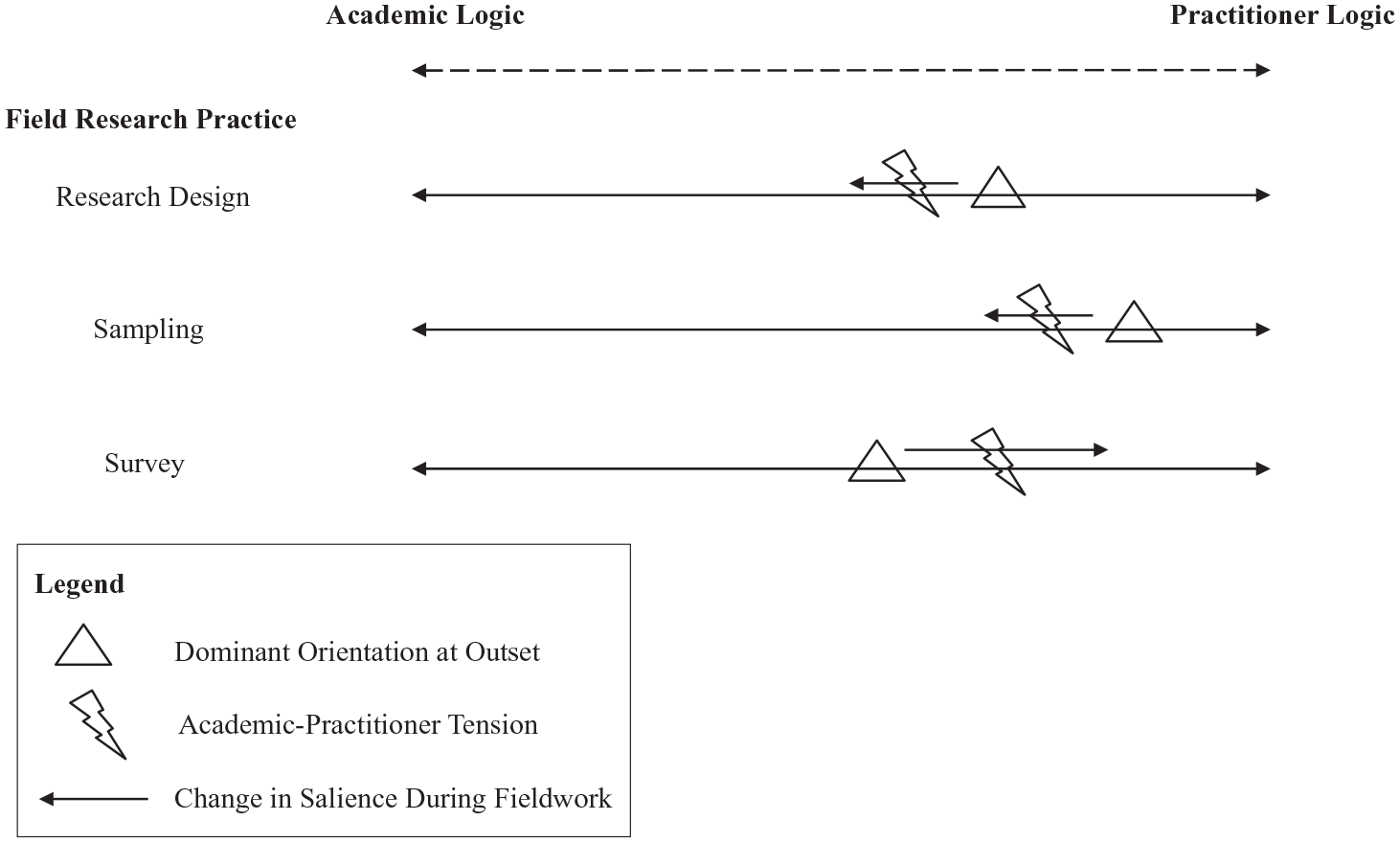
Field research tensions between academics and practitioners.
Illustration 1: gaining access
Salient tensions
The case firm was approached in August of 2009 and conversations coalesced around managing the subject firm’s expectations with our own research objectives. At the outset, interest among academics and practitioners focused on gaining a holistic understanding of Novel Solutions’ reputation from the perspective of multiple stakeholders in different geographical locations, both internal (e.g. consultants) and external (e.g. clients and competitors). Despite an agreement in principle, representatives from Novel Solutions made several demands which conflicted with characteristics of the academic logic, which halted the commencement of the research project. Some demands emerged from academics around the types of office locations they could conduct fieldwork. In this latter context, access to particular offices became dependent on whether the respective managing partner of the office was willing for us to visit to conduct research.
Tensions arose with regard to the nature and deliverables of the research. Such tensions created challenges pertaining to data ownership and deliverables which were manifested in the non-disclosure agreement (NDA). The initial demands determined Novel Solutions as the sole proprietor of any intellectual property and data that are collected as part of the research project. Such demands would preclude any autonomy of the research team to publish from the data set to be collected. In addition, it constrained the ability to publish anything without giving Novel Solutions at least 30 days prior notice of any publications. At the same time, Novel Solutions would have the ability to delay publication if it felt that its confidentiality was being breached. The deliverables of the project were based on a typical arrangement between a consultant (the academic research team) and a client (in this case, Novel Solutions). According to the contract, the research team would have been expected to provide “agreed services” to Novel Solutions, in line with deliverables of a consulting project. Yet, such demands were deemed inconsistent with the academic’s view of rigorous research and the confidentiality agreement. Due to the inconsistency and violation of academic rigor within the proposed NDA/research contract, the research team explained to Novel Solutions that this contract would not be viable in terms of research ethics and rigor, which resulted in delaying the commencement of the research project despite overall agreement about the purpose of the project.
Due to the geographical distance between the research team (country A) and gatekeepers (country B), discussions about the NDA occurred primarily via e-mail, which slowed down the process to re-negotiate the conditions of the NDA:
[We must. . .] try to resolve the NDA discussion on our “work—level”—before this really starts to bother our work and process. (E-mail, 22 April, Dyson)
The above e-mail demonstrates some tension between the researchers and Novel Solutions. Although on the surface this may appear an exceptional circumstance, we would suggest that in many research contexts there are likely to be marked differences in expectations between the researcher and the research subject (Cunliffe and Karunanayake, 2013; Dundon and Ryan, 2010) even in contexts where expectations have been outlined at an early stage in preliminary meetings, as was the case in this research project. This example highlights how the delay in revising and signing the contract affected the progress of the research, access to secondary data, as well as the professional relationship with Novel Solutions.
To bridge the tensions and conflicting interests about the nature of the research project, lengthy discussions ensued about the content of the non-disclosure agreement (NDA). Despite the academic team’s eagerness to commence with interviews, Novel Solutions’ expectations needed to be shifted which required amendments to the conditions set-out in the initial NDA. This was also true of the academic team’s expectations, particularly with regard to conducting the fieldwork in particular geographic locations and during certain time periods. To retain the requirements and conditions of an academic research project, the research team contacted the university’s legal team for support. While a necessary step to create alignment and protect academic rigor and freedom as well as confidentiality of respondents, it added a layer of complexity and intermediation to the re-negotiation of the research contract. The research team was required to liaise with representatives of the legal team, who took several days, sometimes weeks to respond and amend queries of the research team. The research team sent an amended NDA to Dyson hoping for an alignment of interests that would lead to agreement and a signed NDA.
Dyson followed-up with a progress update which expresses concerns about the process of the fieldwork, which was presumably in some part a result of the barriers of the NDA:
Your wishes for amendments regarding the NDA are currently being checked and worked in by our legal department. [. . . Tom] will be your point of contact regarding this issue from now on. Furthermore, we would like to have a meeting with [. . . Ted
4
] and you regarding the concrete design of our project and relevant process. (E-mail, 26 March, Dyson to Lead researcher)
Dyson’s frustration was acknowledged from a member of the research team:
Thank you for getting back to us about the NDA. I get the feeling this is going to turn into a discussion between our respective legal departments which may slow things down a bit and that would be a shame. Perhaps we can discuss when we speak next. (E-mail, 27 March, Ted to Dyson)
Several e-mails were exchanged between Dyson and the research team swopping amendments of the NDA. To speed up the process and create alignment, the research team liaised directly with Novel Solutions’ legal department after an introduction from Dyson:
I have just spoken to [. . . Ted] and we are definitely on the same page that we want to be very flexible with the NDA so this can be signed and we can all proceed and work together on the project moving forward. (E-mail, 22 April, Lead researcher to Dyson)
In addition to involving legal departments at the university and Novel Solutions, the governance of a professional service firm added further complexity to gaining access, causing additional delay to re-negotiating the NDA. A global partnership structure meant that the managing partner of a national office had the prerogative to share or not their internal documentation as well as enable access of the research team to their office, employees, and clients. The same day, Dyson sent a response:
I am very sorry, that the project has come to somewhat of a “halt” due to these problems with the NDA. [. . .] The partners involved are expecting the project to go on and I think it is in nobody’s interest to let the project continue to stand still. Personally, I cannot understand how this came about at all. (E-mail, 22 April, Dyson)
The process was drawn out over several months, characterized by ongoing toing and froing between the research team and Orford and Dyson, representing Novel Solutions, including legal departments on both sides. Colliding interests came to the fore during negotiations of the NDA, which was critical to secure access to conduct research with Novel Solutions without violating academic norms and standards with regard to rigor and data ownership, and ensuring that the new NDA was satisfactory for practitioners from a legal and process perspective. Perseverance of the research team and a continued interest in the research by practitioners ensured an agreement was reached enabling access to the firm, and commencement of the research. Once accepted by Orford and Dyson, the NDA set-out the basis for three activities: first, the scope of the research project ensuring access to conduct interviews and observations at several of Novel Solutions’ offices across a range of geographical locations; second, the proposed research design, including the data collection techniques to be employed to execute the research project which were deemed appropriate to capture Novel Solutions’ reputation through qualitative data in the form of semi-structured interviews, non-participant observations and company documentary analysis, and quantitative data in the form of a company-wide online survey; and, third, the process of contacting the gatekeepers, Orford and Dyson, during the fieldwork.
On reflection, the NDA was a vital underlying logic to ensure that the academic team and Novel Solutions were content with the process of collecting, storing, and using data. As a research team, we had wrongly assumed that signing an NDA was merely an administrative barrier through a legal contract that once agreed would have little bearing on the fieldwork, provided that we adhered to the agreement. Yet, we found several challenges that we outline in greater depth below, including ongoing difficulties of continued access to data during the course of the project due to colliding interest. We acknowledge that a proper expectation management had been neglected, which was constrained by the geographical distance between the host university of the research team and the location of Novel Solutions, where Dyson and Orford were located. These insights triggered us to recognize that the situation required a more engaged approach, for example, through more frequent discussions between the research team and practitioners, particularly face-to-face, online, or telephone meetings, to align expectations and work through any differences in expectations.
Illustration 2: recruiting interviewees
In line with discussions and a signed NDA, the research team started discussions with Dyson to commence the interview process. The scope of the corporate reputation research project pertained to (1) understanding employee perceptions of Novel Solutions and (2) understanding the perceptions of Novel Solutions among external stakeholder groups such as clients, potential employees, and competitors.
The research team made specific requests about the characteristics of employees to be interviewed which were most salient to the project, such as seniority, age, gender, functional area, country, and years working in the firm, among others. Dyson recognized the importance of speaking to a cross-section of employees: “And you can trust me that I will really try to identify a good mix of perspective and attitude towards our firm to help you get a more realistic picture” (E-mail, 25 May from Dyson to Lead researcher). To ensure an unbiased view, Dyson refrained from providing an introduction to external stakeholders and was specific in earlier correspondence about the physical separation from any of Novel Solutions premises and detachment from using any of Novel Solutions equipment while conducting interviews:
With regard to the absolute anonymity—which has to be guaranteed—all external interviews (clients, non-clients, alumni [sic], experts etc.) should be arranged by you (you will get an according list of addresses) and not by [. . . Novel Solutions]. Of course, these external interviews can never be arranged or done from one of our [. . . Novel Solutions] phones or in any of our [. . . Novel Solutions] offices. (E-mail, 13 May, Dyson)
Interests collided due to diverging expectations about the recruitment process of possible interviewees. Differing views among Novel Solutions and the research team ensued about the actual recruitment of potential internal and external interviewees. Dyson was firm about the recruitment of possible interviewees from both employees and external stakeholder groups, suggesting she would contact potential internal interviewees, and for the research to stick to the provided list of contacts from external stakeholder groups:
For better efficiency of the interview process, we suggest to arrange for all of the partner and employee interviews before visiting the respective office. We understand your time pressure and will try to support your schedule as much as possible, but any other procurement might leave the wrong impression. (E-mail, 13 May, Dyson)
While recognizing how it is useful for practitioners to have oversight of research projects, such expectation diverged from the first author’s pragmatic approach and experiences which has been employed successfully in other research projects on interviewing elites (e.g. Harvey, 2011; Li et al., 2023). A pragmatic approach to recruiting interviewees capitalizes on opportunism and a snowballing technique which avoids any selection bias, as was explained by the first author to Dyson:
A very effective way of gaining access is through referrals. For example, [. . .Orford] might recommend that one of his former colleagues from [. . . Consultancy A] speaks to [. . . Researcher A] who is doing a project on reputation within Management Consultancy companies. This person in turn may recommend someone else for [. . . Researcher A] to speak to. Thus, although [. . . Orford] works for [. . . Novel Solutions], it is clear in the communication that it is a [. . . university] project and nothing to do with [. . . Novel Solutions], except like other companies they have been asked to participate. (E-mail, 14 May, Research Lead to Dyson)
Further tensions about the recruitment process increased due to changes in Novel Solutions’ organizational context:
Due to some developments that have nothing to do with this project, there is a growing concern in our firm about the disclosure of sensitive findings or knowledge. We should do our best not to nurture any of these concerns. (E-mail, 27 May, Dyson)
The above context did not become apparent until one of the researchers followed a referral from an employee who suggested speaking to his supervisor who may offer further insights on the research topic. A few days after the interview, Dyson reprimanded the behavior of taking advantage of an internal referral:
Please, do not get diverted from our agreements through interviews with any other people (as senior as they might be) of our firm. We are talking about a sensitive and also political project here, please trust me, that I know how to handle it best. (E-mail, 27 May, Dyson to Lead researcher)
In this instance, the research team had to provide a detailed account of the situation making it clear that the interview had not been arranged from our side, but by a senior employee who felt strongly that we should speak with his line manager who was a senior partner. Although we made it clear that it was not our fault and that we had not broken any of our agreements, we did submit that if such an instance arose again then we would ask them to contact Dyson in the first instance. This example serves to show some of the power relationships at play between the lead researcher, who was a postdoctoral researcher at the time of the fieldwork and the gatekeepers, Dyson and Orford, who were middle-level and senior-level, respectively.
One of the major difficulties was the research team felt like it was being micro-managed by Novel Solutions during the interview process. This is important to highlight because the research project was never intended or communicated as a form of action or collaborative research with the researchers working alongside the subject organization to help solve particular problems. Dyson said, “I would like even to “join” in a bid [sic] more, if possible—only as much as this is suitable and does not influence the findings, of course—since the whole brand and reputation issue really is one of my core personal interests.” This was a difficult situation to respond to because out of professional courtesy we wanted to include Dyson so long as this would not compromise the integrity of the research project. The lead researcher responded by saying, “I am very happy for you to take on a more active participation in the project. In fact, I think it would be really good to start with if you could sit in on one of my interviews so that you could get a sense of what I am asking and how the interviews are conducted.” As it happened, Dyson never decided to sit in or become involved in conducting an interview for this research project so this did not compromise on what interviewees were prepared to say during the interviews and focus groups. Nevertheless and notwithstanding some of the benefits and limitations of involving practitioners in the data collection process, this approach shows the research team’s positive commitment to working with practitioners, which necessitated a significant degree of perseverance around the recruitment of participants even when it seemed this was a deviation from the original agreement.
It was problematic when practitioners wanted to influence the content and process of the fieldwork. Dyson, for example, requested on numerous occasions that a “reputation model” would be included for this study, even though it was made clear at the early stages that any model of reputation management would be created from the data as opposed to creating a preconceived model of reputation. It transpired that her request was owing to pressures from the senior management team for a report on the firm’s reputation as soon as possible. The excerpt below from Dyson illustrates some of her requests concerning the interview questions:
To get the most benefit out of the partner interviews, we recommend to focus on the core reputation questions typical for consultancies (e.g. like elements and background of reputation/branding/positioning; importance and role of personal vs. corporate, local vs. global image for the brand; role of marketing/thought leadership/networking/ community/social media etc. to influence image, current positioning of [. . . Novel Solutions] vs. direct national and international competitors, strengths/weaknesses). (E-mail, 13 May)
The above quotation again highlights that Novel Solutions wanted us to ask questions which target particular areas of concern to them. On one hand, these insights are helpful because they provided us with a clear sense of what the senior management team as well as the marketing and communication department perceived as the most salient issues in relation to reputation. On the other hand, many of the topics were not directly related to the goals of our agreed research project and they were wide-reaching in scope, meaning that we were not in a position to focus on all of these areas without compromising the focus of our research project. This is important because it required some openness, negotiation, and flexibility on our part to manage the expectations and meet the needs of Novel Solutions and to enable the project to proceed. At the same time, we felt that we needed to protect the integrity of the study and what we had initially set out to do. We sought to achieve this through providing a clear explanation of the consequences of undermining the methodological rigor of the data collection process. In short, we had to continually remind ourselves that this was a research project and not action research, collaborative research, or a consultancy project. The correspondence above shows how there can be extensive discussion and negotiation between a subject firm and researchers concerning the focus of a research project, including the types of questions asked.
On reflection, we engaged in snowballing to recruit participants, which is an established technique to increase the sample size. At the time of the fieldwork, the first author perceived little issue adopting a snowballing technique based on his experience of interviewing elites for his PhD and postdoctoral research (Harvey, 2011). After questioning the initial assumptions, we came to recognize that an internal referral in line with snowballing impinged on the locus of control around recruiting interviewees within Novel Solutions, especially as perceived by Dyson. This made us realize that a convenient and pragmatic recruitment process, following principles of snowballing (academic interests), may be incompatible with a practitioner logic. A reflexive analysis suggests that an appropriate response from the academic team to the above circumstances should have involved more face-to-face discussions with the gatekeepers to help better understand the practitioner perspective on snowballing and to more effectively explain the academic rationale for this approach. This may have generated greater trust to share closed-door discussions around the firm’s context, which we discuss in more detail below.
The research team should also have been more in-tune with several important organizational activities at the time of the original fieldwork. The team received hints through written cues about significant strategic activity related to the firm that was reported in the media. First, the firm was undergoing a major global marketing audit and restructure, which could explain the particular interest in certain themes such as the brand. Second, the firm was approached on at least two occasions during the time of the fieldwork by major professional service firms to merge, which later received significant coverage in the global business press. 5 Although the research team frequently received opaque references to these events, they were never voluntarily discussed by Dyson or Orford. While seemingly independent of the research project, these impacted upon the fieldwork. Upon reflection, fostering informal face-to-face and open-ended discussions with gatekeepers might have unveiled important, albeit confidential, contextual information on Novel Solutions, rather than only concentrating on structured and formal meetings with agenda items directly related to the project.
Illustration 3: navigating challenging academic–practitioner tensions
When the first author was negotiating access with Novel Solutions, he presented a clear rationale to run an online survey as it would expand the sample size and representation of a much broader group of stakeholders who would be excluded from interviews due to time constraints and financial reasons. As such, it would have enhanced the scope of the research project, following established criteria that advocate for data triangulation and draw on multiple data sources (Eisenhardt, 1989; Yin, 2010). In advance of signing the NDA, Orford and Dyson were strongly supportive of running an online survey as it aligned with their expectation to obtain insights into the reputation of Novel Solutions from a wide range of stakeholders from across the global operations of the firm. The original agreement was that the online survey would commence after approximately 3 months of interviews once interview data were collected in several countries. The academic rationale was that questions from the semi-structured interviews would help to identify important themes, alongside input from the academic team and the gatekeepers, which could be asked in closed-ended questions via the online survey. In preliminary discussions, the survey was scheduled to run in the first year of the fieldwork.
After 3 months of fieldwork, the research team approached Orford about scheduling the online survey. The research team deemed the survey as ready to administer as it followed a rigorous design and included questions to advance the literature on corporate reputation. The survey design had also gone through a pilot testing. Despite several e-mails sent, Orford stalled the start of the survey by ignoring the requests. Due to the delay caused by Orford’s unresponsiveness, the research team decided to contact Dyson to initiate the survey. Dyson apologized for Orford’s unresponsiveness and committed to advocating the matter: “Sorry for this. If he does not want to answer he doesn’t. . . I will keep hanging in the online survey issue” (e-mail, 7 October, Dyson). After several e-mails apologizing for Orford’s lack of communication on the issue, Dyson recommended to proceed with distributing the online survey. Yet, Dyson also proposed a change to the sampling criteria suggesting to select and include only those individuals in the survey who the research team had already interviewed. Dyson’s suggestion deviated from the initial sampling frame which offered to overcome the constraints of interviewing by including a much broader stakeholder group to better understand the reputation of Novel Solutions:
Unfortunately, he [Tom] did not answer our question with regard to the online survey yet. But from my point of view, there should be no problem, if you just send the online questionnaire to the people you already interviewed and tell them not to send it into further internal circles. We definitely need a quantitative basis to validate your findings. (E-mail, 11 October, Dyson)
While Dyson’s proposed changes to the initial research protocol constrained the breadth of the data set, it still offered a wider pool of data which complemented other forms of data from the research project such as interviews, non-participant observations, focus groups, and partner workshops. Dyson demonstrated strong support for a quantitative study which she thought was “definitely” needed to “validate” the findings obtained from the research, as was reflected in prior discussions between Dyson and the research team during the negotiation of the NDA. On the same day, the research team compiled a tailored list of e-mail addresses to about 40 people and distributed the online survey to ask former interviewees to participate. Once administered, the research team replied via e-mail to Dyson to notify her about the commencement of the survey.
Shortly after the commencement of the online survey, Orford responded with the subject line: “Stop the Online Survey”:
I am quite surprised to hear, that today an online survey of yours was distributed to some of your former interviewees in our company. Let me please point out that we need you to stop the mail-out immediately. I want to be informed upfront about every step you take towards approaching our employees as well as clients. And I would like to have the opportunity to discuss the current status of your work and your plans for the next steps, before you go any further. (E-mail, 19 October, Orford)
Orford’s reprimand caused significant tensions based on sudden misaligned understandings of the research process. From the perspective of the lead researcher, Orford’s demand to stop the online survey broke the initially agreed research design and protocol and the research team also lost the support from Dyson to initiate the survey. Despite previous written confirmation via the e-mail correspondence above, Dyson did not volunteer to Orford that she had given written permission to administer the online survey, which impacted the academic–practitioner relationship. The lead researcher responded with the following message:
I did check this with [. . . Carol] before I approached people and I have only asked those (either directly or through office administrators) who I have already spoken to. I will halt until further discussion. (E-mail, 19 October, Lead researcher to Orford and Dyson)
The above message followed a swift reply from Orford:
Thanks for your understanding—we will set up a meeting asap to resolve the organizational issues and also discuss the overall framework and your activities in connection to the other information and data we have. Afterwards we will hopefully be able to do a proper expectation management to go on with your studies and activities. (E-mail, 19 October, Orford)
At this point, the tensions that had arisen severely threatened not only the online survey, but the progress of the entire research project. To solve the tension and re-align interests between academics and practitioners, the research team engaged in several, long discussions with Orford and Dyson via telephone and e-mail. While the research team provided several reasons to retain the online survey, which included reinforcing the initial agreement and Dyson’s support, Orford’s intervention outweighed any of the research team’s explanations and rationales. One of the reasons given by Orford and Dyson was because there were strategic discussions at the time among the partners of Novel Solutions around a potential merger with another large professional service firm. Hence, it was felt that while the partners were keen to understand the firm’s reputation, administering an online reputation survey during such strategic considerations might be perceived as both destabilizing and distracting.
Ultimately, the research team overcame the tensions ensuring multiple further interviews with internal and external stakeholders of Novel Solutions in several countries as well as two focus groups and three annual partner meetings. Although the qualitative part of the research project was finished, an online survey was never completed. The research team was faced with the choice of abandoning progress of a mixed-method field study based on a violation of conducting a survey, which reduced the geographic scope of the study, and deviated from the NDA. An alternative, which was selected, was to adapt the research procedure and abandon the survey tool but progress the study through semi-structured interviews, focus groups, non-participant observations, company sources, and partner workshops in different countries.
On reflection, our rationale for conducting an online survey was to provide additional data and to triangulate evidence from other methods as part of our study. Despite garnering positive support from the practitioners from the outset, we had not been sufficiently reflexive of how this method (and others) can impact internal dynamics over time within the organization. For example, within a turbulent macroeconomic and organizational environment, we could have recognized factors more broadly outside the immediate considerations of the research project about the propensity for the sector and firm context to change, rather than assuming stability in context and taking-for-granted the continuity of data collection techniques. As a result, the change in circumstance limited the corpus of the data which would have provided greater reach and evidence on corporate reputation based on a triangulation of interviews, focus groups, partner workshops, and non-participant observations.
Discussion
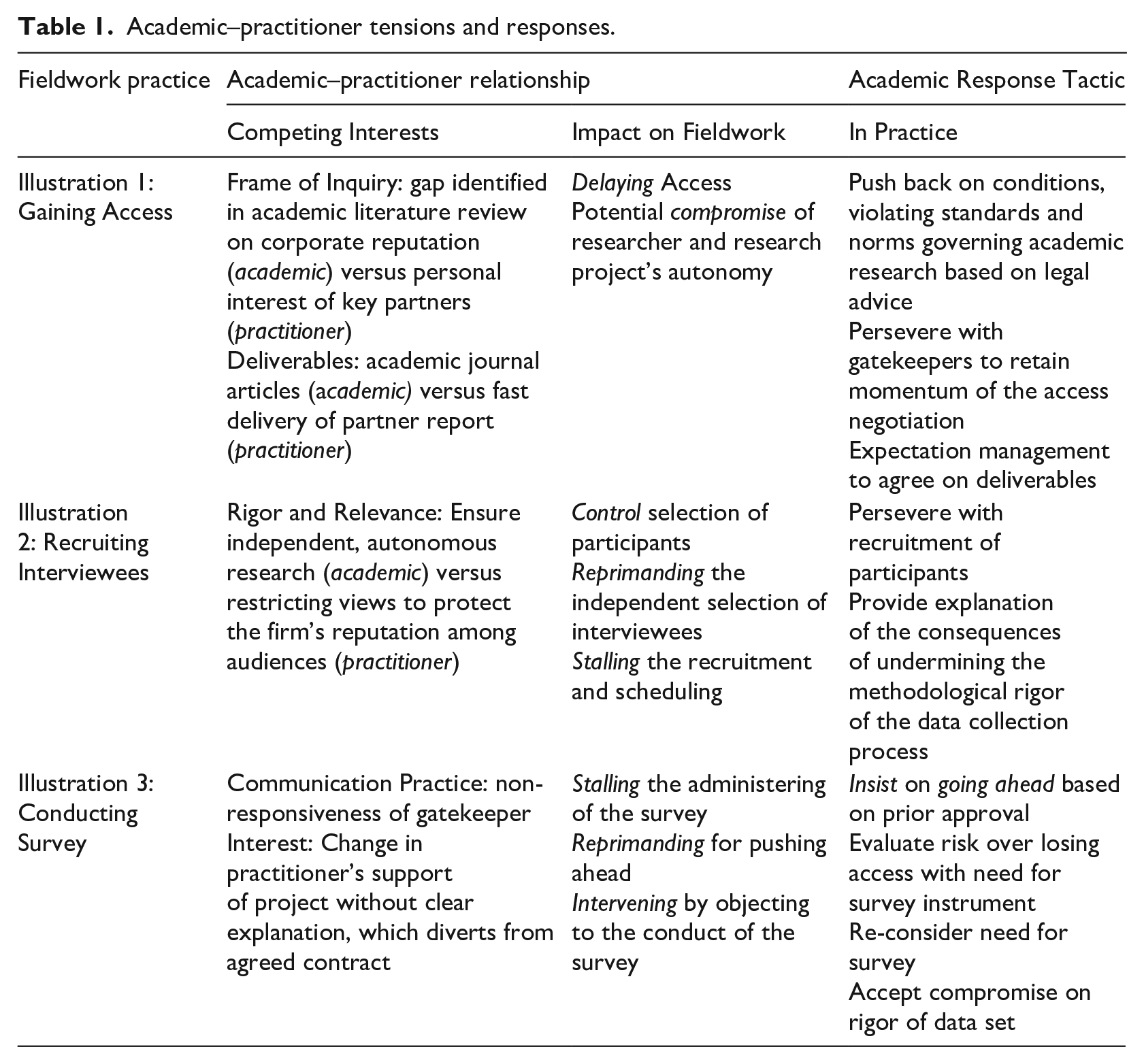
Building on three illustrations, we develop a model that captures the dynamics around managing co-existing yet competing interests and revealing its influence on the fieldwork practice and process (see Figure 2). We argue for a dynamic view of the academic–practitioner relationship (Avenier and Cajaiba, 2012; Bartunek et al., 2021; Bartunek and Rynes, 2014) which contrasts with a largely static and binary view typically based on a single dimension of the relationship (e.g. Beech et al., 2010; Daft and Lewin, 2008). Our study demonstrates why competing interests can arise from academics and practitioners holding differing views of the research, which consist of several characteristics, as summarized in Table 1, and which were omnipresent throughout the fieldwork. We recognize how as researchers we could have been more reflective of the practitioner context (Cunliffe and Alcadipani, 2016), which may have ameliorated some of these binary tensions through rejecting the “us-or” instrumental framing of the academic–practitioner relationship (Putnam et al., 2016). Yet, we also maintain that academic–practitioner tensions are important for surfacing differences (cf. Van De Ven and Johnson, 2006), including those which are negotiable and non-negotiable from the perspective of both groups. While such tensions are uncomfortable to manage, the fact they are visible provides academics with dynamic choices regarding how to respond (e.g. shifting the salience of a “logic” during the field research), possibly in collaboration rather than in conflict with practitioners.
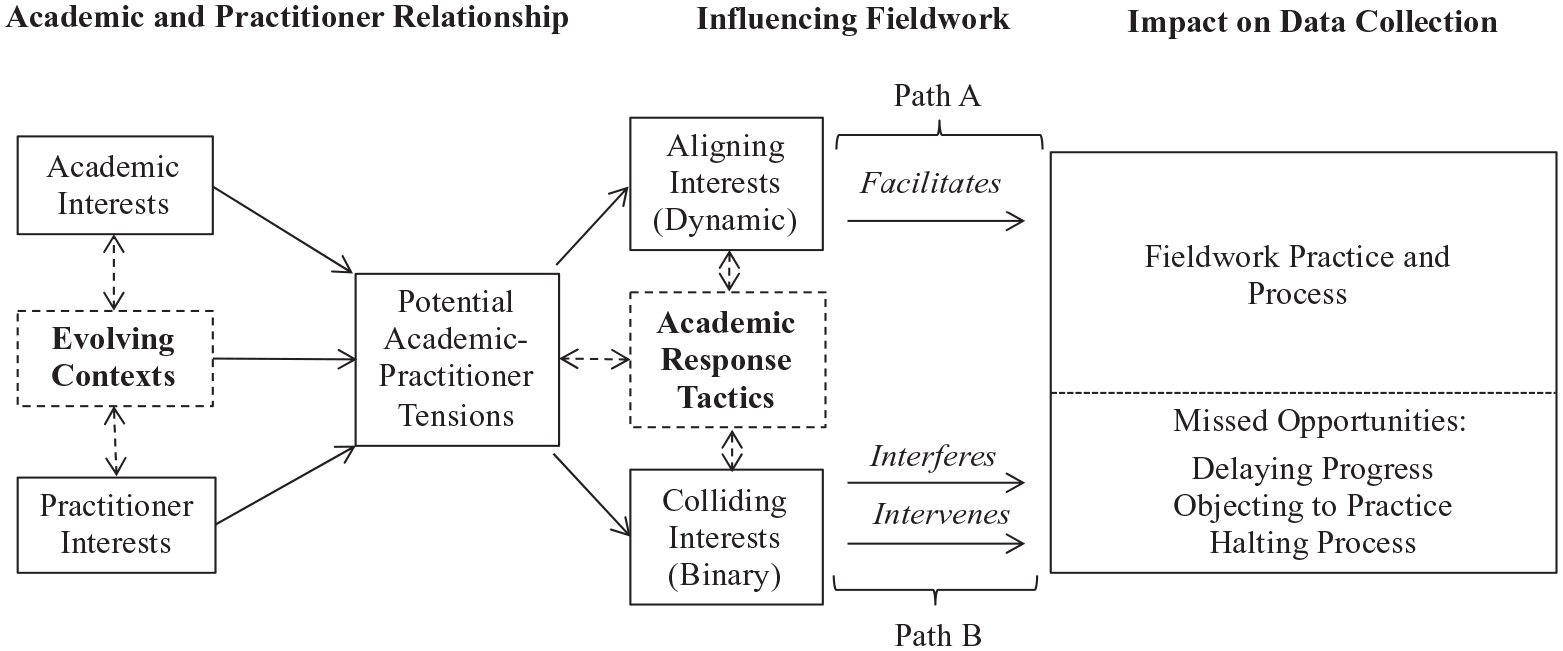
Dynamic and binary academic-practitioner relationships in fieldwork.
Academic–practitioner tensions and responses.
We identified an evolving organizational context as an additional force amplifying competing interests between academics and practitioners, which introduces a dynamic momentum that has been absent from debates which have been dominated by essays and point-counter-point interchanges (cf. Bartuek and Rynes, 2014). The amplification of competing interests has the potential to thwart an initial alignment of interests, as was encountered in relation to administering an online survey. However, as the academic team had an “either-or” binary discussion with Bespoke Solutions about administering an online survey or not, rather than a dynamic “both-and” discussion about how an online survey could benefit both groups within the emerging context of a potential merger, this amplified their respective competing interests. We recognize that additional sources may underlie an evolving organizational context which could amplify competing interests, including derailing an entire research project such as a change in gatekeeper (cf. Buchanan et al., 1988; Peticca-Harris et al., 2016). Nevertheless, a narrow framing of the challenge can set discussions on the wrong trajectory which makes competing tensions even more difficult to reconcile. This links to what Cunliffe and Alcadipani (2016) caution in relation to adopting an instrumental approach versus a reciprocal approach to navigating relationships.
We acknowledge that academics and practitioners can have complementary agendas within research projects, particularly when they are framed in a dynamic manner. However, we should also be realistic that tensions do manifest in the practice and process of fieldwork, which require appropriate identification and management. In relation to practices to get in and get on with fieldwork (Buchanan et al., 1988), our study demonstrates that competing interests may culminate in aligning interests and/or colliding interests. Importantly, academic and practitioner interests continue to co-exist and change throughout the conduct of a particular research project. Thus, we caution from treating aligning interests as equivalent to a shared understanding or agreement on a specific aspect of the research because as we demonstrated above interests can align and collide over time throughout the fieldwork owing to macro- (e.g. global financial crisis), organizational- (e.g. potential merger and acquisitions) and individual-level (e.g. changes in leadership) factors.
Our study demonstrates several response tactics employed to manage tensions and overcome challenges to conduct and progress fieldwork. Response tactics, including perseverance and expectation management, were crucial to enable initially competing interests to align and thus to transcend differences, which ensured progress with the fieldwork. We also highlight that an area we could have been more aware of is the wider context of the organization, which can be difficult to appreciate if practitioners are not forthcoming in sharing such information, but which nevertheless can build empathy with practitioners. This can help to ensure that relationships are managed in a dynamic rather than a binary manner, helping to align interests.
The distinction of aligning interests (e.g. both-and; more-than; reciprocal) and colliding interests (e.g. either-or; instrumental) is useful as it determines the trajectory of the fieldwork. Based on examples of gaining access, recruiting participants, and conducting a survey, we identified two trajectories for data collection (see Figure 2). Path A is characterized by aligning interests which facilitate data collection practices, whereas colliding interests culminate in a second path B, resulting in delays and objections to the fieldwork which creates missed opportunities for data collection. In essence, our fieldwork experience illustrates empirically how a dynamic approach can help foster alignment, whereas a binary approach can lead to misalignment and colliding interests (Bartunek et al., 2021; Putnam et al., 2016). Importantly, alignment and collision of interests can be superficial to significant and can vary over the life of the research project, which is why perseverance and expectation management are ongoing response tactics to help align academic and practitioner interests.
Contributions
Our study extends the literature on academic–practitioner relationships by providing an empirically grounded model demonstrating the influence of academic–practitioner tensions on the fieldwork, which enriches a debate that has been dominated by conceptual arguments (e.g. Bansal et al., 2012; Daft and Lewin, 2008; Kieser and Leiner, 2009; McGahan, 2007). We argue for a dynamic perspective on academic–practitioner relationships (Avenier and Cajaiba, 2012; Bartunek et al., 2021; Bartunek and Rynes, 2014). Building on literature advocating for a constitutive approach to managing tensions (Putnam et al., 2016; Smith and Lewis, 2011), our work moves away from a binary view of academics and practitioners, as advocated by some scholars (e.g. Daft and Lewin, 2008; McGahan, 2007). Our study offers distinctions between aligning interests and colliding interests which provide the basis to identify points of contention in the academic–practitioner relationship in order to address and overcome such tensions. While our study confirms practitioner interest in relevance and academic interest in rigor can create points of contention (cf. Avenier and Cajaiba, 2012; McGahan, 2007), such tensions did not remain fixed from the outset, as many would suggest (Daft and Lewin, 2008; Kieser and Leiner, 2009). Instead, academic response tactics were employed to navigate such tensions which enabled fieldwork work to progress. This is important because we suggest that academic–practitioner tensions are not something that both parties should avoid because “it blinds us to the very real opportunities that are possible from exploiting the differences underlying these tensions in the knowledge production process” (Van De Ven and Johnson, 2006: 803). Instead, we argue that tensions are vital for surfacing salient issues which emerge for both groups and which change over the life of a research project. Of course, academic and practitioner relationships which show no empathy for the other’s context are destined to fail. However, not engaging in tensions to avoid confrontation also allows issues to simmer beneath the surface, which is not effective at framing and managing relationships. This can erode trust and the ability to manage tensions through reframing and reciprocity (Cunliffe and Alcadipani, 2016; Putnam et al., 2016; Vangen and Huxham, 2003).
Our study introduces an evolving organizational context as an additional force which adds dynamism into the academic–practitioner relationship. It recognizes that a particular group’s interests may be amplified due to changes in the organizational context that are independent of the actual research project, which in our case tainted the gatekeepers’ perceptions of the project and the progress of the fieldwork. Yet, such situational and contextual aspects that influence the trajectory of fieldwork have remained absent from the academic–practitioner debate, despite the fact that we know that gaining and maintaining access is challenging and requires a fluid and non-linear approach (Cunliffe and Alcadipani, 2016). Evidence from empirical studies enriches our view of academics and practitioners which to date have been largely derived from conceptual debates (e.g. Beech et al., 2010; Kieser et al., 2015). We call for more research on academics and practitioners as a continuous relationship that needs to be managed (Bartunek and Rynes, 2014) and reframed away from a binary to a dynamic relationship (Bartunek et al., 2021).
Our study illustrates empirically how tensions between academics and practitioners can be managed (Avenier and Cajaiba, 2012). Thus far, the debate on the academic–practitioner relationship is dominated by views advocating the selection of one group’s interest favoring academics over practitioners (e.g. Beech et al., 2010). Our study offers a dynamic understanding informed by paradox theory (Bartunek and Rynes, 2014; Putnam et al., 2016; Smith and Lewis, 2011). Our model (see Diagram 2) demonstrates the need to manage interests, which sometimes throughout the research project may have competing logics. Such interests need to be managed because of the impact on fieldwork practice and process. Colliding interests may constrain progress of the fieldwork due to a deadlock caused by competing interests among academics and practitioners. Our study demonstrates several response tactics which were employed to transcend colliding interests. Transcending colliding interests enables researchers to overcome a deadlock and to progress the fieldwork. However, we also demonstrate that tensions may only be temporally bridged, as was evident in the intervention of the online survey despite its initial approval. Such evidence shows that the academic–practitioner relationship requires ongoing and careful management, which extends the view advocated by Bartunek and Rynes (2014). Managing tensions is important not only because of the instrumental outcome of the research project; it is also valuable so that academics and practitioners can learn to more effectively collaborate for mutual benefit, to better understand the perspectives of other parties, and to reflect on their own working practices and to share their learning more broadly within and beyond their communities.
We highlight that field research is entangled in academic and practitioner relationships. The prevailing wisdom that the two are separate is evident from clean descriptions of the research context and the absence of messy field accounts by researchers in the methods sections of empirical articles, which has been lamented elsewhere (Langley and Klag, 2019). Yet, data (qualitative or quantitative) is not waiting passively to be revealed, like a crop ready for harvesting. Each context (geographic, cultural, temporal, organizational, societal, and individual) does not remain static, but like the world and its environment, continually revolves and evolves (Tsoukas and Chia, 2002). Hence, field research in one given context cannot simply be replicated in another context (cf. Eisenhardt, 1989; Yin, 2010). This lies at the heart of Harley’s (2018) call to reject the straightjacket adoption of norms from laboratory science within management studies because academic–practitioner tensions can emerge and develop in unforeseen and non-linear ways (Cunliffe and Alcadipani, 2016) that require dynamic responses.
Conclusions
Building on the conundrums that we have outlined above, we illustrate how the dynamics between academics and practitioners has important implications on the trajectory of field research. Insights from our work unpack the origins of setbacks and how responses require careful balancing from both academics and practitioners. Our study extends insights into the dynamics experienced during field research (Callagher et al., 2021; Cassell et al., 2009; Cunliffe and Alcadipani, 2016; Frandsen and Pelly, 2020). Specifically, we synthesized learning and suggest response tactics to avoid and/or navigate the challenges arising from potential binary tensions between academics and practitioners during field research. We advocate for more dynamic and innovative framings of academic–practitioner tensions to help navigate these seemingly intractable differences (see Table 1).
Learning for academics
Our illustrations highlight some lessons for how academics engage with practitioners. Depicting the field site as ready for academics to harvest data is problematic for at least four reasons. First, access to a field site is never straightforward, with at least three layers of potential change at the macro (e.g. environmental), meso (e.g. organizational), and the micro (e.g. individual) level. Second, academics cannot freely roam among field sites unencumbered and their work requires careful communication with practitioners. This is as true in a prison as it would be for understanding a consulting firm, a charity, or a school because there are important ethical, relational, contextual, and trust considerations at stake. Third, as we know from prior literature, a researcher’s actions in qualitative research cannot be independent from the field site (cf. insider/outsider approaches, for example, Gioia and Chittipeddi, 1991; Louis and Bartunek, 1992, or action research, for example, Lüscher and Lewis, 2008). Fourth, it creates an assumption of a field site as cooperative and passive that has no agency over the conduct of the field research. This perspective also encourages an aloof approach to how academics engage with practitioners which could create subsequent barriers. We suggest that understanding and adapting to the evolving expectations of practitioners, who are operating within their own distinct individual, organizational and environmental contexts, are important for academics to manage carefully and constructively.
Learning for practitioners
Our illustrations highlight the value of practitioners understanding the academic perspective for three principal reasons. First, data ownership is important for academics from an ethical standpoint to manage data securely and from a publication standpoint in terms of using data in peer-reviewed research. Second, while practitioners supporting and advising field research can be helpful for providing academics with valuable context, insight, and access, this should not be confused with interference when practitioners are seeking to shape or potentially manipulate the field research, which would compromise the veracity of the research. Third, it is essential that practitioners communicate with academics around any significant changes in individual, organizational, or environmental context when it impacts the planned design and agreed process of the research. This helps to maintain trust, manage expectations, and recalibrate outcomes.
Closing reflections
We recognize that our field research example of Novel Solutions may appear as an extreme case because such details are typically not revealed in manuscripts or conference presentations. However, we would suggest that there is more to this than meets the eye, particularly given the growing interaction between academics and practitioners. It is also worth noting that the boundaries between being an academic and practitioner can be porous. For example, consider academics who previously worked or who are currently employed in business, or who sit on Boards of external organizations. Alternatively, consider practitioners who have recently completed their PhDs or who are working on funded research projects that span universities and business. These illustrations serve to problematize crude stereotypes of academics and practitioners.
Candidly sharing our field research experiences is important for the practice of management learning for two reasons. First, it helps to illuminate elements of field research that have previously been hidden or taken-for-granted (Easterby-Smith et al., 2008). Second, it enables readers to understand and benefit from the field research experiences of others. We encourage other management scholars and practitioners to candidly share their own field research experiences. Although in the short term this may expose us to retrospective criticisms around how we could have done things differently or more effectively, in the long term it will promote a richer, more diverse and honest understanding of field research in management that will benefit the learning of academics and practitioners.
