



Abstract
Collaboration between academia and practice is crucial for addressing complex societal challenges and generating new knowledge. However, bridging the perceived gap between these two domains has proven challenging due to differences in language, expectations, and time horizons. In this article, we question the usefulness of framing these differences as a gap and explores alternative approaches to fostering academic–practice collaboration. With the help of organizational institutionalism and theory on configurational boundary work, we propose the concept of “institutional knots” to temporarily ease tensions and reconcile differences between researchers and practitioners. Drawing on two case studies, we examine how temporary knotting activities can support and enable collaboration without undermining participants’ distinct expertise and professional roles. By embracing and understanding the gap from such a perspective, we argue that institutional knots provide an alternative metaphor and valuable framework for organizing and managing academic–practice collaboration. The findings contribute to the literature on how collaborations may be organized by offering a complementary understanding of the gap metaphor and providing practical insights for researchers and practitioners seeking to navigate and leverage their differences.
Introduction
Collaboration between academia and society, or researchers and practitioners, has long been called for. Many actors in these realms argue that academic–practice collaboration is necessary — crucial even — to develop new knowledge and manage “wicked problems” related to, for instance, climate issues and public health and welfare (Head and Alford, 2015; Weber and Khademian, 2008). Collaboration has further been suggested in situations where there is an expressed need for better ways of organizing and leading, for example, the public sector and civil society organizations, to secure long-term provision of knowledge and cater for innovations (Cherney, 2015; de Wit-de Vries et al., 2019; Lam, 2011; Perkmann et al., 2013; Rossi et al., 2017).
Nevertheless, collaborating has proven difficult. McCabe et al. (2021a) argue that knowledge co-production seldom happens organically but needs to be facilitated. Difficulties and tension in power relations relate to differences in language (how to speak of problems and solutions), expectations of outcome (results), and time horizons (ideas of long-term and short-term), which all boil down to different understandings of epistemology and ontology (Jonsson et al., 2022; McCabe et al., 2021b; Miller et al., 2008). The differences are often described and explained as an “academic-practice gap,” mirrored in the discussion on researchers being accused of holding on to an ivory tower and not being interested enough in society (e.g. Etzkowitz et al., 2000). The gap metaphor further builds on the assumption that academia and society make up two broad but distinct and separate societal domains that need to be managed to overcome the divide (Bartunek and Rynes, 2014; Bleijenbergh et al., 2021; Pohl, 2008).
Among the advocates for knowledge collaboration, numerous voices have been raised suggesting that the gap needs to be bridged or even closed (cf. Cohen, 2007; Rynes et al., 2007). For example, McCabe et al. (2021a) stress that one way to bridge the gap is through knowledge co-production involving researchers and practitioners capitalizing on their different but complementary resources. This is primarily supported by parts of the literature focusing on “integrated science,” also known as Triple Helix and Mode 2, which has received particular attention in issues related to climate issues and sustainability science (e.g. Klintman et al., 2022; Makino and Sakurai, 2014). This perspective takes the stance that by better engaging practitioners in the research work and engaging in collaborative research, the gap can be bridged or even closed (e.g. Banks et al., 2016; Hodgkinson and Rousseau, 2009; Rynes et al., 2001).
In this article, we challenge this idea and explore whether or not the illustration of a gap is necessary for collaborations. By bridging, as a means for permanently closing the gap, we would be left with no reasons to collaborate as participants would develop ways to think and act similarly. Following Morgan’s (1980) critique and exploration of the relationship among paradigms, metaphors, and various puzzle-solving research, activities, and certain assumptions are taken for granted. The gap metaphor — how it is typically used — might even contribute to exaggerating differences between researchers and practitioners, thus paradoxically creating conflicts and stressing collaboration challenges.
Against this background, the aim is to problematize the standard connotations of the metaphor by exploring whether the conceptualization as a gap — and the endeavor to overcome it — is fruitful for creating and supporting academic–practice collaboration. What would it mean — for worldviews and professional values — if researchers and practitioners would close the gap? Could it be that we instead need to reconsider ways of organizing academic–practice collaborations?
An alternative approach to bridging the gap would be to temporarily ease tensions between different professional perspectives and values. The concept of “institutional knots” allows for such an alternative understanding. According to Nicolini et al. (2016), a knot comprises a temporary institutional arrangement that combines different logics despite remaining separate. In this article, we explore whether less preoccupation with a (problematic) gap and more attention to how to create temporary meetings and activities could allow researchers and practitioners to think about and organize their engagement in ways that support their expertise and professional roles. Following research on metaphor aptness, the introduction of knotting would allow for ways to see the gap from another perspective and cherish to temporarily reconcile differences between academia and practice (cf. Thibodeau and Durgin, 2011; Tourangeau and Sternberg, 1981).
To the concept of institutional knots (Nicolini et al., 2016), we bring in research on boundary work (cf. Abbott, 1995), and particularly the understanding that boundaries are necessary for collaboration and knowledge development (Bucher et al., 2016; Langley et al., 2019; Quick and Feldman, 2014). Equipped with our theoretical framework, we explore an alternative understanding of the gap metaphor and whether bridge-building can be done through temporary institutional arrangements rather than permanently closing the gap. This could be particularly helpful in collaborations that are more fluid and occasional than, for instance, action research (e.g. Bleijenbergh et al., 2021; Huzzard et al., 2010) or intervention research (Radaelli et al., 2014) that emphasize a need for closing the gap. The research question guiding our exploration was: How do institutional knots overcome tensions in collaborations between researchers and practitioners?
We argue that by acknowledging and explicitly allowing for differences between participants from academia and other societal spheres (cf. Langley et al., 2019; Quick and Feldman, 2014), knotting makes it possible for researchers and practitioners to engage in collaboration without diminishing their understanding of knowledge, worldviews, expectations, and goals (cf. Bartunek and Rynes, 2014; Kieser and Leiner, 2012). In line with Cornelissen et al. (2008), Langley et al. (2019), Quick and Feldman (2014), and others, who argue that boundaries can be understood as temporal or as a form of junctures, we suggest that the metaphor of a knot enables us to see things differently and thereby advance our understanding of how to organize and facilitate such processes (cf. McCabe et al., 2021a). Following Quick and Feldman’s (2014) comment that “it is too often assumed that sites of difference are problems to be resolved rather than opportunities to be engaged” (p. 691), our ambition is to contribute to the ongoing debate as well as the research field on how to organize and support academic–practice collaborations in broad terms. For researchers and practitioners, institutional knots provide a way to rethink the gap and simultaneously develop tools for managing it as part of their everyday work by acknowledging and learning — more than just accepting — about their differences.
We build on two case studies. The actors in both cases emphasize a need for, and interest in, a collaboration between academia and practice. The two cases were studied in different settings, and we aim not to compare or contrast them. Instead, they illustrate — each in its own way — how collaboration can be organized. Moreover, they raise whether the gap metaphor holds or needs to be challenged and problematized. The two case studies, both undertaken in Sweden, build on (a) Ideell Arena (IA), a network for sharing and facilitating knowledge creation between academia and non-profit organizations, and (b) the Government Commission for Trust-Based Management (hereafter the Trust Commission, TC), whose task was to develop knowledge about trust-based management through collaboration between practitioners in the public sector and researchers. We illustrate how these different actors functioned as platforms for learning and provided activities for temporary knotting, where efforts were made to bridge and simultaneously embrace the gap. Particular emphasis was on the contextual conditions and the need to create space for individuals to collaborate without disregarding their field logic.
In the following section, we develop our theoretical framework with the help of organizational institutionalism and the concepts of institutional logic and a knotting strategy (Nicolini et al., 2016) to manage institutional complexity. We also draw on boundary work and, in particular, the framework by Langley et al. (2019) on different forms of boundary work and what is referred to as configurational boundary work to develop our understanding of knotting. Then follows methodological considerations and an introduction of the two cases. Subsequently, we discuss and analyze activities adopted by IA and TC and how these are understood among co-workers and representatives of involved stakeholders. The concluding discussion links the findings to theory and suggests that the institutional knot metaphor offers a fruitful alternative for understanding — and embracing — the gap between academia and practice. Embracing the gap, we argue, may contribute to research and practice on organizing and managing academic–practice collaboration.
Theoretical framework: Institutional logics and the idea of a knotting strategy
The academic–practice gap is often conceptualized as — in a comprehensive sense — the intersection of two fields, each with an institutional logic that defines both professional identities and field actors’ expected, appropriate, and legitimate behavior (cf. Wooten and Hoffman, 2008). These two fields are often described as representing different interests, which is why conflicts and clashes arise: Academics and practitioners often have different expectations of collaboration, which in broad terms relate to varying understandings of epistemology and ontology (e.g. Apetrei et al., 2021; Jonsson et al., 2022; Klintman et al., 2022). Here, we take the conceptualization of two different fields as a point of departure for exploring an alternative metaphor of the academic–practice gap, with the ambition to downplay the role of conflicts and clashes and instead focus on differences as a prerequisite of collaboration.
Institutional logics
Building on organizational institutionalism, the separation of academic research and other societal practices can be conceived as separate fields that adhere to different logics. There is no clear or natural boundary between the two fields — academia and practice — and neither researchers nor practitioners speak with “one voice” or are homogeneous groups. Instead, as stressed by Bailey (2022), we need to be careful not to define the gap as a “purely binary divide” (p. 9). Relationships between the two fields comprise many complex, fluid connections and change over time.
A professional field or social domain is thus understood as being “hold together” by a common institutional logic; that is, a set of ideas, values, and norms concerning what the actors in the field consider to be appropriate behavior (Reay and Hinings, 2005; Scott, 2001; Thornton and Ocasio, 1999). Thornton and Ocasio (1999) define institutional logics as “the socially constructed, historical pattern of material practices, assumptions, values, beliefs, and rules by which individuals produce and reproduce their material subsistence, organize time and space, and provide meaning to their social reality” (p. 804). Logics create stability as they define the common interests of field actors in a specific practice. A field is thereby structured based on robust and taken-for-granted ideas. In this sense, institutional logic comprises a type of “organizing principles” (Friedland and Alford, 1991) that define appropriate behavior in a given situation. Such principles direct, motivate, and legitimate individual and organizational action (Scott et al., 2000).
When this is translated to a academic–practice gap, the gap raises the issue of differences in logics. By this, we mean the broad systems of meaning that permeate “scientific research work” versus “practice-orientated work.” These vast and very broad social spheres — or fields — are by no means simple dichotomies; instead, they are interwoven and interrelated in many complex ways (Bailey, 2022; Swan et al., 2010). Nevertheless, as Kram et al. (2012), among others, suggest, there are discernible differences between the two fields based on perceptions of academic–practice collaboration: “. . . the work of the scholar was perceived as requiring total dedication to generating new ideas with the primary purpose of filling gaps in existent theory (rather than with the primary purpose of improving dynamics in organizations)” (p. 327). Images of the practitioner, on the other hand, included “fast-paced problem solving and quick solutions to pressing problems” (Kram et al., 2012: 327).
Another way to frame this is offered by Kieser and Leiner (2012: 16), who argue that due to their differences in logics and knowledge bases, researchers and practitioners will always be experts and laypersons, respectively. As to the discussion about knowledge collaboration, it is essential to emphasize and understand the differences in how logic and principles influence the knowledge production process in each field. Scientific problem formulation is based on established theory and dealt with through scientifically legitimate methods. At the same time, knowledge production in professional settings outside the academic community focuses on solving practical problems with the direct aim of improving the everyday work in the field (Bullinger et al., 2015).
Knotting — a way to organize institutional complexity
While earlier studies have shown that different logics may coexist within a field as a stage of transformation, with one logic being replaced by another (e.g. Thornton and Ocasio, 1999), recent studies indicate this is not necessarily the case. In a social setting, more than one logic at a time can — and is even most likely to — coexist. Organizations and individuals often have to deal with multiple, sometimes conflicting, demands constructed by their environment (e.g. Bullinger et al., 2015; Dunn and Jones, 2010; Lindberg, 2014; Purdy and Gray, 2009). While it is possible to find such institutional complexity more or less everywhere, it is particularly salient in organizational settings with ambitions to bridge different systems of logic or meaning. This is because such settings strive to involve professionals and combine activities that cut across different societal domains (cf. Bucher et al., 2016; Langley et al., 2019; Quick and Feldman, 2014).
The number of studies on how individual and collective actors respond to and manage institutional complexity spans various fields and practices (e.g. Baumann-Pauly et al., 2016; Fossestöl et al., 2015; Nicolini et al., 2016; Schildt and Perkmann, 2017). In line with the previously stated “let’s close the gap” approach, studies frequently present strategies to reconcile conflicting logics by decreasing tensions and differences (e.g. Ahmadsimab and Chowedhury, 2021; Quick and Feldman, 2014). One common way to manage and overcome differences between researchers and practitioners has been through action research. This form of collaboration is often carried out, assuming it bridges the gap (e.g. Bleijenbergh et al., 2021; Huzzard et al., 2010). Bleijenbergh et al. (2021) identify three aspects of the gap that could be managed through action research: (a) the lack of translations of theoretical advancements into practice and the need for explicit guidelines for organizations to be able to make use of practical implications of research; (b) the scholarly focus on theory testing instead of theory development and the need to find ways to explore theory to create new knowledge that is to be used by practitioners; and (c) the limited involvement of practitioners into the research process.
While Bleijenbergh et al. (2021) offer fruitful guidelines for academic–practice collaboration from an action research perspective, we discuss these aspects of the gap with the help of an empirical exploration of how researchers and practitioners may engage in collaboration through temporary reconciliations of conflicting logics with the use of the concept of institutional knotting and boundary work. Nicolini et al. (2016) show how institutional complexity — with its conflicting logic — is possible as a transition stage toward merged and hybrid forms of logics and how complexity can make up a stable situation. In other words, logic clashes need not be resolved through a complete change. Clashes can also be managed and overcome as part of everyday routines and established practices. This implies that the different logics of practitioners, as opposed to researchers, do not necessarily need to change or adapt for collaboration to occur, let alone be successful. Through what Nicolini et al. (2016) conceptualize as institutional knotting, such collaboration can be enabled simultaneously as the different worldviews — which make up the academic–practice gap — are permitted and may even be embraced. According to these authors, a knot is an “institutional arrangement” that allows “different logics to coexist at the field level in a provisionally durable state” (Nicolini et al., 2016: 241). In line with others (e.g. Bartunek and Rynes, 2014; Guerci et al., 2019; Kieser and Leiner, 2012), we argue that those differences make collaboration relevant in the first place. Knotting is a “temporary form of compromise,” and an “institutional knot” suggests that logics can be combined while remaining demonstrably separate (Nicolini et al., 2016: 241). It is not, however, an automatic process but requires the agency and deliberate effort of the actors involved.
While Nicolini et al. (2016) analyze knotting as a process within one organizational field, making it possible for conflicting logics to coexist over time, we draw on their findings in our study of collaborative efforts across academia and practice. Studies of interstitial spaces — characterized by overlaps in logic and institutional complexity — highlight how logics are adapted, shifted, or reconciled. As we illustrate, based on our case studies, the knotting approach indicates how participants in academic–practice collaboration can create stabilizing and supportive conditions for their work while protecting their interests, worldviews, and professional norms. In this way, the metaphor of creating a knot implies the possibility of meeting and collaborating without changing much of one’s way of working. As Gümüsay et al. (2020) show, empowering individuals through structural support can make knotting take place — or create “elastic hybridity,” as they call it — and enable collaboration without jeopardizing the values and expertise of the participants.
Boundary work and underlying assumptions for collaboration
Literature on boundary work emphasizes that while boundaries can take many forms, different human activities can either be organized to benefit from differentiation, that is, competition, or — the opposite — integration, that is, collaboration (e.g. Abbott, 1995; Bucher et al., 2016; Langley et al., 2019; Quick and Feldman, 2014). The interest in boundary work comes with the “practice turn” (cf. Nicolini, 2012) and understanding of how to maintain or disrupt power relations between different groups in society (cf. Barrett et al., 2012). As Langley et al. (2019) explain, boundary work also implies a processual understanding of organizing, indicating that it is an ongoing activity. This is especially interesting when understanding collaboration and whether differences between boundaries should be bridged, closed, or perhaps embraced.
Langley et al. (2019) distinguish three categories of boundary work, that is, competitive, collaborative, and configurational. While competitive boundary work manifests the gap and, in our case, the differences between academia and practice to protect professional boundaries to maintain power relations, collaborative boundary work, in contrast, call for consensus and bridging the gap to enable cooperation and to disrupt power relations. However, the third category — configurational boundary work — emphasizes arranging and working through boundaries in a temporary and social space (cf. Cartel et al., 2019; Zietsma and Lawrence, 2010). The focus is on “how patterns of differentiation and integration [. . .] may be reconfigured to ensure that certain activities are brought together within bounded spaces, whereas others are at least temporarily kept apart, for producing particular kinds of collective action” (Langley et al., 2019: 707). By coalescing, or combining, different professions, individuals, or groups, both competition and collaboration — differentiation and integration — are achieved, and “temporal boundaries” are created, “enabling new activities to occur, which are then reintegrated into unbounded temporal spaces” (Langley et al., 2019: 725). Such an approach calls for a knowledge broker — a person or an organization — that considers how people work in other fields and facilitates temporal boundaries to “design, organize, or rearrange the sets of boundaries influencing others’ behaviors” (Langley et al., 2019: 707). This further allows for a “knot of expertise” to form as actors from different domains meet and learn about and from each other.
Configurational boundary work can take on three modes: arranging, buffering, and coalescing boundaries (Langley et al., 2019). First, creating — or arranging for — temporary boundaries, or a space, within an organization provides a means for acting and thinking “outside the box.” Second, buffering boundaries relates to shaping boundaries to “accommodate collaboration among organizations from incompatible social worlds or/and actors with competing interests” (Langley et al., 2019: 722), which in this case relates to the academic–practice gap. To buffer “enables collective action, while at the same time, allowing participants to remain behind their preferred established boundaries, and thus deliberately sustaining both competitive and collaborative boundary relation” (Langley et al., 2019: 723). Finally, coalescing boundaries refers to reshaping “existing activities into newly redefined domains or spaces [and] elements from existing domains can be integrated or fused into new or expanded one.” Thus, they serve to bring together groups “with potentially divergent and competing perspectives and goals [and] constructing new domains.” In doing so, the boundary constructions must be temporary and fragile (Langley et al., 2019: 724) or dynamic — as a juncture — to once again use the words by Quick and Feldman (2014). This way of organizing around configurational boundary work resonates with the two case studies, as will further be outlined below.
Method
Following our aim, this article takes a qualitative approach and builds on two case studies of academic–practice collaboration (Eisenhardt, 1989; Yin, 2003). A case study approach offers “good stories” (Dyer and Wilkins, 1991; Harley and Cornelissen, 2021) that allow for more complex understandings and what Alvesson and Sandberg (2014) define as “box-breaking research.” The need for such research is motivated by the tendency among many researchers to engage in “gap-spotting” (another gap metaphor!) and “[. . .] inward dynamics of knowledge production, which in the long run is unhealthy for the advancement of knowledge” (Alvesson and Sandberg, 2013: 976). By problematizing the academic–practice gap metaphor, we also question our assumptions and theoretical pre-understanding (Alvesson and Sandberg, 2013; Davis, 1971) as our ambition is to make broader and deeper interpretations (Alvesson and Sköldberg, 2018; Cornelissen, 2017).
As stressed by Dyer and Wilkins (1991: 615), “the goal of a case study is to provide a detailed description of the social scene” and “to describe the context in which events occur.” In this study, our two Swedish cases are about field-level actors that aim to enable knowledge collaboration between researchers and practitioners within civil society and the public sector. IA focuses on developing employment relationships and supportive working conditions in the non-profit sector. The ambition of the TC’s work was to restore the status and authority of the professional employee in the public sector.
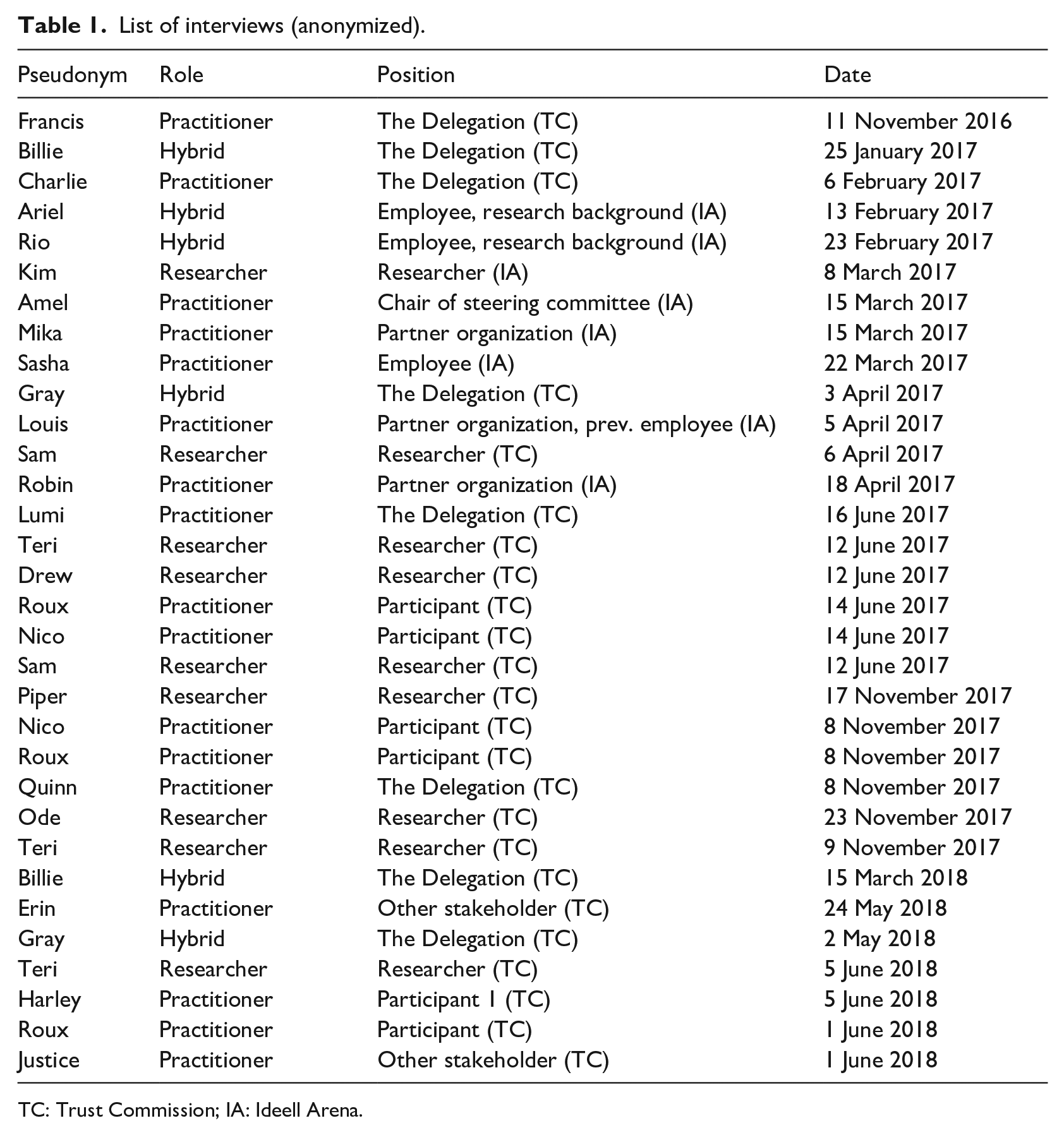
The case studies were performed in 2016–2018 to gain insights into how to organize knowledge collaboration. As stressed, it is essential to underline that our aim is not to compare the two case studies but to use the empirical findings to explore how academic–practice collaboration can be understood and organized through an institutional knotting strategy. To build awareness of context, we initiated the case studies by performing observations at several meetings and workshops (Ghauri and Grönhaug, 2002) before conducting interviews through purposefully selected key interviewees (Patton, 1980). Following the abductive approach, these observations made us reflect on the gap metaphor and the existing research on knowledge collaboration. We conducted 34 interviews with IA (including its partner organizations) and TC (including its stakeholders). All selected respondents had extensive experience in collaboration activities at IA and TC, respectively. Many also had experience from more than one position, for example, previous involvement as a researcher and now as an employee, or previously as an employee and now as a member organization representative (see Table 1).
List of interviews (anonymized).
TC: Trust Commission; IA: Ideell Arena.
As we followed the collaboration work for TC over 2 years, the number of interviews is more than for IA. Another explanation for conducting fewer interviews with IA is that it was a smaller organization. However, important for the understanding is that we had prior knowledge about the work by IA, having been involved as researchers in one of the activities described below. The interviews with TC and IA allowed us to develop insights about how participants in collaborative activity understand and view the situation as well as their role and practice.
We used an interview guide with fixed broad themes: (a) position and role in the organization as well as background/previous experience, (b) what is collaboration work/goal of collaboration, (c) views of knowledge/different types of knowledge, (d) how are collaborative work being undertaken, (e) successful as well as problematic examples of collaboration, (f) perceived obstacles to collaboration, and (g) expectations of results from collaboration. Depending on the position/role of the respondent, we adjusted the questions according to their role and the specific organizational setting. The themes and questions were broad to inspire and facilitate an open and explorative interview setting. Each interview lasted between 40 and 95 minutes — the majority for around 60 minutes — and was recorded and transcribed verbatim.
When working abductively — going back and forth between the empirical data and our theoretical framework - we used theoretical coding (cf. Charmaz, 2014) to categorize, integrate, and organize the empirical material. Triangulation of the primary data sources—interviews, observations, and documents such as reports, edited volumes, and other written documents related to activities and actual outputs of IA and TC—is vital for our case study. In this article, however, we only use interview data. Following Langley’s (1999) discussion on processual data and how to make sense of it, we took a narrative approach by drafting a general description of how collaboration was understood and organized, with illustrative quotations from the material collected. This is further important given that, as Langley et al. (2019) explained, boundary work also implies a processual understanding of organizing, emphasizing that it is an ongoing activity.
The data analysis was undertaken in three steps: First, a literature review on strategies to manage the academic–practice gap in combination with insights from our case study made us reflect upon the importance to acknowledge differences. We jointly sketched ideas on how to create conditions for meetings and spaces for reflecting on the differences between academics and practitioners as ways for them to learn from each other when collaborating rather than only focusing on how to better capitalize each others’ resources (to bridge the gap), as stressed by McCabe et al. (2021a). This work resulted in nascent development of our theoretical framework with focus on fields, institutional logic, and particularly configurational boundary work. Second, we used an abductive approach to thematize and analyze our data. This means that we developed our case study by comparing and contrasting our empirical findings with theory in what can be described as a highly iterative process (Eisenhardt, 1989; Silverman, 2006). In this process, we came across earlier research on the concept of institutional knotting (as a strategy to manage institutional complexity). We explored the concept as a possible way to problematize and develop alternative understandings for the metaphor of the academic–practice gap (cf. Alvesson and Jonsson, 2022; Alvesson and Sandberg, 2014). The analytical work—with help of institutional knotting in combination with configurational boundary work (Langley et al., 2019)—resulted in crafting three themes that manifest challenges and strategies for managing complexity in collaborative work: (a) expectations of outcomes and what is counted as a result (cf. Eigenbrode et al., 2007), (b) how time is perceived and managed (cf. Miller et al., 2008), and (c) what expectations the participants have of each other in terms of learning responsibility (cf. Jonsson et al., 2022). In the third and final step, we further detailed our analytical work and extended the analysis of the three empirical themes and the suggested processes. Combining configurational boundary work and institutional knotting, we could develop ideas on how an institutional knotting strategy for academic–practice collaboration may look like, including, for example, notions of “knots of expertise.” An important part of this work was also to contrast this strategy with the tools provided by an action research approach (Bleijenbergh et al., 2021).
Academic–practice collaboration at IA and TC
IA was created in Sweden in 1998 to link, develop, and transfer knowledge across research and non-profit organizations (IA, 2019). The network was initiated and developed through collaboration between researchers, mainly social scientists, and representatives from various non-profit organizations. Their work currently focuses on three types of collaboration: starting and developing leadership programs, creating meeting places for exchanges of experience in the non-profit sector, and promoting knowledge development through collaboration with academia and practice. Thus, as will be further outlined, the various types of collaboration can be understood as temporary simultaneously as the ambition is to develop a long-term engagement. Four people were employed full-time at the time of the study to enable various exchanges between research and practice. Their main tasks were contributing to knowledge development within the field by coordinating multiple activities. Two of these employees had research experience (one has a PhD in the social sciences, and the other was, at the time, in the final phase of the PhD program).
TC was assigned to promote, investigate, and develop a framework for trust-based management in Sweden’s public sector. Several stakeholders were involved in the process. In line with the ideas about integrated science and the Mode 2 spirit, it was stressed that the commission should engage in dialogue with researchers, practice, and learn from “good examples.” The directive explicitly stated that knowledge should be generated in close collaboration with the research community. This would contribute with a “critical perspective” and “illustrative cases” for how trust-based management could be undertaken in practice. Similar to IA, TC did not constitute a formal organization. However, the stakeholders were engaged temporarily for a limited time of 2 years, and different stakeholders were engaged in different activities on different occasions. Thus, the number of people engaged in the work varied over time. However, the secretariat consisted of one Chair, one project leader, and initially three project members. The Chair, one of three delegates appointed by the government, had a background as a researcher (Associate Professor in Economics) and experienced working as head of analysis in one of Sweden’s most prominent public authorities. The other two delegates represented the authorities (a general manager in one of the involved authorities) and politics (vice chair at the Swedish Association of Local Authorities and Regions and a member of the Left party, Vänsterpartiet). Six months after TC was formed, a research director was recruited who became responsible for coordinating and organizing the academic–practice collaboration of the commission. The research director was, at the time, an active researcher (Associate Professor in Business Administration) and was recruited on that merit.
In the following sections, we described various activities these two organizations undertook to facilitate collaboration. We particularly zoom in on the collaboration between researchers and practitioners. By introducing an alternative approach or metaphor—institutional knotting—we illustrate how the creation of knots enabled involved actors to stay within their professional fields yet still collaborate across fields (see Table 2 for examples). From our data, three themes—or processes—emerged as particularly interesting when taking a “practice turn” and focusing on the processual understanding of organizing collaboration.
Examples of institutional knotting in the two case studies.
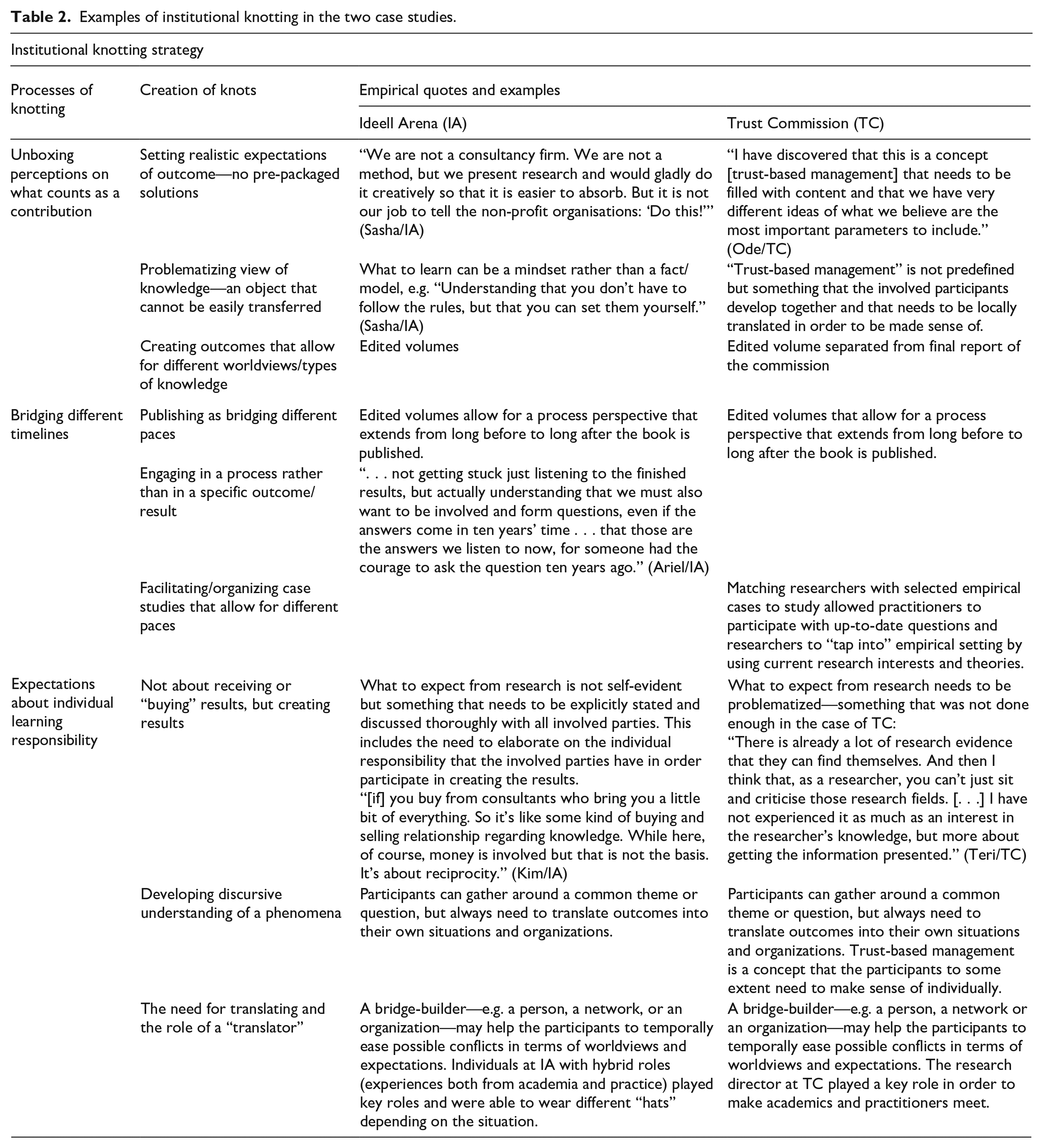
The three processes we identified show how knots were “tied” and facilitated by the two field actors’ interstitial spaces to temporarily reconcile the different professional logics of practitioners and academic researchers.
Unboxing predefined perceptions on what counts as a contribution
What counts as results is recurrently discussed in the interviews based on several aspects, ranging from how research is communicated and made “understandable” to what is generally worth discussing—“what is a problem?”—and what makes up a contribution. One person from IA explains that it became clear at a conference that researchers and practitioners had completely different opinions on the focus of the discussions (Mika/IA). While the researchers wanted to discuss how they approached the problem—how data collection and analysis had been made—the practitioners wished to discuss the results and their implications. Similarly, in the case of TC, practitioners expressed interest in understanding how to implement trust-based management. A PowerPoint presentation was shown at TC’s initial meeting. Reference was made to an opinion article that the former party leader of the Swedish Social Democrats—Stefan Löfven—wrote before the election in 2013, resulting in the delegation. References were also made to additional news articles and reports pointing toward the conclusion that there was a need for trust-based management. At the same time, researchers—at least some—were more interested in problematizing and exploring the phenomenon of trust-based management rather than finding evidence for when trust-based management can be seen as a “good example.”
To participate in creating a knot—a space—in which participants can meet and expect other participants to have other ideas of what is the focus of the discussions and the knowledge creation, both IA and TC clearly instructed the participants not to expect pre-packaged solutions to problems and issues. At the same time, TC selected several examples of trust-based management suggested by practitioners and invited researchers to evaluate these. One researcher reflects on whether this can be explained by the design, that is, how to involve research in following examples of trust-based management, but stresses that most of them have probably accepted the design and feel that it is essential to contribute to the discussion. Moreover, those who did not accept the design, decided not to participate: There may be situations where some researchers have declined to be part of the Trust Commission because they don’t think this kind of participatory research is the best way to contribute to a discussion about trust-based governance. (Teri, TC)
Still, representatives from TC emphasized that it was important to have an open mind throughout the working process and incorporate multiple perspectives. This was manifested in different meeting forums, where stakeholders were invited to share their views on organizing and governing the public sector. The lack of a temporary compromise, where the parties occasionally admit that there are different views on knowledge and results with no quick fix, calls for another form of knowledge that can deliver simple and faster results. For IA, as several interviewees put it, such knowledge can be catered for by a consultant who comes in and presents “ready-to-use” solutions (Sasha/IA; Louis/IA). One person makes it clear that the exchange of knowledge within the IA network can never be about “placing an order” for results that suit their interests: . . . that we do not deliver solutions. We are not a consultancy firm. We are not a method, but we present research and would gladly do it creatively so that it is easier to absorb. But it is not our job to tell the non-profit organizations: “Do this.” (Sasha/IA)
A person from one of the non-profit organizations says the researchers involved need to stand up and defend their work, principles, and logic: You need to find those researchers [. . .] that are willing to say, “This is what my research shows – take it or leave it. You don’t have to like it, but this is what it shows. (Louis/IA)
The quote suggests that practitioners involved at IA see the value of different perspectives. The contribution of collaboration would be better if researchers would dare to be more explicit about what their analyses show — even though these conclusions may not fit the practitioners’ view. This also requires that differences are valued, supported, and carefully guarded through the collaboration process, even if these differences may create a less smooth process and be more time-consuming.
In the case of TC, some interviewed researchers explain that they share some points of departure and that the ideas about the theoretical framework are multiple (Ode/TC; Teri/TC). In particular, the concept of “trust-based management” is debated. One person says, I have discovered that this is a concept that needs to be filled with content and that we have very different ideas of what we believe are the most important parameters to include. (Ode/TC)
Thus, there are explicit aspirations to allow for different perspectives on both platforms. This relates to the importance of understanding knowledge so that it is not “boxed” — not interpreted as an object with the idea that it would be easily transferable from one party to another. It is something that “becomes” through the participants’ use. On the question of what can be considered a thriving output of academic–practice collaboration, one person exemplifies it with a course participant who explained that the most valuable thing she took away from the course was simply that she had “[. . .] understood that you don’t have to follow the rules, but that you can set them yourself” (Sasha/IA). A relevant and valuable result can thus take many forms.
One concrete way to deliberately create a knot reconciling tensions in conflicting ideas about what counts, as a result, was by organizing publications that allow for different worldviews. In the case of IA, two edited volumes are frequently used as illustrative examples. The edited volumes are described as successful projects by the people we interviewed, both researchers and practitioners. Researchers have been engaged in these projects to share their expertise and research results and produce new knowledge. While the researchers are responsible for the content, the texts that comprise the two volumes have been discussed and deliberated with practitioners working to develop the anthologies’ content and form. Traditional seminars have been arranged where opponents have discussed the texts, allowing researchers and practitioners to comment. The edited volumes have then served as the starting point, or platform, for continued discussion and knowledge development in various settings, sometimes together with researchers, sometimes without them. In the case of TC, chapters on trust-based management written by researchers were collected in an edited volume, while empirical and final reports were published separately. This may challenge the idea of collectively developing shared understanding and knowledge — in this case, about trust-based management — while simultaneously allowing multiple and conflicting perspectives to be present.
Bridging different timelines
Our proposition that the tensions between different professions can be eased temporarily still leaves room for a theme that concerns short-term versus long-term work processes. How participants at both IA and TC tried to solve discrepancies in pace can also be related to the work with the edited volumes mentioned above. The book projects by IA are described in the interviews using a process perspective that extends from long before the book is finished to long after it is published and available. One person describes it as a maturation process in which the book’s content develops over time and after publication (Rio/IA). Theories may be interpreted, translated, and used in many different ways. Part of the collaboration efforts in IA was to arrange opportunities for researchers and practitioners to meet and engage in dialogue after something was published — and jointly develop it further. Such meetings illustrate how different timelines may be linked by creating institutional arrangements as a knot.
This maturation process and doing things together over time is resource-intensive in several ways. In particular, the interviews emphasize that research takes time. One person says that if an organization wants an answer to a specific question, it can take years: . . . That is difficult for an organization with a question now, like here and now, to deal with. However, at the same time, we should not get stuck just listening to the finished results, but understand that we must also want to be involved and form questions, even if the answers come in ten years. . . those are the answers we listen to now, for someone dared to ask the question ten years ago (Ariel/IA).
The situation in TC was somewhat different. The explicit mission of the commission came with a strict time limit for the collaboration work. Several of our interviewees reflected that the time constraints were problematic and something that influenced the actual work that could be done. At the same time, TC somehow enabled academic–practice collaboration to take place despite the time constraints as they provided “frames” for the focus of the collaboration. “Cases” were selected (examples or “interesting attempts” of work that could be interpreted as forms of trust-based management in the Swedish public sector) and “matched” with researchers who could follow and evaluate them. As described by the Chair, these cases aimed to develop “new knowledge” by engaging researchers and practitioners and exchanging knowledge and experiences. The setup of the predefined cases of TC was discussed in our interviews to enable researchers and practitioners to meet and collaborate within a limited period. Still, it was simultaneously criticized for focusing too much on evaluation and not creating enough room to study cultural change in the workplace. Different understandings of “research” and “evaluation” emerged when time was limited.
IA and TC created space for mixed time dimensions, albeit differently. Commissioning an evaluation—where the theme and questions are often defined in advance—differs from funding a doctoral project or a professorship related to the non-profit sector. These are not about participating and formulating questions. As stressed by one of the researchers involved in TC, you have to accept uncertainty about the result and whether it will be something that will benefit your own experience. Therefore, perspectives on what constitutes a result are closely interwoven with understanding time. Linking different timelines can allow the collaborating partners to stick to their own pace. Understanding and approaching knowledge production as something that happens over time — as a process in which different actors may participate more during certain times and less at others — put less focus on the starting and ending points of a knowledge-creation process. This is especially true for IA, which has a long tradition of configurational boundary work. At the same time, the case of TC shows that it is a balancing act and reminds us that knotting can be achieved to a greater or lesser extent. TC is an illustrative example of how deliberate attempts to set up conditions for researchers and practitioners to meet and collaborate within specifically given time frames partly was achieved. While the work was done and all the cases apart from one resulted in a book chapter in the edited volume (and sometimes in other reports), the work was criticized for being governed too much by time constraints.
Expectations about individual learning responsibility
The third finding was that the involved actors experienced a need for temporary reconciliation concerning expectations of how knowledge should be acquired and what responsibility the various participants should have. In the case of IA — with a long history of engaging in and enabling research–practice collaboration – it was repeatedly stressed in our interviews that this needed to be explicitly stated. Interviewees emphasized a need to discuss and develop an understanding of the parties’ activities as a joint effort in which all the participants are responsible for their learning and knowledge production. A researcher involved in TC noted during the end of the collaboration process that research should perhaps have been problematized and discussed more thoroughly to understand what was expected of the collaboration to disrupt power tension: There is already a lot of research evidence that they can find themselves. And then I think that, as a researcher, you can’t just sit and criticize those research fields. [. . .] I have not experienced it as much as an interest in the researcher’s knowledge, but more about getting the information presented. (Teri/TC)
The respondents strongly challenged the idea of understanding knowledge as an object that can be transferred or delivered and stressed the importance of a processual understanding of knowledge. To facilitate knowledge co-production, several of those interviewed — both in IA and at TC — emphasize the role of a translator or temporary broker in the knotting endeavor. Arranging meeting places for actors from the two fields makes it possible to create valuable knowledge, but collaboration does not happen by itself (Rio/IA). Instead, in the case of IA, the interviewees stress that all participants — from academic and practice — are responsible for turning knowledge into something useful for themselves. Meetings that provide the time and opportunity for dialogue create the conditions to produce and develop “useful” knowledge and “relevant,” as one person puts it. Still, the participants must translate knowledge to their context and situations to make it useful. One of the researchers involved in TC explains how representatives from public authorities tend to ask the researchers to answer questions about what they should do to improve things (Ode/TC). The interviewee argues that she or he is not the person to tell them — she or he is not the organization’s manager. From such a perspective, the researcher can participate in collaborative projects to develop knowledge and understanding of the work at the organization. Still, the researcher cannot — and should not — present conclusions about what the organization should do. That is something that the organization itself has to develop.
Part of the knotting work is merely about being more explicit about specific conditions and expectations, such as individual responsibilities for learning. At IA, all the partner organizations are responsible for developing, creating, and agreeing on the conditions. It is thus part of the setup that all partner organizations have a pronounced responsibility to develop the knowledge to be generated. It is clearly stated that it is unacceptable to sit back and expect to be served relevant knowledge; it must be processed by engaging all those involved in the knowledge work and collaboration. Running through the interviews is also the idea that knowledge production is a reciprocal process, although this is only sometimes explicitly stated. One person, who has primarily been involved as a researcher within the framework of IA’s activities, says that both parties must feel that they can and want to “knock on each other’s doors” (Kim/IA). As described above, the person emphasizes that knowledge, in this case, cannot be “bought”; it is not a transaction where one person pays another to give them something. It is a collaboration that is based on reciprocity. Again, this is exemplified and compared with consultants: . . . [if] you buy from consultants who bring you a small quantity of everything. So it’s like some buying and selling relationship regarding knowledge. While here, of course, money is involved, but that is not the basis. It’s about reciprocity. (Kim/IA)
This, in turn, means that it is not about receiving — or “buying” — results but about wanting to be part of creating results. This is not necessarily done through mutual processes in which the actors agree upon one type of result. Again, several interviewees exemplify this with how the work with the editorial volumes has been carried out. One person stresses that the book projects allowed the parties “to take the questions away and do something at home” (Robin).
Discussion: knotting as a temporary organizing principle for academic–practice collaborations
The cases of IA and TC illustrate that institutional complexity needs to be organized continuously. The concept of knotting puts emphasis on a process perspective, that something is in the making (Nicolini et al., 2016). At the same time, such complexity can appear stable and manageable by creating temporary settlements among the participants’ different professional logics. We have illustrated this through the cases involving collaboration efforts across research and practice.
Our analysis both contains what can be regarded as successful institutional settlements and highlights when the field actors faced problems and challenges. Returning to Bleijenbergh et al. (2021) and previous studies on action research, the concept of institutional knotting — informed by configurational boundary work (Langley et al., 2019) — offers an additional strategy to manage the academic–practice gap. With the help of the conceptual idea of “knots” and the activity of “knotting,” we elaborate on how practitioners and researchers can collaborate on more fluid and occasional terms, through boundaries, than, for instance, Mode 2–inspired research or action research tend to require. Institutional knotting offers a rather mundane strategy to engage in collaboration as a type of configurational boundary work and as more or less an everyday practice. The activity of knotting stresses minor adjustments that can be made to better support professionals from the two fields of practice and research so they may meet and engage in collaborative working processes. These supportive functions can, for example, be arranging, buffering, or coalescing boundaries for different professionals to meet and engage in joint processes.
Translating theory into practice
The first aspect that Bleijenbergh et al. (2021) highlighted was the lack of translating theoretical advancements into practice and the need for explicit guidelines for organizations to use practical research implications. In the context of Mode 2–inspired research, this is most often expected to be solved by more and closer academic–practice collaboration. Our analysis does not reject such a suggestion but stresses other aspects. While Bleijenbergh et al. (2021), in line with others, suggest that “the researcher needs to invest in understanding the language, culture, and habits of the organization and that the practitioners need to invest in understanding the research context” (p. 8), institutional knotting contends that collaboration and exchanges of ideas can happen even though the two parties lack insights into each other’s demands (Nicolini et al., 2016). This means that translation from theory to practice and vice versa does not necessarily have to occur through the same knowledge-creation process. Instead, it can be more scattered and fuzzy: enabled at different times, in different ways, and by different participants. An edited volume that is already published can, for example, function as a base for collaboration between researchers and practitioners who, at a specific point in time, exchange ideas and make translations between the two fields (without sharing the actual research work). Such volumes are examples of what can be a type of coalescing boundary work in which the activity is adjusted so that it supports that knowledge is not only transferred from science to practice but also makes knowledge available for translation by professionals.
Our findings suggest that organizing for collaboration can be made by establishing basic structures and integrating collaboration ideas into mundane organizational routines through different types of configurational boundary work (Langley et al., 2019). In this way, “knots” may be created through regular forums and workshops that invite academics or use the work of academics (such as popular scientific books and periodicals), participating in cross-sectoral networks (such as being a member of the IA network), engaging in initiatives such as TC, or allowing for further education that is based at the university. These are all examples of activities that are obvious and not new to anyone but still not always valued in discussions and analyses of how to make academic–practice collaboration happen. We argue that these activities should be upgraded and given more attention as valuable situations for researchers and practitioners to meet, inform one another, and engage in long-term learning.
Theory development rather than theory testing
Second, as scholars tend to focus on theory testing instead of theory development (Bleijenbergh et al., 2021; DeNisi et al., 2014; see also, e.g. Sandberg and Alvesson, 2021), the latter, aimed at stimulating new knowledge to be used by practitioners, need to be supported. With an action research approach, the relevance of theory can be secured by involving practitioners actively throughout the entire research process. Once again, the notion of institutional knotting offers similar but slightly different ways to manage how theory may not be tested but also explored and developed about practice and the needs of practitioners. IA and TC are suitable platforms for theory development, as such actors span professional fields and create interstitial spaces. Such platforms can function as a foundation for particularly buffering boundary work, enabling knotting. Participating in such collaboration processes requires researchers and practitioners to engage in explorative work outside their own “boxes” — fields — while valuing and supporting them to stay close to their expertise and professional identity.
Research on practice development and organizational change has shown that the mere mobility of professionals across different fields can lead to new knowledge and methods (cf. Suddaby and Viale, 2011). Once again, it is essential to remember that there is not a binary divide between research and practice but a complex and fluid border landscape that changes over time. Looking closely at the relationships between the fields of research and practice, there are plenty of opportunities for collaboration in their interface. Institutional knotting can bring forth these possibilities, as it is a strategy that leads to less long-term commitment on the part of the involved participants. Large-scale collaboration projects require extensive resources and long-term commitment. Making collaboration a natural part of what practitioners and academics do—through minor adjustments and temporary arrangements suggested by the different forms of configurational boundary work—will be less costly and less risky for practitioners and researchers.
The two empirical settings in our study will indirectly support theory development and tone down the role and interest in theory testing. Again, the platforms offer the structural support—in terms of buffering boundary work—needed to empower individuals to find and test new work methods (cf. Gümüsay et al., 2020). While practitioners may gain from collaborating with researchers, they may also be the professional group internally in organizations with the best skills and the position to create and establish such platforms for collaboration actively.
Engaging practitioners in the research process
Third and finally, a knotting approach may also help overcome the limited involvement of practitioners in the research process. As we have discussed previously, collaborative research can be understood as ways to fully engage the different parties within one single knowledge-generating process, where managers or other practitioners are turned into co-researchers and their engagement is expected to be long term (e.g. in action research, Bleijenbergh et al., 2021; Huzzard et al., 2010). This endeavor requires differences to be downplayed and mutual understanding to be developed. However, if too much effort and focus are placed on managing and closing the gap, this may foster a situation in which the collaborative parties appear more and more alike. The gap illustrates differences in working methods and practices, making collaboration valuable. For example, Kieser and Leiner (2012) emphasize the need to support and make room for a dialogue between management researchers and managers that “produces productive friction” (p. 24); friction that Bartunek and Rynes (2014) stress is necessary to organize successful collaborative relationships fruitfully.
To make collaboration possible without pushing the participants into extensive work and engagement to understand each other’s situations fully, our cases point to the need for a third actor — an intermediary (a person or an organization) — who can support and facilitate actors to collaborate through boundaries and temporary “knots of expertise.” We might even talk about these intermediaries as the ones making the knots in terms of creating, for example, meeting opportunities, linking different activities to one another, and initiating various forms of structures for idea exchange. The role of such intermediaries — often called knowledge brokers, and we might here conceptualize them as “knotters” — has also recently been stressed by Lawler and Benson (2022), who argue that “many important changes in management will emerge from high-quality work that is in the middle of research and practice” (p. 11). To secure knowledge creation at the interface between practice and research, recruiting professionals with a mixed background may be one way for an organization to develop structural support and expertise. Knotting can make this manageable by focusing on minor adjustments and temporary activities that support knowledge creation across practice and research.
To sum up, it is important to stress that conditions for knowledge collaboration through institutional knotting will never happen by itself nor take the form of permanent conditions. Instead, they must be continuously produced and reproduced by the participants involved. Interstitial spaces — as we understand them in terms of configurational boundary work — are a base for such collaboration. Nonetheless, this requires work and facilitating processes for how to create supportive structures. Moreover, individuals must be empowered to navigate conflicting demands (cf. Gümüsay et al., 2020). For an illustration of how this may evolve, see Figure 1.
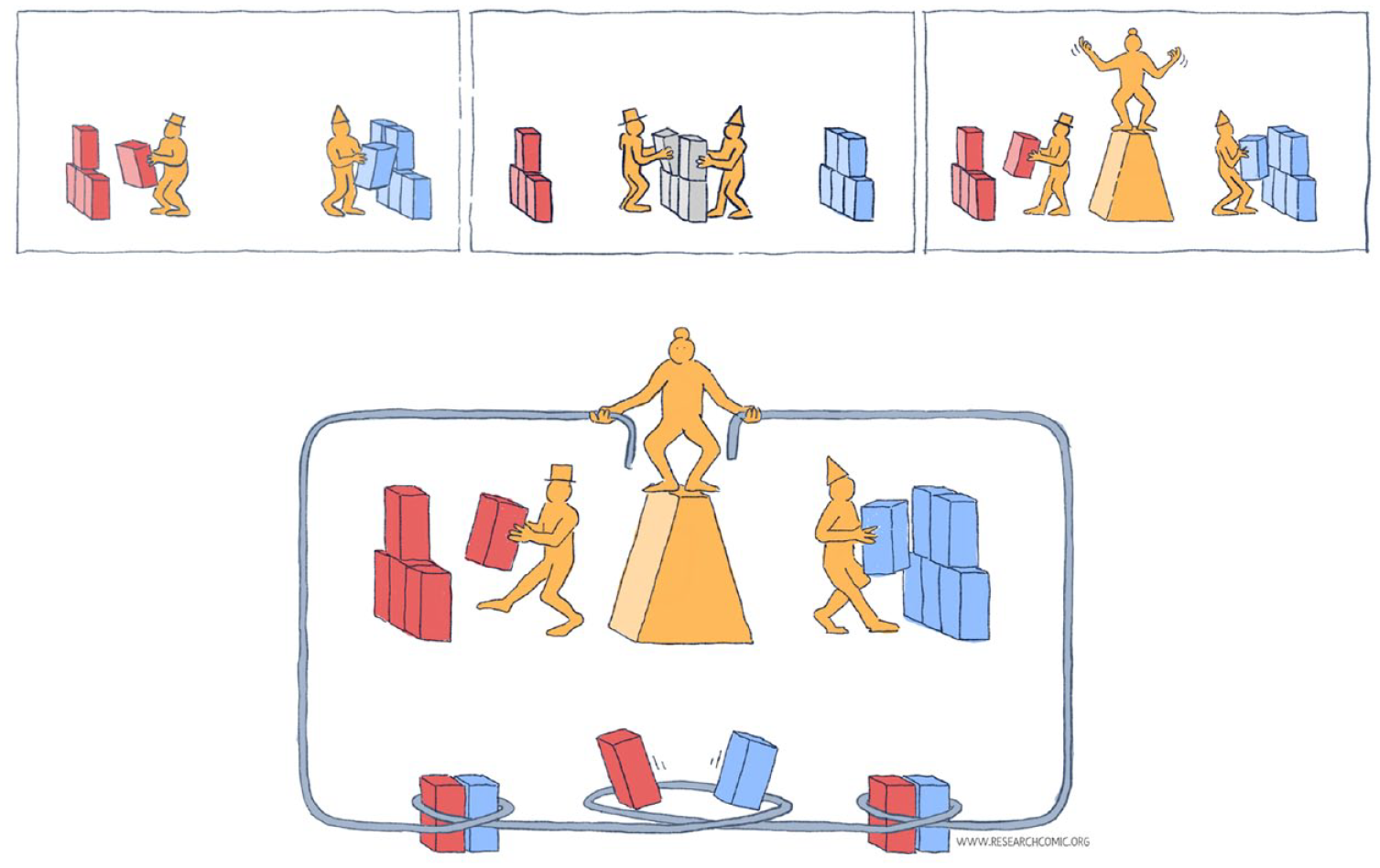
“The institutional knotting timeline.”
Conclusion
Metaphors generally strongly influence what we perceive as problems, their causes, and solutions. Therefore, it is imperative to scrutinize metaphors and modify them or adjust their connotations if they are misleading (Lakoff, 2014). This article aimed to problematize the metaphor of the academic–practice gap in calls for organizing knowledge collaboration. We have drawn findings from two somewhat different cases that both function as platforms for what can be described as configurational boundary work (Langley et al., 2019). Thereby, we have illustrated an alternative approach to understanding the gap and turned to the concept of institutional knotting (Nicolini et al., 2016) to explain how configurational boundary work enables temporal “knots of expertise.”
Rather than trying to close or bridge the academic-practice gap, our alternative approach, or metaphor, suggests that organizing for temporary institutional arrangement is more fruitful — to arrange, buffer, and coalesce for institutional knotting. Such arrangements allow differences between these two fields to be integrated temporarily into the collaboration rather than striving to close the gap permanently. The strategy of knotting (Nicolini et al., 2016) reminds us that it is not necessary to speak with one voice — or even to understand each other very well — that is key for successful collaboration. Instead, as our analysis illustrates, different logics, which in this case define what researchers and practitioners reward and consider appropriate and desirable behavior, can coexist in processes of knowledge collaboration without the need for adaptation or significant revisions. Previous studies often take it for granted that the coexistence of different logics over time results in blending or that one will outcompete or be separated (e.g. Thornton and Ocasio, 1999). This suggests that a knotting strategy might be fruitful to introduce in other areas in which different logics and values are to be combined in some way, such as in the surgery room where different professionals need to find a way to cooperate (e.g. Lindberg et al., 2017), or when there is a need to balance managerial and professional logics, such as in an engineering consultancy firm (e.g. Ollila et al., 2015). The knotting approach helps to set the focus on the working task at hand, and the process perspective, rather than on the possible obstacles for collaboration (cf. Jonsson et al., 2022).
We argue that configurational boundary work and institutional knotting arrangements would add to existing methods and frameworks for enabling and supporting knowledge collaboration between researchers and practitioners (e.g. Bleijenbergh et al., 2021; Guerci et al., 2019). In particular, the concept of knotting may help researchers and practitioners to engage in a collaboration that is not undertaken in extensive forms, such as action research or intervention research, but of a more occasional character that may include, for example, only parts of a knowledge-creation process and that over time can develop as a self-evident part of the everyday work. This can be understood simply as a more or less ongoing collaboration between researchers and practitioners rather than collaborative research and learning opportunities (cf. Kieser and Leiner, 2012). It would allow for the development of the intersection between academia and practice without jeopardizing scientific rigor or diminishing the crucial importance of practice (cf. DeNisi et al., 2014; Ployhart and Bartunek, 2019). It would, however, be naïve to suggest that there are easy-to-follow steps or recipes for making this happen. Instead, we argue, this is more of an approach and mindset that can inspire and support knowledge collaboration in specific directions. In particular, the conceptual idea of institutional knotting can help both researchers and practitioners to engage continuously — throughout their everyday work — in collaborative initiatives and activities. It thus focuses on the possibilities of structuring collaboration work not to be something “special” or “unique” but rather part of what these groups of professionals do as part of their everyday work. Introducing an alternative approach to the academic–practice gap can help us make key aspects of collaboration visible, see things differently, and advance our understanding of organizing such processes. This is also in line with the reasoning by Langley et al. (2019) on configurational boundary work and the benefits of arranging, buffering, and coalescing temporary boundaries that ensure competition and collaboration, that is, differentiation and integration.
In contrast to the standard assumptions behind the gap metaphor, the knot approach opens up for institutional complexity and logics to clash in ordinary and everyday situations. Intermediary actors, such as IA and TC, can be understood as translators or brokers and platforms for learning that may allow for participant’ differences in knowledge collaboration. However, making room for differences needs to be made consciously and explicitly and involve all participants (see also Jonsson et al., 2022). In this work, the metaphor of a knot and the idea of threads that need to be (actively) tied together temporarily can help (cf. Cornelissen et al., 2008). The knotting metaphor visualizes how differences among researchers and practitioners are not to be diminished but that they need to create spaces and conditions for collaboration. Otherwise, they will most likely be unable to share knowledge and experiences, and the problems of the academic–practice gap will remain (and be reproduced). Organizations could benefit from a knotting strategy and become crucial knot-makers themselves.
It is, of course, not possible to generalize from a case study. This was, however, never our intention; instead, we wanted to problematize the almost taken-for-granted metaphor about the academic-practice gap (cf. Alvesson and Sandberg, 2013; Thibodeau and Durgin, 2011). Rather than searching for solutions to overcome or close the gap, we have elaborated — with institutional knots — that the gap is necessary. More research is needed to understand the knotting as well as when and how to arrange knots for successful collaboration. For instance, looking further into different roles and how to cater to those interstitial spaces would be interesting. For example, following Langley et al.’s (2019) argument about configurational boundary work, further understanding the roles of knowledge brokers and translators would be interesting to study and how these roles influence not only opportunities for “knots of expertise” but also, in the case of knowledge collaboration, an increased understanding of science and different types of knowledge (cf. Jonsson et al., 2022).
To conclude, and in line with the arguments of Bartunek and Rynes (2014) and Kieser and Leiner (2012), the knotting metaphor helps elucidate tensions and differences between academic research and organizational practice, in this case within civil society organizations as well as the public sector. Importantly, these tensions and differences need not necessarily to be problematic, as in obstructing collaboration. Instead, they may be a vital basis for mutual learning and creative reframing of the issues in focus in the academic–practice collaboration. From such a perspective, the metaphor of a gap between research and practice appears in another light; rather than closing the gap, there might be reasons for embracing it.
