




Abstract
Much progress has been made with respect to improving our understanding of organizational learning. However, important gaps remain with respect to understanding barriers to learning flows that are rooted in bounded rationality and how such barriers can be reduced. We show how manifestations of bounded rationality in the form of framing effects and cognitive biases can act as barriers to learning at the individual, group, and organizational levels. We theorize that organizations can cope with these barriers to learning by deploying managerial practices that function as organizational repairs. More specifically, we add 3Is to the 4I framework by showing how intervening, inducing, and inquiring practices can attenuate these cognitive barriers to organizational learning. The three kinds of organizational repairs differ in terms of how directly they engage with the learning behaviors of organizational members. They range from direct managerial interventions (intervening) to incentivizing or nudging organizational members to engage in learning behaviors (inducing) to building a culture of reflexivity (inquiring). Throughout the paper we critically reflect on the explicit and implicit assumptions in the 4I framework as well as our extension of it.
Keywords
Introduction
Organizational learning (OL) is often assumed to be important to drive positive organizational outcomes, such as innovation, adaptation, and gaining and renewing competitive advantage (e.g. Argote, 1999; Argote et al., 2021; Crossan et al., 1999; March, 1991; Zhang et al., 2023). Various critical contributions to the OL field have suggested that OL may in fact not always lead to positive outcomes, such as more effectiveness, veridical knowledge, and better organizational performance (Argyris, 1990; Örtenblad, 2002, 2010; Pedler and Hsu, 2018). Drawing on Meyer and Rowan’s (1977) classical statement, other critiques have more fundamentally argued that OL, along with most of management theory, relies on a questionable “Myth of Rationality” which leads to a separation of rationality and emotions, and exalts rational thinking in an unwarranted manner (Czarniawska, 2003; Elkjaer, 2022; McCabe, 2016; Morgan, 1986).
The purpose of this article is also to problematize OL with respect to notions of rationality and the extent to which OL can drive positive organizational outcomes. However, our critical perspective is rather different, less meta-theoretical, and more “internal” to the OL literature (we return to the Myth of Rationality Critique in our “Discussion” section). Thus, our charge is not that OL invokes an untenable Myth of Rationality per se, but rather that OL is unclear about what exactly is assumed about the rationality of organizational members (see also Balasubramanian et al., 2022). In other words, the microfoundations of OL are unclear and incomplete, making the implications of OL for managerial practice similarly unclear and incomplete in key respects.
We are not alone in voicing such concerns. Research recognizes that OL is a complex process involving inter- and intra-level processes through which information and knowledge flow among and across individuals, groups, and the organization(s) at large, but also that gaps remain, particularly with respect to “understanding the mechanisms that . . . restrict the stocks and flows of learning” (Crossan et al., 1999: 535; see also Crossan et al., 2011). Like us, Crossan et al. (2022) recently argued that it is necessary to further elaborate the micro-level aspects of OL to resolve existing gaps in the OL literature. However, while they focus on the role of individual character in OL, we argue that cognitive barriers to OL, rooted in the bounded rationality of organizational members, warrant more scrutiny. The relevance to managerial practice is that when knowledge flows less effectively between units or levels, the organization potentially misses benefits it could otherwise have realized. However, cognitive barriers hindering knowledge flows have been offered little attention by OL scholars. 1
We specifically analyze the foundations of OL theory, focusing on barriers to OL that ultimately are rooted in individuals’ fast, automatic, and largely non-conscious “Type 1” processes (Kahneman, 2011; Sloman, 1996). The manifestations of such default responses have been identified in the vast literature on heuristics and biases in judgment and decision making (Kahneman et al., 1982). Bounded rational individuals adopt (usually successful) cognitive shortcuts to make sense of a complex world and to make decisions (Weber and Mayer, 2011), but systematic errors—that is, biases—may sometimes arise from the use of such heuristics. We argue that cognitive biases represent an overlooked and likely important barrier to OL. We also argue that organizations can mobilize higher order reasoning processes (i.e. Type 2 processes; Sloman, 1996) in a reflexive manner to cope with these barriers and deploy managerial interventions and practices that function as organizational repairs. 2
To lend structure to our reasoning, we specifically apply insights on cognitive biases rooted in bounded rationality to Crossan et al.’s (1999) seminal 4I OL framework. We chose the 4I framework as the cornerstone for our analysis for several reasons. First, while there are many OL theories, 3 Crossan et al. (1999) is unique in its simultaneous focus on (four) distinct learning processes that involve distinct organizational levels (the individual, group, and organizational levels), and can move forward and backward between and within levels. This multilevel, bidirectional focus on learning flows highlights the specific mechanisms underlying such flows. These mechanisms, in turn, are the focal point of tension between cognitive barriers to learning processes and effective flows of learning forward from the individual to the organization and backwards to the individual, thus addressing a central concern in OL theory; namely the tension between exploration and exploitation (March, 1991). The 4I framework also allows for both OL that is top-down, intentional and planned, and OL that is more bottom-up and serendipitous, as well as OL contexts that may range from stable/known to dynamic/unknown (Crossan et al., 2022). Finally, the 4I framework remains among the most cited and influential OL frameworks (Crossan et al., 2011).
We systematically identify how cognitive limitations act as barriers to the feed forward and feedback learning processes identified in Crossan et al.’s (1999) 4I framework. These limitations may (1) reduce how much learning and knowledge are transferred across units and levels in the OL process; (2) distort the learning and knowledge that are transferred; and (3) lead to conflicts among individuals and groups (e.g. teams, departments, functions) that inhibit the flow of learning. The focus on cognitive biases and bounded rationality serves to address important OL limitations, such as the specific mechanisms that hinder flows of learning within complex organizational settings. These mechanisms have been undertheorized and often assumed (away) in contemporary OL research and relying on the 4I framework for OL (Crossan et al., 1999, 2022) helps bring to fore critical cognitive biases that requires attention to understand the complex multi-level OL processes connecting individuals and groups with potentially better organizational level outcomes.
Our systematic integration of cognitive limitations into the 4I framework also offers insights into how organizations, based on reflexive practices, may deal with barriers to learning (Heath et al., 1998). Specifically, we add the following three types of organizational repairs—“intervening,” “inducing,” and “inquiring”—that management can utilize to cope with cognitive barriers to learning. Intervening refers to direct management interventions that break cognitive frames that are harmful to OL at all levels. Inducing refers to mechanisms that facilitate the transmission of learning from individuals to groups and the organization at large by influencing how individuals perceive choices (e.g. by nudging; Thaler and Sunstein, 2008). Inquiring refers to the creation of a culture of dialogue and reflexivity that may enable organizational members to uncover tacit assumptions and hidden biases in order to remedy or even avoid them.
In sum, we develop a multilevel theory on the interactive relationship between individual cognition (and action) and organizational practices by suggesting that cognitive barriers may be reduced by organizational repairs. The 4I framework (Crossan et al., 1999) is unique in its multi-level OL focus, and although it has been highly utilized in the past, we seek to extend it by systematically integrating cognitive biases into the multi-level learning processes as well as introducing new insight into how such biases may be addressed.
We begin by discussing how both learning and cognition are rooted in bounded rationality, followed by a section on how this leads to cognitive barriers influencing specific learning subprocesses in the 4I framework. The final part of the article is dedicated to a discussion of managerial intervention strategies to reduce such barriers. We make a number of key assumptions in our analysis, notably that (1) OL is generally a beneficial organizational process which serves the interests of most members, (2) managers are able (and motivated) to engage in the reflexive processes that make them capable of recognizing cognitive barriers to OL and take steps toward reducing these barriers, and (3) that it is possible to address OL from a purely cognitive perspective. In other words, we adopt a top–down, management-driven perspective of OL. In the “Conclusion” section, we discuss the limitations of these assumptions and outline opportunities for further work.
Cognitive barriers to organizational learning
Meanings of bounded rationality
Bounded rationality is the idea that rationality is constrained by cognitive limitations, the nature of decision problems, and the availability of non-cognitive resources (especially time) for learning and decision making (March, 1994). Perfect rationality is therefore an unattainable ideal. However, OL theory has yet to take individual bounded-rationality-based barriers to learning and their organizational repairs explicitly and systematically into account. This is surprising because OL is fundamentally about overcoming barriers, bounds, and distortions to knowledge and rationality at the individual and organizational levels (Kim, 1998; March, 1991; Simon, 1991). If such barriers, bounds, and distortions did not exist, OL would be faster and less biased. However, OL theory has made little use of those parts of cognitive science and social-psychology research that can enhance our understanding of bounded-rationality-based barriers to OL.
Bounded rationality has the following three interrelated aspects: (1) limited processing capacity (e.g. Simon, 1947); (2) cognitive economizing such as satisficing (Simon, 1955, 1990) and other kinds of heuristics and cognitive shortcuts; and (3) cognitive biases (e.g. Foss and Weber, 2016; Sharp et al., 2023; Weber and Mayer, 2011). The first formulations of bounded rationality (Simon, 1947, 1955) focused on breaking with economics notions of perfect rationality. The key idea was that the human capacity to interpret and process information is highly constrained (Simon, 1947), and that these constraints lead to distortions in information processing (Simon, 2000). A different dimension of bounded rationality is the (satisficing) heuristics that emerge to cope with the consequences of limited processing in decision making. The basic idea is that individuals rely on shortcuts, known as “heuristics,” to organize a subset of the information rather than trying to process all of the available information in a systematic way. Heuristics are therefore fundamentally functional, as they allow individuals to navigate a complex social world. Heuristics have many different manifestations, such as rules of thumb, frames (Gigerenzer, 2004), and stereotypes (Bodenhausen and Wyer, 1985). Although heuristics generally assist in decision making, they can also lead to significant systematic errors in judgment or, in other words, to biased decision making (Tversky and Kahneman, 1974). The list of cognitive biases identified by scholars is long, partly because biases may emerge in judgments, decision making, and memory; may exist at different levels (e.g. both individual and group decision making may be biased); and may have different sources (Kunda, 1990).
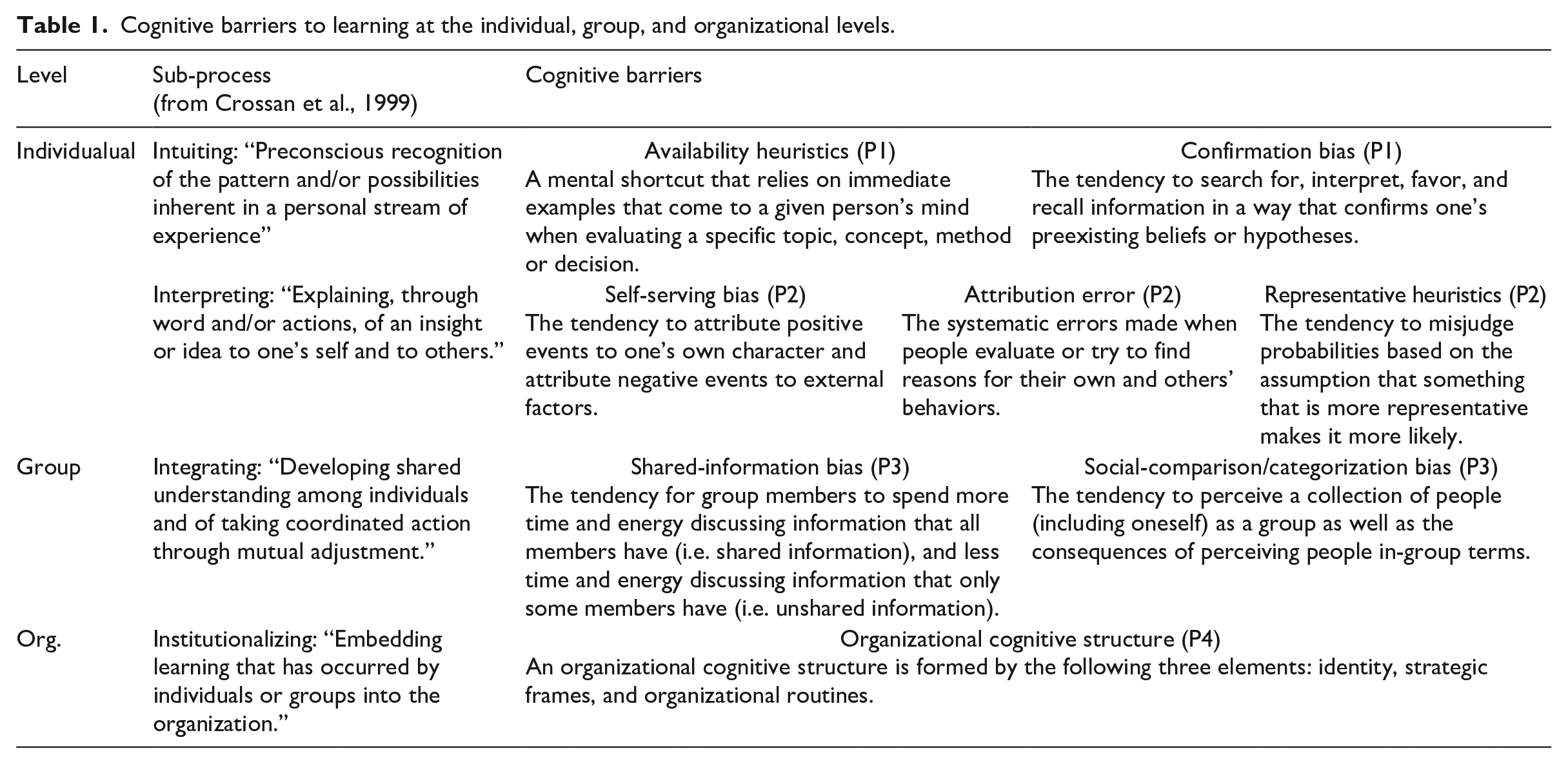
Because we address cognitive barriers to OL, our main focus is on biases in judgment, memory, and decision making. However, given the richness of the extant literature, we follow existing literature (e.g. Das and Teng, 1999; Schwenk, 1988) and focus on the subset of biases that are particularly relevant to understanding the influence of cognitive barriers on OL (see Table 1). Research on biases is constantly evolving. Early work by Hogarth (1980) provided a list of 29 decision-making biases. A popular textbook (Baron, 2008) listed 53 cognitive biases. Wikipedia has compiled an impressive list of 188 cognitive biases as of 2023. However, many of these biases are similar or even duplicates, and range from decision biases to social biases to memory biases and beyond. Similar to other studies (e.g. Das and Teng, 1999; Schwenk, 1988), we focus on a subset of biases of particular relevance to OL. The choice of biases is guided by our focus on the interaction between bounded rationality and various socio-psychological transitive processes (e.g. the 4Is in Crossan et al., 1999) and levels (individual, group, and organizational) of OL. Thus, we focus on some of the best known and most often studied biases in the literature which can be systematically linked to different levels in—and phases of—the OL process. In the following, we describe each bias in the context of the cognitive barriers to OL.
Cognitive barriers to learning at the individual, group, and organizational levels.
The 4I organizational learning framework
To lend structure to the discussion, we rely on the influential 4I OL framework developed by Crossan et al. (1999). This framework provides a cogent and dynamic way of analyzing the OL processes, while it simultaneously pays attention to multiple levels of analysis as well as the flows of learning (forward and backward) between and within these levels.
The 4I framework is based on the following four main premises: (1) OL spans the individual, group, and organization levels, and is about moving knowledge forward or backward among these levels; (2) four broad categories of learning processes—intuiting, interpreting, integrating, and institutionalizing (the 4Is)—link the individual, group, and organization levels; (3) the tension between new ideas and actions (exploration) and what has already been learned (exploitation) is captured by the feed-forward and feedback processes in the learning system; and (4) cognition is fundamental to the learning system, as it affects actions and is affected by actions. Hence, a key tenet of the theory is that learning flows (forward and backward) among individuals, groups, and the organization at large are facilitated by the 4I learning sub-processes. The three levels (individual, group, and organization) define the structure through which OL takes place, while the four sub-processes (4Is) are the mechanisms (or glue) that bind this structure together and facilitate OL. We explicitly address Premise 4, “cognition affects action (and vice versa),” which is outlined in the introduction by Crossan et al. (1999: 523) but largely ignored in the subsequent framing, and we develop theory on the interactive relationship between cognition and action in relation to OL. To this premise, we add the relationship between individual cognition (and action) and organizational practices by suggesting that cognitive barriers may be mitigated by organizational repairs.
Moreover, while the 4I framework deals with OL through the iterative processes of intuiting, interpreting, integrating and institutionalizing, little attention is paid to how individuals access new (external) information to renew or invigorate the learning process. The theoretical model we advance allows for new information to enter the learning system at the individual level and subsequently move upward to the organizational level. Furthermore, by identifying specific barriers to feed-forward and feedback learning processes—and designing mechanisms for overcoming these—we provide a more nuanced framework for understanding OL as it unfolds over time across levels. This helps advance OL theory by explicitly addressing the sources of tension between exploration and exploitation and how companies may deal with these (Crossan et al., 1999). In this way, we not only extend the 4I framework by including cognitive barriers to learning flows but also advance a more prescriptive model of OL that provokes critical reflection regarding the development of new practice for future and current managers (Anderson et al., 2020). 4
The 4I framework has become an influential foundation for understanding the basic processes of OL because it neatly integrates multiple processes of learning in a transparent multi-level framework. Although many studies based on the 4I framework highlight potential challenges to learning at various stages or places in the learning system (e.g. Berends and Lammers, 2010; Crossan and Berdrow, 2003; Lawrence et al., 2005; Vera and Crossan, 2004), little theory systematically investigates barriers to learning or mechanisms for overcoming them. To this end, building explicitly on the 4I framework, a topical review of the OL literature by Schilling and Kluge (2009) provided a long list of potential barriers to learning, some of which are cognitive in nature (e.g. superstitious learning, biased perception). However, this review fell short of systematically integrating these barriers into OL theory (Crossan et al., 2011), and did not provide any remedies for dealing with (cognitive) barriers to learning—the key purposes of this article.
Salient cognitive barriers to organizational learning
The vast literature on cognitive biases point to many different cognitive biases that restrict individuals in their abilities to not only judge, collect, combine, and retrieve information, but also make precise inferences from relevant information (e.g. Tversky and Kahneman, 1974). In an organizational setting, such biases may become barriers and distortions to flows of knowledge: organizational members do not search for, collect, assimilate, integrate, or share relevant learning and knowledge, or, alternatively, they transfer or receive knowledge that is somehow biased. Similar barriers and distortions may operate at group and organizational levels.
A particularly salient bias may arise because of cognitive frames. Group socialization processes typically entail the formation of group-level frames that direct attention of group members toward specific items and away from others (Entman, 1993). Such frames allow individuals to make sense of a complex world and simplify decision problems. However, individuals, groups, or organizations may become inattentive to information that truly matters (Hodgkinson et al., 1999).
Another highly salient bias arises because of ubiquitous processes of social comparison (Foss and Weber, 2016; Nickerson and Zenger, 2008). At the individual level, such biases manifest as superiority biases, egocentric biases, or self-serving biases (Nickerson and Zenger, 2008). At the group level, social-comparison biases manifest as in-group biases (Foss and Weber, 2016). These biases may influence an individual’s decisions about where to seek out or share knowledge. For example, for an organizational member, a social-comparison bias may manifest in feelings of competition with another organizational member who is seen as “better” in some respect. This may harm OL because the former may be reluctant to pass knowledge on to the latter. Similar barriers may exist at the group level between, for example, departments or subsidiaries.
Our focus is on how learning moves forward from individuals through groups to the organization at large and then possibly backward again as knowledge at the organizational level becomes internalized in the minds of individuals within the organization. In these processes, specific types of cognitive biases are particularly pertinent given their influence on the four, connective social and psychological sub-processes of OL—the 4Is (Crossan et al., 1999). Specifically, we identify (1) the availability heuristic and (2) the confirmation bias as particularly salient cognitive barriers that arise during the intuiting process of bringing in new knowledge and recognizing patterns. As learning moves from individuals to groups via interpreting, cognitive mapping is exposed to (3) the self-serving bias, (4) attribution error, and (5) representativeness heuristics, which may limit the learning flow. When groups seek to integrate learning through a shared understanding, (6) the shared-information bias and (7) the social-comparison bias act as barriers to the flow of learning. Finally, (8) organizational cognitive structures may restrict learning from becoming institutionally embedded (see Table 1). We recognize that individual cognitive biases may exert influence on the group and organizational levels, as groups and organizations are composed of individuals. For instance, the confirmation bias is likely to restrict learning at the group and organizational levels. By the same token, as discussed earlier, the social-comparison bias may manifest itself in various forms at both the individual and group levels. For reasons of clarity, we restrict our discussion of each cognitive bias to a particular level and sub-process of learning based on where the salience and impact of a cognitive bias is likely to be strongest.
In the following, we explain this logic. As what has been learned is exploited and internalized by groups and individuals (through the feedback loop), the same cognitive biases may block learning flows in reverse. Figure 1 depicts the research model that guides the discussion. It superimposes salient cognitive biases on Crossan et al.’s (1999) framework and maps the tendency of learning to become less tacit as it moves from individuals through groups to the organizational level because the sub-processes of intuiting, interpreting, integrating, and institutionalizing inherently involve codification processes. In contrast, as learning is internalized by groups and individuals through the feedback loop, it becomes more tacit because the learning process (the 4Is) starts over. Therefore, when learning is internalized by individuals and groups, the new (tacit) knowledge forms the foundation for the exploration of new knowledge through the 4I learning sub-processes, which are subject to the same cognitive biases.
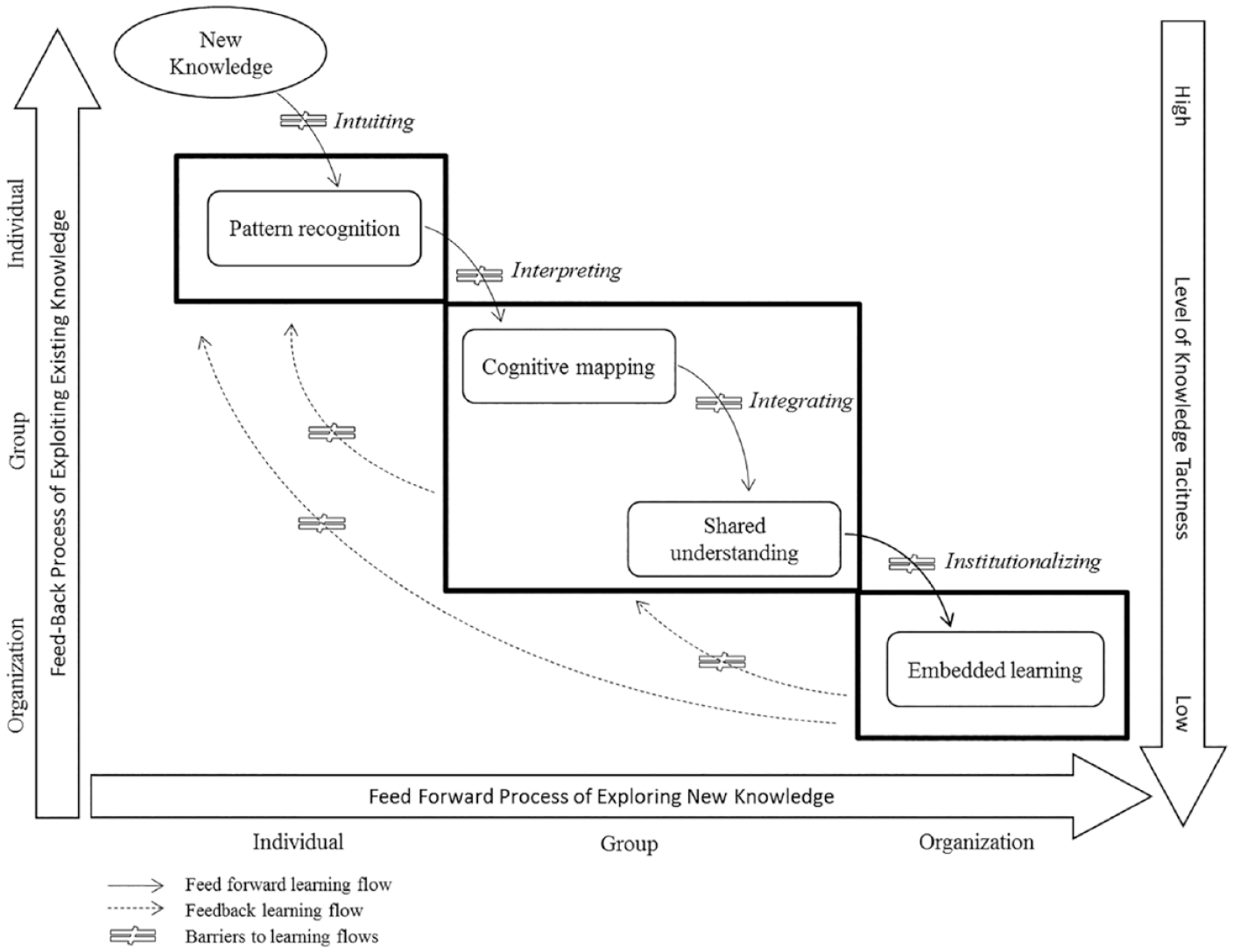
Conceptual model of organizational learning and cognitive barriers.
Barriers to intuiting: availability and confirmation biases
We begin at the individual level where knowledge (new or experiential) is captured through intuiting, “the beginning of new learning” (Crossan et al., 1999: 526). Intuiting is an individual-level phenomenon that is typically performed by gatekeeping or boundary-spanning “entrepreneurs” within the organization who “make novel connections, perceive new and emergent relationships, and discern possibilities that have not been identified previously” (Crossan et al., 1999: 526).
Intuiting helps us understand how and where new knowledge emerges in the context of OL. Thus, intuiting allows individuals to perceive patterns in diverse and disparate data. Notably, however, individuals are likely to perceive such patterns differently even when they are exposed to the same data, as intuitions are shaped by individuals’ personalities and experiences (Weick, 1995). Intuitive judgments have their source in psychological conditions or factors, or in the physical and social environment, which is mostly impressed upon us without conscious effort on our part. They also consist of the mass of facts, patterns, concepts, techniques, abstractions, and formal knowledge or beliefs that are impressed upon our minds through conscious efforts and study. This second source of intuitive mental processes increases with directed experience, study, and education (Simon, 1987).
While intuition represents a highly powerful cognitive apparatus, it is also imperfect. One reason is that intuition is shaped by prior experiences, beliefs, or contexts, all of which might be important sources of cognitive biases that may block new knowledge from being acquired or moved forward in the learning system. In addition, the limitations of individual information-processing abilities lead to the use of schematic, automatic information processing in the exercise of intuitive judgment (Louis and Sutton, 1991), which in turn triggers biased judgments (Kahneman and Klein, 2009). While both heuristics and schematic information processing may economize on mental resource, they may lead to crippling errors when acquiring new knowledge and making judgments about that knowledge (Walsh, 1995).
Pattern recognition through intuiting that brings new knowledge into the learning system is predicated on information collection. In this process, individuals often collect only small, biased samples because of time and/or attention constraints (Tversky and Kahneman, 1971). This may not only bias new information search but may lead individuals to ignore new (external) information and rely on existing (internal) information. Moreover, unawareness of relevant information sources may lead to premature abortion of search efforts and, consequently, keep new knowledge from entering the system, thereby limiting the learning potential.
Even if individuals are aware of relevant information and do not ignore it, the sampled information may be biased owing to the availability heuristic—individuals often assume that the information they consider is the most frequent, probable, and causally important information (Tversky and Kahneman, 1973). Yet, frequent and recent occurring events, though easily recallable, may distort judgments of probabilities of the occurrence of such events. Such heuristics may be appropriate in some situations, but in the search for new, predominantly tacit knowledge, focusing on recent and frequently occurring information and events may lead to biased data collection and pattern recognition (see also Vuori et al., 2023 on the interplay of heuristics and causal knowledge). Hence, solely paying attention to available information is likely to create a false sense of complacency, promote the status quo, and keep new knowledge from entering the learning system, especially when such knowledge is relatively unrelated or is tacit (Barnes, 1984).
Furthermore, individuals often selectively gather or remember information without knowing that they are doing so. This “unwitting” selectivity in the search for, acquisition of, and use of information (Nickerson, 1998) leads to a confirmation bias—the tendency to search for, interpret, favor, and recall information in a way that confirms one’s established beliefs. Confirmation biases contribute to overconfidence in personal beliefs, and they can maintain or even reinforce views in the face of contrary evidence. Such biases have been linked to poor decision making (Schwenk, 1985).
Intuiting may be hampered by these cognitive biases. The cognitive filters (e.g. mental frames) used to acquire information determine which information receives attention. Individuals tend to focus on informational cues that are available, recognized, explicit, or support current mental models, while important information pointing to changing environments might be ignored. Thus, among the many cognitive biases, the availability heuristic and confirmation bias are particularly likely to act as barriers to pattern recognition because they directly speak to issues of limiting information search and biasing intuitive judgments:
Proposition 1: Availability and confirmation biases act as barriers to pattern recognition in the intuiting process by biasing intuitive judgments.
Barriers to interpreting: the attribution error, the representativeness heuristic, and the self-serving bias
For learning to move from the individual level to the group level, ideas and knowledge must first be internalized and made transferable through a process of interpreting (Crossan et al., 1999). This process starts at the individual level when individuals try to make sense of and refine their ideas and embed them in the proper cognitive context before attempting to relay them to others at the group level. Whereas intuiting predominantly operates at the subconscious level, interpreting involves a conscious effort to make sense of intuitions, either within oneself or by transmitting those intuitions to others, typically turning the relevant (often tacit) knowledge into a more declarative form in the process (see Nonaka, 1994). As learning moves from one individual to a group of individuals, various cognitive biases (Duhaime and Schwenk, 1985) may distort the interpretation of knowledge. The biases that are most likely to appear in the interpreting process are those that relate to fitting new learning into existing knowledge at the individual level and sharing this knowledge with others.
The process of interpreting (i.e. searching for and selecting from alternative explanations in the process of sense-making) may also be distorted by fundamental attribution error (Ross, 1977)—that is, in explaining others’ behaviors, people tend to excessively focus on their characteristics (e.g. personality or intentions) rather than external factors. This limits the range of potential alternative explanations. Moreover, even when different perspectives are considered in the interpretive process, they often differ only slightly from one another, and they typically lie within the same general frame. Frames are mental representations, interpretations, and simplifications of reality, and the use of an overly narrow frame may bias an interpretation. Hence, representativeness heuristics may lead to overestimations of the similarity of new information (or an event) to the population which may lead to systematic errors in interpretation and judgment (Gigerenzer, 2004; Tversky and Kahneman, 1974).
The self-serving bias refers to the distortion of cognitive and perceptual processes that stem from individuals perceiving themselves in an overly favorable way, and from their need to maintain and enhance self-esteem. Research shows that individuals typically conclude that their successes result from stable, internal factors (e.g. ability), while they attribute their failures to unstable, external factors (e.g. environmental conditions; Mullen and Riordan, 1988). In the context of interpreting, self-serving biases tend to make individuals search for explanations that makes themselves look good. Such biases may influence the cognitive maps used as interpretive mechanisms to help develop individual and group understandings of intuitions in relation to specific knowledge domains (Huff, 1990). Causal maps and schemas are some of the cognitive filters used by individuals that give meaning to changes in their environments and, in turn, are linked to organizational action (Nadkarni and Narayanan, 2007). Individuals’ actions are driven by how they interpret the world, and those interpretations might be biased or distorted. In this way, self-serving biases may limit the information search and generate shallow hypotheses about cause and effect, which then act as barriers to learning flows in the organization.
Therefore, even if new knowledge is perceived in the intuiting process, it will subsequently be interpreted through the lenses of the current mental models, which constrains learning. Attribution error, representativeness heuristics, and self-serving biases can act as barriers to learning flows because they bias the cognitive maps used as interpretive mechanisms to help develop individual and group understandings of intuition.
Proposition 2: The attribution error, the representativeness heuristics, and self-serving bias act as barriers to the transmission of learning in the interpreting process by biasing cognitive mapping.
Barriers to integrating: shared-information bias, social-comparison bias, and social categorization
As learning moves from the individual level to the group and organizational levels, the focus shifts to the process of integrating. This is inherently a social process, so those cognitive biases that are primarily relevant here are those that directly relate to interaction in social groups.
The goal of integrating is to develop a shared organizational understanding or “collective mind” (Weick and Roberts, 1993) of a phenomenon or an idea. Whereas interpreting focuses on individual change and action through cognitive mapping, integrating is about coherent collective action. Crossan et al. (1999) point to language, dialogue, and storytelling as pivotal processes through which cognitive maps can be translated into a group-level understanding and, ultimately, to an understanding shared across the organization. While individuals learn by interpreting information and stimuli through filters based on their individual cognitions, values, and experiences (Hodgkinson, 2003; Walsh, 1995), groups learn through interaction and collaboration on problem solving. Hence, integrating learning at the group level requires an understanding of the social context.
While most of the previously discussed cognitive barriers primarily operate on the individual level, several biases relate directly to social interactions. For instance, shared-information bias refers to the tendency of group members to spend more time and energy discussing information that is familiar to all members (i.e. shared information), and less time and energy discussing information that only some members have (i.e. unshared information; Forsyth, 2009). When a group lacks access to unshared information when making a decision, the learning outcome may be biased because fewer alternatives are generated.
The team literature often points to the positive cognitive consequences of diversity associated with a variety of perspectives (e.g. Nielsen and Nielsen, 2013). Diversity of knowledge and expertise within a group can promote learning and search behaviors that, in turn, lead to adaptive, innovative solutions (Wiersema and Bantel, 1992; see also Argote and Ren, 2012, on transactive memory). However, although discussions of unshared information may be enlightening, groups are often motivated to discuss shared information in order to reach a consensus on a course of action. According to Postmes et al. (2001), when group members are motivated by a desire to reach closure (e.g. owing to time constraints), their bias in favor of discussing shared information is stronger. This may lead to groupthink (Janis, 1972) in which group members try to minimize conflict and reach a consensus by actively suppressing dissenting viewpoints and isolating themselves from outside influences.
A shared-information bias may also develop during group discussion in response to the interpersonal and psychological needs of individual group members. For example, some group members tend to seek group support for their own opinions. This psychological motivation to garner collective acceptance of one’s own views has been linked to group preferences for shared information during decision-making activities (Greitemeyer and Schulz-Hardt, 2003).
According to Wittenbaum et al. (2004) and consistent with the social-comparison bias, group members are motivated to establish and maintain their status and reputation, to secure tighter bonds, and to compete for success against other group members. Moreover, tendencies toward social categorization and homophily (Tajfel and Turner, 1979) may further reduce a group’s ability to effectively leverage diverse members’ knowledge. As a result, individuals tend to be selective when disclosing information to other group members, which likely biases (or hampers) the ability of individuals to share and integrate their knowledge with organizational groups.
Social categorization and comparison also influence intergroup relations, as one organizational group (e.g. finance or R&D) may develop a domain-specific identity, leading to social competition for legitimacy and scarce resources (Foss and Weber, 2016). Such intergroup behavior may result in conflict and, ultimately, restrict shared understandings and (inter-)group-level learning. Hence, cognitive biases associated with social interactions bias shared understandings and, thus, keep learning from being integrated among individuals within and across organizational groups.
Proposition 3: Shared-information bias, social-comparison bias, and social categorization act as barriers to the integration of knowledge by biasing shared understandings.
Barriers to institutionalizing: organizational cognitive-structure biases
The final process in the 4I framework is the institutionalizing or embedding of learning into organizational routines (or memory), as reflected in strategy, structure, policies, procedures, and systems. Institutionalizing differentiates individual or group learning from organizational learning. Group-level understandings of business practices are rolled out across the organization in an effort to capitalize on or exploit current knowledge in the future (i.e. a feedback loop; Crossan et al., 1999). However, the process of embedding learning through institutionalization may be constrained by the nature of the organizational cognitive structure. In psychology, a “cognitive structure” (such as a “mental model”) organizes our experiences and steers the processing of new information and the retrieval of stored information. “Organizational cognitive structures” are the organization-level analogue to individual-level cognitive structures, and instances of group-level “belief systems” (Martin, 2002). Like organizational knowledge systems (Lyles and Schwenk, 1992), they organize the organization’s experiences and steers its processing of new information (Nystrom and Starbuck, 2015).
Similar to the cognitive filters at the individual level, the organizational cognitive structure may hamper OL. When shared strategic frames or a dominant logic (Bettis and Prahalad, 1995) have been established, non-conforming points of view are likely to be discouraged or marginalized (either tacitly or deliberately), which restricts organizational attention and capabilities (Janis and Mann, 1977). For instance, Miller (1994) reports that knowledge and suggestions residing within some groups at General Motors regarding small car manufacturing or pollution controls were rejected because that information was contrary to entrenched beliefs within the company’s dominant coalition. Similarly, some practices, business initiatives, or newly proposed avenues for improvement might not be accepted within the logic of an organizational identity (Narayanan et al., 2010). This is consistent with Argyris’ (1990) notion of organizational defenses (or defensive routines), which constitute policies, practices, and cultures that actively hamper OL. Organizational identity refers to the organizational members’ collective understanding of central and relatively permanent features of the organization (Albert and Whetten, 1985). Consequently, a shared identity provides an anchor for organizational meaning construction and strong organizational identities might result in cognitive inertia (e.g. Hodgkinson, 1997). Learning is often restricted by the organization’s efforts to preserve its identity.
Similar to the ways in which individuals’ mental frames affect their learning, organizations’ strategic mental frames can constrain their ability to learn. Organizational-level frames and dominant logics (Bettis and Prahalad, 1995) take time and energy to construct. However, when consensus has been achieved, changing that frame is challenging (Kaplan and Henderson, 2005). Dated strategic frames are usually automatically reused to interpret current issues or information cues, even if those frames are inadequate. Consequently, when a dominant logic or collective mental frame has been established, it creates blind spots by providing a framework that dictates the organization’s orientation toward change and innovation. This, in turn, increases the chances of incorporating a related or similar strategy in the future, while changes in environmental conditions are likely to be ignored until those changes are so significant and far-reaching that the organizations’ adaptation is seriously undermined. In this way, when groupthink (Janis and Mann, 1977) or consensus becomes institutionalized, non-conforming views are discouraged or marginalized, thereby hampering learning (see also Argyris, 1990, on organizational defensive routines).
For instance, past successful performance can be detrimental to OL because it creates “psychological slack” in managers, leading them to overestimate their capabilities and be overconfident in the probability of future success (Milliken and Lant, 1991). According to Miller (1993), firms that have been successful in the past are more likely to become one-dimensional by focusing, for instance, on a single goal, strategy, or world view. Successful past strategies or actions can create slack resources. This may subsequently hinder an organization’s ability to adapt to external environments because slack creates a buffer between the organization and environmental changes. Information that contradicts the current strategy will be rationalized as a temporary fluke that can be ignored. In contrast, poor performance is generally supportive of OL and strategic renewal, as there is an incentive to investigate why a strategy has failed (Huff et al., 1992).
Organizational routines are repeatable patterns of independent behavior often used to accomplish organizational tasks (Acharya and Mishra, 2022; Feldman, 2000). Routines involve information processing but economize on cognition, as prevailing strategic frames dominate cognitive processes (Narayanan et al., 2010). They therefore tend to restrict learning (Crossan et al., 1999).
Proposition 4: The organizational cognitive structure acts as a barrier to institutionalization by biasing embedded learning.
Reducing barriers: designing interventions and practices to support organizational learning
Identifying barriers to learning is important to the extent that such barriers can be meaningfully integrated into a theory of OL, which can provide insight into how such barriers can be reduced. Research has long recognized that interventions that modify or break with established cognitive frameworks are key to organizational development and change (e.g. Bartunek and Moch, 1987). In this section, we follow up on and extend this overall idea, describing three specific practices and interventions—“repairs”—that organizational management can use reduce cognitive barriers to organizational learning (Elkjaer, 2022). Clearly, the notion of “repair” is not entirely innocuous terminology. “Repair” may imply “getting us back to the status quo ante”—which presumably was a preferable state—from the current less preferred state. This is not strictly speaking what we intend. Rather, we intend “repair” to simply mean that the negative consequences of a cognitive barrier to learning are remedied through some kind of intervention. Moreover, we also acknowledge a potential paradox between arguing for cognitive barriers due to limited information processes and bounded-rationality biases only to be resolved by seemingly rational managerial interventions (see Ӧrtenblad, 2010 and Berti and Cunha, 2023, on the role of paradox in management theory). However, at the end of the day, management is chartered with devising strategies for overcoming organizational problems and as such they are likely to engage in deliberate actions (interventions) when faced with potential problems. Awareness of the potential cognitive biases that may hamper learning flows is thus likely to trigger managerial response.
Organizational repairs
OL processes involve (sub)conscious actions and efforts by individuals and groups to learn, pass on knowledge, and integrate knowledge (Argote, 1999), yet these actions and efforts may be hampered by cognitive barriers. However, these actions and efforts can also be deliberately influenced by organizational repairs aimed at reducing barriers to OL.
Heath et al. (1998) argue that organizational repairs can be classified into two types: (1) cognitive repairs that overcome cognitive biases and improve the mental procedures applied by individuals and groups to choose which tasks to pursue and how, and (2) motivational repairs designed to increase the eagerness and passion of individuals to pursue a task. While psychologists increasingly stress that cognition and motivation are intertwined (e.g., Kruglanski, 1996), both cognitive and motivational aspects of organizational repairs are important for mitigating bounded-rationality-based limitations and shortcomings and, thus improving OL. We identify three specific organizational repair strategies—intervening, inducing, and inquiring—that management can deploy to mitigate the identified cognitive barriers in each sub-process as learning moves forward and backward in the 4I learning system. These managerial practices differ with respect to how direct the repair is.
Intervening refers to management interventions designed to directly break with cognitive frames and mitigate biases that are harmful to OL at all levels. Prior research has pointed to conflict (Beech et al., 2002), changes in top executives (Crossan and Berdrow, 2003), and the creation of crisis (Kim, 1998) as potential routes to OL that may serve this purpose since they break with cognitive frames.
Inducing refers to practices that facilitate the transmission of learning from the individual level to the group and organizational levels by adjusting the organizational choice environment (or “architecture”; see Thaler and Sunstein, 2008). This may entail changing the way choices are presented to organizational members or changing the motivation to learn while leaving the choice environment unchanged (in practice, the two may be intertwined; see Kaplan and Henderson, 2005). These practices may result in greater knowledge sharing, and the avoidance of distorted or biased learning. “Nudging” (Thaler and Sunstein, 2008), which may involve the creation of defaults that become cognitively salient or changes in the number of alternatives that organizational members will have to consider, is an example of changing the choice environment. Tailoring formal and direct incentives (e.g. introducing financial incentives for knowledge sharing or training) to learning efforts and outcomes, or seeking to increase the intrinsic motivations associated with information processing (learning; for example, by empowering organizational members to learn) are examples of motivating within a given choice environment.
Finally, inquiring refers to the creation of a culture of critical reflexivity, which can exert effects at the individual level (self-reflexivity) and at a more collective level (e.g. “collaborative inquiry,” see Cummings and Nickerson, 2017). While such a culture is not aimed at a particular cognitive bias per se, it allows organizational members and groups to become more self-aware of the biases that may influence their learning behaviors, potentially reducing the harmful effects of those biases. As such, it is more indirect in nature than intervening and inducing, although management must seek to develop and maintain an inquiring culture by establishing supportive practices (see also Hariharan and Anand, 2023). If effective, such a culture may deactivate hippocampal heuristics and prevent cognitive biases.
Table 2 maps our reasoning. We structure the following discussion so that the organizational repairs refer to the different learning sub-processes mapped out in the 4I framework as well as the cognitive biases we have identified as salient to OL. As Table 2 suggests, although all three organizational repairs may influence all OL processes through working on cognition which sets in motion motivational processes, they do so differently because they attenuate given cognitive barriers to different extents. Similar to the cognitive barriers to the learning sub-processes, the organizational repairs also work in reverse through the feedback loop. Hence, as firms seek to internalize what has been learned and feed it back to groups and individuals, intervening, inducing, and inquiring can help reduce the cognitive barriers’ effects on (backward) learning flows.
Cognitive barriers and organizational repairs.
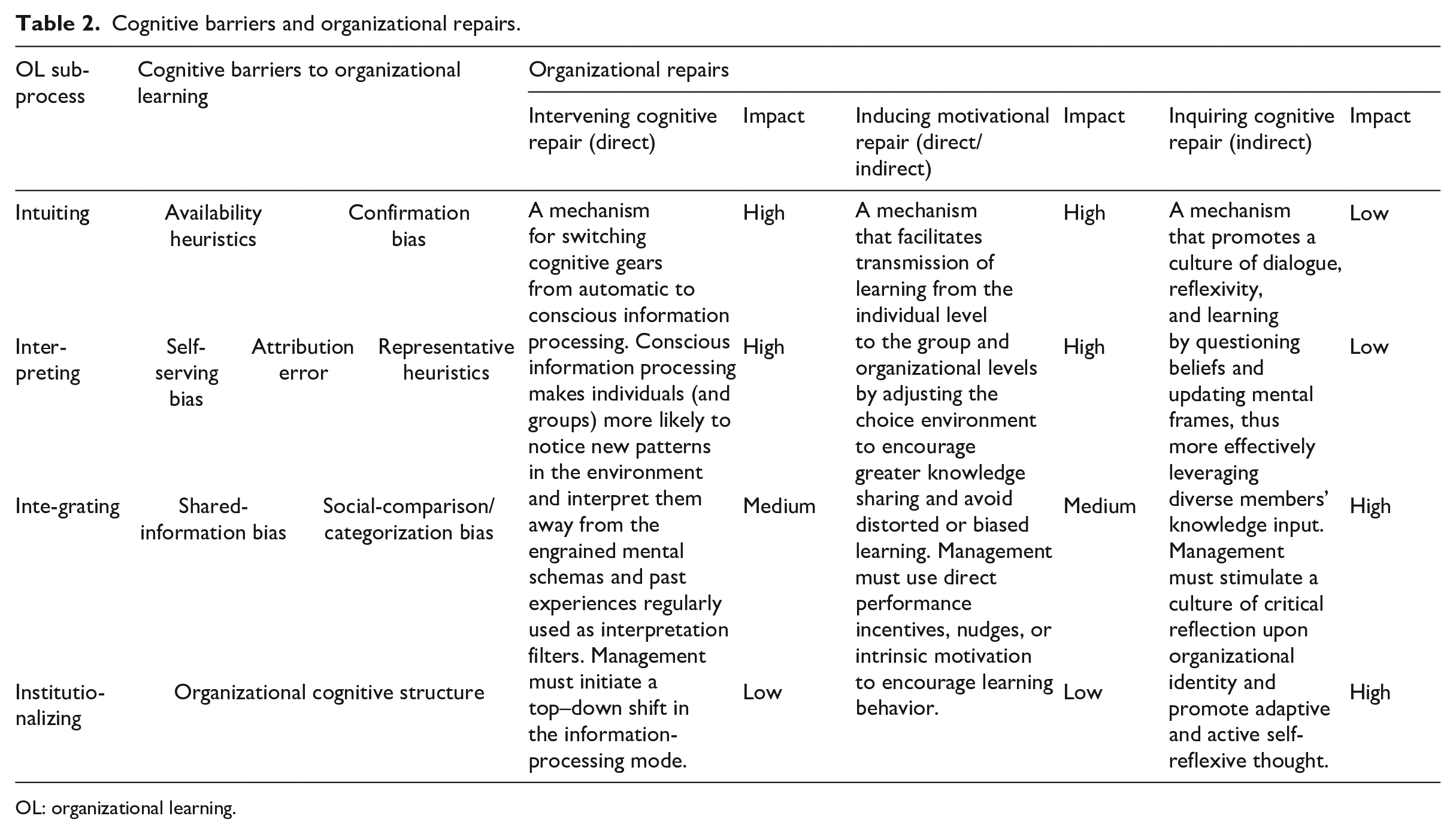
OL: organizational learning.
Intervening
Intervening covers the set of direct ways in which management can make employees switch cognitive gears from automatic to conscious information processing (Louis and Sutton, 1991), which often amounts to “double-loop learning” in which the organization reexamines its fundamental, usually unstated assumptions (Argyris, 1976; see also Bartunek and Moch, 1987). This may happen by, for example, challenging existing routines and procedures, and training employees in alternative ones. This process of deliberately engaging organizational members in processes designed to change their (learning) behaviors is a reflexive process, as it involves a different form of sensitivity and sensibility and an interest in and commitment to attending to intentions and interpretations by the “reflective practitioner” (Schön, 1983). The deliberate OL effort of the Intermountain Hospital System over the last decade encompassed interventions that were designed to break with cognitive frames and counteract biases, especially in the intuiting process (Leonhardt, 2009). Intermountain sought to move away from a system in which treatments and diagnoses were largely based on intuitive judgments, depended on the doctor’s individual past experiences and, as such, were often compromised by confirmation and availability biases. It worked to move toward a system in which more evidence-based diagnosis and treatment practices were identified and subsequently disseminated across the system. The earlier systems produced substantial variation in treatments and outcomes. To reduce such variation, Intermountain intervened in various ways, such as the implementation of evidence-based guidelines and protocols that included a process based on rigorous statistics and the systematic recording of treatment outcomes, as well as systematic training programs. 5 Such practices reduce the level of tacitness involved in learning and help overcome the availability and confirmation biases during the intuiting process.
Another example of interventions that can mitigate cognitive barriers in the intuiting process is the practice of scenario planning, a powerful way of encouraging adaptive cognitive change that works by forcing participants to articulate fundamental assumptions and otherwise engage in conscious information processing. This makes them more likely to notice new patterns in the environment and interpret them away from the engrained mental schemas and past experiences regularly used as intuiting filters. This is consistent with Schön’s (1983) “reflection-in-action,” whereby individuals build new understandings, typically by experimenting within various situations, to inform actions in unfolding situations. As organizational circumstances change, mental frames need to be updated accordingly. Research on schema emergence identifies the deconstruction of existing schemas as a key step in the formation of new schemas (Bingham and Kahl, 2013). When potentially dated individual (and organizational) mental frames are challenged, new configurations and relationships emerge in the business environment. New connections can be made, and information cues might be intuited differently. The overall effect of deconstruction is the broadening of relationships and categories. Thus, individuals are more likely to perceive (i.e. intuit) discrepant or novel information, and avoid cognitive filters that bias attention toward informational cues that are available, recognized, or supportive of existing mental models. This may counteract the availability heuristic and confirmation bias that could limit information search and bias intuitive judgments.
Proposition 5: The creation of shifts in information-processing modes through interventions, such as explicitly questioning basic organizational assumptions or engaging in scenario planning, is an organizational cognitive-repair mechanism that helps alleviate the barriers to OL associated with availability heuristics and confirmation bias in the intuiting learning sub-process.
According to the 4I framework, the next stage in the learning process is interpreting which refers to conscious efforts to interpret and transmit intuitions to others. Learning that contradicts preconceptions might create anxiety and activate ego-defense mechanisms (Brown and Starkey, 2000). By the same token, noticing a threat can block learning. If a threat is perceived, managers rely on fewer sources of information and emphasize cues consistent with current frames. Such behavior will propel organizations to cling to known routines. As noted by Louis and Sutton (1991), cognitive errors occur because individuals fail to recognize the presence of conditions in which they should switch cognitive gears and engage in active thinking.
Self-serving biases together with the fundamental attribution error and the use of representativeness heuristics limit the search for and the range of potential alternative solutions, as information processing remains automatic. Learning flows are offset because the cognitive maps used as interpretive mechanisms to help develop individual and group understandings of intuitions are distorted. As a result, intervening repair strategies must develop conditions conducive to a cognitive gearshift in order to counterbalance such cognitive barriers to learning flows. Louis and Sutton (1991: 60) identify three conditions under which individuals are likely to become consciously engaged. First, a novel or unusual situation is likely to move the individual toward a conscious processing mode. Second, a switch can be provoked by a discrepancy in the form of “an unexpected failure, a troublesome situation, a significant difference between expectations and reality.” Third, a deliberate initiative is usually a response to an external or internal request, such as “trying something new,” or when individuals are “explicitly questioned.”
At this stage, intervention is about helping individuals shift cognitive gears from an automatic mode to a conscious mode by creating novel situations, forcing discrepancies, or introducing deliberate initiatives. Rotations that move employees across jobs, functions, and units change their work situations automatically, thereby creating novelty, discrepancies, and the need for new initiatives. Scenario-planning techniques may also be helpful. For example, Wack (1985) reports how Royal Dutch/Shell designed scenarios around the downturn in oil prices in the 1970s to challenge decision makers to question their own view of reality and change it when necessary. In doing so, individuals are more likely to perceive discrepant or novel information, and process (interpret) it free of the filters which are characteristic of automatic information processing.
Proposition 6: The creation of shifts in information-processing modes through interventions, such as job rotations and scenario planning, helps to reduce the barriers to OL associated with self-serving biases, the fundamental attribution error, and the use of representativeness heuristic in the interpreting learning sub-process.
We suggest that intervening is likely to be particularly effective in the intuiting and interpreting phases of the OL process. However, intervening may still exert an influence on the integrating and institutionalizing processes, as one can imagine more formal ways in which organizations may revisit, discuss, and evaluate fundamental assumptions (e.g. corporate-wide strategy processes). In this way, “reflection-on-action” (Schön, 1983) takes place after the activity and enables the exploration of what happened and why in order to develop questions and ideas and bring examples of the activities and practices into focus. Nevertheless, intervening, as defined here, primarily works through its influence on individual mindsets.
Inducing
Inducing is about improving employees’ learning behaviors by structuring the incentives, information, and options that are presented to them. Thus, inducing covers both attempts to explicitly reward learning behaviors and attempts to “nudge” employees in a certain direction without taking away their freedom to make decisions. While some firms use direct performance incentives to induce learning behaviors, such incentives are relatively ineffective and may even be counterproductive, especially when learning behaviors are best supported by intrinsic motivation (Deci and Ryan, 1985).
Instead, firms may deploy “choice architectures” that contain “nudges,” in the terminology of Thaler and Sunstein (2008). Choice architectures refer to the way choices are presented to decision-makers. For example, performance contingent pay systems (e.g. piece rate system) will present choices in a particular typically quite explicit and controlling way. But choice architectures may also contain more subtle and “soft” elements, such as nudges, that is
any aspect of the choice architecture that alters people’s behavior in a predictable way without forbidding any options [. . .] Nudges are not mandates. Putting fruit at eye level [hoping that people then choose fruit over unhealthy alternatives] counts as a nudge. Banning junk food does not. (Thaler and Sunstein, 2008: 6)
For certain decisions, nudges are superior because they are focused on fundamentally changing the way (i.e. the underlying behavior) individuals process information and make decisions in contrast to extrinsic rewards that are designed to align individual and organizational goals. Nudging alters behaviors in a predictable way without removing any options or significantly changing individuals’ economic incentives. While the locus of control is still external, it is much less visible and blunt than the external locus of control involved in direct performance incentives. Thus, the risk that nudging will crowd out the intrinsic motivation that is often vital to learning behaviors is smaller. In fact, careful nudging is likely to have a positive motivational effect that may facilitate the transmission (flow) of learning in the organization.
Nudges may help reduce some of the bounded-rationality-based cognitive barriers to learning. For instance, during the intuiting stage of learning, individuals tend to unconsciously rely on availability heuristics, which together with the confirmation bias may limit information search and bias intuitive judgments. Adjustments of the choice environment can help reduce such cognitive biases by varying the order in which alternatives are presented, altering the wording used to describe them, adjusting the process by which they are selected, and allowing for the careful selection of defaults. For instance, Nonaka and Takeuchi (1995) describe how Sharp employees were told to be “dragonflies but not flatfish”—dragonflies have compound eyes and, therefore, see the environment from multiple perspectives simultaneously, while flatfish have large eyes that can only see in one direction. Ebert and Freibichler (2017) describe how nudges may improve knowledge worker productivity. For example, carefully managing scheduled meetings may reduce the “information bias,” that is, the tendency to constantly search for information even if it has no discernible effects on outcomes. This furthers organizational learning by controlling the flow of learning between individuals and groups. Simple nudges may also influence the creation of new knowledge through intuiting. Thus, task efficiency in knowledge work may be furthered by having “no-meetings days” (Ebert and Freibichler, 2017). The design of the physical layout of the workplace may also provide nudges that direct learning in desired ways.
Other approaches may include setting up cross-functional teams with diverse knowledge domains or creating competitive sub-teams tasked with developing separate project proposals in order to ensure breadth in the alternatives generated. Relatedly, research on transactive memory (e.g. Argote and Ren, 2012) illustrates that organizations can benefit from developing systematic ways of encoding, storing, and retrieving information in different domains. Transactive memory provides individuals with access to more knowledge as a team or group than they possess individually and helps reduce some of the cognitive barriers associated with confirmation bias and the use of availability heuristics. By the same token, organizations may combat the tendency to rely on biased, available information by instituting processes for systematic information collection. For instance, the medical profession has developed a series of strict protocols for trauma situations in order to ensure that relevant, not just salient, information is collected and quickly assessed. The ‘ABC’ (i.e. airway, breathing, circulation) protocol in emergency rooms is an example of such a procedure. The approach to OL that the Intermountain Hospital System sought to implement generalized this to multiple diagnostic and treatment situations (Leonhardt, 2009). Other examples include Toyota’s 5S production system and the 5C credit analysis used by many banks. Such mental schemas are helpful in nudging people to consider the full range of relevant information (Anderson and Spellman, 1995). Other organizations institutionalize procedures that encourage individuals to pay attention to missing information or unusual events in order to combat the availability and confirmation biases.
Proposition 7: A dedicated choice architecture helps alleviate the barriers to OL associated with the availability heuristic and confirmation bias in the intuiting learning sub-process.
As learning flows to groups within an organization, a dedicated choice architecture may also help overcome some of the systematic errors and biases in judgment related to interpreting. Given the tendency to misattribute both errors and successes, organizations may seek to develop mental schemas that encourage greater deliberation and analysis in decision making. In addition, the tendency to favor interpretations that are consistent with existing views through the application of representativeness heuristics often leads to systematic errors and an inability to correct for biases. One way to avoid such biases is to reduce noise and distance in information collection and interpretation processes. Organizational processes tend to involve unnecessary steps that increase the potential for cognitive biases. By streamlining processes, organizations can reduce such problems. For example, software developers often collect inadequate information about end-users’ preferences and needs, which can give rise to unnecessarily complex programs with graphical user interfaces that defy most users’ logic. One solution may be to let software developers observe users as they interact with the programs and require them to use the same hardware as their customers when developing new software (Cusumano and Selby, 1995).
Another way to utilize the choice architecture to reduce cognitive biases is to evaluate decision alternatives simultaneously rather than sequentially. If people are forced to simultaneously consider competing alternatives, they are nudged away from fixed frames and fundamental attribution errors toward better information processing based on comparative interpretation.
Proposition 8: A dedicated choice architecture helps alleviate the barriers to OL associated with self-serving biases, the fundamental attribution error, and use of representativeness heuristics in the interpreting learning sub-process.
While inducing is primarily relevant for intuiting and interpreting, it may also influence the integration process and, indirectly through aggregation, the institutionalization process. It is possible to structure incentives and nudges such that they are directed at the group’s goal (Lindenberg and Foss, 2011). Therefore, if the firm’s reward system stresses contributions to collective efforts, it may help overcome the shared-information and social-comparison biases that otherwise threaten the development of a shared understanding and coordinated actions in the OL process.
Inquiring
Much of the research on OL and organizational change and development stresses the need for critical self-assessment of an organization’s core premises which are captured by its identity and culture (Hatch and Schultz, 2002). However, such self-assessments can stall when organizational members seek to maintain individual and collective self-esteem by not questioning prevailing self-concepts. Ego defenses protect self-concepts, and the intrinsic motivations that may be associated with learning may be offset by anxiety-provoking ego challenges. Information that threatens the individual or collective identity is often marginalized, ignored, or even concealed.
Therefore, the organization must empower individuals to challenge the fundamental assumptions embodied in the culture and identity of the group or the organization (Argyris, 1976). While intervening is one way to bring this about, it can be a very blunt instrument and is implemented from the top, which can have negative ramifications for motivation. In contrast, the creation of a culture of collaborative inquiry (Cummings and Nickerson, 2017) and critical self-reflexivity leads to an understanding and mitigation of ego defenses, which enables OL in a more indirect but not necessarily less effective way (Brown and Starkey, 2000). Moreover, a culture of dialogue helps individuals share their anxieties in an environment where it is acceptable to express doubts (Schein, 1993). These processes include a managerial commitment to promoting a shared culture between employees, a shared vision of goals among all of the stakeholders, an open-minded approach to new ideas in the organization and extensive dialogue to achieve a collective engagement.
While this can be useful in the individual intuiting and interpreting phases of OL, the strength of inquiring lies “higher up” in the OL process where the focus is on collaborative inquiry in an organizational context (see Cummings and Nickerson, 2017). The strength of collaborative inquiry as a practice lies in the fact that it actively engages and leverages diverse points of view, which makes it particularly useful in the integration process. At this stage, learning is essentially socially constructed, often because of social relations and interactions in “communities of practice” (Brown and Duguid, 1991; De Groot et al., 2023). Hence, learning may be restricted or distorted due to cognitive barriers associated with information sharing, and social-comparison or categorization biases. Yet, when top management actively cultivates a favorable learning environment and invests in the learning of employees, it motivates employees and provides them with a sense of direction that facilitates sharing mutual understandings and learning with each other. This process stimulates the learning process by facilitating a sense of empowerment, belonging and community among employees. In this way, a culture that promotes dialogue and collaborative inquiry across the organization reduces learning restrictions resulting from shared-information bias as well as social-categorization and social-comparison pressures.
Proposition 9: The creation of a culture of dialogue and collaborative inquiry is an organizational cognitive-repair mechanism that helps alleviate the barriers to OL associated with shared-information, social-comparison, and categorization biases in the integrating learning sub-process.
Moreover, the urge to maintain self-image, coupled with individual and organizational conservatism and ego defenses, leads to maintenance of the organizational identity (Brown and Starkey, 2000). Organizations have a strong desire to preserve their collective identities (Dutton and Dukerich, 1991). While a strong organizational identity and self-image may serve the purposes of routine-based learning, OL essentially evolves through modifications to existing routines. As organizational routines are constitutive of members’ collective definitions of their organizations’ identities, a change in this identity must occur for OL to take place. Hence, organizations run the risk of blocking the efficacy of OL through the organizational cognitive structure, as learning is institutionalized in organizational culture, identity and routines. Management must therefore stimulate a culture of critical reflection upon organizational identity and promote adaptive and active self-reflexive thought in the pursuit of OL (Argyris, 1990). While such a culture is difficult to cultivate, it often starts by creating an organizational context that through managerial feedback supports the use and development of the employees’ knowledge, skills and decision-making capabilities in such way that the employees are empowered to decide when to switch between activities pertaining to exploration and exploitation. For instance, Cattaneo et al. (2015) illustrated how metacognitive prompts through instructional activities helped apprentices both build a positive attitude toward reflection and promoted “reflection-on-action” (Schön, 1983). A culture of critical reflection involves development of strategies to identify and correct comprehension and performance errors (i.e. debugging) as well as active post-evaluation of enacted organizational activities in order to avoid barriers to OL stemming from organizational cognitive structures.
Proposition 10: The creation of a culture of critical reflection upon organizational identity is an organizational cognitive-repair mechanism that helps alleviate the barriers to OL associated with organizational cognitive structure in the institutionalizing learning sub-process.
Discussion and conclusion
Contribution
We began from the critical premise that although learning is fundamentally about cognition, there has been surprisingly little attention to cognitive barriers to learning in OL theory. Accordingly, we integrated cognitive biases into a highly influential framework, namely the 4I framework (Crossan et al., 1999). While we highlighted individual-level cognitive biases, we also emphasized that learning is to a large extent a social-interaction process. Some cognitive biases can also manifest at the group level and hamper the flow of learning among groups such as work groups or departments in a firm. This view allowed us to incorporate assumptions about human limitations and social behaviors that might significantly restrict learning flows as learning moves from the individual to group level and beyond (i.e. feeds forward), and back again (i.e. feedback).
As such, this study is the first attempt to systematically integrate cognitive barriers into the 4I learning framework (Crossan et al., 1999). The broader importance of our theorizing rests on its ability to inform OL theory in general. Although most OL theories are rooted in theories of human behavior and social interaction, individual-level bounded-rationality-based barriers to learning flows have thus far been neglected. For instance, Nonaka and Takeuchi (1995) discuss knowledge creation, sharing, and diffusion across levels, but they remain silent on the broader implications of humans’ information-processing limitations beyond the need to convert tacit knowledge into explicit knowledge. Similarly, Argote (1999; Argote and Ren, 2012) provides important insights into learning processes within organizations but pays little attention to how individuals are constrained by their cognitive limitations. While Brown and Duguid (1991) mention that individuals must develop non-canonical practices in order to break free from formal (and restrictive) practices, their focus is on communities and organizational-level learning. Yet, the behavioral theory of the firm (Cyert and March, 1963), upon which most learning theories are based (see Argote and Greve, 2007), explicitly adopts a bounded-rationality view of decision making and organizational behavior, and argues for more emphasis on behavioral assumptions in theorizing. Studies of learning within (and between) organizations will benefit from heeding this advice and increasing the focus on individual cognition.
Our study takes an important step in this direction by explicitly focusing on bounded-rationality-based cognitive barriers to OL and systematically integrating such barriers into a key OL theory. Our investigation also opens up for theorizing about the administrative mechanisms and interventions that can be deployed to alleviate these barriers. In this context, we added 3Is to the 4I framework by proposing that intervening, inducing and inquiring can be used to deal with the various cognitive barriers to OL. Our analysis illustrated how firms (managers) can design informed managerial decision processes (Sibony et al., 2017), which we refer to as organizational repairs, to alleviate cognitive biases as learning moves forward (or backward) from individuals through groups to the organizational level. While some of these organizational repair strategies are recognized in the literature as organizational development or change interventions, they have not previously been systematically linked to specific cognitive biases in various stages of the OL process. Our analysis of organizational repair strategies adds context to OL theory (Johns, 2006) because we study the relationships between individual cognition and organizational practices, thereby providing insights into how organizations can overcome the cognitive limitations of individuals acting within them. In this sense, our theorizing is an attempt to bridge the often-implied gap between descriptive and normative reasoning in decision making (Stanovich and West, 1999). While our analysis of cognitive biases in the various OL subprocesses is predictive in nature, our ensuing analysis of organizational repair strategies takes on a more normative focus to increase the prescriptive power of OL theory (Anderson et al., 2020; Pedler and Hsu, 2018).
Limitations: internal and external critiques
While our study is motivated by critically reflecting on the current state of OL theory, and our key aim is to respond to such critical reflection in terms of theory-building, it is also necessary to turn the critical perspective to our own theorizing. There are at least two domains of critical reflection, namely an “internal” and an “external” one. The domain of internal critique accepts the basic assumptions of our theorizing and instead questions the specific theorizing. The domain of external critique questions those basic assumptions.
The domain of internal critique
Internal critiques relate to issues such as the following: Did we include the right cognitive biases in our analysis? Is our account of how the relevant biases hinder learning sufficiently encompassing? Did we sufficiently account for bidirectional learning flows? Among the more internal critiques are also the point that while our framework recognizes that new knowledge may emerge in a serendipitous and bottom-up process, it is also predicated on the notion that knowledge can be strategically managed by managers by identifying and reducing cognitive biases and in general devise and design structures and processes that increase the value to the organization of OL. This efficiency-oriented approach may be criticized in a number of ways. First, it may be a stretch to assume that managers can devise structures and processes that maximize the value of OL, as this may seem to presuppose that a precise value can be placed on future learning. But this may be inherently contradictory (as future learning cannot be known “now”). Second (and relatedly), a top–down emphasis may mean that too little attention is paid to lower levels in the organization, such that knowledge emerging in an unanticipated manner from these lower may risk getting overlooked. Third, our approach risks overlooking aspects of incentives, power, and manipulation. Thus, to simplify our reasoning, we have not spent much time discussing the fact that learning is a motivated effortful activity, such that the issue of somehow motivating learning arises. We have not touched on the role of power issues and how, for example, a too heavy-handed approach to OL risks backfiring (as employees become demotivated). And we admittedly have not discussed the potential dark side of managing OL by reducing cognitive barriers to learning, such as issues relating to manipulating employees through the use of nudging. Future research may critically deal with these limitations, for instance, by changing the paradigm toward regenerating the learning organization (Pedler and Hsu, 2018).
The domain of external critique: the myth of rationality
However, a perhaps deeper level of critique is the external one, which addresses the fundamental and implicit assumptions that underlies our framework, such as those of a meta-theoretical or even metaphysical nature. First, our view of OL is admittedly predominantly positive. Future research may adopt a more critical perspective of both antecedents and consequences of OL at both individual (e.g. employee satisfaction, power and career mobility), team (e.g. groupthink and diversity), as well as organizational (e.g. inefficient use of resources) level. Our analysis and observations regarding OL and particularly the repair strategies can be argued to be made from a managerial/ownership perspective. While OL is likely a positive phenomenon, in general, in the sense that it is likely to be associated with value creation, innovation, absorptive capacity, and other outcomes that are conventionally seen as beneficial to the organization. However, what is beneficial at the organizational level may not necessarily be beneficial to all organizational members. For example, OL may result in process improvements that may, in turn, result in laying-off employees. If employees understand this, at least some employees may resist OL. Alternatively, employees may experience a reduction of their internal power position. Hence, future research may seek to investigate the OL phenomenon from the perspective of less powerful organizational actors.
Second, even more fundamentally, our theorizing may be argued to be based on a fundamental Myth of Rationality. The critique of rationality comes in many forms. In this article, we have relied on one such critique, namely the critique from bounded rationality, to build a more realistic foundation for key aspects of OL theory. However, our take is still one that relies on rationality. Our particular take, based on the heuristics and biases literature, may be criticized for stressing “cold cognition,” that is, abstract from the role of emotion in driving social outcomes (Abelson and Rosenberg, 1958). However, even more fundamentally, our approach assumes what some have called a “myth of rationality,” namely that organizations (and their managers) pursue rationality, while in actuality, organizations pursue legitimacy through conforming to prevailing norms and institutions (Meyer and Rowan, 1977), and, even more radically, seek to provide illusions of control, order, stability, rationality, and manageability whereas in actuality organizations face uncertainty, irrationality, and disorder (McCabe, 2016).
While these critiques may seem fundamentally different from the (bounded) rational approach we have adopted here, there are ways to make contact between the two positions. Fundamentally, the notion of bounded rationality indeed recognizes that social reality is characterized by uncertainty, disorder, and so on, and that individuals and organizations seek to impose order on this reality. Moreover, this notion also implies that in the face of uncertainty and limited information it makes sense to, for example, imitate others that seem to successfully deal with such uncertainty and limited information. Thus, the criticism from the myth of rationality may be less far from the basic premises of our theorizing than it seems.
Conclusion
We critically engaged with OL theory, pointing out that although learning is a fundamentally cognitive activity and the notion of cognitive biases has been well established for decades, OL theory and cognitive biases have not yet been brought together. Accordingly, we show how the inclusion of such biases further OL theory, building on Crossan et al.’s (1999) seminal 4I framework.
