




Abstract
Over 60 years of scholarship have been dedicated to describing meaning-making processes through which organisational learning occurs. Recently, researchers have considered the creation of shared meaning-making through prolonged and co-located interactions situated in the context of a community. The spread of hybrid working has had an adverse impact on several of these meaning-making processes, disrupting knowledge-sharing ecosystems and organisational learning overall. In this article, we explore ways of facilitating knowledge-sharing against such disruption. To maximise the efficiency of verbal communication, we introduce Basil Bernstein’s socio-linguistic approach of learning as the emergence and consolidation of verbal codes. We trial the LEGO® SERIOUS PLAY® method as a means of facilitating the emergence and consolidation of such verbal codes in five online workshops with manufacturing businesses. We find that the emergence of verbal codes can be facilitated through the use of the LEGO® SERIOUS PLAY® method. We also find that code consolidation is a much more spontaneous process, and we observe this in the final reflection stage of the workshops. Our study offers insights into the process of meaning-making in online exchanges and has implications for organisations seeking to manage hybrid or fully remote workforces, as well as the wider field of organisational learning.
Introduction
Effective organisations share learning and experience across various levels of hierarchy, within and between teams (Brady and Davies, 2004; De Groot et al., 2022; Pattinson et al., 2016). Collaboration across organisational boundaries also makes global connectivity and innovation possible (Håkansson and Snehota, 1995; Huizingh, 2011; Stanko et al., 2017) when situated, for instance, within multi-actor communities (Ketonen-Oksi and Valkokari, 2019). Communities can provide a context of shared meanings and enable organisational learning through inter- and intra-firm knowledge exchanges (Hernes and Irgens, 2013). However, learning communities have changed with the rise of hybrid working (Alexander et al., 2021; Gressgård, 2011). Reflecting on this change, importance must now be given to evaluating remote interactions and online communication and how this impacts knowledge sharing (Ketonen-Oksi and Valkokari, 2019) and thus organisational learning across spaces (online-only or hybrid) and places (co-located or remote).
The subject of organisational learning itself is frequently addressed on the pages of Management Learning, and for good reason. Over 60 years of academic interest and a range of seminal contributions have ensured that definitions – and debates – are abundant (Easterby-Smith et al., 2000). In this article, we outline three broadly interlinked and overlapping areas of scholarly interest. The first consists of studies addressing individual meaning-making through action and cognition, emerging from the work of Piaget (1985) and Dewey (1998). The second consists of research on organisational learning as meaning-making, based on the application and disruption of rules and procedures (Nelson and Winter, 1982). The third is the conceptualisation of organisational learning as situated and socialised meaning-making, for instance, occurring within communities with various levels of dispersion (Lave and Wenger, 1991).
Of particular interest in this third sub-field is the requirement for co-location and prolonged social interactions (in-person exchanges) as key enablers of trust-building and knowledge-sharing across community networks (Elsbach et al., 2005; Nonaka et al., 2006; Nonaka and Takeuchi, 2001). This is significant, as in-person interaction within and between organisations was significantly affected by the move to fully remote and then hybrid working following the coronavirus pandemic (Glas, 2022). This is something that was experienced firsthand as part of our regional impact project. Running between 2016 and 2023, it aimed to connect ‘small- and medium-sized enterprises (SMEs) into a regional peer-learning-oriented community’ (Anonymised project website, accessed 23 September 2022). Phase 1 of the project (2016–2019) had offered facilitated, face-to-face workshops and networking interaction within a landscape of practice (Wenger-Taylor, 2014) to build communities with a common interest (Ketonen-Oksi and Valkokari, 2019). However, widespread lockdowns in the United Kingdom required immediate and substantial revision to modes of delivery. The success of the in-person events in Phase 1 was in stark contrast to the initial online workshops at the start of Phase 2, where engagement was low and collective meaning-making was challenged.
Therefore, we turned to the LEGO® SERIOUS PLAY® method, which has been shown to create environments for shared learning, tacit and experiential knowledge (Mccusker, 2014), and essential antecedents of trust and relational embeddedness (Uzzi and Lancaster, 2003). This allowed us to facilitate communication between groups of individuals with common interests. To further understand shared learning and communication within the group, we used Bernstein’s sociolinguistic theory of language codes to study the organising principles behind the language employed by members. In the ‘Results’ section, we consider how language use within the group influences how individuals give value and meaning to the items they are discussing (for this study, this is the unifying subject of manufacturing within the region). We conclude the article by discussing our contribution to the organisational learning literature and make recommendations for businesses with hybrid or online-only workforces.
The ‘elusive’ subject of organisational learning
Although popularised in the 1980s and growing exponentially since, the topic of organisational learning dates back at least to the 1950s (Easterby-Smith et al., 2000; Inkpen and Crossan, 1995; Naot et al., 2004). Such a timeframe of enquiry has seen the emergence of a rich literature on the subject, yet scholarly consensus appears, to borrow from the words of Inkpen and Crossan (1995), ‘as elusive as locating the fountain of youth’ (p. 597). Organisational learning has been defined as a process or sets of processes producing shared meanings (Elkjaer, 2021) in the form of shared values, norms, goals and assumptions (Argyris and Schön, 1996; Easterby-Smith et al., 2004), which influence how the organisation operates (Crossan et al., 1999; Elkjaer, 2004; Naot et al., 2004). The existence of a plurality of viewpoints and categories notwithstanding (cf. Andrews and Delahaye, 2000; Easterby-Smith et al., 2004), we outline three distinct, yet overlapping, approaches to the study of organisational learning in the literature. First, organisation learning as an aggregation of individual cognitive processes and resultant behaviours within a setting (such as a business), a well-established field that dates back to Piaget (1985) and Dewey (1998). Second, organisation learning as meaning-making produced by the individual or collective enforcement and disruption of (business) rules, processes, and procedures (Hernes and Irgens, 2013). Third, and most recently, organisational learning as socio-cultural meaning-making (Cook and Yanow, 1993), situated in a context or a community (cf. Elkjaer, 2004, 2021).
Accordingly, early contributors to the first domain, like Fiol and Lyles (1985), explored ways in which learning at the individual level could be aggregated into collective and organisational outcomes, transferring this individual learning to organisational learning (Huber, 1991). In turn, scholars debated whether individual learning was a purely cognitive activity, or whether learning required evidence of changes in individuals’ behaviour (Bapuji and Crossan, 2004; Hong et al., 2006; Naot et al., 2004). Although the debate subsided before reaching a definitive resolution, scholarship in this domain has since coalesced around an emergent consensus. The distinction between cognition and behaviour has become increasingly blurred and scholars have proposed that, when occurring at the individual level, learning includes both cognition and behavioural aspects. Yet, changes in the way knowledge is created by an individual can result in shared and organisationally distributed changes, which constitute organisational learning (Easterby-Smith et al., 2004; Fiol and Lyles, 1985).
Research situated in the second domain has included studies on single- and double-loop learning (Argyris and Schön, 1996), focused respectively, on the efficient application of existing processes in pursuit of organisational goals, and on the critical review of the effectiveness of said processes (Easterby-Smith et al., 2004; Huber, 1991). Scholars have also considered the role of rules and organisational processes in setting the pace of learning, and specifically compared the benefits of incremental versus radical change (Easterby-Smith et al., 2004; Hernes and Irgens, 2013). In turn, the study of radical change and its organisational impact grew into the field of ‘unlearning’, through which ineffective processes that lead to unwanted outcomes are discarded (Hedburg, 1981; Inkpen and Crossan, 1995). Huber (1991) offered a synthesis of this debate by blurring the single- and double-loop learning distinction and proposing that both incremental and radical change are required for organisations to respond to changes in their environments, and thus for learning at the organisational level to occur.
Research within the third and most recent domain (Easterby-Smith et al., 2004) recognises the key significance of knowledge creation and dissemination (Hernes and Irgens, 2013) in a collective and shared way (Hong et al., 2006). Here, the onus is placed on meaning-making in each context, through the creation of shared values, goals and meanings, which directly supports organisational operation (Dibella et al., 1996; Elkjaer, 2004; Hernes and Irgens, 2013). This domain seems to have adopted a socio-cultural (Brown and Duguid, 1991) or socially contextual (Hong et al., 2006) focus, in which communities play a significant role. This concept of groups of situated learning (Lave and Wenger, 1991), whose members are connected not only by shared learning experience but also by common interest and skills (Wenger and Snyder, 2000) is influencing theory and practice in many domains. Since Brown and Duguid’s (1991) seminal article on the practice-based view (Nicolini, 2013), the literature has diversified to recognise diverse types of shared learning groups, including ‘looser’ groupings, such as landscapes of practice that connect individuals, as well as networks of practice of shared interests but without the need for members to directly work with or personally know each other (Pyrko et al., 2019). However, as the absence of face-to-face interaction and member co-location is likely to bring about a range of challenges (Jones, 2007; Pattinson et al., 2016), it is the formal boundaries and connections within the community, rather than its more loosely connected variants, which are recognised as a locus of shared meaning-making and thus situated learning (Lave and Wenger, 1991; Wenger and Snyder, 2000).
Yet, the dynamics of meaning-making in the context of communities are highly contested. An emergent debate in this field centres on whether situated meaning-making (in communities) is based on consensus (Elkjaer, 2021), or tension and conflict (Brandi and Elkjaer, 2013). To thrive, sites of meaning-making require trust (Dyck et al., 2005), which itself is contingent on cross-cultural co-operation and prolonged (physical) interaction among members (Mooradian et al., 2006). However, scholars such as Contu (2013) and Gherardi (2009) have challenged the overarching language of cooperation (Contu and Willmott, 2003) and ‘togetherness’, through which community sites are described. Scholars have also proposed that situated interactions are more likely to be governed by conflict, tension and power imbalance (Pattinson et al., 2016; Reynolds, 2000). Importantly, whether extolling conflict or consensus as the predominant factor in situated learning, researchers accept the vital role of the community and the need for co-location and physical interaction as enablers of socialisation and dialogue (Kauppila et al., 2011). Yet, those very conditions have since been disrupted by the spread of hybrid and remote working following the coronavirus pandemic (Glas, 2022). Can shared meaning-making occur without the co-location and prolonged interaction conditions which current studies suggest are necessary? What are the implications of online interactions for organisational learning overall?
Meaning-making through restricted and elaborated codes
The purpose of meaning-making is to generate a distinctive understanding (Colyvas, 2007) or develop a common belief (Combe and Carrington, 2015) that supports organisational processes. The individual cognitive dimension highlights the value of being inclusive while initially having diverging views on meaning; however, the characteristic of group cognitive consensus supports the ability of shared goals and beliefs to develop patterned behaviours in later stages (Li et al., 2022).
Communication is a key component to developing these shared meanings within groups or communities, and therefore, we turn to Basil Bernstein’s (1971) sociolinguistic theory of language codes, which has made a substantial contribution to the study of communication, to better explain how the language individuals use in ordinary conversation both reflects and influences the presumptions of a particular community or group. We consider the use of language codes as an alternative conceptualisation of meaning-making and knowledge-sharing, to maximise the efficiency of verbal exchanges. Although it is well known that a substantial portion of human communication is non-verbal, with some scholars even suggesting that most communicative semantics are drawn from nonlinguistic components of face-to-face interaction (Knapp et al., 2013), this research examines whether (and how much) meaning-making can be produced in environments where non-verbal cues are absent.
However, it is necessary to begin by defining the central concept in Bernstein’s (1971) approach, namely the ‘code’, which produces and transmits meanings, regulates, and constrains behaviour in social exchanges (pp. 143–145). Codes connect individuals to their environments and the roles individuals have in those environments (Kauppila et al., 2011). Codes also allow social roles to be performed in interaction with others (Diaz, 2001). Furthermore, codes produce meanings, not in abstraction, but as a reflection of a particular social context: a student is able to create and share student-related meaning, while a worker does so as an employee (Bernstein, 1971: 167). In this way, codes shape and help make sense of human experience in various social contexts (Bernstein, 1971: 90; 166–167) by enabling the production and re-production of identities, roles and positions (Diaz, 2001).
In practice, codes are produced in communication, and in turn, regulate it (Bernstein, 1971: 145). In addition to the social context, codes reflect the background (e.g. social capital) of the speaker, the background on which he or she draws to communicate in a sophisticated or simple manner. Codes underpin all social (and organisational) rules and principles (Diaz, 2001), and it is through the production and exchange of codes that individuals learn and adopt their social roles, a proposition which Bernstein develops into a separate, ‘role system theory’ developed elsewhere in his Class, Codes and Control (see Bernstein, 1971: 175–180 for an introduction) but which is out of scope for the current discussion.
Bernstein (1971) identifies two broad types of codes, ‘elaborated’ and ‘restricted’ (p. 147). Elaborated codes allow speakers to draw on their full lexicon/vocabulary (‘linguistic resources’) (Bernstein, 1971) and to communicate by considering the specific context and the listener/s (p. 150). Elaborated codes are also ‘verbally explicit’ (Bernstein, 1971: 150) in two ways. First, they require careful planning of the communicated content, as well as the use of specific and varied syntactic arrangements (e.g. questions, statements, exclamations and so on) to convey it. Second, elaborated codes are usually produced through direct speech, rather than non-verbal codes such as facial expressions, tone of voice, body language and so on (Bernstein, 1971: 93). Although it has been suggested that a substantial portion of communicative semantics is drawn from nonlinguistic components of face-to-face interaction (Knapp et al., 2013), Bernstein (1971) proposes that elaborated codes allow for a bespoke set of meanings, through which individuals can make sense of ambiguous or novel circumstances (pp. 170–171), while the reliance on spoken words as opposed to non-verbal communication make them also appropriate for online contexts. In contrast, restricted codes rely on a limited range of meanings and Bernstein (1971: 147–150) recognises two types of restriction: lexical and syntactical. Lexically restricted codes are found in generic exchanges or contexts governed by rigid protocols, for instance, formalised routines, religious services and so on. They are likely to draw on a limited lexicon/vocabulary and as a result, it is not what is being said but how and when it is being said that conveys the more salient relationship (Bernstein, 1971: 148). As those non-verbal expressions (a smile, a nod, a shrug) were missing from the initial set of online workshops we ran following lockdowns here in the United Kingdom, it is unsurprising that we found the facilitation of dialogue and discussion problematic. Those non-verbal signals allow for a relationship to develop on the foundation provided by syntactically restricted codes and make it possible for elaborated codes to emerge. Elaborated codes may take the speakers in one, two or several directions before they eventually converge into another type of restricted code, namely, syntactically restricted. Syntactically restricted codes emerge in contexts of a ‘social relationship based upon a common, extensive set of closely shared identifications and expectations (. . .)’ (Bernstein, 1971: 149) and their role is to ‘reinforce’ (p. 150) the forming (or already formed) social relationship. These codes are likely to produce ‘fast’ and ‘condensed’ sentences, for instance, expressing ‘concrete’ statements rather than raising further questions (Bernstein, 1971: 150). We represent this movement, from lexically restricted through elaborated codes and towards consolidation by syntactically restricted codes, as Pathway I in Figure 1.
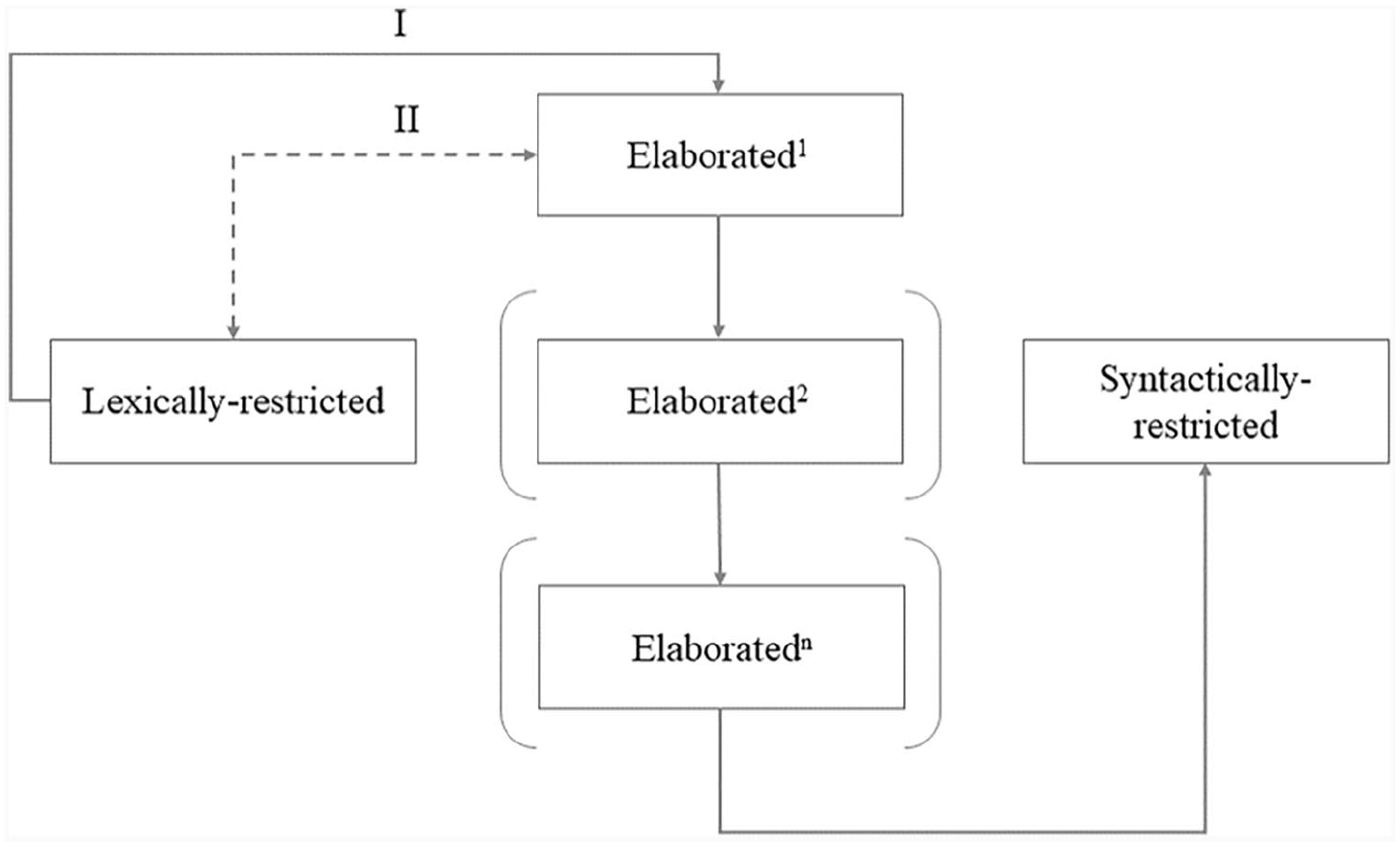
Meaning making as a movement between restricted and elaborated codes during social exchanges. Our interpretation of discussion in Bernstein (1971: 144–155).
We offer a practical example of how movement along Pathway I might look in everyday interaction by creating a fictitious dialogue between two people (Figure 2), accounting for the significance of non-verbal signals (italicised within the parentheses).
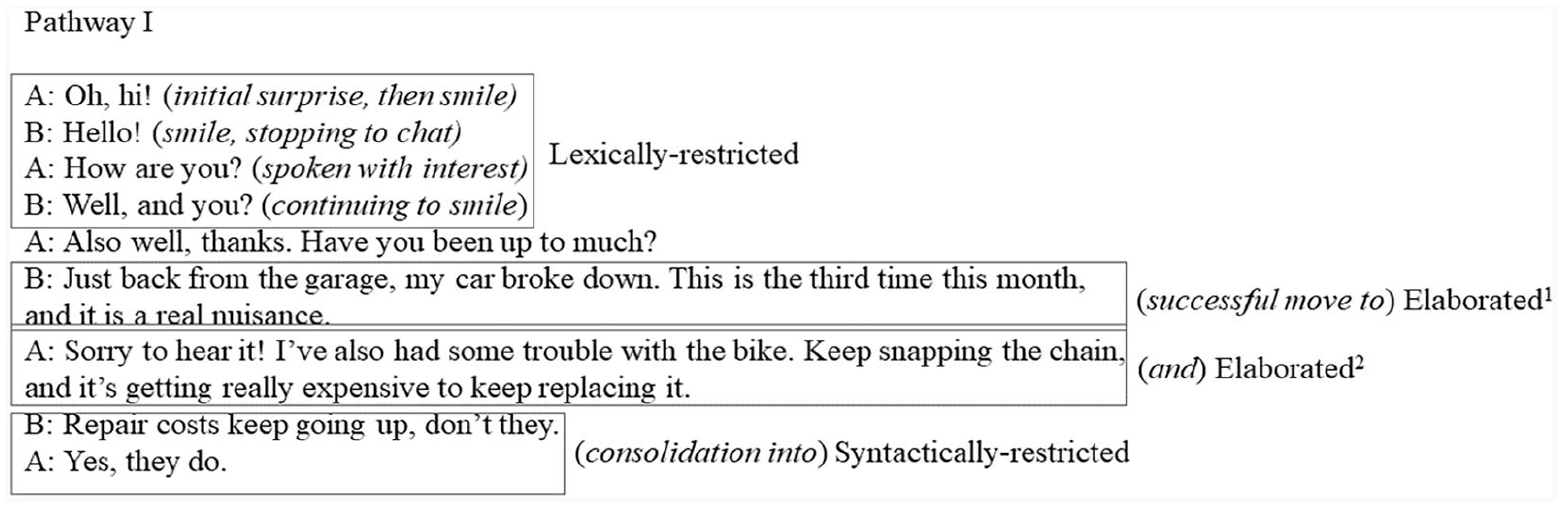
A practical illustration of the Pathway I movement from lexically restricted through elaborated, and consolidating into syntactically restricted codes.
However, the move described in Pathway I does not always occur. It is possible for the non-verbal signals to be such that they discourage a transition to elaborated codes. It is also possible for one of the speakers to choose to limit the scope of the conversation by only using lexically restricted codes, accompanied by minimal non-verbal signals (Bernstein, 1971: 151). This is the Pathway II movement of Figure 1 and is further illustrated in Figure 3.
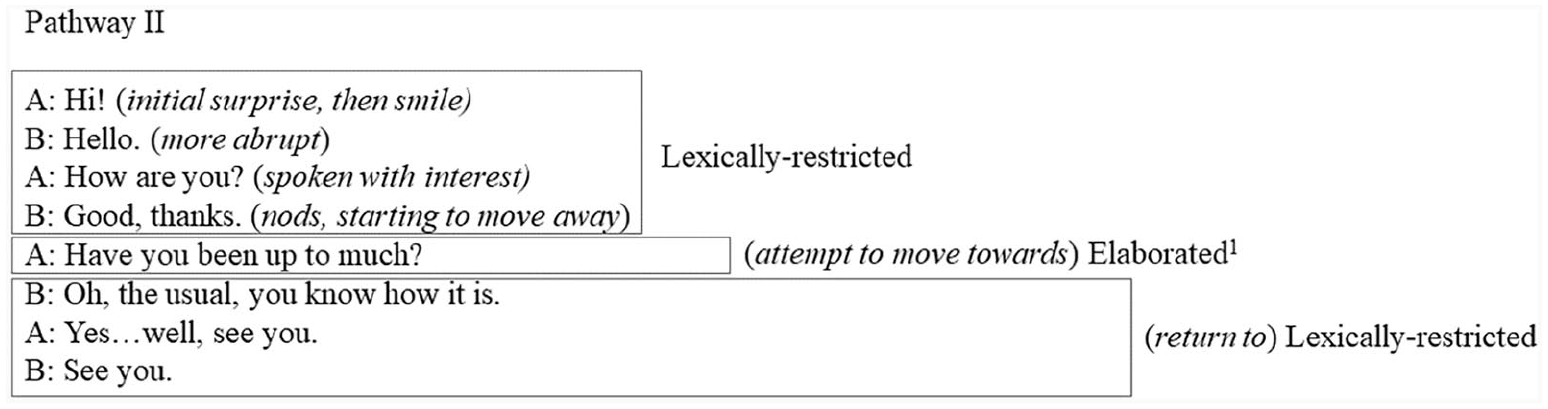
A practical illustration of the Pathway II movement, which shows a conversation failing to move from lexically restricted to elaborated codes.
In concluding this brief overview of Bernstein’s (1971) socio-linguistic approach, we would like to emphasise the importance of this move from lexically restricted, through elaborated and finally to consolidated, syntactically restricted codes for all types of social (including organisational) learning. For Bernstein (1971), syntactically restricted codes can only emerge as part (thus also indicating the existence) of ‘inclusive’ (p. 149) social relationship/s, those enabled by a common identity and shared meanings. Importantly, those relationships ‘take for granted’ the positive intentions of speakers (Bernstein, 1971: 150) which, collectively, closely mirror the conditions for trust and togetherness in communities (Elkjaer, 2021). Importantly, Bernstein’s socio-linguistic approach shows (see, for example, Bernstein, 1971: 149) that once a sense of solidarity has emerged between the speakers, there could be a movement, back and forth between elaborated codes and syntactically restricted consolidation. This conceptualisation can help us also account for studies (see, for example, Contu and Willmott, 2003) that suggest that communities can be sites of conflict as well as consensus.
Using the LEGO® SERIOUS PLAY® method in online workshops
The LEGO® SERIOUS PLAY® method was created for use in facilitated workshops with adults to stimulate conversation and promote reflection while also fostering the use of creativity and problem-solving abilities (Mccusker, 2014). The method has been successfully demonstrated in several studies. For instance, Frick et al. (2014) describe their application of the method with SMEs from the engineering industry as part of a project funded by the European Union (EU). Furthermore, the LEGO® SERIOUS PLAY® method has been used with SMEs in the digital industry (Kranawetleitner et al., 2020) and the tourism industry (Tuomi et al., 2019), as well as mixed-industry SME participant groups (Tawalbeh et al., 2018).
The outset of the coronavirus pandemic made it necessary for the method to evolve away from its traditional face-to-face format to online (Blair, 2020: 5). Blair’s (2020) guidebook, produced at the start of the pandemic, shares several case studies where the LEGO® SERIOUS PLAY® method was used in an online context, yet much of the handbook deals with practical matters such as using one or two screens, lighting, and platform features, rather than seeking methodological innovation or theory-based analysis of data from online workshops. We therefore turned to the LEGO® SERIOUS PLAY® method as a means of both lexical (since one block could have multiple meanings) and syntactic elaboration (since blocks can be arranged in multiple ways, and with specific focus on a given task).
The participants
The study was conducted through five online workshops with 23 participants (48% female, 52% male) between March 2020 and June 2021. As the five sessions were delivered online, a LEGO® SERIOUS PLAY® ‘Window Exploration Bag’ was sent to each participant in advance. Each set included the same selection of standard bricks of assorted colours and shapes, a small selection of special elements (fans, wheels, etc.) and minifigure parts. The participants were all from senior roles within their businesses, and able to make decisions that could influence change. They were purposefully and sequentially selected (Eisenhardt, 1989; Eisenhardt and Graebner, 2007) from various companies that identified themselves as working in manufacturing across the region and worked across a wide range of sectors such as textiles processing, medical equipment and boatbuilding. They all shared challenges that affect manufacturing in the region, issues including operation in a rural location and being able to be agile, grow and innovate, all of which can affect individual and organisational learning in a smaller business (Rao et al., 2008). The newest business was established in 2021, while the oldest has been in operation since 1944. Businesses ranged in size from that of a sole trader to 157 employees. Table 1 (provided in the Supplemental material) gives an overview of basic descriptive data of the workshop participants including the nature of business, location of business, year the business was founded, number of employees and job role within the business.
Although the participants in this study were part of a wider ‘landscape of practice’ (Wenger-Trayner and Wenger-Trayner, 2014) consisting of individuals with common interests, they lacked the established norms, rules and routines of a community of practice (Ketonen-Oksi and Valkokari, 2019). As a result, we were interested in evaluating the scope for enabling knowledge-sharing and shared learning through an alternative set of protocols offered by Bernstein’s sociolinguistic theory of language codes, and interested in studying the organising principles behind the language employed by the participants.
The build challenges
The workshops involved four to eight people and were designed around a series of ‘build challenges’ to further explore how and why SMEs collaborate, network and/or facilitate learning. Each workshop was designed by the facilitator through a detailed lesson plan that incorporated progressive challenge questions with the goal of encouraging discussion and reflection. Each challenge was presented to the participants at the beginning of the process. The facilitator then instructed them to use their LEGO® bricks to construct a model that expressed their thoughts or responses to the building challenge. The role of the facilitator was to encourage the group conversation to reach the goal of the workshop and enable the participants to express their thoughts and ideas. Therefore, their main job was to enable the processes of reflection and dialogue. Their actions determined how the process was perceived by the participants and whether it was successful. Table 2 (in the Supplemental material) shows the basic session outline and challenge questions. To balance model-building with the realities of online workshops, each session was designed to last between 3 and 4 hours and therefore did not include a shared build.
As is a widespread practice in workshops using the LEGO® SERIOUS PLAY® method, the participants are set a series of build challenges, given time to complete them and then invited to explain their builds, and the story behind them, to each other (Wengel et al., 2021). To provide sufficient information on the verbal exchanges, we present only three of those situations below, selecting examples from the ‘core identity’ build challenge in Workshop 1, the ‘aspirational identity’ build challenge in Workshop 3 and the ‘team and connections’ build challenge in Workshop 4. We open the section by outlining the reasons why participants chose to attend the workshops, as opposed to sending cancellations or simply not coming online, as was the case with the first two online workshops. We conclude the Findings section by providing examples of the only two instances of consolidation through syntactically restricted codes we observed. It should be noted that although participants are anonymised as Participants A, B and C to distinguish different voices in the elaborated-codes sections, they are not the same people.
Findings
Novelty and interest as a substitute for non-verbal signal encouragement
The five workshops opened in general silence, with participants joining the call with their cameras off. There was an absence of lexically restricted codes which, in the form of ‘hi’, ‘hello’, ‘good morning’ or other greetings might be expected to accompany an in-person workshop, even if attended by strangers. However, when the facilitator encouraged everyone to turn their cameras on and introduce themselves, participants used their introductions to signal verbal interest in the topic and the workshop. Some provided personal information to the group. In those five workshops, and against the uncertainty and restriction of imposed lockdowns, it seemed that a sense of novelty could stir interest and encourage participation. Despite the absence of the full range of non-verbal signals which could accompany lexically restricted codes, participants demonstrated curiosity in the LEGO® SERIOUS PLAY® method, which created an early sense of shared interests, and thus common ground.
I don’t normally sign up for things like this, but it just piqued my interest for some reason. (Participant A, Workshop 1) I am usually in the garden at home, as I like pottering around but this [LEGO®] is close to my heart. (Participant B, Workshop 1) I was preparing for this workshop with a little bit of help from my 12-year-old son last night. (Participant, Workshop 3) This is the best thing I’ve done at work . . . the best thing I’ve ever done. (Participant, Workshop 4). I get few opportunities like this. Most of the time, unfortunately, I’m sat at a desk with a computer. (Participant, Workshop 5)
Mindful of the challenges of participant focus and concentration when using online platforms (Manolchev et al., 2020), the facilitator proceeded to direct each workshop towards the build challenges promptly. Those build challenges enabled the emergence of explicit and elaborated codes that were particular to the task/build challenge (cf. Bernstein, 1971: 15), and we provide examples of the codes and context which were observed during three of the challenges outlined in Table 2: core identity, aspirational identity and team and connections.
Elaborated codes emerging through facilitation during build challenges
Core identity build challenge
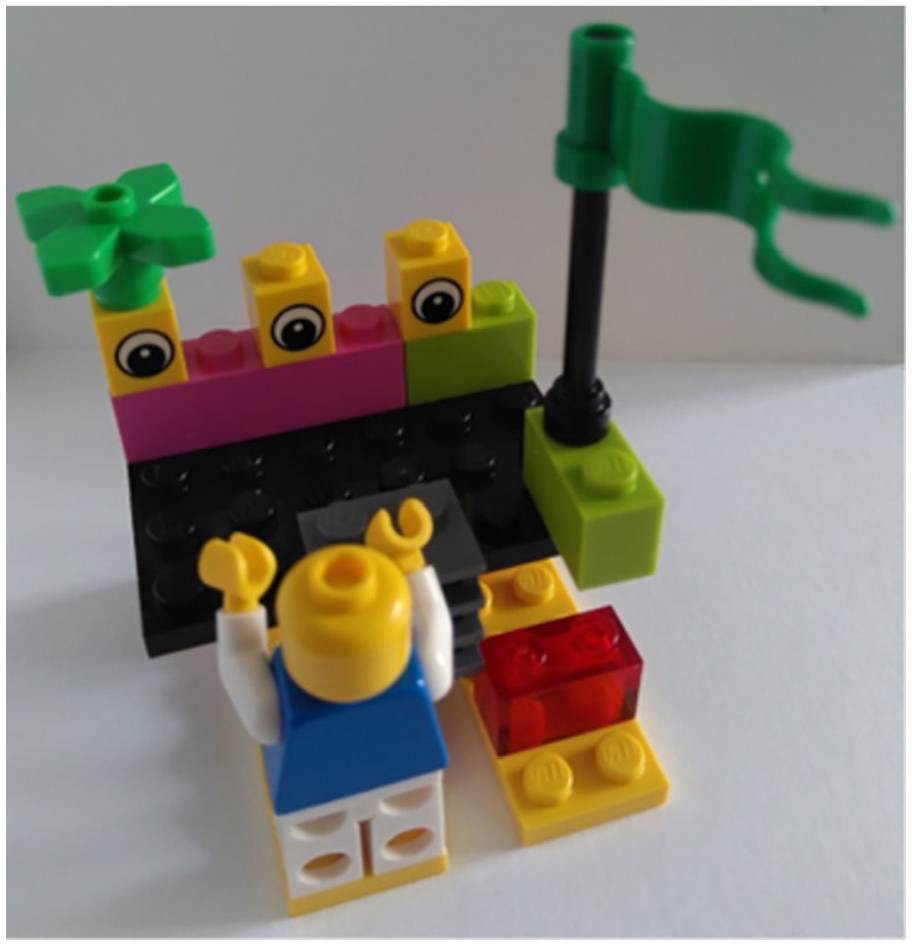
The model in Figure 4 was built in Workshop 1 by a Commercial Director of a manufacturing company, and who has worked there since 2006 after completing an undergraduate degree in business management. The company provides precision-manufactured machine parts including design services and started its operations as a sole trader in 1983. It currently employs 13 people with a wide range of engineering, management, and administrative skills. The following transcription shows an exchange between workshop participants on a common element of their model (Figure 4):
We tend to have to move quickly if there is a new thing on the market or we want to diversify or win a certain client we invest in some specialist [equipment]. We try to be sustainable, I used a windmill to indicate clean energy . . .
I have the windmill part in my model as well! But I use this to be kind of representative of consumer confidence and how people feel about opening up and whether they’re happy to proceed, and make a booking with me, or not. I have fixed the windmill to this massive black thing here, which is another potential government lockdown closure!
Participant A provides an example of elaborated codes in the context of their business. The description is sensitive to the task provided, but also outlines specific challenges in the context of their own business. As will be observed in the remaining two examples, this elaboration prompts another participant to share and elaborate on their own interpretation and their own business reality, as anticipated by Bernstein (1971) and outlined as Pathway I in Figure 1.

Individual model (from Participant A) representing a change in external factors that may affect the business.
Interestingly, the elaborated codes produced by participants reflect both scholarly insights into the field of product innovation (Hernandez-Espallardo and Delgado-Ballester, 2009), and the significance of process capabilities over people’s input when developing new services (Gryszkiewicz et al., 2011). According to Martínez-Román et al. (2011) moving from incremental to radical innovation requires a distinct set of competencies, which is represented in the model through the differentiation between the ‘grey’ of industry and the ‘green’ of sustainable technology, with the changes mostly focusing on the sort of knowledge employed. For radical innovation to occur, shared meaning-making needs to bridge the gap between the status quo and new skill acquisition, creating transformative and exploratory capacities (Herrmann et al., 2007; O’Connor, 2008). Relatedly, even incremental innovation presupposes the ability to create a shared understanding of newly developed competencies, for instance, through elaborated codes (Bernstein, 1971) to facilitate organisational learning (Subramaniam and Youndt, 2005).
Mapping a new domain through sets of elaborated codes is necessary (cf. Bernstein, 1971: 151) and a similar movement from one elaborated-code-governed topic to another elaborated-code-governed topic was observed in the aspirational identity build challenge below.
Aspirational identity build challenge
The model in Figure 5 was built by a participant in Workshop 3, who has been working in a commercial and strategic role since 2020 for a company that produces luxury tea. The company’s tea gardens were the first in the United Kingdom to yield the first major crop for home-grown tea in 2005, and since then the company has continued to nurture rare plants, shrubs and tea plants within the local microclimate.
Individual model (from Participant A) to show how a new product would be introduced to the business.
The following transcription shows an exchange between workshop participants when invited to explain their builds and the story behind them.
This is actually me trying to get my clients’ attention . . . I have placed a ladder, or is it a staircase in front of me, as I am trying to be more visible to the eyes of the customers . . . It feels like I am turning in all directions . . .
. . . pivoting of sorts?
No, more like overcoming obstacles. And I hate that word ‘pivot’ because pivot means you’re in the same place. You are facing a different way but you are still in the same place. I think I might have to find a link to someone with a business [already working in the sector].
In the above exchange, the facilitator uses a syntactically reduced code which, as Bernstein (1971) anticipates, is ‘fast and fluent’ (p. 150). Yet, they fail to move the conversation towards common ground; instead, Participant A expresses some frustration, rejecting the proposed ‘pivoting’ term. Tension and conflict can emerge even in communities of practice (cf. Contu, 2013), and can even co-exist with a sense of trust and ‘togetherness’ (Reynolds, 2000). Similarly, the brief tension does not cause Participant A to disengage completely but rather, they move into another set of elaborated codes to clarify their intentions and reflect on their options.
Elaborated codes, it seems, can facilitate the emergence and overcoming of tension in conversation by allowing for lexical and syntactic structures to remove any ambiguity in the delivered and received meanings. Participant A highlights the importance of continuous review and development, where the company’s innovation capability is critical to retain competitiveness in a fast-moving market. This can represent organisational learning as an aggregation of business relationships, which can be factors of consensus and co-operation, but also innovation through managerial influence and control (Hauser et al., 2006).
Participant A’s use of elaborated practice highlights some of the best practice in innovation research. Establishing strong but informal relationships is an important pre-requisite for building innovation capacity (Jørgensen and Ulhøi, 2010). Furthermore, small businesses and start-ups often need to develop their organisational learning strategies by overcoming the additional challenge of limited resources, market uncertainty, knowledge deficiencies and unproven legitimacy (Rao et al., 2008). Legitimising strategies, for example through communicating and forming alliances with established firms in related industries, can improve a business’s capacity to introduce products successfully and achieve credibility in the eyes of its stakeholders (Rao et al., 2008). Such an approach can enable a business to make sense of a context uncertainty and such an example, facilitated through elaborated codes, is presented in the third and final elaborated-code scenario.
Team connections build challenge
The model in Figure 6 was built in Workshop 4 by the operations manager of a printing company that has been operating (in its current form) since 2003 and which employs 35 people. The business originally started as a small high-street photocopy shop in the middle of one of the region’s biggest towns. From these modest beginnings, the company has gradually grown into a medium-sized family-run enterprise that is now acknowledged as one of the nation’s most environmentally friendly printing businesses.
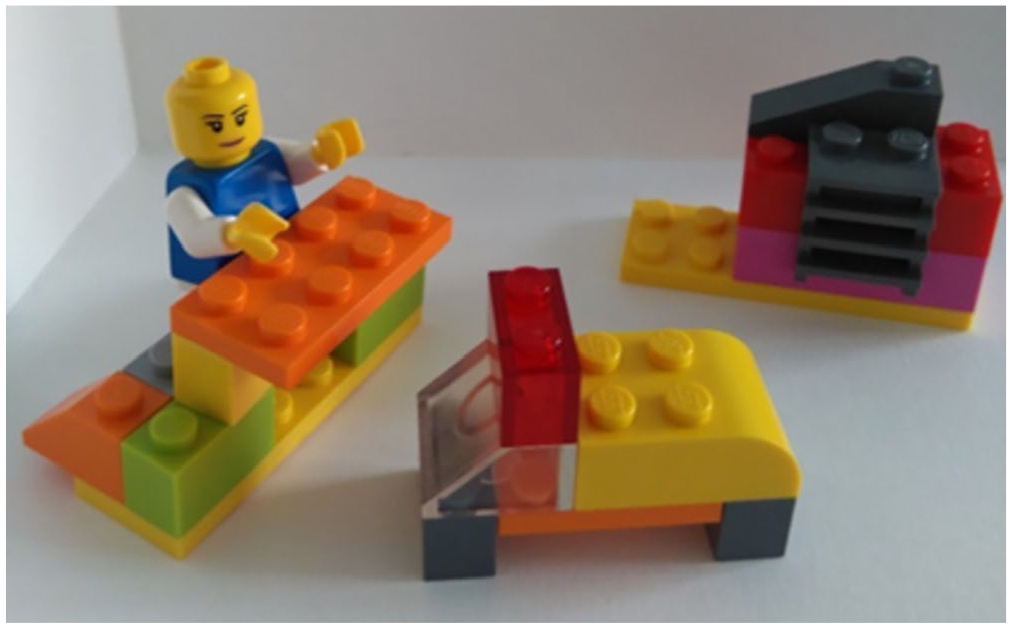
Individual model (from Participant A) showing the perceived risks within the business.
Participant A was invited to explain their build and the story behind it.
So the customer person here at reception is, kind of, my representation of a full customer base. The van is supposed to represent deliveries. These bits and pieces [top-right corner] represent machinery, ‘cause we have to keep upgrading what we operate. Normally you’re in control and you have an understanding of where the sales are going to come from, and what the peaks and troughs are in a year. And this year we’ve had no control – we can’t predict it. So, yeah.
Did anyone see similarities with their model?
Yes and no. Yes, because for everyone it is all down to sales but at the end of the day we are all selling different things, and they might be different scales, so it’s all relative, isn’t it?
But, it affects everybody and in a similar way. I have included a brick wall in my model because I’ve hit it with my business . . .
Great insights, thank you, everyone. Would anyone else volunteer to discuss their model?
The above exchange is of interest because it shows signs of consolidation within the exchanges, before Participant C moves into elaborated codes once again and the facilitator intervenes to move the discussion along. Such a move towards consolidation through syntactically restricted codes reflects the emergence of collective understanding and shared meanings in Bernstein (1971: 150), a process which also underscores learning in the context of a community (cf. Nicolini, 2013). Although this process is not complete in the above example, participants share the collective understanding that, traditionally, planning within a business context starts with a predetermined goal and the process to achieve it is carefully organised in accordance with a set of given resources.
The discussion includes aspects of control and uncertainty, which have been traditionally managed using tools such as market research, competitor analysis, development strategy and financial planning help to reduce the uncertainty within a business environment (McGrath, 2019; Sharma et al., 2020). Uncertainty refers to a lack of information about what will happen in the future, preventing sound judgements (Sarasvathy and Glinska, 2020). It has been argued that entrepreneurs use a variety of techniques to manage and control the entrepreneurial process (Sarasvathy and Glinska, 2020). The model in Figure 6 showcases perceptions of reduced access to such techniques, rendering the environment unpredictable and opaque, devoid of discernible indicators, clues or trends.
Consolidation through syntactically restricted codes
We have already acknowledged that the goal of the facilitated workshops was to encourage the foundation of a landscape of practice through participant discussion and reflection on experiences. This required careful management of the online sessions to avoid fatigue (cf. Manolchev et al., 2020). While this approach was successful in facilitating elaborated codes in the build challenges, there was no noticeable movement towards syntactically restricted codes and consolidation during these. However, we were able to observe several occasions where such consolidation arose spontaneously, both outside of the challenge activity and seemingly independent of the facilitator’s prompts.
Having completed the task of sharing their models of challenges facing their respective businesses, three of the participants spontaneously consolidated their common experience, using variations of the term ‘empty’ as a form of a syntactically reduced code (Bernstein, 1971: 150). The appearance of disagreement between participants (having customers vs having no customers), could be viewed as an indicator of emerging group trust and indeed, the participants were able to negotiate the topic safely. The participants in Workshop 1 were not the same participants whose dialogue was shared in the core-identity build challenge above, so we have anonymised them differently.
Who had the empty, empty table? Because that’s the same as me, I’ve got no customers.
Yeah, so, you know, to me, it’s an empty, empty field, or an empty course, or an empty whatever.
I’ve still got the customers, that they’re still phoning and emailing daily, and needing things and wanting things, but they’re not, it’s not generating any income.
And, and you’ll want them in the future, when the lockdown ends, won’t you?
Yeah. So, it’s just a huge amount of time that you’ll never get paid for.
The consolidation in Workshop 5 occurred around the agreement that owners need to work ‘on the business’, rather than simply ‘in the business’. The consolidation occurs around another debate (evaluating business operations as a challenge vs as an opportunity). We include the elaborated codes which precede the move to syntactic restriction for context:
The business that I’m in, I’m at the sharp end of the lockdown . . . So, yeah, it’s how do I rebuild the, um, structure of the business.
I like the way that you’re standing back from the, the action. You’re not part of the action . . .
Which I think is, you know, important in business, isn’t it, to, to realise you need to work on the business, rather than in the business?
It’s a journey I went through over the 16 years of building the business up . . .
You’ve learnt so much in that time, I get that you don’t have much reflection time, because you’re juggling everything. But it’s a real opportunity to create it differently, isn’t it . . .
Those two examples conclude our ‘Findings’ section and our overview of elaborated codes and syntactically restricted codes, facilitated through the LEGO® SERIOUS PLAY® method in five online workshops. Although it has been suggested that case-based empirical studies are too situation-specific and so insufficiently generalisable (Miles, 1979; Yin, 2018), in the next section, we try to increase the explanatory power of the study (Dubois and Gadde, 2002) by returning to Bernstein’s socio-linguistic approach.
Discussion
Our use of the LEGO® SERIOUS PLAY® method in online workshops sought to provide a space for reflection for a community of individuals with a shared interest in manufacturing within the region. This offered the group an opportunity to share learning on the challenges within the sector and our analysis reflects the lasting centrality of effective verbal communication for meaning-making, even in the absence of non-verbal cues and established community norms and relationships. We applied insights from Basil Bernstein’s (1971) socio-linguistic approach, which outlines the process through which the emergence of shared meanings can enable social learning to take place (Bernstein, 1971). This approach, represented in Figure 1, regards shared meaning-making as producing and as itself produced by speech codes, or rather a movement from lexically restricted to elaborated and finally to consolidation in syntactically restricted codes. Although it predates it, Bernstein’s (1971) approach contributes to the current literature on organisational learning. Bernstein’s theory broadly agrees with key themes in the most recent domain of scholarship, which views organisational learning as based on trust, consensus and collaboration (Dyck et al., 2005), as well as tension, power imbalances and conflict (Contu and Willmott, 2003; Gherardi, 2009).
However, by operationalising Bernstein’s alternative conceptualisation of learning through the LEGO® SERIOUS PLAY® method, we were able to overcome the limitations imposed by the online context and the absence of an established, let alone co-located, community (Lave and Wenger, 1991). Our study offers two types of evidence for this – first, the facilitated emergence of elaborated codes and second, spontaneous consolidation through restricted codes. Let us examine them in turn.
We demonstrate the facilitated emergence of elaborated codes, facilitated both in the sense of producing through using a facilitator and through providing participants with a step-by-step process to follow. This is significant for online-only environments, so we provide cross-references for our observations through pictures and accompanying dialogue. Bernstein (1971) proposes that the emergence of elaborated codes is a complex process that not only requires the speaker to communicate what he or she feels appropriate for the context (pp. 92–96) but requires trust and willingness to share on the part of the speaker/s, as well as a positive disposition from the listener/s. Consequently, for Bernstein (1971), elaborated codes usually emerge as part of a knowledge-sharing process.
Furthermore, Bernstein (1971: 147) and the wider literature on embedded, community learning (Kazmer, 2005), assume that knowledge-sharing typically occurs through both verbal and non-verbal – that is, ‘para-linguistic’ – signals: expressions, tone of voice, body language and so on (Bernstein, 1971: 147). However, this was not the case with our participants, who experienced a reduced availability of such para-linguistic signals during their online exchanges. Conceivably, the impact of a shift from face-to-face to Zoom interaction may have been less for groups with a history of prolonged and co-located interaction, yet our participants share neither the pre-existing norms nor the routines of an established community of practice. Thus, our adoption of the LEGO® SERIOUS PLAY® method for online workshops was successful in recreating some of the typical aspects of knowledge-sharing (complex lexical descriptions and well-organised syntactic structure in Bernstein (1971)) in non-typical conditions. This allowed us to recognise the significance of a facilitator who, in our case, was able to dictate the pace of discussion and direct interaction in such a way as to enable all participants equal time to share. There were several other factors which, in our view, can make the task of managing workers online or in hybrid contexts easier. Online facilitation worked well with a diverse mix of actors, and enabled them to realise that, although working in different industries, they shared a similar regional context and faced similar, place-based issues. Furthermore, encouraging participants to reflect not only on their immediate business environment but to think more broadly on issues affecting the wider regional community can create a sense of socialisation and dialogue (Kauppila et al., 2011). In turn, this can create a sense of ‘togetherness’ (Reynolds, 2000), through which a community as a site of organisational learning can emerge.
As a result, we believe that a well-facilitated workshop using the LEGO® SERIOUS PLAY® method could be a useful tool for navigating diversity and achieving consensus. Other online tools which allow participants to build abstract structures (or create drawings), which must then be described to others, can also give an opportunity for the lexical and syntactic sophistication associated with elaborated codes (Bernstein, 1971: 150–155). Examples of online platforms we are familiar with are Padlet, Mural and Miro.
We also encounter spontaneous consolidation through syntactically restricted codes. This was surprising, as consolidation is not guaranteed in any social exchange, even those enriched by the presence of both verbal and non-verbal codes. For Bernstein (1971), syntactically restricted codes require the presence of not only shared meanings (p. 149) but also close, social relationships, even an emerging, ‘common cultural identity’. Those attributes parallel the definition of communities of practice, where organisational learning is also enabled by shared values and meanings (Elkjaer, 2004). It is not surprising, therefore, that syntactically restricted codes should be rare in online exchanges, but it is unexpected to have witnessed them at all. As their emergence in our research was spontaneous, rather than by design, we leave the task of constructing structured activities (through LEGO® SERIOUS PLAY® or otherwise) targeted at such codes to future researchers. We can, however, reflect on the processes which allowed consolidation in our study. Specifically, we feel that they were predicated on the emerging trust and elaborated codes, which our structured challenge-builds offered. We also recognise the importance of (controlled and safe) spaces of debate and disagreement, which can perhaps offer a pressure valve for any tensions and pressures in social interaction and thus reflect the argument offered by Contu (2013) and Gherardi (2009).
In line with this, we recommend that facilitated online activities build in ‘unstructured spaces’ at the end of build challenges or other tasks set in the platforms we outline above. To encourage participation, each online session was designed to last between 3 and 4 hours; however, further time may have allowed for deeper reflection. In our workshops, the emergence of syntactically restricted codes was spontaneous, and scheduling such unstructured spaces where participants may interact without prompts or tasks may allow a similar, natural consolidation of the build/task experience.
Conclusion
In this study, we share our effort to facilitate knowledge-sharing across 23 Southwest SMEs, who are part of a wider but largely disconnected landscape of practice, during a disruptive and uncertain transition period. As our participants sought to adapt to (at the time) unfamiliar online platforms, and conditions offering limited communication cues, we asked whether shared meaning-making can occur when the conditions enabling it are disrupted and, in some cases, even absent. Although our research question was originally linked to a specific period in the lifecycle of our participant organisations, the spread of hybrid working as ‘the new normal’ makes it significant to the topic of organisational learning more broadly. Consequently, we can show that shared learning can emerge through alternative, socio-linguistic meaning-making processes. In our study this is achieved through elaborated codes, enabled through the facilitated use of a pedagogic device, the LEGO® SERIOUS PLAY® method, and spontaneous consolidation following debate under controlled conditions.
Our research has several implications for the current domain of organisational learning literature. As remote working goes from niche to mainstream, the need for SMEs to adopt novel types of knowledge-sharing practices is likely to remain. Yet, our findings do not seek to challenge the significance of co-location and communities for organisational learning but, rather, hope to extend understanding of the conditions that underpin it.
We propose that facilitating the emergence of elaborated codes through methods such as LEGO® SERIOUS PLAY® and allowing spaces for unstructured participant interaction and banter after facilitated build challenges or other tasks can enable online environments to also become ‘sites’ of knowledge sharing. This can allow participants to share imaginative and highly sophisticated (lexically and syntactically) constructs with their peers, individually and collectively making sense of existing and novel problems and situations. This play-based method can also enable researchers to overcome the limitations of standard, qualitative and more rigid data-gathering approaches. It can also offer an alternative form of embedded learning, where learning is situated not in a community of practice but in learning scenarios, played out through the facilitated use of a pedagogic device. In our case, the method specifically provided an opportunity to observe reciprocal learning, dialogue, meaning-making and knowledge-sharing in remote exchanges among strangers.
We recommend the use of an experienced facilitator and literature-based discussion themes, which can help participants expand their creativity (through the link between the hands and the mind) and thus produce even more sophisticated modelling and a greater range of code elaboration in the present session and any follow-ups. In this way, participants can examine difficult issues that they might ordinarily be hesitant to speak of, especially in front of others. This may be challenging in face-to-face settings but with the application of elaborated codes through a lexicon of images, metaphors and interpersonal exchanges organised through sophisticated syntax structures, these may be explored constructively.
Further research should focus on the role of the university (or other external facilitator) in nurturing these online relationships towards the emergence of a community in other industry areas and business sizes. As remote working gives way to more hybrid forms of interaction, other challenges and opportunities in addition to organisational learning, would need to also be considered. Hybrid work may hold the promise of answering the age-old question of how to achieve work–life balance, yet, as this study has demonstrated, this would require the need to increase both the complexity of available meanings, as well as the likelihood of their consolidation into shared (group) identities. The study of social learning is central to Bernstein’s sociology, making this return to his sociology of pedagogy both needed and timely.
Supplemental Material
sj-docx-1-mlq-10.1177_13505076231183216 – Supplemental material for Learning through games: Facilitating meaning-making in online exchanges
Supplemental material, sj-docx-1-mlq-10.1177_13505076231183216 for Learning through games: Facilitating meaning-making in online exchanges by Ruth Cherrington, Constantine Manolchev, Allen Alexander and Jessica Fishburn in Management Learning
Footnotes
Acknowledgements
The data that support the findings of this study are available on request from the corresponding author. The full dataset is not publicly available due to restrictions (the containing information could compromise the privacy of research participants). The authors would like to thank the editor and reviewers for their useful comments and suggestions during the revision process.
Funding
The author(s) disclosed receipt of the following financial support for the research, authorship and/or publication of this article: The lead author received funding from the European Regional Development Fund (ERDF) as part of the European Structural and Investment Funds (ESIF) Growth Programme 2014–2020. The author from Lappeenranta-Lahti University of Technology has received funding from the European Union’s Horizon 2020 research and innovation programme under the Marie Skłodowska-Curie Innovative Training Networks (ITN) scheme grant agreement No 956745.

Supplemental material
Supplemental material for this article is available online.
References
Supplementary Material
Please find the following supplemental material available below.
For Open Access articles published under a Creative Commons License, all supplemental material carries the same license as the article it is associated with.
For non-Open Access articles published, all supplemental material carries a non-exclusive license, and permission requests for re-use of supplemental material or any part of supplemental material shall be sent directly to the copyright owner as specified in the copyright notice associated with the article.
