



Abstract
This article discusses whether, as academics, we are behaving irresponsibly in the manner in which we deliver the much-vaunted Principles for Responsible Management Education. The Principles for Responsible Management Education constitutes an association and ethos which seeks to promote and infuse responsible management education into business schools and organisations. RME seeks to, inter alia, surface and challenge hegemonic neo-liberal and capitalistic meta-narratives with a view to replacing these with more value-driven, ethical, sustainable and corporately socially responsible education in business schools and business. In our article, we propose a more complementary approach – one in which Principles for Responsible Management Education/RME might work in parallel with dominant capitalistic perspectives. We do this by considering the impact of the hidden curriculum, sustainability competencies and related symbolization (through rankings and accreditations) all within the paradox-explanatory framework of organisational ambidexterity. The argument proposes that a paradoxical approach is needed that is aligned with both the capitalist norms of business society and yet, achieves the more socially orientated United Nations Sustainable Development Goals. Business schools and Principles for Responsible Management Education can play an essential role in ensuring this happens. In essence, we hope to provoke thought, change and action towards the achievement of more socially and societally focused United Nations Sustainable Development Goals on which Principles for Responsible Management Education is predicated.
Keywords
Introduction
Are we – as business school (BS) academics – irresponsible in delivering responsible management education (RME)? Here, RME can be understood as an approach to business that encourages managers and organisations to adopt ethical and sustainable ideas, methods and processes which are characterised by corporate social responsibility and/or sustainable development. Alternatively, irresponsible management education would be defined and comprehended as engaging in pedagogic practices that work against RME (Tench et al., 2012). This intentionally provocative question is where we centre our debate which is conducted through a consideration of the nexus between hidden curriculum, RME competencies and symbolisation via accreditation ‘badges’ set within over-arching paradox theory (i.e. organisational ambidexterity (OA)).
In the 2021 report, ‘Business Schools and the Public Good’, The Chartered Association of Business Schools (CABS, 2021) identifies schools as either ‘purpose-led’ or ‘emergent’ based on actions across teaching, research, internal operations and external engagement. It recommends progressing from ‘teaching shareholder value to prepare graduates for careers in outcomes-based organisations . . . [and that] the next chapter needs to be characterised by business schools developing and coordinating a generation of public good entrepreneurs’ (CABS, 2021: 62). The challenges are significant. Management education has been criticised for acting in self-interest and with a culture of short-termism aligned to capitalistic worldviews (Colombo, 2022). These may be viewed as what Shulman (2005) terms ‘signature pedagogies’. In examining how the hidden curriculum and symbolization through performance measure (related to outputs and rankings) forms part of this system of ‘managerialism’, we concur with Kitchener and Delbridge (2020: 321) that in order to move away from the instrumentalization of higher education (HE), faculty members are key in serving as the ‘collective conscience’ in challenging capitalistic norms. Yet, the survival and growth of ‘responsible’ approaches to management education depends upon successful navigation through the current system of practices typically associated with ‘irresponsible’ managerialism (e.g. pressurised work performance targets, student to lecturer ratios, to name but a few).
First, we need to position ourselves as authors. We do not seek to undermine the Principles for Responsible Management Education 1 (PRME) through a critical onslaught. Rather, we want to provoke thought using a range of perspectives in an attempt to generate further reflection and positive action. Importantly, we would argue that we are advocates (i.e. seeking to present and mediate) rather than activists (i.e. seeking to champion and win) in relation to change. This delineation is essential for the paradoxical tone we adopt. In essence, we do not want to shame people into action, following, for example, Greta Thunberg and many others, but rather prompt action emerging from critical reflection and generating a desire to support change. This is a crucial positioning as we see the activist voice, although bringing the conversations to the fore and delivering important messages and potentially initiating change as, nevertheless, having only a limited (and often alienating) impact thus far. We want to work with mainstream positions in society (akin to Kostera and Strauß, 2022) and the values and views that accompany it to provide potentially creative solutions to extant tensions (following Smith and Lewis, 2022). We thus employ paradoxical perspectives to facilitate this. Thus, we invite you to join us for a journey into self-questioning, emotive positioning regarding what to do next when we demonstrate that all these complexities indeed co-exist and can, if not addressed, work to undermine our approaches within RME. We commence by presenting the paradoxical framework.
Through the lens of OA: the paradoxical position
As paradox is at the core of our argument, it is important to explain how this operates in relation to PRME and RME. We believe the delivery and implementation of RME, and a drive to achieve United Nations Sustainable Development Goals (UN-SDGs), are, by their very nature, paradoxical. We use OA to examine this dichotomy because it directly embraces and addresses paradoxes. OA is constructed around two conceptual opposing positions: exploitation and exploration (Birkinshaw and Gupta, 2013; March, 1991; O’Reilly and Tushman, 2013; Raisch et al., 2009; Stokes et al., 2015). Exploitative approaches are focused on what is known (underpinned by normative and convergent thinking) and centred on existing customers and markets. This position is exemplified by the capitalist virtues and norms to which businesses generally align, for example, shareholder value, profit-making/maximisation, consumption and consumerism. Alternatively, explorative approaches are more focused on moving beyond existing knowledge into novel knowledge through embracing aspects such as innovation, experimentation, flexibility and divergent thinking. For the present argument, we consider an explorative approach as one that would encompass a move towards sustainable development, RME and UN-SDGs realisation. Crucially, ambidextrous tensions in RME emerge particularly from positionings that focus on ‘balance’. However, often in exploitative-capitalistic conditions, the premise is that achieving one element is often seen as being to the detriment of another, that is, if profit is adversely impacted by engaging with RME ideologies, then, often, many organisations would be reluctant to engage in an extensive or meaningful manner. Thus, to address this, the present argument looks at the possibility of embracing the extremes of paradox (Smith, 2016).
To emphasise the need for explorative approaches, Kolb et al. (2017) argue that the implementation of RME requires a different approach to business and this, in turn, requires a shift in how current leaders are taught. Indeed, Matten and Moon (2004: 323) argue that BSs need to become more socially responsible and grow beyond criticisms that they are ‘brainwashing institutions educating their graduates only in relatively narrow shareholder value ideology’. In tandem, PRME (2018) suggests that there is a demand and need for the following future leader, that is, ‘Students that are sensitized to sustainability values are in high demand among leading international businesses and organizations’. Thus, the call for explorative action exists, and our appeal does not constitute a lone voice – our response offers an innovative perspective and approach.
It is significant to emphasise that our application of OA is not necessarily a conventional one. We are using OA to highlight stunted movement towards required business practices that, as PRME (2021) word it, balance economic (sic: capitalistic) and sustainability (sic: RME) goals. Indeed, commonly, OA literature itself focuses on business practices akin to classic Ansoff-Matrix-type economic goals, that is, servicing and developing current markets (exploitative approach) or expanding into new markets (explorative approach). The attempt to translate and balance these practices into RME goals is therefore not overly discussed and arguably presents complexity. Nevertheless, a large section of OA literature, like PRME (2021), does indeed focus on balancing dynamic shifts (i.e. between exploitative and explorative approaches). This is one possible interpretation of OA. However, some sections of the OA literature focus on something more akin to proposing that polar opposites can work alongside each other: ‘paradoxically in tandem’ (Smith, 2016: 12) and this is also our position. In other words, an innovative maximisation and co-habitation of exploitative and explorative approaches rather than a mere conventional status quo balancing. This links to our position as advocates as we strive to see how both extremes somehow co-exist, whereas activists arguably more want to deconstruct and replace supposed capitalist structures that dominate society. Following Antonacopoulou and Chiva (2007), we acknowledge the social complexities innate and inherent in such desired transformations. There are indeed examples of organisations working ambidextrously in this manner in relation to economic goals (Netflix provides a possible case in point, that is, a low-cost subscription price vs high-quality streaming and a strong depth of product selection, including Netflix original films and TV shows), but it is a complicated juxtaposition, and the sustainability paradox could be argued to be insurmountable for many, if not most, organisations. Yet, equally, the ‘world clock’ on sustainability, climate change and other grand challenges of the UN-SDGs is ticking and change has to go beyond a balancing of practices and hence the energised advocacy of our argument.
In connecting OA and RME, it will be useful to elaborate three common types of OA commonly discussed in the literature and these form part of the conceptualisation within this article. Structural ambidexterity refers to an organisational design whereby different sub-units exclusively focus on either exploitative or explorative activities (Kortmann, 2012). Contextual ambidexterity refers to individuals self-managing exploitative- and explorative-orientated activities within an organisation on a day-to-day basis, that is, OA ‘culture’ is encouraged (Gibson and Birkinshaw, 2004). Sequential ambidexterity ‘asserts that organisations can achieve ambidexterity in a sequential manner by shifting structures over time’ (Stokes et al., 2015: 64). In other words, organisations progressively learn and transform from exploitative to explorative mind-sets and stances. Before we engage further with the OA conceptualisation and application (in Table 1), it is an important point to limitations. For example, at first glance, one could infer when leaders and staff are not aligned with responsible management (RM), then they are unlikely to achieve exploration. However, it is important to remember the tension of economic versus sustainability goals, and both are essential to the discussion. In addition, RM may, or may not, be considered by some to be an active part of the numerous tensions outlined. Nevertheless, we have integrated RM into this theoretical development to draw out and discuss core elements of business with a contemplation of how RM approaches are mapped over the top of economic constructions and how BSs might address these.
Examples of ambidextrous tensions for RM.
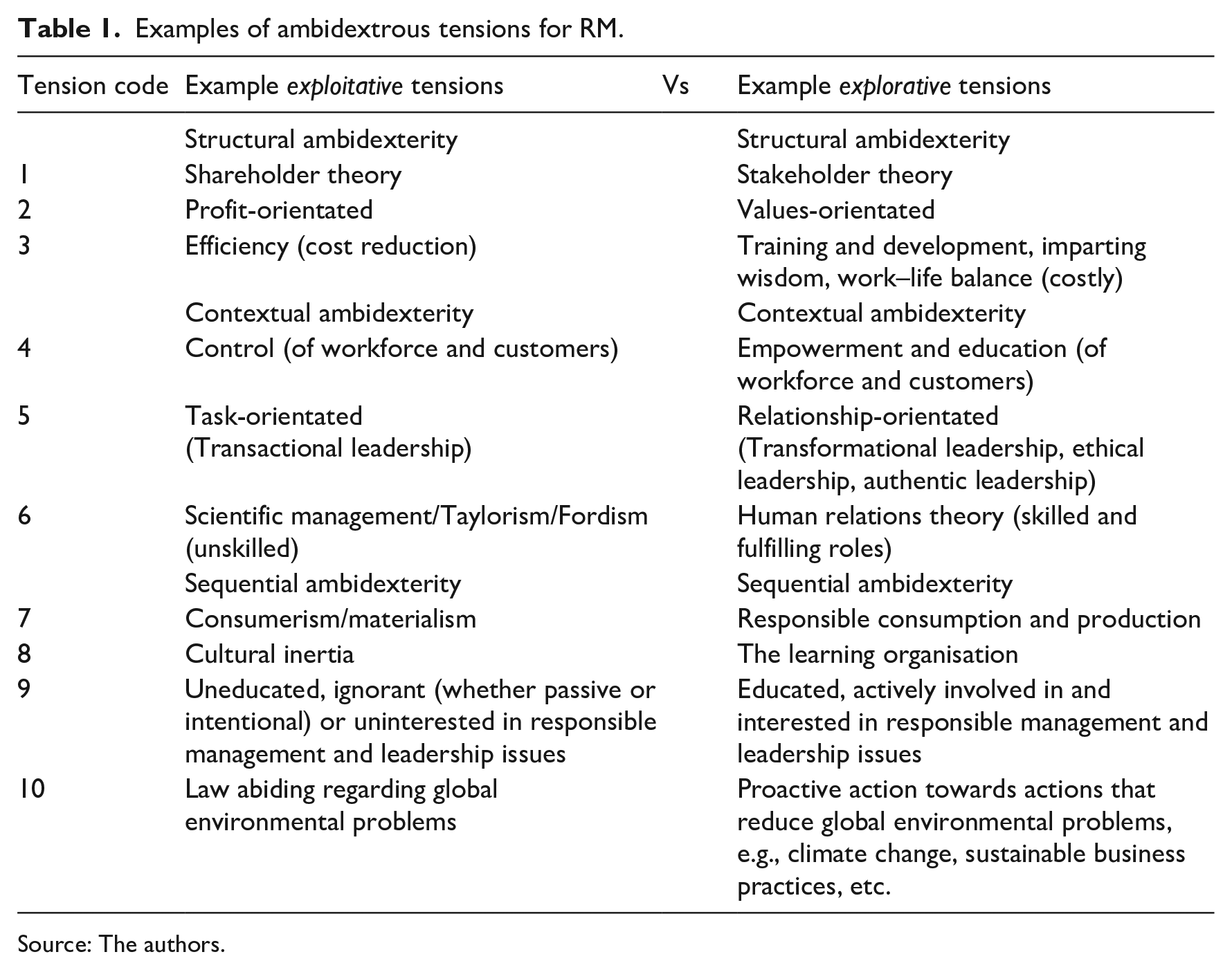
Source: The authors.
Furthermore, we are situating our paradox in a way that focuses on those individuals who are either engaged, or unengaged, with RM activities. We accept that there exists a more complicated continuum between the polar opposites whereby managers, staff and customers may be situated. Crucially, within this theoretical development, this means we target RME as an explorative activity, that is, a shift into ‘new knowledge’. In reality, such education could be potentially an exploitative or explorative activity. Yet, as previously suggested, we believe that explorative approaches are required to achieve a necessary dynamic shift in thinking and practice to maximise, as opposed to balance, economic (i.e. capitalistic) and sustainability (i.e. PRME-linked) goals. Therefore, a working review of mainstream and RME literature is generated in Table 1 which identifies 10 aspects to consider as ambidextrous/paradoxical tensions relating to long-standing organisational issues. The aspects in Table 1 are derived from observation of recurrent themes in UK BS curricula and the OA literature. The purpose is to visualise these (on the left-hand side of Table 1) in the prima facie (exploitative) manner in which they are commonly presented. Then, we move across Table 1 to the right-hand side and reflect simultaneously (following an OA ethos) to view them in an alternative explorative way. In addition, the tension codes (TCs) in Table 1 have been split into types of OA. For codes 1–3, we indicate that organisational structure and design (structural ambidexterity) are primarily impacting these tensions. For codes 4–6, we suggest that contextual ambidexterity is more relevant as responsible leaders have significant choice and impact within day-to-day actions and decision-making. Finally, for codes 7–10, we argue that sequential ambidexterity is fitting as a dynamic shift towards RM and leadership practice often evolves over a time, that is, there are perhaps very few, if any, quick wins in the full pursuit of RM.
The arguments and criticisms that follow centring on the hidden curriculum (i.e. a curriculum that is paradigmatically dominant but not acknowledged) and symbolization (i.e. aligning BS activities with research orthodoxies and accreditation/league tables demands) are very much fostered towards the exploitative elements of Table 1. The explorative elements are passionately taught (as we explore under sustainability competences), but are arguably an extension of the core base of learning (some areas could even be referred to as ‘bolt-on’ aspects of learning – e.g. business ethics – or they are desired but not provided). The argument now amplifies these three important aspects of RME: the hidden curriculum, sustainability competencies and symbolization.
The hidden curriculum
Having outlined the exploitative tensions of BS curricula, it is now useful to consider these further. Following the seminal works of, inter alia, Jackson (1968), Portelli (1993) and Blasco (2011), we define the hidden curriculum as the domination of positivistically informed, neo-liberalistic and capitalistic virtues within HE curricula and pedagogy. This often contrasts with alternative RM priorities in education to achieve more collaborative and societally orientated UN-SDGs (following Jones et al., 2020; Stokes, 2016). Indeed, the HE environment is often complicit in this ambiguous and complex tension as it encapsulates ‘societal, institutional or lecturers’ values that are transmitted unconsciously to students’ (Cotton et al., 2013: 192, emphasis added). There is doubtlessly increasing pressure on management education to respond to global crises and address the UN-SDGs and associated grand challenges. This requires institutional-wide support with studies showing, for example, the role of student organisations in enabling student actions around social impact actions (Borges et al., 2017), and with other studies demonstrating the challenges in extending responsible practices beyond the formal curricula (Singhal et al., 2017). Nevertheless, dependent on the values and commitment to RME by a given university, no matter how committed individual faculty members may be to sustainability principles in research and teaching, they ‘may not be supported by colleagues and superiors in their respective traditionally anchored disciplines’ (Barber et al., 2014: 478). ‘Tradition’ here points at a capitalistic ‘profit-first’ mindset at institutional level that is often also embedded in educational outcomes (Lourenço et al., 2012). Thus, Wals and Benavot (2017: 407) warn of the risks of education contributing primarily to an ‘industrial mind-set’ which can ‘steer students towards individualism, materialism and hyper-rationality’. The perceived challenges of embedding RME into mainstream curricula where it is not perceived as ‘relevant’ and is subject to restrictive time pressures and other institutional constraints, all serve to underline the significance of the persistent background and operation of positivistically informed capitalistic informal/hidden curricula. This serves to highlight those exploitative–explorative tensions/paradoxes outlined in the previous section.
At a time of increasing pressure to deliver economic value in education, it is instrumental to reflect upon the integrative student experience, beyond the formal curriculum alone. Steuer and Marks (2008) highlight one of the roles of HE as learning about ‘power and influence’ in order to bring about change as global citizens. Reflective and experiential practices through broad engagement in wider university life and processes naturally embed such aptitudes and praxis-orientated learning. Student experiences form part of a wider ‘community of practice’ (Borges et al., 2017; Wenger, 1998) that influences attitudes and behaviours beyond their programme of study. For example, within marketing literature, the ‘normalisation’ of sustainability behaviours among consumers is discussed, so as to move beyond a focus on ‘green consumer’ segments towards mass-market practice. This can, for instance, be usefully transferred to the HE context to ensure that a coherent message is delivered – essentially one where all parts of the institution are ‘walking the talk’.
In an update to her seminal paper of 2011, Blasco (2020) notes that just as there can be diversity in approaches to RME, each institution is likely to have its own idiosyncratic hidden curriculum (albeit essentially kindred with predominant neo-liberalistic and capitalistic virtues). Such curricula can perhaps best be understood by encouraging an awareness of how they manifest, so that strategies may be devised to overcome any resultant problems. This demands critical reflexivity across the institution, including discussion on the tensions and paradoxes in the principles of RME. Hinchcliffe (2020) argues that universities and businesses alike need to address ‘hidden’ issues of, for example, colonisation and injustice, the climate emergency and inclusion. This represents a paradox if university operational approaches reflect neo-liberalist models. There is an opportunity to engage in campus and operational strategies reflecting a more RM paradigm. In a similar vein, Semper and Blasco (2018), for example, point to the requirement for educators to self-reflect and be explicit with students on how teaching approaches reflect personal beliefs and values, alongside technical content. The hidden curriculum, through the lens of OA, is an effective mechanism for identifying the complex layering of structural, contextual and sequential ambidextrous tensions in action within HE amid a dominance of exploitative approaches.
Competencies
The discussion thus far points to two crucial questions related to the tensions and paradoxes outlined: ‘What can we do?’ and ‘What is being done?’ Work around RME-related competencies is a useful place to contemplate these questions and the potential for explorative approaches. Critical reflexivity is required across BSs in order to engage authentically with how RME is communicated. The delivery and assessment of the formal curriculum is value-laden with the subtle messages it sends to students and therefore demands educator self-reflection on ‘ideologies, routine practices, and assumptions’ (Høgdal et al., 2021: 186). This demands inspection beyond the ‘institutionalised’ ritual practices of becoming signatories to professional bodies and, alternatively, invites examination regarding how ‘decoupling’ might, for example, occur through addressing RM principles only in elective modules rather than a more integrated curriculum approach (Rasche and Gilbert, 2015). Nevertheless, integrated approaches can be seen as ‘value-laden’ if they do not balance the tensions between RM and more general management thinking. In examining how UN-SDGs can be embedded into the formal curriculum as part of the 2030 Global Education Agenda, UNESCO (2017) sets out cross-cutting competences, with specific learning objectives for each SDG described in relation to cognitive (knowledge), socio-emotional (social) and behavioural (action) domains. UNESCO (2017) calls for students to develop ‘cross-cutting key competencies for achieving all SDGs’ and defined eight competencies for sustainability. They suggest that within a ‘whole institution’ approach, educators consider how the key competences and learning objectives are addressed, which should include reflection on what is included and why, as much as what is not included (and what this says about what is really seen as important). A systematic application of UNESCO’s competencies into each programme offering within a business faculty could represent a powerful unveiling of the paradoxical tensions between existing curriculum learning outcomes versus those that UNESCO has defined as desirable for achieving the SDGs. This can address paradoxical challenges by providing a framework to develop commercial competence alongside sustainability/responsible/ethical competence (Smith et al., 2022). Competency-based approaches are not a panacea to the challenges faced in RME, not least because they are dependent upon an application that is underpinned by transformative approaches to ‘wicked’ problems (Rittel and Webber, 1973) such as climate change, inequality and social injustice.
If BSs are to embrace the paradoxes that undermine both legitimacy and impact (Pettigrew and Starkey, 2016), competency frameworks can illuminate both where the paradoxes exist in the formal curricula and provoke insight into how these might have been shaped by hidden curriculum influences such as individual outlook and preference (for capitalistic vs global developmental goals) in programme design. In this sense, competency frameworks become a tool to question and challenge organisational narratives. In the design of an inter-disciplinary RM competency framework, Laasch et al. (2022) define competencies grounded in ethics, responsible and sustainability literature as ‘complementary’. Their framework develops commonly adopted approaches to competence as ‘KSA’, Knowledge (knowing), Skills/doing (acting) and Attitudes (being) (e.g. Muff et al.’s, 2020, application to responsible leadership competencies) to six competence domains of being, becoming, acting, interacting, knowing and thinking. A core feature of its design is the interdependence between individuals’ (knowing, being and acting) interrelations with situations (becoming), others (interacting) and problems (thinking). This competency complementarity is related to the notion of ‘response-ability’ and the need for BSs’ pedagogies to broaden beyond a focus on knowing and thinking (Laasch et al., 2022: 17). In returning to a consideration of whether it is irresponsible to focus on RM pedagogy, we agree that it is not feasible to adopt a ‘one size fits all approach’ (Lambrechts et al., 2018: 561) and that differing competencies may be required in differing roles (Osagie et al., 2019), and therefore, adaptive pedagogical approaches are required for embedding (RME) competencies. Equally, adopting a paradoxical lens to such pedagogical discussion could be helpful to reveal and accept any tensions, as part of reflexive practice.
In summary, the ‘institutionalisation’ of RME (Beddewela et al., 2020) requires a fundamental change to both curricula (formal) and philosophy (informal curriculum). Competency frameworks offer a pragmatic tool by which ‘institutional entrepreneurs’ (Beddewela et al., 2020) can drive forward discussion and practice, which will be strengthened if informed by a paradoxical lens. For example, it would bring insight into differing worldviews of the role of BSs in society. Similarly, this would enable influence on those practitioners within BSs that act from a stance of ‘ethical denial’ (Huehn, 2016: 182) towards one which supports the incorporation of post-materialist values into the curriculum (Rutherford et al., 2012).
Symbolization
In conjunction with hidden curriculum and perspectives on competencies, it is important to discuss symbolic dynamics of BS accreditations around RME. Rankings such as the People and Planet’s Green League (i.e. benchmarking universities’ environmental and ethical performance), the Times Higher Education Impact Rankings (i.e. assessing universities against the SDGs) and Responsible Futures (i.e. a student-led framework and accreditation) are important indicators of university commitment. These can be viewed as representing an ‘informal’ or less immediately visible component of the hidden curriculum through institutional policies and practices. However, they do indeed provide institutional symbols related to curricular structures, RME and UN-SDG action. Accreditation and ranking regimes should explicitly consider the hidden curriculum (Høgdal et al., 2021) rather than allowing it insidiously to imbue the overall curriculum. This would enable broader visibility and understanding, which might in turn influence positive attitudes towards student experiences (Cotton et al., 2018). Since BS performance is assessed against student satisfaction, the imperatives for understanding and actively considering the role of the hidden curriculum become clear.
Other effects of symbolization can be witnessed. Major accreditations such as AACSB, AMBA, EQUIS, CGE and so on are arguably a factor in attracting high-calibre job applicants who wish to work in a highly accredited institution. However, PRME does not necessarily play a significant role in relation to attracting academics joining a particular BS. Nevertheless, PRME impacts to some extent on the content and delivery of the modules which academics lead as well as the nature of their research. In other words, major accreditations contribute to luring academics (and students), while PRME impacts on academics only once they have joined a BS. However, there is still little correlation between BS facilities, performance, reputability, the ability to generate income and PRME. The recruitment, survival and performance of many institutions rely heavily on accreditations (Abou-Warda, 2014). This view is further supported by Séraphin et al. (2021) who argue that one potential reason BSs join the PRME network is because some accreditations require ethics to be included in their curriculum and, thus, they engage with PRME rather tokenistically. In other words, PRME membership for some BSs is more about reinforcing and supplementing major accreditations. Séraphin et al. (2021) also suggest that PRME (and RM performance) is not considered a unique selling point (USP) for BSs. A somewhat disappointing finding, but this could also explain why most BSs often do not (1) communicate with students about their PRME membership, (2) do not display PRME on their website and/or (3) do not actively recruit academics specialised in sustainability (Séraphin et al., 2021). The importance of symbolization, and the related discussion around tensions and paradox, sits within potential issues of tokenism and a dominance of accreditations that are bottom-line driven. Major accreditations, despite more recent changes to move towards areas like the UN-SDGs, are principally exploitative-led. This is not a direct criticism, but a reflection on societal capitalistic norms that drive aspects like profitability. PRME, being more explorative-led, perhaps unsurprisingly suffers in contrast because it is not driven by those same capitalistic societal norms related to those core exploitative practices.
An OA response to the RME challenge?
The idea that BSs feel obligated to prepare students for a particular vision of the exploitative working world that dominates with neo-liberalistic and capitalistic virtues remains a persistent and challenging reality. Of course, in essence, we cannot ignore the exploitative tensions and related skills or we potentially do a disservice to those graduates going into the wider working world. Thus, as our OA lens suggests, perhaps the approach needs to embrace both ends of this apparent OA spectrum. We need to learn how to optimise the exploitative–explorative dynamic rather than paying primarily lip service and tokenism to explorative elements. This acknowledgement would be a beginning in mitigating issues presented around the hidden curriculum, sustainability competencies and symbolization and our original provocative question: ‘Are we – as BS academics – irresponsible in delivering RME?’
To go beyond the status quo of balance of practices, which is at the basis of OA, the present study proposes a ‘Flexi-RME Approach’, which is based on a more relativistic approach of RME. Relativism is a concept which advocates a focus on a single entity, while acknowledging the existence of other entities (Dahre, 2017). This ‘Flexi-RME Approach’ is useful for two main reasons and uncouples RME from the exploitative–explorative tension. First, it endorses and promotes a RME-activist mind-set and disposition (Séraphin, 2022). Second, as there is little correlation between BS RME and external RM rankings (Séraphin et al., 2021), universalism – which is at the basis of PRME – serves little purpose. Thus, practically, the ‘Flexi-RME Approach’ we are advocating would be based on an environment scanning (ES), which is an approach aiming at identifying the forces which are influencing and shaping an environment (Adema and Roehl, 2010). For this ES, for example, four main criteria would be taken into consideration for the design of RME curriculum, namely (1) the number of HE institutions within the PRME network, (2) the subjects they deliver, (3) environmental sustainability ranking and (4) the country competitive index (following and adapting Séraphin et al. (2021) RM destination index).
Conclusion
When we consider that society and HE curricula are dominated by the exploitative tendencies outlined above, it is possible to see why we are struggling to adjust and change towards the more explorative practices that are needed. Yet, those exploitative aspects which are also so desirable within capitalistic virtues, not only do we have to live with them, indeed, we need to live with them to bring on board acquiescence of a much larger part of society. This leads back to the proposal of embracing the paradox (Smith, 2016). If capitalism cannot be displaced and an alternative set of approaches found, it seems we must find a way for capitalism to co-exist while achieving UN-SDGs, despite the paradoxical challenges clearly outlined. That, of course, is a substantial challenge. Hopefully though, this article and the lens applied provides a provocation and prompt to start, at least, to recognise a need to think in a different way and find stepping stones to accomplish that, that is, working towards (various forms of), and as, ambidextrous organisations. This journey can start, for instance, in BSs and wider management education.
As academics, we could inspire this change in thinking through reflexive purposeful critique within our own HE settings that will lead to actual action. And action is certainly needed – not just academic discussion and publication. This needs the support and potential deeper evolution of BSs. We also hope this article engenders relevant critique of bodies like PRME. We need PRME, but it needs to grow and develop amid the challenges discussed here and perhaps also embrace the paradoxical tipping point whereby we need to work within the constraints of neo-liberalistic and capitalistic virtues (instead of fighting them). This is arguably one of the few ways to truly work towards the achievement of the UN-SDGs. With the hidden curriculum (conscious or unconscious), HE academics can be a part of the problem, but it is time we became a true part of the solution. Our contribution here is within our critical stance and our unique application of a paradoxical lens (namely, OA) within the topics of RME, the hidden curriculum, sustainability competencies and symbolization. We provide our particular insights and arguments in a way to explore realities with a view to prompting action and solutions moving forward.
