




Abstract
This article explores tensions when flipping the normative by developing and facilitating a programme-long critical pedagogy for executive education in a UK business school. Through a small-scale qualitative study with academics, we explore a critical pedagogy underpinning two executive MSc programmes and informing an Executive MBA. We demonstrate how the approach flips the normative by deviating from norms, doing the unexpected and disrupting ‘how things are understood and done around here’. Critical pedagogy is unusual, in opposition to traditional business school education. Programme-long critical approaches are rare. We explore tensions when flipping the normative through the following themes: power, control and trusting the process; vulnerability as strength and emotional risk; and academic privilege, precariousness and Othering. We make four contributions. First, we articulate a programme-long critical pedagogy in executive education, illustrating how this flips the normative. Second, we outline tensions and learning when facilitating a critical pedagogy. Third, through collective reflexivity, we reveal academics’ personal perspectives of facilitating critical pedagogy and its impact. Fourth, we theorize how recognizing vulnerability as strength is a pedagogical process that facilitates critical management and leadership education. We offer learning for future critical executive education and implications for practitioners, academics, business schools and universities to consider.
Keywords
Introduction
This article explores the tensions when developing and facilitating a programme-long critical pedagogy for executive education in a UK business school. We use ‘flipping the normative’ to convey our departures from social norms, where ‘flipping’ leads to opposing, overturning or reversing embedded normative understandings. The critical pedagogy ‘flips the normative’, by doing the unexpected and disrupting the status quo of ‘how things are understood and done around here’. Norms of business school management and leadership education focus on the individual or technical rather than enabling learners to understand highly complex and ambiguous social work environments (Dehler et al., 2001). New approaches to societal impact in business schools still ignore the ‘vast political and economic inequalities, across class, gender, racial and geopolitical lines’ (Rhodes, 2022a: 29). Many business schools ‘produce and sell Masters and MBA degrees, and teach future managers to “play” with models and numbers, instead of critically reflecting on the social nature of management and applying participatory ways of organizing’ (Geppert, 2010: 425). Traditionally, teaching leadership in business schools has relied on narrow psychological assumptions and models that are leader centric, stressing miracle worker, charismatic, White men, selling strategies and visions without attention to power, context, dissent and resistance (Collinson and Tourish, 2015). Such programmes normally deliver stand-alone subjects, taught in modules by different academics – who rarely share a pedagogy. In this study, the programme-long critical pedagogy is in opposition to these traditional norms and much of the leadership literature.
Furthermore, business schools are ‘not exactly radically-progressive hotbeds; academics have, and have been expected to, “fall in line” by supporting/reproducing the current social order’ (Contu, 2020: 743). The context of facilitating a critical pedagogy is a UK Russell Group research-intensive, ‘triple accredited’, university business school and the external appointment of a new academic team; five White, middle-class, able-bodied women. Their task, from the University, was to launch new executive programmes in a school where there was no executive provision or culture/systems in support.
We propose that flipping the normative, through critical executive education and disruption of social norms, provokes tensions for academics, which in turn offer learning. By exploring these tensions, we advance what is known about facilitating critical pedagogy, which operationalizes critical management and leadership education (Dehler, 2009). We understand pedagogy as our approach to learning oriented towards social goals (Hinchliffe, 2000), our theory and practice of relational learning in educational contexts, which recognizes how both academics and learners are influenced by and influence social and contextual power.
Articulating a programme-long critical pedagogy in management and leadership education and scrutinizing experiences of facilitation are rare. The critical pedagogy underpins two executive MSc programmes and informs an Executive MBA (eMBA). The MSc Strategic Leadership (MSc SL) and eMBA were launched during Covid-19 in September 2020 and the third, MSc Coaching and Mentoring (C&M), in September 2021. The programmes are designed for learners, who are ‘executives’, to study while working as senior leaders operating in strategic and systemic contexts. All three programmes combine personal and professional development; learning in the workplace; research with thought-leadership from practice; and part-time, blended online learning with monthly on-campus study blocks.
To explore the guiding research question – what tensions do academics experience when developing and facilitating a programme-long critical pedagogy in a UK business school? – we embarked on a small-scale qualitative study with an academic team. Through analysis of qualitative semi-structured interviews and secondary documents, we outline development of the critical pedagogy and illustrate how we flip the normative in practice, in ‘safe enough’ (Corlett et al., 2021: 10) learning spaces. Building on Ford and Harding (2007), we also use our own experiences as data and mobilize collective reflexivity as a method. We understand reflexivity as ‘questioning our own positionality, what we and others may be taking for granted, what we are seeing, saying and doing . . . and not seeing, saying and doing’ (Cunliffe, 2022: 20), in our practice and relations with others. Embedded in the critical pedagogy to support challenge of normative understandings, reflexivity ‘unsettles our notions of reality, agency, and ways of being and relating’, and becomes ‘a socio-ontological resource . . . as we begin to recognize our ability to change those realities’ (Cunliffe and Jun, 2005: 230). Learners engage with reflexivity throughout the programmes and, as academics, we keep reflexive accounts of our experiences and engage in collective reflexivity, holding the mirror up to ourselves.
In what follows, we make four key contributions. First, we articulate a programme-long critical pedagogy in executive education to address the lack of research exploring critical management education (CME), achieved over space and time and beyond a single module (Perriton and Reynolds, 2018). We provide illustrations of how the pedagogy flips the normative through: embedding challenges to power, control, difference and inequalities (Ford et al., 2010; Perriton and Reynolds, 2018; Reynolds and Trehan, 2003); and embodied and emotional learning (Reynolds and Vince, 2020) where vulnerability is valued as strength (Corlett et al., 2019). These are anomalies that ‘diverge from expectations of students in business schools to acquire technical tools to become “successful”’ (Knights et al., 2022: 5). Second, we outline tensions and related learning when facilitating a critical pedagogy, through interconnected themes of power, control and trusting the process; vulnerability as strength and emotional risk; and academic privilege, precariousness and Othering. Third, through collective reflexivity, we reveal personal perspectives of academics facilitating critical pedagogy, including its impact. Fourth, we theorize how recognizing vulnerability as strength is a pedagogical process that facilitates critical management and leadership education. For academics, recognizing vulnerability as strength in combination with collective reflexivity provides a ‘socio-ontological resource’ (Cunliffe and Jun, 2005: 230) when flipping the normative in executive education. For learners, embedding vulnerability as strength, in safe enough contexts, supports openness to reflexive thinking and to flipping the normative in learning and practice.
Critical management and leadership education
We begin by considering what is known about critical management and leadership education. Reynolds (1999) offered four principles of CME, summarized as (1) questioning taken-for-granted assumptions in the theory and practice of management; (2) making explicit power and ideology in institutional and societal practices; (3) confronting claims of rationality and objectivity and how privileged interests benefit from these claims; (4) and working towards an emancipatory ideal. In developing these initial principles, Reynolds and Vince’s (2004) framework for CME includes emancipation; the realization of a more just society; employing a social rather than an individual perspective; questioning assumptions and what is taken-for-granted; and an analysis of power relations. Reynolds and Vince (2020) organize their critical approaches (from analysing their 27 papers in Management Learning (1971–2021)) into the following themes: competing perspectives on democracy; the emotional here and now of the classroom; power, learning, CME; and critical reflection and reflexivity.
A critical approach demands emancipatory ideals embedded in emancipatory learning environments (Freire, 1993), where education’s role is to challenge inequality and dominant myths rather than socialize learners into the status quo (Dehler, 2009). Taking this approach invites ‘full consideration of experiences of dominant and marginalized groups in classrooms and work organizations, critically examining power dynamics and integrated systems of discrimination and exclusion’ (Lavine et al., 2022: 10). Perriton and Reynolds’ (2018) critical pedagogy is one of difference, power and privilege and one which cannot be achieved in a single module; CME needs learning over space and time.
Relations of difference are understood as intersections of social identities, which establish and constrain the actual experience of critical management pedagogy (Ashcraft and Allen, 2009: 12). Reynolds and Trehan (2003) argue that difference and experiences of difference within education are a powerful source of learning, achieved through critical pedagogy which ‘confronts tendencies to obscure/deny difference and explores difference in both learners’ and academics’ experiences of learning and in wider society’ (p. 164). Difference, therefore, remains central ‘to collectively re-evaluating the foundations of CME’ (Perriton and Reynolds, 2018: 531).
Critical pedagogy in management and leadership education also requires ‘raising levels of learners’ complicatedness to support creation of more sophisticated knowledge structures, where students create meaning and interpretation, while enhancing their own ‘complicated understanding’ (Bartunek et al., 1983; Dehler et al., 2001: 494). Complicated understanding, as developing the capacity to question oneself and to move ‘away from certainty, towards pluralism, diversity, ambiguity and paradox of complexity’ (Zohar, 1997: 9), requires personally meaningful education for learners (Dehler et al., 2001). A method for developing complicated understanding is ‘reflexive dialogical practice’ (Corlett, 2013: 454), where academics provide dialogic opportunities for learners to engage in critical self-reflexivity and, together with learners, question and surface taken-for-granted aspects of everyday experience (Corlett, 2013).
In terms of critical leadership education, Raelin (2016) calls attention to an overreliance on individual, heroic models of leadership and argues for ‘leadership as practice based on a collaborative agency mobilized through engaged social interaction’ (p. 131), which makes meaning from experience (Dehler and Edmonds, 2006). Bilimoria (1998: 266) suggests that ‘real-world learning is based on the notion that experiences generate knowledge and skills’ so that leadership learning is a ‘relational process between people that enhances their understanding of their practice’ (McNiff, 2000: 204). Leadership as practice illustrates how ‘leadership emerges and unfolds through day-to-day experiences, not understood as the physical or mental capacity of any one individual’ (Raelin, 2016: 134).
Drawing upon Gregory (1994), Dehler and Edmonds (2006) suggest that adopting a critical attitude towards their own practice raises learners above that of technicians; ‘engaging learners at a different level of experience, (e.g., critically reflective and emancipatory), leads to a transformation of perspectives – a two-way bond between theory and practice rather than theory-led practice’ (Gregory, 1994: 46–47). Practices ‘also have to be understood in relation to structure(s) and power relations’ (Collinson, 2018: 385) and as processual; influencing others through complex social interactions, co-constructed and affected by emerging and constantly changing relations of power (Schweiger et al., 2020), where practice, power, structure and agency are inextricably linked (Collinson, 2018). Therefore, learning has relevance when it is contextualized; development becomes more process-oriented rather than content-driven (Gregory, 1994); and learners have the opportunity to make their assumptions transparent and to demonstrate their knowledge, sense-making and understanding in unique ways (Dehler and Edmonds, 2006).
In contrast, normative leadership education programmes focus on content-led delivery by a single academic ‘expert’, where established functional theories and models are relatively unchallenged and focussed on the individual as ‘leader’. Normative approaches rarely surface issues of power, position academics as part of social learning with learners or enable learners to take control of the learning space to exchange practice knowledge. Ford and Harding (2007) highlight how pervasive, normative and performative these programmes can be, delivering often prescriptive, content-driven traditional leadership education interventions aiming to develop aspiring leaders to fit a predefined model of what that should be. Critical scholarship continues to challenge the normative and highlights a need for more leadership mind-sets that can respond to the complexity of contemporary circumstances (Schweiger et al., 2020). Sinclair’s (2007) approach to leadership education has been pivotal in having students identify, reflect on and challenge leadership orthodoxy, including the normative value typically given to leadership itself. Critical leadership learning is constructed as a socially situated tacit process, where power relations and gender relations are interwoven and invisible in gendered networks of power, which constrain inclusivity (Stead, 2013). Edwards et al. (2013: 6) argue for leadership learning ‘to strengthen voices of alternative models to the masculine, aggressive and individualistic one’. They highlight how recent studies of leadership education relate to its experiential nature (Stead and Elliott, 2009) and the development of leadership practice from a relational, social and situated perspective through a process of becoming (Cunliffe, 2009). Situated contexts (not treated as individualized, de-contextualized or power-neutral) as well as emotion, anxiety and desire, and critical and creative views are important (Edwards et al., 2013; Stead and Elliott, 2009).
Learning is emotional and that this emotion is ‘noticeable but often avoided or ignored’ is pivotal to critical approaches which ‘engage with the emotional complexity of experiential learning’ (Clancy and Vince, 2019: 175). This means connecting with the ‘emotional, relational and political context in which learning is implemented and its capacity to unsettle and challenge’ (Reynolds and Vince, 2020: 138). Vulnerability, normatively perceived as weakness and reconceptualized as strength which is recognized in ‘safe enough’ developmental spaces (Corlett et al., 2019, 2021) is an approach to enable transformative learning, as are the high-risk practices of accepting and learning through emotional pain; learning from, and in, vulnerability (Hibbert et al., 2022).
Critical approaches therefore challenge and disrupt normative and performative approaches to management and leadership education. Developing critical executive education is in tension with normative approaches which ‘typically focus on mastering techniques intended to improve organizational performance and simultaneously advance participants’ career prospects’ (Wilson et al., 2022: 2). We set out to explore the tensions academics experience when developing and facilitating a programme-long pedagogy for critical executive education in a UK business school.
The research approach
The study was provoked by a second cohort intake; progression to stage 2 of learners on the MSc SL and eMBA; launch of the MSc C&M; and expansion of the academic team beyond original designers, who were capturing their experiences of facilitating the pedagogy in reflexive diaries. The original academics were ‘struck’ (Corlett, 2013) by how much tacit knowledge they carried about the conceived critical pedagogy. The team has worked together in various ways over some years, in more than one university. Experienced in critical pedagogy, they hold a mix of practice expertise as trained psychotherapists and sociologists, with career histories in consultancy, sustainability, HR/D, organizational development and coaching.
The empirical research is led by a current academic who was not involved in developing the pedagogy or programmes. While the research lead ‘delivers’ on the programmes, they had not been briefed about the pedagogy and had only partial understandings. The lead scoped the project and presented this to the team, including gathering data from various sources as part of sense-making and data triangulation, for example, semi-structured interviews, secondary documents, teaching materials and reflexive excerpts. The interview data and reflexive excerpts presented are from a current academic and four original developers of the pedagogy: a Director and two Programme Directors who are module leaders, and an academic. In writing this article, we made difficult choices of what to call ourselves and when. Naming those who facilitate critical pedagogy is challenging; labels such as lecturer, trainer, educator and academic are contested, power-laden, political and troublesome. We chose to identify as ‘academics’, acknowledging the implied power dynamic in relation to learners, to best reflect how we identify in our particular context. We use ‘participant’ when presenting the empirical data.
Underpinning the empirical research was a view of ‘research as learning’ in a dialogic process where the researcher and participants interact and talk, and interrelated and emergent processes of making meaning, self-reflexivity and learning evolve through multiple, interrelated dialogic processes (Corlett, 2013: 5). The interviews were viewed as ‘social practice and process’ (Mills, 2001: 285); during the interview ‘dialogue occurs between participants, and participants engage in dialogue with themselves as they engage with their own experiences’ (p. 286). The research lead and participants know each other to a greater and lesser extent and interview contexts were relaxed familiarity, with shared motivation to articulate our experiences.
Semi-structured interviews of approximately 2 hours duration were recorded on an online platform, producing interview transcripts. The participants were asked to outline the pedagogy, how they developed the pedagogy, how it is operationalized in the programmes and how the pedagogy challenges the normative. A factor during interviews was not to provide any understandings of pedagogic concepts but to enable participants to provide their own and their sense-making. Interview data were analysed by the research lead through literal readings and interpretative readings (Mason, 2002), by interview transcript and thematically across interview data to focus on core concepts. These were summarized in an initial table articulating the critical pedagogy then shared with individual participants for resonance and refinement. Secondary documents and programme/teaching materials were also analysed. Interpreting across interview data and secondary documents, the lead wrote up elements of the pedagogy. Through interpretive discussions, we agreed the summary and, by to-ing and fro-ing between the summary table, secondary documents and extant literature, we co-produced elements of the pedagogy and interpretations of its practice.
Academic reflexivity was built into the process, supporting resonance, credibility and trustworthiness in facilitating the pedagogy. Data come from academics’ reflexive diaries kept during 2021–2022 and posted on a confidential online platform accessible only to the team. We agreed to structure our reflexivity around Hibbert’s (2021: 4) four levels of overlapping reflexive practice: embodied, emotional, rational and relational. Hibbert (2021: 4) outlines how these reflexive practices ‘can be more or less “automatic,” in that we are always adapting to experience whether it affects us through our bodies, emotions, thoughts or relationships’. However, our awareness of what is going on in the different levels ‘lets us interrupt the automatic processes, in order to give an enriched account of our interpretations and choices’ (p. 7). As a team, we aimed to turn inwards towards ourselves to think seriously about our practices (Corlett and Mavin, 2018) and collectively discuss our reflexive diaries. Ten reflexive diary excerpts were analysed by the research lead and, through interpretive discussions across the data, we agreed on three interconnected themes: power, control and trusting the process; vulnerability as strength and emotional risk; and academic privilege, precariousness and Othering (Hibbert, 2021).
Next, to set the context, we outline how the pedagogy was developed and provide illustrations of how the pedagogy flips normative expectations of executive education. We draw upon data as ‘power quotes’, ‘in that we selected what we see as compelling data’ (Pratt, 2009: 860), to illustrate understandings across the interviews and secondary documents.
Developing a critical pedagogy
The development of the pedagogy was driven by the academics’ values and based on an agreed commitment to the centrality of practice for learners.
Values driven
The pedagogy emerged from the academics’ personal values and research expertise. Newly appointed to the University, the team worked over a year through ‘away days’, involving individual presentations and team discussions and developing various visuals, to understand and articulate each other’s values, identities, expertise and research; to make sense of what each individual ‘brought to the table’ and why they were here; and to understand each other’s conceptualizations of leadership and coaching/mentoring: Sharing, a lot of it was sharing. I see myself as a management academic not as an executive academic. We shared our philosophies, explored what we wanted to achieve – what impact we wanted through the programmes. (Participant A) We created an education process and programmes built on the collective passions, discipline expertise and knowledge of what works in terms of learning. (Participant B)
The team’s combined research expertise reflected identity, gender and diversity, learning, sustainability, moral development, psychodynamics, career, organizational practice, teamwork, coaching and entrepreneurship. For example, [The] critical dimension of diversity and inclusion came from [participant B], and [participant C] brought safe and trusted places and I brought notions of relational and vulnerability to the table. Trust became a feature and Action Learning Sets. (Participant A) This expertise informed a set of learning processes: practice, sense-making, reflexivity and criticality, in the context of ‘space-place-voice, which reflects learning spaces where learners give voice to their sense-making in specific places’ (participant B).
Through this process of ‘getting to know each other’ and reflective of their ‘collective passions’, the team agreed underpinning values to their pedagogy which reflected individual and shared motivations, namely, Social Justice, Relating, Human and Humane, Curiosity, Purposeful, Meaningful and Meaning Making, and Integrity. From the outset, the pedagogy was based on the realization of a more just society (Reynolds and Vince, 2004) and raising awareness of learners’ impact on society.
The centrality of practice
The team agreed on a conceptualization of leadership as relationally distributed practice: post-heroic, relational, reflexive, dialogic, collective, collaborative and co-created, values-led, and involving multidisciplinary approaches. The centrality of practice was seen as fundamental, understood as experienced by ‘complicated, substantial human beings’ (Shor, 1993: 26) and ‘what practitioners experience “out in the real world”’ (Weick, 2003: 453), where they encounter leadership processes in holistic ways as ‘a meaningful, unfolding totality’ (Sandberg and Tsoukas, 2011: 341). This is summarized by a participant: Learners are experienced leaders, coaches and mentors in contexts. They have immense tacit knowledge. We thought about how we work with that – entwined in practice – an embodied experience of ‘being in the world’ and how they make sense of the world. Learning through and with practice. (Participant D)
Through the interview process, the participants gave leadership a language of situated relationally distributed practice emerging in relational day-to-day experiences in terms of ‘where, when, how, and why, leadership work is being done’ (Raelin, 2016: 134). The centrality of practice is reflected in how ‘education is not preparation for life; education is life itself (Dewey, 1938) is part of learner induction’ (participant C) and in how learning processes were agreed as: Immersed in situated contexts, practice, practitioner research; questioning and challenging; enabling reflection and reflexivity in social learning spaces; and in cohorts which are psychologically safe and developmental. (Participant B) There is also shared recognition that learning is incomplete if ‘the focus of management [and leadership] education is on practice alone, at the expense of increasingly marginalized critical and reflective practices’ (Rhodes and Garrick, 2003: 449). Learning is facilitated as socially constructed, contextual and relational; ‘what the individual learner is experiencing in the workplace and then helping them to make sense of it through self-reflection, critical self-reflexivity and also you know using theories, to make sense’ (participant B).
Illustrations of flipping the normative in practice
The team was aware, after Dehler et al. (2001), that any critical pedagogy would change their and learners’ roles and responsibilities, learning spaces, methods of facilitation and curricula. The pedagogy is delivered through a holistic programme journey of experiential learning over space and time, beyond a single module (Perriton and Reynolds, 2018), supported by temporal processes expressed by the team as ‘space-voice-place’ and creation of ‘safe enough’ spaces (Corlett et al., 2021).
There are online and face-to-face ‘learning spaces, where language is important and voices are heard, enabling pivotal dialogue from personal contexts to develop leaderful practice’ (participant A).
From the outset, the pedagogy aims to flip normative understandings, provoking changes in perspective and practice. This challenge starts in learner information sessions and interviews, where the team is explicit about the pedagogy: We do it purposefully. I do it from the beginning because I want people to know what they’re getting into. . . . And I’ll say you’re not going to learn . . . if you think you’re going to be taught how to be a strategic leader that’s not what this programme is about. In interviews I ask how they would describe leadership. . . . We then work this [description] through with them, starting with them as individuals so they always you know and, again, this is my responsibility, to say [leadership] it’s about you, it’s always about you. You are the subject, and the discipline is around that. That’s where we go from. (Participant B)
The focus is on the learner in context rather than providing normative models that they can ‘aspire’ to. Flipping the normative is experienced from the beginning in modules which Kick off the pedagogy and their personal leadership practice development, but also how to make that contribution to the organization, them in relation to others and to see how that contributes also at a macro level. (Participant E) We explicitly challenge the normative, conceptualizing vulnerability, notions of power and privilege in a VUCA context. The programmes are very political with a big P, or a small p, in terms of what learners do with that challenge and becoming – what they want to be known for and how they want to live their lives. So that they can develop this ability to co-create their life in their working practices, beyond this programme, so that they can continuously create new knowledge and meaning for them that’s relevant in their context. (Participant B)
For example, the Leadership Perspectives module focuses ‘on two key aspects, critical thinking and leadership as a concept; in order to develop critical perspectives of leadership you first need to understand how to think critically and appreciate leadership as a contested theoretical concept’ (teaching materials).
A shared assumption of the pedagogy is ‘how things are messy; leadership is complex, with intractable thorny issues – big challenges, societal and organizational. Interdisciplinary groups dealing with big problems. This was always the plan for the pedagogy’ (participant B). Disrupting normative assumptions is central to this messiness, with leadership as situated relationally distributed practice: It is the notion of individual heroic-like characteristics – a fixed and enduring ‘essence’ – that we want to move away from. For us, leadership is a collective process – it is not done by a leader to others but rather emerges in our relations with others. (Participant B)
Examples of how complicated understanding (Bartunek et al., 1983) and personally meaningful learning are facilitated through flipping the normative include ‘challenging assumptions of coaching neutrality’ (secondary document); ‘exploring normative managerial expectations of coaches in organizational assignments’ (secondary document); and critiquing ‘neoliberal discourses at play and normative discursive expectations as “the shoulds” expected of learners in relation to their personal identities’ (teaching materials). These practices reveal ways of resisting dominant discourses and discovering alternatives: In the MSc C&M, we educate learners about how they are producing coaching with their clients (rather than revealing a stable inner self) and are therefore political and powerful in their work. (Participant C) The modules really unsettle them in a tectonic plate shift where November/December in the first year is the ‘freak out zone’ and the second personal tutor meeting supports this. I’ve heard that we are ‘rocking their world’ in terms of ways they’ve always viewed themselves and others. (Participant B)
The academics’ role is to create spaces where learning can happen in a critical way, in an unfolding process of inquiry (Dehler et al., 2001), where materials are contested, and assumptions and power relations are questioned. Learners ‘develop their self-identity repertoire becoming equipped to challenge unrealistic leader expectations’ (Corlett et al., 2021: 11). The learners’ personal contexts and practice are central, and participants discuss ‘the academic discipline that we might be teaching but we are focussing on the learners in context’ (participant C) so they are ‘questioning claims of ‘the way things should be’’ (Reynolds, 1998: 183).
There is reflexive awareness among the academic team of how a critical ‘“teacher-liberator” can appear abstract and disembodied, devoid of a particular physicality and identity, especially vis-à-vis gender, race, and sexuality’ (Ashcraft and Allen, 2009: 20). While highly unusual (against the normative) in a UK business school to have a woman-only academic team, the academics recognize their lack of diversity as White, middle-class, cis-gender women. They invest in developing difference and inclusivity in the learning spaces and curricula, for example, through appointment of associates; invited speakers; and consideration of which authors are included in content, directed reading and videos (e.g. gender, race, disability studies, Trans awareness, neurodiversity). There is integrated gender-conscious scholarship, particularly feminist accounts (Ashcraft and Allen, 2009) of experiences in gender relations ‘which has decentred to the extent that I was asked if this was a feminist Masters. Intersecting social identities, power and privilege as unstable and social class emerge very early in the programme’ (participant E).
In support of social justice and disrupting assumptions, aspects of difference, inclusion and belonging are pivotal. The first module focuses on self and critical reflexivity, identity, social identities, normative discourses, gender, power and privilege. The Leadership for the Future of Work module involves both executive learners and Continuous Professional Development learners from the University Black Asian Minority Ethnic Inclusive Futures Leadership Programme where learners take power as they facilitate knowledge–practice exchanges about wicked problems and, Some learners realize that they have led a white privileged life and how privilege is fragile. Realization of the unseen barriers facing people of colour comes into view. Social class and identity is also big in relation to their own practice. (Participant E)
The explicit assumptions of the pedagogy, that learners’ contexts and practice are central, are conveyed through learning which is psychodynamic, provokes disruption, involves embodiment and emotion, and reconceptualizes vulnerability from weakness and something to hide, to being valued as strength (Corlett et al., 2019) in ‘safe enough spaces’ (Corlett et al., 2021: 1). The aim is for learners to become comfortable with feeling uncomfortable. In terms of the pedagogy and facilitation methods, It’s an overt pedagogy – experiential learning, learning to learn, self-reflexivity, exploring values, beliefs and life stories, moving into critical reflexivity, identity, power and privilege. Embodied learning evident at each stage. Times when people were nervous about sharing life stories. Apprehension – you’ve no idea what they’re going to reflect on. (Participant A)
An example is discussion of practice as embodied in the eMBA when facilitating strategy: Rather than normative strategic models, I discuss practice as embodied; we are using our minds and bodies and engaging with material world. Using Sandberg and Tsoukas (2011), in the flow of practice, tacit knowledge and how our understandings are shaped by people around us. Situated individual experience, as your experiences are unique to you. I ask learners to shine a light on our own thinking and behaving – to become aware of the beliefs and values that form the basis of our practice and to question the basis of assumptions, surfacing taken-for-granted rules. Only then do I ask them to consider their organization’s strategy, whether they consider themselves as strategic and what their relationship is with strategy work. (Participant D)
These practices bring the emotional and embodied element of the philosophy to bear on the pedagogy: We use image and metaphor extensively online and on-campus through e.g. photo-elicitation, rich pictures, and also contemplative pedagogic practices which have included meditative/mindfulness practice and creative visualisation. Participant D has just completed a metaphorical object-based exercise. (Participant C) Challenging their narratives and identities, using lifeline and values exercises; everything they thought they knew about themselves. They revisit things they have buried in the too painful box which they find disorienting – and ask how is this filtering knowingly or less consciously into your practice? . . . We are holding their discomfort in safe enough places to work through the discomfort. (Participant D)
The team is firm that in disrupting normative assumptions, psychological safety is critical: So that creation of a safe developmental cohort is part of our pedagogy. We do that before they arrive in the way that we interview and think with people about whether it’s the right programme for them at the right time. (Participant B)
They work purposefully to create safe enough learning spaces for learners with explicit ‘ground rules’ shared regularly: We learn from each other; no one has all of the answers; be curious and respectful about different perspectives; confidentiality and anonymity relating to experiences shared; share something of who you are as a whole person; build rapport; share personal stories and experiences and learn from others’ stories; share the air time so everyone has a chance to express a view; speak up when you don’t understand, or you don’t agree, or you don’t get the relevance of what we are doing; share feelings as well as thoughts and ideas; and recognize learning can feel daunting, and/or emotional. (Teaching materials) [The] team get to know learners, in ways that support learner sense-making and to feel they are held, seen and acknowledged. It means we have the relationship to know how and when to challenge, to push and when to support. It’s one of the things that makes the whole process demanding as we live with them through this for two plus years. (Participant C)
Having safe enough spaces in which to be vulnerable and have their vulnerability recognized as strength (Corlett et al., 2021) is pivotal: We hold learners through ambiguity and have so many mapping processes and learning tools to support them to draw or redraw a map of their personal contexts. If it’s not personal, then they won’t have the courage to take the action to make the change. (Participant B)
There are several structures and processes to scaffold learning including one-to-one tutoring, action learning sets and coaching supervision groups: We’re flipping everything upside down. It’s a flipped classroom but here it’s also flipped concepts – because it’s critical – it’s flipped from the neoliberal assumptions about where safety lies, which is actually often more dangerous in my view. So for me it’s a coaching process that we’re creating with very clear boundaries and creating a series of structures which keep them safe but don’t constrain what they learn. You know we’re monitoring and, you know, evaluating and available for them at every turn, so they’re never abandoned within those structures. . . . You know no surprises, you know permission to do what you can and no more – we give them a lot of permissions. (Participant C)
These practices, which flip the normative, can create tensions for academics, and we turn to experiences of delivering this pedagogy, drawing upon interview data and reflexive excerpts.
Experiences of facilitating a critical pedagogy
We consider the tensions for academics when facilitating a critical pedagogy under three interconnected themes: power, control and trusting the process; vulnerability as strength and emotional risk; and academic privilege, precariousness and Othering.
Power, control and trusting the process
Designed to disrupt power dynamics and support learners’ critical reflexivity, the pedagogy provides opportunity for academics to innovate learning approaches. However, while crucial for critical education, these approaches cause tensions for academics who can feel exposed in giving up power and control, reliant on trusting the process. Sinclair (2007) outlines the ‘heaven’ of taking a critical approach with full-time MBA learners and describes a personal ‘hell’ with eMBA learners, declining to deliver ‘content-led’ methods and taking herself out of the classroom. The eMBA brand seems to set certain expectations for learners. In our example, the academic is about to deliver strategy with eMBA learners, one of the core subjects reflecting historical normative models of ‘how to do’ senior leadership, when learners raise in the student committee The issue of the learning approach. They felt too much time was being spent on reflection and they would value more time in lecture-style learning from ‘experts’. I was not entirely confident that the blended pattern was going to work well for a significant shift in topic. The simplicity of the request – reflection or lecture – struck me as evidence that the learners had misunderstood the pedagogy so far. The request suggested they did not appreciate the depth and richness of the approach or had not sufficiently engaged with it to see the benefit. My teaching of Strategy as Practice challenges my commitment to the pedagogy more than some others. I fear the challenge from MBA learners that they expect the normative MBA strategy education – the models and frameworks of Harvard’s must-reads . . . I remind myself . . . that we chose to teach leadership and strategy from a practice perspective for good developmental reasons that resonate with a VUCA world. I rally, I revise the arguments of a practice perspective for strategy teaching, and then move on to more familiar and confident ground, this is about practice, the pedagogy is about practice, I need to help them connect with learning about practice. (Reflexive excerpt participant D)
This participant experiences the power and control tension of what is normatively expected as ‘teaching’ in a business school context and learner expectations related to ‘content versus process’ and innovative critical methods. The academic ‘fears the challenge’ and has to remind herself that this is a planned approach and to trust the process.
Choosing critical approaches over normative ways of ‘teaching’ leadership exposes academics. Participant B illustrates tensions when not being ‘the expert’ through a knowledge-exchange activity where learners lead the session and academics are part of the cohort: It all appeared to be clear and then one learner said aloud ‘well yes we’re doing your job for you’. It was delivered in a way of jest and I think I may have smiled and even chuckled in response I think perhaps due to awkwardness and a need to feel like I wasn’t ruffled by this remark, but I absolutely was! I felt a real surge of panic. Is that what they all think? Myself and my colleague have designed ourselves a free ride and are shirking our academic responsibilities. We aren’t delivering what they and their organizations are expecting and paying for. (Reflexive excerpt participant B)
The participant’s self-scrutiny and recognition of their own vulnerability (‘ruffled’, ‘panicked’) are managed in-the-moment, for instance, in acknowledging emotions in the classroom, and they carry on, trusting the process. Tensions of delivering process versus content are regular challenges for the team. As well as facing normative ‘customer’ expectations, the structure of an experiential learning event itself might well become the focus of an attack – because there is ‘hatred of having to learn by experience at all, and lack of faith in the worth of such kind of learning’ (Bion, 1961: 89). (Clancy and Vince, 2019: 178)
We focus on difference throughout the pedagogy and specifically analyse gender, race and ethnicity in knowledge-exchange sessions where learners from the University Inclusive Futures Leadership programme join the cohort. A participant captures their thoughts when observing defensiveness from one MSc learner in a group discussing racial equity: In the moment I was deeply concerned for the other learners – are these learners ‘safe’ enough with this learner? – should I have intervened? I was also embarrassed for the learner. Later in the session I am thinking about the learner’s increased defensiveness. I am concerned about risk to the learner and risk to the other learners. In [debrief] dialogue we talked about whether the learners were ‘safe enough’ and how we could or could not intervene either in the moment or in the break to talk to the learner. At what point would we intervene? We realized how some of the men learners across two programmes were struggling [with power, privilege, equity] in face-to-face classes and how the pedagogy was possibly particularly destabilizing and unsettling for them. We think about what to do next. (Reflexive excerpt participant E)
The participant wants to intervene (‘deeply concerned’) but holds back, feeling the responsibility for psychologically safe enough spaces, ‘embarrassed’ and fearful of the process unravelling, demonstrating an uncertainty in trusting the process. As academics, we face similar challenges to learners in that we are embedded in the ‘power relations we are seeking to transform, at the same time as being capable of unsettling them’ (Clancy and Vince, 2019: 181) – this is difficult, risky and personally challenging work.
Power and control are entangled with one’s sense of vulnerability, in feeling anxious and exposed to harm in some way (Corlett et al., 2019). A participant highlights how this can feel when using experimental methods in a learning space: I was hating every second of reading out my notes, but I was too far in to change course. There was no spontaneity in my delivery, just me walking through the wilderness of my notes. Not feeling like me at all. I had lost the normal sense of [me] in the classroom. I was looking at the learners, but I had asked them to close their eyes so they weren’t looking back at me! I had no feedback from them about how they were doing, how they were finding this practice and I felt lonely and worried that they were out there on their own with their feelings. With each of the practices, I felt more at sea, feeling that this strategy was too high risk for me, even if it felt alright to them. I kept reassuring myself that I had prepared all this, I had been through it, and I needed to trust the process. (Reflexive excerpt participant C)
In using a novel approach, the participant gives up expert power and in doing so risks her sense of self, feeling disembodied (‘not feeling like me at all’) and disorientated, illustrating a loss of identity, isolation, anxiety and vulnerability (‘more at sea’, ‘lonely and worried’). She exposes herself to a high level of danger (‘too high risk for me’) and reassures herself that the approach is planned, and she has to trust the process.
While engaging in learning processes with learners, which disrupt normative power and control, academics face tensions in ‘giving up’ expert power and control in the ‘classroom’ and find support by trusting the process of the critical pedagogy.
Vulnerability and emotional risk
Ford and Harding (2007: 488) call for leadership programmes that ‘recognize the importance of emotional investment by both participants and trainers’. Along with asking learners to share and recognize vulnerability as strength in safe contexts, academics experience tensions related to their personal vulnerability. Participant D discusses a ‘Privilege Walk’ exercise as observer of the exercise and co-academic: I did feel vulnerability but not exposed when I delivered the session on power and privilege. I’d not experienced it before. I’m learning to understand my own privilege and the fine line between exposing and being open for self-learning and being open for education. (Participant D)
This participant highlights the tension between ‘exposing’ oneself enough to vulnerability to be ‘open for education’, something we ask learners to do. A further example is a participant using their life story to illustrate a ‘Privilege Walk’ exercise, highlighting how sometimes academics hold personal boundaries around vulnerability and emotions: I was completely caught by how emotional I became during the answers to the Privilege Walk questions. I didn’t feel like crying or feel worried or anxious about doing it – the emotion came through my voice. In discussion one learner recognized my vulnerability and emotion through my voice and learners came up to me at the end and said they were making sense of their own stories due to similar elements in mine. When reflecting on what happened when the emotion crept up on me, I chose, in the moment, not to raise this with the learners but to carry on. I realized it was a boundary I didn’t want to cross. (Reflexive excerpt participant E)
Here the participant talks of emotional risk and makes the in-the-moment decision to show ‘some’ vulnerability but regulates their feelings with learners. Participants continually walk a tightrope with their vulnerabilities and, while they do this with agency, they can be caught out in the moment, feeling more exposed than planned. We design and invest in psychological safety for learners yet realized in delivering the pedagogy that we had invested less in our own. After a particularly challenging face-to-face session with learners, a participant outlines, My colleague shared their experience of constantly wrestling with if/when/how they might intervene within conversations to ensure safety for learners but without undoing the social learning process we have set up. As they shared their experience I was struck by a sense of responsibility to keep them safe and I shared this with them as we worked through how actually it is the team teaching approach which enables the psychological safety for us as we have an almost unspoken reciprocal safety. I shared how I have realized the potential of how vulnerable we are delivering this type of learning in this way. We have been very conscious of creating psychological safety for the learners, it has only just occurred to me what about us. Who looks after us? (Reflexive excerpt participant B)
This participant highlights the relational nature of vulnerability, experienced through interactions with others and demonstrates the power of social support for academics through the privilege of team teaching. This mutual support creates conditions where vulnerability can be recognized as strength and academics engage with collective reflexivity. A further example, when working in a group of three men, is a participant who feels unsafe, at risk in the learning space when she experiences a gender micro-aggression: I think I say ‘that’s inappropriate’. The man learner walks away and I continue talking to the other learner. The learner returns and I explain that what he has just said is a micro-aggression and I am embarrassed. I am shaken and furious. It has been a long time since I put up with these types of gendered micro-aggressions in the classroom. I consider what to do next when my co-academic, who is not aware of what has happened, moves the class onto the next activity. [In the debrief] we discussed how we hadn’t reminded the group of psychological safety in the classroom and how this works for the learners and academics – we had relied on the pedagogic process embedding from year to year and semester to semester – this was learning for us. We raised this with the academic team in the catch up and how safety in the learning environment also applied to us and not just learners. (Reflexive excerpt participant E)
In a context where learners are asked to recognize and value vulnerability as strength, academics can find their own identities challenged. Here the participant highlights exposure in ‘having to put up with’ behaviours in the learning space which place her at emotional risk (‘shaken and furious’) where she makes decisions in-the-moment on how to respond. In a further tension, while holding learners in safe spaces, we can also forget to care for ourselves.
For example, when experimenting with contemplative pedagogy, I can see a pattern of wanting to rescue learners from their emotional and embodied experiences that I invited them into. I also desperately wanted to know every detail of their internal experience to check that it had worked, but had neglected to design a full feedback opportunity into the exercise so that I was left alone and worried. This is a familiar pattern of not taking care of myself when I’m doing something challenging – in fact, I’m likely to take poor care of myself when doing something challenging, and to take care of myself when things are less high stakes. I think I was so petrified of leading the exercise that I couldn’t think beyond it – until it was over, I wasn’t able to think about what feedback or information I needed to evaluate it. (Reflexive excerpt participant C)
This pedagogy is emotionally challenging for academics. It is only as we live and breathe our experiences of the pedagogy that we are able to reflexively see how, while we prioritize our role in providing safety for learners, we miss explicit psychological safety for us. This illustrates how the emotional here and now of the classroom (Reynolds and Vince, 2020) are apprehended (as significant learning opportunities) and analysed to reach learning by combining our vulnerability as strength with collective reflexivity.
The reflexive excerpts convey how, when delivering a critical pedagogy, academics experience vulnerability and emotional risk, feeling ‘lonely’, ‘at sea’, ‘panic’, ‘petrified’, ‘self-doubt’, ‘being caught’, ‘emotional’, ‘responsible’ and ‘deeply concerned’. The pedagogy is demanding. We continually work on the ‘classroom’ as a reflexive learning environment where learners and academics ‘are invited to surface, reflect on, and adapt to the changing dynamics of the learning encounter’, as well as how ‘individuals defend their identities by drawing an invisible boundary or “sensitive line” (Whetten and Cameron, 2016) when they encounter new information inconsistent with their self-esteem or existing self-knowledge’ (Clancy and Vince, 2019: 178).
Academic privilege, precariousness and Othering
The academic team recognizes their privilege in the opportunity to develop and deliver a new critical pedagogy and programmes: I could have developed the programmes ad infinitum. This was the culmination of everything I ever wanted to deliver. I drew all the philosophy from my PhD into the pedagogy, in relation to others – I drew all the ideas together and the delivery and when you believe in something [vulnerability as strength] it rubs off – infectious energy and I’ve been able to read people’s accounts of their transformative experiences. I genuinely believe the programmes have incredible impact. (Participant A)
Participant A conveys her privilege (‘everything I ever wanted to deliver’) and points to how commitment to sharing vulnerability and having this recognized by others are the glue that enables powerful relational learning. Participant B talks of the joy and privilege of being able to design and deliver this pedagogy for critical executive education: I’ll be honest, it is joy. Yes . . . I’ve had the opportunity, I’ve been afforded the opportunity to be part of, a place and a team that has allowed me to be part of designing a programme that is meaningful and allows me to bring me into it. Because it’s very collaborative and it’s counter to the way that I’ve run programmes before because of the culture that we’ve created for ourselves. We are always learning from other people – I get something and I’m developing and they are. It’s brilliant because you really, whether you like it or not, get close to them [learners], because you can’t not – because of the small cohorts and the pedagogy itself, because it’s all revealing. You need to reveal, they reveal and there’s a level and depth of sharing that you wouldn’t get elsewhere, so you have that much closer connection. (Participant B)
The privilege of creating a new culture, where academics are comfortable enough to disclose some of themselves in the process, enables deep connection and learning. However, this privilege is unstable (Mavin and Grandy, 2016) and, without taking into consideration that this is an all-woman team, ironically, the academics are delivering a critical pedagogy with emancipatory ideals in a business school context where they themselves experience precarity and politics of difference, marginalization and oppression. In delivering executive education for work-based learners at all, the team is in the minority, perceives a lack of power and can feel Othered, at odds with social norms. That the approach is critical executive education positions the academic team even further away from the normative, perceived as engaging in a marginalized, high-cost, low-value activity in this business school context. This is compounded by possible misperceptions of delivering a normative pedagogy based on historical unsuccessful attempts at executive education and a misconceived link to ‘training’. The participants highlight how they experience their difference, contrasting the support of the University with the business school: University and Faculty were very receptive to work-based learning and saw this as innovative and very different and they identified ours as good practice but there was [is] still a disconnect with the School. This was a radical pedagogy. (Participant B)
The critical pedagogy places practice as central to the learning process and yet the value of post-experience as an enabler to social learning is precarious and not valued in this business school context: There is no movement in the culture on a pedagogy of practice and I would feel less vulnerable if there was a community of practitioners – it is different in the Post-92 sector. I want an alumni of learners who talk about what we do. (Participant D)
Another aspect of Othering is what is normative for business school relationships with learners and what is expected in terms of learner contact and support: The norm is massive cohorts in lectures and what is valued is number of ‘bums on seats’. We are not being measured by the things that matter in this context. So whilst we may contribute significantly to KPIs relating to the engagement agenda and to the rhetoric of impact – we don’t contribute to the cash cow paradigm in the same ways as some programmes. (Participant D)
The reciprocal safety of team teaching, which we have illustrated as so important to a critical approach, emerges as significantly contentious within the business school context, as its workload accounting system does not allow for academic team teaching: The institutional challenges of being understood when what you are doing is not normative, therefore not understood. The systems and processes assume something which does not apply for these programmes. For example, team teaching is so essential for us when we are dealing with the here and now and emotion in the classroom, and learning over time – we are participants on the journey. I invest in that time because it’s important to be part of the whole learning journey with the learners. (Participant B) We individually invest our personal time in team teaching – this is ‘free’ as it’s not accounted for on workloads . . . because this type of learning needs more than one person in the virtual and physical room, even with small cohorts. (Participant E)
Considering their overall experiences, the academics convey significant tensions and contradictory feelings of a sense of joy in everything they ever wanted to deliver; a commitment to reveal themselves, to embed vulnerability as strength; to continually learn; and precariousness, lack of power and marginalization. Alongside learners on the programmes, the academics experience what happens in an organizational context when they flip the normative. They feel precarious, continually under scrutiny, seen as outliers, constantly justifying their existence, without recognition. As well as developing the capacity for complicated learning for learners, the academic team is developing its own capacity for complicated understanding (Bartunek et al., 1983), facing ambiguity and power relations when operating in a business school context infused with ambiguity and complexity.
Discussion
Flipping the normative
Flipping the normative is our term to describe deviations from prevailing norms in social contexts, where ‘flipping’ leads to an overturning, reversing or opposition to embedded normative understandings. Through this study, we develop language to express the critical pedagogy for executive education and provide illustrations of flipping the normative in practice. This critical pedagogy and leadership education is in opposition to those programmes which widen (individual) leaders’ dominant influence, power and legitimation in organizations (Tomlinson et al., 2013) and to leaderism as a tool for the development of social, symbolic and cultural capitals (Edwards et al., 2013). The pedagogy is programme-long, addressing a lack of research exploring critical pedagogies achieved over space, time and beyond one module (Perriton and Reynolds, 2018). It makes explicit and disrupts ‘dynamics of power and control, seeks to denaturalize leadership, questions taken for granted relationships, and explores how leadership dynamics are the product of an ongoing process of social construction between myriad organizational actors within particular cultural contexts’ (Collinson and Tourish, 2015: 23).
We therefore contribute new understandings of CME through a critical approach which speaks to Reynolds and Vince’s (2020: 136–138) reflections for future scholarship in Management Learning: competing perspectives on democracy; the emotional here and now of the classroom; power, learning, CME; and critical reflection and reflexivity. Our critical executive education is grounded in facilitation of social learning and reflexivity anchored in practice and social justice. Difference as intersecting social identities, power-politics-privilege dynamics and disrupting social power relations is central. We provide illustrations of how relations of difference are reflexively embedded within the learning process and spaces as powerful sources of learning (Reynolds and Trehan, 2003), reflective of the foundations of CME (Perriton and Reynolds, 2018). The pedagogy challenges, decentres and unsettles social, political and moral practices and dominant normative discourses, where we dialogically and reflexively question assumptions in self, theory and practice. We facilitate embodied, emotional learning connected to relational and political contexts (learners’ and our own), where learning is implemented.
Significantly, we extend Reynolds and Vince’s (2020) reflections by adding, first, the power of embedding vulnerability as strength for both academics and learners and, second, academic engagement in collective reflexive learning, for future scholarship and practical facilitation of CME. We theorize how recognizing vulnerability as strength is a facilitator for critical management and leadership education and learning. Facilitating a programme-long critical pedagogy is challenging. For academics, valuing vulnerability as strength combined with processes of collective reflexivity enables us to challenge our assumptions while remaining open to flexibility and change. This combination strengthens our relationships as a team and sustains our trust in the process when flipping the normative with learners and in the normative business school. Importantly, the combination of recognizing vulnerability as strength and collective reflexivity provides a ‘socio-ontological resource’ (Cunliffe and Jun, 2005: 230). We have the privilege of others working alongside us when maintaining focus on programme-long critical pedagogy and when experiencing precariousness and Othering. This strengthens our understanding, capacity and resilience towards power, control and trust in the pedagogic process. Collective reflexivity sustains our practice of recognizing vulnerability as strength and analysing experiences of emotional risk. Furthermore, we propose that embedding vulnerability as strength in safe enough contexts is a pedagogical process that peels away normative ‘dominant, masculinised constructions of manager and leader identities associated with being in control and strong’ (Corlett et al., 2019: 556). This supports learners to become more open to reflexive thinking and to flipping the normative.
The power of vulnerability as strength
At the beginning of the programmes, learners are introduced to research by Corlett et al. (2019), which reconceptualizes vulnerability as strength in safe contexts and outlines its value for managerial identity and learning. In particular, we create the context for and facilitate ‘relational vulnerability’ by supporting learners ‘in relational processes [social learning processes] of recognising and claiming vulnerability’ (Corlett et al., 2019: 564). As academics, we conceptualize, and encourage learners to conceptualize, vulnerability as ‘relational and emotional openness’ (p. 570) and ‘create learning environments for academics and learners where we can engage in non-defensive identity work’ (p. 572). Learners are also introduced to Corlett et al.’s (2021) research exploring action learning sets with executive learners and theorizing the value of vulnerability in trusted and safe enough identity-work spaces, framed within expectations of embodied and emotional learning and psychological safety. Learning activities provide a scaffold for learners to share their vulnerability in certain situations where this vulnerability is recognized by others and valued as part of social learning.
In a reciprocal process, academics also share and have recognized their own vulnerability; sometimes with learners in learning spaces, in the academic team debriefs, and through collective reflexivity via reflexive diaries shared digitally and discussed. Investment in constructing spaces where learners and academics feel safe enough to drop the mask of invulnerability (Corlett et al., 2019) becomes the platform for powerful, deep learning across the programmes.
Academic collective reflexivity
This pedagogy is not easy. It is highly demanding for academics and provokes ‘teaching’ in ways that explicitly acknowledge the political, ethical and philosophical nature of its practice (Grey, 2004). Critical pedagogy is an ‘inevitably partial and contradictory endeavour demanding constant reflexivity and humility’ (Ashcraft and Allen, 2009: 20). While self and critical reflexivity are processes learners develop on the programme, engaged reflexivity for academics is also critical. At times, we engage in collective reflexivity along with learners during sessions and at others, with the academic team. In doing so, we are engaged in ‘the critical examination of our pattern of personal norms and taken-for-granted assumptions’, which changes ‘the patterns of our foundational assumptions (and if they do not, the process is futile)’ (Hibbert, 2013: 805).
We propose that reflexively debriefing with colleagues and sharing reflexive diaries for discussion are crucial relational, dialogic processes of collective reflexivity for the team. This provides reciprocal safety and mutual support when flipping the normative. We practice reflexivity ‘through dialogue with others which enables thoughts, feelings, doubts, dilemmas, and possibilities to be surfaced’ (Corlett and Mavin, 2018: 393). This supports us to ‘embrace a form of knowing and to find meaning from our ongoing lived experiences’ (Cunliffe, 2022: 13), that ‘lies within our shared situations, is embodied and relational and helps us understand what may be happening, anticipate what might happen and how we might respond’ (p. 16). In doing so, our collective reflexivity involves ‘an openness and responsiveness to others, based on a care-ful and reflexive understanding of what we do as academics’ (p. 13). As academics, we find sharing reflexivity helps step from self-reflexivity to collective reflexivity. This is powerful in developing shared ways of knowing, supporting reciprocal safety, staying open to changing our processes and practice, and sustaining team relationships when flipping the normative with learners and in the normative business school. As the reflexive excerpts highlight, through the emotional here and now of the classroom (Reynolds and Vince, 2020), collective reflexivity for the team reveals the explicit impact of critical pedagogy on those who deliver it. Personal perspectives of this impact are often glossed over or omitted, and, therefore, we add new understandings of the impact of facilitating critical pedagogy.
We summarize our theorizing of how recognizing vulnerability as strength is a facilitator for critical management and leadership education and learning in Figure 1. By mobilizing collective reflexivity to assess dynamics in learning processes, we next propose learning from the tensions of delivering the pedagogy as practical implications.
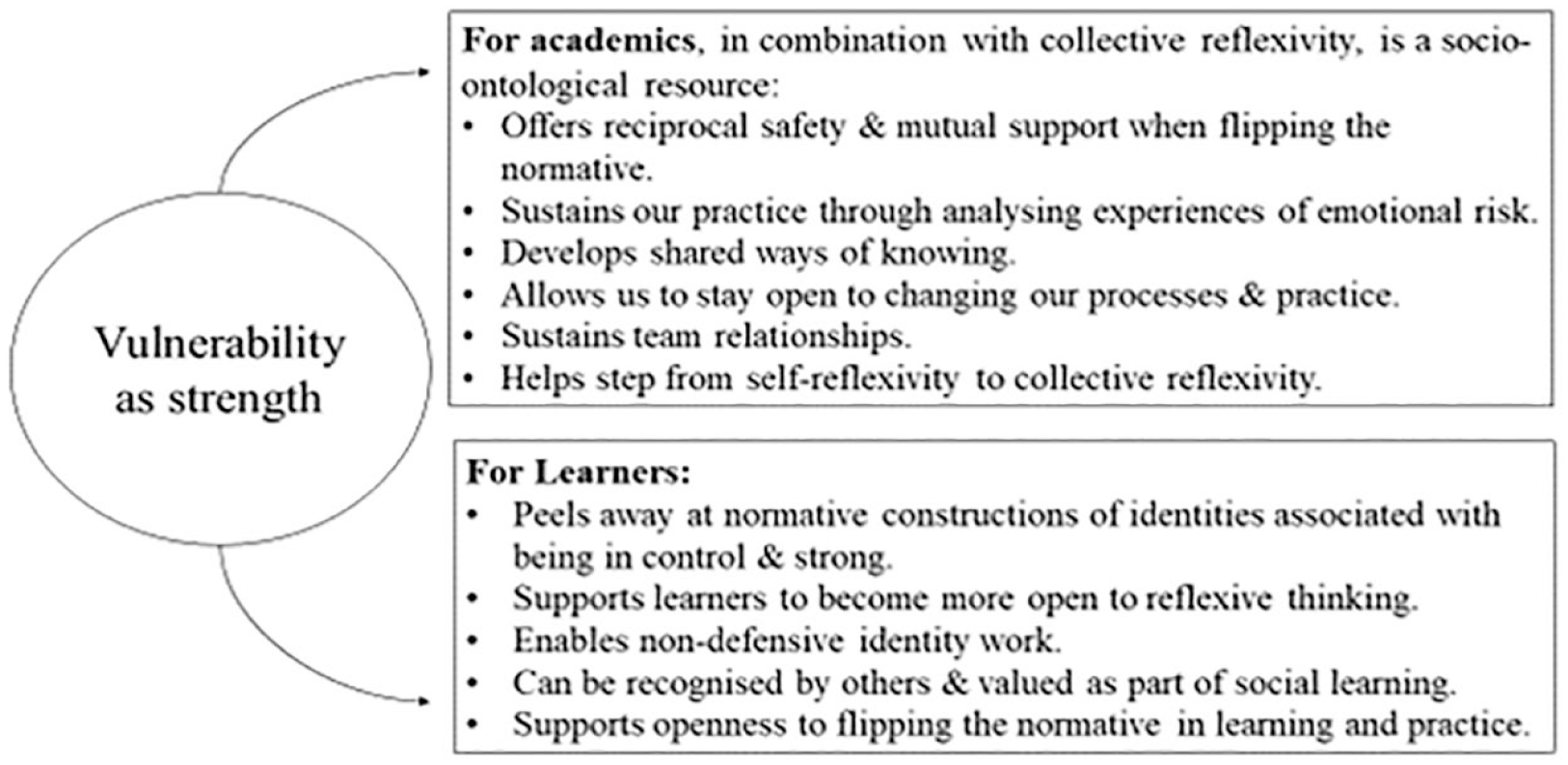
Recognizing vulnerability as strength as a facilitator for critical management and leadership education.
Learning from the tensions of flipping the normative
We highlight learning in three interconnected areas: power, control and trusting the process; vulnerability as strength and emotional risk; and academic privilege, precariousness and Othering.
Power, control and trusting the process
In business schools, ‘there has been a tendency to see anxieties about teaching and learning as something to control, ignore or abandon’ and for ‘anxieties of learning in the classroom to be reduced through very clear divisions between the roles of teacher (to control learning) and student (to comply with the teacher’s control of learning)’ (Vince, 2010: 26). Our lived experiences highlight continuous learning about ourselves as individuals and as academics, through the emotions, anxiety and sometimes the pain, in not performing as ‘sage on the stage but as co-learners’ (participant B). There are tensions when academics experience loss of power and control and feel exposed when facilitating process, not ‘teaching’ content. It is ‘important to question the desirability and possibility of control (Grey, 2004), especially the ways in which control has come to define the role of “teacher”’ (Vince, 2010: 28). The reflexive excerpts convey the need for academic preparedness to experience anxiety and exposure in becoming vulnerable; ‘anxiety is an integral part of learning, whether in the role of tutor or student’ (Vince, 2010: 30). As academics, we experience the critical pedagogy in the same and different ways to the learners.
We are aware of how critical approaches that surface power relations tend to mobilize prevailing relations of power against such approaches (Vince et al., 2018). Regardless of how a critical approach is explained and embedded, because such an approach flips the normative, our learning highlights how academics can expect to be confronted by learners and for their approaches to be challenged, at some stage, for not meeting expectations/not providing content-led learning. In contrast to seemingly disorderly critical approaches, learners may expect rationality, efficient methods and clear and prescriptive ‘how to’ tools (Geppert, 2010). Academics can prepare to engage with in-the-moment scrutiny of their practice but, in trusting the process and as both learners and academics make sense of their experiences, this eases over time. Experimenting with innovative methods is grounded in vulnerability for academics and being reflexive about personal boundaries is important as, along with learners, we also become comfortable with feeling uncomfortable. It is challenging for academics to trust the process while being open to changing the process and not developing levels of defensiveness. Designing ways of evaluation ‘within’ learning sessions is a useful method for academic reassurance (or not) and to inform changing practice. Engaged collective reflexivity supports academics to challenge assumptions and develop commitment to flexibility.
Being on high alert to the ebbs and flows of a programme-long pedagogy is important learning, as is considering how learner defensiveness and openness to critical approaches wax and wane throughout the programme. Do not assume that gains with learners made in one semester will transfer to the next; learner circumstances can change, and the normative has obvious strength, which can quickly dominate.
Vulnerability as strength and emotional risk
Despite the specific context of the academic team, its relationships, research and practice experiences in various organizations and business schools, when delivering the pedagogy, we experience unexpected decentring, walking a tightrope of vulnerability. There are tensions in how learners are asked to be vulnerable and have this recognized as strength and how academics experience vulnerability, including feeling exposed and unsafe yet responsible for safe enough spaces, while trusting the process. Sometimes, we ask for this vulnerability to be recognized by learners. At other times, we are invulnerable with learners and share our vulnerability with the academic team and through reflexive diaries, which can be safer spaces where vulnerability is recognized and valued. We are learning to live with this by engaging in relational, dialogic and collective reflexivity, which generates reciprocal safety and mutual support to trust the process. Investing time in how psychological safety explicitly operates for academics, not just learners, is important. Learning from our experiences is to have signals for ‘time-outs’ during sessions to discuss particular issues that arise.
Our ability as academics to give up the power and control of ‘expert’ is based to some extent on the safety of team teaching and mutual support. As Sinclair (2007: 459–460) notes, ‘you need to not do it alone’ and like Sinclair’s experience, where collaborative teaching is at odds with business school norms, we face continual tensions and challenges of why team teaching is a feature of the pedagogy.
Academic privilege, precariousness and Othering
As academics, we experience significant, ongoing tensions and contradictory feelings in relation to our social context, not least between joy and precariousness. The critical pedagogy creates a programme-long journey for learners that engages multifaceted and integrated experiences, including action learning sets and coaching supervision groups, to build a learning experience and develop relationships – over time. This does not fit with normative ways of organizing UK business school education (compared with transactional lectures and seminar delivery models). Team teaching is not recognized in personal workload profiles, rather the norm is that ‘good teaching is the very heroic, self-reliant performance’ (Sinclair, 2007: 459–460). This echoes individual, heroic models of leadership which our pedagogy resists, and the academic team has not (yet) fallen in line to comply with the business school’s current social order (Contu, 2020). Resistance to this workload model, alongside commitment to critical pedagogy, results in academics paying for their privilege by investing their ‘own free time’ in the reciprocal support of team teaching. This commitment flips the normative in UK business schools; it is labour-intensive, perceived as high-cost and places relatively small-cohort programmes at risk of being discontinued in neoliberal accounting practices. The ‘work-load model’, where power resides and is played out, becomes symbolic of the tensions in this context as a microcosm of power asymmetries, when flipping the normative from full-time ‘elite’ students to critical executive education.
As Vince (2010: 27) points out, the ‘teaching and learning in business schools is never divorced from the complexities of self/other relations, business school power relations and power relations more broadly within society’. The team fails to fall in line with the social order and is entangled within power relations. Feelings of precariousness come from not being ‘mainstream’ and the associated implications. Rhodes (2022a, 2022b) points to the conservative ethos ingrained in what business school academics do and curricula dominated by neoliberal capitalism, where justice, equality, power and politics are ignored. There are significant risks for those perceived as ‘not mainstream’ in business schools, where progressive views have been traditionally suppressed (Rhodes, 2022b). The team is constantly vulnerable to ongoing threats of (dis)continuation of the programmes and incessant inferences about their immateriality; it is hyper-visible while doing invisible work. There is certainly more to learn about the ‘struggle’ of creating and delivering critical pedagogy within the normative university.
Critical pedagogy ‘frames [executive] education as a political process and product’ (Ashcraft and Allen, 2009: 14), and our learning from the tensions surfaces complexity and contradictory experiences. These are reflected in feelings of panic and self-doubt, joy and infectious energy; opportunities for innovation which provoke personal vulnerability and emotional risk; reciprocal safety of team delivery while feeling precarious; and the privilege of ‘starting from scratch’ with trusted others, while facing issues of difference, powerlessness and Othering at work. We hold onto the privilege of team teaching (for the moment), of being in relation to others with shared values, and gain benefit from mutual support – a counterbalance to the team’s ongoing precarity. As Ford and Harding (2007: 477) highlight, ‘if we wish to have an impact as critical thinkers within a world dominated by mainstream (business school) thinking, we will always struggle, both ethically and practically’ and our realities reflect how we have to continually explain, justify and negotiate as part of securing some fragile legitimacy.
This learning from the tensions adds knowledge to understandings of facilitating programme-long critical executive education in business schools, and we agree with Vince (2010: 37) that critical management and leadership education ‘is always likely to produce educational experiences both from “heaven” and from “hell” (Sinclair, 2007)’, for learners and academics. We outline valuable learning about facilitating critical pedagogy for practitioners, academics, business schools and universities to consider when reflecting on alternatives to normative business and executive education.
Conclusion
This study advances understandings of CME through learning from the tensions when developing and facilitating a programme-long critical pedagogy for executive education in a UK business school. The pedagogy is anchored in academics’ values, practice and research and responds to contemporary challenges while strengthening alternative voices to normative management and leadership education by flipping the normative. We extend Reynolds and Vince’s (2020) reflections on CME by theorizing how recognizing vulnerability as strength in safe contexts is a facilitator for critical management and leadership education and how, for academics, vulnerability as strength combined with collective reflexivity is a socio-ontological resource which supports and sustains flipping the normative in CME. We contribute illustrations of how the pedagogy flips the normative simply by delivering executive education at all in the business school context, drawing out practical implications and highlighting future research opportunities into the struggles of academics outside the ‘mainstream’. The next stage of research continues as we engage with learners to explore their experiences of the critical pedagogy.
Footnotes
Acknowledgements
We wish to acknowledge and thank Professor Gabrielle Durepos, Associate Editor, and the three anonymous reviewers for their simultaneous challenge and support which provoked us to develop the paper and in particular for encouraging us to draw out our personal struggles when facilitating critical pedagogy. Thanks go to Professor Amanda Sinclair whose experiences of delivering CME shaped our practice and for the initial encouragement to develop the study.
Funding
The author(s) received no financial support for the research, authorship and/or publication of this article.
