




Abstract
In the responsible turn in business school education and management learning, the responsibility approach is proposed as a possible panacea against a hidden curriculum which leads to damaging business practice. The explicit promise of responsible management learning and education is that homo oeconomicus can be re-formed in the image of a responsible business subject, what we here call ‘homo responsabilis’. We explore how a business school curriculum centred on responsibility affects key subject positions such as consumer, employee, manager, entrepreneur, investor and leader. In three responsible management learning and education illustrations at our business school, we observe three layers of responsibilization of the individual: responsibilization for self-enhancement, responsibilization for economic prosperity and responsibilization for social and environmental sustainability. We find that these three layers of responsibilization impact business school subjects in several problematic ways: excessive moral burdening of consumers, overburdening of self-managing employees and fantasmatic gripping of prospective entrepreneurs. Our contribution to critical studies of responsible management learning and education is twofold: (1) we show how explicit responsible management learning and education curricula tend to extend the neoliberal HC, and (2) we complement studies calling for re-politicizing responsible management learning and education by suggesting transformative learning ways to generate explicitly ethico-political imaginations that can help in resisting individual responsibilization in business school education.
Introduction
The last 20 years have seen a rapid expansion of attempts to reform business school curriculum away from modelling itself on the image of the economic man, homo oeconomicus – the idea of humans as fundamentally economic (Akrivou and Bradbury-Huang, 2015; Dierksmeier, 2011). Those attempts reflect a clear admission of how ‘homo oeconomicus is made, not born’ (Brown, 2015: 84) at various places, not least the business school (cf. Blasco, 2022; Parker, 2018a). Such a reflexive yet reactive exercise of replacing homo oeconomicus as the face of the business school is also situated in a moral critique of capitalism – heightened in the immediate aftermath of the 2008 finance capital–induced crisis, which saw business schools face serious questions about their own societal role and legitimacy (Giacalone and Wargo, 2009; Solitander, 2022; Wang et al., 2011).
One of the most visible responses to this legitimacy crisis has been for business schools and their scholars to frame the drive for transformation through ‘responsibility’ – particularly ‘responsible management education’ (RME) (Burchell et al., 2015; Godemann et al., 2014; Rasche and Gilbert, 2015) and ‘responsibility learning’/‘responsible management learning’ (Blasco, 2022; Blasco et al., 2021; Laasch et al., 2020), literature streams to which we refer hereafter under the umbrella of responsible management learning and education (RMLE). RMLE studies often advance the idea that what is needed is a change of some of the core values attached to homo oeconomicus – and they also assume that business schools can and should play a pivotal role in both legitimating and driving that change (cf. Parkes and Blewitt, 2011; Rocha et al., 2021). Thus, the RMLE approach is proposed as a possible panacea enabling the necessary shift in business behaviour by equipping future business managers with competencies and skills conducive to less damaging business practice in the future (Alcaraz and Thiruvattal, 2010; Godemann et al., 2014).
The ‘hidden curriculum’ (HC) has been raised as a key concept for understanding professional socialization in and through higher education (Margolis, 2001). In the business school context, it has been suggested that the main problem with HC is that it ‘may be undermining the responsibility agenda . . . possibly even leading to the unlearning of a sense of responsibility’ (Blasco et al., 2021). Blasco (2020) argues that engaging with HC can be particularly fruitful in RMLE research to problematize the taken-for-granted rationalities of current business school curricula, as well as the totality and coherence of the belief systems that inform them. In this article, we posit that if RMLE is to fruitfully engage with HC, we first need to understand RMLE in terms of its own taken-for-granted rationalities and interrogate the implicit and explicit belief systems that inform it.
The tacit (and at times explicit) promise of RMLE is that homo oeconomicus can be re-formed in the image of a responsible man(ager), what has been called elsewhere ‘homo virtus’ (Friedland and Cole, 2019) and what we here call ‘homo responsabilis’. In line with the call for the special issue (Blasco et al., 2021), our interest lies not only in the critical examination of the omnipresence of homo oeconomicus in the business school curriculum but also in understanding the particularities of the new explicit curriculum of homo responsabilis, which in many ways extends the logic of many business schools’ HC by adding a layer of responsibilization on top of the already operative neoliberal responsibilizations for individual self-enhancement and for contribution to economic prosperity (Brown, 2015). By explicitly interrogating the relation between RMLE and the responsibilizing human capital foundation of business schools, our article contributes to recent literature on ‘more disruptive and inclusive imaginaries of [RMLE]’ (Millar, 2020: 410) and more broadly to the project of re-politicization of RMLE (Asirvatham and Humphries-Kil, 2017; Millar, 2020; Ramboarisata, 2021).
It is important to say a few words about where we – the two authors – are ‘coming from’ in this critical examination. We work in the same business school, located in a Northern European country, and we have been devoting significant effort in implementing the Principles for Responsible Management Education (PRME) in our business school over the past 15 years or so. Thus, we have very much accompanied the movement whereby homo oeconomicus is gradually transformed into homo responsabilis, so much so that we find the figure of homo responsabilis firmly in place in our business school. Yet, having witnessed recent developments in the name of responsibility in our and other business schools, we are increasingly hesitant as to the merits of the responsibility framing. The current situation leads us to think that while the ‘responsibility turn’ has brought about many possibilities for critical reflexivity and no doubt has enhanced the societal consciousness of business school students, framing the change in terms of ‘responsibility’ alone may be a mistake. We feel that the responsibility approach to learning falls very short of challenging what Fisher (2009) calls ‘capitalist realism’, and that if implemented unproblematically it might reproduce and accelerate the neoliberalization of the business school subjects’ consciousness.
Our aim is to explore how an approach to business school education centred on responsibility affects key subject positions that business school students strongly relate to: particularly, the positions of (responsible) consumer, employee, manager, entrepreneur, investor and leader. We set out to begin this exploration from a constructively critical perspective, being alert to the possible pitfalls of the responsibility approach. This exploration cannot be exhaustive; thus, we zoom in on three teaching/learning illustrations at our business school in which we have been involved in various capacities (as lecturers in two of these illustrations, as ‘early approver’ of a pilot course in the third). In each of these illustrations, we reflect on how the students, asked to think from the perspective of particular subject positions, relate to three layers of responsibilization of the individual: responsibilization for self-enhancement, responsibilization for economic prosperity and responsibilization for social and environmental sustainability. Thus, we ask the following research questions: (1) How does the triple responsibilization manifest itself in different RMLE-inspired courses? (2) To what extent does the responsibilization advanced by RMLE discourse make it possible for students to develop new forms of collective consciousness and alternative imaginations? (3) What could help in making RMLE practice in business schools more conducive to collective consciousness-raising and alternative imaginations?
As a result of our reflection and analysis, we argue that much like discourses of corporate responsibility (see Banerjee, 2008; Fleming and Jones, 2013), RMLE discourses that foreground individual responsibility not only re-legimitimize but also actively perpetuate the unsustainable corporate-dominated status quo. First, because there is no realistic pathway to make all individuals subscribe to the same virtuous moral imperatives conducive to making the world a better place, as in Friedland and Cole’s (2019) characterization of homo virtus. Second, because these individualizing discourses overburden individuals while blinding them to alternative, explicitly collective and political imaginations (see Brown, 2015; Fisher, 2009; Jones, 2010; Shamir, 2008) that would be required for sustainable change. And third, because there is ample evidence that these responsibilizing discourses historically have been strategically deployed by industry to defer responsibility and blame to individuals on questions such as recycling, carbon footprint and occupational health problems (e.g. Chamayou, 2021; Karpf, 2021; Linhart, 2011).
After this introduction, we (1) review some relevant literature on HC in business schools, with particular reference to homo oeconomicus, human capital and neoliberalism; (2) problematize how the explicit RMLE turn, instead of challenging the neoliberal HC, might in fact extend its logic by adding an additional layer of responsibilization; (3) describe our ethico-political research approach; (4) provide three illustrations of the triple responsibilization of business school subjects; (5) discuss possibilities for concrete steps to re-politicize RMLE; and, finally, (6) conclude and specify our contributions to RMLE studies and HC.
The Hidden Curriculum and the socialization of homo oeconomicus
The HC can be seen as a ‘metaphor to describe the shadowy, ill-defined and amorphous nature of that which is implicit and embedded in educational experiences in contrast with the formal statements about curricula and the surface features of educational interaction’ (Sambell and McDowell, 1998: 391–392). It has been argued to play a central role in professional socializing (Høgdal et al., 2021; Margolis, 2001), particularly in an environment where ‘learners are seen as human capital’ (Orón Semper and Blasco, 2018: 481), and for this reason it has been noted that it is of particular importance in business schools (Parker, 2020), notably in relation to RMLE (Blasco, 2012, 2020).
While Parker (2018a) argues that there has historically been a clear lockstep between the explicit curriculum and the HC in business schools, arguably more so than in other Higher Education Institutions (HEIs), he goes on to note that the explicit curriculum of management often lacks an explicit covenant to neoliberalism and capitalism (Parker, 2018a, 2020). Resonating with the notion that what is ‘hidden’ in HC might be implicit but ‘plain for all to see’ (Blasco, 2020: 471), Kociatkiewicz et al. (2022) put it as follows: [capitalism] can be glimpsed within the business school walls, but it is rarely discussed. It is the thread that makes up the fabric of the business school, but yet evades the direct gaze of the business school inhabitants. Instead, it lurks in our peripheral vision – it is the unsaid, the missing word in the course names. . . It is speaking but not spoken of. (pp. 1–2)
Thus, among the structuring, implicit, taken-for-granted ethico-political values guiding most business schools, the acceptance that capitalism is the only realist approach (Fisher, 2009) is strongly installed, together with the neoliberal, human capital logic whereby business school students, who usually pay high tuition fees (Parker, 2018a), are seen as making an enlightened investment decision ‘justified by the probable return on their investment of time and money’ (The Dearing Report, 1997: 11, as cited by Fleming, 2017: 701). With this human capital logic and the associated common assumption that the main value of a business degree lies in enhancing employability, it easily seems ‘perfectly obvious and proper that business students should be trained and socialized into the requisite competences and habitus for business under modern capitalism’ (Blasco, 2020: 464).
It is also in relation to this implicit but compelling sense of inevitability that the figure of homo oeconomicus is constituted in the HC of business schools. This inevitability has been described by Fisher (2009) through the concept of capitalist realism: ‘the widespread sense that not only is capitalism the only viable political and economic system, but also that it is now impossible even to imagine a coherent alternative to it’ (p. 2). The HC of business schools is formed by a business ontology ‘in which it is simply obvious that everything in society, including healthcare and education, should be run as a business’ (Fisher, 2009: 17, emphasis in original). It is in this predetermined context that the model of the market has spread to all domains of life, even those previously construed as non-economic or non-monetized (Brown, 2015), where homo politicus disappears entirely and the rationalities of human capital and homo oeconomicus become the objective definition of what is rational.
The HC of business schools, driven by neoliberal rationality, contributes to ‘configur[ing] human beings exhaustively as market actors always, only, and everywhere as homo oeconomicus’ (Brown, 2015: 31). Yet importantly, the shape and form of homo oeconomicus are not constant and have shifted across the centuries (Brown, 2015). In the typical business school HC, the socialization of homo oeconomicus relies on five main subject positions: the consumer, the entrepreneur, the investor, the leader, and the manager. These five subject positions often form the absolute limits of imagination and action in the curriculum. These are the roles students are playing in the business cases they read (see Blasco, 2020) and the rationales they are asked to reproduce, and whose problems they are asked to solve. Even when students are put in the roles of civil society changemakers, public decision-makers and/or politicians, their sensemaking relies on a rationality grounded in homo oeconomicus.
While for decades there has been ever-growing questioning of what kinds of professionals business schools are producing, homo oeconomicus has proven a recurringly invoked figure. Arguably, it was not until after the 2008 finance capital speculative crash that business schools reacted to the challenges to their societal legitimacy. It is noteworthy that what truly threatened the neoliberal fantasies inscribed in both HC and explicit curriculum was not social conflict or environmental hazards, but a financial crisis (Wilson, 2016). A common feeling at business schools during the crisis was that due to real concerns about societal legitimacy, something had to be done, a response that was reminiscent of the corporate response to the sustainable development agenda in the early 1990s and which relied on ‘responsibility’.
The explicit responsibilization of business school curricula: enter homo responsabilis
As an explicit reframing of business education curricula, the RMLE approach often problematizes HC and particularly how HC reproduces central elements of homo oeconomicus (see Moosmayer et al., 2019). We see RMLE as promoting the advent of a homo responsabilis explicitly framed as a challenge to homo oeconomicus. Advancing homo responsabilis in the curriculum entails explicit rejections of (1) Milton Friedman’s axiom ‘the business of business is business’, which is deemed to have a problematic impact on business school graduates and businesspeople (Friedman and Cole, 2019; Parkes and Blewitt, 2011), and (2) the notion that business education would be ‘value-free’ (Rasche and Escudero, 2009; Storey et al., 2017). In addition, RMLE approaches generally do not try to hide all ‘the ugly realities of capitalism beneath a fantasy of harmonious order’ (Wilson, 2016: 596), often inviting students to engage with questions relating to ‘how we got ourselves into this mess’ (Carstens, 2021: 120). Thus, in many important ways, RMLE works to make explicit and overcome HC elements that hinder meaningful societal transformation for sustainable development (cf. Blasco, 2020).
At the same time, homo responsabilis conjured as an ostentatious panacea to the overwhelming influence of homo oeconomicus in HC is arguably foremost about the moralization of the economy that follows a process of depoliticization, what Brown (2015) and Shamir (2008) call ‘the economization of the political’. The economy still subsumes everything else, yet as a corrective to the excesses of capitalism, it looks different in an explicit curriculum characterized by homo responsabilis. The curriculum is increasingly moralizing its key subjects: the consumer subject who needs to recycle and keep their carbon footprint in check (see Jones, 2010); the employee/manager subject who needs to both be aligned with economic objectives of their employer and make sure that their employer is aligned with their values, opposing corporate irresponsibility and ‘blow[ing] the whistle if needed’ (Vallentin, 2015); the social entrepreneur subject who is to step in to address market and government failures and ‘solution’ to environmental and social malaise (Prudham, 2009); the investor subject who is to actively participate in incentivizing sustainable business through socially responsible investments (Goldstein, 2018); and also the corporate/employer subject, who has to reframe everything that the corporation does as ‘responsible’ and ‘sustainable’ (e.g. Banerjee, 2008). These forms of responsibilization have been developed since at least the 1970s – as Chamayou (2021) shows, it is already in that decade that in the United States, individualized consumer-led recycling became the dominant approach to recycling, pursued as a result of industrial lobbying. Since then, these industry-initiated, responsibilizing approaches have kept becoming dominant solutions in gradually more aspects of business and life, as in the example of BP creating the first individualized carbon footprint calculator in 2004 to shift attention away from oil corporations (e.g. Karpf, 2021).
Responsibility thinking in the business school curriculum, then, is that which re-legitimizes business and business school education (see, for example, Parker, 2018a) at the same time as it ‘morally burdens’ ‘the entity at the end of the pipeline’ (Brown, 2015: 132–133), namely the students as individual consumers, employees, and in the future, entrepreneurs, investors and/or managers. Far from being a clear challenge to neoliberalism, this further responsibilization can be seen as fundamentally aligned with neoliberalism and thinking in the individualized terms of human capital. As Brown (2015) puts it, the individual under neoliberalism is ‘doubly responsibilized: it is expected to fend for itself (and blamed for its failure to thrive) and expected to act for the well-being of the economy (and blamed for its failure to thrive)’ (p. 134). With homo responsabilis, the additional injunction is for the individual to be also burdened by what Gros (2021) calls ‘global responsibility’, that is, ‘standing in solidarity with the injustices produced in the world’ (p. 163). While a sense of global responsibility is morally highly laudable, and indeed should be an integral part of what business school education aims to instil in students, offering the students no other way to relate to social and environmental sustainability than an individual transformation into homo virtus (Friedland and Cole, 2019) is problematic. When only individual responsibility is on offer and when no limit is set to how much responsibility students should feel for questions of social and environmental sustainability, the students run the risk of experiencing an unbearably heavy burden of responsibility. If we take the injunctions to be individually responsible for saving the world literally, ‘the air at such moral summits is unbreathable’ (Gros, 2021: 166).
Thus, as homo responsabilis the students are now triply responsibilized, for (1) self-enhancement/striving in society, (2) economic prosperity/perpetuating economic growth and (3) social and environmental sustainability/saving the world, and as Brown (2015) would have it, they have to accept the burden of blame in the event of failure in any and all of these realms. These three layers of individual responsibilization are strong implicit and sometimes explicit injunctions in our contemporary business school curriculum, burdening the business school subject and foreclosing alternative imaginations. We need to bring back to the fore structural (not individualized) and ethico-political (not moral-economic) imaginations to the business school curriculum if we are to truly challenge the neoliberal figure of homo oeconomicus.
Research approach, context, selection and analysis of the illustrations
In this article, we are not engaging in a traditional empirical study; instead, our arguments rely on long-term abductive reasoning and reflexive practice based on both: (1) our experience of developing and teaching the RMLE curriculum in our business school over a number of years, in line with many previous RMLE articles (e.g. Hawkins and Edwards, 2015; Skilling et al., 2022; Statler, 2014; Tallberg et al., 2022); and (2) confronting that experience with literature on responsibilization under neoliberalism (particularly Brown, 2015; Shamir, 2008). We agree with Blasco (2020) that while each business school has its HC, which is shaped by different constellations of actors and cultural context, it is still possible to diagnose more general elements of HC that constrain possibilities of transformation.
When it comes to cultural context, we are both based in the same business school in Northern Europe, where education remains free for all European Union (EU) students – although a tuition fee was introduced a few years ago for extra-EU students. The business school delivers the same degrees as universities; in all (or at least most) of the disciplines, the emphasis is foremost on academically recognized knowledge within the field rather than on tools to be applied uncritically by future business actors. While the thinking in terms of ‘human capital’ is no doubt strongly present, it is nowhere near as pervasive as in a system of high tuition fees, where students make huge investments in education in order to secure a lucrative job (or at least a livelihood) in the future. In many parts of Northern Europe, the principle of academic freedom also remains strong, which means that while the course offering is set through formal, sometimes very hierarchical decisions, the actual content of each course is to a large extent left to the latitude of the faculty member in charge of the course. All in all, when we compare our teaching/learning environments with those depicted by Parker (2018a), we feel comparatively privileged to be in a singular context ripe with opportunities to challenge problematic aspects of HC – if only we seize those opportunities.
As close colleagues, we discussed our growing dissatisfaction with the responsibility framing, providing examples of the limitations of RMLE when it mainly leads to individualized reflections of students. Through discussions and reflecting on our separate teaching experiences, we came to the conclusion that at worst, RMLE might in fact add an additional layer of individual responsibilization on top of the two neoliberal layers of responsibilization discussed by Brown (2015). In line with RMLE studies building on own teaching experience (e.g. Parkes and Blewitt, 2011; Skilling et al., 2022; Statler, 2014; Tallberg et al., 2022), each of us then selected one illustration from our current teaching where we particularly notice how responsibility learning can too easily lead to excessive moral burdening of students as consumers and/or employees in particular. When we started working on the article, we received some information about a pilot course in entrepreneurship that one of us had approved as part of the school’s RMLE offering a few months earlier. We were both curious and apprehensive about this pilot course, which we saw as potentially a new stage in further responsibilization of students. The course was indeed designed and co-organized by students and aiming to inspire other students to become entrepreneurs solving the world’s most pressing problems, as expressed in the Sustainable Development Goals (SDGs). We then interviewed the official academic examiner of the course for background information and two of the three students who initiated and co-organized the pilot course. This gave us a third ‘illustration’ to provide as evidence for triple responsibilization.
As we deal with ethico-political considerations related to our own teaching and curriculum development, it is important to note that (1) our arguments are affected by particular ethico-political views we subscribe to, which see a neoliberal HC founded on individual human capital as representing ‘undesirable societal ideologies and tendencies’ (Blasco, 2020: 476) particularly because it strongly contributes to a lack of alternative political imaginations at a time when we need radical transformation for sustainability; and (2) we rely on ‘intellectual craftship’ (Bell and Willmott, 2020; Mills, 1959) in designing a singular analytical approach for this study rather than on a more standardized methodological procedure. Aware as we are of the HC operationalization problem – related to how challenging it is to study something that is by definition hidden (see Blasco, 2020) – we propose that those aspects of HC that are most influential might be those that are manifested as ‘effects’ in student voices in their assignments (illustration 1), in-class discussions (illustration 2) and interview accounts (illustration 3). To us, the strongest HC values are those that are ‘hidden’, yet at the same time so taken for granted that they are there ‘for all to see’ (Blasco, 2020). This implies, of course, a research approach that is strongly subjectivist, relying on our singular interpretations of what is going on in the courses at hand and then on confronting our different interpretations with each other to achieve more robust analysis and reflections.
Clearly, before analysing these illustrations for the present study, we had noticed the tendencies of students to emphasize their individual responsibilities in addressing societal issues. Thus, in our analysis of the illustrations, we paid particular attention to how the students understand their responsibility as a consumer, self-managing employee and prospective entrepreneur. Consequently, for each illustration, in alignment with our first two research questions, we looked into the extent to which they include injunctions to triple responsibilization (for self-enhancement, economic prosperity, and social and environmental sustainability) and to consider ways in which they are and/or could be complemented by imaginations drawing on societal structures, political problematizations or anything else that is not individual responsibility–based. Noting the relative absence of more structural and political perspectives in the students’ accounts, we started thinking quite concretely (in line with our third research question) in terms of what could help in making our RMLE practice, as expressed in our courses, more conducive to collective consciousness-raising and alternative imaginations – we reflect on what can be done for that purpose in the discussion, where we refer to actual practices we have recently developed in our courses.
We do not claim that our analysis of the students’ views is comprehensive of all expressed views. In illustrations 1 and 3, we include some verbatim quotes to provide evidence of the triple responsibilization as expressed and experienced by the students. For illustration 1, where the basis is written reflections by students, transcripts of 80 student assignments were used to identify particular themes around different forms of responsibilization the students expressed in two separate assignments. These assignments were selected because the first one directly asks students to reflect on HC, and the second one produced the most explicit engagement with questions around individual versus systemic responsibilities. While the selected quotes are representative, they are still selected because of how explicitly they express the themes of responsibilization. When quoting some of the students’ accounts below for illustrative purposes, S1A to S1F refer to the six students whose accounts we include from the first illustration, and S3A and S3B refer to the two students we interviewed in relation to the third illustration.
Responsibility learning and the risk of morally burdening the activist consumer
The example we use to reflect on the effects/limits of the responsibilized consumer is based on a module on human–nonhuman animal relations in a Corporate Social Responsibility (CSR) course on the BSc level – a large course which Author 2 has taught and developed in a timespan of over 10 years.
Explicitly problematizing the HC
The course itself starts with a week during which the theme is actually HC in business schools, and among other things, the students read Parker’s (2018b) Guardian article ‘Why we should bulldoze the business school’ which summarizes some ideas from his book of the same year (Parker, 2018a), as well as an academic article by Painter-Morland (2015) on the philosophical assumptions undermining management education. Both articles make explicit reference to the particularities of HC at business schools. In an exercise, the students are asked to reflect on the HC as they have personally experienced it – over the years, the assignments show that a large majority of students are aware and have a critical view of the ethos of homo oeconomicus. An example of this awareness can be found in the following self-reflexive account, emphasizing the perceived tension between personal values and business – and by extension awareness of their own responsibilization for economic prosperity: I believe many business students, including myself in my early 20s, believed that only values accepted in business are those taught at the business school, but do not necessarily share those values on personal level. This constant value conflict is very consuming and, in my opinion, a significant factor in the background of burn outs or other work-related mental health issues. Business school does not make students greed[y], but it makes them believe that in business life, they will have to be greed[y]. (S1A)
S1A illustrates a certain Fisherian resignation to the fact that there is an unmitigable chasm between how you are governed to think and act in the business school and the personal moral and ethical positions – but that there is very little you can do about it. S1A vocalizes how such reflexivity is not only an observation of facts but also a self-fulfilling prophecy, where burnouts and other mental health issues are both a consequence of such tensions and a condition that increasingly forecloses the possibility of politicization of these tensions.
Some students also express how they ‘cope’ with the tensions between the business school core assumptions based on human capital thinking and traditionally non-economic settings, such as in the context of dating – echoing shades of Fisher’s (2009) ironic distance: In relationships there is a lot of talk about your ‘market value’ going down as you age, and about the relationship market, demand, etc. It makes you think about yourself and others in very objectifying ways. This effect may of course be amplified in a business school setting. I also notice myself starting to use certain vocabulary as an ironical joke, talking about myself not as a consumer but a seller, or using new vocabulary I have learned in business school in everyday settings. (S1B)
This exercise makes it clear that no matter whether the student population of the course is fully representative of the business school, there are many students who are fully aware and at least passively resent some of the key socializations implied by homo oeconomicus. That said, the students seem less critically reflexive about the moral burdening associated with the third layer of responsibilization, the responsibilization for social and environmental sustainability. When issues are framed in terms of social responsibility, students do not in general imply that there is nothing to be done and no possibilities for transformative action. In that sense, many, from the outset, seem to have bought into the ethos of homo responsabilis – but this is perhaps to be expected from the growing body of students who choose to join courses explicitly discussing business impacts on society.
Responsibility learning on human–nonhuman relations
During the fifth week of the same course, there is a module on human–nonhuman animal relations. The assignments attached to the week are not as such designed for students to see themselves as consumers, but from the outset most participants seem to make sense of their relations to animal welfare/rights from the perspective of consumers – and especially in terms of problematizing their own diets. This is in part triggered using the film ‘Cowspiracy’ as material – the reasons why Author 2 has chosen this film include that it serves as an illustration of the varieties of unsustainabilities of the agrofood sector and their connection to the agroindustrial complex, involving a variety of subject positions such as the farmer, the consumer, the activist, and the manager and their relations to animals as sentient beings/commodities/food. In addition, the students read three critical articles: Kotzmann and Seery (2017), McLoughlin (2019) and Vinnari and Vinnari (2022). The students are then asked to reflect on the ‘“techniques” that allow us in various capacities – such as workers, managers or consumers – to distance ourselves from questions around animal suffering/wellbeing’ (from the course material). Many students express explicit guilt and pressure from their self-perceived hypocrisy of consuming meat/animal products while being aware of the negative environmental impacts and animal harm: Even today, people, including myself, are generally unaware that the animal industry, and particularly the cow industry, is the most destructive industry the planet has to face. It is generally known that eating too much meat is not good for us, and especially for the environment, but the details mentioned in the text and the film made me realise the importance of stopping eating meat. (S1C) I have reduced meat-eating significantly and basically eaten mainly vegetarian food and fish. I have been a strict [parent], not letting my children go to the circus if they use animals in their performances and I am critical towards zoos . . . I have also told my kids I don’t want us to have pets. (S1D) Once . . . on holiday with my parents we went to a fish farm where you can catch your own fish and also kill the fish yourself. You had to slap the fish multiple times with a stick until it stopped moving. I felt so disgusted and didn’t want to do it myself. Then I realized that I was being hypocrite, because I don’t want/able to kill the animals but I do want to eat them. After that experience I just kept eating meat and fish, probably because it is such a normalized thing in our society. My [sibling] even hates to make a fully baked fish ready to eat, but [they are] not being hypocrite because [they] turned vegetarian. (S1B)
Interestingly, the moral responsibilization becomes most evident in this module. Students also vocalize their unwillingness to work in industries that are on record for animal abuse or (legal) slaughtering – vocalizations that are seldom expressed when students reflect on cases where there is systematic abuse and dispossession of workers (mining, textiles or electronics manufacturing) in other course modules.
This module is also where students tend to express least scepticism of individual action or consumerism as a solution – as exemplified below: To achieve systemic change, there is no way around individual change: a system cannot change if its parts remain the same . . . [I]nformed and aware individuals are in a position to understand their role in the system and the implications of their (in)actions. They are able to recognise their values and beliefs and make choices that truly reflect them . . . [M]orally-driven consumerism could generate a strong bottom-up stimulus for paradigm change. When bottom-up forces are predominant in a democratic change process, top-down processes are likely to trigger as well. In my opinion, these are the milestones when picturing the roadmap of how to achieve a world where antispecism is the cultural norm. . .[F]or us consumers, information and awareness, expressed through each of our purchases and everyday choices, are moral obligations to be in a position to hold intellectually honest conversations about sustainability and ethics. (S1E)
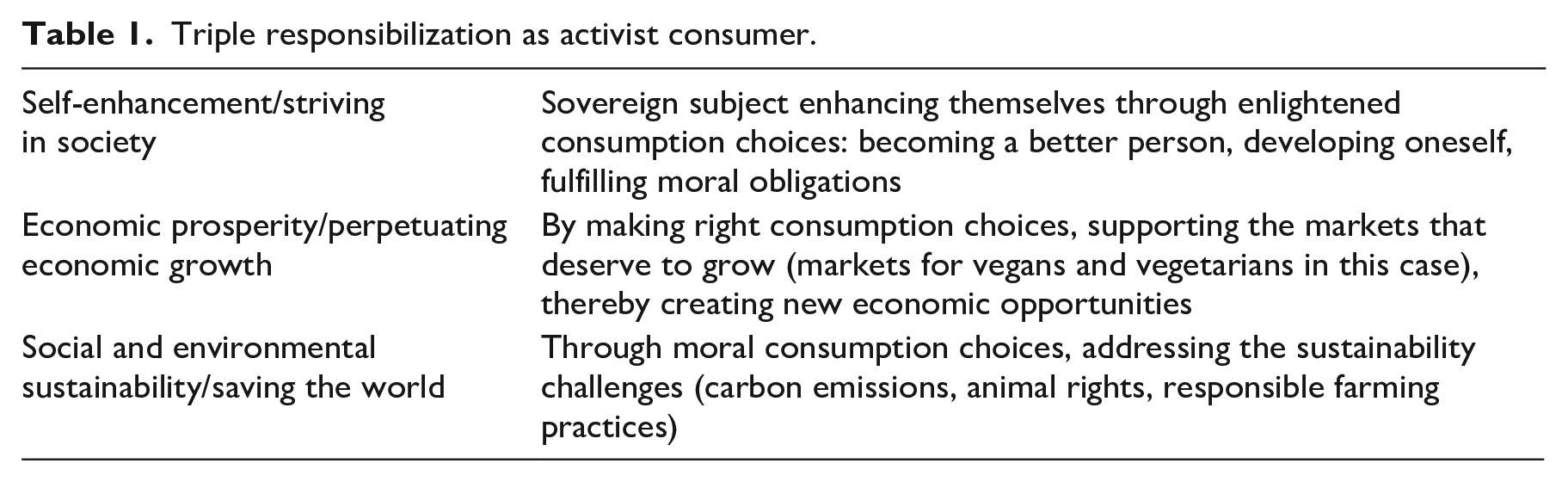
In their responsibilized consumerist sensemaking, students also bypass many other (political) aspects brought up during lectures and in the readings, for example, the aspects of the racialized and very visible class-based inequalities and dependencies in the agrofood chain (such as the low-paid, often immigrant and gendered workforce). In many respects, this thematic module, for Author 2, represents a failure to expose HC: the deification of the consumer as a moral arbiter of humanistic capitalism, on the one hand, and the moral overburdening of the individual, on the other hand. In Table 1, we describe the triple responsibilization of the activist consumer based on the accounts of the students.
Triple responsibilization as activist consumer.
Management and the overburdening of the self-managing employee
The illustration we use to problematize the individualizing and responsibilizing injunctions of ‘management’ relates to what originally started as a guest lecture on power in organizations in a course on organization theory. Knowing Author 1’s interest in questions of power, the examiner of the course asked Author 1 to give this session, and this guest lecture, complemented by a reading seminar, came to be given four times a year. The topic gradually evolved beyond the question of power to the question of ‘organizational control’, with most of the readings associated with the lecture being critical articles about organizational control.
From the beginning, Author 1 started the lecture on power focusing on what Taylor’s principles of scientific management meant in terms of power in organizations. Author 1 initially focused on treating the Taylorist intervention mainly as a matter of a shift in terms of power/knowledge – influenced by Foucault (1980) and Clegg et al. (2006) – that is, a shift from something resembling sovereign power to something that complemented the coercive aspects of sovereign power with a disciplinary power approach, whereby the workers’ bodies themselves are invested by power relations, subjected and made productive (Clegg et al., 2006). The initial lecture then moved on to more contemporary examples, discussing various approaches from management aimed at improving organizational control to serve organizational objectives. The articles used in relation to the lecture and seminar, from the beginning, were quite ‘critical’, including Townley’s (1993) seminal critique of Human Resource Management (HRM) and Costas and Kärreman’s (2013) empirical study of CSR as control in an ostensibly ‘responsible’ company.
When discussing Townley’s (1993) article, the lecture focuses on performance and development discussions as a technology of control, with specific reference to appraisals understood as ‘confessions’ (p. 536). Since most students have had experience of such formal discussions with their supervisors in their part-time or full-time jobs, insights about how power and control are supposed to ‘work’ in such settings are drawn from the experiences of the students themselves. The students often express their views that there is no power involved in the sense that they do not experience coercion in this situation, but when probed further, many do acknowledge that the form they need to fill in before the discussion and the goal orientation of improving future performance and committing for ambitious targets contribute to a pressure that they have experienced. And typically some students point out that from a management perspective, this is in fact a more effective way to advance organizational interests by seemingly empowering employees and getting them to manage themselves in line with organizational objectives. Much reflexivity is involved in those discussions, in line with the ideal of RMLE. And each time this session is given, students show that they have the reflexive and analytical skills to understand how this responsibilization of self-managing employees such as them is framed as a win-win that serves the organization’s economic objectives while feeding the individual’s need for self-enhancement – that is, the first two layers of responsibilization, as if they were ideally aligned. This degree of insight into the workings of HRM is a good achievement, but as such it falls short of a more political perspective on management that would problematize the normalization of this burdening of individuals in the name of economic performance.
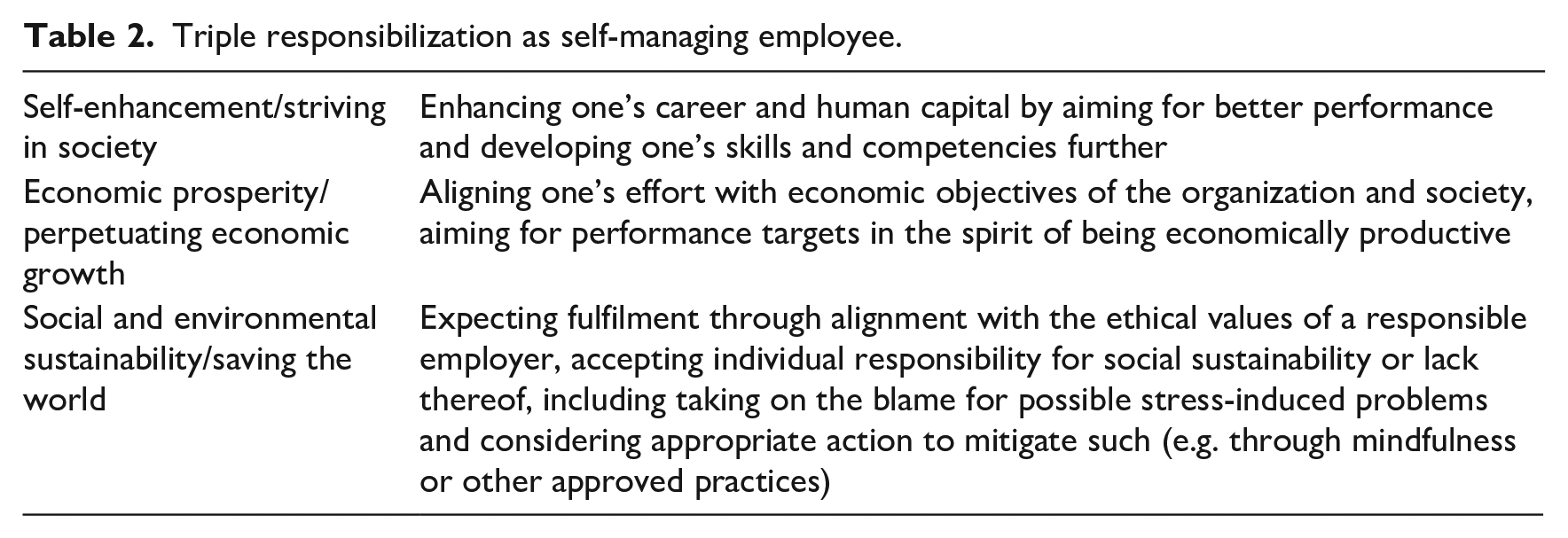
Similarly, in relation to Costas and Kärreman’s (2013) article, a critical discussion of the third layer of responsibilization was initiated, but in a way that failed to become anything more than a resigned descriptive account of the limits of responsibilization as only horizon. A key conclusion of the article is that ‘CSR works as a form of aspirational control that ties employees’ aspirational identities and ethical conscience to the organization’ (Costas and Kärreman, 2013: 394), so those students who want to believe in changing the world through meaningful work in a company that seeks to prioritize good societal impacts often end up disappointed with the findings of the article. In Table 2, we describe the triple responsibilization of the self-managing employee based on discussions with the students.
Triple responsibilization as self-managing employee.
Entrepreneurship and the fantasy of triple responsibilization
The illustration we use to discuss responsibility learning in relation to entrepreneurship is a pilot course that was initiated in a highly unusual way: three entrepreneurship students from our business school discussed the idea of the course and suggested its design to faculty members from entrepreneurship, one of whom became the formal examiner. The pilot course, which perhaps would have benefited from a stronger grip from faculty and more development time, was given in autumn 2021 as an experimental addition to the entrepreneurship curriculum, after its idea was approved by Author 2 in an advisory role as part of strengthening RMLE curriculum at the school. 1 Here, in the spirit of reflexivity, we acknowledge an almost schizophrenic tension between, on the one hand, our joint responsibility for the implementation of the PRME at our school, which leads us to being supportive or even enthusiastic when business school major subjects that hitherto did not explicitly engage with responsibility learning start doing so, and, on the other hand, our constructively critical exercise in this article of scrutinizing the pitfalls with teaching/learning approaches framed entirely as RMLE. While we have had no role whatsoever in organizing this pilot course in a subject that is not our own, we were reasonably happy to see it appear in the curriculum as a result of an initiative of passionate students. That said, we critically reflect below on the extent to which this experiment represented an extreme example of relying on responsibilization of students. Our discussion below is based on the course syllabus and two approximately 1-hour long interviews – one with the official academic examiner and the other with two of the three students who initiated and were de facto the main organizers of the pilot course (hereafter referred to as S3A and S3B).
That the pilot course was initiated by students and later assigned to a faculty member from entrepreneurship as de jure examiner while keeping the three initiating students in a role as co-organizers of the course is a first indication that this course, from the beginning, carries a spirit of responsibilizing students for the business school curriculum. Furthermore, the design of the course is about responsibilizing the students to make the most of a very open process, with no traditional lectures but instead activities consisting of (1) discussions of students in their entrepreneurial groups, (2) ‘hackatons’, (3) ‘masterclasses’ by seven business ‘gurus’ (some of whom are very well-known nationally) during the course, (4) entrepreneur ‘mentors’ for each student group and (5) a final evaluation of the business plans of the student groups by a jury of experienced investors – with some jury members having a presumed good knowledge of the SDGs. Beyond these matters of design of the teaching/learning environment, what is most striking with the course is its responsibilizing spirit from the perspective of the three layers of responsibilization.
The first layer of responsibilization, which is focused on self-enhancement, is foregrounded by the course initiators who see the course as a way of addressing the fact that students ‘are evidently really really concerned about the future and don’t feel that they have a way to impact their future. . .everything [we are] doing is for youth to actually create an impact and also, like, get their voices heard’ (S3A). The initiators understand this empowerment of students as entrepreneurs as a virtuous process whereby the key starting point is for young people to realize that they have it in them to make a positive difference in the world: Everyone has an idea, no one has the guts, or think they have the skills, to do it, so I think that’s also one thing we try to [do]: ‘you can actually do it!’. The more young people start to actually see that they can change stuff, especially these really important problems as the SDGs, problems related to the SDGs . . . all these different things, that you are able to actually do something about it, and I think there’s no one that cares about it more than kind of our generation. (S3B)
And then the idea seems to be that such unleashing of an entrepreneurial mindset and drive combined with an acquisition of the skills to go ‘from idea to market’ (S3B) will eventually lead to innovative solutions that will help address the world’s most pressing problems.
The second layer, related to responsibility for economic value creation, growth and prosperity, appears to be comparatively downplayed, but that is because in the initiators’ mind, it stands to reason that entrepreneurs cannot escape it: ‘The SDGs give purpose, and that’s the main thing, it’s not just, you know, making money but there’s also purpose’ (S3B). ‘Making money’ is assumed as the invariant characteristic of entrepreneurship, a feature which is there by default – after all, the jury who choose the best entrepreneurial project in the course do it based on their experience as venture capitalists or investors, primarily from the perspective of economic prospects. One of the most important characteristics of the liberating entrepreneurial ‘mindset’ which is key to the first layer of responsibilization is ‘a growth mindset . . . instead of a sceptic[al] mindset’ (S3B). Here, homo responsabilis should not have doubts but instead ‘know the first steps to take, and then kind of trust that [they]’ll find answers, because there’s always a way to get them’ (S3A). This mindset is reminiscent of a solutionist business approach to problems, where the second layer of responsibilization can be strongly felt even if it does not need to be as foregrounded as the other two. Being inspired by heroic leaders, entrepreneurs and venture capitalist figures is crucial for the acquisition of the mindset to work: One important thing looking back at their mindset, is like when [the most famous of the ‘gurus’ in the course] tells his story [it leads to] a kind of mindset change, and then seeing those people like in the newspapers, and looking at them like superheroes, but the only difference is they actually think that, yeah, it can be done, and they do it, so, seeing that, really creates a difference in the mindset of students. (S3A)
The extremely frequent reference to the most successful ‘leaders’ and the rhetoric of getting students to become leaders are both key features of contemporary HC of business schools (see, for example, Blasco, 2020). Even seemingly very benign exercises such as ‘Aim2Flourish’ stories (Aim2Flourish, 2023) can lead to a strengthening of thinking of solutions to current sustainability issues as mainly a matter of having the most inspirational leaders, as Author 1 found out in a recent wrap-up discussion with students in a course contributing to Aim2Flourish. Thus, when the pilot course invites successful leaders to act as gurus while referring to them as ‘superheroes’, there is a danger that highly risk-prone figures become even more influential in setting norms of behaviour among prospective entrepreneurs.
The third layer of responsibilization seems assumed to come automatically from the entrepreneurial mindset and skillset that the course is supposed to deliver to the students. The rationale for the course delivering on its sustainable entrepreneurship promise appears to be as follows: since young people are concerned about our society and our planet, and now that they are acquiring an entrepreneurial mindset and the skills that go with that, the solutions they will propose will be the type of win-win solutions we need to work towards the SDGs. In Table 3, we describe the triple responsibilization of the saviour entrepreneur based on the interview with the student initiators.
Triple responsibilization as saviour entrepreneur.
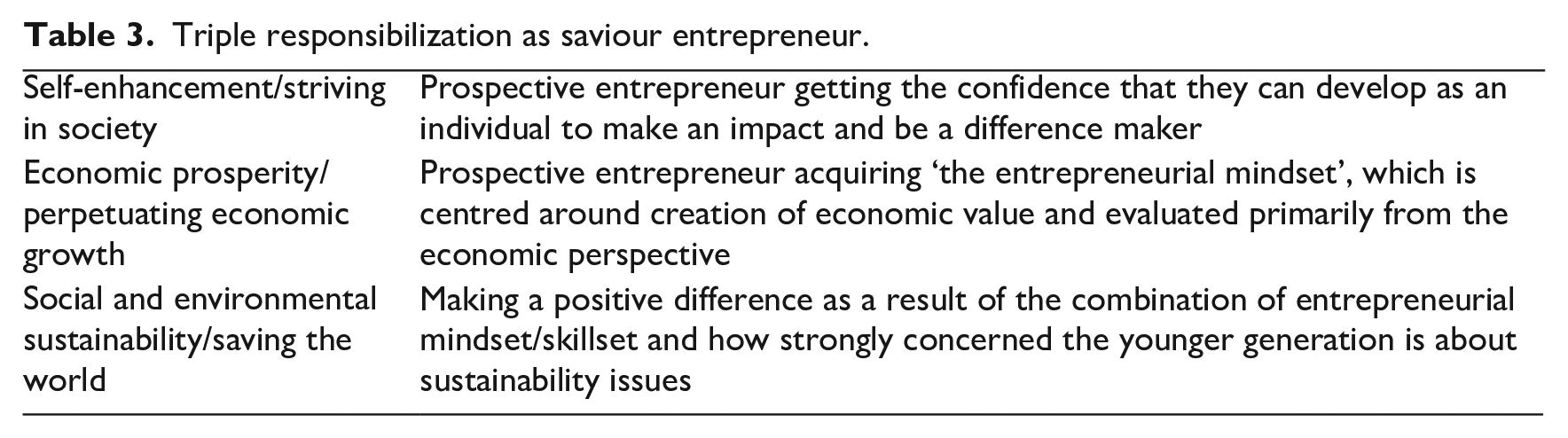
Here, the triple responsibilization can be seen as a ‘fantasy’ because it is as if there cannot be any tension between the desire to feel one can have an impact, self-actualize and appeal to the desire of investors (first layer of responsibilization), the desire to succeed as an entrepreneur by scaling up and creating economic value in society (second layer of responsibilization) and the desire to make the world a better place (third layer of responsibilization). The first and third layers are treated as addressing the same problem: young people feel powerless and angry that business as usual is unsustainable; therefore, if they can be made to feel empowered to make a positive difference through entrepreneurship, they will not only feel much better but also deliver sustainability. As if addressing ‘SDG problems’ was merely a matter of believing in yourself, believing you can do it. Thus, in this discourse of positive responsibilization, there is seemingly no moral burdening. Becoming an entrepreneur will liberate the individuals from their burden of Fisherian impotence and in turn deliver the needed innovations to tackle the sustainability challenges the world is facing. While a degree of ‘can do’ attitude is certainly useful when attempting to address complex societal issues through entrepreneurship, the complete absence of a problematization of possible unanticipated, undesirable consequences of innovative entrepreneurial solutions is concerning, as is the glorification of extremely risk-prone individuals as heroic figures whose example we should all follow to save the world. Excessive celebration of the disruptive entrepreneurial mindset might be even more problematic than the excessive moral burdening other responsibility discourses contribute to.
Discussion: concrete steps to re-politicize RMLE
We discuss some changes we made after realizing the problematic overburdening of activist consumers and self-managing employees in our respective courses, with the aim of challenging individual responsibilization while providing a more structural, political imagination. We then discuss how such structural imagination could help challenge the fantasy of the saviour entrepreneur.
Re-politicizing activist consumers
In the first illustration, while the moral burdening of the consumer was in many senses the limit of the imagined horizon of action, the students did have the capacity to problematize the link between accumulation, capitalist mode of production and animal welfare. This was largely triggered by the article by McLoughlin (2019) that frames animals as ‘sentient commodities’ in capitalist modes of production: Throughout the whole supply chain, animals are effectively objectified and rendered a mere bit of input-output economic processes, transforming from ‘sentient commodities’ to ready-made supermarket shelf products. (S1F)
Yet these insights arguably fall short of an explicitly political perspective that would problematize how this converts into a burdening of individuals (as consumers) through the responsibilization for social and environmental sustainability. This in itself is also a testimony of how strongly the HC socializes the consumer subject as the limit of imagined (individual) action.
An alternative imagination, however, was manifested in another part of the course when during a lecture on artivism, the invited activist, a renowned author of subvertisements, presented how he works in the intersection of art and activism. The activist lifted up one of his most successful subvertisements – a fake ad for the largest retailer in Finland and their sales of eggs produced by caged chicken. The retailer had previously successfully resisted animal activist pressure to stop selling eggs from caged chicken – by claiming this was in line with consumer preferences. The subvertisement campaign represented the retailer’s relation to chicken by depicting the caged animals as the commodity being sold in the retailer’s stores. When the activists were able to create a great deal of visibility for the fake ads, thereby complementing a broader campaign conducted by an animal rights organization, the retailer within 2 months contacted the animal rights organization with a promise to cease sourcing from caged chickens if the campaign was taken down. The artist also showed how both the biggest newspaper and outdoor advertising company in the country had refused to run the subvertisement as an ad with direct reference to losing ad revenues from the retailer – thus also drawing students’ attention not only to the systemic marginalization of animal welfare question by liberal media but also to the hidden structures of capitalism, where ad revenues tremendously affect media content and what is censored.
Re-politicizing self-managing employees
In relation to the second illustration, in order to help students see beyond ‘responsibilization’, its limitations and its discontents, Author 1 felt there was a need to make the lecture more explicitly political and started to re-design some key aspects of the lecture. A first decision was to, early on in the lecture, also address the question of the Taylorist shift from the perspective of a shift of control over the labour process (see, for example, Hanlon, 2016, 2018; Linhart, 2021). Indeed, Author 1 saw this question of control shift as another important way of illuminating the power shift and the political dimension of Taylorism, stripping the workers from their control over their own labour process and putting that firmly in the hands of management. In order to help the students understand these important points, Author 1 used some illustrations, most recently an extract from the podcast ‘Thinking Allowed’ where Laurie Taylor interviews Gavin Mueller about the political significance of the Taylorist managerial shift (while discussing Mueller, 2021).
As the lecture and its associated readings moved towards the question of management as providing tools for organizational control, the lecture became a more explicit problematization of ‘management’ as a project of making employees more efficient, often against the employees’ best interest. In most courses that students majoring in management and organization studies are exposed to, ‘management’ as such is not the target of problematization, but a course focused on organization theory can de-centre management and make it an object of critical inquiry rather than a straightforward set of ideas and tools to improve efficiency and quality: problematizing the assumptions behind management education requires being able to step out of ‘management’ (see, for example, Fougère et al., 2014; Ghoshal, 2005; Moosmayer et al., 2019). From this critical perspective, Taylor’s (1997 [1911]) project, framed as it was in terms of efficiency supposedly in a ‘neutral’ manner, can be shown to have been political at its heart. The analytical question of organizational control makes it possible to problematize the effects of management not only on technical outcomes such as efficiency and quality but also on more human aspects such as well-being. Taylorism can still be seen to influence management thinking today, in many ways (Hanlon, 2016, 2018; Linhart, 2021).
While the discussion of HRM drawing on Townley (1993) seems quite remote from the context in which scientific management initially developed in the early 20th century, there are also elements of continuity in the consequences of the managerial practices that enhance individual performance for corporate gain. Much like Taylorist disciplinary technologies often heightened the workers’ suffering while de-skilling them (Hanlon, 2016; Linhart, 2021), the effects of contemporary HRM disciplinary and confessional technologies on employees’ well-being are often problematic. One of the first insights that can be derived from a discussion drawing on Townley and grounded in the students’ own experiences of HR practices as employees relates to the ‘individualization’ and ‘responsibilization’ of employees and managers through performance and development discussions. The lecture has now been further developed to show how this responsibilization leads to heightened burdening of the individual employee, who becomes easily ‘culpabilized’ (Linhart, 2011) for not reaching the objectives they have committed to themselves. As Linhart (2011, 2017, 2021) has shown, this burdening of the individual employee or manager contributes to serious consequences for the individuals – such as burnouts, depressions, other mental health issues and sometimes suicides – while the organization typically denies any responsibility. Fisher (2009) sees mental health as ‘a paradigm case of how capitalist realism operates’ (p. 19), whereby depression becomes naturalized as an unfortunate fact of life that it is ‘incumbent on individuals to resolve’, while what would be needed would be to politicize the way in which individuals are permanently responsibilized and thus become ‘control addicts’ (p. 22). Using examples of some of the most extreme consequences of such new forms of control – by, for example, referring to the highly mediatized serial suicides at France Télécom (e.g. Linhart, 2017) – can help students understand the gravity of some of the consequences of the extreme responsibilization of individual employees by contemporary management practices.
Drawing on pop culture can also help students develop a more political perspective on contemporary management practices.
In the latest version of the session, an extract from the popular Swedish TV series Bonusfamiljen (Bonus Family, season 3, episode 3) was used to show how violent the injunction to personally and emotionally align with the organization can be. In the extract, fortysomething salesman Martin, one of the main and most relatable characters of the series, resists and eventually strongly rejects his superior’s demand to identify with the interests of the company that employs him and refuses to have ‘feelings’ for a store he has been working at for 13 years. This scene depicting outraged resistance from a character it is easy to identify with makes it possible for students to understand the violence of the managerial impulse to shape the employees’ personality and subjectivity (see Hanlon, 2016, 2018).
Challenging the fantasy of the saviour entrepreneur
In the pilot course, there seem to be two main assumptions about ‘solutions’ to SDGs: (1) innovative solutions developed by entrepreneurs are what is needed to address the SDGs, and (2) since the SDGs are grand challenges, problems that concern large areas and amounts of people, there would be scalable ‘markets’ to be served by these solutions, and thus tremendous business opportunities. While (1) and (2) might be true for some innovations, this outlook on the problem contains many blind spots: to name only two, the notion that business-driven solutions are best equipped to tackle grand social and environmental challenges, and the idea that ‘the entrepreneurial mindset’, drawing on heroic figures in the media, is the most decisive characteristic that is needed to address the SDGs.
One suggestion, which Author 1 has implemented in their course including Aim2Flourish stories, is to draw on the SDGs as a hegemonic policy instrument that claims to take grand challenges seriously and to invite students to take the SDGs in their entirety really seriously. This entails reading every ‘win-win’ innovation through the SDGs, not only for the ‘win’ sides but also for the (usually unvoiced) potential ‘lose’ sides, in as comprehensive a manner as possible. In the last session of the course, the students whose chosen innovations have been voted by their peers as the most inspirational win-wins, as per the appreciative inquiry spirit of Aim2Flourish (2023), are invited to debate with students who have scrutinized the potential negative impacts of their chosen innovations and attempt to convince an audience of the overall desirability of their innovation through arguments firmly grounded in all the relevant SDGs.
Conclusions and contributions: challenging triple responsibilization in business schools
In our Northern European academic context where the hegemony of homo oeconomicus might be more ‘challengeable’ than in market-oriented business school environments with high tuition fees and an obligation to cater primarily for the needs of business, it has been relatively easy for us to promote the advent of RMLE, thereby (largely unwittingly) conjuring the figure of homo responsabilis in the curriculum. But much as with the accommodations of capitalism to appear more responsible and pre-empt more demanding regulation, the advent of homo responsabilis makes it more difficult to challenge the neoliberal foundations of HC: who today can be against a more responsible approach to social and environmental impacts? Yet, as we have seen, an approach to business school education that frames all the correctives to unsustainable capitalism through the signifier ‘responsible’ can be seen to prevent the possibility of a more transformative change towards sustainability by (1) unrealistically envisioning radical change merely as the result of individuals becoming more virtuous (Friedland and Cole, 2019) while (2) running the risk of further burdening (morally and otherwise) business school students, (3) foreclosing their possibilities to develop alternative, collective ethico-political imaginations, and thereby (4) serving the (highly organized) interests of dominant industries, which historically have done everything in their power to defer responsibility and blame to individuals (e.g. Chamayou, 2021; Karpf, 2021; Linhart, 2011).
That is why we believe it is necessary to explicitly challenge the curriculum of homo responsabilis, and based on our recent teaching/learning experiences, we suggest a number of avenues for delivering such explicit problematization of homo responsabilis. These avenues are inspired by the spirit of ‘transformative learning’ (Blasco, 2012) and involve drawing on some of the students’ already established frames of reference in order to challenge their common sense and help them develop new ethico-political imaginations.
First, based on our first illustration on human–nonhuman relations, we can challenge students to go beyond the responsible consumer subject position through the societal activist subject position, which is also ‘responsibilized’ but still more collective and political than individual and moral. Here, the existing frames of reference that are leveraged as a hook for the students relate to the assumed omnipresence of advertising in their world. The activist who was invited to present his interventions uses the hegemonic visual culture of advertising to challenge corporate irresponsibility through subvertisements, sometimes as part of larger campaigns aiming at making corporations change some of their policies. In workshops about how to do subvertisements, he also gives students opportunities to identify with activist subject positions when creating their own ideas of subvertisements. In addition, when discussing how come the campaign about caged eggs was successful, he always emphasizes (1) what obstacles there were, such as the impossibility of publishing the subvertisement in the leading Finnish newspaper due to advertiser pressure, and (2) how the subvertisement was only one element in a broader collective effort involving watchdog investigations and adversarial dialogue with the corporation. Thus, students are exposed to some of the underlying structures of contemporary capitalism, and they can also see that despite obstacles, targeted collective action involving a number of passionate and creative activists can be successful.
Second, based on our second illustration on the overburdening of the self-managing employee, we can show that there is an opportunity in drawing on the frames of reference related to organization studies and ‘organizing’ (cf. Parker, 2018a) in order to critically examine management from the outside in. Teaching within a course called HRM, for example, presupposes that we accept the premises behind HRM. Drawing on organization theory terminology instead gives us the possibility to circumvent that problem and explicitly problematize ‘management’ from a political perspective. Management discourses depoliticize issues by suggesting that the alignment of organizational objectives with employee values is a full win-win with no friction, thereby pre-empting the possibility of antagonism and mitigating the expression of tensions, as in Costas and Kärreman’s (2013) analysis of CSR as aspirational control. Focusing in a de-centred manner on the question of organizational control makes it possible to directly problematize this managerial sleight of hand and to discuss what is eminently political in management. Furthermore, broadly shared frames of reference – whether highly mediatized stories like the France Télécom suicides or extracts from popular series such as in the example of Bonusfamiljen – can help the students realize the possible consequences of contemporary management practices on people and lead them to problematize these structural social sustainability issues from ethico-political perspectives, treating them as a mental health epidemic (Fisher, 2009) rather than as a matter of individuals having to get their act together.
Third, based on our third illustration about the triple responsibilization of sustainable entrepreneurship, we can start by strongly arguing for the need to foreground deep learning on the structural complexities of sustainable development at least as much as attempting to steer the students towards the entrepreneurial mindset that is needed to envision transformative sustainable innovations. Here, the SDGs, as broadly shared frames of reference, can serve as an excellent starting point to explore the interconnections between different social and environmental grand challenges of sustainability. Using them as a systematic framework for students to scrutinize the so-called win-win innovations (such as those studied through ‘appreciative inquiry’ in Aim2flourish) in terms of their possible negative consequences too can be a very fruitful way to help students reach a deeper understanding of sustainability issues, taking into account possible trade-offs between environmental improvements and social justice, for example. Thus, students may not be quite as ‘gripped’ by the potentially blinding win-win fantasy of sustainable innovation, and they may instead develop a consciousness of some of the relevant political aspects and structural constraints.
When positioning our contribution in relation to the agenda for future research on HC in RMLE outlined by Blasco (2020), we posit that the ‘tensions and contradictions’ that are alleged to exist between ‘business school as usual’ and RMLE are at play within RMLE itself (p. 476). If we are to explore ‘the undesirable societal ideologies and tendencies and promote RML[E]-friendly ones instead’ (Blasco, 2020: 476), we first need to understand better the effects of RMLE and its mainstream manifestations, such as PRME. Our contribution can be read as a problematization of mainstream celebratory accounts of RMLE (e.g. Haertle et al., 2017; Kolb et al., 2017; Rasche and Escudero, 2009; Storey et al., 2017), which assume that RMLE necessarily challenges ‘undesirable societal ideologies and tendencies’, as we show how explicit RMLE curricula instead might extend the neoliberal HC by adding a third layer of responsibilization on top of the two neoliberal layers of responsibilization discussed by Brown (2015).
Beyond this, we need to specify our contribution in relation to critical studies of homo oeconomicus in RMLE and business ethics (particularly Friedland and Cole, 2019; Moosmayer et al., 2019). We agree with much of the critique of homo oeconomicus (and RMLE in the case of Moosmayer et al., 2019) as articulated in these studies, but through this article we have further problematized the proposed correctives that rely on individual ethics (the ‘homo virtus’ of Friedland and Cole, 2019) or individual mental models of the learner (the pragmatist suggestions of Moosmayer et al., 2019). Indeed, we argue that while these individual correctives can seem to be potentially useful, they also run the risk of making the RMLE curriculum even more individually responsibilizing than it already is – by adding layers of individual responsibilization on top of those that students already experience very strongly due to the strong neoliberal HC centred on human capital.
Much like the studies by Asirvatham and Humphries-Kil (2017), Millar (2020) and Ramboarisata (2021), we call for re-politizicing RMLE. We largely agree with their suggestions, but we provide, we hope, further clarity as to what is problematic with RMLE, that is, the third layer of responsibilization on top of the very strong, implicit, HC-related neoliberal layers of responsibilization which are taken for granted. In addition, we also contribute to these studies by providing a number of suggestions for transformative learning drawing on broadly shared frames of reference to help students think more in terms of structural, political and collective dimensions of action.
As we continue working with RMLE in our business schools, we no doubt need to remain aware of what can be progressively transformative in the responsibility framing, including the moral imagination it instils in students and the reflexivity that follows from that. That said, we reiterate here that responsibility learning cannot be enough and comes with its own pitfalls. Our most important tasks as RMLE educators are to remain alert to these pitfalls, ensure that our students be vigilant about what the explicit RMLE curriculum added on top of a neoliberal HC entails in terms of responsibilization of individual subjects and, together with them, actively search for ways to generate alternative imaginations of what could more effectively bring about the radical sustainability transformations that are needed.
