




Abstract
This study explores how the adoption of management ideas is conditioned by wider macro-level mentalities that are not company based but that instead reflect professionally or nationally rooted ways of managing. Drawing from studies on professional mentalities and practices, we study Finnish top executives working in globally operating multinational corporations in the metal and forestry industries, showing how, starting in the 1980s, they adopted new management practices during the rise of globalisation, market liberalisation and post-Fordism. Altogether, a traditional engineering mentality strongly conditioned the dissemination of new management ideas, which needed to adapt with the existing mentality. As a result, we find three ways of management idea dissemination: (a) new ideas had to fit in with the old business elite mentality, (b) new ideas were side-lined and belittled by the old mentality and (c) new ideas were smuggled into management by reframing and widening the old mentality. By extending Guillén’s work on elite mentalities, the study contributes to the research on management ideas by exploring the role of societal macro-level mentalities in management learning, highlighting their role in times of societal transformation.
Keywords
Introduction
Why do some management ideas succeed while others fail? The dissemination of management ideas is often explained by looking at the dynamics within corporations (Ansari et al., 2010; Boxenbaum and Pedersen, 2009; Canato et al., 2013; Gondo and Amis, 2013). We argue that the adoption of new ideas may also be conditioned by wider macro-level mentalities that are not company based but rather reflect professionally or nationally rooted ways of performing management.
Theoretically, we draw from Guillén’s (1994a) work on management ideas in the United States, Spain, Germany and France, examining management ideas and practices as conditioned by national elite mentalities and professional groups (pp. 25–26). We develop this perspective by pointing out how new ideas clash with existing elite mentalities; in this case, to survive, new ideas need to adjust with the old mentality by either uniting with it or smuggling new practices into management by reframing and widening the old mentality. To better explore this, we draw on research that has examined how professions form joint understandings and mentalities through everyday work (Iedema et al., 2009; Linde, 2009; Maynard, 1988; Orr, 1996). The vast literature on management ideas and practices has drawn on a variety of schools of thought, most notably on institutional theory (e.g. Ansari et al., 2010; Boxenbaum and Battilana, 2005), Scandinavian intuitionalism (Boxenbaum and Pedersen, 2009; Czarniawska and Joerges, 1996; Czarniawska and Sevon, 1996; Sahlin and Wedlin, 2008) and practice-based theories (Canato et al., 2013). However, the theories on professional learning (Orr, 1996) have been less researched in the context of management ideas and practices. We posit that these theories provide a way to understand how macro-level mentalities stemming from national or professional cultures may play a role in management learning.
We demonstrate our point empirically by drawing from retrospective accounts of 35 members of the top executives from four multinational corporations (MNCs), showing how the adoption of new management ideas was strongly conditioned by the existing professional business elite mentality, which emphasised traditional engineering and rational management mentality and belittled management theories drawing on organisational culture and human resources (HR). Engineering knowledge was regarded as important for top managers in Finland since the beginning of the 1900s (Fellman, 2000: 222–223; Kuokkanen and Seeck, 2013: 218), during which engineers evolved into a tight professional group with shared practices (Michelsen, 1999). We suggest that this engineering mentality largely conditioned the adoption of new management ideas while developing globalised forms of production, here in the context of market liberalisation (Kantola et al., 2019; Kunda and Ailon-Souday, 2005). In our case, much of the management learning took place dynamically (Iedema et al., 2005; Wenger, 1998) through incremental learning and improvisation (Orr, 1996) in management idea adoption and by solving mundane problems in everyday work (Gherardi et al., 1998; Wenger, 2000), as top managers tried to adjust the new ideas, so that they could fit in with the existing engineering mentality. Thus, the life cycle of management ideas was not so much one of novel ideas taking over old ones; rather, it was one of adjusting pragmatically, sometimes even in concealed ways to the existing mentality.
Our study contributes to the research on management ideas by exploring the role of societal macro-level mentalities in management learning, highlighting their role in times of societal transformation. Besides considering the national and professional macro mentality of business managers, this macro perspective shows how, starting in the 1980s, new management ideas were adopted as market liberalisation, globalisation and post-Fordism changed the working environment of management.
Business managers’ mentalities in the macro context
Much research has been conducted on evolving management ideas (Bodrožić and Adler, 2018; Cummings and Bridgman, 2016; Seeck and Lamberg, 2019), particularly on management trend setters (e.g. consultants, management gurus and business media) who create interest in, develop and legitimise new management practices (Abrahamson, 1991, 1996, 1997; Birkinshaw et al., 2008; Clark and Greatbatch, 2004; Engwall and Kipping, 2004, 2006; Greatbatch and Clark, 2003; Greatbatch and Clark, 2005; Groß et al., 2015; Huczynski, 2006). Yet managers play a key role in the adoption, implementation and translation of management practices (Balogun et al., 2015; Canato et al., 2013; Van Grinsven et al., 2020; Wedlin and Sahlin, 2017). Management ideas are often employed to justify and maintain the authority of managers, not merely to justify a specific set of techniques (Bendix, 1956, 1959; Frenkel, 2005; Shenhav, 1995, 2002 (1999)).
In particular, top managers are the key players in adopting new ideas: management ideas develop and spread if managers perceive them as effective (Guillén, 1994a), rational and innovative (Abrahamson, 1996) solutions to prominent problems. Managers can have multiple reasons for implementing new ideas. Overall, management ideas help managers run their organisation, controlling the unpredictability of their environment (Jackson, 1996). Yet studies have highlighted various personal reasons from the managers’ point of view: management ideas can (a) enhance the managers’ sense of self as leaders (Kantola, 2014: 33–36; McCabe, 2011; Watson, 1994, 2001), (b) serve as career enhancers those managers who introduce and implement them, (c) be used as excuses, (d) provide fast results to pressing problems, (e) reduce boredom (Huczynski, 1993: 452–453) and (f) be ‘a desire by managers to be noticed’ (Marchington et al., 1993: 553). Hence, the dissemination of management ideas necessitates a match between the personal interests of the managers and existing practices of the adopting organisation (Ansari et al., 2010; Gondo and Amis, 2013).
At the same time, however, much of the recent research has focussed on the company-level micro processes of management learning. Examining the evolution of management ideas in a society as the joint effect of organisational problems and institutional factors (cf. Guillén, 1994a) is an important study area. We know that the societal macro-level also plays a substantial role in the dissemination of management ideas (Frenkel, 2005; Kalev et al., 2008). However, there are areas at the societal macro-level that have been less researched, such as the role of mentalities. In this respect, Guillén’s (1994a) work stands out in examining management ideas and practices as conditioned by national elite mentalities across countries. For Guillén (1994a: 25), elite mentalities are ‘enduring modes of thought, which are characteristic of a group or class based upon implicit, nonreflective, and subjective assumptions as to how the world works’. Mentalities matter in management not only because they provide assumptions on what works in management, but also because they keep the members of a group from accepting one particular organisational solution over other (Guillén, 1994a: 25).
This approach emphasises the strength and endurance of managers’ mentalities as they are grounded on the underlying institutions and organisations. Indeed, Guillén (1994a: 20–28) suggests that the institutional factors and organisational problems largely impact which management ideas are adopted as solutions to the detected problems. These institutional factors may include, for example, economic competition, state regulation and the position of trade unions in society (Guillén, 1994a: 1–18). Also, according to Guillén (1994a: 21), macro-scale organisational problems often play a role in the introduction of management ideas. Thus, for example, the structure of the economy, international forces and worker actions that challenge the authority of management, such as strikes or sabotage (Guillén, 1994a: 21), may affect the adoption of management ideas. Moreover, a host of institutional factors have influenced what organisational solutions have been adopted in different countries, including the mentality of the business elite, the role of the state in the dissemination of management ideas, the positions of professional groups and experts supporting the idea and response of employees to the implementation of the idea, the regulatory activities of the state, the position of the state in the supranational system and the status of labour unions in society (Guillén, 1994a: 20–29).
Thus, even the most well-known management ideas may follow differing patterns in various contexts (e.g. Guillén, 1994a) and become embedded in their respective contexts (Seeck and Lamberg, 2019). Management ideas can manifest as different ideological and technical ‘solutions’ (Bodrožić and Adler, 2018; Guillén, 1994a: 7)) because the unique elements of different societies and how they relate to each other may induce considerable variations in the evolution of management ideas (Frenkel, 2008).
Management ideas may also be sustained by elite groups, which have an important role in the adoption or rejection of management ideas. Thus, national elites, labour unions and even religions have drawn upon specific elite mentalities (Guillén, 1994a, 1994b). In Germany, for instance, Protestant management intellectuals have been in favour of scientific management, while Catholics have preferred the human relations school. In Spain, Catholic theoreticians have played a decisive role in spreading the ideas of the human relations school (Gorski, 2003; Guillén, 1994b; Seeck and Lamberg, 2019). There is also evidence at a more general level that in Europe, ascetic Protestantism – particularly Calvinism – has led to the emergence of more rationally governed societies than in predominantly Catholic countries (Gorski, 2003; Guillén, 1994a, 1994b; Seeck and Kuokkanen, 2010; Seeck and Lamberg, 2019). Thus, we draw on this embedded approach to management ideas, analysing how the adaptation and translation of management ideas is conditioned by executives’ elite mentalities within specific cultural and organisational contexts (Seeck and Lamberg, 2019).
Although Guillén’s work importantly points to the importance of the macro-level mentalities, we develop this approach by suggesting that the more micro-level developments may matter: both the macro- and micro-levels may play a decisive role in the adoption of management ideas. In Guillén’s account, the focus is clearly on macro-level developments. Subsequently, often the dissemination of management ideas is described as a cyclical development, one where scientific management has oscillated with the human relations modes. From this macro perspective, the models that fall in-between these paradigmatic models, such as lean production and total quality management (TQM), may seem somewhat obscure and eclectic (see, for example, Guillén, 1994b). We, however, suggest that this eclecticism perhaps points to a key feature of management learning: namely to the fact that the adoption of new ideas is conditioned by old ones. As a result, management seldom changes abruptly but instead evolves gradually because traditional macro mentalities have an upper hand in the process and there is a fine-grained struggle at the micro-level, where the old ideas belittle the new ways while the new ideas are moulded and smuggled into management in inventive ways to shift the practices in a shrouded way.
Therefore, to draw attention to management learning where both the macro- and micro-levels matter, we draw from practices studies that have turned from macro-level studies (e.g. Abrahamson, 1996; Strang and Meyer, 1993) towards investigating the micro processes occurring at the organisational level of practice implementation (Ansari et al., 2010; Boxenbaum and Battilana, 2005; Canato et al., 2013; Gondo and Amis, 2013; Reay et al., 2013). This perspective suggests that management practices are not adopted as ‘off-the-shelf’ solutions (Ansari et al., 2010; Canato et al., 2013; Gondo and Amis, 2013). Many studies on management practices have explored the changes that occur in a practice when being adapted to the local level; for example, practice variation has been shown to depend on the compatibility or fit with the local context and may involve the mutual adaptation of the practice, on one hand, and the organisation, on the other hand (Ansari et al., 2010; Canato et al., 2013). However, we suggest that it is important to consider how these changes are conditioned by the macro-level. In business management, managers are, for instance, also professionals who rely on their professional education and perspective in their work. This professionalism is not only a matter of formal credentials and processes, but also various professions (Iedema et al., 2009; Linde, 2009; Maynard, 1988; Orr, 1996) learn, adopt and develop new practices through informal dialogue and learning from their experience developing tacit knowledge: best practices, conventions, subtle cues and rules of thumb (Gabbay and Le May, 2004; Hindmarsh and Pilnick, 2002). Indeed, Orr’s (1996) seminal work demonstrates how copier repairmen build a shared professional know-how by sharing experiences of puzzling problems; this shared understanding hid beneath the formal organisational structures and policies (Orr, 2006: 1807). Similarly, other professions such as insurance agents (Linde, 2009), anaesthesiologists (Iedema et al., 2009), attorneys (Maynard, 1988) and juvenile probation officers (Jacobs, 1990) all developed their professional practices through informal engagement. Thus, these tacit practices typically come to build larger embodied understandings and shared worldviews of the profession (Amin and Roberts, 2008: 359), which are also transferred to newcomers (Bleakley, 2002; Lave and Wenger, 1991: 29).
Thus, in what follows, we consider how the macro- and micro-levels relate in adopting new management ideas as practices. We empirically explore how Finnish top executives adopted new management ideas in the 1980s and 1990s as the globalisation of markets and the rise of post-Fordist production models transformed companies from nationally owned, production-oriented ventures into key global players (Fellman, 2003; Hjerppe and Larsson, 2006; Kantola et al., 2019; Lilja and Tainio, 1996, 2006). Following Guillén (1994a), we suggest that the shared understandings of the profession and national mind-set constitute a wider professional mentality rooted in the wider societal and cultural context, exploring its role in times of systemic change. We examine the Finnish top executives as part of a wider historically rooted engineering mentality that has developed in Finnish industries since the 19th century and is still influential today while having faced considerable challenges in the last decades of the 20th century with globalisation and the rise of post-Fordist logics of production. We analyse how this macro mentality conditioned the adoption and development of new management ideas and practices as business managers sought ways to adapt to the changing conditions of market liberalisation by searching and implementing new ideas. Thus, we examine how this macro mentality influences and is present in management learning as top managers face new management ideas and make decisions about what kinds of ideas will be adopted, along with how these ideas will be implemented (see also Ansari et al., 2010; Hellgren et al., 2002; Kieser, 1997; Zbaracki, 1998). As a result, we show how the managers came up with inventive ways by selecting ideas that fit with the past or alternatively introduced new ideas in a concealed way to better fit the new ideas in with the old. Thus, the macro-level changes incited processes of joint learning by trial and error (Gherardi, 2009: 110), with managers trying to map the ongoing changes and test new practices and management ideas (Gabbay and Le May, 2004; Hindmarsh and Pilnick, 2002) to manage the organisation in new conditions.
Methodology
Context
The top executives who participated in our study represented four MNCs: two metal and two forestry companies (Table 1). The company headquarters are in Finland, and all companies are listed on the stock exchange (Nasdaq Helsinki). The metal and forestry industries were selected because Finnish industrialisation in the mid-19th century was largely founded on iron and forest products, which still account for a large share of Finnish exports. However, recent market globalisation has transformed the companies in these sectors (Lilja and Tainio, 2006). Postwar development was strongly affected by the diversification of export products, the internationalisation of industrial activity, trade liberalisation and EU integration (Lilja and Tainio, 1996). In the 1960s and 1970s, these companies (or their predecessors for companies that merged) expanded heavily into foreign markets, and amid financial liberalisation during the 1980s, foreign investments in Finnish firms steadily grew (Fellman, 2003; Lilja and Tainio, 2006). Consequently, these companies experienced major structural transformations; they grew rapidly in size, adopted new organisational models, took steps towards internationalisation and emerged as global leaders in their fields (Hjerppe and Larsson, 2006). These are among the most attractive targets for new management ideas because MNCs have the resources to implement them. The top managers of these MNCs are well known in the Finnish business media and are members of the Finnish business elite. In Finland, the metal and forest industries were the most important until the rise of the telecommunication industry, so it is hardly surprising that engineers have had an influential role in shaping management (Kuokkanen and Seeck, 2013; Michelsen, 1999: 217).
Characteristics of the MNCs.
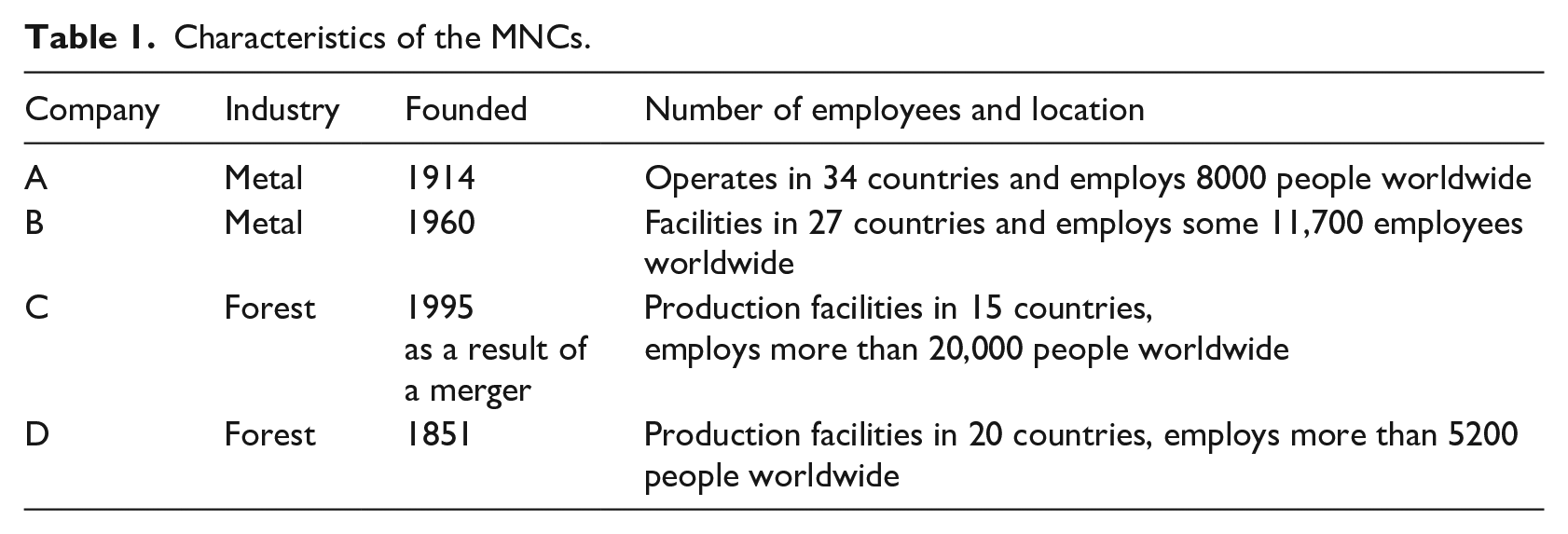
To identify the entry of multiple management ideas within these organisations and identify how top managers explain their usage, the current study required retrospective accounts of long-term top managers active through a change from a closed economy to a liberalised market economy. The period is from the early 1960s to 2008. The respondents had long careers in corporations, with many starting in the 1960s. Older managers often started in the corporation as trainees and were promoted, ending up as members of executive groups or even chief executive officers.
Data
Interviews
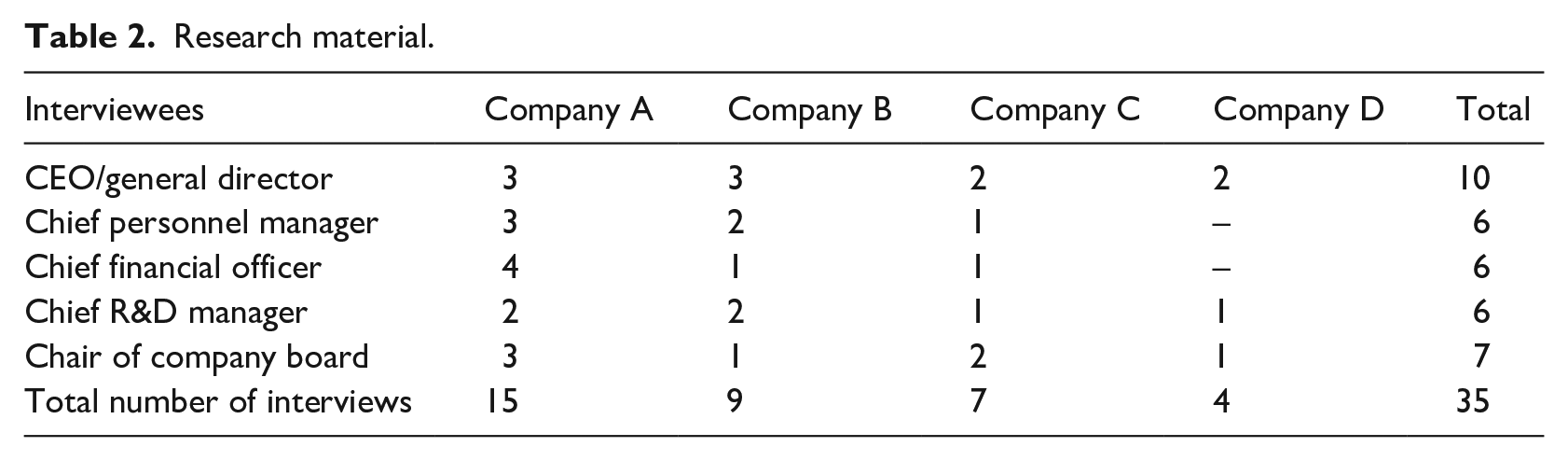
We conducted 35 semistructured interviews. The respondents were chief executive officers, general directors, chief personnel managers, financial directors, research and development (R&D) managers and chairpersons of company boards (Table 2). The interviews were held on the company premises or at the interviewees’ homes, whichever the interviewee preferred. Most of the interviews lasted around 80 minutes, the longest for around 100 minutes and three less than 80 minutes. There was only one woman among the respondents, which accurately depicts the presence of women in the management of Finnish metal and forest industry companies for the study period. All interviews were recorded with the respondents’ consent and later transcribed.
Research material.
The interview frame was partly constructed by drawing on Guillén’s (1994a) work. The questions focussed on the arrival of new management ideas and techniques, organisational culture, company history and the institutional factors behind the adoption of management ideas Many of the questions related specifically to the following themes: critical turning points in the company’s history and their implications for business and management; the personal experience of being a manager, particularly during these turning points; and the meanings and viewpoints assigned to the specific management approaches and practices used in the company or industry as a whole. The respondents were also asked if they remembered any management fashions, fads or buzzwords during their careers. In the interviews, the use and adoption of management ideas and practices was investigated in several ways. The collection interviews was part of a larger multidisciplinary research project focussed on the arrival and translation of management ideas in Finland during the 20th and 21st centuries, including during market liberalisation.
The interviews can also be regarded as expert interviews because all the respondents had long careers in large companies. They represented several generations of managers: the youngest were in their forties, with the oldest approaching their nineties. Many of the former managers had worked in the company since the 1960s. The older managers with extensive careers within the company had a long historical perspective and multifaceted outlook regarding the management of their company. There was also a clear difference compared with recently recruited managers: for most of them, their position as a member of the executive group or even chief executive officer was their first position in the company. Many of the respondents had worked in numerous positions and had experience of several organisational levels. They also had various standpoints in the organisation because they represented different branches of management. Thus, some of them gave priority to the strategic and economic aspects of management, whereas others stressed personnel management or research and development, here according to their post and orientation.
Analysis
All interviews were recorded after receiving the respondents’ consent before then being transcribed. Analysis of the interviews proceeded in stages. First, we analysed the interviews at the company level by writing a brief account of the usage of management practices and ideas in each company. We used Atlas.ti to categorise and order the research material. At this stage, the similarities between the companies became evident; we decided not to focus on individual companies.
We conducted Gioian analysis (Corley and Gioia, 2004; Gioia et al., 2013), which refers to ‘a systematic approach to new concept development and grounded theory articulation that is designed to bring “qualitative rigour” to the conduct and presentation of inductive research’ (Gioia et al., 2013: 15). The analysis proceeds from a full set of first-order terms and second-order themes and aggregate dimensions, which form a basis for building a data structure (see Figure 2). The data structure allows us to organise our data into a visual aid, which shows ‘a graphic representation of how we progressed from raw data to terms and themes in conducting the analyses’ (Gioia et al., 2013: 20). This enhances rigour in qualitative research (Gioia et al., 2013; Tracy, 2010).
Theoretically, we drew on Guillén’s (1994) conceptualisation of the general features (perceived problems) and ideological features (rationality assumptions, views of workers and how to manage workers) of management ideas and the works of Oliver (1992), Ansari et al. (2010) and others (Barley and Kunda, 1992; Fleming and Sturdy, 2011) to determine which management ideas were discussed and how their dissemination and usage were considered. Figure 1 summarises the first stage of the interviews.
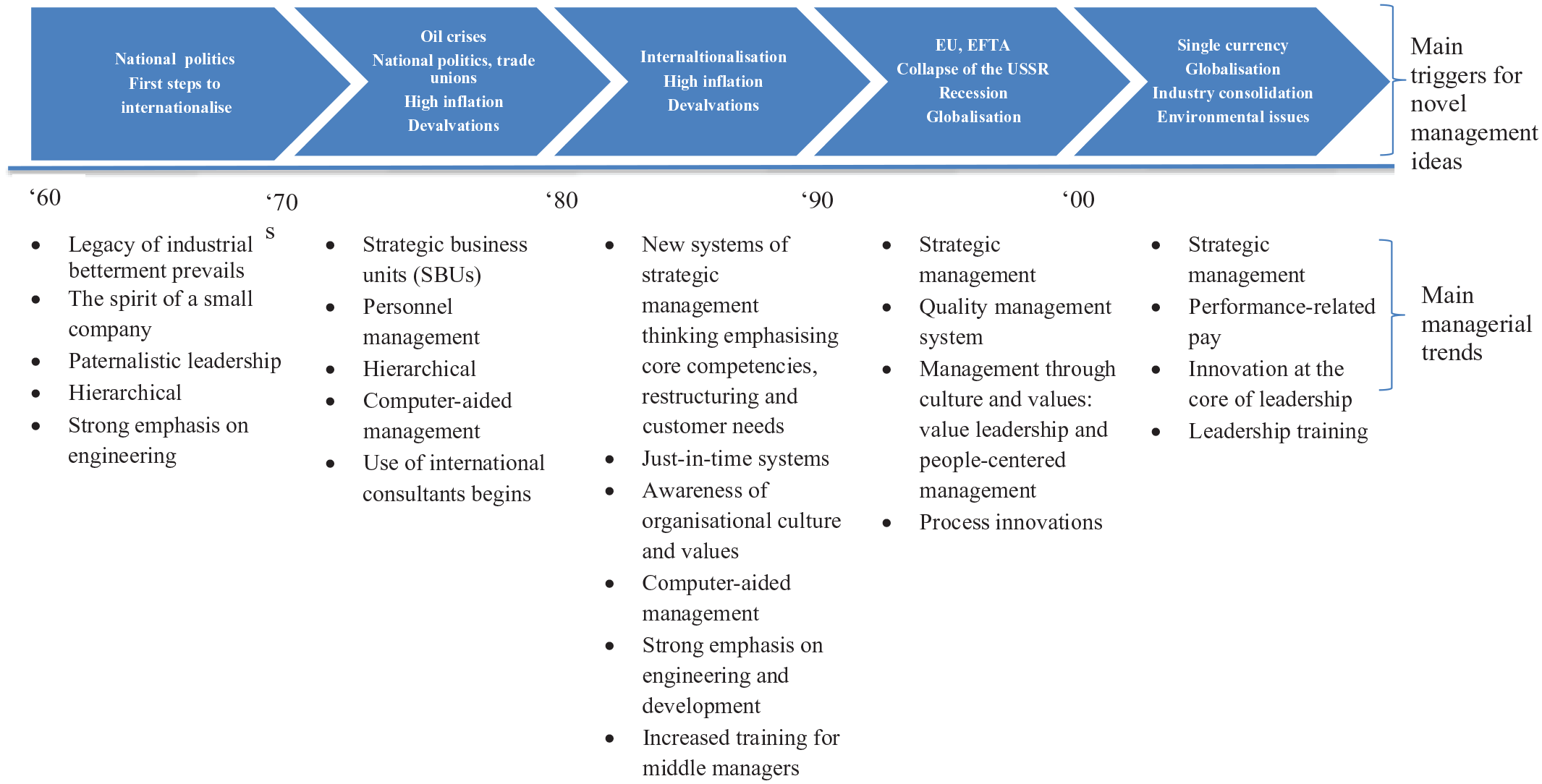
The evolving context of management ideas in the companies under study.
In the second stage, we continued our analysis by coding the individual interviews using Atlas.ti. This began without predefined codes to divert our thinking away from our expectations and previous theorising on the topic (Figure 2). At this stage, we followed a coding procedure, as in Gioian analysis (Corley and Gioia, 2004; Gioia et al., 2013). We organised our raw research into concepts reflecting usage and capturing how management ideas were approached. During the first round of coding (first-order coding), we extracted the relevant codes or themes that arose and recorded the relationships between them. These first codes were created based on the statements that emerged in the interviews, detailing significant topics, respondents’ perceptions and the processes of meaning-making. During the second round of coding, we integrated the first-order codes into more theoretical and abstract categories. We moved back and forth between the research material and emerging structure of theoretical arguments (Gioia et al., 2013; Locke, 2001). Finally, we aggregated our findings in three main ways that capture how the top managers’ mentality impacted the adoption of new management ideas in the context of market liberalisation. The data structure in Figure 2 demonstrates the outcome of this process of theory elaboration; during this stage, our analysis became more theory driven. In what follows, we describe how the adoption of new management ideas took place in the studied Finnish companies.
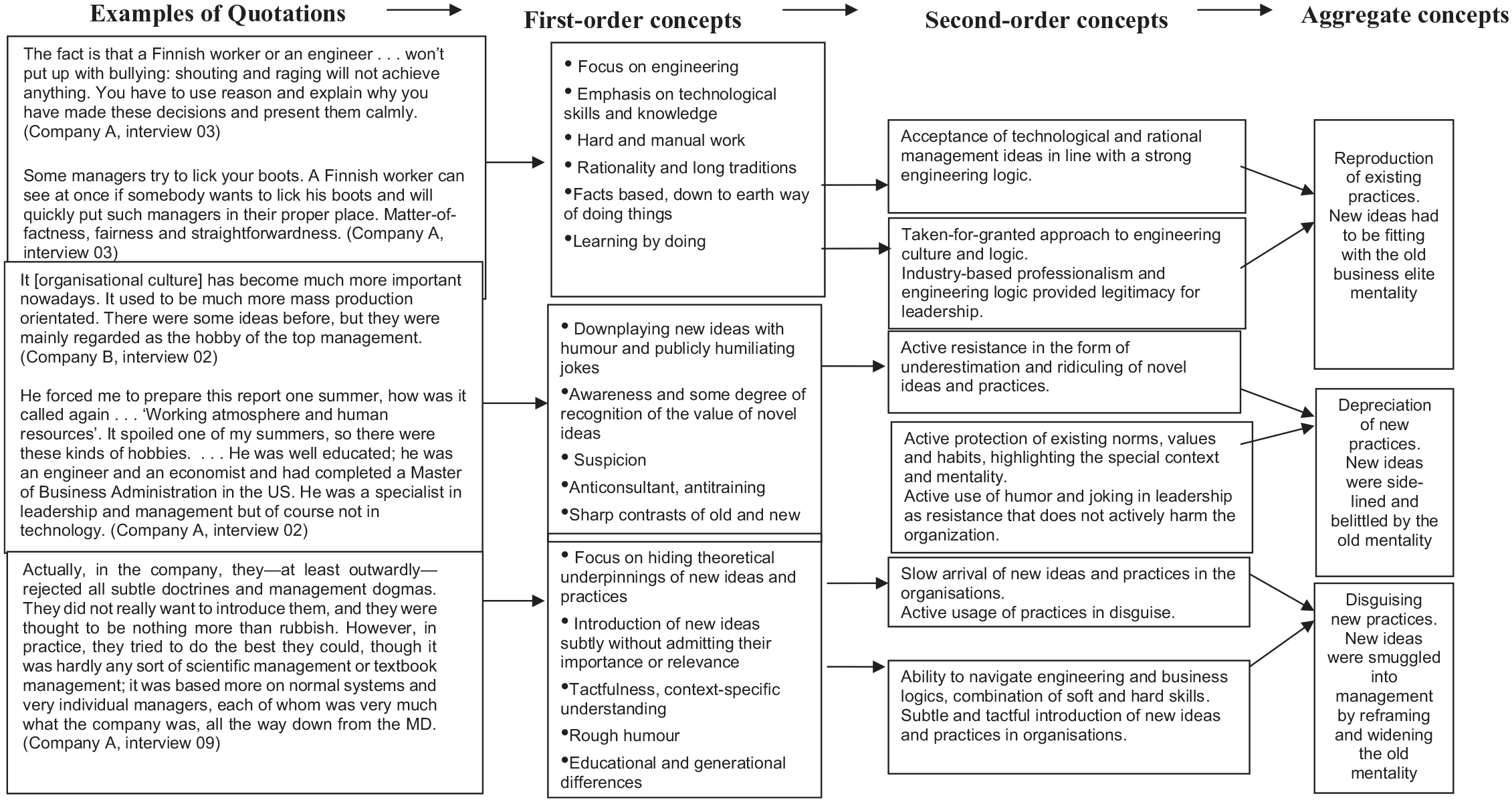
Data structure.
Results
Since the 1980s market liberalisation, globalisation and post-Fordist production models have transformed the working environment for many companies. The postwar Fordist–Keynesian system started to give way to new logics of production as information technologies sped up the flow of goods and services and market liberalisation globalised their operational environment. The investment–profit–investment cycle accelerated, and profit rates declined (Giddens, 1991: 11) as many industries changed into flexible network enterprises delivering ‘just-in-time’ products for niche customers (Castells, 1996: 151–279).
Consequently, companies needed new ideas for management; a flow of new management ideas disseminated, suggesting ways to manage the increasingly hectic and flexible corporations (Huczynski, 2006; Jackson, 2001: 8–13; Kantola, 2014; Kantola and Seeck, 2010; Osborne, 2004). Management gurus and developers ‘packaged’ management ideas and knowledge to products sold to organisations, making top managers the consumers of these products (Alvarez, 1998; Kantola, 2014; Madsen and Slåtten, 2013; Thomas, 2003: 775) suggesting what managers ought to do in the ongoing business situations (Huczynski, 1993: 444; Kramer, 1975: 47).
Many companies focussed on their core competencies through radical restructuring, leading to many cuts (Kunda and Ailon-Souday, 2005). Market-driven management requires that firms adjust their behaviour practically and structurally to market requirements, concentrate their operations on core areas of competency and downsize and outsource their workforce to meet customers’ expected needs (Kunda and Ailon-Souday, 2005). Workforces were reduced, hierarchical layers and functional departments were eliminated, and almost all activities, except the perceived core competencies, were outsourced. Initially, outsourcing affected support and specialist functions, but in the 1990s, functions closer to the core of organisations, such as call centres and manufacturing, were outsourced (Caniëls and Roeleveld, 2009). Outsourcing affected a variety of activities, from legal training to cleaning (Merino and Rodríguez, 2007).
All four large companies that we researched became internationalised and underwent major structural transformations, beginning to operate globally in their fields (Fellman, 2003; Hjerppe and Larsson, 2006; Kantola et al., 2019; Lilja and Tainio, 2006). In Finland, also the largely state-led and coordinated trade with the Soviet Union played a major role in the national economy, contributing a fifth of foreign trade. The fall of the Soviet Union and loss of Soviet trade in the early 1990s pushed many industries to seek new markets.
In the interviews, the managers discussed how these transformations led the companies to reformulate their management practices, inciting processes of joint learning by trial and error (Gherardi, 2009: 110), with top managers trying to map the ongoing changes and trying our new practices and management ideas (Gabbay and Le May, 2004; Hindmarsh and Pilnick, 2002) to manage the organisation in these new conditions.
We describe the three main ways management ideas were adopted, which captures top managers’ mentality as impacted by the adoption of new management ideas in the context of market liberalisation: (a) the persistence of existing mentality, or the way in which new management ideas were only adopted if they fitted an existing business elite mentality; (b) belittling new ideas, or the depreciative tone in which new ideas were side-lined and belittled by the old mentality and (c) reframing the existing mentality, or how the new ideas were smuggled into management by reframing and widening the old mentality (see Figure 2).
The persistence of mentality: new ideas adopted if they fit with existing mentality
Many executives recognised and recalled the traditional engineering culture, which had been the sustaining force behind their mentalities since World War II (Michelsen, 1999, 2001), seeing themselves as active heirs to a historical legacy of engineering culture. The engineering culture and self-esteem of managers and employees were nurtured by a feeling of competence and inventing things that could impact the industry. The managers valued both company traditions and the capacity for radical inventiveness: I would use the expression ‘engineer culture’, which means that we were busy with different kinds of things with very, very high self-esteem because we had recovered from an extremely difficult situation after the war. . . . There was a scarcity of electricity and everything else, too, and then, we invented a method of melting that generates energy from the ore itself. We managed to do it, and the method started to conquer the world. Nowadays, about half of the copper in the world is made using our method. We understood that we were good at it. (Company A, interview 05)
In this culture, effective production and R&D were highlighted as the most important aspects of management. These attitudes are like the one Kunda (1992) encounters, in which the employees described the company as a ‘country club’ or ‘engineers’ sandpit’. In Finland, the paper and metal industries were a prominent sector in the national economy, and engineers were the key professional group in charge of them (Fellman, 2000: 222–223, 2003; Kuokkanen and Seeck, 2013; Michelsen, 1999). The interviewed executives echoed this view: in their own companies, they saw that the companies offered many opportunities for engineers, so they had the best engineers and the best technology. One of the executives praised his own company: A fascinating [workplace], especially for a young engineer. Really interesting work tasks. The staff had a lot of responsibility, even when they were still young because they had some exorbitant production equipment. I was deeply involved in investment projects and got to travel around the world, finding out what technology was the best and . . . very interesting. (Company B, interview 02)
This engineering mentality fit well with new management ideas, which emphasised R&D-related management and rationally justifiable ideas, such as TQM, business process re-engineering (BPR) or strategic management. All these management ideas were accepted because they fit with the existing engineering mind-set. When we asked what types of management ideas and techniques the MNCs implemented in their careers, the executives most often mentioned BPR, TQM and management by objective (MBO). These management ideas typically focus on changing production rationally: they reorganise operations, quantify results and control output in concrete terms, often acting as the drivers of systemic changes and organisational restructuring (Figure 1).
Moreover, the executives also mentioned another group of rational management techniques aiming to impose effective market conditions on organisations. These were, for instance, management ideas relying on strategic management and the pursuit of core competencies that use data as a tool for management-driven systemic changes and organisational restructuring. These techniques reorganise operations and quantify results while controlling the output by quantifying them rationally, thereby bringing home market imperatives to employees in concrete terms. Employees were expected to supervise their own work processes, understand market logic and perform their tasks as if they had personal ownership of the company (see Kunda and Ailon-Souday, 2005).
Belittling new ideas: resisting new practices that question the existing mentality
The new networked and globalised modes of production also gave rise to a range of management ideas contradicting the existing rational management paradigm. As a reaction to these new ideas, many executives took a stance belittling these ideas, thus defending the traditional engineering culture as a form of pragmatic hands-on management not requiring new ideas for management. An emphasis on everyday pragmatism had been typical for Finnish managers in the 20th century (Kuokkanen and Seeck, 2013), and it was also used in the 1990s to counter new ideas.
In particular, ideas on personal management were often regarded as unnecessary. Thus, for instance, theories of human resources management (HRM) and organisational culture were regarded as fads and fashions because engineering was seen as being about common sense and a matter of the managers’ personal experience to lead based on the ability to relate to all types of people. Because these skills were perceived as an innate quality of the manager, there was no need to acquire formal ideas or education. Almost all the respondents said they seldom read books about management and felt little enthusiasm for management courses, with an ‘if you have attended one, you have seen them all’ mentality: Managing and running a business are not such a big thing. Here, the original company way of thinking was good. We didn’t want to introduce formal, precise systems. Instead, we believed we knew what we were doing and did what we wanted. When you have the right people doing it, you get the result you want. The next lesson could be organic management without these spices – they are artificial. (Company B, interview 09)
Formal management education or theoretical knowledge about management was considered unnecessary or even useless: Well, there is a wealth of literature. So many books, and when you read them, you get the feeling that you cannot really learn anything. . . . I believe that you have to grow to be a leader. But this I call the theoretical knowledge about leadership – I mean now, when you really talk about real-life leadership – I don’t believe in it. I believe that you grow to be a leader through experience [not through theoretical knowledge], and what you need is good basic skills. (Company C, interview 03)
Also, management ideas emphasising the need to pay attention and build organisational cultures by relying on methods, such as creating joint missions and visions, were often ridiculed. As one executive described, the new ideas on forming joint visions for the company were perceived as just trends: But of course, all the visions and missions back then were pretty light hearted, and not a lot of thought went into them. Many ridiculed them. ‘Vision? What about a television?’ Back then, they hardly bothered with it all; someone produced a document, it was put away in a desk drawer, and the following year, it would be dug out again. (Company B, interview 02)
Thus, although top managers were aware of past and current fashions and buzzwords, as McCabe (2011) notes, they were not employing them; rather, they emphasised the importance of existing practices and did not see new ideas as relevant. Also, company-wide management models were rare: I think that it has a lot to do with the strong personas of Mr M and Mr B that still haunted the place. [. . .] Mr B used to say that if someone insisted on having more information, the thing to say was, ‘We don’t distribute information; we distribute a dividend’. He felt that was enough. (Company A, interview 11)
Many respondents also described the tensions in a humorous way, indicating the tensions between old mentality and new ideas. Humour in organisations has been shown to be a way of expressing social frustration or conflict without risking the social order; thus, it is a subtle method of criticising management (Collinson, 1988, 1992). Thus, for the top managers, the ridiculing of the new management ideas offered a light moment whereby they could vent a bit of the tensions between their old mentality and new ideas.
Reframing the mentality: new management ideas smuggled into the existing mentality
Although resistance to new ideas was common, it was not the only stance. Some executives also took a more positive stance towards change, seeing that the engineering culture should be reformed. In particular, the younger managers recognised the older paradigm and its limitations. One manager described his experiences with a more seasoned executive: When I suggested to my manager that it would be nice to go on a Lifim [Finnish Institute of Management] course, he said I wouldn’t learn anything there. He was an old school manager – to him, it was just a waste of time. (Company A, interview 03)
Managers who felt the need for change often identified themselves as engineers, thus highlighting their professional identity, yet they also acknowledged the negative aspects – or even dangers – of the engineering mentality: For example, the employers’ federation recently boasted that 70 percent of the world’s paper engineers come from Finland because they are trained in Finland. This is actually a dangerous situation because they all learn to think in the same manner, they behave in the same manner, and they try to solve problems in the same manner. They are like clones. And then things won’t go forward anymore. In other words, people develop machines, but the business disappears. And as we know, this has nearly happened already. And when we are in a crisis, we try to use the same solutions that were tried a hundred years ago and no longer work in today’s world. Then, we are in a crisis – a real crisis. (Company D, interview 01)
This quote illustrates how the top manager was afraid of being stuck with the old manners of working and the static views of identity (Sveningsson and Alvesson, 2003). These critics suggested that the ideals of being a technology-oriented engineer – instead of a top manager – prevented the company from renewal and growth. To address this concern, the reformers proposed new ideas focussed on self-initiative and self-development, introducing new techniques that stood out: increased education of middle management (e.g. leadership training), job shifting, initiative systems and reward systems, all of which were part of the rise of HRM in MNCs starting in the 1970s. Organisational development, organisational culture and teamwork were also discussed at length, whereas quality circles, grid management, mentoring, coaching and career management were only briefly mentioned. At the same time, many techniques intended to drive employee engagement (e.g. job shifting and increased education of middle management) relied on hard rationalities and a positive affective address that inspired feelings of belonging and enthusiasm. These new techniques were also present in all four companies.
In the interviewees’ accounts, awareness and usage of management ideas and the pressure to make changes were either catalysed by evolving market situations or political developments coming predominantly from outside the company: from customers, competitors or other stakeholders. References were made to the adoption of new managerial ideas in response to diminishing business opportunities: Our company was not alone in this change because traditionally, the industry has been based on a modern technology- and production-oriented worldview. In the changing competitive situation and pressures brought by customers, that management approach is no longer based on just technology and production but is balanced and complemented with customer-, business- and people-oriented management. (Company A, interview 15)
These reformers emphasise the importance of customers and markets: ‘The key element of management culture is the customer and is customer driven, and it is very market oriented’ (Company A, interview 15). Moreover, the old culture was seen as a clear counter against these new ideas: That old culture was very up-delegated, hierarchical; we have been changed to emphasise individual responsibility, to favour individual personal responsibility. Give freedom to develop. The aim is to get things done quickly and, as the world changes, to adapt to it. (Company B, interview 01)
Thus, they saw the larger societal shifts as an important reason for adopting new management ideas. As another executive described (Company 2, interview 02), the long production chains of the Fordist model were no longer feasible because operations had become more complex; hence, they needed to focus on core competencies and outsource the rest.
Critical managers saw the value of the new HR- and organisational culture–oriented techniques. Because these ideas often encountered resistance, they brought them in slowly and covertly, adjusting them to the existing mentality. Thus, new ideas were brought in as pragmatic solutions without emphasising their theoretical essence. Their use and dissemination required good translation skills. Attempts were also often framed as trials, not permanent and decisive turning points: Actually, in the company, they – at least outwardly – rejected all subtle doctrines and management dogmas. They did not really want to introduce them, and they were thought to be nothing more than rubbish. However, in practice, they tried to do the best they could, though it was hardly any sort of scientific management or textbook management; it was based more on normal systems and very individual managers, each of whom was very much what the company was, all the way down from the MD. (Company A, interview 09)
Certain managers, especially younger ones, also found ways of subtly introducing novel ideas and explaining them in a manner acceptable to employees. Often, disguising involved translating the new terminology into a language that the employees and other managers could understand. Furthermore, modesty by the manager introducing new ideas was appreciated, particularly when the manager in question was highly educated, younger than the employees and perceived as less experienced. These top managers succeeded in inducing their subordinates and other managers to accept these new concepts by dressing them up or feigning their insignificance: Perhaps, it wasn’t real resistance, but it was all a bit embarrassing. Looking back, we didn’t want to admit that we needed such things. They gradually crept in under a different name, in another context and on a practical level; people knew about them, understood them and produced their own versions of them. In this sense, V was an excellent manager, and it was by his example and because of what he did that a lot of these new ideas came in, though he acted as if nothing was really going on – the client was a necessary evil – joking, things like that. But we knew that he didn’t really mean it. (Company A, interview 09)
According to McCabe (2002), this type of resistance arises from old management traditions that are suspicious of new theoretical management. Similarly, soft management talk and theoretical approach to management collided with the traditional culture that respected engineering knowledge and the old mining and forestry traditions: I am a very theoretically oriented guy, and I had a lot of this kind of material when I came [to this company]; the others teased me about it. But it’s ok. That’s the way it should be. (Company A, interview 13)
The implementation of novel ideas or practices ‘in disguise’ required fine-tuned and sensitive strategising. However, even those claiming to participate in the implementation of novel management ideas used feigning, suggesting resistance. Thus, although softer management ideas of organisational culture and HR were introduced disguised with a tone of depreciation, management ideas perceived as rational were brought in openly and introduced as legitimate.
Discussion
Our findings suggest that the national business elite mentality relying on rational and pragmatic engineering largely conditioned the adoption of new management ideas in the new conditions of market liberalisation starting in the 1980s. In our case, the engineering mentality had a strong value within the country and among its business executives because the metal and forestry industries were historically the ‘crown jewels’ of Finland, being essential to the country’s economy as the main export industries. This mentality influenced and partly controlled the advent of new ideas, such as the more market rationalism–oriented ideas (Kunda and Ailon-Souday, 2005: 19), as well as customer centredness and HR-oriented ideas (Kantola et al., 2019: 772–773).
Traditionally, the Finnish business system was reminiscent of a German–Japanese system, with it being state run, owned by banking groups and based on stakeholder collaboration. From the 1980s onwards, this centralised system took on more features of the American competitive economy. Companies competed for the acclaim of consumers and investors. Finnish companies were managed both as production facilities and, increasingly, purely as investment targets (Lilja and Tainio, 2006: 65; Seeck, 2012: 324). Management ideas and practices spread to Finland mainly from the United States as a by-product of Marshall Aid and through consultants. When the United States offered Marshall Aid after World War II, it came with a model of leadership in Europe that aroused admiration (Ainamo and Tienari, 2002). According to Ainamo and Tienari (2002: 189), management consulting was represented in Europe post–World War II as Americanisation. American influences also included MBA training, replacement of owner-managers with professional managers, corporate financial and stock market propensity and antitrust competition law (Ainamo and Tienari, 2002: 189; Seeck, 2012: 324). American management ideas have been mainly ‘transported’ to Finland either directly or via Germany and sometimes via Sweden before being translated to local versions (Seeck, 2012).
The ideas of rational management – particularly scientific management and system rationalism – were the most influential management paradigms over the course of the 20th century in Finland (Kettunen, 1994, 1997; Michelsen, 1999, 2001; Seeck, 2008). For example, a study analysing the annual reports of seven Finnish metal and forest industry companies from 1980 to 2007 shows that rational management ideas were represented in about 70 percent of the data concerning management ideas in every decade (Seeck and Eräkivi, 2008). Rational rhetoric and rationalisation were used across different sectors, from agriculture to administration at the national level (Kantola, 2006; Kuokkanen et al., 2010: 209; Seeck, 2008), yet its main carriers were engineers, who became a prominent professional group in business management over the 20th century (Michelsen, 1999; Seeck, 2012).
According to our results, the engineering mentality of business executives came across as a dominating influencer also in adopting new management ideas in the 1990s during market liberalisation and the rise of post-Fordism. The adoption of new ideas took place among managers in ways comparable with earlier studies on how various professions (Iedema et al., 2009; Linde, 2009; Maynard, 1988; Orr, 1996) developed best practices and tacit knowledge (Gabbay and Le May, 2004; Hindmarsh and Pilnick, 2002). The engineering mentality was recognised by many executives and by those who tried to challenge and reform it. Yet it remained informal, hiding beneath organisational structures (Orr, 2006: 1807). This informal culture was ‘a way of doing things’, and it was based on practices valuing technological know-how and product development and that viewed personnel management and customers as secondary. Indeed, technology, technological know-how and product development are at the core of the language of engineers (Michelsen, 1999). Shenhav (1995, 2002 [1999]) shows how engineers and their mentality are at the foundation of organisational theory in the United States, how rationality was turned into an ideology by management experts in the 20th century and how managers used an ideology of rationality to establish their power and legitimacy. Most importantly, those practices that emphasised the rational approach to the steering of the company appeared uncomplicated. At the time, human relations were not an issue for management. Clearly, personnel management was seen as a practical thing, and the new management ideas were most often undervalued and ridiculed, at least internally, in all four organisations studied.
The reasons for this can be explained by the historical roots of the managers’ mentality. Top management became professionalised in Finnish industry towards the end of the 1900s (Fellman, 2003). Engineer knowledge was regarded as important for a top manager since the beginning of the 1900s (Fellman, 2000: 222–223; Kuokkanen and Seeck, 2013), and the paper and metal industries in Finland were especially managed by engineers, who were the key professional group in the rise of the industries and leading group in their management (Fellman, 2003; Michelsen, 1999). Hence, Finnish management practices were largely shaped by engineers. In their hands, work life developed in a rational manner, and management metaphors were often derived from technology (Kettunen, 1997: 97–98; Kuokkanen and Seeck, 2013: 217, 227–228; Michelsen, 1999: 230–238, 297–301).
This engineering mentality also has a national aspect because engineering was also a matter of national pride. In Finland, the paper and metal industries were a leading industrial sector with a male-dominated culture (Kuokkanen and Seeck, 2013: 227–228; Michelsen, 1999). Here, worker relations were largely handled in national-level negotiations between unions and industry associations, and employee motivation came from working in a successful industry considered to be a source of national pride or in a family business with a paternal leader – thus, there was no emphasis on or strong tradition of systemic personnel management. Rather, the softer and more people-oriented aspects of management – the human relations and emotional struggles of managers and employees – were often a neglected issue when developing management (see also Hay, 2014).
These findings extend the understanding of the interplay of macro and micro processes in management practice implementation (Ansari et al., 2010; Boxenbaum and Battilana, 2005; Canato et al., 2013; Gondo and Amis, 2013; Reay et al., 2013) by illustrating how the business elites in four MNCs adopted management ideas in the context of market liberalisation.
Our study highlights how management learning is not just a matter of company culture (Canato et al., 2013): it is a wider issue of societal or professional mentalities and associated practices. Thus, the dissemination of new ideas was largely controlled and conditioned by the existing mentality of engineers, which provided a deeply institutionalised perspective, here presenting itself as being objective (Oliver, 1992). In so doing, the existing norms were protected, here in the form of belittling the reforms or turning many of the top managers into resistors of change. The managers’ depreciative tone was also related to what is called defensive institutional work, which describes a situation in which organisational insiders attempt to defend existing practices and resist new practices (Maguire and Hardy, 2009). Yet at the same time, our results indicate how new ideas were introduced, in some cases being smuggled in, by executives who found inventive ways to amend and reform the old practices. Indeed, professions (Iedema et al., 2009; Linde, 2009; Maynard, 1988; Orr, 1996) often sustain and develop new practices through informal dialogue and learning (Gabbay and Le May, 2004; Hindmarsh and Pilnick, 2002); similarly, we argue that although the business executives’ macro-level mentalities conditioned the adoption of new ideas, at the micro-level, the managers managed to reform the old practices from within.
Conclusion
The current study shows how the dissemination of management ideas does not take place only within corporations (Ansari et al., 2010; Boxenbaum and Pedersen, 2009; Canato et al., 2013; Gondo and Amis, 2013). Instead, wider professional or nationally grounded macro-level mentalities (Guillén, 1994a: 25–26) may play a critical role in the adoption of new management ideas, which need to be adjusted with the existing elite mentality. The current study suggests that the micro-level practices play a critical, intermediating role in the formation and dissemination of new management ideas. Although management trend setters – consultants, management gurus and business media – create interest in, develop and legitimise new management ideas and practices (Abrahamson, 1996; Birkinshaw et al., 2008), the fit with the existing national and professional mentalities is important when it comes to disseminating and adapting management ideas and practices. At the same time, the micro processes occurring at the organisational level of management practice implementation (Ansari et al., 2010; Boxenbaum and Battilana, 2005; Canato et al., 2013; Gondo and Amis, 2013; Reay et al., 2013) are important and may work in hidden ways.
Our study makes two main contributions. First, we contribute to the research on management ideas by showing how the nationally valued engineering mentality held in high regard by the interviewed members of the business elite controlled the adoption of new management ideas. Altogether, a traditional engineering mentality strongly conditioned the dissemination of new management ideas, which needed to adapt with the existing mentality. This mentality impacted on the adoption of new management ideas in the context of market liberalisation in three ways: (a) new ideas had to be fitting with the old business elite mentality (we refer to this as persistence of mentality); (b) new ideas were side-lined and belittled by the old mentality (we refer to this as tone of mentality); and (c) new ideas were smuggled into management by reframing and widening the old mentality (we refer to this as reframing of mentality). We suggest that future research explore how persistence of mentality, tone of mentality and reframing of mentality take place in other contexts.
Second, the current study extends our understanding of the adoption and use of management ideas in the context of market liberalisation and post-Fordism, focussing on the importance of wider nationwide elite mentalities in management learning and dissemination of management ideas in a context of large-scale societal change. We draw on an embedded approach to management ideas (Seeck and Lamberg, 2019), offering a contextual reading of the adoption of management ideas in a particular context.
By extending Guillén’s work on elite mentalities, we suggest that managers’ professional mentalities played a decisive role in the adoption of new management ideas while developing globalised post-Fordist forms of production. Thus, we suggest new ideas survive only if they can adjust to the old practices in a successful way and are supported by the dominant elite mentalities involved. Yet we also point out how management learning takes place creatively at the micro-level as managers favouring new ideas smuggle them into management by redefining them as fitting in with the old ones. Overall, the present study contributes to the research on management ideas by exploring the role of societal macro-level mentalities in management learning, highlighting their role in times of societal transformation.
The study also explains at least partly why certain ideas succeed while others fail. The existing elite mentalities are strong, even in times of fundamental societal and economic chance (cf. Drucker: culture eats strategy for breakfast). The success of management ideas predominantly depends on how well the new management ideas adapt to the prevailing mentality of the elites, complement it and slip inside.
To date, empirical research on elite mentalities has remained scant in the field of management idea research, even though the importance of elite mentality in management ideas was established decades ago (e.g. Guillén, 1994a). We call for more research on professional and elite mentalities in different contexts and times. We are particularly interested in how the persistence, tone and reframing of mentality might play out in other contexts and times. We also call for more research on the role of management learning in management idea adoption and translation by management elites, for example, by drawing on social learning theories (Reed et al., 2010), particularly to communities of practice (Cox, 2005; Lave and Wenger, 1991; Wenger, 1998, 2000, 2004) and by considering the power aspect in social learning (Contu and Willmott, 2003) to understand the complexities of elite mentalities, their emergence, transformation and power plays entailed in those. We believe that sociology of practice (Gherardi, 2000, 2009; Gherardi and Nicolini, 2000) may yield yet another interesting lens to examine business and societal elites in the context of management idea adoption and translation because it helps uncover the formation of social practices that enable the functioning of elites and production and reproduction of elite mentalities through everyday work. We need more research from the embedded perspective and on the joint effects of macro and micro dimensions in management idea adoption and implementation, particularly in the context of crisis and large-scale societal transformations.
One example of how management ideas become embedded is the role of religion, which is considered a significant institutional variable in shaping the evolution of management ideas. For example, the religious mentality of the business elite has impacted the adoption and rejection of models of management in many countries (Guillén, 1994a, 1994b), ultimately shaping the evolution of management ideas (Seeck and Lamberg, 2019).
Naturally, we acknowledge that our study is limited in several ways. Because the experience of managers and understanding of the managers’ knowledge are inherently subjective (Warhurst and Black, 2017), their relation to the adoption of management ideas remains blurred. In other words, the relationships in the field are far more complex and unpolished than are often described in scholarly debates. Furthermore, we recognise the specificity of the four MNCs examined. Also, it is possible that the respondents’ statements may have been affected by what they thought would be appropriate. There are also limitations with oral history because the interviewees may not accurately recall factual data, such as names, places or times. Also, stories can be left out or embellished. Another limitation of the interview data is the way in which managers may have seen the past with nostalgia. History and heritage can be viewed negatively, for example, to win consent for change. However, this did not take place in the MNCs studied, hence adding in the minds of the interviewees credibility to the type of practices that had been used successfully in the past. Although the past can be a source of positive identity and provide practices that work, it can also become a burden. As Gabriel (1993: 118) points out, organisational nostalgia can be a pervasive and dominating force, including the emotional complexion of some organisations; therefore, the past cannot be ignored in the making of the future. Regarding new management ideas, our study suggests that the past strongly conditions the processes of change; therefore, new ideas must sometimes be snuck into the old if the new ideas are to survive.
