




Abstract
This article addresses research calls to explore the theory and practice of arts-based methods in business and management education to better understand the learning processes and the ways of knowing that these methods generate. By focusing on photo-elicitation as a pedagogical tool, we problematize an insufficient focus of current discourses on its arts-based origins and revisit photo-elicitation from an arts-based perspective. Based on a reflective account emerging from our teaching experience with photo-elicitation as an assessment strategy, we provide a conceptualization of photo-elicitation as an (experiential) learning and teaching tool. This conceptualization teases out under-theorized elements (i.e. doing, power, multiple framing of meaning, audience) of the method and surfaces overlapping stages of a photo-elicitation learning process. We also offer novel insights into students’ encounters with the photo-elicitation method, thus illustrating the role of the method’s arts-based elements in understanding how learning occurs in such a context. Implications are also provided contributing to an understanding of the value of arts-based methods to the theory and practice of management education.
Keywords
Introduction
Photo-elicitation is a qualitative methodology that uses photographs, produced either by researchers or participants, to elicit implicit meanings, feelings, and abstract thoughts, and then explores such insights in interviews (Richard and Lahman, 2015). Photo-elicitation has been widely employed and investigated in business and marketing education (e.g. Shortt and Warren, 2020). In this learning and teaching context, photo-elicitation is approached as an experiential learning tool (e.g. using photographs in explaining taught concepts and/or used as part of an assessment) providing distinctive learning outcomes. Such outcomes refer to student engagement, reflective thinking, and inclusive and meaningful learning experiences to name a few (Ward and Shortt, 2020).
There is a well-established connection between arts-based methods and experiential learning (e.g. Sutherland, 2013). Thus, the turn towards experiential learning justifies photo-elicitation’s significance and wide use as a learning tool. Nevertheless, current approaches downplay the underlying value of photo-elicitation’s arts-based origins in (experiential) learning processes (Madden and Smith, 2015; Rolling, 2010). To this end, we problematize the current dominant approaches of the photo-elicitation method which focus primarily on the method’s learning processes and outcomes without questioning or explaining how such processes and outcomes arise. In line with Seregina (2020), such an arts-based approach calls for a focus more on the (artistic) research practices that a method involves rather than on the outcome (e.g. photograph as a tool revealing inner thoughts and feelings). This allows for understanding how an arts-based method unfolds as it invites for teasing out a method’s particularities and exploring the experiences it entails and generates.
In this light, we revisit photo-elicitation as an arts-based practice to surface under-theorized elements of this method and explicate its learning outcomes and processes as a learning and teaching tool. We drew inspiration both from our teaching experience with the photo-elicitation method used as part of an assignment for grading purposes in an undergraduate Consumer Behaviour (CB) module and from relevant research calls. Our encounters with students during their progression with the assignment for the aforementioned module and the submitted final assignment made us feel that existing discourses for the photo-elicitation method do not accommodate its arts-based origins, which are nevertheless disclosed in students’ encounters with the method. Research calls have also been made for exploring practices through which students access artistic forms of knowledge and experience different ways of knowing in business and management education (e.g. embodied and interactive knowledge, reflexive ways of knowing) (e.g. Mack, 2012; Madden and Smith, 2015; Shortt and Warren, 2020). Student practices refer to ‘what students do’ to facilitate the process of using such methods and learn through them (Corradi et al., 2010; Gherardi, 2009).
Such calls emphasize the need for better understanding the theory and practice of arts-based methods (e.g. Sutherland, 2013), which move beyond (and even disrupt) existing pedagogical discourses stressing more rational and ‘stable’ ways of knowing (e.g. Beyes and Steyaert, 2020). In other words, arts-based approaches relate with more active, embodied, and affective processes to learning and teaching (e.g. learning through making and sensing). Such processes cultivate and generate soft skills and mindsets (e.g. reflexive thinking, adaptability) required in dealing with business and organizational contexts and practices (e.g. responsibly dealing with complex business contexts, developing lifelong learning mindset; Weise, 2021). Thus, the value of arts-based approaches is manifested in the learning (e.g. processes through which experiential learning occurs) and ways of knowing (e.g. connections that inform understanding and actions) that they generate. This value is at the heart of (the future of) business education provision and is manifested in a (research and/or practical) focus on the application of arts-based methods as experiential learning in business curriculum and on the skills and knowledge that such methods generate and which are required for managerial performance in complex and fluid contexts (Walsh and Powell, 2020).
To this end, the contribution of this study is twofold. First, it provides a layered conceptualization of photo-elicitation as an (experiential) learning and teaching tool, that is, it demonstrates the interaction between photo-elicitation’s arts-based elements and relevant learning processes and outcomes. This conceptualization emerges from an arts-based reading of photo-elicitation, which by teasing out under-theorized (both in research and learning discourses) elements of the method (i.e. doing, power, multiple framing of meaning, audience), surfaces the stages of a photo-elicitation learning process. Thus, we provide a theoretical analysis of such an arts-based learning process (as advised by Kolb and Kolb (2005) learning is better understood as a process). This offers theoretical (i.e. stages of an arts-based learning process) and practical (i.e. a learning process provides a clear focus and engages students in a clear journey of learning) insights into the experiential learning nature of photo-elicitation as an arts-based method. Second, it sheds light into student practices enacted in a photo-elicitation project, that is, performances through which students experience the photo-elicitation method and learn through it. By revealing that photo-elicitation’s arts-based elements shape student practices, we show that without accounting for the elements of an arts-based method or by relying only on an experiential learning approach, we cannot fully understand how learning occurs in the context of arts-based methods. Hence, we bring photo-elicitation’s arts-based origins together with its experiential nature, and we advocate that such an approach allows researchers and practitioners to fully understand the contingent nature of arts-based methods.
We proceed as follows. First, a brief philosophical overview and an analysis of current approaches to visual methods and the photo-elicitation method in learning and teaching take place to elucidate the method’s background and establish its roles in the business and management curriculum. By identifying the arts-based roots of the method, we revisit photo-elicitation from an arts-based perspective and elaborate on its arts-based elements. Next, we provide a methodologically based reflective account of our experience of using this method which bears relevant implications.
A brief historical and philosophical overview of the photo-elicitation visual method
Early uses of visual methods in the fields of sociology and anthropology paid attention to producing objective evidence (Richard and Lahman, 2015), yet such efforts revealed visual methods’ potential to generate new ways of knowing and understanding (Lapenta, 2011). Seregina (2020), Sørensen (2014b) and Leavy (2015) further refer to arts-based practices to explain the interpretive potential of visual methods to generate new ways of knowing, such as eliciting multiple and reflexive meanings and generating new insights. Such benefits are strongly connected with photo-elicitation’s potential to open up new ways of understanding, feeling and seeing (Warren, 2018). This focus on the (subjective) meanings and feelings emerging from photographs parallels Barthes’ (1981) theorization of photography’s significance (Davison, 2014). Barthes refers to such meanings as the punctum, which coexists with studium, that is, literal or well-established meanings that a viewer recognizes to a photograph. Recognizing well-established codes or cultural symbols in a photograph can lead to dominant cultural readings significantly influencing the narratives that viewers create from a photograph (Sontag, 1984 [1977]). However, Barthes argues that punctum can resist such dominant signs and produce ‘a plethora of interpretations and affects’ (Sørensen, 2014a: 289), which surface the symbolic nature of photographs, making viewers to imagine and relate to the world. Such a use of photo-elicitation’s benefits that are described above and mobilized by the punctum are evident in business and management learning contexts as detailed in the following section.
Photo-elicitation in business and management education: a visual method’s lens
Extant studies stress the power of visual methodologies to provide various learning benefits in business and management education, such as higher order skills (e.g. critical and creative thinking) and transferable skills (Fanning, 2011; Taylor and Ladkin, 2009). Despite the variation of terms relating to visual methods (e.g. photo-elicitation, photo essays, photo novel), these methods refer to the use of photographs, pictures or drawings either as an active learning technique or as an assessment strategy (Madden and Smith, 2015). Using images as an active learning technique can include professor-created photographs used for reflecting on and applying taught concepts, such as reflecting on organizational processes and routines (Warren, 2018). Images can also be a part of assessment strategies, that is, assessments designed to evaluate the achievement of learning outcomes set for a module. Such assessments include the application of visual methods as part of a coursework, in which students employ visual methods to explore or apply taught concepts.
In either case, visual methods facilitate higher order learning and allow students to delve deeper to a personal journey of exploration and discovery, thus generating strong student engagement (Kelly et al., 2018). For instance, photographic approaches facilitate students’ understanding and conceptualization of abstract concepts, such as the role of space and place in organizations (Yanow, 2014). Visual approaches also facilitate a more reflective understanding of students’ identity formation (Warhurst, 2012, 2016), as well as a more empathetic understanding of organizational life, such as explaining stakeholder concerns (Madden and Smith, 2015). Thus, such approaches to learning provide more opportunities for experiential learning and reflection, a combination that provides rich learning possibilities (Carroll and Smolović Jones, 2018).
It is also argued that the value of visual methods lies in providing opportunities for exploring complex business and management situations. Such situations relate, for instance, to surfacing nondiscursive meanings that enrich managers’ development in terms of making sense of complex problems in more concrete ways (Taylor and Ladkin, 2009). Existing approaches then focus on the photography’s power to represent an event vividly and define visual literacy as a skill that facilitates students’ understanding of the multiplicity of interpretations that are possible (Kelly et al., 2018). Visual methods have also been used to promote collaborative learning in business education (Blasco, 2016). For instance, the collaboration developed in a photo-elicitation project led to an expansion of students’ acceptance of individual and cultural differences (Pierce and Longo, 2020).
No matter the variation discussed above, photo-elicitation is one of the leading approaches applied in pedagogical contexts and discussed in the relevant literature (e.g. Fanning, 2011; Kaplan et al., 2011). Extant studies on photo-elicitation emphasize the learning processes and benefits that have been detailed above (e.g. experiential and collaborative learning, opportunities for higher engagement and reflexive ways of knowing). Yet, the method’s arts-based characteristics, which generate some of these main processes, as well as outcomes, remain underexplored. We focus on photo-elicitation’s arts-based origins (e.g. Madden and Smith, 2015; Van Auken et al., 2010) to provide a deeper understanding of how this method unfolds and shapes students’ (arts-based) learning experiences.
Revisiting the photo-elicitation method: an arts-based approach
We now revisit photo-elicitation as an arts-based method to surface its under-theorized elements and provide a nuanced understanding of the photo-elicitation as a learning and teaching tool. We discuss the participant-driven photo-elicitation form, that is, students create their own photos, which are then paired with interviews for eliciting implicit meanings (Van Auken et al., 2010). We focus on the participant-driven photo-elicitation, since this form was applied as part of the assessment strategy for grading purposes in the CB module analysed in this article. Compared with other photo-elicitation forms (e.g. professor-created images), this form stresses more creative processes that students undergo to produce knowledge in a process of making (Strati, 2019).
We approach photographs as an expressive art form in order to foreground the arts-based characteristics of photographs as a research tool. Eisner (2008: 8) argues that any talk about arts-based research ‘must take into account the characteristics of the particular art forms that are being employed’ given that producing an artwork (e.g. photograph) is what entails the different ways of knowing, feeling and doing of arts-based methods (Ward and Shortt, 2020). Similarly, Kember (2008) acknowledges the expressive qualities of photography, namely memory and intuition, which lead to expressive and experiential ways of knowing. Discourses in arts-based (Seregina, 2020; Ward and Shortt, 2020) and photo-elicitation research (e.g. Kjellstrand and Vince, 2020; Madden and Smith, 2015) also stress the potential of such methods to involve participants in the co-creation of knowledge by giving them power and voice. Seregina (2020) further argues for this potential of arts-based research to allow for experiential and interactive engagement with consumers and lead to new ways of knowing and understanding (e.g. multisensory knowing) in the consumer culture field.
Thus, an arts-based approach to photo-elicitation calls for a focus on the expressive qualities of photographs (memory and intuition) and on the research process. Memory refers to the main essence of a photograph (e.g. an object that stimulates the remembrance), which by carrying meanings of a given place and time in the here-now, evoke a sense of immediacy transferring viewers to another time and space (Kember, 2008). Such feelings stimulate memories (e.g. personal sensations) that inform reflective modes of deeper self and world understandings (Sutherland, 2013). Intuition is a vital part of the process of creating the aesthetics of an image, that is, creating a photograph (Strati, 2019), and refers to an aesthetic way of encountering a photograph (e.g. a creator’s connection with a photograph and its emotional impact). Intuition is manifested in embodiment performances (e.g. feeling the vibes of an object enacted in a photograph) that overcome the constraints of language and give form to an image. Mack (2012) further elaborates on the connection between intuition and arts-based learning expanding on the relevant learning benefits (e.g. generating new insights and activating experiential learning).
As such, memory and intuition render photography an art form that entails ways of knowing emerging from creating and/or encountering photographs either as a viewer or creator, or both. This focus on creating and encountering photographs, discloses photography’s arts-based processes manifested in the elements of doing, power, multiple framing of meaning, and audience. Indeed, intuition is an integral element of creating (doing) and interacting with photographs and their creators (audience), with both actions to be a subjective experience, within which meanings are negotiated (power) between creators and viewers (Madden and Smith, 2015). Negotiating, remembering and (re)exploring meanings in photographs also reveal the fundamental role of memory, through which personal connections and experiences are disclosed and provide ‘other worlds for audiences to engage with’ (multiple framing of meaning) (Seregina, 2020: 4).
These elements summarize overlapping stages of an arts-based research process, as they have been identified in various studies, yet they have not been synthesized and explored within a learning and teaching context (e.g. Eisner, 2008; Mack, 2012; Seregina, 2020; Warren, 2018). For instance, doing refers to experiential aspects of taking a photograph, through which a participant/student discloses ‘moments of becoming and/or awareness’ (Coats, 2014: 9) about an experience. This active engagement of participants/students also manifests the element of power, which allows for discovering idiosyncratic encounters with an experience from the inside (i.e. participant) rather than having an outsider (e.g. researcher) looking into such insights (Coats, 2014). Multiple framing of meaning refers to a reflexive exploration of such subjective meanings and feelings evoked in photographs. Finally, audience refers to viewers’ encounters with photographs and the collaboration with their group members for exploring the meanings shown in photographs. In the following sections we delve into the connection of these elements with photo-elicitation as a learning and teaching tool.
Doing
Doing is inseparable from human experience as through doing individuals start interacting with, exploring and understanding the world. Doing is closely related with photography’s arts-based roots emerging from intuitive ways of knowing, which is a form of understanding that is inseparable from doing (Kember, 2008). Such an approach stresses the interrelationship between doing and intuitive ways of knowing which demonstrates the role of arts-based methods in encouraging experiential learning and reflective ways of understanding. Mack (2012) provides a brief overview of the potential of arts-based methods to promote experiential learning, and also emphasizes the role of doing in enabling experiential learning (e.g. learning through making an artwork which enables personal connections and (new) realizations, see also Taylor and Ladkin, 2009). Page et al. (2014) also argue for such a connection by referring to intuitive ways of knowing ‘found both in the process of creation and its outcomes’ that enable experiential learning occurring ‘in the processes of making, and through reflection on what is created’ (p. 580).
In the context of the photo-elicitation method, doing refers to a physical engagement of taking a photograph which puts the creator (e.g. student) in a process of interacting with the world (e.g. a given setting) in an intuitive and embodied way. Photographs as visual artefacts activate intuitive and embodied ways of encountering the world and by so doing, they enable individuals to overcome the confines of verbal language (Harper, 2002). Overcoming such limitations relates to either grasping more fully existing meanings and feelings (e.g. photographs elicit feelings that individuals cannot express in words) or expressing unrealized meanings and feelings (e.g. creating metaphorical compositions through photographs which allow for reimagining existing realities). Thus, taking a photograph refers to an active engagement with a situation at hand which invites students to account for different ways of meaning-making (Scott Shields, 2016). Such experiential explorations are at the heart of teaching and learning practices and are met in the act of doing (cf. Rippin, 2013).
Power
Power is a dominant theme both in arts-based methods (e.g. Bell et al., 2017) and the pedagogical field (Seale et al., 2015). From an arts-based methodological standpoint, power refers to inclusivity in the research process achieved through methodologies that either reveal hidden voices or generate different forms of knowing that stimulate critical scholarship, or both (Boxenbaum et al., 2018). In the pedagogical field, power has been discussed in various teaching and learning areas, such as experiential and participatory learning, and inclusion of marginalized groups.
In the context of the photo-elicitation method, Madden and Smith (2015) argue that the use of photo-elicitation as part of an assessed assignment, allows students’ voices to be heard and included into the produced report. When students are invited to take photographs and then describe them in interviews as part of a group assignment, then such a process requires from all students both to voice their subjective perspectives and to recognize and listen to the perspectives of other members of a team. Thus, photo-elicitation generates a ‘third-party effect’ (Kjellstrand and Vince, 2020), that is, photographs create a space, within which empathetic connections are built and each student feels empowered not only to speak but also to be listened to. Therefore, such a space of engagement facilitates ‘lubricated interactions’ (Warren, 2018: 250) between the members of a team (e.g. the participant and the researcher) which promote a deep engagement of the team members in the research process and knowledge creation.
This capacity of photo-elicitation to decrease power imbalances across students also relates to the expressive qualities of photography (i.e. memories and intuition, Kember, 2008). Memories invite students to capture their own experiences (Van Auken et al., 2010). Similarly, intuitive ways of knowing elicit tacit meanings, which ‘inform reflective modes of deeper self and world understandings’ (Sutherland, 2013: 27). As such, photo-elicitation as an arts-based method invites students to encounter their own and others’ photographs as a place of dialogue (Harper, 2002). Thus, it is through these ways that photo-elicitation decreases power relationships and empowers students, and by so doing it promotes motivation and engagement in the learning process (Hemy and Meshulam, 2020).
Multiple framing of meaning
Multiple framing of meaning is a mode of thinking that ‘develops an appreciation for different perspectives for viewing the world’ (Madden and Smith, 2015: 117). Rolling (2010) argues that this mode of thinking is a dimension of arts-based research and describes it as a ‘theatre of simultaneous possibilities’ which stresses reflexivity by developing the ability to question existing knowledge. Multiple framing of meaning occurs either in a process of analysing research accounts (e.g. nuances of consumers’ behaviours) or in the use of different media (e.g. photos used as active learning method) to encourage different ways of knowing and seeing the world (Harper, 2002).
Multiple framing of meaning has beneficial learning and teaching outcomes (e.g. preparing students to deal with complex business realities), yet it is a missing mode of thinking in business education. To this end, Madden and Smith (2015) view photo-elicitation as a way to develop this mode of thinking. Specifically, photographs convey meanings, which by being interpreted from a beholder’s personal background (i.e. personal memories or ‘punctum’ as described above), promote reflective encounters, which help students to learn and resonate in a different way. For instance, such encounters occur when students are invited to share their perspectives on a photograph shown in class or when students are invited to take photographs for a specific topic. In both cases, photo-elicitation brings out emotions and intuitive meanings. This evocative and resonating power of photographs helps students to realize that different individuals bring their own experiences and views in a given situation and will interpret a specific photograph in a range of different, and even contradictory ways, thus encouraging reflexivity (e.g. capturing expressed emotions and experiences, exploring meanings from different viewpoints, Seregina, 2020).
Hence, photo-elicitation enables students to ‘interpret photographs by associating their actual and imagined content with their own stories’ (Kjellstrand and Vince, 2020: 51). This not only involves students in the production of knowledge (Mack, 2012) but also allows them to experience the various meanings and associations that a photograph can generate (e.g. when it is shown in class and/or when students take photographs for a specific topic). Thus, photo-elicitation develops multiple framing of meaning, which fosters reflexive ways of knowing emerging from a process of configuring different experiences and encountering complexity and uncertainty.
Audience
Audience is a vital concept in the arts and relates with art’s potential to foster audience engagement and response. Encountering an artwork invites audience to interpret and co-create its meaning, which in turn creates a window to new realities and inspires for action. Such an approach parallels Seregina’s (2020) arts-based approach to audience, that is, considering audience ‘as interacting with and influencing knowledge-creation’ through the use of artistic practices, such as photographs (p. 13).
In this view, audience plays a significant role in the context of the photo-elicitation method. Viewers of photographs act as witnesses, who encounter and make sense of (e.g. challenge or reimagine) an experience enacted in a photograph. Strati (2019) names such encounters as imaginary participant observations, within which empathetic and aesthetic knowledge is activated from viewers’ attempts to interpret meanings shown in a photograph. Thus, photographs, as an experience-based approach to learning and teaching contribute to collaborative knowledge production. To demonstrate this, in arts-based projects students go through a collective aesthetic experience, within which they both express and encounter aesthetic feelings and judgements, such as empathetic understandings and discovering multiple meanings (Mack, 2012). Such a socially constructed group experience activates students’ intuitions, imaginations and evocative knowing that are part of a collaborative process of accessing and co-creating the meaning(s) of photographs.
While such collaborative learning experiences are a crucial component in the learning and teaching literature, these are linked indirectly with the concept of audience (e.g. McCabe and O’Connor, 2014). Audience seems to be approached as a passive entity as it is used mainly to describe students as the main audience of academic learning or as an element in collaborative learning taking place in assessment strategies (e.g. students deliver a presentation of a project in the class with other students and the teaching team to be the audience). Such approaches seem not to acknowledge the active role of audience as it has been theorized in arts-based methods, that is, an element that ‘promotes reflection, cultivates new insights, and illuminates aspects of the social world’ (Leavy, 2015: 31). As such, the active role of audience in photo-elicitation as an arts-based method extends beyond the tutor/assessor and embraces the members/students of a group who are involved in all stages of an arts-based research project, such as taking photographs and encountering the photographs of the other group members.
Connecting the dots: from photo-elicitation theory to practice
The prior sections set the ground for providing a conceptual analysis of the photo-elicitation as an arts-based method. The historical and philosophical overview of photo-elicitation foregrounds its potential to generate new ways of knowing. Next, by discussing how this potential informs current teaching and learning discourses in business and management, we problematize an insufficient focus of such discourses on photo-elicitation’s arts-based origins, which can explain the method’s potential to generate distinctive learning processes and benefits. Building upon this review alongside studies on arts-based and photo-elicitation research, we offer an arts-based reading of the photo-elicitation which teases out its art-based elements and their connection with learning and teaching.
Figure 1 illustrates these arts-based elements as overlapping stages of a photo-elicitation process (shown in the inner circle of the figure), and the learning processes and outcomes arising from the method (shown in the outer circle of the figure). In line with the above analysis, Figure 1 suggests a relational connection between these elements, with each one of them to play a crucial role in meeting the other elements. For instance, doing initiates experiential learning, which stimulates active engagement in creating meaning both as creator and viewer (power). This active participation then fosters reflexive explorations of meanings (multiple framing of meaning) which generate collaborative opportunities for meaning creation (audience). In other words, the provided analysis, also summarized in Figure 1, offers an arts-based process of the photo-elicitation as a learning and teaching tool. In the following sections, we amplify the significance of this analysis by demonstrating how photo-elicitation unfolds and shapes student practices within a specific pedagogic context.
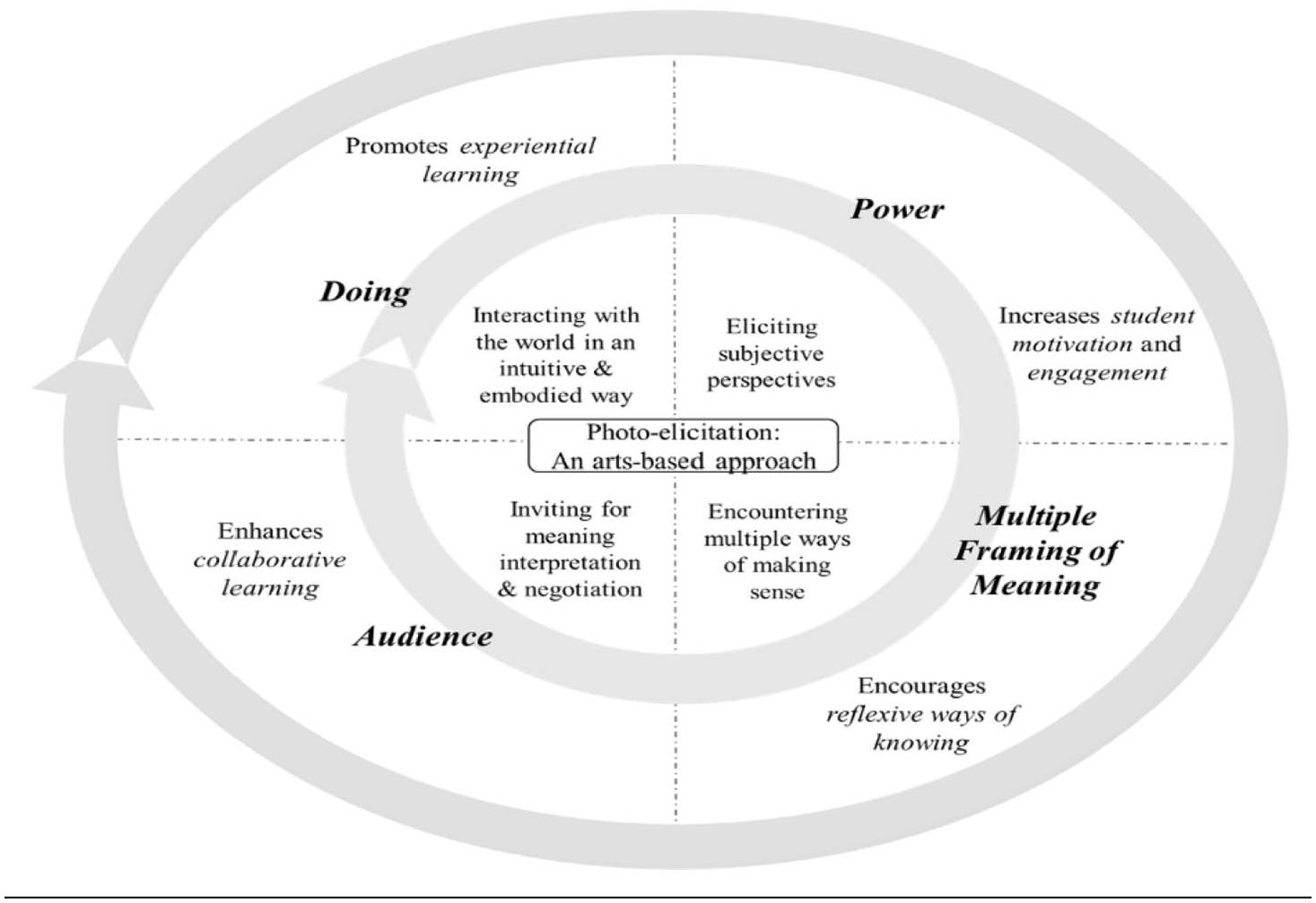
Under-theorized elements of the photo-elicitation as an arts-based method and emerging learning processes and outcomes.
The CB photo-elicitation project: students’ photographic encounters
We now turn to the reflective part of our study, in which we demonstrate how the conceptual analysis described in the previous sections develops a practice of (arts-based) learning through photo-elicitation. The analysed photo-elicitation project has been running for four consecutive years as part of the assessment strategy in an undergraduate (second year) large CB module (student numbers ranged from 170–330 students) in a UK Business School. Students’ evaluations for the learning experience for this module are very positive, with student feedback about the assignment in the module’s evaluation to include comments such as interesting and challenging, helping with developing further knowledge and deeper understanding, unique, very stimulating and practical.
The design of this module, underpinned by the photo-elicitation assessment, adds value to the business school curriculum as not only supports the module’s learning outcomes and allows for curriculum synergies (e.g. building on prior marketing knowledge to understand marketing influences upon consumers) but also differentiates the business curriculum in terms of using more active, embodied and affective processes to learning and teaching. To further demonstrate the value of such processes in business schools, Mack (2012) argues that using such arts-based methods into graduate-level business management curriculums is a growing trend due to the various and distinctive benefits that these methods provide (e.g. developing empathetic understandings, dealing with uncertainty). Also, consumer researchers (e.g. Hudson and Ozanne, 1988) have argued that alternative ways of researching and understanding CB (e.g. poetry, visual methods) allow for exploring its contingent nature in a vivid, interactive and meaningful way, which in turn allows for a deeper and critical understanding of the field (O’Sullivan and Kozinets, 2020). Thus, such an assessment enhances skills and competencies that provide opportunities to business schools to develop professionals who understand and cope with an increasing fluid, and innovative business world (Blasco, 2016).
Zooming into the context of this assignment, students adopt a hybrid ‘consumer and researcher’ identity to conduct a CB research project using the photo-elicitation method. The project starts with a reflection of students’ own ‘consumer’ behaviour (taking the photographs as consumer) and extends to the interviewing process where the students encounter other group members’ behaviour (they act as researchers). Students work in groups of three and follow a participant-driven approach to photo-elicitation, through which they enact their encounters with a selected brand of their choice. Each student takes four photographs, one for each of the CB concepts investigated in the assignment. As per the adopted photo-elicitation form, students are free to determine the content of their photographs, yet each one of the photographs should be connected with the investigated CB concepts. These concepts are needs/wants, learning theories, motivational conflicts and self-concept, and refer to the application of relevant theories covered as part of the module.
The concept of needs/wants relates to hedonic and/or utilitarian needs that drive the consumption behaviour of students as consumers for the selected brand. Learning theories refer to the type of learning behind students’ preferences for the selected brand (e.g. behavioural or cognitive learning). Motivational conflicts relate to the type of conflict that students experience as consumers for the selected brand (e.g. capturing students/consumers preferences for desirable alternatives). The self-concept relates to the dimension of the self that students enact as consumers when they use the selected brand (e.g. actual or ideal self). The next step after the photo-taking process is that students conduct one-to-one interviews to understand each other’s experiences of using the investigated brand. Interview questions are shaped based both on the relevant CB theory and the produced photographs. Next, the collected data are analysed by the groups in order to form the basis of presenting their findings and providing marketing recommendations. The outcome is a qualitative report entailing all the photographs and relevant narrative accounts.
Process of analysis of our reflections on the photo-elicitation method
The analysis of our reflections was conducted in three overlapping and iterative phases. Using the photo-elicitation as part of the assessment strategy for grading purposes in the context of a CB module, has provided us with a wealth of observations and experiences regarding students’ encounters with the method. These observations emerged from our teaching experience with the method, that is, answering student questions about the assignment in feedback and teaching sessions, as well as reflections evolving from the marking process of the submitted assignments. This was the first phase of the interpretive process we followed to organize our observations about the method.
In this phase, we started keeping notes about students’ questions asked about the method, with such questions to be recurring over the years and referred to brand selection, ways of demonstrating the CB concepts in photographs, student reflections on the content of the photographs, as well as ways of representing the accounts emerging from their photo-elicitation project. We started organizing such reflections emerging from these recurring questions. Next, these observations were combined with reflections the authors discussed during the marking process over the years regarding common practices noticed across different assignments. These initial observations made us feel that such recurring questions and practices might denote patterns in students’ encounters with the method, even though photo-elicitation as qualitative and arts-based research fosters multiple practices of conducting such a research project.
The next phase of our analysis emerged from intra-textual and inter-textual cycles of interpretation (Thompson, 1997) of 50 student assignments to flesh out students’ encounters with the photo-elicitation method. The theoretical sampling of 50 assignments included selecting assignments which served as rich exemplars, as well as assignments which challenged or refined initial descriptions that emerged from the assignments that have been selected purposefully (i.e. rich exemplars). We continued this iterative process of analysing assignments until the stage that further assignments did not provide any additional insights. Intra-textual and inter-textual cycles of interpretation guided this stage of analysis. Intra-textual cycles related to reading each one of the selected assignments to identify manifestations of students’ encounters with the photo-elicitation’s arts-based elements. Although our reflective study is not a photo-elicitation study, it refers to a photo-elicitation project. Thus, the content and captions of student photographs alongside the narrative descriptions emerged from the CB photo-elicitation project were used as tools of elicitation to identify and analyse such emerging manifestations (Shortt and Warren, 2020). Such an analysis of photographs parallels both dialogical analysis (Boxenbaum et al., 2018) and auteur theory (Rose, 2001) in terms of privileging the meanings that students assigned to their photographs in the process of interpretation (e.g. photographs were coded based on student meanings, Pink, 2011).
Inter-textual cycles of interpretation were used to analyse the emerging patterns in the data set (i.e. assignments and our observations and reflections) and to disclose similar thematic aspects across the data sources. In this part of the analysis, visual patterns were also explored across the identified thematic aspects, with these patterns to relate to the symbolism of photographs, such as group photographs, photo-collages and images shown a consumption context (see also Shortt and Warren, 2020). These visual patterns were interpreted alongside students’ meanings on their produced photographs and in light of the relevant theory, that is, photo-elicitation’s arts-based elements. The patterns emerged in this stage (e.g. practices related to the content of photographs and representing the arts-based accounts, reflexive acts) were linked to categories, with these categories then to be grouped into analytical themes related to the under-theorized arts-based elements of the photo-elicitation method discussed in this article (Spiggle, 1994). The creation of these categories and themes were underpinned by both an inductive (e.g. student practices emerged from the data sources) and deductive (e.g. the arts-based elements of photo-elicitation emerged from our conceptual analysis discussed in this article) approach. In the final phase, our reflections were reconnected with existing theory to shed light on the discussed under-theorized elements of the photo-elicitation as a learning and teaching tool. To ensure the trustworthiness of our interpretations, we adopted practices recommended in the literature (Johnson et al., 2006). Specifically, the use of different data sources alongside the presentation of relevant evidence (e.g. photographs) as well as the application of reflective practices (e.g. iterative discussions of the interpretations of our reflections) during the process of analysis safeguard the consistency of our themes and interpretations presented below.
Acts of doing: asking, combining and performing
Acts of doing, as the first surfaced element of the discussed photo-elicitation project, manifests experiential ways of knowing through which students interact with and materialize their ideas for the concepts investigated in the CB assignment. Notes from our observations on students’ questions about the assignment and patterns of practices identified in the analysis of our data set disclose that experiential ways of knowing that doing entails embrace practices and/or (bodily) experiences that accompany the process of producing a photograph. Such practices and experiences are revealed in questions students frequently ask before taking their photographs (e.g. how the investigated concepts can be shown in the photographs), in groups sharing their reflections with the teaching team about how their consumption experiences can be enacted in the photographs (e.g. Figure 2), as well as in practices that relate to creating the aesthetics of the image (e.g. organizing shooting scenes, producing, editing and/or combining photographs).

Student question showing an act of doing: A reflective question about a student’s preference for the selected brand and how this preference can be used to create the aesthetics of the photograph.
Such questions that students ask before the actual taking of a photograph denote reflective questions for action (Coulson and Harvey, 2013), namely questions that help students to plan next moves in terms of enacting a theory and personal experiences in a photograph. For instance, Figure 2 shows such a query, which refers to a student’s reflection on their preference for the selected brand (i.e. consumption takes place because of promotion elements) and how this preference can be used to create the aesthetics of the photograph (e.g. editing the image). Our analysis demonstrates that such questions facilitate students to produce their photographs, thus supporting a learning phase that ‘prepares students to engage in experience-learning’ (Coulson and Harvey, 2013: 408).
In this light, doing enables students to start exploring connections between the taught material and their personal lives (Page et al., 2014). Figure 3 manifests a student’s attempt to explore how combinations of different photographs can convey their preference behind the brand selected as part of the assignment and how this preference enacts aspects of this student’s sense of self. Creating photographic collages is a common practice that students adopt in an attempt to explore intuitive and tentative connections between different photographs and finally to select a composition that materializes their experiences. Such a practice is usually initiated by students’ reflective questions about how, for instance, an investigated CB concept is reflected on their personal lives, and how this can be enacted only in one photograph. In this context, the practice of creating photo-collages denotes engagement and experimentation with different photographs which facilitate expressing multiple and/or complex meanings (e.g. feelings of becoming and/or moments of awareness about consuming a brand). Thus, this photo-collaging practice creates new material realities, which enable different ways of seeing and understanding CB (Coats, 2014; Rippin, 2013).
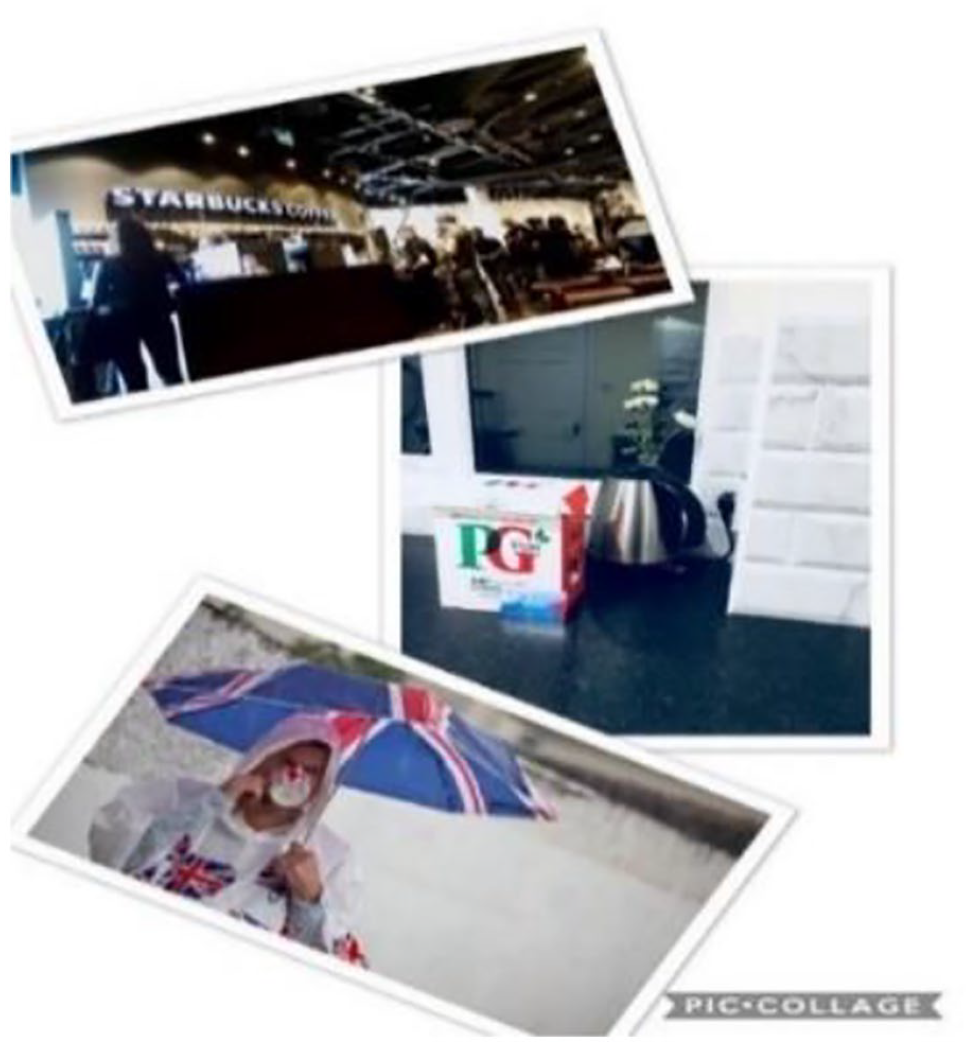
Student photograph showing an act of doing: Student photo-collage creation to enact different aspects of their self-concept.
From our analysis also emerged that this engagement with photographs is not limited to a ‘movement’ that relates to rearranging different photographs but also to physical movements enacted in the produced photographs. Making photographs is viewed as a performative encounter that surfaces experiential knowledge residing within students’ lived bodies (Leavy, 2015). Figure 4 shows doing in ‘action’, namely students’ embodied interactions with the world, through which they give and receive meaning about their consumption experiences with a brand. Such embodied practices reveal a more affective application of the investigated CB theories (Beyes and Steyaert, 2020) in which the body is used as a space of learning, that is, a space in which ‘bodily wisdom and knowledge’ create meaning and understanding (Leavy, 2015: 116). For instance, the student’s account for the photograph on the left refers to bodily sensations (pain) that disclosed a need for comfort that is fulfilled by using the brand selected in the context of the assignment. The student who took the photograph on the right, also uses bodily sensations (e.g. moving bodies in a crowded context) in an attempt to enact their experience with the selected brand, which allows this student to (re)live such an atmosphere. Such an embodied engagement in the process of learning provides access to memories, personal experiences, and habits that not only might otherwise go unnoticed but also might not lead to new ways of knowing emerging from bodies moving within consumption contexts.

Student photographs showing an act of doing: Students’ bodies as a space of learning that creates meaning and understanding of the taught concepts.
In line with prior studies calling for a better understanding of the arts-based pedagogy of photographs in business and management education (Madden and Smith, 2015; Page et al., 2014), we disclose acts of doing that engage students in experiential learning. We argue that such acts activate photo-elicitation’s arts-based potential for a material and embodied engagement with the world, which enables students to ‘grasp what they cannot weave’ (Seregina, 2020: 17) and to access knowledge residing in their bodies. In this light, the arts-based element of doing fosters a ‘deeper experience of personal presence and connection’ (Carroll and Smolović Jones, 2018: 191) enabling students to develop new ideas and understandings.
Student em(power)ment: creating spaces for collective and personal explorations
Power is the second surfaced element of the analysed photo-elicitation project. Our analysis reveals that the adopted participant-driven photo-elicitation provides possibilities for various practices that empower students. One empowerment practice evolves from decreasing power imbalances between the members of a group. Decreasing power imbalances between students is manifested in the active engagement and participation of all members of a group in terms of conducting the research and equally contributing to the completion of the group assignment. An example of how such an active engagement invites all students of a group to elicit and embrace different experiences and perspectives of the group members is shown in Figure 5(a) and (b).
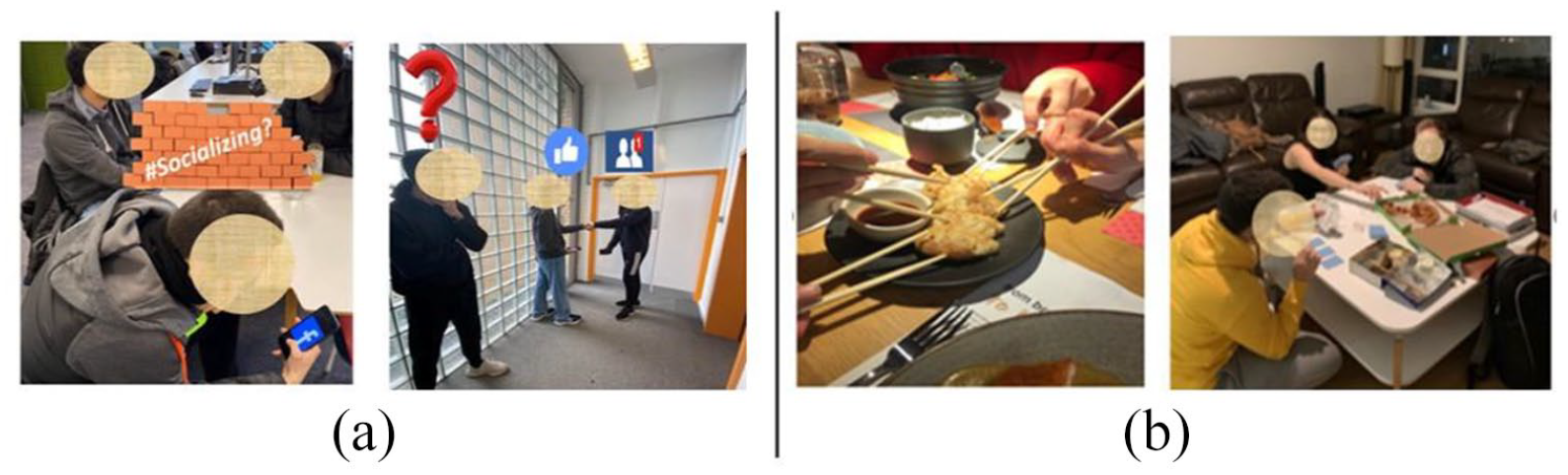
Students’ group photographs showing decreased power imbalances across team members: (a) enacts group performances to show the concepts of motivational conflicts and learning theories and (b) depicts shared lived experiences for exploring and understanding the team members’ needs/wants and learning theories behind the selected brands.
Figure 5(a) shows students from a specific team to take ‘group’ photographs for their group assignment. Group photographs is a common practice that students adopt, with our analysis of submitted assignments and notes on students’ questions about the process of taking photographs to further illustrate this. It should be noted here that such questions are initiated by students to ensure that they are on the right track for progressing with the assignment as well as to be reminded that the adopted participant-driven photo-elicitation form gives voice to students instead of voicing any perspectives of the teaching team. For instance, the group shown in Figure 5(a) disclosed to the teaching team the ideas that this group had about interacting between each other in the process of producing some of their photographs in order to show how it feels to use and experience the selected brand. Group photographs emphasizing group interactions in discovering meanings and experiences for a brand denote that students’ lived meanings for a brand are realized and co-created through such interactions. Coats (2014) argues that photographs position students (photographer) in a place and time, within which intersubjective interactions frame the meaning of an enacted encounter. Accounts discussed in the assignments of the groups displayed in Figure 5(b) also show that the shared lived experiences that these groups organized as part of the assignment engaged students in a process of promoting empathetic engagement among the group members, that is, exploring and understanding the team members’ experiences with the analysed brand. Although usually one student of a team uses such a group photograph in the assignment, the accounts discussed in relevant assignments elaborate on each group member’s experiences with the selected brand, instead of focusing on the experiences of specific members of the team (e.g. the member who took the collective photograph). Our analysis shows that such group photographs might initiate a reflexive process, in which the group photograph invites group members to respond to it and by so doing, enabling students to reveal their own subjective experiences and meanings (Lapenta, 2011).
In this light, group photographs decrease power imbalances across the members of a group by creating a third space (Kjellstrand and Vince, 2020). Such a space allows for new insights to emerge as it encourages students to actively interact with each other and thus, engage themselves in a collective exploration of how the consumption experiences of the group members can be linked or be distinctive. This interaction also facilitates group members to co-create knowledge, which allows for deep engagement of all group members in the learning process (Seregina, 2020). Thus, the adopted participant-driven photo-elicitation form combined with the hybrid identity students undertake as part of the project further support student empowerment, since creating a photograph is a ‘weapon’ in the hands of students who determine the encounters that they will engage themselves with (Coats, 2014).
In this context, photographs are viewed as a source of agency, which also empowers students (Lapenta, 2011). Student agency emerges from the nondiscursive expressions evolving from photographs, which allow students to connect with and/or generate new insights of inner realities that otherwise could have remained unspoken (Harper, 2002). Figure 6 portrays an example of student agency by showing other photographs produced by the members of the group shown in Figure 5(a). Each photograph depicted in Figure 6 has a different composition and (visual) narrative surfacing each student’s personal experiences with a specific concept investigated in the assignment. This team also reflects in the assignment on photo-elicitation’s capacity to provide room both for subjective explorations and more active discussions between the researcher and the participant which allowed the team members to explain the meanings of their photographs and how such meanings revealed deeper aspects of their consumption behaviours. Thus, photo-elicitation not only enables students to tap into idiosyncratic experiences but also views students who produced their photographs as a resource of analysis. In other words, agency is attributed to each student who has produced their photographs and who interprets the meanings enacted in a photograph in collaboration with the researcher (Richard and Lahman, 2015). This co-construction of knowledge fosters student empowerment by creating a context, in which exploration, ownership and control of learning are all experienced simultaneously.
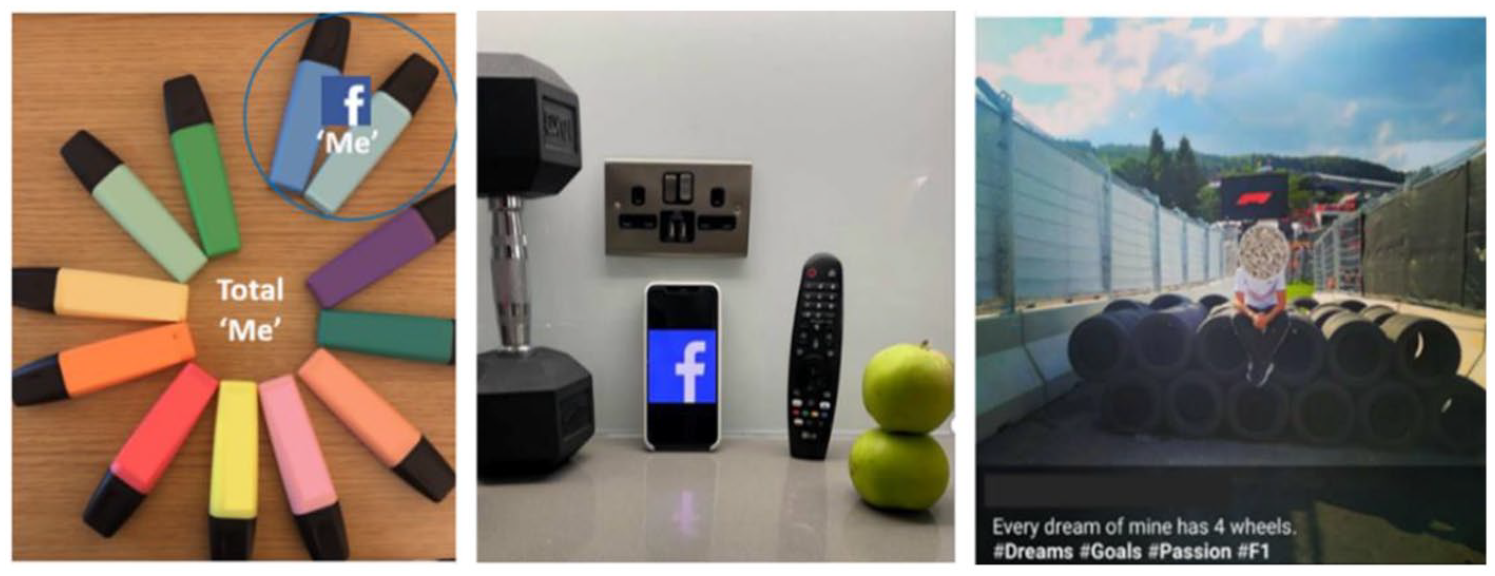
Students’ photographs as a source of agency: each student elicits subjective visual narratives for the notion of self-concept.
Furthermore, students’ decision for selecting a brand alongside the role of the teaching staff before students entering the photo-elicitation field also support the practices described above. Our notes show that a common question at initial stages of the assignment relates to students’ concerns regarding the differentiation of the selected brand, given that all groups should analyse the same CB concepts and reflect on their experiences as consumers. Teaching staff’s approach points towards encouraging students to respond freely to the task in terms of selecting a brand of their choice and discussing understandings emerging from the collected data. Teaching sessions also emphasize the uniqueness of perspectives and practices that each group will follow, such as the use of subjective photographs, different ways of embedding photographs into the assignment to inform both the created themes and the recommendations offered for the brand. Such an approach encourages students to freely express their own viewpoints and practices in an attempt to cultivate empathy, agency and self-reflection between the members of a group (Pink, 2011).
Photo-elicitation has already been described as an inclusive and engaging learning method that empowers students (e.g. Kaplan et al., 2011; Richard and Lahman, 2015). Yet, student practices through which such benefits emerge remain underexplored, thus also hindering an understanding of the photo-elicitation research encounter, which is a collaborative and situated event (Pink, 2011). By approaching photo-elicitation as an arts-based methodology we surface practices that create space for both collective and personal student explorations. We argue that such practices allow for understanding how active participation, subjective voices, and collaborative knowledge as benefits of photo-elicitation and parts of student empowerment become visible and can be discerned in such a learning encounter. Thus, we demonstrate practices that explain and fulfil photo-elicitation’s arts-based pedagogic role to enable inclusive (e.g. engaged participation) and meaningful (e.g. revealing inner thoughts) learning experiences (Blasco, 2016; Sutherland and Jelinek, 2015).
Multiple framing of meaning: eliciting ‘photographic’ interpretations
Multiple framing of meaning is the third arts-based element surfaced in the context of the discussed photo-elicitation project. Our analysis indicates that student empowerment promotes multiple framing of meaning, in a sense that students’ encounters with their and group members’ photographs encourage active participation, reveal subjective voices and produce collaborative knowledge (Pink, 2011). These encounters act as an ‘incubation phase’ (Leavy, 2015), which facilitates student familiarization with the data and is an inseparable stage of the data analysis process. Our analysis shows that during this process students are engaged in unfamiliar sensemaking ways emerging from the use of photo-elicitation accounts, which encourage students to revisit existing knowledge. In other words, photographs gain a different meaning compared with their common use which invites students to encounter new learning experiences with a familiar medium.
In this light, students by enacting different aspects of their lived experiences with a selected brand in photographs, encounter complexity and uncertainty in the phase of data analysis process. Although the process of analysis is not connected directly with the photographs per se, in this stage students produce knowledge claims emerging from the collected photographic accounts. Our notes reveal that during teaching and feedback sessions students ask about the data analysis process, that is, how they can deal with the data analysis process and with the different meanings emerging from their data. Such questions reveal that in this stage students start revisiting the meanings of their data to make sense of the collected accounts and generate CB insights. As a first step in the data analysis process, students produce and analyse the transcripts emerging from the photo-elicitation interviews. Each group member is free to either analyse (i.e. create codes and themes) their own photo-elicitation interview transcript or to analyse a transcript of another group member, before all the group members review the codes and themes emerging from all transcripts and start identifying patterns across the collected accounts. In either case (i.e. a student analyses their own transcript or the transcript of another group member), students encounter a transcript that entails ‘negotiated interpretations and meanings of the images’ (Lapenta, 2011: 202) which broadens their knowledge by deepening understanding and/or by triggering invisible meanings and connections.
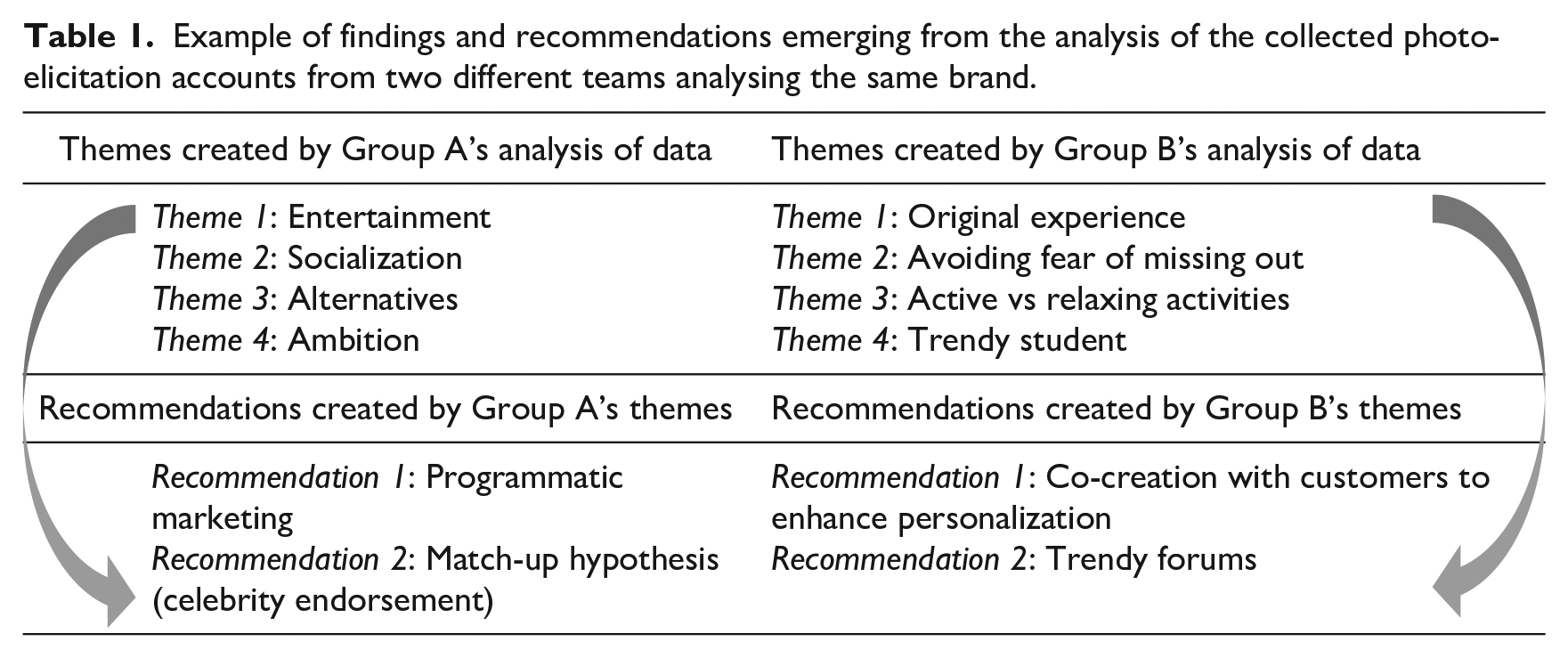
As such, students’ interactions with photo-elicitation transcripts open up multiplicity in meaning-making instead of pushing authoritative claims, given that such transcripts combine verbal and visual narratives, and by so doing enhance the data analysis process and decentralize the role of the researcher as the expert (Leavy, 2015). This multiplicity in meaning-making is disclosed both within a team (e.g. encountering and interpreting the data emerged from a team’s transcripts) and across different teams. In this latter level, multiplicity in meaning-making is revealed in the interpretation of findings (e.g. different CB theories are employed by each group in order to interpret the CB nuances illustrated in their transcripts), on the creation of recommendations for the selected brand based on the findings (e.g. Table 1), and on the visual representation of the data analysis process (e.g. codes and themes) that all teams need to create as part of the assignment and which facilitates different and/or deeper ways of seeing the data (Leavy, 2015).
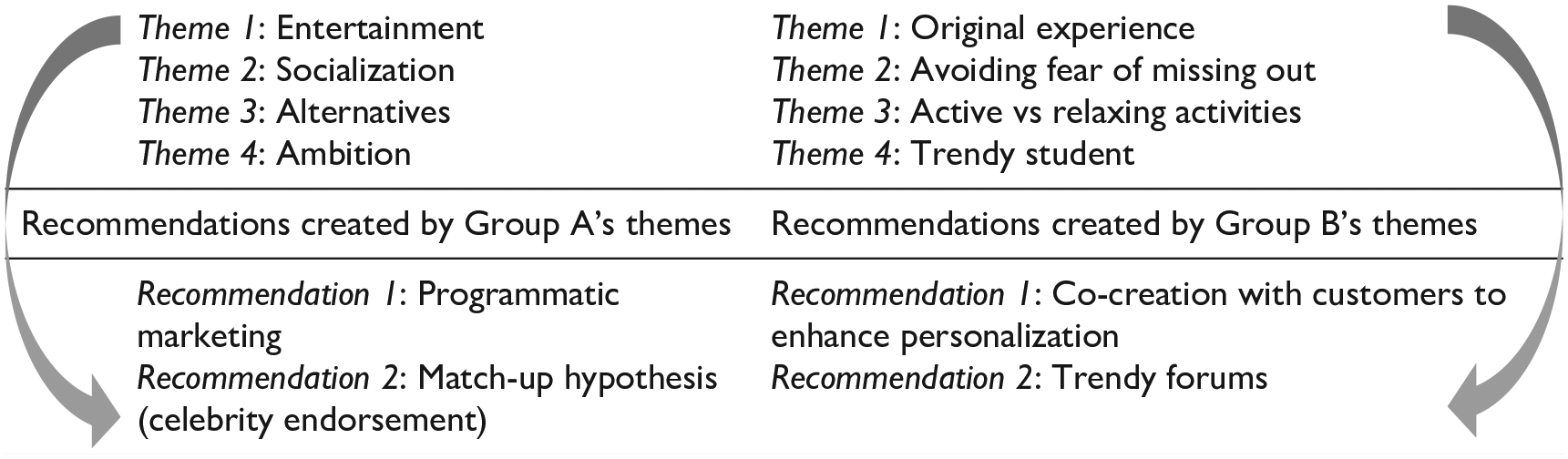
Example of findings and recommendations emerging from the analysis of the collected photo-elicitation accounts from two different teams analysing the same brand.
In such student encounters with the multiplicity in meaning-making, and regardless of the level (i.e. across teams or within a team), students have to deal both with multiple roles, that is, being consumers and (co)researchers, and different types of meanings (i.e. textual and visual meanings). Within these encounters, students might undertake different actions for moving between these different roles and types of meaning which lead them to relate in different ways with the material they have produced (Gherardi, 2009). Such ways are manifested in the visual representations that students craft in order to identify patterns in the collected data and draw insights. Given that in this stage students revisit the meaning of the collected accounts, this stage can be seen ‘as a point for departure for discussions and revelations, thus further developing and co-creating knowledge’ (Seregina, 2020: 28). Figure 7 shows such diagrams created by different teams and which indicate diverse ways of interacting with the collected accounts (Mack, 2012). Such ways vary from straightforward (e.g. theme and relevant codes) to more complex (e.g. matrix) representations as shown in Figure 7:
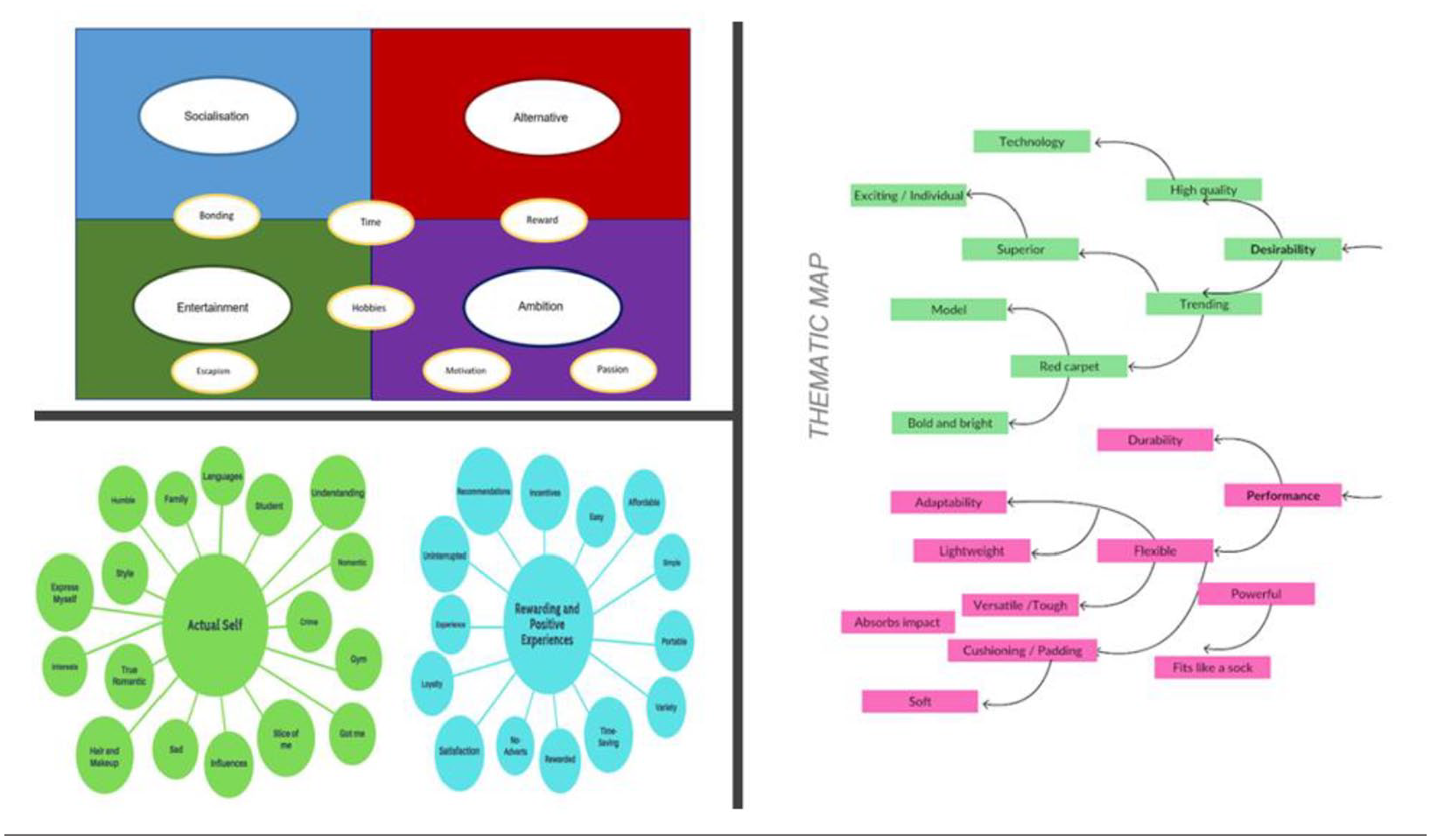
Students’ data analysis diagrams showing ways of interacting with the collected accounts: students as researchers and consumers employ different visual forms in their attempts to express and make sense of multiple meanings of consumption realities.
For instance, the thematic map shows different themes and sub-themes alongside relevant codes for all the team members, thus revealing a collective sensemaking and sensegiving process to disclose relevant insights in a more holistic way compared with categorical coding also shown in Figure 7 (Langley and Ravasi, 2019). This latter representation summarizes codes emerged from all the team members, yet the organization of the codes per investigated concept shows a more deductive way of data analysis that students employed perhaps in an attempt to minimize the ambiguity or complexity emerging from the data. The matrix shown in Figure 7 manifests a more complex way of organizing emerged data and in which students use insights from the data to also draw connections across the investigated concepts. Thus, students employ different visual forms in their attempts to express and make sense of multiple meanings of consumption realities, which emerge from photo-elicitation accounts. These attempts also denote a relational reflexive practice (Cunliffe, 2002) through which students as researchers and consumers are engaged in the interpretation process of the collected accounts and learn through and in relation to the other members of the team (Lapenta, 2011).
This shared learning process also leads to layers of meanings generated from the analysis of the collected photo-elicitation accounts. Our analysis shows that these layers of meanings not only manifest the role of participants in knowledge co-production (Lapenta, 2011) but also an interaction between visual and textual interpretations (Seregina, 2020). In the context of our reflective study, this is shown in the stages of findings and recommendations. For instance, Table 1 shows the themes and recommendations developed by two different groups of students who analysed the same brand. The created themes relate to the CB concepts investigated in the assignment (i.e. needs/wants; learning theories; motivational conflicts; self-concept). The created recommendations are the final section of the assignment and are based on the emerged themes.
Themes and recommendations follow the data analysis stage, within which students create representations that combine visual (photographs) and textual (narratives from the interviews) accounts to produce their findings and recommendations. This combination indicates that multiple meanings are generated from such a research encounter given that text (narratives from interviews) exists alongside photographs and this coexistence encourages students to think and experience in more reflexive, multisensory and authentic ways (Seregina, 2020). For example, Group A’s themes and recommendations shown in Table 1 are distinctive from Group B’s themes and recommendations, even though both teams analysed the same brand and both team members share similar characteristics (e.g. students and same age). Thus, even in cases when themes/recommendations relate to the same background (i.e. brand and investigated concepts), the multiplicity in ways of understanding a marketing context/brand suggested by photographs (Lapenta, 2011), and the opportunities to adopt CB theories depending on the fit with the photographs taken and the underlying narrative, diversify students’ sensemaking responses and ways of relating to a consumption reality (Sutherland, 2013).
Such opportunities for reflexivity offered by the photo-elicitation as an arts-based method encourage connections and ways of knowing emerging from a process of encountering and combining visual and textual interpretations in order to express and make sense of different experiences. Existing studies stress the significance of photo-elicitation as well as of arts-based methods to generate multiple and authentic meanings/connections that either emerge from the collaboration between researchers and participants (e.g. Lapenta, 2011; Pink, 2011) or are encountered in the process of arts-based learning (e.g. Taylor and Ladkin, 2009). Existing discourses describe such connections that transform experience into knowledge as a collaborative and situated practice (Sutherland, 2013), yet they do not elaborate on practices that give rise to such connections. To this end, we reveal the role of the data analysis stage, within which student practices are formed and enable students to develop connections through which they envisage multiple ways of experiencing and making sense of marketing/business phenomena.
Audience: experiencing the produced photo-elicitation accounts through collaborative practices
Audience is the final surfaced element of the discussed photo-elicitation project. Our analysis shows that the experiential, empathetic, and reflexive understandings emerging from the previous arts-based elements make photographs a source of an (aesthetic) experience for the members of a team. For instance, taking a photograph (doing) elicits subjective meanings to the team members which are explored (empowerment) and revisited (multiple framing of meaning) during the research/learning process. Within this process, the cultivation of empathetic feelings and discovery of multiple meanings create feelings of proximity in terms of how students of a team think and feel about the realities enacted in photographs (Coats, 2014). Such feelings of proximity disclose the concept of audience, which pushes students to draw their own interpretations and meanings about photographs as well as to further explore these meanings in collaboration with their team members.
Our analysis indicates that feelings of proximity are activated from students’ encounters with the produced photographs alongside the hybrid identity that students adopt in the project. For instance, Figure 8 shows the photographs that each member of a group took to enact their consumption experiences with a specific brand. Although the created photographs from this group entail short descriptions/labels, this group discusses in the assignment that the created photographs produced different meanings across the team members with these meanings to be further explored during the interviews. Such a discussion is present in many other assignments, even though the majority of the groups in the context of the discussed project use labels to convey key meanings of their photographs. Moreover, most of the groups create some interview questions that aim to further explore the photographs in a more straightforward way (e.g. how does this photograph show your consumption experience with the brand?).
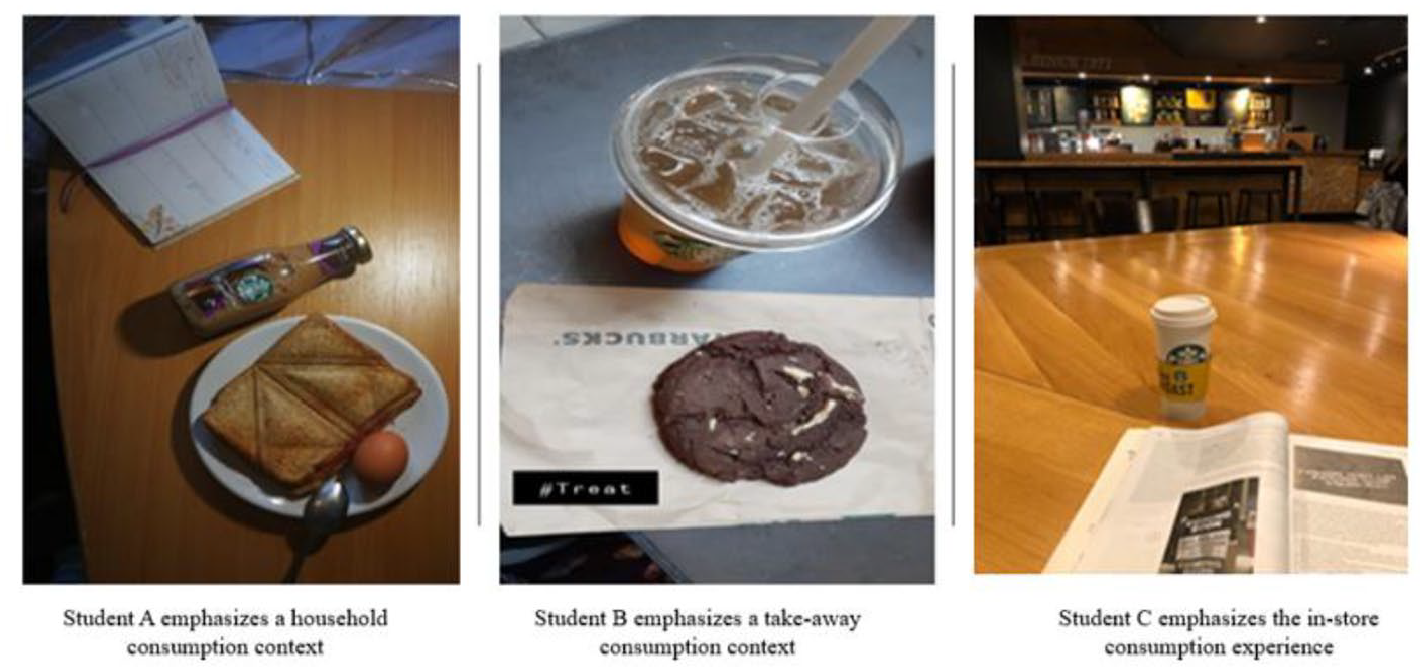
Students as audience of their created work: students’ photographs showing diverse consumption contexts in which students use the brand to satisfy their needs, thus enabling students to respond to and realize different nuances of the consumption world.
Although such an approach stresses the importance of the collaboration between the group members for understanding the meanings of photographs (Lapenta, 2011), it also denotes an encounter occurring between the photographs as ‘raw’ (rather than fully explained during the interviews) material and students as audience. This encounter can be an evocative one, that is, an encounter that makes students experience and respond to the ‘atmosphere’ enacted in a photograph but not fully understand its meanings (Leavy, 2015). These encounters can lead to questions inviting for discussion and inquiry of meanings and feelings enacted in photographs, thus rendering students to be active participants in the production of knowledge (e.g. through the interview questions asked by students as researchers to students as participants/consumers). For instance, the photographs in Figure 8 allowed students as audience to see (and perhaps respond to) different nuances of the consumption world (i.e. different consumption contexts) and further explore these nuances during the interviews (e.g. what are the messages that this photograph conveys? How is your consumption reflected on this picture?). Thus, photo-elicitation as a collaborative research approach ‘offers demonstrations that not only inform’ but also can ‘inspire people to feel differently about their life, or the lives of others’ (O’Sullivan and Kozinets, 2020: 1 and 4).
Approaching students as the audience of their created work is also disclosed in the hybrid identity that students undertake as part of the discussed project (i.e. students as researchers and consumers). Within this dual role students are invited to interact with the research material through different perspectives (i.e. researcher and consumer). This suggests that a needed engagement between ‘researcher(s), research context, and audience’ (Seregina, 2020: 14) in arts-based research is taking place and by so doing, it also discloses audience’s role in interacting with and influencing knowledge at all stages of the research process. This (inter)active role played by students as audience as well as researchers is also manifested in the analysis of the prior arts-based elements of the photo-elicitation demonstrating students’ practices and encounters with the method, which contribute to the knowledge (e.g. taking photographs, experiential and empathetic understandings) produced by such a project. In other words, a group’s task as a research team is to report the analysed accounts in a way that evokes to the audience imaginary participant observations that activate feelings of ‘what is like to consume a particular brand’ so as for the audience to immerse themselves in such experiences and gain new insights through questioning or reimagining the enacted experiences. Given the reflective nature of our discussion and data, relevant evidence that supports the above student engagement is shown in the absence of contribution issues for the discussed photo-elicitation project implemented in large class size (student numbers range from 170 to 330). On the contrary, discussions, as explained above, among students are taking place in terms of further exploring each other’s photographs. We acknowledge that such an efficient group collaboration might be attributed to the small group format, yet it is widely acknowledged that arts-based methods decrease power relationships as explained earlier and embrace the role of the audience in knowledge co-creation (e.g. Leavy, 2015).
Although the concept of audience, as discussed above, is analysed as a key concept in arts-based discourses (e.g. Leavy, 2015; Seregina, 2020), it is not directly recognized in photo-elicitation and arts-based learning discourses (e.g. Fanning, 2011; Lapenta, 2011; Sutherland, 2013). To this end, we surface the role of students as audience of their created work and by so doing, we provide insights into photo-elicitation’s potential to provide opportunities for collaborative knowledge creation, through which understanding and (interpersonal) connections emerge. This in turn, further stresses the role of photo-elicitation’s arts-based elements in more fully understanding what the active role of students in experiential learning entails (e.g. how students as audience interact with and gain (new) insights from their experience with an arts-based method).
Discussion and conclusion
This study addresses calls for exploring the pedagogy of photographs (Madden and Smith, 2015) and of arts-based methods in business and management education (Mack, 2012; Sutherland, 2013). Such calls stress the need for better understanding the learning processes and the ways of knowing that these methods generate. We revisit photo-elicitation as an arts-based method in order to tease out the stages of a photo-elicitation learning process and provide insights into practices through which students experience the method and learn through it. Through this approach we move beyond ‘templates’ about analysing arts-based methods (i.e. emphasis on arts-based process rather than on experiential approach), and we overcome an ‘aesthetic risk’ of management and business education, that is, without aesthetics we might neglect important aspects of classroom experiences (Mack, 2012).
The contribution of the study is twofold. First, it provides a conceptualization of photo-elicitation as an (experiential) learning and teaching tool. This conceptualization emerges from an arts-based reading of photo-elicitation, which by teasing out under-theorized elements of the method surfaces overlapping stages of a photo-elicitation learning process. By providing such an analysis, we show the process through which (experiential) learning occurs in the context of an arts-based method. Such a process has not been discussed before, as prior research focuses on the method’s learning outcomes/benefits and/or on the experiential learning nature of arts-based methods. In either case, such approaches do not address main arguments both in experiential learning (i.e. learning is best perceived as a process and not in terms of its outcomes, Kolb and Kolb, 2005), and in arts-based methods (i.e. consider the characteristics of the employed art method, Eisner, 2008). Our arts-based approach moves beyond such ‘templates’ underpinning prior discourses so as to tap into the particularities of photo-elicitation as an arts-based method and enrich understanding of the practice of learning through photo-elicitation (Leavy, 2015). This understanding also embraces, in an orchestrated way, advantages and processes of arts-based methods discussed in prior research (see Sutherland, 2013). Such a process also provides practical insights into the design (e.g. identification of factors affecting learning) and conduct (e.g. creating a favourable learning context) phases involved in using photo-elicitation in a way that engages students in a clear journey of (experiential) learning.
Second, in response to research calls for ‘a grounded theoretical view of arts-based methods in action’ (Sutherland, 2013: 26), our study illustrates that photo-elicitation’s arts-based elements play a significant role in shaping student practices, and thus in the process of accessing and making connections from such a learning experience (e.g. doing manifests active engagement with a task (access to an experience), and audience leads to making connections). This extends research on the (experiential) learning path (Sutherland and Jelinek, 2015) students follow in arts-based methods by making visible the role of an arts-based method’s elements in shaping this path. By bringing photo-elicitation’s arts-based origins together with its experiential nature, we show that the experiential learning approach does not act as a ‘one size fits all approach’ for understanding how learning occurs in such a context. Contrary to prior studies employing specific experiential parts of such learning experiences (i.e. access and connections as components of the experiential learning path), we advocate for ‘localized’ approaches to arts-based methods which capture the holistic nature of this learning (i.e. practices for encountering the benefits of an arts-based method are interconnected and explicable to the whole arts-based process that shapes these practices). This approach also helps researchers and practitioners to better understand the contingent nature of arts-based methods and thus, extending their applicability and generating refined nuances of the skills they produce (e.g. using critical theory lens, such as psychoanalysis, to demonstrate applications of arts-based methods in enhancing aesthetic reflexivity).
To conclude, the value of arts-based methods for business schools is well established and mainly relates with soft skills (e.g. human-centric) that they nurture and are needed in fluid business contexts. Relevant discourses also point towards a need for a ‘re-imagined’ pedagogy (e.g. learning how to tackle ‘wicked problems’, Walsh and Powell, 2020) for business schools which stresses the necessity for a better understanding of the theory and practice of arts-based methods (e.g. for facilitating integration of such methods into a curriculum). We add to such discourses by demonstrating an arts-based learning process and student practices cultivating such skills and underpinning such a pedagogy. Current discourses also connect the skills that arts-based methods cultivate with lifelong learning (Weise, 2021), and this can be a fruitful area in the agenda of arts-based methods (e.g. the role of arts-based methods in a lifelong learning curriculum). We also provide a fertile ground (i.e. stages of an arts-based process) for revisiting other methods (e.g. poetry, music) to identify their idiosyncratic arts-based elements, thus contributing towards a pluralistic future of arts-based learning.
Footnotes
Acknowledgements
The authors are grateful to three anonymous reviewers and an Associate Editor for their insightful comments which improved this article.
Author’s note
The paper has received a favourable decision following the institutional ethical review process. Figures 3–6 and 8 are photographs produced by students who have granted permission for photograph use in this article. All other material presented (questions/communication – Figure 2, themes and recommendations – Table 1, thematic maps –  ) are equally used here with students’ permission, following the same informed consent process as with photographs. We are unable to present student names, given confidentiality constraints. Faces are blurred (where necessary) to protect the anonymity of the students.
Declaration of conflicting interests
The author(s) declared no potential conflicts of interest with respect to the research, authorship and/or publication of this article.
Funding
The author(s) received no financial support for the research, authorship and/or publication of this article.