




Abstract
How can managers reach a critical position from which to develop more responsible management practices? The literature suggests that the answer lies in critical reflexive learning, explaining how reflexivity can detach individuals from the grip of harmful ideologies. We challenge this premise, according to which critical reflexive learning and ideology are counterposed, arguing instead that they need to be studied as intertwined. We build on the organizational ethnography of a firm promoting inclusive and responsible management, studying a programme for recruitment of highly skilled migrants. Exploring managerial learning achieved through this programme, we show how critique, reflexivity and learning are closely linked to the ideological system of beliefs that naturalizes the organizational order: the organizational doxa ‘Diversity is good’. This work makes the following three contributions to literature on critical reflexive learning: it stresses the currently overlooked interconnection between critical reflexivity and ideology, it shows how an ideological expression (doxa) both induces and simultaneously bounds managers’ engagement with critique, and it argues for the counterintuitive possibility that critique and change can be achieved through doxa. We answer our opening question – how to reach critique and responsible change – somewhat provocatively; through the adoption of a new ideology.
Keywords
Introduction
The expectation that managers question their assumptions is commonplace in contemporary management training. This questioning can take the form of critical reflexivity, an active exercise of unsettling assumptions that has the potential for social transformation (Cunliffe, 2008; Reynolds, 1998). An example of the social transformation that can be reached through critical reflexive learning is responsible management (Hibbert and Cunliffe, 2015). With increasing societal pressure for responsible management, critical reflexive learning is gaining significant attention (e.g. Giacalone and Thompson, 2006; Millar and Price, 2018).
The exercise of critical reflexivity involves learners and practitioners becoming outsiders (Antonacopoulou, 2018) and abstracting themselves from power structures (Hibbert and Cunliffe, 2015; MacLean et al., 2012), to break free from what is seen as common sense and normal. With critical reflexivity, practitioners are encouraged to challenge ideologies, normalized practices and systemic control structures that reproduce exploitation and unsustainable practices (Cunliffe, 2008, 2020).
In corporate reality, however, the transformative potential of critical reflexivity is disputed (e.g. Millar and Price, 2018; Vince et al., 2018). Managers’ assessment of the risks associated with disrupting power hierarchies (Vince, 2008) or cultural norms at work (Mughal, 2021; Mughal et al., 2018) appear to be insurmountable hurdles. In other words, managers find it difficult, if not impossible, to escape from existing organizational and societal structures and become an outsider able to question organizational practices.
This difficulty is founded on ideology, that is, the dominant ideas in organizations that represent and preserve order (Coopey, 1995; McLaren, 2020; Millar and Price, 2018). These dominant ideas are not only imposed but produced in interaction: common sense is acquired, accepted, routinely consented to and embraced (Bourdieu, 2000; Bourdieu and Wacquant, 1992; Burawoy, 2012). Dominant ideas act not only as the main lens through which employees understand and make sense of organizational reality, but also how they imagine alternatives (see Seeck et al., 2020). Perhaps, then, rather than positioning critical reflexivity as in opposition to ideology, we need to examine the relationship between them that makes it possible for managers to challenge the status quo. We argue that current discussion of critical reflexive learning in the literature overlooks the strength of ideology and its capacity to both induce and influence managers’ critical reflexive learning.
We explore the relationship between ideology and learning through an organizational ethnography of a firm actively supporting the development of critical reflexivity among its staff. This organization is committed to promoting societal and organizational change in order to address underemployment of highly skilled migrants. We originally came in contact with this organization as researchers – and highly skilled migrants ourselves – involved in a collaborative research project in (critical) diversity management. Our focus here is on managers’ learning, in particular, critical reflexive learning. We ask the following: how does critical managerial learning relate to ideology? Answering to this research question will enable us to better understand how to reach responsible management practices in organizations.
With a sociological lens inspired by Bourdieu (1977, 1980, 2005), the study approaches the organization as a field and explores what various actors have learned from taking part in norm-critical activities. We focus on the text of interviews with 17 upper and middle managers involved in a mentorship programme for the integration of migrants. First, we position the programme in the field of the organization to clarify which stakes the programme serves. Then, we consider three broad types of learning reported by managers in view of their relation to ideology.
We find that, instead of occurring from a distance, critical learning takes place in relation to a new expression of ideology, the organization’s new doxa. This doxa is an ideological system of beliefs that naturalizes a given organizational order, establishing new taken-for-granted, unquestioned truths. We see how critical change is induced by managers accepting this new doxa, epitomized in the maxim ‘diversity is good’. We also realize that, at the same time, this doxa limits managers’ engagement with critique and reflexivity. Thus, this case illustrates how managers’ learning, including their critical reflexive learning, is not reached by a position of external opposition to ideology. Rather, it develops in close relationship with a new expression of ideology.
Our main contribution is in identifying the importance of the relationship between ideology and critical reflexive learning. Three forms of relationships are identified, that is, a ‘full’, ‘reflexive’ and ‘reserved’ embrace of the new doxa, all of which lead to critical and/or reflexive learning. Consequently, we first argue for the need to consider how critical reflexive learning and ideology are intertwined, rather than, as currently assumed by the literature, counterposed. Second, we extend our theoretical understanding of critical reflexive learning, showing how it can be both induced and simultaneously bounded by the ideological expression of the doxa in place in the field of the organization. We argue that ‘doxa’ deserves more attention in the critical reflexive learning literature as it shapes the world of what is thought to be possible and thus, what is thought to be challenged. Consequently, we third argue for the (counterintuitive) possibility to study critical learning and change in its relationship to what reproduces the status quo, that is, the doxa.
Critical reflexivity and ideology
Critical reflexivity counterposes ideology
Broadly, critical reflexivity is an emancipatory philosophy underpinning learning. While reflexivity involves re-examining one’s epistemological and political commitments (Dallyn, 2014), critical reflexivity takes a step further to scrutinize and unsettle ‘the assumptions underlying social and organizational practices’ (Hibbert and Cunliffe, 2015: 180). Critical reflexive engagement will challenge ‘assumptions, actions and their impact, but at a broader cultural, social, ideological and institutional level’ (Cunliffe, 2008:135). In other words, critical reflexive learning aims to ultimately dismantle ‘normalizing, disciplining, hegemonic, and exclusionary ideologies’ (Cunliffe, 2020: 66). Its mission is to reach responsible change in situations that entrench harmful values (e.g. Giacalone and Thompson, 2006; Hibbert and Cunliffe, 2015). Thus, critical reflexivity, by proposing alternative organizational realities (Reynolds, 1998), involves developing awareness of, and challenging, the dominant ideology that supports the established order.
The transformative potential of critical reflexive learning has been studied from different angles. Some studies examine changing deep-seated values through experience and the development of a sense of community (Dal Magro et al., 2020). Others focus on the barriers to reaching critical reflexivity, for instance, emotional suppressors that impose self-limitations on managers’ learning (Vince, 2008; Vince et al., 2018). These previous works suggest that the realization of the critical reflexive project may be difficult. However, they generally assume that learners are able to reach a point from which they can see the existing normalization and hegemonic power of ideology and practices. A point outside of the dominant ideology.
In the stream of research on critical reflexivity, ideology is critiqued as imposing limits (e.g. McLaren, 2020; Millar and Price, 2018). To this extent, this stream of research resonates with other critical management studies, in denouncing the naturalized ideological component of our work realities. Broadly speaking, studies on critical reflexivity rest on a strong belief in individual agency; that individual emancipation is achievable through reflection, dialogue and openness (Dehler, 2009; Hibbert and Cunliffe, 2015) and that with critical introspection and reflexivity, learners can detach themselves from (the dominant) ideology. Critical reflexivity is therefore positioned in the literature as in opposition to dominant ideologies, which are often presented in broad terms such as capitalism, managerialism and individualism.
The literature provides examples of ways in which individuals can become critically reflexive to the naturalized ideology in an educational setting (e.g. Cunliffe, 2009, 2016; Hibbert and Cunliffe, 2015). Yet, these works do not explicitly articulate from which ideological standpoint this de-naturalization can take place (Dallyn, 2014). Instead, they clarify that they build on specific research traditions: phenomenology and relationally responsive social constructionism (e.g. Cunliffe, 2009). These works highlight the role of self-reflexivity and possibly, critical reflexivity, but they remain elusive about what ideological standpoint induces the kind of (critical) questions that managers are to ask themselves. The literature on critical reflexivity is ambiguous in not clearly articulating the relationship between ideology and critique.
Finally, we learn that in corporate environments, achieved critical reflexivity appears to be linked to an educational programme (e.g. Vince, 2008; Vince et al., 2018). In other words, participants are brought in contact with an external element (such as an educator, a new knowledge and another implicit ideology) that provides an alternative standpoint to that previously taken-for-granted. This is another way in which the literature positions critical reflexivity as in opposition to ideology – it takes place in a way that is external to the everyday managerial and organizational ideological order.
Ideology and its difficult challenge
Studies of ideology in managerial settings indicate that becoming aware of ideology is not straightforward and unlikely to take place without the external standpoint provided by educators. While some studies approach ideology as cognition organizing the social, using synonyms such as cognitive maps, values or beliefs, Seeck et al. (2020: 67) stress the need to associate this worldview with a form of authority, ‘promoting a certain social order or defending the interests of a particular group’. That is, ideology encompasses both an ontological and sociological dimension (Eagleton, 1994). It is more than beliefs and values and resulting practices, it is systemic in the way it supports particular interests.
We learn from Seeck et al. (2020) review the difficulty of reaching a position outside the existing ideology in organizations. For example, Friedman (1977) or Burawoy (1979) shows how workers are organized in such a way that they have the illusion of autonomy but are ideologically alienated. Some studies construe ideology as legitimizing authority and a specific social order, providing meaningful (discursive) frameworks for individual and social actions (e.g. Barley and Kunda, 1992; MacLean et al., 2018) and individual interpretations (e.g. Bartunek, 1984). Similarly, others approach ideology as situated ideas (as in an occupational or organizational culture, for example, Beyer, 1981), or serving as a set of prescriptions, according to which organizational ideologies (e.g. Pettigrew, 1979) are ‘rationalisations that mobilize and encourage managers to act’ (Seeck et al., 2020: 60). These sense-making frameworks often provide a consensual (as in Deetz, 1996) representation of social reality that does not invite questioning of its ideological foundation. Finally, Seeck et al. (2020) highlight different views on ideology, as an object of critique (as in the critical reflexivity literature) or a fantasy structuring social reality. When the former uses ideological standpoints (e.g. feminism, critical theory) to unsettle the status quo and reach emancipation, the latter has a different claim; that ‘no experience of social reality can be “outside” of ideology, as ideology structures social reality itself’ (Seeck et al., 2020: 66).
In sum, studies of ideology in managerial settings either stress ideology as sense-making, that is, a framework in which to think of social reality, or ideology as a form of domination. Regardless, breaking free from, or adopting an alternative ideology appears to be difficult. A central theme in the work of Bourdieu is the reproduction of a given (ideological) order. We therefore first briefly introduce key concepts of his sociology (applied to an organizational setting) and then show how ideology, through doxa, fashions the world of possible for practitioners.
The order of things: a Bourdieusian reading
Applying a Bourdieusian framework to an organizational context, we envision an organization as a field (Emirbayer and Johnson, 2008). Most common in the study of interorganizational interactions, a field analytic perspective can also be applied at the level of one organization (Bourdieu, 2005 see Appendix 1; Emirbayer and Johnson, 2008; Swartz, 2008; Vaughan, 2008). The advantages of doing so include that it enables the application of a sociological perspective to the study of interpersonal interactions, and it stresses the diversity of agendas and conflicts often downplayed at the level of a firm (see, for example, Collien, 2018; Coopey, 1995). This clarifies the relative power of various organizational groups in their co-creation of the existing order of things. It is this relationship and resulting order that is to be challenged by critical reflexivity.
Bourdieu (2005) sketches how to approach an organization as a field and we propose here a few elements to consider in our analysis. The organization-as-field’s boundaries are the permeable boundaries of the organization, comprising all actors with an interest in the organization – this may include staff, interns, and others. This interest can broadly be defined as the performance of the company. At stake in this organization-as-field is recognition as a legitimate employee, partner or contributor to organizational performances. Legitimate members are seen as such because they have the right kinds of capital (cultural, technical, etc.). Internal organizational struggles are observable in attempts by given groups to impose specific forms of capital as legitimate (e.g. a certain technical expertise in an IT company vs managerial experience). Capital that is presented as relevant or prestigious by powerful actors is called symbolic capital. It is attached to symbolic power and authority in the organization.
Symbolic power is a form of power that imposes legitimate visions of the world on others through cultural forms (e.g. corporate myth, language, discourses) and practices (Bourdieu, 1989). It can be exercised only with the complicity of those who are subject to it (Bourdieu, 2000): individuals and groups reproduce the social order through day-to-day practices. According to Bourdieu, the sustainability of existing symbolic power rests on actors not recognizing this form of domination (Bourdieu, 1977). In an organization-as-field, upper management is likely to hold symbolic power and to perpetuate the dominant ideas that are seen as legitimate. This legitimate order of things is what critical reflexivity is supposed to unsettle.
Within an organization-as-field: doxa and the reproduction of the order of things
The difficulty of becoming aware of the prevailing ideology and its political order in favour of a particular group can be explained by Bourdieu’s concept of doxa (Collien, 2018). An ideology is triumphant when it creates conditions that legitimize that ideology, making it taken-for-granted, a common sense. For instance, Boltanski and Chiapello (2018 [1998]) talk about the ideology of capitalism, justified by ‘commonsensical’ logics that deem capitalism as ‘the only possible order, or the best of all possible orders’ (p. XX). This naturalization of the status quo is done by what Bourdieu calls ‘doxa’.
Doxa is a set of accepted cognitive and evaluative presuppositions (Bourdieu, 2000). They are pre-reflexive beliefs that support the naturalization of a given order of things, making it ‘commonsensical’ and thus, simultaneously, hiding its arbitrariness: ‘the natural and social world appears as self-evident’ (Bourdieu, 1977: 164). Believing, for example, that a market economy is the best possible economy is a doxic belief that expresses the capitalist ideology. Doxa leads to experiencing the status quo as an unquestioned truth, and thus limits the possibility of questioning it, because it naturalizes a given political order, its attached systems (e.g. educational system), practices and resulting inequalities (Eagleton and Bourdieu, 1992). In other words, the social conditions that make possible the arbitrariness of the current social order are overlooked (Bourdieu, 2000). This results in the distribution of symbolic power not being clearly recognized, thus, legitimizing and reproducing the (partial) social order. This archetypical situation is what is known as a doxic experience.
In practice, a doxic experience in an organization is not absolute as actors can reflect on their social conditions (Archer, 2012; Bourdieu, 2003; Wacquant, 2004), allowing for improvisation within limits (Burawoy, 2012). But what induces this critical reflection in the absence of critical reflexive educational training? We argue that it is stimulated by an alternative doxa, a position that emerged from our organizational ethnography of a firm promoting inclusive and responsible management.
Methodology: into managers’ experiences
Our investigation takes an interpretivist and inductive approach (Gioia et al., 2012) to ethnographically study the learning experience of managers, while locating those experiences in a power-laden context (Contu and Wilmott, 2003; Madison, 2011).
Research site and collection of empirical material
Our investigation centres around a programme for skilled migrants’ integration in the Swedish labour market. The programme, which we call ‘Settled’, was initiated by a large service company Servall (pseudonym), with clear corporate engagement in social responsibility. The Settled programme offers a 6-month internship position to highly skilled migrants who are currently unemployed. Settled has an impressive success rate of 75% of participants accessing paid employment after the internship. Servall received a national award for its work on equality and diversity in the late 2010s, thanks to this programme. The promotion of ethnic diversity and equality has become central to Servall’s corporate strategy.
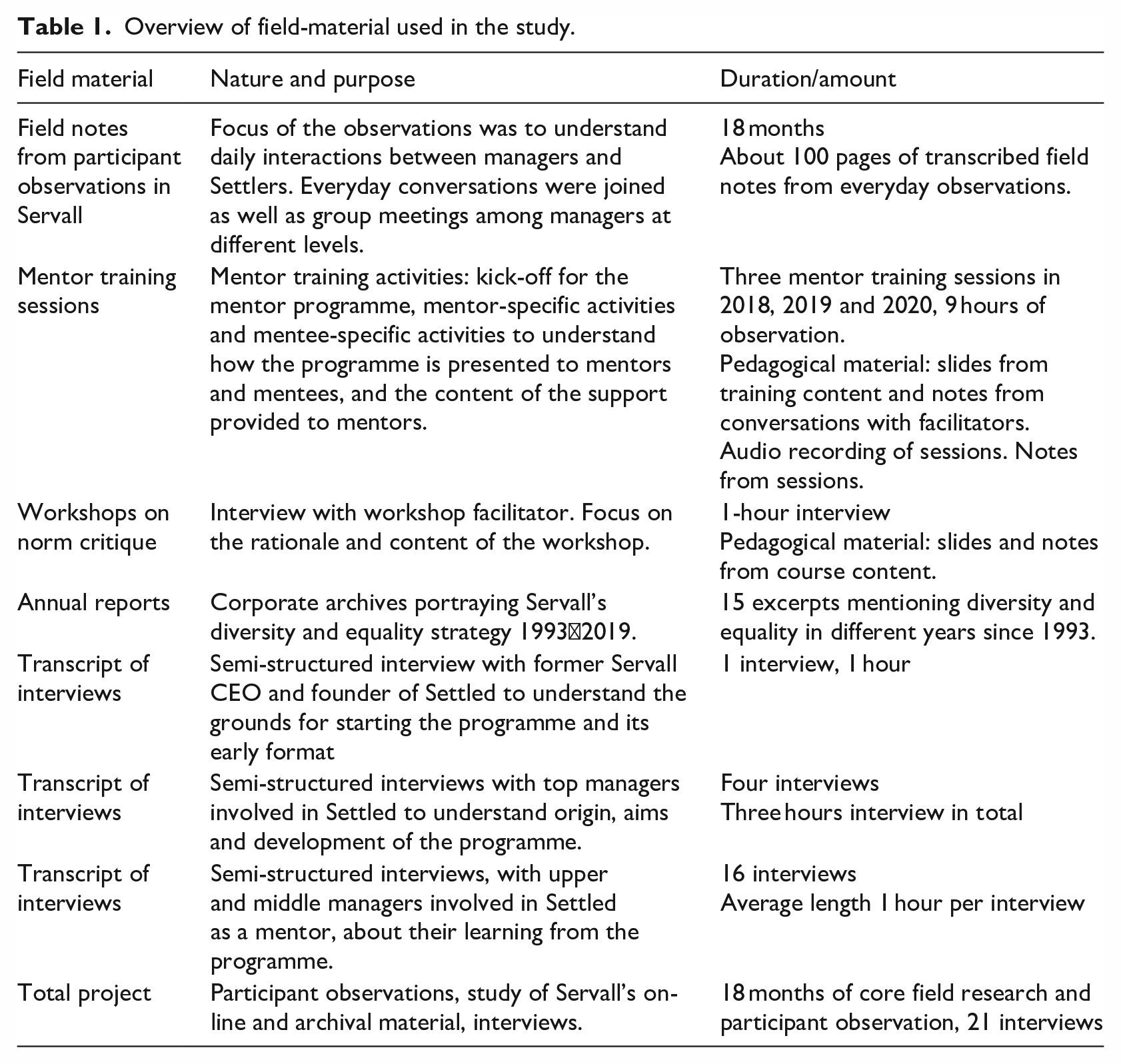
Empirical material was collected during a multiple-year collaborative study between both authors and Servall. Author 1 spent 18 months working as an intern in support functions of the Settled programme, as an insider doing an organizational ethnography. Author 2, as an external academic researcher was in a dialogue for several years with human resource (HR) staff on the programme in general and conducted participant observations of recruitment events and training sessions. Dialogue sessions between the researchers and HR staff would lead to incremental changes in the programme, such as the addition of a training session for mentors. This is an example of the co-construction of empirical material that is reported in this study. Collection of primary empirical material was done using the following three main techniques: shadowing or participant observations (e.g. daily work of managers, training programme), unstructured interviews often in informal settings (e.g. about everyday work or diversity in general), and semi-structured interviews. Secondary empirical material is mainly composed of corporate documentation (e.g. annual reports, webpages about the programme).
Methodology
The investigation of the learning achieved by managers in the programme Settled was primarily done through interviews, originally conducted with managers from all origins. Mentors who grew up or worked intensively outside of Sweden (e.g. former interns of Settled, now in a managerial position) reported specific experiences and this became the topic of a separate analysis. Author 1 interviewed 13 middle and 4 upper managers (identified as ‘UM’ and ‘MM’ in the quotes) raised and educated in Sweden, providing a total of 21 focused interviews. The current analysis builds primarily on material collected through these semi-structured interviews. In a first phase, Author 1 interviewed four upper managers and two middle managers involved in the development of the programme. He specifically asked questions about the programme’s origin, aims, and achievements. In a second phase, Author 1 asked those who were a mentor (13 middle managers and 2 upper managers) questions about the learning experience of being a mentor in the programme. The interviewees described their learning experience in a conversational style, using their own words (consistent with recommendations from Corbetta, 2008; Skovgaard-Smith and Poulfelt, 2018) and articulated their learning mostly at the personal level.
The major themes of the interviews touched on the programme, the resulting learning and diversity at work. Author 1 then considered how these themes were also present in internal corporate materials collected during his participant observations (workshops, meetings, training sessions on diversity, intranet communication), as well as material for external communication (annual reports). This, along with the extensive ethnographic fieldnotes of Author 1 in which these themes were captured, is used as secondary sources of empirical material (see Table 1).
Overview of field-material used in the study.
Analysis
Author 1 first conducted an inductive analysis of the reported learning (using NVIVO11), developing 30 first order categories (interviewee-centred), by coding the text of the interviews, thus, the interpretive work of the subjects. We then revisited the material with a power-sensitive approach (Contu and Wilmott, 2003; Madison, 2011), that is, we considered the text of the interviews and the inductive first order categories in view of the power position of the persons making the account. This showed the importance of differentiating the learning experiences of top and middle managers. When middle managers’ accounts were related to learning from differences, top managers also mentioned learning about the legitimation of the programme, finding ways to convince middle managers to engage in it.
Author 1 inductive analysis was centred on the accounts of middle managers, progressively abstracting from 30 first order categories to three third order categories presenting distinctive learning from diversity (see Figure 1). Then, in order to answer our research question on the relationship between critical managerial learning and ideology, we considered how these three main forms of learning could be related to an ideological context. Knowing that the doxic experience is studied as unanimity effects of symbolic power in social groups that ‘share similar habituses and trajectories’ (Myles, 2004: 93), we paid attention, for example, to expressions of consensus (undisputed statements) and shared beliefs noticed through the participant observations. We realized how the questioning of taken-for-granted managerial practices discriminating against highly skilled migrants and the resulting three forms of learning were done within the framework of another pre-reflexive and consensual belief (a doxa): that diversity is good.
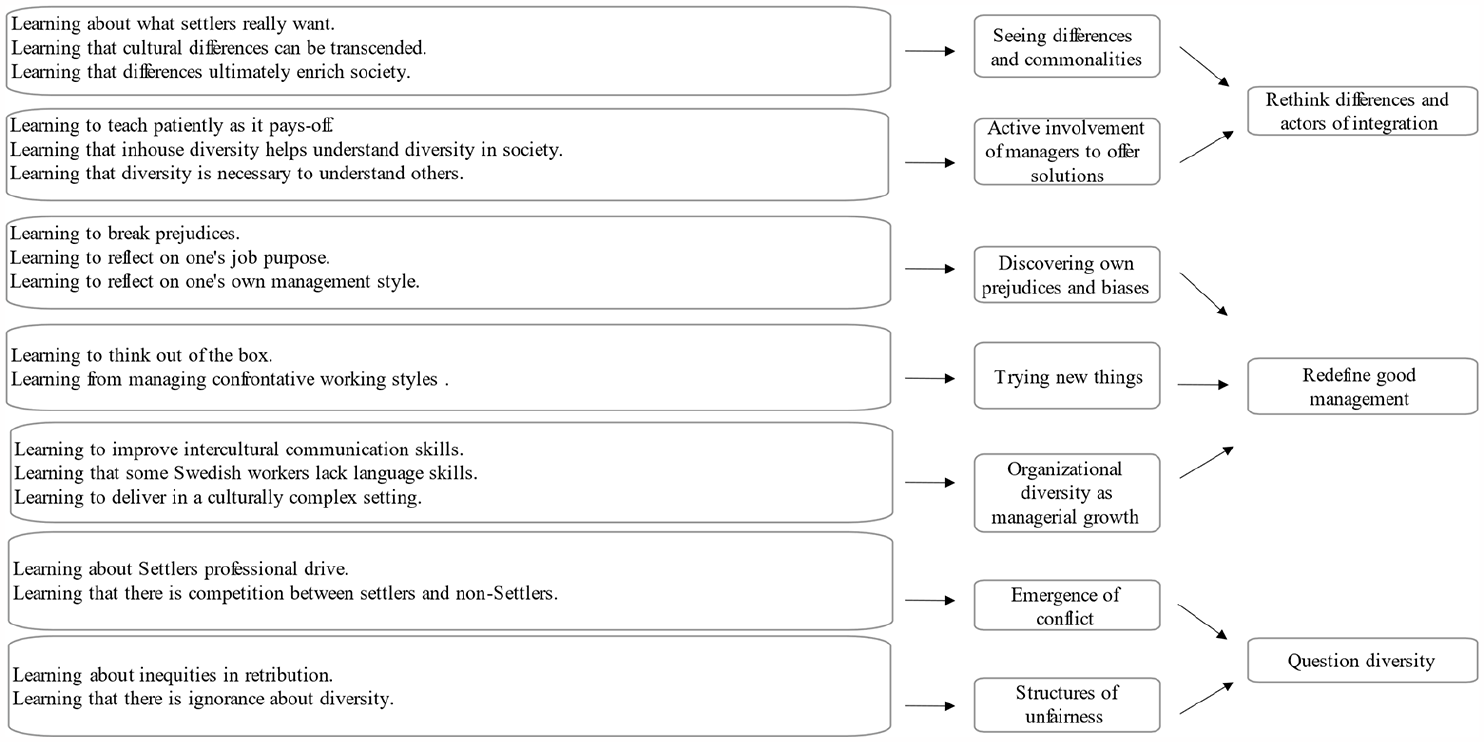
First, second and aggregate categories on managers learning experience- with examples from field material.
Our own reflexive practice
We were introduced by upper management as researchers on ‘diversity’ and, in view of our origins and education, it is reasonable to assume that both authors were seen as highly skilled migrants by their interlocutors. In addition, our position in the ‘organization-as-field’ was closely linked to upper management and their promotion of a new ‘normal’: the responsible management of ethnic diversity. We can therefore expect that interviewed managers were keen to echo the official corporate discourse on diversity in their interactions with us. In addition, all of them were engaged with the programme, thus were most likely already positive in their attitude to diversity. Yet, our goal was to create a space in which opinions that are not supportive of diversity could also be expressed. During his ethnographic fieldwork, Author 1 engaged in multiple informal activities with middle managers and believes that he was seen as a peer by the end of the fieldwork, thus as a person with whom the members of Servall would freely speak their mind. Author 2 had multiple interactions with HR representatives, inviting critical opinions on diversity and enquiring about potential conflicts that might appear in a culturally diverse team. The idea of doxa emerged from our reflections about our interlocutors’ consentient positive accounts of diversity, their ‘membership’ in a group engaged with the programme, and their apparently undisputed belief that diversity is good, presenting a strong sense of unanimity (Myles, 2004).
Inspired by the reflexive practices of Wiant Cummins and Brannon (2022), it took multiple conversations among us, the authors of the paper, to realize our own embeddedness in an ideology. The bulk of our work is in critical diversity management. We broadly believe that diversity management generates organizational practices that can become social control mechanisms. For us, diversity is not all good, but we generally consider diversity to be a beneficial value for organizations and society, especially if it maintains a self-critical spirit. Originally, our own position (critical to diversity management) made us impatient and frustrated that we ‘only’ collected positive accounts. With time, we understood our respondents’ position and realized their role as what Bourdieu calls ‘complicit opponents’ (Bourdieu, 2000: 101). In other words, while we may have different positions on the benefits of diversity, we agree on the central legitimacy of the topic: we share the (doxic) space of this perceived legitimate discussion.
A programme for societal and organizational change
The Settled programme was established by the CEO and a few top managers of Servall early in 2010, in order to attract foreign talent, increase diversity and achieve a more ‘internationally oriented’ organization. Indeed, faced with raising global competition in the search for talent, Servall realized that it could tap into Sweden’s migrant population (mostly from outside of the EU), who were, and still are, underemployed (Irastorza and Bevelander, 2021; Manhica et al., 2015).
Diversity for societal and corporate benefits
Settled was designed to combine business and social benefits through increased integration and diversity so that, skilled migrants have a better chance in the job market, and partly to meet Servall competence needs. Thus, the programme, from the start, had a dual ambition: first, to contribute to the integration of migrants and thereby a more inclusive Swedish society; second, to provide Servall with sought-after competences.
Originally, Settled was not promoted as a talent search, but rather, as another of Servall’s social responsibility initiatives (UM5). Servall’s mission on diversity has been embedded in the narrative of ‘reflecting the reality of Swedish society’, because of its corporate values to serve ‘the many’ (fieldnotes) and show a strong social engagement in contemporary Sweden’s multicultural society. So, the founding rationale of Settled was to address structural discrimination in society, the result of which has been underemployment of highly skilled migrants for reasons such as having the ‘wrong last name’, as one upper manager suggested (UM4). Competence has so far been defined in a narrow way, because ‘Swedish employers were not really . . . looking outside the box when searching for competence’ (UM15).
Simultaneously, the programme aimed to harvest relevant needed skills and to reap the corporate benefits of diversity, for example, by fostering critical thinking among its managers to question traditional (yet discriminatory) ways of working. In the words of the CEO who founded the programme: ‘Teams that are diverse would be more successful because if you can accept differences, you are more open, you are more inclined to listen to strange ideas and you are more likely to find the right answers’ (UM17).
In sum, upper management, that is, powerful members of the organization, through the Settled programme, continue to support a praiseworthy form of ambition (working in a socially responsible way), while concurrently introducing new practices, that is, for managers to be able to work with differences. Upper management can thus be said to be promoting a new form of legitimate capital (intercultural experience) in the ongoing struggles in the organization-as-field, using their symbolic power to attempt to change the existing balance between positions in the field. We show below that the introduction of this new form of legitimate capital (intercultural competences) is concomitant with naturalizing the idea that diversity is good.
The Settled programme: early struggles for legitimacy
The Settled programme is conducted as a 6-month unpaid full-time internship. Upon selection, participants become interns (‘Settlers’) under the mentorship of a Servall manager. The programme relies on the following two pillars: unpaid Settler labour and unpaid managers’ involvement in time and energy as mentors. As one of the managers said, ‘no risk for Servall’ (UM4). During their training, Settlers may apply to Servall intern job openings. The rate of continuing in employment (within and outside of Servall) after completion of the internship is 75%. Within Servall, 75% of those employed are in fixed-term employment, often in the form of 0-hour contracts in client support functions.
In the first years, the Settled programme was resisted by most (middle) managers. They ‘saw so many problems’ (UM5) because of off-schedule unremunerated extra work. Due to resistance, top managers purposely designed the programme as non-obligatory, as a nudging principle: ‘to push [middle managers] into something they don’t know that they will do themselves’ (UM5). Top managers performed legitimacy work to convince lower ranked managers to engage in the programme. They argued that it served Servall’s (organization-as-field) stakes, that it was beneficial to middle managers, to the organization, to society, to everyone. A commanding narrative developed around the programme, asserting with strong optimism that increased diversity gives managers a ‘broader perspective’ (MM1). At the same time, it was made clear that ‘It was very much up to [middle] management to understand that this is an offer’ (UM15).
A legitimate programme for (responsible) leadership development
The programme is now presented as an opportunity to grow as a manager and a leader. Mentors experience diversity in their team by welcoming a Settler; they have the chance to develop the practices of a competent (intercultural) leader. In other words, they have the opportunity to gain this new legitimate form of capital in the organization-as-field.
Each mentor manager was invited to attend training linked to mentoring Settlers and most managers accepted (fieldnotes). This training critically assesses what is commonly taken-for-granted in the labour market (about migrants), for example, addressing (implicit) bias. As with other training provided at Servall (e.g. in gender equality at work), it uses a norm-critical pedagogy for change. Managers are encouraged to reflect critically on their leadership and communication styles and to question what they take for granted. During the training, major questions explored are ‘Why do we do things in that way? How do we see the world? Why do we react in that particular way?’ (training session material). The idea is to use critical reflexive learning to transform managers, which in turn develops Servall into an organization capable of using the potential of diversity.
The doxa ‘diversity is good’
A positive approach to diversity permeates the training. ‘Diversity is good’ (Mångfald är bra) symbolizes Servall’s diversity related training and diversity related communication in general (e.g. a poem praising diversity as ‘pure wealth’ features in Servall’s corporate values booklet, or the sentence ‘Diversity is good’ that is used to conclude mentors’ training material, see also fieldnotes). In our participant observations, the ‘business case’ for diversity is hardly touched upon in the training: it is taken-for-granted. To that extent, we see ‘Diversity is good’ as featuring characteristics of a doxa: it works as a pre-reflexive belief that naturalizes the conditions of a (in fact arbitrary) social order (Bourdieu, 2000). For example, the presence of Settlers (who have very limited work experience is Sweden and often hardly speak Swedish) is not questioned, because ‘Diversity is good’. The substantial work that managers will do to socialize and mentor Settlers in the team is not questioned either, because ‘Diversity is good’. The conditions of this social order (the fact that it is upper management’s agenda to bring sought-after talent to the organization and thus to change the balance of existing expertise) are overlooked too. Consequently, ‘Diversity is good’ can be seen as a doxa to which managers taking part in the programme adhere. It is a doxa that both support the questioning of the current order of things (underemployment of highly skilled migrants) and that blinds those in the organization-as-field to the conditions of the new social order. A new ‘normal’ in which successful management of diversity is valued.
Middle managers’ learning from diversity
When asked about their learning, middle managers provided broadly the following three main accounts: they rethink differences and integration, they redefine good management practices, and they question diversity’s benefits. All three accounts are closely linked to the doxa ‘Diversity is good’.
Learning to rethink differences and actors of integration
Many managers stressed that Settlers are culturally different from them. Yet, rather than focusing on difference, their positive approach to diversity led them to conclude that difference is superficial. As MM10 highlighted, I think it gives you a lot to work with people from different cultures and you learn a lot . . . And you also realize that . . . we’re more equal than unequal. We talk different languages, yes, but otherwise, we are the same.
Differences no longer take centre stage when managers grasp what is of utmost importance for Settlers: access to paid employment. ‘What they really want to know is what they can do to have the opportunity to get work’ (MM11).
In addition, managers understood that to support migrants’ access to work and increase Servall’s diversity, they needed to take an active role: Several of these people that I have worked with, they work here at [Servall] today. So that’s something that I also learned. That if you pay some attention to them and really take it slow and teach them then they would become really good co-workers for [Servall]. (MM11)
Managers learned that they can play an active role in bringing diversity to Servall. One manager recalled how she was personally invested in the Settled programme: You had this political climate in Sweden where people were discussing [immigration]. So, we brought in a woman from Bosnia into our team. Then it was very good for the discussions around . . . when we had coffee in the morning, and so on. So, I think it’s necessary for the integration and to the understanding of this society to have diversity in the workplace. (MM14)
By participating in the Settled programme, managers collaborated with people who had been seen as different and deficient, who were rejected from equal access to employment (Irastorza and Bevelander, 2021; Manhica et al., 2015; Risberg and Romani, 2021). The doxa ‘Diversity is good’ prompted managers to adopt what is presented as common sense at Servall: rather than a problem, differences are perceived as enriching, contributing to a more sustainable society. The doxa ‘Diversity is good’ helped managers go beyond the superficial differences that allegedly made other employers deny employment to Settlers. Managers also reported learning about the role they can play in the integration of migrants and in promoting diversity at work and in society. In contrast to common perceptions in Swedish society that it is the migrants’ responsibility to integrate and find work, the managers learned that they can contribute to diversity (of Servall, of Sweden) by taking an active role as a mentor and facilitating Settlers’ integration. The doxa ‘diversity is good’ motivated them to do extra work towards inclusion and to think of integration as a two-way process. To that extent, the Settled programme and the doxa ‘Diversity is good’ provided conditions for rethinking differences and reducing the structural discrimination that causes highly skilled migrants’ underemployment.
Learning to redefine good management
Another group of managers highlighted the learning that came from reflecting on working with Settlers. Here, differences were not overlooked by a focus on similarities, but instead reflected upon. One manager repeatedly noticed that a Settler was networking in a way that clashed with Swedish social norms, making colleagues feel uncomfortable. Reflecting on this experience, she related how she has developed her communication skills: ‘You need to adjust your communication . . . [and] think about it a little bit more when it’s someone with a totally different cultural background who has limited experience of working in Sweden’ (MM9).
Likewise, MM3 learned how to improve communication and adaptability when working with Settlers using a very direct communication style (fieldnotes). Then, she applied this style with colleagues located in a country with direct communication. While she usually had difficulty getting an answer from them, she says, I wrote an email and I did not write ‘Is it okay?’. . ., ‘do you think?’. . ., but instead: ‘Urgent need’ [makes sound of shooting bullets three times] and then I sent three direct orders. And then I thought to myself ‘Damn, this is too hard’ . . . like, it is too demanding. But it worked out. I adapted. (MM3)
Through their participation in the programme managers re-imagined themselves; they learned to do things differently, becoming more open-minded. After accepting a Settler who had a few formal skills for the position but seeing how this person turned out to be successful at work, a manager was able to reconsider his past evaluation practices of job candidates: ‘I think [the program] has given me the insight. [Now] I dare to think outside the box in the context of recruiting others’ (UM4).
Managers told us that encountering difference and reflecting on this led them to become ‘better managers’: If I get a question from Ahmed [a Settler]. ‘Why do you do it like this?’ then I have to be able to explain. So, that he can understand and that makes me deliver on a higher level. That’s good for the customers, that’s good for Ahmed and that’s good for everyone . . . That’s positive for me as a person but also for the group I manage. (MM4)
In addition to improving managers’ skills, reflecting on differences is also linked to organizational learning: When you are forced to discover new things, you discover also . . . very good [things]. Why haven’t we thought about this before? [having] people who can speak the customer’s languages, people who have other experience that we need in our company?. (MM14)
Similarly, another manager acknowledged learning a new organizational ‘normal’: ‘We are getting more and more diverse . . . [employees with limited international exposure who do not master English] are increasingly becoming a hindrance for us to be more diverse, inclusive [as an organization]’ (MM8).
The reflexive learning presented by these managers is also closely linked to the doxa. Adopting the idea that ‘Diversity is good’ meant they engaged with the differences and reflected on how they added to their (communication) skills, recruitment practices, everyday work and organizational practices in general. Their doxic (positive) take on difference, despite its challenges, led to their reflexive engagement and thus learning. Therefore, doxa is linked to managers revisiting their everyday taken-for-granted ways of working, as well as perception of the ‘normal employee’ (employees with no experience of international differences).
Learning to question diversity’s benefit
A third type of learning from participation or exposure to the programme is linked to the intrinsic inequity that Settlers face in terms of work conditions (unpaid internship for 6 months in positions often below their actual qualifications, subsequent working positions also often below their skills). This was expressed by managers who have been involved with the programme for some years, or whose team have employees from the programme (fieldnotes). Reflecting on the positive spin around the programme, a middle manager said, ‘All the people that I work with really stand behind diversity. But I can see that they don’t really know what they are talking about or they do not really understand’ (MM16).
Another manager, in charge of a team of employees from various origins (some are former Settlers, other have no migration history and were recruited after finishing their education in Sweden-fieldnotes) articulated the inherent inequality of the programme in terms of the different work conditions faced by former Settlers. ‘It sounds like a cliché but those colleagues [former Settlers] that I have are super hungry and are proud to work here, share their experience, and knowledge, and lead things’ (MM3). She contrasted the work ethic of former Settlers with that of some other employees: Petra and Henriett [both former Settlers] work way over the expectations . . . So, if I look at Malin [employee with no immigration background] who came back from maternity leave . . . so, she tends to be ‘now I don’t have time, I can’t do this’, ‘no, that is not part of my job description’ . . . But if a person asks for help if [Malin] says that she has too much to do, then I notice that Petra and Henriett . . . I think that they are bloody annoyed.
In this team, in addition to Settlers’ different attitudes to work, there are also different pay conditions. ‘I would say that [Petra and Henriett] work too much in relation to how much they are paid. And this is why I feel that it’s unfair’. The manager explained how, by entering the organization through Settled, these employees are in a different salary category from the other members of the team. In acknowledging this, she challenged the positioning of the programme as a success for all. While reflecting on the programme’s positive aspects, MM3 also highlighted that ‘There is a bit of a risk with [the program]. That it turns [former Settlers] into a super competent but cheap labour force. I think it is forbidden to say that . . . It’s like they are underpaid overachievers’.
By reflecting on the interactions within her team, this manager’s learning is also linked to the doxa ‘Diversity is good’, but in a critical reflexive sense. By acknowledging the exploitation taking place, and thus the inherent contradiction of the programme, she is aware that she is breaking the doxic experience, the tacit agreement in the field, committing the ‘unforgiven sin’ (Bourdieu, 1991: 46) of pointing to the objectivity of the condition of realization of the (unequal) social order. She questions for whom diversity is good, thus challenging the universality of the doxa. She realizes how the programme can lead to change at the cost of the potential exploitation of some, saying: ‘In a way, it is [Settlers] who have been cheated with this integration issue’. Being critical of the doxa ‘Diversity is good’ challenges both the equity of the programme and its actual work for change towards responsible management.
Critical reflexive learning and its relation to ideology
The Settled programme does achieve its goal, as managers involved in the programme all learned to question what they had taken-for-granted about migrants, about integration and about good management. They now challenge in their new practices what structurally discriminates highly skilled migrants outside of Servall (see Guo et al., 2021; Risberg and Romani, 2021).
Managers at Servall reached reflexivity and critical reflexivity, yet without an intervention from outside of their organization (as in Cunliffe, 2009, 2016; Hibbert and Cunliffe, 2015; Vince, 2008; Vince et al., 2018). Instead, this questioning took place through the intervention of one group of managers, within the organization-as-field, in their work to legitimize a new form of capital with the promotion of the programme Settled. Critical reflexivity is thus induced internally by a group of influential managers with a new agenda: promoting more inclusive managerial practices and reaping the benefit of diversity. With the implementation of this programme, legitimized by a new doxa, this group of managers (upper managers and a former CEO) were able to foster the conditions for critical reflexivity. Simply put, a new doxa, closely linked to the interests of a powerful group of managers, is linked to critical reflexive learning.
Admittedly, what is questioned is not a broad ideology such as capitalism or managerialism, but rather, the expression of an ideology in the organizational doxa. This doxa challenges discrimination against migrants, for example, the previous organizational order in which candidates were thought to have the ‘wrong last name’. Previous assumptions (regarding the value of hiring migrants) are questioned (see Manhica et al., 2015; Risberg and Romani, 2021). In this case, doxa both supports the questioning of a discriminatory order and promotes more responsible (inclusive) management practices. We thus establish a strong relationship between (a new) doxa and responsible change. This provides a first element of answer to our research question on how critical managerial learning relates to ideology: critical reflexive learning can be reached by changing the doxa that supports the established order.
Learning enabled and simultaneously bounded by (a new) doxa
A second element of answer to our research question touches on the nature of the relationship between doxa and critical reflexive learning: it both enables and bounds it. We articulate here the three ways in which the organizational doxa induces learning while also limiting it. We call these full, reflexive or reserved embrace of the (new) doxa.
In the first account of learning, the managers’ narrative is a successful one: they become active promoters of diversity. We call this ‘full embrace’ of the doxa, in which managers feel that they are working to ‘solve the problem of diversity’. This is a non-reflexive learning experience in which the privileged positions of the managers are reproduced, in both their superior knowledge and capacity to act they become better informed managers who can play an active role in integration. This learning experience is critical of the structural discrimination against highly skilled migrants in the Swedish labour market, yet, it does not question the status of these managers in the organization, nor that of migrants in society in general. This type of learning is conducive to demographic changes in the organization but does not disrupt power balances. In sum, the doxa induces managers to engage critically with the existing overall labour market situation for migrants but prevents critical reflexive learning.
We call the second engagement with doxa ‘reflexive embrace’. Because they adhere to the new doxa, managers reflect on the need to learn new skills (e.g. in communication, in motivating everyday routines). Concurrently, they reconsider what has hitherto been seen as legitimate: managers with no experience of diversity. The reflexive embrace leads to a reconsideration of what is normal and delegitimizes the holder of the ‘defeated’ form of capital (those not learning from differences, those not willing – or capable – of working with diversity). The doxa also frames the possible alternative: an inclusive organization. In their accounts, managers explain that they have become culturally competent, open-minded better managers. The achieved alternative is this new intercultural competence, itself embedded and serving the new intercultural and inclusive organizational order. In sum, with the reflexive embrace, the new doxa supports questioning of the ‘old normal’ and simultaneously, naturalizes and legitimizes the ‘new normal’, thus limiting the world of possible. Doxa thus both enables and limits reflexive learning.
We call the third engagement with doxa the ‘reserved embrace’. By reflecting on the long-term effects of the programme and how it leads to, apparently, structural (e.g. pay) discrimination against former Settlers, some managers adopt a critical stance. One middle manager, in particular, challenged the universality of the doxa by asking the question: for whom is diversity good? By drawing attention to the unfair conditions supporting the current organizational order, she partially denaturalizes this social order. She may, at least in part, destabilize the position of managers themselves and the legitimacy of the programme. This allows, to a certain extent, the reimagining of power structures and thus opens a possibility for change. In this third account, critical reflexive learning is achieved: both the status quo (underemployment of migrants) and the new doxa are questioned, at least partially. Indeed, we do not see a total rejection of the doxa, rather a reserved embrace and a questioning of its universality. She (like us, researchers) becomes a complicit opponent still embedded in the assumption that diversity is good.
In sum, the three accounts of learning are all closely related to ideology through doxa and stress how doxa can be linked to critical change. First, because the (new) doxa invites and motivates a critical stance in relation to the current social order (underemploying migrants) by offering a new standpoint (‘Diversity is good’) from which to question the status quo. Simultaneously, doxa naturalizes a new social order, prompting managers to engage in the extra effort required to work for inclusive everyday work. Yet, doxa also delimits what is now taken-for-granted. Critical reflexive managers may be unsure of the benefit of diversity to all, but they do not question the claim that diversity is good.
Theoretical implications
The overall contribution of this case invites literature on critical reflexivity to consider the power of ideology to trigger and shape critical reflexive exploration. We advance three theoretical contributions to support this: to approach ideology and critical reflexivity as intertwined rather than counterposed; to consider how doxa can induce critique; and finally, to use doxa for studying critical learning in organizational settings.
Rather than external and distant, ideology is a part of critical exploration
Instead of focusing on how individuals reach emancipation from a dominant ideology through reflection, dialogue and openness (Dehler, 2009; Hibbert and Cunliffe, 2015) induced by a pedagogical experience, the study adopts a sociological perspective situating managers in their organization.
Organizational context is where managers benefit from the existing social order, but is also where the symbolic power of some (e.g. upper management) is very tangible and influences managers’ learning (see Antonacopoulou, 2000, 2006; Collien, 2018). In other words, when critical reflexivity encourages a questioning of a broad (e.g. pure economic decision making) and ‘distant’ social ideology (Hibbert and Cunliffe, 2015), we show that in organizations, this ideology can be embedded in the very doxa of the organization-as-field.
The case shows that the promotion of a new doxa by a group of upper managers and its adoption by middle managers unsettles the prevailing order and encourages reflexive learning. By exploring this form of doxic experience, the case challenges the current ‘field assumption’ (Alvesson and Sandberg, 2011) that critical reflexive learning involves managers stepping outside their social structures to question practices, policies and procedures (Giacalone and Thompson, 2006; Hibbert and Cunliffe, 2015; Millar and Price, 2018). It also questions the way in which critical reflexivity and ideology are counterposed (Cunliffe, 2008, 2020). The case does not approach ideology as a broad organizing societal and economic system but rather in the everyday expression of a doxa. It shows that managers adhere to another doxa that supports their questioning, a doxa that is part of the same organization-as-field, a doxa promoting an agenda for responsible management. Our first contribution to research on critical reflexivity thus stresses that, ideology, through doxa and critical reflexivity, can be closely intertwined, rather than counterposed.
Ideology expressed in doxa enables and fashions critical change
Because ideology, expressed in doxa, and critical reflexive learning are inextricably linked, it becomes now relevant for the literature on critical reflexivity to investigate how ideology (through doxa) can lead to change.
Doxa and ideology are usually not associated with change; instead with the reproduction of regimes of domination (see Collien, 2018; Seeck et al., 2020; Wacquant, 2004). Critical reflexivity is motivated by the need to reach change in situations that promote harmful values (e.g. Giacalone and Thompson, 2006; Hibbert and Cunliffe, 2015), implicitly considering that ideology is linked to harm in promoting the interest of one specific group over another. We show in this case that, instead, doxa can be linked to a perceived positive societal and organizational change. Millar and Price (2018) also show efforts to implement a socially desirable ideological change. They consider the global Principles for Responsible Management Education (PRME) discourse that aims for responsible education in business schools. In their study, as in ours, change is strongly associated with something positive, socially desirable and inviting consensus. Doxa (discourse, in Millar and Price, 2018) can thus be linked to change for a (perceived) better.
In both Millar and Price (2018) and the current study, doxa is also associated with the limit of change. By shaping the world of what is possible, doxa also bounds criticality. This stresses the importance of considering doxa and symbolic power in critical reflexive research because they define (limit) the meaning and possibility of being critical and thus, to achieve change.
Exploring doxa to capture change
Doxa conceptualizes the reproduction of the status quo in society at large (Bourdieu, 2000; Eagleton and Bourdieu, 1992). Yet, in our case, doxa is linked to change within one organization. Adopting a field perspective at the organizational level (Emirbayer and Johnson, 2008) allowed us to study a much more dynamic social environment than society at large. The organization-as-field conceptualizes organizations as constantly changing, an environment in which groups struggle for the recognition of various forms of capital (Bourdieu, 2005, see also Collien, 2018). In this more volatile environment, it is thus easier to capture the implementation of a new doxa and thus to see how doxa can be linked to the promotion of an alternative order of things.
In our case, doxa supports a critical stance and change in managerial practices. How change is enabled by doxa is closely linked to the power dynamics at play in the organization. The legitimation of the programme Settled by a limited group of upper managers took part in the redefinition of what is desirable capital. These managers (and especially the CEO initiating the programme, who himself has a migration background) can be seen as actors mobilizing their social skills (Fligstein, 2001) and symbolic power for change. When doxa appears to be exclusively used at a society level to present a lack of individual agency (see Eagleton and Bourdieu, 1992), we argue that studying the various symbolic power of actors in the organization-as-field counterbalances the tendency to see doxa as a totalizing experience. It also invites study of socially skilled actors, that is, those who can legitimize a new course of collaborative action, and how they can change a field (see, for example, MacLean et al., 2018). Thus, studying how powerful organizational groups and skilled individual actors promote a new doxa can provide a relevant starting point for the study of critical reflexivity in organizations. In other words, rather than studying reflexivity as an individual experience, we argue for it to be conceptualized as a social experience triggered by strategic agents changing the doxa of a field.
Conclusion
This study invites a reconsideration of the relationship of critical reflexive learning to ideology by specifically asking how critical managerial learning relates to ideology. While most studies consider critical reflexivity as counterposed to ideology, we show instead their close relationship. Studying managerial learning achieved in a programme aiming for responsible management, we identify the intertwining of doxa, criticality and reflexivity. First, doxa induces a critical approach to previously taken-for-granted thinking about highly skilled migrants in organizations. Second, doxa motivates reflexive learning and change for managers; they develop intercultural skills to acquire this new form of legitimate capital. Third, doxa also bounds critical reflexive learning as it thwarts the possibility to challenge the doxa that ‘diversity is good’. Ideology and critical managerial learning are thus closely intertwined in a relationship that both enables and bounds learning.
The implications of this study (beyond theory development) suggest that critical reflexivity in organizations can be reached without combating ideology. Millar and Price’s (2018) study of the PRME discourse stresses how it limits a radical critique of the individualist and self-interested premises of business. Yet, this discourse, promoting one form of ideology, is also conducive of change for increased responsible management. Ideology may indeed limit critical reflexivity, but further research could consider how ideology can induce critical reflexivity too.
This case also invites us to use a sociological lens to complement the current trend to explore individual reflexivity without considering in which organizational field these individuals are embedded, thus overlooking their existing (organizational) world of possible. Studying the possibility of critique in organizations would benefit from examining this world of possible and thus the doxa present in organization-as-field.
Footnotes
Acknowledgements
The authors would like to thank Elena Antonacopoulou for her early support and continuous encouragements. They also feel indebted to Minna Paunova and Florence Villesèche as well as to the three anonymous reviewers for their decisive feedback. They are also very thankful for the very professional editorial work of Gabrielle Durepos.
Funding
The author(s) disclosed receipt of the following financial support for the research, authorship and/or publication of this article: We want to acknowledge financial support from the Jan Wallanders och Tom Hedelius foundation (Handelsbanken) and the Axel and Margaret Ax:son Johnson foundation for the 2021 Scholars-in-Residence.
