



Abstract
One criticism of the globalisation of Business Schools is the propagation of an instrumentalist, functionalist and market-based approach to education. While programmes such as the United Nations Principles of Responsible Management Education initiative have attempted to promote more socially responsible practice and pedagogy within Business Schools, there is little evidence of significant change. Although the extant literature explores the response of educators to such initiatives, little is known about how management educators interpret and make sense of their and others’ responsibilities, particularly in the Global South. In this article, we critically explore the ways in which lecturers in a private Malaysian Business School locate social responsibility within their understanding of responsible business education. We identify dynamics of responsibilisation and elaborate the dialectical inter-relations of four dimensions of responsibility – individual, interactional, group and collective. Our findings reveal the limited impact of the disruptive potential of responsible business education in this instance. However, we argue that alternative theories of responsibility and responsibilisation, indicated in the dynamic inter-relations between the dimensions of responsibility, remain a potent source of inspiration for changes within business education. We offer suggestions to inform efforts towards transformatively oriented and socially responsible business education.
Introduction
Business Schools have enjoyed apparent success, evidenced in their numerical growth and geographical expansion. Yet they face criticism for their provision of predominantly market-based, functionalist and instrumental business education (Siltaoja et al., 2019) that reflects the ideology of managerialism and emphasises discourses of shareholder profit maximisation, efficiency and productivity (McLaren, 2020). On this basis, critics argue that business education fails to prepare students and organisations to act responsibly or deal with ethical, moral or social dilemmas (Koris et al., 2016; Landfester and Metelmann, 2018). In response, Business Schools are increasingly seeking to change business education (Heath et al., 2019) with attempts to make education socially responsible through introducing ideas such as corporate social responsibility (CSR), or stakeholder engagement.
To date, little research has enquired into how those tasked with teaching responsible business – teaching staff, or ‘lecturers’ – make sense of, or interpret, what they are trying to do, how or why they are trying to do it or what their views are on their and others’ responsibilities. Indeed, Cullen (2020) highlights a need to explore the experiences of those teaching responsible management, and how they ‘engage with inherent contradictions within the field . . . [and] also with institutional and cultural issues which present faculty with barriers’ (p. 764). While some studies have examined responsible management education in international and non-Western settings (see, for example, Jamali and Samara, 2020), the majority of the research is predicated in the Global North context (Landfester and Metelmann, 2018).
In this article, we explore and critically reflect upon academics’ situated experiences, understandings, and views on teaching responsible business in a private Business School within Malaysia. Malaysia has been described to have, arguably, one of the most openly ‘privatised’ and diversely ‘marketised’ higher education (HE) sectors in the world (Richards, 2019). American Business Schools have had a significant influence on Malaysian education since at least the 1960s (Jamil, 2015). Since deregulation in 1996, private Malaysian higher education institutions (HEIs) have sought international accreditations (such as the Association to Advance Collegiate Schools of Business (AACSB)) and have partnered with HEIs from an increasing range of Global North countries (e.g. the United States, the United Kingdom and Australia) (Grapragasem et al., 2014). Private HEIs in Malaysia account for nearly 50 percent of student enrolment (Thian et al., 2016), and, unlike a UK part-public HEI, they tend to receive little, or no direct financial support from the government for teaching or research. They are largely reliant on student tuition fees, endowments, donations and/or corporate funding to remain financially afloat (see Hunter (2020) for discussion on the possibility of private HEIs’ collapse in Malaysia due to unexpected financial losses). The expansion of HE provision was a formal part of the Malaysian state’s aspiration to move from an ‘emerging’ to a ‘developed’ country status by 2020 (Nambiar, 2010), and led to a focus on student employability, given the relatively high rate of graduate unemployment in the country (Fahimirad et al., 2019). Concurrently, over the last two decades, the Malaysian HE Ministry has been implementing and monitoring social responsibility initiatives within Malaysian HEIs (Rahman et al., 2019). This is believed to be important given the social tensions and economic inequalities that exist between the predominant indigenous Malay, Chinese-Malay and Indian-Malay groups within Malaysia (Tyson et al., 2011).
By studying academics’ conceptions of responsible business education in the context of a private Business School operating in a competitive Malaysian HE environment, our research offers two contributions to the literature. First, we report empirical variations in academics’ conceptions of responsibility within business education and trace the ways social responsibility is located within the discussions of responsible business education. Our second contribution shows the multi-dimensionality of academics’ responsibility by identifying its four dimensions – the individual, the interactional, the group, and the collective. Previous theorisations of responsibility have focussed on only some of these different dimensions or upon their multiplicity (Trnka and Trundle, 2014) but have not identified their mutual inter-relations. The multi-dimensionality of responsibility and their inter-relations help explain the dynamics of the contestation of responsibilities, which contributes to both the responsible business education and CSR literatures. In this article, we argue that the dialectics of responsibility offer a means for the future re-responsibilising of business education.
We begin by exploring the literature on responsibility and responsibilisation as expressed in different philosophical traditions of business ethics, and trace the debates on the role of Business Schools and responsible business education. Next, we provide information about the case organisation of our exploratory research, and proceed to detail the phenomenographic research approach and present our findings. We then critically discuss our findings to theorise the dimensions and dialectics of social responsibility and responsibilisation. In the following section, we draw out implications of our findings for business educators interested in fostering transformatively oriented and socially responsible management education. We will then suggest lines of enquiry for further research before offering our concluding comments.
Theoretical background
Responsibility and responsibilisation in business ethics
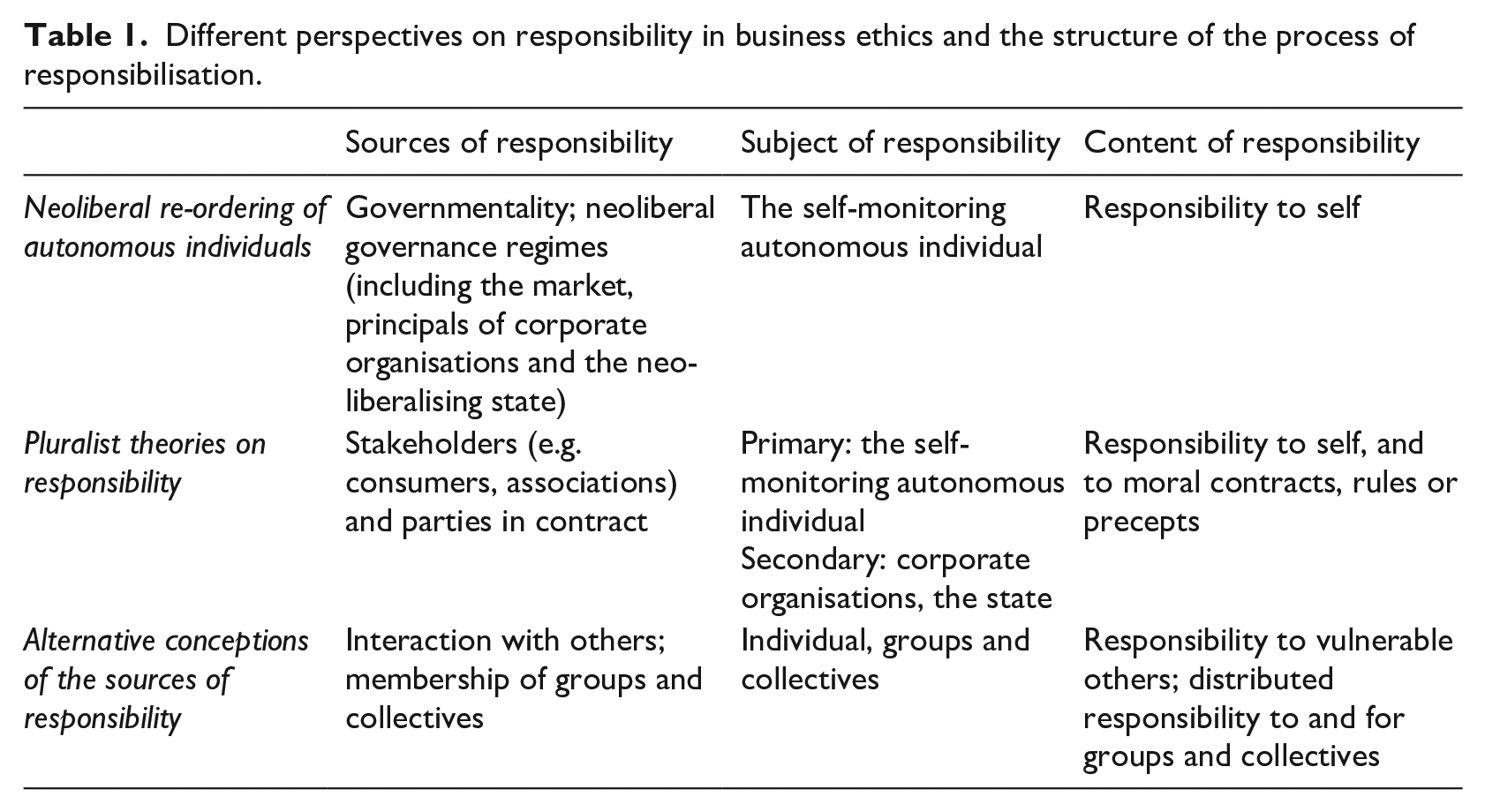
As we summarise in Table 1, responsibility has been articulated within at least three different approaches to business ethics: the neoliberal re-ordering of autonomous individuals; pluralist moral theories such as stakeholder theory; and alternative conceptualisations of interactionist, relational and collectivist ethics. These different representations of responsibility indicate the various sources, subjects, and content of responsibility involved in different modes of responsibilisation. Drawing on Foucault’s conception of the production or construction of subjects (Foucault, 1979, 1982), responsibilisation is understood as the process by which a subject position is constructed and allocated responsibility. Exploring the traditions of business ethics, we highlight the different ways in which the process of responsibilisation is realised.
Different perspectives on responsibility in business ethics and the structure of the process of responsibilisation.
The neoliberal responsibilities of individuals
Neoliberalism is understood as ‘a complex, often incoherent, unstable and even contradictory set of practices that are organized around a certain imagination of the ‘market’ as a basis for the universalisation of market-based social relations, with corresponding penetration in most aspects of our lives’. (Shamir, 2008: 3)
From this perspective, the economic owner (‘principal’) makes the employee (‘agent’) responsible for fulfilling the requirements and tasks set by the principal, who is entitled to pursue their (economic) interests within the constraints of the law and ethical customs (Friedman, 1970). The primary principals are owners and shareholders allocating responsibilities to managers, and, on their behalf, managers act as secondary principals who give responsibilities to other employees.
Neoliberalism presumes that social relations are based in economic action and rationality (Shamir, 2008). This neoliberal epistemology (Carvalho and Rodrigues, 2006) prioritises a first-person perspective (‘I’) on economic action and rationality, and subsumes moral sentiments within the economic action of individuals, corporations, and markets. As a result, morality is calculated through considering costs and benefits. Much CSR, for example, is predicated on the ‘business case for responsibility’ and ‘enlightened self-interest’, thereby following the economically calculating and maximising rationality of neoliberalism (Shamir, 2008). These reinforcing assumptions are put into action via a series of rationalities and technologies, as researched in studies influenced by Foucault’s work on discipline and governmentality. Through various technologies, discourses, and practices of objectivation, calculation, discipline, and surveillance, employees, for example, are allocated responsibility for their own welfare through the attainment of a self-entrepreneurial reflexivity. This self-governmental attitude is presumed to aid them in establishing and monitoring attributes such as their ‘employability’ that will enable them to compete in the market (Boltanski and Chiapello, 2005). Although there are necessarily various acts of overt and covert resistance to such discourses and practices, overall, governmental modes of ‘action at a distance’ succeed in gaining sufficient compliance by responsibilising subjects into modes of conduct amenable to neoliberal governance regimes (Soneryd and Uggla, 2015).
Pluralist perspectives on responsibility
In contrast to the implicit unitarism expressed in neoliberalism, social contract theory and stakeholder theory present a pluralist view that suggests there are multiple responsibilities to a variety of actors. For example, Shamir (2008) argues that both stakeholder theory and CSR are modes of the ‘moralisation’ of markets and businesses that are an unintended effect of the neoliberal centring of economic action as the primary social relation. In these developments, morality is re-inserted as part of the calculation of economically rational action. The plurality of responsibilities involved in the moralisation of the market and businesses is articulated by recourse to different deontological frameworks of rights and responsibilities such as social contract theory, or via institutional mechanisms such as the UN Principles of Responsible Management Education (PRME), which are an example of a ‘social responsibility institution’ (Banerjee, 2018). The deontologically developed rights and responsibilities that inform these pluralist theories are allied with an egoist focus on the moral responsibility of individual actors to act according to the obligations stipulated in these moral frameworks (Knights and O’Leary, 2006).
Thus, pluralist theories of responsibilities also allocate responsibilities to individual subjects (‘I’) in relation to static and universal accounts of moral rules. Sociological and neo-colonial critiques of the neoliberal allocation of individuals’ responsibilities, however, note that individuals and groups are differentially affected, according to, for example, class, gender, race, disability or international economic positions (McLeod, 2017).
Alternative conceptions of responsibility
Neoliberal and pluralist conceptions of responsibility rely upon decontextual, cognitivist and universal precepts, and individualised egos (Knights and O’Leary, 2006). In contrast, several alternative theorisations of the sources of responsibility and morality have focussed on interactional or relational responsibility (McLeod, 2017). This involves a dynamism between individual first-person (‘I’) and interactional second-person (‘you’) perspectives. Both feminist conceptions of an ethics of care (e.g. Heath et al., 2019) and Levinas’ conception of interactional responsibility put a focus on responsibilities to vulnerable others rather than on responsibility for moral precepts, duties or obligations (Knights and O’Leary, 2006). This implies re-interpreting the source of ethics and morality as the enervating experience of situated and embodied moral tension instead of abstract rules (Knights and O’Leary, 2006).
As well as developing this notion of an ethic of care, a number of other approaches to ethics attempt to include conceptions of collectivist responsibilities, such as Young’s (2011) development of the notion of shared responsibility. According to Young, responsibility has a shared dimension that is differentially distributed according to one’s participation in social and economic practices and structures (the partial ‘we’), which involves being co-responsible with others for their involvement in social actions and inactions that aid or harm others. It also has a mutual dimension in terms of membership of, or solidarity with, a collective (the whole ‘we’), which involves an irreducible political responsibility for the collective structures that shape social action and its effects. Therefore, responsibility also involves the prospective assuming of responsibility for one’s future individual, shared and collective actions, structures, and well-being (Young, 2011). Young’s work has been subjected to criticism for underspecifying the distinctions between different forms of responsibility (Barry and Macdonald, 2016). However, the value of her work for highlighting collective responsibilities towards structures as well as individual responsibilities for actions, as well as the retrospective and prospective aspects of responsibility are argued to be substantial contributions (Beck, 2020; Zheng, 2019).
Varieties of responsibilisation
In neoliberalism, responsibilisation is performed by governmentalising principals upon constructed neoliberal subjects who are allocated responsibility for their economic selves. The primary responsibility is to oneself and one’s choices, and if one chooses to engage in a contract, then one is obliged to the other party as stipulated in the contract. In the pluralist versions of responsibility, responsibilisation is performed by moral authorities – particular moral codes (or their institutions) constructing moral subjects that are allocated with responsibility for moral rules and precepts. In these theories, there are a series of abstracted responsibilities to moral rules or other stakeholders, to which the individual ego is responsible. In the alternative conceptions of the sources of responsibility, responsibilisation is performed diffusely, in reciprocal dialogue or interaction, or in shared and collective groups and practices, or potentially by oneself in the sensed obligation to care for the vulnerable other or for the environment. In these alternative theories, there are a dynamic set of evolving and emerging co-responsibilities to others, groups, collectives or the world.
Despite the concept of responsibilisation being associated with a Foucauldian dissection of the governmental strategies of economic and political principals, responsibilisation is not exclusively associated with neoliberal regimes (Rose, 1996). Different actors variably adopt, respond to, and resist, different calls for responsibility in their everyday negotiation of different situations, without necessarily experiencing internal conflict or moral breakdown as they shift between different frames or ethical domains (Trnka and Trundle, 2014). These different sources, subjects, and contents in the varieties of responsibilisation suggest that responsibilities are contested. Having said this, ‘how social responsibilities are deconstructed, evaded, subverted and resisted from different geo-political contextual perspectives has been passed over by much of the mainstream [CSR] literature’ (D’Cruz et al., 2021: 465). Having sketched the main cleavages in the ethical theorisation of responsibility, and how responsibilisation involves different sources, subjects and contents, we next discuss critiques of management education and attempts to embed responsible business education.
Criticisms of Business Schools
Criticisms of Business Schools cover wide and polarised ground. Functionalist critiques of Business Schools suggest that education should emphasise practice, and be oriented towards improving business performance (Pfeffer and Fong, 2002). Critical views, however, find fault with Business Schools for their focus on ‘appropriate technical business training’ and the managerialist assumption that their role is solely to deliver significant economic improvements (Ghoshal, 2005). These views also criticise Business Schools’ greed, short-termism and their embrace of market competition that creates a neo-colonial ‘supply chain’ between core economies and a ‘delivery end’ at various international branch campuses (McLaren, 2020; Parker, 2018; Siltaoja et al., 2019).
Other criticisms focus more directly on ethics, questioning Business Schools’ ability to develop appropriate morality in their graduates (Burchell et al., 2015; Koris et al., 2016). Typically, this complaint is that students have been directed towards economic self-interest, and profit-maximisation to the exclusion of societal needs (Ghoshal, 2005). This is believed to promote narrow and outmoded thinking about business-society relations (Parker, 2018). Moreover, such ethically based criticisms argue that mainstream business education casts knowledge as an entity-based commodity, which is promoted to students on the basis that its mastery will yield improved employability and career prospects, and thus, personal gains (Koris et al., 2016; Landfester and Metelmann, 2018). Along similar lines, Moosmayer et al. (2019) argue that even when educators intend to engender students with an ethical and socially responsible mind-set, the results can be counterproductive, as teaching theories underpinned by normative assumptions often produces concomitant beliefs and behaviour on the part of students. Others argue that the approach taken to teaching business ethics is too abstract to produce change in behaviour and practice (Hope et al., 2020), and that Business Schools have failed to educate students on how to respond to climate issues (Molthan-Hill et al., 2020a).
These criticisms afford Business Schools a seemingly strong role in educating or influencing students, which Knights and O’Leary (2006) contend is unwarranted. They view business education as reflecting the individualised and ego-focussed rationalities found in broader society rather than being directly responsible for them. However, they support the potential of transformative business education that explicitly seeks to develop moral sensitivity and critical thinking (Knights and O’Leary 2006). There is also broader recognition of the value-laden nature and socio-historical positioning of knowledge and practices, and the need for advocating for social change through business education (Koris et al., 2016; Landfester and Metelmann, 2018; Moosmayer et al., 2019; Parker, 2018). Such a critical and transformative business education is said to enable students to work with values, through the lens and practices of dialogical and critically reflexive education and questions of social responsibility and justice (Cunliffe, 2008; Painter-Morland and Slegers, 2018; Solitander et al., 2011; Toubiana, 2014).
Responsible business education, its barriers and enablers
Several broader moves have been made to incorporate forms of socially responsible business education into mainstream business education. These include, for example, PRME as well as various accrediting bodies such as the AACSB and EFMD (European Foundation for Management Development) that include responsible management education as one of their standard criteria (Jamil, 2015). However, these external arguments and pressures for responsible business education may generate only a tokenistic response. Indeed, authors have found that senior Business School staff view their role in primarily business-functional or economically functional terms (see, for example, Doherty et al., 2015). The PRME, in particular, has been critiqued for limiting the discussion of responsibility within Business Schools and shutting down the potential for critical reflexivity with respect to the concept (Millar and Price, 2018). Furthermore, it is unclear whether such external pressures lead to shifts in the ideological underpinnings of globalised and marketised business education (Baden and Higgs, 2015) or result in ‘decoupling’ between espoused values of social responsibility and enacted practices of responsible education (Rasche and Gilbert, 2015). Nonetheless, even partly symbolic, instrumental or piecemeal responses from Business Schools offer narratives that staff can draw upon to advance change (Burchell et al., 2015).
Researchers have also identified constraints or counter-pressures against the introduction of responsible business education. In particular, many UK employers show ‘limited concern for global citizens and ethical or responsible leadership’ as desirable graduate characteristics (Tymon and Mackay, 2016: 439) and students’ favourability towards responsible business education should also not be assumed. Painter-Morland and Slegers (2018) warn educators that students’ current values are likely to be associated with the broad capitalist agenda, and may primarily seek an education that increases their employability prospects. Deviation from this aim can be ill received. Burchell et al. (2015) note a lack of student demand as a reason for the turnover of some responsible management courses in the United Kingdom. Others (e.g. Haski-Leventhal, 2020; Koris et al., 2016) argue, however, that students will ultimately exert pressures on Business Schools to change their curricula towards the broader responsibility agenda. Having said this, students within non-Western contexts may not perceive undertaking responsible business as an important component of management education (Jamali and Samara, 2020).
Academics have also been theorised as a potential lever and barrier in driving curriculum and institutional change in relation to responsible business education (Burchell et al., 2015; Molthan-Hill et al., 2020a; Solitander et al., 2011). Recent research has indicated that adopting teaching approaches that offer opportunities to critically reflect on values and identity (Moosmayer et al., 2019) as well as engage with experiential and problem-based learning within and outside the educational setting (Molthan-Hill et al., 2020a), can facilitate students in developing an understanding of the issues linked with responsible business practices (Hope et al., 2020; Molthan-Hill et al., 2020b). Studies have also indicated variations in academic staff’s responses towards embedding responsible business education that ranged from being supportive, to hostility and ridicule (see (Beddewela et al., 2017; Doherty et al., 2015).
However, the available studies within the context of business education are often tangential to a direct exploration of academics’ understandings of responsibility (Cullen, 2020; Jamali and Samara, 2020). For example, Gottardello and Pàmies’ (2019) study reveals differences in Business School professors’ conceptions of ethics, and the extent to which participants perceived it to be their responsibility to include ethics within their teaching. Toubiana (2014) explored the confluence of normative and organisational factors that interfered with academics’ ability to enact personal views of social justice within their teaching on MBA programmes. Three factors were apparent – the profit-maximising ideology of students, a directive and technical approach adopted to teaching and the institution’s limited inclusion of qualitative research that may more easily reflect issues of social justice. While few studies have explored academics’ perspectives on the discourses of responsible business within settings outside of the Global North (Jamali and Samara, 2020), the research emphasises that discussing topics such as ethics or CSR, without consideration of local context and culture, can lead to resistance from academics and students (Siltaoja et al., 2019). Jamali and Samara (2020) noted that ‘the non-Western context may have significant cultural, regional and historical idiosyncrasies that make research and practice of RME peculiar and subject to a multitude of macro and micro forces affecting it’ (p. 43). For example, in Malaysia (the context of our study), Jamil (2015) found a lack of enthusiasm for teaching business ethics among Malaysian management educators, who generally ‘viewed family upbringing, including religious instruction, as the major influence on ethical behaviour within organizations’ (p. 225). Similarly, Rees and Johari (2010) found that Malaysian employers and academics considered ethics as being largely outside of the remit of educators.
These debates and the mixed views of both business students and academics regarding questions of responsibility within teaching, highlight the contested ethical climate around the educational and societal role of contemporary Business Schools, including in the Global South. We now detail our phenomenographic research approach used to investigate the ways in which Business School academics in Malaysia understand responsible business education.
Methodology
Case organisation
Our study was based in the context of a well-reputed, private Business School in Malaysia. It has research and teaching partnerships with international HEIs, and offers undergraduate and postgraduate degree programmes. The Business School is fully recognised by the Malaysian HE Ministry, and is also working towards achieving international accreditation. Its mission explicitly includes developing employability skills and delivering socially responsible education, which is consistent with the Malaysian state’s priorities for graduate employability and the inclusion of social responsibility within HE curricula (Fahimirad et al., 2019; Tyson et al., 2011). With respect to demography, the majority of the academic staff and student population at the Business School are of Chinese-Malay ethnicity, the second largest and most economically advantaged ethnic group in the country (Khalid and Yang, 2021).
Research design
Phenomenographic research aims to study the different ways in which people experience and understand aspects of their reality (Marton and Booth, 1997). Adopting a relational ontological view, phenomenographic studies assume that individuals and their world is inter-related through lived experience (Marton and Booth, 1997), and that conceptions, or understandings, are ‘people’s ways of experiencing or making sense of their world’ (Sandberg, 2000). Within phenomenographic studies, conception of the surrounding world ‘. . . fundamentally is a question of meaning in a social and cultural context’ (Svensson, 1997: 163), and is ‘. . . socially constructed and reconstructed through the person’s ongoing experiences and relationships with their world’ (Lamb et al., 2011: 676). Conceptions are dependent on not only human activity and thinking but also the external world (Svensson, 1997), and are assumed to be neither fixed nor stable in nature, and can evolve over time (Marton and Booth, 1997). In phenomenographic research, there is an emphasis on the context-sensitivity and social and cultural embeddness of conceptions (Svensson, 1997) as human experiences are always situated in a context characterised by material and abstract realities of our world (Marton and Booth, 1997).
Adopting the view that consciousness is intentional in nature (Sandberg, 2000), phenomenographic research also considers that individuals’ actions and activities are determined by the way they understand the different aspects of their reality (Lamb et al., 2011). Phenomenography assumes that there are a limited number of ways in which a phenomenon is understood 1 by a group of participants, and that these ways can be explored, studied and communicated (Marton and Booth, 1997). The different ways of understanding the phenomenon are presented as categories of description which are relational and qualitative in nature, and made visible through language (Svensson, 1997). Within phenomenography, language that is assumed to have its own social and cultural context, plays ‘. . . a central role in the construal of experience, that is it does not simply represent experience, as it is widely perceived, but more importantly it constitutes experience’ (Marton et al., 2004: 25). This suggests that variation in the character, meaning and parts of conceptions and their relationship with awareness, language, social and cultural realities within which the conceptions are apprehended, can be examined within phenomenographic research (Marton and Booth, 1997; Svensson, 1997). Phenomenographic studies also explore links between the qualitatively different ways of understanding a phenomenon (Trigwell, 2000), in particular, how they build on, or expand, each other, or involve an internal relationship (Akerlind, 2012). Implications from categories of descriptions, or their internal relationships, offer possibilities for theoretical contributions to the literature (see, for example, Sandberg, 2000).
Data collection
The semi-structured interview is the preferred data collection method within phenomenography (Akerlind, 2012). A recommended sample size of participants is 10–15 participants (see Trigwell, 2000), dependent upon whether there is an increasing degree of similarity found within responses. In this study, the first author interviewed 18 academics who were working full-time in the Business School. The participants were teaching a variety of undergraduate modules such as Organisational Behaviour, Leadership, Human Resource Management, Strategic Management, Entrepreneurship, Marketing, Management Accounting and Finance, with a range of 20–300 students enrolled. The participants identified as female (8) and male (10), and occupied various roles (e.g. Teaching Fellows, Lecturers, Senior Lecturers and Professors). The participants’ years of experience teaching (2–25 years), and in industry (0–25 years) varied. Thirteen of them had previously taught in other HEIs within Malaysia and internationally, and 11 had completed their postgraduate degrees in globally North countries. This range of participants helped to capture a wide range of meanings and exhaust the variation in conceptions within the group (‘lecturers’), which is an important requirement within phenomenographic research (Marton and Booth, 1997).
The lecturers agreed to participate in a one-to-one interview to explore their views on responsible business education within Malaysia. They responded to questions such as ‘Do you think businesses need to engage with contextual social, economic and environmental problems?’ and ‘Could you describe your experience of teaching students about this relationship of businesses with the societal problems in your module(s)?’ Follow-up questions were asked when needed to seek clarifications of the participants’ responses and to elicit their rationales and justifications underpinning the teaching-related choices and activities given their relational and contextual nature. Interviews lasted approximately 1 hour, were conducted in English and audio-recorded under the agreement of anonymity and confidentiality.
Data analysis
Akerlind (2012: 323) explains that phenomenographic analysis aims to explore ‘the range of meanings within a sample group, as a group, not the range of meanings for each individual within the group’. With this in mind, the iterative data analysis process began with reviewing the transcripts to develop greater familiarity with the responses. Participants’ descriptions were grouped together in terms of similarities and differences in their views on responsibility in business education. The emerging categories along with their summaries and illustrative excerpts were then shared with the co-authors for review of the preliminary data analysis. We reflected on the meanings of the data-quotes within, and between, categories (Marton and Booth, 1997).
In our review, we also discussed whether the categories had clear distinctions in their underlying focus or if some of these categories were inter-linked and represented a particular view of responsible business education. This is as each category of description ‘is a complex of aspects of the way that the experience of the phenomenon in question has been expressed’ (Marton and Booth, 1997: 125). After our review, some of the initial categories were collapsed into one. For example, two of the initial categories identified were ‘exposing students to local issues of poverty and inequalities’ and ‘making students aware of their individual impact on their surroundings’. We determined that these categories were highlighting inter-related aspects of a particular way of understanding responsible business education, that is, ‘raising awareness of social and environmental challenges’, and so merged them into a larger category.
The remaining categories were then reviewed against the crucial criterion of phenomenographic analysis that ‘each category tells us something distinct about a particular way of experiencing the phenomenon’ (Marton and Booth, 1997: 125). Once we were satisfied that this criterion was met, these were considered as the final set of categories of description. During this stage, we also collectively evaluated and conceptualised the nature and inter-relationships of the three remaining categories. The original transcripts were reviewed to ensure that the final categories and their inter-relationships represented the participants’ described experiences. In this final stage, we also examined whether the participants’ gender, the modules they taught, or breadth of their teaching and industry experience may account for differences in conceptions of responsible business education. We found no such pattern.
Our collaborative approach to data analysis served two purposes. First, it helped to mitigate against an individual researcher’s biases and assumptions being imposed on the analysis (Marton and Booth, 1997). In addition, it encouraged a greater open-mindedness towards alternative perspectives and interpretations of the data (Trigwell, 2000). Second, it aided the attempts to ‘bracket’ our knowledge and assumptions. While recognising that ‘bracketing’, or setting aside, our presuppositions can only be partially successful, 2 such efforts also included developing empathy towards the participants’ descriptions. This involved an ‘imaginative engagement with the world that is being described by the [interviewee]’ and adopting an attitude on our part that facilitates ‘. . . a detachment from the researcher’s lifeworld and a opening up to the lifeworld of the [interviewee]’ (Ashworth and Lucas, 2000: 299).
With this in mind, in our deliberations we not only approached the participants’ descriptions with interest and empathy but were also reflexive on our own biases, assumptions, and backgrounds to warn ourselves against ‘superior moralizing’ (Reynolds, 1998: 194). For example, during the data collection and analysis, we became increasingly aware that in Malaysia, there is little, or no formal state welfare system. Throughout the research process, we remained conscious of this contextual reality as the participants described their views on responsible business education. In turn, our interpretation of the data is not predicated on just representing or deconstructing the views of our informants, but in reflexively reconstructing the relationships between their interpretations and narratives and our own position as Global North–based researchers (Alvesson et al., 2008). In the next section, we present our findings, providing pseudonyms with data excerpts.
Findings: categories of description
Category A: contributing to students’ employability
In this category, the lecturers described students’ primary aim for enrolling onto business programmes as being to secure relevant jobs after graduating. They used the narrative of employability to interpret students’ expectations of business education, and saw their teaching objectives to be contributing largely towards the employability agenda. One participant stated, in south east Asia and in a large part of the world, business education is still all about employability. So, no matter how much we say we need to talk about the environment, society, poverty . . . in teaching, the focus of students and also parents will only be on employability, and that’s what they want from us – to help them to get jobs. (Malan)
Within this category, the lecturers noted that for students and their parents, securing employment within reputable organisations was their return-on-investment in HE. As such, they were interpersonally responsive to students and their parents. The lecturers enacted their sensed broader responsibility to the employability objective, with little or no engagement with environmental or social issues: I say, based on my observations, that most students after finishing their study, the first thing that they try to do is to get a good job. To expect them [students] to actually do something to contribute to the society, to social issues and environment, I think it is a big challenge for us at the moment – you see they have been spending years studying, and the family or students themselves have expectations on what kind of returns they can get at the end of their study. So as a lecturer I feel responsible for that. (Zu)
Since students were judged to perceive themselves as responsible for improving their employability, and as a result, the future profit-making endeavours of organisations, the lecturers described incorporating content related to social responsibility within programme designs and objectives to be problematic for retaining and recruiting students. They highlighted that the narrative of profit-maximisation as the primary purpose of business was the dominant view, particularly within the Malay-Chinese community. One participant described that Most of our students are Malay-Chinese students and their mind-set is that they don’t come here [to Business School] to learn to be socially responsible . . . [In Malaysia] people are exposed to the idea that we must go for profit. Now if we say you should not go for profit, but you should go for social value, people will say what are you talking about, how I am going to survive then? Who will look after my family. (Zak)
According to the participants, the dominant narrative of profit-maximising within organisations was an aspect of their local contextual reality that also limited students’ agency as future employees in undertaking business activities responsibly. Due to this, the lecturers perceived students’ knowledge and awareness of social or environmental issues to be of less value, particularly when working within local business organisations. As one lecturer said, . . .what will happen when they [students] go to work in a workforce as a junior executive, to be at the lowest level in the corporate ladder? If your manager does not seem to be socially responsible in terms of organizational decisions, then you get stuck into that thinking mode of profit, profit, profit, revenue, revenue, revenue . . . how can they [students] use this knowledge about society’s issues when in the real world where most investors and corporations are receptive only towards their primary objective i.e. profit maximising. (Bashr)
The lecturers emphasised the importance of meeting corporations’ and students’ espoused interests within modules and programme designs for student recruitment. This is, as one lecturer stated, that the employability narrative rendered the focus on social and environmental issues within degree programme designs as ‘unattractive’ in the local HE market: Even if we design a programme that has a strong social responsibility element in it but then, what’s the point when it won’t attract students to enrol in it? You can clearly see in terms of which courses are garnering the most students – it’s accounting and finance degree, professions that they see would give a good job and the ones that probably give them the more money and stature . . . it boils down to what they really want from their degree, which is, again, a good career and money, and that’s also the expectations of their parents. I think to be socially and environmentally conscious and responsible is secondary in our current culture. (Gemma)
The excerpts in this category reflect the ‘marketized’ and unilinear view of business education and business that reproduces the dominant narrative of employability and profit-making. This narrative allocates the lecturers’ responsibility as being responsive to students’ and parents’ desire to get a relevant job, and to business demands, encapsulated together in the broader responsibility for employability. In time, the students’ allocated responsibility when working for corporations comes to be the maximisation of business profit.
Category B: raising awareness of social and environmental challenges
In this category, we found that while the lecturers acknowledged students’ (and their parents’) employability agenda, they also described assuming a broader responsibility to issues of social inequalities, poverty and environmental degradation. As such, the lecturers purposively highlighted the possible implications of students’ individual actions in relation to prevailing socio-environmental issues. Doing so was described as important, since, according to them, their students had limited exposure and interest in such challenges. A lecturer said, I think what’s lacking in our society today is civic consciousness . . . since it [civic consciousness] is not coming naturally, or it’s not being developed naturally, I think it needs to be taught to make them [students] aware of the others and the community around you and to be not so self-centred. That is why I tell my students about the homeless here [in the country], of poverty, and other similar kinds of issues. (Reeney)
The lecturers also viewed the narrative of employability and profit-maximising as being likely to remain dominant within Malaysia, and it was not fundamentally questioned or challenged in their teaching. However, enacting their broader responsibility to environmental and social issues (which were rejected in Category A), the lecturers introduced such issues within their modules. This was in a bid to evoke group and collective responsibilities within students in addition to their individual responsibility to employability and profit-maximising demands. One participant said, Can we [lecturers] really change how businesses operate? Can students change how businesses operate? No, I don’t think so. Students will think about jobs first, and corporation will think profits first – that is how it is here in Malaysia. But what we can do, and can do well, is to tell students to start thinking about your surroundings, environment as well. For me that should be our [teaching] focus as our students don’t think on these lines and have employability needs in mind only. (Alli)
In addition to highlighting socio-environmental issues within teaching, and attempting to evoke a form of collective responsibility as in the preceding excerpts, the lecturers understood that students would benefit by interacting with members from materially less-privileged/vulnerable segments of society, or as one participant stated below, the ‘hidden’ parts of their community. To facilitate this, students undertook a small-scale project that involved working with members of these community-segments. Such projects were described by the participants as a response to the lecturers’ assumed responsibility for the moral responsibilisation of students to the relatively poor in their context. Also, the inclusion of this project ensured that the regulatory requirement to embed social responsibility in the curriculum was met as Zeh stated, we have a [anonymised] project here which is a chance for the students to actually understand or realise that they’re part of the whole ecosystem in the society. The whole idea of having them approach an external organisation, and for them to experience the hidden parts of the society, the poor of the society; and making them to think and reflect on their experience, I think is actually quite transforming for the students . . . this module is actually a good platform because it’s been mandated by the Government. This means no escape for the students in taking this module [says this while smiling]. (Zeh)
Another teaching example provided that aimed to enable students to develop a concern for social issues and inequalities was through their experiences on an on-going project in the Business School regarding the challenges faced by people with visual impairments: We must always tell them [students] that they should have empathy for others. We have a very successful project here in the university to create awareness of how blind people feel darkness. I read from our announcement that it’s not only for our students to experience but also students from other institutions come to visit the set-up. It was also broadcast on television and that helps to create awareness. (Alli)
Highlighting social and environmental issues in their teaching was understood to be important by the lecturers as, according to them, the focus of students tended to be predominantly on individual needs rather than thinking at group or community level broadly – in this manner, rather than focussing just on the part (the individual), they also stressed the importance of the whole (institutions, society). However, culturally sensitive topics (such as inter-race relationships, financial corruption, stereotypes relating to gender and homosexuality) tended to be not discussed with students. Indeed, the participants were quick to divert the interview discussion away from these issues if broached. For example, when the researcher mentioned the topic of race relationships to a participant, Ron responded, Shhssshh! [while placing his finger on his lips] We don’t talk about some things openly here. Its best to avoid them [starts laughing]. Do you have another question for me . . .
While attempting to enhance students’ awareness of social and environmental issues through their teaching, the lecturers in this category also recognised the dominant perspectives of employability and profit-maximising as informing students’ understanding of the purpose of business education in Malaysia. The participants perceived these perspectives as barriers in being able to allocate more focus to moral, social and environmental challenges within the design of their business programmes. One participant said, They [students] are not really interested in the transformation of themselves, they just want the certificate to get a good job, and that is what we are doing . . . my worry with this is in terms of the wider social context, that we’re turning out lots of bright, quite hardworking people that don’t really have much understanding of society, of religious tolerance, history, politics, and philosophy – all the things they should be thinking about really. From a wider social perspective, I think there’s a flaw in our system, in our teaching, that we’re not exposing the students enough to such subjects. (Chen)
This category highlights the narrative of the need for transformative business education that can potentially change students’ understandings and actions relating to multiple dimensions of responsibility. However, the lecturers within this category noted that the programmes on which they taught were not socially responsible enough, and highlighted the tension they experienced between their collective transformative educational aims – focussing on the ‘whole’, and their responsibility to produce individually focussed, marketable and employable graduates – focussing on the ‘part’.
Category C: challenging the sole focus on the profit-maximising agenda
Like category B, this category too reflects multiple narratives of responsible business education within the participants’ descriptions. The lecturers assumed responsibility towards students’ employability, profit-making organisations, environmental issues, and wider society. However, they problematised the dominant perspective of neo-liberal profit maximisation by presenting students with a narrative of businesses’ responsibility towards societal issues and challenges. They described purposely introducing case-studies, and occasionally, inviting guest speakers as part of their teaching. This was to develop students’ understanding of the relationship between businesses’ profit-making agenda and social and environmental issues: I see the need for students to understand the wider role that corporations can play in society as very often our students here have wealthy backgrounds and their understanding of what the role of business within society is very limited. So, when I teach my [anonymised] module, in the middle part I move into areas of social problems and the need for businesses to move away from pure profit motive and to look at how they can engage with and help society, to contribute and be a part of society – so no more the pure profit maximizing and things like that. (Lukey)
The lecturers in this category also described that a useful way of responding to wider societal and environmental issues within their teaching was to challenge businesses’ singular focus on the narrative of profit-maximising in comparison to highlighting socio-environmental challenges (as was found in Category B). A participant reported that We can tell students about our society problems in our modules but I question if this is the best way [of addressing the problem]?. . . What we need is more work on companies because if you remember the financial crisis, people have been somehow, if I can use the word, coerced into thinking that businesses are just about making money, without sparing thought for those who are excluded and marginalised. I thought that in order to overcome that kind of perception [of profit-maximizing], the private enterprises should take a more active role in this kind of activity to help neglected parts of the population. (Fahey)
The lecturers in this category viewed businesses as both being driven by a profit-maximising agenda, and as having an interdependent relationship with their local communities, to which they should adopt a form of ‘we-’ orientation in terms of seeing themselves as part of the ‘whole’ of society. Thus, they ascribed group and collective responsibilities to businesses. The lecturers also overtly described students as prospective future business leaders and managers, who are to navigate organisations through the enactment of their responsibilities towards profit-making and social-environmental issues: I say there will be demand for this type of business leaders and managers in the future who have an understanding of what’s going on around them in business, of being responsible to shareholders and stakeholders and also to the environment, that is something which will be very valuable to organisations. (Wang)
As such, these lecturers indicated multiple interlocutors in the co-construction of responsibilities (shareholders, stakeholders, the environment). Within this category, the lecturers, however, viewed the current focus of their business study programmes as too ‘narrow’, in that it reinforced the dominant perspective of the neo-liberal profit-maximising agenda. They described the need to redesign study programmes to prepare students for dealing with different responsibilities, including business needs as well as societal and environment issues. One of the lecturers said, We need to really incorporate social values into our business education. I think our existing lens is very much adopting a narrow approach of how to do business efficiently. It’s really a bottom-line approach – the economics model of management that it’s everything about profit making, and for corporations their primary objective really is economic success. And that is driving the approach to management education, but it needs broadening out. (Zoey)
The descriptions in this category highlight that the lecturers identify tensions between different responsibilities. Responsibility to societal and environmental challenges, however, was presented so that it is incorporated within, and as an evolution of, the dominant perspective of profit-maximising. Businesses, Business Schools and students were seen as responsible for catalysing this prospective evolution where individual students (parts) could contribute to the evolution of the ‘whole’: We [lecturers] need to tell students that business is not just about finance, it’s about being responsible in business because that trend is coming that organisations are looking into CSR, looking into sustainability. So, understanding these concepts would help them [students] to give long term benefits to companies not only in terms of profits but also in terms of good branding and reputation of the company in terms of contributions to the society. With that profits will follow eventually. (Ying)
This category highlights that the lecturers were responding to their assumed responsibility towards socio-environmental issues by problematising pure profit-maximising perspectives of businesses. They allocated group and collective responsibilities to businesses and Business Schools, and to students as prospective future leaders and change agents within responsible businesses. In so doing, there was a proliferation of the number of subjects constructed as bearing responsibility, the contents of responsibility, and the interlocutors with whom responsibility is co-constructed, as was evident within the lecturers’ descriptions.
Discussion
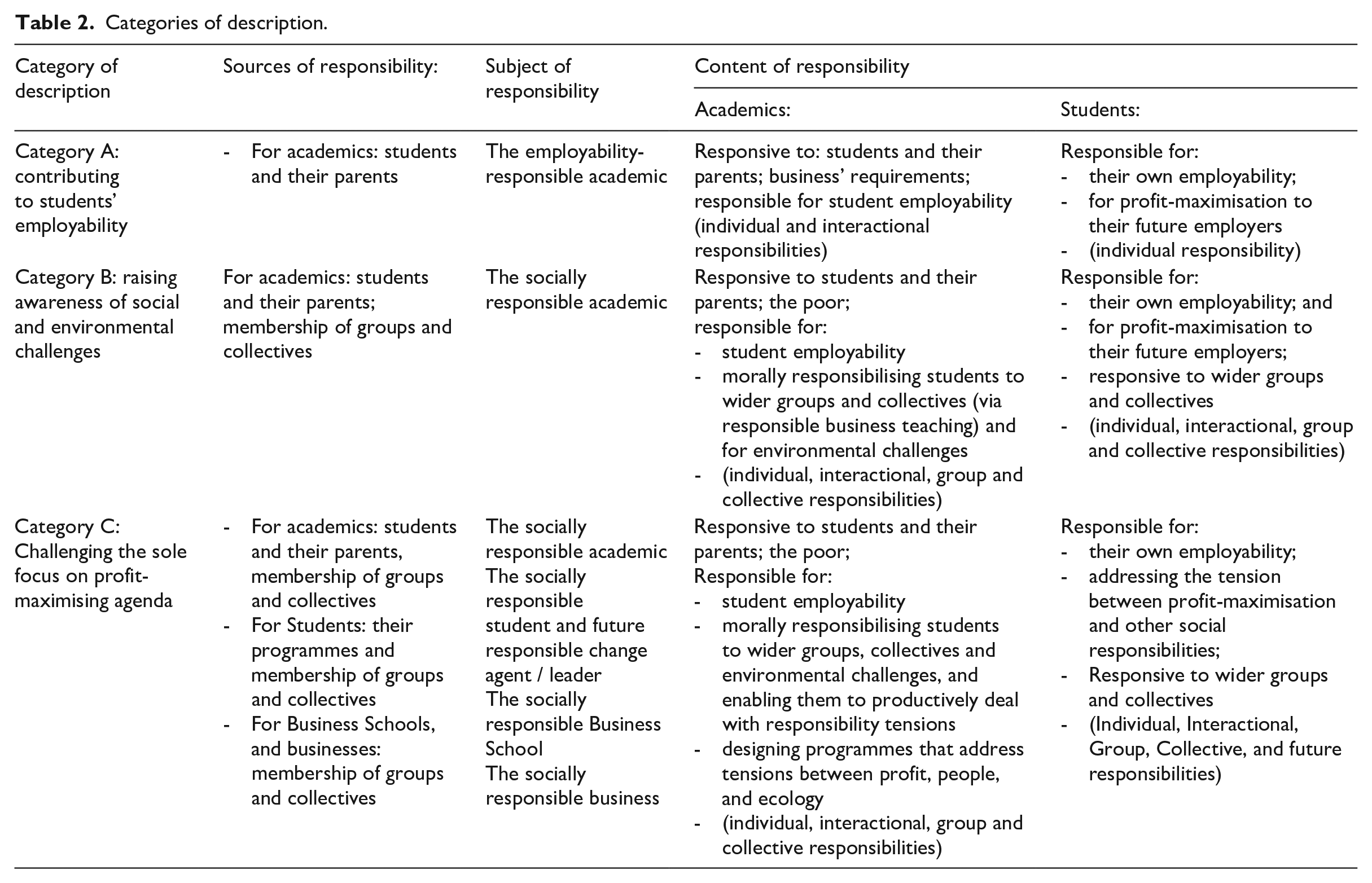
Previous literature has noted the proclivity of Business Schools to teach ‘business from a purely business perspective’ (Koris et al., 2016: 174), and to meet the profit-maximising interests of students and their desire for employability within business education (Burchell et al., 2015; Toubiana, 2014). Our analysis illuminates varying meanings of responsible business education, and how these involve relations of both subordination and resistance to the dominant narrative, but do not fundamentally reject it (summarised in Table 2). According to the counter-perspective (evident in Categories B and C), there are multiple responsibilities of lecturers not only to student consumers but also to the poor, society or environmental issues. Our findings suggest that lecturers in the Global South, as in other contexts, shared no consensus on the role of ethics or responsibility in business education, and some experience tensions between their ethical views and the typical programmes they are tasked to teach on (Doherty et al., 2015; Gottardello and Pàmies, 2019).
Categories of description.
One striking reflection on the findings is that the implicit ethic of care expressed by many of the participants is responsiveness to students and their parents, partly as consumers, in which the students and their parents are a party to a deontological contract with the educator, but also as vulnerable others who must find employment. This is significant as one of the assumptions of a feminist ethic of care (e.g. Heath et al., 2019) and of Levinas’ conceptions of responsiveness to a vulnerable other is that it may enable privileged parties to recognise and accept responsibility to others unlike themselves (Knights and O’Leary, 2006). However, the data suggest that proximal interactions with students are foregrounded in many participants’ minds, and that the moral responsibilities felt within this interactional dimension of responsibility tended to take precedence over those to distant others. As indicated in the excerpts, some participants brought students into the wider community with the explicit purpose of (a) creating civic engagement and interactions between these students and others whom they might not otherwise interact with and (b) of evoking a responsibility to these others through first- to second-person (‘I’–‘you’) interaction, and seeing their individual ‘part’ in relation to the ‘whole’ of society. This implies that there is potential for an ethic of care in generating transformative interactions and educational experiences beyond students’ normal social interactions. However, the participants had limited opportunities to facilitate such experiences as the modules’ and study programmes’ designs were expected to improve employability by teaching a curriculum that was predominantly consistent with the dominant narrative of profit-maximisation, with constraints of student recruitment and retention.
It is also clear that each of the categories contain narratives and allocations of responsibility that are dialectically related to each other. In Category A, the narrative of responsiveness to students and their parents, and of students’ responsibility for profit-maximisation, disavows the responsibilities to other ecological or societal issues, prioritising a focus on individual parts only. In this way, these lecturers minimise their responsibilities (as lecturers) to one dimension – that is, to improve students’ employability. The narratives of assuming responsibility for wider social and environmental challenges, and for challenging the profit maximisation thesis (as found within Categories B and C, respectively), are variously antithetical to the dominant narrative, and, to an extent, to each other. The participants drawing on these counter-narratives saw the profit maximisation thesis as insufficient and allocated additional responsibilities for other social parties and the environment to themselves and businesses, as part of a view of the ‘whole’. Resonating with Young’s (2011) depiction of group and collective dimensions to responsibility, they also identified an extended professional responsibility to develop and transform the moral sensibilities of students, as well as an increase in the relevant interlocutors with whom responsibility is co-constructed. In Category C, the lecturers draw on the narrative of responsibility for challenging the profit maximisation thesis. Their ascription of other responsibilities to businesses and to business educators indicates a dialectical relationship and tension between the individual (‘I’), group (partial ‘we’), and collective (whole ‘we’) dimensions of lecturers’ responsibility – a dialectic between different subject-positionings, and also between the ‘part’ and the ‘whole’ (Jameson, 2010). While some lecturers perceived conflict between profit maximisation and wider social and environmental responsibilities, none of them fundamentally rejected the notion that it is the responsibility of business to generate profit. Rather, other responsibilities are added to the responsibility for profit maximisation, at the most to alloy or evolve it to mitigate the negative effects of this principal responsibility. In Category B, the lecturers recognised the broader (partial ‘we’) responsibilities for students, employees and academics. However, Category C indicated a more encompassing and prospective assumption of broader (whole ‘we’) responsibilities, by Business Schools and businesses, as well as academics. This included responsibilising students as prospective future agents of change and moral leaders in addressing the tensions between business responsibilities and wider social responsibilities – indicating a dialectic between different temporal orientations.
The multiplicity of different versions and dimensions of responsibility has been noted before (Knights and O’Leary, 2006; Trnka and Trundle, 2014; Young, 2011). Our theoretical contribution, however, is drawing attention to the relationships between these different dimensions. The observations of the antithetical and dialectical relations between these different categories indicate a profound aspect of the cultural elaboration and potential transformation of social responsibilities. Rather than seeing the differing conceptions and narratives of responsibility along with the modes of responsibilisation as separate to each other, we argue it is more instructive to see them as mutually implicated and evolving, since the ‘I’ is dialectically developed in relation to the different interlocutors of ‘you’. The thesis of business education focussing on enhancing employability and profit maximisation (as evident in Category A) derives a significant aspect of its meaning and character through its disavowal of wider social and moral dimensions of responsibility. It asserts the primacy of the individual (‘I’) dimension of responsibility (Ghoshal, 2005), while limiting the interactional dimension to the student as consumer and denying group and collective dimensions. In turn, as was clear within Categories B and C, the narrative of responsibility for wider social and environmental issues, and the narrative of responsibility for challenging the profit maximisation thesis also gain part of their meaning and character through their narrative juxtaposition with the profit maximisation thesis. These dialectical narratives highlight the interactional, group and collective dimensions of responsibility. The tensions and complementarities between these dimensions and the individual dimension of responsibility drive the dynamic and dialectical iteration of the micro-processes of allocating, evoking, sensing, assuming and disavowing responsibility evident in the data.
We find that the narratives of responsibility within the categories of descriptions, appear to be profoundly socially, culturally, politically and economically situated. Nonetheless, the broad contours of these narratives share similarities with narratives evidenced in the theorisations of responsibility in Western business ethics. Different perspectives on glocalisation (see Roudometof, 2016, for discussion) describe several mechanisms through which non-local (typically Western) ideas and practices can be imported, recreated, reconstructed and adopted within a given locality. Arguably, the cultural and economic histories and aspirations within the Malaysian context, including its significant influence via American Business Schools (Jamil, 2015) and the globalisation of HE (Siltaoja et al., 2019), affect the evocation and meaning of the participants’ narratives of responsibility. At a more granular level, the case study organisation is involved in a teaching partnership with a HEI in the Global North, and most participants have either worked in, or have completed postgraduate degrees in international HEIs. Also, there are clear parallels between how participants discuss responsibility and how Western ethical theories treat responsibility (as noted in the discussion section). However, these provide an insufficient basis to conclude that the participants are propagating glocalised versions of Western constructions of responsible business, and responsible business education. Without the evidence that future research might provide, we believe it is, as yet, too early to judge in which way such theories influence their conceptions.
Similarly, despite the Malaysian state being involved in responsibilising Business Schools for responsible business education (Rahman et al., 2019), the participants rarely explicitly ascribed much influence to the government. Nonetheless, their conceptions are often partly aligned with (some) of the government’s narratives, while implicitly rejecting others. In Categories B and C, the lecturers express a belief in the importance of incorporating social responsibility within management education, in a manner which is consistent with aspects of the Malaysian government’s discourse (Rahman et al., 2019). Yet those in Category A disavow such responsibilities and resist them. The government’s increased emphasis on enhancing employability (Fahimirad et al., 2019) and the national economic goal of rapid growth, supports these lecturers in evoking the necessity of profit maximisation and in reducing the scope of their sensed individual responsibility to these self-focussed maxims alone (Rees and Johari, 2010). Yet, it is notable that participants in our study made no implicit or explicit mention of the ethnic tensions as well as other culturally sensitive issues (e.g. sexuality, gender, class and economic inequalities) described elsewhere (e.g. Tyson et al., 2011).
Implications of the research findings
Our argument of the dialectical dynamic of responsibilisation has several implications for responsible business education. First, it highlights the potential of cultural reflexivity towards alternative philosophies of business ethics (Heath et al., 2019; Knights and O’Leary, 2006) for students to grasp the dynamic nature of different modes of responsibility and responsibilisation. This would entail explicit articulation of a reflexively comparative analysis of different narratives, practices and assumptions of responsibility: of who enacts responsibilisation, and of how the construction of subjects, and the content of their responsibilities, is effected. Second, it implies that helping students to take account of the differential social, cultural and economic positions of distant others may facilitate a greater understanding of alternative views, senses and experiences of responsibility (Painter-Morland and Slegers, 2018). As indicated in the data, one mode of doing so is through engaging students in projects involving community and vulnerable others. Other modes might involve reflexively comparative studies of community or alternative initiatives, or of the forms of extraction or appropriation employed by many businesses and their negative effects (Banerjee, 2018). It also suggests that a greater engagement with different local and traditional forms of morality presents an opportunity for critical reflection upon Western-influenced ethical frameworks (Siltaoja et al., 2019).
The deflecting response of some academics to the collective dimension of responsibility (as evident in Category A) highlights that business education attempting to facilitate transformative responsibilisation is also likely to engender both expected and emergent forms of defence, resistance and opposition. These emergent forms of opposition could, however, be utilised as relational sources of reflexive and dialogical learning and reflection (Cunliffe, 2008) on the different dimensions of responsibility, and of the tensions and complementarities between ethical frameworks. There is the danger, of course, that such transformative and critically oriented pedagogies may result in new forms of subjectifying responsibilisation (McLeod, 2017), the disavowal of responsibility, or the ossification of what responsibility means (Millar and Price, 2018). These would be important topics for explicit dialogical reflection and critique in responsible business education that takes context seriously.
Future research
The multiple and competing narratives impacting on Business School academics’ conceptions of responsibility in business education raises important questions for future research. For example, how do management educators morally contend with these competing claims of responsibilisation and responsibility? Furthermore, how are individual, interactional, group and collective responsibilities evoked in a morally productive, non-reactionary manner, particularly in contexts where there is little or no state welfare system, as in our case? Doing so may well entail significant potential discomfort and risks for students (including as future employees) and academics (e.g. their career security or development) linked with challenging taken-for-granted assumptions, dominant beliefs and the status quo (McLaren, 2020; Reynolds, 1998). Furthermore, debates around CSR have neglected an empirical exploration of the contested processes of responsibilisation (D’Cruz et al., 2021). Future practice and research both in responsible business education and CSR could develop the theorisations of the structure of the process of responsibilisation, and of the dialectics of the dimensions of responsibility. This could usefully inform understanding of the contestation and evolution of responsibilities and responsibilisation. Exploring how narratives of responsibility (and their associated perspectives, discourses and practices) may change over time via various processes such as hybridisation or inversion (Shamir, 2008) could also be an important area of future research.
Concluding remarks
Our exploration of a Malaysian private Business School operating in a locally competitive environment (Thian et al., 2016) demonstrates the limits of the disruptive potential of the discourses of responsibility to challenge the dominant unilinear perspective on the role of business education – expressed through narratives of student employability and profit-maximisation. This is despite the pluralistic nature of its evocations of responsibility. Our study also highlights the significant role of political, economic, structural and cultural issues on the likelihood of bringing change in business education (Landfester and Metelmann, 2018; Parker, 2018; Toubiana, 2014). Based on our findings, we contend that responsible business education is, so far, another aspect of the moralisation of the market (Shamir, 2008).
Despite repeated calls for the overhaul of Business Schools and business education, the narrative of responsible business is a muted and overshadowed minor player compared with the centre-stage position afforded to student employability and profit-maximisation narratives at the international delivery end of the ‘supply chain’ of global business education. The marketised, neo-liberal business education environment as a set of institutionalised practices and ethical norms and dispositions currently delimits the transformative potential of responsible business education. Despite the sobering implications of the findings, the dialectical nature of responsibility and responsibilisation, evident even in a highly marketised and competitive HE environment, suggests that the transformative potential of alternative theories of responsibility remains a potent potential source of inspiration for future re-responsibilising of business education.
Footnotes
Acknowledgements
The authors thank Professors David Knights and Michael Reynolds for their feedback on the earlier versions of the paper. We also thank the participants for their contributions as well as the reviewers and editor for the encouraging and insightful comments offered during the review process.
Funding
The author(s) received no financial support for the research, authorship and/or publication of this article.
