



Abstract
Gamification is an emerging area in research and practice that has sparked considerable interest in management studies. The attention to gamification is amplified by the ubiquitous nature of digital technologies and augmented reality which touches on how people work and learn socially. Consequently, gamified tools’ affordances affect situated learning in working environments through their implications on human relations in practice. However, the dynamics between gamification and situated learning have not been considered in the literature. Thus, drawing on the synthesis of gamification and situated learning literatures, we offer a model of gamifying situated learning in organisations. Thereby, our discussion explains the role of gamified affordances and their socio-material characteristics, which blend with situated learning as people indwell on such tools in their work. Moreover, gamified tools can afford the technological support of community-building and networking in organisations. Such gamified communities and networks, in turn, can be seen to existing within a gamified altered reality as part of which the physical distance and proximity of situated learning activities become inevitably bridged and joined together.
Introduction
Gamification is an increasingly popular trend in management and organisation research and practice, which has sparked a considerable number of publications on the subject (Deterding, 2019; Roth et al., 2015; Vesa et al., 2017). As a family of techniques, gamification can be understood as the use of game elements and game principles in non-game contexts (Deterding et al., 2011; Shpakova et al., 2017; Werbach and Hunter, 2012). As is evidenced in the literature, gamification lends itself well to improving organisational processes (Dale, 2014), routines (Hamari, 2017), innovation management (Petersen and Ryu, 2015) or knowledge management (Spanellis et al., 2020). In particular, the relationship between gamification and knowledge and learning in organisations appears to offer a promising direction for research (Hutter et al., 2011; Jorge and Sutton, 2017; Landers, 2014).
As a result, gamification and its affordances are ever more present in today’s organisations and inevitably affect how people work, learn, act and think in professional settings. However, in the current literature, most of the focus has been placed on the content and forms of gamification and gamified tools rather than theorising the process by which gamification and learning in organisations unfold hand in hand (Friedrich et al., 2020; Holzer et al., 2020). In other words, a performative view (Orlikowski and Scott, 2008, 2015) of gamification as socio-materiality, which blends learning, thinking and doing in organisational practices, is currently limited in the literature. In addition, the relationship between gamification and situated learning appears under-researched, while situated learning remains one of the key fine-grained perspectives on people’s everyday learning and doing in organisations (Pyrko et al., 2019). For example, as Beane (2019) demonstrates, new technologies can re-organise people’s work while practitioners have to seek new ways of accessing situated learning as the primary source of professional competence development. Consequently, a significant limitation of the current literature’s potential for offering theoretical explanations of the emerging, gamified reality of work and new forms of social interactions which it entails can be observed.
Concerning the noted problematisation of the field, this paper aims to improve the understanding of gamification’s implications on the concept of situated learning which is a form of learning that entails an investment of identity and a social formation of a person (Bechky, 2003; Lave and Wenger, 1991; Macpherson and Clark, 2009). Such consideration, in turn, helps to appreciate the complexities and nuances of the increasingly present digital and material agency within situated learning in organisations as well as increased virtualisation of work (Faraj et al., 2016; Kirkman et al., 2013; McLure Wasko and Faraj, 2005). Our argument is aligned with the academic debates concerned with the relational aspects of knowing and learning and socio-materiality of situated learning, which have been covered richly in Management Learning and other prominent journals in the field (Carlsen, 2006, 2016; Contu and Willmott, 2006; Gherardi et al., 1998; Kakavelakis and Edwards, 2012; Orlikowski, 2002, 2007; Roan and Rooney, 2006).
As part of our contribution, we propose a new model of gamified situated learning in organisations. By referring to this model, we explain the role of gamified affordances in developing situated learning as people indwell on such tools in their everyday work. In sympathy with the contributions of Orlikowski (2002, 2007) and Orlikowski and Scott (2015), the proposed model assumes a performative perspective on gamification as a form of socio-materiality that simultaneously facilitates and blends itself with situated learning and organisational practices. These gamified affordances, we argue, can play an increasingly important role in motivating the identity investment, which is an essential ingredient of situated learning. Gamified situated learning, in turn, can be seen to existing within altered reality as part of which the physical distance and proximity of activities become inevitably bridged and joined together. Thus, our model can be of value to the situated learning literature as it shows the dynamics between popular gamified tools and situated learning processes and elements. Meanwhile, for the gamification researchers, our model provides a theoretical link between gamification seen as a performative accomplishment and situated learning activities happening in practice, thereby serving as a point of reference for future empirical studies.
In what follows, we start with a literature review on (i) gamification and (ii) situated learning, and we comment on the conceptual links between these two areas. Subsequently, we present our vignettes, which illustrate gamification tools and techniques, and how they can translate into the workplace. Then, building on the literature review and synthesis, we propose a model of gamified situated learning representing the relationship between gamification and situated learning, as well as the implications of that relationship. Finally, we discuss the nuanced interplay between gamification techniques and situated learning in organisations, and we observe its implications for future research and practice.
Theoretical foundations
In this section, we introduce the theoretical foundations for our subsequent analysis. Firstly, we describe the current state of the literature on gamification in organisations, which is a rapidly growing area of study. Subsequently, we present our perspective on situated learning and the relational view of knowing in organisations, as, for example, observed in the works of Gherardi and Nicolini (2000, 2002) and other authors in this field (Gherardi et al., 1998; Mørk et al., 2010; Nicolini and Meznar, 1995; Pattinson et al., 2016; Pyrko et al., 2017, 2019). This theoretical perspective emphasises the importance of sustained work relationships and communities as social spaces where situated learning naturally emerges. On this basis, we synthesise the two areas and relate them to one another conceptually. Thus, in this literature review, we address a theoretical puzzle of gamifying situated learning as a phenomenon that may be increasingly present in contemporary organisations.
Organisational gamification
Gamification is an increasingly popular area of research and practice that entails adopting game elements in non-gaming environments, particularly in work settings (Deterding, 2019; Werbach and Hunter, 2012). Although gamification can be associated with virtual reality and augmented reality, it is a broader set of techniques that often draws on these technologies but is essentially not dependent on one particular platform or solution. Meanwhile, the applications of games include using games as therapy device (Baharom et al., 2014; Lazzaro, 2004), a way of nurturing curiosity and attracting peoples’ attention (Lazzaro, 2004) and for building emotional engagement in shared activities (McGonigal, 2011; Metiu and Rothbard, 2013). However, as Vesa et al. (2017) stress, it is typically unfeasible to transfer ‘traditional’ games, such as educational games or video games, to professional settings using the original game design principles. This constraint exists because games aimed at leisure or extracurricular activities often do not lend themselves well for direct implementation at work (Warmelink, 2014). Nonetheless, as demonstrated in the literature on this topic (Armstrong et al., 2016; Deterding, 2019; Shpakova et al., 2020), games and game elements, when adapted to organisational context, can play a useful role in supporting key activities as learning, innovating, or project management (Vesa, 2021). And thus, in particular, the gamified activities, tailored to the contemporary workplace, offer promising application opportunities.
In principle, the purpose of gamification activities is to facilitate engagement and a sense of meaningful experience in pursuing work tasks, progression, deadlines and objectives. The typical tools used are game-elements such as points, badges, avatars, group-based clans or tribes and competitions (Werbach and Hunter, 2012). These tools are socio-material manifestations of the gamified environment that afford new interactions between users. With the help of such tools, gamification activities share with traditional games the use of well-defined targets (Lazzaro, 2004), the achievement of which is supported further through evocative and emotional storytelling (Baharom et al., 2014). In addition, gamified activities and tools enable immediate, tailored feedback in response to participants’ efforts to overcome challenges and complete the required tasks (Domínguez et al., 2013). On this basis, gamification motivates participants, helps build social ties and creates a low-risk gamified space for learning from one’s own mistakes (Lee and Hammer., 2011).
A key theme in gamification research is how gamification affects people’s emotions. Experiencing emotions has been observed as central to playing games (Mekler et al., 2016). Evoking positive emotions through games has been found to help groups of strangers bind together (Morschheuser et al., 2017) and reinforce teamwork in the pursuit of common goals (Lazzaro, 2004), whereby players use a medium of the game to learn about one another (Lee and Hammer, 2011). It has been suggested that, through the affection of people’s emotions, gamification techniques can facilitate learning, attention, decision-making (Mullins and Sabherwal, 2020) and help build trust and social credibility (Lee and Hammer, 2011). Besides, in the pursuit of gamified, ‘epic goals’, participants can experience a sense of emotional commitment to a collective endeavour and reinforce their social bonds (McGonigal, 2011). It must also be noted that while the gamification literature mainly emphasises positive emotions evoked through gamified activities, negative emotions have also been observed (Cardador et al., 2017). Gamified competition may lead to increased anxiety and frustration, even if the ‘simulated’ environments provide a safe space for experimentation and learning to manage the negative emotions, particularly when competing in teams (Jennett et al., 2008). Thus, we acknowledge that gamification can also have its ‘dark sides’, and it is an essential topic for future research, albeit beyond the scope of this paper.
Furthermore, while the materiality of gamification elements has rarely been explicitly acknowledged and investigated (Nofal et al., 2020), we can learn and draw inspirations from the games literature that discusses how material objects and artefacts shape gaming practice and invoke emotions. In this regard, gamers extend their identity to the game space through game elements (Garcia, 2020), while game elements materialise their choices and afford certain interactions between the players (Collins et al., 2017).
In addition, while gamification is still a relatively new research area, games are one of the oldest forms of organising (Huizinga, 1949; Vesa et al., 2017). Therefore, we do not consider gamification and games merely gimmick tools or motivational techniques in our discussion. Instead, we argue that games and gamified activities are natural to organised environments, and the socio-material characteristics of gamification elements may help to understand better the nature of this relationship. The rise in popularity of digital and communication technologies has only reinforced or empowered organisations’ gamified aspects when people mutually engage with and learn from one another. Thus, we believe the situated learning view of human relations at work can help flesh out the role of gamification in contemporary organisations.
Situated learning in organisations
The situated learning concept was introduced initially in the influential essay by Lave and Wenger (1991). Building on Lave’s (1988) prior anthropology research, these authors proposed a new way of looking at how people learn – that learning essentially entails an investment of identity in the social context. Lave and Wenger’s work sparked a plethora of contributions that sympathised with their view of learning, including elaborating communities of practice (e.g. Brown and Duguid, 1991, 2001; Orr, 1996; Stierand, 2015). In the management literature, Lave and Wenger’s work has been echoed by various authors in the rich portrayal and elaboration of working, learning and knowing, as having a relational character and so entailing the negotiation of human relations at work. Knowledge, as portrayed in this stream of research, is not merely a body of objective and general information to be acquired, but rather a sense of competence which is developed gradually by engaging with other practitioners as part of local, work and learning relations (Gberardi, 2000; Gherardi and Nicolini, 2000, 2002; Handley et al., 2006; Macpherson and Clark, 2009; Pyrko et al., 2019).
In this present paper, we acknowledge that situated learning has been observed as leading to the development of social formations such as communities of practice (Pattinson et al., 2016) and collectivities of practice (Lindkvist, 2005). However, in our discussion, we do not specifically focus on any of these social formations as the unit of analysis because, in the spirit of Lave and Wenger (1991), and Lave’s (2011, 2019) subsequent work, we take the view of situated learning more as a process rather than a structure. Therefore, we examine the two general structuration processes which, in different combinations, accompany situated learning in organisations: (i) community-making and (ii) networking (Wenger-Trayner et al., 2015). The former stands for developing a shared sense of identification and care for similar problems, people, topics and practices. The latter stands for building connections with other people, even if those connections are rather loose.
Moreover, we position situated learning with respect to situated curriculum as elaborated by Gherardi et al. (1998), who argue that engaging with situated learning leads to developing competence through socialisation – and the curriculum of that learning is negotiated locally in practice. Situated curriculum thus entails practitioners becoming increasingly accountable to a regime of competence that is idiosyncratic to a local practice, even if situated learning is taking place exclusively online (see also: Tyre and von Hippel, 1997). In other words, what matters to situated learning as a ‘body of knowledge’ involves a high degree of improvisation, identity work and emergence (Gherardi and Nicolini, 2000) – and so the curriculum of learning becomes embedded in the everyday doing and thinking in the local contexts.
Furthermore, focusing on the link between situated learning’s and gamified tools and activities, we draw on the extension of Polanyi’s (1962, 1966) concept of indwelling proposed by Pyrko et al. (2017). In Polanyi’s original formulation, indwelling is explained as a lived experience when a person draws on their tacit knowledge integrated with their current performance to act (e.g. when riding a bicycle or when hammering a nail). Importantly for our argument, indwelling can also integrate the knowledge of tools in the required performance (as when pianist feels like the piano is a part of their body) – and thereby tools can start to feel like an extension of oneself, thus achieving interiorisation. Pyrko et al. (2017) argue that indwelling can also be shared socially through interlocked indwelling – that is when people attend to the same problems meaningfully. As a result of this integration in the fleeting moment, tacit knowledge cannot be shared directly, but it can only be re-developed (see also: Hadjimichael and Tsoukas, 2019). Pyrko et al. (2017) go so far as to argue that without such interlocked indwelling, labelled ‘thinking together’, communities of practice cannot exist. In their later work, the same authors position situated learning and their idea of ‘thinking together’ in the broader landscapes of practice (Pyrko et al., 2019). Situated learning needs to be investigated locally. Still, it also emerges beyond the local situated learning activities at the landscape level where different communities and social learning formations are accountable to one another.
Gamified affordances and situated learning
While gamification has always been present in human forms of organising (Vesa et al., 2017), the emerging technology-enabled tools and activities amplify it and make it more visible. As an essential aspect of organising, gamification accounts for participation, competition, rewards and identity expression forms (Spanellis and Pyrko., 2021). Indeed, similar themes are recognised in organisation studies literature more generally (Cornelissen et al., 2011; Hodson, 2010; Menon et al., 2006; Vroom, 2006). Meanwhile, tensions and a sense of rivalry are also observed within the situated learning and communities of practice literature (Beane, 2019; Contu and Willmott, 2003; Mørk et al., 2010). In such a sense, the contemporary, technology-enabled approaches to gamification amplify various inherent aspects of how people organise rather than create artificial, gimmicky circumstances (Vesa, 2021). Thus, in this paper, in sympathy with other works which research the application of tools in organisations (e.g. Burke and Wolf, 2021; Paroutis et al., 2015), we refer to gamified affordances as the potentiality of gamified tools in supporting learning and organising.
Along these lines, gamified affordances can be observed as a form of socio-materiality that is the phenomenon by which artefacts and social factors interplay and intertwine to the extent that they cannot be separated from one another (Orlikowski and Scott, 2008). Socio-materiality research is widely established, with contributions ranging from, for example, the role of materiality in legitimising actors-in-practice (Nicolini et al., 2021), the process of tool-making in practice (Burke and Wolf, 2021) or the performativity of materiality in everyday practice (Orlikowski, 2007). However, in the management literature, the view of gamification as manifesting a high degree of socio-materiality, that is, non-separation of gamified tools from participants, remains under-researched. At the same time, gamification promises a fertile ground for the application of socio-materiality theorising.
More specifically, digital avatars, ratings, rewards, points and badges, are forms of materiality which people act upon as they invest their identities in learning from one another (Spanellis and Pyrko, 2021). This means that virtual and digital materiality needs to be considered carefully as possible agents in situated learning, especially considering the recent advancements in virtual technology and augmented reality techniques (Aromaa et al., 2017; Morschheuser et al., 2017). Put differently, avatars and gamified systems enhanced with sophisticated artificial intelligence and virtual reality features can be reasonably expected to play an increasing role in situated learning (Spanellis et al., 2020). In addition, we position situated learning as happening within the site of knowing (Nicolini, 2011; Schatzki, 2002) – that is a nexus of practices where human agency and socio-materiality intertwine as people perform practices using tools in the pursuit of their goals. The site of knowing then extends the scope of local networks and communities and networks as broader spaces where materiality is renegotiated, lending itself as a promising perspective for gamification research.
As we argue in our discussion, the concepts of (i) indwelling and (ii) the site of practice serve as fundamental links between gamification, seen as a form of socio-materiality, and situated learning in organisations. This conceptual development is shown in a visual model of gamified situated learning in organisations. Before this model is presented, we introduce two vignettes that demonstrate gamification-at-work and serve as a practical illustration for our discussion.
Vignettes: Learning while gamifying
In this section, we include two vignettes that are used for illustrating our theoretical argument. In this way, we follow the approach of using illustrative cases to support the articulation of a conceptual paper as undertaken, for example, by Furnari (2014), Pyrko et al. (2019) and Välikangas and Carlsen (2020). Thus, these vignettes help our discussion considering the practical and hands-on nature of implementing gamification tools and techniques in organisations.
The following illustrative vignettes concentrate on the implemented projects by a Russian consulting company Pryaniki (http://pryaniky.ru/en) which has been developing and implementing gamification solutions for corporate clients in Russia and other countries since 2012. The clients of Pryaniki range from small to large organisations across different industries, and they pursue various aims concerning the gamification initiatives, including increasing sales results and improving employees’ participation in corporate trainings. Pryaniki was selected for informing our vignettes because, based on the initial contact, we could see their willingness to discuss successes and challenges and problems regarding implementing gamification techniques in organisations. The vignettes are based on the analysis, using Gioia’s inductive coding approach (Gioia, 2004), of 119 corporate blog posts dedicated to Pryaniki’s work on gamifying situated learning and community-building. Those posts included 24 video recordings of webinars with 60 minutes or longer, 33 short video interviews (2–5 minutes each) with the company’s clients and the remaining 66 posts were text-based of 700–1000 words each. They were translated by the first-named author for the analysis. The blog posts were written by Priyaniki’s consultants to describe their engagement with a variety of gamification projects. The stories of the blog posts are rich, contextualised and often supported by quantified justifications.
Vignette 1. Learning together and ‘bonding with vampires’
Anna works as a sales representative in a small pharmaceutical company. In the past two years, her HR department has introduced a new corporate social network that her colleagues have used to ‘stay in the loop’. Compared to the previous corporate communication platform, this new system has introduced several features that allow Anna to interact with her colleagues in new, engaging ways. One of the features she has found particularly intriguing is the gamified currency of virtual coins that are now used on the corporate social network. Each week, Anna receives 10 virtual coins that she can give others to thank them for their help at work, and thus strengthen the social relationships. As Anna and her colleagues consider these virtual coins as their currency, they see them as meaningful and so they indwell on them (Polanyi, 1962). The currency of these virtual coins is that they add to colleagues’ ‘karma’ – which is the virtual representation of individuals’ reputation as expressed on the corporate system. This way, practitioners’ helpful deeds are described by their colleagues in the system’s newsfeed, increasing their publicly visible karma. Thereby, practitioners create a socio-material manifestation of the site of knowing (Nicolini, 2011; Orlikowski and Scott, 2008) – a shared space in which they draw on different practices to learn together and from one another.
Since introducing this gamified currency, Anna feels that she has discovered a lot about her own and her colleagues’, skills, talents and willingness to help one another, contributing to a better sense of shared identity and community-making (Wenger, 1998). For example, recently, she has received five coins from a colleague whom she helped prepare a report on market trends. Her offered assistance was then described on the corporate newsfeed, and her colleagues praised her for her analytical insights. Anna feels positive about that situation, and she enjoys the attention paid to her professional competencies.
On another occasion, Anna offered her five coins as a prize to colleagues in a mini-contest for contributing the most useful information for her current sales report. Within hours, she had all the information she needed, and her colleagues seemed more eager to respond to such requests than ever before. Colleagues were also ready to collaborate on the sales report and so use the mini-contests as the context for their interlocked indwelling on the real-life problems at hand. Thus, through this gamified activity, they developed social connections while ‘thinking together’ (Pyrko et al., 2017) about real-life problems that they all cared about at work. Anna continued engaging with this gamified system, effectively leveraging her publicly visible ‘karma’ reputation. As a result, the HR manager awarded her with a ‘guru badge’, which motivated her to ‘think together’ about burning issues with colleagues even more, especially with less experienced colleagues, thus helping them participate more meaningfully in negotiating the situated curriculum in practice (Gherardi et al., 1998).
Besides, soon after the new system had been introduced, one of Anna’s colleagues brought to the office a toy that was envisioned to serve as a departmental mascot. That toy was a stuffed teddy bear equipped with a stethoscope to reference the company’s pharmaceutical line of business visually. As a result, colleagues started treating their new mascot almost as a new team member, and they created a profile page for it on the corporate social network. In other words, they indwelled on the gamified meaning of the mascot – the teddy bear represented the shared collegial identity of the team. Thus, the mascot became a socio-material manifestation of pracititoners’ shared identity. Since then, each time Anna or her colleagues would go away on a conference or a meeting with a client in a different city or country, they would take a photo of the teddy bear showing its ‘participation’ in the event. Most recently, a colleague posted on the corporate system a photo of the mascot on the Charles Bridge in Prague, Czechia and quickly began trending on the newsfeed. This way, the teddy bear became a workplace mascot that was ‘a member’ of organisational rituals that helped the team bond and developed a better sense of belonging and shared sense of identity and purpose.
What is more, in the last quarter Anna’s manager launched a themed contest. As part of that contest, sales representatives were asked to choose one of the two newly formed ‘clans’– the clan names were evocative and imaginative, namely ‘vampires’ and ‘werewolves’. The two clans were subsequently tasked to compete against one another over ‘the control of the territory’ determined by a total number of contracts accomplished in each city district. For the duration of the completion, Anna chose to ‘become a vampire’ as she fancied its ‘aristocratic note’. She even photoshopped her corporate avatar, adding fangs and a black cloak to look more ‘vampire-like’, while her colleagues followed suit with their avatars, thus indwelling on the gamified new identity. Every week, the manager would post an updated map depicting the two clans’ shifting territorial control. With her vampire fellows, Anna continuously negotiated new strategies and tactics on how to beat the ‘darn werewolves’ in the competition. Thus the new altered environment became the site of knowing where different practices overlap, and avatars and the map signify socio-materiality of the site (Nicolini, 2011; Schatzki, 2002). Unfortunately, although vampires nonetheless lost in the end, Anna still felt proud of her clan and their achievements and kept fond memories of the shared experiences of the game, which suggested that the team developed a sense of shared identity and purpose.
Vignette 2: Learning to be an effective crew on the voyage to El Dorado
Alex works in a government office responsible for entrepreneurship development. In his everyday work, he helps small businesses to obtain bank-approved loans. Nine months ago, his office director launched a gamified competition on the corporate information system – the competition was called ‘a quest in search of the gold of El Dorado’. Alex and his colleagues were split into different teams, thereafter called ‘crews’, representing the ships of the Spanish fleet led by their captains, the division managers. Yet, Alex and his fellow crew had to mildly nudge their captain to register for the voyage, so that their ship could depart on time and avoid being left behind by other crews. Nonetheless, the virtual, gamified teams enabled a sense of proximity which quickly started to help team members mutually engage in practice and develop a shared identity and purpose.
Despite the initial minor hiccups, Alex’s ship managed to sail away in search of the promise of El Dorado. Throughout the voyage, the honourable corsair Hernando Cortez (the company’s managing director) and lady Eleanor of Toledo (the internal communications manager) used the corporate system to publish weekly chronicles recording the significant events and sharing stories of the company’s achievements. Thus, this virtual space became a socio-material manifestation of the site of knowing within the organisation as colleagues began to indwell on the gamified stories and treat them as ‘real’ within the narrative context. Although the details of the chronicled stories were not disclosed publicly, they were actively co-created and shared by local crew members, thereby contributing to the negotiation of the situated curriculum. Indeed, becoming a hero of those chronicles was prestigious for crew members. On one occasion, Alex featured in a chronicle for discovering the biggest number of islands in a week, which ‘in the real-world’ he accomplished by bringing in new banks to participate in the small business support programme. In order to commemorate that grand achievement, his corporate avatar was embellished with the themed features of El Dorado, and lady Eleanor even praised him in person in the corporate space, thus further manifesting (socio-materially) the investment in the new identity.
During the voyage, Alex observed that corsair Cortez could be demanding or even harsh in his communication with the crews, while lady Eleanor was always polite and helpful. Hence, crew members naturally tried to gain lady Eleanor’s support and have her on their side. The dynamic within the teams also altered. Sometimes, crew members felt brave enough to ‘troll’ (tell off) their captains for making mistakes in their leadership of the ship, thus further developing social connections. Another time, all crew members made a bet which of the captains would lead their crew to cover the longest distance with their ship, measured by the number of loans approved in a week. The crew members would also organise working groups and share their experiences of participating in the competition, including the lessons learned to improve their work practices, thereby ‘catching the tail-wind’ and so adding to the socialisation with the situated curriculum. And then, towards the end of the journey, the captains were abducted by pirates. The crew members had to pay a ransom of 100 pearls in test questions of a new corporate training developed by the HR, thus indwelling on the new practices they had to adopt. That collective effort, thankfully, resulted in a safe release of the captains. Finally, luckily reaching the mysterious El Dorado, the crew members focused on searching for gold by collecting stories about how the approved loans transformed their client entrepreneurs’ everyday lives in the ‘real world’. Listening to their own stories, crew members realised the impact they had been making on others’ lives which made them feel that they were working for a cause – and this further strengthened the sense of purpose in the community. The overall quest targets on the voyage to El Dorado were achieved by 110%. For Alex, it was particularly important that, on the voyage to El Dorado, he had developed his personal network and got to know colleagues from other divisions within the company much better, which, he believed, would provide further learning opportunities and benefit the next steps in his ‘real-life’ career.
The model of gamified situated learning
Thus far, the presented vignettes have illustrated gamified affordances in an organisational setting. Anna’s and Alex’s stories have also illustrated and hinted at how gamified affordances can support identity investment and bonding of social relationships, which can be understood as situated learning facilitation. This section synthesises the reviewed literature on gamification and situated learning to develop the model of gamified situated learning (Figure 1). The purpose of this model is to portray the dynamics between gamified affordances and situated learning, and, we argue, these dynamics can be explained and studied using the theoretical underpinnings of (i) Polanyi’s indwelling and (ii) Schatzki’s the site of knowing. What now follows is the description of the model and its underlying theoretical nuances.
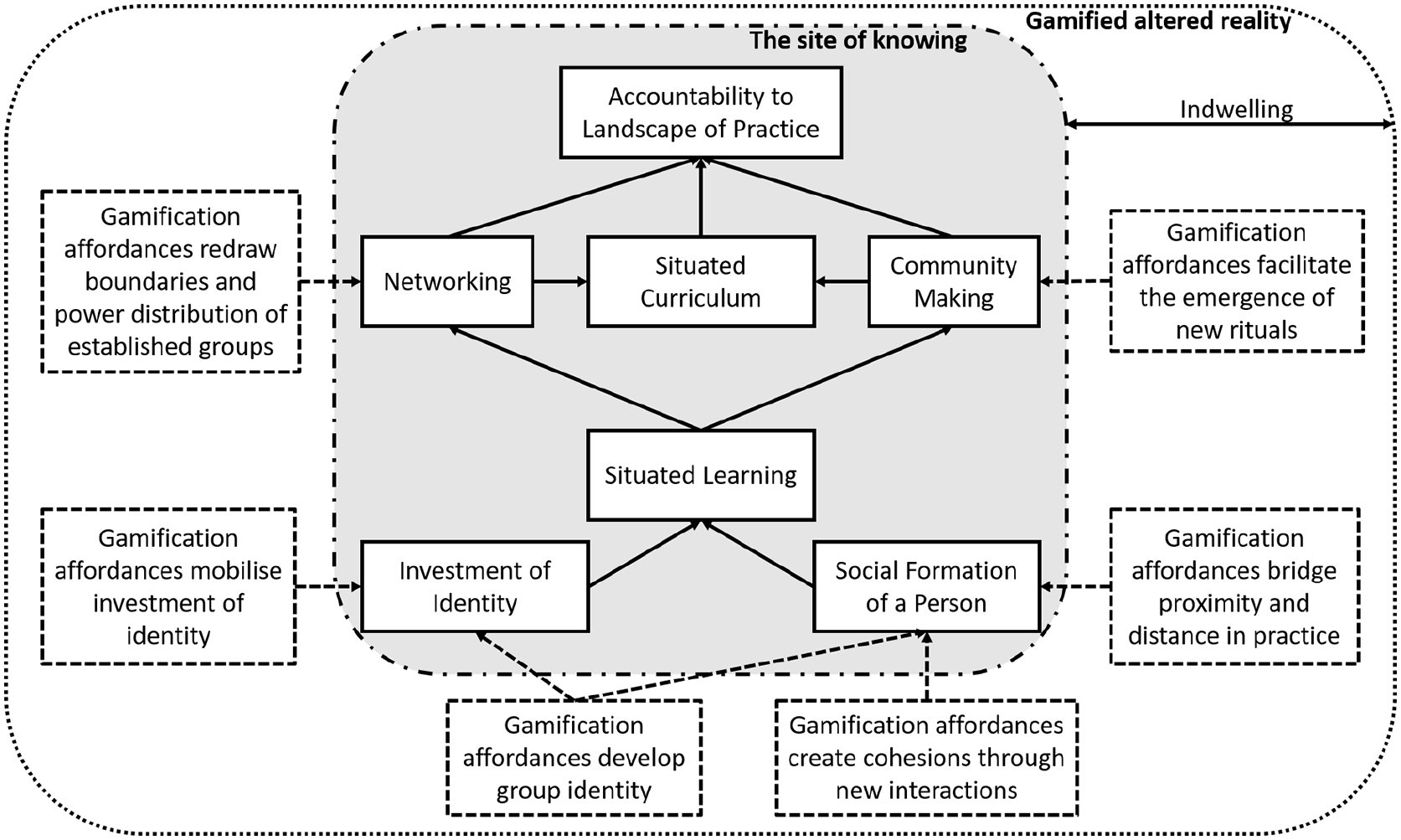
The model of gamified situated learning.
The site: Where situated learning happens
At the heart of the model in Figure 1 is the site of knowing, which is a setting for situated learning activities and mutual engagement. In such sense, the site is a nexus of practices – a space where different practices overlap, complement or contradict one another and are employed to pursue various endeavours within an organisation. The site of knowing is also a space where the socio-materiality and its affordances in practice remain in close interaction, to the extent that the social and material textures of practices may be inseparable (Nicolini, 2011; Schatzki, 2002, 2008). Thus, the concept of the site offers a consistent theoretical lens for understanding gamified affordances and how they facilitate situated learning in organisations. In this picture, situated learning is a knowing process that occurs and unfolds within the site of knowing and carries a higher degree of individual agency, thereby offering a ‘zoom-in’ perspective on the site of knowing (Nicolini, 2011; Pyrko et al., 2019). Put differently, individuals engage in situated learning when they invest their identities and build social relationships with respect to the practices which they care about, or which they have to take into consideration to carry on with their work – and the setting for such happenings is the site of knowing where practices connect (Nicolini, 2011). For example, as seen in our vignettes, Alex and Anna had to find their ways through the nexus of different work-based practices, such as managing sales and helping small businesses to obtain bank-approved loans. That wayfinding through the nexus of practice required personal commitment and developing social relationships with colleagues and clients. And, what affected their situated learning within that nexus of practices was the gamification and its affordances which touched upon the different aspects of the site of knowing.
As observed in the literature, the outcome of situated learning is the gradual development of the situated curriculum, which is a local regime of competence that preserves the practice-based knowledge (Gherardi et al., 1998; Wenger, 1998). Situated curriculum is then an unfolding and fluid learning content ‘in practice’ that develops from situated learning. For organisations, situated curriculum can be highly valuable because it is the only means of persevering tacit knowledge (Raz and Fadlon, 2006), can be the space for innovation (Swan et al., 2002) and due to its idiosyncratic local nature serves as a source of organisational distinctiveness (Autio et al., 2008). It must also be noted that any form of locality or proximity in situated learning and within the site of knowing is not solely determined by physical distance (Nicolini, 2011). Instead, proximity is determined by the ability to engage mutually in the practices, and gamified affordances and digital technologies can be important enablers in that respect. For example, while for someone working from home it may be easier to have a casual chat with their neighbour next door (due to physical proximity), the most meaningful work-related situated learning activities will likely happen when working with colleagues and learning partners via Zoom or other communications technologies (due to practice-based proximity).
In addition, situated learning and its curriculum is never isolated from the external world. Instead, it is accountable to the broader landscape of practice (Pyrko et al., 2019), which is a totality of local sites, communities and networks concerned with related problems and topics. Thus, while people who engage with local sites of knowing, through their work and learning, can influence the landscape’s epistemic texture, they are concurrently constrained by it (Wenger-Trayner et al., 2015). And, importantly, within the site, what connects situated learning, situated curriculum and the landscape of practice are two structuring processes, namely: community-making and networking (Wenger et al., 2011) – that is the ways in which people develop a shared sense of identity and purpose and social connections as they work, think, do and learn together (Pyrko et al., 2017). The model in Figure 1 focuses on community-making processes and can translate into different types of communities, such as closely-knit communities of practice (Oborn and Dawson, 2010), or broader occupational communities (Bechky, 2003). Meanwhile, it is crucial for our argument that, as shown by the literature (Spanellis and Pyrko, 2021) and illustrated by our vignettes, gamified affordances have proved promising in supporting identity investment, building social relationships, networking and community-making. Thus, our model of gamified situated learning is purposed to explain the relationships and dynamics between the gamified affordances and the different aspects of situated learning which emerge naturally within the site and across the nexus of practices.
Gamified altered reality and interlocked indwelling
Gamification increasingly becomes a natural component of organising (Vesa, 2021). In organisations, gamification does not need to be introduced deliberately or facilitated by technology because people always find their way to compete with one another, seek reward and legitimisation, form local ‘clans’ and ‘tribes’ and express distinct identities. Nonetheless, being goal-driven, gamification is usually introduced intentionally in organisations to pursue specific business objectives (Herzig et al., 2015), such as increasing sales – as seen in Anna’s vignette. Unlike games with their own closed systems, gamification tools and their affordances are embedded in non-game environments such as educational or professional work environment. This, in turn, inevitably blurs the boundaries between the game and reality and opens new opportunities for interaction and situated learning. In this paper, we refer to such blurring of game and everyday life reality experienced by people in organisations as gamified altered reality. On this basis, the conceptualisation of gamified altered reality is in sympathy with the notion of hyper-reality in organisational studies, that is the observed phenomenon when people act on something virtual as being real because it affects their life and work (Baralou and Tsoukas, 2015; Flyverbom and Reinecke, 2017; Hatch and Cunliffe, 2013). For example, in our vignettes, while the narrative of the game was told through an imaginative fantasy world (the land of werewolves and vampires and the voyage to El Dorado), the participation in the game was enacted and socially constructed, and so it became real to the participants as much as the actual work that they were expected to do as part of the game (Cooren, 2018).
Moreover, what enables people to connect with, and interiorise the gamified affordances and gamified altered reality, is the process of indwelling. Through indwelling, people extend their own selves and learn to use elements of the world around them as if they were parts of their body. When originally formulating the idea of indwelling, Polanyi (1962) was clear that people can indwell on any form of tools and objects that they find possibly meaningful, and those can be as much physical and tangible as abstract and intangible. And, as shown by Pyrko et al. (2017), indwelling taps into the investment of identity in practice, thereby mobilising situated learning possibilities. What is more, gamified altered reality creates opportunities for interlocking indwelling, referred to by Pyrko et al. (2017) as thinking together, thereby indirectly sharing tacit knowledge and developing situated curriculum within the site of practice. In vignette 1, the challenge of the gamified competition of winning over another clan (the ‘werewolves’) created the moments of interlocked indwelling as practitioners had to think together about devising their strategies for success. The gamified tools such as points of gratitude and mini-contests and quests set up by participants created affordances for developing cohesion and a sense of common progress as people helped each other with tasks and problems, sharing stories of failures and successes. Thus, gamified affordances can motivate and facilitate interlocked indwelling opportunities with regards to shared concerns and real-life problems on the job.
Within the context of the site and underpinned by gamified altered reality, interlocked indwelling becomes a part of the everyday socialisation in an organisation. And, since indwelling is rooted in identity (Pyrko et al., 2017), interlocked indwelling is also the means of constructing and expressing a shared identity in a social setting. For instance, in Anna’s vignette, the membership within a clan of vampires created and reinforced new shared characteristics of group identity – Anna indeed felt a sense of fun in seeing herself, as an avatar within the game, to become an ‘aristocratic vampiress’. In another example, Anna’s indwelling on the gamified affordance of a publicly visible guru badge led her to act upon the new ‘guru’ status. She then became encouraged to be more pro-active in engaging in situated learning with others and helping them at work in order to meet the demands of her new work-based ‘guru’ identity. Consequently, gamified affordances, through their mobilisation of the investment of identity and a social formation of a person, can play an important role in facilitating situated learning in organisations.
Gamified affordances of networking and community-making
Furthermore, gamified affordances make situated learning and its outcomes more visible across the organisation, thus legitimising it as something important and desirable. Such increased visibility then serves as a gamified affordance which translates into new opportunities for networking and community-making. Regarding community-making, gamified affordances can support the enactment of community rituals and the cultivation of social cohesion. For example, in vignette 1, the stuffed toy became a community mascot and an essential part of community rituals, such as sitting the toy on the desk in the key meetings or photo-reporting its ‘adventures’ to other employees. And so, the toy became a socio-material manifestation of belonging to the community.
In addition, gamification affordances allow opportunities to temporarily redraw boundaries between the established groups such as functional units, leading to new community overlaps and encounters within the loose network (Wenger, 1998). For instance, in vignette 2, the teams tasked with the ‘voyage to El Dorado’ were formed somewhat randomly, and so employees found themselves as members of new, temporary ‘crews’, thus extending their existing personal networks. The new characteristics of the fictional persona that each team member represented also reshaped the teams’ power dynamics. The division managers were no longer merely superiors managing their subordinates, but rather captains of ships upholding ‘a great responsibility’ for crew and the outcome of the journey. Thus they became personas who could be challenged to perform up to the expectations.
Moreover, the gamified altered reality and gamified affordances create new ways of negotiating the situated curriculum as part of local networks and communities. For instance, in vignette 2, Alex and his crew had to develop a new, shared understanding of what it takes to be an effective and responsible crew member on their voyage to El Dorado. In a similar manner, the crew members renegotiate with the captains what qualities a good captain should have to lead the ship, which they can achieve only by reevaluating their working practices. That gradual negotiation of the situated curriculum was reinforced and preserved through the gamified chronicles’ storytelling. However, while the situated curriculum is negotiated within the gamified altered reality, it affects the ‘real world’ even when the game ends. For example, gamified points can be viewed as an extrinsic reward awarded for mutual learning, which in the literature is known to produce mixed results (Lombardi et al., 2020; Paik and Choi, 2005; Voelpel et al., 2005). However, as employees become exposed more to the gamified contest, points and badges, in a playful way, their expressed motivation shifts from the extrinsic reward of getting more points towards investing identity and social relationships in proving helpful to others, and so proving one’s worth at work; even if not called ‘karma’ any longer, it is still reputation.
Consequently, the proposed model shows that gamified affordances interact with different elements of the site of knowing where situated learning happens. Through indwelling and interlocked indwelling (‘thinking together’), gamified affordances become interiorised in the everyday emergence of situated learning activities. The proposed model is descriptive and aims to provide a theoretical explanation of the relationship between gamified affordances and situated learning. With the popularisation of gamification in organisations, this relationship is increasingly inevitable, while gamified affordances exercise a visible impact on how people learn, work, do and think at work. Therefore, the implications of the relationship, dynamics and interplay between gamified affordances and situated learning shall be now be explored and problematised.
Discussion
This section discusses the implications, for research and practice, of the gamified situated learning model built and elaborated in this paper. These implications are organised around four propositions that reflect our conceptual argument and build the ground for future research and promising empirical investigations. These four propositions capture the themes of indwelling on gamified affordances as socio-materiality, indwelling on gamified altered reality, using gamified affordances to mobilise identity investment and bonding social relationships and finally applying gamified affordances towards community-making and networking. Each of the propositions is now elaborated and explained.
In this study, situated learning has been portrayed as a performative activity that entails an investment of identity and a social formation of a person (Lave and Wenger, 1991). Since its original formulation, situated learning has helped develop a new view on learning and social activity. In this view, learning is an experience of everyday life and not something that occurs exclusively in schools and other educational environments (Lave and Wenger, 1991). Situated learning has also contributed to a better understanding of the increasingly popular practice view of organisations (Tsoukas and Chia, 2002), where learning and doing are not separate (Raelin, 1997).
In the spirit of these academic debates, our proposed model of gamifying situated learning in organisations shows the socio-material and performative nature of gamified affordances. In other words, through indwelling and stimulation of altered reality, gamification both facilitates and blends with situated learning and organisational practices. Thus far, socio-materiality (e.g. Orlikowski, 2006) has been acknowledged in the games literature where material artefacts have been recognised as the extentions of gamers’ identities (Simon, 2007) that shape gaming practices (Garcia, 2020) and allow players to materialise the sense of oneself into the playspace (Collins et al., 2017). Similarly, we have observed that indwelling on the material components of gamification affordances allow people to manifest their identities (e.g. choosing an appearance of an avatar identity in Anna’s story), facilitate connections interactions (e.g. via karma points in Anna’s story) and support shared identity building (e.g. new characters that alter ways of communicating in among Alex’ story).
In addition, we have positioned situated learning with the site of knowing (Nicolini, 2011; Schatzki, 2002), a concept representing a nexus of practices where work and human activity get done and where material and human agency is intertwined rather than separated. We have strengthened the theoretical connection between situated learning and the site of knowing using Polanyi’s idea of indwelling and Pyrko’s et al. (2017) elaboration of interlocked indwelling. In the proposed model of gamified situated learning, people indwell on gamified tools and their various affordances within the context of the site of knowing. As this happens, and they think together about this indwelling, they interiorise gamified affordances as extensions of themselves in practice. Thereby, as a theoretical explanation, indwelling integrates situated learning with the gamified aspects of the site of knowing. And, since indwelling and interlocked indwelling are understood as the primary processes that develop, sustain and share tacit knowledge (Pyrko et al., 2017), gamified affordances support the development of situated curriculum. Thus, our first proposition is:
Proposition 1: Through peoples’ indwelling, gamification manifests itself as forms of socio-materiality in practice. Thereby, gamified tools and situated learning become non-separate within the site of knowing.
Another implication of indwelling on gamified affordances is that people engaged with situated learning begin to act upon the virtual and digital texture of practice – that is, things that may not appear ‘real’ in their own right. Along these lines, situated learning starts to manifest itself as existing at the level of hyper-reality, which is an ontological concept discussed previously in organisation studies (Baralou and Tsoukas, 2015; Flyverbom and Reinecke, 2017; Hatch and Cunliffe, 2013). This means that gamified affordances create virtual worlds that become enacted as practitioners find them meaningful, use them and discuss them in their day-to-day realities. Even if those virtual avatars, points and badges cannot be touched or felt, they still do represent a reality that is perceived (sensed) and meaningful to the situated learning, because they affect people’s identities, how they behave and how they form social relationships.
Therefore, through its practical and relatively easy to observe application, gamified affordances are suitable for exploring the meshing of the ‘ordinary realities’ of organising, and the virtual, hyper-realities that can be expected to exercise an increasingly significant role in organisations. Importantly, gamified altered reality provided another justification for the claim that in practice, proximity and distance are less defined by physical space, but rather by the space of identity investment and construction of meanings (Fahy et al., 2014). Put differently, within the gamified altered reality, the proximity derives from situated learning and mutual engagement and is not as much determined by whether the individuals work in the same physical space. Therefore, our second proposition is:
Proposition 2: Gamified altered reality affordances bridge the gap between the distance and proximity in situated learning and within the context of practice.
Meanwhile, as presented in our model and illustrated by the two vignettes, gamified affordances can support the two fundamental aspects of situated learning – (i) the co-creation of identity and (ii) the bonding of human relations at work. This observation is significant considering the understanding in the literature that situated learning, as a particular view on learning, essentially entails an investment of identity in the social context (Gherardi et al., 1998; Lave and Wenger, 1991; Pyrko et al., 2017, 2019). Thus, gamification can help enable situated learning as it may support both elements of situated learning: identity and social relationships. Our study presents situated learning informed by gamified affordances as an inherently social activity that entails a high degree of peer learning, building learning partnerships and improvisation in practice (see also Lee and Hammer, 2011). In such a sense, as observed in our vignettes, gamified affordances such as points, contests and badges, help practitioners to ‘draw their identities out’ rather than necessarily build those identities ‘from scratch’. For example, the seasoned practitioner who was given a ‘mentor’ or ‘guru’ badge felt empowered to express her identity as an expert, which, in turn, motivated her more to engage in peer learning and mentoring. As a result, our third proposition is:
Proposition 3: Gamified affordances can mobilise situated learning in organisations by supporting its two underlying mechanism: identity investment and the social formation of a person.
The product of such active situated learning in organisations, as it is acknowledged widely in the literature (Gherardi et al., 1998; Gherardi and Nicolini, 2000; Pyrko et al., 2017), can be a sense of conviviality at work and the emergence of organic practitioners communities and networks. Consequently, our study helps to reveal that gamified affordances can be considered when managers aim to operationalise situated learning; for example, in the attempts to facilitate and mobilise meaningful conversation about hot topics and real-life problems, or when cultivating innovative communities of practice, networks of practice, or landscapes of practice. In particular, we have observed that gamified affordances redraw and extend the boundaries of existing networks because, as part of games, practitioners can find themselves members of new, temporary teams (or ‘crews’ as in Alex’s vignette). Through the effects of gamified altered reality, those extended networks can permanently shift the networks’ scope in the ‘real world’. Meanwhile, gamified affordances can also stimulate local communities’ rituals, as in Anna’s vignette and the toy bear that became a ‘participant’ and focal point of her team’s shared social activities. Thus, it can be argued that gamified affordances can translate into new ways of networking and community-making, and on this basis, our fourth, and final, proposition is:
Proposition 4: Gamified affordances, by redrawing network boundaries and facilitating community rituals, can support community-building and networking respectively.
Conclusion
The relationship between gamification and knowledge and learning in organisations has been approached by different authors in the growing gamification literature (Armstrong et al., 2016; Landers, 2014). In this present paper, we contribute to the debates by explaining the relationship between gamification and the influential concept of situated learning. With the proposed model, illustrative vignettes, and theory-grounded conceptual argument, we have argued that gamification can impact situated learning as a form of learning that entails an investment of identity and a social formation of a person. We have also sharpened and developed the theoretical links between situated learning and gamified affordances as forms of socio-materiality by drawing on Schatzki’s (2002) idea of the site and Polanyi’s (1962) notion of indwelling. This way, in the spirit of Nicolini (2012: 9), we acknowledge that ‘much is gained if we learn to use these [different] approaches [to practice] in combination’.
In this paper, gamified affordances have been observed to influence situated learning directly by facilitating a playful environment in which people are legitimised to express their identities, as they compete with others for rewards, mobilise themselves to help others with their real-life problems at work, and share stories on their day-to-day work. On this basis, gamified affordances are the means and not the end for assisting practitioners in improving the ways in which they learn, work and think together (Vesa, 2021). As illustrated in our model, gamification can also affect networking and community-making in organisations. The proposed model is theoretical and descriptive, and its ultimate purpose is to improve the current understanding of how situated learning and community building are affected by the novel gamification techniques. Therefore, our model does not offer a full list of possible gamified techniques and tools that could be bundled together through internal or external consultancy work to develop productive networks and communities. While our vignettes illustrate some examples of the popular gamification affordances currently available, these can be updated and explored further with future studies in this area.
In addition, we have presented gamification not merely as a set of artificial, gimmicky techniques, but as a family of techniques that can amplify and mobilise the natural organisational features such as competition, rivalry, co-dependence, expression of identity of emotions and negotiation of meanings. In such a sense, gamification can be considered as having always existed in organisational lives. It is only the current advancements in digital and virtual technologies which can only strengthen the effects of gamification and make them more visible, impactful and so more ‘real’ as perceived by practitioners. Nonetheless, in that respect, we have also considered the role of gamified affordances as virtual and digital socio-materiality that can be playing an increasing role in how people learn in social contexts. Such consideration, we argue, may call for the extension of the concepts of situated learning and communities of practice, positioning them ontologically closer to the idea of the site of knowing, which accounts more comprehensively for the role of socio-materiality. The developed propositions also have important implications for the field of gamification, drawing researchers’ attention to a different view of gamification and learning, which is relational and situated in practice. This view contrasts the dominating perception of gamification in learning as a technique to engage learners in content acquisition (Barata et al., 2017; Nordby et al., 2016).
Our argument is conceptual and draws on theorising, with the purpose of building the foundations for invigorating the academic and practitioner debates in this field of study. Future studies can elaborate further on the insights proposed in our discussion, such as the role of gamified, socio-materiality and space in organisations; the way gamified affordances are bundled together for the development of organisational learning; the nuances of indwelling on tools that are virtual and digital; the learning and collaborative activities and formation of virtual networks within gamified altered reality, and exploring gamified environments as hyper-realities from an ontological perspective. This paper focuses on successful examples of applying gamification in an organisational environment. However, gamification is not immune to organisational problems, and several cases gave us a limited insight into such ‘mistakes’, for example, introducing competitive environment in the team programmers, which then led to them trying to play the system and maximise their score rather than working together to complete their work. Future studies can investigate the potential negative impact of gamification, for example, the effect of tribalism, when multiple communities emerge as a result of a coopetition game. We hope our paper is the first step towards establishing the foundation for novel promising scholarly debates on the interplay between situated learning, gamification and new virtual organising forms. While we offer a nuanced and well-grounded platform for future studies, there is much exciting work left to do in this emerging area of research and practice.
